
Showing 16 items matching "bottles medical health"
-
 Orbost & District Historical Society
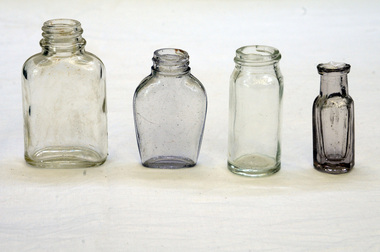
glass bottles, first half 20th century
... bottles medical health...bottles medical health Four small glass medicine bottles. ...Four small glass medicine bottles. Two have screw threads and two are cork sealing. bottles medical health -
 Flagstaff Hill Maritime Museum and Village
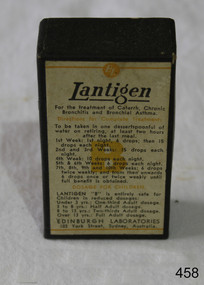
Container - Bottle & Box, Edinburgh Laboratories, Early - Mid 20th Century
... health. Flagstaff Hill Warrnambool Shipwrecked-coast Flagstaff-Hill Flagstaff-Hill-Maritime-Museum Maritime-Museum Shipwreck-coast Flagstaff-Hill-Maritime-Village Lantigen Medical Respiratory Conditions Lantigen. For the treatment of catarrah, chronic bronchitis and bronchial asthma. Edinburgh Laboratories, 103 York Street, Sydney, Australia. Bacterial Vaccine. Cardboard box containing a glass bottle ...Respiratory tract infections are among the most common diseases both in adults and children. ………….Lantigen B is an oral product based on bacterial lysates of six different inactivated strains commonly involved in respiratory tract infections. ……….This study demonstrates Lantigen B's effectiveness in the prevention of bacterial complications and suggests that it can be used in patients who are particularly at risk of infection (children, the elderly, diabetics, and immunocompromised patients) or those in whom an infection might aggravate a clinical picture that is already inherently complicated (diabetics again, but also patients with heart, kidney, or liver disease). https://www.researchgate.net/publication/8349012_Efficacy_of_Lantigen_B_in_the_prevention_of_bacterial_respiratory_infectionsThe control of respiratory conditions is essential to public health.Cardboard box containing a glass bottle of Lantigen colloidal mixture.Lantigen. For the treatment of catarrah, chronic bronchitis and bronchial asthma. Edinburgh Laboratories, 103 York Street, Sydney, Australia. Bacterial Vaccine. flagstaff hill, warrnambool, shipwrecked-coast, flagstaff-hill, flagstaff-hill-maritime-museum, maritime-museum, shipwreck-coast, flagstaff-hill-maritime-village, lantigen, medical, respiratory conditions -
 Orbost & District Historical Society
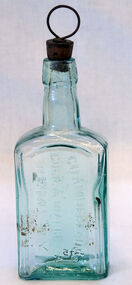
bottle, Early 20th century
... It reflect the changes in public health, medical practice and research over the last century. bottle chamberlain's medicine remedies Front-Chamberlain's Colic & diarrhea Remedy Side- Sydney NSW Side Chamberlain's Ltd Bottom-1185 Small green tinted medicine bottle. ...Brothers Davis and Lowell Chamberlain, along with their sister Izanna, established what became known as the Chamberlain Medicine Company in 1873. The Des Moines, Iowa-based company eventually stretched to Australia, Canada and South Africa. Chamberlains Colic and Diarrhea Remedy used alcohol, ether, and chloroform to soothe upset stomachs. The company also sold a cough remedy, liniment, pain relief balm and lotion. Chamberlain’s Colic, Cholera and Diarrhea Remedy was one of many thousands of patent medicines that made incredible, and often false, claims about their effectiveness, and became tremendously profitable. Eventually government regulations were put in place to prevent medicine manufacturers from making unfounded claims about their products.This item is an example of a typical "over the counter" patented medicine commonly used by families. It reflect the changes in public health, medical practice and research over the last century.Small green tinted medicine bottle. Writing on front. Cork is attached with wire handle.Front-Chamberlain's Colic & diarrhea Remedy Side- Sydney NSW Side Chamberlain's Ltd Bottom-1185bottle chamberlain's medicine remedies -
 Orbost & District Historical Society
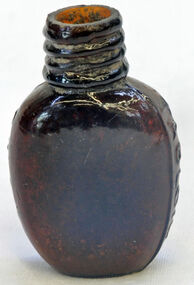
bottle, Early 1900's
... This item reflects the changes in Victorian medical practice and public health over the century. The container is of a type common in the early 20th century. bottle tabloid glass medicine pharmacy Underneath "RI" Sides Tabloid 542595 Sw & Co Very small brown pill bottle with spiral neck. ...This item reflects the changes in Victorian medical practice and public health over the century. The container is of a type common in the early 20th century. Very small brown pill bottle with spiral neck. There is no lid.Underneath "RI" Sides Tabloid 542595 Sw & Cobottle tabloid glass medicine pharmacy -
 Orbost & District Historical Society
spray bottle, C 1930's
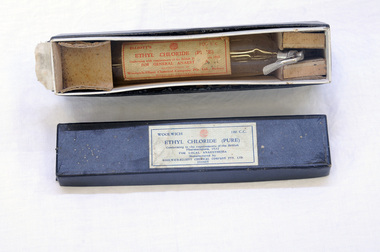
... This item reflects the changes and development in medicine over the last century. ethyl-chloride chemical woolwich-eliott anaesthesia medical health orbost-hospital Ethyl chloride (pure) 100cc Woolwich for local anaesthetic A blue cardboard box containing a glass phial with metal lid that forms a spray nozzle. The lid of the box has a white manufacturer's label with blue writing. The phial has a discoloured white label with red writing. spray bottle ...The glass phial contained liquid ethyl chloride. By directing the nozzle downwards at the skin a stream of liquid squirts out, vaporising on contact.. Ether's unpleasant smell agitated patients. Ethyl chloride's pleasant odour reduced agitation. It was used for controlling pain associated with injections and in minor surgical procedures. This item was used at Orbost Hospital.This item reflects the changes and development in medicine over the last century.A blue cardboard box containing a glass phial with metal lid that forms a spray nozzle. The lid of the box has a white manufacturer's label with blue writing. The phial has a discoloured white label with red writing.Ethyl chloride (pure) 100cc Woolwich for local anaestheticethyl-chloride chemical woolwich-eliott anaesthesia medical health orbost-hospital -
 Orbost & District Historical Society
spray bottle, C 1930's
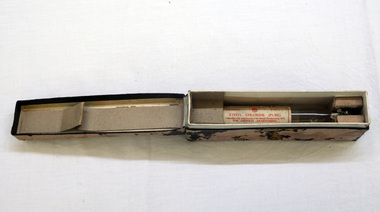
... This item reflects the changes and development in medicine over the last century. ethyl-chloride chemical woolwich-eliott anaesthesia medical health orbost-hospital A blue cardboard box containing a glass phial with metal lid that forms a spray nozzle. The phial has a discoloured white label with red writing. spray bottle Woolwich-Elliott Chemicals P/L ...The glass phial contained liquid ethyl chloride. By directing the nozzle downwards at the skin a stream of liquid squirts out, vaporising on contact.. Ether's unpleasant smell agitated patients. Ethyl chloride's pleasant odour reduced agitation. It was used for controlling pain associated with injections and in minor surgical procedures. This item was used at Orbost Hospital. This item reflects the changes and development in medicine over the last century.A blue cardboard box containing a glass phial with metal lid that forms a spray nozzle. The phial has a discoloured white label with red writing.ethyl-chloride chemical woolwich-eliott anaesthesia medical health orbost-hospital -
 Orbost & District Historical Society
first aid kit, first half 20th century
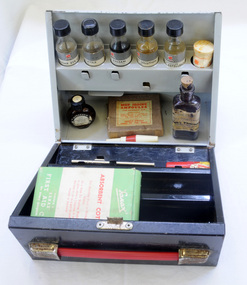
... This item reflects the changes and development in medicine over the last century. medical health orbost-hospital Trafalgar-First-Aid TRAFALGAR (in red) FIRST AID KIT ( in green) Inside a green circle is a white cross. A first aid kit in a metal carry case. It contains bottles ...This item was used at Orbost Hospital.This item reflects the changes and development in medicine over the last century.A first aid kit in a metal carry case. It contains bottles, containers a thermometer, cotton bandages and iodine ampoules.TRAFALGAR (in red) FIRST AID KIT ( in green) Inside a green circle is a white cross. medical health orbost-hospital trafalgar-first-aid -
 Orbost & District Historical Society
bottle, first half 20th century
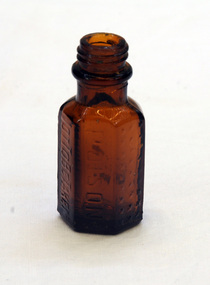
... medical health bottle Condy's-Crystals...bottle contained Condy's crystals. Condy's Crystals (potassium permanganate) was a popular domestic item for decades, its crystals usually being dissolved in water to make a purple solution for antiseptic and disinfectant purposes. It was also used for snake bite, with standard first aid texts advising that a snake bite should be cut with a knife or razor, the venom sucked out and Condy's Crystals applied to the site. (ref. Powerhouse Museum) medical health ...This bottle contained Condy's crystals. Condy's Crystals (potassium permanganate) was a popular domestic item for decades, its crystals usually being dissolved in water to make a purple solution for antiseptic and disinfectant purposes. It was also used for snake bite, with standard first aid texts advising that a snake bite should be cut with a knife or razor, the venom sucked out and Condy's Crystals applied to the site. (ref. Powerhouse Museum) A small rectangular four-sided brown bottle. The neck has a screw thread.On sides - POISON NOT TO BE TAKEN On bottom - F1090 Mmedical health bottle condy's-crystals -
 Orbost & District Historical Society
pill bottle, 1940's
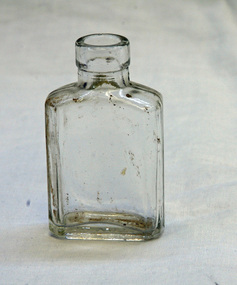
... De-Witt bottle medical health...bottle was found in the pine plantation in Orbost. De Witt’s Kidney and Bladder Pills were intended to ease backache, aches and pains in the muscles, and kidney problems. They are typical of a huge range of treatments that were available ‘over the counter’ at pharmacists for many years. This item reflects the changes and development in public health and medicine over the last century. De-Witt bottle medical ...This bottle was found in the pine plantation in Orbost. De Witt’s Kidney and Bladder Pills were intended to ease backache, aches and pains in the muscles, and kidney problems. They are typical of a huge range of treatments that were available ‘over the counter’ at pharmacists for many years.This item reflects the changes and development in public health and medicine over the last century.An empty rectangular clear glass bottle that contained De Witts Pills. On bottom - DE WITTde-witt bottle medical health -
 Kiewa Valley Historical Society
Bottle - Castor Oil, Circa 1920's to 1900's
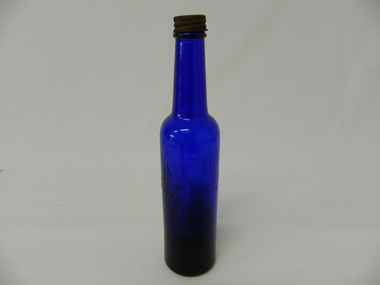
... bottle of castor oil. Home based remedies for non life threatening injuries and illnesses were a part of life in a semi remote rural region. True and trusted family "health" remedies were passed from generation to generation. This Castor Oil bottle is very significant to the Kiewa Valley as it demonstrates the self reliance of the early farming and grazing pioneer families. Knowledge of "first aid" was uppermost to the survival of families before the late 1900's. Naturopathic remedies such as connected with the castor oil contained in this bottle, although may not be sanctioned by medical ...This bottle of castor oil was used during the mid to late 1900's when there was a Hospital in the Kiewa Valley, but regarded as only for serious injuries and near death situation. For this reason many households had a "first aid" box full of items such as this bottle of castor oil. Home based remedies for non life threatening injuries and illnesses were a part of life in a semi remote rural region. True and trusted family "health" remedies were passed from generation to generation.This Castor Oil bottle is very significant to the Kiewa Valley as it demonstrates the self reliance of the early farming and grazing pioneer families. Knowledge of "first aid" was uppermost to the survival of families before the late 1900's. Naturopathic remedies such as connected with the castor oil contained in this bottle, although may not be sanctioned by medical research, does not take into account of the positive "self healing" of the human mind (if you think it is doing you good it creates a positive action). Such preservation techniques were handed down through the generations.Medical Reference material was limited to books available and read and not not from "the internet" in the latter part of the 1900's. The availability of General Practitioners increased because of the boost in the population growth (SEC Vic Hydro Electricity Scheme) in the Kiewa Valley from 1940's onward. This small indigo coloured glass bottle has a narrow neck and a screw on lid.It has an embossed manufacturer's name and contents (Castor Oil) on one side and identification marks embossed on the underside base.medicine bottles, home first aid remedies, indigo glass medicine bottles -
 Royal Australian and New Zealand College of Obstetricians & Gynaecologists (RANZCOG)
Obstetric and Gynaecological Ephemera
... - Item 1: Annotated diagram with comical reference to human anatomy - Item 2: Newspaper article from 26 August 1990 regarding St George's Hospital birthing centre - Item 3: Advertising poster for Livingstone Conductive Gel - Item 4: Victorian Folate Campaign 1999 Public Health Information Leaflet - Item 5: Advertisement for Cervagem removed from a publication - Item 6: IUD Multiload CU250 range medical advertising removed from a publication - Item 7: Fetal Cardio-phonograph Toitu product literature - Item 8: Estraderm and how to use it pharmacopoeia - Item 9: Copy of letter sent in 1980 regarding a donation to the RANZCOG Museum of a 1930's enamel douching instrument - Item 10: Museum display labels on Arthur Wilson / A.M Wilson - Item 11: The IUD Intrauterine Device Public Health Information Leaflet - Item 12: Obstetric Record Patient record [2 x] - Item 13: Planosec Dry Pregnancy Test Medical Advertising - Item 14: A Guide to using Ortho Diaphragms and Spermicides Pharmacopoeia [2 x ] - Item 15: Maison Luer Gynaecological and Obstetric instrument catalogue from 1930,Paris - Item 16: Medicine Recent Acquisitions Rare book brochure with drawing of a pregnant woman on the front cover - Item 17: Feeding Bottle Museum object display material - Item 18: Letter sent from Mr P.W Mitchell, 31/08/1961 regarding Moller Colposcope instruments - Item 19: Sugiview Single Use Laparoscope Advertising - Item 20: Multiload CU375 IUD Advertising - Item 21: Soneryl Drug Advertising - Item 22: Cyclonal Sodium Soluble Hexobarbitone Drug Advertising - Item 23: Aludrox Drug Advertising - Item 24: Veganin Tablets Drug Advertising - Item 25: Priscol Drug Advertising - Item 26: Neocursal Salt Advertising - Item 27: Portable Intra-Uterine Suction Apparatus Medical Advertising - Item 28: The VUC Instrument Medical Advertising... - Item 1: Annotated diagram with comical reference to human anatomy - Item 2: Newspaper article from 26 August 1990 regarding St George's Hospital birthing centre - Item 3: Advertising poster for Livingstone Conductive Gel - Item 4: Victorian Folate Campaign 1999 Public Health Information Leaflet - Item 5: Advertisement for Cervagem removed from a publication - Item 6: IUD Multiload CU250 range medical advertising removed from a publication - Item 7: Fetal Cardio-phonograph Toitu product literature - Item 8: Estraderm and how to use it pharmacopoeia - Item 9: Copy of letter sent in 1980 regarding a donation to the RANZCOG Museum of a 1930's enamel douching instrument - Item 10: Museum display labels on Arthur Wilson / A.M Wilson - Item 11: The IUD Intrauterine Device Public Health Information Leaflet - Item 12: Obstetric Record Patient record [2 x] - Item 13: Planosec Dry Pregnancy Test Medical Advertising - Item 14: A Guide to using Ortho Diaphragms and Spermicides Pharmacopoeia [2 x ] - Item 15: Maison Luer Gynaecological and Obstetric instrument catalogue from 1930,Paris - Item 16: Medicine Recent Acquisitions Rare book brochure with drawing of a pregnant woman on the front cover - Item 17: Feeding Bottle Museum object display material - Item 18: Letter sent from Mr P.W Mitchell, 31/08/1961 regarding Moller Colposcope instruments - Item 19: Sugiview Single Use Laparoscope Advertising - Item 20: Multiload CU375 IUD Advertising - Item 21: Soneryl Drug Advertising - Item 22: Cyclonal Sodium Soluble Hexobarbitone Drug Advertising - Item 23: Aludrox Drug Advertising - Item 24: Veganin Tablets Drug Advertising - Item 25: Priscol Drug Advertising - Item 26: Neocursal Salt Advertising - Item 27: Portable Intra-Uterine Suction Apparatus Medical Advertising - Item 28: The VUC Instrument Medical Advertising Obstetric and Gynaecological Ephemera ...A series of ephemera including information leaflets, advertising, and pharmacopoeia collated by Museum Curator at RANZCOG. There are 28 items. - Item 1: Annotated diagram with comical reference to human anatomy - Item 2: Newspaper article from 26 August 1990 regarding St George's Hospital birthing centre - Item 3: Advertising poster for Livingstone Conductive Gel - Item 4: Victorian Folate Campaign 1999 Public Health Information Leaflet - Item 5: Advertisement for Cervagem removed from a publication - Item 6: IUD Multiload CU250 range medical advertising removed from a publication - Item 7: Fetal Cardio-phonograph Toitu product literature - Item 8: Estraderm and how to use it pharmacopoeia - Item 9: Copy of letter sent in 1980 regarding a donation to the RANZCOG Museum of a 1930's enamel douching instrument - Item 10: Museum display labels on Arthur Wilson / A.M Wilson - Item 11: The IUD Intrauterine Device Public Health Information Leaflet - Item 12: Obstetric Record Patient record [2 x] - Item 13: Planosec Dry Pregnancy Test Medical Advertising - Item 14: A Guide to using Ortho Diaphragms and Spermicides Pharmacopoeia [2 x ] - Item 15: Maison Luer Gynaecological and Obstetric instrument catalogue from 1930,Paris - Item 16: Medicine Recent Acquisitions Rare book brochure with drawing of a pregnant woman on the front cover - Item 17: Feeding Bottle Museum object display material - Item 18: Letter sent from Mr P.W Mitchell, 31/08/1961 regarding Moller Colposcope instruments - Item 19: Sugiview Single Use Laparoscope Advertising - Item 20: Multiload CU375 IUD Advertising - Item 21: Soneryl Drug Advertising - Item 22: Cyclonal Sodium Soluble Hexobarbitone Drug Advertising - Item 23: Aludrox Drug Advertising - Item 24: Veganin Tablets Drug Advertising - Item 25: Priscol Drug Advertising - Item 26: Neocursal Salt Advertising - Item 27: Portable Intra-Uterine Suction Apparatus Medical Advertising - Item 28: The VUC Instrument Medical Advertising -
 Sunshine and District Historical Society Incorporated
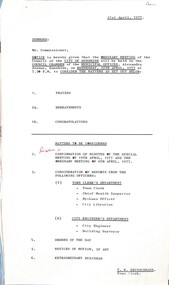
Administrative record - City of Sunshine - Commissioner Mr Alexander Alex George Gillon Collection 1976 - 1982 - Notice of ordinary meeting of the council of the City of Sunshine to be held on 27th April 1977, City of Sunshine, 18th April 1977
... Albans) & 12th Sunshine The Hub hours of Operations Workshop Council Depot Unexpected Loan Monies Brooklyn Preschool Centre Western Region Commission Future Operations Report of the Chief Health Inspector Removal of Dwelling Outside of Municipality 107 Devonshire Road to Scarsdale in the Shire of Glenville Rat Control Prohibition on Non-Returnable Bottles Report of the Medical Officer of Health Weights & Measures Report for the Two Months Ending 31st March 1977 Report of the By-Laws Officer Court Proceedings Recreation Vehicles By-Law No 121 Proposed Limited Parking Shopping Area Mitchell Street Alterations In Parking Provisions Off Street Areas Main Shopping Areas Various Outlying Areas Report of City Librarian Maidstone Library Introduction to library Automation course Report of City Engineer Control of Caravan Parks Under The Melbourne And Metropolitan Planning Scheme Rezoning of Land For Proposed Garbage Depot Disused Albion Quarry Ballarat Road Albion Town Planning Enquires Land Use Permit Application Store for Building Materials and Crane Hampton Avenue Land Use Permit Service Premises and Dwelling Lot 204 Browne Avenue Land Use Permit Application Detached House Lot 1 Boreham Street Land Use Permit Application Sunshine Cricket Club Cricket Pavilion Dempster Park Phoenix Street Land Use Permit Petrol Filling Station and Hotel / Motel Corner Neale Road and Stations Roads Land Use Permit Application Warehouse Extensions and Office Addition Maribyrnong Timber and Building Supplies 58 Emu Road Land Use Permit Application Garden and Building Supplies Lot 14 Francis Street and Lot 15 Geelong Road Furlong Road Estate Stage 5 Furlong Road Estate Stage 6 Westerngate Estate Stage 2 Additional Easements R.D.C. ...Albans) & 12th Sunshine The Hub hours of Operations Workshop Council Depot Unexpected Loan Monies Brooklyn Preschool Centre Western Region Commission Future Operations Report of the Chief Health Inspector Removal of Dwelling Outside of Municipality 107 Devonshire Road to Scarsdale in the Shire of Glenville Rat Control Prohibition on Non-Returnable Bottles Report of the Medical Officer of Health Weights & Measures Report for the Two Months Ending 31st March 1977 Report of the By-Laws Officer Court Proceedings Recreation Vehicles By-Law No 121 Proposed Limited Parking Shopping Area Mitchell Street Alterations In Parking Provisions Off Street Areas Main Shopping Areas Various Outlying Areas Report of City Librarian Maidstone Library Introduction to library Automation course Report of City Engineer Control of Caravan Parks Under The Melbourne And Metropolitan Planning Scheme Rezoning of Land For Proposed Garbage Depot Disused Albion Quarry Ballarat Road Albion Town Planning Enquires Land Use Permit Application Store for Building Materials and Crane Hampton Avenue Land Use Permit Service Premises and Dwelling Lot 204 Browne Avenue Land Use Permit Application Detached House Lot 1 Boreham Street Land Use Permit Application Sunshine Cricket Club Cricket Pavilion Dempster Park Phoenix Street Land Use Permit Petrol Filling Station and Hotel / Motel Corner Neale Road and Stations Roads Land Use Permit Application Warehouse Extensions and Office Addition Maribyrnong Timber and Building Supplies 58 Emu Road Land Use Permit Application Garden and Building Supplies Lot 14 Francis Street and Lot 15 Geelong Road Furlong Road Estate Stage 5 Furlong Road Estate Stage 6 Westerngate Estate Stage 2 Additional Easements R.D.C. ...Notice of Ordinary Meeting 27th April 1977 Report of the Town Clerk Daylight Savings Value of Open Space Unsubdivided Land Boral Albion Reid Proposed Tip site Transfer of Land Council to Education Department Furlong Road Sunshine North Seminar Federalism Policy Its Past Performance, Future Need and Directions Leases for Various Boy Scout Groups 5th Sunshine, 6th Sunshine, 8th Sunshine (Renamed to 1st Deer Park), 10th Sunshine (Renamed to 1st St. Albans) & 12th Sunshine The Hub hours of Operations Workshop Council Depot Unexpected Loan Monies Brooklyn Preschool Centre Western Region Commission Future Operations Report of the Chief Health Inspector Removal of Dwelling Outside of Municipality 107 Devonshire Road to Scarsdale in the Shire of Glenville Rat Control Prohibition on Non-Returnable Bottles Report of the Medical Officer of Health Weights & Measures Report for the Two Months Ending 31st March 1977 Report of the By-Laws Officer Court Proceedings Recreation Vehicles By-Law No 121 Proposed Limited Parking Shopping Area Mitchell Street Alterations In Parking Provisions Off Street Areas Main Shopping Areas Various Outlying Areas Report of City Librarian Maidstone Library Introduction to library Automation course Report of City Engineer Control of Caravan Parks Under The Melbourne And Metropolitan Planning Scheme Rezoning of Land For Proposed Garbage Depot Disused Albion Quarry Ballarat Road Albion Town Planning Enquires Land Use Permit Application Store for Building Materials and Crane Hampton Avenue Land Use Permit Service Premises and Dwelling Lot 204 Browne Avenue Land Use Permit Application Detached House Lot 1 Boreham Street Land Use Permit Application Sunshine Cricket Club Cricket Pavilion Dempster Park Phoenix Street Land Use Permit Petrol Filling Station and Hotel / Motel Corner Neale Road and Stations Roads Land Use Permit Application Warehouse Extensions and Office Addition Maribyrnong Timber and Building Supplies 58 Emu Road Land Use Permit Application Garden and Building Supplies Lot 14 Francis Street and Lot 15 Geelong Road Furlong Road Estate Stage 5 Furlong Road Estate Stage 6 Westerngate Estate Stage 2 Additional Easements R.D.C. Projects Consolidation of Title Lots 45 & 46 Johnson Street Plan of Subdivision Ballarat Road Robert Bodington Pty Strata Subdivision 14 Navigator Street Strata Subdivision 53 - 56 Middle Road Subdivision Shop Sites Camperdown Avenue and Sandford Avenue Strata Subdivision 52 King Edward Avenue Garfield Street Private Street Scheme Building Over Easement Lots 31 to 34 Cromer Avenue McIntyre Road Bridge Load Limit Disposal of MF Loader Plant No 62 Vacant Land Corner Anderson Road and Derby Road Sunshine Certificate of Completion Cooke Avenue Private Street Scheme Creation of Easement of Way Duke Street to Cranwell Street Report of the Building Surveyor Siting of House Lot 703 Oleander Drive St. Albans Siting of House Lot 71 Haven Crescent Sunshine West Refund of Permit Fees Installation of Tank Swing Bridge Motors 556 Ballarat Road Graffiti Dempster Park Pavilion Child Care Building Program Fire Damage to Fence 28 North Street Ardeer Tentative Subdivision 3 Deakin Street city of sunshine, alexander "alex" george gillon, percy street, st. albans, the hub, sun crescent, sunshine, scouts, albion reid, sunshine tip, brooklyn preschool centre, devonshire road, albion quarry, hampton avenue, browne avenue, boreham street, sunshine cricket club, phoenix street, sunshine north, neale road, station road, emu road, maribyrnong, francis street, geelong road, brooklyn, furlong road, johnson street, ballarat road, navigator street, middle road, camperdown avenue, sandford avenue, king edward avenue, albion, garfield street, cromer avenue, mcintyre road bridge, mcintyre road, anderson road, derby road, cooke avenue, duke street, cranwell street, braybrook, oleander drive, haven crescent, sunshine west, dempster park, north street, ardeer, deakin street, maidstone, maidstone library -
 Sunshine and District Historical Society Incorporated
Administrative record - City of Sunshine - Commissioner Mr Alexander Alex George Gillon Collection 1976 - 1982 - Minutes of the ordinary meeting of council held on 27th April 1977, City of Sunshine, 27th April 1977
... Albans) & 12th Sunshine The Hub hours of Operations Workshop Council Depot Unexpected Loan Monies Brooklyn Preschool Centre Western Region Commission Future Operations Report of the Chief Health Inspector Removal of Dwelling Outside of Municipality 107 Devonshire Road to Scarsdale in the Shire of Glenville Rat Control Prohibition on Non-Returnable Bottles Report of the Medical Officer of Health Weights & Measures Report for the Two Months Ending 31st March 1977 Report of the By-Laws Officer Court Proceedings Recreation Vehicles By-Law No 121 Proposed Limited Parking Shopping Area Mitchell Street Alterations In Parking Provisions Off Street Areas Main Shopping Areas Various Outlying Areas Report of City Librarian Maidstone Library Introduction to library Automation course Report of City Engineer Control of Caravan Parks Under The Melbourne And Metropolitan Planning Scheme Rezoning of Land For Proposed Garbage Depot Disused Albion Quarry Ballarat Road Albion Town Planning Enquires Land Use Permit Application Store for Building Materials and Crane Hampton Avenue Land Use Permit Service Premises and Dwelling Lot 204 Browne Avenue Land Use Permit Application Detached House Lot 1 Boreham Street Land Use Permit Application Sunshine Cricket Club Cricket Pavilion Dempster Park Phoenix Street Land Use Permit Petrol Filling Station and Hotel / Motel Corner Neale Road and Stations Road Land Use Permit Application Warehouse Extensions and Office Addition Maribyrnong Timber and Building Supplies 58 Emu Road Land Use Permit Application Garden and Building Supplies Lot 14 Francis Street and Lot 15 Geelong Road Furlong Road Estate Stage 5 Furlong Road Estate Stage 6 Westerngate Estate Stage 2 Additional Easements R.D.C. ...Albans) & 12th Sunshine The Hub hours of Operations Workshop Council Depot Unexpected Loan Monies Brooklyn Preschool Centre Western Region Commission Future Operations Report of the Chief Health Inspector Removal of Dwelling Outside of Municipality 107 Devonshire Road to Scarsdale in the Shire of Glenville Rat Control Prohibition on Non-Returnable Bottles Report of the Medical Officer of Health Weights & Measures Report for the Two Months Ending 31st March 1977 Report of the By-Laws Officer Court Proceedings Recreation Vehicles By-Law No 121 Proposed Limited Parking Shopping Area Mitchell Street Alterations In Parking Provisions Off Street Areas Main Shopping Areas Various Outlying Areas Report of City Librarian Maidstone Library Introduction to library Automation course Report of City Engineer Control of Caravan Parks Under The Melbourne And Metropolitan Planning Scheme Rezoning of Land For Proposed Garbage Depot Disused Albion Quarry Ballarat Road Albion Town Planning Enquires Land Use Permit Application Store for Building Materials and Crane Hampton Avenue Land Use Permit Service Premises and Dwelling Lot 204 Browne Avenue Land Use Permit Application Detached House Lot 1 Boreham Street Land Use Permit Application Sunshine Cricket Club Cricket Pavilion Dempster Park Phoenix Street Land Use Permit Petrol Filling Station and Hotel / Motel Corner Neale Road and Stations Road Land Use Permit Application Warehouse Extensions and Office Addition Maribyrnong Timber and Building Supplies 58 Emu Road Land Use Permit Application Garden and Building Supplies Lot 14 Francis Street and Lot 15 Geelong Road Furlong Road Estate Stage 5 Furlong Road Estate Stage 6 Westerngate Estate Stage 2 Additional Easements R.D.C. ...Report of the Town Clerk Daylight Savings Value of Open Space Unsubdivided Land Boral Albion Reid Proposed Tip site Transfer of Land Council to Education Department Furlong Road Sunshine North Seminar Federalism Policy Its Past Performance, Future Need and Directions Leases for Various Boy Scout Groups 5th Sunshine, 6th Sunshine, 8th Sunshine (Renamed to 1st Deer Park), 10th Sunshine (Renamed to 1st St. Albans) & 12th Sunshine The Hub hours of Operations Workshop Council Depot Unexpected Loan Monies Brooklyn Preschool Centre Western Region Commission Future Operations Report of the Chief Health Inspector Removal of Dwelling Outside of Municipality 107 Devonshire Road to Scarsdale in the Shire of Glenville Rat Control Prohibition on Non-Returnable Bottles Report of the Medical Officer of Health Weights & Measures Report for the Two Months Ending 31st March 1977 Report of the By-Laws Officer Court Proceedings Recreation Vehicles By-Law No 121 Proposed Limited Parking Shopping Area Mitchell Street Alterations In Parking Provisions Off Street Areas Main Shopping Areas Various Outlying Areas Report of City Librarian Maidstone Library Introduction to library Automation course Report of City Engineer Control of Caravan Parks Under The Melbourne And Metropolitan Planning Scheme Rezoning of Land For Proposed Garbage Depot Disused Albion Quarry Ballarat Road Albion Town Planning Enquires Land Use Permit Application Store for Building Materials and Crane Hampton Avenue Land Use Permit Service Premises and Dwelling Lot 204 Browne Avenue Land Use Permit Application Detached House Lot 1 Boreham Street Land Use Permit Application Sunshine Cricket Club Cricket Pavilion Dempster Park Phoenix Street Land Use Permit Petrol Filling Station and Hotel / Motel Corner Neale Road and Stations Road Land Use Permit Application Warehouse Extensions and Office Addition Maribyrnong Timber and Building Supplies 58 Emu Road Land Use Permit Application Garden and Building Supplies Lot 14 Francis Street and Lot 15 Geelong Road Furlong Road Estate Stage 5 Furlong Road Estate Stage 6 Westerngate Estate Stage 2 Additional Easements R.D.C. Projects Consolidation of Title Lots 45 & 46 Johnson Street Plan of Subdivision Ballarat Road Robert Bodington Pty Strata Subdivision 14 Navigator Street Strata Subdivision 53 - 56 Middle Road Subdivision Shop Sites Camperdown Avenue and Sandford Avenue Strata Subdivision 52 King Edward Avenue Garfield Street Private Street Scheme Building Over Easement Lots 31 to 34 Cromer Avenue McIntyre Road Bridge Load Limit Disposal of MF Loader Plant No 62 Vacant Land Corner Anderson Road and Derby Road Sunshine Certificate of Completion Cooke Avenue Private Street Scheme Creation of Easement of Way Duke Street to Cranwell Street Report of the Building Surveyor Siting of House Lot 703 Oleander Drive St. Albans Minutes of the Ordinary Meeting of Council held on 27th April 1977 Siting of House Lot 71 Haven Crescent Sunshine West Refund of Permit Fees Installation of Tank Swing Bridge Motors 556 Ballarat Road Graffiti Dempster Park Pavilion Child Care Building Program Fire Damage to Fence 28 North Street Ardeer Tentative Subdivision 3 Deakin Street city of sunshine, alexander "alex" george gillon, percy street, st. albans, the hub, sun crescent, sunshine, scouts, albion reid, sunshine tip, furlong road, sunshine north, brooklyn preschool centre, devonshire road, mitchell street, maidstone, maidstone library, albion quarry, ballarat road, albion, hampton avenue, browne avenue, boreham street, sunshine cricket club, dempster park, phoenix street, neale road, stations road, emu road, maribyrnong, francis street, geelong road, brooklyn, johnson street, navigator street, middle road, camperdown avenue, sandford avenue, king edward avenue, garfield street, cromer avenue, mcintyre road bridge, mcintyre road, anderson road, derby road, cooke avenue, duke street, cranwell street, braybrook, oleander drive, haven crescent, sunshine west, north street, ardeer, deakin street -
 Emerald Museum & Nobelius Heritage Park
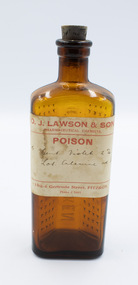
Container - Bottle with 'Poison' Label, O. J. Lawson & Son, 1935
... bottle was manufactured in 1935. Handwriting reveals that the specific poisonous substance within (at least originally) was Calamine Lotion, a medication made from powdered zinc oxide and used to treat mild itchiness. A well-preserved example of the products of a Victorian pharmaceutical company as used in the local area, revealing their systems for labelling dangerous substances. 20th Century Medical & Health Reverse, In Glass: "NOT TO BE TAKEN" Label, Printed: "O. ...O. J. Lawson & Son was a pharmaceutical firm operating out of Fitzroy, Victoria during the first half of the 20th century. Its maker's mark indicates that the bottle was manufactured in 1935. Handwriting reveals that the specific poisonous substance within (at least originally) was Calamine Lotion, a medication made from powdered zinc oxide and used to treat mild itchiness.A well-preserved example of the products of a Victorian pharmaceutical company as used in the local area, revealing their systems for labelling dangerous substances.This item is a tall 8-ounce (approximately 237 ml) brown glass bottle in the shape of a rounded truncated triangular prism. On the rounded face is a label with printed text in red and handwritten text in ink. On the reverse, a warning label is embossed in the glass alongside a pattern of two grids of 68 crosses each. A cork remains in the mouth of the bottle. The bottom of the bottle also features embossed text and what might be a logo.Reverse, In Glass: "NOT TO BE TAKEN" Label, Printed: "O. J. LAWSON & SON / PHARMACEUTICAL CHEMISTS / POISON / 102-4 Gertrude Street, FITZROY / Phone J 3401" Label, Handwritten: "14 [years?] Violet 2% / Lot. Calamine [and?] [unclear]" Glass, Bottom: "M423 / 0 / 8 OZ /M" Glass, Bottom, Near Edge: "H / [0?] / [0?]"20th century, medical & health -
 Emerald Museum & Nobelius Heritage Park
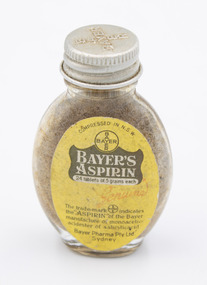
Container - Small Bottle Bayer Aspirin, Bayer Pharma Pty Lty, circa 1948
... bottles produced in Sydney in the late 1940s. The item has historical significance as it is a demonstration of a common household medicine during the 1940s. This in combination with items from other years and geographic areas can demonstrate the evolution of household medicine. 20th Century Medical & Health On Cap: "BAYER" Company Logo (BAYER written vertically intersecting with BAYER written horizontally) Front Label: "Compressed in N.S.W. / BAYER Company Logo (BAYER written vertically intersecting with BAYER written horizontally) / BAYER'S / ASPIRIN / 24 tablets of 5 grains each / Genuine / The trade-mark 'BAYER Logo (BAYER written vertically intersecting with BAYER written horizontally)' indicates / the 'ASPIRIN' of the Bayer / manufacture of monoacetic- / acidester of salicylicacid / Bayer Pharma Pty. ...Bayer began conducting operations in Australia in 1925. This bottle does not have an exact date of production but it is consistent with bottles produced in Sydney in the late 1940s. The item has historical significance as it is a demonstration of a common household medicine during the 1940s. This in combination with items from other years and geographic areas can demonstrate the evolution of household medicine. A small oval transparent glass bottle with a metal twist cap lid. The Metal lid has the Bayer Company logo on the top (BAYER written vertically intersecting with BAYER written horizontally). There is a primarily dirty yellow front label with primarily brownish grey writing with some write writing that reads "BAYER'S ASPIRIN." The word "Genuine" is located just below the white writing in faded red joint-handwriting font. The final letter of "Genuine" loops up into an arrow pointing towards the previous line's text. The back label is the same dirty yellow as the front, with Brownish-Grey text. It has the Bayer Company logo at the top (BAYER written vertically intersecting with BAYER written horizontally), followed by dosage information and two columns of suggested aliments to consume the original contexts. The bottom has a symbol that is presumably the glass bottle manufacturer. The bottle contains some powder residue of unknown origin. On Cap: "BAYER" Company Logo (BAYER written vertically intersecting with BAYER written horizontally) Front Label: "Compressed in N.S.W. / BAYER Company Logo (BAYER written vertically intersecting with BAYER written horizontally) / BAYER'S / ASPIRIN / 24 tablets of 5 grains each / Genuine / The trade-mark 'BAYER Logo (BAYER written vertically intersecting with BAYER written horizontally)' indicates / the 'ASPIRIN' of the Bayer / manufacture of monoacetic- / acidester of salicylicacid / Bayer Pharma Pty. Ltd. / Sydney" Back Label: "BAYER logo (BAYER written vertically intersecting with BAYER written horizontally) / DOSE / 1 to 2 tablets with water / Used on the following / conditions / Headache Rheumatism / Colds Sciatica / Neuralgia Toothache / Lumbago Earache / Relief of Pain in General / FULL DIRECTIONS FOR USE / IN THE ENCLOSED LEAFLET / Bayer Pharma Pty Ltd / Sydney" Bottom: "Symbol (the letter C in a square above the letter M)20th century, medical & health -
 Emerald Museum & Nobelius Heritage Park
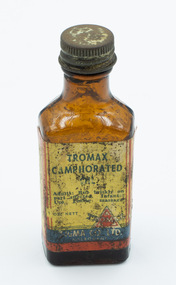
Container - Medicine Bottle - "Tromax Camphorated", Sigma Co. Ltd, 1935
... bottle was manufactured in 1935 by Australian Glass Manufacturers (AGM). This item is an excellent example of a popular household medication used for common ailments such as itching and skin irritation. It was sold for use over a wide area of Melbourne and beyond, aiding inhabitants of the local area. 20th Century Medical & Health Label, printed: "TROMAX / CAMPHORATED / OIL / Adult: Rub briskly on part affected. ...Sigma Co. Ltd. (now known as Sigma Healthcare) was founded in 1912 by Melbourne Pharmacists Edwin Church and Ernest Leete and has since grown to become one of Australia's leading pharmaceutical retailers. Initially driven by the high prices of wholesale drugs and medicines, Church and Leete established Sigma as a manufacturer of medicinal products which could be sold only to paying subscribers. In 1913, it was decided that Sigma would open its markets to non-member pharmacies and retailers, although WWI caused production to falter. Over the following decade, the company grew, resulting in a restructuring in 1927 and the acquisition of small chemist manufacturing firm, Tromax Co. Ltd., who were struggling financially. For centuries, camphor has been used a folk medicine, likely used as a decongestant as well as a treatment for sprains and inflammation. In the 1900s, camphor was used as an analeptic by injection and was also used to induce seizures in schizophrenic patients in an attempt to cure psychosis. Camphorated oil, as was once present in this bottle, was composed of 20% camphor in cottonseed oil. It was rubbed into the skin as a topical medicine to treat itching from minor skin irritation. In 1947, a competitor's 1 oz. bottle of Camphorated oil was sold at a maximum of 8 dimes. The makers mark indicates that this bottle was manufactured in 1935 by Australian Glass Manufacturers (AGM).This item is an excellent example of a popular household medication used for common ailments such as itching and skin irritation. It was sold for use over a wide area of Melbourne and beyond, aiding inhabitants of the local area.This item is a truncated triangular glass bottle with a rusted metal lid attached. A primarily yellow label with red and blue details wraps around the front three faces of the bottle, displaying use instructions and warnings. On the rear of the bottle are two grids containing thirty crosses each and embossed text. There is also embossed text on the base. Inside the bottle, some liquid and solid residue remains. Label, printed: "TROMAX / CAMPHORATED / OIL / Adult: Rub briskly on part affected. Infant: Use gentle massage. / 1 oz. NETT / SIGMA CO LTD. / MELBOURNE" Logo printed on front label: "TROMAX" Embossed underneath label on front face: "5" Left face of label, printed: "CAUTION: Use strictly in accordance with the directions." Right face of label, printed: "For External Use Only." Rear, embossed in glass: "NOT TO BE TAKEN" Base, embossed in glass: "[GM?] / F1092 / 5 M"20th century, medical & health
