
Showing 200 items matching "box body"
-
 Flagstaff Hill Maritime Museum and Village
Vehicle - Tip Dray, Prior to 1930s
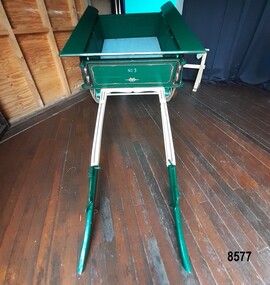
... ...box body...They had a flat level floor and while some had no sides, others had box bodies and sides. Tip Drays (also known as Tip Carts, Muck Cart, Scotch Cart, Tumbrel or Putt in different parts of England) were smaller than other drays as their loads were heavy and usually only pulled by one horse. ...A wooden and metal tipping dray with a box body and four sides. It has two iron and wooden wheels (with 14 spokes), two wooden shafts and a metal tipping mechanism. ...They had a flat level floor and while some had no sides, others had box bodies and sides. Tip Drays (also known as Tip Carts, Muck Cart, Scotch Cart, Tumbrel or Putt in different parts of England) were smaller than other drays as their loads were heavy and usually only pulled by one horse. ...A Dray is a type of dead axle wagon that was used to transport heavy loads or objects. They had a flat level floor and while some had no sides, others had box bodies and sides. Tip Drays (also known as Tip Carts, Muck Cart, Scotch Cart, Tumbrel or Putt in different parts of England) were smaller than other drays as their loads were heavy and usually only pulled by one horse. Their basic design included two wheels, a tipping body and shafts. The Tip Dray has a unique mechanism that allows the top to tip backwards to tip the load out of the back of the dray. The tipper was activated by a handle at the front allowing the driver to operate it while still having control over the horse. A Tip Dray was an indispensable piece of equipment in the days before tractors and mechanical trucks. They were used by farmers and carters to transport hay, rocks, bricks, gravel and rubbish etc. and because they were useful for dumping loads, they were favoured for use in road and railway construction. A photo in the collection of the Lorne Historical Society shows a tipping dray being used during the construction of the Great Ocean Road. They were part of the daily street traffic in towns and cities around Australia from the early days of settlement. In Australia in the early 1900's, carters began to join unions to protect their jobs and pay. N.S.W. had a "Trolley, Draymen and Carters Union", Queensland had a "Tip Dray Men's Association" and in W. A. the "Top Dray Driver's Union" had a "cessation of work" in 1911 when they were fighting for an increase in their day's wages. In 1910 a meeting of Tip Carters was held in Geelong at the Trades Hall to discuss the formation of a union (The Geelong Tip Dray Carters) which was a success and a schedule of rates for all carting, whether by contract or day labor, was fixed. By 1912 they had "labelled" more than 50 drays and had representatives on the "Trades Hall and Eight Hours Committee". By the mid 1930's and early 1940's, tip drays were being superseded by mechanical trucks and utes. However tip drays continued to be used in some circumstances. They were a practical solution to the problem of petrol rationing during W. W. 2. It was noted in a letter to the editor in the "Sunshine Advocate" in 1938 that a positive argument for continued use of Tip Drays for rubbish collection related to the idea that a horse drawn vehicle involved with lots of stops and starts at different houses (very like a milkman's delivery route) often involved the horse "driving itself" while the driver picked up the rubbish - something a motor truck was unable to do! Another article written in August 1935 and published in the Age in a parliamentary report into the rubber industry noted "tip drays had almost disappeared and in their place, metal was carted in 5 ton motor trucks" but the report went on to say that as a part of the Government relief work (during the Great Depression) the Government had "to some extent reintroduced the tip drays so that a greater number of men would be employed". This particular tip dray was owned by Mr. Oswald (Jack) Bourke. He used it to deliver dry goods from Sunbury to the Queen Victoria Market in Melbourne several times a week in the 1930's and then (between 1945 and 1962) Mr. Bourke used it on the garbage round in Springvale Victoria for the Springvale Council. The Council owned three drays and the "No. 3" painted on this dray is in recognition of its original number. After the death of Mr. Bourke in 1990, one of Mr. Bourke's sons (Andy) found the dray in a shed and restored it. The sign writing on the back and side panels were added during the restoration. This Tipping Dray is a significant example of a horse drawn vehicle that was used by workers from the early days of white settlement through to the 1940's and even into the early 1960's. It was used in a range of "working class" occupations - road construction, railway construction, carting goods, rubbish collection etc. and would have been found in cities, country towns and on farms.A wooden and metal tipping dray with a box body and four sides. It has two iron and wooden wheels (with 14 spokes), two wooden shafts and a metal tipping mechanism. The back panel folds down to allow loads to be dumped out. It is painted in green and cream with sign writing on one of the sides and on the front and back panels. It features decorative painted lines and designs in burgundy, cream and light blue on most of the wooden parts. The tipping mechanism is on the front of the dray's left side and consists of a metal pin secured with a metal ring, and a lever.Front of dray - "No. 3" Side of dray - "A. & M. BOURKE / Contractors / LONGWARRY" Back of dray - "G.T. ANDREWS / QUEEN VICTORIA MARKET - Stand C23 / Phone DANDENONG 225"flagstaff hill maritime museum and village, warrnambool, shipwreck coast, tipping dray, dray, tip dray, tip cart, vehicles, horse drawn vehicle, springvale council, jack bourke, muck cart, scotch cart, tumbrel, putt, box body, oswald bourke, sunbury, queen victoria market, melbourne, no. 3 -
 Flagstaff Hill Maritime Museum and Village
Decorative object - Ceramic Box, Prior to 1950
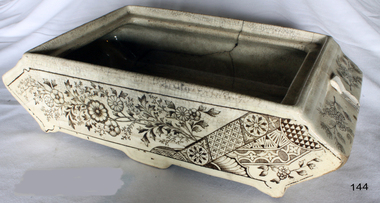
... Ceramic rectangular box body has with fine brown line floral design with protruding wedge ends. ...The subject item at this time cannot be associated with an historical event, person or place, provenance is unknown, item assessed as a collection asset as it is believed to have been produced before 1950. flagstaff hill warrnambool flagstaff hill maritime museum maritime museum shipwreck coast flagstaff hill maritime village great ocean road container decorative object ceramic Ceramic Box None Ceramic rectangular box body has with fine brown line floral design with protruding wedge ends. ...This item is believed to have been made in or around the Staffordshire area in the United Kingdom. Over 1500 pottery firms have operated in Stoke-on-Trent since the early 1700's - Some lasted only a few years and some for well over 200 years. Some potters built and owned their own works. Many others were tenants in works built by others and a succession of potters occupied the same works. It was also a common practice for a works to be split between two different pottery companies or for a larger manufacturer to let out a smaller section of his works to a potter who would make wares which were not of interest to the pot works owner. Some potters purchased 'blanks' from other manufacturers and put their own decoration on them some items have two back stamps some have no marks at all. This adds to the confusion and frustration of trying to trace details of a particular manufacturer such as the subject item.The subject item at this time cannot be associated with an historical event, person or place, provenance is unknown, item assessed as a collection asset as it is believed to have been produced before 1950.Ceramic rectangular box body has with fine brown line floral design with protruding wedge ends. Noneflagstaff hill, warrnambool, flagstaff hill maritime museum, maritime museum, shipwreck coast, flagstaff hill maritime village, great ocean road, container, decorative object, ceramic, ceramic box -
 Wangaratta High School
Microcomputer
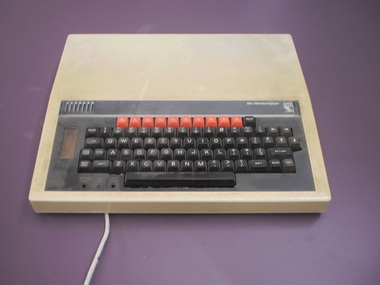
... BBC Microcomputer cream box body with black section containing a black keyboard with a row of red keys at the top...BBC Microcomputer BBC Microcomputer cream box body with black section containing a black keyboard with a row of red keys at the top Microcomputer ...BBC Microcomputer cream box body with black section containing a black keyboard with a row of red keys at the topBBC Microcomputer -
 Glenelg Shire Council Cultural Collection
Functional object - Pencil Box containing pencils, Cumberland Pencil Co. Ltd, n.d
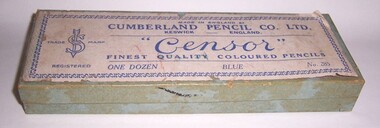
... Label and decorations printed on white paper and glued to top of box. Body of box is blue card glued over cardboard base....Label and decorations printed on white paper and glued to top of box. Body of box is blue card glued over cardboard base. ...Cardboard pencil box containing remains of pencils and crayons. Label and decorations printed on white paper and glued to top of box. Body of box is blue card glued over cardboard base.Front: (see photograph) "Cumberland "Censor" Finest Quality Coloured Pencils" -
 Kiewa Valley Historical Society
Resusci Anne Body Repair Kit
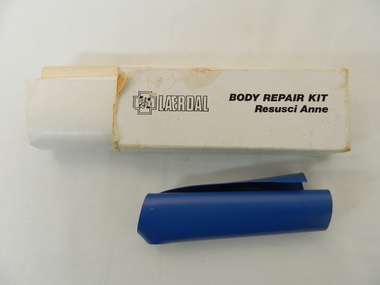
... Cardboard white box with black writing containing Body repair kit for the mannequin 'Resusci Anne". ...On box - LAERDAL Body Repair Kit / Resusci Anne At end of box - Made in Norway No.: 01.10.00...Provenance: Used in the Tawonga District General Hospital which was remote and therefore required good equipment. hospital equipment. tawonga. mt beauty. resuscitator doll. On box - LAERDAL Body Repair Kit / Resusci Anne At end of box - Made in Norway No.: 01.10.00 Cardboard white box with black writing containing Body repair kit for the mannequin 'Resusci Anne". ...This hospital equipment was used in the Tawonga District General Hospital which was built in the 1950s specifically for the increase in population due to the Kiewa Hydro Scheme.Historical: Shows the development of scientific hospital equipment. Provenance: Used in the Tawonga District General Hospital which was remote and therefore required good equipment.Cardboard white box with black writing containing Body repair kit for the mannequin 'Resusci Anne". Box missing one end. Blue rubber of miscellaneous shape inside with instruction pamphlet.On box - LAERDAL Body Repair Kit / Resusci Anne At end of box - Made in Norway No.: 01.10.00hospital equipment. tawonga. mt beauty. resuscitator doll. -
 Warrnambool RSL Sub Branch
Cut Throat or Straight Razor Holder/Container, Max Voos, Germany, 1930's-1940's
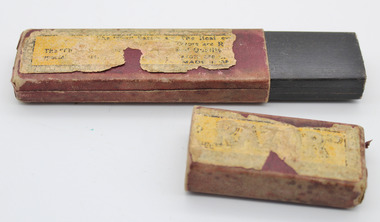
... Rectangular box in two parts; body and sliding lid...Paper labels on full length of both sides Rectangular box in two parts; body and sliding lid Cut Throat or Straight Razor Holder/Container Max Voos, Germany ...Rectangular box in two parts; body and sliding lidPaper labels on full length of both sides -
 City of Moorabbin Historical Society (Operating the Box Cottage Museum)
Document - Kitchen equipment, charcoal sad iron, c1880
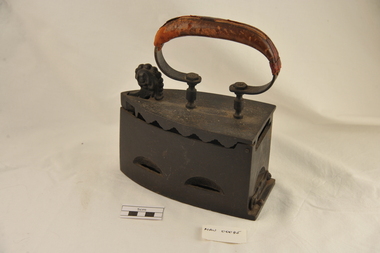
... This type of Charcoal iron was used by early settler families in Moorabbin Shire. The body or ‘box’ of the iron was filled with red-hot coals from the Kitchen hearth. ...A charcoal sad iron with leather covered handle c 1880 The cast iron body or ‘box’ of this sad iron was filled with red-hot coals from the hearth and great care had to be taken to prevent scorching the material to be smoothed....This type of Charcoal iron was used by early settler families in Moorabbin Shire. The body or ‘box’ of the iron was filled with red-hot coals from the Kitchen hearth. ...This type of Charcoal iron was used by early settler families in Moorabbin Shire. The body or ‘box’ of the iron was filled with red-hot coals from the Kitchen hearth. This made for hot as well as smoky ironing and the handle would have become very hot. This type of iron is still used in some countries where electric power is unavailable. This Charcoal flat iron was used by the Curtis family who were early settlers in Moorabbin Shire c1880. A charcoal sad iron with leather covered handle c 1880 The cast iron body or ‘box’ of this sad iron was filled with red-hot coals from the hearth and great care had to be taken to prevent scorching the material to be smoothed.iron charcoal, flat iron, early settlers, pioneers, moorabbin, brighton, market gardeners, craftwork, sewing, laundry equipment, kitchens -
 Flagstaff Hill Maritime Museum and Village
Container - Box
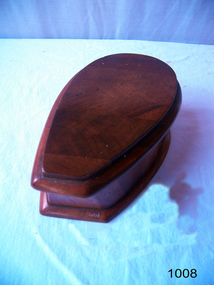
... Container, wooden box with push on lid. Main body of box built from turned laminated wood. ...flagstaff hill warrnambool shipwrecked-coast flagstaff-hill flagstaff-hill-maritime-museum maritime-museum shipwreck-coast flagstaff-hill-maritime-village Container, wooden box with push on lid. Main body of box built from turned laminated wood. ...Container, wooden box with push on lid. Main body of box built from turned laminated wood. flagstaff hill, warrnambool, shipwrecked-coast, flagstaff-hill, flagstaff-hill-maritime-museum, maritime-museum, shipwreck-coast, flagstaff-hill-maritime-village -
 Flagstaff Hill Maritime Museum and Village
Domestic object - Iron
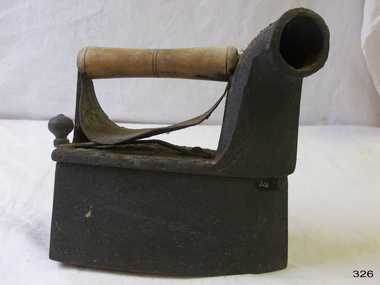
... Charcoal box iron with iron body, wooden handle and metal finger guard. ...Flagstaff Hill Flagstaff Hill Maritime Museum and Village Warrnambool Maritime Museum Maritime Village Great Ocean Road Shipwreck Coast iron domestic iron box iron laundry equipment household item Family charcoal iron On top of iron"8" Charcoal box iron with iron body, wooden handle and metal finger guard. ...The iron is an example of laundry equipment from the Victorian era before electricity was commonly available.Charcoal box iron with iron body, wooden handle and metal finger guard. It has been painted black. Inscription on top of iron.On top of iron"8"flagstaff hill, flagstaff hill maritime museum and village, warrnambool, maritime museum, maritime village, great ocean road, shipwreck coast, iron, domestic iron, box iron, laundry equipment, household item, family charcoal iron -
 Cheese World Museum
Box, butter
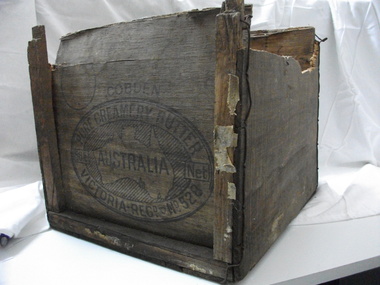
... Its innovative design is light but strong, using plywood for the box body and struts 'stitched' to the body with wire. ...Its innovative design is light but strong, using plywood for the box body and struts 'stitched' to the body with wire. ...This butter box belonged to Jack Gore of Warrnambool who used it in his garage to store car parts. It is connected to Warrnambool Cheese and Butter Factory Company Limited through the box manufacturer, Peter John McGennan, who was one of the instigators of the factory. Cobden and Warrnambool factories were the first two co-operative factories to produce butter in Victoria, both commencing in 1888. Warrnambool Cheese and Butter Factory Company Ltd is the only remaining independent butter factory still using its original name. It is an example of the manner in which butter was packed for export from the late 19th century until well into the 20th century. Its innovative design is light but strong, using plywood for the box body and struts 'stitched' to the body with wire. The ply was originally pine imported from New Zealand which did not taint the butter. Following the exclusion of the timber from NZ, plantations of local pine were planted and used. McGennan's box factory supplied butter boxes to the majority of butter factories in Victoria, producing up to half a million boxes per year by 1917.This Cobden butter box is historically significant relating to the butter industry and a rare item. Not many of these exist. Wooden butter box with broken ends and a hole in the bottom.Constructed using thin ply ends, sides and base with square wooden struts tied with wire to strengthen the box. The trade mark on the end of the box is an oval with text around a map of Australia with the word AUSTRALIA printing across the map.COBDEN/PURE CREAMERY BUTTER/56lb Net/VICTORIA/REGD No.528butter, dairying, dairy manufacturing industry, butter boxes, cobden -
 Flagstaff Hill Maritime Museum and Village
Clothing - Collar and Box
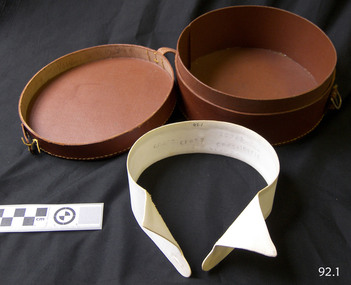
... Leather circular box with strap around body and plated buckle. Lid is attached to box. ...Leather circular box with strap around body and plated buckle. Lid is attached to box. ...Collar box and collar. Leather circular box with strap around body and plated buckle. Lid is attached to box. Contains 1 starched white detachable collar. Collar has markings inside.Printed inside the collar " Rexbilt" and "16½" x1¾""flagstaff hill, warrnambool, shipwrecked coast, flagstaff hill maritime museum, maritime museum, shipwreck coast, flagstaff hill maritime village, great ocean road, collar, collar box, starched collar, gentleman s collar, detachable collar -
 Melbourne Tram Museum
Photograph - Digital Image, construction of W class tramcars at the Holden Factory Woodville, 1924
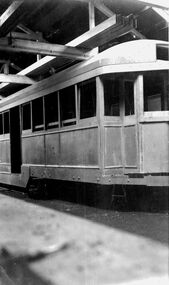
... All 1924. .1 - W class body in a low roofed shop near completion .2 - W Class body in a high roof area, with the roof slats being fitted. Note the brace drill type tool sitting on the destination box. .3 - completed body with an "A" sitting on dolly's outside the workshop buildings...All 1924. .1 - W class body in a low roofed shop near completion .2 - W Class body in a high roof area, with the roof slats being fitted. Note the brace drill type tool sitting on the destination box. .3 - completed body with an "A" sitting on dolly's outside the workshop buildings. - see item 7403 for a print. .4 - ditto - another view .5 - interior view of the erecting shop with at least four bodies under construction and a frame. .6 - interior view showing a new underframe, and other bodies partly completed in the background. .7 - Woodville sidings and the plant in the far background. ...Set of 7 digital images provided by Dr John Radcliffe of Adelaide of the construction of W class tramcars at the Holden Factory Woodville, by a photographer known as Collins. All 1924. .1 - W class body in a low roofed shop near completion .2 - W Class body in a high roof area, with the roof slats being fitted. Note the brace drill type tool sitting on the destination box. .3 - completed body with an "A" sitting on dolly's outside the workshop buildings. - see item 7403 for a print. .4 - ditto - another view .5 - interior view of the erecting shop with at least four bodies under construction and a frame. .6 - interior view showing a new underframe, and other bodies partly completed in the background. .7 - Woodville sidings and the plant in the far background. Permission from John Radcliffe to be obtained prior to use.trams, tramways, new tramcars, w class, adelaide, holdens, construction -
 Uniting Church Archives - Synod of Victoria
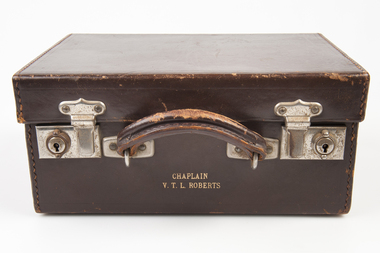
Communion set, circa 1940
... Silver salver (12cm diameter) and silver wafer tin (7.5cm diameter) in fitted slots in lid. In body of box: two plain glass bottles with plastic screw tops and two plain corks, a silver goblet (13.5cm high and 7.5cm diameter) and four glass communion tumblers. ...box: "I am Chaplain of Wesley College" methodist padre's auxiliary of victoria wesley college On case: "The "CHAPLAIN V.T.L. ROBERTS" Inside lid on leather: "THE GIFT OF THE METHODIST PADRE'S AUXILIARY OF VICTORIA" Brown leather case with handle and metal locks at front. Blue fabric lining. Three copies of "Order for the Administration of the Lord's Supper", a Wesley College New Testament and Psalms (1947) in fitted slot. Silver salver (12cm diameter) and silver wafer tin (7.5cm diameter) in fitted slots in lid. In body ...Hand written note in the box: "I am Chaplain of Wesley College"Brown leather case with handle and metal locks at front. Blue fabric lining. Three copies of "Order for the Administration of the Lord's Supper", a Wesley College New Testament and Psalms (1947) in fitted slot. Silver salver (12cm diameter) and silver wafer tin (7.5cm diameter) in fitted slots in lid. In body of box: two plain glass bottles with plastic screw tops and two plain corks, a silver goblet (13.5cm high and 7.5cm diameter) and four glass communion tumblers. Small brown bottle with a plastic lid. Includes large white linen communion cloth. Gold lettering on front of set.On case: "The "CHAPLAIN V.T.L. ROBERTS" Inside lid on leather: "THE GIFT OF THE METHODIST PADRE'S AUXILIARY OF VICTORIA"methodist padre's auxiliary of victoria, wesley college -
 Melbourne Tram Museum
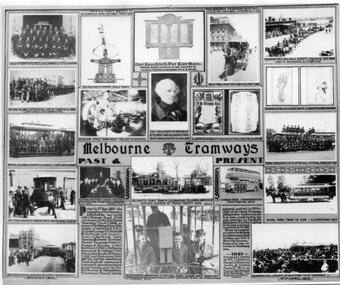
Photograph - Black and White, Melbourne & Metropolitan Tramways Board (MMTB), "Melbourne Tramways Past & Present", 1943
... "Melbourne Tramways Past & Present" - set of photos, drawings and notes of (Left to Right, Top to Bottom), Cable tram Richmond Depot employees 1909, Grip mechanism, Photo of the WW1 Honour Board, a horse cab carrying revenue to a bank, Transporting a cable by horse, installing cable to the Windsor line by T Warr & Co 1891, Nicholson St Power House interior, Chief Magistrate of Port Phillip settlement 1836 to 1939 who lived in a house now occupied by Head Office Building, illuminated address to F B Clapp, retirement 1916, drawings by Hal Gye & David Low of J G Roberts Cable Manager, Official & Clerical Staff at Clifton Hill - last line to operate, Depot Employees at Clifton Hill at Final Stage Oct 1940, No. 1 tram becomes Museum piece for National Museum, Australias First Conductresses Aug 1941, Instructor G S Boardman, Decorated peace tram in celebration following armistice 1919, Double deck bus with Conductresses, Royal Park Zoo tram, Openings of PMTT 1910, text box history of the bodies that formed the MMTB, Peter Henry ABC Broadcaster 3-7-1940 on a cable tram, and opening of HTT in 1916. ..."Melbourne Tramways Past & Present" - set of photos, drawings and notes of (Left to Right, Top to Bottom), Cable tram Richmond Depot employees 1909, Grip mechanism, Photo of the WW1 Honour Board, a horse cab carrying revenue to a bank, Transporting a cable by horse, installing cable to the Windsor line by T Warr & Co 1891, Nicholson St Power House interior, Chief Magistrate of Port Phillip settlement 1836 to 1939 who lived in a house now occupied by Head Office Building, illuminated address to F B Clapp, retirement 1916, drawings by Hal Gye & David Low of J G Roberts Cable Manager, Official & Clerical Staff at Clifton Hill - last line to operate, Depot Employees at Clifton Hill at Final Stage Oct 1940, No. 1 tram becomes Museum piece for National Museum, Australias First Conductresses Aug 1941, Instructor G S Boardman, Decorated peace tram in celebration following armistice 1919, Double deck bus with Conductresses, Royal Park Zoo tram, Openings of PMTT 1910, text box history of the bodies that formed the MMTB, Peter Henry ABC Broadcaster 3-7-1940 on a cable tram, and opening of HTT in 1916. ..."Melbourne Tramways Past & Present" - set of photos, drawings and notes of (Left to Right, Top to Bottom), Cable tram Richmond Depot employees 1909, Grip mechanism, Photo of the WW1 Honour Board, a horse cab carrying revenue to a bank, Transporting a cable by horse, installing cable to the Windsor line by T Warr & Co 1891, Nicholson St Power House interior, Chief Magistrate of Port Phillip settlement 1836 to 1939 who lived in a house now occupied by Head Office Building, illuminated address to F B Clapp, retirement 1916, drawings by Hal Gye & David Low of J G Roberts Cable Manager, Official & Clerical Staff at Clifton Hill - last line to operate, Depot Employees at Clifton Hill at Final Stage Oct 1940, No. 1 tram becomes Museum piece for National Museum, Australias First Conductresses Aug 1941, Instructor G S Boardman, Decorated peace tram in celebration following armistice 1919, Double deck bus with Conductresses, Royal Park Zoo tram, Openings of PMTT 1910, text box history of the bodies that formed the MMTB, Peter Henry ABC Broadcaster 3-7-1940 on a cable tram, and opening of HTT in 1916. Original poster prepared by the MMTB in 1943 See Reg Item 2854 for a framed photograph and 6367 for another poster of the time - Melbourne tramways past and present poster. See Reg Items 6358, 6122, 6121, 6354 and 6774 for individual photographs.Yields information about the Melbourne tram system and its history to 1943Photograph - of a MMTB Poster titled "Melbourne Tramways Past & Present"tramways, trams, cable trams, richmond, honour board, cash transport, cable ropes, clifton hill, nicholson st, winding house, f b clapp, conductresses, peace tram, double deck buses, zoo horse tram, pmtt, htt, abc -
 Federation University Historical Collection
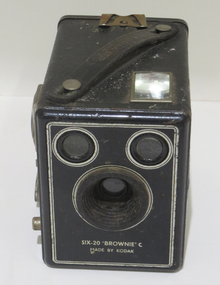
Equipment - Camera, Kodak Six-20 'Brownie' C, c1950
... body with two brilliant finders. Plain matt enamel front; metal wind knob and release button with a single blade shutter. (http://www.brownie-camera.com/71.shtml) This camera took box rollfilm, with 629 film size. ...(http://www.brownie-camera.com/71.shtml) camera photography brownie kodak box brownie Photographic Equipment Morocco-grained imitation leather covered metal body with two brilliant finders. ...This model of camera was made between 1946 and 1957. (http://www.brownie-camera.com/71.shtml)Morocco-grained imitation leather covered metal body with two brilliant finders. Plain matt enamel front; metal wind knob and release button with a single blade shutter. (http://www.brownie-camera.com/71.shtml) This camera took box rollfilm, with 629 film size. The picture size was 2 1/4 X 3 1/4" .(http://www.brownie-camera.com/71.shtml) Instruction books for this model are available at http://www.brownie-camera.com/manuals.shtml camera, photography, brownie, kodak, box brownie, photographic equipment -
 Flagstaff Hill Maritime Museum and Village
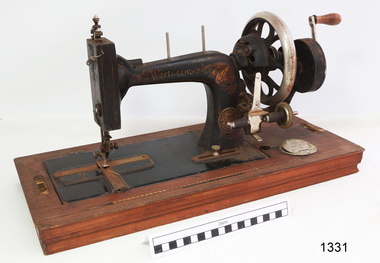
Domestic object - Sewing Machine, 1903
... body of the machine. Wertheim sewing machine in carry case, hand operated with two spindles, handle with locking pin, which turns lever between spokes of main handle, hand brake. The machine is table-mounted with a Turkish walnut base. The base can be attached to a cast iron table with a foot treadle as an optional extra. The walnut base has marquetry to the front set out as a measure for material. There is also an accessory box ...Hugo Wertheim (1854-1919), was a merchant and manufacturer and was born on the 12th July 1854 at Lispenhausen, in the German electorate of Hesse-Kassel, son of Meyer Wertheim and his wife Minna, née Heinemann. Hugo reached Melbourne in October 1875. He soon began advertising, from premises at 39 Flinders Lane East, as agent for his father's cousin Joseph Wertheim, a well-established manufacturer of sewing machines. Hugo returned to Germany where he married Joseph Wertheim's daughter Sophie Emilie (1864-1953) on 30 August 1885 at Frankfurt. the couple then came to Melbourne. In a short time, with extensive advertising, Hugo established a substantial business, selling sewing machines, bicycles, pianos and other mechanical devices, under brands such as Wertheim, Electra, Planet, Griffin and Hapsburg. He also mounted elaborate displays at agricultural shows and in 1901 at the Pan American Exposition, Buffalo, United States of America. O. C. Beale worked with him before setting up his own piano business in New South Wales. Hugo continued to own 25 per cent of one of Beale's companies, which became Wertheim's Queensland business. In 1908 Wertheim opened a large, innovative piano factory at Richmond, Melbourne, intending to produce 2000 pianos and player pianos annually, predominantly using Australian materials. In laying the foundation stone, Prime Minister Alfred Deakin observed that “few men with such opportunities for a life of ease would have embarked on such an enterprise” Hugo died of chronic hepatitis on 11 July 1919 at his home at South Yarra, his wife, two daughters and three sons survived him; Herbert Joseph (1886-1972), the eldest, continued the business. Rupert became a share broker and went on to represent Victoria in inter-State tennis in 1913-27 and Australia in Davis Cup matches against Czechoslovakia in 1922. The piano factory closed in 1935, becoming a Heinz food processing plant and in 1955, GTV Channel 9 studios and offices.Early Australians had to be self-reliant in regards to making and mending their clothes and utensils. This sewing machine was one of many items used that exhibit the skill and craftsmanship of the women in these early families. A sewing machine was a necessary part of each home and this item demonstrates how women of the time managed had to become self-reliant in the repair and making of their families clothes to make their household budgets go further.Wertheim sewing machine in carry case, hand operated with two spindles, handle with locking pin, which turns lever between spokes of main handle, hand brake. The machine is table-mounted with a Turkish walnut base. The base can be attached to a cast iron table with a foot treadle as an optional extra. The walnut base has marquetry to the front set out as a measure for material. There is also an accessory box inside the carry case containing 20 additional items for use with the machine. Wertheim brass trademark badge riveted to the body of the machine of a crouching dwarf with a hammer with the name of the company Wertheim and Frankfurt. Gold filigree decoration in gold paint adorns the main body of the machine. flagstaff hill, warrnambool, shipwrecked-coast, flagstaff-hill, flagstaff-hill-maritime-museum, maritime-museum, shipwreck-coast, flagstaff-hill-maritime-village, sewing machine, hand operated sewing machine, crank handle sewing machine, wertheim, dressmaking, taylor, domestic, clothing, hugo wertheim, joseph wertheim -
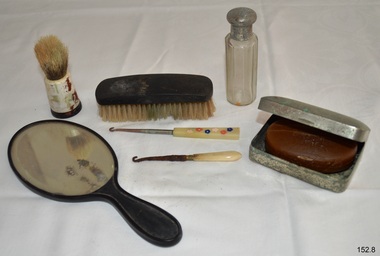 Flagstaff Hill Maritime Museum and Village
Accessory - Grooming Set, T R Cadman, ca. 1924
... box soap container cologne bottle clothes brush shaving brush button hook hand mirror personal efects toiletries T.R. Cadman & Sons Reginald M soap dish Soap container once had star motifs. Men's grooming set; metal soap container with star decoration, oval soap cake, oval hand mirror in a black frame ten-sided clear glass cologne bottle with silver metal lid, yellow bristle clothes brush with brown wooden hand grip, yellow bristle shaving brush with black base and white body, and two button hooks with white handles; the larger one has floral motifs. ...This men's grooming set of personal care equipment and toiletries is an example of items packaged in attractive cases and sold as gifts in Australian chemist outlets and department stores in the 1920s to 1940s. This set was originally packaged in a leather-covered, lined and fitted case, with a comb, hair brush, and razor included as well. as the items shown here. The razor, once included with the set, had the inscription "T.R. Cadman and Sons, Sheffield England". The family business began with Luke Cadman in 1748. Thomas Radley Cadmen (1833 - 1917) took over the business in 1871, by which time it was operating in Sheffield. The business became incorporated as T.R. Cadman & Sons in 1924 but shortly afterwards the straight razors manufactured by them were stamped T.R. Cadman & Sons Ltd. The company specialised in pocket knives and razors from 1933 and supplied the British Royal Navy with razors in WWII. Over 80 per cent of sales were for the overseas market including Australia. Some of their razors were sold in stores in Victoria. The business traded in 1965. This grooming set was donated for exhibit in Flagstaff Hill Maritime Museum and Village's exhibit of the vessel 'Reginald M', a two-masted coastal trading ketch built in Port Adelaide in 1922. These items are examples of personal objects sold in Victoria in the 1920s as gifts for men, cased or packaged for special occasions and sold in retail stores. The items are associated with the historic coastal trading ketch 'Reginald M', listed on the Australian Register of Historic Vessels; and active from 1922 until 1975. The items were displayed in the Master's Quarters of the Reginald M exhibit at Flagstaff Hill Maritime Museum and Village until 2016 when the ship was decommissioned from Flagstaff Hill's fleet.Men's grooming set; metal soap container with star decoration, oval soap cake, oval hand mirror in a black frame ten-sided clear glass cologne bottle with silver metal lid, yellow bristle clothes brush with brown wooden hand grip, yellow bristle shaving brush with black base and white body, and two button hooks with white handles; the larger one has floral motifs. Inscriptions were on the razor originally included in the grooming set.Soap container once had star motifs.flagstaff hill, warrnambool, shipwrecked coast, flagstaff hill maritime museum, maritime museum, shipwreck coast, flagstaff hill maritime village, great ocean road, grooming set, men's grooming set, personal grooming, toiletry set, personal care, soap box, soap container, cologne bottle, clothes brush, shaving brush, button hook, hand mirror, personal efects, toiletries, t.r. cadman & sons, reginald m, soap dish -
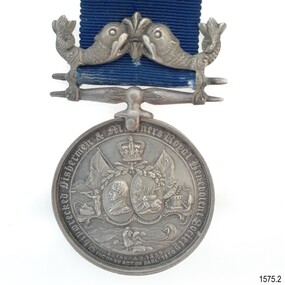 Flagstaff Hill Maritime Museum and Village
Award - Medal, Stokes, c 1882
... box has "MEDAL" handwritten in black. Medal, silver with blue ribbon. The obverse of the medal has images of the British flag, a crown flag with "S.F.", a portrait of a man, a shipwreck, a cannon and anchor, a man with a telescope, and two people attending a body on the shore. ...This medal was presented by the Shipwrecked Fishermen and Mariners' Royal Benevolent Society and was posthumously awarded to Captain John Coffey’s family for his efforts at saving life at sea, in 1882. Captain Coffey lost his life in this attempt. The shipwreck occurred between Australia and England. The included letter was written by the donor, who is the grandson of John Coffey. It is interesting that the medal and note were packaged in a small tin whose original purpose was to present a wedding cake gift to guests. The container is decorated with wedding bells pressed into the lid. Shipwrecked Fishermen and Mariners’ Royal Benevolent Society: - The Shipwrecked Mariners (Shipwrecked Fishermen and Mariners’ Royal Benevolent Society) is a national charity established in 1839. It is run by a network of volunteers in the UK and Ireland. The organisation assists former mariners, their dependants and their families. John Rye and his servant Charles-Gee Jones, of Bath, UK, encouraged its formation after a severe storm caused the loss of life from the ‘Clovelly’ fishing fleet in November 1838. The Society was incorporated by an Act of Parliament in 1850. The Society’s flag is the St George’s Cross, a red cross on a white background and a gold crown in the centre, with the letters S F M S displayed, one in each quadrant. Nominations are made by members each year of those who have performed outstanding acts of bravery in helping those in peril in the sea. The inscription on the reverse "PRESENTED FOR HEROIC EXERTIONS IN SAVING LIFE FROM DROWNING / JOB XXIX 13" refers to a verse in the Bible, which in the King James version reads "The blessing of him that was ready to perish came upon me; and I caused the widow's eart to sing for joy."This is the only medal in our collection awarded from the Shipwrecked Fishermen and Mariners' Royal Benevolent Society. Medal, silver with blue ribbon. The obverse of the medal has images of the British flag, a crown flag with "S.F.", a portrait of a man, a shipwreck, a cannon and anchor, a man with a telescope, and two people attending a body on the shore. The reverse of the medal has text. The medal clasp depicts a fleur de lies between two fish. The medal maker is Stokes. The metal was donated in a tin container and included a letter. The medal was presented posthumously to the family of Captain John Coffey for his efforts at saving life at sea, in 1882. It has an accompanying letter and container.On rim "CAPTAIN JOHN COFFEY - 1882" Obverse "SHIPWRECKED FISHERMEN AND MARINERS ROYAL BENEVOLENT SOCIETY" and "ESTAB AD 1839 INCOd BY ACT OF PARLt 1850" Reverse "PRESENTED FOR HEROIC EXERTIONS IN SAVING LIFE FROM DROWNING / JOB XXIX 13" and "ENGLAND EXPECTS EVERY MAN WILL DO HIS DUTY" The tin box has "MEDAL" handwritten in black.flagstaff hill, flagstaff hill maritime museum and village, warrnambool, maritime museum, maritime village, great ocean road, shipwreck coast, medal, captain john coffey, john coffey, numismatics, hero, saving lives, shipwrecked fishermen and mariners’ royal benevolent society, sfms, shipwrecked mariners' society -
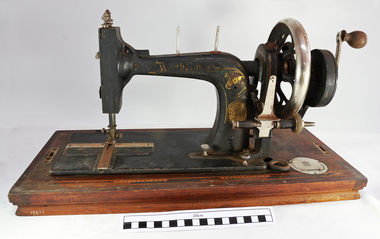 Flagstaff Hill Maritime Museum and Village
Domestic object - Sewing Machine and case, Joseph Wertheim, late 19th century
... Body of machine has brand name transfer across front and oval metal trademark disc on front. Metal sliding covers over footplates have stamped lettering. Timber machine case or cover includes an accessory box...Body of machine has brand name transfer across front and oval metal trademark disc on front. Metal sliding covers over footplates have stamped lettering. Timber machine case or cover includes an accessory box ...Hugo Wertheim (1854-1919), was a merchant and manufacturer and was born on the 12th July 1854 at Lispenhausen, in the German electorate of Hesse-Kassel, son of Meyer Wertheim and his wife Minna, née Heinemann. Hugo reached Melbourne in October 1875. He soon began advertising, from premises at 39 Flinders Lane East, as agent for his father's cousin Joseph Wertheim, a well-established manufacturer of sewing machines. Hugo returned to Germany where he married Joseph Wertheim's daughter Sophie Emilie (1864-1953) on 30 August 1885 at Frankfurt. the couple then came to Melbourne. In a short time, with extensive advertising, Hugo established a substantial business, selling sewing machines, bicycles, pianos and other mechanical devices, under brands such as Wertheim, Electra, Planet, Griffin and Hapsburg. He also mounted elaborate displays at agricultural shows and in 1901 at the Pan American Exposition, Buffalo, United States of America. O. C. Beale worked with him before setting up his own piano business in New South Wales. Hugo continued to own 25 per cent of one of Beale's companies, which became Wertheim's Queensland business. In 1908 Wertheim opened a large, innovative piano factory at Richmond, Melbourne, intending to produce 2000 pianos and player pianos annually, predominantly using Australian materials. In laying the foundation stone, Prime Minister Alfred Deakin observed that “few men with such opportunities for a life of ease would have embarked on such an enterprise” Hugo died of chronic hepatitis on 11 July 1919 at his home at South Yarra, his wife, two daughters and three sons survived him; Herbert Joseph (1886-1972), the eldest, continued the business. Rupert became a share broker and went on to represent Victoria in inter-State tennis in 1913-27 and Australia in Davis Cup matches against Czechoslovakia in 1922. The piano factory closed in 1935, becoming a Heinz food processing plant and in 1955, GTV Channel 9 studios and offices.Early Australians had to be self-reliant in regards to making and mending their clothes and utensils. This sewing machine was one of many items used that exhibit the skill and craftsmanship of the women in these early families. A sewing machine was a necessary part of each home and this item demonstrates how women of the time managed had to become self-reliant in the repair and making of their families clothes to make their household budgets go further.Sewing machine, Wertheim brand “ Syst 182” hand crank operated machine with folding handle, timber case and carry handle. Metal machine is painted black, with remnants of gold, red and green scrolls and floral decoration. Machine has base with inlaid measuring rule across front and 2 holes drilled through the base (perhaps for mounting machine to a bench). Machine tilts open, hinged on one side, after thumb screw is unwound, revealing machine’s workings and serial number. Base has a fitted round, concave, silver metal pin holder with lid that hinges open, and symbol pressed into lid; several pins are inside. Body of machine has brand name transfer across front and oval metal trademark disc on front. Metal sliding covers over footplates have stamped lettering. Timber machine case or cover includes an accessory box with sliding cover and metal hook and eye latch, and inside the box are 23 metal sewing attachments, a disc and a stick of black crayon with maker’s trademark on it paper cover. Workings of machine have seized up. The crayon wrapper has printed on it “For the wonderful Wertheim new family machine made in Germany ‘Syst. 182’”, and the maker’s symbol with “Trademark” beside it. Made for Hugo Wertheim.“WERTHEIM” transfer across front and back of machine body. Cover of pin holder has symbol ‘Wings above a shield’. Maker’s trademark on gold oval disc, “WERTHEIM / FRANCFURT” and picture of a dwarf with a hammer. Left footplate has script “Syst 182”, right footplate has stamp in oval shape “MANUFACTURED IN - - /SPECIALLY FOR / HUGO WERTHEIM” Serial Number “7501”flagstaff hill, warrnambool, shipwrecked-coast, flagstaff-hill, flagstaff-hill-maritime-museum, maritime-museum, shipwreck-coast, flagstaff-hill-maritime-village, sewing machine, hand crank sewing machine, hugo wertheim, wertheim, clothing manufacturer, sewing, syst 182 -
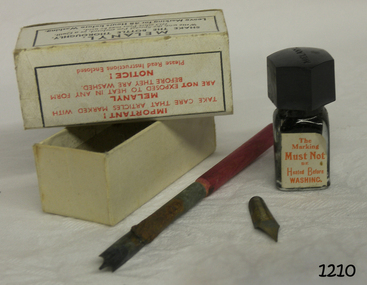 Flagstaff Hill Maritime Museum and Village
Container - Ink Bottle
... Also 2 nibs and wood pen body. Bottle etc all container in cardboard box with sliding sleeve. ...Also 2 nibs and wood pen body. Bottle etc all container in cardboard box with sliding sleeve. ...Bottle clear glass with screw lid "Melanyl" Inventors and Manufacturers Cooper, Dennison and Walkden Ltd. English dye in. Also 2 nibs and wood pen body. Bottle etc all container in cardboard box with sliding sleeve. Small pen with nib corroded, plus spare nib - inscribed "Hinks.Wells & Co "Flexor Pen" England 1884F.flagstaff hill, warrnambool, shipwrecked-coast, flagstaff-hill, flagstaff-hill-maritime-museum, maritime-museum, shipwreck-coast, flagstaff-hill-maritime-village -
 Mission to Seafarers Victoria
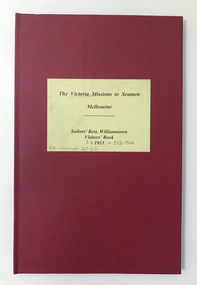
Book (item) - Visitor logbook, The Victoria Missions to Seamen Melbourne- Sailor's Rest Williamstown Visitors' Book, 1933 - 1944
... This together with the 1945 register from Williamstown (see VC MtSV record) provides the earliest such register records surviving in the Mission heritage collection and Archive. seafarers seafarer registers seafarer's rest seafarer's rest williamstown visitors log book box 24 williamstown sailors seamen mrs hodgkiss j.g. sheel crew nationality padre frank leslie oliver Cover: The Victoria Missions to Seamen Melbourne / Sailors' Rest Williamstown/ Visitors' book/ 1933 ( February1933 - March-1944) / Spine:/Sailors' Rest, Williamstown - Visitors' book 1933. Inner page: details of Chaplains and caretakers and contact nos re the Mission. Slim Red cloth visitor book with yellow title paper on cover and spine and yellow end papers. Re bound in 2002. Main body ...This book or register records the date, name and address and ship name and remarks of visiting seafarers from a wide range of origins. The logbook provides an insight into which ships and the origins of their crews were visiting Williamstown and Melbourne in 1933. This together with the 1945 register from Williamstown (see VC MtSV record) provides the earliest such register records surviving in the Mission heritage collection and Archive.Cover: The Victoria Missions to Seamen Melbourne / Sailors' Rest Williamstown/ Visitors' book/ 1933 ( February1933 - March-1944) / Spine:/Sailors' Rest, Williamstown - Visitors' book 1933. Inner page: details of Chaplains and caretakers and contact nos re the Mission.seafarers, seafarer registers, seafarer's rest, seafarer's rest williamstown, visitors log book, box 24, williamstown, sailors, seamen, mrs hodgkiss, j.g. sheel, crew, nationality, padre frank leslie oliver -
 Marysville & District Historical Society
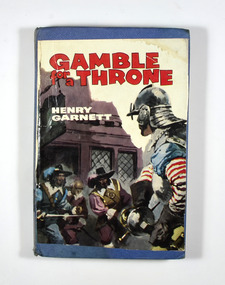
Book, Henry Garnett, Gamble for a Throne, 1962
... Box 22/ Marysville 3779 The cover is blue. On the front cover is a picture depicting men who appear to be soldiers in the 1600's preparing to do battle. In the background is a building will mullioned windows. It appears that the front picture has been cut from the book's dust cover and adhered to the front cover. The title of the book is in red writing at the top of the picture and the author's name is in white writing across the body ...A novel by Henry Garnett that is about Oliver Cromwell, a significant figure in English history.The cover is blue. On the front cover is a picture depicting men who appear to be soldiers in the 1600's preparing to do battle. In the background is a building will mullioned windows. It appears that the front picture has been cut from the book's dust cover and adhered to the front cover. The title of the book is in red writing at the top of the picture and the author's name is in white writing across the body of the picture. The title, the author and publisher are written in silver ink down the spine of the book.fictionA novel by Henry Garnett that is about Oliver Cromwell, a significant figure in English history.england, history, oliver cromwell, fiction, henry garnett -
 Marysville & District Historical Society
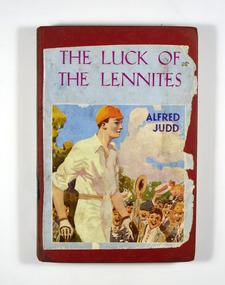
Book, The Luck of the Lennites
... Box 22/ Marysville 3779 The cover is red. On the front cover is a picture depicting a cricket player being cheered by a group of boys in school uniforms waving their hats. It appears that the front picture has been cut from the book's dust cover and adhered to the front cover. The title of the book is in red writing at the top of the picture and the author's name is in black writing across the body ...A novel by Alfred Judd about games of cricket that were played at an English school.The cover is red. On the front cover is a picture depicting a cricket player being cheered by a group of boys in school uniforms waving their hats. It appears that the front picture has been cut from the book's dust cover and adhered to the front cover. The title of the book is in red writing at the top of the picture and the author's name is in black writing across the body of the picture. The title, the author and publisher are written in gold ink down the spine of the book.fictionA novel by Alfred Judd about games of cricket that were played at an English school.england, school, cricket, fiction, alfred judd -
 Federation University Historical Collection
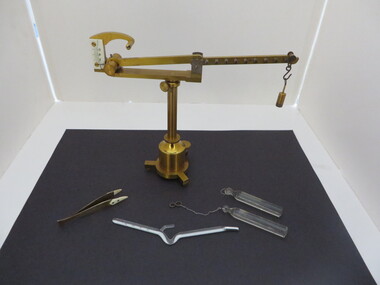
Instrument - Scientific Instrument, Westphal Balance
... A beam Balance, provided with a submersible body at one end, for determining density of water at different temperatures. Housed in a polished wood box....box. A beam Balance, provided with a submersible body at one end, for determining density of water at different temperatures. ...The Westphal Balance was used in the Science Department at the University of Ballarat, VictoriaA beam Balance, provided with a submersible body at one end, for determining density of water at different temperatures. Housed in a polished wood box.Calibration table, hand written, inside the box.westphal, balance, water density, liquids, science department, university of ballarat -
 Flagstaff Hill Maritime Museum and Village
Plan - Vessel, Public Works Department (P.W.D.), Matthew Flinders I, 8-11-1911
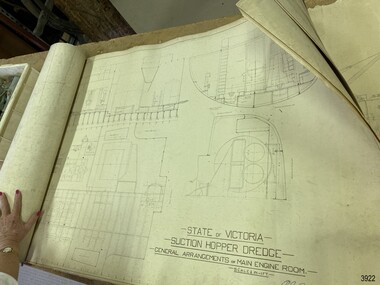
... These plans are line drawings by the State of Victoria for a Suction Hopper Dredge, which used a suction pump to bring up material from the bottom of a body of water. The plans are contained in a box from the Public Works Department, Ports and Harbours Division in Melbourne, which in the year 1910 was responsible for the dredging operations of coastal ports and harbours, and inland waterways. ...These plans are line drawings by the State of Victoria for a Suction Hopper Dredge, which used a suction pump to bring up material from the bottom of a body of water. The plans are contained in a box from the Public Works Department, Ports and Harbours Division in Melbourne, which in the year 1910 was responsible for the dredging operations of coastal ports and harbours, and inland waterways. ...These plans are line drawings by the State of Victoria for a Suction Hopper Dredge, which used a suction pump to bring up material from the bottom of a body of water. The plans are contained in a box from the Public Works Department, Ports and Harbours Division in Melbourne, which in the year 1910 was responsible for the dredging operations of coastal ports and harbours, and inland waterways. The stamped signature is that of Arthur Edward Cutler, Chief Engineer, Public Works Department of New South Wales. The steel steamer Matthew Flinders was constructed by Morts Dock & Engineering Co Ltd in Sydney, New South Wales. Identified as Ship No. 40 by the ship builders, this dredge, had twin screw engines that were made in Sydney. Its gross tonnage was 1180. It was launched on July 15th, 1916, and registered by the owner, Department of Public Works in Victoria, at the Port of Melbourne in 1917. Unlike bucket dredges, the Matthew Flinders did not use permanent moorings but instead had bow and stern anchors. It travelled forward on the bow anchor, taking up a strip of even-depth wilt from the bed below. A local newspaper noted that the Matthew Flinders has many advantages that were especially useful for its work at Warrnambool. Warrnambool Harbour had been experiencing silting and sanding for many years. The problem continued even after the construction of the Breakwater in 1890, which was overseen by New Zealand engineer Arthur Dudley Dobson. Melbourne’s Department of Ports and Harbours sent the new Matthew Flinders to dredge the heavy silting in the Warrnambool Harbour in May 1919. This work was previously done by the smaller dredge, the Pioneer. However, after a month of work, the Matthew Flinders was returned to Melbourne for alterations to make it suitable for work in the heavy seas it experienced at Warrnambool. Both dredges were sent up from Melbourne when required over the years to periodically attend to the silting in the Harbour, but the Matthew Flinders was preferred because of its efficiency. It was still dredging the Harbour even in July 1938. The ship’s original master was J G Rosney. In 1923 the master in charge was Captain Dunbar. In 1930 the dredges were no longer required as the Harbour was no longer suitable as port.These plans are significant for their close association with the suction hopper dredge, the Matthew Flinders I, which was call upon often to remove the silting of Warrnambool Harbour and allow shipping to continue in the Port of Warrnambool until 1930, when the Port of Warrnambool ceased to be suitable as a port. The work done by the Matthew Flinders is significant for its association with the Warrnambool Breakwater and the on-going issues with the silting of the Harbour. Plans with line drawings for the suction hopper dredge Matthew Flinders, rolled, in open-top wooden box. Created for the Public Works Department, Melbourne, Victoria. Stamped with signature and dated November I, 1911. Inscriptions: label on box, handwriting on box, drawings and outer layer of paper. Freighted by 1 Star, New Zealand Express Cargo.Signature stamp “A E Cutler” Date stamp “NOV 8 – 1911” Printed on one page “STATE OF VICTORIA / SUCTION HOPPER DREDGE / GENERAL ARRANGEMENTS OF MAIN ENGINE ROOM / SCALE 1/2 IN = 1 FT.” Label on box "1 [star symbol] / THE NEW ZEALA- - - / EXPRESS CAR - –“ Handwritten on base “PUBLIC WORKS / DEPARTMENT / - - LBOURNE” Handwritten in pencil on cover paper “MATTHEW Flinders”flagstaff hill, warrnambool, maritime village, maritime museum, flagstaff hill maritime museum & village, shipwreck coast, great ocean road, plan, line drawing, dredge, pioneer, steel steam ship, twin screw engines, a e cutler, arthur edward cutler, chief engineer, public works department, new south wales, nsw, 1911, state of victoria, suction hopper, main engine room, public works melbourne, warrnambool harbour, lady bay, sanding, silting, breakwater, morts dock & engineering co ltd, j g rosney, captain dunbar, ship no. 40, matthew flinders i, matthew flinders, 1 star, new zealand express cargo -
 Flagstaff Hill Maritime Museum and Village
Domestic object - Sewing machine in cabinet, Ward Brothers (G & S Ward), ca. 1933
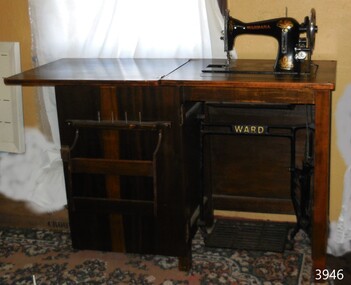
... box. The round shallow oil bottle has a rubber dispensing tube. Colourful decals decorate the black body of the machine. ...box. The round shallow oil bottle has a rubber dispensing tube. Colourful decals decorate the black body of the machine. ...The donor inherited this Wardana machine from her mother, who bought it in about 1933 and used it to sew garments for her sister's dressmaking business in Frankston, Victoria. The donor often used this machine until she purchased an updated model. There were originally three Ward Brothers who owned the North Melbourne sewing machine business but they had a falling out. This machine's decals on the map of Australia only include the two remaining brothers. The Ward Brothers, G & S Ward, established their sewing machine business in North Melbourne in 1888. The cabinets and ironwork of the machines were made in Australia and the Ward Bros. imported their machines from overseas manufacturers in England, America and Germany. The assembled machines were sold under brand names that included Ward, A.N.A. the patriotic-sounding Australian Sewing Machine Company. The "Wardana" was one of their brands.This sewing machine was fabricated in Australia from imported parts from England, giving a snapshot into the early manufacturing industries that were operating at the time just after Federation.Sewing machine in a wooden cabinet with iron foot-operated cast iron treadle mechanism. The hinged cabinet top opens out to form a worktop. The sewing machine lifts out of the cabinet to sit level with the worktop, resting on two supports within the cabinet. The lockable cabinet door opens from right to left revealing fitted shelves and spikes for spools and bobbins. The gold-painted maker's name is cast into the black treadle. The machine has its original instruction book, oil can, and eighteen accessories in an enclosed cardboard box. The round shallow oil bottle has a rubber dispensing tube. Colourful decals decorate the black body of the machine. Inscriptions include a Serial Number stamped on the bed of the machine. The Wardarna Central Bobbin machine was made in England for the Ward Brothers of North Melbourne.TREADLE: cast into metal ACROSS THE TOPE AND ON THE FOOTPLATE "WARD", "WARD" SERIAL NUMBER stamped into oval plate "28383" DECAL: (Map of Australia ) with images of [two brothers] , "WARDANA" above (logo of the rising sun) DECAL: (Decorative floral design with heraldic-like emblems) above "MADE IN ENGLAND" ARM: "WARDANA" PEDESTAL: "C.B." (representing Central Bobbin) "MADE IN ENGLAND" "MADE IN ENGLAND / FOR / WARD BROS / NORTH MELBOURNE" BOOK TITLE: "Instructions for Treadle Machine" ACCESSORIES: some have indecipherable embossed stamps OIL BOTTLE base: (image of log and short lines radiating from a central inscription (indecipherable)sewing machine, domestic, wardana, ward bros., central bobbin, made in england, north melbourne, c.b., flagstaff hill, warrnambool, shipwrecked coast, flagstaff hill maritime museum, maritime museum, shipwreck coast, flagstaff hill maritime village, great ocean road, treadle sewing machine, home industry, clothing, dressmaking, clothing manufacturer -
 City of Moorabbin Historical Society (Operating the Box Cottage Museum)
Newsletter - CMHS April 2014 pdf, April 2014
... Box Cottage Museum. City of Glen Eira is conducting a project for WW1 Centenary involving significant Street names in the area eg Monash, Chauvel, Birdwood etc. Jim has compiled a story about Thomas Calcutt 1809 - 45, a shepherd who emigrated from Oxford, England to Brighton Victoria 1842. He was part of the Henry Dendy 's assignment of settlers. Thomas obtained employment with Public Works and lived in Brighton with his family. Sadly he died during the 6km walk home from his work in St Kilda to Brighton 1845. After a 2 day search his body...Box Cottage Museum. City of Glen Eira is conducting a project for WW1 Centenary involving significant Street names in the area eg Monash, Chauvel, Birdwood etc. Jim has compiled a story about Thomas Calcutt 1809 - 45, a shepherd who emigrated from Oxford, England to Brighton Victoria 1842. He was part of the Henry Dendy 's assignment of settlers. Thomas obtained employment with Public Works and lived in Brighton with his family. Sadly he died during the 6km walk home from his work in St Kilda to Brighton 1845. After a 2 day search his body ...The City of Moorabbin Historical Society was formed c 1960 by a group of Moorabbin area residents who were concerned that the history of the area should be preserved. A good response to a call for items related to the historical area of Moorabbin Shire brought donations of a wide variety of artefacts that are now preserved by the current members of CMHS at Box Cottage Museum. Helen Stanley, Secretary of CMHS, began producing a Newsletter for members in April 2007 to provide current information and well researched items of historical interest. Jim Dale continued to produce the Newsletter in 2013 after Helen resigned. 3 x A4 paper pages printed on one side with colour photographs, Jim Dale, President, welcomes members to the April 27th Meeting at Box Cottage. There were many visitors on the February Open Day including Jeff Marriot. In March some guests from a Wedding at the Rotunda in Joyce Park visited. Chris and Judy Hawker, relatives of early aviator Harry Hawker were presented to Her Excellency, the Governor General of Australia, Quentin Bryce during the Centenary of Military Aviation Air Show, held at Point Cook on March1st & 2nd. Jim representing CMHS attended this memorable occasion. Jim also attended Moorabbin Primary School March 3rd where he told the pupils about Harry Hawker. March 22nd Jim, Valma and Anne attended the Moorabbin Primary School Fete handing out leaflets and talking about Box Cottage Museum. City of Glen Eira is conducting a project for WW1 Centenary involving significant Street names in the area eg Monash, Chauvel, Birdwood etc. Jim has compiled a story about Thomas Calcutt 1809 - 45, a shepherd who emigrated from Oxford, England to Brighton Victoria 1842. He was part of the Henry Dendy 's assignment of settlers. Thomas obtained employment with Public Works and lived in Brighton with his family. Sadly he died during the 6km walk home from his work in St Kilda to Brighton 1845. After a 2 day search his body was found. He was the first immigrant to die in this area and subject to an Inquest.City of Moorabbin Historical Society Newsletter APRIL 2014city of moorabbin historical society, stanley helen, dale jim, melbourne, moorabbin, brighton, cheltenham, ormond, bentleigh, market gardeners, pioneers, early settlers, east bentleigh, city of kingston, marriott jeff, hawker harry, aviators, moorabbin primary school, peulich paul, point cook airforce base, bryce dame quentin, hawker judy, hawker christopher, city of glen eira, world war 1 1914-18, monash sir john, calcutt thomas, calcutt eleanor, calcutt george, calcutt rosanna, calcutt henry, dendy henry, henry dendy's special survey 1841, wilmot w b md jp, st andrew's church of england brighton victoria -
 City of Moorabbin Historical Society (Operating the Box Cottage Museum)
Manufactured Objects, Thumb Tacks 'Ivory', 20thC
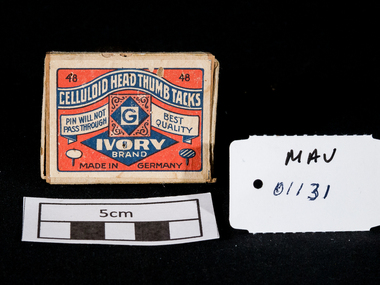
... body, usually made of steel or brass. The head is wide to distribute the force of pushing the tack in, allowing only the hands to be used. Many head designs exist: flat, domed, spherical, cylindrical and a variety of novelty heads. drawing pins thumb tacks brass tacks moore edwin kirsten johann on Box ; 48 / 48 / CELLULOID HEAD THUMB TACKS / 'G' / PIN WILL NOT / PASS THROUGH / BEST / QUALITY / IVORY / BRAND / MADE IN GERMANY Cardboard box with sliding insert that contained 48 'IVORY' Brand celluloid head Thumb Tacks Manufactured Objects, Thumb Tacks 'Ivory' GURA PTY LTD ...A thumb tack, push pin or drawing pin is a short nail or pin used to fasten items to a wall or board for display and intended to be inserted by hand, generally without the assistance of tools. A variety of names are used to refer to different designs intended for various purpose. Edwin Moore invented the "push-pin" in 1900 and founded the Moore Push-Pin Company. Moore described the push-pin as a pin with a handle. Later, in 1904, in Lychen, German clockmaker Johann Kirsten invented flat-headed thumb tacks for use with drawings. A thumb tack has two basic components: the head, often made of plastic, metal or wood, and the body, usually made of steel or brass. The head is wide to distribute the force of pushing the tack in, allowing only the hands to be used. Many head designs exist: flat, domed, spherical, cylindrical and a variety of novelty heads.Cardboard box with sliding insert that contained 48 'IVORY' Brand celluloid head Thumb Tackson Box ; 48 / 48 / CELLULOID HEAD THUMB TACKS / 'G' / PIN WILL NOT / PASS THROUGH / BEST / QUALITY / IVORY / BRAND / MADE IN GERMANYdrawing pins, thumb tacks, brass tacks, moore edwin, kirsten johann -
 City of Moorabbin Historical Society (Operating the Box Cottage Museum)
Manufactured Objects, Thumb Tacks 'GURA', GURA Pty Ltd
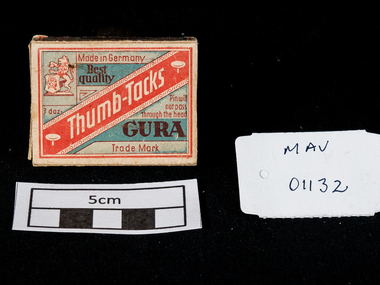
... body, usually made of steel or brass. The head is wide to distribute the force of pushing the tack in, allowing only the hands to be used. Many head designs exist: flat, domed, spherical, cylindrical and a variety of novelty heads. On box ...A thumb tack, push pin or drawing pin is a short nail or pin used to fasten items to a wall or board for display and intended to be inserted by hand, generally without the assistance of tools. A variety of names are used to refer to different designs intended for various purpose. Edwin Moore invented the "push-pin" in 1900 and founded the Moore Push-Pin Company. Moore described the push-pin as a pin with a handle. Later, in 1904, in Lychen, German clockmaker Johann Kirsten invented flat-headed thumb tacks for use with drawings. A thumb tack has two basic components: the head, often made of plastic, metal or wood, and the body, usually made of steel or brass. The head is wide to distribute the force of pushing the tack in, allowing only the hands to be used. Many head designs exist: flat, domed, spherical, cylindrical and a variety of novelty heads. Cardboard box with sliding insert that contained 3 Doz. GURA Brand Thumb Tacks On box ; MADE IN GERMANY / BEST / QUALITY / 3 doz. / THUMB-TACKS / Pin will / not pass / through the head / GURA / Trade Mark -
 City of Moorabbin Historical Society (Operating the Box Cottage Museum)
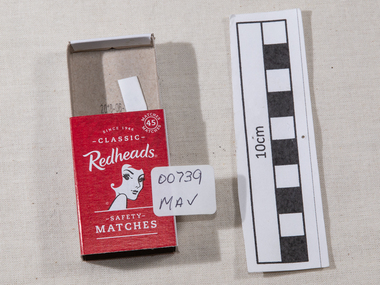
Manufactured Objects, safety matches 'Redheads' 2015, c2015
... STRIKE / GENTLY AWAY FROM BODY . / barcode. An empty box of 'Redheads' safety matches made in Sweden for ST-Group, Springvale, Victoria, Australia c2015. ...This is a current example of the 'Redhead' logo used by Bryant & May Ltd Richmond,Victoria, Australia c 1946 - 1980 On 15th December 1909, Bryant & May, Australia’s first match factory at Church Street, Richmond, Victoria. was opened by The Honourable Alfred Deakin, Prime Minister of Australia, and Mrs. Deakin. It was heralded by the first Commonwealth Government of newly-federated Australia because the government of the day was anxious to encourage secondary industry and pledged tariff protection of local manufacturers. The building was constructed in 1909 as the Empire Works to a design by prolific Melbourne architect William Pitt and was purchased soon after by British safety match manufacturer Bryant and May, who significantly expanded the building, adding another level and the landmark clock tower. Bryant and May were unique in that they operated as a model factory, providing workers with conditions and amenities that even today seem generous. These included a dining hall and sports facilities such as a tennis court and bowling green which were constructed in the 1920s. Bryant and May ceased Australian match manufacture in the early 1980s as a result of import competition. Their iconic Redheads matches are now imported from Sweden. The complex has since been converted for use as offices and showrooms but is extremely well preserved. It is listed on the Victorian Heritage Register. Bryant and May was a United Kingdom (UK) company created in the mid-nineteenth century specifically to make matches. Their original Bryant and May Factory was located in Bow, London. They later opened other match factories in the United Kingdom and Australia, such as the Bryant and May Factory, Melbourne; and owned match factories in other parts of the world. Bryant and May survived as an independent company for over seventy years, but went through a series of mergers with other match companies and later with consumer products companies. To protect its position Bryant and May merged with or took over its rivals. In 1971 the Northern Ireland factory, Maguire & Patterson closed down following a terrorist attack.. In the 1980s, factories in Gloucester and Glasgow closed too leaving Liverpool as the last match factory in the UK, until December 1994. . The registered trade name Bryant and May still exists and it is owned by Swedish Match Industries as are many of the other registered trade names of the other, formerly independent, companies within the Bryant and May group. Two French chemists, Henri Savene and Emile David Cahen, proved in 1898 that the addition of phosphorus sesquisulfide meant that the substance was not poisonous, that it could be used in a "strike-anywhere" match, and that the match heads were not explosive. British company Albright and Wilson, was the first company to produce phosphorus sesquisulfide ( Red Phosphorous) matches commercially. The company developed a safe means of making commercial quantities of phosphorus sesquisulfide in 1899 and started selling it to match manufacturers. Matches were first produced by Bryant & May in Australia in 1909. The Redhead name applies to the red striking heads of the matches which were introduced to Australia in 1946. The logo on the matchbox depicted the head and shoulder of a redheaded woman and has had four major updates since that time with a number of special issues depicting animals, birds and notable persons also producedThe Bryant & May Ltd factory in Church St Richmond is a listed building and has been converted to apartments following the closure of the Company 1980. Bryant & May's Ltd were influential in fighting against the dreadful disease known as Phossy jaw which was caused by white phosphorus used in the manufacture of the early matches. They were also the object of the 'Match Girls Strike' in London 1888, which won important improvements in working conditions and pay for the mostly female workforce working with the dangerous white phosphorus. The public were slow to purchase these safety matches because of the higher price An empty box of 'Redheads' safety matches made in Sweden for ST-Group, Springvale, Victoria, Australia c2015. The tray for the matches slides inside the open ended cover. The striking patch is on both sides of the cover. The matches have been removed. Matches were first produced by Bryant & May in Australia in 1909. The Redhead name applies to the red striking heads of the matches which were introduced to Australia in 1946. The logo on the matchbox depicted the head and shoulder of a redheaded woman and has had four major updates since that time with a number of special issues depicting animals, birds and notable persons also produced. Bryant and May ceased Australian match manufacture in the early 1980s.Top of cover ; Redheads / 45 safety / matches . Logo ; head & shoulders of a female with red hair Base of coverMade in Sweden / Redheads (R) is proudly marketed / by ST- Group Australia. / 718 Princes Highway Springvale Vic. 3171 / .............../ Readheads is a registered trademark / of Swedish Match Industries AB. / Complies ith European / Match Standard EN 1783-1997-SAF/ WARNING; / KEEP OUT OF REACH / OF CHILDREN. STRIKE / GENTLY AWAY FROM BODY . / barcode.redheads safety matches, safety matches, bryant & may pty ltd, phossy jaw disease, early settlers, moorabbin, bentleigh, cheltenham, lights, lamps, tobacco, white phosphorous, phosphorus sesquisulfide, swedish match pty ltd, pitt william, savens henri, cahen emile david , richmond victoria, match girls strike 1888,
