
Showing 4 items matching "box hill (vic.) -- mayoresses"
-
 Kew Historical Society Inc
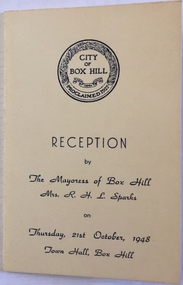
Document (item) - Invitation, City of Box Hill, Reception, 1948
... ...box hill (vic.) -- mayoresses...As a continuous record, ranging across most decades of the Twentieth Century, they reveal changing tastes in design, values and relationships in the history of local government in Victoria. ephemera civic ephemera mayoral balls civic invitations city of box hill box hill (vic.) -- mayoresses mrs r h l sparks Invitation to a Reception in the West Hall, Town Hall, Box Hill in 1948. ...The Municipality of Kew (1860-1863), the Borough of Kew (1863-1910), the Town of Kew (1910-1921) and the City of Kew (1921-1994) were local government instrumentalities in the State of Victoria. In 1994, the City of Kew was amalgamated, together with the former Cities of Camberwell and Hawthorn, into the new City of Boroondara (1994- ). Like other local government entities of the period, Kew was administered by town clerks. The two notable town clerks in Kew's history were H. H. (Henry Hirst) Harrison (1868-1955) and W. D. (William Dickie) Birrell (1899-1974). Harrison was appointed to the position in 1901 and retired in 1938 after 37 years. Birrell, appointed Acting Town Clerk in 1921, became Town Clerk in 1938, following Harrison's retirement. He continued in this role until his retirement in 1966. A large part of this collection of civic ephemera was assembled by W. D. Birrell. This is part of an historically significant civic collection, containing hundreds of separate invitations, documents, greeting cards, programmes and tickets issued and/or collected by successive town clerks. Items in the collection illuminate the political, social and cultural history of the district. As a continuous record, ranging across most decades of the Twentieth Century, they reveal changing tastes in design, values and relationships in the history of local government in Victoria. ephemera, civic ephemera, mayoral balls, civic invitations, city of box hill, box hill (vic.) -- mayoresses, mrs r h l sparks -
 Mission to Seafarers Victoria
Photograph - Digital photograph
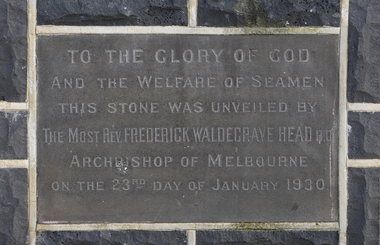
... In February 1929 a fundraising was organised by the Box Hill branch of the Ladies Harbour Lights Guild: "The Mayoress of Box Hill (Mrs. ...In February 1929 a fundraising was organised by the Box Hill branch of the Ladies Harbour Lights Guild: "The Mayoress of Box Hill (Mrs. ...Built in 1888, the building at Port Melbourne was in need of renovation. In February 1929 a fundraising was organised by the Box Hill branch of the Ladies Harbour Lights Guild: "The Mayoress of Box Hill (Mrs. C. Palling) opened a very successful Australian tea, held on Tuesday afternoon in St. Peter's Parish Hall, by members of the Box Hill branch of the Ladies' Harbour Lights Guild, to raise funds towards the cost of renovating the Port Melbourne Seamen's institute. The building is in a very dilapidated condition, and is totally inadequate for the extensive requirements of the Mission to Seamen." (1929 'AUSTRALIAN TEA.', Box Hill Reporter (Vic. : 1925 - 1930), 15 February, p. 7.) "Additional buildings at the Seamen's Institute, conducted by the Victoria Missions to Seamen, at Port Melbourne, were officially opened and dedicated yesterday (23 January 1930) by Archbishop Head. The additions, which have been erected at a cost of £3000, comprise an extension of the recreation hall, new canteen and office, ladies' rest room, apprentices' room, officers' room, and five-roomed dwelling, for the caretaker." 1930 'MISSION TO SEAMEN.', The Age (Melbourne, Vic. : 1854 - 1954), 24 January, p. 13. Rectangular foundation stone with inscription inlayed in a bluestone wall. To the glory of God and the welfare of seamen/ This stone was unveiled by the most Rev. Frederick Waldegrave Head B.O. Archbishop of Melbourne, on the 23rd day of January 1930 archbishop head, port melbourne, reverend h. s. bailey, building renovations, 1930, port melbourne mission -
 Ringwood and District Historical Society
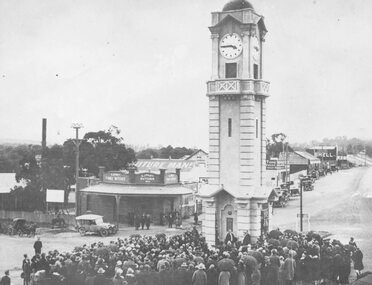
Photograph, Opening of clock tower by Mayor W. Mackinlay in August 1928
... The Salvation Army band from Box Hill rendered suitable music, while Sergeant E. ...The Salvation Army band from Box Hill rendered suitable music, while Sergeant E. ...Age (Melbourne, Vic. : 1854 - 1954), Monday 6 August 1928, page 9 ________________________________________ RINGWOOD WAR MEMORIAL CLOCK TOWER UNVEILED A CIVIC CEREMONY. The people of Ringwood have erected a beautiful stone clock tower at a cost of £1797, as a memorial to those who served in the war. The unveiling ceremony was performed by the mayor of Ringwood (Cr. W. Mackinlay) on Saturday. “Bleak conditions with showers intervening prevailed at Ringwood on Saturday afternoon, when the unveiling ceremony of the soldiers' memorial clock tower, performed by the mayor (Cr. W. Mackinlay) took place in the presence of a Iarge and representative gathering. The ceremony was solely a civic one. A majority of members of the local branch of the R.S.S.I.L.A. had wished that Sir John Monash be invited to take a prominent part in the proceedings, but the trustees elected otherwise. The Salvation Army band from Box Hill rendered suitable music, while Sergeant E. P. Taylor (37th Battalion, A.I.F) sounded the Reveille and The Last Post impressively. Among those present were Mr. Edgar, M.L.C., the vicar of Ringwood (Rev. E. E. Robinson), Rev. G. McLaren (Methodist), the memorial trustees (Cr. J. B. McAlpin, Messrs, J. W. Barrett, A. H. Locke, J. A. Williams and A. G. Ashley). The last two mentioned are president and honorary secretary respectively of the local branch of the R.S.A. Soldier delegates from Camberwell and Mitcham were also present. At the outset the mayor said a few words would not be amiss concerning why the memorial had been so long delayed in being erected. In September, 1919, a public committee was formed, with Mr. A. V. Greenwood as chairman, to consider the erection of a suitable memorial to the soldiers. Among the more important suggestions had been the building of a hall and clubrooms on land generously offered by Mr. R. W. Dawes. This project had been abandoned, also the proposed erection of a huge memorial building, at a cost of £5000, on the site of the present town hall. As two years had passed without anything of a definite nature eventuating it was decided to elect five trustees, comprising three citizens and the president and secretary of the Returned Soldiers' Association with full power to act. In all propositions the trustees had been faced with financial difficulties, but about the time of the completion of the plans of the memorial tower Ringwood became a borough, and the new council was appealed to, and provided £500 to make the erection of the memorial possible. The architect, (Mr. H. Norris) had refused to take anything beyond out-of-pocket expenses (£16), while the engineer (Mr. Lucas) had saved a goodly sum by supervising the work. The total funds at the disposal of the trustees, including the council's donation, was, in round figures £1807. The tower complete would cost £1690; honor roll, £77, and fees paid for various designs had amounted to £30. The total expenditure was £1797, leaving a credit balance of £10. Before the unveiling the mayor, in again addressing the citizens, said he deemed it a privilege to perform such a task in connection with so splendid a memorial. The citizens had erected it as an expression of heartfelt gratitude in memory, first of all, of those heroes who gave not only their services, but their lives, when the call came in the common cause of right and liberty, upon which the British Empire was built. This memorial was also the tribute of the citizens in a degree of appreciation to those men who so un-selfishly and ungrudgingly volunteered their services in the Great War. The memorial, while commemorating the glorious deeds of Australian manhood, was not intended, in any sense, as a glorification of war. The memorial would tend to bring to one's mind the blessing of peace in contrast to the curse of hostilities. They were gathered there that afternoon to do honor to all those who volunteered for service to the Great War, but they wished to assure the friends and relatives of those who paid the supreme sacrifice of their sincere sympathy and trust. If ever in the future this fair southern land of ours was threatened by an invader he felt sure that Australian manhood would not hesitate to rally to the call to duty and defend the freedom of their country. Following prayer by Rev. G. McLaren (Methodist), the memorial clock tower was unveiled, the acting mayoress (Mrs. Mackinlay) cutting the cord, after which the making over of the memorial to the borough council took place, the president of the local branch of the R.S.A. (Mr. J. A. Williams) stating he had pleasure in accepting the key on behalf of the trustees. As the council was the permanent governing body the key would be handed back to the mayor, the memorial being given into the safety and custody of the council. During the proceedings the hymns O God, Our Help in Ages Past and Lest We Forget were rendered, the choirs of various denominations joining in the singing. Benediction was pronounced by the vicar of Ringwood (Rev. E. E. Robinson).” Black and white photograph (2 copies- one original mounted on cardboard backing) Written on rear of backing of original: "Opening of clock tower by Mayor W. Mackinlay, 4.8.1928." Written on back of copy" "Mayor Mackinlay dedicating Ringwood clocktower in original position at end of Warrandyte Rd. 1928. Maroondah Hwy on right." -
 Broadmeadows Historical Society & Museum
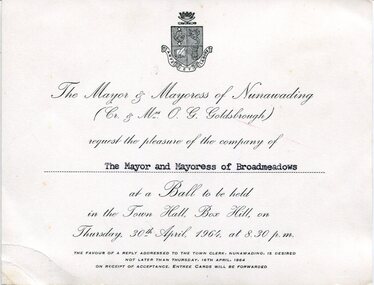
Ephemera - Invitation, Ball Invitation, City of Nunawading, 1963, 1964
... Local government Municipal ceremonies Civic hospitality City of Nunawading (Vic.) City of Broadmeadows (Vic.) Box Hill Town Hall Recto, printed:“The Mayor & Mayoress of Nunawading/(Cr. & Mrs O. ...Reflects formal civic relationships between the municipalities of Nunawading and Broadmeadows during the mid twentieth century and illustrates the social role of municipal leadership in Victoria during the 1960s. This invitation provides documentary evidence of inter municipal civic culture and social practices in suburban Melbourne during the 1960s, highlighting the ceremonial functions of mayors and the importance of formal municipal events. Single square cornered printed invitation card with black ink on cream paper. Recto contains municipal coat of arms and formal script text. Verso is blank apart from an adhered later collection label. Recto, printed:“The Mayor & Mayoress of Nunawading/(Cr. & Mrs O. G. Goldsbrough)/request the pleasure of the company of/The Mayor and Mayoress of Broadmeadows/at a Ball to be held/in the Town Hall, Box Hill, on/Thursday, 30th April, 1964, at 8.30 p.m./The favour of a reply addressed to the Town Clerk, Nunawading, is desired/not later than Thursday, 16th April, 1964./On receipt of acceptance, entree cards will be forwarded.” Back (verso, adhesive label): “WI 4055” local government, municipal ceremonies, civic hospitality, city of nunawading (vic.), city of broadmeadows (vic.), box hill town hall
