
Showing 54 items matching "brass founders"
-
 Bendigo Historical Society Inc.
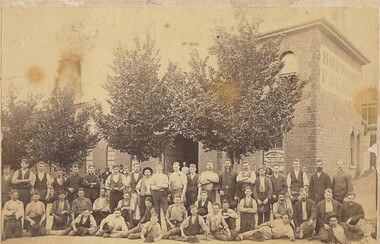
Photograph - HORWOOD AND SONS ENGINEERS: MILLWRIGHTS, IRON AND BRASS FOUNDERS, 1900
... HORWOOD AND SONS ENGINEERS: MILLWRIGHTS, IRON AND BRASS FOUNDERS...... Iron and Brass Founders at the corner of Vine and Mackenzie Streets. ...Sepia photo with approx 50 workmen outside Horwood's Foundry, on window 'Horwood and Son, Engineers, Millwrights, Iron and Brass Founders. Vine Street sign on building. ...Photograph HORWOOD AND SONS ENGINEERS: MILLWRIGHTS, IRON AND BRASS FOUNDERS ...Sepia photo with approx 50 workmen outside Horwood's Foundry, on window 'Horwood and Son, Engineers, Millwrights, Iron and Brass Founders. Vine Street sign on building. Blue line drawn around image.R. Dermer Smith, Bull street, Sandhurstorganization, business, horwood and sons engineers, horwood and son, engineers, millwrights, iron and brass founders at the corner of vine and mackenzie streets. began as the bendigo iron works in 1856. this photograph of some of the staff was taken by r. dermer smith of bull street, sandhurst abo -
 Flagstaff Hill Maritime Museum and Village
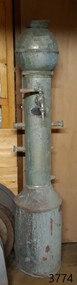
Functional object - Water Boiler, Jackson Boilers Ltd, 1920s
... ...brass founders...Jackson Boilers Ltd., brass founders, electro platers and sheet metal works made this tube water boiler. ...Jackson Boilers Ltd., brass founders, electro platers and sheet metal works made this tube water boiler. ...Jackson Boilers Ltd., brass founders, electro platers and sheet metal works made this tube water boiler. It was a fitting in the vessel Reginald M, a small cargo ship built at Port Adelaide in 1922 and named after her builder and first owner, John Murch. The Reginald M was launched at Largs Bay, South Australia, in 1922 to carry cargo around South Australia that included guano, barley, wool, horses, cattle, timber, explosives, potatoes, shell grit, and gypsum. It passed through numerous owners over the years and primarily maintained its purpose as a cargo vessel. In 1975, the decommissioned Reginald M was purchased by Flagstaff Hill Maritime Museum as an attraction. Although restoration efforts were undertaken and maintained for the craft above the water line, deterioration occurred below the surface and resulted in the ship being unsafe for visitors to board. It was broken up and removed from Flagstaff Hill in 2018, but items such as the historical boiler remain in Flagstaff Hill’s Collection. JACKSON BOILERS LTD.: - In 1911, Henry Jackson was the Managing Director at Jackson Boilers Ltd. He had gained around 30 years’ experience as a tin plate worker, plumber and gas fitter at Ilkey in 1881, then at Leeds by 1901. By 1921, he had changed employment from Jackson Boilers to Managing Director of Patent Water Boilers. During World War I, Jackson Boilers Ltd of Leeds performed war work like many other manufacturers at that time. The firm made cases for the explosive picric acid and electroplated fuse hole plugs. In 1918, the firm employed 15 males and 19 females. Jacksons Boilers became very successful throughout the first half of the twentieth century with showrooms and sales offices in Scotland, the Midlands and Southern England. It also had an office in Dublin, Ireland. In the post-war 1920s, the firm’s production included instantaneous water boilers and coffee machines for cafes, restaurants and canteens. Jackson Boilers also began to supply shipping lines with catering water boilers for their ships. The firm applied for a USA patent for the tube boiler in 1930, for the design which appears to have been invented in 1926. A 1971 advertisement adds the credentials, Members of the Catering Equipment Manufacturers’ Association. The tube water boiler was designed specifically for use in a ship's restaurant or dining area and patented by Jackson Boilers Ltd. of Leeds. The boiler is significant as a patented design, illustrating the evolution of maritime, commercial and domestic water boilers that have led to many innervations and improvements in today's boilers that are used in heating and in producing hot water for domestic and catering use. It is also significant as it is one of the earlier boilers the Jackson company made in the early 1920s before they applied for a US patent on their revised design in 1926.Water boiler, free standing Jackson's Tube boiler. A tall metal cylindrical stand with a metal sphere on top and several pipe fittings on the sides. A brass tap with a lever handle is connected to the front. A plaque with maker's details is attached under the tap. Details are also impressed into the cylinder above the tap.Jackson Boilers Leeds Ltd. "JACKSON'S PATENT" . Other details indecipherable. flagstaff hill maritime museum and village, flagstaff hill maritime museum, flagstaff hill, maritime museum, maritime village, warrnambool, great ocean road, leeds, jackson boilers ltd, jackson boilers, henry jackson, brass founders, electro platers, sheet metal works, patent water boilers, leeds manufacturer, tube water boiler, domestic boiler, tube domestic boiler, tube boiler, water heaters, water boilers, self-feeding water boilers, sheet metal work instantaneous water heaters, engineering, allied trades, metal workers, metal trade, food machinery, hospitality equipment, ship equipment, ship water boiler, ship heater, catering boilers, café boiler, restaurant boiler, canteen boiler, catering equipment manufacturers’ association, cema, kitchen equipment, kitchen appliance, war work, world war i, wwi, picric acid, picric acid cases, fuse hole plugs, electro plated fuse hole plugs, reginald m, cargo ship, port adelaide, 1922, john murch -
 Flagstaff Hill Maritime Museum and Village
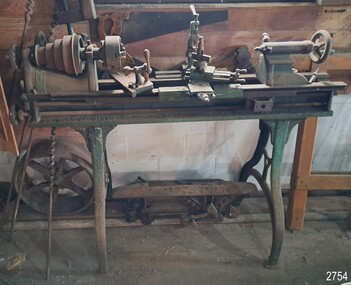
Machine - Lathe, W F & John Barnes, early 1900s
... ...brass foundry...founders...Barnes Illanois early 20th century Briggs Briggs Brass Foundry Briggs Marine Foundry Briggs Marine Products Herbert Harrison Briggs George Edward Briggs Cyril Falkiner McKinnon Briggs Collingwood Moorabbin Frank Lee Les Lee Eva Lee Briggs Marine Warrnambool non-ferrous founders bell specialists ship bell specialists sand cast marine equipment marine fittings foundry brass foundry founders “W F and J Barnes, Rockford, USA” "1820" "1887" The lathe is a green, bench-type, steam-powered woodworking machine. ...This woodworking lathe, connected to both a pulley and a flywheel, demonstrates its historical operation with a steam engine. Such a configuration reflects manufacturing practices from the late 1800s and early 1900s, when steam power was the predominant source for driving workshop and factory machinery. Large machine shops often utilised a single power source, distributing power via roof-mounted belts and pulleys to operate several machines simultaneously. Over time, petrol-driven motors were introduced, and eventually, electricity became the standard power source. Conversion kits were made available in the late 19th and early 20th centuries to adapt older lathes to these newer, cleaner fuels. Manufacturer's History: W.F. & J. Barnes was a renowned maker of hand- and foot-powered treadle woodworking and metalworking machinery, established in 1869. The partnership between William F. Barnes and John Barnes was formalised in 1872, and the firm was incorporated in 1884. Their machines were used for both ‘farm’ applications and professional engineering. By 1881, the company began producing electrically powered machinery. By 1937, W.F. & J. Barnes expanded into manufacturing machinery for automotive assembly. The business closed in 1983, and in 1998, LeBlond Ltd. of Ohio acquired the firm. The lathe was donated by Briggs Marine, Melbourne: In Flagstaff Hill’s formative years, 1972-1975, Briggs Marine, Melbourne (Briggs Brass Foundry), donated equipment and objects used or made at their premises. The foundry was established in 1912 by Herbert Harrison Briggs. In 1965, the firm was owned by partners Cyril Briggs and Frank Lee: Cyril died in 1967, and Frank died in 1971, so the foundry was then run by his son and daughter-in-law, Les and Eva Lee. Briggs Marine’s Warrnambool Branch closed in 1972 after the death of Frank Lee in 1971. Flagstaff Hill’s founding director, John Lindsay, recalled that Briggs Marine’s family members gave personal assistance in setting up the displays in the original village shops, particularly the ‘Brass Foundry’ building, around the time the Maritime Museum opened in 1975. Briggs Marine still exists today, but the Briggs family is no longer involved. This early 1900s lathe marks a significant stage in the evolution of machinery, positioned between the era of hand-operated machines and the advent of electrically powered equipment. Its presence exemplifies the progression of industrial technology and craftsmanship during this period. The lathe is particularly notable for its association with the Briggs Brass Foundry. The foundry was known for developing a specialised brass alloy composed of non-ferrous metals, a formulation that resulted in durable products built to withstand the demanding conditions of marine environments. This focus on resilience and longevity made Briggs Brass Foundry’s goods highly sought after within the maritime sector. Briggs Maine, a long-established business, utilised the foundry’s capabilities to create cast goods tailored to the needs of the marine industry. The facility was equipped to deliver both custom-designed and mass-produced items, ensuring versatility in meeting various requirements. Many of Briggs Foundry’s products found their place on sailing and steam vessels throughout Victoria’s coastline, including in the port town of Warrnambool, where there was once a brancy of Briggs Marine. In addition to general marine fittings, Briggs Marine earned recognition for its expertise in bell-founding. The foundry’s reputation is closely linked to the restoration of the Schomberg Bell at Flagstaff Hill, a small but historically significant bell from a luxury migrant vessel dating back to the mid-19th century. The successful restoration of the Schomberg Bell demonstrates Briggs Brass Foundry’s commitment to preserving craftsmanship and maritime heritage.The lathe is a green, bench-type, steam-powered woodworking machine. Its bench is supported by decorative posts at each end, with each post dividing into arched legs. The lathe is mechanically connected to both a pulley and a flywheel, designed to be operated in conjunction with a steam engine. Included with the lathe is a range of accessories. Across the front of the machine, an inscription is cast, and a stamped, metal lathe pulley guide is attached to the drive mechanism. The lathe was manufactured by W. F. and J. Barnes, Rockford, Illinois, USA, during the 1900s.“W F and J Barnes, Rockford, USA” "1820" "1887"flagstaff hill, flagstaff hill maritime museum and village, warrnambool, maritime museum, maritime village, great ocean road, shipwreck coast, lathe, steam-operated lathe, steam-operated pulley, steam power, steam engine, machine, steam operated machine, metal work, foundry work, metal working trade, tool, pulley driven, metalworking, woodworking, barnes lathe, briggs marine, belt driven, wordworking lathe, free standing lathe, bench lathe, steam powered, vintage lathe, woodturning lathe, w. f. and j. barnes, illanois, early 20th century, briggs, briggs brass foundry, briggs marine foundry, briggs marine products, herbert harrison briggs, george edward briggs, cyril falkiner mckinnon briggs, collingwood, moorabbin, frank lee, les lee, eva lee, briggs marine warrnambool, non-ferrous founders, bell specialists, ship bell specialists, sand cast, marine equipment, marine fittings, foundry, brass foundry, founders -
 Flagstaff Hill Maritime Museum and Village
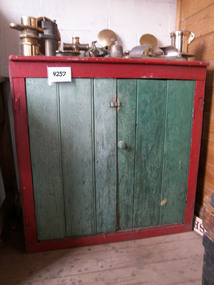
Furniture - Cupboard, 1912-1972
... ...brass foundry...founders...foundering and metalwork, both of which have been essential in supporting marine industries such as shipwrights and boatbuilders. Furthermore, local industries like farming and manufacturing have relied on foundries for the casting of essential equipment. It is believed that Briggs Marine’s family members gave personal assistance in setting up the displays in the original village shops, particularly the ‘Brass...Flagstaff Hill Flagstaff Hill Maritime Museum and Village Warrnambool Maritime Museum Maritime Village Great Ocean Road Shipwreck Coast Briggs Briggs Marine Briggs Foundry cupboard storage brass objects Briggs family marine products village display Briggs Brass Foundry Briggs Marine Foundry Briggs Marine Products Herbert Harrison Briggs George Edward Briggs Cyril Falkiner McKinnon Briggs Collingwood Moorabbin Frank Lee Les Lee Eva Lee Briggs Marine Warrnambool non-ferrous founders bell specialists ship bell specialists sand cast marine equipment marine fittings foundry brass foundry founders Cupboard; wooden, painted red with two green doors, round wood door knobs a wood catch. ...At Briggs’ Brass Foundry, traditional sand-casting techniques have been practised for generations. Sand casting, a craft that spans over two thousand years, involves creating intricate moulds into which molten metal is poured. This handcrafted process produces durable brass and copper alloy goods, which are particularly suited to marine environments. Items such as bells, boat hooks, cowls, propellers, handles, lids, rowlocks, hooks, letters, bolts, rail holders, brackets, deck plates, flanges, rudder guides, portholes and covers have all been made using this technique. The bronze mixture used by Briggs is a copper-based alloy, carefully formulated from locally sourced ingots of copper, tin, zinc and lead in precise quantities. This results in a non-ferrous finished product, renowned for its longevity and resilience, often lasting indefinitely even in harsh conditions. Donation to Flagstaff Hill: In Flagstaff Hill's formative years, 1972-1975, the Briggs family generously donated a range of related items, including casting patterns, brassware, tools, machinery and a cupboard. These patterns illustrate the historic trades of foundering and metalwork, both of which have been essential in supporting marine industries such as shipwrights and boatbuilders. Furthermore, local industries like farming and manufacturing have relied on foundries for the casting of essential equipment. It is believed that Briggs Marine’s family members gave personal assistance in setting up the displays in the original village shops, particularly the ‘Brass Foundry’ building. Exhibition and Legacy: The donated items were displayed in a simulated Brass Foundry within the Village. This exhibit was part of a broader showcase of working crafts, trades and services typical of a Maritime town. The display was available to the public from the completion of the building in 1986 until 1994, when the space was repurposed. A notable feature of the Village Brass Foundry was the historic Cornish chimney, presented as a working model. This chimney visually demonstrated the process of smelting metal in furnaces and pouring it into sand moulds. Constructed from specially curved bricks, the chimney now stands at about two-thirds of its original height, having been relocated from the Grassmere Cheese factory.The small cupboard holds particular significance due to its association with brass foundries operating across Victoria. Marine industries, including ship and boat building, depend heavily on high-quality castings for their machinery, equipment and fittings. Briggs Brass Foundry developed a specialised brass alloy using non-ferrous metals, ensuring the durability and longevity of its products in demanding marine environments. The cupboard is linked to Briggs Maine, a longstanding business dedicated to producing cast goods tailored for the marine sector. The foundry was equipped to meet requirements for both custom and mass-produced items. Briggs Foundry’s products were commonly installed on sailing and steam vessels operating along Victoria’s coastline, including in Warrnambool. In addition to general marine fittings, Briggs Marine was recognised for its expertise in bell-founding. The foundry is notably associated with the Schomberg Bell at Flagstaff Hill, having restored this small, historic bell to its original condition. The Schomberg Bell is a fine example from a luxury migrant vessel dating back to the mid-19th century, reflecting the craftsmanship and heritage preserved by Briggs Brass Foundry.Cupboard; wooden, painted red with two green doors, round wood door knobs a wood catch. Doors are made from tongue-and-groove wood. Inside are two shelves. Stored on the shelves are an assortment of brass hinges, pipes, handles, ventilators, collars, and so on from the Briggs Foundry, Melbourne.flagstaff hill, flagstaff hill maritime museum and village, warrnambool, maritime museum, maritime village, great ocean road, shipwreck coast, briggs, briggs marine, briggs foundry, cupboard, storage, brass objects, briggs family, marine products, village display, briggs brass foundry, briggs marine foundry, briggs marine products, herbert harrison briggs, george edward briggs, cyril falkiner mckinnon briggs, collingwood, moorabbin, frank lee, les lee, eva lee, briggs marine warrnambool, non-ferrous founders, bell specialists, ship bell specialists, sand cast, marine equipment, marine fittings, foundry, brass foundry, founders -
 Federation University Historical Collection
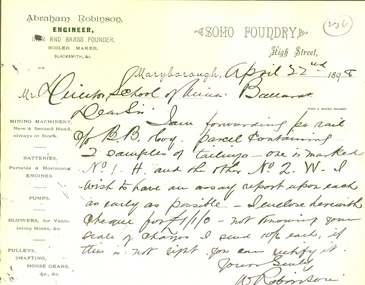
Correspondence, W. Robinson, Correspondence on Soho Foundry Letterhead, 1898, 22/04/1898
... ...brass founder...The letter is on letterhead which includes details for Abraham Robinson, Engineer, iron and brass founder, boiler maker, blacksmith, etc. The correspondence related to two samples of tailings for assay....soho foundry maryborough abraham robinson w. robinson assay ballarat school of mines engineer brass founder iron founder boiler maker blacksmith Correspondence from W. ...Correspondence from W. Robinson of Soho Foundry Maryborough to the Director of the Ballarat School of Mines. The letter is on letterhead which includes details for Abraham Robinson, Engineer, iron and brass founder, boiler maker, blacksmith, etc. The correspondence related to two samples of tailings for assay.soho foundry maryborough, abraham robinson, w. robinson, assay, ballarat school of mines, engineer, brass founder, iron founder, boiler maker, blacksmith -
 Bendigo Historical Society Inc.
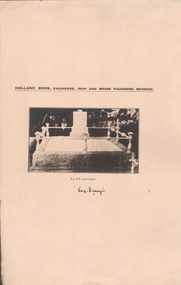
Document - HOLLAND BROS ENGINEERS CATALOGUE
... Engineers, iron and brass founders, Bendigo. Catalogue for grave rails, caste iron lace work, balcony panels, spandrills, Corinthian caps, newel posts, veranda columns, crushing roller, wheels. ...Engineers, iron and brass founders, Bendigo. Catalogue for grave rails, caste iron lace work, balcony panels, spandrills, Corinthian caps, newel posts, veranda columns, crushing roller, wheels. ...Holland Bros. Engineers, iron and brass founders, Bendigo. Catalogue for grave rails, caste iron lace work, balcony panels, spandrills, Corinthian caps, newel posts, veranda columns, crushing roller, wheels. The catalogue is made up of 27 loose pages.books, catalogues, holland bros -
 Bendigo Historical Society Inc.
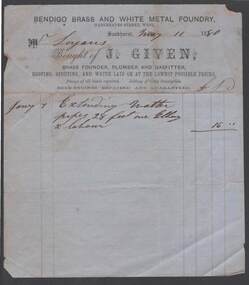
Document - J GIVEN, BENDIGO BRASS, AND WHITE METAL FOUNDRY
... J Given Bendigo Brass, and White Metal Foundry invoice. Brass Founder, Plumber, and gas-fitter. Roofing, Spouting, and Water laid on at the Lowest Possible Prices. ...J Given Bendigo Brass, and White Metal Foundry invoice. Brass Founder, Plumber, and gas-fitter. Roofing, Spouting, and Water laid on at the Lowest Possible Prices. ...J Given Bendigo Brass, and White Metal Foundry invoice. Brass Founder, Plumber, and gas-fitter. Roofing, Spouting, and Water laid on at the Lowest Possible Prices. Invoice dated May 11 1880 issued to Mr Loyans. Extending water pipes 28 feet in length and labour for the amount of sixteen shillings.bendigo, industry, plumbing private house, j given bendigo brass and white metal foundry. -
 Tarnagulla History Archive
Registration of Death form, 1872
... Registration of Death form Name of deceased: Marion Middleton Rank or Occupation: Age: 47 years Cause of Death: Hart (as spelled), Cardiac syncope Duration of illness: Suddenly Date of Death: 22nd April 1872 Place of Death: Newbridge Place of burial: Newbridge Father's name: Andrew Manuel (Brass founder) Mother's name: Janet Manuel ...Registration of Death form Name of deceased: Marion Middleton Rank or Occupation: Age: 47 years Cause of Death: Hart (as spelled), Cardiac syncope Duration of illness: Suddenly Date of Death: 22nd April 1872 Place of Death: Newbridge Place of burial: Newbridge Father's name: Andrew Manuel (Brass founder) Mother's name: Janet Manuel Registration of Death form ...A large lot of papers, including this and many other birth and death registration forms, were apparently found in the ceiling cavity of the Sandy Creek/Tarnagulla Post and Telegraph Office in the later 20th Century, during building works. Donald Clark Collection. Registration of Death form Name of deceased: Marion Middleton Rank or Occupation: Age: 47 years Cause of Death: Hart (as spelled), Cardiac syncope Duration of illness: Suddenly Date of Death: 22nd April 1872 Place of Death: Newbridge Place of burial: Newbridge Father's name: Andrew Manuel (Brass founder) Mother's name: Janet Manuel -
 Ballarat Tramway Museum
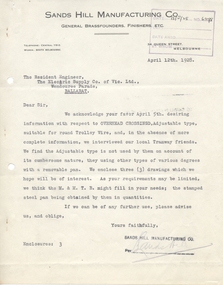
Document - Letter/s, Sands Hill Manufacturing Co, 12/04/1928 12:00:00 AM
... Letter dated 12/4/1928 from the Sands Hill Manufacturing Co, General Brass founders, Finishers Etc of 34 Queen St Melbourne to The Resident Engineer, ESCo, regarding the Overhead Crossing, Adjustable type for round Trolley Wire, forwarding three drawings of fixed type used by the MMTB in Melbourne and stamped steel pans. ...Trams tramways Overhead Points Trolley Wire ESCo Letter dated 12/4/1928 from the Sands Hill Manufacturing Co, General Brass founders, Finishers Etc of 34 Queen St Melbourne to The Resident Engineer, ESCo, regarding the Overhead Crossing, Adjustable type for round Trolley Wire, forwarding three drawings of fixed type used by the MMTB in Melbourne and stamped steel pans. ...Yields information about the manufacture of brass overhead crossings and the complex ones ESCo were using compared to the MMTB.Letter dated 12/4/1928 from the Sands Hill Manufacturing Co, General Brass founders, Finishers Etc of 34 Queen St Melbourne to The Resident Engineer, ESCo, regarding the Overhead Crossing, Adjustable type for round Trolley Wire, forwarding three drawings of fixed type used by the MMTB in Melbourne and stamped steel pans. Typed on Mount Royal Bond Made in Canada paper.trams, tramways, overhead, points, trolley wire, esco -
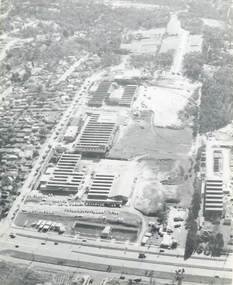 Whitehorse Historical Society Inc.
Photograph, Luke Group, 1959
... He bought 40 acres of cherry orchard in Mitcham in 1952 from a Miss Cook, then went to England and attracted finance from Singer Brass Founders. The company became Luke and Singer. ...He bought 40 acres of cherry orchard in Mitcham in 1952 from a Miss Cook, then went to England and attracted finance from Singer Brass Founders. The company became Luke and Singer. ...K.G. Luke had a foundry in Queen's Parade, Melbourne which made badges and manufactured items for the Armed Forces during the First World War. He bought 40 acres of cherry orchard in Mitcham in 1952 from a Miss Cook, then went to England and attracted finance from Singer Brass Founders. The company became Luke and Singer. The three factories on site were Luke Manufacturing - stainless steel products and hospital equipment, Luke and Singer - a non-ferrous foundry producing components for industry such as nuts and cutlery, and Concentric Engineering - machinery components. Later the manufacture of refrigeration and air conditioning was added at the rear of the complex. A small aerial photograph and 2 A4 photocopies of the K.G.Luke Group of companies in 1959. The factory site is divided into three groups with Whitehorse Road situated at the bottom of the photo and Cook Road Mitcham to the left. Notes at ND6245luke manufacturing, k.g.luke group, luke and singer, concentric engineering, wheatland, vic, manufacturing industry, foundries, engineering industries -
National Wool Museum
Envelope
... Envelope, "David Sowden & Sons, Engineers, Iron, Brass and Copper Founders, Shipley, York". Contained photographs of "David Sowden & Sons looms and was in a package of material from Yarra Falls Mill....Envelope, "David Sowden & Sons, Engineers, Iron, Brass and Copper Founders, Shipley, York". Contained photographs of "David Sowden & Sons looms and was in a package of material from Yarra Falls Mill. ...Envelope, "David Sowden & Sons, Engineers, Iron, Brass and Copper Founders, Shipley, York". Contained photographs of "David Sowden & Sons looms and was in a package of material from Yarra Falls Mill.textile machinery weaving, yarra falls mill david sowden & sons, weaving looms, weaving machinery, textile machinery, weaving -
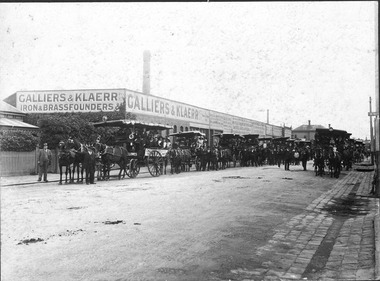 St Kilda Historical Society
Photograph - Industrial, Galliers & Klaerr Iron and Brass Foundry
... Galliers & Klaerr, Iron and Brass Founders Inkerman St, St Kilda. Setting off for the Annual Picnic. ...Galliers & Klaerr, Iron and Brass Founders Inkerman St, St Kilda. Setting off for the Annual Picnic. ...Galliers & Klaerr, Iron and Brass Founders Inkerman St, St Kilda. Setting off for the Annual Picnic. Galliers & Klaerr was an iron foundry and plumbing business in St Kilda, known for producing gas, cooking, and heating stoves from 1883. Located on Inkerman Street, the firm was a major industrial employer in the area, specializing in cast iron stoves and appliances until the company was sold in the 1960s. Henry Albert Galliers (1845-1907), born in England and a plumber and gasfitter by trade, moved to Australia in 1872 and set up business in rented premises in High Street, and later Inkerman Street. In 1882-1883 he established Galliers & Klaerr with Frederick Klaerr (1856 - 1934), also a plumber. Galliers returned to England in 1980 and the partnership was dissolved, with Klaerr undertaking to continue the business on his own account and to continue to use the business name Galliers & Klaerr. After the company was sold in 1960 the site became the St Kilda 10-pin Bowl, then a data processing centre, and then a Commonwealth Employment Service. These days it is the Aldi Supermarket.black and white photograph, mounted, original, good conditionOn front: Setting off for the Annual Picnicgalliers & klaerr, st kilda businesses -
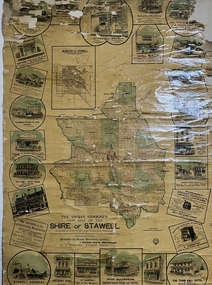 Stawell Historical Society Inc
Advertising Material, Wall map of Stawell Shire & Borough of Stawell. Supplement Stawell Times & Wimmera Advertiser
... (Late Wayman & Kay) Iron & Brass Founders, Engineers , Etc Stawell. ...(Late Wayman & Kay) Iron & Brass Founders, Engineers , Etc Stawell. Businesses The Unique Combine's New map of the Shire of Stawell Compiled by H. ...Advertised Stawell Businesses W. Whiteside, Taylor Clothiers Main Stree.t Mitchell Brothers Auctioneers, Stock & Station Agents, Stawell. The Stawell Times & Wimmera Advertiser, R.W. Baxter Manager. J. H. Stabb, Coach Builder. Isaac Cook, Saddler. Main Street Stawell. Gustav Mahnke. Fancy Bread and Biscuit Baker. McMullin Bros, Produce Merchants and Family Grocer. L.C. Phillips, Taylor & Clothier, Main Street Stawell. Victoria House, George Sprague, Family Draper Main Street. Josiah Cook Butchers, Main Street. The Town Hall Hotel, Wm Short, Main Street. R. H. Wadsworth. Practical Watchmaker & Jeweler. Main Street Stawell. John Allingham, Importer General Draper and Outfitter. Boot & Shoe Warehouse. W. Laxton. Boot and Shoe Manufacturer. Stawell Boot Factory, Main Street Stawell. Anthony Bone, Saddler, Main Street Stawell. Stawell Brewery. G. Bryant & Co. H. Edhouse Manager, Stawell West. The Stawell Coffee Palace, Main Street. T. Aldred Proprieter. S. Isaacson, Draper & Clothier . Main Street Stawell. The Wimmera Flour Mill Co. Ltd. W. Frayne, Manager. George Kay & Co. (Late Wayman & Kay) Iron & Brass Founders, Engineers , Etc Stawell. Large Paper Wall map coloured with cloth backing. Maps of Shire & Borough of Stawell & Advertising The Unique Combine's New map of the Shire of Stawell Compiled by H. E. Ward late Government Draftsmann businesses -
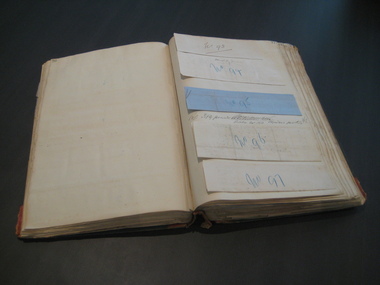 Federation University Historical Collection
Book, Ballarat School of Mines Invoice Book, 1870 - 1875
... King, Iron Merchant, * 1 February 1871 - Richard Tunbridge, Timber Merchant, * January 4th 1871- Henry Gough, * 8th March 1871 William Murfet, * March 1871- Maxwell Morrow, * 1 February 1871- James Curtis, Caxton Steam Printing Works, * May 4th 1871 - William Blomeley, Iron and Brass Founder, * 4 May 1871 - Thomas Rogers, Draper, Milliner, Haberdasher & c. * May14 1871- George Shannon & Co, Importers of China, Glass & Earthenware, * May 31st 1871, Wreford & Co, Machine Printers, *1st July 1871 William McCulloch & Co,( late Reynolds and English) General Carriers to all parts of the Colony, * 1871- J.J. ...King, Iron Merchant, * 1 February 1871 - Richard Tunbridge, Timber Merchant, * January 4th 1871- Henry Gough, * 8th March 1871 William Murfet, * March 1871- Maxwell Morrow, * 1 February 1871- James Curtis, Caxton Steam Printing Works, * May 4th 1871 - William Blomeley, Iron and Brass Founder, * 4 May 1871 - Thomas Rogers, Draper, Milliner, Haberdasher & c. * May14 1871- George Shannon & Co, Importers of China, Glass & Earthenware, * May 31st 1871, Wreford & Co, Machine Printers, *1st July 1871 William McCulloch & Co,( late Reynolds and English) General Carriers to all parts of the Colony, * 1871- J.J. ...Scrap book containing invoices relating to accounts to be paid by the Ballarat School of Mines between 1870 until 1875. The School of Mines at Ballarat was the first school of Mines in Australia and was established in 1870. The works done to the former Ballarat Circuit Court House were overseen by Robert Davidson (architect and Surveyor) with the contractor being James Williams. Large book, green leather with red binding, numerous original invoices pasted onto the pages. The first pages of the scrapbook includes correspondence relating to the refurbishment of the former Ballarat Court House which was used as the Ballarat School of Mines from 1870. The building was demolished c1913 to make way for the Ballarat Technical Art School (still standing). * 23 August 1870 - Bateman, Clark & Co, The Ballarat Courier * August 1870 - Klug Bros. Furniture and Bedding Warehouse * April 1870 - J. Armstrong * Statement of Receipts and Expenditure from 23rd Aug. 1870 to 19 January 1871 * W. Gooch, * 1870 - William L. Mullen, Ballarat Stationery Warehouse & Printing Office, * 31Jany. 1871 - A.H. King, Iron Merchant, * 1 February 1871 - Richard Tunbridge, Timber Merchant, * January 4th 1871- Henry Gough, * 8th March 1871 William Murfet, * March 1871- Maxwell Morrow, * 1 February 1871- James Curtis, Caxton Steam Printing Works, * May 4th 1871 - William Blomeley, Iron and Brass Founder, * 4 May 1871 - Thomas Rogers, Draper, Milliner, Haberdasher & c. * May14 1871- George Shannon & Co, Importers of China, Glass & Earthenware, * May 31st 1871, Wreford & Co, Machine Printers, *1st July 1871 William McCulloch & Co,( late Reynolds and English) General Carriers to all parts of the Colony, * 1871- J.J. McDonald, Plumber and Gas Fitters, * August 29th 1871 - Eyres Brothers, Furnishing and General Ironmongers, * 1st August 1871, Frank Pinkerton,H Ben. Franklin Printing and Stationary House 18, Armstrong Street, Ballarat. * 12TH July 1871 J. Donovan, * 10th August, 1871 - Edward Rand, Wholesale Druggist & Importer, *11 Nov 1871 - Matthew Hamilton, * October 2nd 1871 - C.B. Retallack, Engineer and General Smith, *December 8 1871 - James Harrington, * June 1871 - Wayne, Wholesale Druggist * 21st Nov. 1871 - Smith Brothers, Timber Merchants. * 5 January 1872 - T. Eggington, Carpenter, * 12 January 1872 - James Fayle, Plumbers & Ironwork * January 26th 1872 - S. Stansfield, * August 10th 1872 - John H. Hammond Wholesale and Retail, Bookseller, Commercial and General Stationer, etc. etc."VOUCHER" inscribed on spine in gold Each invoice pasted into the scrapbook has a number written onto it. The numbers are in chronological order at start at 1 in each calendar year. ballarat school of mines, redmond barry, hugh gray, henry richards caselli, henry caselli, joseph flude, ballarat court house, harrie wood, clock, invoice book, robert davison, james williams, ballarat circuit court house, old ballarat court, emanuel steinfeld, j.t. sleep, c.b. retallack, john phillips, eyres bros, ballaarat gas company, national insurance company, broadbent bros, charles evans, niven and co, william johnson, william ford, george robertson, william vale, m.d. hamilton, plumbago crucible company, morgans crucibles, h.r. caselli, henry richards caselli, george evans, bateman, clark & co,, klug bros., j. armstrong, w. gooch,, william l. mullen, a.h. king, richard tunbridge, henry gough,, william murfet,, james curtis, william blomeley,, thomas rogers, george shannon, wreford, william mcculloch, j.j. mcdonald, frank pinkerton, ben franklin printing and stationary house, j. donovan, edward rand, matthew hamilton, c.b. retallack,, james harrington, smith brothers,, james fayle,, maxwell morrow,, s. stansfield, walhalla, brunswick house, t rogers -
 Federation University Historical Collection
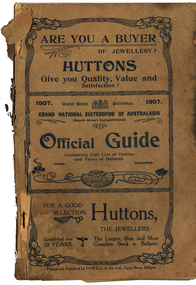
Book - Programme, South Street Eisteddfod Official Guide, 1907, 1907
... Correll Music Seller, James Smith, Isaac Pitman, Arthur Brumfield, Hugh Leschen, John Robson, St Augustine's Band Geelong, Moorabool Falls, Kirks Dam, Ballarat Choral Society, Alfred Deakin, James Long, Hugh McKay Advertisements include: Huttons the Jewellers, Sam Jamieson, Sun Foundry, City Saw Mills, Blomeley Bros Iron and Brass Founders, G. Bongiorno- Railway Fruit Palace, Henry Brind & Co., Andrew Cant, Harrison's Foundry, Umbrella and Sunshade Emporium, Ballarat City Baths, Ballarat Coffee Palace, Irwin's Provincial Hotel, Victa Studio; D. ...Correll Music Seller, James Smith, Isaac Pitman, Arthur Brumfield, Hugh Leschen, John Robson, St Augustine's Band Geelong, Moorabool Falls, Kirks Dam, Ballarat Choral Society, Alfred Deakin, James Long, Hugh McKay Advertisements include: Huttons the Jewellers, Sam Jamieson, Sun Foundry, City Saw Mills, Blomeley Bros Iron and Brass Founders, G. Bongiorno- Railway Fruit Palace, Henry Brind & Co., Andrew Cant, Harrison's Foundry, Umbrella and Sunshade Emporium, Ballarat City Baths, Ballarat Coffee Palace, Irwin's Provincial Hotel, Victa Studio; D. ...South Street competitions have been held in Ballarat since 1991.Official guide to the 1907 South Street competitions. Images include: Prince of Wales, Lord Northcote, W.D. Thomas, South Street Competition Executive Committee (W.H. Pearson, W.H. Chandler, A. Prichard, W.H. Richards, W.D. Hill, Col. Williams, W.D. Thomas, F. Besemeres, F.J. Martell, J.T. Morris. F.J. Williams, R. Maddern, R.J. Gribble), Sir John Madden, Lord Tennyson, W.D. Hill, Frederick Bevan, Ballarat (Sturt Street), Lake Wendouree (Yachts), J.W. Beswick, Lawrence Campbell, City of Ballarat Mayor and Councillor (Mayor Brawn, E. Williams, E. Morey. Cr Brokenshire, J. Whykes, J.M. Barker, G. Crocker, W.D. Hill, R. Pearse, T. Hollway), Ballarat East Mayor and Councillors (J. Gent, Cr Glendenning, J.N. Dunn, I. Pearce, C. Bunting, A. Levy, J. Ritchie, J. McNeil, A. McKenzie, Cr Penhalluriak), Sturt Street Looking West, Old Curiosity House, Entrance to the Ballarat Fine Art Gallery, Interior of the Ballarat Fine Art Gallery, Ballarat East Town Hall and Gardens, Lake Wendouree Ferry, W.E. Swenson, S.B. Swenson, J.G.M. Swenson, Rev. T. Flynn, Edwards' Pyrites, Lestor's Hotel, Sunshine Sheild, W to W Shield, Frank Herman, W.F. Coultman, Marks' Trophy, Lighthouse Port Fairy, R. Correll Music Seller, James Smith, Isaac Pitman, Arthur Brumfield, Hugh Leschen, John Robson, St Augustine's Band Geelong, Moorabool Falls, Kirks Dam, Ballarat Choral Society, Alfred Deakin, James Long, Hugh McKay Advertisements include: Huttons the Jewellers, Sam Jamieson, Sun Foundry, City Saw Mills, Blomeley Bros Iron and Brass Founders, G. Bongiorno- Railway Fruit Palace, Henry Brind & Co., Andrew Cant, Harrison's Foundry, Umbrella and Sunshade Emporium, Ballarat City Baths, Ballarat Coffee Palace, Irwin's Provincial Hotel, Victa Studio; D. Lem Chinese Medical Practitioner, Bosisto's Eucalyptus Oil, Ronaldson Bros & Tippett, Unicorn HOtel, Mrs F. Allen Caterer, Coles & Pullum, J.C. Dillon & Co., Surrey Tannery, Coulthard's Ballarat Business College, George Farmer, MrBride's Boots, L.J. Austin, Dyason's, Ballarat Brewing Company, Phoenix Brewery, Royal Standard Brewery, Edwards' Pyrites, Lestor's Hotel, Robson's College of Music, James A. Gear, Williams Shoemen, Tekardo Brothers, Powell & Co.south street competitions, eisteddfod, chinese herbalist, south street, r.b. lemmon, g. bongiorno, w.d. thomas, john madden, lord tennyson, w.d. hill, frederick bevan, j.w. beswick, lawrence campbell, boer war memorial, queen victoria statue, curiosity shop, m.b. john foundry, ballarat east town hall and gardens, sunshine shield, hugh victor mckay, w to w shield, w.j. coltman, frank herman, j. hutton-jones, t. downer, j. marks, hutton and co trophy, marks trophy, hugh leschen, john robson, st augustine's band, geelong, downer trophy, trekardo brothers, moorabool falls, kirks dam, ballarat choral society, alfred deakin, challenge cup, james long, grand national eisteddfod of australasia, ballarat east gardens, ballarat east town hall -
 Puffing Billy Railway
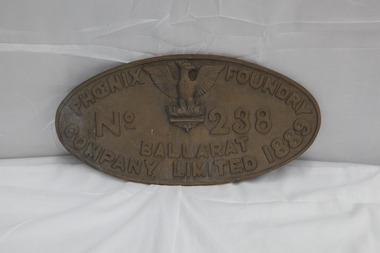
Phoenix Foundry Plate
... By 15 April 1857 they were advertising that they were open for business as engineers, millwrights, boiler makers, smiths, iron founders and brass founders. In January 1858 George Threlfall left the partnership. ...By 15 April 1857 they were advertising that they were open for business as engineers, millwrights, boiler makers, smiths, iron founders and brass founders. In January 1858 George Threlfall left the partnership. ...Phoenix Foundry Plate - replica Made about 2010 cast off original from locomotive Y112 The Phoenix Foundry (1857-1906) fabricated iron and brass products - including engines and pumping gear for the mining industry, locomotives, steam rollers, water pipes, water gauges and diverse small items. Throughout its operation the business was located at premises on Armstrong Street, Ballarat . Background In 1852, at the age of thirty-three and after a year of operating his own engineering business at Williamstown, Lancashire-born blacksmith and engineer George Threlfall (1819-1897) arrived on the Sebastopol gold plain and immediately undertook blacksmith work repairing picks and tools for the miners. Little did he know that this fledgling business would be the genesis of the most iconic business of nineteenth-century Ballarat. At approximately thirty-nine years of age, English mechanical engineer Richard Carter (c1814-1883) came to Australia on board the Arrogant - arriving in Melbourne on 19 April 1853. He soon travelled to the Ballarat goldfields. Born in the year 1830 in Belfast (Ireland), mechanical engineer William Henry Shaw (1830-1896) arrived in Australia in October 1853. He worked briefly with George Threlfall at Sebastopol, then moved to Geelong to manage the small foundry of Frederick Moore. Twenty-four year old English-born iron moulder Robert Holden (c1831-?) left his home in Belfast (Ireland) in late 1854 and travelled from Liverpool to Melbourne on board the James Baines - arriving in February 1855. Afterwards he joined his brother-in-law William Henry Shaw in Ballarat. History Foundation to Incorporation In March 1857 George Threlfall joined in business with Richard Carter, William Henry Shaw and Robert Holden. They relocated Threlfall's successful engineering enterprise from Sebastopol to new premises in Armstrong Street, Ballarat. This business was then known variously as the Phoenix Iron Works Company, Phoenix Foundry or Messrs Carter and Co. By 15 April 1857 they were advertising that they were open for business as engineers, millwrights, boiler makers, smiths, iron founders and brass founders. In January 1858 George Threlfall left the partnership. Incorporation to 1889 1890 to Closing locomotive Y112 Builder: Phoenix Foundry, Ballarat Builder’s Number & Year: 238 of 1889 Designer: Kitson & Co Wheel Arrangement: 0-6-0 No. in class: 31 Entered Service: 24 July 1889 Taken off Register: 11 May 1961 The origins of the Victorian Railways Y-class lay with the decision by Kitson & Co, Leeds to place a 0-6-0 freight locomotive on display at the Centennial International Exhibition, Melbourne in 1888, together with a 2-4-2T suburban passenger locomotive. This marketing initiative proved successful as the Victorian Railways were clearly impressed with these machines, with both purchased after the exhibition and becoming the patterns for new standard locomotive types. Thirty examples of the 0-6-0 heavy freight design were ordered from the Phoenix Foundry, Ballarat, becoming the Y-class for main line heavy freight duties, while the 2-4-2T design became the E-class for Melbourne suburban passenger duties (represented by preserved locomotive E 236). The Y-class prove successful in service and accrued high mileages. They were inevitably superseded by more modern and powerful steam locomotives and a number cascaded into shunting and yard pilot duties, often with the addition of shunters steps along both locomotive and tender. Y 112 was one of the last in service when withdrawn in 1961. Fortunately it was saved for preservation and plinthed in central Ballarat, ostensibly in commemoration of Phoenix Foundry. I understand it is owned by the Sovereign Hill Museums Association. During the 1980’s, Y 112 was leased to Steamrail Victoria and restored to operation at an industrial site in Ballarat. Y 112 features an attractive lined apple green livery and has performed various rail tours around Victoria since restoration. It is normally based at the Steamrail depot in Ballarat East. Y 112 is the only 19th century design in operational condition in Victoria and as such is one of the oldest working steam locomotive in Victoria . Historic - Phoenix Foundry Plate - replica Made about 2010 cast off original from locomotive Y112Phoenix Foundry Plate Oval shaped plate with an image of a phoenix centered at the top with lettering surrounding it.Phoenix Foundry No 238 Ballarat Company Limited 1889.puffing billy, phoenix foundry, ballarat, locomotive y112, phoenix foundry plate - replica -
 Puffing Billy Railway
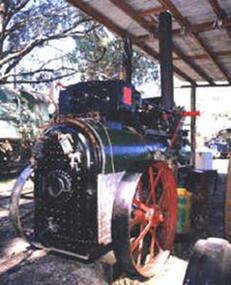
Portable Compound Steam Engine, Marshall & Son's - Builders Number 48317, circa 1908 / 1909
... P/L was founded by James McFarlane Robison and his brothers in 1854, initially as plumbers and coppersmiths, the firm expanded into general engineering, boiler-making and brass, iron and steel founders and became one of Melbourne's most important engineering firms. ...P/L was founded by James McFarlane Robison and his brothers in 1854, initially as plumbers and coppersmiths, the firm expanded into general engineering, boiler-making and brass, iron and steel founders and became one of Melbourne's most important engineering firms. ...Portable Compound Engine - Marshall & Son's. Builders Number 48317 Built by Marshall Sons & Co., Ltd., Gainsborough, England (Builder’s Number 48317 of approximately 1908/1909), to the order of Robison Brothers, Engineers, South Melbourne. It was used for operating a pump to supply irrigation water at Robinvale in Northern Victoria. Robison Bros & Co. P/L was founded by James McFarlane Robison and his brothers in 1854, initially as plumbers and coppersmiths, the firm expanded into general engineering, boiler-making and brass, iron and steel founders and became one of Melbourne's most important engineering firms. They constructed railway bridges, gold mining equipment, railway locomotives, pumping stations, brewing vessels, abattoir machinery, amongst much else and including the first turnstiles at the Melbourne Cricket Ground. A portable engine is either a steam engine or an internal combustion engine, that remains in one place while operating (providing power to machinery), and can be easily moved from one work site to another. Mounted on wheels or sometimes skids, it is required to be towed between work sites.Historic - Industrial Portable Compound Engine - steam engine - Marshall & Son's. Marshall & Son's Portable Compound Engine - Builders Number 48317 made of steel Marshall & Son's. Builders Number 48317puffing billy, state rivers and water supply commission of victoria, portable compound engine - marshall & son's., portable compound engine, marshall sons & co., ltd., robison bros & co. p/l -
 Flagstaff Hill Maritime Museum and Village
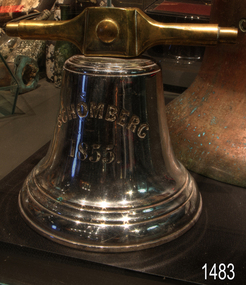
Functional object - Bell, Schomberg 1855, Before 1855
... The bell was entrusted to Briggs Marine Products, a renowned brass founder established in 1912. Upon examination, the specialists at Briggs discovered the reason behind the bell’s persistent lack of shine: it had originally been silver-plated, but most of the plating had worn away over time. ...The bell was entrusted to Briggs Marine Products, a renowned brass founder established in 1912. Upon examination, the specialists at Briggs discovered the reason behind the bell’s persistent lack of shine: it had originally been silver-plated, but most of the plating had worn away over time. ...The Rescue and Journey of the Schomberg Bells: This bell was the smaller of two rescued by the crew of the Schomberg following the ship’s wreck in 1855. While the specific purpose of the smaller bell is unknown, it may have served to assemble the crew or signal mealtimes on board. After surviving the shipwreck, the crew carried both bells as they made their way along the coastline. Their journey eventually led them to the home of settler John Manning, located at Hopkins Point near Warrnambool. Manning took possession of the bells and subsequently presented them to two churches in Warrnambool. The smaller bell went to St Joseph’s Catholic Church, while the larger bell went to St John’s Presbyterian Church. After around a year, the small bell at St Joseph’s developed a crack and became unusable. Thomas Manifold imported a replacement bell for the church, and the damaged bell was stored at his farm. Years later, when the property was sold to John Logan, the discarded bell was donated to the old Warrnambool Museum upon its opening in 1886. The Curator, Joseph Archibald, placed the bell on display in the entry. In 1975, it was transferred from the Warrnambool Art Gallery to Flagstaff Hill. The ’Mystery’ of the small bell solved: Despite numerous attempts by the staff at Flagstaff Hill to restore the bell’s lustre, the bell remained dull and tarnished. In October 1986, Director Peter Ronald decided to send the bell for professional advice. The bell was entrusted to Briggs Marine Products, a renowned brass founder established in 1912. Upon examination, the specialists at Briggs discovered the reason behind the bell’s persistent lack of shine: it had originally been silver-plated, but most of the plating had worn away over time. The experts at Briggs then undertook the task of restoring the bell, successfully returning it to a gleaming silver surface. The Sailing Ship Schomberg: Launched in 1855, the Schomberg was regarded as the “Noblest” ship afloat at the time. Owned by the Black Ball Line, it was built for their passenger fleet by Alexander Hall of Aberdeen at a cost of £43,103. The construction featured three skins: one planked fore and aft and two diagonally planked, all fastened with screw-threaded trunnels (wooden rails). The ship’s First Class accommodation was luxurious, boasting velvet pile carpets, large mirrors, rosewood, birds-eye maple and mahogany timbers, satin damask soft furnishings, and an oak-lined library with a piano. Schomberg had a capacity for 1,000 passengers. The ship’s master, Captain James Nicol Forbes—also known as ‘Bully’ Forbes—was only 34 years old at the launch. He had a reputation for setting and breaking speed records on the Black Ball Line’s Marco Polo and Lightning. In 1852, Forbes completed the London to Melbourne journey on the Marco Polo in 68 days, a record at the time, though 53 passengers died during the voyage. In 1854, he sailed the Lightning to Melbourne in 76 days and returned in only 63 days—a record that stood among sailing ships. Forbes was known for driving his ship and crew to their limits, often prioritising speed over passenger comfort. Determined to set new records, he promised to reach Melbourne in sixty days, declaring he would do so “with or without the help of God.” The Maiden Voyage and the Wreck: Schomberg departed Liverpool on 6th October 1855, flying a banner that read “Sixty Days to Melbourne”. The vessel carried 430 passengers and 3,000 tons of cargo, including materials to build the Melbourne to Geelong Railway and a bridge over the Yarra River. Among the cargo were a cow for fresh milk, pens for fowls and pigs, and 90,000 gallons of water for drinking and washing. Additionally, it transported 17,000 letters and 31,800 newspapers. The ship and cargo were insured for $300,000, a considerable sum for the era. Poor winds while crossing the equator delayed Schomberg’s progress. Land was first sighted on Christmas Day at Cape Bridgewater near Portland. Captain Forbes followed the coastline towards Melbourne, but was reportedly playing cards when the third mate, Henry Keen, reported land only three miles away. The ship ran aground on a sand spit near Curdie’s Inlet (approximately 56 km west of Cape Otway) on 26th December 1855, after 78 days at sea. The sand spit and nearby currents were not marked on Forbes’s map. During the night, the crew launched a lifeboat to search for a safe landing spot for the passengers. The scouting party advised Forbes to wait until morning, as rough seas posed a danger to the lifeboats. At dawn, the ship’s Chief Officer spotted the SS Queen and signalled for help. The master of the Queen brought his vessel alongside, and all passengers and crew disembarked safely. The Black Ball Line’s Melbourne agent sent another steamer to collect the passengers’ baggage, and other steamers assisted with cargo salvage until worsening weather forced operations to cease. Notably, a plunderer later recovered a case of Wellington boots, but all were for the left foot. The wreck and its cargo were sold to local merchants Manifold & Bostock, who did not attempt further salvage. They later sold their interest to a Melbourne businessman and two seafarers. In 1864, after two men drowned in their attempt to reach the Schomberg, salvage efforts were abandoned. By 1870, parts of the ship had washed ashore on New Zealand’s South Island. Today, the wreck is about nine metres below the surface. Although most woodwork has disintegrated, the vessel’s shape remains discernible due to the railway irons, girders, and framework. Various goods and materials from the ship are scattered nearby. The bell is particularly significant in that along with other items from the wreck helped in part to having the legislation changed to protect shipwrecks, with far tighter controls being employed to oversee the salvaging of wreck sites. This bell forms part of the Schomberg collection at Flagstaff Hill maritime museum. The collection as a whole is of historical and archaeological significance at a State level. Flagstaff Hill’s collection of artefacts from the Schomberg is also significant for its association with the Victorian Heritage Registered Schomberg shipwreck (VHR S 612). The collection is of additional significance because of the relationship between the objects salvaged, as together they help us to interpret the story of the Schomberg. The collection as a whole is historically significant for representing aspects of Victoria's maritime history and its potential to interpret social and historical themes from society at the time of the wreck. A small ship’s bell. The silver-plated metal bell bears the ship’s name and year of construction on one side and the name and address of the ship’s builders on the other. These details are deeply engraved into the metal and formed in bold, upper-case lettering. The bell has two bell stands: the left and the right. Both stands have an Iron pipe bent into an inverted ‘Y’ shape, with a hole along its length and feet attached to a rectangular metal plate at the other two ends. Feet are bolted to a timber base that has a hole drilled through the centre for mounting. Bell's front; “SCHOMBERG” with “1855” below. Bell's back “HALL & SONS (crack splits letter “N”) / BUILDERS (in italics) / ABERDEEN” (crack splits letter “B”).flagstaff hill, flagstaff hill maritime museum and village, warrnambool, maritime museum, maritime village, great ocean road, shipwreck coast, schomberg, silver plated bell, mess bell, bell stands, captain ‘bully’ forbes, alexander hall and son, james baines and company, liverpool’s black ball line, bell, schomberg bell, ship's bell, small bell, st joseph's church, briggs marine, john manning, john logan, warrnambool museum, briggs foundry, silver bell -
 Federation University Historical Collection
Print - Scrapbook, Ballarat School of Mines Invoice Scrapbook, 1875-1879, 1875-1879
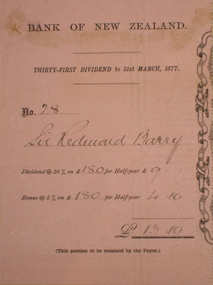
... Barnard * 1/4/1876 - receipt from Joseph Flude * 1/3/1876 - account from William Blomeley, Iron and Brass Founder * 31/3/1876 - account from A.H. King, Iron Merchant * 31/3/1876 - account from W.M. ...Barnard * 1/4/1876 - receipt from Joseph Flude * 1/3/1876 - account from William Blomeley, Iron and Brass Founder * 31/3/1876 - account from A.H. King, Iron Merchant * 31/3/1876 - account from W.M. ...Quarter leather bound scrap book with pasted in invoices which were sent to the Ballarat School of Mines.Ballarat School of Mines Invoice Scrapbook, with many invoices made out to the Ballarat School of Mines stuck into the book (most folded over). * 01/12/1875 - 31/12/1875 - Annual account of all sums of Money for subscriptions to the Ballarat School of Mines * 31/12/1875 - Charles J. Evans - printer * 1875 - William Gooch - for Argus newspaper * 13/01/1876 - M.D. Hamilton - salary payment * 14/01/1876 - receipt for two shillings and sixpence from M.D. Hamilton * 31/1/1876 - account to R.J. Vale * 1/2/1876 - Caxton printing works - account to James Curtis * 4/12/1876 - Ballarat Gas company - receipt from J.W.Robertson * 29/1/1876 - Permewan Hunt and company - account to Hon. W.H.Barnard *28/1/1876 - Osborn, Cushing and company - account to Hon. W.H.Barnard * 7/10/1875 - Geo. H. Bliss and company - account to Hon.N.H. Barnard * 31/12/1875 - I. Longstaff - Druggist * 1875 - A. M. Leirnan * 9/12/1876 - Petty cash - M. Hamilton * 15/12/1875 - reimbursement to W.D. Barnard * 31/1/1876 - "Ballarat Star" newspaper account - Rob Wreford * 12/4/1876 - Geelong Gas company - receipt for 2 pounds and ten shillings - A.B. Langlands * 27/1/1876 - Geelong Gas company - account to School of Mines * 1/2/1876 - Cornell and King - Chemists - account to School of Mines * 10/2/1876 - Salary payment slip to M.D. Hamilton for 8 pounds 6 shillings and 8 pence * January 1876 - Stansfield and Robson, Importers - account to School of Mines * January 1876 - Stansfield and Robson - School of Mines - Dr. A.M.Leisman - account * 31/1/1876 - Charles J. Evans - account to School of Mines * 31/1/1876 - Proprietors of the Evening Post - account to School of Mines * 10/2/1876 - Petty cash receipt from W. Barnard * 1/2/1876 - Bateman, Clark and Company - account to School of Mines * 8/3/1876 - Salary payment to M.D. Hamilton from School of Mines Ballarat *1/3/1876 - William Johnson - Chemist - account to School of Mines Ballarat * 28/2/1876 - Cornell and King - Chemists - account to School of Mines Ballarat * 2/1876 - Hugh Gray and Son - Instrument makers - account from School of Mines * 28/2/1876 - J. Longstaff - druggist * 11/3/1876 - Fidelity Guarantee of Alfred B.Burne for 100 pounds from Victoria Life Insurance Co. *10/3/1876 - Petty cash slip from W.H. Barnard * 4/3/1876 - account from Alfred B. Burne * 15/3/1876 - personal expenses account from I.W. Jonan * 27/3/1876 - account from John Victor * 25/3/1876 - account from C.W. Thomas * 27/3/1876 - account from W. Schmidt - Lecturer * 25/3/1876 - account from Joseph Flude * 29/6/1876 - account from J. Thomas * 30/6/1876 - receipt from W.M. Barnard * 1/4/1876 - receipt from Joseph Flude * 1/3/1876 - account from William Blomeley, Iron and Brass Founder * 31/3/1876 - account from A.H. King, Iron Merchant * 31/3/1876 - account from W.M. Gooch, Newsagent * 13/4/1876 - salary payment to M.D. Hamilton * 12/4/1876 - Petty cash receipt * 13/4/1876 - List of subscriptions received from Alfred B. Burne (collector) (John P. Hanson, Comm. Bank of Aust., T.A. Wanliss, Andrew Cant, B. Hepburn, R. Lewis, Sovereign Hill Mining Co., Buninyong Shire Council, Union Bank Aust. Francis Taylor) * 15/2/1876 - account from Battersea Works London * 2/5/1876 - account from Charles J. Evans Lithographic Printer etc. * 11/5/1876 - salary slip to M.D. Hamilton * 30/4/1876 - subscriptions received from Alfred B. Bruce (M.P. Whiteside, S. Steele, J. Usher, Charles Walker, W.H. Bougghen, W.V. Jenkins, A.M. Gransfield, Hon. Henry Cuthbert, Aust. Bank, Borough Council, Thomas Bath, Rev. William Henderson, James Smith, S. Hamburger) * 30/4/1876 - account from The Ballarat Star Newspaper * 7/6/1876 - account from Ballarat Gas Company * 11/5/1876 - petty cash account from M.J. Barnard * 9/5/1876 - receipt from M.D. Hamilton * 6/5/1876 - account from M.D. Barnard * 4/1876 - account from W.M. Gooch - News and Advertising agents * 22/4/1876 - account from Broadbent Bros and Co. - Railway Carriers etc * 1/6/1876 - account from Bateman, Clark, and Co. * 31/5/1876 - account from J. Longstaff - Druggist * 16/2/1876 account from A.M. Leiman * 6/1876 - account from R.T. Vale - Newsagent * 31/5/1876 - receipt from Sir Redmond Barry for one shilling * 1/6/1876 - account from F.W. Niven - Stationer etc. * 31/5/1876 - account to The Ballarat Star and The Miner newspapers * 31/5/1876 - account from Stansfield and Robson, Importers * 31/5/1876 - account from The Evening Post * 8/6/1876 - Salary slip fro M.D. Hamilton * 1/6/1876 - account to J. McHutchison, Bookbinder * 1/6/1876 - account from A.H. King - Iron Merchant * 1/6/1876 - account from Cornell and King - Chemists * 31/5/1876 - account from W.M. Gooch - Advertising agent * 8/6/1876 - petty cash receipt from M.D. Barnard * 31/5/1876 - List of subscriptions from Alfred B. Bruce (T.J. Kerr, Jacob Showman, J.L. Thompson, W.J. Clarke, R.C. Baih, L. Ballhausen, James Coghlan, Parade Gold mining Co., A. Williams, Sung Hung Fat, A. Dimmock Esq.M.D., Bank Victoria, Reform Co., Gilbert, James Ward, James Stewart, Ian Kwong Yick 7/6/1876 - account to Alfred White - Custom House Agent 30/6/1876 - receipt from John Victor for twelve pounds 10 shillings 29/7/1876 - receipt from A.M. Barnard 26/6/1876 - receipt from Joseph Flude 4/6/1876 - receipt from E.S. Schmidt 22/6/1876 - receipt from John W. Tail 19/6/1876 - receipt from Jonathan Butterworth 3/7/1876 - receipt from Joseph Hurde 1/7/1876 - account from Henry Richards Caselli - Architect and Building Surveyor 30/6/1876 - account from J. Scovell - Cabinet Maker 14/7/1876 - account from H.R. Caselli - Architect and Building Surveyor 20/7/1876 - payslip to M.D. Hamilton 1/7/1876 - account from Henry Brind - Chemist 6/1876 - account from W.M. Gooch - News and Advertising Agent 21/7/1876 - account from W.D. Hamilton 26/6/1876 - account from Parkinson and co. - City Nightmen and van proprietors 19/7/1876 - petty cash receipt from M.D.Barnard 30/6/1876 - account of subscriptions received - J.A. Anderson, A. Anderson, John Osborne, J. Noble Wilson, Bateman and Clarke, National bank of Aust., James Lory, F. Atkins 27/7/1876 - account from H. Hunt - Builder 26/7/1876 - account to G. Leitch and co. 1/8/1876 - receipt to The National Insurance Co. of Aust., Ltd. 1/8/1876 - receipt from Victoria Fire and Marine Insurance Company 1/8/1876 - account to The Victoria Lime and Cement Co. 1/8/1876 - receipt from Ballarat Gas Company 1/8/1876 - account from Charles J. Evans, Printer 1/8/1876 - account from Cornell and King - Druggists and Chemists 8/8/1876 account from Cornell and King - Druggists and Chemists 5/6/1876 to 22/9/1876 - account to A.N. Lennan 11/8/1876 - receipt from W.D. Hamilton 16/9/1876 - receipt from Geelong Gas Company 7/8/1876 - account to the Geelong Gas Company 1/8/1876 - account to Bateman, Clark and Co. 31/7/1876 - account from The Ballarat Star and of The Miner 10/8/1876 - salary slip to M.D. Hamilton 1/7/1876 to 31/7/1876 - list of subscriptions from Alfred B. Burne - P. Channey, P. Pakenhagen, John Price, Ballarat Gas Co., L.E. Brann, A.H. King, M. O"Ferrall, John Foord 19/7/1876 to 10/8/1876 - Petty cash receipt from M.N. Barnard 7/ 1876 - account to W. M. Gooch - General News and Advertising agent 1/7/1876 - account to Stansfield and Robson - Importers in Oils, colours, window glass, etc. 17/8/1876 - account to Lermes Lamurk 4/8/1876 - account to James Allen "Camperdown Chronicle" general printing office from W.H. Barnard 6/9/1876 - account to Henry Masham 1/9/1876 - account to A.H. King - Iron Merchant, Furnishing and General Ironmonger 22/9/1876 - travelling expenses account from R.D. Ellery 25/9/1876 - receipt from M. Schmidt 15/9/1876 - receipt from M.D. Hamilton 1/9/1876 - account to James Curtis - Caxton Printing Works 25/8/1876 - account from William McCulloch and Co., General Carriers 18/8/1876 - account to G. Leitch and Co. 14/9/1876 - payment slip to M.D. Hamilton 10/8/1876 - petty cash account from M.H. Barnard 25/9/1876 - receipt from John Victor 25/9/1876? - receipt from M.H.Barnard 6/10/1876 - receipt from Joseph Fude 12/10/1876 - receipt from M.D. Hamilton 30/9/1876 - receipt from Joseph Fude 1/10/1876 - account to A.M. Lennan 12/10/1876 - salary slip to M.D. Hamilton 30/9/1876 - account from Ballarat Star Newspaper Office 12/10/1876 - petty cash account - M.H. Barnard 30/9/1876 - account to J. McHutchison - Bookbinder 1/8/1876 - account from Ballarat Gas Company 1/11/1876 - receipt from Ballarat Gas Company 1/11/1876 - account to Charles J. Evans - Lithographic Printer 1/11/1876 - account from Cornell and King - Chemists 9/1876 - account from W.M. Gooch - General news and advertising agent 10/1876 - account from J. and J. McDonald - Plumbers and gas fitters 13/10/1876 to 9/11/1876 - petty cash statement from M.H. Barnard 14/11/1876 - receipt from M.D. Hamilton 11/9/1876 - account from A.M. Lennan 9/11/1876 - Salary slip to M.D. Hamilton 12/10/1876 - Expenses account received by M.H. Barnard 1/11/1876 - account from J. Longstaff - Druggist 10/1876 - account from Parkinson and Co. - City Nightmen and van proprietors 6/12/1876 - account from Emanuel Steinfield, Importer of Furniture etc. 13/11/1876 - account The Geelong Gas Company 31/11/1876 - account from The Ballarat Star Newspaper office 28/11/1876 - account from R.T. Vale - bookseller, stationer and news agent 28/11/1876 - acount from John Slater and co. 1/12/1876 - account from J. Doig and co., Tinsmiths, Gasfitters etc. 14/12/1876 - Salary slip to M.D. Hamilton 14/12/1876 - receipt from M.D. Hamilton for one pound one shilling and ninepence 1/11/1876 to 31/12/1876 - petty cash statement 15/12/1876 - statement of travelling expenses for A.B. Barnes 23/12/1876 - receipt from John Victor 21/2/1877 - receipt from C.M.Thomas 23/12/1876 - receipt from Joseph Flude 29/12/1876 - receipt from Lecturer - S.Schmidt 30/12/1876 - receipt from Joseph Flude 1876 - receipt from Joseph Flude 12/1/1877 - statement of refund to W.H. Barnard 11/1/1877 - Salary slip to M.D.Hamilton 8/1/1877 - petty cash statement 18/1/1877 - receipt for Ballarat Gas company 2/1/1877 - account from Eyres Brothers - Furnishing and general ironmongers 19/12/1876 - statement from W.H. Barnard - registrar 1/1/1877 - account from Bateman, Clark and company 11/121876 - account from Parkinson and co. - City nightmen 31/12/1876 - account from Ballarat Star Newspaper office 25/1/1877 - account from J. McHutchison, Bookbinder 3/2/1877 - account from J. McHutchison, Bookbinder 1/2/1877 - account from Cornell and King - Chemists 1/2/1877 - account from Stansfield J. Robson - Importers in oils, colours, window glass etc. 1/2/1877 - account from Charles J. Evans - Bookbinder etc. 12/12/1876 - account from W. Gooch - General news and advertising agent 2/1/1877 - account from proprietors of the Evening Post 14/2/1877 - account from John F.Paten - Printer, Publisher and Bookseller "Avoca Mail" 2/2/1877 - account from T. Longstaff - wholesale and retail druggist 8/81877 - salary slip for M.D. Hamilton 21/1/1877 - account from Ballarat Star Newspaper office 9/2/1877 - account for petty cash from W.H. Barnard 7/2/1877 - account from S.C. Steele - Ballarat Fine Art Gallery 13/2/1877 account from R.T. Vale - Bookseller, Stationer and News Agent 8/2/1877 - account from Joseph Flude 13/1/1877 - account from William Johnson, Chemist 9/1877 - account to J. Flude from William Johnson, Chemist, 3 accounts 2/11/1876 to 23/1/1877 - account from A.N. Leiman 1/3/1877 - account from Bateman, Clark and company 8/3/1877 - salaray payment to M.D. Hamilton 8/3/1877 - salary payment to J. Ashley 9/3/1877 - statement from Post Office Ballarat (one shilling - for the first years rent of telegraph line on school premises) 1/2/1877 - statement from Mining and commercial stationer - J.W. Niven Dec.1876 to 15/2/1877 - account from R.T. Vale - Bookseller, Stationer, and News agent 1/1877 - statement from C.W. Thomas 8/3/1877 - petty cash account from W.H. Barnard 9/3/1877 - account from R. Gibbings - Livery and Letting Stables and carriage repository 28/2/1877 - account from Charles J. Evans - Stationer, Lithographic printer etc. 9/3/1877 - receipt from M.D. Hamilton 31/3/1877 - account from Ballarat Star and The Miner 2/1877 - receipt from Joseph Flude 8/3/1877 - receipt from F.J. Ashley 28/3/1877 salary statement from John Victor 28/4/1877 - salary statement from John A. Sharp 28/3/1877 - receipt from Joseph Flude 26/3/1877 - receipt from T.Schmidt - Lecturer 12/3/1877 - receipt from C.H. Walker 6/4/1877 - account from Mr. Ellery 27/4/1877 - account from A. M. Leiman 31/3/1877 - account from W.M. Gooch, General news and advertising agent 6/3/1877 - statement from London Remittances 12/4/1877 - salary payment to M.D. Hamilton 1877 - receipt from W.H. Barnard 1/4/1877 - account from Parkinson and company, City nightmen and van proprietors 5/4/1877 - account from William McCulloch and company, General carriers 11/4/1877 - account from S. Steele, Draper 31/3/1877 - account from Charles J. Evans, Stationer etc. 1/4/1877 - account from James Curtis - Caxton Printing Works 4/1877 - receipt from W.H. Barnard 8/3/1877 to 12/4/1877 - petty cash receipt from W.H.Barnard 12/4/1877 - receipt from C. Flude 31/3/1877 - receipt for Sir Redmond Barry for 13 pounds 10 shillings 1/1877 - receipt from Alphonse Ausaldie 1/3/1877 - 30/4/1877 - account from Joseph Flude 9/5/1877 - account from Henry Costin - Machinery Merchant 31/1/1877 to 3/5/1877 - Ballarat Gas Company 13/6/1877 - receipt to Ballarat Gas Company 9/5/1877 - salary slip to M.D. Hamilton 11/5/1877 - account for stationary from C. Flude, Registrar 23/3/1877 - account from Edmund Donelly 1/5/1877 - account from Charles J. Evans, Stationer etc. 9/4/1877 - account from W.M. Gooch, News and advertising agent 30/4/1877 - account from The Ballarat Star and The Miner 13/4/1877 - account from T. Longstaff, wholesale and retail druggist 30/4/1877 - account from Echuca railway station 1/5/1877 - account from Cornell and King, Chemists 11/5/1877 - salaray slip for C. Flude 11/5/1877 - petty cash account to the Registrar, W.H. Barnard 2/5/1877 - account from William McCulloch and co.,general carriers 5/1877 - account from William Willis and co. Locksmiths etc. 1/5/1877 - account from Joseph Flude 6/6/1877 - account from Henry Morham 31/5/1877 - account from Charles J. Evans, Stationer and Printer etc. 14/6/1877 - salary payment to M.D. Hamilton 15/6/1877 - salary payment to C. Flude 15/6/1877 - receipt from M.D. Hamilton 1/6/1877 - account from James Curtis, Caxton Printing Works 31/1/1877 - Ballarat Gas company account 23/8/1877 - receipt from Ballarat Gas company 15/6/1877 - receipt from The National Insurance Company of Aust., Ballarat Branch 1/6/1877 - account from The Ballarat Courier 3/1877 - receipt from L.M. Cook 1/6/1877 - account from J.McHutchison, Bookbinder 10/5/1877 to 14/6/1877 - petty cash account 17/5/1877 - account from William McCulloch and co., general carriers 15/6/1877 - account from T. Longstaff, Wholesale and retail Druggist 1/5/1877 - account from H. Hunt, Builder 4/1877 - receipt from John Victor 3/7/1877 - receipt from J.Alex Sharp 15/6/1877 - receipt from Sir Redmond Barry to Revenue and Pay Office 26/6/1877 - receipt from M. Shaw, Lecturer 25/6/1877 - receipt from Joseph Flude 23/6/1877 - receipt from S.Schmidt 6/1877 - account from W.M. Gooch, general news and advertising agent for Argus newspapers 6/1877 - account from the Proprietors of the Evening Post 21/6/1877 - account from John F. Paten, "Avoca Mail" and general printing office 14/6/1877 - account from Ballarat Star and The Miner Newspaper office 30/6/1877 - account from Ballarat Star Newspaper office 2/7/1877 - account from R.T. Vale, News Agent 19/6/1877 account for railway fare and personal expenses 23/5/1877 - account from William Johnson, Chemist 1/7/1877 - account from Henry Brind, Chemist and Family Pharmacist 2/7/1877 - account from Cornell and King, Druggists and Chemists 12/7/1877 - salary slip to M.D. Hamilton 14/7/1877 - salary slip to C. Flude 14/6/1877 - 12/7/1877 petty cash account from W.H. Barnard 16/6/1877 - account from William McMulloch and Co., general carriers 1/7/187 - account from Parkinson and Co., City Nightmen and Van Proprietors 1/6/1877 to 30/6/1877 - account from Joseph Flude 1/8/1877 - receipt to Victoria Fire and Marine Insurance Company 21/7/1877 - account to Brush and Drummond, Importers and Manufacturing Jewellers 11/7/1877 - account from Charles J. Evans, Printer etc. 31/7/1877 - account from The Ballarat Star Newspaper Office 1/8/1877 - account from James Curtis, Caxton Printing Works 7/71877 - account from W.M. Gooch, Advertising Agent 7/1877 - account from Hugh Gray and Son, Mechanists and Philosophical Instrument Makers 13/8/1877 - account from Ballarat Gas Company redmond barry, joseph flude, hall of commerce, george crocker, ballarat star, the miner, bank of new zealand, daniel brophy, james curtis, caxton printing works, mcdonald plumbers and gas fitters, mcvitty and co, j. mchutchison, bookbinder, niven, john warrington rogers, henry bland, rivett henry bland, telegraphy, ellery, r.t. vale, richard vale, w. johnson analytical chemist st kilda, judge warrington rogers, art gallery of ballarat, henry richards caselli, h. hunt, ballarat school of mines botanical gardens, henry caselli, charles flude, ballarat star news, john armstrong -
 Flagstaff Hill Maritime Museum and Village
Accessory - Badge, Before 1855
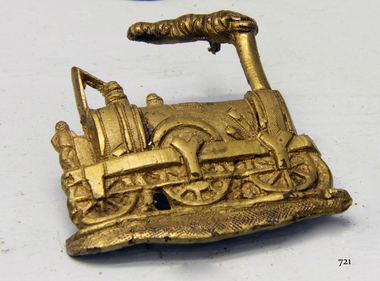
... The shipwreck is of additional historical significance for representing aspects of Victoria’s shipping history and for its association with the first passenger ship, which was designed not only to be the fastest and most luxurious of its day but foundered on its maiden voyage to Australia. warrnambool flagstaff-hill flagstaff-hill-maritime-museum shipwreck-coast flagstaff-hill-maritime-village schomberg shipwrecked-artefact clipper ship black ball line 1855 shipwreck captain forbes ss queen badge Charles Tayleur Great Western Railway Vulcan Foundry Isambard Kingdom Brunel locomoive brooch Gold coloured brass badge depicting an 1840's steam engine or locomotive with the figure of a fireman standing on the back. ...The badge recovered from the Schomberg wreck is believed to depict one of the first steam engines. The engine's design by Charles Tayleur & Co. was to be produced for the Great Western Railway in England. The first nineteen of these locomotives were ordered by Isambard Kingdom Brunel for the Great Western Railway including six 2-2-2 Charles Tayleur locomotives. They were built by Charles Tayleur and Company, which later the Vulcan Foundry. The locomotives were unsuccessful and were rapidly supplemented by the Star Class locomotives ordered by Daniel Gooch once he had been appointed as the Locomotive Engineer. As built, they comprised two groups of three, the first group, was delivered in 1837. This locomotive was the first to run on the Great Western Railway when it was tested on 28 December 1837 from its shed at West Drayton. It was withdrawn in 1843 but was rebuilt as a 2-2-2T tank locomotive and returned to service in 1846, running in this form until 1868. It survived for two more years at Reading as a stationary boiler. It is named after the workshops where it was built, which themselves were named after the Roman god of fire. (Although a supposition, it is possible that the owner was a passenger on the ill-fated Schomberg and that they worked either for the Great Western Railway or the Vulcan Foundry that made the engine in the 1830s.) Wreck of the Schomberg: Schomberg was a large three-masted full-ship rigged wooden ship built in 1855 by Alexander Hall and Co in Aberdeen, Scotland for James Baines' famous Black Ball Line at £43,103. The vessel was 288 feet (88 meters) in length, with a beam of 45 feet (14 meters), a depth of 29.5 feet (8.99 meters) of 2,284 tons. The mainmast was 210 feet (64 meters) high and she carried 3.3 acres of sail. The vessel was constructed with three skins. One planked fore and aft, and two diagonally planked, fastened together with screw-threaded trunnels (wooden rails). The Schomberg is one of only three clipper wrecks in Victorian waters that operated the England to Australia run. While the other two, Empress of the Sea and Lightning, were built by the famous American shipbuilder, Donald Mac Kay. Schomberg was an attempt to build a faster ship than Mac Kay and a vessel fast enough to break the sailing record to Australia. The Schomberg sailed on her maiden voyage from Liverpool on 6 October 1855, under the command of Captain James Forbes, on its maiden voyage to Australia with a general cargo, jewellery, spirits, machinery, and 2,000 tons of iron rails and equipment intended to build the Melbourne to Geelong Railway and a bridge over the Yarra from Melbourne to Hawthorn. She also carried a cow for fresh milk, pens for fowls and pigs, plus 90,000 gallons of water for washing and drinking. She also carried 17,000 letters and 31,800 newspapers. There were approximately 473 passengers and a crew of 105. It was hoped that Schomberg would make Melbourne in sixty days, setting a record for the voyage, but light winds at the equator dashed those expectations. The ship sighted Moonlight Head in southwest Victoria on Christmas Day but through a deadly combination of wind, currents, and unmarked sand spits, the vessel gently ran aground on 26 December 1855 on a spit that juts into Newfield Bay, just east of Curdies Inlet, and the present town of Peterborough. Fortunately, the SS Queen was nearby and managed to save all passengers and crew. The steamers Keera and Maitland were dispatched to salvage the passenger's baggage and the more valuable cargo. Other salvage attempts were made, but deteriorating weather made the work impossible, and within two weeks the Schomberg's hull was broken up and the vessel abandoned. The wrecking of the Schomberg caused quite a public stir, particularly in light of the fact the vessel was supposed to be, the most perfect clipper ship ever built. Captain Forbes was charged in the Supreme Court under suspicion that he was playing cards with two female passengers below decks when his ship ran aground. Despite a protest meeting, two inquiries, and the court proceedings, he was found not guilty and cleared of all charges. In 1975, divers from Flagstaff Hill, including Peter Ronald, found an ornate communion set at the wreck. The set comprised a jug, two chalices, a plate, and a lid. The lid did not fit any of the other objects and in 1978 a piece of the lid broke off, revealing a glint of gold. As museum staff carefully examined the lid and removed marine growth, they found a diamond ring, which is currently on display in the Great Circle Gallery at the Flagstaff Hill Maritime Museum that also displays ship fittings and equipment, and personal effects. Most of the artefacts were salvaged from the wreck by Peter Ronald, former director of Flagstaff Hill.The Schomberg has historical significance as one of the first luxurious ships built to bring emigrants to Australia to cash in on the gold rush era. And is included on the Victorian Heritage Register (VHR S612). The collection of Schomberg artefacts held at Flagstaff Hill Museum is primarily significant because of the relationship between these recovered items having a high potential to interpret the story of the Schomberg and its foundering during a storm. The shipwreck is of additional historical significance for representing aspects of Victoria’s shipping history and for its association with the first passenger ship, which was designed not only to be the fastest and most luxurious of its day but foundered on its maiden voyage to Australia.Gold coloured brass badge depicting an 1840's steam engine or locomotive with the figure of a fireman standing on the back. Smoke is coming from the smokestack. The reverse has three holes, possible where a mounting pin or fastener was attached. The badge was recovered from the wreck of the Schomberg.warrnambool, flagstaff-hill, flagstaff-hill-maritime-museum, shipwreck-coast, flagstaff-hill-maritime-village, schomberg, shipwrecked-artefact, clipper ship, black ball line, 1855 shipwreck, captain forbes, ss queen, badge, charles tayleur, great western railway, vulcan foundry, isambard kingdom brunel, locomoive, brooch -
 Flagstaff Hill Maritime Museum and Village
Functional object - Service Bell, 1855
... The shipwreck is of additional historically significance for representing aspects of Victoria’s shipping history and for its association with the first passenger ship, which was designed not only to be the fastest and most luxurious of its day but foundered on its maiden voyage to Australia. warrnambool flagstaff-hill flagstaff-hill-maritime-museum shipwreck-coast flagstaff-hill-maritime-village schomberg shipwrecked-artefact clipper ship black ball line 1855 shipwreck aberdeen clipper ship captain forbes peterborough shipwreck ss queen bell Service Bell None Bell; small service bell, brass, with heavy encrustation. ...This service bell was recovered from the wreck of the ship Schomberg. The Schomberg was a large three-masted full-ship rigged wooden ship built in 1855 by Alexander Hall and Co in Aberdeen, Scotland for James Baines' famous Black Ball Line at £43,103. The vessel was 288 feet (88 meters) in length, with a beam of 45 feet (14 meters), a depth of 29.5 feet (8.99 meters) of 2,284 tons. The mainmast was 210 feet (64 meters) high and she carried 3.3 acres of sail. The vessel was constructed with three skins. One planked fore and aft, and two diagonally planked, fastened together with screw-threaded trunnels (wooden rails). The Schomberg is one of only three clipper wrecks in Victorian waters that operated the England to Australia run. While the other two, Empress of the Sea and Lightning, were built by the famous American shipbuilder, Donald Mac Kay. Schomberg was an attempt to build a faster ship than Mac Kay and a vessel fast enough to break the sailing record to Australia. The Schomberg sailed on her maiden voyage from Liverpool on 6 October 1855, under the command of Captain James Forbes, on its maiden voyage to Australia with a general cargo, jewellery, spirits, machinery, and 2,000 tons of iron rails and equipment intended to build the Melbourne to Geelong Railway and a bridge over the Yarra from Melbourne to Hawthorn. She also carried a cow for fresh milk, pens for fowls and pigs, plus 90,000 gallons of water for washing and drinking. She also carried 17,000 letters and 31,800 newspapers. There were approximately 473 passengers and a crew of 105. It was hoped that Schomberg would make Melbourne in sixty days, setting a record for the voyage, but light winds at the equator dashed those expectations. The ship sighted Moonlight Head in south west Victoria on Christmas Day but through a deadly combination of wind, currents and unmarked sand spits, the vessel gently ran aground on 26 December 1855 on a spit that juts into Newfield Bay, just east of Curdies Inlet, and the present town of Peterborough. Fortunately, the SS Queen was nearby and managed to save all passengers and crew. The steamers Keera and Maitland were dispatched to salvage the passenger's baggage and the more valuable cargo. Other salvage attempts were made, but deteriorating weather made the work impossible, and within two weeks the Schomberg's hull was broken up and the vessel abandoned. The wrecking of the Schomberg caused quite the public stir particularly in light of the fact the vessel was supposed to be, the most perfect clipper ship ever built. Captain Forbes was charged in the Supreme Court under suspicion that he was playing cards with two female passengers below decks when his ship ran aground. Despite a protest meeting, two inquiries and the court proceedings, he was found not guilty and cleared of all charges. In 1975, divers from Flagstaff Hill, including Peter Ronald, found an ornate communion set at the wreck. The set comprised a jug, two chalices, a plate and a lid. The lid did not fit any of the other objects and in 1978 a piece of the lid broke off, revealing a glint of gold. As museum staff carefully examined the lid and removed marine growth, they found a diamond ring, which is currently on display in the Great Circle Gallery at the Flagstaff Hill Maritime museum that also displays ship fittings and equipment, personal effects. Most of the artefacts were salvaged from the wreck by Peter Ronald, former director of Flagstaff Hill.The Schomberg has historical significance as one of the first luxurious ships built to bring emigrants to Australia to cash in on the gold rush era. And is included on the Victorian Heritage Register (VHR S612). The collection of Schomberg artefacts held at Flagstaff Hill Museum is primarily significant because of the relationship between these recovered items having a high potential to interpret the story of the Schomberg and its foundering during a storm. The shipwreck is of additional historically significance for representing aspects of Victoria’s shipping history and for its association with the first passenger ship, which was designed not only to be the fastest and most luxurious of its day but foundered on its maiden voyage to Australia.Bell; small service bell, brass, with heavy encrustation. Bell has a square loop at the top. The bell was recovered from the wreck of the Schomberg.Nonewarrnambool, flagstaff-hill, flagstaff-hill-maritime-museum, shipwreck-coast, flagstaff-hill-maritime-village, schomberg, shipwrecked-artefact, clipper ship, black ball line, 1855 shipwreck, aberdeen clipper ship, captain forbes, peterborough shipwreck, ss queen, bell, service bell -
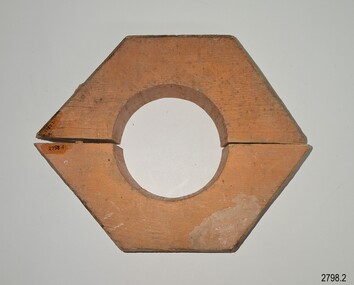 Flagstaff Hill Maritime Museum and Village
Equipment - Pattern, Briggs Brass Foundry, Early 20th century
... These items were prominently displayed in a simulated Brass Foundry within the Village, alongside other working crafts, trades and services typical of a maritime town. From the completion of the building in 1986 until its repurposing in 1994, visitors could view these items and gain insight into the foundering and metalwork trades that supported maritime industries, including shipwrights and boatbuilders. ...Through this local presence, Briggs Brass Founders supported the regional marine industry and forged strong connections with fishermen and businesses. ...The wooden pattern forms part of a larger collection, securely stored within a durable wooden crate. This pattern was an essential tool at Briggs’ Brass Foundry, specifically designed for creating sand casts. Sand casting is a time-honoured technique, with a history exceeding 2,000 years. The handcrafted nature of this process results in the production of brass and copper alloy items, which are particularly suitable for maritime applications. Typical products include bells, boat hooks, cowls, propellers, handles, lids, rowlocks, hooks, letters, bolts, rail holders, brackets, deck plates, flanges, rudder guides, portholes and covers. The distinctive bronze mixture used at Briggs’ Foundry is copper-based, composed of local ingots of copper, tin, zinc and lead, blended in precisely measured quantities. The resulting alloy is non-ferrous, known for its exceptional durability and longevity. In the early years of Flagstaff Hill, the Briggs family generously donated the crate of patterns along with other related items such as brassware, tools and machinery. These items were prominently displayed in a simulated Brass Foundry within the Village, alongside other working crafts, trades and services typical of a maritime town. From the completion of the building in 1986 until its repurposing in 1994, visitors could view these items and gain insight into the foundering and metalwork trades that supported maritime industries, including shipwrights and boatbuilders. The castings produced at the foundry were also vital for farmers, manufacturers and other local industries. The Brass Foundry display featured a historic Cornish chimney, constructed as a working model to illustrate the process of smelting metal in furnaces and pouring it into sand moulds. The chimney, crafted from specially curved bricks, currently stands at approximately two-thirds of its original height, having previously been located at the Grassmere Cheese factory. The craft of sand-casting, which utilises intricately carved wooden patterns to create metal objects, stands as a testament to the enduring value of traditional skills. This age-old technique remains relevant today, linking past craftsmanship to ongoing industrial practices. The foundry pattern set holds particular significance due to its strong associations with brass foundries, both locally and in coastal regions across Victoria. In these areas, marine industries such as ship and boat building have long depended on high-quality metal castings for the machinery, equipment, and fittings essential to their operations. The alloys formulated by Briggs Brass Foundry, crafted from non-ferrous metals, were specifically designed to provide superior longevity and durability in maritime environments. These patterns are closely tied to the history of the Briggs Brass Foundry, a respected and long-running company that specialised in producing cast goods for the marine sector. The foundry was equipped to supply both unique, one-off items and mass-produced components, ensuring that its products found their way onto a variety of sail and steam vessels along the Victorian coast, including in Warrnambool. In addition to its broader marine applications, Briggs Brass Foundry established itself as a bell-founder specialist. The company’s expertise is notably linked to the historic Schomberg Bell at Flagstaff Hill, which they restored to its original splendour as a fine example of a bell from a luxury migrant ship of the mid-19th century. The significance of the pattern set is further heightened by its association with Briggs Brass Founders, a firm established in the early 20th century and widely recognised for its proficiency in producing, repairing, and restoring ship bells and other marine equipment. Renowned for their non-ferrous metal casting, Briggs Brass Founders consistently supplied high-quality fittings and equipment vital to maritime pursuits. Moreover, the company expanded its influence by opening a branch in Warrnambool. Through this local presence, Briggs Brass Founders supported the regional marine industry and forged strong connections with fishermen and businesses. This not only reinforced their reputation as skilled manufacturers but also highlighted their commitment to community engagement and support. Pattern; hexagonal wooden shape painted orange. The thick carved wooden shape is in halves forming a hole when locked together with the dowel pegs and opposing drilled holes. The pattern is part of a set of foundry patterns from Briggs Brass Foundry.flagstaff hill, flagstaff hill maritime museum and village, warrnambool, maritime museum, maritime village, great ocean road, shipwreck coast, briggs' bronze, trade, sand cast, cast, brass alloy, copper alloy, pattern, mould, foundry, brass foundry, metal foundry, casting, sand mould, sand casting, marine equipment, marine tools, marine fittings, copper tin zinc lead, non-ferrous, non-corrosive, brassware, metalware, foundering, metalwork, maritime, bell founders, ship chandlers, marine products, briggs family, herbert harrison briggs, h h briggs, george edward briggs, cyril falkiner mckinnon briggs, cyril briggs, briggs & son brass foundry, h h briggs & sons foundry, briggs marine, alliance casting & engineering solutions, grassmere cheese factory, cornish chimney, curved bricks, collingwood, moorabbin, collingwood foundry, moorabbin foundry, 1912, briggs, briggs brass foundry, briggs marine foundry, briggs marine products, frank lee, les lee, eva lee, briggs marine warrnambool, non-ferrous founders, bell specialists, ship bell specialists, founders, traditional send casting -
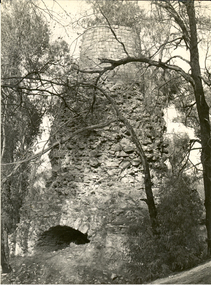 Federation University Historical Collection
Photograph - Photograph Album, Photographs of Ballarat Buildings, 1967, 1967
... ...grigsby brass founder...(Melbourne Advocate, 02 March 1939) ballarat buildings bluestone iron architecture biddington geoff biddington railway old colonists lal lal blast furnace beaufort house her majesty's theatre craig's hotel botanical gardens bailey cuthbert lenaghan tourello smythesdale post office court house hotel, smythesdale smythesdale alexandria tea rooms cast iron eureka street primary school dana street primary school ballarat school of mines administration building grigsby brass founder foundry pratt's warehouse selkirk bricks grandstand court house hotel Two Black folders of Ballarat photographs as follows: .1) Interior of Ballarat Railway Station .2) Interior of Ballarat Railway Station .3) Craig's Hotel .4) Craig's Hotel .5) Craig's Hotel .6) Craig's Hotel .7) Ballarat Fine Art Gallery later Art Gallery of Ballarat .8) Cuthberts, corner Lydiard and Mair Streets .9) Golden City Hotel (GCs) .10) Golden City Hotel (GCs) .11) Reid's Coffee Palace .12) Alexandria Tea Rooms, neighbouring Old Colonists' Club, Ballarat, Lydiard Street North .13) ? ...When these photos were taken Geoffrey Biddington was highly involved with the Ballarat Branch of the National Trust. At one time Her Majesty's Theatre was known as the Memorial Theatre. Lenaghan of Tourello "Master Dan Lenaghan, eldest son of Mr. and Mrs. R. Lenaghan, of Tourello, has been successful in obtaining a Government scholarship, tenable for four years at St. Patrick's College, Ballarat.(Melbourne Advocate, 02 March 1939) Two Black folders of Ballarat photographs as follows: .1) Interior of Ballarat Railway Station .2) Interior of Ballarat Railway Station .3) Craig's Hotel .4) Craig's Hotel .5) Craig's Hotel .6) Craig's Hotel .7) Ballarat Fine Art Gallery later Art Gallery of Ballarat .8) Cuthberts, corner Lydiard and Mair Streets .9) Golden City Hotel (GCs) .10) Golden City Hotel (GCs) .11) Reid's Coffee Palace .12) Alexandria Tea Rooms, neighbouring Old Colonists' Club, Ballarat, Lydiard Street North .13) ? .14 Caste iron drink fountain, corner of Strurt and Drummond Streets, October 1967 .15) Lal Lal Blast Furnace .16) Ballarat Botanical Garden Gates .17) Ballaarat Old Cemetery Gates .18) Novar gate .19) Ballaarat Old Cemetery Gates .20) ? .21) Webster Street .22) Doveton Street South .23) ? .24) ? .25) .26) .27) Iron hitching Rail .28) Iron hitching Rail .30) Postal Box, Corner or Armstrong Street South and Eyre Street, October 1967 .31) Iron Drinking Fountain in the Ballarat Botanical Gardens .32) Iron Drinking Fountain in the Ballarat Botanical Gardens .33) Killarney, Warrenheip .34) Killarney, Warrenheip .35) Killarney, Warrenheip .36) Killarney, Warrenheip .37) Bailey's Mansion, Drummond Street .38) Bailey's Mansion, Drummond Street .39) Beaufort House .40) Beaufort House .41) ? .42) ? .43) ? .44) ? .45) ? .46) ? .47) ? .48) Lenaghan's Tourello, February 1968 .49) Lenaghan's Tourello, February 1968 .50) ? .51) ? .52) ? .53) ? .54) ? .55) ? .56) ? .57) ? .58) ? .59) ? .70) Her Majesty's Theatre, Lydiard Street .71) Her Majesty's Theatre, Lydiard Street .72) Dana Street Primary School, September 1967 .73) Ballarat School of Mines Administration Building, September 1967 .74) Eureka Street Primary School ? .75) Selkirk Brick Chimney? .76) Grigsby's Foundry, Mair Street, September 1967 .77) Pratt's Warehouse, Camp Street .78) Premises of R. And R.A. Williams, Mair Street, September 1967 .79) City Oval Grandstand, with fire training tower in the background, .80) City Oval Grandstand .81) City Oval Grandstand .82) Smythesdale Post Office, October 1967 .83) Court House Hotel. Smythesdale, October 1967 .84) Smythesdale, October 1967ballarat, buildings, bluestone, iron, architecture, biddington, geoff biddington, railway, old colonists, lal lal blast furnace, beaufort house, her majesty's theatre, craig's hotel, botanical gardens, bailey, cuthbert, lenaghan, tourello, smythesdale post office, court house hotel, smythesdale, smythesdale, alexandria tea rooms, cast iron, eureka street primary school, dana street primary school, ballarat school of mines administration building, grigsby brass founder, foundry, pratt's warehouse, selkirk bricks, grandstand, court house hotel -
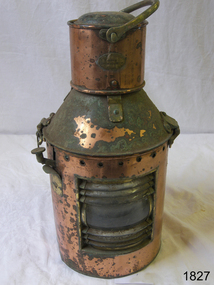 Flagstaff Hill Maritime Museum and Village
Functional object - Marine Lamp, R C Murray & Co Ltd, 1900 -1930
... founder or company history. It appears RC Murray made not only marine lamps but lamps for the railways as well. The company is listed in the Scottish Post Office Directories for 1885 to 1886 as manufacturing tinsmiths, lamp makers, coppersmiths, gas fitters, bell hangers and workers in sheet iron, zinc and brass at street numbers 7, 9 and 11 Carlton Court, Bridge St Glasgow. ...founder or company history. It appears RC Murray made not only marine lamps but lamps for the railways as well. The company is listed in the Scottish Post Office Directories for 1885 to 1886 as manufacturing tinsmiths, lamp makers, coppersmiths, gas fitters, bell hangers and workers in sheet iron, zinc and brass at street numbers 7, 9 and 11 Carlton Court, Bridge St Glasgow. ...The item is a kerosene marine ships lamp used onboard ships and smaller vessels for general lighting and navigation the subject lamp was made by a very well known maker R C Murray of Glasgow Scotland. During the research several different addresses were found but nothing on the founder or company history. It appears RC Murray made not only marine lamps but lamps for the railways as well. The company is listed in the Scottish Post Office Directories for 1885 to 1886 as manufacturing tinsmiths, lamp makers, coppersmiths, gas fitters, bell hangers and workers in sheet iron, zinc and brass at street numbers 7, 9 and 11 Carlton Court, Bridge St Glasgow. An additional address is at 37 Cavendish St Glasgow listed for 1910, and also at Pollokshaws Road. The writer assumes the company must have moved sometime between 1886 & 1910 to these addresses. The writer at this time cannot ascertain any more historical information regarding the company or its founder, however, lamps made by RC Murray are now collector's items commanding significant sale prices on many auction websites.A significant item used in the marine industry on many ships, the company made kerosene lamps for other industries as well and was a well-known company in the early part of the 20th century.Marine kerosene ships lamp, round copper handle on top and side top is hinged with catch and lever, protruding near top.Inscribed "RC Murray and Co Limited" "Pollokshaws Road Glasgow S.1." flagstaff hill, warrnambool, shipwrecked-coast, flagstaff-hill, flagstaff-hill-maritime-museum, maritime-museum, shipwreck-coast, flagstaff-hill-maritime-village, lamp, lantern, brass lamp, nautical object -
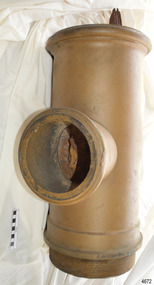 Flagstaff Hill Maritime Museum and Village
Equipment - Bilge Pump Barrel, Alexander Hall and Son, 1855
... The shipwreck is of additional historically significance for representing aspects of Victoria’s shipping history and for its association with the first passenger ship, which was designed not only to be the fastest and most luxurious of its day but foundered on its maiden voyage to Australia. warrnambool flagstaff-hill flagstaff-hill-maritime-museum shipwreck-coast flagstaff-hill-maritime-village schomberg shipwrecked-artefact clipper ship black ball line 1855 shipwreck aberdeen clipper ship captain forbes peterborough shipwreck ss queen bilge pump ship's plumbing bilge pump barrel bilge None Bilge pump barrel,; brass cylinder with screw thread at the base and fittings on one side. ...This bilge pump barrel is part of the ship's bilge pump machinery. Bilge or water can find its way into the hull of a ship and if it is not removed the ship will eventually sink. The bilge pump is designed to efficiently remove the bilge water. The Schomberg was a large three-masted full-ship rigged wooden ship built in 1855 by Alexander Hall and Co in Aberdeen, Scotland for James Baines' famous Black Ball Line at £43,103. The vessel was 288 feet (88 meters) in length, with a beam of 45 feet (14 meters), a depth of 29.5 feet (8.99 meters) of 2,284 tons. The mainmast was 210 feet (64 meters) high and she carried 3.3 acres of sail. The vessel was constructed with three skins. One planked fore and aft, and two diagonally planked, fastened together with screw-threaded trunnels (wooden rails). The Schomberg is one of only three clipper wrecks in Victorian waters that operated the England to Australia run. While the other two, Empress of the Sea and Lightning, were built by the famous American shipbuilder, Donald Mac Kay. Schomberg was an attempt to build a faster ship than Mac Kay and a vessel fast enough to break the sailing record to Australia. The Schomberg sailed on her maiden voyage from Liverpool on 6 October 1855, under the command of Captain James Forbes, on its maiden voyage to Australia with general cargo, jewellery, spirits, machinery, and 2,000 tons of iron rails and equipment intended to build the Melbourne to Geelong Railway and a bridge over the Yarra from Melbourne to Hawthorn. She also carried a cow for fresh milk, pens for fowls and pigs, plus 90,000 gallons of water for washing and drinking. She also carried 17,000 letters and 31,800 newspapers. There were approximately 473 passengers and a crew of 105. It was hoped that Schomberg would make Melbourne in sixty days, setting a record for the voyage, but light winds at the equator dashed those expectations. The ship sighted Moonlight Head in southwest Victoria on Christmas Day but through a deadly combination of wind, currents and unmarked sand spits, the vessel gently ran aground on 26 December 1855 on a spit that juts into Newfield Bay, just east of Curdies Inlet, and the present town of Peterborough. Fortunately, the SS Queen was nearby and managed to save all passengers and crew. The steamers Keera and Maitland were dispatched to salvage the passenger's baggage and the more valuable cargo. Other salvage attempts were made, but deteriorating weather made the work impossible, and within two weeks the Schomberg's hull was broken up and the vessel abandoned. The wrecking of the Schomberg caused quite a public stir, particularly in light of the fact the vessel was supposed to be, the most perfect clipper ship ever built. Captain Forbes was charged in the Supreme Court under suspicion that he was playing cards with two female passengers below decks when his ship ran aground. Despite a protest meeting, two inquiries and the court proceedings, he was found not guilty and cleared of all charges. In 1975, divers from Flagstaff Hill, including Peter Ronald, found an ornate communion set at the wreck. The set comprised a jug, two chalices, a plate and a lid. The lid did not fit any of the other objects and in 1978 a piece of the lid broke off, revealing a glint of gold. As museum staff carefully examined the lid and removed marine growth, they found a diamond ring, which is currently on display in the Great Circle Gallery at the Flagstaff Hill Maritime museum that also displays ship fittings and equipment, and personal effects. The Schomberg has historical significance as one of the first luxurious ships built to bring emigrants to Australia to cash in on the gold rush era. And is included on the Victorian Heritage Register (VHR S612). The collection of Schomberg artefacts held at Flagstaff Hill Museum is primarily significant because of the relationship between these recovered items having a high potential to interpret the story of the Schomberg and its foundering during a storm. The shipwreck is of additional historically significance for representing aspects of Victoria’s shipping history and for its association with the first passenger ship, which was designed not only to be the fastest and most luxurious of its day but foundered on its maiden voyage to Australia.Bilge pump barrel,; brass cylinder with screw thread at the base and fittings on one side. A piece of the ship's timber is attached. The object was recovered from the wreck of the shipo Schomberg. Nonewarrnambool, flagstaff-hill, flagstaff-hill-maritime-museum, shipwreck-coast, flagstaff-hill-maritime-village, schomberg, shipwrecked-artefact, clipper ship, black ball line, 1855 shipwreck, aberdeen clipper ship, captain forbes, peterborough shipwreck, ss queen, bilge pump, ship's plumbing, bilge pump barrel, bilge -
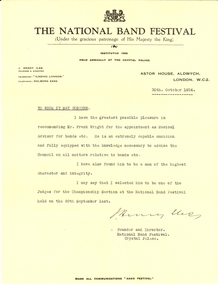 Federation University Historical Collection
Document, J Henry Iles, Reference for Frank Wright from J. Henry Iles of the National Band Festival, 1934, 30/10/1934
... The Frank Wright Medal at the Royal South Street competition is awarded to an individual recognized as making an outstanding contribution to brass music in Australia. frank wright j henry iles the national band festival crystal palace brass band Signature in black pen This single sheet of paper with the black printed header of The National Band Festival, is a typed letter of reference for Frank Wright. It is signed by Founder ...Frank Wright was a renown resident of Smeaton, where he was born on 2 August 1901. He lived at Laura Villa, and attended Smeaton State School. His father William was a gold miner and his mother's name was Sarah. Their family won many singing and instrumental awards. Frank was tutored by Percy Code and was awarded a gold medal for the highest marks in the ALCM examinations in the British Colonies at the age of seventeen years. He became the Australian Open Cornet Champion by the age of eighteen. A year later, Frank conducted the City of Ballarat Band, and later the Ballarat Soldiers’ Memorial Band. He formed the Frank Wright Frisco Band and Frank Wright and his Coliseum Orchestra. These bands won many South Street awards, and Frank as conductor won many awards in the Australian Band Championship contest. In 1933 Frank Wright sailed to England to conduct the famous St Hilda’s Band and was later appointed Musical Director of the London County Council, where he organized many amazing concerts in parks, in and around the London district. He was made Professor of Brass and Military Band Scoring and conducted at the Guildhall of Music and Drama. Frank was often invited to adjudicate Brass Band Championships around Europe, in Australia, including South Street and in New Zealand. The Frank Wright Medal at the Royal South Street competition is awarded to an individual recognized as making an outstanding contribution to brass music in Australia.This single sheet of paper with the black printed header of The National Band Festival, is a typed letter of reference for Frank Wright. It is signed by Founder and Director J Henry Iles.Signature in black penfrank wright, j henry iles, the national band festival, crystal palace, brass band -
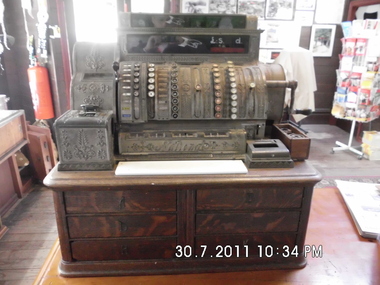 Walhalla Museum
'NATIONAL' Cash Register, National Cash Register (NCR), 1903
... founder of International Business Machines (IBM), started as a traveling salesman for NCR. This register came from a shop owned by Mrs. Dulcie Anderson near the Star Hotel in Walhalla. money shop shops 1903 cash cash register 'NATIONAL' on the back. This cash register consists a brass ...This cash register was made in 1903 at Dayton, Ohio (USA) by the National Cash Register (NCR) company, which still operates today manufacturing commercial equipment, including Automatic Teller Machines. Mr. Thomas Watson, the founder of International Business Machines (IBM), started as a traveling salesman for NCR.This register came from a shop owned by Mrs. Dulcie Anderson near the Star Hotel in Walhalla. This cash register consists a brass register that is now heavenly tarnished. The register has two mechanical displays on the back and fore on the front. The register is siting on a wooden chest with a dark varnish and cash draws ladled A,B,D,E,H,K, with draw E missing the metal letter.'NATIONAL' on the back.money, shop, shops, 1903, cash, cash register -
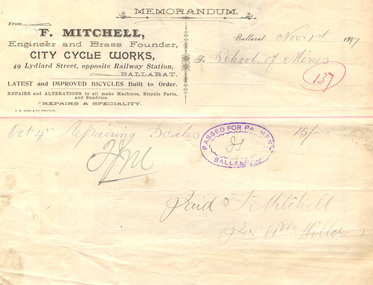 Federation University Historical Collection
Document, Invoices to the Ballarat School of Mines, 1897
... ...M.B. John Brass founder...John M.B. John Brass founder F. Mitchell F. Mitchell Brassfounder and Engineer City Cycle Works Innvoices to the Ballarat School of Mines Invoices to the Ballarat School of Mines Document ...Innvoices to the Ballarat School of Minesm.b. john, m.b. john brass founder, f. mitchell, f. mitchell brassfounder and engineer, city cycle works -
 Federation University Historical Collection
Photograph - Black and White, Warren Tiller and the All Purpose Band Graduation, c1995
... Lloyd Stinton is on the cornet, back row, fourth from the right. all purpose band warren tiller lloyd stinton music band brass instruments Formal grouping of students and conductor Warren Tiller. They are standing on the stage in the Mt Helen Campus Founders Hall, with the Ballarat College of of Advanced Education weaving in the background. ...The All Purpose Band Graduation with the conductor Warren Tiller. Lloyd Stinton is on the cornet, back row, fourth from the right.Formal grouping of students and conductor Warren Tiller. They are standing on the stage in the Mt Helen Campus Founders Hall, with the Ballarat College of of Advanced Education weaving in the background. all purpose band, warren tiller, lloyd stinton, music, band, brass instruments -
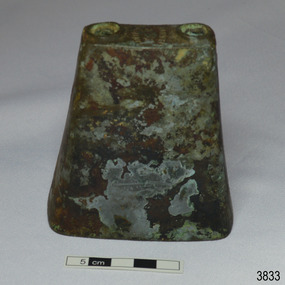 Flagstaff Hill Maritime Museum and Village
Functional object - Cow Bell, James Barwell, 1860s-1878
... The collection is also historically significant for its association with the LOCH ARD, which was one of the worst and best known shipwrecks in Victoria’s history. flagstaff hill warrnambool flagstaff hill maritime museum maritime museum shipwreck coast flagstaff hill maritime village great ocean road john chance loch ard mutton bird island glenample eva carmichael tom pearce james barwell cow bell horse bell bell founder bell smith vintage bell birmingham bell foundry farmer shepherd drover stock bell Stamped on the head "BARWELL / - - - / - - -- ING" [Perhaps BARWELL - - - BIRMING. Could size be in centre? 3 3/4 IN?] Stamped on side [motif] (undecipherable) Cow bell; heavy brass ...This brass cow bell was recovered from the wreck of the sailing ship ‘Loch Ard’ at Mutton Bird Island, near Port Campbell, Victoria, from late 1960s to early 1970s. Cow bells were listed as part of the cargo on board the Loch Ard. This bell is now part of the John Chance collection. Flagstaff Hill Maritime Village’s divers also recovered similar bells from the Loch Ard wreck in 1973. One of them was found in a sandy hole in the centre of the wreck site. All of the recovered cow bells are without their hangers. A bell of this size could have been used by horse or cattle teams. Cow bells were a common Colonial item. They were hung around the necks of grazing domestic cows and goats, bullock and horse teams, even camel teams so that they could be found again. Sheep and cattle drovers used them as a warning for night time disturbances such as wild animals. The maker of the cow bell, James Barwell, was a bell founder established in Birmingham, England, from 1784. In 1842 he acquired Fiddian’s firm of ‘Steam and Water’, keeping its name and stamping it on some of his products. According to his advertisement in the Exhibitors guide for the Church Congress of 1887, he made bells and fittings for churches and schools. He also made bells for cloches and chimes, and made tuned musical handbells. He repaired and reproduced bells, and he had a team of experienced ringers to “inspect towers and report upon the tone and condition of bells and fittings.” In 1903 he became incorporated as a Limited Company, ‘engineers’ and plumbers’ brasswork, and bell founders.’ In 1914 he advertised as ‘Cock and Bell Founders’, specialising in plumbing and engineering fittings, church bells, and “every description of hanging and hand bells.” Some of Barwell’s products were stamped with his maker’s mark (his initials J. B. either side of a cross entwined with a ‘B’ in an oval of oak leaves (for Birmingham)). James Barwell bells were no longer made after 1920. James Barwell was among makers who exported bells to the Australian colony from the 1860s. Early Australian iron animal bells were also made from the 1860s by blacksmiths such as Anthony Morgan from 1861, August Menneke from 1867, and Samuel Jones from 1868. Few brass bells were produced here in those times. This bell is historically significant as typical of a cow bell used by farmers and herdsmen in Colonial Victoria. Its significance is increased by being an artefact recovered by John Chance, a diver from the wreck of the Loch Ard and other wrecks in the late 1960s to early 1970s. Items that come from several wrecks along Victoria's coast have since been donated to the Flagstaff Hill Maritime Village’s museum collection by his family, illustrating this item’s level of historical value. The cow bell is also significant for being part of Flagstaff Hill’s collection of artefacts from LOCH ARD, which is significant for being one of the largest collections of artefacts from this shipwreck in Victoria. It is significant for its association with the shipwreck, which is on the Victorian Heritage Register (VHR S417). The collection is significant because of the relationship between the objects, as together they have a high potential to interpret the story of the LOCH ARD. The LOCH ARD collection is archaeologically significant as the remains of a large international passenger and cargo ship. The LOCH ARD collection is historically significant for representing aspects of Victoria’s shipping history and its potential to interpret sub-theme 1.5 of Victoria’s Framework of Historical Themes (living with natural processes). The collection is also historically significant for its association with the LOCH ARD, which was one of the worst and best known shipwrecks in Victoria’s history. Cow bell; heavy brass, flat top, pyramid shape, rectangular head, shoulders flare out to rectangular mouth. The head has two same-sized tooled holes for adding the hanging yoke. Inscription on top and one side. Encrustations are on the metal in places. The hanger and clapper are missing. Made by James Barwell of Birmingham.Stamped on the head "BARWELL / - - - / - - -- ING" [Perhaps BARWELL - - - BIRMING. Could size be in centre? 3 3/4 IN?] Stamped on side [motif] (undecipherable) flagstaff hill, warrnambool, flagstaff hill maritime museum, maritime museum, shipwreck coast, flagstaff hill maritime village, great ocean road, john chance, loch ard, mutton bird island, glenample, eva carmichael, tom pearce, james barwell, cow bell, horse bell, bell founder, bell smith, vintage bell, birmingham bell foundry, farmer, shepherd, drover, stock bell
