
Showing 24 items matching "bright space"
-
 Women's Art Register
Archive (Series) - Maggie Diaz Photography Prize. Subject File 1
... Bright Space...Bright Space Leanne Airey Anne Algar Barbara Bradington Rachel Sara Bromberg Susan Bruniati Jessie Dinan J.Forsyth Susanne Harroothunian Julie Higginbotham Camilla Johansson-Merrick Donna Killen Killian Edith Knowler Anne Moffat Gino Nero Tagette O'Halloran Bec Penistorn-Bird Tessa Penny Photography Foolscap white archival 4 flap folder or document wallet Archive Maggie Diaz Photography Prize. ...Invitationsbright space, leanne airey, anne algar, barbara bradington, rachel sara bromberg, susan bruniati, jessie dinan, j.forsyth, susanne harroothunian, julie higginbotham, camilla johansson-merrick, donna killen, killian, edith knowler, anne moffat, gino nero, tagette o'halloran, bec penistorn-bird, tessa penny, photographybright space, leanne airey, anne algar, barbara bradington, rachel sara bromberg, susan bruniati, jessie dinan, j.forsyth, susanne harroothunian, julie higginbotham, camilla johansson-merrick, donna killen, killian, edith knowler, anne moffat, gino nero, tagette o'halloran, bec penistorn-bird, tessa penny, photography -
Women's Art Register
Archive (Collection) - Maggie Diaz Photography Prize Exhibition Archive
... Bright Space...2019 Bright Space Leanne Airey Anne Algar Barbara Bradington Rachel Sara Bromberg Susan Bruniati Jessie Dinan J.Forsyth Susanne Harroothunian Julie Higginbotham Camilla Johansson-Merrick Donna Killen Killian Edith Knowler Anne Moffat Gino Nero Tagette O'Halloran Bec Penistorn-Bird Tessa Penny Photography Archive Maggie Diaz Photography Prize Exhibition Archive ...bright space, leanne airey, anne algar, barbara bradington, rachel sara bromberg, susan bruniati, jessie dinan, j.forsyth, susanne harroothunian, julie higginbotham, camilla johansson-merrick, donna killen, killian, edith knowler, anne moffat, gino nero, tagette o'halloran, bec penistorn-bird, tessa penny, photographybright space, leanne airey, anne algar, barbara bradington, rachel sara bromberg, susan bruniati, jessie dinan, j.forsyth, susanne harroothunian, julie higginbotham, camilla johansson-merrick, donna killen, killian, edith knowler, anne moffat, gino nero, tagette o'halloran, bec penistorn-bird, tessa penny, photography -
Women's Art Register
Archive (Series) - Maggie Diaz Photography Prize. Duplicate File 1
... ... Bright Space...Photography Bright Space Leanne Airey Anne Algar Barbara Bradington Rachel Sara Bromberg Susan Bruniati Jessie Dinan J.Forsyth Susanne Harroothunian Julie Higginbotham Camilla Johansson-Merrick Donna Killen Killian Edith Knowler Anne Moffat Gino Nero Tagette O'Halloran Bec Penistorn-Bird Tessa Penny Foolscap manilla file Archive Maggie Diaz Photography Prize. ...Invitationsphotography, bright space, leanne airey, anne algar, barbara bradington, rachel sara bromberg, susan bruniati, jessie dinan, j.forsyth, susanne harroothunian, julie higginbotham, camilla johansson-merrick, donna killen, killian, edith knowler, anne moffat, gino nero, tagette o'halloran, bec penistorn-bird, tessa pennyphotography, bright space, leanne airey, anne algar, barbara bradington, rachel sara bromberg, susan bruniati, jessie dinan, j.forsyth, susanne harroothunian, julie higginbotham, camilla johansson-merrick, donna killen, killian, edith knowler, anne moffat, gino nero, tagette o'halloran, bec penistorn-bird, tessa penny -
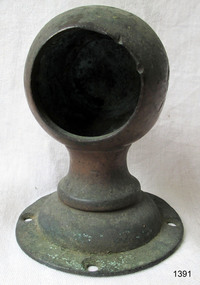 Flagstaff Hill Maritime Museum and Village
Functional object - Rail holder, About 1893, when the ship was made
... spaced fixture holes around its edge. The metal shows signs of pitting and has mild encrustation. The fitting of the base is loose, allowing it to swivel in a complete circle. The top of the sphere is rough and has a dent in it. Underneath the base there is verdigris; some has flaked off and reveals a bright...spaced fixture holes around its edge. The metal shows signs of pitting and has mild encrustation. The fitting of the base is loose, allowing it to swivel in a complete circle. The top of the sphere is rough and has a dent in it. Underneath the base there is verdigris; some has flaked off and reveals a bright ...This brass rail holder fixture would have been used to hold the end of a rail in place. There is no information as to where the fitting or rail would have been placed on the ship; sailing ships had many brass fittings. It was recovered from the wreck of the La Bella, which lies at the bottom of the Warrnambool Harbour. Some 15 ships are believed to have been wrecked in Lady Bay, but only two have been discovered on the sea floor; the La Bella and the Edinburgh Castle. Both wrecks are popular diving sites and are preserved as significant historical marine and marine archaeological sites. The story of the final voyage of the La Bella is summarised as follows … The ship from which the sailors were rescued was the three-masted, iron and steel barquentine the La Bella, built in Norway in 1893. She was one of two iron and steel ships by Johan Smith, the company being one of the leading shipping families in Tvedestrand, Norway. She was significant to Norwegian shipping, being one of only 27 iron and steel ships ever built in Norway. She was registered in New Zealand and engaged from 1902 in inter-colonial trading of timber in the pacific, between New Zealand and Australia and was often in Port Phillip Bay, Victoria. On 5th October, 1905, the twelve year old La Bella left Lyttleton, New Zealand carrying a cargo of timber bound for Warrnambool, Australia . She was manned by a crew of twelve: the Master, (Captain Mylius, previously 1st Mate of La Bella, appointed Captain to La Bella on 6th February 1903) 2 Mates, Cook, six able seamen, one ordinary seaman and a boy. . Bad weather en route caused her to shelter at Burnie on Tasmania's North West coast. On November 10th, the 37th day of her journey, La Bella approached Warrnambool. Captain Mylius steered her towards Lady Bay Channel in heavy south-west seas and evening mist. He ordered the helmsman to steer for the light. As the ship came round, a tremendous sea struck her on the port quarter, causing her to breach broadside in a north-westerly direction into breakers. The helm was brought round twice more, but each time heavy seas broke over her, the third time throwing the La Bella on to a submerged reef in Lady Bay now known as La Bella Reef (about 100 yards from the Warrnambool breakwater). The sea was so rough that it even wrenched a one-and-a-half ton anchor from its fastenings and into the sea. As Captain Mylius headed to the steel wheelhouse, intending to send up a rocket flare, a huge sea slammed the steel door into him (resulting in massive bruising front and back) Despite his injuries he still managed to set off a blue light, which he held up in his hands. La Bella’s lifeboats were filled with sea water and broke up on their chocks. The blue light was the first indication to people on shore that there was a ship in distress. The Harbour Master, Captain Roe (who lived in the Harbour Master’s House opposite Flagstaff Hill), organised a group of volunteers to crew the lifeboat because the trained crew was unavailable; the crewmen were working on a steamer in Port Fairy at the time. He then poured oil onto the water to try and smooth the sea. At around 11pm three of the crew took shelter in the steel forecastle but the sea crashed into it and broke it up. While the rest of the crew and onlookers watched helplessly in the moonlight the bodies were washed away into the sea, never to be seen again. Some of the crew lashed themselves to the weather rail to keep from being washed away. Watson, the ordinary seaman, became tangled in the rigging lines and was too weak to move, so the 2nd Mate, Robertson, put a line onto him so that he wouldn’t wash off. Around 11pm three of the crew were unconscious from exhaustion. The situation on La Bella was becoming dangerous. The 2nd Mate moved to the ‘house’ and soon afterwards the ship slipped in the heavy sea. The lashings of the 1st Mate and the ‘boy’ Denham had kept them safe until about 2am when they were washed overboard; no one was able to help. One by one, the exhausted crew were being washed overboard, too weak to hold on any longer. During the night the La Bella had broken into two and the deckhouse ran out towards the sea. Two more men drowned when trying to reach the lifeboat. By sunrise the only survivors of the twelve were the Master, 2nd Mate and three seamen. Early in the morning Captain Roe used the rocket apparatus on shore to try and shoot a line to the ship for a safer rescue but each attempt fell short of the target. Several attempts were made by the lifeboat to rescue the stricken sailors, but the rough conditions made this difficult for the boat to get close enough to the ship and the lifeboat had to return to shore. During a final attempt to reach the ship Captain Mylius ordered his men to jump into the sea. Leonard Robertson, 2nd mate, jumped and swam towards the lifeboat, taking hold of the boat hook offered to him. Oscar Rosenholme managed to reach the boat floating on a piece of timber from the ship’s load and a third survivor, Noake, also made the boat. Along with the lifeboat rescue crew, 25 year old William Ferrier rowed his small dingy through the heavy seas and managed to rescue the Captain, whom he landed on the breakwater. Ferrier then returned to the ship to attempt a final rescue, losing his oars and rowlocks into the high sea. Using just a spare paddle he skulled towards the La Bella, reaching her stern in time to cut loose the lone surviving sailor, Payne, from the lashing that held him to the ship; the terrified sailor dropped from the ship and into the dingy. Shortly after the last man was rescued, the La Bella was lifted by a huge wave and crashed back down on the reef; she broke up and sank. The ordeal had lasted ten hours. The survivors were taken to the nearby Bay View Hotel and gratefully received warm food and clothing, medical attention and a place to sleep. In the following days an unidentified body of a young person was washed ashore; it was either Watson or Denham. The body was buried in the Warrnambool cemetery with an appropriate gravestone and inscription. William Ferrier became a national hero as news of the daring rescue spread. In recognition of his bravery in the two daring rescues he was awarded the Silver Medal for Bravery by the Royal Humane Society and was honoured in the letter from the Prime Minister and the Parliament of the Commonwealth, telegrams and a cheque for £20 from the Governor General, over £150 subscribed by the public, including Warrnambool and district and readers of The Argus, and a gold medal from the Glenelg Dinghy Club of South Australia. Ferrier’s rescue efforts are one of the most heroic in Victoria’s shipwreck history. (William Ferrier’s son, Frank, received a similar award almost fifty years later, when he helped rescue four members of the crew on the yacht Merlan, after it ran on to a reef near the Point Lonsdale Lighthouse. ) The wreck of La Bella now lies on her port side in 13 metres of sheltered water inside the reef she struck. The bow section is relatively intact and part of the stern has drifted north-easterly towards the mouth of the Hopkins River. The reef the La Bella struck now bears its name. Those five rescued from the La Bella were Captain George Mylius, Leonard Robertson (2nd Mate, 21 years old), R. Payne, Oscar Rosenholme and Jack Noake. Those seven who lost their lives were Mr Coulson (1st mate), Charles Jackman (cook) Gustave Johnson, Pierre Johann and Robert Gent (all able seamen), Harry Watson (ordinary seaman) and Jack Denham (ship’s boy), Captain Mylius was found guilty of careless navigation; he had sailed into the bay without the services of a pilot. His Master Certificate was suspended for twelve months. Later he was also charged with manslaughter of one of the crew who had died when the La Bella was wrecked, but found not guilty. The event’s adverse publicity and damage to his career took a toll on his health and he died of a heart attack six months after the wreck; he was only thirty-seven. His body was buried in the Melbourne General Cemetery. The La Bella was “the best documented of all sailing ships owned in New Zealand”. Her record books, ship logs, correspondence and supporting papers are still available. At the time of the tragedy, she was owned by Messers David C.Turnbull and Co. of Timaru, New Zealand timber merchants and shipping agents, who had purchased her on 13th December 1901. A detailed account of the last journey of La Bella can be read in “Leonard Robertson, the Whangaroa & La Bella” written by Jack Churchouse, published in 1982 by Millwood Press Ltd, Wellington, NZ. Some 15 – 17 ships are believed to have sunk in Lady Bay, but only two have been discovered on the seafloor; the “La Bella” and the “Edinburgh Castle”. Both wrecks are popular diving sites and are preserved as significant historical marine and marine archaeological sites. As well as this letter, Flagstaff Hill’s La Bella Collection includes a photograph of the wrecked La Bella, a brass rail holder and a postcard of William Ferrier with four of the survivors. This original congratulatory letter sent to William Ferrier by the Prime Minister and Government of Australia demonstrates the importance attached to his efforts for Victoria and to Australia. The letter is part of the La Bella Collection and is significant at both a local and state level. Its connection to the La Bella shipwreck and the rescue of five survivors highlights the dangers of Victoria’s Shipwreck Coast. The letter to William Ferrier from the Australian Government acknowledges the bravery of ordinary Australians who risked their lives to save victims of shipwrecks along the coast. The letter is significant to the history of Warrnambool as it honours William Ferrier, a local fisherman whose descendants continue to live in the area. It highlights the way of life of people who lived in coastal towns in 19th century Victoria and the effects of shipwrecks upon them. The letter connects to the postcard of William Ferrier with four of the five rescued crew, the photograph of the wreck of the La Bella and the artefact from the wreck, the rail holder. This item is significant because of its association with the sailing ship “La Bella” . the “La Bella” is of local and state and national significance. It is one of the only two shipwrecks discovered in Lady Bay, Warrnambool, out of the 15-17 shipwrecks in the bay. Brass rail holder from the wreck "La Bella". This rail holder would have been used as a fitting for the end of a rail. It is made up of two parts and looks a little like a goblet in shape. The top is a hollow spherical shape with a circular hole cut out on one side, into which the end of a round rail would fit. There are two gouge marks close to each other on one side of the hole, about one centimetre apart, at 1 and 2 o’clock position. The sphere has a hollow pipe-like stem with a screw thread turned into the outside of the lower section and the bottom of the stem has been flared out after having the base fitted. The base is round and has a mound in the centre. The edge has four evenly spaced fixture holes around its edge. The metal shows signs of pitting and has mild encrustation. The fitting of the base is loose, allowing it to swivel in a complete circle. The top of the sphere is rough and has a dent in it. Underneath the base there is verdigris; some has flaked off and reveals a bright golden colour underneath. rail holder, brass rail holder, la bella, lady bay, norway, 1893, new zealand, captain mylius, william ferrier, flagstaff hill, warrnambool, shipwrecked coast, flagstaff hill maritime museum, maritime museum, shipwreck coast, flagstaff hill maritime village -
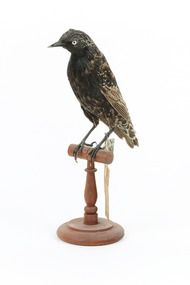 The Beechworth Burke Museum
Animal specimen - Common Starling, Trustees of the Australian Museum, 1860-1880
... bright plumage. This specimen is part of a collection of almost 200 animal specimens that were originally acquired as skins from various institutions across Australia, including the Australian Museum in Sydney and the National Museum of Victoria (known as Museums Victoria since 1983), as well as individuals such as amateur anthropologist Reynell Eveleigh Johns between 1860-1880. These skins were then mounted by members of the Burke Museum Committee and put-on display in the formal space...bright plumage. This specimen is part of a collection of almost 200 animal specimens that were originally acquired as skins from various institutions across Australia, including the Australian Museum in Sydney and the National Museum of Victoria (known as Museums Victoria since 1983), as well as individuals such as amateur anthropologist Reynell Eveleigh Johns between 1860-1880. These skins were then mounted by members of the Burke Museum Committee and put-on display in the formal space ...The Common Starling is an introduced species to Australia (as well as widely throughout the world), and is considered a pest due to its attacks on fruits and seedlings, as well as competing with the native bird population. It was introduced to Victoria in 1861, and has since become abundant, whose sheer numbers cause many problems. These birds are a social species, which can mass in very large flocks (murmations), and show spectacular synchronised aerobatic displays. This species has a distinctive plumage, with glossy black bodies, white spots on their backs and wings, and a purple and green tinge to their underparts and wings. This species, when moving across the ground, has a distinctive 'walk' or 'run' rather than the traditional hopping of many other bird species. This bird is a noisy species, often becoming a nuisance to people. Starlings prefer to nest in holes in trees or buildings, yet there are at least two recorded cases of this species nesting on the backs of living sheep. This specimen is a good and intact example of this species. As the white spots are large and visible, as well as the purple and green shine, this specimen likely died close to Autumn and the breeding season, when these birds get their new bright plumage. This specimen is part of a collection of almost 200 animal specimens that were originally acquired as skins from various institutions across Australia, including the Australian Museum in Sydney and the National Museum of Victoria (known as Museums Victoria since 1983), as well as individuals such as amateur anthropologist Reynell Eveleigh Johns between 1860-1880. These skins were then mounted by members of the Burke Museum Committee and put-on display in the formal space of the Museum’s original exhibition hall where they continue to be on display. This display of taxidermy mounts initially served to instruct visitors to the Burke Museum of the natural world around them, today it serves as an insight into the collecting habits of the 19th century. This specimen is part of a significant and rare taxidermy mount collection in the Burke Museum. This collection is scientifically and culturally important for reminding us of how science continues to shape our understanding of the modern world. They demonstrate a capacity to hold evidence of how Australia’s fauna history existed in the past and are potentially important for future environmental research. This collection continues to be on display in the Museum and has become a key part to interpreting the collecting habits of the 19th century.This adult Common Starling has glossy-black plumage with a metallic sheen, and white speckles throughout. The plumage has a purple and green shine. The irises are white. Its beak is black and pointed. This specimen appears to be male, with less white spots on its underparts. This specimen stands upon a wooden platform and has an identification tag tied around its leg, and a metal tag tied around its foot.Swing-tag: 139a. / Starling / Catalogue Page, 59 / Metal-tag: 1250 (?)taxidermy mount, taxidermy, animalia, burke museum, beechworth, australian museum, skin, reynell eveleigh johns, bird, sheep, common starling, starling, murmations, pest, australian bird -
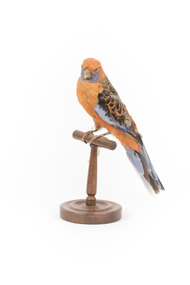 The Beechworth Burke Museum
Animal specimen - Crimson Rosella
... brighter colours than the specimen collected. This specimen has also been documented as having a light blue or black beak. This specimen is part of a collection of almost 200 animal specimens that were originally acquired as skins from various institutions across Australia, including the Australian Museum in Sydney and the National Museum of Victoria (known as Museums Victoria since 1983), as well as individuals such as amateur anthropologist Reynell Eveleigh Johns between 1860-1880. These skins were then mounted by members of the Burke Museum Committee and put-on display in the formal space...brighter colours than the specimen collected. This specimen has also been documented as having a light blue or black beak. This specimen is part of a collection of almost 200 animal specimens that were originally acquired as skins from various institutions across Australia, including the Australian Museum in Sydney and the National Museum of Victoria (known as Museums Victoria since 1983), as well as individuals such as amateur anthropologist Reynell Eveleigh Johns between 1860-1880. These skins were then mounted by members of the Burke Museum Committee and put-on display in the formal space ...The Crimson Rosella is native to Australia and located in Queensland and South Australia. Australia has a diverse range of rosellas, but the crimson rosella is easily recognised by the red body and blue cheeks. These birds are friendly to humans and consume seeds, insects and some blossoms. They nest in high trees, preferably eucalyptus. Typically, a crimson rosella should have far brighter colours than the specimen collected. This specimen has also been documented as having a light blue or black beak. This specimen is part of a collection of almost 200 animal specimens that were originally acquired as skins from various institutions across Australia, including the Australian Museum in Sydney and the National Museum of Victoria (known as Museums Victoria since 1983), as well as individuals such as amateur anthropologist Reynell Eveleigh Johns between 1860-1880. These skins were then mounted by members of the Burke Museum Committee and put-on display in the formal space of the Museum’s original exhibition hall where they continue to be on display. This display of taxidermy mounts initially served to instruct visitors to the Burke Museum of the natural world around them, today it serves as an insight into the collecting habits of the 19th century.This specimen is part of a significant and rare taxidermy mount collection in the Burke Museum. This collection is scientifically and culturally important for reminding us of how science continues to shape our understanding of the modern world. They demonstrate a capacity to hold evidence of how Australia’s fauna history existed in the past and are potentially important for future environmental research. This collection continues to be on display in the Museum and has become a key part to interpreting the collecting habits of the 19th century.This Crimson Rosella has a red feathered chest and cape across the head and blue cheeks besides the bill. The tail and wing feathers are mostly black with blue around the edges. The head is angled slightly to the specimen's left. This specimen stands upon a wooden platform and has an identification tag tied around its leg.78a. / Rennauts Parakeet / See Catalogue, page 22 /taxidermy mount, taxidermy, animalia, burke museum, beechworth, australian museum, skin, bird, california, australian native bird, crimson rosella, rosella, reynell eveleigh johns, platycercus elegans -
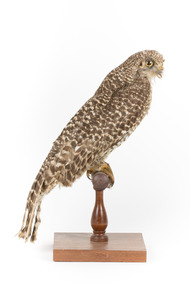 The Beechworth Burke Museum
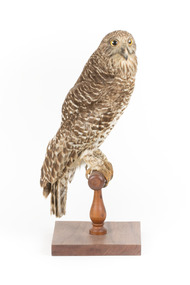
Animal specimen - Powerful Owl, Trustees of the Australian Museum, 1860- 1880
... brighter yellow in colour in real life. This specimen is part of a collection of almost 200 animal specimens that were originally acquired as skins from various institutions across Australia, including the Australian Museum in Sydney and the National Museum of Victoria (known as Museums Victoria since 1983), as well as individuals such as amateur anthropologist Reynell Eveleigh Johns between 1860-1880. These skins were then mounted by members of the Burke Museum Committee and put-on display in the formal space...brighter yellow in colour in real life. This specimen is part of a collection of almost 200 animal specimens that were originally acquired as skins from various institutions across Australia, including the Australian Museum in Sydney and the National Museum of Victoria (known as Museums Victoria since 1983), as well as individuals such as amateur anthropologist Reynell Eveleigh Johns between 1860-1880. These skins were then mounted by members of the Burke Museum Committee and put-on display in the formal space ...The Powerful owl is native to south-eastern and eastern Australia and is the largest owl on the continent. It is found in coastal areas and in the Great Dividing Range rarely more than 200 km (120 mi) inland. An apex predator in its narrow distribution, the Powerful owl is often an opportunist like most predators, but generally hunts arboreal mammals, in particular small to medium-sized marsupials. It is a typically territorial raptorial bird that maintains a large home range and has long intervals between egg-laying and hatching of clutches. Unlike most raptorial birds, male Powerful owls are larger and stronger than females and so the male takes the dominant position in the mating pair, which extends to food distribution. This example of a Powerful Owl show lighter brown coloured feathers and slight discolouration. The Powerful Owl has darker colourings and whiter feathers in real life. This example also show discolouration in the feet and they are brighter yellow in colour in real life. This specimen is part of a collection of almost 200 animal specimens that were originally acquired as skins from various institutions across Australia, including the Australian Museum in Sydney and the National Museum of Victoria (known as Museums Victoria since 1983), as well as individuals such as amateur anthropologist Reynell Eveleigh Johns between 1860-1880. These skins were then mounted by members of the Burke Museum Committee and put-on display in the formal space of the Museum’s original exhibition hall where they continue to be on display. This display of taxidermy mounts initially served to instruct visitors to the Burke Museum of the natural world around them, today it serves as an insight into the collecting habits of the 19th century.This specimen is part of a significant and rare taxidermy mount collection in the Burke Museum. This collection is scientifically and culturally important for reminding us of how science continues to shape our understanding of the modern world. They demonstrate a capacity to hold evidence of how Australia’s fauna history existed in the past and are potentially important for future environmental research. This collection continues to be on display in the Museum and has become a key part to interpreting the collecting habits of the 19th centuryThis Powerful Owl has medium brown to dark grey-brown above, with white barring, and off-white front. The glass eyes are yellow, set in a dark grey/brown facial mask. The legs are feathered with yellow feet and talons. The specimen stands upon a wooden platform and has no identification tags attached. Swing-tag: n/a Metal tag: n/a Mount: no markings taxidermy mount, taxidermy, animalia, burke museum, beechworth, australian museum, skin, reynell eveleigh johns, bird, owl, powerful owl -
 The Beechworth Burke Museum
Animal specimen - Powerful Owl, Trustees of the Australian Museum, 1086- 1880
... brighter yellow in colour in real life. This specimen is part of a collection of almost 200 animal specimens that were originally acquired as skins from various institutions across Australia, including the Australian Museum in Sydney and the National Museum of Victoria (known as Museums Victoria since 1983), as well as individuals such as amateur anthropologist Reynell Eveleigh Johns between 1860-1880. These skins were then mounted by members of the Burke Museum Committee and put-on display in the formal space...brighter yellow in colour in real life. This specimen is part of a collection of almost 200 animal specimens that were originally acquired as skins from various institutions across Australia, including the Australian Museum in Sydney and the National Museum of Victoria (known as Museums Victoria since 1983), as well as individuals such as amateur anthropologist Reynell Eveleigh Johns between 1860-1880. These skins were then mounted by members of the Burke Museum Committee and put-on display in the formal space ...The Powerful owl is native to south-eastern and eastern Australia and is the largest owl on the continent. It is found in coastal areas and in the Great Dividing Range rarely more than 200 km (120 mi) inland. An apex predator in its narrow distribution, the Powerful owl is often an opportunist like most predators, but generally hunts arboreal mammals, in particular small to medium-sized marsupials. It is a typically territorial raptorial bird that maintains a large home range and has long intervals between egg-laying and hatching of clutches. Unlike most raptorial birds, male Powerful owls are larger and stronger than females and so the male takes the dominant position in the mating pair, which extends to food distribution. This example of a Powerful Owl show lighter brown coloured feathers and slight discolouration. The Powerful Owl has darker colourings and whiter feathers in real life. This example also show discolouration in the feet and they are brighter yellow in colour in real life. This specimen is part of a collection of almost 200 animal specimens that were originally acquired as skins from various institutions across Australia, including the Australian Museum in Sydney and the National Museum of Victoria (known as Museums Victoria since 1983), as well as individuals such as amateur anthropologist Reynell Eveleigh Johns between 1860-1880. These skins were then mounted by members of the Burke Museum Committee and put-on display in the formal space of the Museum’s original exhibition hall where they continue to be on display. This display of taxidermy mounts initially served to instruct visitors to the Burke Museum of the natural world around them, today it serves as an insight into the collecting habits of the 19th century.This specimen is part of a significant and rare taxidermy mount collection in the Burke Museum. This collection is scientifically and culturally important for reminding us of how science continues to shape our understanding of the modern world. They demonstrate a capacity to hold evidence of how Australia’s fauna history existed in the past and are potentially important for future environmental research. This collection continues to be on display in the Museum and has become a key part to interpreting the collecting habits of the 19th century.This Powerful Owl has medium brown to dark grey-brown on its wings and back, lighter patterning on its chest lightening with white barring, and off-white front. The eyes are yellow, set in a dark grey/brown facial mask. The legs are feathered with yellow/browning feet and talons. The specimen stands upon a wooden platform and has no identification tags attached. Swing-tag: n/a Metal tag: n/a Mount: wooden with no markings.taxidermy mount, taxidermy, animalia, burke museum, beechworth, australian museum, skin, reynell eveleigh johns, bird, owl, powerful owl -
 The Beechworth Burke Museum
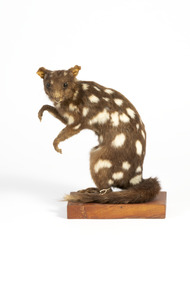
Animal specimen - Eastern quoll, Trustees of the Australian Museum, 1860-1880
... bright eyes, a moist pink nose and many sharp teeth. Like most Australian mammals, quolls are mainly active at night. Typically, they spend the day in one of their many dens, although spotted-tailed quolls and northern quolls sometimes forage and bask in the sunshine. Their large home ranges can extend for several kilometres in each direction from a smaller core range, and the range of a male quoll often overlaps those of several females. An interesting feature of their behaviour is the use of shared latrine (toilet) sites in open spaces...bright eyes, a moist pink nose and many sharp teeth. Like most Australian mammals, quolls are mainly active at night. Typically, they spend the day in one of their many dens, although spotted-tailed quolls and northern quolls sometimes forage and bask in the sunshine. Their large home ranges can extend for several kilometres in each direction from a smaller core range, and the range of a male quoll often overlaps those of several females. An interesting feature of their behaviour is the use of shared latrine (toilet) sites in open spaces ...Four species of quoll occur in Australia: the northern, spotted-tailed, eastern and western quolls. Once, most parts of Australia were inhabited by at least one of the species.Captain Cook collected quolls along the east coast in 1770, and recorded "quoll" as their local Aboriginal name. Quolls were often seen by early settlers, who called them "native cat", "native polecat" and "spotted marten", names based on familiar European animals. Since 1770, all four species have declined dramatically in numbers. This is mainly because of habitat loss or change across Australia, and introduced predators such as foxes and cats. Quolls are carnivorous marsupials with a pointed snout, a long tail and brown to black fur distinctively spotted with white. They are lively, attractive animals, with bright eyes, a moist pink nose and many sharp teeth. Like most Australian mammals, quolls are mainly active at night. Typically, they spend the day in one of their many dens, although spotted-tailed quolls and northern quolls sometimes forage and bask in the sunshine. Their large home ranges can extend for several kilometres in each direction from a smaller core range, and the range of a male quoll often overlaps those of several females. An interesting feature of their behaviour is the use of shared latrine (toilet) sites in open spaces such as rock ledges, for marking their territory and other social functions. Male quolls travel widely during the breeding season, with mating occurring during winter. All four species have a gestation period of 21 days. Because they are marsupial mammals, their young are born tiny and undeveloped and must work their way to the pouch, where they attach themselves to a teat to feed. Only the spotted-tailed quoll has a true pouch. In the other species, the young are protected by shallow folds of skin around the teats. As the pups grow, they dangle from the mother's belly; later, she carries them on her back. Quolls reach sexual maturity at one year. They have a naturally short life span, with smaller quolls living an average of only two years, and the larger spotted-tailed quoll about four to five years. The northern quoll is particularly short-lived. This specimen is part of a collection of almost 200 animal specimens that were originally acquired as skins from various institutions across Australia, including the Australian Museum and the National Museum of Victoria, as well as individuals such amateur anthropologist Reynell Eveleigh Johns between 1860-1880. These skins were then mounted by members of the Burke Museum Committee and put-on display in the formal space of the Museum’s original exhibition hall where they continue to be on display. This display of taxidermy mounts initially served to instruct visitors to the Burke Museum of the natural world around them, today it serves as an insight into the collecting habits of the 19th century. This specimen is part of a significant and rare taxidermy mount collection in the Burke Museum. This collection is scientifically and culturally important for reminding us of how science continues to shape our understanding of the modern world. They demonstrate a capacity to hold evidence of how Australia’s fauna history existed in the past and are potentially important for future environmental research. This collection continues to be on display in the Museum and has become a key part to interpreting the collecting habits of the 19th century.Average sized quoll with brown fur with white spots on body but absence on the long tail which is furry unlike the smooth body fur. The quoll has a small had with a pointed snout lined with sharp teeth, and thin membraned ears that are slightly covered in fur. The forelegs of the quoll are slightly smaller than the hindlegs, with all four legs featuring sharp clawed paws.On mounting board: BMM5984/ On Catalogue Tag (attached to left hindleg): Native Cat./ Catalogue. Page 50./ burke museum, taxidermy, taxidermy mount, fauna, animal, animalia, reynell eveleigh johns, quoll, native cat, dasyurus -
 The Beechworth Burke Museum
Animal specimen - Nankeen Night Heron, Trustees of the Australian Museum, 1860-1880
... bright yellow colour which are adapted to night vision. This specimen is part of a collection of almost 200 animal specimens that were originally acquired as skins from various institutions across Australia, including the Australian Museum and the National Museum of Victoria, as well as individuals such amateur anthropologist Reynell Eveleigh Johns between 1860-1880. These skins were then mounted by members of the Burke Museum Committee and put-on display in the formal space...bright yellow colour which are adapted to night vision. This specimen is part of a collection of almost 200 animal specimens that were originally acquired as skins from various institutions across Australia, including the Australian Museum and the National Museum of Victoria, as well as individuals such amateur anthropologist Reynell Eveleigh Johns between 1860-1880. These skins were then mounted by members of the Burke Museum Committee and put-on display in the formal space ...Nankeen Night Herons reside in Australia wherever there is permanent water. They can often be found in wetlands, shallow river margins, floodplains and parks and gardens. These birds spend the day time roosting in groups among dense foliage and emerge during the night. An adult Nankeen Night Heron is identified by the black cap on its head and a pale breast. This particular specimen has these signs which enable it to be identified as adult. The large eyes of the Nankeen Night Heron are a bright yellow colour which are adapted to night vision. This specimen is part of a collection of almost 200 animal specimens that were originally acquired as skins from various institutions across Australia, including the Australian Museum and the National Museum of Victoria, as well as individuals such amateur anthropologist Reynell Eveleigh Johns between 1860-1880. These skins were then mounted by members of the Burke Museum Committee and put-on display in the formal space of the Museum’s original exhibition hall where they continue to be on display. This display of taxidermy mounts initially served to instruct visitors to the Burke Museum of the natural world around them, today it serves as an insight into the collecting habits of the 19th century. This specimen is part of a significant and rare taxidermy mount collection in the Burke Museum. This collection is scientifically and culturally important for reminding us of how science continues to shape our understanding of the modern world. They demonstrate a capacity to hold evidence of how Australia’s fauna history existed in the past and are potentially important for future environmental research. This collection continues to be on display in the Museum and has become a key part to interpreting the collecting habits of the 19th century.The Nankeen Night Heron has a stocky body and is standing tall on a wooden pedestal and looking towards the upper right. This adult specimen has yellow and black glass eyes and a long pale grey bill. Plumage on the head is black which turns a pale cinnamon on the nape of the neck. The wings are placed along the back of the body and are a light brown. The torso is a pale buff colour. This specimen has nuptial plums which look like they come out of the back of the birds head. These plums are long white feathers which appear during the breeding season.taxidermy mount, taxidermy, animalia, burke museum, beechworth, australian museum, skin, reynell eveleigh johns, bird, nankeen night heron, heron, nocturnal -
 The Beechworth Burke Museum
Animal specimen - Nankeen Night Heron, Trustees of the Australian Museum, 1860-1880
... bright yellow colour which are adapted to night vision. This specimen is part of a collection of almost 200 animal specimens that were originally acquired as skins from various institutions across Australia, including the Australian Museum in Sydney and the National Museum of Victoria (known as Museums Victoria since 1983), as well as individuals such as amateur anthropologist Reynell Eveleigh Johns between 1860-1880. These skins were then mounted by members of the Burke Museum Committee and put-on display in the formal space...bright yellow colour which are adapted to night vision. This specimen is part of a collection of almost 200 animal specimens that were originally acquired as skins from various institutions across Australia, including the Australian Museum in Sydney and the National Museum of Victoria (known as Museums Victoria since 1983), as well as individuals such as amateur anthropologist Reynell Eveleigh Johns between 1860-1880. These skins were then mounted by members of the Burke Museum Committee and put-on display in the formal space ...Nankeen Night Herons reside in Australia wherever there is permanent water. They can often be found in wetlands, shallow river margins, floodplains and parks and gardens. These birds spend the day time roosting in groups among dense foliage and emerge during the night. An adult Nankeen Night Heron is identified by the black cap on its head and a pale breast. This particular specimen has these signs which enable it to be identified as adult. The large eyes of the Nankeen Night Heron are a bright yellow colour which are adapted to night vision. This specimen is part of a collection of almost 200 animal specimens that were originally acquired as skins from various institutions across Australia, including the Australian Museum in Sydney and the National Museum of Victoria (known as Museums Victoria since 1983), as well as individuals such as amateur anthropologist Reynell Eveleigh Johns between 1860-1880. These skins were then mounted by members of the Burke Museum Committee and put-on display in the formal space of the Museum’s original exhibition hall where they continue to be on display. This display of taxidermy mounts initially served to instruct visitors to the Burke Museum of the natural world around them, today it serves as an insight into the collecting habits of the 19th century. This specimen is part of a significant and rare taxidermy mount collection in the Burke Museum. This collection is scientifically and culturally important for reminding us of how science continues to shape our understanding of the modern world. They demonstrate a capacity to hold evidence of how Australia’s fauna history existed in the past and are potentially important for future environmental research. This collection continues to be on display in the Museum and has become a key part to interpreting the collecting habits of the 19th century.The Nankeen Night Heron has a stocky body and is standing tall on a wooden pedestal and looking forward. This adult specimen has yellow and black glass eyes and a yellow and pale grey bill. Plumage on the head is black which turns a pale cinnamon on the nape of the neck. The wings are placed along the back of the body and are a light brown. The torso is a pale buff colour. This specimen has nuptial plums which look like they come out of the back of the birds head. These plums are long white feathers which appear during the breeding season.taxidermy mount, taxidermy, animalia, burke museum, beechworth, australian museum, skin, reynell eveleigh johns, bird, nankeen night heron, heron, nocturnal -
 The Beechworth Burke Museum
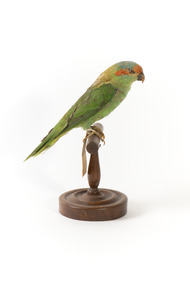
Animal specimen - Musk Lorikeet, Trustees of the Australian Museum, 1860-1880
... bright colours of this Lorikeet enable the bird to camouflage in dense foliage. This specimen is part of a collection of almost 200 animal specimens that were originally acquired as skins from various institutions across Australia, including the Australian Museum in Sydney and the National Museum of Victoria (known as Museums Victoria since 1983), as well as individuals such as amateur anthropologist Reynell Eveleigh Johns between 1860-1880. These skins were then mounted by members of the Burke Museum Committee and put-on display in the formal space...bright colours of this Lorikeet enable the bird to camouflage in dense foliage. This specimen is part of a collection of almost 200 animal specimens that were originally acquired as skins from various institutions across Australia, including the Australian Museum in Sydney and the National Museum of Victoria (known as Museums Victoria since 1983), as well as individuals such as amateur anthropologist Reynell Eveleigh Johns between 1860-1880. These skins were then mounted by members of the Burke Museum Committee and put-on display in the formal space ...The Musk Lorikeet is a bright coloured bird which commonly resides in south-eastern Australia. They also live in the drier areas of Tasmania. These birds are common in suburban and urban areas and are nomadic, meaning they are willing to travel significant distance to find flowering trees. The bright colours of this Lorikeet enable the bird to camouflage in dense foliage. This specimen is part of a collection of almost 200 animal specimens that were originally acquired as skins from various institutions across Australia, including the Australian Museum in Sydney and the National Museum of Victoria (known as Museums Victoria since 1983), as well as individuals such as amateur anthropologist Reynell Eveleigh Johns between 1860-1880. These skins were then mounted by members of the Burke Museum Committee and put-on display in the formal space of the Museum’s original exhibition hall where they continue to be on display. This display of taxidermy mounts initially served to instruct visitors to the Burke Museum of the natural world around them, today it serves as an insight into the collecting habits of the 19th century.This specimen is part of a significant and rare taxidermy mount collection in the Burke Museum. This collection is scientifically and culturally important for reminding us of how science continues to shape our understanding of the modern world. They demonstrate a capacity to hold evidence of how Australia’s fauna history existed in the past and are potentially important for future environmental research. This collection continues to be on display in the Museum and has become a key part to interpreting the collecting habits of the 19th century.The Musk Lorikeet is a beautiful species of parrot with mainly green plumage. it has a patch of yellow on the side of the breast which has faded to a grey on this specimen. This could be due to the impact of the taxidermy process or a product of time. The bird has an orange patch on the forehead and band through he eye to the ear coverts which has also faded from a brighter red colour. The crown of this bird is grey and would have been a grey-blue colour originally.87a / (89a)? Musk Lorikeet / See catalogue, page 24. /taxidermy mount, taxidermy, animalia, burke museum, beechworth, australian museum, skin, reynell eveleigh johns, bird, australian birds, lorikeet, musk lorikeet -
 The Beechworth Burke Museum
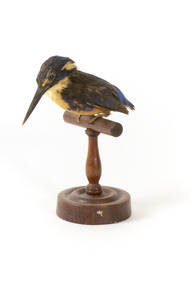
Animal specimen - Azure kingfisher, Trustees of the Australian Museum, 1860-1880
... bright and contrasting colouring and tiny stature. They are the smallest kingfisher found in Australia. These birds feed on yabbies and small fish. This specimen is part of a collection of almost 200 animal specimens that were originally acquired as skins from various institutions across Australia, including the Australian Museum in Sydney and the National Museum of Victoria (known as Museums Victoria since 1983), as well as individuals such as amateur anthropologist Reynell Eveleigh Johns between 1860-1880. These skins were then mounted by members of the Burke Museum Committee and put-on display in the formal space...bright and contrasting colouring and tiny stature. They are the smallest kingfisher found in Australia. These birds feed on yabbies and small fish. This specimen is part of a collection of almost 200 animal specimens that were originally acquired as skins from various institutions across Australia, including the Australian Museum in Sydney and the National Museum of Victoria (known as Museums Victoria since 1983), as well as individuals such as amateur anthropologist Reynell Eveleigh Johns between 1860-1880. These skins were then mounted by members of the Burke Museum Committee and put-on display in the formal space ...The Azure kingfisher can be located throughout northern and eastern Australia. It can also been found in parts of Indonesia, New Guinea and surrounding islands. This species frequents the Kimberley region in Western Australia and and the Top End of Queensland. In Victoria, it resides inland near the Murray-Darling Basin. These birds prefer to make their homes near bodies of water such as creeks and rivers. They live in areas with shady vegetation. This particular species of Kingfisher are known for their bright and contrasting colouring and tiny stature. They are the smallest kingfisher found in Australia. These birds feed on yabbies and small fish. This specimen is part of a collection of almost 200 animal specimens that were originally acquired as skins from various institutions across Australia, including the Australian Museum in Sydney and the National Museum of Victoria (known as Museums Victoria since 1983), as well as individuals such as amateur anthropologist Reynell Eveleigh Johns between 1860-1880. These skins were then mounted by members of the Burke Museum Committee and put-on display in the formal space of the Museum’s original exhibition hall where they continue to be on display. This display of taxidermy mounts initially served to instruct visitors to the Burke Museum of the natural world around them, today it serves as an insight into the collecting habits of the 19th century.This specimen is part of a significant and rare taxidermy mount collection in the Burke Museum. This collection is scientifically and culturally important for reminding us of how science continues to shape our understanding of the modern world. They demonstrate a capacity to hold evidence of how Australia’s fauna history existed in the past and are potentially important for future environmental research. This collection continues to be on display in the Museum and has become a key part to interpreting the collecting habits of the 19th century.The Azure kingfisher is stylised perched upon a wooden stand and has a paper identification tag attached to one of its legs. This bird has a combination of blue, yellow/orange and black plumage. The orange colour is located upon its chest while the royal blue is upon the rear of the bird on its back and head. The blue has faded in places due to age. The specimen is a diminutive bird species with a wide torso and a long and slender black bill. It has a short tail and two glass black eyes. The feet are a pale cream colour.11a. / Azure Kingfisher See Catalogue, page 9. /taxidermy mount, taxidermy, animalia, burke museum, beechworth, australian museum, skin, reynell eveleigh johns, bird, australian birds, kingfisher, azure, azure kingfisher, small birds, brightly coloured birds -
 The Beechworth Burke Museum
Animal specimen - Musk Lorikeet, Trustees of the Australian Museum, 1860-1880
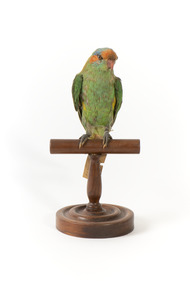
... bright colours of this Lorikeet enable the bird to camouflage in dense foliage. This specimen is part of a collection of almost 200 animal specimens that were originally acquired as skins from various institutions across Australia, including the Australian Museum in Sydney and the National Museum of Victoria (known as Museums Victoria since 1983), as well as individuals such as amateur anthropologist Reynell Eveleigh Johns between 1860-1880. These skins were then mounted by members of the Burke Museum Committee and put-on display in the formal space...bright colours of this Lorikeet enable the bird to camouflage in dense foliage. This specimen is part of a collection of almost 200 animal specimens that were originally acquired as skins from various institutions across Australia, including the Australian Museum in Sydney and the National Museum of Victoria (known as Museums Victoria since 1983), as well as individuals such as amateur anthropologist Reynell Eveleigh Johns between 1860-1880. These skins were then mounted by members of the Burke Museum Committee and put-on display in the formal space ...The Musk Lorikeet is a bright coloured bird which commonly resides in south-eastern Australia. They also live in the drier areas of Tasmania. These birds are common in suburban and urban areas and are nomadic, meaning they are willing to travel significant distance to find flowering trees. The bright colours of this Lorikeet enable the bird to camouflage in dense foliage. This specimen is part of a collection of almost 200 animal specimens that were originally acquired as skins from various institutions across Australia, including the Australian Museum in Sydney and the National Museum of Victoria (known as Museums Victoria since 1983), as well as individuals such as amateur anthropologist Reynell Eveleigh Johns between 1860-1880. These skins were then mounted by members of the Burke Museum Committee and put-on display in the formal space of the Museum’s original exhibition hall where they continue to be on display. This display of taxidermy mounts initially served to instruct visitors to the Burke Museum of the natural world around them, today it serves as an insight into the collecting habits of the 19th century.This specimen is part of a significant and rare taxidermy mount collection in the Burke Museum. This collection is scientifically and culturally important for reminding us of how science continues to shape our understanding of the modern world. They demonstrate a capacity to hold evidence of how Australia’s fauna history existed in the past and are potentially important for future environmental research. This collection continues to be on display in the Museum and has become a key part to interpreting the collecting habits of the 19th century.The Musk Lorikeet is a beautiful species of parrot with mainly green plumage. It has a patch of yellow on the side of the breast which has faded to a grey on this specimen. This could be due to the impact of the taxidermy process or a product of time. The bird has an orange patch on the forehead and band through he eye to the ear coverts which has also faded from a brighter red colour. The crown of this bird is grey and would have been a grey-blue colour originally.88a / Musk Lorikeet / See Catalogue, page 24. /taxidermy mount, taxidermy, animalia, burke museum, beechworth, australian museum, skin, reynell eveleigh johns, bird, australian birds, lorikeet, musk lorikeet -
 The Beechworth Burke Museum
Animal specimen - Turquoise Parrot, Trustees of the Australian Museum, Taxidermy Turquoise Parrot, 1860-1880
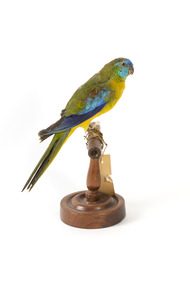
... space of the Museum’s original exhibition hall where they continue to be on display. This display of taxidermy mounts initially served to instruct visitors to the Burke Museum of the natural world around them, today it serves as an insight into the collecting habits of the 19th century. The male Turquoise Parrot is bright...space of the Museum’s original exhibition hall where they continue to be on display. This display of taxidermy mounts initially served to instruct visitors to the Burke Museum of the natural world around them, today it serves as an insight into the collecting habits of the 19th century. The male Turquoise Parrot is bright ...This specimen is part of a collection of almost 200 animal specimens that were originally acquired as skins from various institutions across Australia, including the Australian Museum in Sydney and the National Museum of Victoria (known as Museums Victoria since 1983), as well as individuals such as amateur anthropologist Reynell Eveleigh Johns between 1860-1880. These skins were then mounted by members of the Burke Museum Committee and put-on display in the formal space of the Museum’s original exhibition hall where they continue to be on display. This display of taxidermy mounts initially served to instruct visitors to the Burke Museum of the natural world around them, today it serves as an insight into the collecting habits of the 19th century. The male Turquoise Parrot is bright green above, with a turquoise blue crown and face. A brilliant two-tone blue band around the bend of the wing contrasts with a dark, brick-red shoulder patch. Its underparts and tail edges are a rich yellow. The female is similar, but not as bright, with a whitish facial mask, no red on the wing, and a pale wing stripe. Old birds of both sexes may have orange underparts. Once common throughout many parts of eastern Australia, the Turquoise Parrot was formerly recorded from near Mackay in Queensland south to Melbourne until the 1880s, when its population suddenly crashed. It was even considered to be extinct by 1915, but populations recovered spectacularly over the next 20 years or so, and by the 1930s they were again recorded through much of their former range. Now the species can once more be seen in many parts of eastern and south-eastern Australia, though not quite as extensively as before. These birds are vulnerable in NSWThis specimen is part of a significant and rare taxidermy mount collection in the Burke Museum. This collection is scientifically and culturally important for reminding us of how science continues to shape our understanding of the modern world. They demonstrate a capacity to hold evidence of how Australia’s fauna history existed in the past and are potentially important for future environmental research. This collection continues to be on display in the Museum and has become a key part to interpreting the collecting habits of the 19th century. This Turquoise Parrot is bright green above, with a turquoise blue crown and face. A brilliant two-tone blue band around the bend of the wing contrasts with a dark, brick-red shoulder patch. Its underparts and tail edges are a rich yellow. Old birds of both sexes may have orange underparts. This particular specimen is faded with some missing feathers. It is mounted on a wooden stand with a tag wrapped around its leg.Label: 80a. / Chesnutt-shouldered Grass Parakeet / See Catalogue, page 22.taxidermy, parrot, turquoise parrot, taxidermy bird, australian bird, burke museum, trustees of australia -
 The Beechworth Burke Museum
Animal specimen - Golden Whistler, Trustees of the Australian Museum, 1860-1880
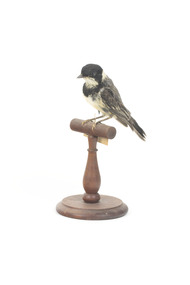
... bright yellow. This specimen is part of a collection of almost 200 animal specimens that were originally acquired as skins from various institutions across Australia, including the Australian Museum in Sydney and the National Museum of Victoria (known as Museums Victoria since 1983), as well as individuals such as amateur anthropologist Reynell Eveleigh Johns between 1860-1880. These skins were then mounted by members of the Burke Museum Committee and put-on display in the formal space...bright yellow. This specimen is part of a collection of almost 200 animal specimens that were originally acquired as skins from various institutions across Australia, including the Australian Museum in Sydney and the National Museum of Victoria (known as Museums Victoria since 1983), as well as individuals such as amateur anthropologist Reynell Eveleigh Johns between 1860-1880. These skins were then mounted by members of the Burke Museum Committee and put-on display in the formal space ...The Golden Whistler is native to coastal areas of Australia, from Queensland around to Southern Western Australia, including Tasmania. It usually lives in dense forested areas. The males have bright yellow plumage, whilst the females have only pale yellow plumage. The males and females work together to build the nest and raise chicks. They eat spiders and insects. The taxidermy specimen is not a good example of a Golden Whistler. Its feathers are very faded and ruffled. There looks to be some damage on the throat of the specimen. The Golden Whistler has usually vibrant colours, whilst this one is almost white. The colour markings on the bird indicate that it is male; the specimen should be a bright yellow. This specimen is part of a collection of almost 200 animal specimens that were originally acquired as skins from various institutions across Australia, including the Australian Museum in Sydney and the National Museum of Victoria (known as Museums Victoria since 1983), as well as individuals such as amateur anthropologist Reynell Eveleigh Johns between 1860-1880. These skins were then mounted by members of the Burke Museum Committee and put-on display in the formal space of the Museum’s original exhibition hall where they continue to be on display. This display of taxidermy mounts initially served to instruct visitors to the Burke Museum of the natural world around them, today it serves as an insight into the collecting habits of the 19th century.This specimen is part of a significant and rare taxidermy mount collection in the Burke Museum. This collection is scientifically and culturally important for reminding us of how science continues to shape our understanding of the modern world. They demonstrate a capacity to hold evidence of how Australia’s fauna history existed in the past and are potentially important for future environmental research. This collection continues to be on display in the Museum and has become a key part to interpreting the collecting habits of the 19th century. This male Golden Whistler has a black head and stripe on chest, brown-grey wings and tail and white patches on throat and neck. The belly is a white-yellow, though significantly faded. Its feathers are quite ruffled and there is sign of damage to the throat. The specimen stands on a wooden stand and has an identification tag attached to its leg. Label: 24a / white throated Thickhead / See catalogue, page 11taxidermy mount, taxidermy, golden whistler, beechworth, burke museum, australian bird -
 Warrnambool and District Historical Society Inc.
Document, VCFL Hampden District, Mid 20th century
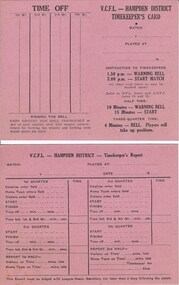
... space to record the various aspects of time matters for each football game. A common but essential part of the running of sports . warrnambool, hampden league hampden district timekeepers vcfl V C F L Hampden District Both cards are identical and are bright pink with black text in table form on front and back. ...These cards are to be filled out by the timekeeper at football matches in the hampden district which covers the area from Colac to Port Fairy in Western Victoria. The form has space to record the various aspects of time matters for each football game. A common but essential part of the running of sports .Both cards are identical and are bright pink with black text in table form on front and back. V C F L Hampden Districtwarrnambool,, hampden league, hampden district, timekeepers vcfl -
 Yarra City Council
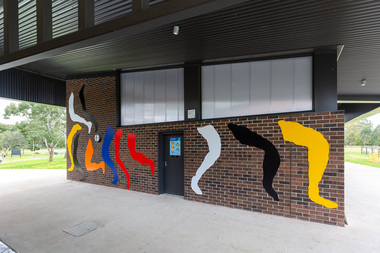
Artwork, other - Mural/Installation, Julia Gorman, Opening Lines, 2020
... A series of abstracted legs in various shapes that jump, kick and run across the wall, activating and animating the space with bold, bright colours....Sport Women installation modernism accompanying plaque A series of abstracted legs in various shapes that jump, kick and run across the wall, activating and animating the space with bold, bright colours. Opening Lines Artwork, other Mural/Installation Julia Gorman ..."The work gestures towards Utopian, modernist public art, like that of Miro, Matisse and Sainte-Phalle, but I was also inspired by Yarra's own Keith Haring murals, in the way that he repeats his personal iconography to fill a chosen space. I wanted to make an expansive, open and inclusive artwork. I drew legs from women playing footy, cricket and soccer, but tried to draw them in the least heroic, least literal way possible." Commissioned as part of an upgrade project at the Malcolm Graham Pavilion, Kevin Bartlett Reserve, Burnley, 2020. The existing facilities were upgraded to include female change rooms and amenities. The project funding comes from Yarra City Council and the State Government through its Female Friendly Facilities Fund. The commission is a result of Yarra's Public Art Policy 2015 - 2020 which ensures Council commits a percentage of the capital works budget for new community infrastructure projects. Matisse and Sainte-Phalle, Keith Herring, Miro, ModernistCopyright the artistA series of abstracted legs in various shapes that jump, kick and run across the wall, activating and animating the space with bold, bright colours.accompanying plaquesport, women, installation, modernism -
Port Melbourne Historical & Preservation Society
Book - Reference, Grids and Greenery. The Character of Inner Melbourne, 1987
... The Character of Inner Melbourne" A largely pictorial account of how inner Melbourne's public spaces have developed from early settlement to the 1980s. 71 pages, white cover with grey grid and bright colours on the front...The Character of Inner Melbourne" A largely pictorial account of how inner Melbourne's public spaces have developed from early settlement to the 1980s. 71 pages, white cover with grey grid and bright colours on the front Grids and Greenery. ..."Grids and Greenery. The Character of Inner Melbourne" A largely pictorial account of how inner Melbourne's public spaces have developed from early settlement to the 1980s. 71 pages, white cover with grey grid and bright colours on the frontbuilt environment - civic, natural environment, parks and gardens -
 Embroiderers Guild, Victoria
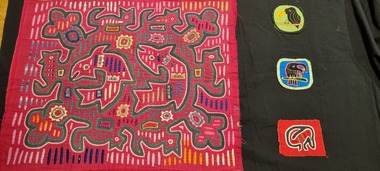
Accessory - San Blas Mola Panel
... spaces, traditionally believed to leave no room for evil spirits to settle. Evolving from ancestral geometric body painting. Following 1925 Guna Revolution, securing their autonomy, making and wearing Molas became a symbol of cultural identity and independence. Embroidery Mola Reverse applique Black panel with rectangle of reverse applique in very bright ...traditional hand sewn crafted by indigenous Guna (Kuna) people of the San Blas Islands, panama and Colombia. Usually made in pairs to decorate the front and back of a Guna woman's blouse. Artists fill nearly all the spaces, traditionally believed to leave no room for evil spirits to settle. Evolving from ancestral geometric body painting. Following 1925 Guna Revolution, securing their autonomy, making and wearing Molas became a symbol of cultural identity and independence.Black panel with rectangle of reverse applique in very bright colours - orange, blue, pink, black, with red fabric predominant. Depicting two dolphins/sharks. Three separate motifs depict birds. Part of Mola - traditional garment.embroidery, mola, reverse applique -
 Wodonga & District Historical Society Inc
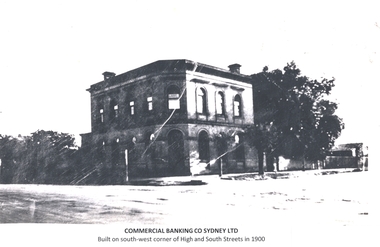
Photograph - Commercial Bank of Sydney, High Street, Wodonga, 1876 - 2025
... bright and attractive appearance with a stream-lined working layout. Alderson Swythyn Blackett-Smith, the manager of bank at time of move to new premises stated that the growth of the district and the bank’s business had made the old premises unsatisfactory due to insufficient space. ...bright and attractive appearance with a stream-lined working layout. Alderson Swythyn Blackett-Smith, the manager of bank at time of move to new premises stated that the growth of the district and the bank’s business had made the old premises unsatisfactory due to insufficient space. ...The Bank of Victoria was established in Wodonga during 1873. This two storey bank was constructed on the site in 1876. It later became the Commercial Banking Company of Sydney. In 1876 the Albury Banner and Wodonga Express reported that Mr. Nation had gained the contract for the erection of a new building for the Bank of Victoria, at Wodonga. The site secured for the bank was at the corner of South and Sydney streets, and immediately opposite the new Post and Telegraph Offices. The original bank was demolished in the 1950s and a new bank was built on the site. The new building was constructed with innovative foundations designed to prevent damage from vibrations caused by heavy transport vehicles along High Street which was then part of the Hume Highway. A contemporary newspaper article provides detail of the new bank. The well-lit building with open banking offices was designed by Melbourne architects, Turner and Stephenson, and combined a bright and attractive appearance with a stream-lined working layout. Alderson Swythyn Blackett-Smith, the manager of bank at time of move to new premises stated that the growth of the district and the bank’s business had made the old premises unsatisfactory due to insufficient space. The Commercial Banking Company of Sydney (CBC) merged with the National Bank of Australasia in 1982 to form the National Australia Bank and the second bank was closed. The building has since operated as several retail (including video hire and framing shop), commercial and community functions. It is currently (2025) used by the Wodonga Indie School.These images are significant because they document the development of an important financial institution established in Wodonga in the late 19th century.A series of images showing the evolution of the Commercial Banking Company of Sydney building in Wodonga from its construction in 1876 to the development of the site in 2025.commercial banking company of sydney, banking wodonga, wodonga financial institutions -
 Brimbank City Council Art Collection
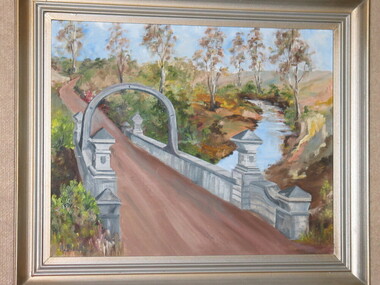
Painting, F Disch, Bridge over River, 1977
... Local Scene All the paintings by Disch are in a naïve style with bright colours, abundant detail and flat space. The artist's works in the collection represent views of historical interest. ...Local Scene All the paintings by Disch are in a naïve style with bright colours, abundant detail and flat space. The artist's works in the collection represent views of historical interest.Painting, oil on board. -
 Embroiderers Guild, Victoria
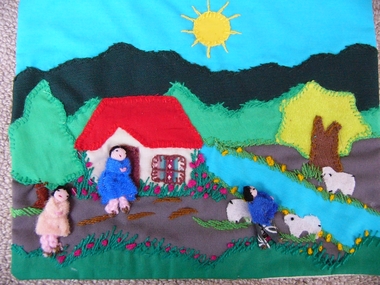
Textile - Chilean Arpillera Appliqué Scene, 1980
... brightly colored, three-dimensional patchwork tapestries and textile pictures created predominantly by working-class women (arpilleristas). The word comes from the Spanish term for the rough burlap or hessian sacking (often made from flour, potato, or sugar sacks) used as a backing material. They feature fabric scraps, embroidery, wool, and small 3D figures like dolls. Pinochet Regime (1973–1990): They gained international fame in Chile during General Augusto Pinochet's military dictatorship. The Catholic Church Role: Organized under the protection of the Vicariate of Solidarity (Vicaría de la Solidaridad) and the Catholic Church, these workshops offered a safe space...brightly colored, three-dimensional patchwork tapestries and textile pictures created predominantly by working-class women (arpilleristas). The word comes from the Spanish term for the rough burlap or hessian sacking (often made from flour, potato, or sugar sacks) used as a backing material. They feature fabric scraps, embroidery, wool, and small 3D figures like dolls. Pinochet Regime (1973–1990): They gained international fame in Chile during General Augusto Pinochet's military dictatorship. The Catholic Church Role: Organized under the protection of the Vicariate of Solidarity (Vicaría de la Solidaridad) and the Catholic Church, these workshops offered a safe space ...Arpillera are brightly colored, three-dimensional patchwork tapestries and textile pictures created predominantly by working-class women (arpilleristas). The word comes from the Spanish term for the rough burlap or hessian sacking (often made from flour, potato, or sugar sacks) used as a backing material. They feature fabric scraps, embroidery, wool, and small 3D figures like dolls. Pinochet Regime (1973–1990): They gained international fame in Chile during General Augusto Pinochet's military dictatorship. The Catholic Church Role: Organized under the protection of the Vicariate of Solidarity (Vicaría de la Solidaridad) and the Catholic Church, these workshops offered a safe space for women to process grief, share stories, and earn a vital source of income after their husbands, sons, or fathers were forcibly disappeared (los desaparecidos). A "Fabric Newspaper": Because public gatherings were banned and traditional media was heavily censored, women used these textiles to document state atrocities, poverty, soup kitchens, forced disappearances, and human rights abuses. International Smuggling: Finished pieces were secretly rolled up and smuggled out of Chile in diplomatic or traveler luggage to be sold abroad, raising global awareness and funding for the resistance movement.They tell of the maker's lives and the traumatic events experienced by these mothers, wives and sisters of the victims.This piece depicts a brightly coloured scene with a house, people and sheep in appliqué and embroidery.appliqué, creative embroidery -
 Sunshine and District Historical Society Incorporated
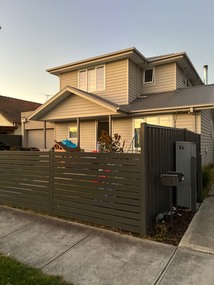
Photograph - Albion Houses - Old and New, Albion Houses
... Classically crisp external lines introduce faultlessly finished spaces including an airy, inviting lounge that can be flexibly formal or informal according to the occasion. To the rear, a refined yet relaxed living/dining area is kept beautifully bright by a series of superb Velux sky-lights while access to eco alfresco decking creates a seamlessly successful relationship between indoors and out. ...Classically crisp external lines introduce faultlessly finished spaces including an airy, inviting lounge that can be flexibly formal or informal according to the occasion. To the rear, a refined yet relaxed living/dining area is kept beautifully bright by a series of superb Velux sky-lights while access to eco alfresco decking creates a seamlessly successful relationship between indoors and out. ...Albion is a suburb in Melbourne, Victoria, Australia, 14 km (8.7 mi) west of Melbourne's Central Business District, located within the City of Brimbank local government area. Albion recorded a population of 4,334 at the 2021 census. Albion is bordered on the north by Ballarat Road, the south by Forrest Street, the west by Kororoit Creek and the east by Anderson Road. The suburb is completely surrounded by other parts of Sunshine except for Ardeer, which lies to Albion's due west across Kororoit Creek.History - The area was originally called Darlington, from at least 1860 to about 1890. The area originally known as Albion was directly west of Duke Street, as can be noted by the many streets there named after English counties and placenames – Albion being an ancient name for the island of Great Britain. Albion station opened on 5 January 1860 as Albion and Darlington but closed a year later. It was not until 1919 that a new station was opened on the same site with the name Albion station. In March 1885 the Albion Quarrying Company began its operations in the area. The disused Albion quarry, accessed from Hulett Street in Albion, was the location for AC/DC's Jailbreak music video. It was H. V. McKay of Sunshine Harvester Works fame who bought land to develop a residential community for his workers in first decades on the 20th century. His concept for Sunshine was the Sunshine Estate: a community designed with superficial similarities to garden cities of the early 20th century. This area was mainly in what is now called Albion. McKay's own residence, The Gables, was in Talmage Street (where the cul-de-sac The Gables now is) until it was consumed by fire and subsequently demolished. Today - Albion has many period homes such as California bungalows and 1940s weatherboard houses. In the eastern parts of Albion, many of the oldest homes were built by H. V. McKay as part of his Sunshine Estate, a housing community built according to the influential early 20th Century Garden city movement. Kororoit Creek provides the western border for Albion. Along it runs the Kororoit Creek Trail which runs all the way southwards to meet the Federation Trail in Brooklyn. Stony Creek lies on the eastern edge of Albion, close to Anderson Road. As of 2013, the creek's environmental state west of Anderson Road is very poor as it has long been converted to nothing more than a concrete stormwater drain for this particular section of its course. A notable landmark of Albion is the red brick John Darling and Son Flour Mill built in 1922. It is just to the south of Ballarat Road, next to Albion train station.7010.01 - 84 King Edward Avenue Albion Vic 3020 has a land size of 630m2. It is house with 2 bedrooms, 1 bathroom, and no parking space. It was sold in 2018 for $775,000 and leased for $330 per week by Jas Stephens Real Estate. In 2017 the house was leased for $320 per week. In 2011 it was sold for $353,000 by Redina Real Estate. In 2007 the house was sold for $327,000. Median Property prices in Albion over the last year range from $797,500 for houses. 7010.30 - 82 King Edward Avenue Albion Vic 3020 has a land size of 629m2. It is a house. Median property prices in Albion over the last year range from $797,500 for houses. 7010.40 - 34 King Edward Avenue Albion Vic 3020 has a land size of 259 m2 It is a house that was built in 1950 with 3 bedrooms, 1 bathroom, and no parking space. It was sold in 2012 for $285,000 by Douglas Kay Real Estate Sunshine. Median Property prices in Albion over the last year range from $797.500 for houses for $311,000 for units. Recent sale on 30th April 2012 for $285,000; Sold in on 4th April 2011 for $235,000; Sold 15th April 1996 $60,000; Sold 29th January 1994 $68,000; Sold on 27th August 1982 $20,700. Built in 1950. 7010.50 - 30 Perth Avenue, Albion has a land size of 698 m2. It is a house with 2 bedrooms, 1 bathroom and 1 parking space. It was sold in 2023 for $765,000 by Barry Plant – Sunshine. Median property prices in Albion over the last year range from $797,000 for houses. 7010.80 – 14B Perth Avenue Albion. The passion for excellence that is the signature attribute of any address built by NERO LIVING defines this freshly completed Hamptons influenced four bedroom, two bathroom home. Classically crisp external lines introduce faultlessly finished spaces including an airy, inviting lounge that can be flexibly formal or informal according to the occasion. To the rear, a refined yet relaxed living/dining area is kept beautifully bright by a series of superb Velux sky-lights while access to eco alfresco decking creates a seamlessly successful relationship between indoors and out. The kitchen is a showstopper: a perfect zone for exercising your culinary creativity complemented by the elegance efficiency of Hamptons inspired styling beneath beautiful racked ceilings, where a walk-in pantry and Smeg appliances including an induction cooktop, oven and integrated dishwasher make meeting modern day needs a breeze. Alluring accommodation is led by a luxurious main bedroom with a twin-vanity ensuite and shower with floor-to-ceiling tiles. Three additional robed bedrooms, a chic bathroom, and a powder room complete the ensemble. With double glazing, efficient laundry area, Daikin climate control heating/cooling, Bosch alarm, rainwater tank, and remote garage, with additional OSP this brilliant brand new residence is desirably positioned walking distance from Selwyn Park, the Perth Avenue café and shopping hub and Albion Primary School. A perfect property for enjoying Albion today's way. 27/7/2026 House price low range $680,000 and high range $810,000. The estimated rental income of 14 Perth Avenue is $425 based on our available property data. 14 Perth Avenue Albion Vic 3020 has a land size of 697 m2. It is a house with 2 bedrooms, 1 bathroom and 2 Parking spaces. I was sold in 2024 for $705,000 by One Agency Carlo Puglia Property. Median property prices in Albion over the last year range from $797,500 for houses to $300,000 for units. The house was sold before that on 5th September 1998 for $87,000. albion houses - old and new, albion houses - 82 king edward avenue, albion houses - 84 king edward avenue, 34 king edward avenue, 14 perth avenue, 30 perth avenue
