
Showing 3 items matching "british fur company"
-
 Whitehorse Historical Society Inc.
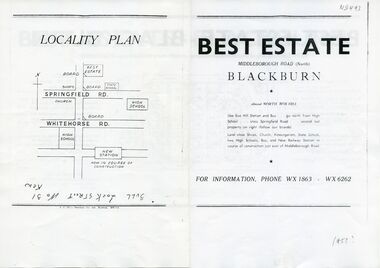
Document, Best Estate, n.d
... ...british fur company...land subdivision best estate blackburn north chapman street middleborough road joseph street nestor grove vivian street de stoop roger best richard british fur company sale of land at Best Estate, Blackburn North. ...sale of land at Best Estate, Blackburn North. Part of the original land holdings of R. de Stoop and R. Best of British Fur Co.Advertisement for sale of land at Best Estate, Blackburn North. Part of the original land holdings of R. de Stoop and R. Best of British Fur Co.sale of land at Best Estate, Blackburn North. Part of the original land holdings of R. de Stoop and R. Best of British Fur Co.land subdivision, best estate, blackburn north, chapman street, middleborough road, joseph street, nestor grove, vivian street, de stoop, roger, best, richard, british fur company -
 Flagstaff Hill Maritime Museum and Village
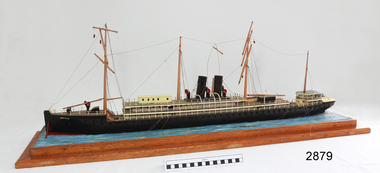
Craft - Ship Model, S.S. Orotava, ca. 1930-1974
... This is a ship model of the SS Orotava, a British Screw Steamship built at Barrow-in-Furness, county of Lancashire, by the Naval Construction and Armaments Company (NC & A Co.) in 1889. ...This is a ship model of the SS Orotava, a British Screw Steamship built at Barrow-in-Furness, county of Lancashire, by the Naval Construction and Armaments Company (NC & A Co.) in 1889. ...This is a ship model of the SS Orotava, a British Screw Steamship built at Barrow-in-Furness, county of Lancashire, by the Naval Construction and Armaments Company (NC & A Co.) in 1889. The gross tonnage was 5552.10 tons, length 430 feet, breadth 49.3 feet and depth 34.2 feet. It was built for the Pacific Steam Navigation Company (of 31, James Street, Liverpool) and used as a passenger liner. The vessel was launched in 1889 and made two voyages for the Pacific Steam Navigation Company during 1889. Then, under the new management of the Orient Line, its first sailing was 6th June 1890 from Liverpool to Australia via Suez. During the Boer War (1889 – 1903), Orotava served as a troop ship, but apart from this, it remained in the Orient Line’s Australia service until 1906. On 14th December 1896, the Orotava sank at Tilbury Docks after being serviced on her return from Australia, becoming unstable and taking in water. Five men lost their lives. The ship was then raised to dry dock and repaired for service again, and an investigation was launched into the cause of the sinking. Between 1901 – 1906, the name Orient-Pacific Steam Line was used due to the close ties between the Pacific and the Orient lines. In 1906, the Pacific Steam Line Australian service was taken over by the Royal Mail Steam Packet Co., and the alliance between them and the Orient Line was dissolved in 1909. Orotava then served the West Indies service of the Royal Mail Line. In World War 1 (Dec 1914 – June 1916), the vessel served as HMS OROTAVA, an armed merchant cruiser. It was broken up in 1919.The model shows a visual description of the SS Orotava, which was used for commercial and government purposes from 1889 to 1919. The model is also an example of ship model-making, a skilled craft enjoyed for hundreds of years, demonstrating the evolution of ocean vessels. Ship model: SS Orotava. The model, without a case, has four masts and two funnels, and is mounted on a small timber base. The SS Orotave was a British passenger liner, launched in 1889. Inscriptions are painted on the hull. "OROTAVA" painted in white on each side of the bow. 'OROTAVA / LONDON" painted in white on the stern.flagstaff hill, warrnambool, shipwrecked-coast, flagstaff-hill, flagstaff-hill-maritime-museum, maritime-museum, shipwreck-coast, flagstaff-hill-maritime-village, ship model, ss orotava, naval construction and armaments co., n c & a co., pacific steam navigaiton company, passenger liner, orient line, orient-pacific steam line, royal mail line, hms orotava -
 Flagstaff Hill Maritime Museum and Village
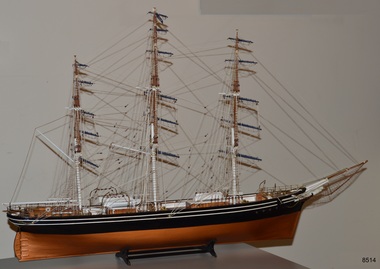
Craft - Ship Model, Billings Boats Denmark Aps, Cutty Sark, 1980s
... Ltd., a substantial British passenger and liner company. and subsequently Furness Withy Ltd. ...Ltd., a substantial British passenger and liner company. and subsequently Furness Withy Ltd. ...This ship model of the Cutty Sark was hand-built in the 1980s from a model kit produced by Billings, Denmark. It was on display in the Olde Maritime Motor Inn in Warrnambool until it was refurbished around 2015. The Cutty Sark was a famous clipper ship, launched in 1869 for the tea trade from China to London. The ship was designed for speed, with the ambition to be the fastest ship. In the late 1800s, it competed in the tea clipper races. It was eventually sold to a Portuguese company, Ferreria, and took on the company's name. It was sold again and renamed Maria do Amparo. Finally, the ship's name was returned to the original 'Cutty Sark' when it was purchased by Captain Dowman for use as a cadet training ship. The ship continued trading and in 1922 it became the last operating clipper ship in the world. The ship is now a museum, preserved in a dry dock at Greenwich, England, as part of the British National Historic Fleet. About Barry Williams: - The maker, Barry Williams, worked for the Australian Shipping Line, Huddart Packard Ltd., until it closed down in 1960. Williams then worked for Shaw Savill & Albion Co. Ltd., a substantial British passenger and liner company. and subsequently Furness Withy Ltd. (SS&A's parent company). In the late 1970s Williams and two friends established their own ship chartering company in Melbourne, the Harwood Shipping Co. During the early 1970s Williams and his wife lived in London, near Greenwich, and often walked along the river where the Cutty Sark Maritime Museum is located. The fascination of the Cutty Sark led Williams to build model ships of the same era. At one stage Williams lost the rigging plan for the Cutty Sark but one of his partners, on a visit to London, photographed the Cutty Sark on the river, and Williams used these to complete the rigging on the model. Williams found the making of the model a very demanding but also pleasurable exercise.The model is significant for showing a visual representation of one of the most famous tea clippers, the vessel Cutty Sark. The three-masted ship was built for speed and traded tea between England and China. In 1922 the Cutty Sark became the last operating tea clipper in the world. The craft of ship model building has been popular for centuries, especially with people associated with the sea, such as this model builder, whose career was based around the shipping industry.Ship model; clipper ship, the 'Cutty Sark', a three-masted clipper ship, bare rigging, netting below the bowspit, and fine chains hanging from the bowspit. Black hull with two parallel horizontal stripes below the rail. Lifeboats on board. The white figurehead is below the bowsprit. The model comes with a cradle stand. The ship's name is not visible on the model.flagstaff hill, warrnambool, shipwrecked coast, flagstaff hill maritime museum, maritime museum, shipwreck coast, flagstaff hill maritime village, great ocean road, cunysark, historic sailing ship, tea clipper, sail training vessel, cadet training ship, commercial trading vessel, cargo sail vessel, ship model cutty sark
