
Showing 38 items matching "british general hospitals"
-
 Returned Nurses RSL Sub-branch
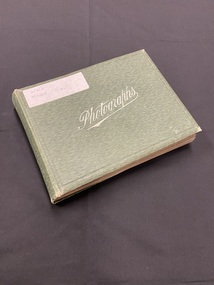
Album - Photograph album, WWI Middle East, 1917
... ...British General Hospitals...The album also contains images relating to the 19th and 17th British General Hospitals, their nurses, patients, V.A.D.'...The album also contains images relating to the 19th and 17th British General Hospitals, their nurses, patients, V.A.D.' ...Album of photographs taken in the Middle East in 1917. The collection begins with images of the ship 'Wiltshire' leaving from Sydney and then on to Colombo. There are photos of local points of interest and local people in Colombo, Cairo, Alexandria and Lower Jordan. The album also contains images relating to the 19th and 17th British General Hospitals, their nurses, patients, V.A.D.'s and residences. According to the inscription on the cover, the album belonged to Dorothy White. Dorothy was staying at Rhedural Hotel in Alexandria in 1917. "Rhedural" was a historical misspelling of Khedivial Hotel (Hotel Khédivial), located on Rue de la Porte de Rosette in Alexandria, Egypt. During World War I it was used to accommodate military personnel and nurses. The collection includes photos of this hotel and its surrounds.Dark green mottled cover photo album with the word 'photographs' printed across the front cover in white print. There is a white sticker attached to the top left corner with WWI Middle East handwritten on it. The pages are cardboard with cutouts to display four 2x3 photos on each page.'WWI / MIDDLE EAST' [Handwritten in black ink on a label attached to front cover] 'Dorothy S. White / Rhedural Hotel / Rue De Rosette / Alexandria / Egypt' [Handwritten in black ink on the inside front cover] '17.12.17' [Handwritten on the inside front cover]middle east, wwi, ww1, world war 1914-1918, 1917, australian military nurses, british general hospitals, nurses, vad, military hospitals, alexandria, cairo, colombo, jordan -
 Bendigo Military Museum
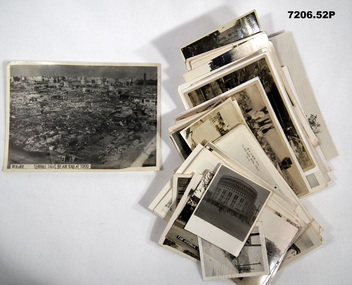
Photograph - PHOTOGRAPHS BCOF, TOKYO, JAPAN, 1946 - 47
... Eight re British, American general Hospital buildings. Eight re bombing of Tokyo. ...Eight re British, American general Hospital buildings. Eight re bombing of Tokyo. ...Items in the collection re Clarence Shearing, refer Cat No 7089.16P for his service details.Photographs B & W various sizes, some have inscriptions on some none at all. Eight re British, American general Hospital buildings. Eight re bombing of Tokyo. Two of Tokyo. One, BCOF House. One, Ebasui Camp Tokyo. Three, Places in Meijo, Two, Ginza Crossing & Tokyo PX Three, Hibiya area. Three, Imperial Buildings. Seven, Theatres and Buildings. Sixteen, General Buildings and views, no text.photographs, bcof, tokyo -
 Embroiderers Guild, Victoria
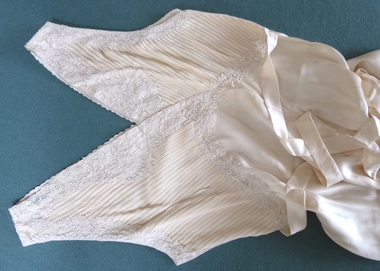
Clothing - Chinese Silk Night Dress, 1948
... In early 1946, with the occupation of Japan, Australian nurses were posted to the hospital on the island of Iwo Jima to care for the Australian component of the occupation force and in February of 1949, now stationed at Kure, near Hiroshima, they became part of the British Commonwealth General Hospital. ...In early 1946, with the occupation of Japan, Australian nurses were posted to the hospital on the island of Iwo Jima to care for the Australian component of the occupation force and in February of 1949, now stationed at Kure, near Hiroshima, they became part of the British Commonwealth General Hospital. ...Bought by the donor in 1948 in Japan PX shop . She was nursing with the Australian Nursing Service (1945-1949) on the island of Iwo Jima and then in Kure. In early 1946, with the occupation of Japan, Australian nurses were posted to the hospital on the island of Iwo Jima to care for the Australian component of the occupation force and in February of 1949, now stationed at Kure, near Hiroshima, they became part of the British Commonwealth General Hospital. (Australian Rural and Regional News Jan 10 2022)Cream silk night dress is mostly handmade with pintucks and lace finely buttonholed along the bodice edges. The hem has a buttonhole stitched scalloped edge.embroidery, night dress -
![Medal - Royal Red Cross Medal & miniature in box, Garrard & Co. Limited, [circa 1918]](/media/collectors/64a5077bc83bd7b7b94f4211/items/6a695a9b154863c24680e420/item-media/6a695b3e154863c24680fd40/item-fit-380x285.jpg?cb=6) Returned Nurses RSL Sub-branch
Returned Nurses RSL Sub-branchMedal - Royal Red Cross Medal & miniature in box, Garrard & Co. Limited, [circa 1918]
... "Appointed to QAIMNSR 22 January 1915 Arrived in Egypt 22 January 1915 Embarked Bombay 18 April 1917 Disembarked Basrah 26 April 1917 Posted No 3 British General Hospital 26 April 1917 Admitted to hospital 03 May 1917 Discharged 07 May 1917 Joined for duty at Bagdad 23 May 1917 Appointed Assistant Matron to 31 BSH at Basrah 01 December 1917 Mentioned in Lieut General Sir F S Mande's despatch dated 02 November 1917 London Gazette No 30570 Joined for temporary duty Baghdad 24 May 1918 Admitted OCD 29 July 1918 Discharged 17 August 1918 and returned to Duty Left unit to proceed on leave to India 24 August 1918 Proceeded to India on leave per 'Kina' 01 September 1918 Returned from Leave 31 October 1918 Rejoined unit from leave Baghdad 10 November 1918 Awarded Royal Red Cross 1st Class in recognition of valuable services with the British Forces in Mesopotamia 26 August 1918 (Gazette No 30865) Mentioned in despatches by Lt. ..."Appointed to QAIMNSR 22 January 1915 Arrived in Egypt 22 January 1915 Embarked Bombay 18 April 1917 Disembarked Basrah 26 April 1917 Posted No 3 British General Hospital 26 April 1917 Admitted to hospital 03 May 1917 Discharged 07 May 1917 Joined for duty at Bagdad 23 May 1917 Appointed Assistant Matron to 31 BSH at Basrah 01 December 1917 Mentioned in Lieut General Sir F S Mande's despatch dated 02 November 1917 London Gazette No 30570 Joined for temporary duty Baghdad 24 May 1918 Admitted OCD 29 July 1918 Discharged 17 August 1918 and returned to Duty Left unit to proceed on leave to India 24 August 1918 Proceeded to India on leave per 'Kina' 01 September 1918 Returned from Leave 31 October 1918 Rejoined unit from leave Baghdad 10 November 1918 Awarded Royal Red Cross 1st Class in recognition of valuable services with the British Forces in Mesopotamia 26 August 1918 (Gazette No 30865) Mentioned in despatches by Lt. ...This Royal Red Cross was awarded to Minnie Maud McNab who served as a nurse then Sister in Queen Alexandria's Imperial Military Nursing Staff Reserve, Dr Bird's Unit during WWI. "Appointed to QAIMNSR 22 January 1915 Arrived in Egypt 22 January 1915 Embarked Bombay 18 April 1917 Disembarked Basrah 26 April 1917 Posted No 3 British General Hospital 26 April 1917 Admitted to hospital 03 May 1917 Discharged 07 May 1917 Joined for duty at Bagdad 23 May 1917 Appointed Assistant Matron to 31 BSH at Basrah 01 December 1917 Mentioned in Lieut General Sir F S Mande's despatch dated 02 November 1917 London Gazette No 30570 Joined for temporary duty Baghdad 24 May 1918 Admitted OCD 29 July 1918 Discharged 17 August 1918 and returned to Duty Left unit to proceed on leave to India 24 August 1918 Proceeded to India on leave per 'Kina' 01 September 1918 Returned from Leave 31 October 1918 Rejoined unit from leave Baghdad 10 November 1918 Awarded Royal Red Cross 1st Class in recognition of valuable services with the British Forces in Mesopotamia 26 August 1918 (Gazette No 30865) Mentioned in despatches by Lt. General W R Marshall in his despatch dated 15 April 1918 (Gazette No 30867) Admitted to Hospital 11 January 1919 Discharged from Hospital 10 February 1919 31 B S Hospital 'Sister Minnie Maud McNab QAIMNS Reserve has served under me for eighteen months as Sister and Assistant Matron, the duties of the latter she performed to my entire satisfaction. I consider her a thoroughly well trained Nurse, most kind and attentive to the patients, she is energetic, reliable, punctual, tactful and good tempered. Her powers of administration and initiative are excellent and she has great ability in instructing the orderlies. I recommend her for further service if required, promotion and for full gratuity.' Transferred to UK for duty 21 February 1919 Embarked 'Vasna' 21 February 1919 or UK Appointment terminated 21 July 1919 Departed from her unit 21 July 1919 After taking a holiday in Scotland asked for temporary duty if her passage home was not available. Posted to Royal Herbert Hospital, Woolwich 08 September 1919 Postal address whilst awaiting repatriation Berrington War Hospital, Shrewbury Returning to Australia per 'Northumberland' trans-shipped at Bombay ex 'Macedonia' embarked England 01 November 1919" (https://ausww1nurses.weebly.com/mca-mcn.html) "The Royal Red Cross is a military decoration awarded in the United Kingdom and Commonwealth for exceptional services in military nursing. It was established on 27 April 1883 by Queen Victoria... The Royal Red Cross was originally a single class of Member and it was first awarded to the founder of modern nursing, Florence Nightingale. A second class, Associate, was added during World War I in 1917. The award is awarded to a fully trained nurse of an officially recognized nursing service, military or civilian, who has shown exceptional devotion and competence in the performance of nursing duties, over a continuous and long period, or who has performed an exceptional act of bravery and devotion at her or his post of duty. The decoration was conferred exclusively to women until 1976. Recipients of the Royal Red Cross are entitled to use the post-nominal letters “RRC” or “ARRC” for Members and Associates respectively." [https://collectionswa.net.au/items/25f38e85-6c15-429f-95b6-0a24c241e199] A thin, black, textured leather coated box with gold lettering 'R R C' in the centre and '1st' in the bottom left corner. Has a white sticker attached to the top right hand corner with red handwritten 'M47'. The box has a small metal button on bottom section that when pushed opens the box. The leather is damaged and fraying around the edges and corners of the box and there are various scratch marks that have removed the black paint/dye from the leather in places. Inside, the box lid is lined with padded fabric (likely silk or satin), has the manufacturer details printed at the centre of lid. There is a small blue ink mark on the fabric in the top left of the inside of the lid and minor holes and wear in the upper portion of the lid. The bottom part of the box is a mount covered in blue velvet. The mount and velvet have a depression in the shape of the main Royal Red Cross (RRC) medal and ribbon. The velvet is dusty and has some fibres in the creases and across the whole area. "The badge for the RRC is in the shape of a golden cross, 1.375 inches (3.49 cm) wide, the obverse enamelled red, with a circular medallion, bearing an effigy of the reigning monarch at its centre. The words "Faith", "Hope" and "Charity" are inscribed on the upper limbs of the cross, with the year "1883" in the lower limb. The reverse is plain except a circular medallion bearing the royal cypher of the reigning monarch" [Wikipedia - see References], on this medal the initials are GRJ. The ribbon is a dark blue stripe between crimson edge stripes and forms a landscape oriented bow that the medal hangs from the middle. This box also contains a miniature medal, bearing the same description as above being of [approximately quarter size]. There is a white sticker on the underside of the box that has handwritten in black ink 'RNC / J McCarthy' 'M47' [red ink on white sticker attached to top of box] 'RNC / J McCarthy' [black ink on white sticker attached to underneath of box] 'M.M.McNAB / 1914-1919' [Engraved on bottom of the lower part of the full sized medal's cross]minnie maud mcnab, wwi, ww1, world war one, royal red cross 1st class, royal red cross, queen alexandra's imperial military nursing service reserve -
 Greensborough Historical Society
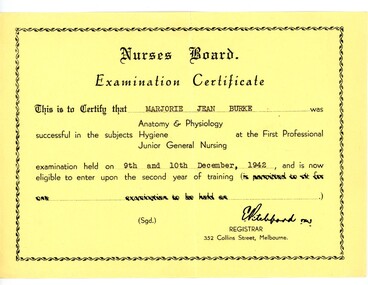
Document - Certificate, Nurses Board Melbourne, Nurses Board: Examination Certificate for Marjorie Jean Burke, 10/12/1942
... general nursing. Miss Burke was a nurse, midwife and infant welfare sister. This collection covers her many qualifications throughout Australia and Great Britain, including references both professional and personal. When Miss Burke returned to Australia, she was employed at Diamond Valley Community Hospital ...Examination certificate for Marjorie Jean Burke issued by Nurses Board Melbourne, the course covered anatomy and physiology, hygiene and junior general nursing.Miss Burke was a nurse, midwife and infant welfare sister. This collection covers her many qualifications throughout Australia and Great Britain, including references both professional and personal. When Miss Burke returned to Australia, she was employed at Diamond Valley Community Hospital as a nurse in 1953 and as Deputy Matron 1954-1971.Certificate typed on cream card.Signed by registrar.marjorie jean burke, nurses, diamond valley community hospital, nurses board melbourne -
 Greensborough Historical Society
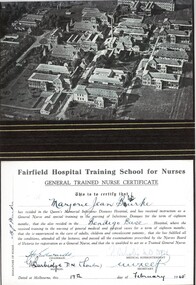
Document - Certificate, Fairfield Training School for Nurses, General Trained Nurse Certificate for Marjorie Jean Burke, 17/02/1945
... General Trained Nurse certificate for Marjorie Jean Burke issued by Fairfield Hospital Training School for Nurses. This also states that Miss Burke resided at Fairfield Infectious Diseases Hospital where she was trained in the nursing of infectious diseases; and at Bendigo Base Hospital where she received training in general medical and surgical cases. Miss Burke was a nurse, midwife and infant welfare sister. This collection covers her many qualifications throughout Australia and Great Britain ...General Trained Nurse certificate for Marjorie Jean Burke issued by Fairfield Hospital Training School for Nurses. This also states that Miss Burke resided at Fairfield Infectious Diseases Hospital where she was trained in the nursing of infectious diseases; and at Bendigo Base Hospital where she received training in general medical and surgical cases.Miss Burke was a nurse, midwife and infant welfare sister. This collection covers her many qualifications throughout Australia and Great Britain, including references both professional and personal. When Miss Burke returned to Australia, she was employed at Diamond Valley Community Hospital as a nurse in 1953 and as Deputy Matron 1954-1971.Certificate typed on cream card and pasted into brown leatherette folder."Bourke" spelt incorrectly, corrected (to Burke) and initialled.marjorie jean burke, nurses, diamond valley community hospital, bendigo base hospital, fairfield infectious diseases hospital -
 Greensborough Historical Society
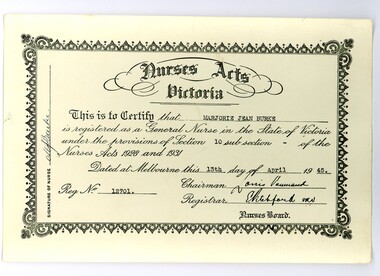
Document - Certificate, Nurses Board Melbourne, General Nurse Certificate for Marjorie Jean Burke, 13/07/1945
... General Nurse certificate for Marjorie Jean Burke issued by the Nurses Board under the Nurses Acts Victoria, 1928 and 1931. Miss Burke was a nurse, midwife and infant welfare sister. This collection covers her many qualifications throughout Australia and Great Britain, including references both professional and personal. When Miss Burke returned to Australia, she was employed at Diamond Valley Community Hospital ...General Nurse certificate for Marjorie Jean Burke issued by the Nurses Board under the Nurses Acts Victoria, 1928 and 1931. Miss Burke was a nurse, midwife and infant welfare sister. This collection covers her many qualifications throughout Australia and Great Britain, including references both professional and personal. When Miss Burke returned to Australia, she was employed at Diamond Valley Community Hospital as a nurse in 1953 and as Deputy Matron 1954-1971.Certificate typed on cream card.marjorie jean burke, nurses, diamond valley community hospital, nurses board melbourne -
 Greensborough Historical Society
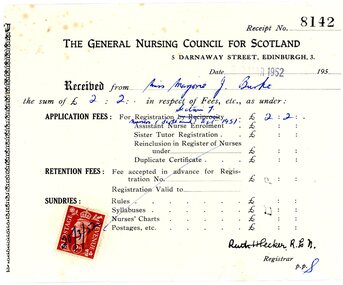
Document - Receipt, General Nursing Council for Scotland, Receipt for Registration Fees for Marjorie Jean Burke, 20/03/1952
... General Nursing Council for Scotland, issued in 1952. Miss Burke was a nurse, midwife and infant welfare sister. This collection covers her many qualifications throughout Australia and Great Britain, including references both professional and personal. When Miss Burke returned to Australia, she was employed at Diamond Valley Community Hospital ...Receipt for registration for Marjorie Jean Burke, from the General Nursing Council for Scotland, issued in 1952.Miss Burke was a nurse, midwife and infant welfare sister. This collection covers her many qualifications throughout Australia and Great Britain, including references both professional and personal. When Miss Burke returned to Australia, she was employed at Diamond Valley Community Hospital as a nurse in 1953 and as Deputy Matron 1954-1971.Receipt on cream letterhead.Signed by Registrar.marjorie jean burke, nurses, diamond valley community hospital, general nursing council for scotland -
 Greensborough Historical Society
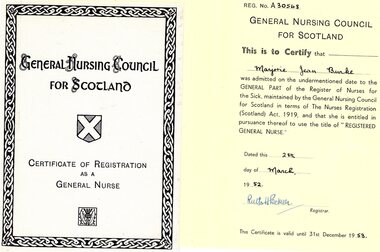
Document - Certificate, General Nursing Council for Scotland, Certificate of Registration as a General Nurse for Marjorie Jean Burke, 28/03/1952
... General Nursing Council for Scotland, issued in 1952. Miss Burke was a nurse, midwife and infant welfare sister. This collection covers her many qualifications throughout Australia and Great Britain, including references both professional and personal. When Miss Burke returned to Australia, she was employed at Diamond Valley Community Hospital ...Certificate of Registration as a General Nurse for Marjorie Jean Burke, from the General Nursing Council for Scotland, issued in 1952.Miss Burke was a nurse, midwife and infant welfare sister. This collection covers her many qualifications throughout Australia and Great Britain, including references both professional and personal. When Miss Burke returned to Australia, she was employed at Diamond Valley Community Hospital as a nurse in 1953 and as Deputy Matron 1954-1971.Certificate on cream folded card.Signed by Registrar.marjorie jean burke, nurses, diamond valley community hospital, general nursing council for scotland -
 Greensborough Historical Society
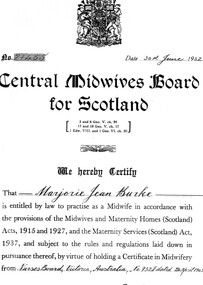
Document - Certificate, General Nursing Council for Scotland et al, Certificate to practise as a midwife (Scotland) for Marjorie Jean Burke, 30/06/1952
... Britain, including references both professional and personal. When Miss Burke returned to Australia, she was employed at Diamond Valley Community Hospital as a nurse in 1953 and as Deputy Matron 1954-1971. marjorie jean burke nurses diamond valley community hospital general nursing council for scotland central midwives board for scotland Signed by Registrar. ...Certificate to practise as a midwife for Marjorie Jean Burke, from the Central Midwives Board for Scotland, issued in 1952.Miss Burke was a nurse, midwife and infant welfare sister. This collection covers her many qualifications throughout Australia and Great Britain, including references both professional and personal. When Miss Burke returned to Australia, she was employed at Diamond Valley Community Hospital as a nurse in 1953 and as Deputy Matron 1954-1971.Certificate on cream paper.Signed by Registrar.marjorie jean burke, nurses, diamond valley community hospital, general nursing council for scotland, central midwives board for scotland -
 Greensborough Historical Society
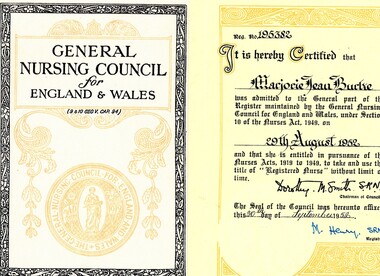
Document - Certificate, Central Midwives Board (England and Wales) et al, Certificate to practise as a registered nurse (England) for Marjorie Jean Burke, 29/08/1952
... General Nursing Council for England and Wales, issued in 1952. Miss Burke was a nurse, midwife and infant welfare sister. This collection covers her many qualifications throughout Australia and Great Britain, including references both professional and personal. When Miss Burke returned to Australia, she was employed at Diamond Valley Community Hospital ...Certificate to practise as a registered nurse in England and Wales for Marjorie Jean Burke, from the General Nursing Council for England and Wales, issued in 1952.Miss Burke was a nurse, midwife and infant welfare sister. This collection covers her many qualifications throughout Australia and Great Britain, including references both professional and personal. When Miss Burke returned to Australia, she was employed at Diamond Valley Community Hospital as a nurse in 1953 and as Deputy Matron 1954-1971.Certificate on cream folded paper.Signed by Registrar.marjorie jean burke, nurses, diamond valley community hospital, central midwives board for england and wales, general nursing council for england and wales -
 Shepparton RSL Sub Branch
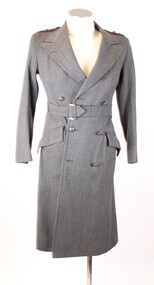
Uniform, Great Coat
... About 16,000 Australians served in the British Commonwealth Occupation Forces, including 130 from the Australian General Hospital with whom Sister Danson presumably served. ...About 16,000 Australians served in the British Commonwealth Occupation Forces, including 130 from the Australian General Hospital with whom Sister Danson presumably served. ...Coat worn by Sister Danson (VFX151507) during the British presence in Japan following the end of the Second World War. About 16,000 Australians served in the British Commonwealth Occupation Forces, including 130 from the Australian General Hospital with whom Sister Danson presumably served. Sister Danson was born in Numurkah and served as Leiutentant with the Heidelberg Military Hospital before embarking for Japan in 1947.This coat is part of a complete uniform set held by the Shepparton RSL. The uniform has representative and historic significance as an example of the style of uniform worn by nursing staff of the Australian General Hospital during the 1940s and into the 1950s. The uniform set has social significance to the Shepparton area, being owned and worn by a serving community member who was born in Numurkah, enlisted in Shepparton and returned to the community in later life.Shin length grey woollen double breasted coat fastened with three buttons on front centre. Interior bakelite or plastic button fastens panels on interior. Two hip-height pockets with folded flap on exterior. Grey fabric belt fastened with a metal buckle; belt is held in place with two fabric loops on either side of the waist. "AUSTRALIA" shoulder flashes on both left and right shoulders; on left arm a blue and brown rectangular colour patch and on the right arm, a blue square patch with embroidered crown and the words "BRITISH COMMONWEALTH FORCES." Epaulettes on either shoulder carry two metal badges signifying a senior Sister and fastened with a metal button. A pin is missing from the base of the epaulette. Interior lined with purple-grey lining; pocket on interior left chest and manufacturer's label at base of neck underneath loop.Shoulder flashes read "AUSTRALIA" and "BRITISH COMMONWEALTH FORCES". Label reads "TAILORS & HABIT/MAKERS/J. RAVENSDALE/& SON/NICHOLAS BLDG./SWANSTON ST MELBOURNE/SISTER DANSON". Buttons read "AUSTRALIAN MILITARY FORCES"second world war, world war ii, medical, wwii, nurse, women -
 Shepparton RSL Sub Branch
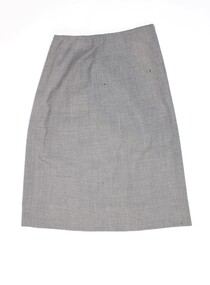
Uniform, Skirt
... About 16,000 Australians served in the British Commonwealth Occupation Forces, including 130 from the Australian General Hospital with whom Sister Danson presumably served. ...About 16,000 Australians served in the British Commonwealth Occupation Forces, including 130 from the Australian General Hospital with whom Sister Danson presumably served. ...This skirt is part of an official uniform by Sister Danson (VFX151507) during the British presence in Japan following the end of the Second World War. About 16,000 Australians served in the British Commonwealth Occupation Forces, including 130 from the Australian General Hospital with whom Sister Danson presumably served. Sister Danson was born in Numurkah and served as Leiutentant with the Heidelberg Military Hospital before embarking for Japan in 1947.Grey slim line with side 5 press studs and 2 hook and eyes "L Danson"japan ww2, occupation force, british commonwealth occupational forces, ww2, world war 2, world war two, wwii, second world war, nurse, military, heidelberg military hospital, vfx151507, sister danson -
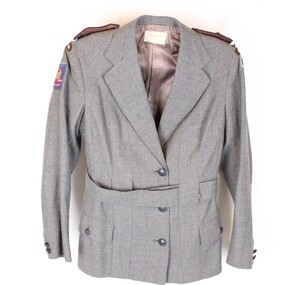 Shepparton RSL Sub Branch
Uniform, Jacket, J Ravensdale and Sons
... About 16,000 Australians served in the British Commonwealth Occupation Forces, including 130 from the Australian General Hospital with whom Sister Danson presumably served. ...About 16,000 Australians served in the British Commonwealth Occupation Forces, including 130 from the Australian General Hospital with whom Sister Danson presumably served. ...This jacket is part of an official uniform by Sister Danson (VFX151507) during the British presence in Japan following the end of the Second World War. About 16,000 Australians served in the British Commonwealth Occupation Forces, including 130 from the Australian General Hospital with whom Sister Danson presumably served. Sister Danson was born in Numurkah and served as Leiutentant with the Heidelberg Military Hospital before embarking for Japan in 1947.One grey linen single 3 button breasted coat. 2 button pocket. 2 buttons on each sleeve. 2 shoulder flash buttons with 2 pips on each. 2 Australia 1 occupation forces lapel. Shoulder pads 10 moth holesmilitary, british commonwealth occupational forces, sidter danson, vfx151507, ww2, wwii, world war two, world war ii, world war 2, second world war, australian general hospital, heidelberg military hospital -
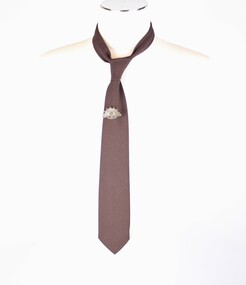 Shepparton RSL Sub Branch
Uniform, Tie, Nurses
... About 16,000 Australians served in the British Commonwealth Occupation Forces, including 130 from the Australian General Hospital with whom Sister Danson presumably served. ...About 16,000 Australians served in the British Commonwealth Occupation Forces, including 130 from the Australian General Hospital with whom Sister Danson presumably served. ...This tie is part of an official uniform by Sister Danson (VFX151507) during the British presence in Japan following the end of the Second World War. About 16,000 Australians served in the British Commonwealth Occupation Forces, including 130 from the Australian General Hospital with whom Sister Danson presumably served. Sister Danson was born in Numurkah and served as Leiutentant with the Heidelberg Military Hospital before embarking for Japan in 1947.This tie holds historic and representative significance, as a piece of standard military uniform that would have been worn by a nurse in the second military district of the occupational forces, presumably in Japan shortly after WW2. Brown synthetic fabric tie (formerly tied in simple Windsor knot) with peach lining. military, uniform, tie, nurse, second military district, occupational forces, ww2, wwii, world war two, world war 2, second world war, vfx151507, sister danson -
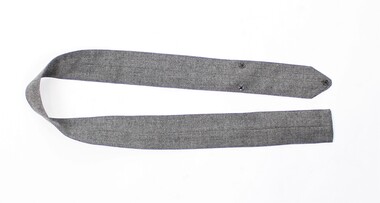 Shepparton RSL Sub Branch
Uniform, Jacket Belt
... About 16,000 Australians served in the British Commonwealth Occupation Forces, including 130 from the Australian General Hospital with whom Sister Danson presumably served. ...About 16,000 Australians served in the British Commonwealth Occupation Forces, including 130 from the Australian General Hospital with whom Sister Danson presumably served. ...Part of a jacket worn by Sister Danson (VFX151507) during the British presence in Japan following the end of the Second World War. About 16,000 Australians served in the British Commonwealth Occupation Forces, including 130 from the Australian General Hospital with whom Sister Danson presumably served. Sister Danson was born in Numurkah and served as Leiutentant with the Heidelberg Military Hospital before embarking for Japan in 1947.This belt is part of a complete uniform set held by the Shepparton RSL. The uniform has representative and historic significance as an example of the style of uniform worn by nursing staff of the Australian General Hospital during the 1940s and into the 1950s. The uniform set has social significance to the Shepparton area, being owned and worn by a serving community member who was born in Numurkah, enlisted in Shepparton and returned to the community in later life.Grey fabric belt fastened with a metal buckle; belt is held in place with two fabric loops on either side of the waist.second world war, world war ii, medical, wwii, nurse, women -
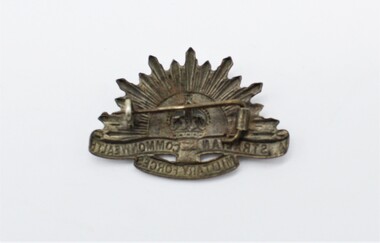 Shepparton RSL Sub Branch
Uniform, Badge
... About 16,000 Australians served in the British Commonwealth Occupation Forces, including 130 from the Australian General Hospital with whom Sister Danson presumably served. ...About 16,000 Australians served in the British Commonwealth Occupation Forces, including 130 from the Australian General Hospital with whom Sister Danson presumably served. ...This badge is attached to a tie which was worn as part of an official uniform by Sister Danson (VFX151507) during the British presence in Japan following the end of the Second World War. About 16,000 Australians served in the British Commonwealth Occupation Forces, including 130 from the Australian General Hospital with whom Sister Danson presumably served. Sister Danson was born in Numurkah and served as Leiutentant with the Heidelberg Military Hospital before embarking for Japan in 1947.This badge is part of a complete uniform set held by the Shepparton RSL. The uniform has representative and historic significance as an example of the style of uniform worn by nursing staff of the Australian General Hospital during the 1940s and into the 1950s. The uniform set has social significance to the Shepparton area, being owned and worn by a serving community member who was born in Numurkah, enlisted in Shepparton and returned to the community in later life.Dark brown metallic badge with pin on the back for fastening. The badge has embossed features. These depict a crown in the centre, a crescent shaped section which is meant to represent the rising sun and which half encircles the crown as well as three pieces of ribbon (metallic) with the embossed words "Australian Commonwealth Military Forces".second world war, world war ii, medical, wwii, nurse, women, badge, australian commonwealth military forces, military -
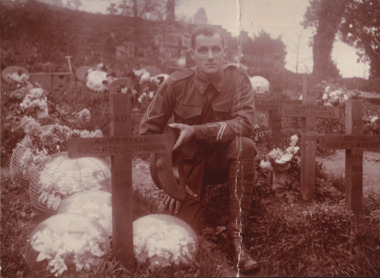 The Beechworth Burke Museum
Photograph
... General Hospital, Bristol, England on 27 July, 1916. John James Simpson passed away from his wounds on 1 August, 1916. He was 33 years old. The record is historically significant due to its connection to World War I. This conflict is integral to Australian culture as it was the single greatest loss of life and the greatest repatriation of casualties in the country's history. Australia’s involvement in the First World War began when the Australian government established the Australian Imperial Force (AIF) in August 1914. Immediately, men were recruited to serve the British ...Taken on an unknown date, depicted is a portrait of a young, unidentified male soldier kneeling beside a grave in a cemetery. He is dressed in an Australian military uniform. The cemetery pictured is the Arnos Vale Cemetery in Bristol, United Kingdom. There are multiple crosses marking graves in this photograph, all marked in memory of different soldiers who fought with the Australian Imperial Force (AIF) during World War I. It is believed that the soldier who is kneeling was also part of the Australian Imperial Force. This can be inferred by the chevron rank insignia visible on the uniform. The placement of this insignia on the sleeve of the right arm suggests that this soldier was either a Warrant Officer or a Non-Commissioned Officer (NCO). Another signifier of the Australian Imperial Force uniform are the three inverted chevron stripes positioned on the lower part of the left sleeve, near the wrist. These are called Good Conduct Stripes and were worn by Warrant Officers and NCOs. This patch consisted of a single chevron stripe for each year of military service meeting certain requirements of good conduct. Additionally, the man in this photograph is also wearing a 'Rising Sun' collar badge on his coat. Australia, unlike most other Commonwealth countries, did not adopt metal regimental badges during the First World War. All units were issued with the Australian Army General Service Badge, better known as the 'Rising Sun’ badge. This insignia is almost always identified with the Australian Imperial Force. Furthermore, the grave that this unidentified soldier is kneeling next to is the resting place of Private John James (J. J.) Simpson. He was born in Stanley, Victoria in 1883. He enlisted in the Australian Imperial Force in Melbourne, Victoria on 12 July, 1915, with the service number 4909. John James Simpson was then posted to the 60th Company Depot at Seymour for military recruit training. John James Simpson was reported wounded in action in France on 19 July, 1916. He was admitted to 13th General Hospital, France with gunshot wounds to his legs. From Boulogne, France, he traveled to the United Kingdom aboard the Hospital Ship 'St. Denis' for medical care. Upon arrival, he was admitted to 2nd Southern General Hospital, Bristol, England on 27 July, 1916. John James Simpson passed away from his wounds on 1 August, 1916. He was 33 years old.The record is historically significant due to its connection to World War I. This conflict is integral to Australian culture as it was the single greatest loss of life and the greatest repatriation of casualties in the country's history. Australia’s involvement in the First World War began when the Australian government established the Australian Imperial Force (AIF) in August 1914. Immediately, men were recruited to serve the British Empire in the Middle East and on the Western Front. The first significant Australian action of the war was the Australian Naval and Military Expeditionary Force’s (ANMEF) landing on Rabaul on 11 September 1914. The ANMEF took possession of German New Guinea at Toma on 17 September 1914 and of the neighbouring islands of the Bismarck Archipelago in October 1914. On 25 April 1915, members of the AIF landed on Gallipoli in Turkey with troops from New Zealand, Britain, and France. This specific event holds very strong significance within Australian history. The record has strong research potential. This is due to the ongoing public and scholarly interest in war, history, and especially the ANZAC legend, which is commemorated annually on 25 April, known as ANZAC Day.Sepia rectangular photograph printed on matte photographic paper mounted on card.Obverse: A.I.F. / AUSTRALIA / 441, PTE.T. / T (?) / 26B (?) / 6.1.17 / (?) / LANGTON RD. / ST. ANNES PK. / BRISTOL / A.I.F. / AUSTRALIA. / 708, GNR B.L.CRAWFORD. / FR / 5 D.A.C. / 13.2.17 / A.I.F. / AUSTRALIA. / 4481, P (?) D.MORRIS. / (?) / 31.12.(?) / A.I.F. / AUSTRALIA. / 4909, PTE J.J.SIMPSON. / 608(?) / 1.8.16 / Winchester / LANGTON RD. / ST. ANNES PK / BRISTOL / Reverse: 2641 /military album, military, war, world war i, wwi, australian imperial force, aif, j. j. simpson, uniform, cemetery -
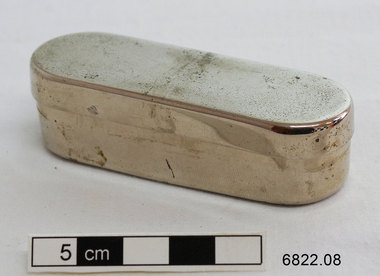 Flagstaff Hill Maritime Museum and Village
Instrument - Syringe set, c. 1940s
... Dr Angus assisted Dr Tom Ryan, a pioneer in the use of X-rays and in ocular surgery. flagstaff hill warrnambool shipwrecked coast flagstaff hill maritime museum maritime museum shipwreck coast flagstaff hill maritime village great ocean road dr w r angus dr ryan surgical instrument t.s.s. largs bay warrnambool base hospital nhill base hospital mira hospital flying doctor medical treatment medical history medical education medical text book fivepoint syringe general surgical co. injections Printed on syringe cylinder "FIVEPOINT BRITISH" and symbol of a red star. ...Whether it’s an anaesthetic, blood test, insulin, vitamin shot or vaccination, at a base human level something feels instinctively wrong about having a long thin piece of metal stuck deep into your flesh. And yet, in allowing physicians to administer medicine directly into the bloodstream, the hypodermic needle has been one of the most important inventions of medical science. In the beginning… Typically, it was the Romans. The word ‘syringe’ is derived from Greek mythology. Chased to the edge of a river by the god Pan, a rather chaste nymph by the name of Syrinx magically disguised herself as water reeds. Determined, Pan chopped the hollow reeds off and blew into them to create a musical whistling sound, thereby fashioning the first of his fabled pipes. Taking that concept of ‘hollow tubes’, and having observed how snakes could transmit venom, the practice of administering ointments and unctions via simple piston syringes is originally described in the writings of the first-century Roman scholar Aulus Cornelius Celsus and the equally famous Greek surgeon Galen. It’s unclear if the Egyptian surgeon Ammar bin Ali al-Mawsili was a fan of either of their scribblings, but 800 years later he employed a hollow glass tube and simple suction power to remove cataracts from his patients’ eyes – a technique copied up until the 13th century, but only to extract blood, fluid or poison, not to inject anything. Syringes get modern Then, in 1650, while experimenting with hydrodynamics, the legendary French polymath Blaise Pascal invented the first modern syringe. His device exemplified the law of physics that became known as Pascal’s Law, which proposes “when there is an increase in pressure at any point in a confined fluid, there is an equal increase at every other point in the container.” But it wasn’t until six years later that a fellow Renaissance man, the English architect Sir Christopher Wren took Pascal’s concept and made the first intravenous experiment. Combining hollow goose quills, pig bladders, a kennel of stray dogs and enough opium to fell a herd of elephants, Wren started injecting the hapless mutts with the ‘milk of the poppy’. By the mid-1660s, thinking this seemed like a great idea, two German doctors, Johann Daniel Major and Johann Sigismund Elsholtz, decided to try their hand at squirting various stuff into human subjects. Things didn’t end well, and people died. Consequently, injections fell out of medical favour for 200 years. Let's try again… Enter the Irish doctor Francis Rynd in 1844. Constructing the first-ever hollow steel needle, he used it to inject medicine subcutaneously and then bragged about it in an issue of the Dublin Medical Press. Then, in 1853, depending on who you believe, it was either a Frenchman or a Scot who invented the first real hypodermic needle. The French physician Charles Pravaz adapted Rynd’s needle to administer a coagulant in order to stem bleeding in a sheep by using a system of measuring screws. However, it was the Scottish surgeon Alexander Wood who first combined a hollow steel needle with a proper syringe to inject morphine into a human. Thus, Wood is usually credited with the invention. Sharp advancements Over the following century, the technology was refined and intravenous injections became commonplace – whether in the administering of pain relief, penicillin, insulin, immunisation and blood transfusions, needles became a staple of medicine. By 1946, the Chance Brothers’ Birmingham glassworks factory began mass-producing the first all-glass syringe with interchangeable parts. Then, a decade later, after sterilisation issues in re-used glass syringes had plagued the industry for years, a Kiwi inventor called Colin Murdoch applied for a patent of a disposable plastic syringe. Several patents followed, and the disposable syringe is now widespread. https://www.medibank.com.au/livebetter/be-magazine/wellbeing/the-history-of-the-hypodermic-needle/ This syringe set was donated to Flagstaff Hill Maritime Village by the family of Doctor William Roy Angus, Surgeon and Oculist. It is part of the “W.R. Angus Collection” that includes historical medical equipment, surgical instruments and material once belonging to Dr Edward Ryan and Dr Thomas Francis Ryan, (both of Nhill, Victoria) as well as Dr Angus’ own belongings. The Collection’s history spans the medical practices of the two Doctors Ryan, from 1885-1926 plus that of Dr Angus, up until 1969. ABOUT THE “W.R.ANGUS COLLECTION” Doctor William Roy Angus M.B., B.S., Adel., 1923, F.R.C.S. Edin.,1928 (also known as Dr Roy Angus) was born in Murrumbeena, Victoria in 1901 and lived until 1970. He qualified as a doctor in 1923 at University of Adelaide, was Resident Medical Officer at the Royal Adelaide Hospital in 1924 and for a period was house surgeon to Sir (then Mr.) Henry Simpson Newland. Dr Angus was briefly an Assistant to Dr Riddell of Kapunda, then commenced private practice at Curramulka, Yorke Peninsula, SA, where he was physician, surgeon and chemist. In 1926, he was appointed as new Medical Assistant to Dr Thomas Francis Ryan (T.F. Ryan, or Tom), in Nhill, Victoria, where his experiences included radiology and pharmacy. In 1927 he was Acting House Surgeon in Dr Tom Ryan’s absence. Dr Angus had become engaged to Gladys Forsyth and they decided he would take time to further his studies overseas in the UK in 1927. He studied at London University College Hospital and at Edinburgh Royal Infirmary and in 1928, was awarded FRCS (Fellow from the Royal College of Surgeons), Edinburgh. He worked his passage back to Australia as a Ship’s Surgeon on the on the Australian Commonwealth Line’s T.S.S. Largs Bay. Dr Angus married Gladys in 1929, in Ballarat. (They went on to have one son (Graham 1932, born in SA) and two daughters (Helen (died 12/07/1996) and Berenice (Berry), both born at Mira, Nhill ) Dr Angus was a ‘flying doctor’ for the A.I.M. (Australian Inland Ministry) Aerial Medical Service in 1928 . The organisation began in South Australia through the Presbyterian Church in that year, with its first station being in the remote town of Oodnadatta, where Dr Angus was stationed. He was locum tenens there on North-South Railway at 21 Mile Camp. He took up this ‘flying doctor’ position in response to a call from Dr John Flynn; the organisation was later known as the Flying Doctor Service, then the Royal Flying Doctor Service. A lot of his work during this time involved dental surgery also. Between 1928-1932 he was surgeon at the Curramulka Hospital, Yorke Peninsula, South Australia. In 1933 Dr Angus returned to Nhill where he’d previously worked as Medical Assistant and purchased a share of the Nelson Street practice and Mira hospital from Dr Les Middleton one of the Middleton Brothers, the current owners of what was once Dr Tom Ryan’s practice. Dr L Middleton was House Surgeon to the Nhill Hospital 1926-1933, when he resigned. [Dr Tom Ryan’s practice had originally belonged to his older brother Dr Edward Ryan, who came to Nhill in 1885. Dr Edward saw patients at his rooms, firstly in Victoria Street and in 1886 in Nelson Street, until 1901. The Nelson Street practice also had a 2 bed ward, called Mira Private Hospital ). Dr Edward Ryan was House Surgeon at the Nhill Hospital 1884-1902 . He also had occasions where he successfully performed veterinary surgery for the local farmers too. Dr Tom Ryan then purchased the practice from his brother in 1901. Both Dr Edward and Dr Tom Ryan work as surgeons included eye surgery. Dr Tom Ryan performed many of his operations in the Mira private hospital on his premises. He too was House Surgeon at the Nhill Hospital 1902-1926. Dr Tom Ryan had one of the only two pieces of radiology equipment in Victoria during his practicing years – The Royal Melbourne Hospital had the other one. Over the years Dr Tom Ryan gradually set up what was effectively a training school for country general-practitioner-surgeons. Each patient was carefully examined, including using the X-ray machine, and any surgery was discussed and planned with Dr Ryan’s assistants several days in advance. Dr Angus gained experience in using the X-ray machine there during his time as assistant to Dr Ryan. Dr Tom Ryan moved from Nhill in 1926. He became a Fellow of the Royal Australasian College of Surgeons in 1927, soon after its formation, a rare accolade for a doctor outside any of the major cities. He remained a bachelor and died suddenly on 7th Dec 1955, aged 91, at his home in Ararat. Scholarships and prizes are still awarded to medical students in the honour of Dr T.F. Ryan and his father, Dr Michael Ryan, and brother, John Patrick Ryan. ] When Dr Angus bought into the Nelson Street premises in Nhill he was also appointed as the Nhill Hospital’s Honorary House Surgeon 1933-1938. His practitioner’s plate from his Nhill surgery states “HOURS Daily, except Tuesdays, Fridays and Saturday afternoons, 9-10am, 2-4pm, 7-8pm. Sundays by appointment”. This plate is now mounted on the doorway to the Port Medical Office at Flagstaff Hill Maritime Village, Warrnambool. Dr Edward Ryan and Dr Tom Ryan had an extensive collection of historical medical equipment and materials spanning 1884-1926 and when Dr Angus took up practice in their old premises he obtained this collection, a large part of which is now on display at the Port Medical Office at Flagstaff Hill Maritime Village in Warrnambool. During his time in Nhill Dr Angus was involved in the merging of the Mira Hospital and Nhill Public Hospital into one public hospital and the property titles passed on to Nhill Hospital in 1939. In 1939 Dr Angus and his family moved to Warrnambool where he purchased “Birchwood,” the 1852 home and medical practice of Dr John Hunter Henderson, at 214 Koroit Street. (This property was sold in1965 to the State Government and is now the site of the Warrnambool Police Station. ). The Angus family was able to afford gardeners, cooks and maids; their home was a popular place for visiting dignitaries to stay whilst visiting Warrnambool. Dr Angus had his own silk worm farm at home in a Mulberry tree. His young daughter used his centrifuge for spinning the silk. Dr Angus was appointed on a part-time basis as Port Medical Officer (Health Officer) in Warrnambool and held this position until the 1940’s when the government no longer required the service of a Port Medical Officer in Warrnambool; he was thus Warrnambool’s last serving Port Medical Officer. (The duties of a Port Medical Officer were outlined by the Colonial Secretary on 21st June, 1839 under the terms of the Quarantine Act. Masters of immigrant ships arriving in port reported incidents of diseases, illness and death and the Port Medical Officer made a decision on whether the ship required Quarantine and for how long, in this way preventing contagious illness from spreading from new immigrants to the residents already in the colony.) Dr Angus was a member of the Australian Medical Association, for 35 years and surgeon at the Warrnambool Base Hospital 1939-1942, He served as a Surgeon Captain during WWII1942-45, in Ballarat, Victoria, and in Bonegilla, N.S.W., completing his service just before the end of the war due to suffering from a heart attack. During his convalescence he carved an intricate and ‘most artistic’ chess set from the material that dentures were made from. He then studied ophthalmology at the Royal Melbourne Eye and Ear Hospital and created cosmetically superior artificial eyes by pioneering using the intrascleral cartilage. Angus received accolades from the Ophthalmological Society of Australasia for this work. He returned to Warrnambool to commence practice as an ophthalmologist, pioneering in artificial eye improvements. He was Honorary Consultant Ophthalmologist to Warrnambool Base Hospital for 31 years. He made monthly visits to Portland as a visiting surgeon, to perform eye surgery. He represented the Victorian South-West subdivision of the Australian Medical Association as its secretary between 1949 and 1956 and as chairman from 1956 to 1958. In 1968 Dr Angus was elected member of Spain’s Barraquer Institute of Barcelona after his research work in Intrasclearal cartilage grafting, becoming one of the few Australian ophthalmologists to receive this honour, and in the following year presented his final paper on Living Intrasclearal Cartilage Implants at the Inaugural Meeting of the Australian College of Ophthalmologists in Melbourne In his personal life Dr Angus was a Presbyterian and treated Sunday as a Sabbath, a day of rest. He would visit 3 or 4 country patients on a Sunday, taking his children along ‘for the ride’ and to visit with him. Sunday evenings he would play the pianola and sing Scottish songs to his family. One of Dr Angus’ patients was Margaret MacKenzie, author of a book on local shipwrecks that she’d seen as an eye witness from the late 1880’s in Peterborough, Victoria. In the early 1950’s Dr Angus, painted a picture of a shipwreck for the cover jacket of Margaret’s book, Shipwrecks and More Shipwrecks. She was blind in later life and her daughter wrote the actual book for her. Dr Angus and his wife Gladys were very involved in Warrnambool’s society with a strong interest in civic affairs. Their interests included organisations such as Red Cross, Rostrum, Warrnambool and District Historical Society (founding members), Wine and Food Society, Steering Committee for Tertiary Education in Warrnambool, Local National Trust, Good Neighbour Council, Housing Commission Advisory Board, United Services Institute, Legion of Ex-Servicemen, Olympic Pool Committee, Food for Britain Organisation, Warrnambool Hospital, Anti-Cancer Council, Boys’ Club, Charitable Council, National Fitness Council and Air Raid Precautions Group. He was also a member of the Steam Preservation Society and derived much pleasure from a steam traction engine on his farm. He had an interest in people and the community He and his wife Gladys were both involved in the creation of Flagstaff Hill, including the layout of the gardens. After his death (28th March 1970) his family requested his practitioner’s plate, medical instruments and some personal belongings be displayed in the Port Medical Office surgery at Flagstaff Hill Maritime Village, and be called the “W. R. Angus Collection”. The W.R. Angus Collection is significant for still being located at the site it is connected with, Doctor Angus being the last Port Medical Officer in Warrnambool. The collection of medical instruments and other equipment is culturally significant, being an historical example of medicine from late 19th to mid-20th century. Dr Angus assisted Dr Tom Ryan, a pioneer in the use of X-rays and in ocular surgery. Syringe set (8 pieces),part of the W.R. Angus Collection. Pocket syringe kit in oval stainless steel container with separate lid. Container holds syringe cylinder, plunger, 2 needles, blade and cap. Printed on syringe cylinder "FIVEPOINT BRITISH" and symbol of a red star. One needle stamped "22"flagstaff hill, warrnambool, shipwrecked coast, flagstaff hill maritime museum, maritime museum, shipwreck coast, flagstaff hill maritime village, great ocean road, dr w r angus, dr ryan, surgical instrument, t.s.s. largs bay, warrnambool base hospital, nhill base hospital, mira hospital, flying doctor, medical treatment, medical history, medical education, medical text book, fivepoint syringe, general surgical co., injections -
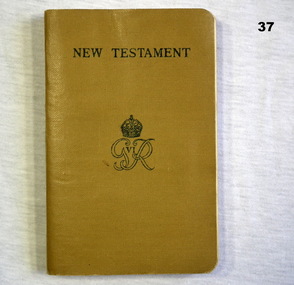 Bendigo Military Museum
Book, New Testament, c. pre 1940
... General Hospital, 2/5th General Hospital. Refer also Cat No’s 314.2, 513. Books bibles religion Written inside front cover: “VX75707 20th Field Ambulance Pte. A. G. Bingham A.I.F. Australia" Written on introductory page: TO MUM WITH BEST OF LOVE SON 30th-5-1942 BALCOMBE 1942 WANGAR ATTA BACCOME New Testament, brown covers with black printing & George VI insignia. New Testament Book BOOK British ...Bible sent to the mother of Alfred George BINGHAM (born Richmond, enlisted Caulfield) No VX75707, enlisted in the 2nd AIF on 21.3.1942 age 23 years 5 months. Posted to AAMC 26.3.1942, embarked for New Guinea 3.1.1943 on the 2/1st Aust Hospital ship Manunda, returned to Aust and disembarked on 7.5.1944, embarked for Morotai on 17.3.1945, returned to Aust and disembarked on 4.1.1946, discharged from the AIF on 20.6.1946. Units served in, 20th Field Ambulance, 2/9th General Hospital, 2/5th General Hospital. Refer also Cat No’s 314.2, 513. New Testament, brown covers with black printing & George VI insignia. Written inside front cover: “VX75707 20th Field Ambulance Pte. A. G. Bingham A.I.F. Australia" Written on introductory page: TO MUM WITH BEST OF LOVE SON 30th-5-1942 BALCOMBE 1942 WANGAR ATTA BACCOMEbooks, bibles, religion -
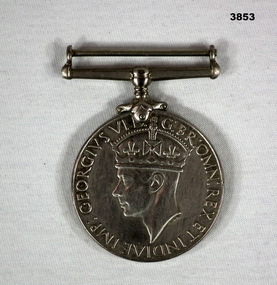 Bendigo Military Museum
Award - MEDAL WW2, Post 1945
... General Hospital. Award medal WW2 114 agh “NF465083 H.I.D Maclennan” British War Medal 1939-45. ...Medal issued to Hazel Irene Daphne MACLENNAN No NF465083, enlisted in the Army 4.10.1943 age 18 years, discharged on 26.4 1944 with the rank of Pte in No 114 Aust General Hospital.British War Medal 1939-45. No ribbon attached.“NF465083 H.I.D Maclennan”award, medal ww2, 114 agh -
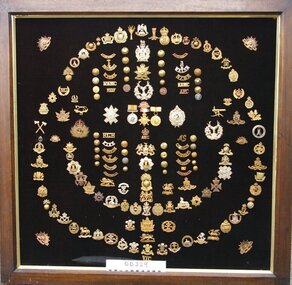 Frankston RSL Sub Branch
Collection, Military Badges and Insignia
... Britain and other countries. The collection features a set of three medals as the centrepiece which were awarded to an Australian serviceman, Acting Warrant Officer Alwin Stevens Nicholas, service number 4752 of the 3rd Australian General Hospital, Australian Medical Corp, A.I.F. ...Britain and other countries. The collection features a set of three medals as the centrepiece which were awarded to an Australian serviceman, Acting Warrant Officer Alwin Stevens Nicholas, service number 4752 of the 3rd Australian General Hospital, Australian Medical Corp, A.I.F. ...Framed collection consisting of a large number of World War 1 era military badges and insignia from Australia, New Zealand, Britain and other countries. The collection features a set of three medals as the centrepiece which were awarded to an Australian serviceman, Acting Warrant Officer Alwin Stevens Nicholas, service number 4752 of the 3rd Australian General Hospital, Australian Medical Corp, A.I.F. The metal badges and insignia are mounted on a black felt cloth background over a wooden backing and housed in a wooden frame. There is no glass front to the frame. for more details about A S Nicholas refer: < https://recordsearch.naa.gov.au/SearchNRetrieve/Interface/ViewImage.aspx?B=7998061 >none -
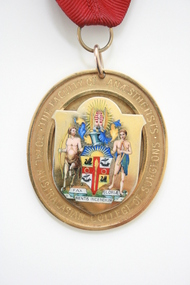 Geoffrey Kaye Museum of Anaesthetic History
Medal - Medal, Dean, Garrard & Co. Goldsmiths & Silversmiths, 1953
... Britain. He then turned his attention to improving dental anaesthesia. Working with fellow colleagues R R Macintosh and W S McConnell, they established the ‘Mayfair Gas Company’, primarily for dental anaesthesia, but also provided anaesthesia for general surgery during honorary hospital sessions. ...Britain. He then turned his attention to improving dental anaesthesia. Working with fellow colleagues R R Macintosh and W S McConnell, they established the ‘Mayfair Gas Company’, primarily for dental anaesthesia, but also provided anaesthesia for general surgery during honorary hospital sessions. ...Dr Bernard Johnson was elected on December the 6th December 1952 as the Faculty's first honorary Fellow. At the time, Johnson was the Dean of the Faculty of Anaesthetists, Royal College of Surgeons, England. He was invited to visit Australia to receive his award and in 1953 Johnson received his award and brought with him a notable gift being the local Dean's medal of office which was presented on behalf of the Royal College of Surgeons. Johnson had previously met with Ivan Jose and H.J. Daly by providing advice for the establishment of an Australasian Faculty. Johnson is a significant figure as a pioneer into intravenous anaesthesia into Great Britain. He then turned his attention to improving dental anaesthesia. Working with fellow colleagues R R Macintosh and W S McConnell, they established the ‘Mayfair Gas Company’, primarily for dental anaesthesia, but also provided anaesthesia for general surgery during honorary hospital sessions. Johnson participated in the development of the Faculty of Anaesthetists within the Royal College of Surgeons. A founding member of the Board of Faculty, he served as Vice-Dean and then was the second Dean (1952-5), a role which provided a seat on the council of the RCS England. A 9 carat gold [375] oval shaped Dean's Medal of the Faculty of Anaesthetists, Royal Australasian College of Surgeons secured onto a red coloured woven tape by two large gold links. Obverse depicts in coloured enamel secured onto base the RACS coat of arms and crest. Engraved around the sunken diameter are the Faculty and College names. The reverse side has the presentation details inscribed onto a plaque secured onto the main piece with three rivets with hallmarks on both the message plaque and the outer rim. The original red leather box is in poor condition. Printed on the inside silk cover are the maker's marks.[obverse] THE FACULTY OF ANAESTHETISTS / ROYAL AUSTRALASIAN COLLEGE OF SURGEONS [reverse] PRESENTED / BY THE DEAN / DR BERNARD JOHNSON / ON BEHALF OF THE BOARD OF / THE FACULTY OF ANAESTHETISTS / OF THE ROYAL COLLEGE OF / SURGEONS OF ENGLAND / AT THE INAUGURAL MEETING / 17th APRIL 1953 [hallmarks on reverse] GAS CO LTD 9 375 R Edinburgh? [black print on inside box cover] By appointment silversmiths to / THE LATE KING / GEORGE VI / THE [goldsmith's logo] / GOLDSMITHS & SILVERSMITHS / COMPANY LTD / CROWN JEWELLERS / incorporating GARRARD & CO / 112 REGENT STREET, LONDON W. I.dean medal, mayfair gas company, rcs england, johnson, bernard -
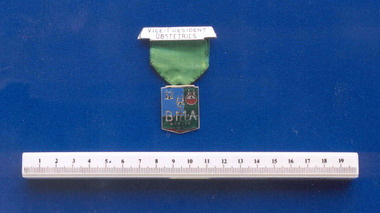 Royal Australian and New Zealand College of Obstetricians & Gynaecologists (RANZCOG)
Medal - British Medical Association medal associated with Professor F J Browne, Dublin, 1933, 1933 (approximate)
... General Practice in Wales, Maternity Department of the Edinburgh Royal Infirmary, 1st director of obstetric unit, University College Hospital London. Retired and continued postgraduate teaching in London and NSW. Married to Grace Cuthbert, who was director of Maternal and Baby Welfare in NSW. Collection of objects transferred from the Archives to the Museum collection found amongst Professor FJ Browne's papers. Numismatics British ...Francis James Browne died in Sydney 1963. He had a long career in obstetrics and gynaecology. Summary of appointments include: General Practice in Wales, Maternity Department of the Edinburgh Royal Infirmary, 1st director of obstetric unit, University College Hospital London. Retired and continued postgraduate teaching in London and NSW. Married to Grace Cuthbert, who was director of Maternal and Baby Welfare in NSW. Collection of objects transferred from the Archives to the Museum collection found amongst Professor FJ Browne's papers.Square medal with ribbon. Medal is decorated with blue, green, and red enamel and has silver inserts. Medal design is divided vertically and horizontally by silver lines and carries the text, "B.M.A/DUBLIN/1933". There are three symbols on the upper section of the front of the medal. Top of medal is attached to a green grosgrain ribbon, which in turn is attached to a silver bar inscribed with the words "VICE-PRESIDENT/OBSTETRICS". Small stamp printed on back of medal.numismatics, british medical association -
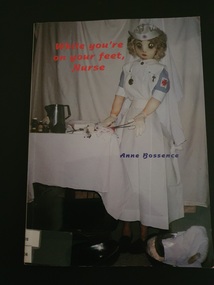 Alfred Hospital Nurses League - Nursing History Collection
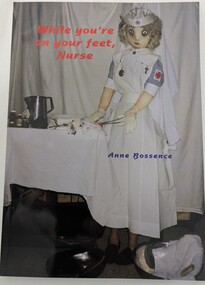
Book - Illustrated book, Anne Bossence et al, While you're on your feet, nurse, 1999
... Hospital in 1957 and was also a member of the AHNL. Nurse-Australia-biography Nurse-Great Britain-biography A light hearted look at nursing in general, and patients in particular, when nurses were hospital trained. ...A light hearted look at nursing in general, and patients in particular, when nurses were hospital trained.front cover has a coloured photo of a dummy dressed in the uniform of a third year Alfred Hospital student nurse, with various nursing paraphernalia. Title and author's name also on front cover and spine. Synopsis of book and author information on back cover. Black and white illustrations within non-fictionA light hearted look at nursing in general, and patients in particular, when nurses were hospital trained.nurse-australia-biography, nurse-great britain-biography -
 Alfred Hospital Nurses League - Nursing History Collection
Book - Illustrated book, Anne Bossence et al, While you're on your feet, nurse, 1999
... Hospital in 1957 and was also a member of the AHNL. Nurse-Australia-biography Nurse-Great Britain-biography A light hearted look at nursing in general, and patients in particular, when nurses were hospital trained. ...A light hearted look at nursing in general, and patients in particular, when nurses were hospital trained.front cover has a coloured photo of a dummy dressed in the uniform of a third year Alfred Hospital student nurse, with various nursing paraphernalia. Title and author's name also on front cover and spine. Synopsis of book and author information on back cover. Black and white illustrations within non-fictionA light hearted look at nursing in general, and patients in particular, when nurses were hospital trained.nurse-australia-biography, nurse-great britain-biography -
 Ballarat Base Hospital Trained Nurses League
Priscilla Wardle - Trainee Ballarat District Hospital, 27/02/1905 to 01/03/1908 and WW1 Nurse. Also Edith Popplewell & Lily MacKenzie
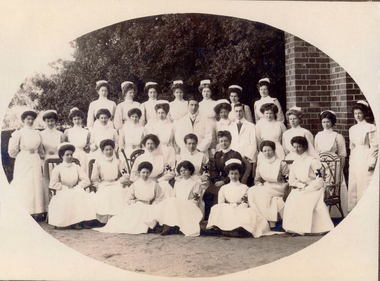
... General Hospital (Officers Hospital) in Havre., France Friday 29 March 1918 to Monday 29 July 1918 note the two dark bands on her right sleeve denoting that she is an “Acting Sister”. Priscilla is 34 years of age in this picture and in the three weeks prior to this posting she met Cyril Terence Charles Kirby (1892-1968) her future husband at the 42nd Stationary Hospital in Flixecourt while he was serving with the British Army during the battle and evacuation of Amiens. ...General Hospital (Officers Hospital) in Havre., France Friday 29 March 1918 to Monday 29 July 1918 note the two dark bands on her right sleeve denoting that she is an “Acting Sister”. Priscilla is 34 years of age in this picture and in the three weeks prior to this posting she met Cyril Terence Charles Kirby (1892-1968) her future husband at the 42nd Stationary Hospital in Flixecourt while he was serving with the British Army during the battle and evacuation of Amiens. ...No 1: Matron Eagleton with Nursing Staff, Ballarat & District Hospital. Priscilla Wardle, far right - trainee nurse 1905-1908. No 2: This could be a group of trainee nurses at Ballarat Hospital. Circa 1906/1907. The nurses with the grey looking sleeves in this black and white photograph may be wearing the lilac uniform of Trainee nurses. The sitting nurse on the far right may already be qualified because she appears to be wearing the white of a trained nurse. Sitting in the middle with the cheeky grin could be Priscilla and the standing nurse on the far left could be Edith Popplewell. No 3: This photograph is labelled 1907 and Priscilla would have just commenced her training. She appears to be “fanning” a female patient presumably to cool her down. This could be upstairs in the Queen Victoria’s Women’s Ward. Priscilla graduated as a nurse in 1908. In this photograph Priscilla was at age 23 years. No 5: Sheila Kelly (left) and Priscilla Wardle. This photograph is labelled 1909 and shows Priscilla in an all white uniform indicating she has qualified as a nurse. Sheila Kelly appears to have darker sleeves/blouse (lilac) and may still be a trainee. No 6: There is a very good chance that this photograph is Edith Popplewell, standing left, Lily MacKenzie , standing on the right and Priscilla seated. Writing in her album is very hard to read but it appears to be “Pop McK & I”. The arm bands with the St John Cross denote they are “charge nurses” maybe in charge of a ward. Taking all this into account the photograph could be circa 1909/1910. No 8 & 9: Priscilla painting what appears to be a gate while wearing her nurse uniform. She has a big grin on her face. Together with Lily MacKenzie they were the principals in the Mount Stuart Private Hospital at 18 Duke Street. Daylesford. This property is now known as Mount Stuart House. Priscilla appears to be on Central Spring Road with the Daylesford Post Office in the background. Photograph 9 is labelled 1914 which would make it near the end of their tenancy between 1911 and 1914. No 10: This photograph raises some questions. Priscilla appears to have darker sleeves /blouse (lilac) which may indicate she is still a trainee however Priscilla is also wearing a “charge nurse” arm band. While my research shows trainee nurses can be a “charge nurse” this is not common practise. The scene appears to be at the door of a house/home. I am not sure if the children’s ward/orphanage at the Ballarat Hospital at this time was in such a building. It could be that it is at the Mount Stuart Hospital but this would mean Priscilla and Lily have duplicated the wearing of the “charge nurse” arm band. The St John’s logo looks different too. Priscilla Isabel “Pearl” Wardle (1884-1967). The armband indicates Priscilla is a Charge Nurse at the Ballarat Hospital. Nothing else known. No 11: Mary & I at Mount Stuart – House Daylesford – This is probably the nursery at the Mount Stuart House Private Hospital being run by Priscilla Isabel “Pearl” Wardle (1884 – 1967) and Selina Lily (Lil) MacKenzie or McKenzie (1882 – 1975) between 1910 and 1914. Mary is certainly Mary Young MacKenzie or McKenzie (1865- 1942) Lily’s stepsister who trained at Ballarat Hospital as “Mary Young “at the same time as Priscilla and Lily. Mount Stuart House still stands at 18 Duke Street Daylesford. Photo date 1912. No 12: Priscilla wearing her distinctive Queen Alexandra’s Imperial Military Nursing Service Reserve cape and badge. Possibly while nursing in London for a month in 1919 after the war. No 12A: Priscilla Wardle - WW1 Diary, OCR enabled. No 13: Priscilla and friends at No. 7 General Hospital, Malassises, Saint Omer, France in July 1915 The old monastery being used as a hospital can be seen in the background. The tents are the nurses quarters. This photograph may have been taken at the same time as the group photograph on page 250 of the diary transcription. Priscilla is thought to be the nurse at the centre in the QAIMNSR uniform. The nurses quarters at the No 7 General Hospital in Saint Omer in France where Priscilla worked for most of the first year of her Diary. Their Monastery (Hospital) at Malassises can be seen in the background. No 15: Priscilla is an Acting Sister working at the 2nd General Hospital for Officers in Havre, France, between March and July 1918. The nurses were enjoying their “tea party”. (see also page 253 of the Diary transcription) No 17: Priscilla at Havre - at 2nd General Hospital (Officers Hospital) in Havre., France Friday 29 March 1918 to Monday 29 July 1918 note the two dark bands on her right sleeve denoting that she is an “Acting Sister”. Priscilla is 34 years of age in this picture and in the three weeks prior to this posting she met Cyril Terence Charles Kirby (1892-1968) her future husband at the 42nd Stationary Hospital in Flixecourt while he was serving with the British Army during the battle and evacuation of Amiens. No 18: Priscilla Wardle at No 8 Stationary Hospital Wimereux, France - from Saturday 24 June 1916 to Tuesday 18 September 1917, Priscilla worked at this hospital for 15 months her longest time in one hospital. during the war. While at Wimereux on Sunday 1 July 1917 she was appointed an Acting Sister. Priscilla once said she disliked nursing in her cape and badges and here she is in her favourite “uniform” for work “the robe” as she called it. She may be leaving the “operating theatre” at Wimereux in this photograph. No 19: Priscilla worked in various operating theatres throughout France. This could be after she became an anaesthetist in 1918 and worked with this team. She is wearing her favourite uniform which is more comfortable. She did not like the collars and capes that were required to be worn. No 20: Priscilla and Sister Michael Meeke? (details not found) are having a quiet drink at the 2nd General Hospital for Officers in Havre, France. Note the dark bands on their sleeves denote their rank as nursing “Sisters”. While it looks like they are smoking look more closely they are in fact holding a “flute” style probably “cocktail” glass. Tea parties and cocktails, Havre could almost have been fun. No 22: 1913 – Ballarat nurse Priscilla Isabell “Pearl” Wardle (1884-1967) in Cannes on the French Riviera during leave from between Friday 20 February 1918 and Friday 6 March 1918.Priscilla is second from the left wearing her distinctive QAIMNSR cape of grey with dark “wine” coloured border. The other nurses are wearing their “travelling” army uniform. They were rudely called “Salvation Army Lassies” by American nurses for the way they were dressed. (see page 232 of Priscilla’s War Diary) The description of 1913 on this photograph is confusing. No 23: Priscilla with her best friend Edith Victoria Donaldson somewhere in the “mysterious far east” on their trip on the Orontes. Priscilla is second from left - this may have been taken at Durban during Priscilla's return to Australia in 1919. No 25: Priscilla Wardle, Ballarat nurse in her Queen Alexandra’s Imperial Military Nursing Service Reserve (QAIMNSR) uniform. Notice the distinctive grey cape with “wine coloured” border Priscilla is also wearing her QAIMNSR qualification badge (medal) on the right side. Because she has no dark (wine coloured) bands on her sleeves so this photograph may be before 1 July 1918. No 26: Priscilla met her husband to be English army Lieutenant Cyril Terrence Charles Kirby during the battle and subsequent evacuation of Amiens in France. As an army nursing “Sister” Priscilla also held the rank of Lieutenant. Priscilla was stationed at the 42nd Stationary Hospital between 7/3/18 and 23/3/18. She had just completed a fortnight break at Cannes on the French Riviera. They were married at Priscilla’s home “Waverley" at 215 Dawson Street Ballarat on Saturday 15 November 1919. Nov 15, 1919 – Mr and Mrs Kirby. The bride Priscilla Isabell “Pearl” Kirby (nee Wardle) (1884-1967) and the groom Cyril Terence Charles Kirby (1892– 1968) on their wedding day. Priscilla was 34 years of age and Cyril 27 years of age however their marriage certificate states that they were both 34 years of age. Their marriage certificate states they were married at Waverley, Dawson St, South, Ballarat in a Presbyterian service conducted by the Rev. John Walker, a Minister of the Presbyterian Church of Australia and the Moderator General of the Church we think for Victoria. Was it in an outdoor setting as the surrounds in this photograph seem to indicate. Their witnesses were Robert and Olive, Priscilla’s brother and sister. Cyril signed as C. Terence. C. Kirby and Priscila signed as Priscilla I. Wardle. The certificate lists Cyril (Terence) as a Bachelor, Born at sea on a British ship and his occupation as Sailor. His father interestingly is listed as Charles John Kirby, of independent means and his mother as Emily Newman. Priscilla is listed as a Spinster, born in Ballarat with occupation as a Nurse. Her father is listed as Henry Thomas Wardle, Timber Merchant and her mother as Isabella Allan. They are both resident at 215 Dawson St. Ballarat which was Waverley the Wardle family home. No 28: Reverse in Poppy’s handwriting: “Lovingly yours Poppy, Dec 1908” Taken the year after Poppy qualified at BBH. No 29: Reverse in Poppy’s handwriting: “With much love to you Cilla, Poppy 1915” This picture was taken in the same year as the Marquette sinking incident. Edith Catheina Popplewell RRC (1884-1972) in her New Zealand Army Nursing Service (NZANS) Uniform. Poppy is at age 29 years in this photograph. Poppy was awarded the Royal Red Cross (RRC) medal for her heroism during the sinking of the Marquette transport ship. She lost her best friend NZ nurse Lorna Ratray. No 30: Taken in Cairo. Poppy is in the centre and wearing her New Zealand army badge and cape. The two nurses on either side are Australian nurses probably wearing their unique silver Australian Army sunrise badge and cape. No 31: Reverse in Poppy’s handwriting: “Ward 7 on Xmas day 1917, with my love, Poppy, A Happy New Year to you – had the sweetest letter from Bobbie”. (Bobbie is Priscilla’s brother Robert). It is thought the nurse in the centre of the three on the left is Poppy. It is 1917 two years after the Marquette sinking. Poppy appears to be a “sister” note the two dark bands on her sleeve. The uniform also matches that of Poppy 2. This photograph is in Post Card form very common during WWI. Edith Popplewell RRC is the “Sister” in the middle of the group of three nurses on the left. She is a sister not a general nurse because of the two bands on her left wrist denoting her rank. She was in fact the Charge Nurse ( in charge) of Ward 7 at this time. Note the Christmas decorations. Poppy is at age 33 years of age in this photograph.Bobbie is Priscilla’s brother Robert Norman “Bobbie” Wardle (1895-1979). No 32: Lilly MacKenzie & Poppy – Otaki - Australian nurse Selina Lily (Lil) MacKenzie sometimes McKenzie (1882– 975) grew up and trained as a nurse in Ballarat Victoria. After completing her training Lily and Priscilla Isabell “Pearl” Wardle (1884 – 1967) conducted the Mount Stuart House Private Hospital in Daylesford Victoria. In late 1913 Lily travelled to Otaki, 32 kms north of Wellington in New Zealand and worked at the Otaki Cottage Hospital with close friend Edith Catheina Popplewell “Poppy” (1884-1976) who also grew up and trained as a nurse at the Ballarat Hospital. In 1914 Lily was matron of a private hospital in Taihape 150kms north of Wellington. Both Lily and Poppy volunteered for New Zealand but as New Zealand were not accepting Australian trained nurses she returned to Australia and enlisted in the Australian Army Nursing Service (AANS) in October 1915. Lily went on to serve in Egypt, England, France and Italy where she was awarded the Royal Red Cross (RRC) medal for her service. This photograph is while Lily and Poppy were working at Otaki Cottage Hospital in New Zealand. Circa 1914. trainee, charge sister, ballarat, hospital, 1905, 1908, ww1, mount stuart house, sleeman, wardle, popplewell, mackenzie, military, queen alexandra's imperial military nursing service reserve, daylesford, nurses, private hospital, edith popplewell, france, cairo, diary, ww1 diary, havre, lily mackenzie, eagleton, matron, otaki, new zealand, donaldson, malassises, kelly, young, kirby, priscilla -
 Surrey Hills Historical Society Collection
Photograph, Three Deakin sisters, 1964
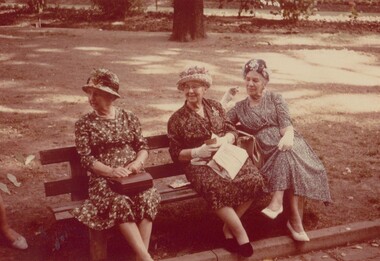
... General Hospital. She embarked with the rank of Sister for India and was appointed to the Victoria Hospital, Bombay. In January, 1917, when she was transferred to England and a Military Hospital at Bagthorpe later to the 1 Australian Auxiliary Hospital, and in January of the following years to 25 (British) GH in France but returned a few weeks later to England and the 1 AAH after suffering a seriously strained left ankle. ...General Hospital. She embarked with the rank of Sister for India and was appointed to the Victoria Hospital, Bombay. In January, 1917, when she was transferred to England and a Military Hospital at Bagthorpe later to the 1 Australian Auxiliary Hospital, and in January of the following years to 25 (British) GH in France but returned a few weeks later to England and the 1 AAH after suffering a seriously strained left ankle. ...These are the 4 surviving daughters of Thomas Henry Deakin (1845-1915), born in Monmouthshire, Wales and his wife Janet (Jessie) Longmore (1851-1939), born in Morayshire, Scotland. The couple also had 2 sons: John Henry (1879-1962) and William Andrew (1883-1939). A fifth daughter Daisy Jessie was born in 1880 and died the same year at the age of 7 months. Elsie Longmore Deakin (1881-1969) was a nurse ans remained single; Minnie Winifred (1886-1966) married Charles Williamson in 1923; Lily Vipond (1890-1943) married David Mair in 1910 and Jessie Alice, known as Alice, married Hector Williamson in 1921. Hector and Charles were brothers. Elsie Longmore Deakin enlisted AANS aged 35 years in 10 May 1915; embarked on the Mooltan on 22 August 1916. Address : 114 Station Street, Fairfield, Next of kin : mother, Mrs Janet Deakin (nee Longmore), 114 Station Street, Fairfield, father, Thomas Henry Deakin Elsie Deakin enlisted at 35 years of age on 10 May, 1915 and served locally before volunteering for overseas duty on 9 August, 1916. Her three years of training were completed at the Melbourne General Hospital. She embarked with the rank of Sister for India and was appointed to the Victoria Hospital, Bombay. In January, 1917, when she was transferred to England and a Military Hospital at Bagthorpe later to the 1 Australian Auxiliary Hospital, and in January of the following years to 25 (British) GH in France but returned a few weeks later to England and the 1 AAH after suffering a seriously strained left ankle. She returned to France post-war and served another four months before being returned to Australia in May, 1919. Her appointment was terminated as medically unfit on 9 June, 1919. Born South Melbourne, she died in Elsternwick on 14 October, 1969, aged 87. (REF: http://www.ozsportshistory.com/wardeaths/women_a_e.html) There is a photo of her in uniform on this site and also on http://ww1nurses.gravesecrets.net/de.html LtoR: Alice, Minnie, Lily, Elsie. This is part of a large donation relating to the Deakin, Mair and Young families. The donor thought this was taken during the 1950s but the Kodak stamp identifies it as later.This is part of a large collection of material related to the Deakin, Mair and Young families with multiple connections to Surrey Hills and Mont Albert.A colour photo with a cream edge of 3 well-dressed women sitting on a public bench in what looks to be a park. All are wearing hats and carrying handbags. Two are wearing gloves. On rear in blue biro - "Aunties / Elsie Minnie & Alice / Mum's RIGHT TO LEFT In black biro) / Beryl / YOUNG / My Mothers Sisters / (Lily Vipond Deakin / MAIR." Some of the handwriting is thought to be that of the donor's mother, Beryl Mair. There may be another hand. It appears that not all the inscriptions were added at the same time. There is also a photographic processing stamp in red: " THIS IS A / KODACHROME PRINT / Made by / KODAK / FEBRUARY 1964 M" elsie longmore deakin, minnie winifred deakin, minnie winifred williamson, lily vipond deakin, lily vipond mair, jessie alice deakin, alice deakin, jessie alice williamson, alice williamson -
 Surrey Hills Historical Society Collection
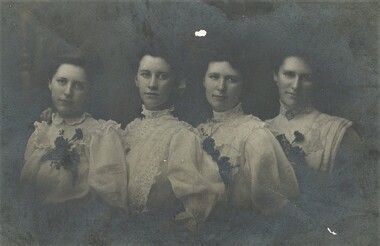
Photograph, The four Deakin sisters as young women, 1905
... General Hospital. She embarked with the rank of Sister for India and was appointed to the Victoria Hospital, Bombay. In January, 1917, when she was transferred to England and a Military Hospital at Bagthorpe later to the 1 Australian Auxiliary Hospital, and in January of the following years to 25 (British) GH in France but returned a few weeks later to England and the 1 AAH after suffering a seriously strained left ankle. ...General Hospital. She embarked with the rank of Sister for India and was appointed to the Victoria Hospital, Bombay. In January, 1917, when she was transferred to England and a Military Hospital at Bagthorpe later to the 1 Australian Auxiliary Hospital, and in January of the following years to 25 (British) GH in France but returned a few weeks later to England and the 1 AAH after suffering a seriously strained left ankle. ...These are the 4 surviving daughters of Thomas Henry Deakin (1845-1915), born in Monmouthshire, Wales and his wife Janet (Jessie) Longmore (1851-1939), born in Morayshire, Scotland. The couple also had 2 sons: John Henry (1879-1962) and William Andrew (1883-1939). A fifth daughter Daisy Jessie was born in 1880 and died the same year at the age of 7 months. Elsie Longmore Deakin (1881-1969) was a nurse ans remained single; Minnie Winifred (1886-1966) married Charles Williamson in 1923; Lily Vipond (1890-1943) married David Mair in 1910 and Jessie Alice, known as Alice, married Hector Williamson in 1921. Hector and Charles were brothers. Elsie Longmore Deakin enlisted AANS aged 35 years in 10 May 1915; embarked on the Mooltan on 22 August 1916. Address : 114 Station Street, Fairfield, Next of kin : mother, Mrs Janet Deakin (nee Longmore), 114 Station Street, Fairfield, father, Thomas Henry Deakin Elsie Deakin enlisted at 35 years of age on 10 May, 1915 and served locally before volunteering for overseas duty on 9 August, 1916. Her three years of training were completed at the Melbourne General Hospital. She embarked with the rank of Sister for India and was appointed to the Victoria Hospital, Bombay. In January, 1917, when she was transferred to England and a Military Hospital at Bagthorpe later to the 1 Australian Auxiliary Hospital, and in January of the following years to 25 (British) GH in France but returned a few weeks later to England and the 1 AAH after suffering a seriously strained left ankle. She returned to France post-war and served another four months before being returned to Australia in May, 1919. Her appointment was terminated as medically unfit on 9 June, 1919. Born South Melbourne, she died in Elsternwick on 14 October, 1969, aged 87. (REF: http://www.ozsportshistory.com/wardeaths/women_a_e.html) There is a photo of her in uniform on this site and also on http://ww1nurses.gravesecrets.net/de.html LtoR: Alice, Minnie, Lily, Elsie. This is part of a large donation relating to the Deakin, Mair and Young families.A black & white photo with a cream edge of 4 well-dressed young women in a head and shoulders formal pose. It is likely a studio photo. All wear white frilly or lacy blouses and 3 are carrying bunches of flowers.1. On rear: Top in blue biro - "Elsie Minnie Lily Alice DEAKIN / Mum's (crossing out) sisters On the basis of inscriptions in family autograph books, this writing belongs to Lily's daughter, Beryl Mair. 2. The rear has 4 remnant glued labels roughly torn from larger labels - the type once common for labelling jars and bottles. Partially beneath these is writing in another hand in black ink: " ..th love and be.. / ..shes ---------your /(crossing out) then name removed (superficial paper loss. 3, "YOUNG" in blue biro in lower LH corner. This may be the donor's handwriting. It may have been added in the course of sorting photos into Young antecedent photos; there are no members of the Young family in the photo itself. elsie longmore deakin, minnie winifred deakin, minnie winifred williamson, lily vipond deakin, lily vipond mair, jessie alice deakin, alice deakin, jessie alice williamson, alice williamson -
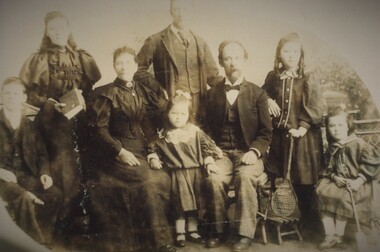 Surrey Hills Historical Society Collection
Photograph, Thomas Henry and Janet Longmore Deakin and family, 1895, Original: 1895
... General Hospital. She embarked with the rank of Sister for India and was appointed to the Victoria Hospital, Bombay. In January, 1917, when she was transferred to England and a Military Hospital at Bagthorpe later to the 1 Australian Auxiliary Hospital, and in January of the following years to 25 (British) GH in France but returned a few weeks later to England and the 1 AAH after suffering a seriously strained left ankle. ...General Hospital. She embarked with the rank of Sister for India and was appointed to the Victoria Hospital, Bombay. In January, 1917, when she was transferred to England and a Military Hospital at Bagthorpe later to the 1 Australian Auxiliary Hospital, and in January of the following years to 25 (British) GH in France but returned a few weeks later to England and the 1 AAH after suffering a seriously strained left ankle. ...Thomas Henry Deakin (1845-1915), born in Monmouthshire, Wales and his wife Janet (Jessie) Longmore (1851-1939), born in Morayshire, Scotland had 2 sons: John Henry (1879-1962) and William Andrew (1883-1939) and 4 surviving daughters. A fifth daughter Daisy Jessie was born in 1880 and died the same year at the age of 7 months. Elsie Longmore Deakin (1881-1969) was a nurse and remained single; Minnie Winifred (1886-1966) married Charles Williamson in 1923; Lily Vipond (1890-1943) married David Mair in 1910 and Jessie Alice, known as Alice, married Hector Williamson in 1921. Hector and Charles were brothers. LtoR: William Andrew (seated), Elsie Longmore (standing), Janet (Jessie) Mair nee Longmore (seated), Jessie Alice (standing beside her mother), John Henry (standing), Thomas Henry (seated), Minnie Winifred (standing), Lily Vipond (seated). Elsie Longmore Deakin enlisted AANS aged 35 years in 10 May 1915; embarked on the Mooltan on 22 August 1916. Address : 114 Station Street, Fairfield, Next of kin : mother, Mrs Janet Deakin (nee Longmore), 114 Station Street, Fairfield, father, Thomas Henry Deakin Elsie Deakin enlisted at 35 years of age on 10 May, 1915 and served locally before volunteering for overseas duty on 9 August, 1916. Her three years of training were completed at the Melbourne General Hospital. She embarked with the rank of Sister for India and was appointed to the Victoria Hospital, Bombay. In January, 1917, when she was transferred to England and a Military Hospital at Bagthorpe later to the 1 Australian Auxiliary Hospital, and in January of the following years to 25 (British) GH in France but returned a few weeks later to England and the 1 AAH after suffering a seriously strained left ankle. She returned to France post-war and served another four months before being returned to Australia in May, 1919. Her appointment was terminated as medically unfit on 9 June, 1919. Born South Melbourne, she died in Elsternwick on 14 October, 1969, aged 87. (REF: http://www.ozsportshistory.com/wardeaths/women_a_e.html) There is a photo of her in uniform on this site and also on http://ww1nurses.gravesecrets.net/de.html This is part of a large donation relating to the Deakin, Mair and Young families.The connection with Surrey Hills area is through Lily Vipond Deakin who married David Miller Mair and came to live in Mont Albert.A sepia copy photo of a family in a formal pose taken against a studio backdrop. The group comprises a mother and father with 2 boys and 4 girls. The 3 older girls are carrying - REAR: In blue biro - "Top HENRY ...............GRANDFATHER.....ALF / ANDREW .......Thomas Henry (crossed out) ..........MOTHER - JANET / DEAKIN" Middle: "ELSie minnie Lily" Below: "ALICE FRONT" Bottom: "LONGMORE"xelsie longmore deakin, minnie winifred deakin, minnie winifred williamson, lily vipond deakin, lily vipond mair, jessie alice deakin, alice deakin, jessie alice williamson, alice williamson, william andrew deakin, janet (jessie) longmore, janet (jessie) deakin, thomas henry deakin, john henry deakin
