
Showing 7 items matching "british vocalion"
-
 Flagstaff Hill Maritime Museum and Village
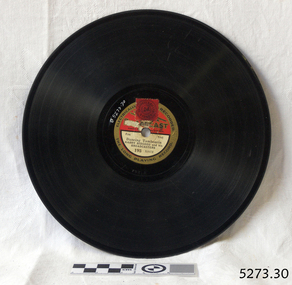
Audio - Gramophone Record, Vocalion Gramophone Co. Ltd (Broadcast records), Dancing Tamborine, late 1920s to early 1930s
... ...British Vocalion...Title: Dancing Tamborine Artist: Harry Bidgood and his Broadcasters Publisher: Broadcast, British Vocalion Number: A193 Size: 8 inch Electrically recorded, promoted by Broadcast as The Long Playing Record....Title: Dancing Tamborine Artist: Harry Bidgood and his Broadcasters Publisher: Broadcast, British Vocalion Number: A193 Size: 8 inch Electrically recorded, promoted by Broadcast as The Long Playing Record. ...Thomas Edison (1847–1931), an American, invented the phonograph in 1877, making it possible to record sound waves vertically and reproduce them on a wax cylinder so they could be heard again. Later, the German American, Emile Berliner (1851-1929), improved on Edison’s principles, greatly increasing the quality of the reproduced sounds with his invention of the gramophone in 1887, which recorded the sound waves laterally onto a flat shellac disc, or ‘record’. Records could be mass-produced in a factory where audio recordings were converted to a physical copy of that recording on a plate-sized disc. A gramophone machine reproduced the sound by spinning the record on a turntable at a specified number of rotations per minute (RPM) and using a stylus or needle to transfer the vibration via a membrane to a speaker, which amplified the sound. Berliner helped set up affiliated businesses overseas. One of his representatives was William Barry Owen (1860–1914), who, on 23 February 1889, partnered with Edmund Trevor Lloyd Williams (1859–1946) in England to register The Gramophone Company. His Master’s Voice (HMV) soon became the company’s major recording label, popular worldwide. The business based the label's logo of a dog looking into a gramophone horn for ‘his master’s voice’ was based on a painting by English artist Francis Barraud, which featured a terrier called Nipper beside a gramophone. Early gramophone records were mostly made from a material referred to as shellac, a natural ingredient combined with slate powder, and a filler of manilla copal, wood resin, carnauba wax, and carbon black. Although Bakelite seemed a useful, synthetic product, it was unsuccessful as a product for records. Around the time of World War II, lightweight, flexible synthetic vinyl records began replacing shellac records. Common diameters of records: 7 inch, 10 inch, 12 inch and 16 inch Revolutions Per Minute include: 33 1/3, 45, 78 Minutes per side of record: 3, 5.5, 7, 8, 9, 12, 15 and 22 Labels, in minutes per side: Single Play 3-5 min, Extended Play (EP) 7-12 min, Long Play (LP) 12-22 min This gramophone represents a step in the evolution of recording sound. In the 19th century, the human voice was first recorded on wax cylinders and replayed. It was the beginning of a new era in sound. Then, in the 1880s, voice could be recorded onto flat discs like this record, reliably reproduced and replayed many times, even on portable devices. Later, in the mid-20th century the following generation of electronic audio recording began, and later that century, digital recording gave even better reproduction. The record represents a popular means of entertainment for personal and social activities, as well as in some businesses. Shellac gramophone record with a red, cream and gold label. Title: Dancing Tamborine Artist: Harry Bidgood and his Broadcasters Publisher: Broadcast, British Vocalion Number: A193 Size: 8 inch Electrically recorded, promoted by Broadcast as The Long Playing Record.flagstaff hill, warrnambool, maritime village, maritime museum, flagstaff hill maritime museum and village, shipwreck coast, great ocean road, gramophone, phonograph, sound waves, record, reproduction, audio record, music, sound, thomas edison, emile berliner, 1887, shellac, rpm, william barry owen, edmund trevor lloyd williams, the gramophone company, his master’s voice, hmv, francis barraud, nipper, electrically recorded, the long playing record, broadcast, british vocalion, middlesex, a193, dancing tamborine, harry bidgood and his broadcasters, 8 inch -
 Flagstaff Hill Maritime Museum and Village
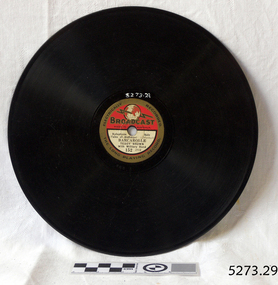
Audio - Gramophone Record, Vocalion Gramophone Co. Ltd (Broadcast records), Barcarole, late 1920s to early 1930s
... ...British Vocalion...Title: Barcarole Artist: Teddy Brown with his Military Band, Publisher: Broadcast, British Vocalion, Middlesex Number: A152 Size: 9 inch, Electrically recorded, promoted as Broadcast, The Long Playing Record....Title: Barcarole Artist: Teddy Brown with his Military Band, Publisher: Broadcast, British Vocalion, Middlesex Number: A152 Size: 9 inch, Electrically recorded, promoted as Broadcast, The Long Playing Record. ...Thomas Edison (1847–1931), an American, invented the phonograph in 1877, making it possible to record sound waves vertically and reproduce them on a wax cylinder so they could be heard again. Later, the German American, Emile Berliner (1851-1929), improved on Edison’s principles, greatly increasing the quality of the reproduced sounds with his invention of the gramophone in 1887, which recorded the sound waves laterally onto a flat shellac disc, or ‘record’. Records could be mass-produced in a factory where audio recordings were converted to a physical copy of that recording on a plate-sized disc. A gramophone machine reproduced the sound by spinning the record on a turntable at a specified number of rotations per minute (RPM) and using a stylus or needle to transfer the vibration via a membrane to a speaker, which amplified the sound. Berliner helped set up affiliated businesses overseas. One of his representatives was William Barry Owen (1860–1914), who, on 23 February 1889, partnered with Edmund Trevor Lloyd Williams (1859–1946) in England to register The Gramophone Company. His Master’s Voice (HMV) soon became the company’s major recording label, popular worldwide. The business based the label's logo of a dog looking into a gramophone horn for ‘his master’s voice’ was based on a painting by English artist Francis Barraud, which featured a terrier called Nipper beside a gramophone. Early gramophone records were mostly made from a material referred to as shellac, a natural ingredient combined with slate powder, and a filler of manilla copal, wood resin, carnauba wax, and carbon black. Although Bakelite seemed a useful, synthetic product, it was unsuccessful as a product for records. Around the time of World War II, lightweight, flexible synthetic vinyl records began replacing shellac records. Common diameters of records: 7 inch, 10 inch, 12 inch and 16 inch Revolutions Per Minute include: 33 1/3, 45, 78 Minutes per side of record: 3, 5.5, 7, 8, 9, 12, 15 and 22 Labels, in minutes per side: Single Play 3-5 min, Extended Play (EP) 7-12 min, Long Play (LP) 12-22 min This gramophone represents a step in the evolution of recording sound. In the 19th century, the human voice was first recorded on wax cylinders and replayed. It was the beginning of a new era in sound. Then, in the 1880s, voice could be recorded onto flat discs like this record, reliably reproduced and replayed many times, even on portable devices. Later, in the mid-20th century the following generation of electronic audio recording began, and later that century, digital recording gave even better reproduction. The record represents a popular means of entertainment for personal and social activities, as well as in some businesses. Shellac gramophone record with a red, cream and gold label. Title: Barcarole Artist: Teddy Brown with his Military Band, Publisher: Broadcast, British Vocalion, Middlesex Number: A152 Size: 9 inch, Electrically recorded, promoted as Broadcast, The Long Playing Record.flagstaff hill, warrnambool, maritime village, maritime museum, flagstaff hill maritime museum and village, shipwreck coast, great ocean road, gramophone, phonograph, sound waves, record, reproduction, audio record, music, sound, thomas edison, emile berliner, 1887, shellac, rpm, william barry owen, edmund trevor lloyd williams, the gramophone company, his master’s voice, hmv, francis barraud, nipper, electrically recorded, the long playing record, broadcast, british vocalion, middlesex, a152, barcarole, teddy brown with his military band, 9 inch -
 Flagstaff Hill Maritime Museum and Village
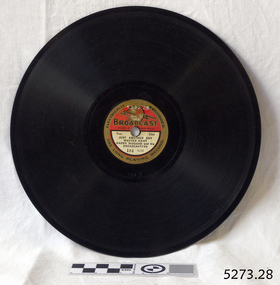
Audio - Gramophone Record, Vocalion Gramophone Co. Ltd (Broadcast records), Just Another Day Wasted Away, late 1920s to early 1930s
... ...British Vocalion...Title: Just Another Day Wasted Away Artist: Harry Bidgood and his Broadcasters Publisher: Broadcast, British Vocalion Number: A184 Size: 8 inch This small record was electronically recorded. ...Title: Just Another Day Wasted Away Artist: Harry Bidgood and his Broadcasters Publisher: Broadcast, British Vocalion Number: A184 Size: 8 inch This small record was electronically recorded. ...Thomas Edison (1847–1931), an American, invented the phonograph in 1877, making it possible to record sound waves vertically and reproduce them on a wax cylinder so they could be heard again. Later, the German American, Emile Berliner (1851-1929), improved on Edison’s principles, greatly increasing the quality of the reproduced sounds with his invention of the gramophone in 1887, which recorded the sound waves laterally onto a flat shellac disc, or ‘record’. Records could be mass-produced in a factory where audio recordings were converted to a physical copy of that recording on a plate-sized disc. A gramophone machine reproduced the sound by spinning the record on a turntable at a specified number of rotations per minute (RPM) and using a stylus or needle to transfer the vibration via a membrane to a speaker, which amplified the sound. Berliner helped set up affiliated businesses overseas. One of his representatives was William Barry Owen (1860–1914), who, on 23 February 1889, partnered with Edmund Trevor Lloyd Williams (1859–1946) in England to register The Gramophone Company. His Master’s Voice (HMV) soon became the company’s major recording label, popular worldwide. The business based the label's logo of a dog looking into a gramophone horn for ‘his master’s voice’ was based on a painting by English artist Francis Barraud, which featured a terrier called Nipper beside a gramophone. Early gramophone records were mostly made from a material referred to as shellac, a natural ingredient combined with slate powder, and a filler of manilla copal, wood resin, carnauba wax, and carbon black. Although Bakelite seemed a useful, synthetic product, it was unsuccessful as a product for records. Around the time of World War II, lightweight, flexible synthetic vinyl records began replacing shellac records. Common diameters of records: 7 inch, 10 inch, 12 inch and 16 inch Revolutions Per Minute include: 33 1/3, 45, 78 Minutes per side of record: 3, 5.5, 7, 8, 9, 12, 15 and 22 Labels, in minutes per side: Single Play 3-5 min, Extended Play (EP) 7-12 min, Long Play (LP) 12-22 min This gramophone represents a step in the evolution of recording sound. In the 19th century, the human voice was first recorded on wax cylinders and replayed. It was the beginning of a new era in sound. Then, in the 1880s, voice could be recorded onto flat discs like this record, reliably reproduced and replayed many times, even on portable devices. Later, in the mid-20th century the following generation of electronic audio recording began, and later that century, digital recording gave even better reproduction. The record represents a popular means of entertainment for personal and social activities, as well as in some businesses. Shellac gramophone record with a red, cream and gold label. Title: Just Another Day Wasted Away Artist: Harry Bidgood and his Broadcasters Publisher: Broadcast, British Vocalion Number: A184 Size: 8 inch This small record was electronically recorded. It was promoted as Broadcast, The Long Playing Record.flagstaff hill, warrnambool, maritime village, maritime museum, flagstaff hill maritime museum and village, shipwreck coast, great ocean road, gramophone, phonograph, sound waves, record, reproduction, audio record, music, sound, thomas edison, emile berliner, 1887, shellac, rpm, william barry owen, edmund trevor lloyd williams, the gramophone company, his master’s voice, hmv, francis barraud, nipper, electrically recorded, the long playing record, broadcast, british vocalion, middlesex, a184, just another day wasted away, harry bidgood and his broadcasters, 8 inch -
 Bendigo Historical Society Inc.
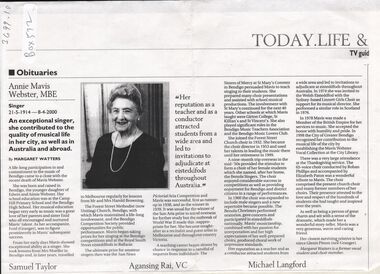
Document - BARBARA MAMOUNEY COLLECTION: IMAGE AND OBITUARY OF ANNIE MAVIS WEBSTER MBE
... In 1978 Mavis was made a Member of the British Empire for her services to music.City of Greater Bendigo acknowledged Mavis contribution and skills by establishing the Mavis Webster Vocal Collection at the City library....In 1978 Mavis was made a Member of the British Empire for her services to music.City of Greater Bendigo acknowledged Mavis contribution and skills by establishing the Mavis Webster Vocal Collection at the City library. ...An exceptional singer who contributed greatly to local Bendigo and Australia as well as abroad Bendigo born and raised by Edwin and Annie Webster, Education was at Camp Hill. A life long participation in and commitment to local music and Competition Society provided opportunities for performance. The ultimate prize for amateur singers at the time was the Sun News Pictorial Aria Competition, which Mavis attained as runner up in 1938 and as winner in 1939. Outbreak of WWII curtailed early opportunities for overseas travel but there was much call for her as recitalist, artist and teacher such as at The Sisters of Mercy at St Mary's Convent, Bendigo where she taught singing. Mavis gained impressive reputation and experience in numerous roles including as chorister (and founder of the all female choir and the Benola singers which she also named, after her home), and later (1960) included male voices; she was also conductor; musical director; and adjudicator at Eisteddfords. She laso taught at Girton, St Killian's. During the 1950s Mavis went on a very successful 9 month overseas trip on which she was inspired in many respects including the formation of the choirs. In 1978 Mavis was made a Member of the British Empire for her services to music.City of Greater Bendigo acknowledged Mavis contribution and skills by establishing the Mavis Webster Vocal Collection at the City library.A photocopy of newspaper publication of obituary for Annie Mavis Webster, MBE 21/5/1914 - 8/4/2000 bendigo, history, obituary and biography of annie mavis webster mbe, forest st methodist (now uniting) bendigo, girton, st killian's, herald sun aria, the eisteddford, sisters of mercy at st mary's convent, mavis webster vocal collection, city of greater bendigo, margaret watters. -
 Bendigo Historical Society Inc.
Document - THE MAYORAL AUXILIARY, 25 Sept. 1947
... Britain Appeal. 25 Sept.... 1947. Piano & Violin: Misses Leggo & McNair. Vocal Solo: Mr Arthur Nicholls. ...Britain Appeal. 25 Sept., 1947. Part 1 - Musical Programme. 1.Piano & Violin: Misses Leggo & McNair. Vocal...Britain Appeal. 25 Sept., 1947. Part 1 - Musical Programme. 1.Piano & Violin: Misses Leggo & McNair. Vocal ...The Mayoral Auxiliary. Entertainment arranged by The Mayoral Auxiliary in aid of The Food For Britain Appeal. 25 Sept., 1947. Part 1 - Musical Programme. 1.Piano & Violin: Misses Leggo & McNair. Vocal Solo: Mr Arthur Nicholls. Trio: Mesdames Ennor & Lober & Miss Pianto. Dramatic Scene, Song & Dance: Miss Janice Morgan. Vocal Solo: Mr Beckwith. Specialty Act: Miss Gladys Brown. Vocal Solo: Mrs Ennor. Part 2 - Dramatic Entertainment. Dramatic Personage: Dreamer: Mr Jack Hocking. Grandparents: Mr Mac Walker & Mrs Oliver. Suitors: Messers Beckwith & Harvey. Daughter: Miss Letty White. Dancer: Miss Eileen Clarke. Sports Girl: Miss Mary Stanistreet. Marie & Mary: Misses A Taylor. The Cook & the Lady: Misses Dorothy Farmer & Helen Sargeant. Widow: Miss Beverly Dyer. Sister: Miss Judy Edwards. Bride: Miss Phyllis Farmer. Nanny & the Children: Mrs T O Hunter, Misses Janice Morgan & Gladys Brown. Nurses: Misses D Farmer & Helen Sargeant. Orchestra: Misses Leggo (Piano); McNair (Violin) & Kerr (Viola). Costumieres: Mr & Mrs L V Lansell. Cake Stall: Mesdames Amer, Bryenton & Poulston. Sweets: Mesdames Chellew & Guthery. Sellers: Girls School Students. Doorkeepers: Mesdames Anderson and Streader. Sweets supplied by Girls School, High School, Mr Wilkinson, Mrs Body, Misses Burgess & Weller. Tickets donated by Mr Albert Matthews. Stage Manager: Mrs T O Hunter. Compere: Mess L MacGillivray. Assistant: Mr L M Green. 3 copies of program 4268 a,b,c. 4 pages.entertainment, theatre, the mayoral auxiliary, the mayoral auxiliary in aid the food for britain appeal. 25 sept., 1947. piano & violin: misses leggo & mcnair. vocal solo: mr arthur nicholls. trio: mesdames ennor & lober & miss pianto. dramatic scene, song & dance: miss janice morgan. vocal solo: mr beckwith. specialty act: miss gladys brown. vocal solo: mrs ennor. dramatic personage: dreamer: mr jack hocking. grandparents: mr mac walker & mrs oliver. suitors: messers beckwith & harvey. daughter: miss letty white. dancer: miss eileen clarke. sports girl: miss mary stanistreet. marie & mary: misses a taylor. the cook & the lady: misses dorothy farmer & helen sargeant. widow: miss beverly dyer. sister: miss judy edwards. bride: miss phyllis farmer. nanny & the children: mrs t o hunter, misses janice morgan & gladys brown. nurses: misses d farmer & helen sargeant. orchestra: misses leggo (piano); mcnair (violin) & kerr (viola). costumieres: mr & mrs l v lansell. cake stall: mesdames amer, bryenton & poulston. sweets: mesdames chellew & guthery. sellers: girls school students. doorkeepers: mesdames anderson and streader. sweets supplied by girls school, high school, mr wilkinson, mrs body, misses burgess & weller. tickets donated by mr albert matthews. stage manager: mrs t o hunter. compere: mess l macgillivray. assistant: mr l m green. -
 Ballarat and District Irish Association
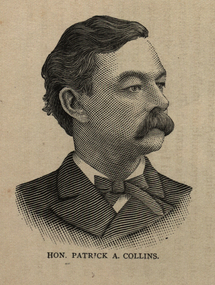
Image, Patrick A. Collins, c1864
... British rule in Ireland). This work led him into politics. He was quickly elected a state representative and then a state senator. As a legislator, Collins worked to ease restrictions on the practice of religion for Catholics in state institutions and to earn public money for Catholic charitable institutions. With the rapidly increasing number of Irish voters in Boston in the 1870s, their vocal...British rule in Ireland). This work led him into politics. He was quickly elected a state representative and then a state senator. As a legislator, Collins worked to ease restrictions on the practice of religion for Catholics in state institutions and to earn public money for Catholic charitable institutions. With the rapidly increasing number of Irish voters in Boston in the 1870s, their vocal ...As a young man, Collins joined the Fenian movement (founded to overthrow British rule in Ireland). This work led him into politics. He was quickly elected a state representative and then a state senator. As a legislator, Collins worked to ease restrictions on the practice of religion for Catholics in state institutions and to earn public money for Catholic charitable institutions. With the rapidly increasing number of Irish voters in Boston in the 1870s, their vocal assertion of their rights, and strong political organization, the Irish were beginning to be recognized as a power to be reckoned with. Collins was central to these developments.(http://www.questia.com/library/journal/1P3-2036414231/young-patrick-a-collins-and-boston-politics-after, accessed 21 January 2014)Image of Patrick A. Collins, United States Congressmanballarat irish, patick collins, collins, -
 Brighton Historical Society
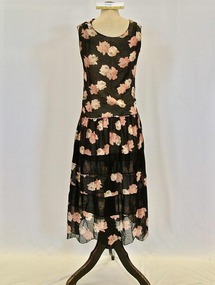
Dress, late 1920s
... vocal advocate for women and families and supported building a stronger relationship between Australia and Asia. In 1965 she became the first woman to chair a Senate committee. Marie retired from politics in 1968, after Robert was badly injured in a car accident. He died shortly after and she re-dedicated herself to community service, raising funds for UNICEF and serving on the Victorian Consultative Committee on Social Development and the Australian Advisory Council of Elders. In 1959 she was appointed an Officer of the British...vocal advocate for women and families and supported building a stronger relationship between Australia and Asia. In 1965 she became the first woman to chair a Senate committee. Marie retired from politics in 1968, after Robert was badly injured in a car accident. He died shortly after and she re-dedicated herself to community service, raising funds for UNICEF and serving on the Victorian Consultative Committee on Social Development and the Australian Advisory Council of Elders. In 1959 she was appointed an Officer of the British ...Worn by Dame Marie Breen DBE OBE, Federal Senator for Victoria and Brighton resident. A passionate member (and founder) of many community organisations and charities, Marie Freda Breen (nee Chamberlin, 1902-1993) had her first experience of public life when her husband Robert became Mayor of Brighton in 1940. She became involved in the fledgeling Liberal Party, and Robert encouraged her to run for office. Marie because Victoria's first female Federal Senator in 1962. In Parliament, she was a vocal advocate for women and families and supported building a stronger relationship between Australia and Asia. In 1965 she became the first woman to chair a Senate committee. Marie retired from politics in 1968, after Robert was badly injured in a car accident. He died shortly after and she re-dedicated herself to community service, raising funds for UNICEF and serving on the Victorian Consultative Committee on Social Development and the Australian Advisory Council of Elders. In 1959 she was appointed an Officer of the British Empire for her work in the role of State President of the National Council of Women (Victoria) and in 1979 she was appointed Dame Commander of the Order of the British Empire. Marie and Robert had three daughters, one of whom, Jeannette Patrick, was the Liberal Member for Brighton (1976-1985) and Parliamentary Secretary of the Liberal Party, (1979-82).Sleeveless black cotton voile dress printed with large cream and apricot coloured roses. Dropped waist; bias-cut triangular draping applied to back neck; two horizontal bands of black voile inserted into skirt.dame marie breen, 1920s, liberal party of australia, australian senate, politics, robert breen
