
Showing 12 items matching "broadmeadows (vic.) -- history."
-
![Broadmeadows: a forgotten history / [by] Andrew Lemon](/media/collectors/550653872162f11fb04854aa/items/5ece0e2bf36c2704c4f1395c/item-media/5ece0ec7f36c2704c4f147b0/item-fit-380x285.jpg?cb=6) Kew Historical Society Inc
Kew Historical Society IncBook, Andrew Lemon, Broadmeadows: a forgotten history, 1982
... broadmeadows (vic.) -- history....History of Broadmeadows, Victoria broadmeadows (vic.) -- history. broadmeadows (vic.). council West Melbourne : City of Broadmeadows in conjunction with Hargreen, 1982 xiv, 257 p. : ill., facsims., maps, ports. ; 25 cm. ...West Melbourne : City of Broadmeadows in conjunction with Hargreen, 1982 xiv, 257 p. : ill., facsims., maps, ports. ; 25 cm. non-fictionbroadmeadows (vic.) -- history., broadmeadows (vic.). council -
 Broadmeadows Historical Society & Museum
Document - Letter, Edna M. Tripovich, Letter from Edna M. Tripovich to Kath Forsyth congratulating her on engagement, 20 May 1964
... Broadmeadows (Vic.) — History...Its provenance within a broader archival collection enhances its research and interpretive value. Broadmeadows (Vic.) — History Local government — Victoria — Broadmeadows Mayors — Social life and customs Personal correspondence — 20th century Engagements (marriage announcements) Women’s social networks (Front page, handwritten in ink) “20 5 64 /Dear Kath, /It was lovely to see you again at/Brunswick last night. ...This letter documents a personal social exchange connected with civic leadership in the City of Broadmeadows in 1964. It reflects interpersonal networks, political office holders, and community relationships, specifically referencing the engagement of Kath Forsyth to Cr. Evans, Mayor of Broadmeadows. The document illustrates mid 20th century communication practices, gendered social conventions, and civic identity in a rapidly developing suburban municipality.This handwritten letter is historically significant as evidence of social and civic networks in Broadmeadows during the mid 20th century, particularly in relation to the office of the Mayor. It demonstrates the intersection of personal relationships and public roles and contributes to understanding local governance culture and community life. Its provenance within a broader archival collection enhances its research and interpretive value.Single handwritten letter in ink on paper. The letter comprises one page and is written in cursive handwriting. Paper shows typical ageing consistent with mid 20th century correspondence. No envelope present.(Front page, handwritten in ink) “20 5 64 /Dear Kath, /It was lovely to see you again at/Brunswick last night. You certainly/gave me a pleasant surprise when you/told me the news that you will be getting married to Cr. Evans. It has/been a pleasure having the opportunity/to get to know you during your term/as Mayoress, and I still hope that it/continues in the future. Jack & I join/in wishing you both a very happy future together, and the best of luck to you both./Yours sincerely /Edna M. Tripovich / 1 Halifax Court / Ashburton, SE11” On the outside: Yellow catalogue label: “WI 4186”broadmeadows (vic.) — history, local government — victoria — broadmeadows, mayors — social life and customs, personal correspondence — 20th century, engagements (marriage announcements), women’s social networks -
Broadmeadows Historical Society & Museum
Book - Published book, Andrew Lemon, Broadmeadows: A Forgotten History, 1999
... Broadmeadows (VIC) - History...Broadmeadows (VIC) - History Broadmeadows (VIC) history Broadmeadows Victoria History City of Broadmeadows Copyright page has: Label - 30003 015660770 Pencil note: BRN 154 508 : REF 994.51 LEM 257pp, Hardcover. ...257pp, Hardcover. Slip jacket in protective sleeve Ex-Moreland City Libraries book. Associated library stickers.broadmeadows, victoria, history, city of broadmeadows -
Broadmeadows Historical Society & Museum
Document - Municipal Overview, Broadmeadows Municipal and Industrial Profile, mid-20th century
... Broadmeadows (Vic.)...Municipal history...The document is significant as a consolidated historical reference that documents the expansion of Broadmeadows, particularly its industrial base, contributing to an understanding of local economic and social development. Broadmeadows (Vic.) Municipal history Industrial development Urban growth Local government City of Broadmeadows 1880-1981 Printed text throughout document. ...This document reflects the historical growth of Broadmeadows from its proclamation in the mid 19th century through to significant industrial expansion in the mid 20th century, documenting key employers and urban development trends.The document is significant as a consolidated historical reference that documents the expansion of Broadmeadows, particularly its industrial base, contributing to an understanding of local economic and social development.Printed paper document, single sheet.Printed text throughout document. Handwritten inscriptions visible.broadmeadows (vic.), municipal history, industrial development, urban growth, local government, city of broadmeadows, 1880-1981 -
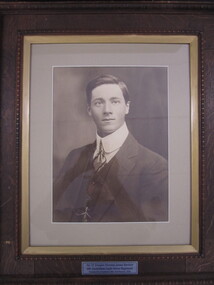 4th/19th Prince of Wales's Light Horse Regiment Unit History Room
Photograph - Framed Photograph, Trooper Norman Bartlett 4th Australian Light Horse, abt 1915
... Broadmeadows Vic and was posted to A Squadron 4th Australian Light Horse Regiment. He embarked for Egypt on HMAT Wiltshire on 19 Oct 1914 then going ashore on Gallipoli on 21 May 1915. At 8:00 pm Trooper Bartlett was struck in the stomach by either shrapnel or gunfire. His wounds were dressed and he was evacuated. He died of wounds and was buried at sea on 24 May 1915. The 4th Australian Light Horse Regiment is an ancestor unit of the modern day 4th/19th Prince of Wales's Light Horse Regiment. The Unit History ...Tpr Bartlett was the first casualty of the 4th Light Horse Regiment at Gallipoli. Tpr Bartlett enlisted on 18 August 1914 at Broadmeadows Vic and was posted to A Squadron 4th Australian Light Horse Regiment. He embarked for Egypt on HMAT Wiltshire on 19 Oct 1914 then going ashore on Gallipoli on 21 May 1915. At 8:00 pm Trooper Bartlett was struck in the stomach by either shrapnel or gunfire. His wounds were dressed and he was evacuated. He died of wounds and was buried at sea on 24 May 1915. The 4th Australian Light Horse Regiment is an ancestor unit of the modern day 4th/19th Prince of Wales's Light Horse Regiment. The Unit History Room is the custodian of its history. This memento of the first casualty of the 4th Light Horse Regiment at Gallipoli is both significant and poignantFramed portrait photo of No 72 Tpr Norman James Bartlett, 4th Australian Light Horse Regiment. In glass fronted wooden frame No 72 Trooper Norman James Bartlett, 4th Australian Light Horse Regiment Donated by Frankston RSL Sub-Branch 2016framed portrait photo of no 72 tpr norman james bartlett, 4th australian light horse regiment. in glass fronted wooden frame -
 National Wool Museum
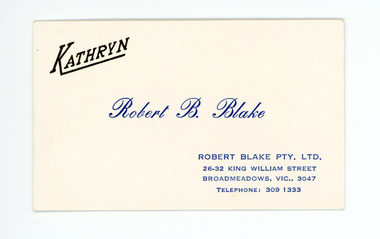
Card - Business Card, Kathryn Knitwear, c.1960-1980
... Business Business history Manufacturing Knitting Machine Fashion Textile Production Business Archives Manufacturing Documents Children's Knitwear Children's clothing [obverse] KATHRYN Robert B. Blake ROBERT BLAKE PTY. LTD. 26-32 KING WILLIAM STREET BROADMEADOWS, VIC ...Kathryn Knitwear, founded by Robert Blake, manufactured high quality children’s knitwear in Melbourne from the 1940s – 1980s. Robert Blake began manufacturing children’s knitwear in his bedroom in Strathmore using a hand powered machine in the late 1940s. The operation moved to Ascot Vale and Essendon, before eventually establishing a factory in Moonee Ponds in the early 1950s. The business continued to expand, necessitating a move to a new factory in Broadmeadows. By 1962, the Broadmeadows factory was producing an average of 20,000 garments per month, which increased to 24,000 by 1964. Robert Blake’s Son, Brendan recalls that “The Kathryn brand was famous around Australia, anywhere children needed to keep warm and dress smartly. It also won a number of wool fashion awards”, including the 1969 Wool Awards, which was held by the Australian Wool Bureau and published in Women’s Weekly. The Kathryn range was designed for durability, comfort and care, without sacrificing style. They used patterning techniques that increase stretchiness, comfort and fit, as well as integrating decorative elements into the fabric to prevent them from being bulky, uncomfortable or tight. Making longevity of style a priority, Brendan Blake remembers that “there was one particular garment that was in the range for at least thirty years”. He also recalls “In the past, when women have found out that I was associated with Kathryn Knitwear, they would often relate to me the story of a garment they had purchased or received as a gift and, when their child had grown out of it, they would hand it on to another child. Several ladies have told me of purchasing garments for their daughters’ glory box, or saving a particular garment after their daughter had grown out of it. Brendan Blake: “At the peak of their operation they employed approximately two hundred people, mainly women and girls. A family would often seek to send their daughter to work in this company because they knew they would be looked after and safe. One lady wrote to me telling me that working at the Moonee Ponds Factory prior to getting married was the happiest time of her life.” In 1963, workers at the Kathryn factory earned £13 per week, which was 8 shillings and 8 pence higher than the minimum weekly wage for female workers in the textile manufacturing industry (£12 11s 4d). By 1970, the Kathryn Knitwear brand expanded from children’s knitwear into womenswear under the brand name ‘Lady Kathryn’, and for boys and men under ‘Robert Blake’. Continuing to diversify their distribution, they also began exporting ‘Kathryn’ garments to New Zealand, the Pacific Islands, and Japan. ‘Kathryn Knitwear’ was well-known for their early adoption of modern materials and techniques that had broad appeal to their customer base. This is shown in their early use of the acrylic fibre ‘Orlon’ in the 50s and 60s and ‘Superwash’ wool in the 1970s. Many of Kathryn Knitwear’s styles, particularly those that were long running staples of the brand, were available in both wool and Orlon to suit the consumer’s preference. Far from the humble origins of one man in his bedroom with a hand-cranked machine; at its closure in 1980, the Broadmeadows factory of ‘Kathryn’ housed more than 100 machines, including 53 sewing machines and 45 knitting machines. Robert Blake was “a passionate advocate for wool and Australian Made” throughout his whole life. A strong thread that ties through the lifespan of Robert Blake and Kathryn Knitwear is a balance between adopting new innovations without sacrificing the core values of durability, comfort, care and style that had made the brand so well known. Their legacy forms an integral part of both Australian social and manufacturing history.Business card for Robert B. Blake on cream cardstock. Name and contact information is printed in blue ink, and the Kathryn knitwear logo is stamped in golden metallic foil[obverse] KATHRYN Robert B. Blake ROBERT BLAKE PTY. LTD. 26-32 KING WILLIAM STREET BROADMEADOWS, VIC., 3047 TELEPHONE: 309 1333business, business history, manufacturing, knitting machine, fashion textile production, business archives, manufacturing documents, children's knitwear, children's clothing -
 National Wool Museum
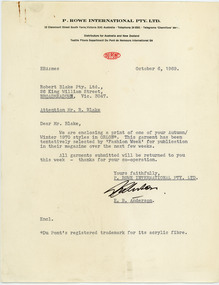
Letter, P Rowe International, 6/10/1969
... history Manufacturing Knitting Machine Fashion Textile Production Business Archives Manufacturing Documents [obverse] P. ROWE INTERNATIONAL PTY. LTD. 12 Claremont Street South Yarra, Victoria 3141 Australia – Telephone 24 6561 - Telegrams ‘Chemfibre’ Me[unintelligible] Distributors for Australia and New Zealand Textile Fibers department Du Pont de Nemours International SA EBA: mes October 6, 1969. Robert Blake Pty. Ltd., 26 King William Street, BROADMEADOWS, Vic ...Kathryn Knitwear, founded by Robert Blake, manufactured high quality children’s knitwear in Melbourne from the 1940s – 1980s. Robert Blake began manufacturing children’s knitwear in his bedroom in Strathmore using a hand powered machine in the late 1940s. The operation moved to Ascot Vale and Essendon, before eventually establishing a factory in Moonee Ponds in the early 1950s. The business continued to expand, necessitating a move to a new factory in Broadmeadows. By 1962, the Broadmeadows factory was producing an average of 20,000 garments per month, which increased to 24,000 by 1964. Robert Blake’s Son, Brendan recalls that “The Kathryn brand was famous around Australia, anywhere children needed to keep warm and dress smartly. It also won a number of wool fashion awards”, including the 1969 Wool Awards, which was held by the Australian Wool Bureau and published in Women’s Weekly. The Kathryn range was designed for durability, comfort and care, without sacrificing style. They used patterning techniques that increase stretchiness, comfort and fit, as well as integrating decorative elements into the fabric to prevent them from being bulky, uncomfortable or tight. Making longevity of style a priority, Brendan Blake remembers that “there was one particular garment that was in the range for at least thirty years”. He also recalls “In the past, when women have found out that I was associated with Kathryn Knitwear, they would often relate to me the story of a garment they had purchased or received as a gift and, when their child had grown out of it, they would hand it on to another child. Several ladies have told me of purchasing garments for their daughters’ glory box, or saving a particular garment after their daughter had grown out of it. Brendan Blake: “At the peak of their operation they employed approximately two hundred people, mainly women and girls. A family would often seek to send their daughter to work in this company because they knew they would be looked after and safe. One lady wrote to me telling me that working at the Moonee Ponds Factory prior to getting married was the happiest time of her life.” In 1963, workers at the Kathryn factory earned £13 per week, which was 8 shillings and 8 pence higher than the minimum weekly wage for female workers in the textile manufacturing industry (£12 11s 4d). By 1970, the Kathryn Knitwear brand expanded from children’s knitwear into womenswear under the brand name ‘Lady Kathryn’, and for boys and men under ‘Robert Blake’. Continuing to diversify their distribution, they also began exporting ‘Kathryn’ garments to New Zealand, the Pacific Islands, and Japan. ‘Kathryn Knitwear’ was well-known for their early adoption of modern materials and techniques that had broad appeal to their customer base. This is shown in their early use of the acrylic fibre ‘Orlon’ in the 50s and 60s and ‘Superwash’ wool in the 1970s. Many of Kathryn Knitwear’s styles, particularly those that were long running staples of the brand, were available in both wool and Orlon to suit the consumer’s preference. Far from the humble origins of one man in his bedroom with a hand-cranked machine; at its closure in 1980, the Broadmeadows factory of ‘Kathryn’ housed more than 100 machines, including 53 sewing machines and 45 knitting machines. Robert Blake was “a passionate advocate for wool and Australian Made” throughout his whole life. A strong thread that ties through the lifespan of Robert Blake and Kathryn Knitwear is a balance between adopting new innovations without sacrificing the core values of durability, comfort, care and style that had made the brand so well known. Their legacy forms an integral part of both Australian social and manufacturing history.Letter from E. B. Anderson from P. Rowe International Pty. Ltd. On behalf of DuPont International to Robert Blake, owner of Kathryn Knitwear. The letter confirms the tentative selection of a Kathryn Knitwear Orlon garment to be published in ‘Fashion Week’ as advertising for both Kathryn knitwear and DuPont’s Orlon fibre. The Advertisement can be found under the accession number NWM-09065.[obverse] P. ROWE INTERNATIONAL PTY. LTD. 12 Claremont Street South Yarra, Victoria 3141 Australia – Telephone 24 6561 - Telegrams ‘Chemfibre’ Me[unintelligible] Distributors for Australia and New Zealand Textile Fibers department Du Pont de Nemours International SA EBA: mes October 6, 1969. Robert Blake Pty. Ltd., 26 King William Street, BROADMEADOWS, Vic. 3047 Attention Mr. R. Blake Dear Mr Blake, We are enclosing a print of one of your Autumn/ Winter 1970 styles in ORLON*. This garment has been tentatively selected by ‘Fashion Week’ for publication in their magazine over the next few weeks. All garments submitted will be returned to you this week – thanks for your co-operation. Yours faithfully, P. ROWE INTERNATIONAL PTY. LTD. [signature] E. B. Anderson. Encl. *Du Pont’s registered trademark for its acrylic fibre.business, business history, manufacturing, knitting machine, fashion textile production, business archives, manufacturing documents -
 National Wool Museum
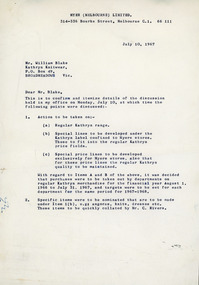
Letter, 10/7/1967
... Business Business history Manufacturing Knitting Machine Fashion Textile Production Business Archives Manufacturing Documents Myer Myer Emporium Myer (Melbourne) MYER (MELBOURNE) LIMITED. 314-336 Bourke Street, Melbourne C.1. 66 111 July 10, 1967 Mr. William Blake Kathryn Knitwear. P.O. Box 49. BROADMEADOWS Vic ...Kathryn Knitwear, founded by Robert Blake, manufactured high quality children’s knitwear in Melbourne from the 1940s – 1980s. Robert Blake began manufacturing children’s knitwear in his bedroom in Strathmore using a hand powered machine in the late 1940s. The operation moved to Ascot Vale and Essendon, before eventually establishing a factory in Moonee Ponds in the early 1950s. The business continued to expand, necessitating a move to a new factory in Broadmeadows. By 1962, the Broadmeadows factory was producing an average of 20,000 garments per month, which increased to 24,000 by 1964. Robert Blake’s Son, Brendan recalls that “The Kathryn brand was famous around Australia, anywhere children needed to keep warm and dress smartly. It also won a number of wool fashion awards”, including the 1969 Wool Awards, which was held by the Australian Wool Bureau and published in Women’s Weekly. The Kathryn range was designed for durability, comfort and care, without sacrificing style. They used patterning techniques that increase stretchiness, comfort and fit, as well as integrating decorative elements into the fabric to prevent them from being bulky, uncomfortable or tight. Making longevity of style a priority, Brendan Blake remembers that “there was one particular garment that was in the range for at least thirty years”. He also recalls “In the past, when women have found out that I was associated with Kathryn Knitwear, they would often relate to me the story of a garment they had purchased or received as a gift and, when their child had grown out of it, they would hand it on to another child. Several ladies have told me of purchasing garments for their daughters’ glory box, or saving a particular garment after their daughter had grown out of it. Brendan Blake: “At the peak of their operation they employed approximately two hundred people, mainly women and girls. A family would often seek to send their daughter to work in this company because they knew they would be looked after and safe. One lady wrote to me telling me that working at the Moonee Ponds Factory prior to getting married was the happiest time of her life.” In 1963, workers at the Kathryn factory earned £13 per week, which was 8 shillings and 8 pence higher than the minimum weekly wage for female workers in the textile manufacturing industry (£12 11s 4d). By 1970, the Kathryn Knitwear brand expanded from children’s knitwear into womenswear under the brand name ‘Lady Kathryn’, and for boys and men under ‘Robert Blake’. Continuing to diversify their distribution, they also began exporting ‘Kathryn’ garments to New Zealand, the Pacific Islands, and Japan. ‘Kathryn Knitwear’ was well-known for their early adoption of modern materials and techniques that had broad appeal to their customer base. This is shown in their early use of the acrylic fibre ‘Orlon’ in the 50s and 60s and ‘Superwash’ wool in the 1970s. Many of Kathryn Knitwear’s styles, particularly those that were long running staples of the brand, were available in both wool and Orlon to suit the consumer’s preference. Far from the humble origins of one man in his bedroom with a hand-cranked machine; at its closure in 1980, the Broadmeadows factory of ‘Kathryn’ housed more than 100 machines, including 53 sewing machines and 45 knitting machines. Robert Blake was “a passionate advocate for wool and Australian Made” throughout his whole life. A strong thread that ties through the lifespan of Robert Blake and Kathryn Knitwear is a balance between adopting new innovations without sacrificing the core values of durability, comfort, care and style that had made the brand so well known. Their legacy forms an integral part of both Australian social and manufacturing history.Letter from Myer (Melbourne) Limited to William Blake. The letter confirms and details of a meeting held to discuss business arrangements between Kathryn Knitwear and Myer. Due to the lack of signatory, it is likely there was originally additional pages that have been lost. It is typewritten in blue ink on white paper, with smudges and pen marks evident.MYER (MELBOURNE) LIMITED. 314-336 Bourke Street, Melbourne C.1. 66 111 July 10, 1967 Mr. William Blake Kathryn Knitwear. P.O. Box 49. BROADMEADOWS Vic. Dear Mr. Blake. This is to confirm and itemize details of the discussion held in my office on Monday, July 10, at which time the following points were discussed: - 1. Action to be taken on:- (a) Regular Kathryn range. (b) Special lines to be developed under the Kathryn label confined to Myers stores. These to fit into the regular Kathryn price fields. (c) Special price lines to be developed exclusively for Myers stores, also that for these price lines the regular Kathryn quality to be maintained. With regard to Items A and B of the above, it was decided that purchases were to be taken out by departments on regular Kathryn merchandise for the financial year August 1, 1966 to July 31, 1967, and targets were to be set for each department for the same period for 1967-1968. 2. Specific items were to be nominated that are to be made under Item 1(b), eg: angoras, knits, dresses, etc. these items to be quickly collated by Mr C. Rivers.business, business history, manufacturing, knitting machine, fashion textile production, business archives, manufacturing documents, myer, myer emporium, myer (melbourne) -
 National Wool Museum
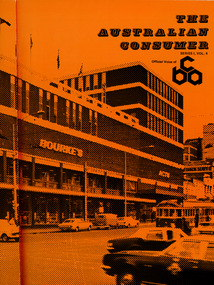
Magazine - The Australian Consumer, Series I, Volume 4, Consumer Benefits Association, 1972
... Business Business history Manufacturing Knitting Machine Fashion Textile Production Business Archives Manufacturing Documents Consumer Affairs School Uniform Advertising [obverse] THE AUSTRALIAN CONSUMER SERIES I, VOL. 4 Official voice of CBA [internal, page 12] Childrens Knitwear of Quality KATHRYN and Collegewear MANUFACTURED IN AUSTRALIA BY ROBERT BLAKE PTY. LTD. 26-32 KING WILLIAM STREET, BROADMEADOWS 3049 VIC ...Kathryn Knitwear, founded by Robert Blake, manufactured high quality children’s knitwear in Melbourne from the 1940s – 1980s. Robert Blake began manufacturing children’s knitwear in his bedroom in Strathmore using a hand powered machine in the late 1940s. The operation moved to Ascot Vale and Essendon, before eventually establishing a factory in Moonee Ponds in the early 1950s. The business continued to expand, necessitating a move to a new factory in Broadmeadows. By 1962, the Broadmeadows factory was producing an average of 20,000 garments per month, which increased to 24,000 by 1964. Robert Blake’s Son, Brendan recalls that “The Kathryn brand was famous around Australia, anywhere children needed to keep warm and dress smartly. It also won a number of wool fashion awards”, including the 1969 Wool Awards, which was held by the Australian Wool Bureau and published in Women’s Weekly. The Kathryn range was designed for durability, comfort and care, without sacrificing style. They used patterning techniques that increase stretchiness, comfort and fit, as well as integrating decorative elements into the fabric to prevent them from being bulky, uncomfortable or tight. Making longevity of style a priority, Brendan Blake remembers that “there was one particular garment that was in the range for at least thirty years”. He also recalls “In the past, when women have found out that I was associated with Kathryn Knitwear, they would often relate to me the story of a garment they had purchased or received as a gift and, when their child had grown out of it, they would hand it on to another child. Several ladies have told me of purchasing garments for their daughters’ glory box, or saving a particular garment after their daughter had grown out of it. Brendan Blake: “At the peak of their operation they employed approximately two hundred people, mainly women and girls. A family would often seek to send their daughter to work in this company because they knew they would be looked after and safe. One lady wrote to me telling me that working at the Moonee Ponds Factory prior to getting married was the happiest time of her life.” In 1963, workers at the Kathryn factory earned £13 per week, which was 8 shillings and 8 pence higher than the minimum weekly wage for female workers in the textile manufacturing industry (£12 11s 4d). By 1970, the Kathryn Knitwear brand expanded from children’s knitwear into womenswear under the brand name ‘Lady Kathryn’, and for boys and men under ‘Robert Blake’. Continuing to diversify their distribution, they also began exporting ‘Kathryn’ garments to New Zealand, the Pacific Islands, and Japan. ‘Kathryn Knitwear’ was well-known for their early adoption of modern materials and techniques that had broad appeal to their customer base. This is shown in their early use of the acrylic fibre ‘Orlon’ in the 50s and 60s and ‘Superwash’ wool in the 1970s. Many of Kathryn Knitwear’s styles, particularly those that were long running staples of the brand, were available in both wool and Orlon to suit the consumer’s preference. Far from the humble origins of one man in his bedroom with a hand-cranked machine; at its closure in 1980, the Broadmeadows factory of ‘Kathryn’ housed more than 100 machines, including 53 sewing machines and 45 knitting machines. Robert Blake was “a passionate advocate for wool and Australian Made” throughout his whole life. A strong thread that ties through the lifespan of Robert Blake and Kathryn Knitwear is a balance between adopting new innovations without sacrificing the core values of durability, comfort, care and style that had made the brand so well known. Their legacy forms an integral part of both Australian social and manufacturing history.Copy of Series I, Volume 4 of the magazine of the Consumer Benefits Association ‘the Australian Consumer’, dated 1972. Page 12 features a full-page advertisement for both the collegewear and children’s Kathryn Knitwear lines. The outfit in the top right image is similar to NWM-08913 Photos on the bottom are from the same photoshoot, photo on left is same model as NWM-09029, NWM-09031, NWM-09037. Photo on right is same model as NWM-09032 On the opposite page is an article discussing the ‘school uniform scandal’ that argues that problems are caused by an inefficient ordering and supply system, and proposes a system that it claims will reduce costs for both manufacturer and parents, while still allowing schools to specify uniform requirements.[obverse] THE AUSTRALIAN CONSUMER SERIES I, VOL. 4 Official voice of CBA [internal, page 12] Childrens Knitwear of Quality KATHRYN and Collegewear MANUFACTURED IN AUSTRALIA BY ROBERT BLAKE PTY. LTD. 26-32 KING WILLIAM STREET, BROADMEADOWS 3049 VIC PHONE 309 1333 [internal page 13] ANSWER TO SCHOOL UNIFORM SCANDALbusiness, business history, manufacturing, knitting machine, fashion textile production, business archives, manufacturing documents, consumer affairs, school uniform, advertising -
 Broadmeadows Historical Society & Museum
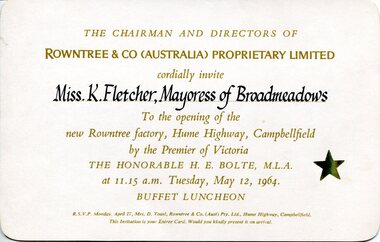
Ephemera - Invitation, Rowntree & Co. (Australia) Proprietary Limited, Invitation to opening of new Rowntree factory, Campbellfield, 1964
... Broadmeadows (Vic.)...Corporate events...Manufacturing history...This item has local historic significance for Broadmeadows and Campbellfield, providing primary evidence of major industrial development and civic engagement in Victoria during the 1960s. Industrial development Campbellfield (Vic.) Broadmeadows (Vic.) Corporate events Manufacturing history ...The invitation documents the opening of Rowntree & Co. (Australia)’s Campbellfield factory in 1964, officiated by the Premier of Victoria. It demonstrates post‑war industrial expansion in Melbourne’s northern suburbs and highlights civic–corporate relationships through the invitation of the local Mayoress.This item has local historic significance for Broadmeadows and Campbellfield, providing primary evidence of major industrial development and civic engagement in Victoria during the 1960s.Rectangular printed card with rounded corners. Cream/light buff cardstock. Recto printed in gold and black ink; verso blank except for later applied catalogue label.Recto (centre): “THE CHAIRMAN AND DIRECTORS OF / ROWNTREE & CO (AUSTRALIA) PROPRIETARY LIMITED / cordially invite / Miss K. Fletcher, Mayoress of Broadmeadows / To the opening of the / new Rowntree factory, Hume Highway, Campbellfield / by the Premier of Victoria / THE HONORABLE H. E. BOLTE, M.L.A. / at 11.15 a.m. Tuesday, May 12, 1964. / BUFFET LUNCHEON” (lower margin): “R.S.V.P. Monday, April 27, Mrs. D. Youel, Rowntree & Co. (Aust) Pty. Ltd., Hume Highway, Campbellfield. / This Invitation is your Entree Card. Would you kindly present it on arrival.” Recto (right): Gold star motif Verso (upper right): “WI 4054” (typed label)industrial development, campbellfield (vic.), broadmeadows (vic.), corporate events, manufacturing history, local government representation -
Broadmeadows Historical Society & Museum
Booklet - Council Booklet, Broadmeadows City Council, Future Directions, 1994
... Broadmeadows (Vic.)...Urban Development...Local History...Broadmeadows City Council Local Government Municipal Administration Community Planning Economic Development Public Finance Municipal Services Broadmeadows (Vic.) Urban Development Local History Monochrome illustrated stapled booklet issued by Broadmeadows City Council. ...This booklet was produced during 1993–1994 and communicates the priorities and direction of Broadmeadows City Council. Topics include organisational restructuring, occupational health and safety improvements, debt refinancing, changes to the municipal rating system, community consultation, service delivery and economic development. It provides evidence of local government administration and policy immediately prior to the Victorian municipal amalgamations of the mid-1990s.This publication is historically significant as a record of Broadmeadows City Council's policies, priorities and public communications during the early 1990s. It documents management reforms, financial strategies, community engagement initiatives and economic development objectives at a time of significant change in Victorian local government. The booklet provides valuable evidence of civic administration, municipal planning and community aspirations within Broadmeadows immediately before local government restructuring.Monochrome illustrated stapled booklet issued by Broadmeadows City Council. The publication outlines council management reforms, financial management initiatives, debt refinancing, waste collection services, capital works projects, community consultation programs, kindergarten services and economic development strategies. Approximately eight pages with photographic illustrations and council branding throughout. broadmeadows city council, local government, municipal administration, community planning, economic development, public finance, municipal services, broadmeadows (vic.), urban development, local history -
Broadmeadows Historical Society & Museum
Document, City of Broadmeadows Council, Meeting of Council to be held on 3rd May 1982 at 7.30p.m, 1982
... history...Broadmeadows (Vic.)...Broadmeadows Historical Society, contributing to the understanding of local history, social activity, and institutional development in Broadmeadows and surrounding regions. Of historic and research significance as part of the archival record relating to Broadmeadows. While individually modest, its value derives from its role within a broader documentary context, contributing to the evidentiary base used to interpret local history. Local government municipal administration council meetings council agendas notice papers civic administration local governance public administration municipal decision making councils and councillors community governance twentieth century local history Broadmeadows (Vic ...This item forms part of the documentary record preserved by the Broadmeadows Historical Society, contributing to the understanding of local history, social activity, and institutional development in Broadmeadows and surrounding regions.Of historic and research significance as part of the archival record relating to Broadmeadows. While individually modest, its value derives from its role within a broader documentary context, contributing to the evidentiary base used to interpret local history.Paper-based item setting out the agenda and business to be considered at a council meeting. Text is typewritten and arranged in a formal notice format.RECTO: Typed text including meeting details and date. VERSO: yellow catalogue adhesive label affixed above other labels: WI-3073 : white catalogue adhesive label affixed above other labels: WI-0584 (struck through) local government, municipal administration, council meetings, council agendas, notice papers, civic administration, local governance, public administration, municipal decision making, councils and councillors, community governance, twentieth century local history, broadmeadows (vic.), victoria local government, administrative documents
