
Showing 80 items matching "brunswick house"
-
 Brunswick Community History Group
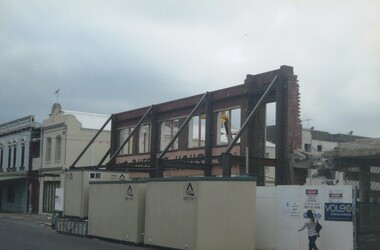
Photograph - Buffalo House, Brunswick, Laurie Cunningham, 2012
... Buffalo House, Brunswick...Demolition of Buffalo House, Union Street and Little Gold Street, Brunswick. Buffalo House was erected in about 1942 as the joint premises of two companies engaged in the manufacturing of cardboard boxes and associated products, children's activiyy books etc. ...Photograph Buffalo House, Brunswick Laurie Cunningham ...Demolition of Buffalo House, Union Street and Little Gold Street, Brunswick. Buffalo House was erected in about 1942 as the joint premises of two companies engaged in the manufacturing of cardboard boxes and associated products, children's activiyy books etc. The Heritage Council of Victoria deemed the building to be of historic and aesthetic significance. -
 Brunswick Community History Group
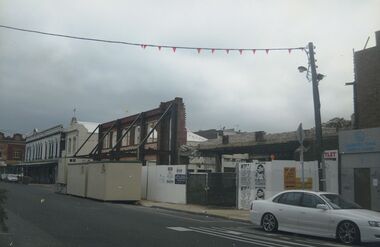
Photograph - Buffalo House, Brunswick
... Buffalo House, Brunswick...Streetscape featuring the demolition of Buffalo House, Union Street and Little Gold Street, Brunswick. The demolition company's portable offices are at the front. ...Photograph Buffalo House, Brunswick ...Streetscape featuring the demolition of Buffalo House, Union Street and Little Gold Street, Brunswick. The demolition company's portable offices are at the front. The Buffalo House signage (on yellow background) is just visible. Date stamped at time of printing 20 Oct 2012. Buffalo House was erected in about 1942 as the joint premises of two companies engaged in the manufacturing of cardboard boxes and associated products, children's activity books etc. The Heritage Council of Victoria deemed the building to be of historic and aesthetic significance. -
 Melbourne Tram Museum
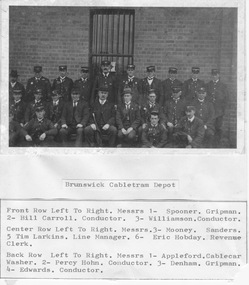
Photograph - Staff at Brunswick cable tram depot, 1901-1920s
... Brunswick car house (depot)...Photograph shows 23 men standing and sitting in rows facing the camera with the brick wall and barred window of the Brunswick car house (depot) administration building behind. ...Photograph shows 23 men standing and sitting in rows facing the camera with the brick wall and barred window of the Brunswick car house (depot) administration building behind. ...Photograph shows 23 men standing and sitting in rows facing the camera with the brick wall and barred window of the Brunswick car house (depot) administration building behind. Three men are dressed in suits, ties and hats and the remaining 20 are in full tramway (MTOC or interim Tramway Board) uniform with caps, some wearing the large pins used by conductors. As the MTOC only provided full uniforms to its traffic staff from 1901, the photograph can be dated between 1901 and the early 1920s, when the new Tramways Board (M&MTB) supplied a different uniform and cap. Two of the men in suits are the line manager and revenue clerk. There are many similar staff photos from this era which suggests they were initiated by MTOC. Yields information about Brunswick cable tram employees Black and white photograph glued to paper with note below. Note reads: "Brunswick cabletram Depot" then lists the names and duties of 10 of the 23 men pictured, which includes a line manager, revenue clerk, gripmen, conductors and car washer. brunswick car house (depot), suits and hats, full tramway uniform, line manage, mtoc, m&mtb, line manager, revenue clerk -
 Federation University Historical Collection
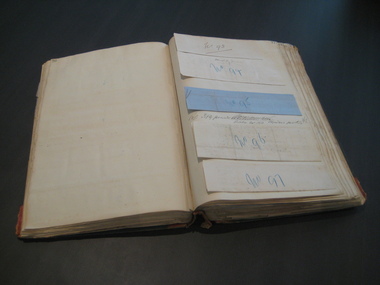
Book, Ballarat School of Mines Invoice Book, 1870 - 1875
... ...Brunswick House...The works done to the former Ballarat Circuit Court House were overseen by Robert Davidson (architect and Surveyor) with the contractor being James Williams. ballarat school of mines redmond barry hugh gray henry richards caselli henry caselli joseph flude ballarat court house harrie wood clock invoice book robert davison james williams ballarat circuit court house old ballarat court emanuel steinfeld j.t. sleep c.b. retallack john phillips eyres bros ballaarat gas company national insurance company broadbent bros charles evans niven and co william johnson william ford george robertson william vale m.d. hamilton plumbago crucible company morgans crucibles h.r. caselli henry richards caselli george evans bateman, clark & co, klug bros. j. armstrong w. gooch, william l. mullen a.h. king richard tunbridge henry gough, william murfet, james curtis william blomeley, thomas rogers george shannon wreford william mcculloch j.j. mcdonald frank pinkerton ben franklin printing and stationary house j. donovan edward rand matthew hamilton c.b. retallack, james harrington smith brothers, james fayle, maxwell morrow, s. stansfield walhalla Brunswick House T Rogers "VOUCHER" inscribed on spine in gold Each invoice pasted into the scrapbook has a number written onto it. ...Scrap book containing invoices relating to accounts to be paid by the Ballarat School of Mines between 1870 until 1875. The School of Mines at Ballarat was the first school of Mines in Australia and was established in 1870. The works done to the former Ballarat Circuit Court House were overseen by Robert Davidson (architect and Surveyor) with the contractor being James Williams. Large book, green leather with red binding, numerous original invoices pasted onto the pages. The first pages of the scrapbook includes correspondence relating to the refurbishment of the former Ballarat Court House which was used as the Ballarat School of Mines from 1870. The building was demolished c1913 to make way for the Ballarat Technical Art School (still standing). * 23 August 1870 - Bateman, Clark & Co, The Ballarat Courier * August 1870 - Klug Bros. Furniture and Bedding Warehouse * April 1870 - J. Armstrong * Statement of Receipts and Expenditure from 23rd Aug. 1870 to 19 January 1871 * W. Gooch, * 1870 - William L. Mullen, Ballarat Stationery Warehouse & Printing Office, * 31Jany. 1871 - A.H. King, Iron Merchant, * 1 February 1871 - Richard Tunbridge, Timber Merchant, * January 4th 1871- Henry Gough, * 8th March 1871 William Murfet, * March 1871- Maxwell Morrow, * 1 February 1871- James Curtis, Caxton Steam Printing Works, * May 4th 1871 - William Blomeley, Iron and Brass Founder, * 4 May 1871 - Thomas Rogers, Draper, Milliner, Haberdasher & c. * May14 1871- George Shannon & Co, Importers of China, Glass & Earthenware, * May 31st 1871, Wreford & Co, Machine Printers, *1st July 1871 William McCulloch & Co,( late Reynolds and English) General Carriers to all parts of the Colony, * 1871- J.J. McDonald, Plumber and Gas Fitters, * August 29th 1871 - Eyres Brothers, Furnishing and General Ironmongers, * 1st August 1871, Frank Pinkerton,H Ben. Franklin Printing and Stationary House 18, Armstrong Street, Ballarat. * 12TH July 1871 J. Donovan, * 10th August, 1871 - Edward Rand, Wholesale Druggist & Importer, *11 Nov 1871 - Matthew Hamilton, * October 2nd 1871 - C.B. Retallack, Engineer and General Smith, *December 8 1871 - James Harrington, * June 1871 - Wayne, Wholesale Druggist * 21st Nov. 1871 - Smith Brothers, Timber Merchants. * 5 January 1872 - T. Eggington, Carpenter, * 12 January 1872 - James Fayle, Plumbers & Ironwork * January 26th 1872 - S. Stansfield, * August 10th 1872 - John H. Hammond Wholesale and Retail, Bookseller, Commercial and General Stationer, etc. etc."VOUCHER" inscribed on spine in gold Each invoice pasted into the scrapbook has a number written onto it. The numbers are in chronological order at start at 1 in each calendar year. ballarat school of mines, redmond barry, hugh gray, henry richards caselli, henry caselli, joseph flude, ballarat court house, harrie wood, clock, invoice book, robert davison, james williams, ballarat circuit court house, old ballarat court, emanuel steinfeld, j.t. sleep, c.b. retallack, john phillips, eyres bros, ballaarat gas company, national insurance company, broadbent bros, charles evans, niven and co, william johnson, william ford, george robertson, william vale, m.d. hamilton, plumbago crucible company, morgans crucibles, h.r. caselli, henry richards caselli, george evans, bateman, clark & co,, klug bros., j. armstrong, w. gooch,, william l. mullen, a.h. king, richard tunbridge, henry gough,, william murfet,, james curtis, william blomeley,, thomas rogers, george shannon, wreford, william mcculloch, j.j. mcdonald, frank pinkerton, ben franklin printing and stationary house, j. donovan, edward rand, matthew hamilton, c.b. retallack,, james harrington, smith brothers,, james fayle,, maxwell morrow,, s. stansfield, walhalla, brunswick house, t rogers -
 Melbourne Tram Museum
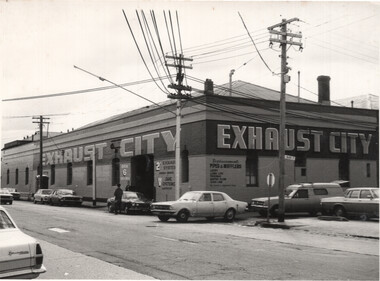
Photograph - Brunswick Road, Brunswick cable tram engine house, 1960s
... Brunswick Road, Brunswick cable tram engine house...Photos shows the exterior of the former cable tram engine house on the corner of Brunswick Road and Black St. It operated from 1887 to 1936. ...Yields information about the appearance the former Brunswick cable tram engine house. tramways cable trams engine houses Brunswick Brunswick Road Black and white print with a plain back. ...Photos shows the exterior of the former cable tram engine house on the corner of Brunswick Road and Black St. It operated from 1887 to 1936. At the time the building was occupied by Exhaust City sales. A planning permit was issued during 2025 to redevelop the building. Photo early 1960s based on the motor vehicles, photographer unknown. See also item 8653 for further information.Yields information about the appearance the former Brunswick cable tram engine house.Black and white print with a plain back.tramways, cable trams, engine houses, brunswick, brunswick road -
 Melbourne Tram Museum
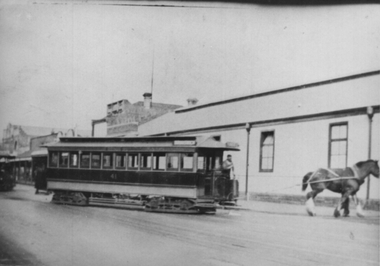
Photograph - Set of 2 - Shunting cable trams - Brunswick, Wal Larsen, May 1914
... ...Brunswick Depot...car house...The two photographs show cable trams being shunted into the Brunswick Cable Tram Depot or car house from Sydney Road. ...Yields information about the shunting of cable trams at the Brunswick car house or depot. tramways tramcars cable trams Brunswick Brunswick Depot car house shunting MMTB tram 41 trams grip Second copy has "Photo from W H Larsen" written on the back. ...The two photographs show cable trams being shunted into the Brunswick Cable Tram Depot or car house from Sydney Road. The first shows a horse pulling a bogie tram trailer into the car house while the second shows the grip being pushed in by hand. Note the raised position of the grip when this shunting task is performed - 1920s. Yields information about the shunting of cable trams at the Brunswick car house or depot.Set of two black and white copy photographs with adhesive marks on the rear. Two copies of each held. Second copy has "Photo from W H Larsen" written on the back.tramways, tramcars, cable trams, brunswick, brunswick depot, car house, shunting, mmtb, tram 41, trams, grip -
 Whitehorse Historical Society Inc.
Newspaper - Article, Relocation plans pushing ahead, 13/07/1994
... Article on relocation of Mitcham Community House to Brunswick Road....Article on relocation of Mitcham Community House to Brunswick Road. Relocation plans pushing ahead Newspaper Article ...Article on relocation of Mitcham Community House to Brunswick Road.neighbourhood houses, mitcham community house inc. -
Whitehorse Historical Society Inc.
Newspaper - Article, House to get home, 1/03/1993
... Article on relocation of Mitcham Community House to Brunswick Road....Article on relocation of Mitcham Community House to Brunswick Road. House to get home Newspaper Article ...Article on relocation of Mitcham Community House to Brunswick Road.neighbourhood houses, mitcham community house inc. -
 Brunswick Community History Group
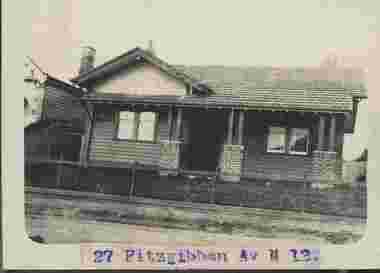
Photograph - Dollman house, 1920s
... He lived in this West Brunswick house until his death in February 1953. ...He lived in this West Brunswick house until his death in February 1953. ...A black and white photograph of a single storeyed house identified in a (contemporary) typed label as '27 Fitzgibbon Ave N 12'. This was the Dollman family home from the mid-1920s. Charles Arthur John (Jack) Dollman, born 1881, was a Sydney Road picture framer and founding member of the first Brunswick Historical Society in 1936. He lived in this West Brunswick house until his death in February 1953. Part of the Dollman Collection. charles arthur john dollman, fitzgibbon avenue brusnwick west -
 Whitehorse Historical Society Inc.
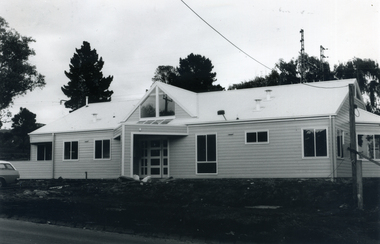
Photograph, Mitcham Community House
... house...neighbourhood houses...brunswick...Black and white photograph of the new Mitcham Community House in Brunswick Road, Mitcham, c1996...mitcham community house neighbourhood houses brunswick road mitcham community houses Black and white photograph of the new Mitcham Community House in Brunswick Road, Mitcham, c1996 Mitcham Community House Photograph Photograph ...Black and white photograph of the new Mitcham Community House in Brunswick Road, Mitcham, c1996mitcham community house, neighbourhood houses, brunswick road, mitcham, community houses -
 Brunswick Community History Group
Photograph - Hartnett House, Maria Tsitsiovis, 2009
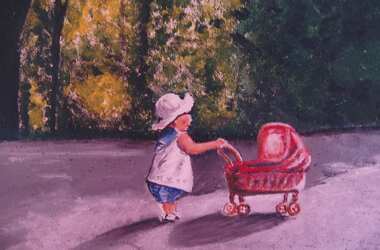
... Featured in 'Hartnett House, Brunswick: its founder, its work, its history' by Banda Dagher, BCHG, 2001....Featured in 'Hartnett House, Brunswick: its founder, its work, its history' by Banda Dagher, BCHG, 2001. ...Colour photograph of a painting of a child pushing doll's pram. Featured in 'Hartnett House, Brunswick: its founder, its work, its history' by Banda Dagher, BCHG, 2001. -
 Brunswick Community History Group
Photograph - Hartnett House, 4 December 2009
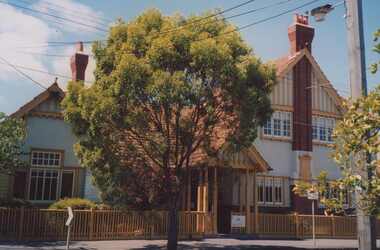
... Colour photograph of Hartnett House, 123 Albion St., Brunswick taken in 2009. Featured in 'Hartnett House, Brunswick: its founder, its work, its history' by Banda Dagher, BCHG, 2001....Colour photograph of Hartnett House, 123 Albion St., Brunswick taken in 2009. Featured in 'Hartnett House, Brunswick: its founder, its work, its history' by Banda Dagher, BCHG, 2001. ...Colour photograph of Hartnett House, 123 Albion St., Brunswick taken in 2009. Featured in 'Hartnett House, Brunswick: its founder, its work, its history' by Banda Dagher, BCHG, 2001. -
Whitehorse Historical Society Inc.
Document, Jacqueline Lightbody, 2008
... Notes of an interview with Jacqueline Lightbody by Lesley Alves on 13 November 2008 on building her first house in Brunswick Road Mitcham in 1950 and life in Mitcham in the 1950s....Brunswick Road Mitcham Notes of an interview with Jacqueline Lightbody by Lesley Alves on 13 November 2008 on building her first house in Brunswick Road Mitcham in 1950 and life in Mitcham in the 1950s. ...Notes of an interview with Jacqueline Lightbody by Lesley Alves on 13 November 2008 on building her first house in Brunswick Road Mitcham in 1950 and life in Mitcham in the 1950s.Notes of an interview with Jacqueline Lightbody by Lesley Alves on 13 November 2008 on building her first house in Brunswick Road Mitcham in 1950 and life in Mitcham in the 1950s.Notes of an interview with Jacqueline Lightbody by Lesley Alves on 13 November 2008 on building her first house in Brunswick Road Mitcham in 1950 and life in Mitcham in the 1950s.brunswick road, mitcham -
 Melbourne Tram Museum
Document - Personal Papers, Melbourne Tramways Trust (MTT), "Notice Papers for 'The Melbourne Tramways Trust' meetings", 1885 - 1886
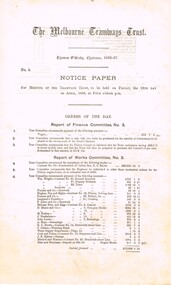
... Date Notes 5 16/4/1886 Wages, supplier payments, accept tenders for mechanical stokers, construction of Carlton line, notice to construct a siding in Wellington Parade and purchase of land for the Brunswick Engine house. 1888 – 1890 – Cr. C.H Jennings Chairman, T. ...Date Notes 5 16/4/1886 Wages, supplier payments, accept tenders for mechanical stokers, construction of Carlton line, notice to construct a siding in Wellington Parade and purchase of land for the Brunswick Engine house. 1888 – 1890 – Cr. C.H Jennings Chairman, T. ...Set of 16 Notice Papers or Meeting Agendas - sent to Trust Members and others for The Melbourne Tramways Trust for period April 1886 to November 1890 as listed below. Printed by Ferguson and Moore or Edgerton and Moore for the Trust. Signed by the Secretary. Covers construction arrangements, appointments, financial, loans, debentures, legislation, arrangements with the Melbourne Tramway and Omnibus Company and other organisations including banks. Notes are the principal items shown in the Orders of the Day. Printed by Fergusson and Moore or Edgerton and Moore - different name on the 17/1/1890 meeting. 1886 – 1887 – Thomas O’Grady and T. Hamilton remain as Chairman and Secretary respectively. Meeting No. Date Notes 5 16/4/1886 Wages, supplier payments, accept tenders for mechanical stokers, construction of Carlton line, notice to construct a siding in Wellington Parade and purchase of land for the Brunswick Engine house. 1888 – 1890 – Cr. C.H Jennings Chairman, T. Hamilton Secretary Meeting No. Date Notes 3 17/1/1890 Wages, supplier payments, accept tenders for crossings, railway crossings, cement and that the Hawthorn House is completed and ready for traffic. 4 24/1/1890 Special meeting to consider communication from MTCo re opening of the Hawthorn horse tramway. 5 14/2/1890 Wages, supplier payments. 6 14/3/1890 Wages, supplier payments, dispute with David Munro over fine for the Hawthorn bridge and Collingwood council seeking to widen approach to Victoria St bridge. 7 18/4/1890 Wages, supplier payments, wood blocking of Hawthorn and Victoria bridge lines. 8 16/5/1890 Wages, supplier payments, proceed with Victoria Bridge approaches. 9 13/6/1890 Wages, supplier payments, reappointment of C. W. Ellis as auditor, protect Trust interest in reference to the Hoddle St tramway bill. 10 11/7/1890 Wages, supplier payments including hire of horses for threading of cable. 11 8/8/1890 Wages, supplier payments, call tenders etc for St Kilda Esplanade line. 12 5/9/1890 Wages, supplier payments 13 3/10/1890 Wages, supplier payments, letting of tenders for track materials, 2nd crossover for cars in Spencer St. 14 31/10/1890 Wages, supplier payments, acceptance of tenders for Esplanade line. 1890 – 1891 – Cr. C.H Jennings Chairman, T. Hamilton Secretary Meeting No. Date Notes 1 19/12/1890 Wages, supplier payments, accept of tenders for Esplanade including engines. 15 3/11/1890 Special meeting to consider letter from St Kilda council re widening of the Esplanade. 16 28/11/1890 Wages, supplier payments, accept of tenders for Esplanade including engine house and cable. For a word version - see: \dbtext\hawthtramcoll\images\htd2003doc.doctrams, tramways, mtt, cable trams, melbourne tramways trust, construction, finances, mto co -
 Flagstaff Hill Maritime Museum and Village
Wood Samples, 1891
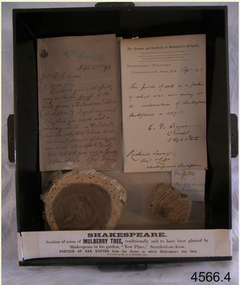
... This scion was then established at Shakespeare's garden at "New Home" that had been demolished by Rev Francis Gastrell in 1759. flagstaff hill warrnambool shipwrecked coast flagstaff hill maritime museum maritime museum shipwreck coast flagstaff hill maritime village great ocean road shakespeare display case wood samples oak from shakespeare's birthplace mulberry from shakespeare's home "new place" stratford-upon-avon shakespeare's birthplace the trustees and guardians of shakespeare's birthplace &c. shakespeare trust shakespeare birthday committee r.s. harris, brunswick, victoria richard s harris, brunswick, victoria c.f. loggins, chemist, 3 high street stratford-on-avon richard savage warrnambool museum and art gallery thomas court pt barnum charles dickins anne hathaway black mulberry tree reverend francis gastrell Cardboard label inside the glass case “Shakespeare Section of Mulberry Tree, traditionally said to have been planted by Shakespeare in his garden, “New Place,” Stratford-on-Avon. PORTION OF OAK RAFTER from the house ...The timber display case was presented to Mr Richard Standcombe Harris of Warrnambool (1831-1923). He was a councillor (1875-1891) and predominant businessman. Mr C F Loggin had met Mr Harris while on a trip to Stratford upon Avon in the United Kingdom. Upon his return to Warrnambool, Mr Harris donated the item to the Warrnambool Museum and Art Gallery, (established 1886) where Joseph Archibald was Curator: he catalogued the case in 1894. THE LETTERS IN THE CASE The two letters contained within the display case confirm the authenticity of the oak wood sample. The first letter in the case includes the text; "[Stamped Header on banner] High Street, Stratford on Avon [Hand written] Sept. 22nd / 91. Mr. R. S. Harris, Dear Sir, Enclosed you will find [underlined next 3 words] every authentic proof of the Oak from Shakespeare's House (Birth place). I regret very much Sir, that you made a short-day at S. on A. I should have been delighted to have had the honour, & pleasure, of showing you around our Beautiful Country. You did not give [next 3 words underlined] me or yourself a fair chance. But however I hope that we may again some day have more time to go quietly around. With kind regards, and wishing you, Sir, a pleasant voyage, I remain, Dear Sir, Yours very truly, C.F. Loggin. P.S. A paper will be always acceptable to be as how you Jolly Warrnamboolites are desporting yourselves. “ The second letter includes text; “[Printed Letterhead with stamped impression] The Trustees and Guardians of Shakespeare’s Birthplace Incorporated by Act of 54 and 55, Vict. 1891 Secretary and Librarian - Richard Savage Shakespeare’s Birthplace Stratford-upon-Avon [handwritten] 22 Sept 1891 This piece of oak is a portion of what was cut away at at the restoration of Shakespeare’s Birthplace in 1857-58. C. F. Loggins Chemist 3 High Street Richard Savage Sec. – Shakespeare’s Birthplace Mr C F Loggin was connected with the Shakespeare Trust as the person who had originally donated a scion of Shakespeare's mulberry tree to the "Shakespearean Birthday Committee" in 1842. (The scion that was given to the Shakespearean Birthday Committee, from which the Mulberry sample is derived, still grows today in "New Place" garden.) Mr Richard Savage was the Secretary and Liberian of the then renamed “Trustees and Guardians of Shakespeare’s Birthplace when the display case was given to Mr Harris in 1891 by Mr Loggin. WILLIAM SHAKESPEARE Shakespeare was born in 1564 in Stratford-upon-Avon, where he also grew up. He married at 18 years and he and his wife, Anne Hathaway, had three children: They moved to London where he became successful as an actor, writer, and part-owner of a playing company. He later returned to Stratford and purchased his last home, which he called "New Place" in 1602 where he later died in 1616. For the next 150 years, it was known that there existed a black mulberry tree in the garden. At the time there was a fashion for planting mulberry trees. It was the early 17th century after King James had come to the throne, and he imported tens of thousands of saplings in an attempt to get landowners to start a silk industry in England. Unfortunately for posterity, Shakespeare's mulberry was felled around 1756, by the then owner of “New Place" the Reverend Francis Gastrell, who was apparently tired of continual visits by pilgrims asking to see the tree, so he chopped it down. Gastrell had applied for local permission to extend the garden but the application was rejected and his tax was increased. Gastrell retaliated by demolishing the house in 1759, this greatly outraged the local inhabitants. Gastrell was eventually forced to leave town having provoked the wrath of Stratford residents for committing such an act. Today only the garden remains where “New House" used to stand with a scion from the original mulberry tree still growing there. The wood from the felled mulberry tree at “New House" was purchased by an enterprising local clock-maker Thomas Sharp and he spent the next 40 years or so years making souvenirs from the wood. These became early tourist souvenirs and subsequently developed into a profitable sideline for various other makers, including George Cooper and John Marshall. These objects range from relatively small domestic wooden objects, such as snuff boxes and weight scales to large tea caddies and even tables. C. F. Loggin donated a scion or cutting from Shakespeare's mulberry tree to the Shakespeare Birthplace Trust in 1862, he was a chemist who lived and worked in Stratford. There is a note on the frame of the donation that the mulberry sample is from this scion, research shows that from Richard Savage's diary notes that there must have been a lot of wood taken from that scion over the years which was planted in the garden of “New Place” and is still growing there today. The "Trustees and Guardians of Shakespeare’s Birthplace" (1847 -1964) was formed after the house where Shakespeare is believed to have been born fell into disrepair. Subsequently in 1846 after the death of Thomas Court's widow the last owner. Interest in the house was revived when PT Barnum, the American showman, wanted to buy it and ship the house back to America. In response to this, the Shakespeare Birthday Committee was established (by a private Act of Parliament) with the help of such luminaries as Charles Dickens, the Committee of Trustees raised the necessary £3,000 and purchased the house the following year. Once the Committee had acquired the building, restoration work began. Originally the Birthplace formed part of a terrace with later houses built either side. The first stage in its conservation was their destruction. At the time it was thought necessary to avoid the risk of fire spreading to Shakespeare's birthplace. Reconstruction was carried out by the Shakespeare Trust between 1857 and 1864 that restored the outside of the building to its original 16th-century state. It is from this restoration that the donated piece of oak is derived, originally from a beam that was in the house. Communication from The Shakespeare Birthplace Trust, dated April 11th, 2019, confirms that the pieces displayed in this case have good provenance. The wood samples are significant for their association with the history of William Shakespeare. The display case and its content is significant to Warrnambool local history for its association with the establishment in 1886 of the Warrnambool Museum and Art Gallery. However, it should be noted that the letters of authentication that accompany the wood samples are only applicable to the oak sample. None the less, all the pieces have very good provenance, with Richard Savage's certificate of authenticity for the oak, and the mulberry sample with the letter to Mr Harris from Mr CF Loggin having also been the donor of the scion of mulberry in 1862 to the Shakespeare Birthplace Trust. This scion was then established at Shakespeare's garden at "New Home" that had been demolished by Rev Francis Gastrell in 1759. Two wood samples associated with William Shakespeare, presented in a hanging, timber and glass display case with metal trim around the frame. The case also contains two letters and a label printed on a card that refers to the contents, their origins and the donor. A card label with a printed number and a round adhesive label are attached on the back of the case. The left round section of wood is from a donated scion (or shoot) derived from the original mulberry tree planted by William Shakespeare at his last home "New Place", Stratford-upon-Avon. The outer section is light brown coloured while the centre is dark grain. The right wood sample in the case is a section of oak rafter from the house where Shakespeare was born in 1564. The wood is mid brown with a distinct grain. The included letters, each dated 22/9/1891, refer to only the oak sample. - The letter on the left comprises two handwritten pages from Mr CF Loggin to Mr Richard Standcombe Harris. The paper has the printed letterhead address of High Street, Stratford on Avon. - The letter on the right is a handwritten certificate of authenticity signed by Mr CF Loggin and counter signed by Mr Richard Savage, Secretary and Liberian of the Shakespeare Trust. It is on the printed letterhead of The Trustees and Guardians of Shakespeare’s Birthplace Cardboard label inside the glass case “Shakespeare Section of Mulberry Tree, traditionally said to have been planted by Shakespeare in his garden, “New Place,” Stratford-on-Avon. PORTION OF OAK RAFTER from the house in which Shakespeare was born. (Presented by R S Harris 1891.) Printed label on the back of the case “3 2 “ The handwritten adhesive label “0566” flagstaff hill, warrnambool, shipwrecked coast, flagstaff hill maritime museum, maritime museum, shipwreck coast, flagstaff hill maritime village, great ocean road, shakespeare display case, wood samples, oak from shakespeare's birthplace, mulberry from shakespeare's home "new place", stratford-upon-avon, shakespeare's birthplace, the trustees and guardians of shakespeare's birthplace &c., shakespeare trust, shakespeare birthday committee, r.s. harris, brunswick, victoria, richard s harris, brunswick, victoria, c.f. loggins, chemist, 3 high street stratford-on-avon, richard savage, warrnambool museum and art gallery, thomas court, pt barnum, charles dickins, anne hathaway, black mulberry tree, reverend francis gastrell -
 Flagstaff Hill Maritime Museum and Village
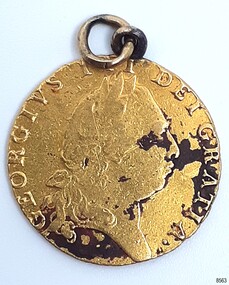
Currency - Guinea Coin, The Royal Mint, 1793 George III Spade Guinea, 1793
... Flagstaff Hill Maritime Museum and Village Warrnambool Great Ocean Road Shipwreck Coast Royal Mint British coin currency guinea military guinea Australian currency British guinea gold coin spade guinea King George III George III fifth portrait Arms of England and Scotland Arms of France Arms of Ireland Arms of the House of Hanover coins gold coins gold medallion Georgian era 1793 numismatics contamination phenomena gold corrosion good luck lucky charm pendant lucky coin trade Loch Ard wreck of the Loch Ard 1878 Mutton Bird Island Peterborough scuba diver 1980s guinea coin gold guinea shipwreck artefact relic Julie Wilkins Obverse text; 'GEORGIVS III DEI GRATIA' (translates to George the Third, by the Grace of God) Obverse relief; (King George III bust, facing right, laurel wreath on head) Reverse text; 'M.B.E.ET.H.REX.F. D.B.ET.L.D. S.R.I.A.T.ET.E' '1793' (translates to: King of Great Britain, France and Ireland, Defender of the Faith, Duke of Brunswick ...The coin was discovered by Julie Wilkins, a Victorian scuba diver who had already experienced more than 500 dives in Australia and overseas. She was holidaying in Peterborough, Victoria, and looking forward to discovering more about the famous Loch Ard ship, wrecked in June 1878 at Mutton Bird Island. The fast Glasgow-built clipper ship was only five years old when the tragedy occurred. There were 54 people on board the vessel and only two survived Julie's holiday photograph of Boat Bay reminds her of her most memorable dive. Submerged in the calm, flat sea, she was carefully scanning around the remains of the old wreck when, to her amazement, a gold coin and a small gold cross suddenly came up towards her. She excitedly cupped them in her hands, then stowed the treasures safely in her wetsuit and continued her dive. She soon discovered a group of brass carriage clock parts and some bottles of champagne. It was a day full of surprises. The items were easily recognisable, without any build-up of encrustations or concretion. Julie secretly enjoyed her treasures for twenty-four years then packed them up for the early morning train trip to Warrnambool. After a short walk to Flagstaff Hill Maritime Museum and Village, her photograph was taken as she handed over her precious find. She told her story to a local newspaper reporter, lunched a café in town then took the late afternoon train home. Her generous donation is now part of a vast collection of Loch Ard shipwreck artefacts, including the gold watch and the Minton Majolica model peacock. The coin is a British 1793 George III Gold Spade Guinea. It was already 83 years old when the Loch Ard had set sail. The loop and ring have been added, perhaps as a pendant, pocket watch accessory or similar purpose. It may have been worn for ‘good luck’ on the long journey to Australia, where ships had to carefully navigate the treacherous Bass’s Strait before arriving at their destination of Melbourne. Sadly, many met their fate on that short stretch of ocean aptly named the Shipwreck Coast. The coin is very recognisable even though it was exposed to the wrecking of the ship, its consequent movement, and the sea's turbulence. Its bent, scratched, buckled, split, dinted and worn condition is part of its story. The red-brown-black discolouration is similar to that found on other gold coins, sometimes called the ‘corrosion phenomena’. Studies suggest the possible cause is contaminants in the minting process reacting to the coins’ environment. The GEORGE III GOLD SPADE GUINEA: - The British Guinea was introduced in 1663 and was circulated until 1814. It was made of 22 carat gold, was 25 to 26 cm in diameter and weighed 8.35 grams. It had a value of 21 British shillings. The guinea coin ceased circulation after 1816 and was replaced by the one-pound note. However, the term ‘guinea’ continued to represent 21 shillings. King George (1738-1820) had six gold guinea designs minted during his reign from 1760 and 1820. Each of the six had different obverse portraits, all facing the right. There were three different reverse sides. The Spade Guinea was the fifth issue of the coin, introduced in 1787 and produced until 1799. The reverse shows a royal crown over a flat-topped shield with the Royal Arms of Great Britain, used in Scotland between 1714 and 1800. The shield images are, from left to right, top to bottom, the Arms of England and Scotland, the Arms of France, the Arms of Ireland, and the Arms of the House of Hanover. The Gold Guinea is also part of Australia’s history. It was the first coin mentioned in the announcement of Governor King of New South Wales his Australian Proclamation of a limited variety and denomination of coins accepted for use in the Australian Colony. The historic and decorative George III Spade Guinea has been reproduced for special collections of coins. However, replicas and imitations have also been made as souvenirs for tourists, as gaming tokens and chips for gamblers, and as ‘fake’ coins for profit. These coins differ in many ways; they may be only half the weight of the genuine coin. Often have a small stamp on the obverse with “COPY” or the manufacturer’s name or initials. Some have scalloped edges, some have dates that are different to the original dates of issue, and some even have text in Latin that translates as something very different to the original coin.The King George III Guinea was only produced from 1663 to 1814 and was the first English coin to be mechanically minted. The coin is the fifth edition of the King George III Guinea, the Spade Guinea, was only produced between 1787 and 1799. It is the only edition with this portrait of King George and the only one with the Royal Coat of Arms of Great Britain in Scotland on the reverse side. This edition was also the last guinea in circulation, because the sixth edition was reserved as the Military guinea. This edition of the Guinea is unique; This coin is the only guinea in our collection. It was minted in 1793, so it is now over 230 years old. The Gold Guinea is part of Australia’s history; it was the first coin in the list of coins for use in the Australian Colonies, mentioned by Governor King of New South Wales in his Australian Proclamation speech of 1800. The George III Spade Guinea was included in the Limited Edition Sherwood 12 Coin Collection of Notable Coinage of Australia. This coin is the only known guinea coin recovered from the wreck of the Loch Ard. It was already 85 years old when the ship was wrecked.Gold coin; British. 1793, King George III of the United Kingdom of Great Britain and Ireland (1760-1820), Spade Guinea. Yellow gold coin with gold metal loop mount and a gold ring through the loop. The design is the fifth issue of the George III Gold Guinea. The obverse relief is a portrait of George III facing right. Reverse relief is a crown above the Coats of Arms (1801-1816) of flat top spade-shaped shield divided into four quadrants that depict crowned lions, fleur de lies, a harp. These images are identified as, from left to right, top to bottom, England and Scotland, France, Ireland and Hanover. Inscriptions are minted around the rims of each side. The coin is dated 1793. Its surface has dark areas on both sides and the reed edge and surfaces are well worn. The loop mount is bent and the ring is buckled. The coin was recovered from the wreck of the ship Loch Ard.Obverse text; 'GEORGIVS III DEI GRATIA' (translates to George the Third, by the Grace of God) Obverse relief; (King George III bust, facing right, laurel wreath on head) Reverse text; 'M.B.E.ET.H.REX.F. D.B.ET.L.D. S.R.I.A.T.ET.E' '1793' (translates to: King of Great Britain, France and Ireland, Defender of the Faith, Duke of Brunswick and Lüneburg, Arch-Treasurer and Elector of the Holy Roman Empire) Reverse relief; a spade-shaped image i.e. (Crown with fleer de lies, above Shield with crowned lions in different postures, a harp, and other details)flagstaff hill maritime museum and village, warrnambool, great ocean road, shipwreck coast, royal mint, british coin, currency, guinea, military guinea, australian currency, british guinea, gold coin, spade guinea, king george iii, george iii, fifth portrait, arms of england and scotland, arms of france, arms of ireland, arms of the house of hanover, coins, gold coins, gold medallion, georgian era, 1793, numismatics, contamination phenomena, gold corrosion, good luck, lucky charm, pendant, lucky coin, trade, loch ard, wreck of the loch ard, 1878, mutton bird island, peterborough, scuba diver, 1980s, guinea coin, gold guinea, shipwreck artefact, relic, julie wilkins -
 Orbost & District Historical Society
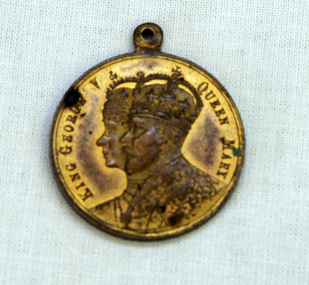
badge, 1911
... During his reign, which spanned World War I, the royal house abandoned the title the house of Saxe-Coburg-Gotha (or the house of Hanover or Brunswick) and became known as the house of Windsor. ...During his reign, which spanned World War I, the royal house abandoned the title the house of Saxe-Coburg-Gotha (or the house of Hanover or Brunswick) and became known as the house of Windsor. ...Medal issued to celebrate the coronation of King George V and Queen Mary in 1911. George ascended the throne on his father?s death on 9 May 1910. During his reign, which spanned World War I, the royal house abandoned the title the house of Saxe-Coburg-Gotha (or the house of Hanover or Brunswick) and became known as the house of Windsor. George died in 1936, and was succeeded briefly by Edward VIII. Different versions of this medal were produced for the states. In all, Stokes produced over 400,000 medals, with many issued to school children.A bronze commemorative badge for the coronation of King George V, Has loop at top. On front is coat of arms-"peace and prosperity" and back has profiles of King George V and Queen Mary.medallion badge george-v -
 Flagstaff Hill Maritime Museum and Village
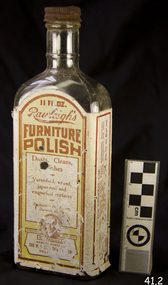
Container - Glass Bottle, W T Rawleigh, 1920s
... Brunswick factory and several independent sale representatives sold their products door-to-door throughout the country. The ‘Rawleigh’s man’ was a regular door-to-door salesman of inter war and post-war suburban Melbourne. Rawleigh’s products are still in production today. A significant item as it gives a snapshot into domestic life and social norms of the pre and post war period in Melbourne and throughout Australia and New Zealand. The item demonstrates how selling house ...W.T. Rawleigh's & Co. manufactured various household products in a factory in Collins Place, Melbourne, between 1930 and 1935. The W.T. Rawleigh Company was an American company started by William Rawleigh in 1889. The company expanded to both Canada and Australia with the Rawleigh company specialising in medicines, remedies, food additives, cleaning products and toiletries. Due to increased demand, Rawleigh’s required a larger factory and thus built the factory in Dawson Street Brunswick Victoria and by 1950 the factory had been extended to include 98,000 square feet of floor space. The Brunswick factory ceased production in the late 1970s and manufacturing was moved to New South Wales. During the peak of production, more than 200 people were employed in the Brunswick factory and several independent sale representatives sold their products door-to-door throughout the country. The ‘Rawleigh’s man’ was a regular door-to-door salesman of inter war and post-war suburban Melbourne. Rawleigh’s products are still in production today.A significant item as it gives a snapshot into domestic life and social norms of the pre and post war period in Melbourne and throughout Australia and New Zealand. The item demonstrates how selling house hold products door to door was pioneered in Australia by the Rawleigh’s company in the early 1900s and is still in existence today.Bottle, glass, narrow neck rectangular base with metal screw top.label of Rawleigh's Furniture Polishflagstaff hill, warrnambool, flagstaff hill maritime museum, shipwreck coast, flagstaff hill maritime village, great ocean road, bottle, rawleigh's furniture polish, furniture polish, rawleigh's, cleaning -
 Eltham District Historical Society Inc
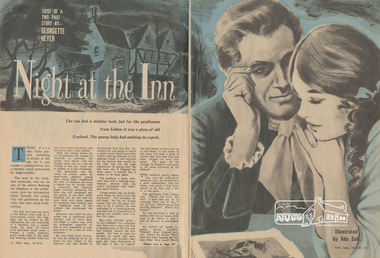
Work on paper (item) - Magazine, New Idea, October 18, 1961, October 18, 1961
... Brunswick. From 1963 she and her husband Robert built a Alistair Knox designed house at Lot 8. ...Brunswick. From 1963 she and her husband Robert built a Alistair Knox designed house at Lot 8. ...Florence Ada Zull, known as Ada was an illustrator for the 'New Idea for Women" magazine. In 1961 she lived in Brunswick. From 1963 she and her husband Robert built a Alistair Knox designed house at Lot 8. Metery Road, Eltham "... Mum .. worked too during the week.. from the bungalow in Brunswick. The New Idea, a woman's magazine would send her the galley for the week's short story and she would illustrate an appropriate picture." - Sue Bennett (nee Zull), Eltham District Historical Society Newsletter, No 250 February 2020. In this issue Ada Zull has a full page illustration for part one of a story by Georgette Heyer. (page 12 and 13). Ada's son and daughter Susan model jumpers that were knitting competition prize winners at the Royal Agricultural Society of Victoria's Royal Show including Mrs L.M. Fullerton. (page 15) This was the "Special Baby Issue". It includes articles on women in the Armed forces and marriage, Mrs Mary Jane Virtue a pilot, Egg dish recipes and a number of pages relating to baby care. Patterns for making a baby-sac, bonnet, jackets and babycot, advertising, letters, beauty column, patterns and other features. women's royal army corp, women's royal australian navy service, women's auxiliary australian air force, wrans, wrac, wraaf, marriage, mary jane virtue, ada zull, georgette heyer, royal agricultural society of victoria, royal melbourne show, l.m. fullerton, egg dishes, handcrafts, baby-care, magazine, women, 1961, susan zull, susan bennett -
 Eltham District Historical Society Inc
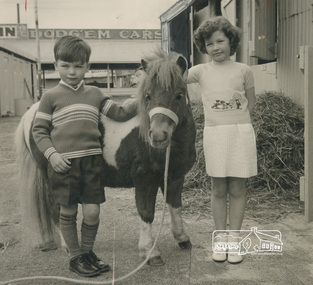
Work on paper (item) - Photograph, Little Models, 1961
... Brunswick. From 1963 she and her husband Robert built a Alistair Knox designed house at 2 (lot 8) Metery Road, Eltham. ...Brunswick. From 1963 she and her husband Robert built a Alistair Knox designed house at 2 (lot 8) Metery Road, Eltham. ...Florence Ada Zull, known as Ada was an illustrator for the 'New Idea for Women" magazine. In 1961 she lived in Brunswick. From 1963 she and her husband Robert built a Alistair Knox designed house at 2 (lot 8) Metery Road, Eltham. In this issue Ada's son and daughter Susan model jumpers that were knitting competition prize winners at the Royal Agricultural Society of Victoria's Royal Show including Mrs L.M. Fullerton. (page 15) The opposite page features a photograph of film star Virginia Mayo and a beauty column. Original photo cut in half donated along with the issue of the magazine the photo was published in. royal agricultural society of victoria, royal melbourne show, l.m. fullerton, 1961, susan zull, susan bennett, zull family, knitting, pony, jumpers, virgninia mayo -
 Eltham District Historical Society Inc
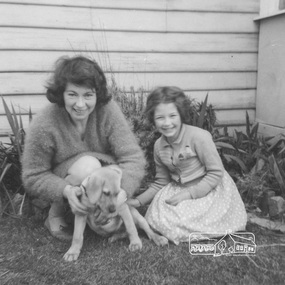
Work on paper (item) - Photograph, Ada and Susan Zull with a puppy, October 18, 1961
... house, possibly their home in Burnswick. Early 1960s. Florence Ada Zull, known as Ada was an illustrator for the 'New Idea for Women" magazine. In 1961 she lived in Brunswick...house, possibly their home in Burnswick. Early 1960s. Florence Ada Zull, known as Ada was an illustrator for the 'New Idea for Women" magazine. In 1961 she lived in Brunswick ...Ada Zull and her daughter Susan photographed with a puppy in front of a weatherbaord house, possibly their home in Burnswick. Early 1960s. Florence Ada Zull, known as Ada was an illustrator for the 'New Idea for Women" magazine. In 1961 she lived in Brunswick. From 1963 she and her husband Robert built a Alistair Knox designed house at Lot 8. Metery Road, Eltham ada zull, susan zull, susan bennett, puppy, pet -
 Eltham District Historical Society Inc
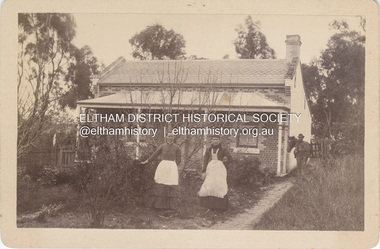
Photograph, William Hall, Possibly Caroline Fairlie Stewart (nee Kidd) on left and Unidentified Shillinglaw Family Female (sister?) on right, c.1885
... house...Kidd Family...Unknown...william hall Photographer 114 Brunswick Street...Ltd., Berwick, Victoria 1991 Marg Ball Collection Shillinglaw Family Photo Album 2 Cabinet Photo 1875-1886 1885 Caroline Fairlie Stewart (nee Kidd) Female Shillinglaw 2 house Kidd Family Unknown william hall Photographer 114 Brunswick Street CABINET Photo approximnately 4.5 inches by 6.5 inches (11.5 x 16.5 cm). ...The two women may be sisters (Kidd family) Duplicate image in Album 3 (05665) William Hall operated at 114 Brunswick St., Fitzroy, Victoria, between 1875-1886 (SLV and Sands directory) CABINET 1866-1905 The Cabinet photo was introduced in 1866 in answer to a demand for a larger format photograph which could be mounted for a cabinet or on the wall. They were 4.5 inches by 6.5 inches (11.5 x 16.5 cm), more than twice the size of the cdv. They cost about twice as much as a cdv but eventually displaced them. They were not extensively produced until 1880 and had ceased by 1905. Coloured mounts, especially maroon or green, indicate a date between 1880 and 1890. - Frost, Lenore; Dating Family Photos 1850-1920; Valiant Press Pty. Ltd., Berwick, Victoria 1991marg ball collection, shillinglaw family photo album 2, cabinet photo, 1875-1886, 1885, caroline fairlie stewart (nee kidd), female shillinglaw 2, house, kidd family, unknown, william hall photographer 114 brunswick street -
 Eltham District Historical Society Inc
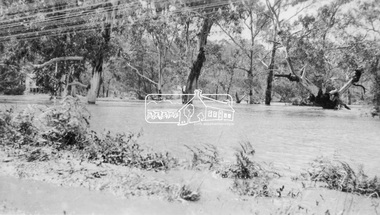
Negative - Photograph, Floodwaters, Diamond Creek, Eltham, 1934
... houses were swept away with hundreds of people left homeless across the state. The historic 1934 flood of the Diamond Creek and Yarra River set the criteria for future planning with respect to flood water rise. Noted on reverse of print - Copied by Hugh Fisher, 82 Lygon St., Brunswick...houses were swept away with hundreds of people left homeless across the state. The historic 1934 flood of the Diamond Creek and Yarra River set the criteria for future planning with respect to flood water rise. Noted on reverse of print - Copied by Hugh Fisher, 82 Lygon St., Brunswick ...The Diamond Creek in flood near the Main Road bridge at Eltham, Victoria. The Yarra also was in flood. In early December 1934 the "Greatest flood in the history of the Yarra" occured, according to The Argus newspaper. Bridges and houses were swept away with hundreds of people left homeless across the state. The historic 1934 flood of the Diamond Creek and Yarra River set the criteria for future planning with respect to flood water rise. Noted on reverse of print - Copied by Hugh Fisher, 82 Lygon St., BrunswickThis photo forms part of a collection of photographs gathered by the Shire of Eltham for their centenary project book,"Pioneers and Painters: 100 years of the Shire of Eltham" by Alan Marshall (1971). The collection of over 500 images is held in partnership between Eltham District Historical Society and Yarra Plenty Regional Library (Eltham Library) and is now formally known as the 'The Shire of Eltham Pioneers Photograph Collection.' It is significant in being the first community sourced collection representing the places and people of the Shire's first one hundred years.Digital image 4 x 5 inch B&W Neg (2 frames on one neg) Print 9 x 15.5 cmOn reverse of print - "Copied by Hugh Fisher, 82 Lygon St., Brunswick" (for Shire of Eltham)sepp, shire of eltham pioneers photograph collection, eltham, floods, 1934 flood, diamond creek (creek), floodwater -
 Eltham District Historical Society Inc
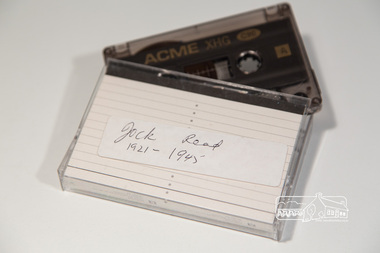
Audio - Audio Compact Cassette Tape, Audio Recording; Jock Read with Diana Bassett-Smith, 1990s
... 25:22 Left Eltham high school in 1930 26:00 Begins discussing involvement with the church of England 31:46 Electricity did not come to Eltham until 1926 Jock described it as an exciting event 33:00-34:00 Describing the rented house, he was living in- small wooden cottage 35:00 Discussion around starting a mail run round areas of Eltham 38:40-42:35 Enlisted in the navy during WW2 • Navel cadets in 1934 • HMAS Vampire • Served as a seaman gunner Audio Cassette Audio Recording Diana Bassett-Smith Eltham Jock Read oral history Read family elham primary school eltham high school Eltham Primary School 1920s Brunswick Depression Church St Margaret's Church Housing WW2 Second World War Audio Compact Cassette Tape ACME C90 XHG Converted to MP3 file; 55.1MB, 0:42:35 Audio Recording; Jock Read with Diana Bassett-Smith Audio Audio Compact Cassette Tape ...Oral history interview with Jock Read (1915- 2010) conducted by Diana Bassett-Smith of Eltham District Historical Society. Peter Bassett-Smith and possibly Gwen Orford also in attendance. The interview includes discussion of Jock's family history and connection to Eltham, including his attendance at Eltham State School starting 1921, childhood memories including games he played, memories of Eltham High School, recreational activities, milking, money earned, local transport, neighbours, effect of the Depression, local shops, involvement with the Church of England and more. Recording contains significant amount of noise. 0:00 Introduction including the clarification of Jock's name as Frances and backstory of his parents being from England 3:15- 5:00 Commences talking about home life and childhood 3:38 Talking about family immigrating to Australia His father immigrated to Australia when he was 6 4:05 Jock was born in and lived with his parents in Brunswick before moving to Eltham during the 1920s 4:55-7:44 Permanently moved to Eltham and started at Eltham Primary School in 1921 Talking about books used at school, and games played at school such as marbles, cricket and football 8:45 Moved into Eltham High School after finishing at Eltham Primary 9:50 Week and weekend activities including: Milking cows and doing milk runs on horseback before school 13:15 Most common mode of transport was using horse drawn vehicles and walking 14:50 Discusses impact of depression on family: Father had previously started a business but the depression had a large impact on that 16:10-18:00 Facilities that Jock had • Used hurricane lamps and candles- no electricity • Woodfire • Milk and bread were delivered • Greengrocer- George Bird? 25:22 Left Eltham high school in 1930 26:00 Begins discussing involvement with the church of England 31:46 Electricity did not come to Eltham until 1926 Jock described it as an exciting event 33:00-34:00 Describing the rented house, he was living in- small wooden cottage 35:00 Discussion around starting a mail run round areas of Eltham 38:40-42:35 Enlisted in the navy during WW2 • Navel cadets in 1934 • HMAS Vampire • Served as a seaman gunner Audio Compact Cassette Tape ACME C90 XHG Converted to MP3 file; 55.1MB, 0:42:35audio cassette, audio recording, diana bassett-smith, eltham, jock read, oral history, read family, elham primary school, eltham high school, eltham primary school, 1920s, brunswick, depression, church, st margaret's church, housing, ww2, second world war -
 Eltham District Historical Society Inc
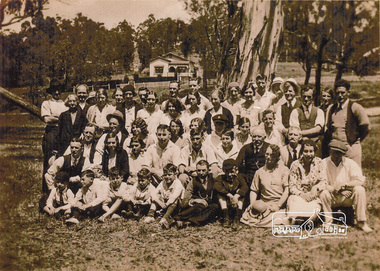
Photograph, Group from Brunswick ANA Lodge at Eltham, Nov. 1933
... house of similar style present in this location. Further reviews of photos taken in the 1950s by Grace Mitchell looking back towards Bremner Flats shows two trees close by on a lean similar to that in the photos. Australian Natives Association Bremners Flats recruitment wingrove park Inkjet-printed copy of sepia photograph Group from Brunswick ...One of three photos. Group of people including children associated with the Australian Natives Association at an outing at Eltham Lower Park. The first image was reproduced in EDHS Newsletter No. 163 July 2005 following a query from Nillumbik Historical society (Gwen Myers) seeking information about the location of the photo. It was suggested that it may be Eltham Lower Park, however the house in the background did not appear correct. There were simliar but mirror imaged. A more recent review of these photographs (2023) suggests that the photos were actually taken in Bremners flats (present-day Wingrove Park) looking towards the house near the intersection of Main and Mount Pleasant roads - Mrs Bremner's house. The topograpghy is also more in fitting with this location than that of Eltham Lower Park. A review of a 1945 aerial photo shows only one house of similar style present in this location. Further reviews of photos taken in the 1950s by Grace Mitchell looking back towards Bremner Flats shows two trees close by on a lean similar to that in the photos.Inkjet-printed copy of sepia photographaustralian natives association, bremners flats, recruitment, wingrove park -
 Eltham District Historical Society Inc
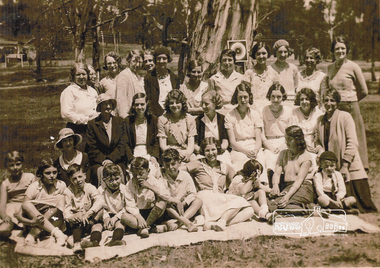
Photograph, Group from Brunswick ANA Lodge at Eltham, Nov. 1933
... house of similar style present in this location. Further reviews of photos taken in the 1950s ny Grace Mitchell looking back towards Bremner Flats shows two trees close by on a lean similar to that in the photos. Australian Natives Association Bremners Flats recruitment wingrove park Inkjet-printed copy of sepia photograph Group from Brunswick ...One of three photos. Group of people including children associated with the Australian Natives Association at an outing at Eltham Lower Park. The first image was reproduced in EDHS Newsletter No. 163 July 2005 following a query from Nillumbik Historical society (Gwen Myers) seeking information about the location of the photo. It was suggested that it may be Eltham Lower Park, however the house in the background did not appear correct. There were simliar but mirror imaged. A more recent review of these photographs (2023) suggests that the photos were actually taken in Bremners flats (present-day Wingrove Park) looking towards the house near the intersection of Main and Mount Pleasant roads - Mrs Bremner's house. The topograpghy is also more in fitting with this location than that of Eltham Lower Park. A review of a 1945 aerial photo shows only one house of similar style present in this location. Further reviews of photos taken in the 1950s ny Grace Mitchell looking back towards Bremner Flats shows two trees close by on a lean similar to that in the photos.Inkjet-printed copy of sepia photographaustralian natives association, bremners flats, recruitment, wingrove park -
 Eltham District Historical Society Inc
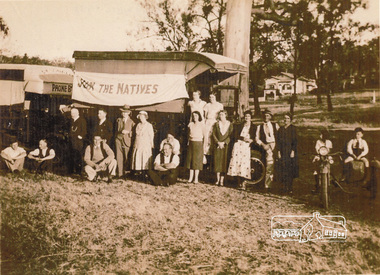
Photograph, Group from Brunswick ANA Lodge at Eltham, Nov. 1933
... house of similar style present in this location. Further reviews of photos taken in the 1950s ny Grace Mitchell looking back towards Bremner Flats shows two trees close by on a lean similar to that in the photos. Australian Natives Association recruitment Bremners Flats Wingrove Park Inkjet-printed copy of sepia photograph Group from Brunswick ...One of three photos. Group of people including children associated with the Australian Natives Association at an outing at Eltham. A truck displays a flag "Join the Natives". The first image was reproduced in EDHS Newsletter No. 163 July 2005 following a query from Nillumbik Historical society (Gwen Myers) seeking information about the location of the photo. It was suggested that it may be Eltham Lower Park, however the house in the background did not appear correct. There were simliar but mirror imaged. A more recent review of these photographs (2023) suggests that the photos were actually taken in Bremners flats (present-day Wingrove Park) looking towards the house near the intersection of Main and Mount Pleasant roads - Mrs Bremner's house. The topograpghy is also more in fitting with this location than that of Eltham Lower Park. A review of a 1945 aerial photo shows only one house of similar style present in this location. Further reviews of photos taken in the 1950s ny Grace Mitchell looking back towards Bremner Flats shows two trees close by on a lean similar to that in the photos. Inkjet-printed copy of sepia photographaustralian natives association, recruitment, bremners flats, wingrove park -
 Bendigo Historical Society Inc.
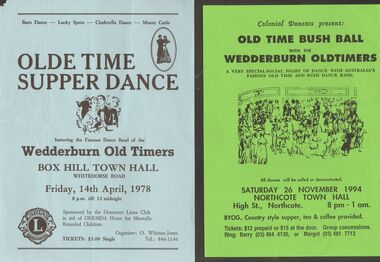
Document - PETER ELLIS COLLECTION: WEDDEBURN OLD TIMERS
... House NSW... The Graphic - February 1880... St Ambrose's Hall Brunswick...ENTERTAINMENT Dance ball Peter Ellis Collection Wedderburn Old Timers Box Hill Town Hall Doncaster Lions Club ONEMDA Home for Mentally Retarded Children O Whitten-Jones Northcote Town Hall Sir Roger de Coverley Government House NSW The Graphic - February 1880 St Ambrose's Hall Brunswick Talk Song & Dance Society Victoria Inc Seven advertising notices for dances and balls featuring the Wedderburn Old Timers. ...Seven advertising notices for dances and balls featuring the Wedderburn Old Timers. The light blue one was held at the Box Hill Town Hall on 14/4/1978 and was sponsored by the Doncaster Lions Club in aid of ONEMDA Home for Mentally Retarded Children and organised by W Whitten-Jones. The bright green on was held at the Northcote Town Hall on 26/11/1994. The two yellow and the white one was held at the Northcote Town Hall on 24/6/1995 and the two darker green ones were for the St Patrick's Eve Old Time-Colonial Ball held at St Ambrose's Hall, Brunswick on 16/3/1996 and was presented by Talk, Song & Dance Society Victoria Inc.entertainment, dance, ball, peter ellis collection, wedderburn old timers, box hill town hall, doncaster lions club, onemda home for mentally retarded children, o whitten-jones, northcote town hall, sir roger de coverley, government house nsw, the graphic - february 1880, st ambrose's hall brunswick, talk song & dance society victoria inc -
 Australian Queer Archives
Poster, Cathie Knox, International Women's Day 1995, 1995
... Additional text: "A woman's place is… …in the struggle : 24th consecutive rally and march : 6:30pm steps of Parliament House : Dance afterwards 8:30pm Brunswick Town Hall (cnr. Sydney Rd. + Dawson St.)."...Women's liberation Additional text: "A woman's place is… …in the struggle : 24th consecutive rally and march : 6:30pm steps of Parliament House : Dance afterwards 8:30pm Brunswick Town Hall (cnr. Sydney Rd. + Dawson St.)." ...The use of the colours purple, green and white reference the colours used during the first wave feminist movement initially in the UK by the Women’s Social and Political Union (WSPU), and subsequently emblematic of the Australian women’s movement.Graphic illustration of a naked female seated figure in purple, white and red, against a background with 'rays' of purple, green and white. Main text in red, with additional text at base in purple.Additional text: "A woman's place is… …in the struggle : 24th consecutive rally and march : 6:30pm steps of Parliament House : Dance afterwards 8:30pm Brunswick Town Hall (cnr. Sydney Rd. + Dawson St.)."women's liberation -
Port Melbourne Historical & Preservation Society
Document - List of Port Melbourne Hotels & Licencees 1872, 1872
... Brunswick Pier Hotel...Chequers Inn...Chusan Hotel...Commercial Hotel...Cosmopolitan Hotel...Customs House...BARTLETT Edward SUFFOLK Martin CLASBY Mrs PEATT W KINYON William SPIRE Thomas TURVILLE Charles PEACOCK J WILLIAMS William CANNON J BELL Michael FLANAGAN William CARROLL J W CARR John ALLEN J E CROCKFORD Charles SHARP Henry O'BRIEN G T POTTER F JOHNSON All England Eleven Hotel Auld Reekie Hotel Australian Hotel Bay View Hotel Brunswick Pier Hotel Chequers Inn Chusan Hotel Commercial Hotel Cosmopolitan Hotel Customs House Hotel Exchange Hotel Fitzjames Hotel Floodgate Hotel Foresters Arms Hotel Foundry Hotel Fountain Inn Freemasons Hotel Happy Home Hotel Hibernian Hotel Kent Hotel Locomotive Hotel Lord Raglan Hotel Marine Hotel Naval Brigade Hotel New Great Britain Hotel Pier Hotel President Lincoln Hotel Prince Alfred Hotel Retreat Inn Royal Hotel Ship Hotel Station Hotel Victoria Hotel W CRUIKSHANK Army and Navy Hotel A4 size handwritten sheet with names, addresses and licencees of Port Melbourne hotels in 1872. ...Handwritten list of hotels & their licencees in 1872 believed to have been complied by donor's ancestor, a member of the LOBB family.A4 size handwritten sheet with names, addresses and licencees of Port Melbourne hotels in 1872.business and traders - hotels, built environment - commercial, lobb, h. fonseca, harry hall, william hays, j mcculloch, wm reynolds, g sefton, mrs crockford, andrea lagogiannis, g braithwaite, v sanderson, j carter, g w hall, j michie, t cowling, jas. bartlett, edward suffolk, martin clasby, mrs peatt, w kinyon, william spire, thomas turville, charles peacock, j williams, william cannon, j bell, michael flanagan, william carroll, j w carr, john allen, j e crockford, charles sharp, henry o'brien, g t potter, f johnson, all england eleven hotel, auld reekie hotel, australian hotel, bay view hotel, brunswick pier hotel, chequers inn, chusan hotel, commercial hotel, cosmopolitan hotel, customs house hotel, exchange hotel, fitzjames hotel, floodgate hotel, foresters arms hotel, foundry hotel, fountain inn, freemasons hotel, happy home hotel, hibernian hotel, kent hotel, locomotive hotel, lord raglan hotel, marine hotel, naval brigade hotel, new great britain hotel, pier hotel, president lincoln hotel, prince alfred hotel, retreat inn, royal hotel, ship hotel, station hotel, victoria hotel, w cruikshank, army and navy hotel
