
Showing 8 items matching "bucking design"
-
 Moorabbin Air Museum
Book - Aircraft structures
... ...Bucking design...Aircraft structures Static analysis of structures Flight -vehicle imposed loads Elasticity of structures Behaviour & evaluation of vehicle material Stress analysis Deflection analyses Finite element stiffness method Semimonocoque structure analyses Thermal stresses Tension Bending Torsion Bucking design Joints & fittings Overview of fundamental concepts in analysis & design of flight structures, circa 1982 Aircraft Structures Book Aircraft structures ...Overview of fundamental concepts in analysis & design of flight structures, circa 1982non-fictionOverview of fundamental concepts in analysis & design of flight structures, circa 1982static analysis of structures, flight -vehicle imposed loads, elasticity of structures, behaviour & evaluation of vehicle material, stress analysis, deflection analyses, finite element stiffness method, semimonocoque structure analyses, thermal stresses, tension, bending, torsion, bucking design, joints & fittings -
Glenelg Shire Council Cultural Collection
Souvenir - Tea Towel - Portland Victoria, n.d
... Black print 'Greetings from PORTLAND Victoria', in orange 'WHALES' Souvenir Tea Towel - Portland Victoria Designed by Buck Marketing, Australia ...Souvenir tea towel, cotton, white on back, front multi-coloured, dark blue border. Images of whales, chart showing sizes of whales relative to one another. Black print 'Greetings from PORTLAND Victoria', in orange 'WHALES' -
 Geoffrey Kaye Museum of Anaesthetic History
Equipment - Inhaler, Bruck, 1908
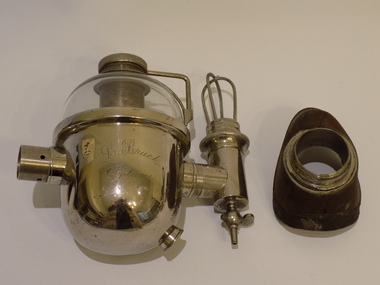
... The ability for the surgeon to unscrew, clean and sterilize each part of the Inhaler contributes to the streamlined design of the piece. The Buck Inhaler holds scientific significance. ...The Bruck Inhaler is a modification of the Clover Inhaler, designed by Lambert Bruck. Bruck added a glass dome which enabled the level of ether to be monitored during administration. This was a revolutionary change as it removed guess work from the process.The Bruck Inhaler is a historically, aesthetically and scientifically significant piece. The basic design is based on the Clover Inhaler, but with a rounded bottom. The idea of a glass viewing window was possibly inspired by Wilson-Smith Inhaler. The Bruck Inhaler is historically significant as it is the first inhaler to be made with a completely clear lower glass section. This improved the usability for the ether administrator, and eliminated much of the guesswork associated with dosage and ether levels, which in turn improved the patient experience. This piece provides a strong local link to both anaesthetic and general medical practice at the turn of the century. The design is credited to Ludwig Bruck of Sydney, and was presumably manufactured in the same area. Bruck, as the attributed designer, holds much relevance to the significance of the object, as connected with him is much historical information about the social context of medical practice. Ludwig Bruck was a prominent figure in the medical industry. He started his medical career in Sydney as a Medical Transfer Agent, and later owned a shop at 16 Castlereagh Street, Sydney. This business is listed in the 1903 Register of Firms as a Medical Agent and Importer of Medical Instruments and Books. Bruck was vocal as a journalist and published analyses of medical statistics, as well as the well known Australasian Medical Dictionary and Handbook, which included the “List of Unregistered Medical Practitioners”. Ludwig Bruck was an immigrant. He was of German descent, which placed him in a precarious position within Sydney society during the turn of century. Bruck conducted several public conversations with prominent members of the Australian Natives Association through the Sunday News in regards to his disagreement of the employment of medical practitioners by the ANA specifically to corroborate their health insurance policies. He was also a stalwart supporter of the Australian arm of the British Medical Association, being the publisher of the first and subsequent editions of The Australian Medical Gazette. Bruck chose to end his life with a combination of poison and chloroform on 14 August 1915, after being accused of trading with the enemy during World War One. His suicide note stated his horror at leaving his business partner to deal with the tarring of his reputation as the reason for his decision. The Bruck Inhaler has aesthetic significance as it is a beautiful example of turn of the century surgical design and craftsmanship. Aseptic methods of surgery were well known by 1909, and the aesthetic design of the Bruck Inhaler conformed to these principles. The ability for the surgeon to unscrew, clean and sterilize each part of the Inhaler contributes to the streamlined design of the piece. The Buck Inhaler holds scientific significance. There is the capacity for further research to be undertaken on the object. Geoffrey Kaye often collected multiple examples of equipment, usually one for reverse engineering and another for teaching. There are currently two examples of the Bruck Inhaler in the collection, presenting an opportunity for further technical research on the object. The inhaler is oval shaped with one half made of glass to allow observation of the ether level. A vertical cross tube, 22mm in diameter passes between the face-piece and the bag [missing]. There is a stopcock for admission of oxygen or nitrous oxide opposite the bag attachment. There is a central tube, 28mm in diameter, with controllable ports on either side. There is also a tear-drop shaped fask mask.Hand engraved on side of base: L. Bruck / Sydneyclover, joseph, bruck, lambert, inhaler, rebreather, nitrous oxide, oxygen, williams, probyn -
 Geoffrey Kaye Museum of Anaesthetic History
Equipment - Inhaler, Clover (modified)
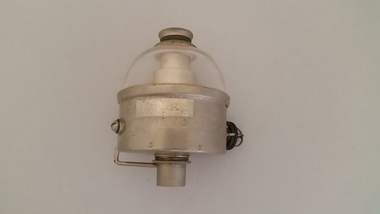
... designed. The dome-shaped reservoir was turned to points on a control dial to gradually increase or decrease the percentage of the air that passed over the ether. Several inventors based new inhalers on this, while the original continued to be manufactured as late as the beginning of WWII. This modified version differs from the original Clover inhaler as it has a glass dome chamber at the top allowing the level of ether to be monitored. Joseph Clover Lambert Buck ...Dr. Joseph Clover (1825-1882), an English physician, first described his Portable Regulating Ether Inhaler on Jan. 20, 1877. Clover was an especially sought after anesthesiologist and early pioneer in the specialty. This was the best-known of many inhalers that Clover designed. The dome-shaped reservoir was turned to points on a control dial to gradually increase or decrease the percentage of the air that passed over the ether. Several inventors based new inhalers on this, while the original continued to be manufactured as late as the beginning of WWII. This modified version differs from the original Clover inhaler as it has a glass dome chamber at the top allowing the level of ether to be monitored.Metal based chamber with glass dome top. There is a metal connection point at the top of the glass dome for a rebreather bag, with a whistle tip connection point at the base of the chamber for a facemask. There is no rebreather bag or facemask. There is a black plastic stopper to the side of the chamber, with a glass bulb with a metal wire cage covering.joseph clover, lambert buck, closed administration -
 Federation University Art Collection
Work on paper - Bookplate, 'Ex Libris Andrew Buck'
... design award keith wingrove memorial trust Pencil signature. Morrison A woman watches a person in a hot air balloon with sails. Artists statement: "The balloon print was undertaken for a themed exhibition held in Belgium, but it suits Andrew well. He is always claiming that he wants to escape but is anchored down." In 2001 Andrew Buck ...After a quiet period, interest in bookplates in Australia began to increase in the early 1970s, Entrepreneurial art and book collectors such as Edwin Jewell and others commissioned multiple Bookplate designs from a range of well known fine artists. At a 1997 meeting in Melbourne of the Ephemera Society of Australia Edwin Jewell and others announced the formation of the Australian Bookplate Society. The society was instrumental in promoting the art of the bookplate through establishment of the Australian Bookplate Design competition. The competition includes a design award for secondary schools students. A woman watches a person in a hot air balloon with sails. Artists statement: "The balloon print was undertaken for a themed exhibition held in Belgium, but it suits Andrew well. He is always claiming that he wants to escape but is anchored down." In 2001 Andrew Buck was a lecturer in law/politics at Macquarie University, New South Wales. Pencil signature. Morrisonbookplate, printmaking, australian bookplate design award, keith wingrove memorial trust -
 Kilmore Historical Society
History of England, 1846
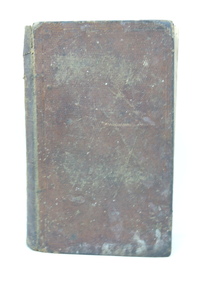
... Buck/Mounted Constable/Kilmore District/June 1856'. Brown leather-bound hardcover book, very worn extremities, tear to upper spine. Embossed cross-hatch design ...Whittaker's improved edition of Pinnock's Goldsmith's History of England, from the invasion of Julius Caesar to the death of George 11., with a continuation to the present time; also, a dictionary, biographical, historical &c. explaining every difficulty, and rendering the whole easy to be understood; and questions for examination at the end of each section: besides a variety of valuable information added throughout the work....Brown leather-bound hardcover book, very worn extremities, tear to upper spine. Embossed cross-hatch design on leather with embossed border. Staining lower right front, loss of colour back & front. Scored damage to front. Flyleaf torn with piece missing upper right. Front hinge separated, binding loose. 2nd flyleaf stained. Foxing and discolouration of page edges. 519 pp. Poor condition.Inside front cover, label advertising Fulton & Knight's Pronouncing Dictionary, 'T & C Buck/1846'. Front flyleaf, ' [missing] Buck/ [indecipherable] school/1846'. Front 2nd flyleaf, 'Thomas Buck/Mounted Constable/Kilmore District/June 1856'.history of england, thomas buck, mounted constable, kilmore -
 University of Melbourne, Burnley Campus Archives
Photograph - Black and white print, Publicity Branch Victorian Department of Agriculture, Table Tennis Game, 1961
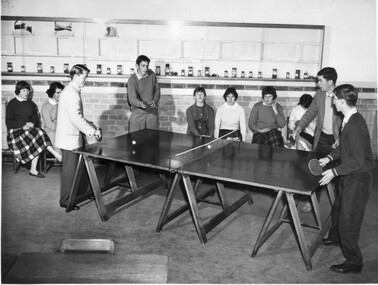
... Black and white photograph of 4 male students playing table tennis in the Landscape Design Room upstairs in the Administration Building watched by 6 female students. Identified: L to R, R. Flower, H. Savery, J. Deverson, J. Nancarrow, J. Buck...All graduated with a Diploma of Horticulture in 1961. students table tennis female students r. flower h. savery j. deverson j. nancarrow j. buck d. issell h. page diploma of horticulture 1961 recreation On reverse, "Photograph by Publicity Branch Victorian Department of Agriculture Ref. No. c.1695.R." Black and white photograph of 4 male students playing table tennis in the Landscape Design Room upstairs in the Administration Building watched by 6 female students. ...All graduated with a Diploma of Horticulture in 1961.Black and white photograph of 4 male students playing table tennis in the Landscape Design Room upstairs in the Administration Building watched by 6 female students. Identified: L to R, R. Flower, H. Savery, J. Deverson, J. Nancarrow, J. Buck, D. Issell, H. Page, ?, ?, ?.On reverse, "Photograph by Publicity Branch Victorian Department of Agriculture Ref. No. c.1695.R."students, table tennis, female students, r. flower, h. savery, j. deverson, j. nancarrow, j. buck, d. issell, h. page, diploma of horticulture, 1961, recreation -
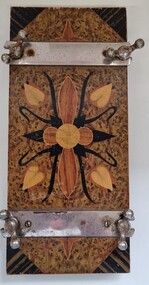 Wodonga & District Historical Society Inc
Functional object - Flower press, c1900
... Buck PTY LTD. / MELBOURNE" A flower press made from timber with metal clasps and screws. The front is decorated with a parquetry flower design. ...The preservation of plants and flowers for both decorative and scientific purposes dates back to ancient times. Drying and pressing flowers became a popular hobby and preservation method in Victorian England. The flower press was readily available to buy or simple and inexpensive to create. This flower press was marketed through Henry Buck Pty. Ltd. in Melbourne, Victoria. Henry Buck migrated from England and established his store in Melbourne in 1890. The business dealt primarily in menswear, but also had other domestic lines. The business, trading as Henry Bucks, still operates in Melbourne and several other locations.This item is representative of a popular hobby of the Victorian era.A flower press made from timber with metal clasps and screws. The front is decorated with a parquetry flower design. There are 2 metal strips screwed onto the timber horizontally. These are secured by wing screws which can be adjusted to hold the back and front together. They allow pressure to be adjusted depending on what item is being compressed.Label on back: Left hand side around red shape with HB in the centre "THE SIGN OF/ EXCELLENCE" On right hand side: "LONDON/ Henry Buck PTY LTD. / MELBOURNE"flower drying, victorian era hobbies, henry buck pty. ltd.
