
Showing 12 items matching "bulk food storage"
-
 Friends of Westgarthtown
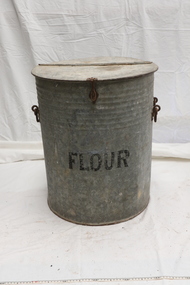
Domestic object - Metal flour tin, c. 1920-1950
... food storage...kitchen equipment...domestic life...household management...bulk...Large storage tins such as this were commonly used in rural households throughout the nineteenth and twentieth centuries, particularly when staple ingredients were purchased in bulk. These containers were an essential part of household management, allowing families to store substantial quantities of food for regular use. ...Flour tin food storage kitchen equipment domestic life household management bulk food storage farming households Westgarthtown Ziebell family. ...This metal flour storage tin belonged to the Ziebell family and was originally used at their farm at Westgarthtown, Thomastown, Victoria. Henry Ziebell recalled the tin being used by the family during his childhood and its continued presence in the family home in Thomastown. He explained that flour was traditionally purchased in large 70-pound (approximately 32 kg) bags and transferred into the tin for everyday domestic use. Large storage tins such as this were commonly used in rural households throughout the nineteenth and twentieth centuries, particularly when staple ingredients were purchased in bulk. These containers were an essential part of household management, allowing families to store substantial quantities of food for regular use. The tin provides a tangible connection to the domestic routines, food preparation and household practices of successive generations of the Ziebell family, reflecting the practical nature of everyday life at Westgarthtown. The tin was donated to Ziebell's Farmhouse Museum by Lyn and James Ziebell.Large metal storage tin with hand-painted black lettering reading 'Flour'. Used for storing bulk quantities of flour, the tin provided a practical means of keeping dry goods contained and protected from moisture, pests and contamination.flour tin, food storage, kitchen equipment, domestic life, household management, bulk food storage, farming households, westgarthtown, ziebell family. -
 Flagstaff Hill Maritime Museum and Village
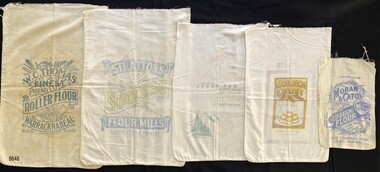
Textile - Flour Bags (5)
... bulk storage of dry goods or sewn into domestic objects such as tea towels, pillowcases or waggas. The flour bags provide both a snapshot of different producers and stockists of flour in Victoria and an example of a useful domestic packaging product, from the early 20th century. Flagstaff Hill Maritime Museum and Village Great Ocean Road Shipwreck Coast flour bags calico domestic object textile food ...Flour bags were used when purchasing flour from the late 19th century to the mid 20th century. They were able to be reused for bulk storage of dry goods or sewn into domestic objects such as tea towels, pillowcases or waggas.The flour bags provide both a snapshot of different producers and stockists of flour in Victoria and an example of a useful domestic packaging product, from the early 20th century.A set of five flour bags originating from different Victorian places. Stratton's in Melbourne, McAlpin's in Melbourne / Ballarat, Moran & Cato's in Fitzroy, Golden Crust from South Yarra and W.C. Thomas from Warracknabeal. Each bag is made from calico with an image on the front that relates to the company.flagstaff hill maritime museum and village, great ocean road, shipwreck coast, flour bags, calico, domestic object, textile, food storage -
 Flagstaff Hill Maritime Museum and Village
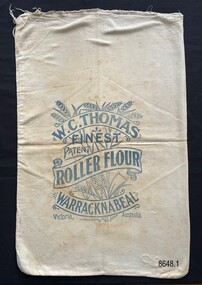
Textile - Flour bag - W.C.Thomas, Warracknabeal
... bulk storage of other dry goods or sewn into domestic objects such as tea towels, pillowcases or waggas. This is a good example of a flour bag from a prominent Victorian flourmill, operating from the late 19th century to the mid-20th century. Flagstaff Hill Maritime Museum and Village Great Ocean Road Shipwreck Coast flour bags calico domestic object textile food ...This flour bag came from the W.C. Thomas Flour Mill at Warracknabeal, Victoria. W.C. Thomas ran a number of flour mills throughout the Victorian wheat belt, with the Warracknabeal Mill operating from 1884 to 1964. After their use for flour storage, flour bags were able to be reused for bulk storage of other dry goods or sewn into domestic objects such as tea towels, pillowcases or waggas.This is a good example of a flour bag from a prominent Victorian flourmill, operating from the late 19th century to the mid-20th century.Calico flour bag for 'Roller Flour' from the flour mill of W.C. Thomas in Warracknabeal, a large wheat growing area in Victoria. The stencil on the front of the bag includes an image of wheat overlaid with the written information in scroll format.W.C. Thomas, Finest, Patent, Roller Flour, Warracknabeal, Victoria, Australia. Wheat image.flagstaff hill maritime museum and village, great ocean road, shipwreck coast, flour bags, calico, domestic object, textile, food storage, w.c. thomas, warracknabeal, flour mill -
 Flagstaff Hill Maritime Museum and Village
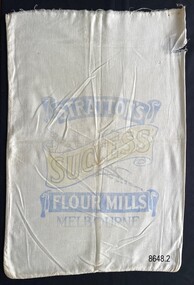
Textile - Flour bag - Stratton's, Melbourne
... bulk storage of dry goods or sewn into domestic objects such as tea towels, pillowcases or waggas. The flour bag provides an example of a useful domestic packaging product, from the early 20th century. Flagstaff Hill Maritime Museum and Village Great Ocean Road Shipwreck Coast calico domestic object textile food ...Flour bags were used when purchasing flour from the late 19th century to the mid 20th century. They were able to be reused for bulk storage of dry goods or sewn into domestic objects such as tea towels, pillowcases or waggas.The flour bag provides an example of a useful domestic packaging product, from the early 20th century.Calico flour bag for 'Success Flour' from Stratton’s flour mill in Melbourne. The stencil on the front of the bag includes the image of a wheat stalk overlaid with the written information in scroll format.Stratton's, Success, Flour Mills, Melbourneflagstaff hill maritime museum and village, great ocean road, shipwreck coast, calico, domestic object, textile, food storage, stratton's, flour bag -
 Flagstaff Hill Maritime Museum and Village
Textile - Flour bag - Golden Crust
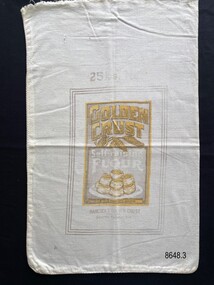
... bulk storage of dry goods or sewn into domestic objects such as tea towels, pillowcases or waggas. The flour bag provides an example of a useful domestic packaging product, from the early 20th century. Flagstaff Hill Maritime Museum and Village Great Ocean Road Shipwreck Coast calico domestic object textile food ...Flour bags were used when purchasing flour from the late 19th century to the mid 20th century. They were able to be reused for bulk storage of dry goods or sewn into domestic objects such as tea towels, pillowcases or waggas.The flour bag provides an example of a useful domestic packaging product, from the early 20th century.Calico flour bag for Golden Crust Self-raising flour, 25lb. The stencil on the bag includes the manufacturer’s address and images of heads of wheat and a plate of scones. 25lbs, Golden Crust, Self-raising Flour, Blended with Phosphate Aerator, Hancock’s Golden Crust Pty.Ltd. South Yarra, Vicflagstaff hill maritime museum and village, great ocean road, shipwreck coast, calico, domestic object, textile, food storage, flour bag, golden crust -
 Orbost & District Historical Society
flour bags, mid 20th century
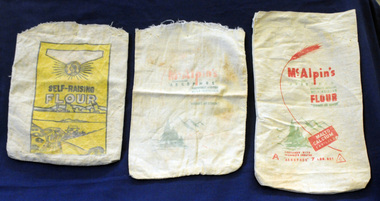
... bulk purchases of flour in early to mid 20th century. They would have been laundered and re-used for storage. In earlier times empty flour bags were washed and boiled and then made into tea towels or children’s bloomers, or underwear. The flour bags are good examples of packaging and design for Australian produce which sold across Australia and overseas in the mid 20th century. flour-bags warren-helena mcalpin mcvitty food-storage Three rectangular, open calico flour bags. 2491.1 is faded and has red and green print sketch of a fir tree with mountains in the background- "McAlpin's, Containing "Aerophos", Self-Raising Flour; "There's No Other". 2491.2 has similar print with a red stalk of wheat and "7lbs Net" and a C inside a triangle. 2491.3 has yellow background inside a rectangular frame with black print - "Tested ; Self-Raising Flour"; a drawing of a wheat field; "Medallion Brand ; Groves McVitty & Co Pty Ltd' 8 Market Street Melbourne. flour bags J.McAlpin & Sons, ...These three flour bags belonged to Helena Warren (nee McKeown) who was a self-taught photographer who became the local press correspondent and producer of postcard images. She was married to William John warren and lived in Newmerella. Flour bags were used for bulk purchases of flour in early to mid 20th century. They would have been laundered and re-used for storage. In earlier times empty flour bags were washed and boiled and then made into tea towels or children’s bloomers, or underwear. The flour bags are good examples of packaging and design for Australian produce which sold across Australia and overseas in the mid 20th century. Three rectangular, open calico flour bags. 2491.1 is faded and has red and green print sketch of a fir tree with mountains in the background- "McAlpin's, Containing "Aerophos", Self-Raising Flour; "There's No Other". 2491.2 has similar print with a red stalk of wheat and "7lbs Net" and a C inside a triangle. 2491.3 has yellow background inside a rectangular frame with black print - "Tested ; Self-Raising Flour"; a drawing of a wheat field; "Medallion Brand ; Groves McVitty & Co Pty Ltd' 8 Market Street Melbourne.flour-bags warren-helena mcalpin mcvitty food-storage -
 Kiewa Valley Historical Society
Tin Tea Pyramids Blend, early 1900's
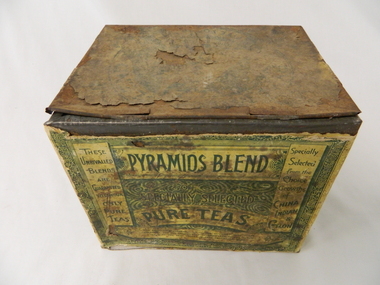
... Bulk storage tins such as this item were not only a requirement but also offered storage for other household items. This usefulness was not overlooked by the "canny" rural family. loose leaf tea containers food storage tins kitchen tidies On the front side and in the background, there are three sketches of Egyptian pyramids(increasing in size from left to right). ...This early 1900's tin which contained loose leaf blended tea was imported into Australia by those tea merchants who wanted to provide the Australian tea drinkers with quality tea. It could well be early Lipton distributors to both city and rural clients and consumers. This was in a period when most rural families were heavy tea drinkers. It was well before the introduction of coffee as a drink (especially instant) for the early morning, after meals and general "drink any time" pick me up beverage.This relatively large tea tin marks a period in time when loose leaf tea was in great demand and large quantities were not only used by families but also restaurants, workers mess halls and remote large rural families. The ability to obtain a quick tea supply in semi remote rural areas such as the Kiewa Valley was not possible due to the factors of all weather road access and the economics of traders going out of their way. Stocking up with important beverages, such as tea, was a "one of those things" that early rural communities had to endure with. Bulk storage tins such as this item were not only a requirement but also offered storage for other household items. This usefulness was not overlooked by the "canny" rural family.This large metal tin container was specifically manufactured for the kitchens requiring a bulk storage "bin" type of loose leaf tea content. When emptied, it could also be used as a general kitchen storage container for other bulk consumables.On the front side and in the background, there are three sketches of Egyptian pyramids(increasing in size from left to right). At the forefront there is a camel "train" loaded with supplies and handlers, making their way over the sandy desert going towards a large sign(in a freehand script) "PYRAMIDS BLEND". The left side "Specially Selected" and underneath "PURE TEAS" below this and within a circle is the figure of a Geisha clad of Asian appearance (with a fan in a raised hand with boxes(of varying sizes) around her. All these are in (off white design and wording on a green background. On the back in green print on off white background "PYRAMIDS BLEND" and underneath "OF SPECIALLY SELECTED PURE TEAS". On either side are columns of similar print. To the left "THESE UNRIVALLED BLENDS ARE GUARANTEED TO CONTAIN ONLY PURE TEAS".To the right "SPECIALLY SELECTED FROM THE CHOICE GROWTHS OF CHINA INDIAN & CEYLON". Below both columns is "for delicacy & fragrance of flavor, combined with great strength, and are confidently recommended to the public as the best values in teas obtainable" On the last side is a sketch of an " Indian encircled, holding a staph with palm trees in the background and four tea containers on his left, with "PYRAMID BLEND" as a subject heading. There are two Oxen pulling a two wheeled cart with a load of six large boxes. On lid and barely readable "FIVE POUNDS NET"loose leaf tea containers, food storage tins, kitchen tidies -
 Kiewa Valley Historical Society
Tin Coffee Cylindrical, circa mid to late 1900's
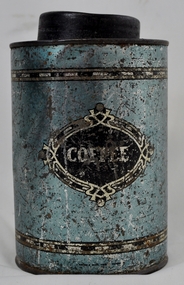
... ...domestic food storage...bulk...foods and drinks to semi isolated rural regions. The accessibility through greater information channels becoming available brought with it unbelievable ranges of goods and foodstuffs. Rural regions still relied on bulk supplies and relatively larger storage...This transition was precipitated by the SEC Vic Hydro Scheme of the 1940's to 1960's which increased the valley's population level three fold. kitchen containers domestic food storage bulk stocks of dried condiments "COFFEE" within an elongated spherical "art deco" four pointed banner of silver and black colouring This cylindrical tin has a pull/push lid(for easy access to the contents). ...This "coffee" tin has by the "art deco" appearance its origins in the late 1950's to 1960's. This time period was one of accelerated growth both in the physical (housing) sense and the mental (new ideas and inventions) changes in "attitudes". These occurred more rapidly in cities but had its effects on the rural environment. The drinking of coffee was spurred on by easier distribution of imported food and drinks. Advertising by stronger radio links and then by television brought the variety of foods and drinks to semi isolated rural regions. The accessibility through greater information channels becoming available brought with it unbelievable ranges of goods and foodstuffs. Rural regions still relied on bulk supplies and relatively larger storage containers than those in cities. This "bulk" buying and storage "syndrome" was a lingering result of many years of "drought" periods when road transports met delays from flooded roadways in supplying population centres in the Kiewa Valley. The construction phases in building the SEC Vic Hydro electricity Scheme in the eastern sections of the Victorian Alps brought many changes to the quiet rural regions in the Kiewa Valley. Changes in population and social mores. The influx of a varied , mostly temporary, and "European flavoured cuisine" changes the "cuppa tea only" flavour to the have a "coffee break". The subliminal influence of the "American" films changed those children growing up in the post 1950s from the "English tea" to the "American coffee". This "Americanisation process has influenced not only rural Australia but also other areas throughout the world.This "insignificant" coffee tin is very significant as it demonstrates that the Kiewa Valley was becoming more accessible to reliable coffee supplies and general food items.The container was part of a "set" of containers that included tea, sugar,biscuits,flour, rice and other family condiments. This type of kitchen storage containers was brought about through changing patterns in tea and coffee useage and overall consumption. Household demands for faster "self help" cooking especially beveridges and the greater choice of kitchen "utensils" was brought on by easier access to products due to a lessening of the area's "isolation" by having a reliable (all weather) road system and an ever increasing population growth. The need for travelling goods/merchant supply caravans to service the area became a diminishing factor, as a result of the establishment of grocery stores in Tawonga and Mount Beauty in the supply of previously "hard to get" groceries. This transition was precipitated by the SEC Vic Hydro Scheme of the 1940's to 1960's which increased the valley's population level three fold.This cylindrical tin has a pull/push lid(for easy access to the contents). The container is labelled for "coffee" however it has no commercial manufacturer's label to establish that it was bought with coffee ingredients in it. The majority of the container's external surface has a "metallic" light blue colour with two sets of silver rings confining black (horizontal spotted) rectangles. "COFFEE" within an elongated spherical "art deco" four pointed banner of silver and black colouringkitchen containers, domestic food storage, bulk stocks of dried condiments -
 Hume City Civic Collection
Scoop
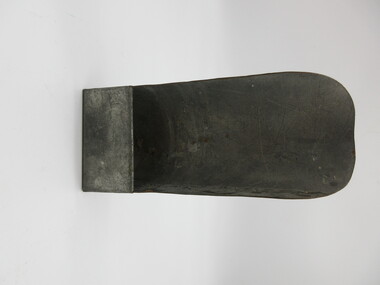
... This tin scoop would have been used in the kitchen at the Sunbury Asylum to distribute bulk food such as sugar, flour etc from larger containers. sunbury asylum george evans collection A tin scoop used to distribute sugar, flour etc from storage containers. ...This tin scoop would have been used in the kitchen at the Sunbury Asylum to distribute bulk food such as sugar, flour etc from larger containers.A tin scoop used to distribute sugar, flour etc from storage containers.sunbury asylum, george evans collection -
 Mont De Lancey
Domestic object - Flour Bag, WatsonMilling Company. Pty.Ltd, 1950's
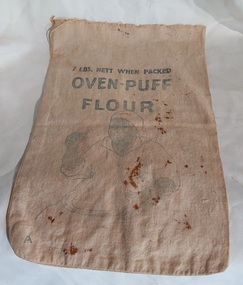
... bulk purchases of flour in early to mid 20th century. They would have been laundered and re-used for storage. In earlier times empty flour bags were washed and boiled and then made into tea towels or children’s bloomers, or underwear. Flour Flour bags Flour containers Food ...This brand of Oven-Puff Flour may refer to self-raising flour. It is noted that self-rising flour (as it was called then) was invented in England in 1845. This flour was commonly branded as "Mammy Oven Puff". Mammy Products Pty Ltd operated during the mid-1900s, producing these specialty baking goods. Advertisements from the late 1930s and 1940s show the flour was marketed as "something different" for home bakers. Flour bags were used for bulk purchases of flour in early to mid 20th century. They would have been laundered and re-used for storage. In earlier times empty flour bags were washed and boiled and then made into tea towels or children’s bloomers, or underwear.A vintage small cream coloured draw string cotton flour bag with the brand Oven-Puff Flour printed in faded pale blue lettering on both sides. 7lbs. Nett when Packed is at the top of the bag. There is an outline image of a black woman wearing a headscarf below the branding. This flour was commonly branded as "Mammy Oven Puff". Mammy Products Pty Ltd. ' 7LBS. NETT WHEN PACKED OVEN-PUFF FLOUR' There is an outline image of a black woman wearing a headscarf below the branding. 'Watson Milling Company. Pty. Ltd.' Is stamped in faded blue on the back of the bag at the bottom. flour, flour bags, flour containers, food storage bags -
 Mont De Lancey
Container - Food Canister, 1900's - 1970's
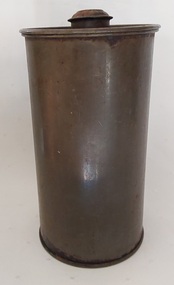
... storage history, with many common examples dating from the 1930s through the 1970s. These items, ranging from plain steel to colorful lithographed patterns, were once ubiquitous in households for storing bulk foods, biscuits, or sewing supplies. ...storage history, with many common examples dating from the 1930s through the 1970s. These items, ranging from plain steel to colorful lithographed patterns, were once ubiquitous in households for storing bulk foods, biscuits, or sewing supplies. ...Vintage unbranded lidded round tin canisters are enduring pieces of kitchen storage history, with many common examples dating from the 1930s through the 1970s. These items, ranging from plain steel to colorful lithographed patterns, were once ubiquitous in households for storing bulk foods, biscuits, or sewing supplies. A tall vintage brown metal canister with a well-fitted lift off lid. The lid has a round knob attached with a rivet. The tin has a small rim at the top and bottom and is clamp sealed at one side. containers, food storage containers, tins -
 Mont De Lancey
Domestic object - Flour bag, Hancock's Golden Crust Pty. Ltd, 1920's - 1950's
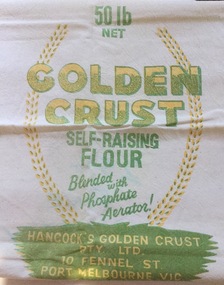
... bulk purchases of flour in early to mid 20th century. They would have been laundered and re-used for storage. In earlier times empty flour bags were washed and boiled and then made into tea towels or children’s bloomers, or underwear. Flour Flour bags Flour containers Food ...Self-rising flour was invented in England in 1845. The inventor, Henry Jones, sought to greatly improve the palatability of the “molar breaking” bread, hard tack, for British sailors. However, it took over 10 years of trying to convince the British command of the Navy to get behind it. In 1855, self-rising flour was finally put to use to make fresh bread for sailors during the Crimean War.Flour bags were used for bulk purchases of flour in early to mid 20th century. They would have been laundered and re-used for storage. In earlier times empty flour bags were washed and boiled and then made into tea towels or children’s bloomers, or underwear.A vintage white calico flour bag with the brand Golden Crust Self-Raising Flour printed in yellow and green lettering on the front, surrounded by two curved lines of wheat stalks each side. The manufacturing details are printed at the bottom with 50 lb Net at the top. 'Golden Crust Self-Raising Flour 50 lb - Blended with Phosphate Aerator!' 'Hancock's Golden Crust Pty.Ltd. 10 Fennel St Port Melbourne Vic'flour, flour bags, flour containers, food storage bags
