
Showing 13 items matching "burial grounds"
-
 Bendigo Historical Society Inc.
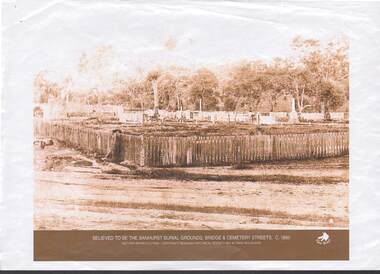
Document - SANDHURST BURIAL GROUNDS
... SANDHURST BURIAL GROUNDS...Photocopy images a,b, believed to be of Sandhurst Burial Grounds, and overlooking fence looking East, Bridge Street C 1860. ...Document SANDHURST BURIAL GROUNDS ...Photocopy images a,b, believed to be of Sandhurst Burial Grounds, and overlooking fence looking East, Bridge Street C 1860. Copyright Bendigo Historical Society & David Mulqueen.bendigo, history, cemetery -
 Bendigo Historical Society Inc.
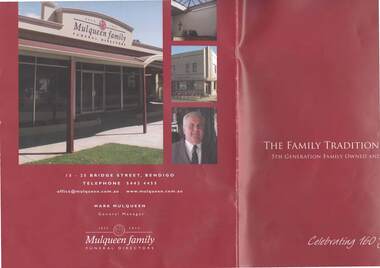
Book - THE FAMILY TRADITION CONTINUES: MULQUEEN FAMILY 160 YEARS
... ... Sandhurst Burial Grounds...BUSINESS Funeral director Mulqueen Family The Family Tradition Continues - Mulqueen Family 160 Years Mark Mulqueen Adele Mulqueen Peter Mulqueen Peter Mulqueen Jnr Paul Mulqueen Daniel Mulqueen Corey Mulqueen Ruth Mulqueen John Mulqueen Fran Mulqueen Bern Mulqueen David Mulqueen Australian Funeral Directors Association Michael McQueen Tracy Guy Bendigo Chamber of Commerce Bendigo Sportsmen's Association Michael Mulqueen Elizabeth Mulqueen Fizelle & Mulqueen Peter Fizelle Elizabeth Fizelle Chas P Friley S T Gill I'll Be There Maude Hurford We Remember If I Should Go Tomorrow A Time For Everything Book of Ecclesiastes 3 1-13 Sandhurst Trustees Abell and Oakley Undertakers Thomas Abell Phillip Kennedy Sandhurst Burial Grounds Thomas Oakley William Oakley William Oakley Bubs Mahony Dark red covered booklet titled ' the Family Tradition Continues - 5th Generation Family Owned and Operated Business.' ...Dark red covered booklet titled ' the Family Tradition Continues - 5th Generation Family Owned and Operated Business.' Celebrating 160 Years Mulqueen Family Funeral Directors Since 1853. Contains a brief history of the Mulqueen Family Business. Also contains information about the funeral business, History, stories of different family members and advertisements. There are also a number of photographs in the book.business, funeral director, mulqueen family, the family tradition continues - mulqueen family 160 years, mark mulqueen, adele mulqueen, peter mulqueen, peter mulqueen jnr, paul mulqueen, daniel mulqueen, corey mulqueen, ruth mulqueen, john mulqueen, fran mulqueen, bern mulqueen, david mulqueen, australian funeral directors association, michael mcqueen, tracy guy, bendigo chamber of commerce, bendigo sportsmen's association, michael mulqueen, elizabeth mulqueen, fizelle & mulqueen, peter fizelle, elizabeth fizelle, chas p friley, s t gill, i'll be there, maude hurford, we remember, if i should go tomorrow, a time for everything, book of ecclesiastes 3, 1-13, sandhurst trustees, abell and oakley undertakers, thomas abell, phillip kennedy, sandhurst burial grounds, thomas oakley, william oakley, william oakley, bubs mahony -
 Emerald Museum & Nobelius Heritage Park
Tool - Axe
... ...Burial grounds...Emerald Victoria Australia Aboriginal culture Hunting Burial grounds R. Douglas Aboriginal stone axe found circa 1921 and donated by R. ...Comment from Andrea Murphy, aboriginal heritage consultant, Upper Beaconsfield, January 2006: This is an axe head, which was most common and the most important implement in the aboriginal stone "assemblage". The implement was a man's tool and would have been in daily use to cut wood off trees, cut notches for foot-holds for climbing trees, or to dispatch game. The axe head was often hafted with resin on to a hard-wood stick. The implement is of diorite or greenstone (although black in appearance), which was obtained from an aboriginal quarry at Mount William in the Lancefield area. Stone from this quarry was often traded for other goods and has been found as distant as Queensland. A piece of greestone this size, unground, was considered worth a possum-skin cloak (a cloak took approximately 28 possum skins). Trading in greenstone therefore had social significance. This type of implement was often handed down from one generation to the next. It was sometimes buried with the dead. The edge of the axe was formed by grinding on a rougher stone. Working with greenstone more recent techonology [than the other stones]. This implement is reasonably small but is a good example of symmetrical grinding. There is minor damage to the edge; otherwise it is in good condition.Aboriginal stone axe found circa 1921 and donated by R. DouglasStoneemerald, victoria, australia, aboriginal culture, hunting, burial grounds, r. douglas -
Emerald Museum & Nobelius Heritage Park
Booklet - Poetry booklet, Mann, Leonard et al, The Delectable Mountains and Other Poems, 1944
... ...Burial grounds...Avonsleigh Victoria Australia authors poetry World War Two Burial grounds Leonard Mann Soft cover 56 pages. ...Collection of 33 poems by author Leonard Mann, who lived in Avonsleigh. Many of the poems relate to his experiences during World War Two. One of the poems, Bush Cemetery, is believed to be about the Macclesfield Cemetery.Soft cover 56 pages.avonsleigh victoria australia, authors, poetry, world war two, burial grounds, leonard mann -
Clunes Museum
Booklet, ROBERT W BELL, A VISITORS GUIDE TO THE TWO BUNINGYONG BURIAL PLACES, 2001
... GENERAL GUIDE TO TWO BURIAL GROUNDS IN BUNINYONG PUBLISHED BY ROBERT W. ...GENERAL GUIDE TO TWO BURIAL GROUNDS IN BUNINYONG PUBLISHED BY ROBERT W. ...GUIDE TO CEMETERIES, HISTORY AND GUIDE OF TWO BUNINYONG CEMETERIESPALE GREEN COVER BOOKLET. WITH BLACK INK TITLE AND AUTHOR AND AN IMAGE OF A RURAL CEMETERY WITH TWO ADULT FIGURES, A YOUNG FIGURE AND A DOG IN A CEMETERY. 20 PAGESnon-fictionGUIDE TO CEMETERIES, HISTORY AND GUIDE OF TWO BUNINYONG CEMETERIESlocal history, document, burial places, buninyong, burials ground -
 Bendigo Historical Society Inc.
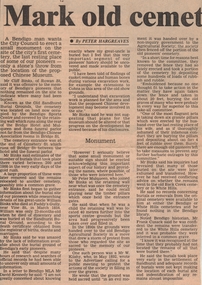
Newspaper - NEWSPAPER CLIPPINGS CALL FOR A MONUMENT TO THE PIONEERS OF THE OLD BENDIGO CEMETERY, 1987
... Newspaper Clipping 09 April 1987 Bendigo Advertiser Historian Mr Cliff Binks descendant of some of the original Bendigo Pioneers calls for a monument to honour and remember those who were buried in The Old Sandhurst Burial Grounds....BENDIGO History old bendigo cemetery Newspaper Clipping 09 April 1987 Bendigo Advertiser Historian Mr Cliff Binks descendant of some of the original Bendigo Pioneers calls for a monument to honour and remember those who were buried in The Old Sandhurst Burial Grounds. Newspaper NEWSPAPER CLIPPINGS CALL FOR A MONUMENT TO THE PIONEERS OF THE OLD BENDIGO CEMETERY ...Newspaper Clipping 09 April 1987 Bendigo Advertiser Historian Mr Cliff Binks descendant of some of the original Bendigo Pioneers calls for a monument to honour and remember those who were buried in The Old Sandhurst Burial Grounds.bendigo, history, old bendigo cemetery -
 The Beechworth Burke Museum
Photograph, Late 1800s
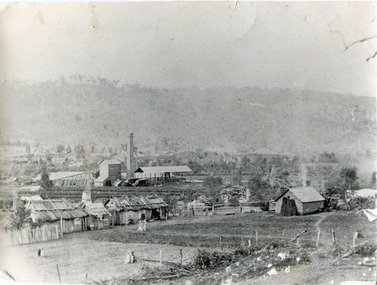
... As the years progressed the Chinese camp began to construct more permanent structures and included temples of worship, shops and separate burial grounds. ...As the years progressed the Chinese camp began to construct more permanent structures and included temples of worship, shops and separate burial grounds. This photograph demonstrates the early multi-cultural aspects of Australia and Victoria during the late 1800s. ...This photograph was taken during the late 1800s at the Chinese camp at Beechworth, Victoria. It was in camps such as these that many would-be gold miners made their home after arriving in Australia from across Asia. After arriving in South Australia where there was no poll-tax required of migrants as was the norm in Victoria and New South Wales, those looking to settle on the gold fields walked en mass overland for hundreds of kilometres before arriving in destinations such as Beechworth. Due to widespread prejudice against Chinese gold diggers they were forced to live separate from the town and developed enclaves much like the one depicted in the photograph. As the years progressed the Chinese camp began to construct more permanent structures and included temples of worship, shops and separate burial grounds. This photograph demonstrates the early multi-cultural aspects of Australia and Victoria during the late 1800s. It also showcases pressures and prejudices specific to the Chinese migrant community and the measures taken to separate them from the rest of the predominantly white community. It also reflects the gold-rush period and one of the first draws to Australia due to its mineral wealth. Black and white rectangular photograph developed on paperObverse: None Reverse: From the/Chinese Camp/84-80-1/1997-3221chinese camp, beechworth, houses, immigrants, gold mining, gold rush, late 1800s, chinese, asia -
 Victorian Aboriginal Corporation for Languages
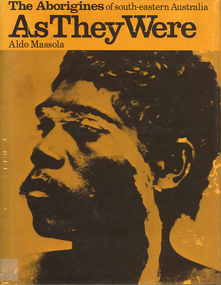
Book, Aldo Massola, The Aborigines of south-eastern Australia : as they were, 1971
... intratribal fighting; p.134-147; Death, disposal of body - eating of the dead, burial, cremation, platform exposure, dendroglyphs (N.S.W.), Aboriginal burial grounds (Darling &? Murray Rivers), mourning, widowhood, kopi caps (N.S.W.), causes of death, inquest ceremonies, revenge expedition, after death beliefs; p.148-157; The end of the tribes white settlement &? ...intratribal fighting; p.134-147; Death, disposal of body - eating of the dead, burial, cremation, platform exposure, dendroglyphs (N.S.W.), Aboriginal burial grounds (Darling &? Murray Rivers), mourning, widowhood, kopi caps (N.S.W.), causes of death, inquest ceremonies, revenge expedition, after death beliefs; p.148-157; The end of the tribes white settlement &? ...Contents: p.1-3; Origins, arrival in Australia; p.4-9; How they lived - camp sites, dating (including carbon dating); p.10-27; Physical appearance, skin colour, hair, clothing, body ornaments, cicatrization; exchange system, distribution of food, marriage &? sexual relations; the tribe - structure, relationship to land, territory, gives map showing locations of tribes, New South Wales, Victoria &? eastern South Australia, leadership, government, division of labour, status of women, estimated population at white settlement, density of population (Victoria); p.28-31; Language - names &? naming, reproduces Wembawemba vocabulary, notes use of secret languages, gives 12 rules for pronounciation; p.32-53; Religion, spirit beliefs, totemism, moieties, phratries, marriage rules; mythology, gives eaglehawk &? crow myth from Lake Victoria &? other myths illustrating origins of fire &? natural rock formations, mythical beasts (Bunyip, Mindie), stellar beliefs; magic, medicine men, powers, native remedies for sickness, describes ceremony held in Melbourne, 1847 to avert evil, sorcery, pointing bone, love magic, rain makers; messengers, appearance, etiquette, message sticks; p.54-71; Rock art, motifs, colours, decorative art, engraving of utensils, rock engravings, manufacture &? use of pigments, engraving techniques; trade system, objects bartered, meeting places for trade (Victoria), map shows possible routes (south east Australia); corroborees, purpose, body ornaments &? decorations, musical instruments; p.72-93; Ceremonial life, marriage, punishment for infidelity, birth, childhood, games &? amusements, initiation, etiquette of visiting tribes, details of ceremony, womens role, earth figures &? ground designs, bull roarers, female puberty ceremonies; p.94-133; Shelters, fire making, cooking, construction of canoes, wooden implements, use of reeds, animal skins &? sinews, shells; stone tools, cylindro conical stones, scrapers, knives &? microliths; hunting weapons, spear, other methods pits, nets; fishing methods &? spears, traps; food sharing, womens responsibilities for collecting, digging stick, cooking methods, insect foods, plant foods, water resources; manufacture &? use of spears, spear throwers, shields, clubs, boomerangs; inter- &? intratribal fighting; p.134-147; Death, disposal of body - eating of the dead, burial, cremation, platform exposure, dendroglyphs (N.S.W.), Aboriginal burial grounds (Darling &? Murray Rivers), mourning, widowhood, kopi caps (N.S.W.), causes of death, inquest ceremonies, revenge expedition, after death beliefs; p.148-157; The end of the tribes white settlement &? its impact on Aboriginal life, friction between natives &? settlers, establishment of Protectorates; copiously illustrated throughout.maps, b&w illustrations, b&w photographswemba wemba, murray river, darling river, lake victoria -
 Eltham District Historical Society Inc
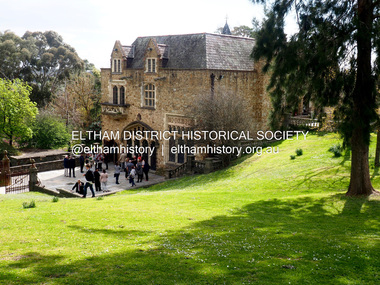
Photograph - Digital Photograph, Jim Connor, Eltham Cemetery Trust's launch at Montsalvat of Our Eltham - Artistic Recollections, 21 September 2017
... burial took place in 1861 in the Church of England section. Headstones depict the names of many early and well known local families. In recent years the Trust has encouraged the use of creative artistic elements within the natural bushland environment in their landscaped grounds adjoining Montsalvat. ...burial took place in 1861 in the Church of England section. Headstones depict the names of many early and well known local families. In recent years the Trust has encouraged the use of creative artistic elements within the natural bushland environment in their landscaped grounds adjoining Montsalvat. ...Our Eltham - Artistic Recollections by Jim Connor, EDHS newsletter No. 236 October 2017 The Eltham Cemetery Trust, established in 1858, selected the existing burial site at Mount Pleasant Road on high ground overlooking the village of Eltham. The first recorded burial took place in 1861 in the Church of England section. Headstones depict the names of many early and well known local families. In recent years the Trust has encouraged the use of creative artistic elements within the natural bushland environment in their landscaped grounds adjoining Montsalvat. Their ongoing vision has been to offer the local communty a fresh and unique relationship to the Cemetery. On Thursday 21st September 2017 their latest commissioned art project titled ‘Our Eltham - Artistic Recollections’ was unveiled. It is a collection of panels collaboratively created by artist Nerina Lascelles and ceramicist Linda Detoma. The project was designed and constructed by Leigh Wykes using Australian stone with ironwork by Neil Carter. All contributors to this installation, located adjacent to the car park near Metery Road, are residents of the Eltham area. Our Eltham - Artistic Recollections is described as a celebration of life in the Shire since the opening of the Eltham Cemetery more than 150 years ago. Depicting scenes of life in and around Eltham, the collection offers deeper connections to the Eltham area through a series of visual narratives of Eltham’s past, environment and community. The project involves the artistic interpretation by Nerina Lascelles of historic and current images symbolically intermixed with locally indigenous flowers and plants. These are displayed on thirty-one ceramic panels by Linda Detoma, mounted within an iron fence by Neil Carter, upon an attractive rock wall constructed by Leigh Wykes. The Eltham District Historical Society is pleased to have contributed to this project. Russell Yeoman and Jim Connor from our Society have collaborated with Liz Pidgeon, Local and Family History Librarian at Yarra Plenty Regional Library on a selection of photographs, many from the Shire of Eltham Pioneers Collection we hold in partnership, located at Eltham Library. We also provided information on the images chosen. The Eltham Cemetery Trust has produced a booklet about this artwork, which can be viewed on the Cemetery website at: http://www.elthamcemetery.com/oureltham/#1 Our Eltham - Artistic Recollections is a significant monumental installation, which will encourage visitors to come to view this outstanding combination of local creative skills, set within the attractive grounds of the Eltham Cemetery. jim connor collection, eltham cemetery trust, montsalvat, our eltham artistic recollections, 2017-09-21 -
 Warrnambool and District Historical Society Inc.
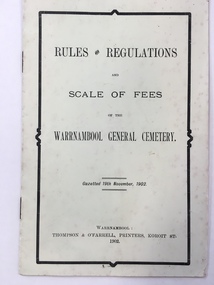
Booklet, Thompson & O'Farrell, Rules & Regulations scale of fees Cemetary, 1902 (original edition)
... It was also noted that no child under ten was permitted into the cemetery grounds unless under adult supervision. The charge for an adult burial was £1 and ten shillings for a child under ten. ...It was also noted that no child under ten was permitted into the cemetery grounds unless under adult supervision. The charge for an adult burial was £1 and ten shillings for a child under ten. ...This booklet gives the Rules and Regulations and the Scale of Fees for the Warrnambool General Cemetery as from 1902. The booklet rescinded the Rules and Regulations of 1855 and amongst the 1902 Rules it is noted that no catacombs or wooden structures were allowed by the Trustees. It was also noted that no child under ten was permitted into the cemetery grounds unless under adult supervision. The charge for an adult burial was £1 and ten shillings for a child under ten. The Warrnambool Cemetery is in Otway Road, Warrnambool and was first gazetted in 1853 with Mr Whittet as the first Sexton. This booklet is of considerable interest because it gives the Rules and Regulations and the Scale of Charges of the Warrnambool General Cemetery as laid down in 1902. The Trustees at the time were William Ardlie, a prominent Warrnambool lawyer, Samuel Nettleton, a well-known Warrnambool shopkeeper and J.H.Allan, a member of a pioneering family in the Warrnambool district. This is a small booklet containing the Rules and Regulations of the Warrnambool General Cemetery. It contains four double-sided pages with printed material on all of the pages. The cover is pale yellow and the printing on the front cover has a black edging. There is some silverfish damage on the page edges. The pages were stapled together but the staples have been removed (the use of staples suggests that this booklet is perhaps a reprint at a later date)Front Cover: ‘Rules and Regulations and Scale of Fees of the Warrnambool General Cemetery, Gazetted 19th November 1902, Warrnambool, Thompson and O’Farrell, Printers, Koroit St. 1902’.warrnambool general cemetery -
 Warrnambool RSL Sub Branch
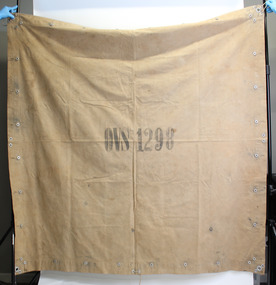
Ground sheet
... Grounds sheets have also been known to have been used to wrap deceased bodies in prioir to burial....Grounds sheets have also been known to have been used to wrap deceased bodies in prioir to burial. ...Ground sheets such as this were typically used as rain protection by German troops. Two or more zeltbahn (ground sheets) could be attached together via the button holes to form a tent for two or more people. Some models of ground sheets, particularly those which are triangular in shape, could also be fashioned into personal raincoats worn by soldiers. Grounds sheets have also been known to have been used to wrap deceased bodies in prioir to burial.This groundsheet, despite a lack of clear provenance, is a representative example of the types of ground sheets used by the German forces during wartime. The zeltbahn (ground sheet) also has social significance in that they were known to have been used to wrap deceased bodies in prior to burial.Large square sheet constructed of biege/brown coloured water resistant material. 67mm hem folded over and sewn along all edges with brown stitching. Metal buttons are spaced at 200mm intervals along parallel edges, next to a button hole which can be used to attach to another ground sheet. Four corners bear a large round eyelet in silver-coloured metal in between three smaller eyelets; two of four corners have short lengths of brown cord attached to these eyelets. One corner has only two smaller eyelets surrounding the larger.Printed in black ink in the centre of the sheet is the incriptions "OVS 1298."ground sheet, zeltbahn, tent, raincoat, german -
 City of Whittlesea
Photograph - Thomastown Wesleyan Cemetery, Thomastown Methodist / Wesleyan Cemetery photographs
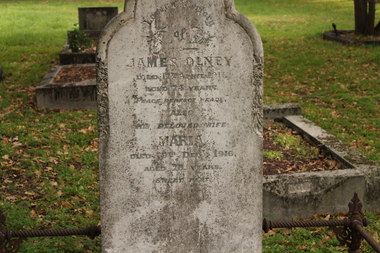
... The cemetery runs along the grounds of the Thomastown Primary School.The last burial was 1955. The Cemetery is maintained by Whittlesea Council....The cemetery runs along the grounds of the Thomastown Primary School.The last burial was 1955. The Cemetery is maintained by Whittlesea Council. ...The cemetery was at the rear of the Wesleyan Church in High Street Thomastown. The church, schoolhouse and cemetery were established in 1854. In 1988 the Uniting Church donated the cemetery to the City of Whittlesea as a permanent reminder and tribute to Thomastown's early British pioneersCemetery is located off High Street Thomastown. Official address is 1w Stewart Street Thomastown. The Wesleyan Church and schoolhouse were built in 1854. The cemetery was laid at out at the rear. The cemetery runs along the grounds of the Thomastown Primary School.The last burial was 1955. The Cemetery is maintained by Whittlesea Council.Bicentennial Plaque donated by Mrs Murial Wuchatsch 1988 -
Glen Eira Historical Society
Letter - Rosstown Railway
... McCombie Thas Keyes Robert Brighton Cemetery Burials Grounds and Graveyards War-ein Road Were J.B. ...This file contains four items: 1/A black and white photocopy of a letter dated either 07/08/1889 or 09/08/1889, from Robert Lundon to an unidentified recipient discussing an agreement reached between the author – on behalf of the recipient – and Soon Hang Hi in regard, in regards to the allotment known as Webber’s. The agreement is outlined in the letter in what appears to be Chinese characters, and includes the marks of Robert Lundon and Soon Hang Hi. File note from Joy Wu states that the calligraphy is not Mandarin or traditional Chinese. 2/Three sheets of hand-written working notes with information taken from the Victorian Government Gazette on THE ROSSTOWN AND MURRUMBEENA LAND COMPANY LIMITED, THE ROSSTOWN JUNCTION RAILWAY AND PROSPERITY COMPANY LIOMITED, and THE ROSSTOWN JUNCTION, ELSTERNWICK, AND OAKLEIGH RAILWAY COMPANY LIMITED, covering dates between 1887 and 1894. The notes concern meetings and creditors claims relevant to the companies, with reference numbers for the information source. Date and author of the notes are not recorded. 3/A black and white photocopy of the a partial map of the Rosstown Railway and surrounding area, undated. The map includes the names of landholders in the areas of Brighton, Garden Vale and Elsternwick, as well as other railway lines present in the region. 4/A fold-out map and guide of the Rosstown Rail Trail, including a brief general history of Caulfield as well as a more extensive biography of William Murray Ross and the Rosstown Railway. The map marks and describes significant sites along the trail, including photographs of some of these sites, provided by DF Jowett.documents, correspondence, webber’s, lundon robert, chinese characters, ethnic communities, signatures, text, settlements, taxes, fraser john grieves, lovell r.h., price davies, meetings, communication activities, soon hang hi, commercial events and activities, the rosstown and murrumbeena land company limited, victorian government gazette, bulmer richard, parry john, osment henry, shareholders, creditors claims, the rosstown junction railway and property company limited, finch and best, lawyers, the rosstown junction elsternwick and oakleigh railway company limited, cameron w.c., phillips p.d., garden vale, elsternwick, elsternwick railway station, rosstown, rosstown railway, thomas street, bay street, kooyong road, melbourne and brighton railway, hawthorn road, bambra road, caulfield and frankston railway, booran road, grange road, koornang road, murrumbeena road, north road, north road railway station, east brighton railway station, south road, railway routes, railway lines, railways, land transport, murphy j., caulfield, hamilton t.f., dane p., holloway, webb, ailee john, payne t.b., brodie chas, dane john, o’neil h., mccombie john, mcmillane a., smyth c.d., cooper, ebden, landholders, jeffrey j.d., gill j., balcombe a.e., cooper h., mcnab j., white j., sutherland j., greeves a.f.a., newton m.c., chamley f.b., fowler j., inglis p., grant t., stooke j., swanson g., cochrane c., adams e.b., mccombie thas, keyes robert, brighton cemetery, burials grounds and graveyards, war-ein road, were j.b., holland j., mcmahon c., winter t.l.m., dendy henry, mitchell w., jackson s., were j.e., wickham francis dawe, bryant jane, east brighton railway station, railway stations, maps, allotments, land titles, roads and streets, rosstown rail trail, city of glen eira, tourism, trains, tourism information bureaus, tours, pamphlets, elsternwick railway park, oakleigh junction, princes park, ee gunn reserve, packer park, sites, jowett d.f., weickhardt i.g., return to rosstown: railways land sales and sugar beet ventures in caulfield, land sales, walking trails, ross william murray, transport objects, locomotion, walking, cycling, driving, sports, country mansions, people, caulfield john, builders, construction and demolition workers, occupations, careers, professionals, topography, geology, landforms, horticulture, market gardens, primary industry workers, city of caulfield, mood kee, pennington harold, annual general meetings, caulfield town hall, glen eira city council, carnegie, carnegie station, rosstown station, people by circumstance, migrants, sugar beet, sugar beet mill, sugar beet industry, mills, factories, sea beach lines, bent thomas, parliamentary representatives, neville street, miller street, lemann’s swamp reserve, koornang park, cane sugar industry, breweries, rabbit processing plants, health establishments, hospitals, food production establishments, abattoirs, thieves, social problems, vagrants, theft, squatting, financial economics, debt, finance industry, insurance companies, company managers, bentleigh, ross leila, the grange, leila road, wild cherry road, financial trouble, mortgages, gisborne street, archibald street, riddell parade, victoria railways, glen huntly road, clarence street, college street, gladstone parade, parrell street, aileen avenue, seaview street, land subdivisions, dover street, sussex street, landfill, marara road, booran road, woodville avenue, dorothy avenue, ormond park, royal avenue, ormond railway station, oakleigh road, melten avenue, miller street, munro avenue, lord reserve, neerim road, toolambool road, the rosstown hotel, rosanna street, murrumbeena crescent, commercial establishments, the national bank, rosstown road, kangaroo road, poath road, freda street, hughesdale kindergarten, oakleigh council, hughesdale community centre, civic establishments, galbally reserve, plaques, warrigal road, out and about brochures, orion estate
