
Showing 38 items matching "burial register"
-
 Queenstown Cemetery Trust and Friends & Relations of Queenstown Cemetery
Burial Register, Eltham Shire Burial Book, Circa 1860
... Burial Register...The Burial Registered was given to Martha Wike after her successful negotiation with the Commissioners to transfer the Trusteeship from the Eltham Council to local individuals ...Photocopy of first page of Burial Register in the Queenstown Public Cemetery Item to be updated when the Register comes out of storage ...The Burial Registered was given to Martha Wike after her successful negotiation with the Commissioners to transfer the Trusteeship from the Eltham Council to local individuals It is the original Burial Register, handwritten by the Registrar of the Eltham Council Cemetery Records Burial Documents Queenstown Cemetery Nillumbik Shire Council Gold Rush Caledonian Diggings Queenstown Smiths Gully Cemetery Page No 1, Date of Burial, Name of Deceased, Age, Late Residence,Ptivate or Public Grave Photocopy of first page of Burial Register in the Queenstown Public Cemetery Item to be updated when the Register comes out of storage Eltham Shire Burial Book Burial Register ...The Burial Registered was given to Martha Wike after her successful negotiation with the Commissioners to transfer the Trusteeship from the Eltham Council to local individuals It is the original Burial Register, handwritten by the Registrar of the Eltham CouncilPhotocopy of first page of Burial Register in the Queenstown Public Cemetery Item to be updated when the Register comes out of storage Page No 1, Date of Burial, Name of Deceased, Age, Late Residence,Ptivate or Public Gravecemetery records, burial documents, queenstown cemetery, nillumbik shire council, gold rush, caledonian diggings, queenstown, smiths gully cemetery -
 Eltham District Historical Society Inc
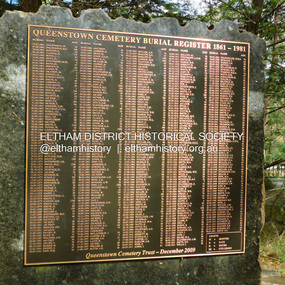
Photograph, Jim Connor, Queenstown Cemetery Burial Register 1861-1981, Queenstown Cemetery, Smiths Gully Road, St Andrews, 8 March 2023
... Queenstown Cemetery Burial Register 1861-1981, Queenstown Cemetery, Smiths Gully Road, St Andrews...Jim Connor Collection 2023-03-08 Queenstown Cemetery Smiths Gully Road St Andrews 1 image - born digital Queenstown Cemetery Burial Register 1861-1981, Queenstown Cemetery, Smiths Gully Road, St Andrews Photograph Photograph Jim Connor ...Installed by the Queenstown Cemetery Trust December 2009 The discovery of gold in Smyth's Creek in 1854 and subsequent gold rush to the Caledonia diggings led to the establishment of Queenstown (present day St Andrews). The first recorded burial was July 31st, 1861 and it was officially declared a Cemetery Reserve in 1866. Many graves are unmarked and unrecorded including many Chinese and other itinerant miners. The cemetery was closed for new burials in 1851. The last recorded burial was in 1981 in an existing family grave.jim connor collection, 2023-03-08, queenstown cemetery, smiths gully road, st andrews -
 Bendigo Historical Society Inc.
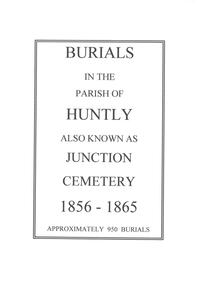
Article - Huntly Burials list
... ...Burial Register...Approximately 950 Burials. Photocopied pages from the original register, stored in thirty-four, A3 plastic pockets. ...Huntly Burial Register Cemetery Junction Cemetery Burials in the Parish of Huntly also known as Junction Cemetery 1856 - 1865. ...Burials in the Parish of Huntly also known as Junction Cemetery 1856 - 1865. Approximately 950 Burials. Photocopied pages from the original register, stored in thirty-four, A3 plastic pockets. Some photocopied pages have annotations, confirming dates and names. One A4 plastic pocket is at the front holding a title page describing the item.huntly, burial register, cemetery, junction cemetery -
Ballarat Heritage Services
Document - Database, Dorothy Wickham, Ethersay's Book Ballarat Old Cemetery, 1994
... Burials as written transcribed from Ethersay's Burial Register, Ballarat Old Cemetery. 99 burials...Ballaarat Old Cemetery burials Ethersay early burials Burials as written transcribed from Ethersay's Burial Register, Ballarat Old Cemetery. 99 burials Ethersay's Book Ballarat Old Cemetery Document Database Dorothy Wickham ...Dorothy Wickham Researcher BDGS transcribed burials for Ballarat that were prior to the Cemetery Records that started in 1856. Burials as written transcribed from Ethersay's Burial Register, Ballarat Old Cemetery. 99 burialsballaarat old cemetery, burials, ethersay, early burials -
 Eltham District Historical Society Inc
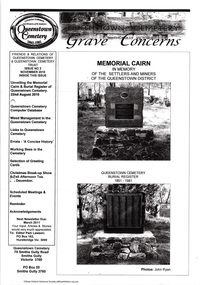
Newsletter, Queenstown Cemetery: Grave Concerns, 2010
... Newsletter includes feature on memorial cairn and burial register unveiled 22 August 2010...Newsletter includes feature on memorial cairn and burial register unveiled 22 August 2010 harry gilham collection queenstown cemetery memorial cairn Issue No 3. ...The Queenstown Cemetery (1861-1981) is a pioneer and miner’s cemetery, established during the gold rush of the 1850’s at the site of the first mining village of the Caledonia Diggings. A Cemetery Trust administers the cemetery with the support of The Friends and Relations of Queenstown Cemetery and endeavours to maintain and preserve it for future generations. The Friends Group publish a newsletter. Newsletter includes feature on memorial cairn and burial register unveiled 22 August 2010Issue No 3. November 2010harry gilham collection, queenstown cemetery, memorial cairn -
 Kiewa Valley Historical Society
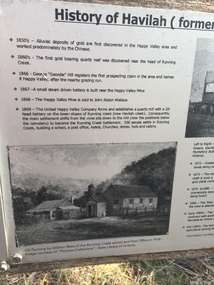
Papers - Havilah Cemetery, Havilah Cemetery Formerly Running Creek Cemetery
... One paper lists 29 names in the Burial Register 1861-1948. The last two sheets record the history as a timeline from the 1850s to the 1900s. ...One paper lists 29 names in the Burial Register 1861-1948. The last two sheets record the history as a timeline from the 1850s to the 1900s. ...In 1889, 24 residents of the Running Creek and surrounding district submitted a petition to the Minister of Lands, Melbourne requesting land for a cemetery. Their request was granted. The Cemetery was decommissioned in the early 1950s and the last trustee for the cemetery died in 1986. There is a wooden fence around the boundary (May 2024). One paper lists 29 names in the Burial Register 1861-1948. The last two sheets record the history as a timeline from the 1850s to the 1900s. Havilah was a gold mining settlement from the 1850s located 20km west of the Kiewa Valley and in the Ovens catchment near Myrtleford.Five black and white A4 pages stapled together. Copies of the sign erected at the gate of 'Havilah cemetery formerly Running Creek Cemetery'. Also the 'History of Havilah formerly Running Creek'havilah, running creek, cemetery -
 Expression Australia
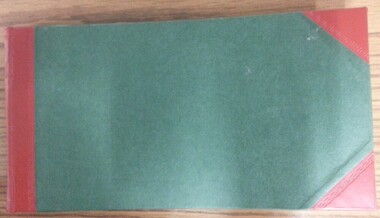
Book, Register of Burials
... A register of Burials (funerals) held in the Deaf Society Church Jolimont during the period 1969-1999. ...A register of Burials (funerals) held in the Deaf Society Church Jolimont during the period 1969-1999. ...A register of Burials (funerals) held in the Deaf Society Church Jolimont during the period 1969-1999. Includes place of burial.Significant as a record of the funerals held at the Deaf Society Church.Green Cover, 15cmHx29cmW -
 Uniting Church Archives - Synod of Victoria
Photocopy of hand-drawn portrait, Unknown
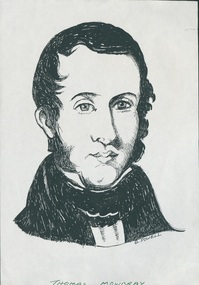
... Born: 1812 at Hamilton, Lanarkshire, Scotland Baptised: Arrived: 26 January 1842 per "Robert Benn" from Greenock, Scotland Church Registers: Presbyterian Baptisms Campbellfield 1842 Church Registers: Presbyterian Burials Melbourne 1840-1842 Church Registers: Presbyterian Burials Melbourne 1843 Married: 17 August 1841 at West Colinton, Edinburgh, Scotland to Williamina Anderson Died: 24 December 1867 at Kangaroo Point, Moreton Bay, Queensland Buried: 25 December 1867 at Paddington Cemetery, Brisbane, Queensland "As the European population grew, settlement outside Melbourne developed, and the Colonial Committee of the Church of Scotland sent out more ministers. ...Born: 1812 at Hamilton, Lanarkshire, Scotland Baptised: Arrived: 26 January 1842 per "Robert Benn" from Greenock, Scotland Church Registers: Presbyterian Baptisms Campbellfield 1842 Church Registers: Presbyterian Burials Melbourne 1840-1842 Church Registers: Presbyterian Burials Melbourne 1843 Married: 17 August 1841 at West Colinton, Edinburgh, Scotland to Williamina Anderson Died: 24 December 1867 at Kangaroo Point, Moreton Bay, Queensland Buried: 25 December 1867 at Paddington Cemetery, Brisbane, Queensland "As the European population grew, settlement outside Melbourne developed, and the Colonial Committee of the Church of Scotland sent out more ministers. ...Born: 1812 at Hamilton, Lanarkshire, Scotland Baptised: Arrived: 26 January 1842 per "Robert Benn" from Greenock, Scotland Church Registers: Presbyterian Baptisms Campbellfield 1842 Church Registers: Presbyterian Burials Melbourne 1840-1842 Church Registers: Presbyterian Burials Melbourne 1843 Married: 17 August 1841 at West Colinton, Edinburgh, Scotland to Williamina Anderson Died: 24 December 1867 at Kangaroo Point, Moreton Bay, Queensland Buried: 25 December 1867 at Paddington Cemetery, Brisbane, Queensland "As the European population grew, settlement outside Melbourne developed, and the Colonial Committee of the Church of Scotland sent out more ministers. The second to arrive was the Rev. Thomas Mowbray, on January 28th 1842. He almost immediately settled in Campbellfield, called by a small congregation brought into being largely by the work of people such as Neil Campbell, Dr Wilson and George Somerville. Mr Campbell donated five acres of land to the Presbyterian Church for the purposes of building a church, a school-house and a manse. No pictures or clear description of the church that Mowbray built on the site. One source described it as being “built of logs and roofed with imported shingles”, another said it was “shingle-roofed wattle and daub”, and still others mention “rough adzed beams” and a “bark roof”. No trace remains on the site now. Yet while it may have been “so low that people had to stoop to enter”, it is certain that the building was erected with great pride and it was with much excitement that regular, well-attended worship services began on the present Campbellfield site with its dedication on May 8th 1842. An early colonist recollected that over the next two and half years Campbellfield developed into “an important charge, with many influential and wealthy adherents”. The first meeting of the Presbytery of Melbourne was held on June 7th 1842, with the Revs James Forbes, Thomas Mowbray and Peter Gunn, with Dr David Patrick (Elder) . Their first priority for action was public education. At their second meeting on September 6th it was reported that “schools which had been established by Mr Forbes in Melbourne were well attended and efficiently taught; also that schools were connected with the congregations at Campbellfield, Geelong and Portland.” The official history of Presbyterianism in Victoria , written in 1888, says of Mowbray: He was a man of high scholarly attainments, took special interest in the cause of education, and was a preacher of superior ability. His useful and acceptable labours were very much confined to the district in which he was settled. By reason of infirm health he was unable to undergo the fatigue of long excursions into the interior. But his labours were highly appreciated at the school which he originated and superintended sustained a good reputation. No official public records can be traced pertaining to Mowbray’s school. There may be a simple reason for this, and it is suggested that it has to do with the rifts in Presbyterianism which culminated in the Great Disruption in the Church of Scotland in May of 1843. The same divisions were by then already reflected in Victoria. Clergy from both ‘sides’ came to Australia and the main criterion for categorising them as Presbyterians of the Established Church of Scotland or Free Presbyterians was their acceptance or non-acceptance of state aid. Mowbray remained neutral in the 1846 Assembly-level wrangling and, although there is no evidence to support this contention, he may well have struggled to maintain his school with local resources rather than accept Government money; hence the lack of Government records. Unfortunately Mr Mowbray’s health declined rapidly and in answer to a call from Sydney on the 3rd of December 1844, he left Campbellfield on Boxing Day in 1844. Later he established the Presbyterian Church in Queensland, with the Ann Street Presbyterian Church being established in 1849." Quoted from "Scots Church Campbellfield—A Brief History" (ed. Robert Renton), 2nd Ed. 2017, pp. 2–4.Head and shoulders portrait (drawing) of Thomas Mowbray by E PowellChurch & Nation 10/8/1988 p32; Rev. Thomas Mowbrayrev. thomas mowbray; ordained 1841 church of scotland. served at campbellfield (scots) 1842, sydney 1844, moreton bay 1847 qld. pioneer of the presbyterian church of queensland -
 Flagstaff Hill Maritime Museum and Village
Functional object - Key, circa 1866
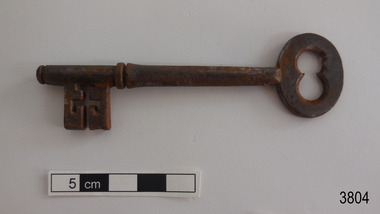
... Register (VHR H0392). It is a historical example of early settlement and development of a run in the coastal land of South West Victoria, and it is constructed from locally quarried sandstone but doesn’t take away from its Georgian design. Glenample Homestead is of State significance through its unique connection with the wreck of the ship Loch Ard and the connection to its owners, Hugh and Lavinia Gibson and Peter McArthur, played a historically and socially significant role in the rescue and care of the survivors, the salvage of goods and the burial of those who lost their lives. ...The key is one of a collection of seven 1860s keys once belonged to the Glenample Homestead near Princetown. They are all keyed with different bits and would have opened the external panelled doors of the Georgian building. The keys would now be around 150 years old. The keys are now part of the John Chance Collection. Locksmiths became a recognised trade by the middle of the 19th century, doing work that blacksmiths and gunsmiths would have done. They were craftsmen and trained apprentices for their trade. The local community and businesses relied on them for making a wide variety of precision objects such as locks and keys, knives, ornamental and decorative latticework, fine instruments, accurate tools and hardware items. Glenample Homestead became famous after the disastrous wreck of the sailing ship Loch Ard on June 1, 1878. The owners, Hugh Hamilton Gibson and Peter McArthur, were involved in the rescue and recovery of Eva Carmichael and Tom Pearce, the only two survivors, as well as overseeing the salvage of items from the shipwreck and the burial of those who lost their lives. Eva first met Jane Shields at Glenample and they became long-time friends. The keys are significant as an example of mid-19th century locksmith hardware, and for their connection with Glenample Homestead, and for their connection to the history of the Loch Ard shipwreck’s only two survivors. The set of keys also hold significance as they were discovered by John Chance, who was also a diver from the wreck of the Loch Ard in the 1960s-70s. Items that come from several wrecks along Victoria's coast have since been donated to the Flagstaff Hill Maritime Village’s museum collection by his family, illustrating this item’s level of historical value. Glenample Homestead is of historical, social and architectural significance to the State of Victoria and is listed on the Victorian Heritage Register (VHR H0392). It is a historical example of early settlement and development of a run in the coastal land of South West Victoria, and it is constructed from locally quarried sandstone but doesn’t take away from its Georgian design. Glenample Homestead is of State significance through its unique connection with the wreck of the ship Loch Ard and the connection to its owners, Hugh and Lavinia Gibson and Peter McArthur, played a historically and socially significant role in the rescue and care of the survivors, the salvage of goods and the burial of those who lost their lives. The shipwreck of the Loch Ard itself is of significance for Victoria and is registered on the Victorian Heritage Register (S417). Key; steel domestic door key. Flat open bow with 'figure 8' space, round shank that flares out slightly above the collar on the bit. The rectangular bit has internal notches and grooves. There is a rounded pin on the end.flagstaff hill, warrnambool, flagstaff hill maritime museum, maritime museum, shipwreck coast, flagstaff hill maritime village, great ocean road, glenample homestead, victorian heritage register vhr h0392, georgian homestead, loch ard, princetown, jane shields, eva carmichael, tom pearce, blue china tea set, antique door key, glenample photographs, john chance -
 Flagstaff Hill Maritime Museum and Village
Functional object - Key, circa 1866
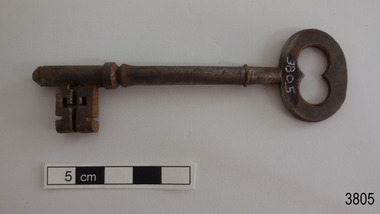
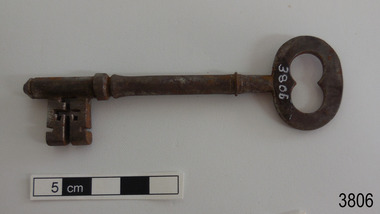
... burial of those who lost their lives. Eva first met Jane Shields at Glenample and they became long-time friends. The keys are significant as an example of mid-19th century locksmith hardware, and for their connection with Glenample Homestead, and for their connection to the history of the Loch Ard shipwreck’s only two survivors. Glenample Homestead is of historical, social and architectural significance to the State of Victoria and is listed on the Victorian Heritage Register ...The key is one of a collection of seven 1860s keys once belonged to the Glenample Homestead near Princetown. They are all keyed with different bits and would have opened the external panelled doors of the Georgian building. The keys would now be around 150 years old. The keys are now part of the John Chance Collection. Locksmiths became a recognised trade by the middle of the 19th century, doing work that blacksmiths and gunsmiths would have done. They were craftsmen and trained apprentices for their trade. The local community and businesses relied on them for making a wide variety of precision objects such as locks and keys, knives, ornamental and decorative latticework, fine instruments, accurate tools and hardware items. Glenample Homestead became famous after the disastrous wreck of the sailing ship Loch Ard on June 1, 1878. The owners, Hugh Hamilton Gibson and Peter McArthur, were involved in the rescue and recovery of Eva Carmichael and Tom Pearce, the only two survivors, as well as overseeing the salvage of items from the shipwreck and the burial of those who lost their lives. Eva first met Jane Shields at Glenample and they became long-time friends. The keys are significant as an example of mid-19th century locksmith hardware, and for their connection with Glenample Homestead, and for their connection to the history of the Loch Ard shipwreck’s only two survivors. Glenample Homestead is of historical, social and architectural significance to the State of Victoria and is listed on the Victorian Heritage Register (VHR H0392). It is a historical example of early settlement and development of a run in the coastal land of South West Victoria, and it is constructed from locally quarried sandstone but doesn’t take away from its Georgian design. Glenample Homestead is of State significance through its unique connection with the wreck of the ship Loch Ard and the connection to its owners, Hugh and Lavinia Gibson and Peter McArthur, played a historically and socially significant role in the rescue and care of the survivors, the salvage of goods and the burial of those who lost their lives. The shipwreck of the Loch Ard itself is of significance for Victoria and is registered on the Victorian Heritage Register (S417). Key; steel domestic door key. Flat open bow with 'figure 8' space, collar on shank, close to the bow. Round shank flares out slightly above the collar on the bit. The rectangular bit has internal and external notches and grooves. There is a rounded pin on the end.flagstaff hill, warrnambool, flagstaff hill maritime museum, maritime museum, shipwreck coast, flagstaff hill maritime village, great ocean road, glenample homestead, victorian heritage register vhr h0392, georgian homestead, loch ard, princetown, jane shields, eva carmichael, tom pearce, blue china tea set, antique door key, glenample photographs, john chance -
 Flagstaff Hill Maritime Museum and Village
Functional object - Key, circa 1866
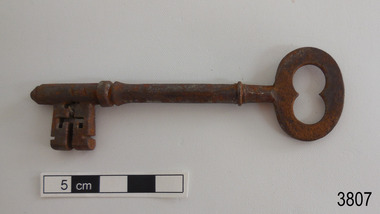
... Register (VHR H0392). It is a historical example of early settlement and development of a run in the coastal land of South West Victoria, and it is constructed from locally quarried sandstone but doesn’t take away from its Georgian design. Glenample Homestead is of State significance through its unique connection with the wreck of the ship Loch Ard and the connection to its owners, Hugh and Lavinia Gibson and Peter McArthur, played a historically and socially significant role in the rescue and care of the survivors, the salvage of goods and the burial of those who lost their lives. ...The key is one of a collection of seven 1860s keys once belonged to the Glenample Homestead near Princetown. They are all keyed with different bits and would have opened the external panelled doors of the Georgian building. The keys would now be around 150 years old. The keys are now part of the John Chance Collection. Locksmiths became a recognised trade by the middle of the 19th century, doing work that blacksmiths and gunsmiths would have done. They were craftsmen and trained apprentices for their trade. The local community and businesses relied on them for making a wide variety of precision objects such as locks and keys, knives, ornamental and decorative latticework, fine instruments, accurate tools and hardware items. Glenample Homestead became famous after the disastrous wreck of the sailing ship Loch Ard on June 1, 1878. The owners, Hugh Hamilton Gibson and Peter McArthur, were involved in the rescue and recovery of Eva Carmichael and Tom Pearce, the only two survivors, as well as overseeing the salvage of items from the shipwreck and the burial of those who lost their lives. Eva first met Jane Shields at Glenample and they became long-time friends.The keys are significant as an example of mid-19th century locksmith hardware, and for their connection with Glenample Homestead, and for their connection to the history of the Loch Ard shipwreck’s only two survivors. The set of keys also hold significance as they were discovered by John Chance, who was also a diver from the wreck of the Loch Ard in the 1960s-70s. Items that come from several wrecks along Victoria's coast have since been donated to the Flagstaff Hill Maritime Village’s museum collection by his family, illustrating this item’s level of historical value. Glenample Homestead is of historical, social and architectural significance to the State of Victoria and is listed on the Victorian Heritage Register (VHR H0392). It is a historical example of early settlement and development of a run in the coastal land of South West Victoria, and it is constructed from locally quarried sandstone but doesn’t take away from its Georgian design. Glenample Homestead is of State significance through its unique connection with the wreck of the ship Loch Ard and the connection to its owners, Hugh and Lavinia Gibson and Peter McArthur, played a historically and socially significant role in the rescue and care of the survivors, the salvage of goods and the burial of those who lost their lives. The shipwreck of the Loch Ard itself is of significance for Victoria and is registered on the Victorian Heritage Register (S417). Key; steel domestic door key. Flat open bow with 'figure 8' space, narrow collar on shank, close to the bow. Round shank flares out slightly above the collar on the bit. The rectangular bit has internal and external notches and grooves. There is a rounded pin on the end.flagstaff hill, warrnambool, flagstaff hill maritime museum, maritime museum, shipwreck coast, flagstaff hill maritime village, great ocean road, glenample homestead, victorian heritage register vhr h0392, georgian homestead, loch ard, princetown, jane shields, eva carmichael, tom pearce, blue china tea set, antique door key, glenample photographs, john chance -
 Flagstaff Hill Maritime Museum and Village
Functional object - Key, circa 1866
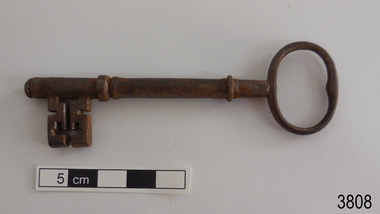
... Register (VHR H0392). It is a historical example of early settlement and development of a run in the coastal land of South West Victoria, and it is constructed from locally quarried sandstone but doesn’t take away from its Georgian design. Glenample Homestead is of State significance through its unique connection with the wreck of the ship Loch Ard and the connection to its owners, Hugh and Lavinia Gibson and Peter McArthur, played a historically and socially significant role in the rescue and care of the survivors, the salvage of goods and the burial of those who lost their lives. ...The key is one of a collection of seven 1860s keys once belonged to the Glenample Homestead near Princetown. They are all keyed with different bits and would have opened the external panelled doors of the Georgian building. The keys would now be around 150 years old. The keys are now part of the John Chance Collection. Locksmiths became a recognised trade by the middle of the 19th century, doing work that blacksmiths and gunsmiths would have done. They were craftsmen and trained apprentices for their trade. The local community and businesses relied on them for making a wide variety of precision objects such as locks and keys, knives, ornamental and decorative latticework, fine instruments, accurate tools and hardware items. Glenample Homestead became famous after the disastrous wreck of the sailing ship Loch Ard on June 1, 1878. The owners, Hugh Hamilton Gibson and Peter McArthur, were involved in the rescue and recovery of Eva Carmichael and Tom Pearce, the only two survivors, as well as overseeing the salvage of items from the shipwreck and the burial of those who lost their lives. Eva first met Jane Shields at Glenample and they became long-time friends. The keys are significant as an example of mid-19th century locksmith hardware, and for their connection with Glenample Homestead, and for their connection to the history of the Loch Ard shipwreck’s only two survivors. The set of keys also hold significance as they were discovered by John Chance, who was also a diver from the wreck of the Loch Ard in the 1960s-70s. Items that come from several wrecks along Victoria's coast have since been donated to the Flagstaff Hill Maritime Village’s museum collection by his family, illustrating this item’s level of historical value. Glenample Homestead is of historical, social and architectural significance to the State of Victoria and is listed on the Victorian Heritage Register (VHR H0392). It is a historical example of early settlement and development of a run in the coastal land of South West Victoria, and it is constructed from locally quarried sandstone but doesn’t take away from its Georgian design. Glenample Homestead is of State significance through its unique connection with the wreck of the ship Loch Ard and the connection to its owners, Hugh and Lavinia Gibson and Peter McArthur, played a historically and socially significant role in the rescue and care of the survivors, the salvage of goods and the burial of those who lost their lives. The shipwreck of the Loch Ard itself is of significance for Victoria and is registered on the Victorian Heritage Register (S417). Key; steel domestic door key. Flat open bow with 'figure 8' space, narrow collar on shank, close to the bow. Round shank flares out slightly above the collar on the bit. The Rectangular bit has internal and external notches and grooves. There is a rounded pin on the end.flagstaff hill, warrnambool, flagstaff hill maritime museum, maritime museum, shipwreck coast, flagstaff hill maritime village, great ocean road, glenample homestead, victorian heritage register vhr h0392, georgian homestead, loch ard, princetown, jane shields, eva carmichael, tom pearce, blue china tea set, antique door key, glenample photographs, john chance -
 Flagstaff Hill Maritime Museum and Village
Functional object - Key, circa 1866
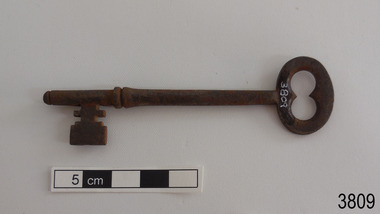
... Register (VHR H0392). It is a historical example of early settlement and development of a run in the coastal land of South West Victoria, and it is constructed from locally quarried sandstone but doesn’t take away from its Georgian design. Glenample Homestead is of State significance through its unique connection with the wreck of the ship Loch Ard and the connection to its owners, Hugh and Lavinia Gibson and Peter McArthur, played a historically and socially significant role in the rescue and care of the survivors, the salvage of goods and the burial of those who lost their lives. ...The key is one of a collection of seven 1860s keys once belonged to the Glenample Homestead near Princetown. They are all keyed with different bits and would have opened the external panelled doors of the Georgian building. The keys would now be around 150 years old. The keys are now part of the John Chance Collection. Locksmiths became a recognised trade by the middle of the 19th century, doing work that blacksmiths and gunsmiths would have done. They were craftsmen and trained apprentices for their trade. The local community and businesses relied on them for making a wide variety of precision objects such as locks and keys, knives, ornamental and decorative latticework, fine instruments, accurate tools and hardware items. Glenample Homestead became famous after the disastrous wreck of the sailing ship Loch Ard on June 1, 1878. The owners, Hugh Hamilton Gibson and Peter McArthur, were involved in the rescue and recovery of Eva Carmichael and Tom Pearce, the only two survivors, as well as overseeing the salvage of items from the shipwreck and the burial of those who lost their lives. Eva first met Jane Shields at Glenample and they became long-time friends. The keys are significant as an example of mid-19th century locksmith hardware, and for their connection with Glenample Homestead, and for their connection to the history of the Loch Ard shipwreck’s only two survivors. The set of keys also hold significance as they were discovered by John Chance, who was also a diver from the wreck of the Loch Ard in the 1960s-70s. Items that come from several wrecks along Victoria's coast have since been donated to the Flagstaff Hill Maritime Village’s museum collection by his family, illustrating this item’s level of historical value. Glenample Homestead is of historical, social and architectural significance to the State of Victoria and is listed on the Victorian Heritage Register (VHR H0392). It is a historical example of early settlement and development of a run in the coastal land of South West Victoria, and it is constructed from locally quarried sandstone but doesn’t take away from its Georgian design. Glenample Homestead is of State significance through its unique connection with the wreck of the ship Loch Ard and the connection to its owners, Hugh and Lavinia Gibson and Peter McArthur, played a historically and socially significant role in the rescue and care of the survivors, the salvage of goods and the burial of those who lost their lives. The shipwreck of the Loch Ard itself is of significance for Victoria and is registered on the Victorian Heritage Register (S417). Key; steel domestic door key. Round, thin open bow with 'B' shaped internal space, collar on shank, close to the bow. Round shank flares out slightly above the collar on the bit. The rectangular bit has internal and external notches and grooves. There is a rounded pin on the end.flagstaff hill, warrnambool, flagstaff hill maritime museum, maritime museum, shipwreck coast, flagstaff hill maritime village, great ocean road, glenample homestead, victorian heritage register vhr h0392, georgian homestead, loch ard, princetown, jane shields, eva carmichael, tom pearce, blue china tea set, antique door key, glenample photographs, john chance -
 Flagstaff Hill Maritime Museum and Village
Functional object - Key, circa 1866
... Register (VHR H0392). It is a historical example of early settlement and development of a run in the coastal land of South West Victoria, and it is constructed from locally quarried sandstone but doesn’t take away from its Georgian design. Glenample Homestead is of State significance through its unique connection with the wreck of the ship Loch Ard and the connection to its owners, Hugh and Lavinia Gibson and Peter McArthur, played a historically and socially significant role in the rescue and care of the survivors, the salvage of goods and the burial of those who lost their lives. ...The key is one of a collection of seven 1860s keys once belonged to the Glenample Homestead near Princetown. They are all keyed with different bits and would have opened the external panelled doors of the Georgian building. The keys would now be around 150 years old. The keys are now part of the John Chance Collection. Locksmiths became a recognised trade by the middle of the 19th century, doing work that blacksmiths and gunsmiths would have done. They were craftsmen and trained apprentices for their trade. The local community and businesses relied on them for making a wide variety of precision objects such as locks and keys, knives, ornamental and decorative latticework, fine instruments, accurate tools and hardware items. Glenample Homestead became famous after the disastrous wreck of the sailing ship Loch Ard on June 1, 1878. The owners, Hugh Hamilton Gibson and Peter McArthur, were involved in the rescue and recovery of Eva Carmichael and Tom Pearce, the only two survivors, as well as overseeing the salvage of items from the shipwreck and the burial of those who lost their lives. Eva first met Jane Shields at Glenample and they became long-time friends. The keys are significant as an example of mid-19th century locksmith hardware, and for their connection with Glenample Homestead, and for their connection to the history of the Loch Ard shipwreck’s only two survivors. The set of keys also hold significance as they were discovered by John Chance, who was also a diver from the wreck of the Loch Ard in the 1960s-70s. Items that come from several wrecks along Victoria's coast have since been donated to the Flagstaff Hill Maritime Village’s museum collection by his family, illustrating this item’s level of historical value. Glenample Homestead is of historical, social and architectural significance to the State of Victoria and is listed on the Victorian Heritage Register (VHR H0392). It is a historical example of early settlement and development of a run in the coastal land of South West Victoria, and it is constructed from locally quarried sandstone but doesn’t take away from its Georgian design. Glenample Homestead is of State significance through its unique connection with the wreck of the ship Loch Ard and the connection to its owners, Hugh and Lavinia Gibson and Peter McArthur, played a historically and socially significant role in the rescue and care of the survivors, the salvage of goods and the burial of those who lost their lives. The shipwreck of the Loch Ard itself is of significance for Victoria and is registered on the Victorian Heritage Register (S417). Key; steel domestic door key. Flat open bow with 'figure 8' space. Round narrow shank flares out slightly above the collar on the bit. The rectangular bit has has external notches and grooves. There is a rounded pin on the end.flagstaff hill, warrnambool, flagstaff hill maritime museum, maritime museum, shipwreck coast, flagstaff hill maritime village, great ocean road, glenample homestead, victorian heritage register vhr h0392, georgian homestead, loch ard, princetown, jane shields, eva carmichael, tom pearce, blue china tea set, antique door key, glenample photographs, john chance -
 Flagstaff Hill Maritime Museum and Village
Functional object - Key, circa 1866
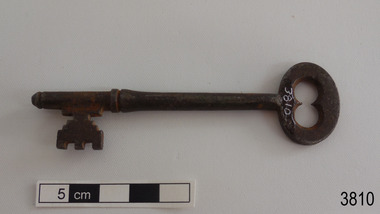
... Register (VHR H0392). It is a historical example of early settlement and development of a run in the coastal land of South West Victoria, and it is constructed from locally quarried sandstone but doesn’t take away from its Georgian design. Glenample Homestead is of State significance through its unique connection with the wreck of the ship Loch Ard and the connection to its owners, Hugh and Lavinia Gibson and Peter McArthur, played a historically and socially significant role in the rescue and care of the survivors, the salvage of goods and the burial of those who lost their lives. ...The key is one of a collection of seven 1860s keys once belonged to the Glenample Homestead near Princetown. They are all keyed with different bits and would have opened the external panelled doors of the Georgian building. The keys would now be around 150 years old. The keys are now part of the John Chance Collection. Locksmiths became a recognised trade by the middle of the 19th century, doing work that blacksmiths and gunsmiths would have done. They were craftsmen and trained apprentices for their trade. The local community and businesses relied on them for making a wide variety of precision objects such as locks and keys, knives, ornamental and decorative latticework, fine instruments, accurate tools and hardware items. Glenample Homestead became famous after the disastrous wreck of the sailing ship Loch Ard on June 1, 1878. The owners, Hugh Hamilton Gibson and Peter McArthur, were involved in the rescue and recovery of Eva Carmichael and Tom Pearce, the only two survivors, as well as overseeing the salvage of items from the shipwreck and the burial of those who lost their lives. Eva first met Jane Shields at Glenample and they became long-time friends.The keys are significant as an example of mid-19th century locksmith hardware, and for their connection with Glenample Homestead, and for their connection to the history of the Loch Ard shipwreck’s only two survivors. The set of keys also hold significance as they were discovered by John Chance, who was also a diver from the wreck of the Loch Ard in the 1960s-70s. Items that come from several wrecks along Victoria's coast have since been donated to the Flagstaff Hill Maritime Village’s museum collection by his family, illustrating this item’s level of historical value. Glenample Homestead is of historical, social and architectural significance to the State of Victoria and is listed on the Victorian Heritage Register (VHR H0392). It is a historical example of early settlement and development of a run in the coastal land of South West Victoria, and it is constructed from locally quarried sandstone but doesn’t take away from its Georgian design. Glenample Homestead is of State significance through its unique connection with the wreck of the ship Loch Ard and the connection to its owners, Hugh and Lavinia Gibson and Peter McArthur, played a historically and socially significant role in the rescue and care of the survivors, the salvage of goods and the burial of those who lost their lives. The shipwreck of the Loch Ard itself is of significance for Victoria and is registered on the Victorian Heritage Register (S417). Key; steel domestic door key. Flat open bow with 'figure 8' space, collar on shank, close to the bow. Round shank flares out slightly above the collar on the bit. The rectangular bit has external notches and grooves. There is a rounded pin on the end.flagstaff hill, warrnambool, flagstaff hill maritime museum, maritime museum, shipwreck coast, flagstaff hill maritime village, great ocean road, glenample homestead, victorian heritage register vhr h0392, georgian homestead, loch ard, princetown, jane shields, eva carmichael, tom pearce, blue china tea set, antique door key, glenample photographs, john chance -
 Flagstaff Hill Maritime Museum and Village
Photograph - Set of Photographs, John Chance, late 1960s to early 1970s
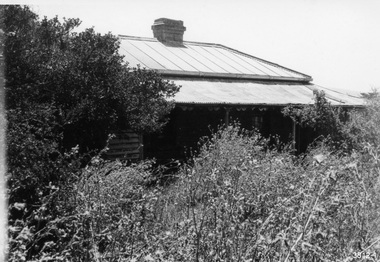
... Register (VHR H0392). It is a historical example of early settlement and development of a run in the coastal land of South West Victoria, and it is constructed from locally quarried sandstone but doesn’t take away from its Georgian design. Glenample Homestead is of State significance through its unique connection with the wreck of the ship Loch Ard and the connection to its owners, Hugh and Lavinia Gibson and Peter McArthur, played a historically and socially significant role in the rescue and care of the survivors, the salvage of goods and the burial of those who lost their lives. ...This set of glossy black and white photographs is a set of images of Glenample Homestead circa late 1960s to early 1970s. They were taken by John Chance and are part of the John Chance Collection. The Colonial Georgian style Glenample Homestead was built from 1866 to 1869 from locally quarried sandstone. In is built on the top of a hill amongst trees. There are paddocks below and around the building. The building is basically a rectangular shape with a recessed room on the right side of the front. The pitched roof is covered in corrugated iron. The veranda, added in 1886, also has a corrugated iron room and is supported by square posts with decorative tops. It shelters three sides of the building. The edge of the veranda is decorated with scalloped shapes along the front and left side of the building. On the right is a brick wall incorporating a chimney. Another chimney on the left is contained within the building. The four-panelled outside doors are visible in some of the photos, as are the 12-paned glass windows, which are framed in contrasting stone. The veranda is trimmed with scalloped metal work on two sides and had some enclosed corners. There appears to be a cubical water tank on the roof line. Out-buildings include a toilet built against the house's brick wall. Another building appears to have two rooms with outside doors, perhaps for workers. There is the remains of a two-wheeled cart under a shelter. GLENAMPLE & the LOCH ARD Glenample Homestead became famous after the disastrous wreck of the sailing ship Loch Ard on June 1, 1878. The owners, Hugh Hamilton Gibson and Peter McArthur, were involved in the rescue and recovery of the only two survivors, as well as overseeing the salvage of items from the shipwreck and the burial of those who lost their lives. Glenample Homestead is on the Great Ocean Road at Princetown. Originally the land was part of Kennan’s Station lease, one of the district’s early settlements, circa 1847. James Murray bought Kerman’s land in 1856-57, combined it with nearby land, and named it Glenample Homestead. The ruins of huts Murray built on the property were still there until recently. Glenample was sold in 1866 to the partnership of Gibson and McArthur, who built a Georgian style house there using local sandstone, completing it by 1869. On 1st June 1878 the Loch Ard was wrecked at what is now called Loch Ard Gorge. Apprentice crewman Tom Pearce and eighteen year old passenger Eva Carmichael were the only survivors. Pearce had brought Eva ashore and sheltered her in a cave, reviving her with whiskey found amongst items washed up from the wreck. He climbed the cliffs and came across two riders from Glenample. No other survivors were found and sadly, Eva’s family members were amongst those who drowned. Hugh and Lavinia Gibson cared for Pearce and Eva at Glenample and extended their hospitality to Eva, who stayed on for about six weeks as she recovered from the ordeal physically and emotionally. Mrs Gibson introduced Eva to Jane Shields and the young ladies became lifelong friends. Years after Eva had returned to England, Jane’s daughter visited her. Eva handed her a blue china tea set to pass onto her mother as a gift. A descendant of Jane’s donated part of the tea set to Flagstaff Hill Maritime Village while another descendant donated her inherited share of the tea set to the Warrnambool and District Historical Society. In 1886 Glenample Homestead was updated to include a veranda on three sides. In 1887 Gibson sold his share to partner Peter McArthur. McArthur’s son Ernest inherited the property in 1897. Ernest established the Glenample Cheese Factory in around 1911. It was closed due to the World War and reopened in 1929 by McArthur’s sons, Robert and Colin, when they took control. In 1945 they sold Glenample and several owners followed but it was left unoccupied and became dilapidated. It was during this time that John Chance visited the property and photographed the buildings. In the 1980s the National Parks Service acquired the Glenample Homestead and began a restoration program. Work began in 1989 by Cathedral Stone, which was established in 1989 by James Charlwood, a specialist stonemason and son of maritime author Don Charlwood. This set of photographs are significant as a record of Glenample Homestead as it was from around the late 1860s to the late 1960s. The photographs are also significant as they were taken by John Chance, a diver from the wreck of the Loch Ard in the 1960s-70s. Items that come from several wrecks along Victoria's coast have since been donated to the Flagstaff Hill Maritime Village’s museum collection by his family, illustrating this item’s level of historical value. The photographs are significant as a link between Glenample, the vessel Loch Ard, and the only survivors of the Loch Ard. Glenample Homestead is of historical, social and architectural significance to the State of Victoria and is listed on the Victorian Heritage Register (VHR H0392). It is a historical example of early settlement and development of a run in the coastal land of South West Victoria, and it is constructed from locally quarried sandstone but doesn’t take away from its Georgian design. Glenample Homestead is of State significance through its unique connection with the wreck of the ship Loch Ard and the connection to its owners, Hugh and Lavinia Gibson and Peter McArthur, played a historically and socially significant role in the rescue and care of the survivors, the salvage of goods and the burial of those who lost their lives. The shipwreck of the Loch Ard itself is of significance for Victoria and is registered on the Victorian Heritage Register (S417). The set of ten rectangular black and white photographs of the Glenample Homestead, taken in the late 1960s or early 1970s, give san overview of the Glenample property. The views include the front, back and one side of the building, three outbuildings, and the situation of the homestead on the property. The details on the photographs show the materials used and the Colonial Georgian style. The photographs are also a record of the deterioration of the property over the years it was unoccupied.flagstaff hill, warrnambool, flagstaff hill maritime museum, maritime museum, shipwreck coast, flagstaff hill maritime village, great ocean road, kennans station, glenample homestead, georgian homestead, loch ard, princetown, victoria, james murray, hugh hamilton gibson, lavinia gibson, jane shields, eva carmichael, tom pearce, blue china tea set, peter mcarthur, ernest mcarthur, robert mcarthur, colin mcarthur, glenample cheese factory, cathedral stone, don charlwood, james charlwood, antique door key, glenample photographs, john chance, victorian heritage database 392 -
 City of Moorabbin Historical Society (Operating the Box Cottage Museum)
Certificate - Document, Certificate of Burial 1890, c1880
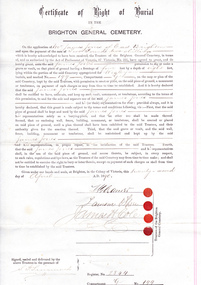
... An original paper Certificate of Right of Burial in The Brighton General Cemetery signed and dated by the Trustees of the Cemetery upon the application of James Jones of East Brighton, Victoria, 22nd April 1890. A plot , Register...Simmonds, dated twenty- second April 1890 Reverse side Dated 22nd April 1890 / Certificate of Right of Burial / IN THE / BRIGHTON GENERAL CEMETERY/ Mr James Jones ( hand written) / DENOMINATION Wesleyan / Compartment G / No. 199 Hand written on right side 3454 (signed) S Simmonds / 4797 (signed) S Simmonds / 36897 20/ 11 / 40 An original paper Certificate of Right of Burial in The Brighton General Cemetery signed and dated by the Trustees of the Cemetery upon the application of James Jones of East Brighton, Victoria, 22nd April 1890. A plot , Register ...James Jones was the son of Philip Jones, a Chairmaker, and Ann Jones who settled in East Brighton after the sale of land c1852 in the area of the Henry Dendy Special Survey of 1841. Mary Ann Moore was the daughter of Thomas Moore, a Gardener, and Sarah Harris who also settled in Brighton c1852. James and Mary Ann Jones settled and raised their family in East Brighton now Bentleigh. Mr John Herron resided at 4 Vickery St Bentleigh until 1989. Sadly Martha Jones born 1888 died in 1890 and James Jones had to purchase this plot at Brighton General Cemetery for her burial. A further 2 children were interred in 1893 and 1900 then Mary Ann in 1903 and James in 1940 James Jones and Mary Ann Moore were born in Brighton c1857 and c 1859 into pioneer market gardener families in the area of the Dendy Special Survey of 1841. They married in 1883 and raised their family in East Brighton, now Bentleigh. Sadly infectious diseases took the lives of many infants throughout the Colony of Victoria due to the poor state of water supply and sewerage disposal and locally the swamps of the Elster Creek were a constant breeding ground.An original paper Certificate of Right of Burial in The Brighton General Cemetery signed and dated by the Trustees of the Cemetery upon the application of James Jones of East Brighton, Victoria, 22nd April 1890. A plot , Register No. 2844, of 4 feet in width and 8 feet in depth in the Wesleyan Section, No. 199, compartment G in the Brighton General Cemetery. would be supplied upon payment of Two Pounds two shillings and receipt of same is acknowledged. Certificate of Right of Burial / IN THE / BRIGHTON GENERAL CEMETERY. Application of Mr James Jones of East Brighton for a plot to be supplied upon payment of Two Pounds and 2 Shillings and receipt of same acknowledged. Signed by the Trustees of the Cemetery, (4 signatures) in presence of S. Simmonds, dated twenty- second April 1890 Reverse side Dated 22nd April 1890 / Certificate of Right of Burial / IN THE / BRIGHTON GENERAL CEMETERY/ Mr James Jones ( hand written) / DENOMINATION Wesleyan / Compartment G / No. 199 Hand written on right side 3454 (signed) S Simmonds / 4797 (signed) S Simmonds / 36897 20/ 11 / 40 melbourne, brighton, moorabbin, water supply, pioneers, bentleigh, dendy henry, market gardeners, early settlers, jones mary ann, wesleyan church, jones james, vaccination, typhoid, dendys special survey 1841, infectious diseases, elster creek, jones martha, brighton general cemetery -
 Bendigo Historical Society Inc.
Document - GERTRUDE PERRY COLLECTION: CERTIFICATE OF TITLE BURIAL PLOT, 1911
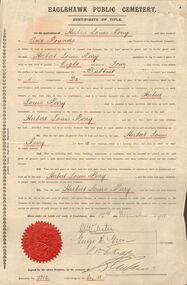
... Eaglehawk Public Cemetery Certificate of Title and receipts for Burial Plot purchased by Herbert Louis Perry. 15th December 1911. Register No. 7310 Compartment No. 02, 11 Baptist Section. ...Eaglehawk Public Cemetery Certificate of Title and receipts for Burial Plot purchased by Herbert Louis Perry. 15th December 1911. Register No. 7310 Compartment No. 02, 11 Baptist Section. ...Document. Certificate of title Burial plot. Eaglehawk Public Cemetery Certificate of Title and receipts for Burial Plot purchased by Herbert Louis Perry. 15th December 1911. Register No. 7310 Compartment No. 02, 11 Baptist Section. Document has Municipality of Eaglehawk Red Seal.document, certificate, gertrude perry collection, gertrude perry collection, herbert louis perry, eaglehawk pupblic cemetry, certificate of title burial plot -
 Narre Warren and District Family History Group
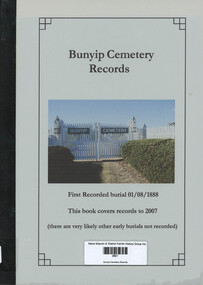
Book, West Gippsland Family History Group, Bunyip Cemetery Records, 2022
... Bunyip cemetery; an amalgamation of burial records. Transcribed from the register in 1981 by the sextant Mr Moore. ...Bunyip cemetery; an amalgamation of burial records. Transcribed from the register in 1981 by the sextant Mr Moore. The Meadley family transcribed the headstones in 1981. The West Gippsland Genealogical Society transcribed the register from 1981 to 1996 in 1996.non-fictionBunyip cemetery; an amalgamation of burial records. Transcribed from the register in 1981 by the sextant Mr Moore. The Meadley family transcribed the headstones in 1981. The West Gippsland Genealogical Society transcribed the register from 1981 to 1996 in 1996.bunyip cemetery, bunyip (vic.) -
 Narre Warren and District Family History Group
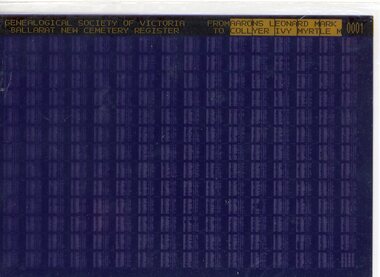
Film, Ballarat and District Genealogical Society Inc, Ballarat New Cemetery Register 1867 - 1988
... burial and cremation records. The cemetery opened in June 1867 on Doveton Street North. Set of 6 microfiche. Ballarat New Cemetery Register 1867 - 1988. ...Contains over 78,000 burial and cremation records. The cemetery opened in June 1867 on Doveton Street North.Set of 6 microfiche. non-fiction Contains over 78,000 burial and cremation records. The cemetery opened in June 1867 on Doveton Street North. ballarat (vic.), cemeteries -- victoria -- ballarat -
 Narre Warren and District Family History Group
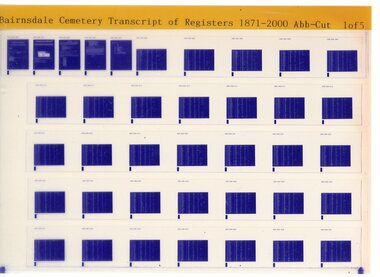
Film, East Gippsland Family History Group, Bairnsdale Cemetery Register Transcription 1871 - 2000, 2000
... Cemeteries -- Victoria -- Bairnsdale Bairnsdale (Vic.) Burial registers: 28 May 1871-29 August 2000 - Lawn Cemetery register: 1969-2000 - Sexton's registers: May 1871-December 1968 - Niche walls register. ...Burial registers: 28 May 1871-29 August 2000 - Lawn Cemetery register: 1969-2000 - Sexton's registers: May 1871-December 1968 - Niche walls register.Set of 5 microfiche.non-fictionBurial registers: 28 May 1871-29 August 2000 - Lawn Cemetery register: 1969-2000 - Sexton's registers: May 1871-December 1968 - Niche walls register. cemeteries -- victoria -- bairnsdale, bairnsdale (vic.) -
 Narre Warren and District Family History Group
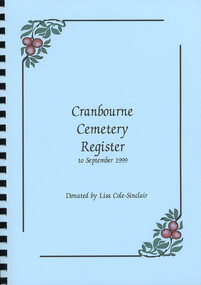
Book, Cranbourne Cemetery Trust, Cranbourne Cemetery Register to September 1999, 1999
... Reg Number, Date of Burial Cranbourne Cemetery Register to September 1999 Book Cranbourne Cemetery Trust ...1871 - 1999 includes Surname, Given name, Section. Reg Number, Date of Burialnon-fiction1871 - 1999 includes Surname, Given name, Section. Reg Number, Date of Burialcranbourne (vic.), cranbourne cemetery -
 Narre Warren and District Family History Group
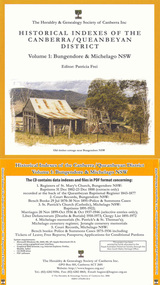
Document, Patricia M Frei, Historical indexes of the Canberra/Queanbeyan district, 2006
... Queanbeyan NSW Canberra District (ACT) parish registers burial records Historical Indexes of the Canberra Queanbeyan District in 4 volumes Volume 1: Bungendore & Michelago NSW contains: 1. ...Historical Indexes of the Canberra Queanbeyan District in 4 volumes Volume 1: Bungendore & Michelago NSW contains: 1. Registers of St. Mary's Church, Bungendore NSW: Baptisms 31 Dec 1882-23 Dec 1888 (extracts only) recorded at the back of the Queanbeyan Baptismal Register 1843-1877 2. Court Records, Bungendore NSW: Bench Books 29 Jul 1870-30 Nov 1891-Police & Summons Cases 3. St. Patrick's Church (Catholic), Michelago NSW: Baptisms 1891-1922; Marriages 20 Nov 1899-Oct 1936 & Oct 1937-1946 (selective entries only); Liber Defunctorum [Deaths & Burials] 1910-1973; Clergy List 1891-1972 4. Michelago memorials (St. Patrick's & St. Thomas's); Michelago cemetery register; Jerangle cemetery memorials 5. Court Records, Michelago NSW: Bench books: Police & Summons Cases 1875-1936 including Tickets of Leave; Free Reports; Passports; Applications for Conditional Pardons Volume 2: Council & Court Records, Queanbeyan NSW contains: 6. Selective notes from the: Minutes of meetings of Queanbeyan Municipal Council 1885-1926; Borough Council Record Book; Halloran & Co. vs Queanbeyan Municipal Council; Commons Trust Minute Book 1899-1916 7. Notes transcribed from the District Council Papers 1843-1847 8. Notes transcribed from the Yarrowlumla Shire Council Minutes Apr 1907-Feb 1950 9. Courthouse Records: Minutes of Proceedings in Court of Review, Queanbeyan (selective 1899-1903); Bailiffs Execution Book (selective entries 1897-1918) 10. Notes transcribed from the Bench of Magistrates Correspondence 1833-1851 11. Free Reports 1846-1847; Small Debts Register 1849-1864 (incl Return of Ticket of Leave Holders); Court of Requests-Judgement book Sep 1854- May 1859 (to Jan 1864) & Cash Book: Sep 1844-Aug 1846 12. Selective notes from the Court of Claims: Register of Cases from 1835 13. Publicans Licences 1841-1862 recorded in the Deposition Book from 1838 14. Bench Records-Queanbeyan 1838-1896 Volume 3: Land and Other Records contains: 15. Research notes from the: Queanbeyan Conditional Purchase Registers 1862-1872, 1874-1877; Selections made 1870-1879 under the Volunteers Regulation Act 1867; Conditional Purchase Registers, Queanbeyan 1862-1878; Dates of Birth-Juvenile Selectors 1872-1878 (selective) 16. Alienation of Lands 1812-1853 (selective Queanbeyan & district) incl. County Register 1829-1839 (King, St. Vincent, Murray Counties) 17. Land Selection 1869-1872, 1874-1876 (selective research notes on Queanbeyan & district) 18. Selective notes from the Royal Commission on the Site for a Federal Capital (site proposed at Queanbeyan: Wanniassa, Canberra, Lake George 1899-1902) 19. Teachers in Public Schools 1884 (selective Queanbeyan & district) 20. Notes transcribed from the Queanbeyan School of Arts Minute Book 21 Jul 1925-22 Jul 1935 21. Index to Obituaries & Personal Notices circa 1820s-2001 Volume 4: Parish Registers & Burial Records contains: 22. Deaths registered at Queanbeyan NSW 1856-1901 & Burials in outlying cemeteries 1856-1907 23. Queanbeyan NSW-Gemetery records transferred from denominational trustees 24. Supreme Crt of NSW-Probate Index 1800-1901 (extracts relating to the Queanbeyan district) 25. Supreme Crt of NSW-Wills & Administrations 1800-1901 (extracts only) 26. Cemetery transcriptions—Michelago, Riverside-Queanbeyan, Gundaroo, Upper Gundaroo, Barnsdale-Gundaroo, St.Thomas-Carwoola, Ss Peter & Paul—Hoskingtown (all NSW), Weetangerra, Hall, Tharwa (all ACT) 27. Anglican Church of St. John the Baptist, Canberra: baptisms 1845-1900; marriages 1845-1877; burials 1844-1915 (selective Gundaroo entries only) 28. Christ Church (Anglican), Queanbeyan (selective): baptisms 1838-1866; marriages 1838-1909, burials 1838-1880,1913-1917,1920-1968 29. St. Gregory's (Catholic), Queanbeyan: baptisms 1843-1920; marriages 1843-1857,1856-1898, 1881; burials 1844-1877,1937-1967 (selective) 30. Ministrations by RevT Hassall, Diocese of Goulburn: baptisms 1836; baptisms by T Hassall 1827-1834,1836; marr 1827-1833; burials 1827,1829 31. Fr. J.J. Therry's registers (Catholic baptisms, marriages & burials), Queanbeyan district 1820-1838 32. Anglican Church of St. Clement's, Yass NSW (Gundaroo entries only): baptisms 1839-1863; marriages 1839-1853; burials 1839-1875 33. Parish Registers, Gunning NSW, (Gundaroo entries only): baptisms 1839-1930; marriages 1840-1850; burials 1842-18554 optical discsnon-fictionHistorical Indexes of the Canberra Queanbeyan District in 4 volumes Volume 1: Bungendore & Michelago NSW contains: 1. Registers of St. Mary's Church, Bungendore NSW: Baptisms 31 Dec 1882-23 Dec 1888 (extracts only) recorded at the back of the Queanbeyan Baptismal Register 1843-1877 2. Court Records, Bungendore NSW: Bench Books 29 Jul 1870-30 Nov 1891-Police & Summons Cases 3. St. Patrick's Church (Catholic), Michelago NSW: Baptisms 1891-1922; Marriages 20 Nov 1899-Oct 1936 & Oct 1937-1946 (selective entries only); Liber Defunctorum [Deaths & Burials] 1910-1973; Clergy List 1891-1972 4. Michelago memorials (St. Patrick's & St. Thomas's); Michelago cemetery register; Jerangle cemetery memorials 5. Court Records, Michelago NSW: Bench books: Police & Summons Cases 1875-1936 including Tickets of Leave; Free Reports; Passports; Applications for Conditional Pardons Volume 2: Council & Court Records, Queanbeyan NSW contains: 6. Selective notes from the: Minutes of meetings of Queanbeyan Municipal Council 1885-1926; Borough Council Record Book; Halloran & Co. vs Queanbeyan Municipal Council; Commons Trust Minute Book 1899-1916 7. Notes transcribed from the District Council Papers 1843-1847 8. Notes transcribed from the Yarrowlumla Shire Council Minutes Apr 1907-Feb 1950 9. Courthouse Records: Minutes of Proceedings in Court of Review, Queanbeyan (selective 1899-1903); Bailiffs Execution Book (selective entries 1897-1918) 10. Notes transcribed from the Bench of Magistrates Correspondence 1833-1851 11. Free Reports 1846-1847; Small Debts Register 1849-1864 (incl Return of Ticket of Leave Holders); Court of Requests-Judgement book Sep 1854- May 1859 (to Jan 1864) & Cash Book: Sep 1844-Aug 1846 12. Selective notes from the Court of Claims: Register of Cases from 1835 13. Publicans Licences 1841-1862 recorded in the Deposition Book from 1838 14. Bench Records-Queanbeyan 1838-1896 Volume 3: Land and Other Records contains: 15. Research notes from the: Queanbeyan Conditional Purchase Registers 1862-1872, 1874-1877; Selections made 1870-1879 under the Volunteers Regulation Act 1867; Conditional Purchase Registers, Queanbeyan 1862-1878; Dates of Birth-Juvenile Selectors 1872-1878 (selective) 16. Alienation of Lands 1812-1853 (selective Queanbeyan & district) incl. County Register 1829-1839 (King, St. Vincent, Murray Counties) 17. Land Selection 1869-1872, 1874-1876 (selective research notes on Queanbeyan & district) 18. Selective notes from the Royal Commission on the Site for a Federal Capital (site proposed at Queanbeyan: Wanniassa, Canberra, Lake George 1899-1902) 19. Teachers in Public Schools 1884 (selective Queanbeyan & district) 20. Notes transcribed from the Queanbeyan School of Arts Minute Book 21 Jul 1925-22 Jul 1935 21. Index to Obituaries & Personal Notices circa 1820s-2001 Volume 4: Parish Registers & Burial Records contains: 22. Deaths registered at Queanbeyan NSW 1856-1901 & Burials in outlying cemeteries 1856-1907 23. Queanbeyan NSW-Gemetery records transferred from denominational trustees 24. Supreme Crt of NSW-Probate Index 1800-1901 (extracts relating to the Queanbeyan district) 25. Supreme Crt of NSW-Wills & Administrations 1800-1901 (extracts only) 26. Cemetery transcriptions—Michelago, Riverside-Queanbeyan, Gundaroo, Upper Gundaroo, Barnsdale-Gundaroo, St.Thomas-Carwoola, Ss Peter & Paul—Hoskingtown (all NSW), Weetangerra, Hall, Tharwa (all ACT) 27. Anglican Church of St. John the Baptist, Canberra: baptisms 1845-1900; marriages 1845-1877; burials 1844-1915 (selective Gundaroo entries only) 28. Christ Church (Anglican), Queanbeyan (selective): baptisms 1838-1866; marriages 1838-1909, burials 1838-1880,1913-1917,1920-1968 29. St. Gregory's (Catholic), Queanbeyan: baptisms 1843-1920; marriages 1843-1857,1856-1898, 1881; burials 1844-1877,1937-1967 (selective) 30. Ministrations by RevT Hassall, Diocese of Goulburn: baptisms 1836; baptisms by T Hassall 1827-1834,1836; marr 1827-1833; burials 1827,1829 31. Fr. J.J. Therry's registers (Catholic baptisms, marriages & burials), Queanbeyan district 1820-1838 32. Anglican Church of St. Clement's, Yass NSW (Gundaroo entries only): baptisms 1839-1863; marriages 1839-1853; burials 1839-1875 33. Parish Registers, Gunning NSW, (Gundaroo entries only): baptisms 1839-1930; marriages 1840-1850; burials 1842-1855queanbeyan nsw, canberra district (act), parish registers, burial records -
 Narre Warren and District Family History Group
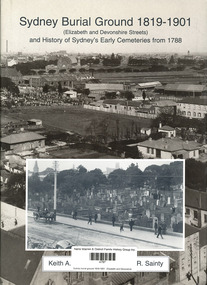
Book, Keith A Johnson et al, Sydney burial ground 1819-1901 : Elizabeth and Devonshire streets and history of Sydney's early cemeteries from 1788, 2001
... New South Wales Lorraine Taylor Collection Central Railway Station Licenses to Bury & Butts Interment Register Monumental Inscriptions at Bunnerong This book is about the Sydney Burial Ground 1819 - 1901 and the history of the early cemeteries from 1788 Sydney burial ground 1819-1901 : Elizabeth and Devonshire streets and history of Sydney's early cemeteries from 1788 Book Keith A Johnson Malcolm R Sainty Library of Australian History ...This book is about the Sydney Burial Ground 1819 - 1901 and the history of the early cemeteries from 1788non-fictionThis book is about the Sydney Burial Ground 1819 - 1901 and the history of the early cemeteries from 1788new south wales, lorraine taylor collection, central railway station, licenses to bury & butts, interment register, monumental inscriptions at bunnerong -
Stawell Historical Society Inc
Archive, Great Western Cemetery Records. Names of Burials Recorded, 1860
... Photocopied Lots of Burials at Great Western Black Lever Arch, Plastic Inserts with paper Records. Cemetery Map Death Certificates, Inquests, Cemetery Register...Death Certificates Inquests Register Map Cemetery Photocopied Lots of Burials at Great Western Black Lever Arch, Plastic Inserts with paper Records. ...Death Certificates Inquests Register MapPhotocopied Lots of Burials at Great Western Black Lever Arch, Plastic Inserts with paper Records. Cemetery Map Death Certificates, Inquests, Cemetery Registercemetery -
 Sunshine and District Historical Society Incorporated
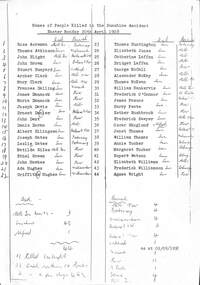
Certificate - Sunshine Rail Disaster death certificates, 1908
... Sunshine Railway Disaster Disaster Railways Sunshine Railway Station Printed List of Names of People killed in the Sunshine Accident Easter Monday 20 April 1908 Rose Acreman died Melbourne General Queen Vic Buried Footscray Thomas Atkinson died Sunshine Buried Williamstown John Blight died Melbourne General Queen Vic Buried Ballarat Old John Brown died Sunshine Buried Ballarat Old Stuart Bunyard died Sunshine Buried Oakleigh Archer Clark died Sunshine Buried Melbourne New Mary Clark died Sunshine Buried Melbourne New Frances Dalling died Sunshine Buried Warrick James Dannock died Sunshine Buried Kew Maria Dannock died Sunshine Buried Kew Joseph David died Sunshine Buried Melbourne New Ernest Denier died Sunshine Buried Ballarat New John Dent died Sunshine Buried Kew Denis Doran died Sunshine Buried Melbourne Albert Ellingsen died Sunshine Buried Ballarat New Joseph Gates died Sunshine Buried Footscray Leslie Gates died Sunshine Buried Footscray Matilda Giles died Melbourne General Queen Vic Buried Kew Ethel Green died Sunshine Buried Kew John Haekes died Sunshine Buried Kew Ada Hughes died Sunshine Buried Williamstown Griffith Hughes died Sunshine Buried Williamstown Thomas Huntington died Sunshine Buried Footscray Elizabeth Jones died Sunshine Buried Melbourne Catherine Laffan died Sunshine Buried Melbourne Bridget Laffan died Sunshine Buried Melbourne George McCall died Sunshine Buried Kew Alexander McKay died Sunshine Buried Melbourne Thomas McKean died Sunshine Buried Melbourne William Nankervis died Sunshine Buried Melbourne Frederick OConnor died Sunshine Buried St Kilda James Pascoe died Sunshine Buried Ballarat Old Harry Peate died Sunshine Buried Kew Esther Rushbrook died Sunshine Buried Kew Frederick Sawyer died Sunshine Buried Melbourne Oscar Skoglund died Alfred Buried Kew Janet Thomas died Sunshine Buried Ballarat Old William Thomas died Sunshine Buried Melbourne Annie Tucker died Sunshine Buried Coburg Margaret Tucker died Sunshine Buried Coburg Rupert Watson died Sunshine Buried Coburg Elizabeth Williams died Sunshine Buried Melbourne Frederick Williamson died Sunshine Buried Coburg Agnes Wright died Sunshine Buried Kew A3 photocopy of death registered in the District of East Melbourne in the State of Victoria Sunshine Rail Disaster death certificates Death certificates listing the 44 people who died as a result of the railway disaster at Sunshine Station 20th April 1908 Also lists names of those who did at Sunshine Melbourne and Alfred Hospital and place of burial Findings by coroner May and July inquest Certificate Sunshine Rail Disaster death certificates ...Printed List of Names of People killed in the Sunshine Accident Easter Monday 20 April 1908 Rose Acreman died Melbourne General Queen Vic Buried Footscray Thomas Atkinson died Sunshine Buried Williamstown John Blight died Melbourne General Queen Vic Buried Ballarat Old John Brown died Sunshine Buried Ballarat Old Stuart Bunyard died Sunshine Buried Oakleigh Archer Clark died Sunshine Buried Melbourne New Mary Clark died Sunshine Buried Melbourne New Frances Dalling died Sunshine Buried Warrick James Dannock died Sunshine Buried Kew Maria Dannock died Sunshine Buried Kew Joseph David died Sunshine Buried Melbourne New Ernest Denier died Sunshine Buried Ballarat New John Dent died Sunshine Buried Kew Denis Doran died Sunshine Buried Melbourne Albert Ellingsen died Sunshine Buried Ballarat New Joseph Gates died Sunshine Buried Footscray Leslie Gates died Sunshine Buried Footscray Matilda Giles died Melbourne General Queen Vic Buried Kew Ethel Green died Sunshine Buried Kew John Haekes died Sunshine Buried Kew Ada Hughes died Sunshine Buried Williamstown Griffith Hughes died Sunshine Buried Williamstown Thomas Huntington died Sunshine Buried Footscray Elizabeth Jones died Sunshine Buried Melbourne Catherine Laffan died Sunshine Buried Melbourne Bridget Laffan died Sunshine Buried Melbourne George McCall died Sunshine Buried Kew Alexander McKay died Sunshine Buried Melbourne Thomas McKean died Sunshine Buried Melbourne William Nankervis died Sunshine Buried Melbourne Frederick OConnor died Sunshine Buried St Kilda James Pascoe died Sunshine Buried Ballarat Old Harry Peate died Sunshine Buried Kew Esther Rushbrook died Sunshine Buried Kew Frederick Sawyer died Sunshine Buried Melbourne Oscar Skoglund died Alfred Buried Kew Janet Thomas died Sunshine Buried Ballarat Old William Thomas died Sunshine Buried Melbourne Annie Tucker died Sunshine Buried Coburg Margaret Tucker died Sunshine Buried Coburg Rupert Watson died Sunshine Buried Coburg Elizabeth Williams died Sunshine Buried Melbourne Frederick Williamson died Sunshine Buried Coburg Agnes Wright died Sunshine Buried Kew A3 photocopy of death registered in the District of East Melbourne in the State of Victoriasunshine railway disaster, disaster, railways, sunshine railway station -
Clunes Museum
Book, PETER SPARK, CLUNES CEMETERY VICTORIA - HEADSTONE REGISTER 1861-2020
... CLUNES CEMERTERY BURIALS FROM 1861 TO 2020 CHURCH OF ENGLAND SECTION ST.PAUL'S CHURCH BURIAL RECORDS CLUNES CEMERTERY BURIALS FROM 1861 TO 2020 CHURCH OF ENGLAND SECTION HEADSTONE REGISTER 1861-2020 VOLUME THREE: CHURCH OF ENGLAND SECTION INCLUDED IS A SHORT HISTORY OF ST. ...CLUNES CEMERTERY BURIALS FROM 1861 TO 2020 CHURCH OF ENGLAND SECTIONHEADSTONE REGISTER 1861-2020 VOLUME THREE: CHURCH OF ENGLAND SECTION INCLUDED IS A SHORT HISTORY OF ST. PAUL"S CHURCH., COLOURED RED HARDCOVER. 213 PAGES PHOTO OF THE CHAPEL/REGISTRY ON FRONT AND BACKnon-fictionCLUNES CEMERTERY BURIALS FROM 1861 TO 2020 CHURCH OF ENGLAND SECTIONst.paul's church, burial records -
Box Hill Historical Society
Book, Marjorie Morgan, The old Melbourne Cemetery 1837 - 1922, 1982
... Cemeteries Old Melbourne Cemetery Graves An alphabetical burial register of those who were buried in the old Melbourne Cemetery located where the Queen Victoria Market now stands. ...An alphabetical burial register of those who were buried in the old Melbourne Cemetery located where the Queen Victoria Market now stands. It includes a copy of inscriptions on tombstones in the Old Melbourne Cemetery, some photos, plan of cemetery, grave numbers, denomination and some birth dates and details of those buried.319pAn alphabetical burial register of those who were buried in the old Melbourne Cemetery located where the Queen Victoria Market now stands. It includes a copy of inscriptions on tombstones in the Old Melbourne Cemetery, some photos, plan of cemetery, grave numbers, denomination and some birth dates and details of those buried.cemeteries, old melbourne cemetery, graves -
Lakes Entrance Historical Society
Book, Semmens Palma and Maffra Historical Society, An Index of Names of burials in Maffra Public Cemetery, 1996
... An index to names of burials in the Maffra Public cemetery compiled from the cemetery journal 1869-1983 the cemetery register 1869-1993 and memorial headstones excluding the lawn section....Cemeteries An index to names of burials in the Maffra Public cemetery compiled from the cemetery journal 1869-1983 the cemetery register 1869-1993 and memorial headstones excluding the lawn section. ...An index to names of burials in the Maffra Public cemetery compiled from the cemetery journal 1869-1983 the cemetery register 1869-1993 and memorial headstones excluding the lawn section.cemeteries -
Stawell Historical Society Inc
Archive, Great Western Cemetery Records. Names of Burials Recorded, 1860
... Death Certificates Inquests Register Map Cemetery Photocopied Lots of Burials at Great Western Great Western Cemetery Records. ...Death Certificates Inquests Register MapPhotocopied Lots of Burials at Great Western cemetery
