
Showing 26 items matching "butchers tools"
-
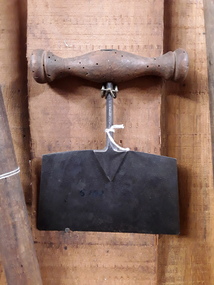 Mont De Lancey
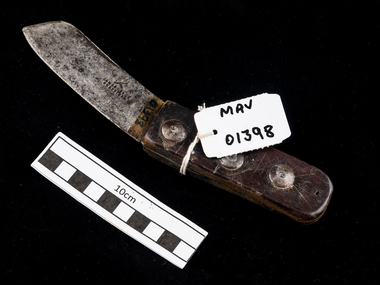
Tool - Meat Chopper, Unknown
... ...Butchers tools...Cutters Cutting tools Butchers tools Meat chopper Cleavers Butchers knives A small vintage handmade metal rectangular meat chopper with a short metal handle attached to the very sharp blade. ...A small vintage handmade metal rectangular meat chopper with a short metal handle attached to the very sharp blade. It has a turned, patterned curved wooden handle joined to this.cutters, cutting tools, butchers tools, meat chopper, cleavers, butchers knives -
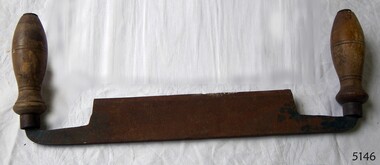 Flagstaff Hill Maritime Museum and Village
Tool - Draw Knife, Hale Bros. (John Thomas Hale and Samuel Stafford Hale), 1940s or earlier
... The firm made tools for edgers and joiners, wall drills, cold chisels, files and rasps, printers' and publishers' tools, butchers' and bread knives, and table cutlery. ...The firm made tools for edgers and joiners, wall drills, cold chisels, files and rasps, printers' and publishers' tools, butchers' and bread knives, and table cutlery. ...This draw knife once belonged to a Sough Australian family of coopers, or barrel makers surnamed Schahinger. The maker was Hale Bros. of Sheffield. The brothers, John Thomas Hale (1853-1919) and Samuel Stafford Hale (1855-1948) owned the Moorfield Works. The firm's Corporate Mark of a horse's head was granted in 1842 and came with the statement that "All tools marked with a "Horse's Head" are Guaranteed". The firm made tools for edgers and joiners, wall drills, cold chisels, files and rasps, printers' and publishers' tools, butchers' and bread knives, and table cutlery. This draw knife was used by a cooper in South Australia for making wooden barrels in the traditional manner. The makers had a family business of making knives, cutlery and tools for trades people. This draw knife is relevant to the trades represented in a maritime village of the late 19th century. Draw knife; cooper's steel draw knife with bulbous wooden handles that have scored rings as decoration. The straight blade is 13 inches long. Inscription and logo of a horse's head on centre of blade. Made by Hale Bros of Sheffield. "HALE BROS / SHEFFIELD / - - - - " Image [Horse's Head]flagstaff hill, warrnambool, maritime-museum, coopers, draw knife, barrel maker, hale bros., sheffield, moorfield works, john thomas hale, samuel stafford hale, knife makers -
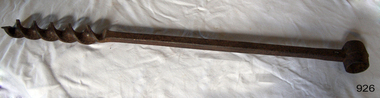 Flagstaff Hill Maritime Museum and Village
Tool - Auger, Robert Sorby, First half of the 20th Century
... By the early 20th century, they were manufacturing carving tools, planes and plane irons, circular saws, wood saws, butchers saws and cleavers, garden tools, pruning knives, coopers’ knives, bricklayers tools and joiners tools. ...By the early 20th century, they were manufacturing carving tools, planes and plane irons, circular saws, wood saws, butchers saws and cleavers, garden tools, pruning knives, coopers’ knives, bricklayers tools and joiners tools. ...A scotch eye auger is perfect for quickly making holes in dry or wet wood for making chairs, stools, and any number of woodworking projects. The scotch eye serves as a peg gauge and whatever peg you make to go into the hole should fit into the augers eye. Robert Sorby & Sons: The forbearer's of Robert Sorby had been cutlers in the Sheffield region of England, dating from the mid 17th century. Robert Sorby and Sons were registered in Sheffield in 1828 as a manufacturer of edge tools, saws, scythes and hay knives. In addition to manufacturing tools, they also diversified into the manufacture of crucible steel for tool manufacture. From circa 1860-1967, the Sorby factory in Sheffield was known as the “Kangaroo Works”. The Kangaroo Brand of tools was made by Robert Sorby & Sons. During the 19th century, they had a large trade in Australasia. By the early 20th century, they were manufacturing carving tools, planes and plane irons, circular saws, wood saws, butchers saws and cleavers, garden tools, pruning knives, coopers’ knives, bricklayers tools and joiners tools. In 1923 Robert Sorby & Sons was bought by Sheffield company Hattersley and Davidson. They are today one of the few remaining British tool manufacturers.The company has a long tradition of making edged tools for various uses and exporting them to Australia, however the subject item was probably made from the early 20th century up until 1967 when the company stopped exporting to Australia.Scotch Eye Auger, Double Twist with Lead Screw, square shaft, socket set at right angleRob Sorbey Sheffield stamped on shaft with Kangaroo trade markflagstaff hill, warrnambool, flagstaff-hill, flagstaff-hill-maritime-museum, maritime-museum, shipwreck-coast, flagstaff-hill-maritime-village, ring auger, carpenders tools, hole drilling, rob sorby & sons -
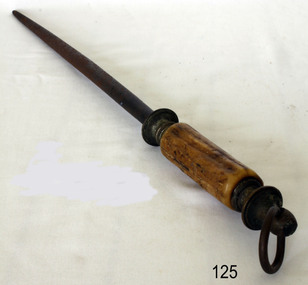 Flagstaff Hill Maritime Museum and Village
Functional object - Knife Sharpener, Johann Friedrich Dick, 1873 to 1900
... In 1889, Friedrich Dick built a new factory in Kollwitz/Fleischmannstrasse in Esslingen, employing 100 people and expanding the product line to include knives for butchers and chefs, cleavers and other specialized tools. Files manufactured ranged from the smallest watchmaker's file to the largest (over 45 cm in length) square file. ...In 1889, Friedrich Dick built a new factory in Kollwitz/Fleischmannstrasse in Esslingen, employing 100 people and expanding the product line to include knives for butchers and chefs, cleavers and other specialized tools. Files manufactured ranged from the smallest watchmaker's file to the largest (over 45 cm in length) square file. ...Johann Friedrich Dick founded the company in 1778 to manufacture files, the company continued in the manufacture of files as its main product line until 1873, when Paul Friedrich Dick took over the company and began the production of sharpening steels, with the logo of “F Dick” on their products. One hundred years after the founding of the company, a factory in Esslingen began construction. At that time the company had 20 employees. In 1881, company commissioned Germany's first file production machine. In 1889, Friedrich Dick built a new factory in Kollwitz/Fleischmannstrasse in Esslingen, employing 100 people and expanding the product line to include knives for butchers and chefs, cleavers and other specialized tools. Files manufactured ranged from the smallest watchmaker's file to the largest (over 45 cm in length) square file. In 1997, the F Dick company moved to a new headquarters in Deizisau, Germany. The old factory in Esslingen is now a class listed monument and the town's landmark.An item made by a world class manufacture of cutlery for chefs, the subject item is significant as its manufacture was probably early in the firms beginnings when Friedrich Dick took over in1873 when he specialised in making sharpening steels. The company is still producing these items today as well as other specialised knives for professionals. Early manufactured steels such as the subject item are sought after today by collectors and quite rare. Sharpening Steel or Knife sharpener with bone handle with ribbed pattern, brass knobs and ring at end of handleMarked F Dick Esslingenflagstaff hill, warrnambool, shipwrecked coast, flagstaff hill maritime museum, flagstaff hill maritime village, great ocean road, sharpening steel, knife sharpener, kitchen tool, carving, kitchen utensil, cooking, f dick -
 City of Moorabbin Historical Society (Operating the Box Cottage Museum)
Tools, Knife, curved, Sheffield c1900, 20thC
... butcher’s knife crossed with a sharpening steel (and the letters ‘JO’). The firm stayed in the family until 1960. Early settlers were self reliant and repaired their own equipment for kitchen,dairy, farm, horses, carts using various tools . ...butcher’s knife crossed with a sharpening steel (and the letters ‘JO’). The firm stayed in the family until 1960. Early settlers were self reliant and repaired their own equipment for kitchen,dairy, farm, horses, carts using various tools . ...John Oxley was a shoe and butchers’ knife manufacturer, who was listed in Whitecroft UK in 1822 . By 1825, he was based in Hollis Croft. John apparently died in about 1837. He had two sons – George (1808-1879) and James (1811-1881) who took over the business. George moved to Indianna, USA and in 1868 James continued to manufacture 'Cooks’ and palette knives and steels" Oxley’s trade mark was a butcher’s knife crossed with a sharpening steel (and the letters ‘JO’). The firm stayed in the family until 1960. Early settlers were self reliant and repaired their own equipment for kitchen,dairy, farm, horses, carts using various tools . This strong steel knife is typical of the type used by early settlers in Moorabbin Shire c1900Heavy duty curved steel knife with a wide blade encased in 2 thick leather straps secured with steel rivets Blade ; James Oxley with Trade Mark - a butcher’s knife crossed with a sharpening steel (and the letters ‘JO’). scratched into leather handle ; J EVANSknives, sheffield steel, oxley james ltd. , leatherworkers, saddles, horses, bootmakers, shoes, boots, builders, carpenters, early settlers, market gardeners, blacksmiths, tools, building equipment, hammers, moorabbin shire, bentleigh, mckinnon, highett, cheltenham,mcewan james pty ltd, melbourne, bunnings pty ltd, -
 Orbost & District Historical Society
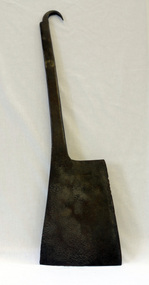
cleaver, c. 1900 to 1930s
... Stock was slaughtered and prepared by Orbost butchers. meat-cleaver butchering-tool Williams-Smithfield 192 55575 A large and heavy iron butcher's cleaver with a thin handle and with a hook on the end of the handle. ...Possibly used by a local butcher in the Orbost region. Stock was slaughtered and prepared by Orbost butchers.A large and heavy iron butcher's cleaver with a thin handle and with a hook on the end of the handle. The blade has a square shape.Williams-Smithfield 192 55575meat-cleaver butchering-tool -
 Orbost & District Historical Society
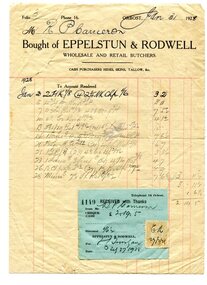
accounts, 1915 -1928
... butcher in Nicholson Street (the main street), Orbost in the early 20th century. This document is a record of an early business in Orbost and reflects a time when accounts were hand-written. It is a useful research tool ...Robert Pullar Cameron was a Shire Councillor for many years. He married Penuel Hossack and had a family of James, Flora, Penuel and Alex. A. E. Rodwell was a wholesale and retail butcher in Nicholson Street (the main street), Orbost in the early 20th century.This document is a record of an early business in Orbost and reflects a time when accounts were hand-written. It is a useful research tool.Three accounts. One very yellow with block print and illustration of a bull in the top left hand corner. The other two are white with red lines and blue print. One has a blue receipt attached and a yellow duty stamp. They are from A.E. Rodwell, wholesale and retail butcher, to R. Cameron.document-accounts cameron-r.p. rodwell-a.e.-butcher -
 Orbost & District Historical Society
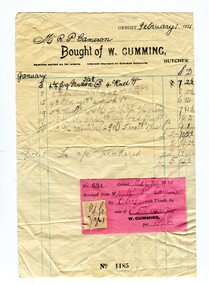
account, February 1st 1921
... butcher's shop on his farm. He was a shire councillor and served as a South Riding representative for 38 years. He was a keen Newmerella football supporter, a member of the Orbost Bowling Club as well as a director of the Orbost Butter Factory. Cumming was married to Ellen Louise Mundy and had four children ( Harold, Mary, William and Gordon). This item is an example of a hand-written account for a local early 20th century business in Orbost. It is a useful research tool ...Robert Pullar Cameron was a Shire Councillor for many years. He married Penuel Hossack and had a family of James, Flora, Penuel and Alex. William Cumming was a prominent Orbost identity. He was born in Ballymena, Northern Ireland, in 1866 the son of William Cumming and Mary Ann Montgomery. He came to Australia, aged 28, and to Orbost in 1890. He farmed at Bete Bolong and during WW1 ran a butcher's shop on his farm. He was a shire councillor and served as a South Riding representative for 38 years. He was a keen Newmerella football supporter, a member of the Orbost Bowling Club as well as a director of the Orbost Butter Factory. Cumming was married to Ellen Louise Mundy and had four children ( Harold, Mary, William and Gordon).This item is an example of a hand-written account for a local early 20th century business in Orbost. It is a useful research tool.A white paper account with blue lines and black ink . It has a pink receipt attached as well as a yellow duty stamp. It is from W. Cumming, butcher, to R.P. Cameron.cameron-robert-pullar cumming-william-butcher -
 Orbost & District Historical Society
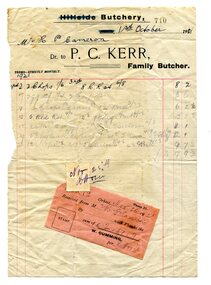
account, 1st October 1921
... This is an example of a hand-written account from an early Orbost business and is a useful research tool. cameron-robert-pullar kerr-p.c.-butcher account A white paper account with black print, red lines and handwritten pencil information. ...Robert Pullar Cameron was a Shire Councillor for many years. He married Penuel Hossack and had a family of James, Flora, Penuel and Alex. Peter Kerr bought the butchery from William Cumming in 1921.This is an example of a hand-written account from an early Orbost business and is a useful research tool.A white paper account with black print, red lines and handwritten pencil information. It has a yellow duty stamp and a large pink receipt sticker.cameron-robert-pullar kerr-p.c.-butcher account -
 Orbost & District Historical Society
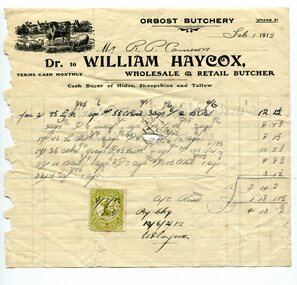
account, 1st February 1912
... Butcher shop was near the Club Hotel. Robert Pullar Cameron was a Shire Councillor for many years. He married Penuel Hossack and had a family of James, Flora, Penuel and Alex. This item is an example of book keeping in the early 20th century. It is from a business in Orbost and is a useful research tool ...William Haycox was a wholesale and retail butcher who was a cash buyer of hides, sheepskins and tallow. The Haycox Butcher shop was near the Club Hotel. Robert Pullar Cameron was a Shire Councillor for many years. He married Penuel Hossack and had a family of James, Flora, Penuel and Alex. This item is an example of book keeping in the early 20th century. It is from a business in Orbost and is a useful research tool.A white paper account with black print, blue ;lines and an illustration of cattle in the top left hand corner. It has a yellow duty stamp and is from William Haycox, butche,r to R.P. Cameron.on back -"Penalty McColl..." -
 Orbost & District Historical Society
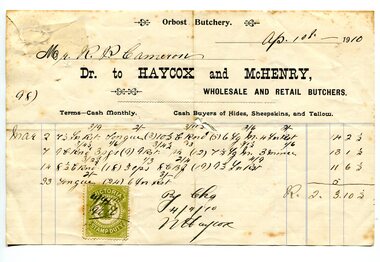
account, April 1st, 1910
... Butcher shop was near the Club Hotel. Robert Pullar Cameron was a Shire Councillor for many years. He married Penuel Hossack and had a family of James, Flora, Penuel and Alex. This item is an example of the book-keeping of an early Orbost business and is a useful research tool. ...William Haycox was a wholesale and retail butcher who was a cash buyer of hides, sheepskins and tallow. The Haycox Butcher shop was near the Club Hotel. Robert Pullar Cameron was a Shire Councillor for many years. He married Penuel Hossack and had a family of James, Flora, Penuel and Alex.This item is an example of the book-keeping of an early Orbost business and is a useful research tool.A white paper account with black ink and blue lines from Haycox & Mc Henry, wholesale and retail butchers to R. Cameron. There is a duty stamp.haycox-butcher-orbost cameron-robert-pullar -
 Emerald Museum & Nobelius Heritage Park
Headwear - Fire Fighters Helmet, MSA, c.1970s
... butcher's shop near the corner of Monbulk Road. The Brigade's first fire station was built around 1945. In 1966, this station was recorded as containing the fire truck and a Land rover pumper, three radio sets, 40 knapsacks, six lengths of hose, helmets, rake hoes and other hand tools. ...butcher's shop near the corner of Monbulk Road. The Brigade's first fire station was built around 1945. In 1966, this station was recorded as containing the fire truck and a Land rover pumper, three radio sets, 40 knapsacks, six lengths of hose, helmets, rake hoes and other hand tools. ...Helmets protect firefighters from heat, falling objects and cinders. During the 1960s in Australia, helmets evolved from metal construction to that of polymer and other plastics. The manufacturer of this helmet, MSA, was founded in 1914 in the USA. It began as a mine safety company but since expanded into more general worker protection and safety products. The Emerald Fire Brigade was established on 14 March 1941 as the Emerald Bush Brigade. Originally its equipment was stored at Madigan's butcher's shop near the corner of Monbulk Road. The Brigade's first fire station was built around 1945. In 1966, this station was recorded as containing the fire truck and a Land rover pumper, three radio sets, 40 knapsacks, six lengths of hose, helmets, rake hoes and other hand tools. In 2010, the Brigade moved into a new purpose-built building in Monbulk Road.This helmet is an historical artifact worn by members of a crucial volunteer fire fighting service operating in the Emerald district since 1941.Yellow, lightweight, hard plastic or polymer helmet with black leather detachable chin strap with velcro fastening.Inside helmet on a partly torn label: 'MSA / VGARD / Type 2 ...? / STANDARDS AUSTRALIA' Inside the brim at one end engraved: 'MSA'' and at the other end: '1801-1881 / LN70' On front of helmet a label with logo and red lettering: 'CFA' helmets, fire fighting, msa, emerald fire brigade, cfa -
 Emerald Museum & Nobelius Heritage Park
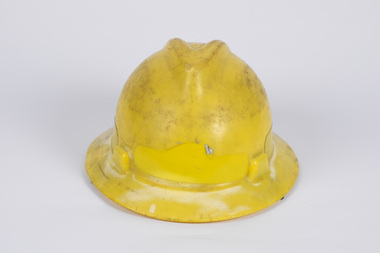
Headwear - Fire Fighters Helmet, MSA, c.1970s
... butcher's shop near the corner of Monbulk Road. The Brigade's first fire station was built around 1945. In 1966, this station was recorded as containing the fire truck and a Land rover pumper, three radio sets, 40 knapsacks, six lengths of hose, helmets, rake hoes and other hand tools. ...butcher's shop near the corner of Monbulk Road. The Brigade's first fire station was built around 1945. In 1966, this station was recorded as containing the fire truck and a Land rover pumper, three radio sets, 40 knapsacks, six lengths of hose, helmets, rake hoes and other hand tools. ...During the 1960s in Australia, helmets evolved from metal construction to that of polymer and other plastics. This helmet was donated by the Emerald Fire Brigade which was established on 14 March 1941 as the Emerald Bush Brigade. Originally its equipment was stored at Madigan's butcher's shop near the corner of Monbulk Road. The Brigade's first fire station was built around 1945. In 1966, this station was recorded as containing the fire truck and a Land rover pumper, three radio sets, 40 knapsacks, six lengths of hose, helmets, rake hoes and other hand tools. In 2010, the Brigade moved into a new purpose-built building in Monbulk Road. The manufacturer of this helmet, MSA, was founded in 1914 in the USA. MSA began as a mine safety company but since expanded into more general worker protection and safety products. This helmet is an historical artifact worn by members of a crucial volunteer fire fighting service operating in the Emerald district since 1941.Yellow, lightweight, hard plastic or polymer helmet with black leather detachable chin strap with Velcro fastening. inside the helmet is an adjustable head harnessInside helmet on a partly torn label: 'MSA / VGARD / Type 2 ...? / STANDARDS AUSTRALIA' Inside the brim black pen writing EMERALD SPARE 5 EMERALD at one end engraved: 'MSA'' and at the other end: '1801-1881 On the outside of the helmet there is a yellow reflector on each side and at the front and the back there is evidence of labels that have been removed.helmets, fire fighting, msa, emerald fire brigade, cfa -
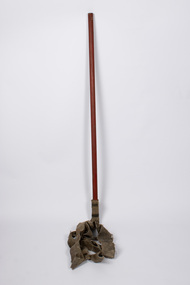 Emerald Museum & Nobelius Heritage Park
Tool - Fire Fighters Beaters, c.1950s - 1960s
... butcher's shop near the corner of Monbulk Road. The Brigade's first fire station was built around 1945. In 1966, this station was recorded as containing the fire truck and a Land rover pumper, three radio sets, 40 knapsacks, six lengths of hose, helmets, rake hoes and other hand tools. ...butcher's shop near the corner of Monbulk Road. The Brigade's first fire station was built around 1945. In 1966, this station was recorded as containing the fire truck and a Land rover pumper, three radio sets, 40 knapsacks, six lengths of hose, helmets, rake hoes and other hand tools. ...This pair of fire fighters beaters were donated by the Emerald Fire Brigade which was established on 14 March 1941 as the Emerald Bush Brigade. Originally its equipment was stored at Madigan's butcher's shop near the corner of Monbulk Road. The Brigade's first fire station was built around 1945. In 1966, this station was recorded as containing the fire truck and a Land rover pumper, three radio sets, 40 knapsacks, six lengths of hose, helmets, rake hoes and other hand tools. In 2010, the Brigade moved into a new purpose-built building in Monbulk Road. These beaters date from the 1950s to 1960s.These fire fighters beaters were used by members of a crucial volunteer fire fighting service operating in the Emerald district since 1941.Two Firefighter Beaters each consisting of a long round, red wooden pole with wide heavy-duty textile straps attached to the bottom of the pole. One has wire attached at the top of the pole for hanging purposes. Nonefire fighting, emerald fire brigade, cfa -
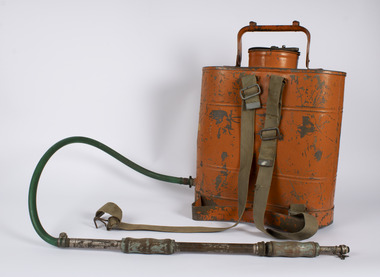 Emerald Museum & Nobelius Heritage Park
Tool - Fire Extinguisher, c. 1960s
... butcher's shop near the corner of Monbulk Road. The Brigade's first fire station was built around 1945. In 1966, this station was recorded as containing the fire truck and a Land Rover pumper, three radio sets, 40 knapsacks, six lengths of hose, helmets, rake hoes and other hand tools. ...butcher's shop near the corner of Monbulk Road. The Brigade's first fire station was built around 1945. In 1966, this station was recorded as containing the fire truck and a Land Rover pumper, three radio sets, 40 knapsacks, six lengths of hose, helmets, rake hoes and other hand tools. ...This Fire Fighting Backpack was donated by the Emerald Fire Brigade which was established on 14 March 1941 as the Emerald Bush Brigade. Originally its equipment was stored at Madigan's butcher's shop near the corner of Monbulk Road. The Brigade's first fire station was built around 1945. In 1966, this station was recorded as containing the fire truck and a Land Rover pumper, three radio sets, 40 knapsacks, six lengths of hose, helmets, rake hoes and other hand tools. In 2010, the Brigade moved into a new purpose-built building in Monbulk Road. This Fire Fighting Backpack dates from around c.1960s.This Fire Fighting Backpack Extinguisher was used for mopping-up and combating small fires by members of a crucial volunteer fire fighting service operating in the Emerald district since 1941.This galvanised metal Rega Fire Fighting Backpack Sprayer was used by Emerald CFA (formerly RFB) from 1960's. The main body of the spray tank is orange and has woven canvas shoulder straps with buckles for carrying on your back. On top of the oval tank is a lid with a chain which has "REGA SPRAYER" embossed onto it. It has a metal handle over the top of the lid, which is hinged and has two clips for docking the wooden handle of the sprayer hose when not in use. The wooden sprayer handle with a brass pump assembly is attached to the tank with a piece of hosing allowing for pressurized spraying. The backpack tank has the brand name "REGA" and "CFA" embossed on the front of the tank's well worn patina from many years of use. "Emerald RFB" on the side of the tank. "OK 1/97" on the top near the lidfire fighting, emerald fire brigade, cfa, rega firefighting brand -
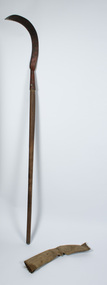 Emerald Museum & Nobelius Heritage Park
Tool - Fire Fighters Scythe (Fern hook), c.1950s - 1960s
... butcher's shop near the corner of Monbulk Road. The Brigade's first fire station was built around 1945. In 1966, this station was recorded as containing the fire truck and a Land rover pumper, three radio sets, 40 knapsacks, six lengths of hose, helmets, rake hoes and other hand tools. ...butcher's shop near the corner of Monbulk Road. The Brigade's first fire station was built around 1945. In 1966, this station was recorded as containing the fire truck and a Land rover pumper, three radio sets, 40 knapsacks, six lengths of hose, helmets, rake hoes and other hand tools. ...This fire fighter's scythe was donated by the Emerald Fire Brigade which was established on 14 March 1941 as the Emerald Bush Brigade. Originally its equipment was stored at Madigan's butcher's shop near the corner of Monbulk Road. The Brigade's first fire station was built around 1945. In 1966, this station was recorded as containing the fire truck and a Land rover pumper, three radio sets, 40 knapsacks, six lengths of hose, helmets, rake hoes and other hand tools. In 2010, the Brigade moved into a new purpose-built building in Monbulk Road. This scythe, also known as a fern hook, dates from the 1950s to 1960s.This fire fighter's scythe was used by members of a crucial volunteer fire fighting service operating in the Emerald district since 1941.One Firefighter scythe (Fern Hook) consisting of a long wooden pole with curved blade attached at the end. The blade has a canvas protective sleeve.Nonefire fighting, emerald fire brigade, cfa -
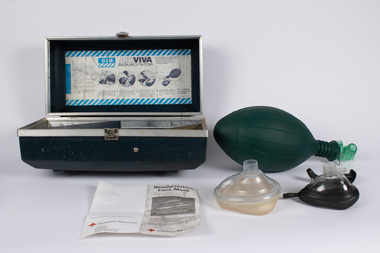 Emerald Museum & Nobelius Heritage Park
Equipment - Air-Viva Resuscitator, c.1950s - 1960s
... butcher's shop near the corner of Monbulk Road. The Brigade's first fire station was built around 1945. In 1966, this station was recorded as containing the fire truck and a Land rover pumper, three radio sets, 40 knapsacks, six lengths of hose, helmets, rake hoes and other hand tools. ...butcher's shop near the corner of Monbulk Road. The Brigade's first fire station was built around 1945. In 1966, this station was recorded as containing the fire truck and a Land rover pumper, three radio sets, 40 knapsacks, six lengths of hose, helmets, rake hoes and other hand tools. ...This resuscitation kit was donated by the Emerald Fire Brigade which was established on 14 March 1941 as the Emerald Bush Brigade. Originally its equipment was stored at Madigan's butcher's shop near the corner of Monbulk Road. The Brigade's first fire station was built around 1945. In 1966, this station was recorded as containing the fire truck and a Land rover pumper, three radio sets, 40 knapsacks, six lengths of hose, helmets, rake hoes and other hand tools. In 2010, the Brigade moved into a new purpose-built building in Monbulk Road. This resuscitation kit dates from the 1960s to 1970s.This resuscitation kit was used by members of a crucial volunteer fire fighting service operating in the Emerald district since 1941.A resuscitator kit made by Air-Viva, contained in a blue box and consisting of two face shield masks, a manual squeeze pump and throat opening device. Also contains Australian Red Cross instructions and CIG Air-Viva Resuscitator instructions Air Viva Resuscitator 'Made in Australia' on the outside of the box. Printed instructions from Australian Red Cross and CIG contained withinfire fighting, emerald fire brigade, cfa -
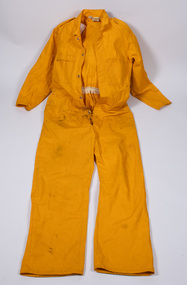 Emerald Museum & Nobelius Heritage Park
Clothing - Fire Fighter's Overalls (CFA), c.1960s - 1970s
... butcher's shop near the corner of Monbulk Road. The Brigade's first fire station was built around 1945. In 1966, this station was recorded as containing the fire truck and a Land rover pumper, three radio sets, 40 knapsacks, six lengths of hose, helmets, rake hoes and other hand tools. ...butcher's shop near the corner of Monbulk Road. The Brigade's first fire station was built around 1945. In 1966, this station was recorded as containing the fire truck and a Land rover pumper, three radio sets, 40 knapsacks, six lengths of hose, helmets, rake hoes and other hand tools. ...This pair of CFA fire fighter's overalls were donated by the Emerald Fire Brigade which was established on 14 March 1941 as the Emerald Bush Brigade. Originally its equipment was stored at Madigan's butcher's shop near the corner of Monbulk Road. The Brigade's first fire station was built around 1945. In 1966, this station was recorded as containing the fire truck and a Land rover pumper, three radio sets, 40 knapsacks, six lengths of hose, helmets, rake hoes and other hand tools. In 2010, the Brigade moved into a new purpose-built building in Monbulk Road. These beaters date from the 1960s to 1970s.These CFA fire fighter's overalls were used by members of a crucial volunteer fire fighting service operating in the Emerald district since 1941.A Pair of CFA Firefighter overalls, yellow in colour, Size 97R CFA, Stewart and Heaton Clothing manufacturer. Size 97 Regularfire fighting, emerald fire brigade, cfa -
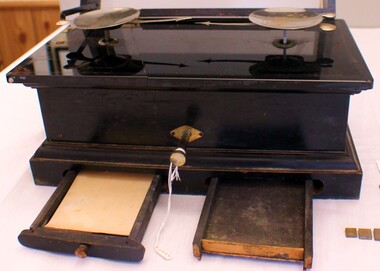 J. Ward Museum Complex
Tool - Measuring Scales
... The scales are in excellent condition and a good example of medical equipment used in Aradale Mental Hospital and J Ward. psychiatric history mental health aradale mental hospital j ward No manufacturer markings or serial numbers Measuring scales for medications Timber construction with glass lid Small crack along the left hand side of scales Two drawers contain four weights in ounces Case painted in black lacquer Metal hinges and three brass knobs (one missing from right lower drawer) Small piece of folded butcher paper in left hand drawer Tool Measuring Scales ...The traditional scale consists of two plates or bowls suspended at equal distances from a fulcrum. One plate holds an object of unknown mass (or weight), while known masses are added to the other plate until static equilibrium is achieved and the plates level off, which happens when the masses on the two plates are equal. Medication given to patients at both Aradale Mental Hospital and J Ward had their does measured using these weights and scales - and some evidence of residue remains.The scales are in excellent condition and a good example of medical equipment used in Aradale Mental Hospital and J Ward. Measuring scales for medications Timber construction with glass lid Small crack along the left hand side of scales Two drawers contain four weights in ounces Case painted in black lacquer Metal hinges and three brass knobs (one missing from right lower drawer) Small piece of folded butcher paper in left hand drawer No manufacturer markings or serial numberspsychiatric history, mental health, aradale mental hospital, j ward -
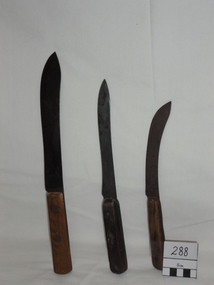 Myrtleford and District Historical Society
Butcher's Knives, Circa 1850
... The provender's site then became known as the Myrtle Creek Hotel Butcher's Tools Schomberg Paul Family Engraved "Pipe Brand" Steel butcher's knives with rivetted wooden handles and curved blades. ...Knives were retrieved from the shipwreck of the "Schomberg" at Curdies River, Western Victoria on December 26, 1855 by Joseph Paul, who subsequently moved to the Myrtleford district.A shipwreck retrieval which assisted the Paul family to establish a business to supply the gold mining fraternity with provisions after their arrival (via Beechworth) from 1857. The provender's site then became known as the Myrtle Creek HotelSteel butcher's knives with rivetted wooden handles and curved blades.Engraved "Pipe Brand"butcher's tools schomberg paul family -
Clunes Museum
Tool - MEAT AXE
... BUTCHERING AXE Nil MEAT AXE HEAD USED FOR BUTCHERING Tool MEAT AXE ...MEAT AXE HEAD USED FOR BUTCHERINGNilbutchering, axe -
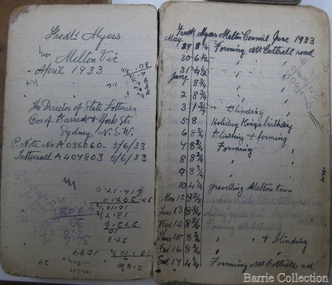 Melton City Libraries
Book, Frederick Myers work notebooks/diaries, 1923-1933
... Melton town, G Hobbs Boundary Rd, Melton May G Hobbs 2 pages of food expenses and amount paid Simpson & Co – Butcher account and amount paid Mon 5th –July 22nd Toohey days and hour worked 34 yards Tuppal 20th Aug additional list 1735 Eynesbury 3rd Oct additional list 2093 Diagram 3 drawings in ink –a type of tool Nov 21 1904 List Dunmore Stn Orford Vic Barwidgee Stn Caramut Vic Wharparanna Stn via Tocumural N.S.W. ...Melton town, G Hobbs Boundary Rd, Melton May G Hobbs 2 pages of food expenses and amount paid Simpson & Co – Butcher account and amount paid Mon 5th –July 22nd Toohey days and hour worked 34 yards Tuppal 20th Aug additional list 1735 Eynesbury 3rd Oct additional list 2093 Diagram 3 drawings in ink –a type of tool Nov 21 1904 List Dunmore Stn Orford Vic Barwidgee Stn Caramut Vic Wharparanna Stn via Tocumural N.S.W. ...FREDERICK THOMAS MYERS Born 20th February 1877 at Melton Married Martha Mary Watson 30th April 1908 at the Manse 101 Gore Street Fitzroy according to the rites of the church (Cong) – Congregational. Died Bacchus Marsh and District War Memorial Hospital 30th April 1963 Frederick lived in Melton all his life. Work Notebooks/ diary 1901 – 1905 No 1 1901 Shearing Tally Rockbank, 1901, 1902. Lists 3 Combs 6.0, 12 Cutters 5.0, Tab 1.6 Jongebloed account – Tobacco, matches sardines. Shearing shed 1904 Tuppal 20 Aug. Daily Tally of sheep shorn Total 1730 E C Shopping list - 6 pages of household items, Leader, Age and Weekly Times Tomato Sauce- recipe written in ink Toolern Road Hours worked 35 ½ Reverse order from back cover – Harwood 29th Aug 1902 Shearing Tally 1083 November 1902 - List of dates Mon- Sat. Nov 3rd - Fri Dec 5th E Chalmer. Tally of hours worked. Jan 1903 Thur 1st - 31st Toohey Keilor Road, Feb – March 14th Payment L75:4:9 J Walker April 1903 – 23rd 18 Cutters 7:6 5 Combs 10:0 2 Tab 3:0 Ticket 15:0 Total 1:15:6 Tucker 3:12:6 Other pages are calculations related to hours worked and amounts The notebook contains 26 pages with some blank and other torn out. It measures 2 ½ x 4 inches with a hard black cover. FREDERICK MYERS Workbook/ Diary No 2 Opening 5 pages – Gottfried Jongebloed account - paid 2/11/04 List of grocery and household items. E Chalmer -Pr Boots, 8:9 Tab 1:8 Leader 3’ Reverse order Eynesbury 7th Oct 1904 Shearing Tally 1635 Tucker payment L1:18:6 Tuppal 20th Aug 1904 Tally 1636 [ 4 weeks and 4 days] Feb 1905 Melton 1st – 13, Toolern Rd 14th , April Braybrook Rd. Melton town, G Hobbs Boundary Rd, Melton May G Hobbs 2 pages of food expenses and amount paid Simpson & Co – Butcher account and amount paid Mon 5th –July 22nd Toohey days and hour worked 34 yards Tuppal 20th Aug additional list 1735 Eynesbury 3rd Oct additional list 2093 Diagram 3 drawings in ink –a type of tool Nov 21 1904 List Dunmore Stn Orford Vic Barwidgee Stn Caramut Vic Wharparanna Stn via Tocumural N.S.W. Puckawidgee vis Aug Deniliquin N.S.W. Bundure Stn via Aug Jerilderie Trawalla Ballarat Oct Woorywooryte Oct Vic Yancannia Bourke July Pretty Tower Stn Beaufort November Size of Notebook 2 ¼ x 5 inches. WORK NOTEBOOK 1909, 1910 Wandook 17th Aug 1909. 21 days of shearing 1248 Total. Payment L14 ?? Boomanoomana 23 Sept 1909. 17 days shearing 1124 Total. L13.12.9 Eynesbury 20th Oct 1909. 17 days shearing 1587 Total L17. 13.0 Cobran Aug 13 1910 Studs Rams Total 3397 List of expenses includes 12 cutters, 3 combs, Union ticket, matches, tobacco stamps. Miller, J Egan. Eynesbury Oct 1910 Total 1467 Lal Lal Nov 21 Total 1172 For Backache Tincture of Gentian Compound one ounce Syrup of Rhubarb one ounce Liquid Barkola Compound one ounce Syrup of Ginger five ounce Dose a teaspoonful after each meal and one at bedtime John Collins, Woodside Via Yarram Yarram Mr Fisken Lal Lal Via Yendon Woodlawn Deniliquin 15th October Oct 12th 1911 Eucla Jarrett Barfold 21,000 7? Shearers Clark Moir Estate 10th Aug 1910-1911 Income amounts Shearing income. Mc Donald – thrasher Keating Toohey Cobran 1911 Studs and Rams 1793 Cobran 14th Aug per man 1500 Golf Hill 26th Sept per man 1900 Cobran 14th Aug Cut out 23rd Sept 2368 payment L21..19..4 [after expenses] Spring Plains Oct 2nd 1022 Total Barfold 2636 Total Chaffcutting J.B. Loft Feb 17th - 31 ½ hours John Minns Toohey Started Deep Creek Whelahan Ballarat Rd May 25th Mr J Walker Koohnamu Stn via Junta S.A. N Aitken Bringlibit via Kyneton Income list 1911 to 1912 and amounts earned Cobran L29..0..9 , Spring Plains Barfold L42..6..3, John Minns L4..8..0, J.B. Loft L3..0..6, D Whelahan L22.. 6..0, E Toohey L15.. 1..0, = total L123..2..6 John Minns 12..0, JB Loft 4.. D Whelahan L10..2..0, Barrie L11..5. Total Amount L145..5..6. Cobran 1912 15th Aug 1922 total Rams double. Expenses include 12 + 6 Cutters, 2+2+2 Combs, Political fund, Ticket, Mess Account, Hut Keeper, Hospital, Cook Total L11..8..3. Station Rd - L11..2..9. Golf Hill Sept 26 Cut out 31 Oct Total 2332 Lal Lal Nov 6th 19th 1912 6 days Total 1066 Contracts – Cameron, Barrie, McKay, Toohey, Stn Rd ? Cobran 1913 – Aug 14- 1913 Total 1621 Cobran 1621 Kyneton Park 515 Golf Hill 2144 Lal Lal 1066 Total 5,346 1913 – 1914 Income 5, 350 sheep Local contracts E. Barrie, Greig, Weir, S Barrie, Jongebloed, Burton, E Toohey, Total L133..3..0. Trench & Moran L19..8..0. End of front section of Notebook Work notebooks belonging to Frederick Myers local identities -
Hand Tool Preservation Association of Australia Inc
Saw punch
... This item is part of the Thomas Caine Tool Collection, owned by The National Trust of Australia (Victoria) and curated by the Hand Tools Preservation Association of Australia. saw punch, butchers Saw punch ...This item is part of the Thomas Caine Tool Collection, owned by The National Trust of Australia (Victoria) and curated by the Hand Tools Preservation Association of Australia.saw punch, butchers -
 Friends of Westgarthtown
Functional object - Trunk/ Koffer, c. 1840s
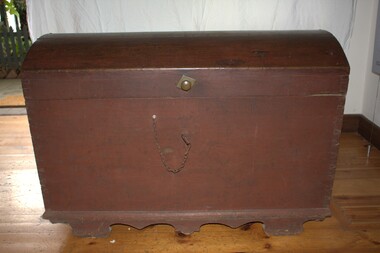
... It is likely that the contents included some building tools and as well, implements which Christian Ziebell used in his trade as a butcher in Bruel, thereby enabling him to undertake profitable work on his arrival in Australia....It is likely that the contents included some building tools and as well, implements which Christian Ziebell used in his trade as a butcher in Bruel, thereby enabling him to undertake profitable work on his arrival in Australia. ...The chest was constructed to allowable dimensions for storage in the ship's hold. The sturdy watertight construction afforded protection for the chests contents. It can be imagined that these would be household utensils, items of clothing and the most treasured ornaments as space permitted. It is likely that the contents included some building tools and as well, implements which Christian Ziebell used in his trade as a butcher in Bruel, thereby enabling him to undertake profitable work on his arrival in Australia.This object is of primary significance. The Koffer was constructed to allowable dimensions for storage in the ship’s hold. The sturdy watertight construction afforded protection for the Koffer’s contents on the voyage aboard the Privislaw from Hamburg, Germany to Hobsons Bay, Australia in 1850. The Koffer held the precious necessities for life for Christian Ziebell's family at their new destination. It is likely that the contents included some building tools as well, implements that Christian used in his trade as a butcher in Bruel, thereby enabling him to undertake profitable work on arrival in Australia. The wooden Koffer was airtight, so if lost overboard it would be retrievable. Some were fixed to the ship’s deck. After they settled at Westgarthtown the Koffer continued to contain the precious documents through each generation. Only the current owners saw the contents in each generation, and the children always regarded it as a “treasure chest”, which was always locked and out of bounds for them. This German-made sea chest, dating from the late 1840s, holds exceptional historical, cultural, and interpretive significance as an original migration object belonging to Christian and Sophia Ziebell during their maiden voyage to Australia. Serving as the family’s personal storage trunk aboard the Pribislaw in 1849, the chest would have functioned as a container for clothing, tools, and essential belongings. Later it served as storage for family archives and Lutheran church committee papers. Constructed in the robust mid-19th-century German style, the chest likely features oak timbers, dovetail joinery, and iron fittings typical of sea-going koffers of the period. Its painted decoration, including the name “C. Ziebell” in large black charcoal script, provides strong, direct provenance and reflects both ownership and pride in family identity. Such personalised embellishment was common among German migrants who decorated their chests during periods of spare time aboard the ship. As one of the rare surviving objects directly associated with the Ziebell family’s migration story, this chest embodies themes of aspiration, hardship, cultural continuity, and settlement. It is a tangible link between the family’s Mecklenburg origins and their new life at Westgarthtown, offering powerful interpretive value for understanding early German-Wendish migration and daily life at sea. Built to specifications for sea voyaging it is also a reminder of the planning required prior to considered migration. Its survival enriches the museum’s capacity to convey the lived experience of Christian and Sophia Ziebell and the foundational story of the community they helped to establish. Large wooden trunk/koffer. Base is rectangular, and lid is rectancular to fit the base but curves between the front and back. Morticed corners; protruding base with beveled edge. Supported by profiled runners with four built-in feet. Handle for carrying on each end, and locking mechanism on front.'C. Ziebell' written in large font on back of chestpersonal effects, travel goods, pribislaw, johann christian ziebell, german migration, luggage -
 Port Fairy Historical Society Museum and Archives
Tool - Calendar
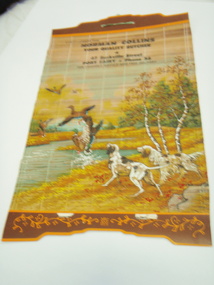
... butcher (calendar removed). Printed with rural scene of ducks and hunting dogs. Bamboo slats are joined by thread and the ribbon is attached to the top of the calendar for hanging. Calendar itself has been removed. Tool ...This item was bought by Lynda Tieman for the Port Fairy Historical Society. It represents a time in in Port Fairy when there were several butchers in the town and competition for customers was fierce. Norman Collins butchers was situated in Sackville Street where a dress shop now occupies the site.An advertising piece that places Norman Collins as butcher in 47 Sackville Street and a rare example of this type of advertising.Bamboo, advertising,give away calendar with green ribbon hanger for Port Fairy butcher (calendar removed). Printed with rural scene of ducks and hunting dogs. Bamboo slats are joined by thread and the ribbon is attached to the top of the calendar for hanging. Calendar itself has been removed.With Compliments from Norman Collins Your Quality Butcher 47 Sackville Street, Port Fairy, Phone 56 For Friendly Service and Free Deliverybutcher, advertising, business, collins, sackville street, norman collins, calendar -
 Rutherglen Historical Society
Image, Valentine Publishing Co. Ltd, 1910s to 1920s
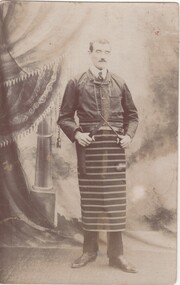
... Black and white postcard photograph of a butcher in striped apron, holding knife and sharpening tool....butcher in apron jack ryan On back: "Uncle Jack Ryan" Black and white postcard photograph of a butcher in striped apron, holding knife and sharpening tool. Image Valentine Publishing Co. ...Black and white postcard photograph of a butcher in striped apron, holding knife and sharpening tool.On back: "Uncle Jack Ryan"butcher in apron, jack ryan
