
Showing 56 items matching "c. 1880s"
-
 Ringwood and District Historical Society
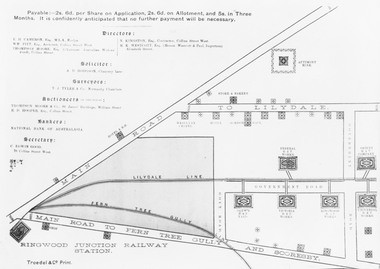
Document, Extract from land sale brochure map of Ringwood's early main central area around Mount Dandenong Road - c.1880s
... Extract from land sale brochure map of Ringwood's early main central area around Mount Dandenong Road - c.1880s....Black and white printed document Extract from land sale brochure map of Ringwood's early main central area around Mount Dandenong Road - c.1880s. Document ...Black and white printed documentTyped note at bottom of map: "From 1800's land sale brochure- an accurate portrayal of the area. Note several brickworks which operated 1881 to 1916." -
 Royal Australasian College of Surgeons Museum and Archives
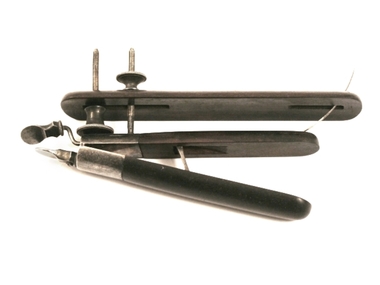
Tool - Hernia instrument, Davis Hernia instrument c 1880s
... Davis Hernia instrument c 1880s...Davis Hernia instrument c 1880s Tool Hernia instrument ... -
 Stawell Historical Society Inc
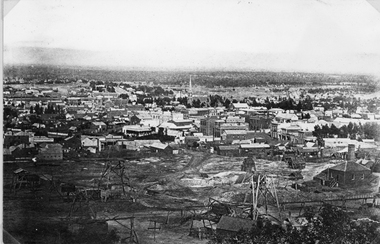
Photograph, Panorama of Stawell from Big Hill with Whims & Poppet Heads Victorian Views Collection C Herbert c.1880s
... Panorama of Stawell from Big Hill with Whims & Poppet Heads Victorian Views Collection C Herbert c.1880s...Panorama of Stawell from Big Hill with Whims & Poppet Heads Victorian Views Collection C Herbert c.1880s Photograph ...Views from Big Hill Sloane Street Fisher Street areas looking towards West. Mining in foreground of photo. Upper Main Street and Patrick Street Streetscapes visible. Mathers and Franklin. Agnew Draper. J R Franklin? Draper. Coffee Palace formerly Castlemaine Hotel , Town Hall visiblePanorama of Stawell from Big Hill showing Sloane's St. / Fisher St. areas. The photo has Whims & Poppet Heads in the foreground. There are around 6 copes of the photograph. Victorian Views. C. Herbert. Photo. Copyright Registered. Stawellstawell, panorama, mining, streetscape -
 City of Ballarat Libraries
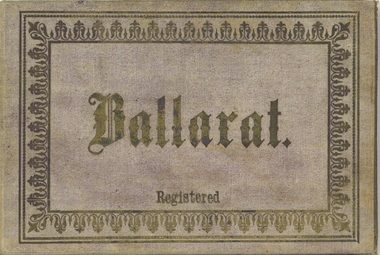
Leporello, Ballarat Registered c.1880s
... Ballarat Registered c.1880s...leporello punshon family lithograph ballarat publishing publisher album Ballarat Registered c.1880s Leporello ...This leporello photo album, published by A.J Punshon, Bookseller contains 12 unique scenes around Ballarat, notably the Botanical Gardens and the Town Hall. The images appear hand drawn and are possibly lithographs. Inside the back-cover of the leporello is a tiny sticker identifying A.J Punshon Bookseller as the publisher or supplier. This sticker might be the only evidence of Punshon in business in Ballarat, apart from a single entry in Niven's 1888 Ballarat and District Directory, which gives his occupation as bookseller and address as 82 Dawson Street south. The only result from a search in Trove indicates he published the Australian Almanac for 1887. His name is not familiar as one of the booksellers of Ballarat. Alfred James Punshon was born in Prahan in 1856 to Isabella Lockwood and Robert Punshon; he married Elizabeth Lyons of Buningyong in 1881, they had two daughters, Ethel Mary in 1882 and Flora Hazel in 1894. It seems the family moved to Melbourne after Flora's birth. Elizabeth Punshon died in St.Kilda 1913 and Alfred died in 1938, in South Yarra. It seems in the early 1880's he set up as a bookseller and published at least two books but this is all we have been able to find out. If you have any additional information on Alfred Punshon, we would be pleased to hear it in the comments below! leporello, punshon family, lithograph, ballarat, publishing, publisher, album -
 Bacchus Marsh & District Historical Society
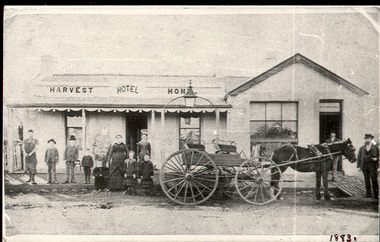
Photograph, Harvest Home Hotel Main Street Bacchus Marsh c.1880s-1890s
... Harvest Home Hotel Main Street Bacchus Marsh c.1880s-1890s...Harvest Home Hotel Main Street Bacchus Marsh c.1880s-1890s Photograph ...The Harvest Home Hotel was licensed as a beer shop in 1866. Patrick Vallence was the licensee. On his death in 1874 his widow Mrs M. A. Vallence obtained the license. The date that this image was created has not been identified. Around 1883 George Marshall was leasing the hotel. The people in this image are could be members of the Marshall family and some of the staff who worked in the hotel at this time. Following a decrease in the population of Bacchus Marsh by 1911 the hotel had lost its licence. The Vallence family still owned the building after the loss of the hotel license in 1911and it was used for some years after this as a private residence by some members of the Vallence family. Small black and white photograph. The image depicts the Harvest Home Hotel situated in Main Street Bacchus Marsh. The name of the hotel can be seen above the verandah roof. The building appears to be of stone with decorative stonework corners. A verandah is inset to the left of a gabled front section which has its own door and window. A deep gutter runs along the front of the hotel, with a slab acting as a bridge to the road. Standing in front of the building facing the camera is a group of adults and children, men and women and boys and girls. A four seated buggy drawn by a single horse is also present in the image. The lantern erected above the horse trough can be seen.hotels bacchus marsh, vallence family bacchus marsh, marshall family bacchus marsh, harvest home hotel bacchus marsh -
![Photograph, [Staff of Geelong Woollen Mills 1880s]](/media/collectors/510b3f7f023fd725b4cd52cc/items/54065e319821f50e3cc9e109/item-media/54065e319821f50e3cc9e10a/item-fit-380x285.jpg?cb=6) National Wool Museum
National Wool MuseumPhotograph, [Staff of Geelong Woollen Mills 1880s]
... Group photograph, possibly depicting the staff of a Geelong woollen mill, c.1880s....Photograph of the staff of a Geelong Woollen Mill, c.1880s....Group photograph, possibly depicting the staff of a Geelong woollen mill, c.1880s. Textile Industry - history Textile Mills - history Textile Mills - staff Geelong Woollen Mills Textile Industry - history Textile Mills - history Textile Mills - staff Geelong Wollen Mills [sic] / Taken in early 80's Photograph of the staff of a Geelong Woollen Mill, c.1880s. ...Group photograph, possibly depicting the staff of a Geelong woollen mill, c.1880s.Photograph of the staff of a Geelong Woollen Mill, c.1880s.Geelong Wollen Mills [sic] / Taken in early 80'stextile industry - history textile mills - history textile mills - staff, geelong woollen mills, textile industry - history, textile mills - history, textile mills - staff -
 Port Melbourne Historical & Preservation Society
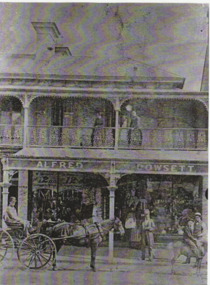
Photograph - Alfred Dowsett's shop, Bay Street, 1880s
... Laser copy of photograph of Alfred Dowsett's (clothier and draper) shop, 305 Bay Street c 1880s...Built Environment - Commercial Business and Traders - Tailors and Clothing Alfred DOWSETT Bay Street Laser copy of photograph of Alfred Dowsett's (clothier and draper) shop, 305 Bay Street c 1880s Photograph Alfred Dowsett's shop, Bay Street ...Laser copy of photograph of Alfred Dowsett's (clothier and draper) shop, 305 Bay Street c 1880sbuilt environment - commercial, business and traders - tailors and clothing, alfred dowsett, bay street -
 Williamstown Historical Society Inc
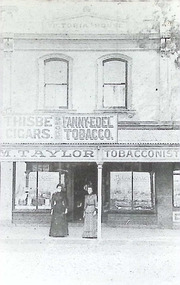
Photograph - Nelson Place, showing Mrs Mary Taylors Tobacconist shop, c.1880's
... ...c. 1880s...Nelson Place c. 1880s Mrs Mary Taylor Tobacconist Victoria House buildings Mrs Taylor and shop assistant Mary Ann Victoria House buildings Photograph Nelson Place, showing Mrs Mary Taylors Tobacconist shop, c.1880's ...Victoria House buildingsMrs Taylor and shop assistant Mary Ann nelson place, c. 1880s, mrs mary taylor, tobacconist, victoria house buildings -
 Port Melbourne Historical & Preservation Society
Photograph - Railway Pier, Port Melbourne, Jack GOULD
... Black and white photograph looking along Railway Pier with many sailing ships berthed on either side. C. 1880s....Piers and Wharves - Railway Pier Transport - Shipping Nancy U'REN nee MORRIS Black and white photograph looking along Railway Pier with many sailing ships berthed on either side. C. 1880s. Photograph Railway Pier, Port Melbourne Jack GOULD ...From a box of photographs in Nancy U'REN's papers used during research for her thesis, The Early Growth and Development of Sandridge (1976) and/or her book with Noel TURNBULL, A History of Port Melbourne (1983). Jack GOULD probably created this from an earlier photograph.Black and white photograph looking along Railway Pier with many sailing ships berthed on either side. C. 1880s.piers and wharves - railway pier, transport - shipping, nancy u'ren nee morris -
 Orbost & District Historical Society
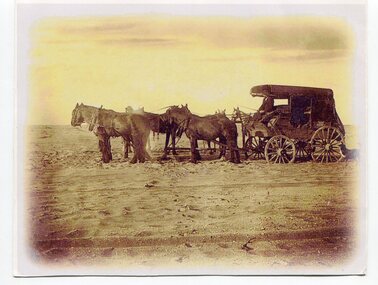
Photograph - Two coach photos, Orbost, c.1880s-1920
... The other photo shows a coach passing a barn in a rural setting. Both photos c. 1880s-1920. ...c.1880s-1920...From the 1880s to c. 1920, much of the Orbost district was linked by coaching routes. ...From the 1880s to c. 1920, much of the Orbost district was linked by coaching routes. These photos show two different locations: one photo shows a coach crossing a sand bar. This is most likely the crossing of the Lake Tyers sand bar to Lakes Entrance. The other photo shows a coach passing a barn in a rural setting. Both photos c. 1880s-1920. These photos are significant because they show horses and coaches which were an important transport method prior to the linking of settlements within East Gippsland by roads, cars, and railway. Two b/w photographs of horses and coaches. 2718.1 photo of a coach and 4 horses, 3 people sitting on front of the coach. Coach is outside a barn. 2718.2 photo of a 4 horse coach with one man driving. Other horses behind this coach. All are in a flat, sandy location. 2718.1 on back of photograph: 'Albert Barthile drove coaches from Orbost to Lakes Entrance & sometimes from Cann River to Orbost.' 2718.2 no inscriptionshorses, coaches, orbost, lake tyers -
 Orbost & District Historical Society
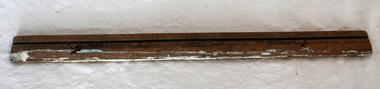
ruler, C 1930's
... The Mundy family were farmers / settlers in the Snowy River area since c. 1880s. The original Mundy family moved to a land "selection" at Betebolong in the early 1880's from Buchan. ...The Mundy family were farmers / settlers in the Snowy River area since c. 1880s. The original Mundy family moved to a land "selection" at Betebolong in the early 1880's from Buchan. ...The Mundy family were farmers / settlers in the Snowy River area since c. 1880s. The original Mundy family moved to a land "selection" at Betebolong in the early 1880's from Buchan. John Mundy grew up in the Orbost district. This item highlights the comparison between today's educational equipment and those of the 1930's.A 15 inch wooden ruler with carvings and holes.On back - J. MUNDYmeasurement ruler mundy-family educational -
 Orbost & District Historical Society
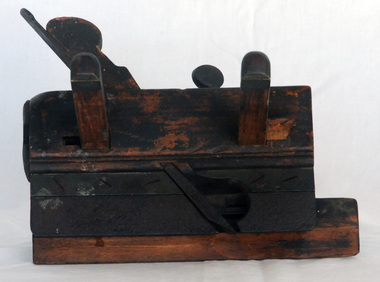
roughing plane, c. 1890 - 1950
... The Mundy family were farmers / settlers in the Snowy River area since c. 1880s. The original Mundy family moved to a land "selection" at Betebolong in the early 1880's from Buchan. ...The Mundy family were farmers / settlers in the Snowy River area since c. 1880s. The original Mundy family moved to a land "selection" at Betebolong in the early 1880's from Buchan. ...Owned by the Mundy family of Orbost district. The Mundy family were farmers / settlers in the Snowy River area since c. 1880s. The original Mundy family moved to a land "selection" at Betebolong in the early 1880's from Buchan. Mundy familyA roughing plane made of wood with a small blade, held together with metal bolts. Also called a grooving plough plane.WHM is stamped into the wood (WJM?)grooving-plane roughing-plane woodworking-tool -
 Orbost & District Historical Society
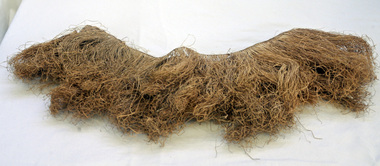
grass skirt, approx. 1905
... The Mundy family were farmers / settlers in the Snowy River area since c. 1880s. The original Mundy family moved to a land "selection" at Bete Bolong in the early 1880's from Buchan. ...The Mundy family were farmers / settlers in the Snowy River area since c. 1880s. The original Mundy family moved to a land "selection" at Bete Bolong in the early 1880's from Buchan. ...Worn by Mrs Jack Mundy while in New Hebrides. The Mundy family were farmers / settlers in the Snowy River area since c. 1880s. The original Mundy family moved to a land "selection" at Bete Bolong in the early 1880's from Buchan. Mundy familyHandmade grass skirt made of native plant fibres and held together with knotting along the top. Natural colour.nonegrass-skirt new-hebrides mundy costume-female native-materials -
 Charlton Golden Grains Museum Inc
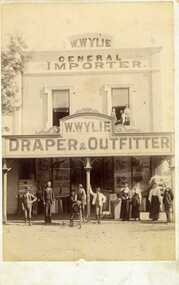
Photograph, Clarke Bros Photographers, W. Wylie shop, c.1890
... Wylie's store, west end of High St, Charlton. built by Peter Johnson c. 1872, managed by Mr. Gatwood c.1880s, then bought by William Wylie. Group of people standing outside on footpath, young man on a bicycle, 2 children and a man in upstairs window...Wylie's store, west end of High St, Charlton. built by Peter Johnson c. 1872, managed by Mr. Gatwood c.1880s, then bought by William Wylie. Group of people standing outside on footpath, young man on a bicycle, 2 children and a man in upstairs window w. wylie general importer draper & outfitter johnson's bridge store High Street Charlton Wylie's Building Clarke Bros Photographers Windsor Mounted unframed photograph. ...W. Wylie's store, west end of High St, Charlton. built by Peter Johnson c. 1872, managed by Mr. Gatwood c.1880s, then bought by William Wylie. Group of people standing outside on footpath, young man on a bicycle, 2 children and a man in upstairs windowMounted unframed photograph. W. Wylie's store, west end of High St, Charlton. Group of nine people standing outside on footpath, includes three women, a young man on a bicycle being held by another young man, 2 children and a man in upstairs windowClarke Bros Photographers Windsorw. wylie, general importer, draper & outfitter, johnson's bridge store, high street, charlton, wylie's building -
 Orbost & District Historical Society
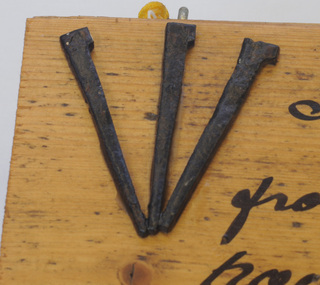
nails on board, 1885
... Often imported nails made for the softer English and North American timbers bent when hammered against the harder colonial woods and so The Mundy family were farmers / settlers in the Snowy River area since c. 1880s. The original Mundy family moved to a land "selection" at Betebolong in the early 1880's from Buchan. ...Often imported nails made for the softer English and North American timbers bent when hammered against the harder colonial woods and so The Mundy family were farmers / settlers in the Snowy River area since c. 1880s. The original Mundy family moved to a land "selection" at Betebolong in the early 1880's from Buchan. ...These nails were made for Walter John Mundy (1868-1944). Often imported nails made for the softer English and North American timbers bent when hammered against the harder colonial woods and so The Mundy family were farmers / settlers in the Snowy River area since c. 1880s. The original Mundy family moved to a land "selection" at Betebolong in the early 1880's from Buchan. It's only over the past century or so that the mass-produced nail has become an inexpensive and common way to join materials. These three iron nails were hand made by an early Orbost settler or blacksmith in the 1880's, using iron, forge and anvil. They are examples of the types of nails used in the 19th century. A rectangular, wooden(athel pine?) board with three hand-made nails glued in fan design to top left corner of section of floorboard. There is a short length of yellow cord attached for hanging. To the right of the nails is hand-written text in black. the nails have irregular shanks and hammer marks on both shanks and heads.right of nails - " Flooring & nails from Walter Mundy's house at Jarrahmond built C.1885. Still in use to this day."mundy-walter hand-made-nails -
 Orbost & District Historical Society
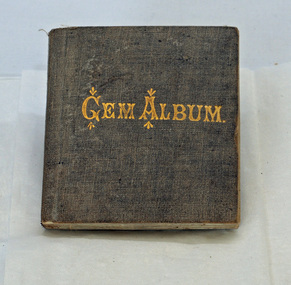
album, Gem Album, c. 1880s
... c. 1880s ...Gem Albums date from the 1860s in the USA, made for small ferotype images.A small photo album with grey-brown fabric cover and the words Gem Album written in gold lettering on the front.inside cover - G Munro, Clifton Hill, 1881album gem-album book photos -
 Orbost & District Historical Society
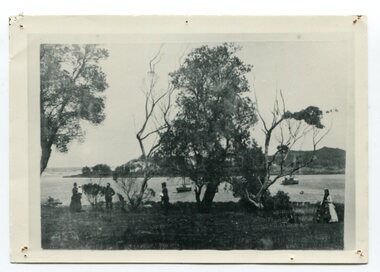
black and white photograph, C 1880s - 1890s
... C 1880s - 1890s ...There is no information with this item.A black / white photograph of a group of people at Marlo, East Gippsland, They are looking out to the water.marlo -
 Halls Gap & Grampians Historical Society
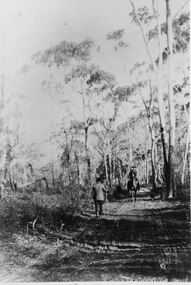
Photograph - B/W, C 1880s
... C 1880s ...This photo is of the road approaching Delley's Bridge. It shows methods of transport and the access route to Halls Gap in the late 19th Century.A man with a walking stick walking away from the camera on a rutted dirt road through trees and bush. Another man is approaching from the opposite direction on horseback.access routes, roads -
 Bendigo Historical Society Inc.
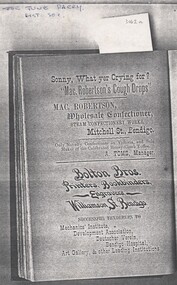
Document - BENDIGO BUSINESS ADVERTISEMENTS - 8 PHOTOSTAT PAGES, c 1880s
... c 1880s ...Document. Eight photostat pages of advertisements for 12 Bendigo businesses taken from the Sandhurst Mechanics Institute Directory. (a) MacRobertson- Confectioner & Bolton Bros- Printers Bookbinders. (b) Sandhurst Rolling Stock Co. (c) Samuel Webb- Merchant Tailor & W Bradley and Son- Jewellers. (d) Charles Ross & Co- Drapers & Carpets & Henry Jackson and Co- Ironmongers. (e) J W Burrows- Printers, Bookbinders. (f) Alfred Day- Asphalt Manufacturer & Union Bank of Australia. (g) Henderson & Goodisson- Dept Store. (h) A Gordon- Picture frame manufacturer. Handwritten in ink on top of page 3062a is 'for June Parry, Hist. Soc.'Sandhurst Mechanics Instituteorganization, business, commercial, sandhurst mech.inst. business directory, macrobertson confectioner, bolton bros., sandhurst rolling stock co., samuel webb, w bradley & son, charles ross & co., henry jackson & co., jw burrows, alfred day, union bank, henderson & goodisson, a gordon -
 Charlton Golden Grains Museum Inc
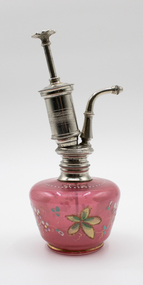
Domestic object - Scent Atomiser, c.1880s
... c.1880s ...Owned by Miss M. Howell (Nurse), 1890s of Barrakee.Pink coloured glass (embossed) & silver scent atomiser.barrakee, howell, atomiser -
 National Wool Museum
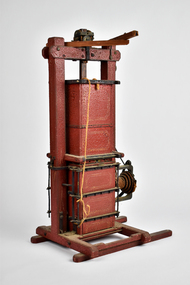
Model - Wool Press Model, Humble and Nicholson, c.1880s
... c.1880s ...In 1866 Humble & Nicholson brought the Vulcan Foundry in Geelong, where it is believed this model wool press was made.Red wooden model of a wool press with string pulley and crank.wool, wool press, humble and sons pty ltd, humble and nicholson, vulcan foundry, geelong, innovation, industry, model, design -
 Uniting Church Archives - Synod of Victoria
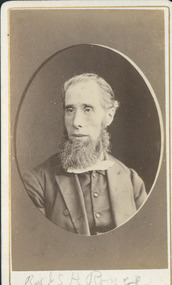
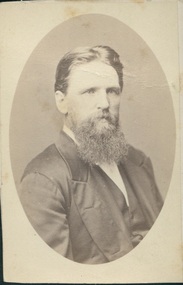
Photograph, Rev. James Stephen Hambrook Royce, Undated c.1880s
... Undated c.1880s ...B: England 23/10/1829, trained at the Richmond Theological Institution, then spent 5 years as a missionary in Fiji. When his health broke down he became a circuit minister in Australia. He became a supernumerary in 1887 and died 29/09/1907 at Geelong. Married Elizabeth Jenkins Berry, father of Archibald John Royce and T.W. Royce (Principal of Geelong Ladies' College) who was tragically drowned in 1893. Children: Elizabeth Mary Jane (1856 - 1939), Frances Ellen Gough (1858 - 1937, James Hamilton (1860 - 1927), Thomas William Arthur (1862 - 1893), Charlotte Louisa (1865 - 1933), Archibald John (1868 - 1944), Florence Annie (1874 - 1957)Oval inset, sepia toned head and shoulders studio portrait of the Rev. J.S.H. Royce. Carte de visite format.Rev. J.S.H. Royceroyce, j. s. h., wesleyan minister, fiji -
 Uniting Church Archives - Synod of Victoria
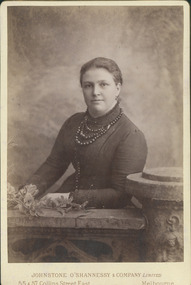
Photograph, undated c.1880s
... undated c.1880s ...Mary Forrest Gardner married Joseph Bartlett Davies on 6th February 1872 at St. Andrew's Presbyterian Church Launceston, Tasmania. She was the sister-in-law of Sir Matthew Davies, first Australian-born Speaker of the Legislative Assembly. Her father was the Rev. John Gardner. She died on 28th October 1887 and was buried at the Boroondara Cemetery. The Mentone Presbyterian Church was built as a memorial to her. The foundation stone of the church was laid by J. Bartlett Davies on 17th August 1889.Sepia toned cabinet card. Waist-length studio portrait of Mary Forrest Davies (nee Gardner). -
 Uniting Church Archives - Synod of Victoria
photograph, Undated c.1880s
... Undated c.1880s ...Born Grantham, Lincolnshire 9 August 1841. Migrated to Australia in 1849 and settled in Geelong. Entered the ministry in 1866. Posted to Mortlake, Echuca, South Yarra, Lonsdale St. Melbourne, Carlton, Bendigo and Hawthorn. Founding President of Methodist Ladies College, Melbourne, 1882. Elected President of the Wesleyan Conference of 1895 and was the first President following Church Union in 1902. Elected President General in 1904. Married 1870 (1) Jemima Shaw - died 1918; (2) 1920 Edith Skelton nee Wimble, widow of the Rev William Williams. Died 25 May 1928.Sepia toned head and shoulders studio portrait of Rev. William Henry Fitchett, in carte de visite format.william henry fitchett, methodist, minister, methodist ladies college, president of conference -
 Uniting Church Archives - Synod of Victoria
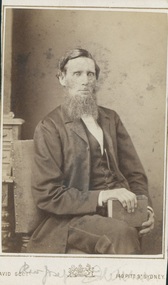
Photograph, Undated c.1880s
... Undated c.1880s ...Born 1823 West Indies, commenced ministry 1847, died 1890 in Rookwood, NSW. Joseph Horner Fletcher (1823-1890), Wesleyan minister, was born at St Vincent, Windward Islands, the eldest son of Rev. Joseph Fletcher, Wesleyan missionary, and his wife Mary, née Horner. In 1830-37 he attended a Methodist school in Kingswood, England, and then his uncle's school in Bath. He entered business but in July 1842 became a local preacher. He was accepted for the Wesleyan ministry in 1845 and after training at Richmond College, Surrey, he married Kate Green in December 1848. He was sent to Auckland, New Zealand, where he became the founding principal of Wesley College. In 1856 poor health obliged him to take up circuit work in Auckland and New Plymouth, where he witnessed the Maori war. He moved to Queensland and in 1861-64 was on circuit in Brisbane. In 1863 he became the first chairman of the Queensland Wesleyan District. In 1865 Fletcher was serving at Ipswich when invited to succeed Rev. John Manton as president of Newington College, Sydney. He acknowledged that the main business of the school was secular education in a Christian atmosphere and believed that education could help to overcome sectarianism. He invited distinguished academics to examine Newington students and strongly supported (Sir) Henry Parkes's education policies. He opposed the formation of a Methodist university college until a strong secondary school was established. He believed that boys should be taught to appreciate orderly conduct rather than to fear punishment and that corporal punishment was degrading and to be used only in extreme circumstances. Under Fletcher Newington developed a high moral tone and a tradition of order and respect. After he retired in 1887 the old boys gave him an address of appreciation and a portrait in oils to be hung in the hall. In addition to his normal duties from 1883 he had taught resident theological students. From 1887 he was an effective and progressive full-time theological tutor. As a preacher Fletcher had exceptional power: he expressed his thoughts in a fresh way with sparkling illustrations and characteristic humour. He combined humility with great spiritual power, prophetic vision and administrative ability. He encouraged the development of institutional church work which grew into the Central Methodist Mission in Sydney. Fletcher was elected as the first president of the New South Wales and Queensland Wesleyan Methodist Conference in 1874 and again in 1884, when he was also president of the General Conference of the Australasian Wesleyan Methodist Church. As conference editor in 1868, 1871 and 1873, Fletcher contributed more than fifty articles, numerous essays and reviews of books to the Weekly Advocate. He read widely, deeply and with discrimination. Never robust in health, he suffered months of illness before he died aged 66 at Stanmore, Sydney, on 30 June 1890. He was survived by three sons and two daughters, and buried in the Wesleyan section of Rookwood cemetery. In 1892 his eldest son, Joseph, edited a memorial edition of his Sermons, Addresses & Essays. Information from Australian Dictionary of Biography, Vol. 4, 1972. Sepia toned carte de visite. Seated studio portrait of the Rev. Joseph Fletcher.Rev Joseph Fletcherrev. joseph fletcher, joseph horner, wesleyan minister, newington college sydney, new zealand, queensland, president general conference, wesleyan methodist church, central methodist mission -
 Uniting Church Archives - Synod of Victoria
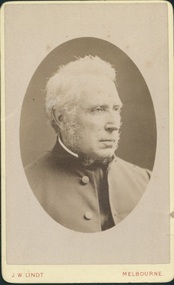
Photograph - Carte de visite, F W Lindt, C. 1880s
... C. 1880s ...Rev. W. A. Quick (1820-1915) was a significant figure in Victorian Methodism. President of the Queen's College Council 1888-1908. Chairman of the Tasmanian District 1861-71. President of the Australian Conference, 1866.Carte de Visite. Sepia toned head and shoulders studio portrait of the Rev. William Abraham Quick. The Rev Quick is looking to his left.Printed on the front: "J.W.LINDT MELBOURNE" Handwritten in ink on the back "Rev. W.A.Quick"methodist, wesleyan, president queen's college council, chairman tasmanian district, william abraham quick, president wesleyan conference victoria -
 Brighton Historical Society
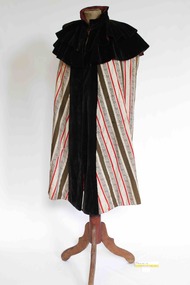
Clothing - Cloak, c. 1880s
... c. 1880s ...A cloak believed to have been worn by Captain George Ward Cole. George Ward Cole was an early member of the Victorian Parliament and the family featured prominently in Melbourne Society in their time. They established a substantial home known as “St Ninians” at 10 Miller Street in 1841. The family reportedly entertained Melbourne’s first Royal visitor the Duke Of Edinburgh, Queen Victoria’s second son at St Ninians in 1867. In later years St Ninians was subsequently sub divided and later demolished. A cream, green, brown and red striped cotton evening cloak with a brown silk velvet collar from the 1880s. The cloak features a double tiered velvet capelet with high standing collar that meets in the centre front, fastening with three hook and eye closures and finishing just below the shoulder line. At the centre front throat is an additional piece of lined cloak fabric which may have attached across the throat, purpose unknown. The lining of the throat and collar of the capelet appears to be a replacement with a darker red silk. The original red silk lining features through out the remainder of the garment. Inside the front left breast, the lining features two pockets; inside the right breast, the lining features a single pocket. The lining also features a waist tie to secure the cloak to the body. The cloak is approximately mid calf to ankle length. st ninians, george ward cole, brighton, 1880s -
 Kew Historical Society Inc
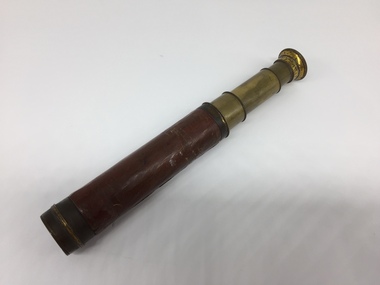
Functional object - Optical Instrument, Hand-held Optical Telescope, c.1880s
... c.1880s ...While telescopes and binoculars each have a long history, handheld optical telescopes were still widely used in the Nineteenth Century. The origins of this small optical telescope are unclear, apart from that it was used by a family in Kew in the 1880s.Brass, brown leather and glass telescope, anecdotally recorded as used by an early Kew family at sports days in the 1880sSeparate later label: "Early telescope owned by a Kew family & used on Sports Day in 1880s"sports - kew (vic), optical telescopes, hand-held telescopes -
 Whitehorse Historical Society Inc.
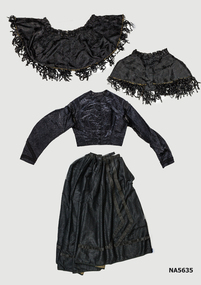
Clothing - Skirt, bodice and cape, C 1880s
... C 1880s ...Female costumeWomen's 1880s black three piece outfit - skirt, jacket/bodice and cape. Skirt - self patterned silk material with wide black grosgrain ribbon decoration. Bodice/jacket is fitted waist length with 10 black covered buttons down front. Cape has frilled neck and fringing along edge and just covered the shoulders. Note: This is a duplicate of a de-accessioned record NA1150. Item was de-accessed and then reinstated under the new number. -
 Whitehorse Historical Society Inc.
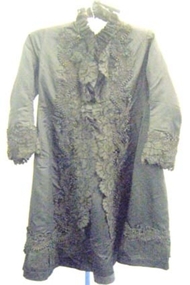
Clothing - Coat Dress, Dress Coat, probably c 1880s
... probably c 1880s ...c 1880sA coat dress, cut on a Princess Line with twelve button holes down the front. Panelled each side of the buttons in heavy ribbon braid and lace overlay. Standup lace collar and|cuffs. Large bow at back.costume, female
