
Showing 8 items matching "c.m.f. services"
-
 Bendigo Military Museum
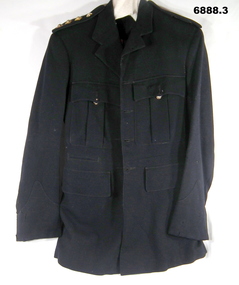
Uniform - MESS DRESS, ARMY, OFFICERS, M.TX
... C.M.F. Services..."Captain C.J. Swatton" C.M.F. Services Uniform Army Captain C.J. Swatton Passchendaele Barracks Trust 1. ..."Captain C.J. Swatton"1. Jacket, woollen, black. Four front pockets. Top two held shut with brass buttons. Chest held shut with four brass buttons. Epaulettes have the 3 brass pips of a Captain. The button motif is for R.A.A.S.C. 2. Trousers, black, woollen. Red stripe on side. 3. Belt, woollen, black. Two pronged brass buckle.1. Written on lining, left arm is name "Swatton". 2. Written on inside of trouser pocket is "Swatton".c.m.f. services, uniform, army, captain c.j. swatton, passchendaele barracks trust -
 Lara RSL Sub Branch
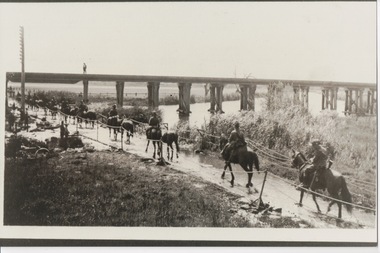
Photograph, Set 4 photographs. and others for Torquay Light Horse camp, 1940
... C.M.F. regiments declined and horses became more of a luxury during the 1930s depression years of poverty and unemployment. Some regiments were motorised. Then, in 1939, Australia joined Britain in another world war. Training was increased for the militia at both home bases and regional training camps. The camp at Torquay in 1940, commanded by Major General Rankin, was at Divisional strength. By the end of the camp some felt that the Division was ready for active service...C.M.F. regiments declined and horses became more of a luxury during the 1930s depression years of poverty and unemployment. Some regiments were motorised. Then, in 1939, Australia joined Britain in another world war. Training was increased for the militia at both home bases and regional training camps. The camp at Torquay in 1940, commanded by Major General Rankin, was at Divisional strength. By the end of the camp some felt that the Division was ready for active service ...These images capture for all time Light Horsemen travelling through Geelong on their way to camp at Torquay for the last Group meeting in Australia . information following - details obtained from .........https://torquayhistory.com/light-horse-brigade/ On Australia Day, 1997, Sir John Young unveiled this plaque on Point Danger, Torquay. Torquay history, Light Horse Training Camp, WW2 Plaque at Pt. Danger Note----- (See images to view plaque) The plaque identifies a significant event in Torquay’s history and the sentiments of ‘change’ for the Light Horse Brigade – from horses to machines. In 1940 the four Light Horse Regiments (4th, 8th, 13th and 20th), some 5000 Light Horse and 2000 horses camped and trained at Torquay. Three other regiments, formerly mounted on horses, were also at Torquay ‘mounted’ on privately owned trucks and cars. Division troops included Artillery, Engineers, Signals, Field Ambulance and other branches of the Army necessary to enable a Division to function. It wasn’t just the sheer numbers of men coming to this little town that made the event significant, it was also the fact that the men of the Light Horse were dramatic, almost glamorous figures and it is easy to see their exploits as some splendid adventure. Horses have played a special role in the story of Australia. They were the only means of transport across this huge country, so it was necessary for everyone to have the ability to ride a horse. When war broke out in 1899 between Britain and the Boers of South Africa (“Boer” was Dutch for “farmer”) Australia sent troops to fight. At first Britain was wary of using untried, unprofessional colonial cavalrymen but soon saw that the slouch-hatted Australian “bushmen” were a match for the fast-moving and unconventional mounted commandos of the Boers. The Australians proved themselves to be expert rough-riding horsemen and good shots. Bush life had hardened them to go for long periods with little food and water. They also showed remarkable ability to find their way in a strange country and use its features for cover, in both attack and defence. By 1914, when Australia joined the war against Germany, there were 23 Light Horse regiments of militia volunteers. Many men from these units joined the Light Horse regiments of the Australian Imperial Force (AIF). Men were given remounts (if not using their own horses) – army horses bought by Commonwealth purchasing officers from graziers and breeders. These were called “walers” because they were a New South Wales stockhorse type – strong, great-hearted animals with the strains of the thoroughbred and semi-draught to give them speed, strength and stamina. On 1st November, 1914, Australia’s First Infantry Division and the first four Light Horse regiments sailed for England in a fleet of transport ships. The first of the Light Horse arrived at Gallipoli in May without their horses. Back with their horses after Gallipoli, they were formidable combatants across the Sinai and Palestine. Some British commanders observed that the light horseman moved with a “lazy, slouching gait, like that of a sleepy tiger” but described how the promise of battle “changes that careless gait, into a live athletic swing that takes him over the ground much quicker than other troops”. They had Light Horse, Torquay, training campdeveloped a reputation as formidable infantrymen. The Turks called them “the White Ghurkas” – a reference to their deadly skill with the bayonet. The Arabs called them “The Kings of the Feathers”. The plume had originally been a battle honour of the Queensland Mounted Infantry for their work in the shearer’s strike of 1891. During WW1 it was adopted by almost all the Light Horse Regiments. It was the proud badge of the light horseman. The most famous of their battles was the attack on Beersheba- the charge of the 4th Light Horse Brigade. Mounted infantrymen and their superb walers had carried out one of the most successful cavalry charges in history – against what seemed impossible odds. They surprised the Turks by charging cavalry-style, when they would normally have ridden close to an objective then dismounted to fight. The fall of Beersheba swung the battle tide against the Turks in Palestine; and changed the history of the Middle East. While 19 men from the Surf Coast Shire served with the 4th Light Horse over the course of WW1, only four were involved in the charge of Beersheba- John GAYLARD, Philip QUINN.(Winchelsea); Wallace FINDLAY (Anglesea); Harry TRIGG (Bambra). After the war, Light Horse units played a key role in the Australian Government’s compulsory military training programme. The Citizen Military Forces (C.M.F.) thrived on the glamour of the wartime Light Horse tradition, ignoring the possibility that motor vehicles would soon replace the horses. When training was no longer compulsory, the C.M.F. regiments declined and horses became more of a luxury during the 1930s depression years of poverty and unemployment. Some regiments were motorised. Then, in 1939, Australia joined Britain in another world war. Training was increased for the militia at both home bases and regional training camps. The camp at Torquay in 1940, commanded by Major General Rankin, was at Divisional strength. By the end of the camp some felt that the Division was ready for active service. Gradually, over the next four years, the Australian Light Horse units were mounted on wheels and tracks and the horses were retired. Six men enlisted at the Torquay camp and another 57 men and women enlisted at Torquay for service in WW2. Those who served in the Militia provided valuable Officers and NCOs and men for the armed services during the war. Each infantry division of the 2nd AIF had a Light Horse regiment attached to it. But the day of the Australian mounted soldier hadn’t quite passed. During World War II, Australia’s 6th Cavalry Regiment formed a mounted unit they called “The Kelly Gang” which did valuable scouting work. In New Guinea, a mounted Light Horse Troop did patrol duty and helped carry supplies. Some fully equipped walers were flown into Borneo for reconnaissance in rugged mountain country. But by the end of the war, in 1945, the horse had disappeared from the Australian Army. References: Australian Light Horse Association www.lighthorse.org.au National Australia Archives Australian War Memorial Surf Coast Shire WW1 memorials www.togethertheyserved.com The Light horse- a Cavalry under Canvas Light Horse, Training Camp, Torquay, WW2 Late in 1939 it was decided to set up a Lighthorse training camp in Torquay to train both men and horses for the battles of the Second World War. Horses, men and equipment came on special trains from all over Victoria and NSW, and as you would expect horseman came from areas such as Omeo and Sale, the Wimmera and the Western District. They arrived at the Geelong racecourse for watering in the Barwon River and then were ridden across the ford at the breakwater and began their 11 mile trek to Torquay. Light Horse, Training Camp, Torquay, WW2 Tent city By the end of January 1940 the camp at Torquay accommodated some 5000 men and 2500 horses of the Second Cavalry Division. The rows of horses, tents and huts near Blackgate Road were quite a sight. While the cavalrymen engaged in exercises on the land and on the beaches, many of the troops took over the Torquay School for special training of men and officers. Mr Bob Pettit local farmer and Councillor for the Barrabool Shire, wrote about the Light horse in the Surf Coast Community News in 1985 saying “They used to travel about the district riding four abreast in one long convoy. To my annoyance they went through my property and shut all the gates behind them. I had certain gates open to let stock in to the water holes and it would take me three -quarters of an hour to follow the horsemen up and put all the gates right again” he continued “the men from the Light Horse were here when the fire went through in March 1940. He recalled an incident when early one morning, as some one blew the bugle, a soldier putting a white sheet on the line frightened the horses. They panicked and ran off in all directions. Six went over the cliff near Bird Rock, five were never found, and the rest were gathered up after nearly a fortnight in the bush around Addiscott and Anglesea" Light Horse, Training Camp, Torquay, WW2, Geelong Parade Geelong parade The training camp culminated in a parade through the streets of Geelong on March 12th 1940. The salute was given at the Town Hall and the troops continued on a route to the You Yang’s for a training exercise. Note-----(see media section for photograph) The Camp was abandoned in mid 1940 as it was deemed unsuitable for training during winter and the cost of a permanent camp could not be justified if it could not be used all year. Historic.......Rare,,,Interpretive.Sepia photographs.set of four ....post card size ....Horses &LighthorsemenNo 1, Lighthorsemen Regiment Geelong 1940......No 2 Light Horse at Breakwater Geelong 1938 to 1940....No 3 Light Horse at Breakwater Geelong 1938 to 1940.....No 4 Light Horse crossing Breakwater camped at Geelong Showgrounds. These markings are on reverse of photographs.light horsemengeelong 1940., world war 2 -
 Bendigo Military Museum
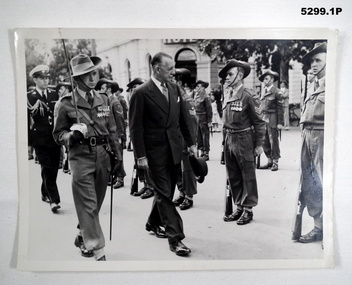
Photograph - PHOTOGRAPHS, Sir Dallas Brooks Inspecting Northern Vic Regiment 38 Bn, c1955-1962
... C.M.F. was known as the Northern Victorian Regiment. General Sir Dallas Brooks was Governor of Victoria 1949-1963. Collection item re Harry Burrell MM, refer Cat No 298.4 for his service details....C.M.F. was known as the Northern Victorian Regiment. General Sir Dallas Brooks was Governor of Victoria 1949-1963. Collection item re Harry Burrell MM, refer Cat No 298.4 for his service details. 38 Bn Dallas Brooks 1. ...The 38 Bn C.M.F. was known as the Northern Victorian Regiment. General Sir Dallas Brooks was Governor of Victoria 1949-1963. Collection item re Harry Burrell MM, refer Cat No 298.4 for his service details.1. B & W photo shows Gov. Sir Dallas Brooks inspecting members of 38 Bn. The soldiers are wearing battle dress and slouch hats. The men are standing to attention with their .303 Enfield rifles. Thge escorting officer with sword drawn is Captain Russ Emond. 2. B & W photo of Sir Dallas Brooks talking to a Warrant officer. The escorting officer is Captain Russ Emond (WW2 Veteran). The governor is in civvies, the soldiers are in battle dress.1. Written on rear is AC148. 2. Written on the rear in ink - Sir Dallas Brooks? Talking to H. Burrell. Capt Russ Emond.38 bn, dallas brooks -
 Bendigo Military Museum
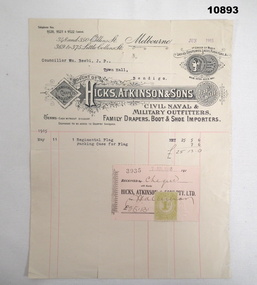
Administrative record - RECEIPT, Hicks, Atkinson & Sons Pty Ltd, 11 May 1915
... In November 1914, the 67th (Bendigo) Infantry C.M.F. were called up for full time service to guard the heads at Port Philip. ...In November 1914, the 67th (Bendigo) Infantry C.M.F. were called up for full time service to guard the heads at Port Philip. ...In November 1914, the 67th (Bendigo) Infantry C.M.F. were called up for full time service to guard the heads at Port Philip. The Lord Mayor, Cr Beebe, noted the Battalion did not have their own "colours" so he promised to have one made. This was done, then the "Colour" of the 67th Bendigo Infantry was presented to the Battalion in Bendigo, April 1915. The flag or colour is held in the Bendigo Military Museum, along with two Union Jacks from the Boer War.Off white sheet of paper with the Company letterhead, phone no's and address. Dated 1915, May 11. All printing is in black ink. Glued to the receipt is a small pink slip which is the receipt for cheque of .25.13.00. (25 pounds 13 shillings). That pink slip has a one penny Victorian Stamp Duty stamp on it. Dated 7 July 1915. The receipt shows; 1 Regimental Flag cost 25.5.6d. Packing case for flag 0.7.6d. Total .25.13.00.Stamp on top RH Corner = "Jun 1915". Pencilled on back are: "160 + 10"ww1, 67th bendigo infantry, admin record -
 Bendigo Military Museum
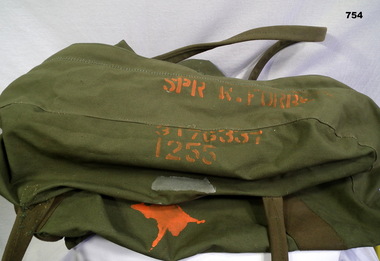
Equipment - KIT BAG VIETNAM, Arthur Stanton, est 1969
... Wayne also had pre service in the C.M.F....Wayne also had pre service in the C.M.F. containers kit Vietnam "SPR W Forbes 3176337 1255" Green canvas echelon kit bag with two handles and zip closure. 3 coloured stripes and red kangaroo. ...Wayne William Forbes (born Melbourne, enlisted Bendigo) No 3176337 served as a National Servicemen from April 1969 to April 1971. He volunterred and served in Vietnam with 1 Field Sqd Royal Aust Engineers from 22.8.70 to 22.7.71. He signed on in Vietnam for an extra 3 months service beyond his 2 years National Service. The kit bags were issued prior to Vietnam. Refer 2586 and his Father 1101, 1102, 1103.44P. Wayne also had pre service in the C.M.F.Green canvas echelon kit bag with two handles and zip closure. 3 coloured stripes and red kangaroo. All markings are painted on."SPR W Forbes 3176337 1255"containers, kit, vietnam -
 Bendigo Military Museum
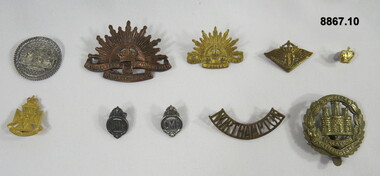
Badge - VARIOUS MILITARY BADGES, Unknown
... Service Badge No. 278005. 5. Queens Crown Badge. 6. The Melbourne Rifles Collar Badge 1953-1960. 7. C.M.F...Service Badge No. 278005. 5. Queens Crown Badge. 6. The Melbourne Rifles Collar Badge 1953-1960. 7. C.M.F ...Military badges either gold, silver or brass colour with or without a backing mounting plate, pins. Sizes vary. 1. Australian Rising Sun with Coat of Arms, Brooch (made in Palestine). 2. Australian Rising Sun Hat badge (Circa WW1-WW2). 3. Australian Rising Sun Collar badge (Australian Military Forces). 4. Returned from Active Service Badge No. 278005. 5. Queens Crown Badge. 6. The Melbourne Rifles Collar Badge 1953-1960. 7. C.M.F. Lapel badge. 8. C.M.F. Lapel badge. 9. Northampton Regiment Brass Shoulder Title. 10. Northamptonshire Regiment Hat Badge (Circa WW2). passchendaele barracks trust, pbt241to250, badges -
 Bendigo Military Museum
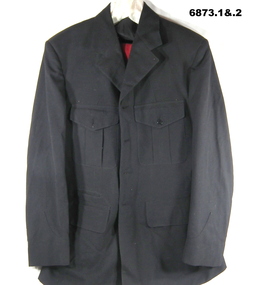
Uniform - MESS DRESS, ARMY, Sandleigh Clothes, 1953
... Refers to the service of "Sgt Toby Martin", 15 Tpt Sqn. C.M.F....Refers to the service of "Sgt Toby Martin", 15 Tpt Sqn. C.M.F. Army Uniforms Sgt Toby Martin Passchendaele Barracks Trust 1. ...Refers to the service of "Sgt Toby Martin", 15 Tpt Sqn. C.M.F.1. Jacket - Four front pockets. Top 2 held shut with 4 BN buttons. No epaulettes. Brass belt keepers in situ. 2. Trousers - black, button fly. Single red stripe down outsides of legs. Three pockets. 3. Belt - black, 50 mm with brass buckle. Two black plastic buttons. 4. Belt - black, 50 mm, no buckle, 3 black plastic buttons on it.1. Typed note - “Sgt Martin L.C”army, uniforms, sgt toby martin, passchendaele barracks trust -
 Wangaratta High School
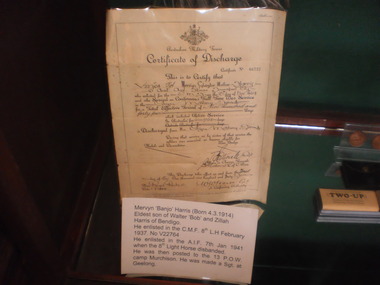
Mervyn 'Banjo' Harris certificate of Discharge, 1944
... House fnanopant cay who enlisted for the C.M.F on the 25th day of Nov 1939 and who served on continuous full time war service in the Citizen Military Forces for a total effective period of nine hundred and fifty four days which included active service in Australia for 748 days outside Australia for [0] days is discharged from the Citizen military Forces during that service or by virtue of that service the soldier was awarded or became eligible for [no] medals and decorations [no] war badge. this discharge takes effect on and from the first day of may one thousand nine hundred and forty four. ...House fnanopant cay who enlisted for the C.M.F on the 25th day of Nov 1939 and who served on continuous full time war service in the Citizen Military Forces for a total effective period of nine hundred and fifty four days which included active service in Australia for 748 days outside Australia for [0] days is discharged from the Citizen military Forces during that service or by virtue of that service the soldier was awarded or became eligible for [no] medals and decorations [no] war badge. this discharge takes effect on and from the first day of may one thousand nine hundred and forty four. ...House fnanopant cay who enlisted for the C.M.F on the 25th day of Nov 1939 and who served on continuous full time war service in the Citizen Military Forces for a total effective period of nine hundred and fifty four days which included active service in Australia for 748 days outside Australia for [0] days is discharged from the Citizen military Forces during that service or by virtue of that service the soldier was awarded or became eligible for [no] medals and decorations [no] war badge. this discharge takes effect on and from the first day of may one thousand nine hundred and forty four. ...Mervyn 'Banjo' Harris (born 4/3/1914) was the eldest son of Walter 'Bob' and Zillah Harris of Bendigo. He enlisted in the C.M.F. 8th L.H. February 1937. No V22764. He enlisted in the A.I.F. 7th January 1941 when the 8th light horse disbanded. He was then posted to he 143 P.O.W. camp Murchison. He was made a Sgt. at Geelong.Paper Certificate with Australian military forces logo and some slight ageing evident. Reads: Australian Military forces Certificate of Discharge certificate no. 66757 This is to certify that v22764 Sgt Mervyn Sylvester Walter Harris- 6 Aust. Aux. House fnanopant cay who enlisted for the C.M.F on the 25th day of Nov 1939 and who served on continuous full time war service in the Citizen Military Forces for a total effective period of nine hundred and fifty four days which included active service in Australia for 748 days outside Australia for [0] days is discharged from the Citizen military Forces during that service or by virtue of that service the soldier was awarded or became eligible for [no] medals and decorations [no] war badge. this discharge takes effect on and from the first day of may one thousand nine hundred and forty four. [signitures]Australian Military forces Certificate of Discharge certificate no. 66757 This is to certify that v22764 Sgt Mervyn Sylvester Walter Harris- 6 Aust. Aux. House fnanopant cay who enlisted for the C.M.F on the 25th day of Nov 1939 and who served on continuous full time war service in the Citizen Military Forces for a total effective period of nine hundred and fifty four days which included active service in Australia for 748 days outside Australia for [0] days is discharged from the Citizen military Forces during that service or by virtue of that service the soldier was awarded or became eligible for [no] medals and decorations [no] war badge. this discharge takes effect on and from the first day of may one thousand nine hundred and forty four. [signitures
