
Showing 12 items matching "campaign objectives"
-
 Moorabbin Air Museum
Book - South Pacific Air War, New Guinea 1942 - 1943 Halting the last Japanese Advance
... ...Campaign objectives...South Pacific Air War Attackers capabilities Defenders capabilities Campaign objectives The campaign Analysis & conclusions Overview of Allied & Japanese airpower in WW2 battle of New Guinea, circa 2025 New Guinea 1942 - 1943 Halting the last Japanese Advance Book South Pacific Air War ...Overview of Allied & Japanese airpower in WW2 battle of New Guinea, circa 2025non-fictionOverview of Allied & Japanese airpower in WW2 battle of New Guinea, circa 2025attackers capabilities, defenders capabilities, campaign objectives, the campaign, analysis & conclusions -
 Lara RSL Sub Branch
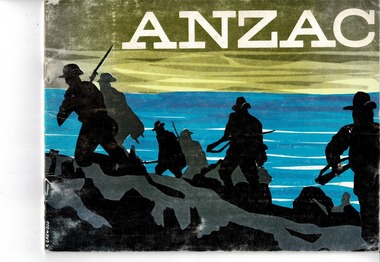
Booklet, ANZAC
... The Anzacs were courageous and although the Gallipoli campaign failed in its military objectives, the Australian and New Zealand actions during the campaign left us all a powerful legacy. ...On the 25th of April 1915, Australian and New Zealand soldiers formed part of the allied expedition that set out to capture the Gallipoli peninsula. These became known as Anzacs and the pride they took in that name continues to this day. This booklet gives a brief rundown on the history of the ANZACS.The Anzacs were courageous and although the Gallipoli campaign failed in its military objectives, the Australian and New Zealand actions during the campaign left us all a powerful legacy. Rectangular shaped Booklet.ANZACbooklet, anzac, world war one, lara r.s.l. -
 Lara RSL Sub Branch
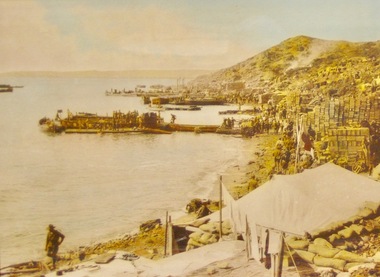
Framed Photograph of Anzac cove, Anzac Cove 1915
... Gallipoli Campaign 1915-6[edit] The first objective for soldiers coming ashore in enemy-held territory was to establish a beachhead, that is a safe section of beach protected from enemy attack where supplies and extra troops could be safely brought ashore. ...Gallipoli Campaign 1915-6[edit] The first objective for soldiers coming ashore in enemy-held territory was to establish a beachhead, that is a safe section of beach protected from enemy attack where supplies and extra troops could be safely brought ashore. ...Gallipoli Campaign 1915-6[edit] The first objective for soldiers coming ashore in enemy-held territory was to establish a beachhead, that is a safe section of beach protected from enemy attack where supplies and extra troops could be safely brought ashore. Anzac Cove was always within 1 kilometre (3,300 ft) of the front-line, well within the range of Turkish artillery though spurs from the high ground of Plugge's Plateau, which rose above Arıburnu, provided some protection. General William Birdwood, commander of Anzac, made his headquarters in a gully overlooking the cove, as did the commanders of the New Zealand and Australian Division and the Australian 1st Division. It was on 29 April that General Birdwood recommended that the original landing site between the two headlands be known as "Anzac Cove" and that the surrounding, hitherto nameless, area occupied by his corps be known as "Anzac". Anzac Cove is a small cove on the Gallipoli peninsula in Turkey. It became famous as the site of World War I landing of the ANZACs (Australian and New Zealand Army Corps) on 25 April 1915. The cove is 600 metres (2,000 ft) long, bounded by the headlands of Arıburnu to the north and Little Arıburnu, known as Hell Spit, to the south. Following the landing at Anzac Cove, the beach became the main base for the Australian and New Zealand troops for the eight months of the Gallipoli campaign. Rectangular shaped glass covered picture frame showing Anzac Cove.world war 1,gallipoli,anzac cove,lara r.s.l. ww1 -
 Eltham District Historical Society Inc
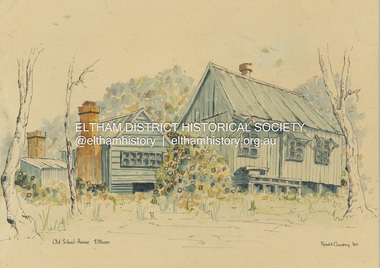
Painting - Watercolour, Ronald Coudrey, Falkiners Cottage, 1980
... In the late 1970s and early 80s this building was the subject of a campaign by our Society with the objective of its preservation. ...In the late 1970s and early 80s this building was the subject of a campaign by our Society with the objective of its preservation. ...Originally situated on the northwest corner of Ely and Porter streets, Eltham. Incorrectly titled by the artist as "Old School House" Newsletter No. 189 November 2009 Donation: Lesley Rickards of South Australia has made a donation to the Society of a painting by her father Ronald Coudrey, who was a well-known artist in that state. The water colour painting reproduced below, is titled "Old School House, Eltham" but has been identified as an old cottage that once stood in Ely Street Eltham near the Eltham High School. In the late 1970s and early 80s this building was the subject of a campaign by our Society with the objective of its preservation. It had been identified as having associations with Eltham pioneer Frederick Falkiner. Suggestions that it was an old school building shifted to this site were not supported by any evidence. The land developer donated the cottage and a small area of land to the Eltham Shire Council. However, due to its poor condition and vandalism, it was decided that the cottage could not be retained and ultimately it was demolished. The land on which it stood has recently been sold by Nillumbik Shire Council. The Society has a number of photos and another painting of this building, but this recent donation is an important addition to our collection and we are grateful for the donation.art, falkiners cottage, ronald coudrey -
 Monbulk RSL Sub Branch
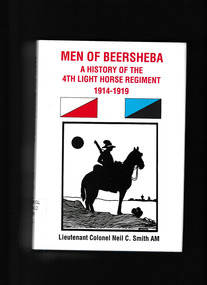
Book, Mostly Unsung Military History Research and Publications, Men of Beersheba : a history of the 4th Light Horse Regiment, 1914-1919, 1993
... world war 1914-1918 - campaigns - palestine australian army - 4th light horse regiment - history The principal objective of Men of Beersheba is to examine those men of the Regiment who participated in the renowned charge at Beersheba on the 31st of October 1917 index, bibliography, ill, maps, p.158. ...The principal objective of Men of Beersheba is to examine those men of the Regiment who participated in the renowned charge at Beersheba on the 31st of October 1917index, bibliography, ill, maps, p.158.non-fictionThe principal objective of Men of Beersheba is to examine those men of the Regiment who participated in the renowned charge at Beersheba on the 31st of October 1917world war 1914-1918 - campaigns - palestine, australian army - 4th light horse regiment - history -
 Victorian Interpretive Projects Inc.
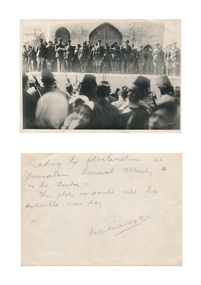
Photograph - Black and White, General Allanby Reading the Proclamation in Jerusalem, 1918, 1918
... The Battle of Jerusalem occurred during the British Empire's "Jerusalem Operations" against the Ottoman Empire, when fighting for the city developed from 17 November, continuing after the surrender until 30 December 1917, to secure the final objective of the Southern Palestine Offensive during the Sinai and Palestine Campaign of World War I. ...The Battle of Jerusalem occurred during the British Empire's "Jerusalem Operations" against the Ottoman Empire, when fighting for the city developed from 17 November, continuing after the surrender until 30 December 1917, to secure the final objective of the Southern Palestine Offensive during the Sinai and Palestine Campaign of World War I. ...The Battle of Jerusalem occurred during the British Empire's "Jerusalem Operations" against the Ottoman Empire, when fighting for the city developed from 17 November, continuing after the surrender until 30 December 1917, to secure the final objective of the Southern Palestine Offensive during the Sinai and Palestine Campaign of World War I. (Wikipedia) On 11 December, General Edmund Allenby humbly entered the Old City on foot through the Jaffa Gate instead of horse or vehicles to show respect for the holy city. He was the first Christian in many centuries to control Jerusalem, which is a very important site for many faiths. The Prime Minister of the United Kingdom, David Lloyd George described the capture as "a Christmas present for the British people". The battle was a great morale boost for the British Empire.(wikipedia)Photograph showing a number of soldiers on a raised platform, including General Allanby. Locals look on from below, some wearing fez hats.Verso: Reading the proclamation at Jerusalem. General Allenby in centre. This photo no doubt will be valuable one day. Palestine, 1918world war one, jerusalem, palestine, allenby, general allenby -
 National Vietnam Veterans Museum (NVVM)
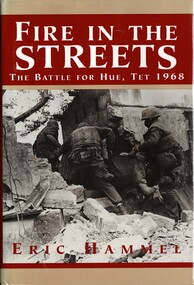
Book, Hammel, Eric, Fire in the Streets: The Battle for Hue, Tet 1968, 1991
... campaign of the Vietnam War. The ancient capital city of Hue, once considered the jewel of Indochina' cities, was a key objective of that surprse Communist offnesive launched on Vietnam's most important holiday. ...The Tet Offensive of Jnuary 1968 was the most important military campaign of the Vietnam War. The ancient capital city of Hue, once considered the jewel of Indochina' cities, was a key objective of that surprse Communist offnesive launched on Vietnam's most important holiday.The Tet Offensive of Jnuary 1968 was the most important military campaign of the Vietnam War. The ancient capital city of Hue, once considered the jewel of Indochina' cities, was a key objective of that surprse Communist offnesive launched on Vietnam's most important holiday.hue, battle of (hue´^, vietnam (1968), tet offensive (1968), vietnam war, 1961-1975 -- urban warfare -- united states -
 Bendigo Historical Society Inc.
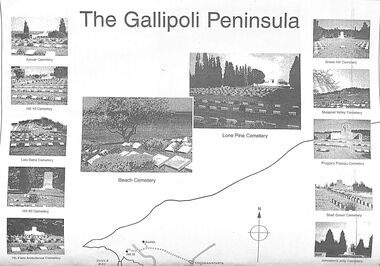
Map - Jack Lockett Collection: The Gallipoli Peninsula
... On the rear of the map there is an Information Sheet titled Commonwealth War Graves, Under the heading THE GALLIPOLI PENINSULA, TURKEY there is a brief description of the objective and actions of The Gallipoli Campaign 1915. Beneath the heading COMMEMORATION OF THE DEAD Under the terms of the Armistice with Turkey the British Army Re- entered the Peninsula at the end of 1918 and cleared the battlefields of the bodies still unburied. ...On the rear of the map there is an Information Sheet titled Commonwealth War Graves, Under the heading THE GALLIPOLI PENINSULA, TURKEY there is a brief description of the objective and actions of The Gallipoli Campaign 1915. Beneath the heading COMMEMORATION OF THE DEAD Under the terms of the Armistice with Turkey the British Army Re- entered the Peninsula at the end of 1918 and cleared the battlefields of the bodies still unburied. ...John Henry Lockett OAM (22 January 1891 – 25 May 2002) was the oldest man ever in Australia when he died aged 111 years, 123 days. As one of the last surviving veterans of World War I, he was acclaimed as a national hero during the last decade of his life. Lockett was born in the small Victorian town of Waanyarra, near Bendigo. He left school aged nine to work on a local farm. Later, he worked for his uncles in the Mallee. On 24 March 1916, he travelled to Mildura to enlist in the Australian Imperial Force. He served in France with the 38th Battalion, earning promotion to sergeant and was discharged on 20 September 1919. https://en.wikipedia.org/wiki/Jack_Lockett After the war, Jack returned to The Mallee and selected a 640 acres (260 ha) block of land in Linga, Victoria, deciding to make his living as a farmer. In 1923, he married Maybell Ingwerson and they had four children together. In 1963, the couple retired to Bendigo, leaving the farmland (which now covered more than 130,000 acres (53,000 ha), in the care of their children and grandchildren A long map on A3 paper attached to a A4 paper. Black print map of The Gallipoli Peninsula showing sites of battlefields. Surrounding the map there 33 small black and white photographs of Cemeteries and memorials. On the rear of the map there is an Information Sheet titled Commonwealth War Graves, Under the heading THE GALLIPOLI PENINSULA, TURKEY there is a brief description of the objective and actions of The Gallipoli Campaign 1915. Beneath the heading COMMEMORATION OF THE DEAD Under the terms of the Armistice with Turkey the British Army Re- entered the Peninsula at the end of 1918 and cleared the battlefields of the bodies still unburied. The Construction of the Cemeteries and Memorials was completed in 1926. It also includes a list of 39 Cemeteries with their names, a description of the Battle and the number of burials. jack lockett, mabel ingwersen, gallipoli war graves, nanga gnulle -
 St Kilda Historical Society
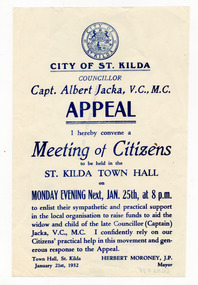
Ephemera - Flyer, Capt Albert Jacka VC MC Appeal, 1932
... campaign and two more decorations for his bravery on the Western Front. He received a hero's welcome on his return to Melbourne in January 1920 and an estimated 50,000 people turned up to watch his funeral procession to St Kilda Cemetery, where he was buried with full military honours. On 29 January, the appeal committee, chaired by Brigadier-General Brand, decided to call for donations to the Albert Jacka Fund by 29 February. The Fund had two objectives...campaign and two more decorations for his bravery on the Western Front. He received a hero's welcome on his return to Melbourne in January 1920 and an estimated 50,000 people turned up to watch his funeral procession to St Kilda Cemetery, where he was buried with full military honours. On 29 January, the appeal committee, chaired by Brigadier-General Brand, decided to call for donations to the Albert Jacka Fund by 29 February. The Fund had two objectives ...Notice of a meeting of citizens, convened by the Mayor of St Kilda, to raise funds for the widow and child of the late Albert Jacka, former St Kilda Councillor (from 1929) and Mayor (1930). The meeting was held in the St Kilda Town Hall on 25 January 1932. Albert Jacka had collapsed on 14 December 1931 after a council meeting and was admitted to Caulfield Military Hospital. He died on 17 January 1932 at the age of 39. Albert Jacka is most well-known for his military service in WWI, having received the Victoria Cross medal for his actions during the Gallipoli campaign and two more decorations for his bravery on the Western Front. He received a hero's welcome on his return to Melbourne in January 1920 and an estimated 50,000 people turned up to watch his funeral procession to St Kilda Cemetery, where he was buried with full military honours. On 29 January, the appeal committee, chaired by Brigadier-General Brand, decided to call for donations to the Albert Jacka Fund by 29 February. The Fund had two objectives: 'In the first instance, the erection of a simple, suitable and inexpensive memorial stone over the grave of the dead hero, and secondly the placing of the residue of the fund in the hands of trustees for the benefit of his widow and child.'White paper, discoloured with age, printed in blue on one side.albert jacka, city of st kilda, jacka appeal -
 St Kilda Historical Society
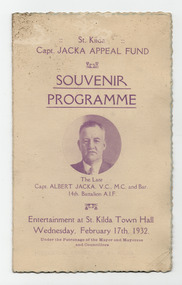
Ephemera - Special event program, Capt. Jacka Appeal Fund Souvenir Programme, 1932
... campaign and two more decorations for his bravery on the Western Front. He received a hero's welcome on his return to Melbourne in January 1920 and an estimated 50,000 people turned up to watch his funeral procession to St Kilda Cemetery, where he was buried with full military honours. The Albert Jacka Fund had two objectives...campaign and two more decorations for his bravery on the Western Front. He received a hero's welcome on his return to Melbourne in January 1920 and an estimated 50,000 people turned up to watch his funeral procession to St Kilda Cemetery, where he was buried with full military honours. The Albert Jacka Fund had two objectives ...Concert program of entertainment as aprt of fundraising for the Jacka Appeal, held on 17 February 1932 at St Kilda Town Hall. The headline performer was Gladys Moncreiff, 'Australia's Queen of Song'. Albert Jacka, a St Kilda Councillor, collapsed on 14 December 1931 after a council meeting and was admitted to Caulfield Military Hospital. He died on 17 January 1932 at the age of 39. He is most well-known for his military service in WWI, having received the Victoria Cross medal for his actions during the Gallipoli campaign and two more decorations for his bravery on the Western Front. He received a hero's welcome on his return to Melbourne in January 1920 and an estimated 50,000 people turned up to watch his funeral procession to St Kilda Cemetery, where he was buried with full military honours. The Albert Jacka Fund had two objectives: the erection of a simple, suitable and inexpensive memorial stone over the grave of the dead hero; the placing of the residue of the fund in the hands of trustees for the benefit of his widow and child.Folded cream card with scalloped edges and printed in purplealbert jacka, jacka appeal, gladys moncreiff -
 Wangaratta RSL Sub Branch
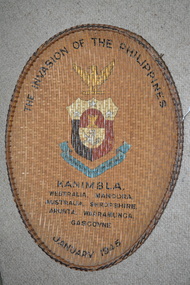
Memorabilia - Cane Woven Basket Tray, The Invasion of the Philippines, c1945
... In early January 1945, Australian warships took part in their next big naval action of the campaign when American forces were landed at Lingayen Gulf for the invasion of Luzon Island. Their objective was the capital, Manila. ...In early January 1945, Australian warships took part in their next big naval action of the campaign when American forces were landed at Lingayen Gulf for the invasion of Luzon Island. Their objective was the capital, Manila. ...In early January 1945, Australian warships took part in their next big naval action of the campaign when American forces were landed at Lingayen Gulf for the invasion of Luzon Island. Their objective was the capital, Manila. The frigates Gascoyne and Warrego carried out survey tasks and escort duties, coming under artillery fire and also attacks from aircraft. The Kanimbla, Manoora and Westralia again transported American troops for the landings and once again the escorts included the cruisers Shropshire and Australia – the latter had undergone repair – and the destroyers Arunta and Warramunga. Whist not confirmed, this large cane woven oval tray with The Philippines Coat of Arms in the centre above list of Royal Australian Navy ships that were involved in the liberation of the Philippines, is believed to have belonged to Robert Hamilton Hutchieson PM 4802 who served on HMAS Westralia as a landing craft coxswain in the Southwest Pacific Campaign 1942 to 1945. Large oval shaped cane woven basket tray The Invasion of the Philippines Image of Coat of Arms Commonwealth of the Philippines Kanimbla, Westralia, Manoura, Australia, Shropshire, Arunta, Warramunga, Gascoyne January 1945ww2, invasion of the philippines, 1945, hmas westralia, hmas kanimbla -
 Melbourne Tram Museum
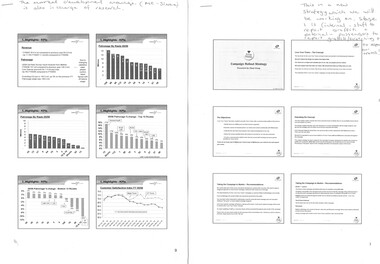
Document - Report, Yarra Trams, "100 years of electric trams in Melbourne", 2005 - 2006
... Set of two presentations or printout of a PowerPoint presentation, 6 slides per sheet and two position descriptions. .1 - Three page report (part of a larger report - page 9 to 11) results of a survey of various routes, KPI's - surveys, customer feedback, and incidents, service delivery. .2 - four page report about the Love Your Trams campaign presented by Flash Group, the objective, concept, the message, graffiti reduction and messages from passengers and staff. .3 - Two page Yarra Tram position description for Customer Relations and Marketing Officer, Camberwell. .4 - ditto for Customer Relations Assistant Camberwell....Set of two presentations or printout of a PowerPoint presentation, 6 slides per sheet and two position descriptions. .1 - Three page report (part of a larger report - page 9 to 11) results of a survey of various routes, KPI's - surveys, customer feedback, and incidents, service delivery. .2 - four page report about the Love Your Trams campaign presented by Flash Group, the objective, concept, the message, graffiti reduction and messages from passengers and staff. .3 - Two page Yarra Tram position description for Customer Relations and Marketing Officer, Camberwell. .4 - ditto for Customer Relations Assistant Camberwell. "100 years of electric trams in Melbourne" Document Report Yarra Trams ...Set of two presentations or printout of a PowerPoint presentation, 6 slides per sheet and two position descriptions. .1 - Three page report (part of a larger report - page 9 to 11) results of a survey of various routes, KPI's - surveys, customer feedback, and incidents, service delivery. .2 - four page report about the Love Your Trams campaign presented by Flash Group, the objective, concept, the message, graffiti reduction and messages from passengers and staff. .3 - Two page Yarra Tram position description for Customer Relations and Marketing Officer, Camberwell. .4 - ditto for Customer Relations Assistant Camberwell.On top of each document are notes in blue ink.trams, tramways, yarra trams, accidents, melbourne, depots, marketing, staff
