
Showing 217 items matching "carding equipment"
-
 Kew Historical Society Inc
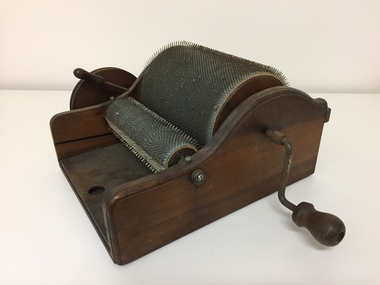
Equipment - Hand drum carder, Ertoel Wheels, 1980s
... ...carding equipment...Ertoel Wheels made a wide range of looms, chairs, drum and hand carders, and spinning and weaving accessories. wool carding drum carders carding equipment "Ertoel Wheels" Small drum carder, designed to be used on a table and operated by hand to card wool and or other fibres in preparing them for spinning or felting. ...Ertoel Wheels made a wide range of looms, chairs, drum and hand carders, and spinning and weaving accessories. Small drum carder, designed to be used on a table and operated by hand to card wool and or other fibres in preparing them for spinning or felting. This wooden carder has two cylindrical drums covered with coarse or fine metal “tines” designed to rake through and comb the natural fibre. The manufacturer's name 'Ertoel Wheels' is glued at one end"Ertoel Wheels"wool carding, drum carders, carding equipment -
 Wodonga & District Historical Society Inc
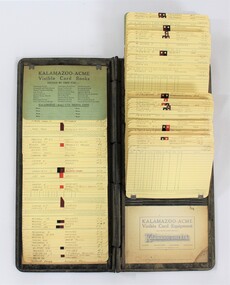
Financial record - Kalamazoo - Acme Visible Card Book, c. 1930s
... "KALAMAZOO - ACME / Visible Card Equipment / THE "RAPID SIGHT" METHOD / Kalamazoo (AUST.) ..."KALAMAZOO - ACME / Visible Card Equipment / THE "RAPID SIGHT" METHOD / Kalamazoo (AUST.) ...Part of the 'Mann' collection in the Wodonga Historical Society, used for accounting in the J. Mann & Sons General Store in High Street, Wodonga in 1934-35. J. Mann and Sons was first established as a farm produce store in 1921. The range of products was extended in the 1930s and included groceries and hardware, as well as the first petrol bowser in Wodonga outside the store. After WWII, the premises were extended and the range of products continued to increase. In the 1960s the Mann Family opened a new supermarket in Wodonga, in addition to the hardware business, providing steel, plumbing and industrial supplies, and they employed over 100 people at one stage. With changes in the retail industry, the Mann Family sold the main hardware business to Bunnings and the steel and rural produce business to the Kelly brothers in 2006.Local significance due to its use in the J. Mann & Sons General Store in High St, Wodonga and association with the prominent Mann family. National significance as kalamazoos were manufactured by an Australian company and used in the 1930s for accounting purposes by local businesses.Visible card book or kalamazoo used by the accounts department of J. Mann & Sons General Store, High Street, Wodonga, in 1934-35 for customers with surnames from K to P.Details for each customer provided on individual cards. "KALAMAZOO - ACME / Visible Card Equipment / THE "RAPID SIGHT" METHOD / Kalamazoo (AUST.) LTD. / SYDNEY - MELBOURNE - BRISBANE - ADELAIDE"mann, accounting, financial record, high street wodonga, wodonga, commerce, business, kalamazoo, general store, j. mann & sons -
 8th/13th Victorian Mounted Rifles Regimental Collection
Card
... AMF members personal equipment card...Sapper 10-44 - 8 - 3 - 46" AMF members personal equipment card Card ...Geoffrey R Fink volunteered for military service in early 1940. He served initially with 3rd Division A.A.S.C. but was discharged as being in a reserved occupation at the Aircraft Production Commission. He resigned from the Commission and joined the AIF on 28 July 1941 and was allotted to 2/8th Armoured Regiment. He served with the regiment in New Guinea and on return to Australia was transferred to No 41 Landing Craft Company serving out the war in the South Pacific. Geoffrey Fink died 14 March 2008 aged 86 at Wangaratta Victoria.Complements other objects in the collection relating to this WWII soldier.AMF members personal equipment card"VX 60307 Fink G,R. Sapper 10-44 - 8 - 3 - 46"fink geoffrey r mr, 2/8th armoured regiment, 41 landing craft company -
 Lilydale RSL Sub Branch
Card
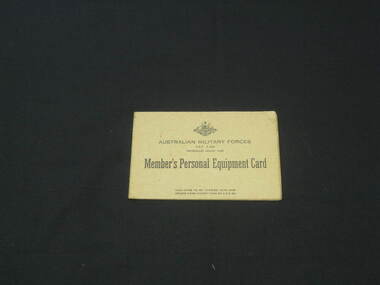
... Member's Personal Equipment Card - AMF - Cpl C H Pooley VX130306...Issued to Cpl CH Pooley VX130306 Member's Personal Equipment Card - AMF - Cpl C H Pooley VX130306 Card ...Issued to Cpl CH Pooley VX130306Member's Personal Equipment Card - AMF - Cpl C H Pooley VX130306 -
 Frankston RSL Sub Branch
Handbook, Member's Personal Equipment Card
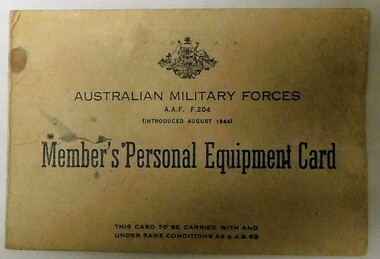
... Member's Personal Equipment Card...Folded buff coloured card used by the Australian Military Forces to record equipment issues to service personnel. ...AUSTRALIAN MILITARY FORCES Member's Personal Equipment Card A.A.F. F.204 (introduced August 1944)...AUSTRALIAN MILITARY FORCES Member's Personal Equipment Card A.A.F. F.204 (introduced August 1944) Folded buff coloured card used by the Australian Military Forces to record equipment issues to service personnel. ...Folded buff coloured card used by the Australian Military Forces to record equipment issues to service personnel. The card front cover, second and third pages are printed in black. The inner pages record details of uniform items and hardware items issued.AUSTRALIAN MILITARY FORCES Member's Personal Equipment Card A.A.F. F.204 (introduced August 1944) -
 Geelong RSL Sub Branch
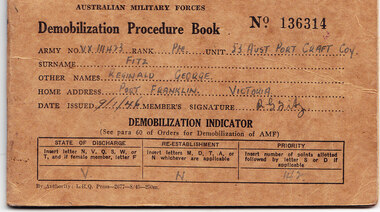
Documents - VX111423 Pte R G Fitz, Mid 20 Century
... AAB 83 Record of Service Book, AAB 87 Demolization Procedure Book, AAF F 204 Members Personal Equipment Card...VX111423 R G Fitz AAB 83 AAB 87 AAF F 204 All books - VX111423 Pte R G Fitz AAB 83 Record of Service Book, AAB 87 Demolization Procedure Book, AAF F 204 Members Personal Equipment Card Documents - VX111423 Pte R G Fitz ...These three Books, AAB 83, AAb 87 and AAF F 204 have belonged to Pte R G Fitz. Pte Fitz is a Victorian, he enlisted on 02 August 1941, interestingly his discharge was from 153 Aust Port Craft Coy, RAE.VX111423 Pte R G Fitz enlisted in the AIF on 02 August 1941, the books are originals that belonged to Pte Fitz.AAB 83 Record of Service Book, AAB 87 Demolization Procedure Book, AAF F 204 Members Personal Equipment CardAll books - VX111423 Pte R G Fitzvx111423 r g fitz, aab 83, aab 87, aaf f 204 -
 Bendigo Military Museum
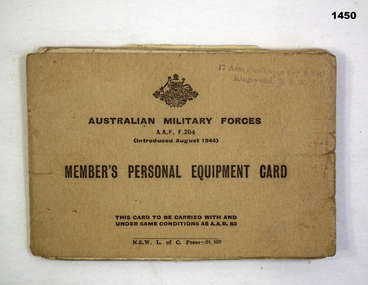
Booklet - CARD, PERSONAL EQUIPMENT, 1939 - 45
... CARD, PERSONAL EQUIPMENT...Members Personal Equipment Card A.A.F. F204 re VX100151 Clarence Wilfred Curnow. ...Booklet CARD, PERSONAL EQUIPMENT ...C.W Curnow, refer Cat No’s 1444, 1445.2.Members Personal Equipment Card A.A.F. F204 re VX100151 Clarence Wilfred Curnow. Brownish covers, inside are two photos of the soldier plus his record of service. Stamped across the top right hand corner "17 Aust Sup Depot Coy AASC Kingswood NSW"documents, record of service, army records, curnow -
Dandenong/Cranbourne RSL Sub Branch
Work on paper - Member's Personal Equipment Card, WWII, Australian Military Forces, 1944
... Member's Personal Equipment Card, WWII...equipment card...Within the card is a record of personal equipment issued to Army No VX111547 with typed and handwritten red and blue ink inscriptions from 21/12/44 to 21/1/46....Front cover: "AUSTRALIAN MILITARY FORCES / AAF F204 / INTRODUCED AUGUST 1944 / MEMBER'S PERSONAL EQUIPMENT CARD / THIS CARD TO BE CARRIED WITH AND UNDER SAME CONDITIONS AS A.A.B.83"...He was a fitter and turner and went on to work for EA Machin & Co 535 Elizabeth St Melbourne as a mechanical fitter after the war. equipment card member's personal equipment card Multiple inscriptions both typed and handwritten. ...Belonged to THOMPSON NORMAN VOISEY JAMES who served in WWII. His service Number - VX111547 : Date of birth - 17 Feb 1918 : Place of birth - WONTHAGGI VIC : Place of enlistment - IN THE FIELD WA : Next of Kin - THOMPSON A According to inscriptions within the book, Thompson was discharged on 27 December 1945. His home address was 10 Clarke St Prahran VIC. He was a fitter and turner and went on to work for EA Machin & Co 535 Elizabeth St Melbourne as a mechanical fitter after the war.Small brown rectangular bi-fold card from World War II. Within the card is a record of personal equipment issued to Army No VX111547 with typed and handwritten red and blue ink inscriptions from 21/12/44 to 21/1/46.Multiple inscriptions both typed and handwritten. Front cover: "AUSTRALIAN MILITARY FORCES / AAF F204 / INTRODUCED AUGUST 1944 / MEMBER'S PERSONAL EQUIPMENT CARD / THIS CARD TO BE CARRIED WITH AND UNDER SAME CONDITIONS AS A.A.B.83"equipment card, member's personal equipment card -
 Bendigo Military Museum
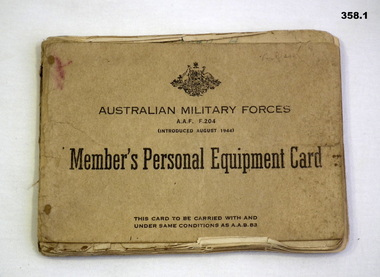
Document - DEMOBILIZATION PROCEDURE, EQUIPMENT CARD, TOBACCO RATION, C.1939 - post war
... DEMOBILIZATION PROCEDURE, EQUIPMENT CARD, TOBACCO RATION.....1) Members Personal Equipment Card A.A.F F 204.Light Tan in Colour. .2) Demobilization Procedure Book A.A.B 87, No 217241. ...Document DEMOBILIZATION PROCEDURE, EQUIPMENT CARD, TOBACCO RATION. ...Items relating to Alan Telford VX146055 2nd AIF. Refer Cat No 357.3 .1) Members Personal Equipment Card A.A.F F 204.Light Tan in Colour. .2) Demobilization Procedure Book A.A.B 87, No 217241. Brown in Colour. .3) Special Tobacco Ration for Ex Service Personnel No 81660. Light Tan in Colour..1) "Alan Telford VX146055" .2) "VX146055 Alan Telford" .3) "Alan Telford VX146055, Authorised Monthly quota"documents, records, demobilization, tobacco -
 Federation University Historical Collection
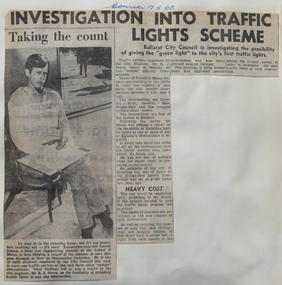
Book - Scrap Book, Ballarat School of Mines Scrap Book, 1965-1967, 1965-1967
... ...punch card equipment...Grey hard covered scrapboks with clippings relating to the Ballarat School of Mines, including: 24-5-1965 - Mildura Students at School of Mines 16-9-1965 - Ballarat Junior Technical School Mothers' Club Clock 23-11-1965 - Plan for Mall in Lydiard Street 29-03-1966 - Punch card equipment for School of Mines 10-05-1966 - Apprentice Craftsmen Certificates 25-7-1966 - Ian Barker 01-08-1966 - Woman Diplomate - Jennifer Drummond and Sue Milbourne 05 August 1967 - New Woolclassing and Motor Mechanics Building on the corner of Albert Street and Grant Street 09-09-1966 - New School site 23-09-1966 - Inspection of gaol site 22-09-1966 - Murray Gillin 19-10-1966 - Michael Young 26-01-1967 - A new site for SMB (Mt Helen Campus) 06-05-1967 - Geology Gift to SMB (William Baragwanath)...The Ballarat School of Mines was established in 1870. ballarat school of mines murray gillin gerald jenzen ludovio hart photography mount helen campus ron quick lydiard street closure ballarat junior technical school student accomodation r.r. watson phillip law martin report punch card equipment ken ogden ian barker jennifer drummond sue milbourne women and physics greg mcrae jan butterworth former ballarat gaol peter donaldson michae young mount clear site j.r. pound eric sharman chris sanos john gorton zaiga baltrocis motor mechanics & woolclassing building women women diplomates jennifer drummong technical education growrh e.j. barker mothers club w. johnson pottery ceramics ian billington matriculation victoria institute of colleges punch cards computer craftsman certificates new campus site architecture michael young sebastopol technical school ballarat school of mines master plan fourth university 4th university r. giles william baragwanath geology collection phil day john phillips greg strang plumbing centenary langi logan minefield a.l. mckenzie peter bennett r.w. richards medal woolclassing motor mechanics new building albert street grant street pound Grey hard covered scrapboks with clippings relating to the Ballarat School of Mines, including: 24-5-1965 - Mildura Students at School of Mines 16-9-1965 - Ballarat Junior Technical School Mothers' Club Clock 23-11-1965 - Plan for Mall in Lydiard Street 29-03-1966 - Punch card equipment for School of Mines 10-05-1966 - Apprentice Craftsmen Certificates 25-7-1966 - Ian Barker 01-08-1966 - Woman Diplomate - Jennifer Drummond and Sue Milbourne 05 August 1967 - New Woolclassing and Motor Mechanics Building on the corner of Albert Street and Grant Street 09-09-1966 - New School site 23-09-1966 - Inspection of gaol site 22-09-1966 - Murray Gillin 19-10-1966 - Michael Young 26-01-1967 - A new site for SMB (Mt Helen Campus) 06-05-1967 - Geology Gift to SMB (William Baragwanath) Ballarat School of Mines Scrap Book, 1965-1967 Book Scrap Book ...The Ballarat School of Mines was established in 1870.Grey hard covered scrapboks with clippings relating to the Ballarat School of Mines, including: 24-5-1965 - Mildura Students at School of Mines 16-9-1965 - Ballarat Junior Technical School Mothers' Club Clock 23-11-1965 - Plan for Mall in Lydiard Street 29-03-1966 - Punch card equipment for School of Mines 10-05-1966 - Apprentice Craftsmen Certificates 25-7-1966 - Ian Barker 01-08-1966 - Woman Diplomate - Jennifer Drummond and Sue Milbourne 05 August 1967 - New Woolclassing and Motor Mechanics Building on the corner of Albert Street and Grant Street 09-09-1966 - New School site 23-09-1966 - Inspection of gaol site 22-09-1966 - Murray Gillin 19-10-1966 - Michael Young 26-01-1967 - A new site for SMB (Mt Helen Campus) 06-05-1967 - Geology Gift to SMB (William Baragwanath)ballarat school of mines, murray gillin, gerald jenzen, ludovio hart, photography, mount helen campus, ron quick, lydiard street closure, ballarat junior technical school student accomodation, r.r. watson, phillip law, martin report, punch card equipment, ken ogden, ian barker, jennifer drummond, sue milbourne, women and physics, greg mcrae, jan butterworth, former ballarat gaol, peter donaldson, michae young, mount clear site, j.r. pound, eric sharman, chris sanos, john gorton, zaiga baltrocis, motor mechanics & woolclassing building, women, women diplomates, jennifer drummong, technical education growrh, e.j. barker, mothers club, w. johnson, pottery, ceramics, ian billington, matriculation, victoria institute of colleges, punch cards, computer, craftsman certificates, new campus site, architecture, michael young, sebastopol technical school, ballarat school of mines master plan, fourth university, 4th university, r. giles, william baragwanath geology collection, phil day, john phillips, greg strang, plumbing, centenary, langi logan minefield, a.l. mckenzie, peter bennett, r.w. richards medal, woolclassing, motor mechanics, new building, albert street, grant street, pound -
 Bendigo Military Museum
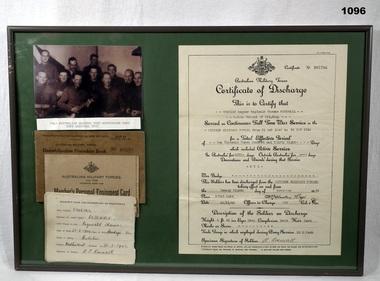
Memorabilia - COLLAGE, FRAMED, c.1942 - 1945
... LS black & white photograph, soldiers in uniform, informal group from the Mouth Organ Band, an Australian Military Force Demobilization Procedure Book & Members Personal Equipment Card & page of book showing Soldier's Name and Description on Enlistment. ...LS black & white photograph, soldiers in uniform, informal group from the Mouth Organ Band, an Australian Military Force Demobilization Procedure Book & Members Personal Equipment Card & page of book showing Soldier's Name and Description on Enlistment. ...Certificate of Discharge of Sapper Reginald T Rosewall. Frame. Grey painted metal frame with dark green mount & glass front. Collage. LS black & white photograph, soldiers in uniform, informal group from the Mouth Organ Band, an Australian Military Force Demobilization Procedure Book & Members Personal Equipment Card & page of book showing Soldier's Name and Description on Enlistment. RS certificate black print on cream paper: Certificate of Discharge.Certificate of Discharge of Sapper Reginald T Rosewall. Handwritten in black ink & typed in black on 2 documents, enlistment & discharge information.documents - certificates, frame accessories, r.t.rosewall -
 Bendigo Military Museum
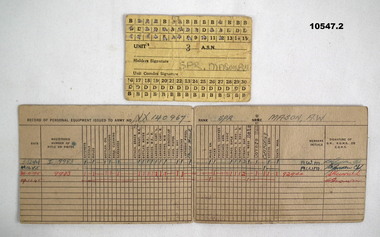
Document - RATION & EQUIPMENT CARDS, Aug 1944
... Card...Equipment Card...Cardboard card, khaki colour marked w. Form 91. 2. A.M.F. members personal equipment card. ...WW2 Personal Documents Ration Card Equipment Card As above 1. Ration card. For Spr Mason A.W. ...Refer to A.W. Mason collection. See cat No. 3979.2 for service details.1. Ration card. For Spr Mason A.W. This is probably from a troopship. It has 27 heart shaped holes cut into it. Top of card has a row "B", then a row "D", then a row of numbers up to 15. Bottom half card not used. Cardboard card, khaki colour marked w. Form 91. 2. A.M.F. members personal equipment card. For VX140967, Spr Mason A.W. For weapons, webbing and hardware. it is khaki cardboard. Folds outwards. Army form AAF F204.As aboveww2, personal documents, ration card, equipment card -
 Federation University Historical Collection
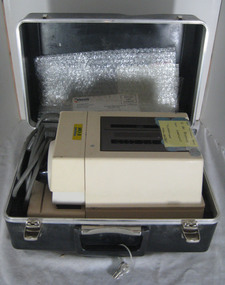
Equipment - Postage Meter, Pitney Bowes, Post Office Franking Machine, c 1970
... equipment and services. It was founded in 1920 when the company of Arthur Pitney, founded in 1902, merged with the company of Walter Bowes, founded in 1908. The name at merger became Pitney Bowes Postage Meter Company. They produced the first commercially available postage meter. ballarat school of mines university of ballarat post office mail franking machine postage meter arthur pitney walter bowes Code No. 6331 Serial No. 18412 Yellow sticker for SMB White, brown and black Pitney Bowes model 6300 Franking Machine in a black carry case. Includes power lead and blue soft cover. Yellow card ...This franking machine was used in the mail room of SMB and also in the mail room at University of Ballarat. Pitney Bowes is a global technical company, known for its postage meters and other mailing equipment and services. It was founded in 1920 when the company of Arthur Pitney, founded in 1902, merged with the company of Walter Bowes, founded in 1908. The name at merger became Pitney Bowes Postage Meter Company. They produced the first commercially available postage meter.White, brown and black Pitney Bowes model 6300 Franking Machine in a black carry case. Includes power lead and blue soft cover. Yellow card with instructions fro Supervisor of Mail Centre Code No. 6331 Serial No. 18412 Yellow sticker for SMBballarat school of mines, university of ballarat, post office, mail, franking machine, postage meter, arthur pitney, walter bowes -
 Flagstaff Hill Maritime Museum and Village
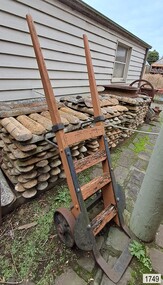
Functional object - Hand Trolley, Melbourne Steamship Company (MSS Co), Late 19th to mid-20th century
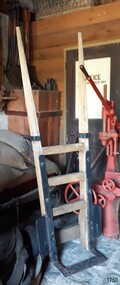
... card...rolling cart...station trolley...dolly...stack truck...box cart...two-wheeler...material handling equipment...More recently, as well as the continued use of this simple style of trolley, the design has been improved to include specialised trolleys that fold, climb stairs, move pianos and even easily turn corners on their spinning, pivoting wheels. warrnambool flagstaff-hill flagstaff-hill-maritime-museum maritime-museum shipwreck-coast flagstaff-hill-maritime-village Hand Trolley Sack Truck Trolley Luggage Trolley hand truck trundler sack barrow bag barrow leverage marine technology cargo handling docks wharft shipping trade vintage antique hand card rolling cart station trolley dolly stack truck box cart two-wheeler material handling equipment shipping trade MSS Co MSSC Melbourne Steamship Company interstate shipping Hugh R. ...This hand trolley was originally marked M.S.S. Co., and likely to have once belonged to the Melbourne Steamship Company, often referred to by those initials. Flagstaff Hill’s collection has several other objects connected to the M.S.S. Co. The firm was established in 1873 under the name Hugh R. Reid and Company, renamed Melbourne Steamship Company Ltd in 1895, and became Melbourne’s foremost interstate shipping line. Warrnambool was one of the ports of call at least between 1922 and 1956; for example, on September 27 1934, the ship Coolana left Warrnambool on its way to Stanley, Burnie and Devonport, then on to Sydney and Newcastle, while other of its vessels were visiting Fremantle, Port Lincoln, Whyalla, Adelaide, and Melbourne. The firm remained in business until around 1960. A hand trolley can be loaded with heavy and bulky objects such as luggage, and stacks of boxes such as produce, cargo and equipment. It uses the principles of wheels and leverage, like a wheelbarrow, and can easily be wheeled from one place to another. Hand trolleys are still used by farmers, railway workers, shipping companies, porters, airports, hospitals, warehouses, logistical firms, furniture removalists, factory labourers and even in private homes when heavy loads need to be moved. Hand trolleys were first used in the 18th century in industries where children were used to move heavy loads. By using a hand trolley, the young labourers could move the piles of objects with the same efficiency as the adult workers. This hand trolley is significant for its likely connection to the Melbourne Steamship Company, or MSSCo, Melbourne’s foremost shipping line for interstate trade in the late nineteenth and early-to- mid twentieth century, representing many aspects of early trade within maritime Australia; Warrnambool was one of the ports visited by the company’s ships. The design of the hand trolley is an example of equipment used since the 18th century to move heavy loads at docks and shipyards. It is associated with the maritime industries of shipping, transportation, travel, and trade, as well as the colonial primary production sectors of farming, markets, and produce. The design represents an early step in the evolution of the simple hand trolley. More recently, as well as the continued use of this simple style of trolley, the design has been improved to include specialised trolleys that fold, climb stairs, move pianos and even easily turn corners on their spinning, pivoting wheels. Hand trolley: an L-shaped handcart with handles and supporting legs at one end, wheels at the other, and a ledge or platform to hold the load. This hand trolley has orange wooden slats and handles, two metal wheels, and a black metal frame with semi-circular side flanges. An inscription is stamped on one side.Stamped: "M.S.S.CO."warrnambool, flagstaff-hill, flagstaff-hill-maritime-museum, maritime-museum, shipwreck-coast, flagstaff-hill-maritime-village, hand trolley, sack truck, trolley, luggage trolley, hand truck, trundler, sack barrow, bag barrow, leverage, marine technology, cargo handling, docks, wharft, shipping, trade, vintage, antique, hand card, rolling cart, station trolley, dolly, stack truck, box cart, two-wheeler, material handling equipment, shipping trade, mss co, mssc, melbourne steamship company, interstate shipping, hugh r. reid and company -
 Flagstaff Hill Maritime Museum and Village
Equipment - Hand Trolley
... card...hand truck...rolling cart...luggage trolley...station trolley...dolly...stack truck...sack truck...trundler...box cart...sack barrow...bag barrow...two-wheeler...leverage...material handling equipment...Flagstaff Hill Warrnambool Shipwreck Coast Maritime Museum Flagstaff Hill Maritime Museum and Village vintage antique hand trolley hand card hand truck rolling cart luggage trolley station trolley dolly stack truck sack truck trundler box cart sack barrow bag barrow two-wheeler leverage material handling equipment marine technology cargo handling docks shipping trade Hand trolley: an L-shaped hand-operated trolley with handles and supporting legs at one end, wheels at the other, and a ledge or platform to hold the load. ...A hand trolley can be loaded with heavy and bulky objects such as luggage, and stacks of boxes such as produce, cargo and equipment. It uses the principles of wheels and leverage, like a wheelbarrow, and can easily be wheeled from one place to another. Hand trolleys are still used by farmers, railway workers, shipping companies, porters, airports, hospitals, warehouses, logistical firms, furniture removalists, factory labourers and even in private homes when heavy loads need to be moved. Hand trolleys were first used in the 18th century in industries where children were used to move heavy loads. By using a hand trolley, the young labourers could move the piles of objects with the same efficiency as the adult workers. The design of the hand trolley is an example of equipment used since the 18th century to move heavy loads at the docks and shipyards. It is associated with the maritime industries of shipping, transportation, travel and trade as well as the colonial primary production sectors of farming, markets and produce. The design represents an early step in the evolution of the simple hand trolley. More recently, as well as the continued use of this simple style of trolley, the design has been improved to include specialised trolleys that fold, climb stairs, move pianos and even easily turn corners on their spinning, pivoting wheels. Hand trolley: an L-shaped hand-operated trolley with handles and supporting legs at one end, wheels at the other, and a ledge or platform to hold the load. This hand trolley has orange wooden slats and handles, two metal wheels, and a black metal frame with curved corners on its rectangular side flanges.flagstaff hill, warrnambool, shipwreck coast, maritime museum, flagstaff hill maritime museum and village, vintage, antique, hand trolley, hand card, hand truck, rolling cart, luggage trolley, station trolley, dolly, stack truck, sack truck, trundler, box cart, sack barrow, bag barrow, two-wheeler, leverage, material handling equipment, marine technology, cargo handling, docks, shipping trade -
 Flagstaff Hill Maritime Museum and Village
Equipment - Survival Kit, c. 1943
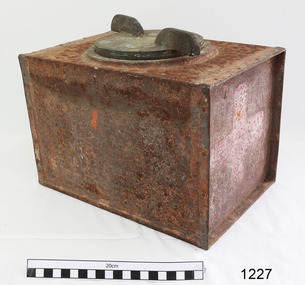
... Also inside, one Sun-flash Distress Signal Mirror (instructions adhered to back) with padded pouch, labelled "MIRROR" in white paint, and a card inside pouch, adhering to insides. Metal is corroding. Equipment Survival Kit Commonwealth of Australia ...Emergency survival kit made safe and watertightThe kit represents equipment used around the time of World War II to aid the safety and survival of seafarers.Survival kit, 1973. Rectangular metal box with round screw top lid that has wing handles with a red cross on both ends of box (one end is heavily rusted). Contents of box includes booklet 1943 "Advice to Those in Lifeboats and Rafts of Merchant Ships" and one rectangular piece of water resistant paper with "Advice-books" written on it (separated from booklet), cylindrical stainless steel container with wire handle, cotton bandage. Also inside, one Sun-flash Distress Signal Mirror (instructions adhered to back) with padded pouch, labelled "MIRROR" in white paint, and a card inside pouch, adhering to insides. Metal is corroding.White painted label on pouch 'MIRROR". Paper instructions on back of mirror headed "_ _ FSON SUN-FLASH DISTRESS, SIGNAL DEVICE". Printed on waterproof cover "ADVICE BOOKS". warrnambool, flagstaff-hill, flagstaff-hill-maritime-museum, shipwreck-coast, survival kit, commonwealth of australia, sun-flash distress signal mirror, survival advice book, military supplies, emergency kit, survival kit. -
 Mission to Seafarers Victoria
Souvenir - Ticket, City Light Methodist Church
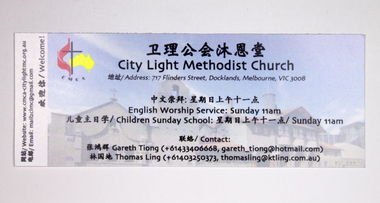
... The Chinese Methodist Church uses the St Peter chapel for its services and is a hiring a room for its equipment. ticket, methodist, chinese ticket methodist church city light methodist church chinese interest group Small light card/ticket, printed text on one side with MTSV building picture as background. ...The Chinese Methodist Church uses the St Peter chapel for its services and is a hiring a room for its equipment.Small light card/ticket, printed text on one side with MTSV building picture as background.ticket, methodist, chinese, ticket, methodist church, city light methodist church, chinese, interest group -
 Greensborough Historical Society
Card - Business card, Rebel Sport, Greensborough 2016, 2016_
... Business card for a Greensborough Plaza business, Rebel Sport Greensborough. business cards greensborough plaza rebel sport sports equipment Business card, white card with black text. ...Business card for a Greensborough Plaza business, Rebel Sport Greensborough.Business card, white card with black text.business cards, greensborough plaza, rebel sport, sports equipment -
 Marysville & District Historical Society
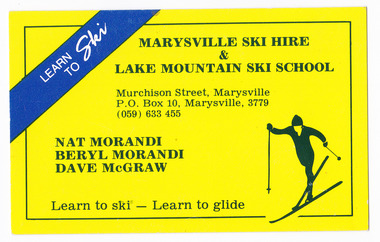
Ephemera (Item) - Business card, Marysville Ski Hire & Lake Mountain Ski School, Unknown
... card advertising Marysville Ski Hire and Lake Mountain Ski School in Victoria. Marysville Ski Centre is a family-owned business, which has been operated by Nat and Beryl Morandi since 1981. The business started from very humble beginnings hiring toboggans at Lake Mountain initially from the back of a Bedford Van, and then upgraded to a rickety old shed with the addition of ski equipment for hire. ...A business card advertising Marysville Ski Hire and Lake Mountain Ski School in Victoria.A business card advertising Marysville Ski Hire and Lake Mountain Ski School in Victoria. Marysville Ski Centre is a family-owned business, which has been operated by Nat and Beryl Morandi since 1981. The business started from very humble beginnings hiring toboggans at Lake Mountain initially from the back of a Bedford Van, and then upgraded to a rickety old shed with the addition of ski equipment for hire. In 1983, Marysville Ski Centre commenced business in its current position in Marysville. Then this building was destroyed, along with most of the buildings in Marysville, during the 2009 Black Saturday bushfires. Currently, the business operates from their new custom-designed ski hire which has been built to cater for the different needs of the hire.marysville, victoria, marysville ski centre, photograph, nat morandi, beryl morandi, 2009 black saturday bushfires, lake mountain ski school, lake mountain, dave mcgraw -
 Lara RSL Sub Branch
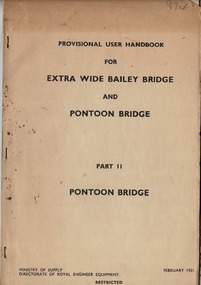
Provisional User Handbook, Extra Wide Bailey Bridge and Pontoon Bridge Part II (Restricted), February 1951 Ministry of Supplym Directorate of Royal Engineer Equipment (RESTRICTED)
... (RESTRICTED) Ministry of Supply, Directorate Royal Engineer Equipment. Light brown thin card board front and Back, interior pages off white 17 pages and appendix H of 9 pages. ...(Restricted) Government publicationPrinted in February 1951Light brown thin card board front and Back, interior pages off white 17 pages and appendix H of 9 pages. Provisional user handbook for Extra Wide Bailey Bridge and Pontoon Bridge = Part II Pontoon Bridge. Dated February 1951Provisional user handbook for Extra Wide Bailey Bridge and Pontoon Bridge = Part II Pontoon Bridge. Dated February 1951. (RESTRICTED) Ministry of Supply, Directorate Royal Engineer Equipment.user handbook, extra wide bailey bridge, pontoon bridge -
 Lara RSL Sub Branch
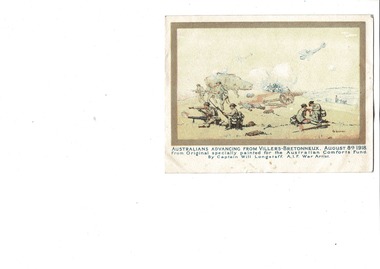
greeting Card 8/8/1918, Advance from Villers-Bretonneux 8/8/1918 & Capture of Hamel 4/7/1918 & Captured German Tank
... card Page 1: Australian Advancing from Villlers - Bretonneux 8/8/1918 drawing of soldiers in action. Page 2 : Villlers - Bretonneux Start of the German attack 8/8/1918 Picture of captured German tank by Australians. Page 3 : Capture of Hamel Village 4/4/1918 by Australian. From color Paiinting Australian Comfort Fund by A. Pearse War Artist. Pages 4 : Australian capture A 14 C.M. German Naval Gun intact with its Train and Equipment ...Four color pages card Advance from Villers-Bretonneux 8/8/1918 & Capture of Hamel 4/7/1918 & Captured German Tank .Page 1: Australian Advancing from Villlers - Bretonneux 8/8/1918 drawing of soldiers in action. Page 2 : Villlers - Bretonneux Start of the German attack 8/8/1918 Picture of captured German tank by Australians. Page 3 : Capture of Hamel Village 4/4/1918 by Australian. From color Paiinting Australian Comfort Fund by A. Pearse War Artist. Pages 4 : Australian capture A 14 C.M. German Naval Gun intact with its Train and Equipment. Greeting from.................cardboard card, world war 1, greeting card -
 Lara RSL Sub Branch
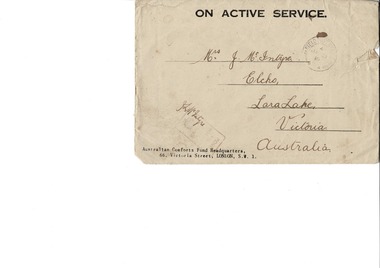
Card & Envelope, Raphael Tuck & Sons,Ltd.Publishers to the King and Queen, Australian Comforts Fund Xmas & New Years Greeting Card 1918-19, Circa 1918-19
... The card depicts four scenes from the First World War: Australians Advancing from Villers-Brettonneux August 8th 1918, A German tank captured by the Australians near Villers-Brettonneux, Capture of Hamel Village July 4th 1918 by Australians assisted by a detachment of Americans, Captured by The Australians a 14 C.M. German Naval Gun intact with its Train & Equipment...The card depicts four scenes from the First World War: Australians Advancing from Villers-Brettonneux August 8th 1918, A German tank captured by the Australians near Villers-Brettonneux, Capture of Hamel Village July 4th 1918 by Australians assisted by a detachment of Americans, Captured by The Australians a 14 C.M. German Naval Gun intact with its Train & Equipment ...Small Christmas card produced for the Australian Comforts Fund, Christmas 1918. Christmas & New Years Greetings, 1918-19, with scenes of battles at Villers-Brettonneux and Hamel, and views of a captured tank and a 14cm. gun. Produced by Raphael Tuck & Sons, Publishers to the King and Queen.These cards were sent by service personal serving overseas to family members back home.l Sent by J.L.Mcintre while on active service in France to his loved ones back home.Christmas card with blue and black lettering Australian Comforts Fund Christmas & New Years Greetings, 1918-19, Produced by Raphael Tuck & Sons, Publishers to the King and Queen. The card depicts four scenes from the First World War: Australians Advancing from Villers-Brettonneux August 8th 1918, A German tank captured by the Australians near Villers-Brettonneux, Capture of Hamel Village July 4th 1918 by Australians assisted by a detachment of Americans, Captured by The Australians a 14 C.M. German Naval Gun intact with its Train & Equipment.Australian Advancing from Vlllers-Brettonneux.August 8th 1918. From Original specially painted for the Australian Comforts Fund by Captain Will Longstaff.A.I.F.War Artist. -
 Lara RSL Sub Branch
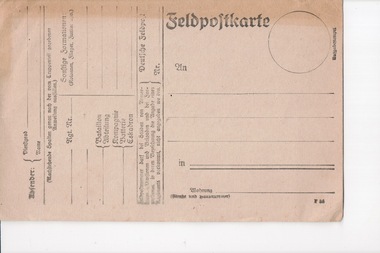
Memento, German Field Service Card x 2, World War 1
... Information written in German On the back of one card Mr Mcintyre has written how the card was taken from a german prisoner and details of equipment captured....Blank service card issued to German soldiers to send messages home german field service card mcintyre world war one lara Information written in German On the back of one card Mr Mcintyre has written how the card was taken from a german prisoner and details of equipment captured. ...Blank service card issued to German soldiers to send messages homeGerman Field service CardInformation written in German On the back of one card Mr Mcintyre has written how the card was taken from a german prisoner and details of equipment captured.german field service card mcintyre world war one lara -
 Federation University Historical Collection
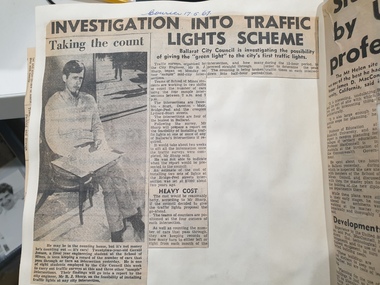
Book - Scrapbook, Ballarat School of Mines Scrapbook, 1960-1961
... ...punch card equipment...The Ballarat School of Mines is a predecessor institution of Federation University Australia. ballarat gaol scrapbook newsclippings ballarat school of mines third university ron quick wall clock Lydiard Street south closure Phil law punch card equipment motor mechanics craftsmen certificates e.j. barker ian barker ballarat gaol site murray gillin peter donaldson michael young mount clear reid's j.r. pound william baragwanath collection eric sharman Gerald Jenzen walter Reimann Ballarat Junior Technical School Scrapbook with newsclips relating to the Ballarat School of Mines, including: 1960 - Ballarat Gaol 1960- Sebastopol Technical School to be Built Ballarat School of Mines Scrapbook Book Scrapbook ...The Ballarat School of Mines is a predecessor institution of Federation University Australia.Scrapbook with newsclips relating to the Ballarat School of Mines, including: 1960 - Ballarat Gaol 1960- Sebastopol Technical School to be Builtballarat gaol, scrapbook, newsclippings, ballarat school of mines, third university, ron quick, wall clock, lydiard street south closure, phil law, punch card equipment, motor mechanics, craftsmen certificates, e.j. barker, ian barker, ballarat gaol site, murray gillin, peter donaldson, michael young, mount clear, reid's, j.r. pound, william baragwanath collection, eric sharman, gerald jenzen, walter reimann, ballarat junior technical school -
 Federation University Historical Collection
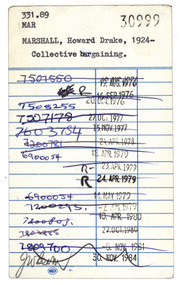
Equipment - Cards, Gippsland Institute of Advanced Education Library Borrowing Card, 1970s, 1970s
... Gippsland Institute of Advanced Education Library Borrowing Card, 1970s Equipment Cards ...Gippsland Institute of Advanced Education is a predecessor institution of Federation University. These cards were used at the Gippsland campus library before the introduction of a computer catalogue. A date card listing book title, author, and recording the student number of each borrower and the date the book was due back at the library.library, gippsland institute of advanced education, churchill, library date card, borrowing card -
 Flagstaff Hill Maritime Museum and Village
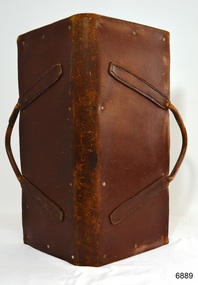
File System, 20th century
... BROWN Limited Clifton Hill Melb, - - - Equipment” Portable leather covered filing system with handles. opens like a book; part of the W.R. Angus Collection. File system is lined with metal sides inside, rivetted onto leather. Flip-up card ...This portable filing system was used by Dr Angus in his medical surgery. It was donated to Flagstaff Hill Maritime Village by the family of Doctor William Roy Angus, Surgeon and Oculist. It is part of the “W.R. Angus Collection” includes historical medical equipment, surgical instruments and material once belonging to Dr Edward Ryan and Dr Thomas Francis Ryan, (both of Nhill, Victoria) as well as Dr Angus’ own belongings. The Collection’s history spans the medical practices of the two Doctors Ryan, from 1885-1926 plus that of Dr Angus, up until 1969. ABOUT THE “W.R.ANGUS COLLECTION” Doctor William Roy Angus M.B., B.S., Adel., 1923, F.R.C.S. Edin.,1928 (also known as Dr Roy Angus) was born in Murrumbeena, Victoria in 1901 and lived until 1970. He qualified as a doctor in 1923 at University of Adelaide, was Resident Medical Officer at the Royal Adelaide Hospital in 1924 and for a period was house surgeon to Sir (then Mr.) Henry Simpson Newland. Dr Angus was briefly an Assistant to Dr Riddell of Kapunda, then commenced private practice at Curramulka, Yorke Peninsula, SA, where he was physician, surgeon and chemist. In 1926, he was appointed as new Medical Assistant to Dr Thomas Francis Ryan (T.F. Ryan, or Tom), in Nhill, Victoria, where his experiences included radiology and pharmacy. In 1927 he was Acting House Surgeon in Dr Tom Ryan’s absence. Dr Angus had become engaged to Gladys Forsyth and they decided he further his studies overseas in the UK in 1927. He studied at London University College Hospital and at Edinburgh Royal Infirmary and in 1928, was awarded FRCS (Fellow from the Royal College of Surgeons), Edinburgh. He worked his passage back to Australia as a Ship’s Surgeon on the on the Australian Commonwealth Line’s T.S.S. Largs Bay. Dr Angus married Gladys in 1929, in Ballarat. (They went on to have one son (Graham 1932, born in SA) and two daughters (Helen (died 12/07/1996) and Berenice (Berry), both born at Mira, Nhill ) According to Berry, her mother Gladys made a lot of their clothes. She was very talented and did some lovely embroidery including lingerie for her trousseau and beautifully handmade baby clothes. Dr Angus was a ‘flying doctor’ for the A.I.M. (Australian Inland Ministry) Aerial Medical Service in 1928 . Its first station was in the remote town of Oodnadatta, where Dr Angus was stationed. He was locum tenens there on North-South Railway at 21 Mile Camp. He took up this ‘flying doctor’ position in response to a call from Dr John Flynn; the organisation was later known as the Flying Doctor Service, then the Royal Flying Doctor Service. A lot of his work during this time involved dental surgery also. Between 1928-1932 he was surgeon at the Curramulka Hospital, Yorke Peninsula, South Australia. In 1933 Dr Angus returned to Nhill and purchased a share of the Nelson Street practice and Mira hospital (a 2 bed ward at the Nelson Street Practice) from Dr Les Middleton one of the Middleton Brothers, the current owners of what previously once Dr Tom Ryan’s practice. Dr Tom and his brother had worked as surgeons included eye surgery. Dr Tom Ryan performed many of his operations in the Mira private hospital on his premises. He had been House Surgeon at the Nhill Hospital 1902-1926. Dr Tom Ryan had one of the only two pieces of radiology equipment in Victoria during his practicing years – The Royal Melbourne Hospital had the other one. Over the years Dr Tom Ryan had gradually set up what was effectively a training school for country general-practitioner-surgeons. Each patient was carefully examined, including using the X-ray machine, and any surgery was discussed and planned with Dr Ryan’s assistants several days in advance. Dr Angus gained experience in using the X-ray machine there during his time as assistant to Dr Ryan. When Dr Angus bought into the Nelson Street premises in Nhill he was also appointed as the Nhill Hospital’s Honorary House Surgeon 1933-1938. His practitioner’s plate from his Nhill surgery is now mounted on the doorway to the Port Medical Office at Flagstaff Hill Maritime Village, Warrnambool. When Dr Angus took up practice in the Dr Edward and Dr Tom Ryan’s old premises he obtained their extensive collection of historical medical equipment and materials spanning 1884-1926. A large part of this collection is now on display at the Port Medical Office at Flagstaff Hill Maritime Village in Warrnambool. In 1939 Dr Angus and his family moved to Warrnambool where he purchased “Birchwood,” the 1852 home and medical practice of Dr John Hunter Henderson, at 214 Koroit Street. (This property was sold in1965 to the State Government and is now the site of the Warrnambool Police Station. and an ALDI sore is on the land that was once their tennis court). The Angus family was able to afford gardeners, cooks and maids; their home was a popular place for visiting dignitaries to stay whilst visiting Warrnambool. Dr Angus had his own silk worm farm at home in a Mulberry tree. His young daughter used his centrifuge for spinning the silk. Dr Angus was appointed on a part-time basis as Port Medical Officer (Health Officer) in Warrnambool and held this position until the 1940’s when the government no longer required the service of a Port Medical Officer in Warrnambool; he was thus Warrnambool’s last serving Port Medical Officer. (Masters of immigrant ships arriving in port reported incidents of diseases, illness and death and the Port Medical Officer made a decision on whether the ship required Quarantine and for how long, in this way preventing contagious illness from spreading from new immigrants to the residents already in the colony.) Dr Angus was a member of the Australian Medical Association, for 35 years and surgeon at the Warrnambool Base Hospital 1939-1942, He served with the Australian Department of Defence as a Surgeon Captain during WWII 1942-45, in Ballarat, Victoria, and in Bonegilla, N.S.W., completing his service just before the end of the war due to suffering from a heart attack. During his convalescence he carved an intricate and ‘most artistic’ chess set from the material that dentures were made from. He then studied ophthalmology at the Royal Melbourne Eye and Ear Hospital and created cosmetically superior artificial eyes by pioneering using the intrascleral cartilage. Angus received accolades from the Ophthalmological Society of Australasia for this work. He returned to Warrnambool to commence practice as an ophthalmologist, pioneering in artificial eye improvements. He was Honorary Consultant Ophthalmologist to Warrnambool Base Hospital for 31 years. He made monthly visits to Portland as a visiting surgeon, to perform eye surgery. He represented the Victorian South-West subdivision of the Australian Medical Association as its secretary between 1949 and 1956 and as chairman from 1956 to 1958. In 1968 Dr Angus was elected member of Spain’s Barraquer Institute of Barcelona after his research work in Intrasclearal cartilage grafting, becoming one of the few Australian ophthalmologists to receive this honour, and in the following year presented his final paper on Living Intrasclearal Cartilage Implants at the Inaugural Meeting of the Australian College of Ophthalmologists in Melbourne In his personal life Dr Angus was a Presbyterian and treated Sunday as a Sabbath, a day of rest. He would visit 3 or 4 country patients on a Sunday, taking his children along ‘for the ride’ and to visit with him. Sunday evenings he would play the pianola and sing Scottish songs to his family. One of Dr Angus’ patients was Margaret MacKenzie, author of a book on local shipwrecks that she’d seen as an eye witness from the late 1880’s in Peterborough, Victoria. In the early 1950’s Dr Angus, painted a picture of a shipwreck for the cover jacket of Margaret’s book, Shipwrecks and More Shipwrecks. She was blind in later life and her daughter wrote the actual book for her. Dr Angus and his wife Gladys were very involved in Warrnambool’s society with a strong interest in civic affairs. He had an interest in people and the community They were both involved in the creation of Flagstaff Hill, including the layout of the gardens. After his death (28th March 1970) his family requested his practitioner’s plate, medical instruments and some personal belongings be displayed in the Port Medical Office surgery at Flagstaff Hill Maritime Village, and be called the “W. R. Angus Collection”. The W.R. Angus Collection is significant for still being located at the site it is connected with, Doctor Angus being the last Port Medical Officer in Warrnambool. The collection of medical instruments and other equipment is culturally significant, being an historical example of medicine from late 19th to mid-20th century. Dr Angus assisted Dr Tom Ryan, a pioneer in the use of X-rays and in ocular surgery. Portable leather covered filing system with handles. opens like a book; part of the W.R. Angus Collection. File system is lined with metal sides inside, rivetted onto leather. Flip-up card holders are inserted into metal on both sides; cards have reinforced lower edge and slots for inserting index card. Embossed in gold lettering each side “ Manufactured by by Brownbuilt in Clifton Hill, Melbourne, Australia. Card size 8 x 5 (inches).Tracydex / Visible Record” and “BROWNBUILT / E.T. BROWN Limited Clifton Hill Melb, - - - Equipment”flagstaff hill, warrnambool, shipwrecked coast, flagstaff hill maritime museum, maritime museum, shipwreck coast, flagstaff hill maritime village, great ocean road, dr w r angus, dr ryan, surgical instrument, t.s.s. largs bay, warrnambool base hospital, nhill base hospital, mira hospital, flying doctor, filing system, portable filing system, office equipment -
 Flagstaff Hill Maritime Museum and Village
Fire Pump, 20th century
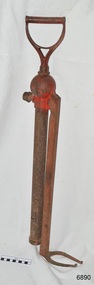
... equipment Moulded into metal "STOKES" and “MELB”. Label attached with string to handle (no text visible). Fire pump, part of the W.R. Angus Collection. Red metal water pump. "D" shaped pump handle slides within pump cylinder, stand has 'U" shaped footrest. Pump has threaded fitting for pipe at top and wire filter at bottom. Made by Stokes, Melbourne. Remnants of red paint left on pump. Card ...This water pump was owned by Dr. W.R. Angus AND was donated to Flagstaff Hill Maritime Village by the family of Doctor William Roy Angus, Surgeon and Oculist. It is part of the “W.R. Angus Collection” includes historical medical equipment, surgical instruments and material once belonging to Dr Edward Ryan and Dr Thomas Francis Ryan, (both of Nhill, Victoria) as well as Dr Angus’ own belongings. The Collection’s history spans the medical practices of the two Doctors Ryan, from 1885-1926 plus that of Dr Angus, up until 1969. ABOUT THE “W.R.ANGUS COLLECTION” Doctor William Roy Angus M.B., B.S., Adel., 1923, F.R.C.S. Edin.,1928 (also known as Dr Roy Angus) was born in Murrumbeena, Victoria in 1901 and lived until 1970. He qualified as a doctor in 1923 at University of Adelaide, was Resident Medical Officer at the Royal Adelaide Hospital in 1924 and for a period was house surgeon to Sir (then Mr.) Henry Simpson Newland. Dr Angus was briefly an Assistant to Dr Riddell of Kapunda, then commenced private practice at Curramulka, Yorke Peninsula, SA, where he was physician, surgeon and chemist. In 1926, he was appointed as new Medical Assistant to Dr Thomas Francis Ryan (T.F. Ryan, or Tom), in Nhill, Victoria, where his experiences included radiology and pharmacy. In 1927 he was Acting House Surgeon in Dr Tom Ryan’s absence. Dr Angus had become engaged to Gladys Forsyth and they decided he further his studies overseas in the UK in 1927. He studied at London University College Hospital and at Edinburgh Royal Infirmary and in 1928, was awarded FRCS (Fellow from the Royal College of Surgeons), Edinburgh. He worked his passage back to Australia as a Ship’s Surgeon on the on the Australian Commonwealth Line’s T.S.S. Largs Bay. Dr Angus married Gladys in 1929, in Ballarat. (They went on to have one son (Graham 1932, born in SA) and two daughters (Helen (died 12/07/1996) and Berenice (Berry), both born at Mira, Nhill ) According to Berry, her mother Gladys made a lot of their clothes. She was very talented and did some lovely embroidery including lingerie for her trousseau and beautifully handmade baby clothes. Dr Angus was a ‘flying doctor’ for the A.I.M. (Australian Inland Ministry) Aerial Medical Service in 1928 . Its first station was in the remote town of Oodnadatta, where Dr Angus was stationed. He was locum tenens there on North-South Railway at 21 Mile Camp. He took up this ‘flying doctor’ position in response to a call from Dr John Flynn; the organisation was later known as the Flying Doctor Service, then the Royal Flying Doctor Service. A lot of his work during this time involved dental surgery also. Between 1928-1932 he was surgeon at the Curramulka Hospital, Yorke Peninsula, South Australia. In 1933 Dr Angus returned to Nhill and purchased a share of the Nelson Street practice and Mira hospital (a 2 bed ward at the Nelson Street Practice) from Dr Les Middleton one of the Middleton Brothers, the current owners of what previously once Dr Tom Ryan’s practice. Dr Tom and his brother had worked as surgeons included eye surgery. Dr Tom Ryan performed many of his operations in the Mira private hospital on his premises. He had been House Surgeon at the Nhill Hospital 1902-1926. Dr Tom Ryan had one of the only two pieces of radiology equipment in Victoria during his practicing years – The Royal Melbourne Hospital had the other one. Over the years Dr Tom Ryan had gradually set up what was effectively a training school for country general-practitioner-surgeons. Each patient was carefully examined, including using the X-ray machine, and any surgery was discussed and planned with Dr Ryan’s assistants several days in advance. Dr Angus gained experience in using the X-ray machine there during his time as assistant to Dr Ryan. When Dr Angus bought into the Nelson Street premises in Nhill he was also appointed as the Nhill Hospital’s Honorary House Surgeon 1933-1938. His practitioner’s plate from his Nhill surgery is now mounted on the doorway to the Port Medical Office at Flagstaff Hill Maritime Village, Warrnambool. When Dr Angus took up practice in the Dr Edward and Dr Tom Ryan’s old premises he obtained their extensive collection of historical medical equipment and materials spanning 1884-1926. A large part of this collection is now on display at the Port Medical Office at Flagstaff Hill Maritime Village in Warrnambool. In 1939 Dr Angus and his family moved to Warrnambool where he purchased “Birchwood,” the 1852 home and medical practice of Dr John Hunter Henderson, at 214 Koroit Street. (This property was sold in1965 to the State Government and is now the site of the Warrnambool Police Station. and an ALDI sore is on the land that was once their tennis court). The Angus family was able to afford gardeners, cooks and maids; their home was a popular place for visiting dignitaries to stay whilst visiting Warrnambool. Dr Angus had his own silk worm farm at home in a Mulberry tree. His young daughter used his centrifuge for spinning the silk. Dr Angus was appointed on a part-time basis as Port Medical Officer (Health Officer) in Warrnambool and held this position until the 1940’s when the government no longer required the service of a Port Medical Officer in Warrnambool; he was thus Warrnambool’s last serving Port Medical Officer. (Masters of immigrant ships arriving in port reported incidents of diseases, illness and death and the Port Medical Officer made a decision on whether the ship required Quarantine and for how long, in this way preventing contagious illness from spreading from new immigrants to the residents already in the colony.) Dr Angus was a member of the Australian Medical Association, for 35 years and surgeon at the Warrnambool Base Hospital 1939-1942, He served with the Australian Department of Defence as a Surgeon Captain during WWII 1942-45, in Ballarat, Victoria, and in Bonegilla, N.S.W., completing his service just before the end of the war due to suffering from a heart attack. During his convalescence he carved an intricate and ‘most artistic’ chess set from the material that dentures were made from. He then studied ophthalmology at the Royal Melbourne Eye and Ear Hospital and created cosmetically superior artificial eyes by pioneering using the intrascleral cartilage. Angus received accolades from the Ophthalmological Society of Australasia for this work. He returned to Warrnambool to commence practice as an ophthalmologist, pioneering in artificial eye improvements. He was Honorary Consultant Ophthalmologist to Warrnambool Base Hospital for 31 years. He made monthly visits to Portland as a visiting surgeon, to perform eye surgery. He represented the Victorian South-West subdivision of the Australian Medical Association as its secretary between 1949 and 1956 and as chairman from 1956 to 1958. In 1968 Dr Angus was elected member of Spain’s Barraquer Institute of Barcelona after his research work in Intrasclearal cartilage grafting, becoming one of the few Australian ophthalmologists to receive this honour, and in the following year presented his final paper on Living Intrasclearal Cartilage Implants at the Inaugural Meeting of the Australian College of Ophthalmologists in Melbourne In his personal life Dr Angus was a Presbyterian and treated Sunday as a Sabbath, a day of rest. He would visit 3 or 4 country patients on a Sunday, taking his children along ‘for the ride’ and to visit with him. Sunday evenings he would play the pianola and sing Scottish songs to his family. One of Dr Angus’ patients was Margaret MacKenzie, author of a book on local shipwrecks that she’d seen as an eye witness from the late 1880’s in Peterborough, Victoria. In the early 1950’s Dr Angus, painted a picture of a shipwreck for the cover jacket of Margaret’s book, Shipwrecks and More Shipwrecks. She was blind in later life and her daughter wrote the actual book for her. Dr Angus and his wife Gladys were very involved in Warrnambool’s society with a strong interest in civic affairs. He had an interest in people and the community They were both involved in the creation of Flagstaff Hill, including the layout of the gardens. After his death (28th March 1970) his family requested his practitioner’s plate, medical instruments and some personal belongings be displayed in the Port Medical Office surgery at Flagstaff Hill Maritime Village, and be called the “W. R. Angus Collection”. The W.R. Angus Collection is significant for still being located at the site it is connected with, Doctor Angus being the last Port Medical Officer in Warrnambool. The collection of medical instruments and other equipment is culturally significant, being an historical example of medicine from late 19th to mid-20th century. Dr Angus assisted Dr Tom Ryan, a pioneer in the use of X-rays and in ocular surgery. Fire pump, part of the W.R. Angus Collection. Red metal water pump. "D" shaped pump handle slides within pump cylinder, stand has 'U" shaped footrest. Pump has threaded fitting for pipe at top and wire filter at bottom. Made by Stokes, Melbourne. Remnants of red paint left on pump. Card label is attached. Moulded into metal "STOKES" and “MELB”. Label attached with string to handle (no text visible).flagstaff hill, warrnambool, shipwrecked coast, flagstaff hill maritime museum, maritime museum, shipwreck coast, flagstaff hill maritime village, great ocean road, dr w r angus, dr ryan, surgical instrument, t.s.s. largs bay, warrnambool base hospital, nhill base hospital, mira hospital, flying doctor, water pump, fire pump, fire extinguisher, safety equipment -
 Flagstaff Hill Maritime Museum and Village
Functional object - Spectacles and Case, Carter & Foord, 1902-1930s
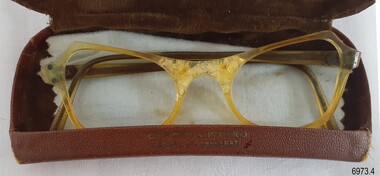
... equipment and this service was free of charge. Customers were promised that they would be fitted with glasses guaranteed to correct the most complex sight. Mr F M Clacius performed the grinding of specific lenses. Julia Carter, Harold Foord and Clacius were all formerly from the business Carter & Warner, which had been sold to Frederick Clark around 1903 after Mr Carder passed away. ...equipment and this service was free of charge. Customers were promised that they would be fitted with glasses guaranteed to correct the most complex sight. Mr F M Clacius performed the grinding of specific lenses. Julia Carter, Harold Foord and Clacius were all formerly from the business Carter & Warner, which had been sold to Frederick Clark around 1903 after Mr Carder passed away. ...The spectacles and case are an example of eyewear from the early 20th century. The case was made by Carter & Foord of Ballarat. According to the tag inside, the spectacles frame cost three pounds, three shillings and sixpence (£3.3.6). Carter & Foord was established in 1902. The firm advertised as opticians, oculists, watchmakers and jewellers. The staff repaired scientific instruments and were sole agents for the gramophone, demonstrating its advantages whenever there was an opportunity. In 1902 the business was located at 46 Lydiard Street, Ballarat. The staff in the ophthalmic department, under the care of Harold Foord, specialised in sight testing using up-to-date equipment and this service was free of charge. Customers were promised that they would be fitted with glasses guaranteed to correct the most complex sight. Mr F M Clacius performed the grinding of specific lenses. Julia Carter, Harold Foord and Clacius were all formerly from the business Carter & Warner, which had been sold to Frederick Clark around 1903 after Mr Carder passed away. Carter & Foord operated a few doors away from the former business. In 1912 advertisements in the Geelong Advertiser invited the community to visit Harold Foord, of Carter & Foord, to have their eyes examined at no charge. These spectacles are similar to others in the W.R. Angus collection, donated by the family of Dr W R Angus, surgeon and oculist. The W.R. Angus Collection spans the years 1885 to the mid-1900s and includes historical medical and surgical equipment and instruments from the doctors Edward and Thomas Ryan of Nhill, Victoria, with whom Dr Angus worked for several years. Dr Tom and his brother had worked as surgeons including in eye surgery. Dr Tom Ryan performed many of his operations in the Mira private hospital on his premises. When Dr Angus bought into the Nelson Street premises in Nhill he was also appointed as the Nhill Hospital’s Honorary House Surgeon 1933-1938. Dr Angus married Gladys in 1927 at Ballarat, the nearest big city to Nhill where he began as a Medical Assistant and had been Acting House surgeon at the Nhill hospital where their two daughters were born. Dr Angus and his family moved to Warrnambool in 1939, where Dr Angus operated his own medical practice. He later took on the part-time role of Port Medical Officer and was the last person appointed to that position. After convalescing from injury resulting from his service during WWII, Dr Angus studied ophthalmology at the Royal Melbourne Eye and Ear Hospital. He created cosmetically superior artificial eyes by pioneering the use of intrascleral cartilage. Angus received accolades from the Ophthalmological Society of Australasia for this work. He returned to Warrnambool to commence practice as an ophthalmologist, pioneering artificial eye improvements. He had been an Honorary Consultant Ophthalmologist at Warrnambool Base Hospital for 31 years. He made monthly visits to Portland as a visiting surgeon, to perform eye surgery. Both Dr Angus and his wife were very involved in the local community, including the planning stages of the new Flagstaff Hill and the layout of the gardens there. Dr Angus passed away in March 1970.The Carter &O Foord spectacles are significant as an example of early 20th-century eyewear and fashion. They are connected to the history of regional Victoria, being made in Ballarat and purchased for local use. The spectacles are significant for being connected to the W.R. Angus Collection, which is important for still being located at the site connected to Doctor Angus, Warrnambool’s last Port Medical Officer. Dr Angus and his wife brought their young family to Warrnambool in 1938 and he remained a resident until his death in 1970. Early in his profession in the town of Nhill, Dr Angus assisted Dr Tom Ryan in his pioneering use of X-rays and in ocular surgery, and Dr Angus later inherited these items. The W.R. Angus Collection includes these medical instruments and other related equipment and is culturally and historically significant as an example of the medical practice of the late 19th to the mid-20th century. Other items in the collection relate to Dr Angus’ service in the Flying Doctor Service and the Army.Spectacles in a hard brown textured case with rounded corners and a hinged lid. The case is lined with brown velvet. The opaque yellow oval frames, raised at the outer top corners, are decorated with sparkling jewell decorations on the bridge. The arms are reinforced with metal inside. Also in the case is a pale blue cleaning cloth and a cardboard price tag with handwritten text. An inscription in gold lettering is stamped inside the case. The case was made by Carter & Foord of Ballarat. The design of the frames is called ‘ewell These spectacles are part of the W.R. Angus Collection.Stamped: “CARTER & FOORD / STURT ST BALLARAT” Handwritten label: “JEWELL / £3.3.6”flagstaff hill, warrnambool, maritime village, maritime museum, shipwreck coast, great ocean road, dr w r angus, dr roy angus, dr ryan, warrnambool oculist, port medical officer, nhill base hospital, mira hospital nhill, oculist, spectacles, eyewear, glasses, carter & foord, ballarat oculist, w.r. angus collection, ophthalmology, royal melbourne eye and ear hospital., artificial eyes, intrascleral cartilage, eye surgery -
 City of Moorabbin Historical Society (Operating the Box Cottage Museum)
Functional object - Sewing Equipment, needles
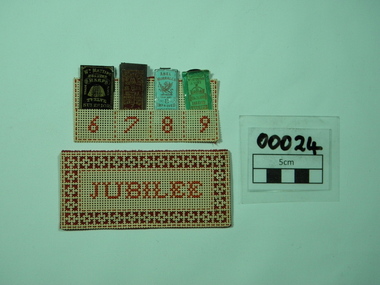
... card needle case the word "NEEDLES" is embroidered, and on the other side the word "JUBILEE". Inside the needle case is four packets of different sized needles, by Wm Mattins Small cream coloured Punched-Cardboard needle case,with red satin lining and red cross-stitch decoration. The case contains four paper packets each containing sewing needles of a different gauge. Each packet of needles is 3 1/2 cms long and 1 cm wide. The size of the needles Functional object Sewing Equipment ...In the 1820s perforated cardboard first became available. Then, with the invention of the printing press, designs such as sentimental or religious mottos were pre-printed on the card and a Victorian craze began as it provided a simpler and cheaper method of embroidering for the masses compared to the previously far more expensive linen embroidery. Over the following decades embroidering of punched-card grew enormously in popularity and a variety of articles from Christmas decorations to birthday cards, and in this case a Neele case to celebrate Queen Victoria's golden Jubilee in 1887. The pioneer settlers and market gardeners of Moorabbin Shire had to be self reliant and made their own clothing and utensils. This is one of many items used to exhibit the skill and craftsmanship of the women in these families. Small cream coloured Punched-Cardboard needle case,with red satin lining and red cross-stitch decoration. The case contains four paper packets each containing sewing needles of a different gauge. Each packet of needles is 3 1/2 cms long and 1 cm wide. The size of the needles In red cot tonCross stitch on one side of the card needle case the word "NEEDLES" is embroidered, and on the other side the word "JUBILEE". Inside the needle case is four packets of different sized needles, by Wm Mattins1887, queen victorias golden jubilee, victorian punched card work, hand embroidery, different packets, different gauge sharp needles, wm shrimpton and sons, william mattins, abel morrals, copestakes, cross stitch -
 Greensborough Historical Society
Business card - Digital Image, All things safety wear Briar Hill, 2016_
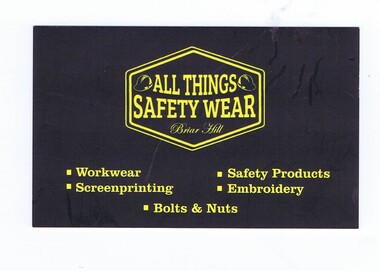
... All Things Safety Wear is a Briar Hill business selling work wear and safety equipment. all things safety wear sherbourne road Coloured business card All things safety wear Briar Hill Business card - Digital Image ...All Things Safety Wear is a Briar Hill business selling work wear and safety equipment.Coloured business cardall things safety wear, sherbourne road
