
Showing 10 items matching "cargo doors"
-
 Moorabbin Air Museum
Manual - Boeing 737 Manuals, Boeing Commercial Airplane Company 737 Maintenance Training
... ...Cargo doors...Boeing 737 manuals Pneumatics Air Conditioning Pressurization Ice & rain protection Fire protection Equipment & furnishings Lighting Oxygen Water & waste systems Doors Windows Cargo doors Forward air stair Aft air stair Component locator guide Spiral bound manual Boeing Commercial Airplane Company 737 Maintenance Training Manual Boeing 737 Manuals ...Component locator guideSpiral bound manual non-fictionComponent locator guidepneumatics, air conditioning, pressurization, ice & rain protection, fire protection, equipment & furnishings, lighting, oxygen, water & waste systems, doors, windows, cargo doors, forward air stair, aft air stair -
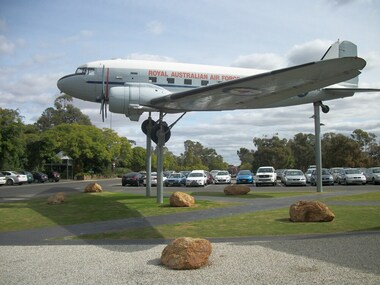 Yarrawonga RSL Sub Branch
Dakota C-47, Douglas Aircraft Co, 1943
... Military adaption of DC3 AIRLINER fitted with cargo door,stronger floor.Able to carry cargo or troops....RAAF colour and markings Military adaption of DC3 AIRLINER fitted with cargo door,stronger floor.Able to carry cargo or troops. ...Military adaption of DC3 AIRLINER fitted with cargo door,stronger floor.Able to carry cargo or troops.RAAF colour and markings -
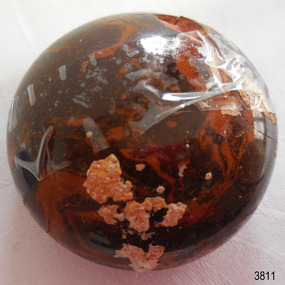 Flagstaff Hill Maritime Museum and Village
Functional object - Knob, circa 1870s
... door handle, possibly part of the ship's furnishings because it appears to have been broken off its connecting shank. The encrustations on the surface are from being in the sea around 90 years. The knob was recovered from the wreck of the Loch Ard and is part of the John Chance collection. The Loch Ard was a clipper ship built in Scotland in 1873. In 1978 the ship was sailing to Melbourne with 54 people on board as well as a mixed cargo...door handle, possibly part of the ship's furnishings because it appears to have been broken off its connecting shank. The encrustations on the surface are from being in the sea around 90 years. The knob was recovered from the wreck of the Loch Ard and is part of the John Chance collection. The Loch Ard was a clipper ship built in Scotland in 1873. In 1978 the ship was sailing to Melbourne with 54 people on board as well as a mixed cargo ...This small knob has been manufactured to look like marble. It may have been used as a drawer or door handle, possibly part of the ship's furnishings because it appears to have been broken off its connecting shank. The encrustations on the surface are from being in the sea around 90 years. The knob was recovered from the wreck of the Loch Ard and is part of the John Chance collection. The Loch Ard was a clipper ship built in Scotland in 1873. In 1978 the ship was sailing to Melbourne with 54 people on board as well as a mixed cargo that included items for the 1880 International Exhibition in Melbourne. On June 1st 1878 it was not far from its destination when it crashed into Mutton Bird Island, east of Port Campbell. Only two people survived. The wreck was re-discovered in 1967 and the site is listed as a Historic Shipwreck. (See References and Significance for further information.)This knob is historically significant as it is an example of hardware fittings made and used during the mid-to-late 19th century. This knob is significant for its connection with the John Chance Collection, which is historically significant as an example of artefacts from wrecks that had been lost in the coastal waters of Victoria from thirty to over one hundred years before John Chance and others discovered them. These artefacts are a sample of goods carried as cargo or personal possessions, and of ship hardware of that era. The knob is significant through its connection with the clipper ship Loch Ard (1873-1878), which is historically significant to both Victoria and Australia. The loss of the ship has been described as one of the ‘worst shipwreck tragedies’ and is well known in Victoria for the tragic death of 52 out of the 54 lives on board. The Loch Ard wreck is historically significant as a large international passenger and cargo clipper ship. It is registered on the Victorian Heritage Database VHR S417. The wreck site is labelled as ‘one of Victoria’s most spectacular diving sites’ and the area is a popular tourist site. It is part of Victoria’s Underwater Shipwreck Discovery Trail. Knob or handle; ceramic (faux marble), dome with flat base, brown colour with orange and cream swirls through it, polished surface. Base has two embedded round, rough-edged metal fittings. Encrustations adhere to the polished surface in pleases. Clear tape keeps large broken chip intact. Another chipped area reveals the rough inner surface of the marble.flagstaff hill, warrnambool, flagstaff hill maritime museum, maritime museum, shipwreck coast, flagstaff hill maritime village, great ocean road, john chance, loch ard, knob, handle, door hardware, ceramic, faux marble, vintage, antique, cabinetry, door pull, drawer pull -
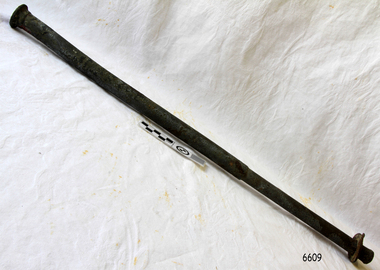 Flagstaff Hill Maritime Museum and Village
Functional object - Rod, Approx. 1871
... Other cargo remains included croquet balls and mallets, buggy fittings, rat traps, perfumery, cutlery and Douay Bibles, clocks, bicycles, chairs, a flywheel, a cooking stove, timber, boxes, pianos, organs, wooden clothes pegs and a ladder. There were three cases of goods meant for the Exhibition Other items salvaged from amongst the debris floating in the sea were chairs, doors...Other cargo remains included croquet balls and mallets, buggy fittings, rat traps, perfumery, cutlery and Douay Bibles, clocks, bicycles, chairs, a flywheel, a cooking stove, timber, boxes, pianos, organs, wooden clothes pegs and a ladder. There were three cases of goods meant for the Exhibition Other items salvaged from amongst the debris floating in the sea were chairs, doors ...This rod was salvaged from the American three-masted wooden clipper ship, Eric the Red, named after the Viking discoverer, Eric the Red. The ship first traded in coal between America and Britain and later traded in guano nitrates from South America. In 1879 its hull was re-metalled and the vessel was in first class condition. On 10th June 1880 Eric the Red departed New York under the command of Captain Z Allen, with 24 crew plus two passengers. It was heading for Melbourne and then Sydney. The ship was commissioned by American trade representatives to carry a special cargo of 500 American exhibits for the U.S.A. pavilion at Melbourne’s first International Exhibition. The items included furniture, ironmongery, wines, chemicals, dental and surgical instruments, paper, cages, bronze lamp trimmings, axles, stamped ware, astronomical and time globes, and samples of corn and the choicest of leaf tobacco. Also on board was general merchandise such as cases of kerosene and turpentine, brooms, Bristol's Sarsaparilla, Wheeler and Wilson sewing machines, Wheeler’s thresher machine, axe handles and tools, cases of silver plate, toys, pianos and organs, carriages and Yankee notions. The ship had been at sea for 85 days when, on 4th September 1880, it hit the Otway Reef on the southwest coast of Victoria and was quickly wrecked. Captain and crew ended up on floating parts, or in the long boat or the sea. He was amongst the 23 battered and injured men who were rescued by the steamer Dawn and later taken to Warrnambool, where they received great hospitality and care. Four men lost their lives; three crew and one passenger. Captain Allen took the train back to Melbourne and then returned to America. The captain and crew of the Dawn were recognised by the United States Government in July 1881 for their humane efforts, being thanked and presented with substantial monetary rewards, medals and gifts. The salvaging ship Pharos collected Wheeler and Wilson sewing machines, nests of boxes, bottles of Bristol’s sarsaparilla, pieces of common American chairs, axe handles, a Wheelers’ Patent thresher and a sailor’s trunk with the words “A. James” on the front. A ship’s flag board bearing the words “Eric the Red” was found on the deckhouse; finally, those on board the Pharos had found the name of the wrecked vessel. The government steamer Victoria and a steamer S.S. Otway picked up flotsam and wreckage. A whole side of the hull and three large pieces of the other side of the hull, with some of the copper sheathing stripped off, had floated onto Point Franklin. Some of the vessel's yards and portions of its masts were on shore with pieces of canvas attached, confirming that the vessel had been under sail. On shore were many cases of Diamond Oil kerosene labelled R. W. Cameron and Company, New York. large planks of red pine, portions of a small white boat and a large, well-used oar. There were sewing machines, some consigned to ‘Long and Co.”, and notions, axe and scythe handles, hay forks, wooden pegs, rolls of wire, some branded “T.S” and Co, Melbourne”, and kegs of nails branded “A.T. and Co.” from the factory of A. Field and Son, Taunton, Massachusetts. Other cargo remains included croquet balls and mallets, buggy fittings, rat traps, perfumery, cutlery and Douay Bibles, clocks, bicycles, chairs, a flywheel, a cooking stove, timber, boxes, pianos, organs, wooden clothes pegs and a ladder. There were three cases of goods meant for the Exhibition Other items salvaged from amongst the debris floating in the sea were chairs, doors, musical instruments, washing boards, nests of trunks and flycatchers. Most of the goods were saturated and smelt of kerosene. A section of the hull lies buried in the sand at Parker River Beach. An anchor with a chain is embedded in the rocks east of Point Franklin and a second anchor, thought to be from Eric the Red, is on display at the Cape Otway light station. A life belt was once on the veranda of Rivernook Guest House in Princetown with the words “ERIC THE RED / BOSTON”. Parts of the ship are on display at Bimbi Park Caravan Park and Apollo Bay Museum. Flagstaff Hill Maritime Village also has several artefacts from the wreck. There seemed to be no personal luggage or clothing. “The Eric the Red is historically significant as one of Victoria's major 19th century shipwrecks. (Heritage Victoria Eric the Red; HV ID 239) The wreck led to the provision of an additional warning light placed below the Cape Otway lighthouse to alert mariners to the location of Otway Reef. The site is archaeologically significant for its remains of a large and varied cargo and ship's fittings being scattered over a wide area. The site is recreationally and aesthetically significant as it is one of the few sites along this coast where tourists can visit identifiable remains of a large wooden shipwreck, and for its location set against the background of Cape Otway, Bass Strait, and the Cape Otway lighthouse.“ (Victorian Heritage Database Registration Number S239, Official Number 8745 USA)Iron rod with flat lugged washer. The rod is made of a heavy metal with encrustations and signs of rusting on the surface. It is stepped down in diameter mid-shaft and is slightly bowed on the narrower end. The narrow end flares out slightly in the last few centimetres with a burred foot and has a circular head on the wider end. The washer on the narrower end cannot move past the centre or the narrow end of the rod. The washer is a different metal from the rod and has a small lug jutting out along the circumference in one position. The rod was recovered from the wreck of the ship the Eric the Red.flagstaff hill, warrnambool, shipwrecked-coast, flagstaff-hill, flagstaff-hill-maritime-museum, maritime-museum, shipwreck-coast, flagstaff-hill-maritime-village, rod, iron-rod, eric the red, steamer dawn, cape otway reef, 1880, captain allen, usa pavillion, melbourne exhibition, melbourne international exhibition, captain jones, medal, united states government, pharos, a. james, flag board, steamer victoria, steamer otway, diamond oil, r w cameron and company, long and co., t s and co melbourne, a. field and son, taunton, massachusetts, ketch apollo, ship nail -
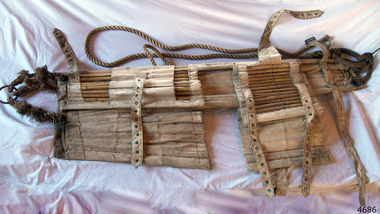 Flagstaff Hill Maritime Museum and Village
Equipment - Stretcher, 1965 to 1999
... The stretcher is designed for removing an injured person from spaces wherein access, doors or hatches are too small to permit the use of regular stretchers. Spaces such as ship engine room spaces, cargo holds, pump rooms, boiler rooms etc. are a few examples of such compact spaces....The stretcher is designed for removing an injured person from spaces wherein access, doors or hatches are too small to permit the use of regular stretchers. Spaces such as ship engine room spaces, cargo holds, pump rooms, boiler rooms etc. are a few examples of such compact spaces. ...A Neil Robinson stretcher is a lightweight carrying device modelled on Japanese bamboo litters, the Neil Robertson rescue stretcher was developed in the early 1900s by John Neil Robertson. Used for lifting an injured person vertically. The stretcher is made from stout canvas reinforced with bamboo slats. The stretcher is designed for removing an injured person from spaces wherein access, doors or hatches are too small to permit the use of regular stretchers. Spaces such as ship engine room spaces, cargo holds, pump rooms, boiler rooms etc. are a few examples of such compact spaces.An item designed to transport injured personnel from tight places, either at sea or on land.A rescue stretcher made from white canvas reinforced with bamboo slats and adjustable canvas straps. The canvas straps are secured with metal buckles and there is a metal ring attached to lengths of ropes at both ends. Noneflagstaff hill, warrnambool, flagstaff hill maritime museum, maritime museum, shipwreck coast, flagstaff hill maritime village, great ocean road, stretcher, neil robertson, neil robertson rescue stretcher, rescue equipment -
 Queenscliffe Maritime Museum
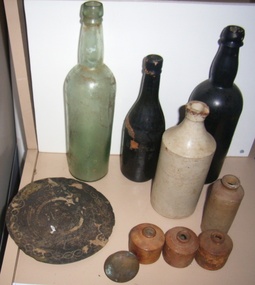
Domestic object - 10 items recovered from the Cambridgeshire wreck site
... cargo of general goods and a crew of 40, when she was lost off Cambridgeshire Reef. Read more at wrecksite: https://wrecksite.eu/wreck.aspx?54312 Underwater relics Salvage Glass bottles Ceramic bottles Ceramic ink wells 3 glass bottles, 3 ceramic ink bottles, 2 ceramic bottles, 1 brass door knob, 1 engraved metal disc Domestic object 10 items recovered from the Cambridgeshire wreck site ...CAMBRIDGESHIRE (J. Marshall) was on voyage from Gravesend UK to Sydney, New South Wales with a cargo of general goods and a crew of 40, when she was lost off Cambridgeshire Reef. Read more at wrecksite: https://wrecksite.eu/wreck.aspx?543123 glass bottles, 3 ceramic ink bottles, 2 ceramic bottles, 1 brass door knob, 1 engraved metal discunderwater relics, salvage, glass bottles, ceramic bottles, ceramic ink wells -
 Queenscliffe Maritime Museum
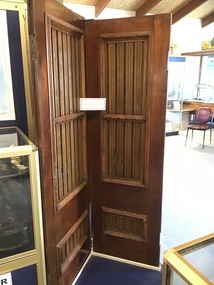
Functional object - Doors
... cargo vessel. It is educationally and recreationally significant as a coherently intact example of a British built iron clipper ie: representative of a class or type. Along with the wrecks of the Light of the Age (1868 - American-built wooden clipper ship) and Sussex (1871 - Blackwall frigate) nearby these vessels represent the three major design classes, and span the evolution of commercial and immigrant sailing ships used by the British in the colonial Australian trade in the last half of the nineteenth century. Doors ...There are only seven shipwrecks in Victoria that have had more than 100 objects recovered from them reported as a result of the Commonwealth Amnesty held in 1993-94. These are the Loch Ard (1878), Schomberg (1855) and Fiji (1891) - all situated along the western district 'Shipwreck Coast' - and the George Roper (1883), Light of the Age (1868), Joseph H. Scammell (1891) and Victoria Tower - all situated along the short section of the 'Surf Coast' between Point Lonsdale and Torquay.The Victoria Tower is archaeologically significant as the wreck of an international inward-bound passenger and cargo vessel. It is educationally and recreationally significant as a coherently intact example of a British built iron clipper ie: representative of a class or type. Along with the wrecks of the Light of the Age (1868 - American-built wooden clipper ship) and Sussex (1871 - Blackwall frigate) nearby these vessels represent the three major design classes, and span the evolution of commercial and immigrant sailing ships used by the British in the colonial Australian trade in the last half of the nineteenth century.2 Doors from the 'Victoria Tower' made from teak and mahoganydoors, salvage, shipwreck, torquay, victoria tower -
 National Vietnam Veterans Museum (NVVM)
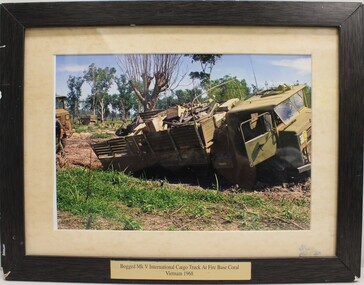
Photograph - A Framed Coloured Photograph of a Bogged MK V International Cargo Truck At Fire Base Coral Vietnam 1968, Bogged MK V International Cargo Truck At Fire Base Coral Vietnam 1968
... door of the truck there is a black kangaroo. At the front of the truck written on yellow is the number 112 There is a plaque on the bottom of the frame which reads "Bogged MK V International Cargo Truck At Fire Base Coral Vietnam 1968"...Pte Stanley William Exon 3791206 Royal Australian Army Service Corps 2 Transport Platoon Photograph MKV International Cargo truck Australian National Serviceman A coloured photograph in a black/brown frame with a cream matt. The photograph depicts a MK V International truck which is bogged. There are lots of items on the back of the truck. On the door ...This item was donated by Pte Stanley William Exon (3791206) who was a National Serviceman with the Royal Australian Army Service Corps. He served in Vietnam with 2 Transport Platoon RAASC from April 1968 to January 1969.A coloured photograph in a black/brown frame with a cream matt. The photograph depicts a MK V International truck which is bogged. There are lots of items on the back of the truck. On the door of the truck there is a black kangaroo. At the front of the truck written on yellow is the number 112 There is a plaque on the bottom of the frame which reads "Bogged MK V International Cargo Truck At Fire Base Coral Vietnam 1968"pte stanley william exon, 3791206, royal australian army service corps, 2 transport platoon, photograph, mkv international, cargo truck, australian national serviceman -
 National Vietnam Veterans Museum (NVVM)
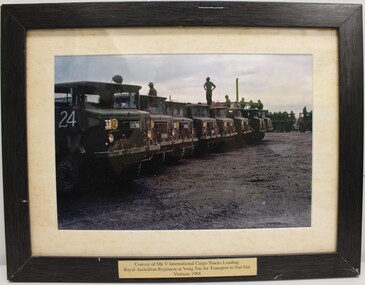
Photograph - A Framed Coloured Photograph of Convoy of MK V International Cargo Trucks Loading Royal Australian Regiment at Vung Tau for Transport to Nui Dat Vietnam 1968, Convoy of MK V International Cargo Trucks Loading Royal Australian Regiment at Vung Tau for Transport to Nui Dat Vietnam 1968
... Cargo Trucks. The first truck has the number plate (ARN) 171 596 on it as well as the number 24 on the drivers door. ...Cargo Trucks. The first truck has the number plate (ARN) 171 596 on it as well as the number 24 on the drivers door. ...This item was donated by Pte Stanley William Exon (3791206) who was a National Serviceman with the Royal Australian Army Service Corps. He served in Vietnam with 2 Transport Platoon RAASC from April 1968 to January 1969.A coloured photograph in a black/brown frame with a white matt. There is a convoy of eight MK V International Cargo Trucks. The first truck has the number plate (ARN) 171 596 on it as well as the number 24 on the drivers door. At the front of there truck in white is the number 33 and on a yellow circle the number 12 in black. There are several soldiers on top of some of these vehicles. The foreground is either dirt or sand. At the bottom of the frame there is a plaque which reads "Convoy of MK V International Cargo Trucks Loading/Royal Australian Regiment at Vung Tau for Transport to Nui Dat Vietnam 1968"Convoy of MK V International Cargo Trucks Loading/Royal Australian Regiment at Vung Tau for Transport to Nui Dat Vietnam 1968pte stanley william exon, 3791206, australian national serviceman, royal australian army service corps, 2 transport platoon, convoy, international cargo trucks, mkv international, australian soldiers, photograhp -
Moorabbin Air Museum
Manual (Item) - Ansett VH-RMX Cargo Door
... Ansett VH-RMX Cargo Door...Ansett VH-RMX Cargo Door...Ansett VH-RMX Cargo Door Manual Ansett VH-RMX Cargo Door ...
