
Showing 5 items matching "carl ziebell"
-
 Friends of Westgarthtown
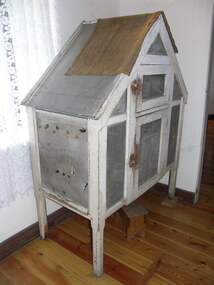
Functional object - Coolgardie Safe, Carl Ziebell, direct descendant, c. 1915
... ...carl ziebell...Carl Ziebell, direct descendant...Functional object Coolgardie Safe Carl Ziebell, direct descendant ...This Coolgardie safe is a significant example of late-19th-century Australian ingenuity and domestic adaptation in response to the challenges of life in remote and harsh environments. Invented in the late 1890s by Arthur Patrick McCormick at Coolgardie, then the center of a major Western Australian gold rush, the safe represents an important technological response to the need for preserving perishable foods in extreme heat before the availability of mechanical refrigeration. Using the same evaporative principles employed by explorer’s canvas water bags, the Coolgardie safe utilised a timber frame, zinc metal sheets, wire mesh panels and wet hessian cloth to create a naturally cooled storage chamber. When placed in a draught or breeze, evaporation lowered the internal temperature, allowing miners, settlers and later rural households to keep meat, dairy and vegetables safe for longer periods. Sylvia Schultz (nee Ziebell) remembers the Coolgardie safe at Ziebell’s Farmhouse “was always positioned in the pantry where it is today, near the window to allow the breeze in”. Items the Ziebell’s stored in the safe included meats, milk and cream, and home-made goods. This object embodies a pivotal moment in Australia’s social and technological history, illustrating resourcefulness, adaptation to climate, and the lived realities of those who settled and worked in remote regions. As an early form of sustainable refrigeration, it contributes valuable interpretive depth to domestic, rural and goldfields history. Handmade food safe with white painted wooden frame and perforated zinc screen panels. Galvanised sheet roof. Raised four beveled legs. Two rectangular doors, bottom door large, opens to main area with one shelf. top door small, opens to triangular roof section. Movable latches of wood on both doors.No visible markingsdomestic items, food storage and preservation, food, safe, storage, pantry, carl ziebell -
 Friends of Westgarthtown
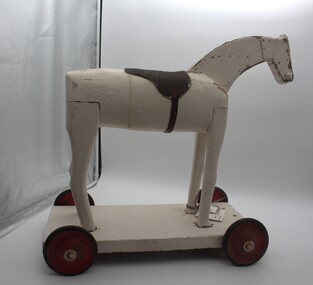
Toy Horse, c. 1910-1930
... Handmade by Carl Heinrich Alfred "Carl Alfred" Ziebell (1867–1940), great-grandson of Westgarthtown pioneers Christian and Sophia Ziebell, this toy horse is an example of the skilled craftsmanship practised within the Ziebell family. ...Handmade by Carl Heinrich Alfred "Carl Alfred" Ziebell (1867–1940), great-grandson of Westgarthtown pioneers Christian and Sophia Ziebell, this toy horse is an example of the skilled craftsmanship practised within the Ziebell family. ...Handmade by Carl Heinrich Alfred "Carl Alfred" Ziebell (1867–1940), great-grandson of Westgarthtown pioneers Christian and Sophia Ziebell, this toy horse is an example of the skilled craftsmanship practised within the Ziebell family. It was made for the children of his eldest son, Alfred Ziebell, and remained within the family until donated by Joan Morris (née Ziebell).Handmade wooden toy horse known as Pearly Bridge, constructed and painted white with a dark painted saddle and mounted on a rectangular wheeled base with four red-painted wheels. The horse features a stylised carved body with a flat, shaped head and simple painted details -
 Friends of Westgarthtown
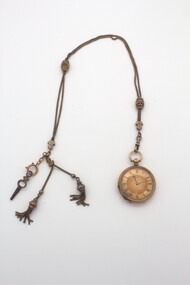
Accessory - Fobwatch, Chain and Key, c.1856-1890
... Believed to have belonged to either Elizabeth Ziebell (née Sprenger, 1836–1892) wife of Carl Chrsitian Ziebell or Amelia Alice Ziebell (née Bodycoat 1870-1948) wife of Albert Heinrich Ziebell, the watch provides a personal link to the women of the early Ziebell family and to domestic and social life within Westgarthtown’s German settler community. ...Believed to have belonged to either Elizabeth Ziebell (née Sprenger, 1836–1892) wife of Carl Chrsitian Ziebell or Amelia Alice Ziebell (née Bodycoat 1870-1948) wife of Albert Heinrich Ziebell, the watch provides a personal link to the women of the early Ziebell family and to domestic and social life within Westgarthtown’s German settler community. ...This finely crafted women’s gold fob watch, made by Robert Stauffer & Fils of La Chaux-de-Fonds, Switzerland, is an elegant example of mid-19th-century Swiss watchmaking. Its engraved floral motifs, protected beneath glass and repeated on the reverse, reflect the refinement and skill associated with one of Europe’s foremost horological centers. Believed to have belonged to either Elizabeth Ziebell (née Sprenger, 1836–1892) wife of Carl Chrsitian Ziebell or Amelia Alice Ziebell (née Bodycoat 1870-1948) wife of Albert Heinrich Ziebell, the watch provides a personal link to the women of the early Ziebell family and to domestic and social life within Westgarthtown’s German settler community. Women’s watches of this era were both functional and fashionable, commonly worn on a long necklace chain, suspended from a chatelaine at the waist, or attached to a decorative bodice brooch. Such pieces served as markers of refinement, femininity and social standing. The tiny winding key is central to the object’s significance. Before stem-winding mechanisms became standard in the 1870s, watches were wound and set by inserting a small key into an arbor at the back of the case. The survival of both the watch and its original key strengthens their historical integrity and deepens understanding of 19th-century personal technology. Donated to Ziebell’s Farmhouse Museum in 2025 by Kristina Colic (née Ziebell) and her father Mervyn Turner Ziebell, the watch holds strong familial and interpretive value, enriching the museum’s representation of women’s heritage, adornment and craftsmanship within the Ziebell family. Robert Stauffer & Fils of La Chaux-de-Fonds, Switzerland -
 Friends of Westgarthtown
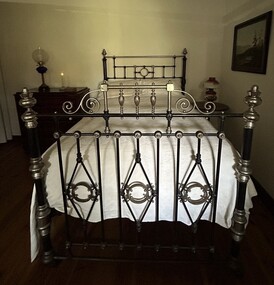
Furniture - Bed, double, Late 1800s
... The nickel plated brass bedstead was made by Carl Alfred Ziebell for his wife Dorothea. Carl Alfred Ziebell ( 23.08.1867 - 26.10. 1940) was the third generation grandson of Christian Ziebell. ...This object is of primary significance. The nickel plated brass bedstead was made by Carl Alfred Ziebell for his wife Dorothea. Carl Alfred Ziebell ( 23.08.1867 - 26.10. 1940) was the third generation grandson of Christian Ziebell. Dorothea remained proud of her bed throughout her long life. (14.7.1873 - 14.12.1969) The bed linen and quilts remain traditionally dressed as they were in 1850. This ornate iron bed holds strong historical and cultural significance as a rare surviving example of craftsmanship by Carl Heinrich Alfred “Carl Alfred” Ziebell (1867–1940), grandson of Christian and Sophia Ziebell, early German-Wendish settlers of Westgarthtown. A skilled wheelwright by trade, Carl Alfred possessed deep technical knowledge of metalworking, timber precision, and traditional fabrication techniques required for constructing and repairing wagon wheels. These same skills are reflected in the bed’s carefully forged ironwork and its distinctive circular decorative motifs. Carl Alfred crafted this bed for his wife, Dorothea, who, as family accounts recall, “remained proud of her bed throughout her long life.” The linens displayed on the bed are traditional cotton fabrics with intricate lace detailing, donated to the museum by Sylvia Ziebell. These textiles closely resemble the types of linens that would originally have dressed the bed, helping to evoke its historic domestic context. The bed represents both the material resourcefulness and artisanal expertise present within the second generation of the Ziebell family. Its construction demonstrates a blending of practical skill with aesthetic ambition, illustrating how tradespeople adapted their craft to create durable and decorative domestic furnishings. As Carl Alfred and Dorothea are buried in the Lutheran Cemetery adjacent to Ziebell’s Farmhouse, the bed also strengthens the site’s tangible connection to the family’s multi-generational presence in Westgarthtown. The piece is significant for its rarity, its association with an identified maker within the Ziebell lineage, and its ability to illuminate the lived experience, creativity, and craftsmanship of the early community. Nickel plated and painted tubular steel bedstead with double bed mattress and spreads. On four castor wheels, ornate decoration on both ends. Turned sections on each corner post, four on the bottom ends, only caps on the top ends. Spring wire mattress base.furniture, domestic, double bed, bedstead, nickel-plated, steel, turned -
 Friends of Westgarthtown
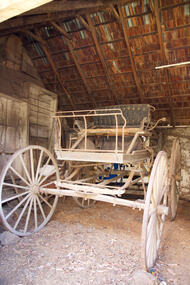
Functional object - Buggy, horse drawn, c. early 1900s
... The horse-drawn buggy, built by Carl Alfred Ziebell, is one of the most evocative surviving artefacts of everyday life at Ziebell’s Farmhouse, and a tangible link to the family’s heritage. ...The horse-drawn buggy, built by Carl Alfred Ziebell, is one of the most evocative surviving artefacts of everyday life at Ziebell’s Farmhouse, and a tangible link to the family’s heritage. As a skilled wheelwright, Carl Alfred constructed this four-wheeled vehicle on the property to serve his wife Dorothea and their ten children throughout the early 1900s. For decades, the buggy was the primary mode of transport for the Ziebell family, used for travel between their farm, central Melbourne, and surrounding districts and there was adequate rear storage for purchases. Its survival in fair, serviceable condition offers a rare example of traditional carriage construction, combining finely turned timber wheels, forged ironwork, steel-trimmed rims, and a leather-upholstered seat. As the only remaining transport relic associated with Westgarthtown’s settlers, the buggy holds deep historical, technological and social significance. It illustrates how immigrant families adapted European trades to harsh landscape conditions, tailored domestic vehicles for local needs, and maintained mobility before motorisation. Exhibiting the buggy within the museum preserves and interprets these connections, offering visitors a direct insight into the material culture and everyday lives of the Ziebell family and the broader settler community in 19th- and early 20th-century Victoria. The buggy was donated by Lyn and James Ziebell. James Ziebell is the son of Henry Christian Ziebell (1911–1988) and Anne Emily Ziebell (née Zimmer, 1912–1985), on whose property the buggy resided following the sale of the Ziebell’s Thomastown farm. Horse drawn buggy. Black leather upholstered chair with studded back. Four large timber spoked wheels the back wheels are larger than the front wheels, with steel trim on edges of wheels. Axels connects wheels and have turning mechanism. Two metal steps on each side of carriage. Small wooden seat on back of carriage facing the back. Steel barrier at front of the carriage. Wooden attachment with two wooden poles to attach to cart to horse.No visible markings.transport, animal, buggy, cart, horse, dairy, carriage, jessie.
