
Showing 48 items matching "casualty clearing station"
-
 Tramways/East Melbourne RSL Sub Branch - RSL Victoria Listing id: 27511
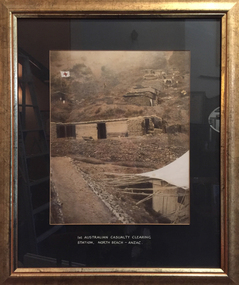
Print, 1st Australian Casualty Clearing Station
... 1st Australian Casualty Clearing Station...casualty clearing station...Printed underneath the image is '1ST AUSTRALIAN CASUALTY CLEARING STATION, NORTH BEACH - ANZAC'...casualty clearing station north beach anzac medical triage ww1 Gallipoli Printed underneath the image is '1ST AUSTRALIAN CASUALTY CLEARING STATION, NORTH BEACH - ANZAC' A framed print showing the temporary buildings set up on North Beach - Anzac Cove in WW1 to deal with incoming casualties. ...A framed print showing the temporary buildings set up on North Beach - Anzac Cove in WW1 to deal with incoming casualties. Images details terrain, building materials and overall conditions of the site. Printed underneath the image is '1ST AUSTRALIAN CASUALTY CLEARING STATION, NORTH BEACH - ANZAC'casualty clearing station, north beach, anzac, medical, triage, ww1, gallipoli -
 Hume City Civic Collection
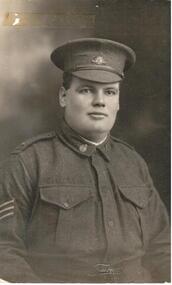
Photograph, 2/11/1915
... Sargent Medical Corps. 2nd Australian Casualty Clearing Station...MARTIN, 2ND AUST CASUALTY CLEARING STATION A.M.C. (ON ACTIVE SERVICE) 2/11/15...MARTIN, 2ND AUST CASUALTY CLEARING STATION A.M.C. (ON ACTIVE SERVICE) 2/11/15 A b/w postcard portrait of soldier H. ...Sargent Medical Corps. 2nd Australian Casualty Clearing StationA b/w postcard portrait of soldier H. Martin.Typewritten on front: Private H. Martin Printed on front: TALMA MELBOURNE Handwritten on back: PRIVATE H.J. MARTIN, 2ND AUST CASUALTY CLEARING STATION A.M.C. (ON ACTIVE SERVICE) 2/11/15world war 1, martin, h. j. (private), soldiers, armed forces, uniforms, clothing and dress, postcards, george evans collection -
 Lara RSL Sub Branch
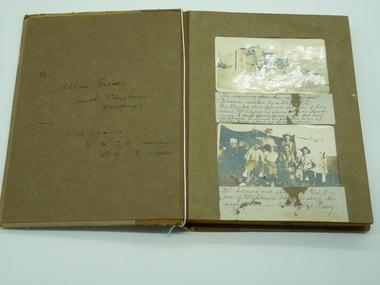
Photograph Album, To Allan Groves, 1917
... ...53rd casualty clearing station...Women making bricks, 53rd Casualty Clearing Station destroyed by a bomb, Royal Scots Fusilier Pipe Band after church parade, The Sultan Hasser Mosque ...photograph album egyp ww1 allan groves will adams rafa raid 53rd casualty clearing station Front sleeve To Allan Groves With Christmas greetings from Will Adams YMCA Secretary with A.L.H. ...Cardboard Album Khaki coloured 8 leaves with photos and written descriptionsFront sleeve To Allan Groves With Christmas greetings from Will Adams YMCA Secretary with A.L.H. Brigade There are explanations under each couple of photos too much to write in this space. In general the photos are of Will Adams experience in Egypt The Rafa Raid Prisoners of war, Beni Selah women waiting for water. Women making bricks, 53rd Casualty Clearing Station destroyed by a bomb, Royal Scots Fusilier Pipe Band after church parade, The Sultan Hasser Mosque photograph, album, egyp, ww1, allan groves, will adams, rafa raid, 53rd casualty clearing station -
 Federation University Historical Collection
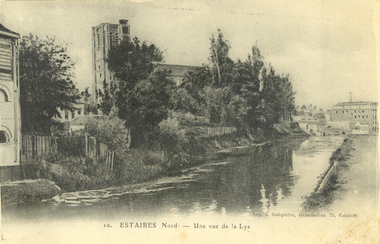
Postcard - black and white, Estaires, France, c1917, C1917
... 1st Australian Casualty Clearing Station...The town was a Field Ambulance centre as early as November 1914, and later the 1st Australian Casualty Clearing Station was posted in it. (http://www.cwgc.org/find-a-cemetery/cemetery/26801/ESTAIRES%20COMMUNAL%20CEMETERY%20AND%20EXTENSION, accessed 11/07/2014)...The town was a Field Ambulance centre as early as November 1914, and later the 1st Australian Casualty Clearing Station was posted in it. (http://www.cwgc.org/find-a-cemetery/cemetery/26801/ESTAIRES%20COMMUNAL%20CEMETERY%20AND%20EXTENSION, accessed 11/07/2014) Australian soldier's WW1souvenir Estaires Communal Cemetery and Extension Estaires France Chatham-Holmes Family Collection 1st Australian Casualty Clearing Station postcard A black and white postcard with buildings along a river at Estaires in Northern France. ...WW1 Australian soldier Holmes Famiiy memento. Estaires is a town and commune in the Department of the Nord, about 11 kilometres west of Armentieres. The Estaires Communal Cemetery and Extension is on the eastern outskirts of the town and on the east side of the road to Bailleul. Estaires town was occupied by French cavalry on the 15 October 1914, and passed at once into British hands. On the 10 April 1918 it was captured by the enemy, after an obstinate defence by the 50th (Northumbrian) Division; and it was finally retaken by British troops at the beginning of September 1918. The town was a Field Ambulance centre as early as November 1914, and later the 1st Australian Casualty Clearing Station was posted in it. (http://www.cwgc.org/find-a-cemetery/cemetery/26801/ESTAIRES%20COMMUNAL%20CEMETERY%20AND%20EXTENSION, accessed 11/07/2014)Australian soldier's WW1souvenirA black and white postcard with buildings along a river at Estaires in Northern France.estaires communal cemetery and extension, estaires, france, chatham-holmes family collection, 1st australian casualty clearing station, postcard -
 Running Rabbits Military Museum operated by the Upwey Belgrave RSL Sub Branch
Photo Display Gallipoli
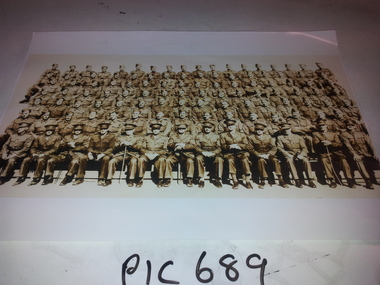
... Photograph of members of 32 Casualty Clearing Station...Photo WW2 Army Photograph of members of 32 Casualty Clearing Station Photo Display Gallipoli ...Photograph of members of 32 Casualty Clearing Stationphoto, ww2, army -
 Running Rabbits Military Museum operated by the Upwey Belgrave RSL Sub Branch
Photograph
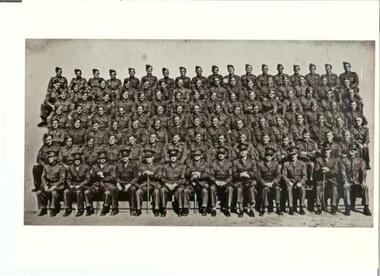
... 32 Casualty Clearing Station, with most names on the rear...Photo WW2 Army 32 Casualty Clearing Station, with most names on the rear Photograph ...32 Casualty Clearing Station, with most names on the rearphoto, ww2, army -
 Returned Nurses RSL Sub-branch
Document - Photocopy of newspaper clipping and related documents, Sunday Herald, The forgotten heroine, 5 December 1914 - May 20 2012
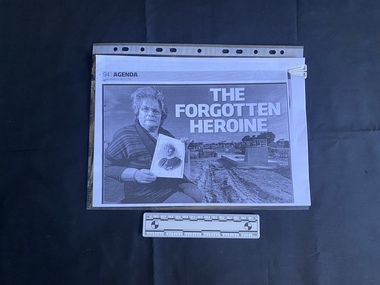
... 47th Australian Casualty Clearing Station...Lee-Archer, Estelle (RRC) listed) Dr Collopy Kildonian Castle London Caulfield Tasmania John Lee Archer Mary Anne Lyons Joseph Lyons Parlianment House Hobart Ross Bridge Alfred Hospital Kyarra 1st Australian General Hospital Swanage Dorset Gallipoli 2nd Australian General Hospital 3rd Australian General Hospital 25th Australian General Hospital 47th Australian Casualty Clearing Station 3rd Australian Casualty Clearing Station 7th Australian General Hospital John Saddington Five photocopied pages held together with a plastic paperclip. ...Newspaper - 'The forgotten heroine' Visitors to New Cheltenham Cemetery in Melbourne would not know that a highly decorated and dedicated nurse was buried there. Her grave is unmarked, there is no reference to her achievements or selfless dedication. Estelle Lee Archer died in 1960, at the Repatriation General Hospital, Heidelberg, age 78 from a perforated ulcer. Margaret Leyden wants the Office of Australian War Graves to recognise that her great-aunt died from war-related injuries and to restore and maintain her grave. Margaret, who never met her aunt, has pieced together her history, including that Estelle's medals, including the prestigious Royal Red Cross 2nd Class for services in support of our ANZACs have ended up in the MAryborough Military & Colonial Museum after they were bought at a second hand shop. Estelle served in seven army units and was in the Middle East, England and France for the duration of World War 1. After the war she continued to dedicate her life to the care of soldiers. Document 1 - digitised copy of 'First Wold War Embarkation Roll' for Estelle Frances Lee-Archer Document 2 - photocopy of 'Austraalian Imperial Force - Nominal Roll' page 7 (Lee-Archer, Estelle Frances listed) Document 3 - photocopy of unknown document (Sis. Lee-Archer, Estelle (RRC) listed) Five photocopied pages held together with a plastic paperclip. Two pages are of a newspaper story, the first showing a full page black and white photo of a seated older woman holding a photo of a woman in nurse's uniform. The second page of the newspaper story has four columns of text with a photo of a war medal and a photo of a standing woman in nurse's uniform beside them. The final three pages are war-time documents.dr collopy, kildonian castle, london, caulfield, tasmania, john lee archer, mary anne lyons, joseph lyons, parlianment house, hobart, ross bridge, alfred hospital, kyarra, 1st australian general hospital, swanage, dorset, gallipoli, 2nd australian general hospital, 3rd australian general hospital, 25th australian general hospital, 47th australian casualty clearing station, 3rd australian casualty clearing station, 7th australian general hospital, john saddington -
 Running Rabbits Military Museum operated by the Upwey Belgrave RSL Sub Branch
Flag
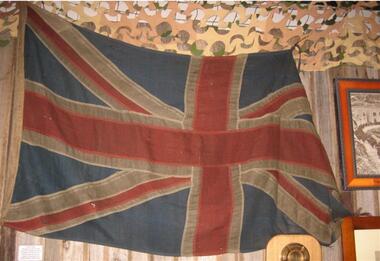
... Union Flag of Great Britain, No 3 Casualty Clearing Station....Flag/Banner WW1 Army Union Flag of Great Britain, No 3 Casualty Clearing Station. Flag ...Union Flag of Great Britain, No 3 Casualty Clearing Station.flag/banner, ww1, army -
 Returned Nurses RSL Sub-branch
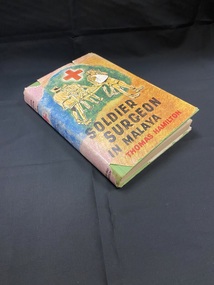
Book - Hardcover book, Thomas Hamilton, Soldier surgeon in Malaya, 1957
... Australia. Army. Casualty Clearing Station...World war two WWII World War 2 Australia. Army. Casualty Clearing Station 1939-1945 -- Medical care -- Australia 1939-1945 -- Malaysia -- Malaya Singapore A record of 'the work done by the 2/4th Casualty Clearing Station of the 8th Division in Malaya and Singapore in 1941-2. ...A record of 'the work done by the 2/4th Casualty Clearing Station of the 8th Division in Malaya and Singapore in 1941-2. Lieut.Colonel Hamilton wrote the diary in secret within the confines of Japanese prisoner-of-war camps at Changi in Singapore and at various points along the Burma-Thailand railway." - from dust-jacket.Green hard-cover with dust-jacket.The cover is orange and green with a red medical cross at the top and a drawing of wounded soldiers being assisted by medics, the title is below in black and the author's name in red.non-fictionA record of 'the work done by the 2/4th Casualty Clearing Station of the 8th Division in Malaya and Singapore in 1941-2. Lieut.Colonel Hamilton wrote the diary in secret within the confines of Japanese prisoner-of-war camps at Changi in Singapore and at various points along the Burma-Thailand railway." - from dust-jacket.world war two, wwii, world war 2, australia. army. casualty clearing station, 1939-1945 -- medical care -- australia, 1939-1945 -- malaysia -- malaya, singapore -
 Returned Nurses RSL Sub-branch
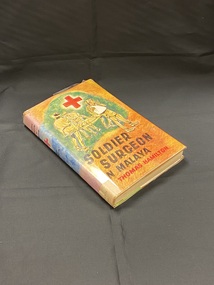
Book - Hardcover book, Thomas Hamilton, Soldier surgeon in Malaya, 1957
... Australia. Army. Casualty Clearing Station...World war two WWII World War 2 Australia. Army. Casualty Clearing Station 1939-1945 -- Medical care -- Australia 1939-1945 -- Malaysia -- Malaya Singapore A record of 'the work done by the 2/4th Casualty Clearing Station of the 8th Division in Malaya and Singapore in 1941-2. ...A record of 'the work done by the 2/4th Casualty Clearing Station of the 8th Division in Malaya and Singapore in 1941-2. Lieut.Colonel Hamilton wrote the diary in secret within the confines of Japanese prisoner-of-war camps at Changi in Singapore and at various points along the Burma-Thailand railway." - from dust-jacket.Green hard-cover with dust-jacket.The cover is orange and green with a red medical cross at the top and a drawing of wounded soldiers being assisted by medics, the title is below in black and the author's name in red.non-fictionA record of 'the work done by the 2/4th Casualty Clearing Station of the 8th Division in Malaya and Singapore in 1941-2. Lieut.Colonel Hamilton wrote the diary in secret within the confines of Japanese prisoner-of-war camps at Changi in Singapore and at various points along the Burma-Thailand railway." - from dust-jacket.world war two, wwii, world war 2, australia. army. casualty clearing station, 1939-1945 -- medical care -- australia, 1939-1945 -- malaysia -- malaya, singapore -
 Ringwood RSL Sub-Branch
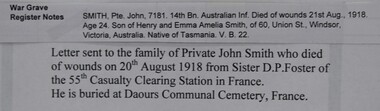
Document
... Letter sent to family of Private John Smith 7181 14th Btn kia 20/8/1918 from Sr Foster 55 Casualty Clearing Station...Letter sent to family of Private John Smith 7181 14th Btn kia 20/8/1918 from Sr Foster 55 Casualty Clearing Station Document ...Letter sent to family of Private John Smith 7181 14th Btn kia 20/8/1918 from Sr Foster 55 Casualty Clearing Station -
 Returned Nurses RSL Sub-branch
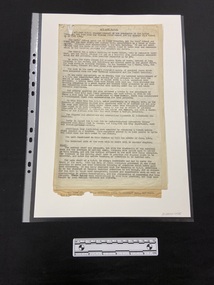
Document - Typed document, Sister J Langham, 2/3 Aust C.C.S
... An account of the 2/3 Austrailan Casualty Clearing Station (C.C.S.) in 1941-42 including information on staff, equipment, movements, patients, evacuations and conditions....An account of the 2/3 Austrailan Casualty Clearing Station (C.C.S.) in 1941-42 including information on staff, equipment, movements, patients, evacuations and conditions. ...An account of the 2/3 Austrailan Casualty Clearing Station (C.C.S.) in 1941-42 including information on staff, equipment, movements, patients, evacuations and conditions.'2/3 AUST C.C.S.' typed and underlined at the top of the page followed by a full page of typed print. There are twelve pages in total, of varying sizes. 'by Sister J Langham' [Lightly written in pencil in the top right corner of the first page]australian army nurses, world war 1939-1945, ww2, wwii, 2/3 australian casual clearing station, jess langham -
 Returned Nurses RSL Sub-branch
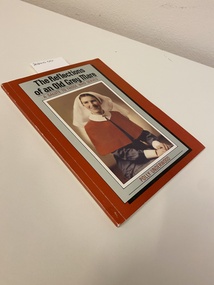
Book, Polly Underwood, The Reflections of an old grey mare : A salute to those who served
... The book is important because it records the experience of a nurse working in different kinds of medical facitilities during WW2 - tented hospitals, Casualty clearing stations, ambulance trains....The book is important because it records the experience of a nurse working in different kinds of medical facitilities during WW2 - tented hospitals, Casualty clearing stations, ambulance trains. World War Two WW2 Finschhafen ambulance trains WWII A record of nursing service in the second world war, from enlistment to peace. ...A record of nursing service in the second world war, from enlistment to peace.Soft cover, red and grey, containing a portrait of the author in army nurses' uniform. Australian Army Nursing Service uniform. Back cover, white with a facsimile of the Instrument of Surrender.non-fictionA record of nursing service in the second world war, from enlistment to peace.world war two, ww2, finschhafen, ambulance trains, wwii -
 Returned Nurses RSL Sub-branch
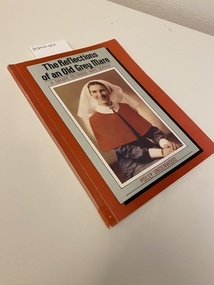
Book, Polly Underwood, The Reflections of an old grey mare : A salute to those who served
... The book is important because it records the experience of a nurse working in different kinds of medical facitilities during WW2 - tented hospitals, Casualty clearing stations, ambulance trains....The book is important because it records the experience of a nurse working in different kinds of medical facitilities during WW2 - tented hospitals, Casualty clearing stations, ambulance trains. World War Two WW2 Finschhafen ambulance trains WWII A record of nursing service in the second world war, from enlistment to peace. ...A record of nursing service in the second world war, from enlistment to peace.Soft cover, red and grey, containing a portrait of the author in army nurses' uniform. Australian Army Nursing Service uniform. Back cover, white with a facsimile of the Instrument of Surrender.non-fictionA record of nursing service in the second world war, from enlistment to peace.world war two, ww2, finschhafen, ambulance trains, wwii -
 Returned Nurses RSL Sub-branch
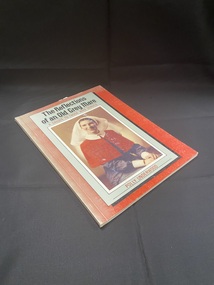
Book - Illustrated paperback book, Polly Underwood, The Reflections of an old grey mare : A salute to those who served
... The book is important because it records the experience of a nurse working in different kinds of medical facitilities during WW2 - tented hospitals, Casualty clearing stations, ambulance trains....The book is important because it records the experience of a nurse working in different kinds of medical facitilities during WW2 - tented hospitals, Casualty clearing stations, ambulance trains. World War Two WW2 Finschhafen ambulance trains WWII A record of nursing service in the second world war, from enlistment to peace. ...A record of nursing service in the second world war, from enlistment to peace.Paperback with faded cover. Plain white spine with a red front cover. Most of the cover contains a large pale green rectangle with a shadow behind it, inside it is the title and author details and a picture of an Army Nurse in uniform.non-fictionA record of nursing service in the second world war, from enlistment to peace.world war two, ww2, finschhafen, ambulance trains, wwii -
 Bendigo Military Museum
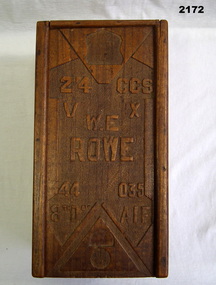
Memorabilia - CARVED WOOD BOX, 1942 - 1943
... At discharge on 20.3.1946 he was a Pte in 2nd/4th Casualty Clearing Station. ...At discharge on 20.3.1946 he was a Pte in 2nd/4th Casualty Clearing Station. containers military history - souvenirs handcrafts - woodwork POW Carved in lid “2/4 CCS, WE Rowe”, “VX 44035 8th Div AIF” Hand inscribed on lid, “Dela Fliente” Teak wooden box crafted whilst a prisoner of War. ...Carved by Walter Ernest Rowe VX44035 2nd AIF. Enlisted 7.9.1940 age 34 years. Taken POW at the fall of Singapore. At discharge on 20.3.1946 he was a Pte in 2nd/4th Casualty Clearing Station. Teak wooden box crafted whilst a prisoner of War. Carved Burma / Malaya 1942 1943.Carved in lid “2/4 CCS, WE Rowe”, “VX 44035 8th Div AIF” Hand inscribed on lid, “Dela Fliente”containers, military history - souvenirs, handcrafts - woodwork, pow -
 Melbourne Legacy
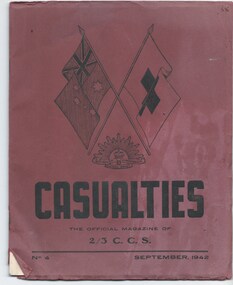
Magazine, Casualties : The offical magazine of the 2/3 C.C.S, 1942
... The 2/3 CCS is a casualty clearing station that worked in the middle east, in particular Beirut. ...The 2/3 CCS is a casualty clearing station that worked in the middle east, in particular Beirut. ...A magazine published during World War Two for the troops. It contains black and white photos and articles about the war. It is 36 pages long. The 2/3 CCS is a casualty clearing station that worked in the middle east, in particular Beirut. Photos and articles from World War Two that would have been significant to the legatees as they were all returned servicemen.A magazine containing black and white articles, photos and drawing from World War Two. Maroon cover and 36 cream pages with black text. Issue No 4 September 1942. Handwritten on title page 'J__ Gillespie' in blue ink.soldiers, world war two -
 Bendigo Military Museum
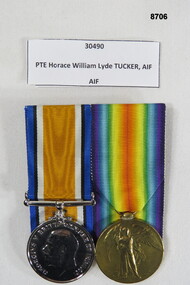
Award - MEDAL SET WW1, Post 1919
... (Born Kangaroo Flat, enlisted in Melbourne) Enlisted 7.6.1916 in Field Artillery Brigade 8, Reinforcements 8, embarked for overseas 23.11.1916, transfers later to No 2 Casualty Clearing Station, Returns to Australia 8.10.1919....(Born Kangaroo Flat, enlisted in Melbourne) Enlisted 7.6.1916 in Field Artillery Brigade 8, Reinforcements 8, embarked for overseas 23.11.1916, transfers later to No 2 Casualty Clearing Station, Returns to Australia 8.10.1919. ...Horace William Syde Tucker. (Born Kangaroo Flat, enlisted in Melbourne) Enlisted 7.6.1916 in Field Artillery Brigade 8, Reinforcements 8, embarked for overseas 23.11.1916, transfers later to No 2 Casualty Clearing Station, Returns to Australia 8.10.1919.Medals, set of two (2) mounted. British War Medal 1914-18, (replica). Victory Medal 1914-19.On Victory medal, "30490 DVR PTE H.W.L. TUCKER A.M.O. A.I.F."pbt701, h.w.l. tucker, bob english collection, ww1, medals, passchendaele barracks trust -
 Bendigo Military Museum
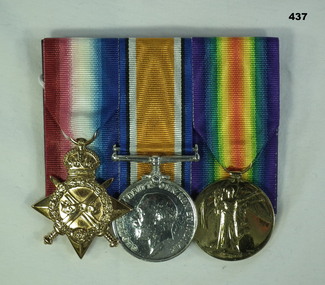
Award - MEDAL SET WW1, Post 1919
... She had 5 brothers in the AIF, one DOW's and one awarded a DCM. 1ACCS (1st Aust Casualty Clearing Station), 15 CCS (15th Casualty Clearing Station), 10th SH (10th Stationary Hospital)...She had 5 brothers in the AIF, one DOW's and one awarded a DCM. 1ACCS (1st Aust Casualty Clearing Station), 15 CCS (15th Casualty Clearing Station), 10th SH (10th Stationary Hospital) numismatics- medals- history metalcraft 1. ...Frances Madge Killicoat (Born Burra Burra) Enlisted on 5.11.15 in the Australian Army Nursing Service age 26 years, embarked for Eygpt 12.11.1915. Joins the B.E.F in Alexandria 26.3.1916, disembarks Marseilles 4.4.1916, hospital with Hay Fever 16.6.1917 later changed to Nasal Catarrh and then with Debility, rejoin unit 4.7.1917. From there she served in No 1 ACCS, 15 CCS and 10th SH. She was discharged from the AIF on her marriage to Capt S.O.Coen AAMC on 18.11.18. She had 5 brothers in the AIF, one DOW's and one awarded a DCM. 1ACCS (1st Aust Casualty Clearing Station), 15 CCS (15th Casualty Clearing Station), 10th SH (10th Stationary Hospital)Medals, court Mounted, set of (3) Re Nurse- sister F. Killicoat. 1. 1914-15 Star. 2. War Medal 1914-18 3. Victory Medal 1914-191. "Nurse/Sister F.M Killicoat, ANS A.F 2. "S - Nurse F.M Killicoat A.I.F" 3. "Sister F.M Killicoat A.I.F"numismatics- medals- history, metalcraft -
 Melbourne Legacy
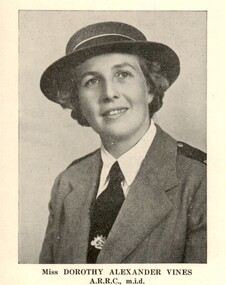
Article, Melbourne Legacy, Miss Dorothy Vines, 1955
... At the beginning of 1940 she went to the Middle East and served as Senior Sister of No.1 Casualty Clearing Station and shortly afterwards was appointed Sister-in-charge of the No.3 Casualty Clearing Station. ...At the beginning of 1940 she went to the Middle East and served as Senior Sister of No.1 Casualty Clearing Station and shortly afterwards was appointed Sister-in-charge of the No.3 Casualty Clearing Station. ...The newsletter from August 1955. It featured photos of the Legacy staff, including Miss Dorrie Vines the Matron of Stanhope. It summarises her life before joining Stanhope on 11 November 1946. She had served with distinction overseas during World War 2 as a Major with the Royal Australian Army Nursing Corps. At the beginning of 1940 she went to the Middle East and served as Senior Sister of No.1 Casualty Clearing Station and shortly afterwards was appointed Sister-in-charge of the No.3 Casualty Clearing Station. She returned to Australian in 1943 and was appointed Matron of a hospital in Alice Springs and in 1944 she again left Australia for New Guinea as Matron of the 2/11 Australian General Hospital. For her war service she was awarded the medal of an Associate of the Royal Red Cross in 1943 and was also mentioned in despatches. Miss Vines remained at Stanhope until her retirement in December 1966.Newsletter outlining news of Junior Legatee activities also occassionally contained information about staff.Black and white printed article about Miss Vines from Newsletter published August 1955. Volume 9 Number 2staff, residences, dorothy vines -
 Bendigo Military Museum
Photograph - WW1 NURSE, 1918
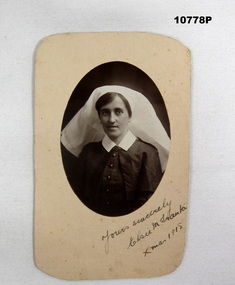
... Elsie May Tranter (born Geelong) enlisted on 2.9.1916 in the AAMS age 28 years, embark for England 6.12.1916, embark for France and posted to 26th General Hospital 13.2.1917, hospital with Measles 6.4.1917, rejoin Unit 16.7.1917, posted to several other Units including No 29 Casualty Clearing Station, promoted to Sister13.12.1918, discharged from the Army on 30.11.1919. ...Elsie May Tranter (born Geelong) enlisted on 2.9.1916 in the AAMS age 28 years, embark for England 6.12.1916, embark for France and posted to 26th General Hospital 13.2.1917, hospital with Measles 6.4.1917, rejoin Unit 16.7.1917, posted to several other Units including No 29 Casualty Clearing Station, promoted to Sister13.12.1918, discharged from the Army on 30.11.1919. ...Photo. Elsie May Tranter (born Geelong) enlisted on 2.9.1916 in the AAMS age 28 years, embark for England 6.12.1916, embark for France and posted to 26th General Hospital 13.2.1917, hospital with Measles 6.4.1917, rejoin Unit 16.7.1917, posted to several other Units including No 29 Casualty Clearing Station, promoted to Sister13.12.1918, discharged from the Army on 30.11.1919. Staley collection, refer Cat No 10758.2P for more details.Photograph B & W, oval shape inset on a card background with rounded edges, text on the front.On the front, "Yours sincerely Elsie M Tranter Xmas 1918"tmstaleycollection, nurse -
 Bendigo Military Museum
Photograph - PHOTOGRAPH, FRAMED WW1, Post 1916
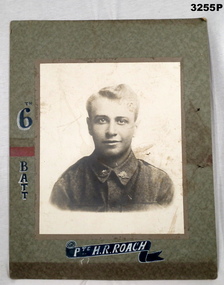
... Admitted to No 3 Canadian Casualty Clearing Station same day but DOW’s same day. ...Admitted to No 3 Canadian Casualty Clearing Station same day but DOW’s same day. ...The photo has H. R. ROACH when it is actually R. H. ROACH. Robert Hartley ROACH enlisted on 28.1.1916 in the AIF in 17th reinforcements to the 6th Batt age 24 years 9 months. Embarked for Egypt 4.4.1916, embarked for England 31.5.1916, embarked for France 16.9.1916.hospitalised 4.12.1916 with Influenza, WIA Belgium 16.9.1917 GSW, to buttocks which penetrated through to the abdomen. Admitted to No 3 Canadian Casualty Clearing Station same day but DOW’s same day. His name is on the Honour Roll at the Soldiers Memorial Institute Bendigo. ‘Sepia photo on white background, mounted on grey cardboard fawn backing. Head & shoulders portrait of a solder without head gear, two Rising Sun badges on jacket collar. On backing LHS: "6TH BATT" On backing bottom centre: "PTE H R ROACH"photography-photographs/mounting accessories, 6th -
 Bendigo Military Museum
Photograph - PHOTOGRAPH, FRAMED, Gunner Harry F Midgley, System generated
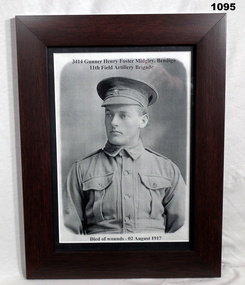
... DOW’s in 41st Casualty Clearing Station Belgium 2.8.1917....DOW’s in 41st Casualty Clearing Station Belgium 2.8.1917. photography-photographs military history Midgley 3414 Gunner Henry Foster Midgley, Bendigo 11th Field Artillery Brigade on top. ...Harry Foster Midgley No 3414 enlisted in the AIF in 11th reinforcements 14 th Batt on 14.7.1915 aged 21 years 4 months. Embarked for Egypt 11.10.1915, hospitalised 14.12.1915 with Dysentry, returned to unit 4.2.1916, transferred to 46th Batt 3.3.1916 then 12th FAB as a gunner 17.3.1916. Embarked for France 2.6.1916, transferred to 11th FAB, WIA GSW to left ear, transferred to 4th Div Ammunition column 25.6.1917, WIA 1.8.1917 with GSW’s to chest, back, right arm, right leg. DOW’s in 41st Casualty Clearing Station Belgium 2.8.1917.Black & white photocopied photograph of soldier, button up uniform from waist up with Rising Sun badges on lapels. Peeked cap with badge in front, faux timber frame with glass front, cardboard back. 3414 Gunner Henry Foster Midgley, Bendigo 11th Field Artillery Brigade on top. Died of wounds - 02 August 1917 at bottom. On back: Brenda Chambers in texta.photography-photographs, military history, midgley -
 Ballarat RSL Sub-Branch Inc.
Letter - confirmation of death
... Date of death is 29/07/1916 44th Casualty Clearing Station, FRANCE, Buried Puchevillers Military Cemetery, FRANCE,Plot 1, (697)....Date of death is 29/07/1916 44th Casualty Clearing Station, FRANCE, Buried Puchevillers Military Cemetery, FRANCE,Plot 1, (697). ...This object relates to Benjamin Staveley TAPNER. He was born on 11/08/1893 in Clifton Hill, VIC. Benjamin Staveley served in the Offier - AIF enlisting on, 11/02/1915 in Clifton Hill, VIC before being discharged from duties with the C COY 22nd BATTN as a Army Commissioned 2nd Lieutenant (2LT) on 29/07/1916. Benjamin Staveley TAPNER was not a prisoner of war. His next of kin is B W TAPNER. Date of death is 29/07/1916 44th Casualty Clearing Station, FRANCE, Buried Puchevillers Military Cemetery, FRANCE,Plot 1, (697).first world war (ww1), 1914 - 1918, literature, ballarat rsl, ballarat -
Ballarat RSL Sub-Branch Inc.
Service Record (copies of excerpts)
... Date of death is 29/07/1916 44th Casualty Clearing Station, FRANCE, Buried Puchevillers Military Cemetery, FRANCE,Plot 1, (697)....Date of death is 29/07/1916 44th Casualty Clearing Station, FRANCE, Buried Puchevillers Military Cemetery, FRANCE,Plot 1, (697). ...This object relates to Benjamin Staveley TAPNER. He was born on 11/08/1893 in Clifton Hill, VIC. Benjamin Staveley served in the Offier - AIF enlisting on, 11/02/1915 in Clifton Hill, VIC before being discharged from duties with the C COY 22nd BATTN as a Army Commissioned 2nd Lieutenant (2LT) on 29/07/1916. Benjamin Staveley TAPNER was not a prisoner of war. His next of kin is B W TAPNER. Date of death is 29/07/1916 44th Casualty Clearing Station, FRANCE, Buried Puchevillers Military Cemetery, FRANCE,Plot 1, (697).first world war (ww1), 1914 - 1918, literature, ballarat rsl, ballarat -
 Returned Nurses RSL Sub-branch
Booklet, 2/7th Australian General Hospital Assiciation, Silver Jubilee : 1965, 1965
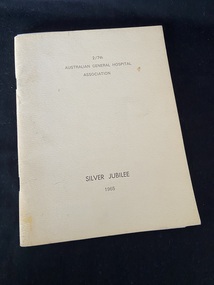
... Contains a unit history (including anecdotes, but very precise about the order of events as the unit assembled), extracts from what appears to be the official unit diary (1/7/1940 - 24/12/1945), statistics for the 2/7th (May 1941- August 1945), List of hospitals on active service (including casualty clearing stations, camp hospitals 46 and 66, field ambulances and hospital ships).The booklet also contains a list of members of the 2/7th AGH Association, notes regarding AANS and AAMWS, and a list of appointmenta available in the AAMC (medical offices, pharmacists, etc.)....Contains a unit history (including anecdotes, but very precise about the order of events as the unit assembled), extracts from what appears to be the official unit diary (1/7/1940 - 24/12/1945), statistics for the 2/7th (May 1941- August 1945), List of hospitals on active service (including casualty clearing stations, camp hospitals 46 and 66, field ambulances and hospital ships).The booklet also contains a list of members of the 2/7th AGH Association, notes regarding AANS and AAMWS, and a list of appointmenta available in the AAMC (medical offices, pharmacists, etc.). 2/7th Australian General Hospital World War II medical care WW2 WWII 2/7th 'Foreword / The Australian Army Nursing Service, 1939-45. / Compiled by VFX 47777 / This small volume represents a brief account of the work done by its members, at home, and abroad.' ...Contains a unit history (including anecdotes, but very precise about the order of events as the unit assembled), extracts from what appears to be the official unit diary (1/7/1940 - 24/12/1945), statistics for the 2/7th (May 1941- August 1945), List of hospitals on active service (including casualty clearing stations, camp hospitals 46 and 66, field ambulances and hospital ships).The booklet also contains a list of members of the 2/7th AGH Association, notes regarding AANS and AAMWS, and a list of appointmenta available in the AAMC (medical offices, pharmacists, etc.).Cream coloured booklet with two staples. The title and author are typed in black ink on the cover.non-fiction'B88' [Handwritten in pencil on the first page] 2/7th australian general hospital, world war ii medical care, ww2, wwii, 2/7th -
 Geoffrey Kaye Museum of Anaesthetic History
Container - Bottle, Blood transfusion
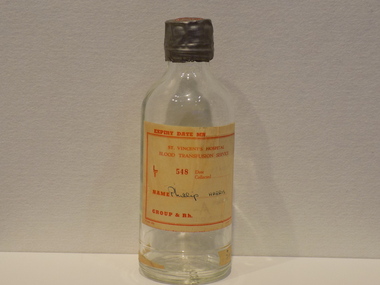
... The wounded were then transported back to the Casualty Clearing Station or Regimental Aid Post for further treatment. ...The wounded were then transported back to the Casualty Clearing Station or Regimental Aid Post for further treatment. ...Dr Alan Holmes á Court enlisted in the Australian Army in 1916 as a medical officer with the rank of Captain. In 1918, Holmes á Court was promoted to Major and attached to the 4th Australian Field Ambulance on the Western Front. As the front advanced, the Casualty Clearing Stations became further removed from the battlefield, creating an urgent need for immediate resuscitation prior to transfer back to the CCS. In June 1918, Holmes a Court and his colleagues established a forward resuscitation team. The team consisted of one doctor trained in surgery, blood transfusion and resuscitation, another doctor trained in anaesthesia, resuscitation and blood classification, and four other assisting staff. This team moved out to the wounded, rather than waiting for them to be stretchered back. They provided on-the-spot, life-saving resuscitation. The wounded were then transported back to the Casualty Clearing Station or Regimental Aid Post for further treatment. Among the assorted surgical and resuscitation equipment carried by the forward resuscitation team, were a number of Kimpton-Brown flasks. Blood was collected from patients with minor injuries using the flask. It was then administered to those in need, after establishing their blood type. Citrated blood was introduced by the Americans in 1917. This allowed blood administration to be delayed for up to two hours but there were many problems with transport, storage and infection in these early experimental days.Round, clear glass bottle with white [discoloured] paper label, with red printed, and metal screw-top lid.Handwritten on white [discoloured] paper label: Phillip HARRIS Moulded into the top of the screw-top lid in red ink: RED CROSS BLOOD TRANSFUSION SERVICEblood transfusion, red cross, world war one -
 Warrnambool RSL Sub Branch
Sculpture - Miniature Bronze Statuette, Wounded Soldier and Guide - Kokoda Trail
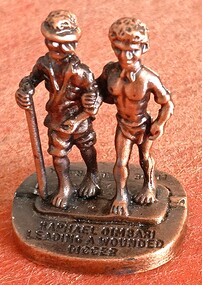
... He was immortalized in an iconic photograph taken by war photographer George Silk on Christmas Day 1942, which depicts Oimbari leading a blinded, wounded Australian soldier, Private George "Dick" Whittington, to a casualty clearing station. The image stands as one of the most enduring symbols of wartime mateship between Australia and Papua New Guinea. ...He was immortalized in an iconic photograph taken by war photographer George Silk on Christmas Day 1942, which depicts Oimbari leading a blinded, wounded Australian soldier, Private George "Dick" Whittington, to a casualty clearing station. The image stands as one of the most enduring symbols of wartime mateship between Australia and Papua New Guinea. ...WW2, Kokoda trail 1942 Raphael Oimbari (d. 1996) was a Papuan orderly and national hero of Papua New Guinea, famously known as a "Fuzzy Wuzzy Angel" during World War II. He was immortalized in an iconic photograph taken by war photographer George Silk on Christmas Day 1942, which depicts Oimbari leading a blinded, wounded Australian soldier, Private George "Dick" Whittington, to a casualty clearing station. The image stands as one of the most enduring symbols of wartime mateship between Australia and Papua New Guinea. More information -https://kokodahistorical.com.au/diggers-stories/george-whittington-and-raphael-oimbari One of the most famous photographs from PNG in WW2two figures mounted on small stand on a larger oval base 26 mm x 23 mm. Overal height 35mmon base front- RAPHAEL OIMBARI LEADING A WOUNDED DIGGER. On base rear MADE IN AUSTRALIA Base underside – Astor Base Metal 02 97500111 Reg Des ww2, mateship, casualty of war, png -
 Alfred Hospital Nurses League - Nursing History Collection
Book - Illustrated book, Deborah Burrows 1959, Nurses of Australia: The illustrated story, 2018
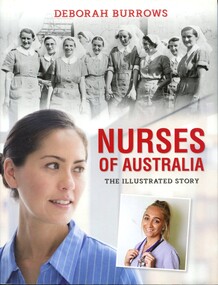
... Title and authors name printed on front cover and spine (red ink on front and white ink on red background on spine) Background of front cover has three photographs: black and white photograph of a group of nurses (Malaya 1941 group portrait of Australian Army Nursing Service nurses of the 2/4th Casualty Clearing Station), colour photo of a nurse looking over her shoulder, and a coloured photo of an Indigenous nurse. ...Title and authors name printed on front cover and spine (red ink on front and white ink on red background on spine) Background of front cover has three photographs: black and white photograph of a group of nurses (Malaya 1941 group portrait of Australian Army Nursing Service nurses of the 2/4th Casualty Clearing Station), colour photo of a nurse looking over her shoulder, and a coloured photo of an Indigenous nurse. ...From the First Nation caregivers who healed, birthed and nursed for millennia to the untrained and ill-equipped convict men and women who cared for the sick in the fledgling colony of New South Wales, nursing has been practised in Australia since the beginning. It would take the arrival of a group of dedicated Irish nuns, followed by Florence Nightingale-trained nurses - and decades of constant and continuing campaigning - to transform nursing into what it is today: the most trusted profession in Australia. Nurses will recognise their own lived experience in stories about training days, nurses' quarters, changing uniforms, changing roles, the arrival of male nurses and current pathways to nursing. Produced in collaboration with the Australian College of Nursing and the Congress of Aboriginal and Torres Strait Islander Nurses and Midwives, with additional information provided by the Australian Nursing and Midwifery Federation, this is the story of nursing in Australia.Illustrated book. Title and authors name printed on front cover and spine (red ink on front and white ink on red background on spine) Background of front cover has three photographs: black and white photograph of a group of nurses (Malaya 1941 group portrait of Australian Army Nursing Service nurses of the 2/4th Casualty Clearing Station), colour photo of a nurse looking over her shoulder, and a coloured photo of an Indigenous nurse. The back cover has a summary of the book along with four coloured photographs: Portrait of a nun with constitution and quill (Sister Mary Augustine Aikenhead by Nicholas Joseph Cowley), A nurse in uniform with veil (Vivian Bull winkel 1941), an indigenous woman (Lois O'Donoghue) an enrolled nurse (Samuel Yenui)non-fictionFrom the First Nation caregivers who healed, birthed and nursed for millennia to the untrained and ill-equipped convict men and women who cared for the sick in the fledgling colony of New South Wales, nursing has been practised in Australia since the beginning. It would take the arrival of a group of dedicated Irish nuns, followed by Florence Nightingale-trained nurses - and decades of constant and continuing campaigning - to transform nursing into what it is today: the most trusted profession in Australia. Nurses will recognise their own lived experience in stories about training days, nurses' quarters, changing uniforms, changing roles, the arrival of male nurses and current pathways to nursing. Produced in collaboration with the Australian College of Nursing and the Congress of Aboriginal and Torres Strait Islander Nurses and Midwives, with additional information provided by the Australian Nursing and Midwifery Federation, this is the story of nursing in Australia.nurses-australia-history, nursing-australia-history -
 Bendigo Military Museum
Book - POW BOOK, TENKO ON THE RIVER KWAI, 1987
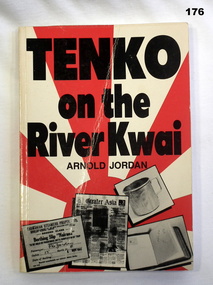
... ACCS (Aust Casualty Clearing Station) AGH (Aust General Hospital) Siam (Thailand) Con Depot (Convalescent Depot)...ACCS (Aust Casualty Clearing Station) AGH (Aust General Hospital) Siam (Thailand) Con Depot (Convalescent Depot) Books military POW’s WW2 Handwriting on page 3. ...The Author Arnold Oakley JORDAN (born Tasmania, enlisted Tasmania) in the 2nd AIF No TX3528 on 21.6.40 age 28 years 9 months. Posted to 2/40th Bn 25.6.1940, hospital with Influenza 24.8.1940, rejoin unit 9.9.1940, appointed group 3 Nursing Orderly and posted to 2/4 ACCS, embarked for Singapore 1.2 1941, hospital 23.5.1941 with Acute Tonsilitis, hospital 24.12.1941 with Malaria, rejoin unit 17.1.1942, reported missing 16.2.1942 (POW) Malaya, reported alive in Siam 22.8.1945, recovered in Siam 22.8.1945, embark for Australia 18.10.1945, evacuated to 111 AGH then 2/1st Con Depot, discharged from the 2nd AIF 23.1.1946. ACCS (Aust Casualty Clearing Station) AGH (Aust General Hospital) Siam (Thailand) Con Depot (Convalescent Depot)Paperback book written by Arnold Jordan. Japanese flag on front cover. Handwriting on page 3. Gift inscription inside.books, military, pow’s, ww2
