
Showing 16 items matching "cattle feed"
-
 Friends of Westgarthtown
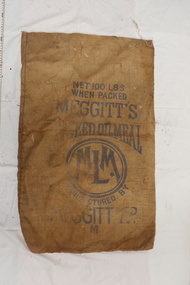
Textile - Megget's Linseed hessian sack, c.1900
... ...cattle feed...Henry Ziebell recalled that linseed meal was used as cattle feed on the family farm. He also described how empty hessian sacks were repurposed for agricultural use, particularly during haymaking. ...Originally used for the packaging, storage and transport of linseed products intended as supplementary feed for livestock, particularly dairy cattle. The sack is constructed from woven hessian, a durable material commonly used for agricultural packaging and the transport of bulk produce and animal feed....Henry Ziebell recalled that linseed meal was used as cattle feed on the family farm. He also described how empty hessian sacks were repurposed for agricultural use, particularly during haymaking. ...This hessian sack forms part of the Ziebell family collection associated with their farm at Westgarthtown, Thomastown, Victoria. Linseed meal, a by-product of linseed oil production, was commonly used as a supplementary feed for dairy cattle. Rich in protein, it provided additional nutrition to support the condition and productivity of livestock. Henry Ziebell recalled that linseed meal was used as cattle feed on the family farm. He also described how empty hessian sacks were repurposed for agricultural use, particularly during haymaking. Once hay had been gathered and stacked in the fields, hessian sacks were sewn together to create large coverings that helped protect the haystacks from wind and rain. The reuse of hessian sacks reflects the resourcefulness of farming families, who frequently adapted available materials for practical purposes rather than discarding them. The sack provides a tangible connection to dairy farming, livestock feeding and traditional haymaking practices at Westgarthtown, illustrating both the agricultural supplies used on the property and the importance of reusing materials in everyday farm operations. The sack was donated to Ziebell's Farmhouse Museum by Lyn and James Ziebell.Hessian sack bearing printed lettering reading 'Megget's Linseed' and 'MLM'. Originally used for the packaging, storage and transport of linseed products intended as supplementary feed for livestock, particularly dairy cattle. The sack is constructed from woven hessian, a durable material commonly used for agricultural packaging and the transport of bulk produce and animal feed.hessian sack, megget's linseed, mlm, linseed meal, cattle feed, dairy farming, animal fodder, haymaking, agricultural packaging, westgarthtown, ziebell family -
 Friends of Westgarthtown
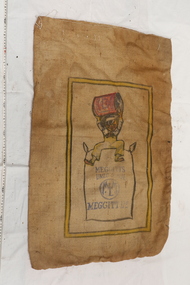
Textile - Megget's Linseed Meal hessian sack, c.1900
... ...cattle feed...Henry Ziebell recalled that linseed meal was used as cattle feed on the family farm. He also described how empty hessian sacks were repurposed for agricultural use, particularly during haymaking. ...Originally used for the packaging, storage and transport of linseed meal intended as supplementary feed for livestock, particularly dairy cattle. The sack is constructed from woven hessian, a durable material commonly used for agricultural packaging and the transport of bulk produce and animal feed....Hessian sack Megget's Linseed Meal MLM linseed meal cattle feed dairy farming animal fodder haymaking haystack agricultural packaging Westgarthtown Ziebell family. ...This hessian linseed meal sack forms part of the Ziebell family collection associated with their farm at Westgarthtown, Thomastown, Victoria. Linseed meal is a by-product of linseed oil production, produced from the remaining seed material after oil has been extracted. Rich in protein, it was commonly used as supplementary feed for dairy cattle to support their nutritional requirements and condition. Henry Ziebell recalled that linseed meal was used as cattle feed on the family farm. He also described how empty hessian sacks were repurposed for agricultural use, particularly during haymaking. Once hay had been gathered and stacked in the fields, hessian sacks were sewn together to create large coverings that helped protect the haystacks from wind and rain. The reuse of hessian sacks reflects the resourcefulness and practical ingenuity of farming families, who frequently adapted and repurposed available materials to meet everyday agricultural needs. The sack provides a tangible connection to dairy farming, livestock feeding and traditional haymaking practices at Westgarthtown, illustrating both the agricultural supplies used on the property and the importance of reusing materials in everyday farm operations. The sack was donated to Ziebell's Farmhouse Museum by Lyn and James Ziebell.Hessian sack bearing printed lettering reading 'Megget's Linseed Meal' and 'MLM'. Originally used for the packaging, storage and transport of linseed meal intended as supplementary feed for livestock, particularly dairy cattle. The sack is constructed from woven hessian, a durable material commonly used for agricultural packaging and the transport of bulk produce and animal feed.MLMhessian sack, megget's linseed meal, mlm, linseed meal, cattle feed, dairy farming, animal fodder, haymaking, haystack, agricultural packaging, westgarthtown, ziebell family. -
 Maffra Sugarbeet Museum
Book, Cattle Feeding with Sugar Beets, Sugar, Molasses and Sugar Beet Residuum
... Hardcover book "Cattle Feeding with Sugar Beets, Sugar, Molasses and Sugar Beet Residuum", 1902, 390 pages illus....Cattle Feeding with Sugar Beets, Sugar, Molasses and Sugar Beet Residuum. ...Frank Pywell was manager of the Maffra Sugar Beet FactoryThe Sugar Beet industry was highly significant in the Maffra area for just under 50 years, and led to the construction of the Glenmaggie Weir and the consequent Macalister Irrigation District. This book is one of a number from the private library of the factory manager, and the entire collection of them provides a unique insight into information available at the time of manufacture. It is unlikely a collection of this breadth on sugarbeet is held anywhere else in Australia.Hardcover book "Cattle Feeding with Sugar Beets, Sugar, Molasses and Sugar Beet Residuum", 1902, 390 pages illus."F.J.Pywell" inside front cover "R.J. Shingles" page preceding title page. Stamp "Technical Library / Department of Agriculture / Melbourne" in several placessugarbeet -
 Cheese World Museum
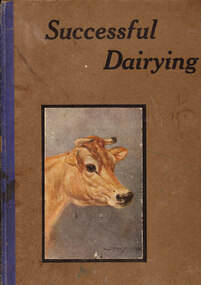
Book, Successfull Dairying in Australia
... It provides information relating to the dairy industry covering topics such as planning, breeding, choosing dairy cattle, feed crops, care of milk and cream and herd health. ...It provides information relating to the dairy industry covering topics such as planning, breeding, choosing dairy cattle, feed crops, care of milk and cream and herd health. ...This book is part of the collection donated by Leon Garner. It provides information relating to the dairy industry covering topics such as planning, breeding, choosing dairy cattle, feed crops, care of milk and cream and herd health. It covers all areas of Australia. This book is an early manual for Australian dairy farmers.Grey hard cover book with full colour picture of a jersey cow and title printed in black on the front cover. The inside back cover contains a paper lift-up model of a cow showing its skeleton and internal organs.639 (stamped on front page)noel garner, dairy industry, allansford, dairy cattle, cattle breeding, herd health -
 Eltham District Historical Society Inc
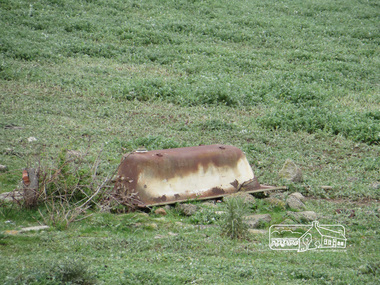
Photograph, Liz Pidgeon, Heritage Excursion; Maroondah Aqueduct, 3 September 2016, 3 September 2016
... Newsletter No., 229, August 2016 Abandoned and rusted house base probably purposed to water or feed cattle. ...Newsletter No., 229, August 2016 Abandoned and rusted house base probably purposed to water or feed cattle. maroondah aqueduct eltham north activities eltham district historical society heritage excursion bath acqueduct trail Born Digital Heritage Excursion; Maroondah Aqueduct, 3 September 2016 Photograph Photograph Liz Pidgeon ...Heritage Excursion - Maroondah Aqueduct Walk - Saturday 3rd September The Maroondah Aqueduct was once a major link in Melbourne’s water supply system. It was built between 1886 and 1891 to transfer water from the Watts River near Healesville to the Preston Reservoir. It was 66 km in length, made up of 41 km of open channel, 10 km of tunnel through hills and 15 km of pipeline across stream valleys known as inverted siphons. The section of the aqueduct through the Eltham area has been abandoned since the 1980s but the open channel has largely been retained. A recreational path follows the aqueduct reserve. For our excursion on 3rd September we intend to walk along the section of the aqueduct adjacent to Allendale Road. This is a section not visited on previous excursions and includes the transition from open channel to the inverted siphon across the Diamond Creek valley. Apart from the aqueduct itself the main feature of the walk is the extensive views across Eltham North and Diamond Creek. Along the way we will talk about the history of the aqueduct and the area. This easy walk is about 3 km return and will take 2 to 2.5 hours. It will start at 2pm at the junction of Allendale Road with Godber Road and Zig Zag Road North, officially Diamond Creek, but on the northern boundary of Eltham. (Melway ref.12 B10). Newsletter No., 229, August 2016 Abandoned and rusted house base probably purposed to water or feed cattle. Born Digitalmaroondah aqueduct, eltham north, activities, eltham district historical society, heritage excursion, bath, acqueduct trail -
 Eltham District Historical Society Inc
Photograph, Peter Pidgeon, Heidelberg Artists Trail signs are through this area including local artist Walter Withers, 2 Sep 2017
... Here he has captured the dairy cattle belonging to local Eltham farmer, Mr. Tom Orr, feeding and resting in the shade of the tall Manna gums. ...Here he has captured the dairy cattle belonging to local Eltham farmer, Mr. Tom Orr, feeding and resting in the shade of the tall Manna gums. ...The Heidelberg School Artists Trail was established in about 1999 with about 52 signs across four local governemnt areas including Nillumbik and Banyule. This one located in Wingrove Park Eltham pays tribute to Walter Withers and his painting "The Silent Guns" Transcription of sign: Walter Withers – The Silent Gums, 1909 Walter Withers painted this tranquil pastoral scene in the vicinity this park. Here he has captured the dairy cattle belonging to local Eltham farmer, Mr. Tom Orr, feeding and resting in the shade of the tall Manna gums. Wither’s daughter, Nan recalled how her father, for inspiration, often visited the property of their neighbour, Mr. Tom Orr, and in his later years, Withers painted many landscapes depicting Mr Orr’s sheep and dairy cattle. Heritage Excursion by EDHS Members - An Eltham South Ramble, 2 Sep 2017Born Digitalactivities, eltham district historical society, eltham south, heritage excursion, local history centre, walter withers, heidelberg artists' trail, wingrove park trail, the silent gums -
 Kiewa Valley Historical Society
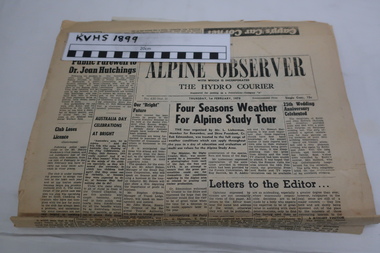
Newspapers - Cattlemen
... Traditionally, farmers from the Kiewa Valley took their cattle up to the Bogong High Plains during the summer for better feed. From 1978, the Alpine National Park management, along with the Victorian Government stopped the practice as a result of studies showing the deterioration of the land due to the cattle grazing on the High Plains.This disagreement resulted in the banning of cattle on the High Plains....Traditionally, farmers from the Kiewa Valley took their cattle up to the Bogong High Plains during the summer for better feed. From 1978, the Alpine National Park management, along with the Victorian Government stopped the practice as a result of studies showing the deterioration of the land due to the cattle grazing on the High Plains.This disagreement resulted in the banning of cattle on the High Plains. ...Traditionally, farmers from the Kiewa Valley took their cattle up to the Bogong High Plains during the summer for better feed. From 1978, the Alpine National Park management, along with the Victorian Government stopped the practice as a result of studies showing the deterioration of the land due to the cattle grazing on the High Plains.This disagreement resulted in the banning of cattle on the High Plains.A collection of newspaper reports on the issue of cattle grazing on the Bogong High Plains. Also, the Conservation Council's argument for the cattle being excluded from the Bogong High Plains. Newspaper cuttings re Cattlemen in the High Plains from 1978. Book - Land Conservation 1983 - pale blue 81 pages.cattlemen on the high plains, bogong high plains, land conservation council -
 Kiewa Valley Historical Society
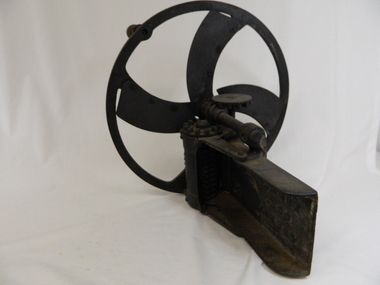
Cutter Green Feed, Hocking, estimated 1935; Early 20th Century
... cattle and other stock requiring all year access to hay/grass supplies. The use of, now defunct, Tobacco drying sheds for the storage of hay and other fodder is typical of the Australian farmer/grazier's adaptability to utilise anything available. To think outside the square. agriculture farm machinery stock feeding ...This iron chaff cutter was a vital piece of rural machinery especial for cattle in areas subjected to limited grass growing seasons. The Kiewa Valley and Alpine regions were up to the 21st century "snowed" in. The conditions requiring summer crops and fodder to be prolonged for the harsh winter climate are now becoming less and less and may confirm the precursor of "global warming". The Kiewa Valley is still a strong base for dairy cattle and other stock requiring all year access to hay/grass supplies. The use of, now defunct, Tobacco drying sheds for the storage of hay and other fodder is typical of the Australian farmer/grazier's adaptability to utilise anything available. To think outside the square.Black Iron Chaff Cutter. The wheel has a single piece inside with 4 curved spokes with adjustable blades attached by 4 screws & 3 rivets. The wheel has a wooden handle. Operated by cogs. HOCKING GREASE BALLARAT COGS FREELYagriculture, farm machinery, stock feeding, grazier, farm animals -
 Kiewa Valley Historical Society
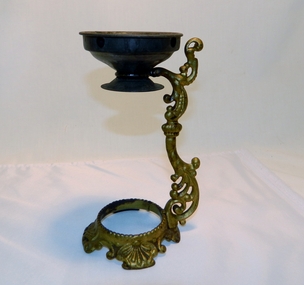
Vaporiser Cresolene, circa late1800's to early 1900's
... feeds. The introduction of the SEC Victorian Hydro Electricity Scheme started in the 1940's, was the impetus for health planners to build a hospital in the Kiewa Valley. Rural regions especially those considered semi or fully remote locations had to rely on farm based remedial health "alternative medical treatment". This product is such a remedy. This vapouriser is very significant to a rural area such as the Kiewa Valley as it demonstrates the "home" remedies that were available to rural communities such as the cattle ...This Cresolene vapouriser is an "American" product when "home" based remedial products were of a high demand due to lack of specialised medical facilities such as a hospital in rural communities. "An apparatus for reducing medicated liquids to a state of vapor suitable for inhalation or application to accessible mucous membrane A device for volatising liquid anesthetics." The only criteria used by Health authorities in the decision to provide a community with hospitals was and still is the size of the population it feeds. The introduction of the SEC Victorian Hydro Electricity Scheme started in the 1940's, was the impetus for health planners to build a hospital in the Kiewa Valley. Rural regions especially those considered semi or fully remote locations had to rely on farm based remedial health "alternative medical treatment". This product is such a remedy.This vapouriser is very significant to a rural area such as the Kiewa Valley as it demonstrates the "home" remedies that were available to rural communities such as the cattle and sheep stations before the Kiewa Valley had a hospital(1949). The influx of workers employed by the SEC Vic. Hydro Electricity Scheme(circa 1940's onward) changed dramatically the need for a hospital and specialised medical treatment. The reliance of "health products" such as this vaporiser were still in high demand especially when on the box of this product was printed "Guaranteed under the Food and Drugs Act, June 30, 1906, Serial no. 436". Also on the packaging is printed "A remedy Whooping Cough also Asthma, Catarrh, Colds Diptheria, Croup, Coughs Hay Fever, Sore Throat, Influenza, Etc." An additional benefit of this product "Is obnoxious to Moths, Flies, Mosquitos, Ants, Cock Roaches, Hen Lice, and other Troublesome insects." This advertising is dated before a tightening in the "advertising" legislation of post mid 1900's. However it was a good attraction for rural communities wanting relief of "rural" pests. This vaporiser stand with its cradle and dish is made from cast iron (stand) and tin (dish). At the bottom of the "dish" is a flame diffusion port with eight heat directional holes. The stand upright is painted gold in colour.See KVHS 0342 (B) for markings and advertising material printed on the box which contains this item.home based vaporisers, first aid, home nursing, over-the-counter medicines -
 Bendigo Historical Society Inc.
Book - ERROL BOVAIRD COLLECTION: THE WEEKLY TIMES FARMERS HANDBOOK
... cattle, pigs, sheep, poultry, dogs, cats and ferrets. Also covered are fruits, vegetables, flowers General Information, Index to Advertisements, Clearing Out Rabbit Warrens, The Horse and Its Harness, Economical Feeding of Livestock and Good Fencing is a Wise Investment....cattle, pigs, sheep, poultry, dogs, cats and ferrets. Also covered are fruits, vegetables, flowers General Information, Index to Advertisements, Clearing Out Rabbit Warrens, The Horse and Its Harness, Economical Feeding of Livestock and Good Fencing is a Wise Investment. ...Book with green cloth cover, black printing, black vertical and horizontal lines, and a black Logo of The Herald Press. It has a man on a rearing horse playing a trumpet. Livestock covered are horses, cattle, pigs, sheep, poultry, dogs, cats and ferrets. Also covered are fruits, vegetables, flowers General Information, Index to Advertisements, Clearing Out Rabbit Warrens, The Horse and Its Harness, Economical Feeding of Livestock and Good Fencing is a Wise Investment.john bovaird collection - the weekly times farmers handbook, farmers' information bureau, the herald press, the herald and weekly times ltd melbourne -
 Bendigo Historical Society Inc.
Pamphlet - Frank A. Hill and Co. 100 years, 1953
... McPherson Sternberg and Co. was a large public company set up in Bendigo in the year 1853 especially to cater for the New South Wales consignments of cattle and horses which came regularly to Bendigo in those days to feed the thousands of hungry miners who had congregated from the four comcri:; of the earth in search of gold. ...McPherson Sternberg and Co. was a large public company set up in Bendigo in the year 1853 especially to cater for the New South Wales consignments of cattle and horses which came regularly to Bendigo in those days to feed the thousands of hungry miners who had congregated from the four comcri:; of the earth in search of gold. ...L. McPherson Sternberg and Co. was a large public company set up in Bendigo in the year 1853 especially to cater for the New South Wales consignments of cattle and horses which came regularly to Bendigo in those days to feed the thousands of hungry miners who had congregated from the four comcri:; of the earth in search of gold. The cattle were sold in the Municipal Cattle Yards ,and the horses in the Bazaar at Charing Cross. The founders of the business must have had tremendous faith in the future of Bendigo to have built such a large and solid structure as the Bazaar, including ample space for the administrative offices which, though reconstructed, are still basically as they were in the far-off fifties. When L. McPherson Sternberg & Co. retired from business in or about the year 1892, the business was acquired by Mr. Frank A. Hill. Frank A. Hill and Co. - a 14 page pamphlet outlining the history of the company and its 100 year development. Black and white, contains texts and photos.history, bendigo, frank a hill and co -
 Eltham District Historical Society Inc
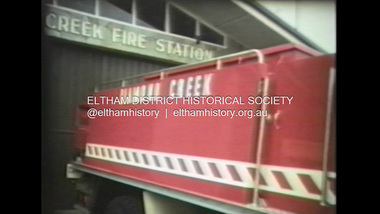
Film - Video (VHS), Diamond Creek Fire Brigade, c.1955-1987
... feeding ground for fire. On 8th January 1969, high temperatures and strong north winds, were, with the carelessness of some individual all that was necessary to produce the worst fire the district had seen. Cuts to scene of blackened fields and cattle...feeding ground for fire. On 8th January 1969, high temperatures and strong north winds, were, with the carelessness of some individual all that was necessary to produce the worst fire the district had seen. Cuts to scene of blackened fields and cattle ...Combination of three movie films. Movie One (1950s): 00:00 – 13:14 Black and white footage of Diamond Creek firemen practising in Diamond Street in the 1950s for forthcoming demonstrations of abilities. Mentions of Gordon Brandy and Joe Hislop Running out hoses from old hose reels along Diamond Street, Diamond Creek Displays from various brigades running out and connecting hoses. Also scenes from the 1950s of Diamond Creek Fire Brigade competing in various locations around Victoria and Tasmania. Mentions of Brigade members Dave Kidd, Bruce Hackett, Ron Kirkbride, Jack Marks, Graham Upton who are prominent in these events. Members of Kyneton Fire Brigade also present. Members competing in running out hose reels, connecting hoses togethers and to hydrants then climbing towers to direct water from hose or at a target hanging above the road. Diamond Creek members identified wearing a diamond on their chest and back. Includes scenes of Scottish pipe bands at the events and significant crowds of spectators. Footage of Mel Stone and Beryl Marks, Stan Redpath and Ron Kirkbride, then Ron Kirkbride and Eric Holt viewing flower displays. Film changes to colour at Diamond Creek oval for practice with fire engine entering oval. Members depicted include Bill May, Jack Sinclair, Jim Cox, Bob Beale, Dave Kidd, Bruce Hackett and Captain Clarrie Stone. Reverts to black and white in the 1950s where the Brigade joins forces with the Diamond Valley Community Hospital for a Gala Day on the Diamond Creek Oval. Changes to colour again, possibly same event and scenes of children on bikes and scooters or with prams and carts racing around the oval. Mention of young lad Brian Laurie who has his own fire truck. Dart throwing, pony rides. Scenes with Dr Don Cordner, Gus Lyons, Vic Cohn (?) and spinning wheel and Diamond Creek School children entertain a large crowd with Maypole dancing. Movie Two (1950s): 13:25 – 19:00 This black and white film was taken by a TV film crew in the 1950s depicts a typical call out for the Diamond Creek Fire Brigade. In this case the careless action of a member of the public throwing a lighted match from a car, which can cause extensive damage. Footage features the Shire of Eltham War Memorial tower at Kangaroo Ground before it was modified with a fire spotter’s cabin. Discusses fire spotting operations from the tower. Shows a fire spotter walking around the top of the tower. A fire is detected, and the information is relayed to the nearest fire station, in this case, Diamond Creek. The telephone call is received, and the alarm sounded. Captain Clarrie Stone and firemen May and Shaw leave their workplaces and prepare for action. Scenes of running across the Main Hurstbridge road showing the shops (Shell service station and Chemist prominent). Scenes entering the fire station which has a pictorial warning covering the entire door “Only you can prevent forest fires – If you’re careless – we’re homeless!” Eric Holt pinpoints the location of the fire while Captain Clarrie Stone and Fireman Shaw take note. The advance vehicle (an FE Holden ute, rego GTE-696) leaves to assess the extent of the fire. Having assessed the fire, Fireman Shaw communicates with base showing radio with call sign VL3JZ. Eric Holt takes the call. In the meantime, Captain Clarrie Stone and Fireman Shaw undertake some limited action to address the fire. Firemen Bill May, Jim Bates and Hugh Bar (?) man the tanker. A photo portrait of Queen Elizabeth is visible hanging on the wall. They are later joined by Firemen Jim Cox, Eric DeBuse (?) and Jack Marks. The tanker is seen departing the station and diverging off before the bridge. Captain Clarrie Stone and Fireman Shaw are seen pumping water on the flames with hand pumps when the tanker arrives. The hose is unreeled, and water turned on the flames. Jack Sinclair joins the action. Jim Cox directs water to the high stuff. The fire put out, Jack Marks and Eric DeBuse wind in the hoses and the team head back to town. It’s peaceful again at the memorial tower. Movie Three (1969-1987): 19:14 – 34:34 Colour film “Fired with Dedication”, Country Fire Authority Victoria, produced by I.L. Wadeson, Commentary by A.M. Hem. Credits with CFA Victoria emblem and then placed over a view of an old-style ladder engine. Opens with the scene of a fire engine outside the Diamond Creek Fire Station then various trophies reflecting the competition success of the brigade in various track and disciplined events. Two trophies shown of particular pride to the brigade were for first place in the Torchlight Procession at the State Championships in Mildura in 1986 and also at Swan Hill in 1981. Still photo scenes of ex Captain Clarrie Stone, Brigade Captain for 21 years; ex Captain Jack Marks, 10 years; ex Captain Ian Douglas, 10 years. Cuts to scene of radio control room, January 1969, and news of a fire on the northern side of the township of Diamond Creek. With scenes of flames in bush, the narration explains that until the early 1960s the area was an orchard district which protected the town against the savagery of bushfires. But due to competition from other areas more suitable for orcharding and easier transport to Melbourne the district could no longer remain competitive, and orchards were replaced by grassed areas, which together with the bush areas were a feeding ground for fire. On 8th January 1969, high temperatures and strong north winds, were, with the carelessness of some individual all that was necessary to produce the worst fire the district had seen. Cuts to scene of blackened fields and cattle - Hundreds of hectares of grass land were blackened, and cattle had to be transported to other areas for agistment. Scene of destroyed buildings in the township – 13 houses and the public hall in the town were destroyed as was the theatre equipment which was owned by the fire brigade. The Church of England Hall and bell tower were badly damaged. The whole town could have been burnt out but for the determination, skill, and courage of the Diamond Creek Fire Brigade. Scenes of all that was left of the home on the hill on the west side of the Church of England. Also, the remains of the old Pisy (?) home on the top of the same hill near Lambert Street, and the ruined Crocker home. Cuts to a scene in the mid-1970s to mid-1980s of a house fire in Haley Street attended by the Diamond Creek Fire Brigade. Although the house was severely damaged, it was saved. Mentions that whilst assistance is appreciated, in some circumstances, those doing so are not properly dressed for fighting fires. Breathing apparatus is a must in structure fire attack. Next scene (either on Mangarook or Coventry oval) showing off four Diamond Creek Fire Brigade efficient and very expensive firefighting units. Features a forward control vehicle Toyota 4WD used for conveying task force personnel to the required areas; a Hino Model 3.2 tanker, diesel powered and carries 3,000 litres of water and has a 16 HP petrol driven pump which delivers 900 litres of water per minute; an International tanker (registration TCM-418) which carries 3,000 litres of water with pumping capacity of 600 litres per minute. The Ford diesel powered pumper (registration MXE-754) is a well-equipped vehicle with a water capacity of 1,000 litres and capable of pumping 1,900 litres of water per minute from the main pump, has many lockers which hose equipment such as breathing apparatus and various types of hose nozzles and foam making equipment. The vehicle carries 360m of 64mm diameter hose which can be laid out from the rear lockers and a portable lighting plant, an Oxy Viva resuscitator to revive smoke inhalation victims and forcible entry tools to gain access to structure fires. Views of the main pump and control panel on the vehicle. As well as the main pump, the vehicle is equipped with an auxiliary pump which allows the facility to pump whilst moving. Fire fighters must undergo constant training and hone their skills, Scenes of a training exercise using the pumper to pump from static water. First, the short lengths of suction hose are coupled, a strainer fitted to ensure debris does not foul the pump. Gauges must be constantly monitored to ensure manageable water pressures are maintained. Pressures are normally controlled to allow two fire fighters to work at each nozzle outlet. Two nozzles are tested, one adjustable jet fog type which is used on flammable gasses or within a structure fire to absorb heat. A straight jet nozzle to project water long distances to protect exposed surfaces close to a fire radiated heat. The pumper is quite a versatile vehicle in handling structure fires, but it also carries specialist equipment needed in containing hazardous chemical incidents. Cuts to scene of parade – the Diamond Creek Fire Brigade has with other neighbouring brigades participated in most town fairs and earns the respect of the watching public. It can be seen why this brigade has been so successful at disciplined contests. Views of Plenty Fire Brigade Road Rescue unit which is equipped with the “Jaws of Life” Scenes of athletic competitions – many neighbouring brigades indulge in friendly but keen competition at the Diamond Creek Town Fair. The young are also encouraged to participate in all aspects of Junior Fire Brigade activities and become tomorrow’s generation of volunteer fire fighters. Scene of the 1986 Diamond Creek Town Fair which was the last time veteran Captain Clarrie Stone BEM marched with the brigade. Clarrie was awarded the British Empire Medal for his service to the Country Fire Authority. Also, scenes of vehicles in the parade. Cuts to scene of brigade members in drill formation for inspection by Acting Chief Harry Rothsay (?) on the occasion of the opening of the new fire station extensions on August 29, 1987. Rudy Libel (?) Captain at the time. Scenes of crowds including many dignitaries of neighbouring brigades present including Lieutenant Gordon Grandy (who came down from Queensland for the occasion) and ex-Secretary David Kidd and wife Betty, also ex Captain Clarrie Stone and Mrs Nel Stone, a life member of the Ladies Auxiliary, the Reverend Jock Ryan, son of J.L Ryan, founder of the Diamond Creek Fire Brigade, Foundation Captain of the fire brigade, Keith Bradbury and Mrs Bradbury. Pauline Dick accepts a community service award for services to the CFA. Recognising over 47 and a half years of service, a presentation is made by Mr Neil Marshall, Acting Chairman of the CFA to ex Captain Clarrie Stone with response by Clarrie. Other members of the official party include Cr. Martin Wright, Shire President Wayne Phillips and local Member of Parliament, Mrs Pauline Toner. Ex foreman John Bennett is presented with a life member’s awards by Captain Rudy Libel. The camera also catches Gwen Cox, Jean Ryan and Bessie Layton (?) Provides historic footage of people, places and equipment and a record of the worst fires expoerienced in Diamond Creek in 1969BASF Standard Quality SQ E-180 VHS dubbing (poor quality) of three films Converted to MP4 file format 0:34:38, 1.85GBOn label: "Donation - August 2000 Diamond Creek Unit Old films made up from Fire Brigade shows at competitions - also Kangaroo Ground Tower being used"video recording, diamond creek fire brigade, 1986 diamond creek town fair, a.m. hem, acting chief harry rothsay, athletic competitions, beryl marks, bessie layton, betty kidd, bill may, bob beale, brian laurie, bruce hackett, captain clarrie stone, chemist, church of england hall, clarrie stone, clarrie stone bem, country fire authority victoria, coventry oval, cr. martin wright, crocker home, dart throwing, dave kidd, david kidd, diamond creek, diamond creek fire station, diamond creek oval, diamond creek school, diamond creek town fair, diamond street, diamond valley community hospital, dr don cordner, eric debuse, eric holt, fe holden ute, fire damage – buildings, fire spotter, fire spotter’s cabin, fire station extension, fired with dedication (film), firefighting units, fireman shaw, firemen jim cox, ford pumper, foundation captain, gala day, gordon brandy, gordon grandy, graham upton, gus lyons, gwen cox, haley street, hino model 3.2 tanker, house fire, i.l. wadeson, ian douglas, international tanker, j.l ryan, jack marks, jack sinclair, january 1969, jaws of life, jean ryan, jim bates and hugh bar, jim cox, joe hislop, john bennett, kangaroo ground, kangaroo ground tower, keith bradbury, kyneton fire brigade, lambert street, main hurstbridge road, mangarook oval, maypole dancing, mel stone, mildura 1986, mrs bradbury, mxe754 vic registration, neil marshall, nel stone, orchard district, oxy viva resuscitator, pauline dick, pauline toner mp, pisy home, plenty fire brigade road rescue unit, pony rides, radio control room, reverend jock ryan, ron kirkbride, rudy libel, shell service station, shire of eltham war memorial, shire president wayne phillips, spinning wheel, stan redpath, state championships, swan hill 1981, tcm418 vic registration, torchlight procession, toyota 4wd, trophies, vic cohn, victorian bushfires - 1969, vl3jz -
 Warrnambool and District Historical Society Inc.
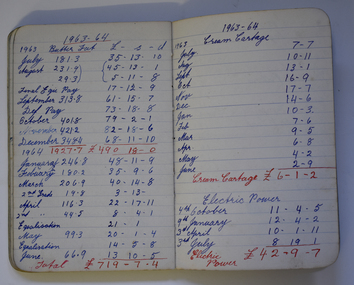
Financial record - Bonnett Farm Account Notebook, George Bonnett, Mepunga, 1920 to 1981
... The accounts date from 1920 to 1981 and commence with the sale of stock (pigs, sheep and cattle) in 1920 and go on to record purchases as well as sales in a variety of goods and services - cartage costs, electricity bills, garage repairs, stock feed, household goods etc. ...The accounts date from 1920 to 1981 and commence with the sale of stock (pigs, sheep and cattle) in 1920 and go on to record purchases as well as sales in a variety of goods and services - cartage costs, electricity bills, garage repairs, stock feed, household goods etc. ...This is a notebook used to keep some of the farm accounts of the Bonnett farm in Mepunga. As the handwriting is the same throughout, most of the entries appear to have been made by George Bonnett, the son of Frederick and Charity Bonnett. The accounts date from 1920 to 1981 and commence with the sale of stock (pigs, sheep and cattle) in 1920 and go on to record purchases as well as sales in a variety of goods and services - cartage costs, electricity bills, garage repairs, stock feed, household goods etc. This notebook is an interesting memento of Westen District farm finances over a period of sixty years in the 20th centuryThis is a small note book with a black cover. It contains pages with ruled lines and handwritten entries in red, blue and black ink. Some pages have been cut out at the back of the book.mepunga farming, bonnett family of mepunga -
 Melton City Libraries
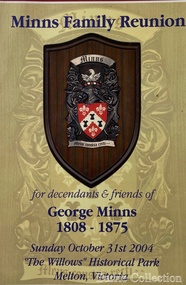
Document, Minns Family Reunion, 2004
... cattle, a large proportion of which were milking cows. The reporter also noted that a ‘large number of pigs are kept upon this farm and are found to be very profitable stock’. Their manure was used in an orchard and garden in which ‘large quantities of lucerne and prairie grass are grown for the use of stock when ordinary feed is scarce’. ...cattle, a large proportion of which were milking cows. The reporter also noted that a ‘large number of pigs are kept upon this farm and are found to be very profitable stock’. Their manure was used in an orchard and garden in which ‘large quantities of lucerne and prairie grass are grown for the use of stock when ordinary feed is scarce’. ..."A perpetual spring in the adjacent creek provided a steady supply of fresh water to the site on which the homestead is built. Although we can not be certain of the identity of the builder, the first stage of ‘The Willows’ homestead appears to have been constructed in the mid 1850s. The house is situated on Crown Allotment No.1 (No Section), Parish of Kororoit, an allotment of 5 acres 3 roods 4 perches. Although it had surveyed the land, the Crown did not offer it for sale until 22nd November 1861, at which time it was purchased by Charles March Williams. (Although the property is directly opposite and immediately adjacent to the Township of Melton, and was sold as ‘Suburban Allotment 33’, it was situated within the Shire of Braybrook rather than the Shire of Melton until 1917.) Considerable improvements had taken place on the land prior to the Crown sale. When CM Williams purchased the allotment in November 1861 he paid £23.5.0 for the land itself, and valued the improvements at £400. Even allowing for some exaggeration by Williams, this is an extremely high valuation for improvements, and must have included a house. Some local research has claimed that in 1858 Williams had taken over the interest of a Mr Parkinson in the property, and that Parkinson built the house upon taking possession of the land c.1855. It was definitely built by 1861, when a map shows a square building on the site marked as ‘House’. The property is important in the district for its association with the establishment of the pound. The district pound had been established in 1854, when George Scarborough of Mount Cottrell (Mt Cottrell Road, south of Greigs Road) was appointed pound-keeper. Scarborough resigned in 1857. The pound was moved to Melton following agitation from local farmers and Charles March Williams appointed pound-keeper on 26th April 1858. Williams, the son of a doctor, had been born in London. Reminiscences of local residents of the time, as recorded in the Express newspaper, note Williams’ success in breeding horses on the property. Sales of up to 60 guineas were noted. Whether this was from Williams’s own stock or from unclaimed pound stock is not made clear. Williams appeared before a government inquiry in 1860 and advocated registration of all stock brands in the State. Williams died in 1862 leaving a widow, Catherine, and five living children aged 15 years to five months. At the time of his death Williams had entered negotiations with one Matthew Devenish and had a mortgage of £100 on allotments 1 and 2, Parish of Kororoit. Catherine Williams was appointed pound-keeper on 2 September 1863, with her eldest son Charles as her assistant. Her tenure was short for on 22nd March 1864 George Minns senior paid Matthew Devenish £135 for allotments 1 and 2 Parish of Kororoit (considerably less than Williams had claimed the property was worth in 1861) and on the same day paid William Tullidge £45 for the adjoining allotments 3 and 4. In April 1867, James Ebden Minns, the newly married son of George senior became the owner of The Willows property having entered into a mortgage arrangement with his father to the extent of £200. At the time George Minns was residing in Kaarimba having left Melton in 1867 for a short trip to England and upon his return having taken up a selection in the Kaarimba district with his son Frederick who had a hotel licence there. James paid out the mortgage on 2-1-1873. James Minns was appointed pound-keeper in 1872; in 1885 the pound was moved elsewhere and Minns purchased the old pound site and added it to his farm. The Willows residence underwent a major change about this time. A two room extension, similar in style but with a lower elevation was added to the original rear of the house with a chimney matching the distinctive originals. Window arrangements did not match the original but became a feature of the façade when the new addition became the front of the building. Six buttresses were attached to the east and west walls of the old building, two to the south wall and the whole rendered with mortar to give the appearance of dressed stonework around the windows. Galvanized iron was placed over the shingles and a verandah added on three sides. By 1876 The Willows was the homestead for a thriving mixed farm of 340 acres of which 156 was rented from a H. Ruck. In October of that year the Australasian travelling reporter visited and reported on the property. In common with the nearly every other property in the district the farm had ‘recently’ (generally within the last two years) abandoned cultivation of crops, and turned over completely to cattle pasture. Butter making was the principal occupation of the farm, which had about 50 head of cattle, a large proportion of which were milking cows. The reporter also noted that a ‘large number of pigs are kept upon this farm and are found to be very profitable stock’. Their manure was used in an orchard and garden in which ‘large quantities of lucerne and prairie grass are grown for the use of stock when ordinary feed is scarce’. Two bores attached to deep brick lined wells supplied water for the house in addition to the farm. A commodious timber barn and necessary sheds had also been constructed. Access to the property was improved following the construction of the bluestone ford across the creek c.1887, when the recreation ground came into use. Prior to this date it may have been that the crossing referred to as ‘Mr Minns bridge’ was used. This appears to have been a flimsy structure and has but two references in Council reports in the Melton Express in the 1880’s. It is believed that in the late 1890’s a timber building was added near the rear of the building to house a kitchen, ablutions and laundry rooms and rooms for seasonal workers. This was attached to the house by means of a trellised walkway using the original front entry to the house (long since the back door). A photograph of this building appears in a local history of Melton. This was demolished in recent decades during the period when the house was tenanted (after the Minns family had left). James Minns son, George, took over the property following his marriage to Alice Walsh in 1903. James and Caroline moved into a house on the former JH Games property at the eastern end of Henry Street. George held the position of Shire Secretary for Melton for 40 years. He was a most prominent member of the community being Secretary to, among others, the Melton Coursing Club, the Shooting Club and the Cemetery Trust. He also rode with the hunting parties who sported across the Plains and were entertained at Mount Kororoit. George and Alice had one son, Norman who followed his father into local government and became Secretary of the Shire of Werribee completing a record term in this position. George retired to Werribee in 1951, where he died in 1965. The National Trust records note that James Ebden Minns and his sons were ‘leading men of the district, Justices of the Peace, and Shire Councillors’. It claims that Sir Thomas Bent was a frequent visitor. The Willows passed into the hands of George’s grandson, Bruce Minns and the property was let for a number of years. In the 1960s it became vacant and was subject to vandalism. Major structural problems arose with the part demolition of the roof, the loss of windows and doors and holes dug into and under the floorboards. The outbuildings were particularly targeted. Following widespread public support, the Shire of Melton purchased the house, with 3.75 acres of land, in 1972. In 1975 the Shire of Melton and the Melton and District Historical Society were successful in nominating the building for National Trust classification, and then the Australian Heritage Commission’s Register of the National Estate. The AHC particularly noted its ‘townscape importance’. It was envisaged that the farmhouse would form ‘a picturesque centrepiece to Melton’s planned … historical park, along with Dunvegan bluestone cottage … and similar structures as they become available.’ In a time of great Melton’s ‘satellite city’ development the Council spelt out its broader vision in its submission to the AHC: ‘Melton is destined to become, by the end of the present century, a city of between 75,000 and 100,000 people. Significant relics of the past, such as ‘The Willows’, regrettably will be rare in that situation. It is essential that sufficient tangible links with Melton’s pioneering days remain to promote in the new community a sense of history and continuity’. Under the direction of ‘The Willows’ Restoration Committee and consultant architect John Hitch, all outbuildings, with the exception of the garage and toilet, were demolished and the dwelling house restored. Finances were provided by the Shire of Melton and the National Estate Grants Program, and considerable amount of voluntary labour was provided by the local community. The orchard was removed, and remaining wooden buildings were relocated to provide an open vista for visitors to the Park. The property was furnished with donations from district families keen to preserve this example of pioneer life in the area. The Willows became the headquarters of the Melton and District Historical Society". Invitation to the family reunion at the Willowslocal identities, pioneer families -
 Falls Creek Historical Society
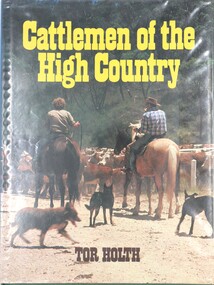
Book - Cattlemen of the High Country, Tor Holth with Jane Barnaby, 1980
... Mountain Cattlemen Cattle Breeders Victoria Australian Cattlemen Bogong High Plains History The lives of the mountain cattlemen of Victoria's alpine country revolve around the annual muster held before the first snowfall of autumn, when they bring their cattle down to lower pastures for winter feeding, or consign them for auction at the annual calf sales in Omeo or Myrtleford. ...The lives of the mountain cattlemen of Victoria's alpine country revolve around the annual muster held before the first snowfall of autumn, when they bring their cattle down to lower pastures for winter feeding, or consign them for auction at the annual calf sales in Omeo or Myrtleford. The close-knit communities of cattlemen share the common hazards of this mountainous region, enduring the snow and freezing conditions of winter and the threat of ravaging bushfires in summer, finding shelter from the harshness of the environment in little huts which they built from the rough materials available. But the dangers of steep slopes and rocky terrain, in which more than one drover has lost his life, hold no terrors for them. These tough and resourceful cattlemen are self-sufficient and skilful in everything they do, whether it is bushmanship, horse-riding, or telling tall tales. In this book their yarns and reminiscences about their mates, their horses and Hereford cattle, and their indispensable dogs, reveal a characteristic courage and endurance, and an indomitable sense of humour. This book provides an enduring record of a vanishing breed of Australians, folk heroes in their own right, whose lives form the basis of verse and legend.A book of 224 pages including maps, illustrations and photographic images, both black and white and colour. It includes a bibliography.The lives of the mountain cattlemen of Victoria's alpine country revolve around the annual muster held before the first snowfall of autumn, when they bring their cattle down to lower pastures for winter feeding, or consign them for auction at the annual calf sales in Omeo or Myrtleford. The close-knit communities of cattlemen share the common hazards of this mountainous region, enduring the snow and freezing conditions of winter and the threat of ravaging bushfires in summer, finding shelter from the harshness of the environment in little huts which they built from the rough materials available. But the dangers of steep slopes and rocky terrain, in which more than one drover has lost his life, hold no terrors for them. These tough and resourceful cattlemen are self-sufficient and skilful in everything they do, whether it is bushmanship, horse-riding, or telling tall tales. In this book their yarns and reminiscences about their mates, their horses and Hereford cattle, and their indispensable dogs, reveal a characteristic courage and endurance, and an indomitable sense of humour. This book provides an enduring record of a vanishing breed of Australians, folk heroes in their own right, whose lives form the basis of verse and legend.mountain cattlemen, cattle breeders victoria, australian cattlemen, bogong high plains history -
 City of Melbourne Libraries
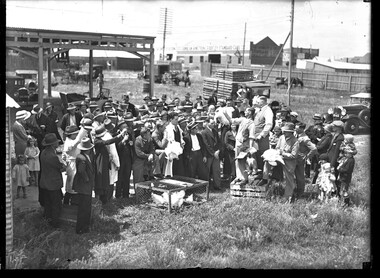
Photograph, Bull, Hugh Jones, 1897-1993, Poultry auction for Christmas dinners, Bentleigh Poultry Market
... feeding, marketing and other matters of concern to anyone keeping fowls. In 1914 poultry farms were spread from Ormond, through Cheltenham and Mentone to Mordialloc.” The Encyclopedia of Melbourne online advises that the Shire of Moorabbin once covered an extensive area of the south-eastern suburbs, land where the Boon wurrung people had hunted, fished and collected water from the natural springs near Beaumaris and Cheltenham. The Boon wurrung reputedly called this district Mooroobin, a name that Richard and John King adapted to Moorabbin for the cattle...feeding, marketing and other matters of concern to anyone keeping fowls. In 1914 poultry farms were spread from Ormond, through Cheltenham and Mentone to Mordialloc.” The Encyclopedia of Melbourne online advises that the Shire of Moorabbin once covered an extensive area of the south-eastern suburbs, land where the Boon wurrung people had hunted, fished and collected water from the natural springs near Beaumaris and Cheltenham. The Boon wurrung reputedly called this district Mooroobin, a name that Richard and John King adapted to Moorabbin for the cattle ...Published: Age (Melbourne, Vic.: 1854- ), Thursday 21 December 1933, page 11 Published title: : POULTRY FOR CHRISTMAS DINNERS Published caption: With the approach of the Festive Season, the demand for poultry of all descriptions tends to harden and good clearances of many thousands of birds have been effected at recent auctions. The above picture was taken yesterday at the sale conducted by Messrs. Parnham and Carter of Bentleigh, whose auctions are the largest in Melbourne on the basis of individual sales. The auctioneer's assistant is holding up a prime goose for the appraisement of bidders preparing for Christmas fare. Trove article identifier: http://nla.gov.au/nla.news-article203351699 Research by project volunteer, Louise McKenzie: This photo is full of action! A poultry auction is in full flight. The serious-looking auctioneer and his assistant stand on a Parnham & Carter wooden box so that the auctioneer can make eye contact with the bidding crowd. The auctioneer is wearing a waistcoat and tie and has his pencil and paper ready to record the winning bids. The assistant in overalls is holding a live white duck in each hand. Two other assistants also hold live birds. A wire cage on the ground holds a few white chickens – presumably the next auction items. The majority of the substantial crowd is male, mostly wearing Fedora hats and jackets or suits and ties. Some women are present, wearing hats and coats, and at least seven children are visible, some dressed up, others dressed more casually. The auction is taking place in a rural setting, possibly on the site where the birds are farmed. It is an informal, rather rough, grassed area next to a large shed with a high verandah. Two horse drawn vehicles are visible in the background, as well as five motorised vehicles. There are stacks of wooden boxes or crates which look as if they transport birds, and two cows are grazing by the fence. There are two telegraph poles with many lines. In the adjacent block is a very large car business comprising two large brick warehouse style buildings, plus outbuildings. The signage on one brick warehouse mentions Standard Cars. Both a man and a woman have their arms raised to bid. It is an occasion – but a serious one. We cannot be sure if these birds are for breeding or the table, but buying poultry for the Christmas meal was a tradition in Melbourne with purchasers going either to the auctions, or perhaps the Queen Victoria Market. The Argus in its article “Christmas Dinner” on 6 December 1932 advised of increased demand for turkeys and chickens ahead of a possible Christmas shortage. Part of this shortage would be because of the outbreak of Newcastle disease which resulted in a quarantine around Melbourne within which all killing must be under supervision and bear the Government brand. They believed this would result in smaller producers not bothering to get such a permit as "for many of them the poultry cheque is only pin money for their wives.” Interestingly, an article in the Sun News Pictorial of 26 January 1934 reported a strong market, and “One auctioneer stated that buyers were taking up chickens freely now for the Centenary celebrations because they would probably never be as plentiful at the present levels of prices until next season.” That same article quoted officials of the Department of Agriculture stating that "…they had received a fair number of inquiries from farmers recently on the possibilities of table poultry breeding for local and export markets. The good prices being paid for poultry were attracting interest.” In fact, on 29 December 1933, the Sun News-Pictorial had reported that for the first time, the innovation of holding poultry sales in Melbourne between the Christmas and New Year holidays had been trialled the day before, and had proved successful. The Bentleigh area had a long history of poultry farming. The Seal of the Municipality of Moorabbin has a cockerel featured in the top right quadrant, and according to its local history website, “Writers in the local press gave advice on breeding, feeding, marketing and other matters of concern to anyone keeping fowls. In 1914 poultry farms were spread from Ormond, through Cheltenham and Mentone to Mordialloc.” The Encyclopedia of Melbourne online advises that the Shire of Moorabbin once covered an extensive area of the south-eastern suburbs, land where the Boon wurrung people had hunted, fished and collected water from the natural springs near Beaumaris and Cheltenham. The Boon wurrung reputedly called this district Mooroobin, a name that Richard and John King adapted to Moorabbin for the cattle run they established in the mid-1840s. The sandy soil of much of the district proved suitable for market gardening which flourished in Moorabbin from the 1850s. Some districts, such as Highett, remained largely devoted to cattle, while fishing was a major activity in the coastal villages. Moorabbin's population remained tiny throughout the 19th and much of the early 20th century with less than 1000 ratepayers in the shire. When the more popular coastal resort areas of the shire seceded after World War I, Moorabbin was left as an under-serviced, still largely rural area. It was not until the 1930s that the population rose above 20,000. By the late 1930s poultry farming had been added to market gardening as a local industry. But northern sections of the city, such as Bentleigh and McKinnon, were beginning to develop as residential areas. The local council took steps to attract industry and new residents to the city by erecting reputedly the largest neon sign in Melbourne at the time on the Point Nepean Road (later Nepean Highway), pointing out that plentiful residential and industrial land was available. The era of gardeners’ picnics, the formation of the Market Gardeners’ & Fruit Growers’ Association, and the Moorabbin Horticultural, Poultry & Dog Society Spring Shows was over. References: POULTRY SALES HELD (1933, December 29). The Sun News-Pictorial (Melbourne, Vic. : 1922 - 1954; 1956), p. 20. Retrieved July 30, 2024, from http://nla.gov.au/nla.news-article276124760 MUCH INTEREST IN POULTRY (1934, January 26). The Sun News-Pictorial (Melbourne, Vic. : 1922 - 1954; 1956), p. 30. Retrieved July 30, 2024, from http://nla.gov.au/nla.news-article277292695 Christmas Dinner. (1932, December 6). The Argus (Melbourne, Vic. : 1848 - 1957), p. 6. Retrieved July 30, 2024, from http://nla.gov.au/nla.news-article4512606 'Moorabin', eMelbourne, https://www.emelbourne.net.au/biogs/EM01004b.htm 'City of Glen Eira Thematic Environmental History [Refresh] 2020', prepared for The City of Glen Eira by Built Heritage P/L, https://www.gleneira.vic.gov.au/media/7583/glen-eira-c214glen-city-of-glen-eira-thematic-environmentla-history-refresh-2020.pdf Photographer notations on slide: "Poultry for Christmas Dinners Age 21-12-33 B9".christmas, poultry
