
Showing 59 items matching "ceramic jar"
-
 Buninyong Visitor Information Centre
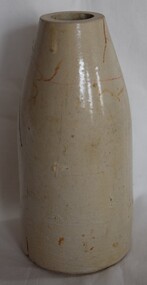
Container - Ceramic Jar, Pale coloured ceramic jar
... Ceramic Jar...Pale coloured ceramic jar....Pale coloured, bottle shaped ceramic jar with no stopper. Has a partial but illegible maker's mark. ...Further identification required. Pale coloured ceramic jar. Container Ceramic Jar ...Partial manufacturer's stamp on side near base not yet identified reads 'Port... das OLASO... Pottery'. Further research needed.Pale coloured, bottle shaped ceramic jar with no stopper. Has a partial but illegible maker's mark. Further identification required.'Port... das OLASO... Pottery'.pottery, containers, jars, ceramics -
 Buninyong Visitor Information Centre
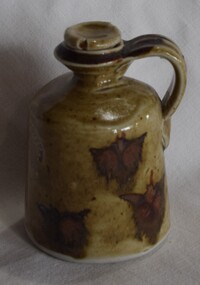
Container - Ceramic Jar, Old Library Pottery, Ceramic Jar with stopper and handle, Unknown
... Ceramic Jar...Ceramic Jar with stopper and handle....Small stopper and handle at the top. Ceramic Jar with stopper and handle. Container Ceramic Jar Old Library Pottery ...Made in the old Buninyong Library building which leased rooms to the potter. Small clay jar with brown glaze and bat-like red coloured figure patterning. Small stopper and handle at the top. Old Library Pottery, G.S.C., Buninyongceramics, pottery, old library pottery -
 Ballarat Heritage Services
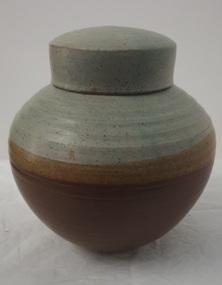
Ceramic - Domestic Ware, Lidded Ceramic Jar, c1992
... Lidded Ceramic Jar...Lidded Ceramic Jar...Ceramics Australian Studio Pottery Lidded Ceramic Jar Lidded Ceramic Jar Ceramic Domestic Ware ...Lidded Ceramic Jarceramics, australian studio pottery -
 Clunes Museum
Domestic object - CERAMIC COOKIE JAR
... CERAMIC COOKIE JAR...CERAMIC...COOKIE JAR...CREAM COLOURED CERAMIC COOKIE JAR WITH GREEN AND BLUE FLOWERS AND A BAMBOO HANDLE...CERAMIC COOKIE JAR CREAM COLOURED CERAMIC COOKIE JAR WITH GREEN AND BLUE FLOWERS AND A BAMBOO HANDLE Domestic object CERAMIC COOKIE JAR ...CREAM COLOURED CERAMIC COOKIE JAR WITH GREEN AND BLUE FLOWERS AND A BAMBOO HANDLEceramic, cookie jar -
Clunes Museum
Container - CERAMIC JAR
... CERAMIC JAR...CERAMIC JAR - NO LID - FINE EMBOSSED DESIGN TOP OF VESSEL...LOCAL HISTORY DOMESTIC ITEM CONTAINERS CERAMIC JAR - NO LID - FINE EMBOSSED DESIGN TOP OF VESSEL Container CERAMIC JAR ...CERAMIC JAR - NO LID - FINE EMBOSSED DESIGN TOP OF VESSELlocal history, domestic item, containers -
Glenelg Shire Council Cultural Collection
Container - Ceramic Jar, 1850s
... Ceramic Jar...Ceramic jar, hand made, cream base with straight sides, tan stain colour to neck, flat bottom. ...Wide mouth opening (55 mm) Nene Valley Container Ceramic Jar ...Found on shipwreck of 'Nene Valley' by an abalone diver some 10 years ago. Nene Valley was built in Durham, Sunderland, in 1852 – a typical merchant vessel of the era built for the colonial trade. In June 1854 Nene Valley left Gravesend, England, on its final voyage carrying nine passengers and cargo. On 19 October, the vessel grounded 15km northwest of Cape Northumberland after the crew mistook the land ahead for a cloud on the horizon. When they realised their mistake it was too late for evasive action. All passengers and crew evacuated safely, but the following morning four crew drowned after they returned to the vessel to cut away the masts.Ceramic jar, hand made, cream base with straight sides, tan stain colour to neck, flat bottom. Wide mouth opening (55 mm) Nene ValleyNene Valleynene valley, shipwreck, container -
 Bendigo Historical Society Inc.
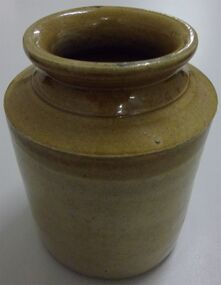
Container - HARRIS COLLECTION: CERAMIC JAR
... HARRIS COLLECTION: CERAMIC JAR...Double glazed ceramic jar. Main body beige colour, top light brown. ...BHS Collection DOMESTIC EQUIPMENT Food storage & preservation Double glazed ceramic jar. Main body beige colour, top light brown. ...BHS CollectionDouble glazed ceramic jar. Main body beige colour, top light brown. The jar is 14 cm tall with a diameter at the bottom of 10.5 cm. The opening is 6.5 cm. There are no marks on this jar. from George Harris estatedomestic equipment, food storage & preservation -
 Bendigo Historical Society Inc.
Container - HARRIS COLLECTION: ROUND CERAMIC JAR
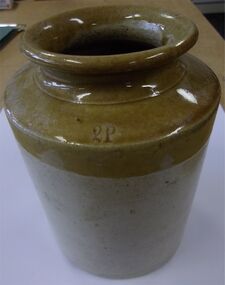
... HARRIS COLLECTION: ROUND CERAMIC JAR...Large double glazed round ceramic jar. The main body is beige in colour, the top is light brown. ...BHS Collection DOMESTIC EQUIPMENT Food storage & preservation Large double glazed round ceramic jar. The main body is beige in colour, the top is light brown. ...BHS CollectionLarge double glazed round ceramic jar. The main body is beige in colour, the top is light brown. The mark 2P is on the top side. The jar is 17 cm. tall, the diameter at the bottom is 11.4 cm, the mouth opening is 7cm. from George Harris estatedomestic equipment, food storage & preservation -
 Bendigo Historical Society Inc.
Container - HARRIS COLLECTION: CERAMIC JAR WITH HANDLE
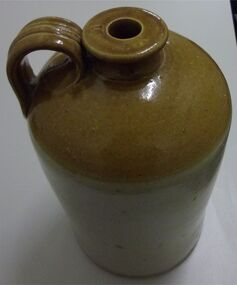
... HARRIS COLLECTION: CERAMIC JAR WITH HANDLE...Large double glazing ceramic jar with handle. The main body is beige the mouth, the handle and the top of the jar are light brown. ...From the George Harris estate Container HARRIS COLLECTION: CERAMIC JAR WITH HANDLE ...This item is a demijohn. The name demijohn is believed to have come from the French "dame-jeanne" or Lady Jane, with the term first being used in the 17th century.Large double glazing ceramic jar with handle. The main body is beige the mouth, the handle and the top of the jar are light brown. The number 1 is imprinted on the mouth near the handle. The diameter at the bottom is 17.5 cm. The mouth opening is 2.5 cm. From the George Harris estatedomestic equipment, food storage & preservation -
 Bendigo Historical Society Inc.
Container - SNUFF JAR CERAMIC TADDY AND COMPANY. H.G.J.BIGGS
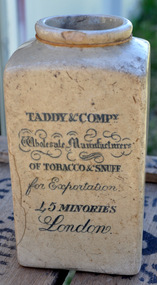
... SNUFF JAR CERAMIC TADDY AND COMPANY. H.G.J.BIGGS...Ceramic Snuff Jar (Previously # 90 from Mechanics Institute Eaglehawk ) Ceramic jar decorated with 'Taddy and Company, Wholesale Manufacturers of Tobacco and Snuff. ...Tobacco Taddy and Company Ceramic Snuff Jar (Previously # 90 from Mechanics Institute Eaglehawk ) Ceramic jar decorated with 'Taddy and Company, Wholesale Manufacturers of Tobacco and Snuff. ...Ceramic Snuff Jar (Previously # 90 from Mechanics Institute Eaglehawk ) Ceramic jar decorated with 'Taddy and Company, Wholesale Manufacturers of Tobacco and Snuff. For Exportation, 45 minories, London' Label attached H.J.G.Biggs , Eaglehawktobacco, taddy and company -
Clunes Museum
Domestic object - CERAMIC JAR
... CERAMIC JAR...LOCAL HISTORY DOMESTIC ITEM CONTAINERS ROUND CERAMIC CONTAINER WITH HANDLES ON EACH SIDE Domestic object CERAMIC JAR ...ROUND CERAMIC CONTAINER WITH HANDLES ON EACH SIDElocal history, domestic item, containers, -
 Flagstaff Hill Maritime Museum and Village
Container - Ceramic Salt Container, Doulton Lambeth, circa 1880
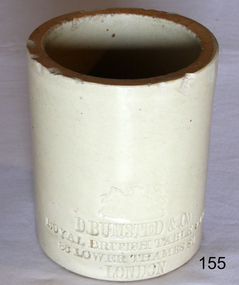
... ...ceramic container...salt jar...Glazed Container; cream coloured ceramic salt jar, round shaped, ..."D.BUMSTEAD & CO.\ ROYAL BRITISH TABLE SALT \ 86 LOWER THAMES ST \ LONDON" Glazed Container; cream coloured ceramic salt jar, round shaped, Container Ceramic Salt Container D. ...The 1846 London Directory lists David Bumsted & Co., trading at 86 Lower Thames Street, 35 Bridge Wharf, City Road Basin & 338 Wapping High Street Droitwich, as a salt merchant. The London Gazette had the following announcement dated 30th November 1887 advising his partnership with John Campbell Bumsted, carrying on business at 36, King William-street, in the city of London, as Salt Merchants, is dissolved as and from this date; and that the business will be continued to be carried on by the said John Campbell Bumsted alone.A rare item now sought after by collector of ceramics and significant as a collectors item from the late 19th century.Glazed Container; cream coloured ceramic salt jar, round shaped, Has lion and unicorn emblem and inscription impressed on outside. "D.BUMSTEAD & CO.\ ROYAL BRITISH TABLE SALT \ 86 LOWER THAMES ST \ LONDON"flagstaff hill, warrnambool, flagstaff hill maritime museum, shipwreck coast, flagstaff hill maritime village, great ocean road, ceramic container, salt jar, d. bumstead & co, london salt merchant, food and drink, doulton & co -
 Robin Boyd Foundation
Container - Jar
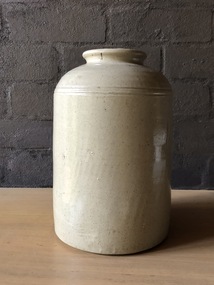
... Ceramic jar, cylindrical, stone colour...Walsh St furnishings robin boyd Sticker with 66 underlined on base Ceramic jar, cylindrical, stone colour Container Jar ...Ceramic jar, cylindrical, stone colourSticker with 66 underlined on basewalsh st furnishings, robin boyd -
 Flagstaff Hill Maritime Museum and Village
Ceramic - Amphora, mid-to-late 19th century
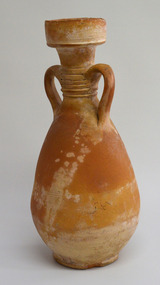
... ...ceramic jar...Flagstaff Hill Maritime Museum and Village Warrnambool Great Ocean Road Shipwreck Coast amphora jug Mahogany ship ancient wreck Joe O'Keefe Duncan Thermoluminescence North Africa Levy Point pottery storage jar Flagstaff Hill Maritime Museum Maritime Village shipwreck artefact relic Shipwreck Museum pottery jar ancient jar Egyptian water pot Greek jar ceramic jar mystery exotic jar mystery antique historic jug 1934 Joe O’Keefe Marshall Duncan Port Fairy 1935 1985 Marshall McKenzie Duncan Mac Duncan Duncan family 1981 Dan Madden scientific investigation scientific analysis scientific dating North African origin mid-late 19th century Marram grass Levy’s Point Pinhole patterns: [3 holes above 3 holes] opposite [3 holes above 3 holes], 1 hole] [ 1 hole above 2 holes] Amphora or jug; earthenware, orange clay with areas of cream. ...This amphora or jug has a silhouette shaped like a woman with her hands on her hips, wearing a long, flared-out skirt. The design was used in ancient Greece for pottery storage jars, the neck being narrower than the body. According to reports, this amphora was discovered in 1934 by Joe O'Keeffe, in a sand blowout, or sand hummocks, west of Levy's Point, west of Warrnambool, while he was planting marram grass for Mr Duncan. An article in the Warrnambool Standard newspaper of December 21, 1985, states that the amphora may be linked to the wooden sailing ship called the Mahogany Ship (also called the Ancient Wreck). Thermoluminescence testing indicates the relic was made in the mid-to-late 19th century, and experts suggest it was of North African origin. The presence of the amphora in the dunes, and the amphora itself, is still a mystery. The amphora was donated to Flagstaff Hill on a long-term loan by the Duncan family and displayed to the public for the first time on December 21, 1985. The exhibition continued until February 2023, when the objects on display in the Assistant Lighthouse Keepers Cottage (Shipwreck Museum) were returned to storage to rest, and the redevelopment of the Cottage began. A search for members of the Duncan Family was undertaken by Flagstaff Hill and stakeholders to resolve the loan term, but the family at that time was unknown. As such, to properly care for the amphora, it has been registered until ownership can be determined. The amphora is currently on display in the Great Circle Gallery, where members of the Duncan family recognised it and have since made contact with the museum. The amphora's presence in the hummocks remains an intriguing and tantalising mystery, yet to be solved!The amphora is significant for the mystery it holds. Its origin and connection with the local area have led to local speculation since it was discovered in 1934. Amphora or jug; earthenware, orange clay with areas of cream. The vessel has a wide mouth, a deep lip, two opposing handles between the neck and shoulder, and a bulbous body. The curved handles have a design of six bands between them. There are three rings of small dots encircling the body. The underside has concentric circles in the clay, an uneven edge and pinhole markings. The amphora is kindly on loan from the Duncan family.Pinhole patterns: [3 holes above 3 holes] opposite [3 holes above 3 holes], 1 hole] [ 1 hole above 2 holes] flagstaff hill maritime museum and village, warrnambool, great ocean road, shipwreck coast, amphora, jug, mahogany ship, ancient wreck, joe o'keefe, duncan, thermoluminescence, north africa, levy point, pottery, storage jar, flagstaff hill, maritime museum, maritime village, shipwreck artefact, relic, shipwreck museum, pottery jar, ancient jar, egyptian water pot, greek jar, ceramic jar, mystery, exotic jar, mystery antique, historic jug, 1934, joe o’keefe, marshall duncan, port fairy, 1935, 1985, marshall mckenzie duncan, mac duncan, duncan family, 1981, dan madden, scientific investigation, scientific analysis, scientific dating, north african origin, mid-late 19th century, marram grass, levy’s point -
 Coal Creek Community Park & Museum
Domestic object - Mug
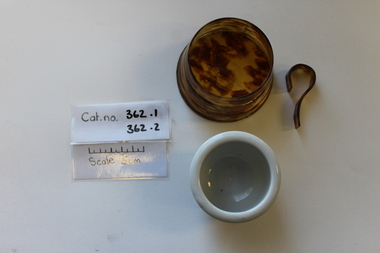
... Mug in two parts, synthetic material holder containing removable ceramic jar...Mug in two parts, synthetic material holder containing removable ceramic jar Domestic object Mug ...Mug in two parts, synthetic material holder containing removable ceramic jar -
 Trafalgar Holden Museum
Container - Properts saddle stain, Circa 1900
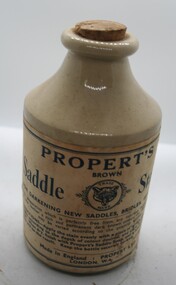
... Beige ceramic Jar with cork stopper labelled as Properts saddle stain along with instructions for use...Used for preserving new saddles, bridles and other leather goods As imported and sold by Holden and Frost leather stain properts Properts saddle stain along with instructions for use Beige ceramic Jar with cork stopper labelled as Properts saddle stain along with instructions for use Container Properts saddle stain ...Used for preserving new saddles, bridles and other leather goodsAs imported and sold by Holden and FrostBeige ceramic Jar with cork stopper labelled as Properts saddle stain along with instructions for useProperts saddle stain along with instructions for useleather stain, properts -
 Kiewa Valley Historical Society
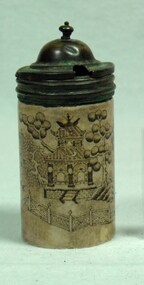
Dispenser Mustard, 1860's
... Small Ceramic jar with brown willow Chinese pattern. ... copper chinese table items kitchen domestic mustard willow pattern Small Ceramic jar with brown willow Chinese pattern. ...This item would have been used as a salt container and would have been part of a dinner set. This would have been used for special occasions . It is in good condition and is a good example of this type salt storage jar. As this has a brown willow pattern instead of the usual blue it makes this make this salt despenser rare item.This has social and historical significance as it shows what items families used for special dinner occasions. It is the only one our collection and therefore will have good interpretation value for exhibitions . Small Ceramic jar with brown willow Chinese pattern. Copper hinged lid with recess for spoon. The spoon is required to dispense the mustard.ceramic, copper, chinese, table items, kitchen, domestic, mustard, willow pattern -
 Whitehorse Historical Society Inc.
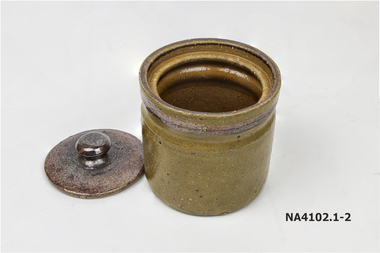
Container - Jar and lid, c1970
... Tan ceramic jar with lid. Lid is brown with knot on top and rests in a circle above an indented circle on the main body of the jar...Bought by donor at factory in Bendigo domestic items containers Bendigo Pottery Tan ceramic jar with lid. Lid is brown with knot on top and rests in a circle above an indented circle on the main body of the jar Container Jar and lid ...The jar is a product of the Bendigo Pottery in Victoria. Bought by donor at factory in BendigoTan ceramic jar with lid. Lid is brown with knot on top and rests in a circle above an indented circle on the main body of the jarBendigo Potterydomestic items, containers -
 Orbost & District Historical Society
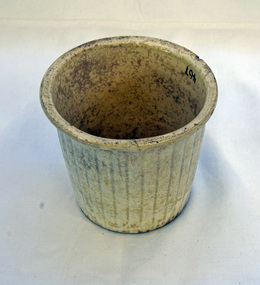
jar
... container ceramic dripping-jar household-uses...Used as a dripping jar. container ceramic dripping-jar household-uses Small ceramic container with a wider top than bottom and with lines running down the outside. ...Used as a dripping jar.Small ceramic container with a wider top than bottom and with lines running down the outside. Cream colour with staining inside.container ceramic dripping-jar household-uses -
 Parks Victoria - Gabo Island Lightstation
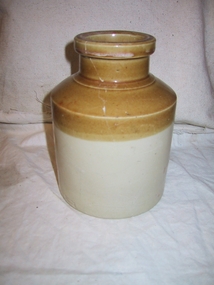
Jar
... Ceramic jar. Squat shape, body of jar is cream coloured. ..."POWEL &DB Stol" Ceramic jar. Squat shape, body of jar is cream coloured. ...The glazed stoneware pot is an oyster jar made by Powell potteries, Bristol, probably between 1860 and 1880. Pickled oysters were a regular food of the poor in England in the 19thc. Sam Weller, Charles Dickens’ character in Pickwick Papers (1836-37) commented that ‘Poverty and oysters always seen to go together’. In England, pickling oysters for transport to inland towns and long voyages became an industry. The jar was found in sand near the jetty in 1999.Whatever their provenance, they have an association with an event or activity on Gabo Island and for this reason have second level contributory significance for their potential to yield information relating to the cultural history of the lightstation.Ceramic jar. Squat shape, body of jar is cream coloured. Spots of mildew on side. The jar has a pronounced lip, short neck, sloping shoulders and rounded body. Just below the shoulder, the glaze colour changes from brown to stone."POWEL &DB Stol" -
 Flagstaff Hill Maritime Museum and Village
Jar
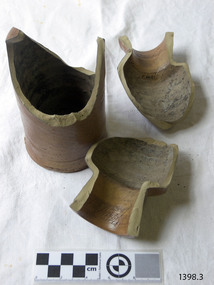
... Jar, ceramic cylindrical in shape with neck and wide spout, glazed brown. ...flagstaff hill warrnambool shipwrecked-coast flagstaff-hill flagstaff-hill-maritime-museum maritime-museum shipwreck-coast flagstaff-hill-maritime-village Jar Jar, ceramic cylindrical in shape with neck and wide spout, glazed brown. ...Jar, ceramic cylindrical in shape with neck and wide spout, glazed brown. Broken into three pieces and chipped at base.flagstaff hill, warrnambool, shipwrecked-coast, flagstaff-hill, flagstaff-hill-maritime-museum, maritime-museum, shipwreck-coast, flagstaff-hill-maritime-village, jar -
 Orbost & District Historical Society
ginger jar, Pre 1893 floods in Orbost
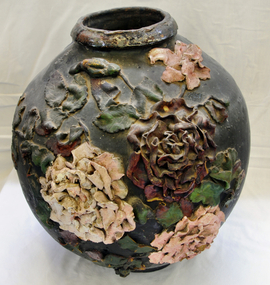
... Looks more like a vase than a ginger jar. Ceramic....Looks more like a vase than a ginger jar. Ceramic. ginger jar ...In the early days of Orbost many Chinese were engaged in land clearing or had arrived when gold was discovered in East Gippsland in the 1840's. They lived in camps along the Marlo Road and houses were usually built on stilts. They left after the 1893 floods.This object has aesthetic appeal. It is an object which belonged to the very early settlement days of Orbost.Huge, ornate Chinese ginger jar. Four raised hand- painted pink roses on front. Jar itself is matt black. Looks more like a vase than a ginger jar. Ceramic.Some Chinese writing to left hand side of roses.ceramics, ginger jar, container - domestic, vase -
 Wodonga & District Historical Society Inc
Functional object - Earthenware Bottle - Brown Brothers Milawa, 1970s - 1980s
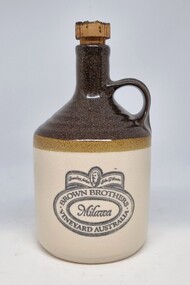
... Since 1899 Brown Brothers has grown into one of Australia’s largest family-owned wine businesses and now operates several vineyards in Victoria and Tasmania. These ceramic jars were used by Brown Brothers in the 1970s and 1980s to package Port, Muscat and Tokay. ...Since 1899 Brown Brothers has grown into one of Australia’s largest family-owned wine businesses and now operates several vineyards in Victoria and Tasmania. These ceramic jars were used by Brown Brothers in the 1970s and 1980s to package Port, Muscat and Tokay. ...In 1885 John Francis Brown first planted 10 acres of vines in Milawa, Victoria. Brown Brothers was founded in 1889 when the vines were ready to produce their first crop, as John hoped his brothers would join him in this new and promising venture. This did not happen but the name remained. Since 1899 Brown Brothers has grown into one of Australia’s largest family-owned wine businesses and now operates several vineyards in Victoria and Tasmania. These ceramic jars were used by Brown Brothers in the 1970s and 1980s to package Port, Muscat and Tokay. Fortified wines packaged in this manner would maintain their quality for decades as long as the wax seal was unbroken. Elischer Pottery was started in Sandringham, Melbourne Victoria in 1947 by well-known sculptor John (Johann Wolfgang) Elischer (1891-1966) and his son, also named John, (known as Wolly). John (Snr) was born in Vienna and trained at the Academy of Vienna from 1908 to 1911 and was an Associate of the Royal Academy Vienna. John (Senior) died in 1966 and the business was continued by his son John (Wolly), until 1987 when it was sold. Prior to that, at some time, he started making pieces the brand NCP. The business continues today as “Unique Ceramics” in Highett, Victoria. They continue to use the “Elischer” brand on some of their products.This jug is representative of an historic and continuing leading Australian Winemaker located in Northeast Victoria.An earthenware wine jug created for Brown Brothers Milawa Vineyard manufactured by John Elischer Pottery. The jug has a tradition loop handle. The bottom half of the jug is a traditional beige colour with a darker brown top section. The logo is imprinted in black and is covered in a clear glaze. The cork stopper is still intact although before being opened would have been sealed with wax.Company logo on one side: at top a central male image between the text "Founding Father /John F Brown. In a central oval around the name "Milawa", BROWN BROTHERS/ VINEYARD AUSTRALIA" On base: "97"brown brothers milawa, elischer pottery, northeast victorian wineries -
 Flagstaff Hill Maritime Museum and Village
Container - Ink Bottle, Royal Doulton, 1853-1878
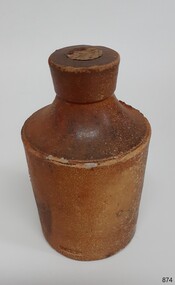
... ceramic and home accessories manufacturer founded in 1815. Operating initially in Vauxhall, London, it later moved to Lambeth, In1882 it opened a factory in Burslem, Stoke on Trent, in the centre of English pottery. The business specialised in making salt-glazed stoneware articles, including utilitarian or decorative bottles, jugs and jars...ceramic and home accessories manufacturer founded in 1815. Operating initially in Vauxhall, London, it later moved to Lambeth, In1882 it opened a factory in Burslem, Stoke on Trent, in the centre of English pottery. The business specialised in making salt-glazed stoneware articles, including utilitarian or decorative bottles, jugs and jars ...The ink bottle was made by the Royal Doulton company which began as a partnership between John Doulton, Martha Jones, and John Wattis an English ceramic and home accessories manufacturer founded in 1815. Operating initially in Vauxhall, London, it later moved to Lambeth, In1882 it opened a factory in Burslem, Stoke on Trent, in the centre of English pottery. The business specialised in making salt-glazed stoneware articles, including utilitarian or decorative bottles, jugs and jars, much of it intended for inns and pubs. The backbone of the business was a wide range of utilitarian wares, mostly stoneware's, including storage jars, tankards and the like, and later extending to pipes for drains, lavatories and other bathroom ceramics. From 1853 to 1902 its wares were marked Doulton & Co., then from 1902, when a royal warrant was given, wares were marked Royal Doulton. The company always made some more decorative items, initially still mostly stoneware, and from the 1860s the firm made considerable efforts to get a reputation for design, in which it was largely successful, as one of the first British makers of art pottery. Initially, this was done through artistic stoneware made in Lambeth, but in 1882 the firm bought a Burslem factory, which was mainly intended for making bone china table wares and decorative items. History of the Loch Ard: The Loch Ard got its name from ”Loch Ard” a loch that lies to the west of Aberfoyle, and the east of Loch Lomond. It means "high lake" in Scottish Gaelic. The vessel belonged to the famous Loch Line which sailed many vessels from England to Australia. The Loch Ard was built in Glasgow by Barclay, Curdle and Co. in 1873, the vessel was a three-masted square-rigged iron sailing ship that measured 79.87 meters in length, 11.58 m in width, and 7 m in depth with a gross tonnage of 1693 tons with a mainmast that measured a massive 45.7 m in height. Loch Ard made three trips to Australia and one trip to Calcutta before its fateful voyage. Loch Ard left England on March 2, 1878, under the command of 29-year-old Captain Gibbs, who was newly married. The ship was bound for Melbourne with a crew of 37, plus 17 passengers. The general cargo reflected the affluence of Melbourne at the time. Onboard were straw hats, umbrellas, perfumes, clay pipes, pianos, clocks, confectionery, linen and candles, as well as a heavier load of railway irons, cement, lead and copper. There were other items included that were intended for display in the Melbourne International Exhibition of 1880. The voyage to Port Phillip was long but uneventful. Then at 3 am on June 1, 1878, Captain Gibbs was expecting to see land. But the Loch Ard was running into a fog which greatly reduced visibility. Captain Gibbs was becoming anxious as there was no sign of land or the Cape Otway lighthouse. At 4 am the fog lifted and a lookout aloft announced that he could see breakers. The sheer cliffs of Victoria's west coast came into view, and Captain Gibbs realised that the ship was much closer to them than expected. He ordered as much sail to be set as time would permit and then attempted to steer the vessel out to sea. On coming head-on into the wind, the ship lost momentum, the sails fell limp and Loch Ard's bow swung back towards land. Gibbs then ordered the anchors to be released in an attempt to hold their position. The anchors sank some 50 fathoms - but did not hold. By this time the ship was among the breakers and the tall cliffs of Mutton Bird Island rose behind. Just half a mile from the coast, the ship's bow was suddenly pulled around by the anchor. The captain tried to tack out to sea, but the ship struck a reef at the base of Mutton Bird Island, near Port Campbell. Waves subsequently broke over the ship and the top deck became loosened from the hull. The masts and rigging came crashing down knocking passengers and crew overboard. When a lifeboat was finally launched, it crashed into the side of Loch Ard and capsized. Tom Pearce, who had launched the boat, managed to cling to its overturned hull and shelter beneath it. He drifted out to sea and then on the flood tide came into what is now known as Lochard Gorge. He swam to shore, bruised and dazed, and found a cave in which to shelter. Some of the crew stayed below deck to shelter from the falling rigging but drowned when the ship slipped off the reef into deeper water. Eva Carmichael a passenger had raced onto the deck to find out what was happening only to be confronted by towering cliffs looming above the stricken ship. In all the chaos, Captain Gibbs grabbed Eva and said, "If you are saved Eva, let my dear wife know that I died like a sailor". That was the last Eva Carmichael saw of the captain. She was swept off the ship by a huge wave. Eva saw Tom Pearce on a small rocky beach and yelled to attract his attention. He dived in and swam to the exhausted woman and dragged her to shore. He took her to the cave and broke the open case of brandy which had washed up on the beach. He opened a bottle to revive the unconscious woman. A few hours later Tom scaled a cliff in search of help. He followed hoof prints and came by chance upon two men from nearby Glenample Station three and a half miles away. In a complete state of exhaustion, he told the men of the tragedy. Tom then returned to the gorge while the two men rode back to the station to get help. By the time they reached Loch Ard Gorge, it was cold and dark. The two shipwreck survivors were taken to Glenample Station to recover. Eva stayed at the station for six weeks before returning to Ireland by steamship. In Melbourne, Tom Pearce received a hero's welcome. He was presented with the first gold medal of the Royal Humane Society of Victoria and a £1000 cheque from the Victorian Government. Concerts were performed to honour the young man's bravery and to raise money for those who lost family in the disaster. Of the 54 crew members and passengers on board, only two survived: the apprentice, Tom Pearce and the young woman passenger, Eva Carmichael, who lost her family in the tragedy. Ten days after the Lochard tragedy, salvage rights to the wreck were sold at auction for £2,120. Cargo valued at £3,000 was salvaged and placed on the beach, but most washed back into the sea when another storm developed. The wreck of Lochard still lies at the base of Mutton Bird Island. Much of the cargo has now been salvaged and some items were washed up into Lochard Gorge. Cargo and artefacts have also been illegally salvaged over many years before protective legislation was introduced in March 1982. One of the most unlikely pieces of cargo to have survived the shipwreck was a Minton majolica peacock- one of only nine in the world. The peacock was destined for the Melbourne 1880 International Exhibition. It had been well packed, which gave it adequate protection during the violent storm. Today the Minton peacock can be seen at the Flagstaff Hill Maritime Museum in Warrnambool. From Australia's most dramatic shipwreck, it has now become Australia's most valuable shipwreck artifact and is one of very few 'objects' on the Victorian State Heritage Register.An early utilitarian stoneware item made by a well-known company that specialised in making salt-glazed items that later earned a reputation for making stoneware art objects. Of additional significance is that it was recovered from the wreck of the Loch Ard. A shipwreck that is of additional significance as it is registered on the Victorian Heritage Register ( S 417). Flagstaff Hill has a varied collection of artefacts from Loch Ard and its collection is significant for being one of the largest accumulations of artefacts from this notable Victorian shipwreck of which the subject items are a small part. The collections objects give us a snapshot of how we can interpret the story of this tragic event. The collection is also archaeologically significant as it represents aspects of Victoria's shipping history that allows us to interpret Victoria's social and historical themes of the time. Through is associated with the worst and best-known shipwreck in Victoria's history. Salt glazed stoneware ink bottle, large capacity, tapered lip and body, two-tone brown with some encrustation on surface, still sealed with cork. Inscription in clay. Recovered from the wreck of the LOCH ARD.Stamped into clay "DOULTON LAMBETH"flagstaff hill, warrnambool, flagstaff hill maritime museum, shipwreck coast, flagstaff hill maritime village, great ocean road, loch line, loch ard, captain gibbs, eva carmichael, tom pearce, glenample station, mutton bird island, loch ard gorge, ink bottle, bulk ink bottle, writing accessory, stationery, stoneware, doulton lambeth, royal doulton, writing equipment -
 Flagstaff Hill Maritime Museum and Village
Ceramic - Lid, circa 1878
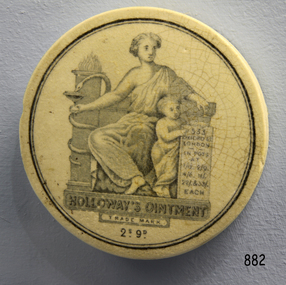
... ceramic lid is from a Holloway’s Ointment pot. It was retrieved from the wreckage of the LOCH ARD. The vessel was laden with an up-to-date, high-value cargo, including luxury items intended for the Melbourne International Exhibition in 1880. Britain exported her manufactures to the Australasian colonies and the Americas. Holloway’s Ointment was one nineteenth-century pharmaceutical product that was advertised in both these markets. The price of this particular jar...ceramic lid is from a Holloway’s Ointment pot. It was retrieved from the wreckage of the LOCH ARD. The vessel was laden with an up-to-date, high-value cargo, including luxury items intended for the Melbourne International Exhibition in 1880. Britain exported her manufactures to the Australasian colonies and the Americas. Holloway’s Ointment was one nineteenth-century pharmaceutical product that was advertised in both these markets. The price of this particular jar ...This ceramic lid is from a Holloway’s Ointment pot. It was retrieved from the wreckage of the LOCH ARD. The vessel was laden with an up-to-date, high-value cargo, including luxury items intended for the Melbourne International Exhibition in 1880. Britain exported her manufactures to the Australasian colonies and the Americas. Holloway’s Ointment was one nineteenth-century pharmaceutical product that was advertised in both these markets. The price of this particular jar and its contents was printed on the label as “2S 9D” (2 shillings and nine pence). This value calculated to the approximate price in 2014, would be £51.31 (UK pounds and decimal pence) or $85 AU ― quite an expensive ointment. The label also shows a picture of a stone tablet with the inscription "IN POTS AT 1/½, 2/9, 4/6,11/-, 22/- & 33/- EACH”, which is most likely the alternative prices that the ointment was available for in differently sized containers. Holloway’s claims for his “great remedy” included the cure of sores, wounds, ulcers and boils, gout, rheumatism, diphtheria, bronchitis, influenza, sore throats, coughs and colds, “all varieties of skin diseases”, scrofula, ringworm, scurvy, “dropsical swellings” and liver disease, piles, fistulas, and internal inflammation. The salve cream was said to penetrate the skin when rubbed on; purifying internal tissues and organs, cleansing all bodily fluids particularly the blood, and eradicating all disease from the body. Purchasers were assured that if Holloway’s Ointment alone did not affect immediate cure, then the combination of it and Holloway’s Pills (sold separately) most certainly would. Thomas Holloway began manufacturing and marketing his miraculous ointment from premises at 244 Strand in the 1840s, moving to the more prestigious address of 533 Oxford in the late 1860s. The London address was an important part of his promotional appeal and was displayed prominently on the packaging of his products. Holloway’s attention to marketing is also observed in the pseudo-Classical emblems that decorated his containers. The sign of a snake curled around a staff is a longstanding and commonly recognised symbol of the physician’s power to heal. Similar reference on this lid is also being made to an ancient goddess of healing and her healthy young offspring. History of the Loch Ard: The Loch Ard got its name from ”Loch Ard” a loch which lies to the west of Aberfoyle, and the east of Loch Lomond. It means "high lake" in Scottish Gaelic. The vessel belonged to the famous Loch Line which sailed many vessels from England to Australia. The Loch Ard was built in Glasgow by Barclay, Curdle and Co. in 1873, the vessel was a three-masted square-rigged iron sailing ship that measured 79.87 meters in length, 11.58 m in width, and 7 m in depth with a gross tonnage of 1693 tons with a mainmast that measured a massive 45.7 m in height. Loch Ard made three trips to Australia and one trip to Calcutta before its fateful voyage. Loch Ard left England on March 2, 1878, under the command of 29-year-old Captain Gibbs, who was newly married. The ship was bound for Melbourne with a crew of 37, plus 17 passengers. The general cargo reflected the affluence of Melbourne at the time. Onboard were straw hats, umbrella, perfumes, clay pipes, pianos, clocks, confectionery, linen and candles, as well as a heavier load of railway irons, cement, lead and copper. There were other items included that were intended for display in the Melbourne International Exhibition of 1880. The voyage to Port Phillip was long but uneventful. Then at 3 am on June 1, 1878, Captain Gibbs was expecting to see land. But the Loch Ard was running into a fog which greatly reduced visibility. Captain Gibbs was becoming anxious as there was no sign of land or the Cape Otway lighthouse. At 4 am the fog lifted and a lookout aloft announced that he could see breakers. The sheer cliffs of Victoria's west coast came into view, and Captain Gibbs realised that the ship was much closer to them than expected. He ordered as much sail to be set as time would permit and then attempted to steer the vessel out to sea. On coming head-on into the wind, the ship lost momentum, the sails fell limp and Loch Ard's bow swung back towards land. Gibbs then ordered the anchors to be released in an attempt to hold its position. The anchors sank some 50 fathoms - but did not hold. By this time the ship was among the breakers and the tall cliffs of Mutton Bird Island rose behind. Just half a mile from the coast, the ship's bow was suddenly pulled around by the anchor. The captain tried to tack out to sea, but the ship struck a reef at the base of Mutton Bird Island, near Port Campbell. Waves subsequently broke over the ship and the top deck became loosened from the hull. The masts and rigging came crashing down knocking passengers and crew overboard. When a lifeboat was finally launched, it crashed into the side of Loch Ard and capsized. Tom Pearce, who had launched the boat, managed to cling to its overturned hull and shelter beneath it. He drifted out to sea and then on the flood tide came into what is now known as Lochard Gorge. He swam to shore, bruised and dazed, and found a cave in which to shelter. Some of the crew stayed below deck to shelter from the falling rigging but drowned when the ship slipped off the reef into deeper water. Eva Carmichael a passenger had raced onto the deck to find out what was happening only to be confronted by towering cliffs looming above the stricken ship. In all the chaos, Captain Gibbs grabbed Eva and said, "If you are saved Eva, let my dear wife know that I died like a sailor". That was the last Eva Carmichael saw of the captain. She was swept off the ship by a huge wave. Eva saw Tom Pearce on a small rocky beach and yelled to attract his attention. He dived in and swam to the exhausted woman and dragged her to shore. He took her to the cave and broke the open case of brandy which had washed up on the beach. He opened a bottle to revive the unconscious woman. A few hours later Tom scaled a cliff in search of help. He followed hoof prints and came by chance upon two men from nearby Glenample Station three and a half miles away. In a complete state of exhaustion, he told the men of the tragedy. Tom then returned to the gorge while the two men rode back to the station to get help. By the time they reached Loch Ard Gorge, it was cold and dark. The two shipwreck survivors were taken to Glenample Station to recover. Eva stayed at the station for six weeks before returning to Ireland by steamship. In Melbourne, Tom Pearce received a hero's welcome. He was presented with the first gold medal of the Royal Humane Society of Victoria and a £1000 cheque from the Victorian Government. Concerts were performed to honour the young man's bravery and to raise money for those who lost family in the disaster. Of the 54 crew members and passengers on board, only two survived: the apprentice, Tom Pearce and the young woman passenger, Eva Carmichael, who lost her family in the tragedy. Ten days after the Lochard tragedy, salvage rights to the wreck were sold at auction for £2,120. Cargo valued at £3,000 was salvaged and placed on the beach, but most washed back into the sea when another storm developed. The wreck of Lochard still lies at the base of Mutton Bird Island. Much of the cargo has now been salvaged and some items were washed up into Lochard Gorge. Cargo and artefacts have also been illegally salvaged over many years before protective legislation was introduced in March 1982. One of the most unlikely pieces of cargo to have survived the shipwreck was a Minton majolica peacock- one of only nine in the world. The peacock was destined for the Melbourne 1880 International Exhibition in. It had been well packed, which gave it adequate protection during the violent storm. Today the Minton peacock can be seen at the Flagstaff Hill Maritime Museum in Warrnambool. From Australia's most dramatic shipwreck it has now become Australia's most valuable shipwreck artifact and is one of very few 'objects' on the Victorian State Heritage Register.The shipwreck of the Loch Ard is of significance for Victoria and is registered on the Victorian Heritage Register ( S 417). Flagstaff Hill has a varied collection of artefacts from Loch Ard and its collection is significant for being one of the largest accumulation of artefacts from this notable Victorian shipwreck of which the subject items are a small part. The collections objects give us a snapshot of how we can interpret the story of this tragic event. The collection is also archaeologically significant as it represents aspects of Victoria's shipping history that allows us to interpret Victoria's social and historical themes of the time. Through is associated with the worst and best-known shipwreck in Victoria's history. The ceramic lid off a Holloway’s Ointment container, retrieved from the wreckage of the LOCH ARD. The artefact is white with the pale blue image of a woman (seated) and a child (standing). The woman is draped in a soft white robe and her throne is beside a pillar that is entwined by a serpent. The child points to an inscribed stone tablet he is holding on the other side of seated woman. The front face of the lid, at the base of the woman on the throne, bears the label “HOLLOWAY’S OINTMENT”. Below this, in smaller letters, is written “TRADE MARK” and “2S.9D.” On the stone tablet pointed to by the child is inscribed “533 OXFORD ST. LONDON”, and beneath this, “IN POTS AT 1/½, 2/9, 4/6,11/-, 22/- & 33/- EACH”.flagstaff hill, warrnambool, flagstaff hill maritime museum, shipwreck coast, flagstaff hill maritime village, great ocean road, loch line, loch ard, captain gibbs, eva carmichael, tom pearce, glenample station, mutton bird island, loch ard gorge, holloway’s ointment, ceramic lid, pot lid, nineteenth-century medicines, pharmaceutical marketing -
 Flagstaff Hill Maritime Museum and Village
Ceramic - Stoneware Bottle, Doulton Lambeth, Circa 1870 - 1890
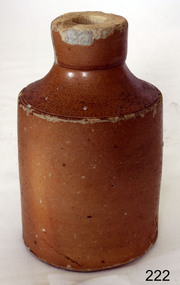
... ceramic and home accessories manufacturer founded in 1815. Operating originally in Vauxhall, London, later moving to Lambeth, in 1882 it opened a factory in Burslem, Stoke-on-Trent, in the centre of English pottery. The business was specialised in making salt-glazed stoneware articles, including utilitarian or decorative bottles, jugs and jars...ceramic and home accessories manufacturer founded in 1815. Operating originally in Vauxhall, London, later moving to Lambeth, in 1882 it opened a factory in Burslem, Stoke-on-Trent, in the centre of English pottery. The business was specialised in making salt-glazed stoneware articles, including utilitarian or decorative bottles, jugs and jars ...The Royal Doulton company began as a partnership between John Doulton, Martha Jones, and John Wattis an English ceramic and home accessories manufacturer founded in 1815. Operating originally in Vauxhall, London, later moving to Lambeth, in 1882 it opened a factory in Burslem, Stoke-on-Trent, in the centre of English pottery. The business was specialised in making salt-glazed stoneware articles, including utilitarian or decorative bottles, jugs and jars, much of it intended for inns and pubs. The backbone of the business was a wide range of utilitarian wares, mostly stone wares, including storage jars, tankards and the like, and later extending to pipes for drains, lavatories and other bathroom ceramics. From 1853 to 1902 its wares were marked Doulton & Co., then from 1902, when a royal warrant was given, Royal Doulton. The company always made some more decorative items, initially still mostly stoneware, and from the 1860s the firm made considerable efforts to get a reputation for design, in which it was largely successful, as one of the first British makers of art pottery. Initially, this was done through artistic stoneware's made in Lambeth, but in 1882 the firm bought a Burslem factory, which was mainly intended for making bone china table wares and decorative items. An early utilitarian stoneware item made by a well-known company that specialised in making salt-glazed items that later earned a reputation for making stoneware art objects.Ink bottle, brown salt glazed stoneware with narrow mouth tamped Doulton Lambeth cork missing. Stamp impressed into clay on edge "(2)32 / Doulton / Lambeth" flagstaff hill, warrnambool, shipwrecked coast, flagstaff hill maritime museum, flagstaff hill maritime village, great ocean road, stoneware, stoneware jar, doulton lambeth, kitchen ware, salt glazed -
 Flagstaff Hill Maritime Museum and Village
Container - Jar Base
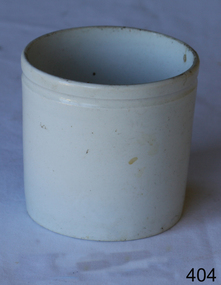
... Flagstaff Hill Warrnambool Shipwrecked-coast Flagstaff-Hill Flagstaff-Hill-Maritime-Museum Maritime-Museum Shipwreck-coast Flagstaff-Hill-Maritime-Village Ceramics None White ceramic container, glazed with single groove around circumference near lip Container Jar Base ...Human beings appear to have been making their own ceramics for at least 26,000 years, subjecting clay and silica to intense heat to fuse and form ceramic materials. The earliest found so far were in southern central Europe and were sculpted figures, not dishes. The earliest known pottery was made by mixing animal products with clay and baked in kilns at up to 800°C. While actual pottery fragments have been found up to 19,000 years old, it was not until about ten thousand years later that regular pottery became common. An early people that spread across much of Europe is named after its use of pottery, the Corded Ware culture. These early Indo-European peoples decorated their pottery by wrapping it with rope, while still wet. When the ceramics were fired, the rope burned off but left a decorative pattern of complex grooves on the surface. The invention of the wheel eventually led to the production of smoother, more even pottery using the wheel-forming technique, like the pottery wheel. Early ceramics were porous, absorbing water easily. It became useful for more items with the discovery of glazing techniques, coating pottery with silicon, bone ash, or other materials that could melt and reform into a glassy surface, making a vessel less pervious to water. https://en.wikipedia.org/wiki/CeramicThe discovery and development of ceramics in numerous shapes, form and materials, revolutionised the world.White ceramic container, glazed with single groove around circumference near lipNoneflagstaff hill, warrnambool, shipwrecked-coast, flagstaff-hill, flagstaff-hill-maritime-museum, maritime-museum, shipwreck-coast, flagstaff-hill-maritime-village, ceramics -
 Flagstaff Hill Maritime Museum and Village
Ceramic - Stoneware Bottle, Dundas Pottery, 1856-1910
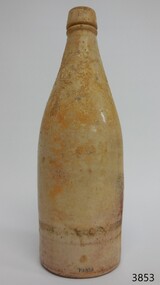
... jars and domestic wares in Bristol glaze. He streamlined the water filter manufacturing, which had become a speciality of the pottery, and a dedicated section of the pottery was created solely for their production, which was exported worldwide. A significant item of salt-glazed ceramic ...This bottle is part of the John Chance Collection of shipwreck artefacts. The Dundas Pottery works were established in 1828 by William Johnstone in partnership with John Forsyth and John Mc Coll. Located where the Forth and Clyde Canal joined the Monkland Canal, North of Glasgow. Johnstone sold the pottery in 1835 to Robert Cochran and James Couper. Mc Coll was retained as manager until 1837when in 1839 Cochran & Couper sold the pottery and purchased the St Rollex Glass Works. George Duncan took over briefly but died in 1841, with the pottery possibly being run by his widow Helen and a potter named Alexander Paul. James Miller was the manager at the time and he bought the pottery in 1856, in partnership with John Moody. Miller's long and careful stewardship of the pottery saw success from the export market which allowed him to purchase the North British pottery in 1867 until 1874 when it was sold. In 1875, Miller, in partnership with John Young, leased part of Caledonian Pottery, naming it Crown Pottery, however, it burned down in 1879. In the early 1880s, Young extended the pottery and named it Milton Pottery. Miller’s son, James W., became a partner in Milton pottery in 1905. James Miller Snr died in 1905 and the company continued as a limited liability company, being sold to the Borax Consolidation Ltd in 1929, but it was unsuccessful and Possil pottery purchased some of the company's equipment before it finally closed in 1932. From 1828 until the James Miller period of circa 1856, the pottery produced salt-glazed stoneware for the local industrial trade; mainly bottles and drain pipes. James Miller produced various bottles, whisky and acid jars, casks, butter crocks, jam jars and domestic wares in Bristol glaze. He streamlined the water filter manufacturing, which had become a speciality of the pottery, and a dedicated section of the pottery was created solely for their production, which was exported worldwide. A significant item of salt-glazed ceramic stoneware made by the Dundas potteries in Scotland who were renowned for making quality ironstone pottery. The bottle that was in common use throughout the British colonies and America for the containment of ale The bottle is also significant as it was recovered by John Chance, a diver, from a wreck on the coast of Victoria in the 1960s-70s. Items that come from several wrecks along Victoria's coast have since been donated to the Flagstaff Hill Maritime museum collection by his family Illustrating the level of historical value the subject item has.Beige salt glazed stoneware, bottle with discolorations above base. Manufacturer's oval Inscription lozenge stamped near base. Stamp: [symbol of concentric ovals], text within the symbol "PORT DUNDAS POTTERY COY." and "GLASGOW". Stamp:[Symbol - square with short vertical line in centre of base line]flagstaff hill, warrnambool, flagstaff hill maritime museum, maritime museum, shipwreck coast, flagstaff hill maritime village, great ocean road, john chance, stoneware bottle, pottery, port dundas pottery, william johnstone, bottles, shipwreck artefact, stoneware, ironstone, bottle, glasgow, antique bottle -
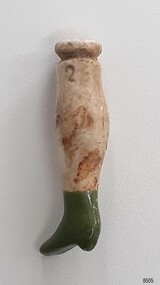 Flagstaff Hill Maritime Museum and Village
Leisure object - Doll's Leg, circa 1869
... The ceramic doll's leg was one of a group of artefacts in the McCulloch Collection that were recovered from the shipwreck Victoria Tower. The jar...The ceramic doll's leg was one of a group of artefacts in the McCulloch Collection that were recovered from the shipwreck Victoria Tower. The jar ...The ceramic doll's leg was one of a group of artefacts in the McCulloch Collection that were recovered from the shipwreck Victoria Tower. The jar could have been from the ship's cargo or amongst the passengers' personal effects. The object is now one of the shipwreck artefacts in Flagstaff Hill’s McCulloch Collection, which includes other items recovered from the Victoria Tower, built in Liverpool by Evans in 1969, and wrecked the same year near Torquay, Victoria, on its maiden voyage. A diver salvaged the objects in the early 1970s while working along the southwest coast of Victoria. Advanced marine technology had enabled divers to explore the depths of the ocean and gather its treasures before the Government introduced protective legislation. The artefacts were donated to the Queensland Department of Environment and Heritage Protection (EHP) by a passionate shipwreck lover. Bruce McCulloch verified their locations. In 2017, the Department repatriated them to Flagstaff Hill, where they joined our vast collection of artefacts from Victoria’s Shipwreck Coast.The artefact is an example of cargo or personal items on board a ship in 1869. It provides a reference point for classifying and dating similar items. This artefact is significant for its association with the British-built, iron clipper ship Victoria Tower, a commercial and immigrant sailing ship constructed to carry cargo and passengers to colonial Australia. The vessel is recorded on the Victoria Heritage Database, VHR S698.Doll's leg, cream-coloured ceramic leg with two seams, a flat solid top and a glazed green ankle-length heeled boot. A shallow groove runs around the leg just below the top. An inscription is stamped into the leg below the groove. Recovered from the wreck of the Victoria Tower. Inscribed "2"flagstaff hill, warrnambool, maritime village, maritime museum, flagstaff hill maritime museum and village, shipwreck coast, great ocean road, shipwreck artefact, wreck dive, mcculloch collection, bruce mcculloch, victorian heritage register, sailing ship, doll's leg, ceramic doll leg, porcelain doll leg, doll's limb, ceramic limb from doll, children's toy, children's recreation, doll's leg with green boot, southwest coast victoria, victoria tower, 1869, torquay, diver, evans, liverpool, clipper ship, iron hull, migrant ship, cargo ship, 1869 shipwreck -
City of Moorabbin Historical Society (Operating the Box Cottage Museum)
Manufactured Glass, Pharmacy beaker 'PYREX', 20thC
... jar. Corning Inc. removed the lead from Nonex, and developed it as a consumer product and Pyrex made its public debut in 1915 during World War I, positioned as an American-produced alternative to the German ‘Duran’. 1952 ‘Corning ware’ ceramic glass was developed by Dr. ...jar. Corning Inc. removed the lead from Nonex, and developed it as a consumer product and Pyrex made its public debut in 1915 during World War I, positioned as an American-produced alternative to the German ‘Duran’. 1952 ‘Corning ware’ ceramic glass was developed by Dr. ...PYREX is a brand that was introduced by Amory Houghton Sr. (1812-1882) founder of Corning Incorporated in 1915 for a line of clear, low-thermal-expansion borosilicate glass used for laboratory glassware and kitchenware. In 1879 Corning Incorporated developed a bulb-shaped glass encasement for Thomas Edison’s new incandescent lamp. Borosilicate glass was first made by German chemist and glass technologist Otto Schott, founder of Schott AG , Jena , Germany in 1893, 22 years before Corning Inc. produced the PYREX brand. Schott AG sold the product under the name "Duran.".. In 1908, Dr. Eugene Sullivan (1872 - 1962), Director of Research at Corning Glass Works, U.S.A., who had studied in Leipzig, Germany, developed Nonex, a borosilicate low-expansion glass. 1913 Jesse Littleton of Corning Inc. discovered the cooking potential of borosilicate glass by giving his wife a casserole dish made from a cut-down Nonex battery jar. Corning Inc. removed the lead from Nonex, and developed it as a consumer product and Pyrex made its public debut in 1915 during World War I, positioned as an American-produced alternative to the German ‘Duran’. 1952 ‘Corning ware’ ceramic glass was developed by Dr. S.D.Stookey. 1994 Corning received an Award for life- changing, life- enhancing technological inventions that enabled new industries, - lighting, television, optical communications. The PYREX line of highly durable cookware and laboratory glass products are still available today. It is now made of tempered glass.A pharmaceutical clear glass beaker with capacity 300mlPYREX 300pyrex, corning ware, corning incorporated, houghton amory snr, sullivan eugene, littleton jesse, schott otto, jena germany, corning america, glass manufacturers, laboratory glass, cooking, housework, kitchen equipment, pharmacy, moorabbin, bentleigh, cheltenham, fibe optics, television, hubble telescope
