
Showing 35 items matching "ceramic teapot"
-
 Ballarat Heritage Services
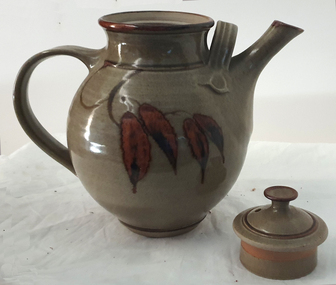
Photograph - Ceramics, Ceramic Teapot by Ken Hovenden, c1980s
... Ceramic Teapot by Ken Hovenden...Australian Studio Pottery ceramics Ken HOvenden teapot Stoneware teapot with beige glaze and handpainted gumleaves, and stamped 'KH' on the footrim. Ceramic Teapot by Ken Hovenden Photograph Ceramics ...Ken HOVENDEN Working at Bendigo Pottery from April 1972 at the age of 17, Ken Hovenden was also involved in the Lillydale Pottery venture. He worked at Cannie Ridge Pottery for a time, exhibiting work there in 1979. Known as a great thrower, his work featured beautifully fitted lids and quantities of mugs of identical size. In the 1980s, he set up his own pottery at Malmsbury and sold his work through Bangles Gallery at Cobargo. From late 1988 to 1997, he worked under the business name Shiloh Pottery in Castlemaine. His work often features a unique gum leaf design on individually thrown work. Marks used include KH on Bendigo Pottery Epsom Ware, Kevin Hovenden on Badger Creek Pottery, KH on Lillydale Pottery and his own impressed KH initials.Stoneware teapot with beige glaze and handpainted gumleaves, and stamped 'KH' on the footrim.australian studio pottery, ceramics, ken hovenden, teapot -
 Flagstaff Hill Maritime Museum and Village
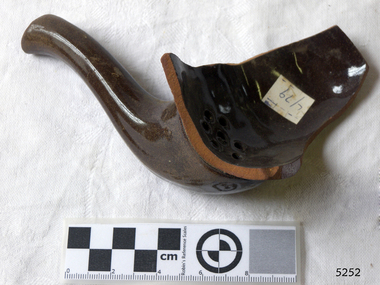
Teapot Spout
... ...Ceramic teapot...Ceramic teapot spout from the wreck of the Loch Ard. ...Flagstaff Hill Warrnambool Shipwrecked coast Flagstaff Hill Maritime Museum Maritime Museum Shipwreck coast Flagstaff Hill Maritime Village Great Ocean Road Loch Line LOCH ARD Captain Gibbs Eva Carmichael Tom Pearce Glenample Station Mutton Bird Island LOCH ARD Gorge Ceramic teapot teapot Ceramic teapot spout from the wreck of the Loch Ard. ...HISTORY OF THE LOCH ARD The LOCH ARD belonged to the famous Loch Line which sailed many ships from England to Australia. Built in Glasgow by Barclay, Curdle and Co. in 1873, the LOCH ARD was a three-masted square rigged iron sailing ship. The ship measured 262ft 7" (79.87m) in length, 38ft (11.58m) in width, 23ft (7m) in depth and had a gross tonnage of 1693 tons. The LOCH ARD's main mast measured a massive 150ft (45.7m) in height. LOCH ARD made three trips to Australia and one trip to Calcutta before its final voyage. LOCH ARD left England on March 2, 1878, under the command of Captain Gibbs, a newly married, 29 year old. She was bound for Melbourne with a crew of 37, plus 17 passengers and a load of cargo. The general cargo reflected the affluence of Melbourne at the time. On board were straw hats, umbrella, perfumes, clay pipes, pianos, clocks, confectionary, linen and candles, as well as a heavier load of railway irons, cement, lead and copper. There were items included that intended for display in the Melbourne International Exhibition in 1880. The voyage to Port Phillip was long but uneventful. At 3am on June 1, 1878, Captain Gibbs was expecting to see land and the passengers were becoming excited as they prepared to view their new homeland in the early morning. But LOCH ARD was running into a fog which greatly reduced visibility. Captain Gibbs was becoming anxious as there was no sign of land or the Cape Otway lighthouse. At 4am the fog lifted. A man aloft announced that he could see breakers. The sheer cliffs of Victoria's west coast came into view, and Captain Gibbs realised that the ship was much closer to them than expected. He ordered as much sail to be set as time would permit and then attempted to steer the vessel out to sea. On coming head on into the wind, the ship lost momentum, the sails fell limp and LOCH ARD's bow swung back. Gibbs then ordered the anchors to be released in an attempt to hold its position. The anchors sank some 50 fathoms - but did not hold. By this time LOCH ARD was among the breakers and the tall cliffs of Mutton Bird Island rose behind the ship. Just half a mile from the coast, the ship's bow was suddenly pulled around by the anchor. The captain tried to tack out to sea, but the ship struck a reef at the base of Mutton Bird Island, near Port Campbell. Waves broke over the ship and the top deck was loosened from the hull. The masts and rigging came crashing down knocking passengers and crew overboard. When a lifeboat was finally launched, it crashed into the side of LOCH ARD and capsized. Tom Pearce, who had launched the boat, managed to cling to its overturned hull and shelter beneath it. He drifted out to sea and then on the flood tide came into what is now known as LOCH ARD Gorge. He swam to shore, bruised and dazed, and found a cave in which to shelter. Some of the crew stayed below deck to shelter from the falling rigging but drowned when the ship slipped off the reef into deeper water. Eva Carmichael had raced onto deck to find out what was happening only to be confronted by towering cliffs looming above the stricken ship. In all the chaos, Captain Gibbs grabbed Eva and said, "If you are saved Eva, let my dear wife know that I died like a sailor". That was the last Eva Carmichael saw of the captain. She was swept off the ship by a huge wave. Eva saw Tom Pearce on a small rocky beach and yelled to attract his attention. He dived in and swam to the exhausted woman and dragged her to shore. He took her to the cave and broke open case of brandy which had washed up on the beach. He opened a bottle to revive the unconscious woman. A few hours later Tom scaled a cliff in search of help. He followed hoof prints and came by chance upon two men from nearby Glenample Station three and a half miles away. In a state of exhaustion, he told the men of the tragedy. Tom returned to the gorge while the two men rode back to the station to get help. By the time they reached LOCH ARD Gorge, it was cold and dark. The two shipwreck survivors were taken to Glenample Station to recover. Eva stayed at the station for six weeks before returning to Ireland, this time by steamship. In Melbourne, Tom Pearce received a hero's welcome. He was presented with the first gold medal of the Royal Humane Society of Victoria and a £1000 cheque from the Victorian Government. Concerts were performed to honour the young man's bravery and to raise money for those who lost family in the LOCH ARD disaster. Of the 54 crew members and passengers on board, only two survived: the apprentice, Tom Pearce and the young woman passenger, Eva Carmichael, who lost all of her family in the tragedy. Ten days after the LOCH ARD tragedy, salvage rights to the wreck were sold at auction for £2,120. Cargo valued at £3,000 was salvaged and placed on the beach, but most washed back into the sea when another storm developed. The wreck of LOCH ARD still lies at the base of Mutton Bird Island. Much of the cargo has now been salvaged and some was washed up into what is now known as LOCH ARD Gorge. Cargo and artefacts have also been illegally salvaged over many years before protective legislation was introduced. One of the most unlikely pieces of cargo to have survived the shipwreck was a Minton porcelain peacock - one of only nine in the world. The peacock was destined for the Melbourne International Exhibition in 1880. It had been well packed, which gave it adequate protection during the violent storm. Today, the Minton peacock can be seen at the Flagstaff Hill Maritime Museum in Warrnambool. From Australia's most dramatic shipwreck it has now become Australia's most valuable shipwreck artefact and is one of very few 'objects' on the Victorian State Heritage Register. Flagstaff Hill’s collection of artefacts from LOCH ARD is significant for being one of the largest collections of artefacts from this shipwreck in Victoria. It is significant for its association with the shipwreck, which is on the Victorian Heritage Register (VHR S417). The collection is significant because of the relationship between the objects, as together they have a high potential to interpret the story of the LOCH ARD. The LOCH ARD collection is archaeologically significant as the remains of a large international passenger and cargo ship. The LOCH ARD collection is historically significant for representing aspects of Victoria’s shipping history and its potential to interpret sub-theme 1.5 of Victoria’s Framework of Historical Themes (living with natural processes). The collection is also historically significant for its association with the LOCH ARD, which was one of the worst and best known shipwrecks in Victoria’s history. Ceramic teapot spout from the wreck of the Loch Ard. Brown in colour. Length 5¼". Artefact Reg No LA/79.flagstaff hill, warrnambool, shipwrecked coast, flagstaff hill maritime museum, maritime museum, shipwreck coast, flagstaff hill maritime village, great ocean road, loch line, loch ard, captain gibbs, eva carmichael, tom pearce, glenample station, mutton bird island, loch ard gorge, ceramic teapot, teapot -
 Bright & District Historical Society operating the Bright Museum
Teapot
... teapot...ceramic...Black ceramic teapot. Highly decorated in faded colours of yellow, white, blue and pink - storks and flowers....teapot ceramic goldfields buckland valley aldo gios tableware On base of teapot : Ro. ...Black ceramic teapot. Highly decorated in faded colours of yellow, white, blue and pink - storks and flowers.On base of teapot : Ro. No. 113746teapot, ceramic, goldfields, buckland valley, aldo gios, tableware -
 Ballarat Heritage Services
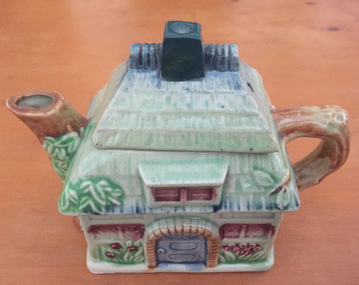
Photograph - Object, Manto Ware, Cottage Teapot, c1930
... Green ceramic teapot in the shape of a cottage....This teapot was part of a teaset was given to Kathleen Carroll by her grandmother, Ellen (Nellie) Carroll. kathleen gervasoni kathleen carroll manto ware teapot cottage teapot Ellen carroll Stamped on the base - Manto-ware Made in Japan Green ceramic teapot in the shape of a cottage. Cottage Teapot Photograph Object Manto Ware ...This teapot was part of a teaset was given to Kathleen Carroll by her grandmother, Ellen (Nellie) Carroll. Green ceramic teapot in the shape of a cottage.Stamped on the base - Manto-ware Made in Japankathleen gervasoni, kathleen carroll, manto ware, teapot, cottage teapot, ellen carroll -
Coal Creek Community Park & Museum
Domestic object - Tea Pot
... White ceramic teapot with flowers, birds and butterflies, metal handle....White ceramic teapot with flowers, birds and butterflies, metal handle. ...White ceramic teapot with flowers, birds and butterflies, metal handle. -
 Ballarat Heritage Services
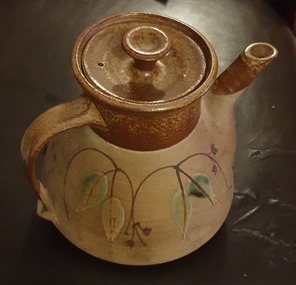
Ceramic - Ceramics, Jill Giles, Pottery Teapot by Jill Giles, c1985
... Photograph of a hand thrown and decorated ceramic teapot by Jill Giles. ...Her daughter Melinda Solly also makes ceramics. ceramics studio pottery teapot Jill Giles coffee pot Photograph of a hand thrown and decorated ceramic teapot by Jill Giles. Pottery Teapot by Jill Giles Ceramic Ceramics Jill Giles wartook Pottery ...Jill Giles is a potter who was active in Geelong from the mid 1970s until the mid 1990s. Her work may be marked 'J Giles' (painted), 'Giles Geelong Australia' (impressed) or G over J (impressed). Her daughter Melinda Solly also makes ceramics.Photograph of a hand thrown and decorated ceramic teapot by Jill Giles. ceramics, studio pottery, teapot, jill giles, coffee pot -
 City of Kingston
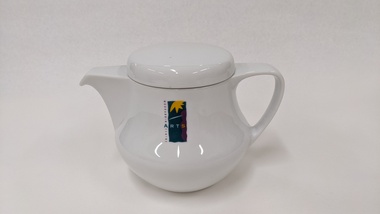
Ceramic - Moorabbin Arts Centre teapot, City of Moorabbin, c. 1990
... White ceramic teapot with lid and Moorabbin Arts Centre logo on front....Ephemera Crockery Tableware Moorabbin Arts Centre Marked on base: Royal Porcelain / Kingdom of Thailand / Oven to Table / Dishwasher - safe / Microwave - safe White ceramic teapot with lid and Moorabbin Arts Centre logo on front. ...Teapot belonging to a set produced for use at the Moorabbin Arts Centre (now Kingston Arts).White ceramic teapot with lid and Moorabbin Arts Centre logo on front.Marked on base: Royal Porcelain / Kingdom of Thailand / Oven to Table / Dishwasher - safe / Microwave - safeephemera, crockery, tableware, moorabbin arts centre -
Coal Creek Community Park & Museum
Tea Pot
... Round ceramic teapot minus lid, blue and white with handle on one side and spout on the other....Round ceramic teapot minus lid, blue and white with handle on one side and spout on the other. ...Round ceramic teapot minus lid, blue and white with handle on one side and spout on the other. -
 Orbost & District Historical Society
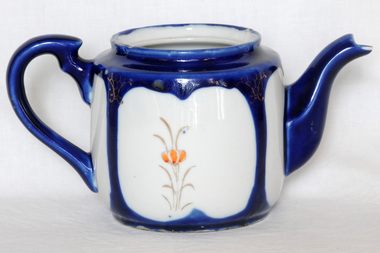
teapot
... A painted ceramic teapot. The body is white with a blue border and it has a blue spout and handle. ...teapot pottery ceramics beverages A painted ceramic teapot. The body is white with a blue border and it has a blue spout and handle. ...A painted ceramic teapot. The body is white with a blue border and it has a blue spout and handle. On the flat surfaces are pictures of hens in a garden with flowers.teapot pottery ceramics beverages -
 Clunes Museum
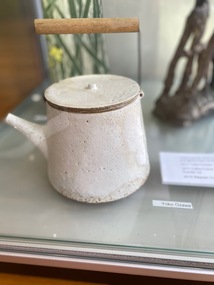
Ceramic - ARTWORK, YOKO OZAWA, STEAMING KETTLE, 2017
... STEAMING KETTLE. CERAMIC TEAPOT WITH LID AND A WOODEN HANDLE MOUNTED ON WIRE. ...STEAMING KETTLE. CERAMIC TEAPOT WITH LID AND A WOODEN HANDLE MOUNTED ON WIRE. ...2017 CLUNES CERAMIC AWARD FINALIST2017 CLUNES CERAMIC AWARD FINALIST. YOKO OZAWA2017 CLUNES CERAMIC AWARD FINALIST. YOKO OZAWA. STEAMING KETTLE. CERAMIC TEAPOT WITH LID AND A WOODEN HANDLE MOUNTED ON WIRE. WIDER AT THE BASE.yoko ozawa, clunes ceramics awards, artwork -
 Wodonga & District Historical Society Inc
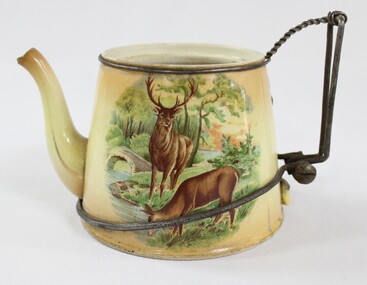
Domestic object - Haeusler Collection Teapot
... teapot...teaware...tableware...ceramic...A glazed ceramic teapot with a printed design depicting two deer and a hunter in a woodland on one side, and two deer by a stream in a woodland on the other. ...It contributes to our understanding of domestic and family life in early twentieth century Wodonga, as well as providing interpretative capacity for themes including local history, social history, and women’s history. teapot teaware tableware ceramic domestic social history Faded, circular makers mark on the base of teapot, illegible/"ENGLAND" A glazed ceramic teapot with a printed design depicting two deer and a hunter in a woodland on one side, and two deer by a stream in a woodland on the other. ...The Wodonga Historical Society Haeusler Collection provides invaluable insight into life in late nineteenth and early twentieth century north east Victoria. The collection comprises manuscripts, personal artefacts used by the Haeusler family on their farm in Wodonga, and a set of glass negatives which offer a unique visual snapshot of the domestic and social lives of the Haeusler family and local Wodonga community. The Haeusler family migrated from Prussia (Germany) to South Australia in the 1840s and 1850s, before purchasing 100 acres of Crown Land made available under the Victorian Lands Act 1862 (also known as ‘Duffy’s Land Act’) in 1866 in what is now Wodonga West. The Haeusler family were one of several German families to migrate from South Australia to Wodonga in the 1860s. This teapot is one of the many domestic objects in the Haeusler Collection that represent family and home life in early twentieth century Wodonga. The ingenious repair to the teapot's handle reflects the resourcefulness and thriftiness of the Haeusler family during the economic hardships of the 1930s Great Depression. The teapot was manufactured in England, likely dating from the early twentieth-century. This item has well documented provenance and a known owner. It forms part of a significant and representative historical collection which reflects the local history of Wodonga. It contributes to our understanding of domestic and family life in early twentieth century Wodonga, as well as providing interpretative capacity for themes including local history, social history, and women’s history. A glazed ceramic teapot with a printed design depicting two deer and a hunter in a woodland on one side, and two deer by a stream in a woodland on the other. The broken handle of the teapot has been replaced with wire. The teapot handle was repaired by Alfred Haeusler (b.1922, d.1997) and holds remarkable balance, perfectly retaining its function. Faded, circular makers mark on the base of teapot, illegible/"ENGLAND"teapot, teaware, tableware, ceramic, domestic, social history -
 Flagstaff Hill Maritime Museum and Village
Ceramic - Teapot, First half of the 20th century
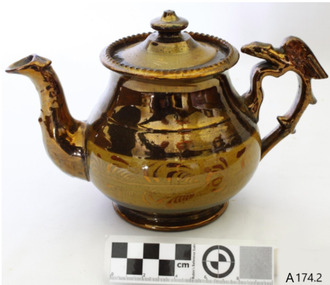
... teapot...tea set...kitchen ware...ceramic...Teapot ceramic ornate copper lusterware abstract floral design handle has a protruding sculptured bird for thumb grip. ...Ceramic Teapot ...Lusterware is a type of pottery or porcelain with a metallic glaze that gives the effect of iridescence. The technique on pottery was first developed in Mesopotamia (modern Iraq) in the early 9th century. It is produced by metallic oxides in an overglaze finish, which is given a second firing at a lower temperature in a "muffle kiln", or a reduction kiln, excluding oxygen. The Lusterware effect is a final coating applied over the ceramic glaze, and fixed by a light second firing, applying small amounts of metallic compounds (generally of silver or copper) mixed with something to make it paintable (clay or ochre). This is then fired in a reducing atmosphere at a temperature high enough to "soften" the glaze from the first firing, and break down the metallic compounds, leaving a very thin ("perhaps 10 or 20 atoms thick") layer that is fused with the main glaze, but is mainly metal. Lusterware normally only uses one colour per piece, and the range is limited a "gold" derived from silver compounds was historically the most common. The process has always been expensive and rather unpredictable, always requiring two firings, and often the use of expensive materials such as silver and platinum. The very thin layer of luster is often delicate, and many types of Lusterware are easily damaged by scratching removing the metallic layer, or by contact with acids. Lusterware has therefore always been for display and occasional use, although by the 19th century it could be relatively cheap. Many pieces show the luster effect only working correctly on parts of the surface, or not at all. An item probably made in Staffordshire UK where this type of pottery was popular in the late 19th century by unknown pottery as the subject item has no marks. The teapot at this time cannot be associated with a historical event, person, or place, provenance regards manufacture is unknown, item assessed as a collection asset given it was produced before 1950.Teapot ceramic ornate copper lusterware abstract floral design handle has a protruding sculptured bird for thumb grip. Nonewarrnambool, flagstaff-hill, flagstaff-hill-maritime-museum, maritime-museum, shipwreck-coast, flagstaff-hill-maritime-village, teapot, tea set, kitchen ware, ceramic, lusterware, pottery, staffordshire uk, pottery finishes -
 Flagstaff Hill Maritime Museum and Village
Teapot
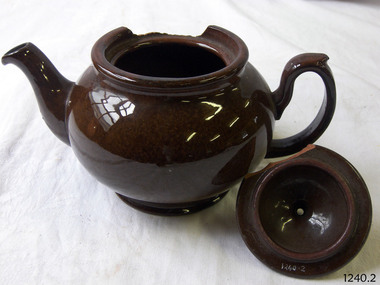
... Teapot ceramic brown shiny glaze. Piece missing from rim around top section near lid also chip out of lid. ...Flagstaff Hill Warrnambool Shipwrecked-coast Flagstaff-Hill Flagstaff-Hill-Maritime-Museum Maritime-Museum Shipwreck-coast Flagstaff-Hill-Maritime-Village Teapot ceramic brown shiny glaze. Piece missing from rim around top section near lid also chip out of lid. ...Teapot ceramic brown shiny glaze. Piece missing from rim around top section near lid also chip out of lid. Marked "ALB Patented England".flagstaff hill, warrnambool, shipwrecked-coast, flagstaff-hill, flagstaff-hill-maritime-museum, maritime-museum, shipwreck-coast, flagstaff-hill-maritime-village -
 Flagstaff Hill Maritime Museum and Village
Ceramic - Teapot, Josiah Wedgwood & Sons Ltd, 1890
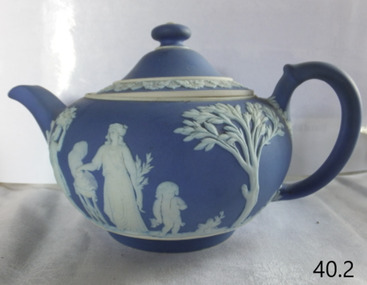
... Wedgwood is a significant pottery manufacturer as the company is especially associated with the "dry-bodied" (unglazed) stoneware Jasperware in contrasting colours, and in particular that in "Wedgwood blue" and white that has become a trademark. flagstaff hill warrnambool flagstaff hill maritime museum maritime museum shipwreck coast flagstaff hill maritime village great ocean road teapot wedgewood blue wedgewood teapot tea pot kitchen ware Josiah Wedgwood Staffordshire Potteries Impressed name Wedgewood and date letter "S" = 1890 Teapot and lid, Wedgwood blue Jasperware with white pattern Ceramic Teapot Josiah Wedgwood & Sons Ltd ...Josiah Wedgwood (1730–95), came from an established family of potters and trained with his elder brother. He was in partnership with the leading potter Thomas Whieldon from 1754 until 1759 when a new green ceramic glaze he had developed encouraged him to start a new business on his own. Relatives leased him the Ivy House in Burslem, Stoke-on-Trent, and his marriage to Sarah Wedgwood, a distant cousin with a sizeable dowry, helped him launch his new venture. After an extensive and systematic program of experiment Wedgwood in 1765 created a new variety of creamware, a fine glazed earthenware, which was the main body used for his table wares thereafter. After he supplied Queen Charlotte with a tea set for twelve the same year, she gave official permission to call it "Queen's Ware" (from 1767). This new form, perfected as white pearlware (from 1780), sold extremely well across Europe, and to America. It had the additional advantage of being relatively light, saving on transport costs and import tariffs in foreign markets. Wedgwood developed several further industrial innovations for his company, notably a way of measuring kiln temperatures accurately, and several new ceramic bodies including the "dry-body" Stoneware, "black basalt" (by 1769), cane ware, and jasperware (the 1770s), all designed to be sold unglazed, like "biscuit porcelain". In the later 19th century the company returned to being a leader in the design and technical innovation, as well as continuing to make many of the older styles. Despite increasing local competition in its export markets, the business continued to flourish in the 19th and early 20th centuries, remaining in the hands of the Wedgwood family, but after World War II it began to contract, along with the rest of the English pottery industry. After buying several other Staffordshire ceramics companies, in 1987 Wedgwood merged with Waterford Crystal to create Waterford Wedgwood plc, an Ireland-based luxury brands group. After a 2009 purchase by KPS Capital Partners, a New York-based private equity firm. Wedgwood has always been associated with fine china, porcelain, and luxury accessories, the entrepreneur Josiah Wedgwood rapidly became successful and was soon one of the largest manufacturers of Staffordshire pottery. Wedgwood is a significant pottery manufacturer as the company is especially associated with the "dry-bodied" (unglazed) stoneware Jasperware in contrasting colours, and in particular that in "Wedgwood blue" and white that has become a trademark. Teapot and lid, Wedgwood blue Jasperware with white patternImpressed name Wedgewood and date letter "S" = 1890flagstaff hill, warrnambool, flagstaff hill maritime museum, maritime museum, shipwreck coast, flagstaff hill maritime village, great ocean road, teapot, wedgewood blue, wedgewood teapot, tea pot, kitchen ware, josiah wedgwood, staffordshire potteries -
 Royal Australian and New Zealand College of Obstetricians & Gynaecologists (RANZCOG)
Ceramic feeding cup associated with midwife Mary Howlett, c.1866-1920
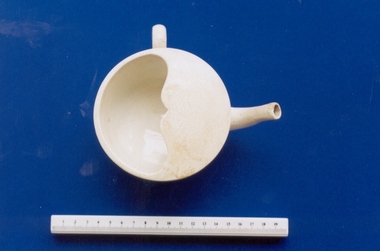
... teapot spout) with a handle. There are four small holes inserted inside the cup diagonally at the proximate end of the spout. Ceramic ...This type of cup was designed for use by an adult and was in common usage from the early 1900s to the 1930s. Feeding cups were used both in the home and in hospitals, and were also often made of white enamel. Mary Howlett (1840-1922) began practising as a country midwife in 1866 in the western district of Victoria. She qualified as a 'ladies monthly nurse' in 1887 and continued to practise as a nurse and midwife until 1920. She began her six months training at the Melbourne Lying-In Hospital. She was known by many as 'Auntie', and her career spanned more than 50 years. Mrs Howlett's midwifery box and contents were given to Dr Frank Forster, and he donated them the museum collection in 1993. Feeding cup made out of white china, now discoloured. The cup has a curved spout (similar to a teapot spout) with a handle. There are four small holes inserted inside the cup diagonally at the proximate end of the spout. midwifery -
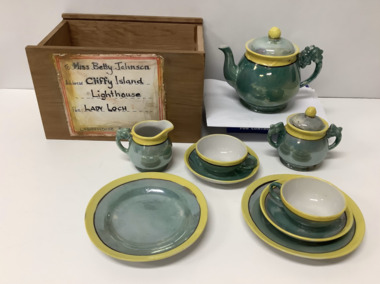 Williamstown Historical Society Inc
Domestic object - Child's ceramic tea set
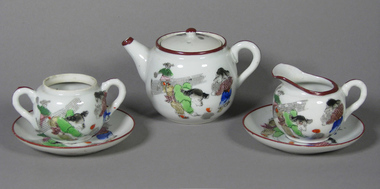
... Total of eleven pieces in irridescent green ceramic with yellow and black decorative edges. The plywood box is not original. Comprises: One teapot with lid One sugar bowl with lid One milk jug Two cups and saucers Two side plates...Total of eleven pieces in irridescent green ceramic with yellow and black decorative edges. The plywood box is not original. Comprises: One teapot with lid One sugar bowl with lid One milk jug Two cups and saucers Two side plates Domestic object Child's ceramic tea set ...The Lady Loch was a Lighthouse Tender built in 1886 by Campbell, Sloss & McCann in Footscray, for the Victorian Dept. of Public Works. The ship was named after Lady Elizabeth Loch, wife of Sir Henry Loch, Governor of Victoria from 1884 -1889. It was an iron Steamship of 531 tons. Built for use as a lighthouse tender and serviced lighthouses around the south east coast and Tasmania. Owned by Victorian Ports and Harbours Department. Register closed in September 1935 when the vessel was converted to a hulk at Brisbane. Official Number: 88946 Length: 182' Plywood box containing a child's Japanese ceramic toy tea set. Total of eleven pieces in irridescent green ceramic with yellow and black decorative edges. The plywood box is not original. Comprises: One teapot with lid One sugar bowl with lid One milk jug Two cups and saucers Two side platesOn teapot, milk jug, two plates and saucers: ''Made in Japan'' . Address label on front of the box: "To Miss Betty/Johnson/Cliffy Island Lighthouse/Lady Loch" -
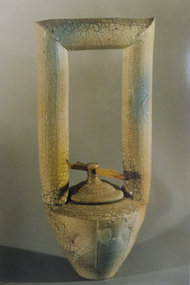 Federation University Art Collection
Ceramic - Artwork - Ceramics, 'Raku Lidded Pot with Tall Handle' by Bruce Anderson, c1984
... raynham ceramics Raku teapot with tall handle. 'Raku Lidded Pot with Tall Handle' by Bruce Anderson Ceramic Artwork - Ceramics Bruce Anderson ...Bruce ANDERSON (20 August 1950- Born Surry Hills, Melbourne, Victoria In 1971 Bruce Anderson obtained a Diploma of Art (Sculpture) from the Prahran Institute of Technology. For the next two years, he worked at Raynham Ceramics in East Bentleigh, making slipcast ware. After a year of National Service, he completed a teacher education course at the State College of Victoria, Auburn and taught for a time in the secondary school system. In 1977, he moved to Queensland to take up a position as Head of the Ceramics Department at Townsville TAFE. In 1984, he relocated to the Darling Downs Institute in Toowoomba and was still teaching there in his entry in the 1986-7 directory, working in raku and blackware fired with gas in a ceramic fibre kiln. During 1986, he moved to Adelaide to take up a position as senior lecturer in ceramics at the South Australian School of Design. During the late 1980s and 1990s, he began to make sculptural works of architactural form cast from a mixture of terracotta clay and refractory concrete. Part-glazed, the works allude to primitive industry and utilitarianism. In 1984 Bruce Anderson was a guest at Spotkanie held at the Gippsland Institute of Advanced Education.Raku teapot with tall handle. bruce anderson, ceramics, jan feder memorial ceramics collection, gippsland campus, teapot, raynham ceramics -
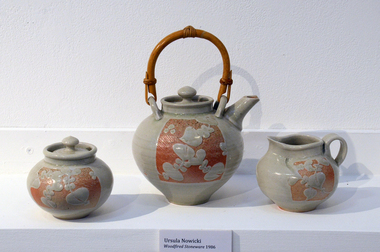 Federation University Art Collection
Ceramic, Tea Set by Ursula Nowicki, c1986
... Ursula NOWICKI ursula nowicki ceramics jan feder memorial ceramics collection jan feder gippsland campus Woodfire 86 UN on base A woodfired stoneware Teapot, sugar bowl and milk jug. Tea Set by Ursula Nowicki Ceramic Ursula Nowick ...Ursula NOWICKIA woodfired stoneware Teapot, sugar bowl and milk jug.UN on baseursula nowicki, ceramics, jan feder memorial ceramics collection, jan feder, gippsland campus, woodfire 86 -
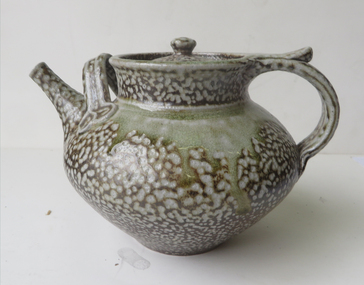 Federation University Art Collection
Ceramic, Salt Glazed Teapot by Arthur Rosser, c1986, c1986
... Salt Glazed Teapot by Arthur Rosser, c1986 Ceramic Arthur Rosser ...Arthur ROSSER Arthur and Carol Rosser have been based at the Eungella Pottery in Dalrymple Heights, QLD, since 1976. Specialists in woodfiring and the use local clays and ash, salt and shino glazes, as well as firing with oil and gas as well as wood. Salt glazed teapot with lid.arthur rosser, ceramics, jan feder memorial ceramics collection, gippsland, gippsland campus, woodfire -
 Harcourt Valley Heritage & Tourist Centre
Cannie Ridge Pottery, mid 1970s
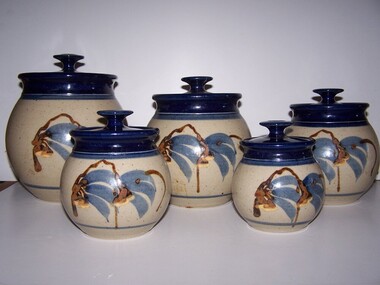
... CANNIE RIDGE POTTERY OPENED SEPT 1976 BY ALLAN & MARY LETTS, AND SON GARY AND JENNY, APPROX 16 EMPLOYEES PRODUCED MEMORABILIA FOR THE POPE'S VISIT IN 1988 AND HOUSEHOLD ITEMS INCLUDING WINE BARRELS, GOBLETS, CASSEROLES, TEAPOTS, JUGS, PLATES AND EVEN DINNER SETS EACH bearing the distinctive Eucalyptus patterns. Products of a now-closed ceramic pottery located in Harcourt. ...CANNIE RIDGE POTTERY OPENED SEPT 1976 BY ALLAN & MARY LETTS, AND SON GARY AND JENNY, APPROX 16 EMPLOYEES PRODUCED MEMORABILIA FOR THE POPE'S VISIT IN 1988 AND HOUSEHOLD ITEMS INCLUDING WINE BARRELS, GOBLETS, CASSEROLES, TEAPOTS, JUGS, PLATES AND EVEN DINNER SETS EACH bearing the distinctive Eucalyptus patterns.Products of a now-closed ceramic pottery located in Harcourt.BLUE GLAZED 5 SIZED CANNISTERS GUM LEAF MOTIF WITH BLUE LIDSCANNIE RIDGE STAMP ON BOTTOM -
 Federation University Art Collection
Ceramic - Ceramic (Selkirk Prize), Claire Blake, 'Teapot with 5 Spikes' by Claire Blake, 2001
... 'Teapot with 5 Spikes' by Claire Blake Ceramic Ceramic (Selkirk Prize) Claire Blake ...This item is part of the Federation University Art Collection. The Art Collection features over 2000 works and was listed as a 'Ballarat Treasure' in 2007.Blue shoe shaped teapot.art, artwork, claire blake, ceramics, available, available ceramics, teapot, alumni, feduniceramics -
 Federation University Art Collection
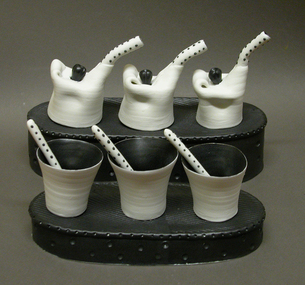
Ceramic, Ngai, Connie, 'Black & White teapot' by Connie Ngai, 2006
... A ceramic tea set in black and white. It comprises of two black bases, three small teapots and three cups with ceramic stirrers. ...It comprises of two black bases, three small teapots and three cups with ceramic stirrers. 'Black & White teapot' by Connie Ngai Ceramic Ceramic Ngai, Connie ...Connie NGAI This item is part of the Federation University Art Collection. The Art Collection features over 2000 works and was listed as a 'Ballarat Treasure' in 2007.A ceramic tea set in black and white. It comprises of two black bases, three small teapots and three cups with ceramic stirrers. art, artwork, connie ngai, ceramics, teaset, teapot, available, ceramics available, alumni -
Federation University Art Collection
Ceramic, Unknown, [ Celadon Teapot]
... The Art Collection features over 1000 works and was listed as a 'Ballarat Treasure' in 2007. art artwork [ Celadon Teapot] Ceramic Unknown ...This item is part of the Federation University Art Collection. The Art Collection features over 1000 works and was listed as a 'Ballarat Treasure' in 2007.art, artwork -
![Ceramic, [Celadon Teapot]](/media/collectors/530576742162ef0fa09a2288/items/534748189821f420f8c03adc/item-media/5f0041fa21ea671878de3951/item-fit-380x285.jpg?cb=6) Federation University Art Collection
Federation University Art CollectionCeramic, [Celadon Teapot]
... The Art Collection features over 2000 works and was listed as a 'Ballarat Treasure' in 2007. art artwork teapot Teapot [Celadon Teapot] Ceramic Ceramic Unknown ...This item is part of the Federation University Art Collection. The Art Collection features over 2000 works and was listed as a 'Ballarat Treasure' in 2007.Teapotart, artwork, teapot -
Federation University Art Collection
Ceramic, Unknown, [Unglazed teapot]
... The Art Collection features over 1000 works and was listed as a 'Ballarat Treasure' in 2007. art artwork [Unglazed teapot] Ceramic Unknown ...This item is part of the Federation University Art Collection. The Art Collection features over 1000 works and was listed as a 'Ballarat Treasure' in 2007.art, artwork -
Federation University Art Collection
Ceramic, Unglazed Teapot
... The Art Collection features over 1000 works and was listed as a 'Ballarat Treasure' in 2007. art artwork Unglazed Teapot Ceramic ...This item is part of the Federation University Art Collection. The Art Collection features over 1000 works and was listed as a 'Ballarat Treasure' in 2007.art, artwork -
 Federation University Art Collection
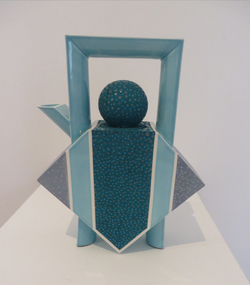
Ceramic - teapot, Dianne Peach, Slip Cast Teapot by Dianne Peach, 1983, 1983
... Slip Cast Teapot by Dianne Peach, 1983 Ceramic teapot Dianne Peach ...In particular I have been using these methods of construction [slab] to interpret the traditionally spherical form of the teapot as a cubist painter might by squaring it up and transposing curved surfaces into planes and angles. These geometric versions provide flat surfaces for pattern making and light reflection, and the objects become increasingly more decorative than functional. I find enormous pleasure in bending convention to the verge of impracticality. But not so radically that l miss the challenge of producing a form that still incorporates most of the elements of a properly functioning teapot, such as the height of the spout to the pot, the ease of filling, emptying, and handling. Surface decoration plays a vital role in reinforcing the abstraction. Bold areas of black underglaze are applied with distinct boundaries dictated by the form’s angles and planes. In pairs or ad hoc groupings the teapots react with each other and the spaces between to present complex geometric patterns. High firing produces a dense, almost vitrified body and the surface quality I admire without the need for glaze. Although some with more functionality may be glazed inside.(http://www.diannepeach.com/, accessed 23 July 2021)Dianne PEACH (1947- ) Since being introduced to pottery by Milton Moon and David Smith in the mid 60s Dianne Peach initially focused on wheel thrown functional war, which expnded include the infinite possibilities of slab building and casting. This work was purchased from the "Fresh Clay' Exhibition in 1983.Electric kiln fired slip cast earthenware teapot with stencils and coloured glazes. Purchased from the 'Fresh Clay' exhibition, 1883.dianne peach, jan feder memorial ceramics collection, jan feder, ceramics, teapot, fresh clay exhibition -
Federation University Art Collection
Ceramic - Artwork - Ceramics, Ray Hearn, 'End Game' by Ray Hearn
... ceramic 'game' starts again too. As it transpires End Game is about my own work too. All research degrees require an end--a thesis must reach a conclusion, and like a game of chess, start again. The sculptural potential of clay is unlimited, and in theory functional clay wares' aesthetic potential unlimited too, from a classic Song celadon to Arneson's genital encrusted teapots (which I first saw illustrated in Craft Horizons 1971). ...ceramic 'game' starts again too. As it transpires End Game is about my own work too. All research degrees require an end--a thesis must reach a conclusion, and like a game of chess, start again. The sculptural potential of clay is unlimited, and in theory functional clay wares' aesthetic potential unlimited too, from a classic Song celadon to Arneson's genital encrusted teapots (which I first saw illustrated in Craft Horizons 1971). ...Dr Ray HEARN (1943- ) Born Stawell, Victoria Ray Hearn graduated from the Ballarat School of Mines Technical Art School with a Diploma of Art (Ceramics) in 1970, followed by an Master of Fine Art from Regina Canada in 1976. He holds a PhD in Anthropology from Northern Territory, Darwin in 2003, with field work, exhibitions and teaching in Thailand since 1996. He has completed his MA in art curatorship from the University of Melbourne, with a thesis on Sidney Nolan and Ned Kelly.From Above and beyond function: Ray Hearn explains the reasons behind his useless ceramics:- "End Game suggests a climax of a tactical and intellectual struggle, in ceramics or chess, but it is also about beginnings and endings, for in chess the king can never be captured--one game ends and the board is reset so the next can begin. I made this piece at the start of my PhD work, acknowledging then that as there were once potters so too there are potters today--and tomorrow. The ceramic pieces were all collected in Tanon Suthep, one of Chiang Mai's streets. The board is a fragment of white tiles from a pharmacy building being remodelled, the bowl is a broken fast food noodle bowl from the ubiquitous street stalls, and the new small blue and white jars purchased from a market stall. Typical of my work, the objects are familiar--they might be just like ones we have at home today, had but threw away only yesterday, or objects we might purchase tomorrow. Clay lives on, and the ceramic 'game' starts again too. As it transpires End Game is about my own work too. All research degrees require an end--a thesis must reach a conclusion, and like a game of chess, start again. The sculptural potential of clay is unlimited, and in theory functional clay wares' aesthetic potential unlimited too, from a classic Song celadon to Arneson's genital encrusted teapots (which I first saw illustrated in Craft Horizons 1971). West Coast funk with its kitschy teapots and cups were vehicles for sculptural objects never meant to be drunk from, and a genre of useless functional wares emerged. Nothing could be more useless in a practical sense than a work of art, especially a painting--yet most craftwork has a passing reference at least to function." ( https://www.thefreelibrary.com/Above+and+beyond+function%3A+Ray+Hearn+explains+the+reasons+behind+his...-a0172598257, accessed 07 February 2018:)ray hearn, ballarat school of mines, ballarat technical art school, alumni, ceramics -
 Tennis Australia
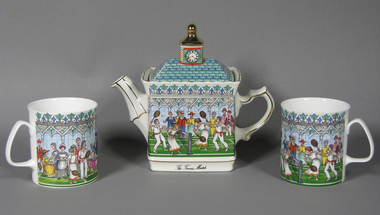
Dishware, Circa 1990
... Five piece painted ceramic tea set, decorated with lawn tennis motif. (.1 and .2) mugs printed with 'WINDSOR/MADE IN ENGLAND' on bases (.3) square teapot (1/2) with lid (2/2) with text 'THE TENNIS MATCH' and printed with 'SADLER/CHAMPIONSHIPS/MADE IN ENGLAND' on base; (.4) Sadler Classic Collection brochure. ...Tennis Five piece painted ceramic tea set, decorated with lawn tennis motif. (.1 and .2) mugs printed with 'WINDSOR/MADE IN ENGLAND' on bases (.3) square teapot (1/2) with lid (2/2) with text 'THE TENNIS MATCH' and printed with 'SADLER/CHAMPIONSHIPS/MADE IN ENGLAND' on base; (.4) Sadler Classic Collection brochure. ...Five piece painted ceramic tea set, decorated with lawn tennis motif. (.1 and .2) mugs printed with 'WINDSOR/MADE IN ENGLAND' on bases (.3) square teapot (1/2) with lid (2/2) with text 'THE TENNIS MATCH' and printed with 'SADLER/CHAMPIONSHIPS/MADE IN ENGLAND' on base; (.4) Sadler Classic Collection brochure. Materials: Ceramic, Pigment, Paper, Inktennis -
 Tennis Australia
Dishware, Circa 1890
... Seven piece painted ceramic children's tea set, decorated with dogs-playing-tennis motif. (.1 and .2) saucers (.3) jug (.4) two-handled sugar pot; (.5) teapot with lid and (.6) cup. ...Tennis Seven piece painted ceramic children's tea set, decorated with dogs-playing-tennis motif. (.1 and .2) saucers (.3) jug (.4) two-handled sugar pot; (.5) teapot with lid and (.6) cup. ...Seven piece painted ceramic children's tea set, decorated with dogs-playing-tennis motif. (.1 and .2) saucers (.3) jug (.4) two-handled sugar pot; (.5) teapot with lid and (.6) cup. No makers marks. Materials: Ceramic, Pigmenttennis
