
Showing 18 items matching "ceremonial equipment"
-
 Bendigo Military Museum
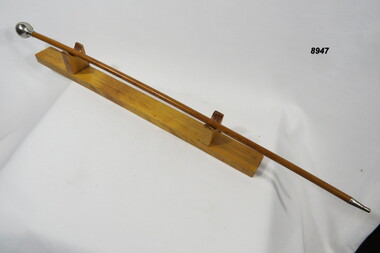
Equipment - SWAGGER STICK, Australian Army - 38th Battalion, Unknown
... ...Ceremonial Equipment...Passchendaele Barracks Trust PBT243 Swagger Stick Ceremonial Equipment Jack Gerdsen Round-silver top with the Rising Sun emblem embossed and featuring the Bendigo Regiment 38th Battalion Regimental Badge. ...Relates to the 38th Battalion. Belonged to "Jack GERDSEN".The Australian Army uses the Swagger stick as a traditional ceremonial symbol of authority, commonly carried under the right arm by a Company Sergeant Major and Commissioned Officers, particularly in ceremonial or “Walking Out” dress. The swagger stick is made of light coloured polished timber with a round silver top featuring the 38th Battalion Regimental Badge, the lower of base of the stick is protected by a silver metal cap.Round-silver top with the Rising Sun emblem embossed and featuring the Bendigo Regiment 38th Battalion Regimental Badge.passchendaele barracks trust, pbt243, swagger stick, ceremonial equipment, jack gerdsen -
 Bendigo Military Museum
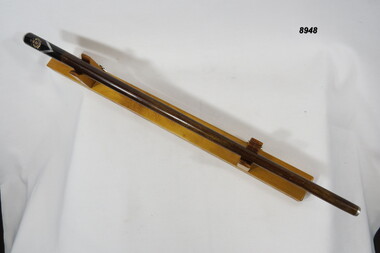
Equipment - SWAGGER STICK, Unknown
... ...Ceremonial Equipment...Passchendaele Barracks Trust PBT244 Swagger stick Ceremonial Equipment Set in to the top/side of the stick - Australian Engineers Badge over a “'V”symbol. ...The Australian Army uses the Swagger stick as a traditional ceremonial symbol of authority, commonly carried under the right arm by a Company Sergeant Major and Commissioned Officers, particularly in ceremonial or “Walking Out” dress. The swagger stick is made of dark coloured polished timber with the top 9 cm painted black, the top and bottom of the stick has metal caps screwed on.Set in to the top/side of the stick - Australian Engineers Badge over a “'V”symbol.passchendaele barracks trust, pbt244, swagger stick, ceremonial equipment -
 Bendigo Military Museum
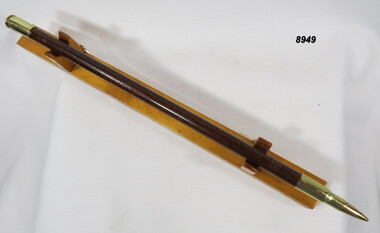
Equipment - SWAGGER STICK, Unknown
... ...Ceremonial equipment...Passchendaele Barracks Trust PBT245 Swagger stick Ceremonial equipment On the top shell casing - “C6 77” The Australian Army uses the Swagger stick as a traditional ceremonial symbol of authority, commonly carried under the right arm by a Company Sergeant Major and Commissioned Officers, particularly in ceremonial or “Walking Out” dress. ...The Australian Army uses the Swagger stick as a traditional ceremonial symbol of authority, commonly carried under the right arm by a Company Sergeant Major and Commissioned Officers, particularly in ceremonial or “Walking Out” dress. The swagger stick is made of polished timber with a half brass shell casing on the top and the projectile on the bottom. On the top shell casing - “C6 77”passchendaele barracks trust, pbt245, swagger stick, ceremonial equipment -
 Bendigo Military Museum
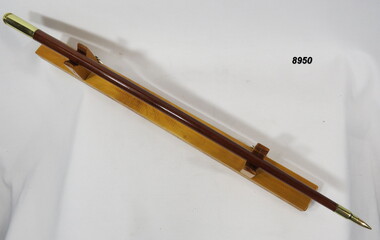
Equipment - SWAGGER STICK, Unknown
... ...Ceremonial equipment...Passchendaele Barracks Trust PBT246 Swagger stick Ceremonial equipment On the top of the shell casing - ”The emblem of the Royal Australian Corps of Transport” The Australian Army uses the Swagger stick as a traditional ceremonial symbol of authority, commonly carried under the right arm by a Company Sergeant Major and Commissioned Officers, particularly in ceremonial or “Walking Out”dress. ...The Australian Army uses the Swagger stick as a traditional ceremonial symbol of authority, commonly carried under the right arm by a Company Sergeant Major and Commissioned Officers, particularly in ceremonial or “Walking Out”dress. The swagger stick is made of polished timber with a half shell casing on the top and the projectile casing on the bottom.On the top of the shell casing - ”The emblem of the Royal Australian Corps of Transport”passchendaele barracks trust, pbt246, swagger stick, ceremonial equipment -
 Bendigo Military Museum
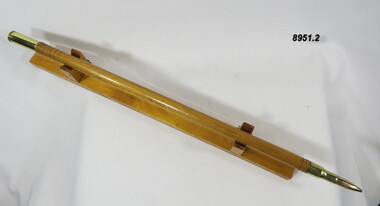
Equipment - SWAGGER STICK, Unknown
... ...Ceremonial Equipment...Passchendaele Barracks Trust PBT247 Ceremonial Equipment Swagger stick 2. “WO2 R.D. Hosking RACT “ - Two small collar badges with the wording “Royal Australian Corps of Transport” 1. ...1. The Australian Army uses the Swagger stick as a traditional ceremonial symbol of authority, commonly carried under the right arm by a Company Sergeant Major and Commissioned Officers, particularly in ceremonial or “Walking Out” dress. The swagger stick is made of polished timber with a brass shell casing on the top and the shell casing projectile on the bottom. 2. Wooden display stand with R.D. Hosking RACT Label.2. “WO2 R.D. Hosking RACT “ - Two small collar badges with the wording “Royal Australian Corps of Transport”passchendaele barracks trust, pbt247, ceremonial equipment, swagger stick -
 Frankston RSL Sub Branch
Webbing, Belt, No maker discernible, Unknown
... The belt has been "blackened" for ceremonial use and has brass fittings, the 2 angled buckles normally located on the rear of the belt have been removed. The 1937 pattern equipment...The belt has been "blackened" for ceremonial use and has brass fittings, the 2 angled buckles normally located on the rear of the belt have been removed. The 1937 pattern equipment ...Used with dress uniform for ceremonious purposes.An example of the standard issue webbing belt used by Australian service personnel. The name "Bretterecker" and the number 360053, (possibly a post World War 2 service number) is written in black ink on the inside surface of the belt. The belt has been "blackened" for ceremonial use and has brass fittings, the 2 angled buckles normally located on the rear of the belt have been removed. The 1937 pattern equipment (also known as '37 webbing') was an item of military load-carrying equipment. Pattern 37 replaced the 1908 Pattern and 1925 Pattern—on which it was based—and was standard issue for British and Commonwealth troops from its introduction in 1937, throughout World War II, and in the post-war period until it was superseded by 58 pattern webbing. The design was confirmed on 8 June 1938 and wide-scale issue began in 1939. Towards the end of World War II, some 37 Webbing was produced in jungle green for troops fighting in the Pacific Theatre, although purpose-made 44 Pattern Webbing was then introduced for the humid jungle conditions, being lighter in weight, quicker drying, and rot-proofed.[ Although 44 Pattern continued in use with the British Army for jungle warfare in its various post-World War II colonial conflicts, it did not replace 37 Pattern in general service, which was in use up until the introduction of 58 Pattern. However, 37 Pattern was used for ceremonial purposes and still issued to Cadets in the 1990s. 1937 Pattern Webbing was made from cotton webbing, which was waterproofed and dyed before being woven. The fittings were made of stamped brass and it was produced by various manufacturers.Written in black ink on the inside "Bretterecker" and the number 360053, possibly a post World War 2 service number.webbing belt, dress webbing -
 Orbost & District Historical Society
nulla nulla
... A waddy, nulla nulla or hunting stick is an Australian Aboriginal war club.It was used in hunting, fighting and as a ceremonial tool. The necessary tools and equipment for hunting, fishing and warfare were one of the very few items that Aboriginals carried with them from place to place. ...A waddy, nulla nulla or hunting stick is an Australian Aboriginal war club.It was used in hunting, fighting and as a ceremonial tool.The necessary tools and equipment for hunting, fishing and warfare were one of the very few items that Aboriginals carried with them from place to place. Most were used for a multiplicity of purposes. Because many were made from raw natural materials, such as wood, generally only partial remains are found today. This item is an example of a wooden weapon used by the early Indigenous people of eastern australia.A hand-made wooden pointed stick, a nulla nulla. One end is thicker that the other. Designs have been burnt into the wood.nulla-nulla waddy aboriginal weapon -
 Flagstaff Hill Maritime Museum and Village
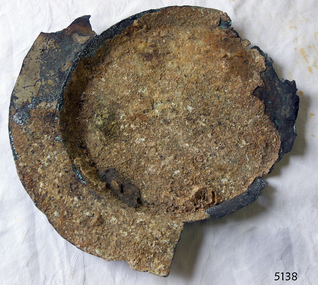
Ceremonial object - Paten, Ca. 1855
... equipment, personal effects, a lithograph, tickets and photographs from the Schomberg. Most of the artefacts were salvaged from the wreck by Peter Ronald, former director of Flagstaff Hill. This paten is significant as an example of a ceremonial ...This paten or diskos is a small plate used during a ceremonial religious service called Mass. It is part of a Communion Set that was recovered from the wreck of the Schomberg. About the Schomberg: - When the ship Schomberg was launched in 1855, she was considered the most perfect clipper ship ever to be built. James Blaine’s Black Ball Line had commissioned her to be built for their fleet of passenger liners. At a cost of £43,103, the Aberdeen builders designed her to sail faster than the quick clippers designed by North American Donald McKay. She was a three-masted wooden clipper ship, built with diagonal planking of British oak with layers of Scottish larch. This luxury vessel was designed to transport emigrants to Melbourne in superior comfort. She had ventilation ducts to provide air to the lower decks and a dining saloon, smoking room, library and bathrooms for the first-class passengers. At the launch of Schomberg’s maiden voyage, her master Captain ‘Bully’ Forbes, drunkenly predicted that he would make the journey between Liverpool and Melbourne in 60 days. Schomberg departed Liverpool on 6 October 1855 with 430 passengers and 3000 tons of cargo including iron rails and equipment intended the build the Geelong Railway and a bridge over the Yarra from Melbourne to Hawthorn. The winds were poor as Schomberg sailed across the equator, slowing her journey considerably. She was 78 days out of Liverpool when she ran aground on a sand spit near Peterborough, Victoria, on 27 December; the sand spit and the currents were not marked on Forbes’s map. Overnight, the crew launched a lifeboat to find a safe place to land the ship’s passengers. The scouting party returned to Schomberg and advised Forbes that it was best to wait until morning because the rough seas could easily overturn the small lifeboats. The ship’s Chief Officer spotted SS Queen at dawn and signalled the steamer. The master of the SS Queen approached the stranded vessel and all of Schomberg’s passengers were able to disembark safely. The Black Ball Line’s Melbourne agent sent a steamer to retrieve the passengers’ baggage from the Schomberg. Other steamers helped unload her cargo until the weather changed and prevented the salvage teams from accessing the ship. Local merchants Manifold & Bostock bought the wreck and cargo but did not attempt to salvage the cargo still on board the ship. They eventually sold it on to a Melbourne businessman and two seafarers. After two of the men drowned when they tried to reach Schomberg, salvage efforts were abandoned.32 In 1975, divers from Flagstaff Hill, including Peter Ronald, found an ornate communion set at the wreck. The set comprised a jug, two chalices, a plate and a lid. The lid did not fit any of the other objects and in 1978 a piece of the lid broke off, revealing a glint of gold. As museum staff carefully examined the lid and removed marine growth, they found a diamond ring, which is currently on display in the Great Circle Gallery.33 Flagstaff Hill also holds ship fittings and equipment, personal effects, a lithograph, tickets and photographs from the Schomberg. Most of the artefacts were salvaged from the wreck by Peter Ronald, former director of Flagstaff Hill. This paten is significant as an example of a ceremonial item in common use in the mid-19th century and still in use in religious services today. The Schomberg, which is on the Victorian Heritage Register (VHR S612), has great historical significance as a rare example of a large, fast-clipper ship on the England-to-Australia run, carrying emigrants at the time of the Victorian gold rush. She represents the technical advances made to break sailing records between Europe and Australia. Flagstaff Hill’s collection of artefacts from the Schomberg is significant for its association with the shipwreck, The collection is primarily significant because of the relationship between the objects, as together they have a high potential to interpret the story of the vessel Schomberg. It is archaeologically important as the remains of an international passenger Ship. It is historically significant for representing aspects of Victoria’s shipping history and for its association with the shipwreck and the ship, which was designed to be the fastest and most luxurious of its day Paten, part of a communion set. It has had a decoration pattern engraved onto it. The platen is corroded and has encrustation and silver oxide on the surface. A large section corroded away. Platen was recovered from the wreck of the Schomberg.flagstaff hill, flagstaff hill maritime museum and village, warrnambool, maritime museum, maritime village, great ocean road, shipwreck coast, schomberg, 1855, clipper ship, james baines & co, black ball line, luxury ship, emigrant ship, captain forbes, bully forbes, ss queen, peterborough shipwreck, communion set, religious service, communion service, ceremonial service, mass, paten, diskos, plate -
 Bendigo Military Museum
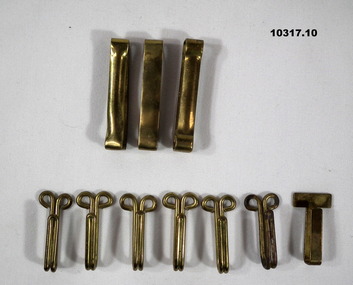
Equipment - BELT KEEPERS - ARMY, Australian Defence Industries, c.1980's
... ceremonial dress belt (black) for length adjustment. Brass colour metal. Rectangular shape. 4. - 9. Six belt keepers for service dress jacket. Heavy gauge brass wire hooks - U shaped to keep belt in position on jacket. 10. One belt keeper for service dress jacket - flat medium gauge brass hook. - U shape with small flat cross bar. Equipment ...Uniform items issued to "D. Hutchinson". Refer Cat No 10313.31.2.3. Three belt keepers for ceremonial dress belt (black) for length adjustment. Brass colour metal. Rectangular shape. 4. - 9. Six belt keepers for service dress jacket. Heavy gauge brass wire hooks - U shaped to keep belt in position on jacket. 10. One belt keeper for service dress jacket - flat medium gauge brass hook. - U shape with small flat cross bar. d hutchinson, uniforms, army, belt buckles, belt keepers -
 Bendigo Military Museum
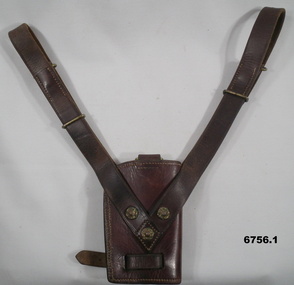
Equipment - SCABBARDS, CEREMONIAL, Post WW1
... Scabbard - leather, brown, metal studs and buckles. Equipment SCABBARDS, CEREMONIAL ...1. Scabbard - leather, brown, metal studs and buckles. 2. Scabbard - leather, brown, metal studs and buckles.passchendaele barracks trust, leather scabbards -
 Bendigo Military Museum
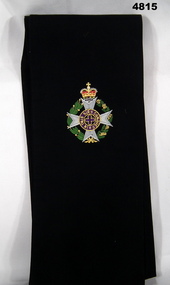
Ceremonial object - RELIGIOUS STOLE, Church Stores
... equipment Major Thomas Bruce Williams Inside the middle section - supplier's name in gold lettering on a black tag. Plain black Christian religious stole with two embroidered crests consisting of a Maltese cross under a central circle with the motto 'In This Sign Conquer'. The cross is ringed by a floral wreath and topped with a queen's crown. Three folds are sewn into the mid section of the stole. Ceremonial ...Part of the Reverend Chaplain Major Thomas Bruce Williams No 556101 Collection.Plain black Christian religious stole with two embroidered crests consisting of a Maltese cross under a central circle with the motto 'In This Sign Conquer'. The cross is ringed by a floral wreath and topped with a queen's crown. Three folds are sewn into the mid section of the stole.Inside the middle section - supplier's name in gold lettering on a black tag.army chaplains, personal equipment, major thomas bruce williams -
 Bendigo Military Museum
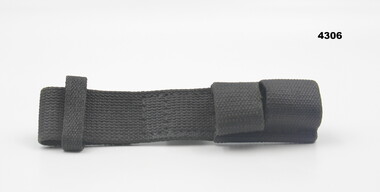
Equipment - BAYONET FROG, Post 1960
... The frog was black coated for ceremonial use otherwise it was a green colour to suit all equipment....The frog was black coated for ceremonial use otherwise it was a green colour to suit all equipment. bayonet frog webbing Bayonet frog, webbing, black nugget coated for SLR Bayonet Scabbard with 3 loops to fit scabbard Equipment BAYONET FROG Commonwealth Government Clothing Factory ...The frog was black coated for ceremonial use otherwise it was a green colour to suit all equipment.Bayonet frog, webbing, black nugget coated for SLR Bayonet Scabbard with 3 loops to fit scabbardbayonet, frog, webbing -
 Bendigo Military Museum
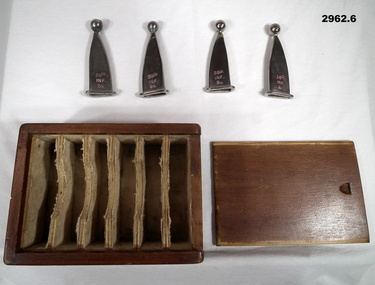
Accessory - BAYONET TIPS, Post WW1
... military equipment - army Bayonet Passchendaele barracks trust .3) - .6) Stamped with traces of red paint, both sides of tip covers: “38th Inf Bn” Sticky label on box side: 26. Set (4 of 6, 2 missing) ceremonial ...Set (4 of 6, 2 missing) ceremonial bayonet tip covers. .1) Wooden box, varnished brown, padded internal dividers. .2) Wooden, sliding type lid. .3) - .6) Chromed bayonet tip cover with a 12 mm sphere at tip..3) - .6) Stamped with traces of red paint, both sides of tip covers: “38th Inf Bn” Sticky label on box side: 26.military equipment - army, bayonet, passchendaele barracks trust -
 Uniting Church Archives - Synod of Victoria
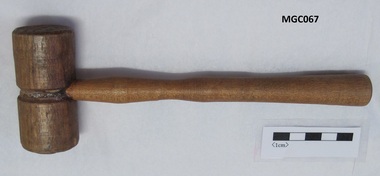
Ceremonial object - Gavel
... equipment. Methodist Girls' Comardeship Small wooden handmade gavel. Ceremonial object Gavel ...The Methodist Girls' Comradeship was formed in 1918 with the first Branch being in Bondi, NSW. There were three sections: Junior Rays, 8 - 11 years; Senior Rays, 11 - 15 years and Comrades, 15 years and over. The aims of the MGC was to "challenge young people with the saving power of Jesus Christ and provide avenues of christian service" and "to provide for the spiritual, social, physical and educational welfare of the members". The MGC's motto was "The Utmost for the Highest". A gavel was part of the MGC Branch equipment. Small wooden handmade gavel.methodist girls' comardeship -
 Wodonga & District Historical Society Inc
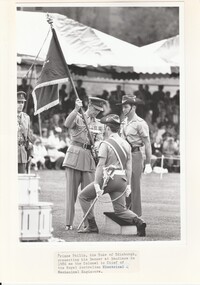
Mixed media - Presentation of Prince Philip's Banner to RAEME, 1986
... equipment. RAEME personnel are represented in most Army units. The Royal Australian Electrical and Mechanical Engineers corps motto is ‘Arte et Marte’, which is Latin for ‘With Skill and Fighting’. On the 5th March 1959, His Royal Highness, The Prince Philip, Duke of Edinburgh, accepted the appointment of Colonel-in-Chief of the Corps of the Royal Australian Electrical and Mechanical Engineers. On Tuesday 20 May 1986, His Royal Highness, The Prince Philip, Duke of Edinburgh, Colonel in Chief of the Royal Australian Electrical and Mechanical Engineers (RAEME) presented the Prince Philip Banner to the Corps at a Ceremonial...equipment. RAEME personnel are represented in most Army units. The Royal Australian Electrical and Mechanical Engineers corps motto is ‘Arte et Marte’, which is Latin for ‘With Skill and Fighting’. On the 5th March 1959, His Royal Highness, The Prince Philip, Duke of Edinburgh, accepted the appointment of Colonel-in-Chief of the Corps of the Royal Australian Electrical and Mechanical Engineers. On Tuesday 20 May 1986, His Royal Highness, The Prince Philip, Duke of Edinburgh, Colonel in Chief of the Royal Australian Electrical and Mechanical Engineers (RAEME) presented the Prince Philip Banner to the Corps at a Ceremonial ...RAEME Corps was first established in 1942 when the Ordnance Corps and the Service Corps were combined. The royal ascent was granted in 1948. The Royal Australian Electrical and Mechanical Engineers (RAEME) is a technical corps tasked with the maintenance of the Army's modern hardware and equipment. RAEME personnel are represented in most Army units. The Royal Australian Electrical and Mechanical Engineers corps motto is ‘Arte et Marte’, which is Latin for ‘With Skill and Fighting’. On the 5th March 1959, His Royal Highness, The Prince Philip, Duke of Edinburgh, accepted the appointment of Colonel-in-Chief of the Corps of the Royal Australian Electrical and Mechanical Engineers. On Tuesday 20 May 1986, His Royal Highness, The Prince Philip, Duke of Edinburgh, Colonel in Chief of the Royal Australian Electrical and Mechanical Engineers (RAEME) presented the Prince Philip Banner to the Corps at a Ceremonial Parade held at the RAEME Training Centre, Bandiana.These items are significant because they document an important event for the RAEME Unit at Bandiana.A collection of images and newspaper articles documenting an important event for the RAEME unit at Bandiana, Victoria. The Prince Philip features the Royal Cipher on the front and the RAEME Badge on the reverse.raeme, prince philip duke of edinburugh -
 8th/13th Victorian Mounted Rifles Regimental Collection
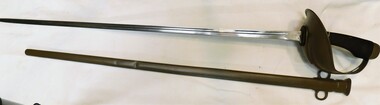
Weapon - Sword
... equipment of Light Horse ln period 1920 -1940. Carried by 8/13 VMR Heritage Troop during 1980s. Display potential and occasional ceremonial use. sword sabre cavalry light horse military weapon On handguard 2 RMA MBY 340 British Model 1908 cavalry sword steel blade 890mm long, composition handle with steel hand-guard painted khaki green. ...Swords were issued to Australian Light Horse in 1918. They were part of the equipment of Light Horse ln period 1920 -1940. Carried by 8/13 VMR Heritage Troop during 1980s.Display potential and occasional ceremonial use.British Model 1908 cavalry sword steel blade 890mm long, composition handle with steel hand-guard painted khaki green. Steel scabbard with 2 fixed rings painted khaki green.On handguard 2 RMA MBY 340sword, sabre, cavalry, light horse, military, weapon -
 Vision Australia
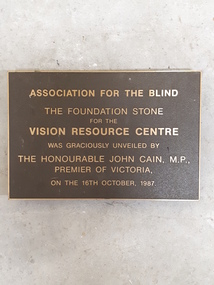
Photograph - Image, Vision Resource Centre, 1987-1989
... The growing need for assistive equipment and the increased demands upon the Association for the Blind, bigger premises were needed to house these services. In 1987 the Victorian Premier ceremonially...The growing need for assistive equipment and the increased demands upon the Association for the Blind, bigger premises were needed to house these services. In 1987 the Victorian Premier ceremonially ...The growing need for assistive equipment and the increased demands upon the Association for the Blind, bigger premises were needed to house these services. In 1987 the Victorian Premier ceremonially layed the foundation stone for the new building that would become the Vision Resource Centre designed to meet this need. It was built using funds from the Vision Victorian Appeal and completed in 1989.2 digital images of metal plaqueAssociation for the Blind The foundation stone for the Vision Resource Centre was graciously unveiled by the Honourable John Cain, M.P., Premier of Victoria, on the 16th October, 1987. Association for the Blind The official opening of the Vision Resource Centre was performed by His Excellency, Dr. Davis McCaughey, A.C. Governor of Victoria, on the 3rd May 1989.association for the blind, john cain, dr davis mccaughey -
 Port Fairy Historical Society Museum and Archives
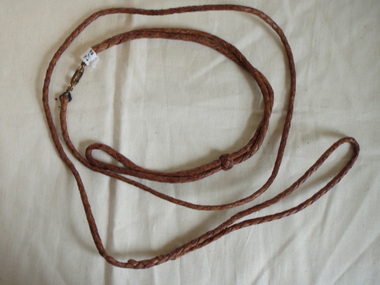
Equipment - Leather Lanyard, early 1900s
... Used by Captain William Robertson local history costume male ceremonial port fairy naval reserves boxer rebellion s.s.casino belfast and koroit steam navigation co. Leather Lanyard: Brown plaited leather lanyard with a brass swivel Equipment Leather Lanyard ...Used by Captain William RobertsonLeather Lanyard: Brown plaited leather lanyard with a brass swivellocal history, costume, male ceremonial, port fairy naval reserves, boxer rebellion, s.s.casino, belfast and koroit steam navigation co.
