
Showing 24 items matching "ceremonial textiles"
-
 Friends of St Brigids Association
Ceremonial object - Altar cloth
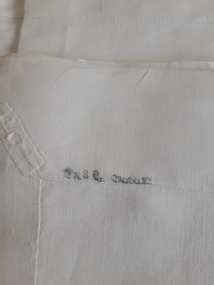
... ceremonial textiles...Used on altar at St Brigid's Church, Crossley ceremonial textiles altarcloths Celtic cross embroidered in red . ...Used on altar at St Brigid's Church, CrossleyCream altar cloth used to cover an altar. In the Catholic Church it is used as a sign of respect towards the holiness of the altar. Celtic cross embroidered in red . Hand embroidered in center / bottom of cloth.ceremonial textiles, altarcloths -
 Friends of St Brigids Association
Ceremonial object - Humeral Veil, Humeral Veil - a liturgical vestment that covers the shoulders and hands of the minister to carry the Blessed Sacrament or give Benediction
... Ceremonial textiles...Used at St Brigid's Church Crossley Ceremonial textiles "Benediction " : "CSNG Crossley" Rectangular cloth Humeral Veil - a liturgical vestment that covers the shoulders and hands of the minister to carry the Blessed Sacrament or give Benediction. ...Used at St Brigid's Church Crossley Rectangular cloth"Benediction " : "CSNG Crossley"ceremonial textiles -
 Bendigo Historical Society Inc.
Textile - Rechabite Ceremonial Sashes
... Ceremonial Sashes from the Independent Order of Rechabites, Salford Unity. Cream silk, various ranks, printed designs, red stripes on the outer edge. Superintendent x 1, Secretary x 3, Guardian x 3, Steward x 7, Levite x 1 Textile Rechabite Ceremonial Sashes ...The Rechabite movement began in Salford England. In 1861 the first Independent order of Rechabites Friendly Society, Salford Unity, was opened in Bendigo to be called “Star of Bendigo” Tent. It was registered as Number 5 making it one of the first in Victoria. They worked with the Total Abstinence Society to organize lectures and social events designed to prove that entertainment and fun could be had without alcohol. They met in the new Temperance Hall in View Street.Ceremonial Sashes from the Independent Order of Rechabites, Salford Unity. Cream silk, various ranks, printed designs, red stripes on the outer edge. Superintendent x 1, Secretary x 3, Guardian x 3, Steward x 7, Levite x 1i.o.r. (rechabites), salford unity -
 Bendigo Historical Society Inc.
Textile - Rechabite Ceremonial Sashes
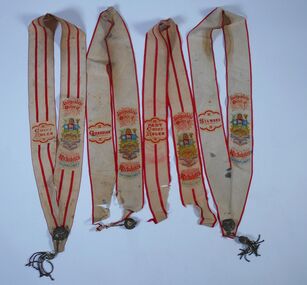
... ceremonial costumes. Cream silk, various ranks, printed designs, red stripes on the outer edge. A Rank Superintendent - cream silk collar with embroidered I.O.R. motif and crests of Victoria, U.S.A. & United Kingdom in red 2 x 1/4 inch stripes on outer edges B Rank Deputy - As "A" above plus a single 1/2 inch central strip C Rank Past Chief Ruler - As for "A" above plus 3 x 1/2 inch stripes, four tier rosette hangs at base of collar, 2 tiers, top 2 tiers white D Rank Chief Ruler - as for "A" above plus 2 x 1/2 inch stripes Textile Rechabite Ceremonial Sashes ...The Rechabite movement began in Salford England. In 1861 the first Independent order of Rechabites Friendly Society, Salford Unity, was opened in Bendigo to be called “Star of Bendigo” Tent. It was registered as Number 5 making it one of the first in Victoria. They worked with the Total Abstinence Society to organize lectures and social events designed to prove that entertainment and fun could be had without alcohol. They met in the new Temperance Hall in View Street.Four Ceremonial Sashes from the Independent Order of Rechabites, Salford Unity. Male ceremonial costumes. Cream silk, various ranks, printed designs, red stripes on the outer edge. A Rank Superintendent - cream silk collar with embroidered I.O.R. motif and crests of Victoria, U.S.A. & United Kingdom in red 2 x 1/4 inch stripes on outer edges B Rank Deputy - As "A" above plus a single 1/2 inch central strip C Rank Past Chief Ruler - As for "A" above plus 3 x 1/2 inch stripes, four tier rosette hangs at base of collar, 2 tiers, top 2 tiers white D Rank Chief Ruler - as for "A" above plus 2 x 1/2 inch stripes i.o.r. (rechabites), salford unity -
 Bendigo Historical Society Inc.
Textile - Rechabite Ceremonial Sashes
... ceremonial sashes. A. cream silk central orange stripe B. cream silk 2 x 12 mm orange stripe C. cream silk with 3 x 12 mm orange stripes Textile Rechabite Ceremonial Sashes ...The Rechabite movement began in Salford England. In 1861 the first Independent order of Rechabites Friendly Society, Salford Unity, was opened in Bendigo to be called “Star of Bendigo” Tent. It was registered as Number 5 making it one of the first in Victoria. They worked with the Total Abstinence Society to organize lectures and social events designed to prove that entertainment and fun could be had without alcohol. They met in the new Temperance Hall in View Street. Independent Order of Rechabites, Salford Unity. Male ceremonial sashes. A. cream silk central orange stripe B. cream silk 2 x 12 mm orange stripe C. cream silk with 3 x 12 mm orange stripes i.o.r. (rechabites), salford unity -
 Bendigo Historical Society Inc.
Textile - Rechabite Ceremonial Sashes
... ceremonial collars for the Independent Order of Rechabites, cream silk with red stripes. The number of stripes vary according to rank. Chief Rulers collar x1, Steward x 2, Secretary x 1, Levite x 1 & Supporter x 1 5 collars have a silver wire 7 sequin rosettes at base of "collar V", 3 have silver wire tassels. Textile ...The Rechabite movement began in Salford England. In 1861 the first Independent order of Rechabites Friendly Society, Salford Unity, was opened in Bendigo to be called “Star of Bendigo” Tent. It was registered as Number 5 making it one of the first in Victoria. They worked with the Total Abstinence Society to organize lectures and social events designed to prove that entertainment and fun could be had without alcohol. They met in the new Temperance Hall in View Street. Independent Order of Rechabites, Salford Unity. Male ceremonial sashes. 8 silk ceremonial collars for the Independent Order of Rechabites, cream silk with red stripes. The number of stripes vary according to rank. Chief Rulers collar x1, Steward x 2, Secretary x 1, Levite x 1 & Supporter x 1 5 collars have a silver wire 7 sequin rosettes at base of "collar V", 3 have silver wire tassels.Some collars have stamped on reverse "Star of Bendigo Tent No 5"i.o.r. (rechabites), salford unity -
 Bendigo Historical Society Inc.
Textile - Rechabite Ceremonial Badges
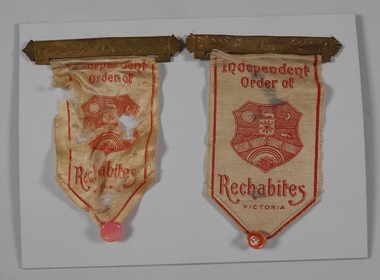
... ceremonial badges. A Stylized brass button with pin back, decorated with stamped design of maple leaf and palm fronds, cream satin ribbon with crest of Independent Order of Rechabites. Small pink (faded red) button at base B as per "A" above but button is clear with an orange circle. Textile ...The Rechabite movement began in Salford England. In 1861 the first independent order of Rechabites Friendly Society, Salford Unity, was opened in Bendigo to be called “Star of Bendigo” Tent. It was registered as Number 5 making it one of the first in Victoria. They worked with the Total Abstinence Society to organize lectures and social events designed to prove that entertainment and fun could be had without alcohol. They met in the new Temperance Hall in View Street.Independent Order of Rechabites, Salford Unity. Male ceremonial badges. A Stylized brass button with pin back, decorated with stamped design of maple leaf and palm fronds, cream satin ribbon with crest of Independent Order of Rechabites. Small pink (faded red) button at base B as per "A" above but button is clear with an orange circle.Some collars have stamped on reverse "Star of Bendigo Tent No 5"i.o.r. (rechabites), badge -
 National Wool Museum
Film - Australian Olympic Uniform Design, The Woolmark Company, 2000
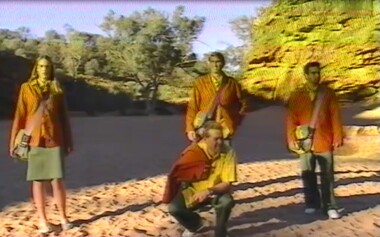
... Film Sydney 2000 Olympic Games uniform The Woolmark Company textile design mambo australian olympic committee athletes Label on tape: WOOLMARK / Ceremonial / Uniforms / Duration: 5 min 31 sec Black VHS tape with white stickers and printed text. ...Tape documents the design of Australian athletes Olympic Uniform for the Sydney 2000 Olympics. Film features Australian athletes, Australian Olympic Committee staff, The Woolmark Company staff and Mambo staff.Black VHS tape with white stickers and printed text. Tape is housed in clear plastic case. Film includes colour footage and audio. 00:02 - titles 00:06 - Mambo artwork detail 00:11 - outback scenes 00:23 - detail of sewing machines 00:40 - Herb Elliot, Director of Athlete and Corporate Relations, Australian Olympic Committee speaking about design of Australian Olympic uniforms 01:10 - Australian athletes wearing uniforms 01:10 - Maria Italiano, Project Manager, Olympics and Sport Marketing Apparel, The Woolmark Company, speaking about uniform design 02:04 - Lachlan Barnard, Australian Menswear Designer, Mambo 02:36 - Deare Jennings, Creative Director, Mambo 04:24 - Russell Mark, Australian Clay Target Shooter 04:58 - Daniel Marsden, Australian Water Polo Team 05:12 - Paul Goudion, Australian Hockey Team 05:27 - end title 05:33 - endLabel on tape: WOOLMARK / Ceremonial / Uniforms / Duration: 5 min 31 secfilm, sydney 2000 olympic games, uniform, the woolmark company, textile design, mambo, australian olympic committee, athletes -
 Kew Historical Society Inc
Archive (Sub-series) - Subject File, Boroondara, City of - Memorabilia Working Group, 1996
... textiles and a number of outdoor items”. The response in the Interim Report September 11, 1996 noted that in contrast to the submission by the Kew representatives for Kew-related material to be relocated to the Kew Library, the Society had been given a scarf, a ceremonial cover, and a cup and saucer. ...textiles and a number of outdoor items”. The response in the Interim Report September 11, 1996 noted that in contrast to the submission by the Kew representatives for Kew-related material to be relocated to the Kew Library, the Society had been given a scarf, a ceremonial cover, and a cup and saucer. ...Various partiesReference, Research, InformationKHS OrderWorking Brief (Jan 1996) and Interim Report of and to the City of Boroondara Memorabilia Working Group on which the representatives of Kew were Jill O’Brien and Dorothy Benyei. The Brief described the items under consideration to include: “historic artefacts, photographic material, books, works on paper, textiles and a number of outdoor items”. The response in the Interim Report September 11, 1996 noted that in contrast to the submission by the Kew representatives for Kew-related material to be relocated to the Kew Library, the Society had been given a scarf, a ceremonial cover, and a cup and saucer. The items that the Kew representatives wanted returned to Kew included five paintings and a photograph. These are itemised in the report.city of boroondara - collections, kew historical society - collections, city of kew - collectionscity of boroondara - collections, kew historical society - collections, city of kew - collections -
 Ballarat Diocesan Historical Commission
ceremonial collar, Hibernian Australasian Catholic Benefit Society (HACBS) ceremonial collar, Early 20th century
... Hibernian, HACBS, textile, ceremonial collar, Friendly Society....Hibernian, HACBS, textile, ceremonial collar, Friendly Society. Large velvet ceremonial collar with gold metal braid trim and PP for Past President embroidered in gold metal thread. ...The Ballarat Hibernian Society was a friendly society formed at Ballarat in 1868. In 1871 the group amalgamated with a similar group in Melbourne to form the HACBS. Due to legislative changes the insurance interests of the society were absorbed into those of the IOOF in the late twentieth century . These collars were worn at official functions and meetings of the society. They vary in elaboration from heavily embroidered to very simple silk collars and many are embroidered with motifs such as kangaroos, emus, shamrocks and Irish harps.Large velvet ceremonial collar with gold metal braid trim and PP for Past President embroidered in gold metal thread.hibernian, hacbs, textile, ceremonial collar, friendly society. -
 Hymettus Cottage & Garden Ballarat
Textile - ceremonial collar, Hibernian collar
... Hymettus cottage is a rare example of a Catholic family property dating from the nineteenth century with much of its original and early fabric, furnishings and devotional items of the family's Catholic faith still in situ. hibernian, australasian, hacbs, st arnaud, victoria, burke, ceremonial, collar. Hibernian collar Textile ceremonial collar ...Silk ceremonial collar of Mr A. Burke St Arnaud who was a member of the Hibernian Australasian Catholic Benefit Society (HACBS).Mr A. Burke died at Ballarat in 1951 while staying with his daughter, Mrs Mary Taffe of Hymettus. Several of the Burke family items including this ceremonial collar remain at the cottage. Hymettus cottage is a rare example of a Catholic family property dating from the nineteenth century with much of its original and early fabric, furnishings and devotional items of the family's Catholic faith still in situ.hibernian, australasian, hacbs, st arnaud, victoria, burke, ceremonial, collar. -
 City of Moorabbin Historical Society (Operating the Box Cottage Museum)
Ceremonial object - Clothing, child's dress-up costume, c1927
... A child's dress-up costume incorporating the Australian Red Ensign Flag made for a pageant c1927 clothing moorabbin dressmaking textiles melbourme velia dowdes house A child's dress-up costume c1927. An Australian Red Ensign Flag sleeveless top with detachable cape Ceremonial object Clothing, child's dress-up costume Velia Dowdes ...A child's dress-up costume incorporating the Australian Red Ensign Flag made for a pageant c1927A child's dress-up costume c1927. An Australian Red Ensign Flag sleeveless top with detachable capeclothing, moorabbin, dressmaking, textiles, melbourme, velia dowdes house -
Emerald Museum & Nobelius Heritage Park
Textile - Ceremonial ribbon, Unknown maker, ANZAC Day 1921
... Avenue of Honour emerald ANZAC Remnant of Ribbon Shown in Photograph shwon on left 1921 ANZAC Day Remnant of the ribbon which was used in opening the Emerald Avenue of Honour - Several sections of purple ribbon mounted on a piece of heavy cardboard, ribbon appears to originally glued to the board a repair has been made with whaat appears to be “invisible”tape. Textile Ceremonial ribbon Unknown maker ...The Emerald Avenue of Honour Was officially opened on ANZAC Day, 1921. The ribbon used in the ceremony was cut by Mrs Mahony, wife of Cr J. Mahony. This Avenue of Honour was later removed to facilitate the widening of the road, the trees were much later replaced. The original metal plaques are now housed at the Emerald RSL.the object is historically and socially significant as it is the only known remnant of the ribbon used in the opening ceremony of the Avenue of Honour in Emerald.Remnant of the ribbon which was used in opening the Emerald Avenue of Honour - Several sections of purple ribbon mounted on a piece of heavy cardboard, ribbon appears to originally glued to the board a repair has been made with whaat appears to be “invisible”tape.Remnant of Ribbon Shown in Photograph shwon on left 1921 ANZAC Dayavenue of honour, emerald, anzac -
 Embroiderers Guild, Victoria
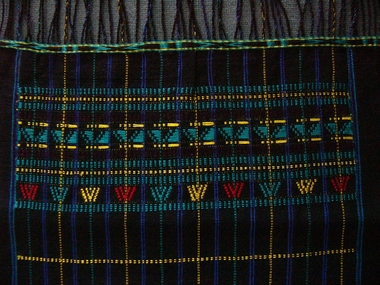
Accessory - Tobanese Woven Piece Samosin Island, Sumatra, 1960-1980
... Tobanese weaving refers to the ancient, sacred textile tradition of the Batak Toba people, who live in the Lake Toba region of North Sumatra, Indonesia. Historically practiced by women using a traditional backstrap loom (gedogan), this craft is most famous for producing Ulos, a ceremonial handwoven cloth that serves as a fundamental pillar of Batak social structure, identity, and ritual life....Tobanese weaving refers to the ancient, sacred textile tradition of the Batak Toba people, who live in the Lake Toba region of North Sumatra, Indonesia. Historically practiced by women using a traditional backstrap loom (gedogan), this craft is most famous for producing Ulos, a ceremonial handwoven cloth that serves as a fundamental pillar of Batak social structure, identity, and ritual life. ...Tobanese weaving from Samosin Island in Lake Toba. Gifted by Dr. and Mrs. J.S.Mills. Tobanese weaving refers to the ancient, sacred textile tradition of the Batak Toba people, who live in the Lake Toba region of North Sumatra, Indonesia. Historically practiced by women using a traditional backstrap loom (gedogan), this craft is most famous for producing Ulos, a ceremonial handwoven cloth that serves as a fundamental pillar of Batak social structure, identity, and ritual life.Black ground with woven-in vertical and horizontal stripes of green, blue. purple, red and yellow. Blocks of red, green and yellow shapes. Ends finished with a deep fringe made of warp threads.weaving, stoles, indonesia, scarves, 1960-1980 -
 Embroiderers Guild, Victoria
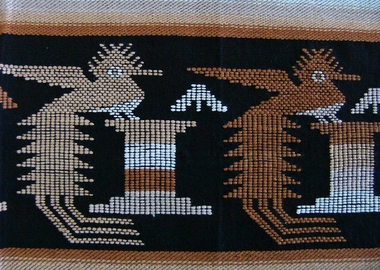
Textile - Handwoven Pattern Darning Guatemalan Wall Decoration, Late 20th century
... Regional Craftsmanship: Many distinct pieces originate from highland communities like Chichicastenango and Santiago Atitlán, where multi-purpose textiles like tzutes or ceremonial huipils are crafted....Regional Craftsmanship: Many distinct pieces originate from highland communities like Chichicastenango and Santiago Atitlán, where multi-purpose textiles like tzutes or ceremonial huipils are crafted. Embroidery Wall Hanging Pattern Darning South America 1960-80 Hand woven striped cotton, black back ground,brown and white tones. ...Handwoven and embroidered Guatemalan wall decorations are traditional Mayan folk art pieces created using backstrap looms and intricate hand-embroidery techniques like brocade, darning, and randa stitching. Key Features of Guatemalan Wall Textiles Backstrap Loom Weaving: Panels are woven on a traditional backstrap loom where the weaver uses body tension to control the warp and weft threads. Pattern Darning and Brocade: Artisans use supplementary-weft techniques—such as brocade (randa) and darning—to build geometric, zoomorphic, and nature-inspired motifs like quetzals, deer, horses, and floral mandalas. Regional Craftsmanship: Many distinct pieces originate from highland communities like Chichicastenango and Santiago Atitlán, where multi-purpose textiles like tzutes or ceremonial huipils are crafted.Hand woven striped cotton, black back ground,brown and white tones. Large central band has 4 large quetzel birds, 2 narrow bands have 11 figures in pattern darning. Ends are fringed.embroidery, wall hanging, pattern darning, south america, 1960-80 -
 Sunshine and District Historical Society Incorporated
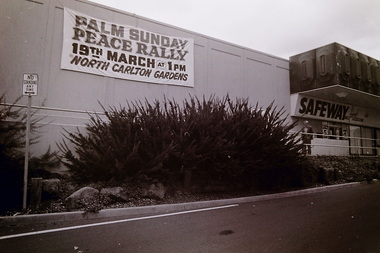
Photograph - Palm Sunday Banner Sunshine Plaza Hampshire Road Sunshine 1989 Photograph, Sharon Cavanagh, 16th March 1989
... As a textile object created for ritual use, it reflects the importance of visual symbolism in worship and the continuity of liturgical traditions across generations. The banner also represents the cultural diversity of local churches, many of which include migrant communities who maintain distinctive artistic and ceremonial customs. ...This photograph, taken by The Advocate in 1989, feature a Palm Sunday banner hanging on the exterior wall of the Sunshine Plaza, Hampshire Road, Sunshine. The banner was advertising a peace rally for the 19th March to be held at the North Carlton Gardens. Palm Sunday is the Sunday before Easter, celebrating Jesus’ arrival in Jerusalem, where crowds welcomed him by waving palm branches and laying them on the road as a sign of honour.The Palm Sunday banner is significant for its role in expressing the religious identity and devotional practices of Christian congregations in Melbourne’s western suburbs. As a textile object created for ritual use, it reflects the importance of visual symbolism in worship and the continuity of liturgical traditions across generations. The banner also represents the cultural diversity of local churches, many of which include migrant communities who maintain distinctive artistic and ceremonial customs. Its presence in Palm Sunday celebrations highlights the communal nature of faith and the shared preparation for Easter within the broader Sunshine & District Region.7482 - Palm Sunday Banner Sunshine Plaza Hampshire Road Sunshine 1989 Photograph (Advocate 861).JPGpalm sunday, sunshine plaza, hampshire road, sunshine -
 Embroiderers Guild, Victoria
Textile - Part of Sari, 19 th C
... ceremonial vestments, symbolizing immense wealth and power, famously seen at the Field of the Cloth of Gold event. One of two pieces of a sari, cloth of gold woven with silk warps and gold thread weft. The selvedge has a decorative band of lions, stags and horses with flowers and scatterd motifs on the main area. Textile ...Cloth of gold is a luxurious, historically significant fabric woven with real gold (or gilt) threads, often wrapped around a silk core, creating a stiff, heavy, and incredibly expensive material used for royal robes, tapestries, and ceremonial vestments, symbolizing immense wealth and power, famously seen at the Field of the Cloth of Gold event. One of two pieces of a sari, cloth of gold woven with silk warps and gold thread weft. The selvedge has a decorative band of lions, stags and horses with flowers and scatterd motifs on the main area. -
 National Wool Museum
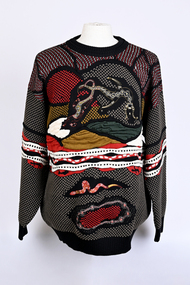
Clothing - Jumper, Geelong Wool Combing, 1993
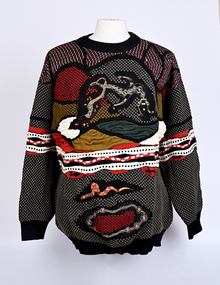
... Ceremonial Hunting Grounds, in the You Yangs' upon commission from the Geelong Wool Combing Company. It depicts hunting in the You Yangs, today referred to as its original Wadawurrung name Wurdi Youang, the distinctive granite peaks that overlook the region. In 1993, Couzens’ painting was translated into a pattern by textile...Ceremonial Hunting Grounds, in the You Yangs' upon commission from the Geelong Wool Combing Company. It depicts hunting in the You Yangs, today referred to as its original Wadawurrung name Wurdi Youang, the distinctive granite peaks that overlook the region. In 1993, Couzens’ painting was translated into a pattern by textile ...Stanley Couzens, a Gunditjmara man and long-time Geelong resident, painted the story 'Ceremonial Hunting Grounds, in the You Yangs' upon commission from the Geelong Wool Combing Company. It depicts hunting in the You Yangs, today referred to as its original Wadawurrung name Wurdi Youang, the distinctive granite peaks that overlook the region. In 1993, Couzens’ painting was translated into a pattern by textile designer Jenny McMahon. It was then turned into a jumper using wool sourced entirely from the region. It was fully processed, from fleece to fabric, in Geelong. The jumper was given to attendees at the opening of the Geelong Wool Combing company on 10 December 1993. Among the many guests, was the Prime Minister Paul Keating.Woollen jumper featuring red, mustard, green and cream colours depicting landscape and fauna motifs, with black cuffs and collar. Size XL, label stitched to inside collar with paper swing-tag attached.jumper, wool, geelong, 1993, geelong wool combing ltd, stanley couzens, woolmark, you yangs, corio bay, wathourong, snake, fish, wurdi youang, jenny mcmahon -
 National Wool Museum
Clothing - Jumper, Geelong Wool Combing, 1993
... Ceremonial Hunting Grounds, in the You Yangs' upon commission from the Geelong Wool Combing Company. It depicts hunting in the You Yangs, today referred to as its original Wadawurrung name Wurdi Youang, the distinctive granite peaks that overlook the region. In 1993, Couzens’ painting was translated into a pattern by textile...Ceremonial Hunting Grounds, in the You Yangs' upon commission from the Geelong Wool Combing Company. It depicts hunting in the You Yangs, today referred to as its original Wadawurrung name Wurdi Youang, the distinctive granite peaks that overlook the region. In 1993, Couzens’ painting was translated into a pattern by textile ...Stanley Couzens, a Gunditjmara man and long-time Geelong resident, painted the story 'Ceremonial Hunting Grounds, in the You Yangs' upon commission from the Geelong Wool Combing Company. It depicts hunting in the You Yangs, today referred to as its original Wadawurrung name Wurdi Youang, the distinctive granite peaks that overlook the region. In 1993, Couzens’ painting was translated into a pattern by textile designer Jenny McMahon. It was then turned into a jumper using wool sourced entirely from the region. It was fully processed, from fleece to fabric, in Geelong. The jumper was given to attendees at the opening of the Geelong Wool Combing company on 10 December 1993. Among the many guests, was the Prime Minister Paul Keating.Woollen jumper featuring red, mustard, green and cream colours depicting landscape and fauna motifs, with black cuffs and collar. Size XL, label stitched to inside collar.jumper, wool, geelong, 1993, geelong wool combing ltd, stanley couzens, woolmark, you yangs, corio bay, wathourong, snake, fish, wurdi youang, jenny mcmahon -
 National Wool Museum
Clothing - Jumper, Jenny McMahon, 1993
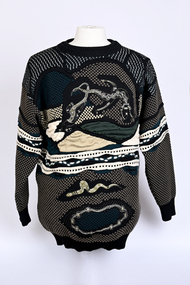
... Ceremonial Hunting Grounds in the You Yangs' upon commission from the Geelong Wool Combing Company. It depicts hunting in the You Yangs, today referred to as its original Wadawurrung name Wurdi Youang, the distinctive granite peaks that overlook the region. In 1993, Couzens’ painting was translated into a pattern by textile...Ceremonial Hunting Grounds in the You Yangs' upon commission from the Geelong Wool Combing Company. It depicts hunting in the You Yangs, today referred to as its original Wadawurrung name Wurdi Youang, the distinctive granite peaks that overlook the region. In 1993, Couzens’ painting was translated into a pattern by textile ...Stanley Couzens, a Gunditjmara man and long-time Geelong resident, painted the story 'Ceremonial Hunting Grounds in the You Yangs' upon commission from the Geelong Wool Combing Company. It depicts hunting in the You Yangs, today referred to as its original Wadawurrung name Wurdi Youang, the distinctive granite peaks that overlook the region. In 1993, Couzens’ painting was translated into a pattern by textile designer Jenny McMahon. It was then turned into a jumper using wool sourced entirely from the region. It was fully processed, from fleece to fabric, in Geelong. The jumper was given to attendees at the opening of the Geelong Wool Combing company on 10 December 1993. Among the many guests, was the Prime Minister Paul Keating.Mens knitted jumper depicting an image of the You Yangs and Corio Bay on the front of the jumper in colours including brown, green, cream, black, with white and gold stitching. The central motif extends to the back of the jumper. A cardboard tag attached to the label explains the provenance of the design and manufacture of the jumper.merino sheep knitting, mcmahon, jeni - mcmahon's farm, corio bay, victoria, merino sheep, knitting, stanley couzens, you yangs, jumper, design, gunditjmara, geelong wool combing company, wurdi youang, jenny mcmahon -
 National Wool Museum
Container - Miniature Bool Bale, Geelong Wool Combing, 1993
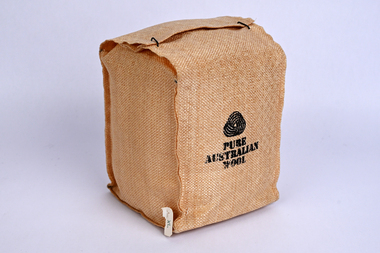
... Ceremonial Hunting Grounds, in the You Yangs' upon commission from the Geelong Wool Combing Company. It depicts hunting in the You Yangs, today referred to as its original Wadawurrung name Wurdi Youang, the distinctive granite peaks that overlook the region. In 1993, Couzens’ painting was translated into a pattern by textile...Ceremonial Hunting Grounds, in the You Yangs' upon commission from the Geelong Wool Combing Company. It depicts hunting in the You Yangs, today referred to as its original Wadawurrung name Wurdi Youang, the distinctive granite peaks that overlook the region. In 1993, Couzens’ painting was translated into a pattern by textile ...Stanley Couzens, a Gunditjmara man and long-time Geelong resident, painted the story 'Ceremonial Hunting Grounds, in the You Yangs' upon commission from the Geelong Wool Combing Company. It depicts hunting in the You Yangs, today referred to as its original Wadawurrung name Wurdi Youang, the distinctive granite peaks that overlook the region. In 1993, Couzens’ painting was translated into a pattern by textile designer Jenny McMahon. It was then turned into a jumper using wool sourced entirely from the region. It was fully processed, from fleece to fabric, in Geelong. The jumper was given to attendees at the opening of the Geelong Wool Combing company packaged in these miniature wool bales, on 10 December 1993. Among the many guests, was the Prime Minister Paul Keating.Synthetic miniature wool bale packaging, with miniature bale hooks, previously containing a jumper. Miniature wool bale features two stenciled designs in black ink. Features two stenciled design with black ink. First stencil on front reads "A Gift From/ GWC/ Geelong Wool Combing ". Second stencil on back reads "Pure/ Australian/ Wool" with Woolmark logo above. Small tag on bottom right corner reads "XL".wool bales, wadawurrung, gunditjmara, stanley couzens, you yangs, wurdi youang, jumper, packaging, geelong, jenny mcmahon, geelong wool combing company, gifts, corporate gifts -
 Embroiderers Guild, Victoria
Textile - Vietnamese Embroidered Clothing Panel, 1990
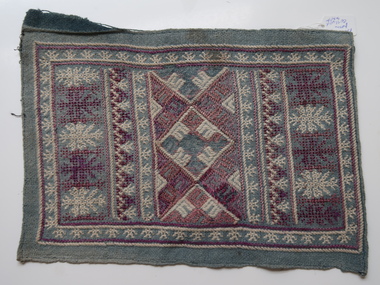
... ceremonial garments, trousers, and baby carriers, serving as a significant expression of cultural identity and heritage. The Yao (lu Mien) ethnic group are widely recognized across regions of Southwest China, Laos and Vietnam. Example of Hill Tribes embroidery Small embroidered panel, faded indigo with counted thread embroidery. Textile ...Purchased by donor north of Sapa near Mount Fansipan, Vietnam. Small embroidered panel worn as part of everyday wear on back of jacket/top. These panels are typically embroidered by Yao women to decorate traditional ceremonial garments, trousers, and baby carriers, serving as a significant expression of cultural identity and heritage. The Yao (lu Mien) ethnic group are widely recognized across regions of Southwest China, Laos and Vietnam.Example of Hill Tribes embroiderySmall embroidered panel, faded indigo with counted thread embroidery. -
 Embroiderers Guild, Victoria
Textile - Vietnamese Embroidered Clothing Panel, 1990
... ceremonial garments, trousers, and baby carriers, serving as a significant expression of cultural identity and heritage. The Yao (lu Mien) ethnic group are widely recognized across regions of Southwest China, Laos and Vietnam. Embroidered panel utilizing intricate, geometric cross stitch and counted thread embroidery traditional to Yao textiles ...Purchased by donor from hill tribes in Sapa region of Northern Vietnam, part of traditional clothing - apron/skirt panel. These panels are typically embroidered by Yao women to decorate traditional ceremonial garments, trousers, and baby carriers, serving as a significant expression of cultural identity and heritage. The Yao (lu Mien) ethnic group are widely recognized across regions of Southwest China, Laos and Vietnam.Embroidered panel utilizing intricate, geometric cross stitch and counted thread embroidery traditional to Yao textiles. -
Broadmeadows Historical Society & Museum
Clothing - Christening Gown, c. 1900's
... A christening gown made of worsted cotton from the early 20th century is a distinctive artifact that reflects both the textile practices and ceremonial traditions of the time. ...A christening gown made of worsted cotton from the early 20th century is a distinctive artifact that reflects both the textile practices and ceremonial traditions of the time. ...A christening gown made of worsted cotton from the early 20th century is a distinctive artifact that reflects both the textile practices and ceremonial traditions of the time. Unlike the more commonly used fine cottons or silks, worsted cotton—known for its smooth, tightly spun yarn—would have given the gown a slightly firmer texture and greater durability while still maintaining a refined appearance. This choice of fabric suggests a practical yet elegant approach, possibly indicating a middle-class family valuing both quality and longevity in ceremonial garments. The gown likely featured traditional design elements such as a long, flowing silhouette, delicate lace or embroidery, and possibly hand-finished seams or pintucks. These garments were often handmade and passed down through generations, serving as cherished heirlooms. The use of worsted cotton may also reflect regional textile availability or a preference for sturdier materials that could withstand repeated use and laundering. Historically, such a gown embodies the intersection of faith, family heritage, and domestic craftsmanship, offering insight into early 20th-century social customs and material culture. This early 20th-century christening gown, crafted from worsted cotton, is a rare and valuable example of ceremonial infant clothing that reflects both the social customs and textile practices of its time. The use of worsted cotton—a durable, finely spun fabric more commonly associated with suiting or outerwear—distinguishes the gown from the more typical fine cotton or silk examples, suggesting a unique blend of practicality and refinement. Its construction likely involved skilled handwork, including lace, embroidery, or pintucks, indicative of domestic craftsmanship and the importance placed on family rites of passage. As a garment used in baptism, a significant religious and cultural event, the gown embodies themes of purity, tradition, and familial continuity. Its preservation offers insight into early 20th-century material culture, class sensibilities, and the evolving role of textile choices in everyday and ceremonial life.Worsted cotton christening gown from the early 20th century.christening gown, 20th century, worsted cotton
