
Showing 26 items matching "cherry blossom"
-
 Tatura Irrigation & Wartime Camps Museum
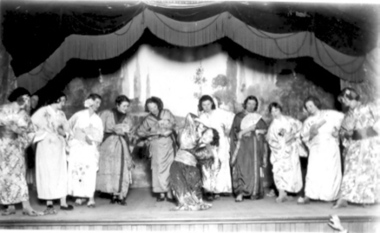
Photograph, Geisha Girls in Cherry Blossom
... Geisha Girls in Cherry Blossom...Performance of Cherry Blossom, Geisha Girls, c1930s?...tatura hall costume female performing arts theatrical plays Performance of Cherry Blossom, Geisha Girls, c1930s? Geisha Girls in Cherry Blossom Photograph ...Performance of Cherry Blossom, Geisha Girls, c1930s?tatura, hall, costume, female, performing, arts, theatrical, plays -
 Tatura Irrigation & Wartime Camps Museum
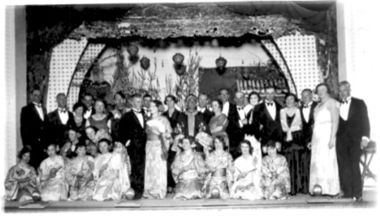
Photograph, Cast of Cherry Blossom
... Cast of Cherry Blossom...Cast photo of Cherry Blossom performers, taken on stage with set features in the background....Cast of Cherry Blossom Photograph ...Cast photo of Cherry Blossom performers, taken on stage with set features in the background.tatura, hall, festivals, costume, female, male, performing, arts, theatrical, plays -
 University of Melbourne, Burnley Campus Archives
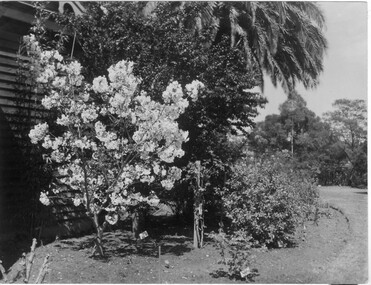
Photograph - Black and white print, Ornamental Cherry in Blossom, Pre 1947
... Ornamental Cherry in Blossom......cherry tree...blossom...Black and white photograph. Ornamental Cherry in Blossom. The wall of the Pavilion is visible in the background. ...shrubbery pavilion cherry tree blossom Black and white photograph. Ornamental Cherry in Blossom. ...Black and white photograph. Ornamental Cherry in Blossom. The wall of the Pavilion is visible in the background. Another copy B98.994 (iv)shrubbery, pavilion, cherry tree, blossom -
 Lara RSL Sub Branch
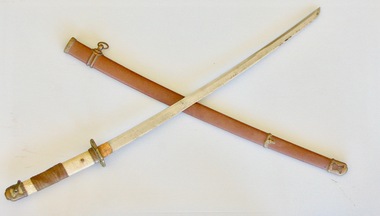
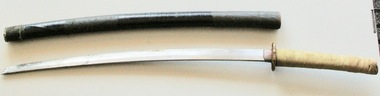
Sword, World War Two Japanese NCO/Officer Sword and Scabbard, 1932 to 1944
... japanese sword officer scabbard shi-gunto samuri cherry blossom...The guard is rectangular in shape with cherry blossom motifs. The hilt is encased in Shark skin (?) ...Cherry Blossom inscription on guard...The guard is rectangular in shape with cherry blossom motifs. The hilt is encased in Shark skin (?) ...Japanese Shi-gunto Army Officers sword and scabbard. The guard is rectangular in shape with cherry blossom motifs. The hilt is encased in Shark skin (?) Scabbard is made of painted steel. Brass fittings on the wooden scabbard encased in an enamel painted metal sheathWorld War Two Japanese NCO/Officer sword and scabbardCherry Blossom inscription on guardjapanese sword officer scabbard shi-gunto samuri cherry blossom -
 University of Melbourne, Burnley Campus Archives
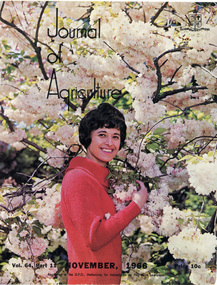
Photograph - Journal, Dept pf Agriculture, Victoria, Cherry Blossom, 1966
... Cherry Blossom...Colour photograph on the front cover of The Journal of Agriculture, Victoria Vol 64, Part 11, November 1966. "Cherry blossom in the ornamental gardens of the Department's College of Horticulture, Burnley. ...Requini completes the attractive setting." Cherry Blossom Photograph Journal Dept pf Agriculture, Victoria ...ornamental garden, i requini, laboratory assistant, dept of agriculture -
 Lara RSL Sub Branch
Sword, Japenese Gunto 1944, Circa World War Two
... japanese sword scabbard shi-gunto samuri cherry blossom...Cherry Blossom...Japanese gunto steel sword and scabbard possibly worn by a NCO japanese sword scabbard shi-gunto samuri cherry blossom Cherry Blossom JapaneseSword and Scabbard - 1944 Japenese Gunto 1944 Sword ...Japanese gunto steel sword and scabbard possibly worn by a NCOJapaneseSword and Scabbard - 1944Cherry Blossomjapanese sword scabbard shi-gunto samuri cherry blossom -
 University of Melbourne, Burnley Campus Archives
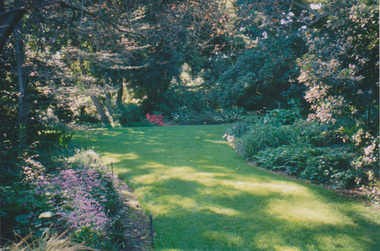
Photograph - Colour prints, Friends of Burnley Gardens, Burnley Gardens October 2002, 2002
... ...cherry blossom...Labelled "Burnley Gardens 2002" (1) The Azalea Lawn. (2) Cherry Blossom....These were with other photographs marked "Melb Int Flower Show 2004" azalea lawn cherry blossom garden view Laminated colour photographs. ...These were with other photographs marked "Melb Int Flower Show 2004"Laminated colour photographs. Labelled "Burnley Gardens 2002" (1) The Azalea Lawn. (2) Cherry Blossom.azalea lawn, cherry blossom, garden view -
 University of Melbourne, Burnley Campus Archives
Slide - Glass slide, Hand coloured, 1891-1905
... Hand coloured. Viewing Cherry Blossom, Japan....Hand coloured. Viewing Cherry Blossom, Japan. Slide Glass slide, Hand coloured ...17.' Hand coloured. Viewing Cherry Blossom, Japan.overseas images, japan -
University of Melbourne, Burnley Campus Archives
Slide - Glass slide, Hand coloured, 1891-1905
... Hand coloured. Viewing cherry blossom from boats in a canal, Japan....Hand coloured. Viewing cherry blossom from boats in a canal, Japan. Slide Glass slide, Hand coloured ...13.' Hand coloured. Viewing cherry blossom from boats in a canal, Japan.overseas images, japan -
 Wodonga & District Historical Society Inc
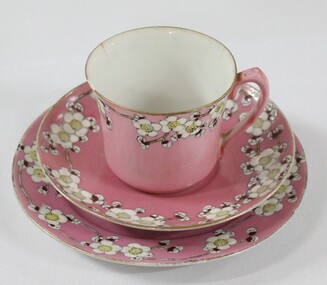
Functional object - Haeusler Collection Teacup, Saucer and Cake Plate
... Teacup, sauce and cake plate set with pink glaze and cherry blossom design....It contributes to our understanding of domestic and family life in early twentieth century Wodonga, as well as providing interpretative capacity for themes including local history, social history, and women’s history. household porcelain tableware social history No makers mark Teacup, sauce and cake plate set with pink glaze and cherry blossom design. Haeusler Collection Teacup, Saucer and Cake Plate Functional object Haeusler Collection Teacup, Saucer and Cake Plate ...The Wodonga Historical Society Haeusler Collection provides invaluable insight into life in late nineteenth and early twentieth century north east Victoria. The collection comprises manuscripts, personal artefacts used by the Haeusler family on their farm in Wodonga, and a set of glass negatives which offer a unique visual snapshot of the domestic and social lives of the Haeusler family and local Wodonga community. The Haeusler family migrated from Prussia (Germany) to South Australia in the 1840s and 1850s, before purchasing 100 acres of Crown Land made available under the Victorian Lands Act 1862 (also known as ‘Duffy’s Land Act’) in 1866 in what is now Wodonga West. The Haeusler family were one of several German families to migrate from South Australia to Wodonga in the 1860s. This porcelain [CONFIRM] tea set is one of the many domestic objects in the Haeusler Collection that represent family and home life in early twentieth century Wodonga. DATED? This item has well documented provenance and a known owner. It forms part of a significant and representative historical collection which reflects the local history of Wodonga. It contributes to our understanding of domestic and family life in early twentieth century Wodonga, as well as providing interpretative capacity for themes including local history, social history, and women’s history.Teacup, sauce and cake plate set with pink glaze and cherry blossom design.No makers markhousehold, porcelain, tableware, social history -
 Benalla Art Gallery
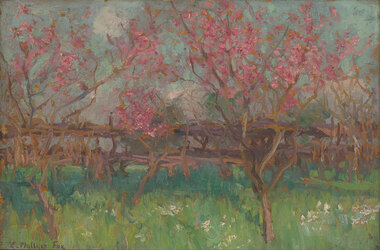
Painting, E. Phillips FOX, Spring blossoms, Not dated
... ... Cherry blossom...Impressionism Paiting Landscape Garden Trees Cherry blossom Fence Impressionist Recto: Signed "E. ...Born: Fitzroy, Victoria, Australia 1865; Lived and worked: France and England 1887-1892, France 1901-1913; Died: Melbourne, Victoria, Australia 1915ImpressionismMajor Basil MacNay Bequest, Gift of Arts Victoria, 1998Oil on wood panel depicting pink spring blossoms in a field. Carved gold brushed timber frameRecto: Signed "E. Phillips Fox" in purple oil in l.l.c of composition; Not dated; Not titledpaiting, landscape, garden, trees, cherry blossom, fence, impressionist -
 University of Melbourne, Burnley Campus Archives
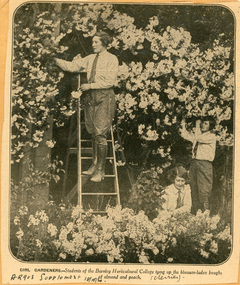
Newspaper - Newspaper Cutting, The Argus, Girl Gardeners, 1930
... ...cherry blossom...The caption reads, "Girl Gardeners- Students of the Burnley Horticultural College tying up the blossom-laden boughs of almond and peach." "(cherries)" handwritten....the argus female students students working outside almond blossom cherry blossom :(Cherries)" handwritten after almond and peach. ...Photograph in the "Argus Supplement," 18/10/30. The caption reads, "Girl Gardeners- Students of the Burnley Horticultural College tying up the blossom-laden boughs of almond and peach." "(cherries)" handwritten.:(Cherries)" handwritten after almond and peach. the argus, female students, students working outside, almond blossom, cherry blossom -
Tatura Irrigation & Wartime Camps Museum
Plaque, 1980
... Green enamel background with white/pink cherry blossom on a branch embossed on the plaque...Green enamel background with white/pink cherry blossom on a branch embossed on the plaque Plaque Plaque ...Presented to Miss Ethel May (Monte) Punshon in recognition of her services to Japanese internees and her contribution to friendly relations between Japan and AustraliaLarge cloisonne plaque. Green enamel background with white/pink cherry blossom on a branch embossed on the plaqueplaque, punshon m, hamblin w, camp 4, tatura, ww2, civic, momentos, plaques -
 Embroiderers Guild, Victoria
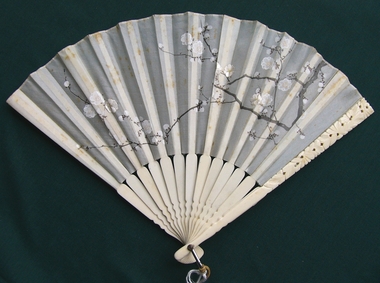
Accessory - Fan
... Cream silk fan (possibly Japanese) with painted cherry blossom design. Some blossoms are embroidered in silk. ...Fans Silk Embroidery Cream silk fan (possibly Japanese) with painted cherry blossom design. Some blossoms are embroidered in silk. ...Cream silk fan (possibly Japanese) with painted cherry blossom design. Some blossoms are embroidered in silk. The sticks are cream ? bonefans, silk embroidery -
 Geelong RSL Sub Branch
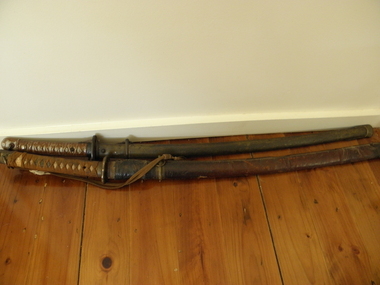
Gunto (military sword), Circa 1935
... One sword has a brown tassle indicating the rank of sergeant and three cherry blossoms on the grip, one has three cherry blossoms on the grip however the tassle is missing....One sword has a brown tassle indicating the rank of sergeant and three cherry blossoms on the grip, one has three cherry blossoms on the grip however the tassle is missing. ...The shin gunto was used by non-commissioned officers the design resembled the officer's shin gunto but were a cheaper quality.These swords are originals of their time and would have belonged to non-commissioned officers.2 x Gunto Japanese Swords, both swords have a curved steel blade, one sword has a metal scabbard, one has a leather scabbard. One sword has a brown tassle indicating the rank of sergeant and three cherry blossoms on the grip, one has three cherry blossoms on the grip however the tassle is missing.The blade of the sword with the metal scabbard has the number - 101657.japanese, sword, non-commissioned officers -
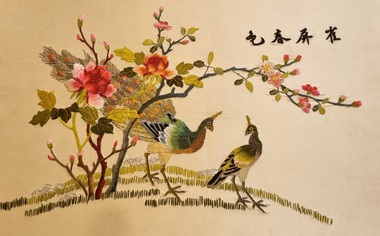 Embroiderers Guild, Victoria
Textile - Korean Embroidered Silk Picture Peacocks, Early - mid 20th C
... Silk embroidery of a pair of peacocks under cherry blossom and peonies. Cream silk background with colourful satin stitch embroidery using silk threads....Four characters - Chinese 'Hanzi' or Korean 'Hanja' Silk embroidery of a pair of peacocks under cherry blossom and peonies. Cream silk background with colourful satin stitch embroidery using silk threads. ...Traditional embroidery (chasu) in Korea has a history of more than 2,000 years. Since prehistoric times, the need for sewing led ancient Koreans to use needles made from fish or other animal bones to weave animal skin, tree bark and leaves. After society got more advanced, chasu was introduced as a method of adding colour and detail.Silk embroidery of a pair of peacocks under cherry blossom and peonies. Cream silk background with colourful satin stitch embroidery using silk threads.Four characters - Chinese 'Hanzi' or Korean 'Hanja' -
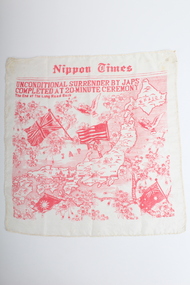 Lara RSL Sub Branch
Silk Flag, Nippon Times
... Unconditional Surrender by Japs Completed at 20 minute Ceremony. Picture of cherry blossoms, map of Japan and British, American Flag...Unconditional Surrender by Japs Completed at 20 minute Ceremony. Picture of cherry blossoms, map of Japan and British, American Flag Nippon Times Silk Flag ...Made at the end of World War 2 to celebrate the surrender of Japan. The item was brought back from Japan by Sapper Albert Alexander Founds VX71775 who joined from Lara Victoria 12 January 1942 and was discharged on 9th July 1947. Made of silk after the Japanese Surrender of World War 2A silk flag with the words Nippon Times. Unconditional Surrender by Japs Completed at 20 minute Ceremony. Picture of cherry blossoms, map of Japan and British, American FlagSee imagesilk, american army, british army, australian military forces, aif, cherry blossoms, nippon times, japan, world war 2, ww2, japenese surrender -
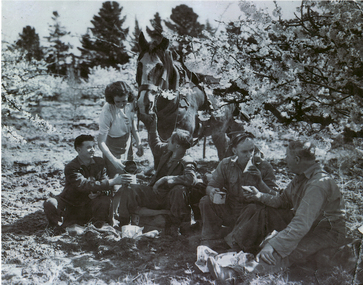 Whitehorse Historical Society Inc.
Photograph - B/W Photograph, Orchard at Blackburn
... Photo taken by photographer from Herald Sun who came every year to photograph the cherry blossom....Photo taken by photographer from Herald Sun who came every year to photograph the cherry blossom. Orchard at Blackburn Photograph B/W Photograph ...Black and white photograph of workers on Pearce family orchard on site of present Blackburn High School. Photo taken by photographer from Herald Sun who came every year to photograph the cherry blossom.pearce, ronald, harry, edward h., blackburn high school, orchard, herald sun -
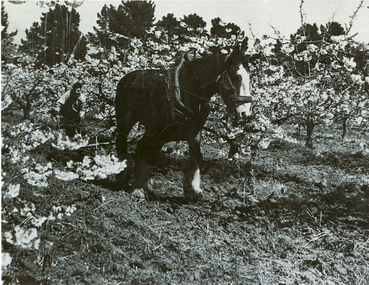 Whitehorse Historical Society Inc.
Photograph - Black and white photo, Orchard at Blackburn
... Photo taken by photographer from Herald Sun who came every year to photograph the cherry blossom...Photo taken by photographer from Herald Sun who came every year to photograph the cherry blossom Orchard at Blackburn Photograph Black and white photo. ...Black and white photograph of horse pulling plough on Pearce family orchard at site of present Blackburn High School. Photo taken by photographer from Herald Sun who came every year to photograph the cherry blossompearce, ronald, harry, edward h., blackburn high school, orchard, herald sun -
Frankston RSL Sub Branch
Souvenir, Cloth
... Embroidered with the British flag, the British Military Police badge, the British Commonwealth Occupation Forces badge, and a scene depicting Mount Fuji and cherry blossom in thread of various colours. There is also an embroidered inscription. ...Embroidered with the British flag, the British Military Police badge, the British Commonwealth Occupation Forces badge, and a scene depicting Mount Fuji and cherry blossom in thread of various colours. There is also an embroidered inscription. ...Dark blue coloured embroidered satin like cloth with a white satin border on all four sides. Embroidered with the British flag, the British Military Police badge, the British Commonwealth Occupation Forces badge, and a scene depicting Mount Fuji and cherry blossom in thread of various colours. There is also an embroidered inscription. This rectangular cloth is a souvenir of the post World War 2 occupation of Japan and is dated 1947.The embroidered inscription is "To My Darling Mother From Peter Japan 1947" -
 Whitehorse Historical Society Inc.
Accessory - Fan
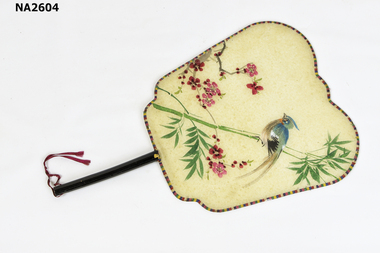
... Cream background with bird of paradise on green bamboo with pink cherry blossom. Thin multi coloured border. Modern Chinese Fan Known as a rigid or screen fan. ...Cream background with bird of paradise on green bamboo with pink cherry blossom. Thin multi coloured border. Modern Chinese Fan Known as a rigid or screen fan. ...Possibly a version of 'The Comfyhold Fan' - trade mark US patent.|Also it is possibly made in Japan.Silk fan with wooden handle, A straight fan rather than folded. Cream background with bird of paradise on green bamboo with pink cherry blossom. Thin multi coloured border. Modern Chinese Fan Known as a rigid or screen fan. Stretched over a circumferential frame of very thin wood which was usually braced by a handle that continued across its diameter behind the silk. A cooling device of the Chinese.costume accessories, female -
 Bendigo Historical Society Inc.
Accessory - MAGGIE BARBER COLLECTION: LADIES UMBRELLA, Early 1900's
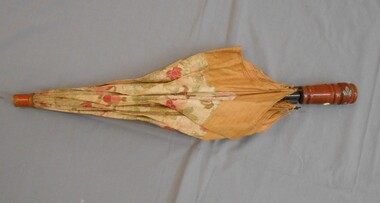
... The fabric is linen, and has a Japanese ''Cherry blossom'' type print. The outer edge has a 6 cm deep border in a tan coloured linen....The fabric is linen, and has a Japanese ''Cherry blossom'' type print. The outer edge has a 6 cm deep border in a tan coloured linen. ...Object. Wooden frame and handle, metal mechanism and spokes, line fabric covering. Wooden handle is 4 cms in diameter and 9 cm long. An eyelet through the handle may once have a carrying loop. The handle has a polished wood finish, and is decorated with painted leaves. The top peak of the umbrella is also polished wood, 3.5 cm long, 2 cm in diameter. The fabric is linen, and has a Japanese ''Cherry blossom'' type print. The outer edge has a 6 cm deep border in a tan coloured linen.costume accessories, female, ladies umbrella -
 City of Melbourne Libraries
Photograph, Bull, Hugh Jones, 1897-1993, Japanese woodblock prints
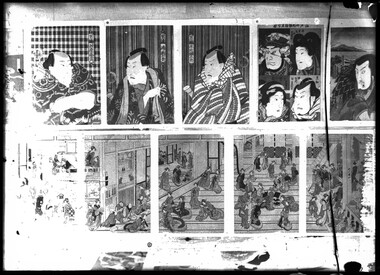
... Asai Ryōi celebrated this spirit in the novel Ukiyo Monogatari (Tales of the Floating World), c. 1661: “[L]iving only for the moment, savouring the moon, the snow, the cherry blossoms, and the maple leaves, singing songs, drinking sake, and diverting oneself just in floating, unconcerned by the prospect of imminent poverty, buoyant and carefree, like a gourd carried along with the river current: this is what we call ukiyo.” ...Asai Ryōi celebrated this spirit in the novel Ukiyo Monogatari (Tales of the Floating World), c. 1661: “[L]iving only for the moment, savouring the moon, the snow, the cherry blossoms, and the maple leaves, singing songs, drinking sake, and diverting oneself just in floating, unconcerned by the prospect of imminent poverty, buoyant and carefree, like a gourd carried along with the river current: this is what we call ukiyo.” ...A DECK GALLERY FOR JAPANESE PRINTS. A unique exhibition of Japanese Prints was opened yesterday on Japanese ship Kamo Maru.These pictures are the property of the captain of the Kamo Maru Captain T. Takahata, and are displayed in a specially arranged gallery on the deck of the ship now berthed at No. 13 Victoria Dock. A picture on board yesterday after noon. (Inset) - One of many fine works by Utaguard Toyokuni who died in 1825. Photographer notations on slide: "B21" Published: 23 February 1934 Published title: A DECK GALLERY FOR JAPANESE PRINTS. Published caption: A unique exhibition of Japanese Prints was opened yesterday on Japanese ship Kamo Maru.These pictures are the property of the captain of the Kamo Maru Captain T. Takahata, and are displayed in a specially arranged gallery on the deck of the ship now berthed at No. 13 Victoria Dock. A picture on board yesterday after noon. (Inset) - One of many fine works by Utaguard Toyokuni who died in 1825. Trove article identifier: http://nla.gov.au/nla.news-article203376863 Description: Japanese woodblock prints, probably belonging to Captain Takahata of the Japanese passenger and cargo ship Kamo Maru, who displayed his Japanese Woodblock prints in a special on-board gallery when it visited Melbourne during 1933 and 1934. Research by project volunteer, Louise McKenzie: Plate MCK025 shows a number of Japanese woodblock prints. Three are of traditional “samurai” or Kabuki-style Japanese men in traditional dress and hairstyle; one is a composite of four different prints: two men and two women (samurai/geisha) in traditional dress. There are also several prints appearing to depict traditional scenes of indoor and outdoor life in Japan in the Edo period. An article appeared in The Age in February 1934, covering the visit to Melbourne of Captain T Takahata on the Japanese ship the Kamo Maru. An accompanying photo shows several women, in coats and hats, and a man, closely inspecting a gallery hang of Japanese woodblocks. Inset is a single image of a Kabuki theatre performer, a detail from the full photograph as shown in our slide. This work is attributed to Utagawa Toyokuni (1769-1823), who was mostly known for his prints relating to kabuki theatre and the actors’ dramatic postures. Japanese Kabuki theatre features heavily stylised performances, glamorous, highly decorated costumes and elaborate make-up worn by its performers. It was particularly popular in the Edo period (1615-1868), as was woodblock printing, after its earlier introduction from China around 150 years earlier. Woodblock printing in Japan is a technique best known for its use in the ukiyo-e artistic genre of single sheet images (although books were also created) which flourished from the 17th through 19th centuries. Its artists produced woodblock prints and paintings of such subjects as female beauties; kabuki actors and sumo wrestlers; scenes from history and folk tales; travel scenes and landscapes; flora and fauna, and erotica. The term ukiyo-e translates as 'picture[s] of the floating world'. This expression could be confusingly translated as meaning ‘a world of sorrow and grief’, 'erotic’ or ‘stylish’, and later came to describe the hedonistic spirit of the lower classes of the 17th century. Asai Ryōi celebrated this spirit in the novel Ukiyo Monogatari (Tales of the Floating World), c. 1661: “[L]iving only for the moment, savouring the moon, the snow, the cherry blossoms, and the maple leaves, singing songs, drinking sake, and diverting oneself just in floating, unconcerned by the prospect of imminent poverty, buoyant and carefree, like a gourd carried along with the river current: this is what we call ukiyo.” (Wikipedia: 'Ukiyo-e') Mass production of woodblocks during the Edo period was due to high literacy rates: 100% for samurai and 50-60% for farmers. Consequently, cheaper books were produced in large numbers. In the 18th century, Suzuki Harunobu established the technique of multicolor woodblock printing called nishiki-e and greatly developed Japanese woodblock printing culture such as ukiyo-e. Ukiyo-e influenced European Japonisme and Impressionism. Yoshitoshi was called the last great ukiyo-e master, and his cruel depictions and fantastic expressions influenced later Japanese literature and anime. However today the best known exponents from the period are probably Hokusai and Hiroshige.The price of one ukiyo-e at that time was about 20 mon, and the price of a bowl of soba noodles was 16 mon, so the price of one ukiyo-e was several hundred yen to 1000 yen in today's currency. 'Wikipedia: Ukiyo-e' states: “Japanese art, and particularly ukiyo-e prints, came to influence Western art from the time of the early Impressionists. Early painter-collectors incorporated Japanese themes and compositional techniques into their works as early as the 1860s: the patterned wallpapers and rugs in Manet's paintings were inspired by the patterned kimono found in ukiyo-e pictures, and Whistler focused his attention on ephemeral elements of nature as in ukiyo-e landscapes. Van Gogh was an avid collector, and painted copies in oil of prints by Hiroshige and Eisen. Degas and Cassatt depicted fleeting, everyday moments in Japanese-influenced compositions and perspectives. ukiyo-e's flat perspective and unmodulated colours were a particular influence on graphic designers and poster makers. Toulouse-Lautrec's lithographs displayed his interest not only in ukiyo-e's flat colours and outlined forms, but also in their subject matter: performers and prostitutes. He signed much of this work with his initials in a circle, imitating the seals on Japanese prints. Other artists of the time who drew influence from ukiyo-e include Monet, La Farge, Gauguin, and Les Nabis members such as Bonnard and Vuillard. French composer Claude Debussy drew inspiration for his music from the prints of Hokusai and Hiroshige, most prominently in La mer (1905). Imagist poets such as Amy Lowell and Ezra Pound found inspiration in ukiyo-e prints; Lowell published a book of poetry called Pictures of the Floating World (1919) on oriental themes or in an oriental style.” An awareness of and interest in this style of art seems to have been well established by the time Captain Takahata brought his sailing gallery to Australia in the 1930s. The Age article “Colour Prints from Japan” on 22 February 1934 p. 13, consists predominantly of a sophisticated curatorial assessment of the woodblock style and detailed artist and style information, which is remarkable for its in-depth analysis. The writer even draws attention to the existence of female woodprint artists. It has been difficult to verify those noted in this article, but worth drawing attention to the work produced by the daughter of Hokusai, Katsushika Oi, which is documented and has gained attention within Japan and elsewhere. Captain Takahata may have been quite the ambassador: adverts in Australian quarterly magazine, The Home, promoted regular cruises out of Melbourne and Sydney via Queensland, Thursday Island, Phillippines and Hong Kong to Japan at a cost of £90 for a round trip via Yokohama.(The Home, 1 August 1936, pages 76 and 79). It is reported in one of the many newspapers articles printed during 1933/1934 about Captain Takahata and his collection, that he inherited it, and it was not for sale even at an offered £10,000. However, one article makes mention of him scouring antique shops in rural Japan to add to the collection! And even enlisting the help of his children in the hunt. The collection totalled 11,000 prints and apparently 1,500 travelled with him when he sailed. These numbers do differ between reports, but his collection was undoubtedly large, and Captain Takahata enjoyed lecturing on the subject, explaining that each print was handmade. It took painstaking work over months to create the delicate colour tones, with a block being created for each colour used, and transferred onto specially prepared paper. Many of the designs are symbolic, and even those representing figures and scenes have a narrative basis, or represent traditional incidents in the life and history of Japan. (See Japanese Prints, The Sydney Morning Herald, 14 July 1934). In Brisbane in October 1934, The Courier Mail noted that Captain Takahata, now on the Yusen Kaisha steamer ‘Atsuta Mam’ (a sister ship to Kamo Maru) arrived with another 100 prints in his possession, and that he spent his spare time mounting and cataloguing his treasures. One of his new additions dated from 1787 and Captain Takahata “said that it was the only woodcut to depict eyelashes, and with the aid of a magnifying glass, he showed the extremely fine lines around the eyes of the three Japanese ladies on the print.” References: COLOR PRINTS FROM JAPAN. (1934, February 22). The Age (Melbourne, Vic. : 1854 - 1954), p. 13. Retrieved February 29, 2024, from http://nla.gov.au/nla.news-article20338088 A DECK GALLERY FOR JAPANESE PRINTS. (1934, February 23). The Age (Melbourne, Vic. : 1854 - 1954), p. 11. Retrieved February 29, 2024, from http://nla.gov.au/nla.news-article203376863 JAPANESE WOOD-CUTS. (1934, July 14). Daily Commercial News and Shipping List (Sydney, NSW : 1891 - 1954), p. 4. Retrieved February 29, 2024, from http://nla.gov.au/nla.news-article161150580 JAPANESE PRINTS. (1934, July 14). The Sydney Morning Herald (NSW : 1842 - 1954), p. 12. Retrieved February 29, 2024, from http://nla.gov.au/nla.news-article28024038 RARE WOOD-PRINTS FROM JAPAN (1934, July 16). The Herald (Melbourne, Vic. : 1861 - 1954), p. 20. Retrieved March 2, 2024, from http://nla.gov.au/nla.news-article243171208 JAPANESE WOODPRINTS. (1934, July 14). The Sydney Morning Herald (NSW : 1842 - 1954), p. 16. Retrieved March 2, 2024, from http://nla.gov.au/nla.news-article28023902 11,000 RARE WOODCUTS (1934, October 11). The Courier-Mail (Brisbane, Qld. : 1933 - 1954), p. 18. Retrieved March 2, 2024, from http://nla.gov.au/nla.news-article35647690 A DECK GALLERY FOR JAPANESE PRINTS. (1934, February 23). The Age (Melbourne, Vic. : 1854 - 1954), p. 11. Retrieved March 2, 2024, from http://nla.gov.au/nla.news-article203376863 RARE JAPANESE PRINTS (1934, July 11). The Courier-Mail (Brisbane, Qld. : 1933 - 1954), p. 10. Retrieved March 2, 2024, from http://nla.gov.au/nla.news-article36723139 Wikipedia: 'Ukiyo-e', https://en.wikipedia.org/wiki/Ukiyo-e Wikipedia: 'Woodblock printing in Japan', https://en.wikipedia.org/wiki/Woodblock_printing_in_Japan Wikipedia: 'Utagawa Toyokuni', https://en.wikipedia.org/wiki/Utagawa_Toyokuni Wikipedia: 'Kabuki', https://en.wikipedia.org/wiki/Kabuki 'Digital Humanities and Japanese History',https://dh.japanese-history.org/2020-spring-women-in-japanese-history/japanese-women-artists-of-the-edo-period/ '25 Famous Painters in Japanese Art', https://dh.japanese-history.org/2020-spring-women-in-japanese-history/japanese-women-artists-of-the-edo-period/ 'Nyk Kamo Maru', https://blog.shipwatcher.com/index.php/nyk-kamo-maru/ The Home : an Australian quarterly Retrieved March 4, 2024, from http://nla.gov.au/nla.obj-386036987 : Volume 17, No. 8, 1 August 1936.Photographer notations on slide: "B21".japan, prints, ships, art -
Ringwood and District Historical Society
Book, Alien Blossom
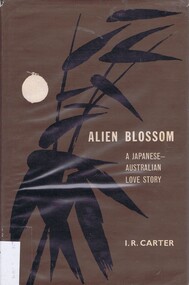
... Cherry Parker was the first Japanese bride to be allowed entry into Australia after the Pacific War Missing from NWD 01-01-03 File 4 Alien Blossom Book I.R. ...A Japanese - Australian Love Story Nobuko Sakuramoto (Cherry) and Gordon Parker. Cherry Parker was the first Japanese bride to be allowed entry into Australia after the Pacific War Missing from NWD 01-01-03 File 4 -
 Greensborough Historical Society
Book, Alien Blossom: a Japanese-Australian love story. By I. R. Carter, 1965_
... This book was owned by Ruby Fort. world war ii japanese war brides cherry parker On fly leaf: "Ruby Fort Emily Rough" 161 pages. b&w photographs. Brown dust jacket with drawing of bamboo. Alien Blossom ...Tells te story of the first Japanese 'war bride' to be admitted entry to Australia after World War II. This book was owned by Ruby Fort.161 pages. b&w photographs. Brown dust jacket with drawing of bamboo.On fly leaf: "Ruby Fort Emily Rough"world war ii, japanese war brides, cherry parker -
University of Melbourne, Burnley Campus Archives
Photograph - Black and white print, iv. Flowering Cherry Prunus cerasus, 1925-1955
... pavilion a.w. jessep cherry tree blossoms On reverse, "Return to Mr Jessep." ...Outside the Pavilion On reverse, "Return to Mr Jessep."pavilion, a.w. jessep, cherry tree, blossoms
