
Showing 24 items matching "child's toy doll"
-
 Whitehorse Historical Society Inc.
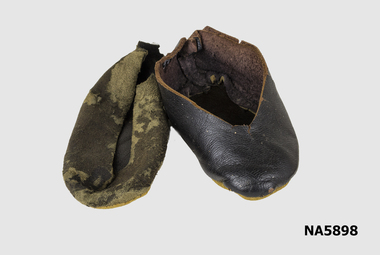
Leisure object - Pair of dolls shoes, Unknown
... Child's toy...Doll...Part of dolls costume Child's toy Doll - Suede, leather sole and upper - Slipper style - not matching Leisure object Pair of dolls shoes ...Part of dolls costume - Suede, leather sole and upper - Slipper style - not matching child's toy, doll -
 Whitehorse Historical Society Inc.
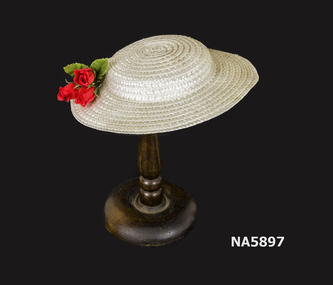
Leisure object - Doll's hat, Between 1945 -1949
... Child's toy - Doll...Part of doll's costume Child's toy - Doll Made in Taiwan, R.O.C - Imitation straw plaited and sewn - Boater Style - Imitation red rose buds with green leaves Leisure object Doll's hat ...Part of doll's costume - Imitation straw plaited and sewn - Boater Style - Imitation red rose buds with green leaves Made in Taiwan, R.O.C child's toy - doll -
 Whitehorse Historical Society Inc.
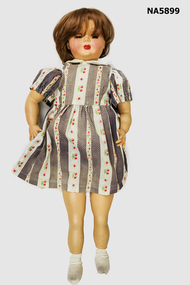
Leisure object - Doll, Bernard E Fleischaker and Hugh Baun, 1950's
... Child's toy doll...Appears to be an Effanbee Ann Shirley doll - American doll Child's toy doll - Composition material - Long molded hair - Walking doll - Open/closing eyes with eye lashes - Dress -patterned cotton, puffed sleeves and collar, knickers - Cream petticoat - nylon socks Leisure object Doll Bernard E Fleischaker and Hugh Baun ...Appears to be an Effanbee Ann Shirley doll - American doll - Composition material - Long molded hair - Walking doll - Open/closing eyes with eye lashes - Dress -patterned cotton, puffed sleeves and collar, knickers - Cream petticoat - nylon socks child's toy doll -
![Ceramic doll]s leg, cream and beige, with shape of shoe on the end](/media/collectors/4f729f6597f83e03086016ea/items/521602bb19403a17c4b9fa5a/item-media/52a7cc472162ef1d94e8449b/item-fit-380x285.jpg?cb=6) Flagstaff Hill Maritime Museum and Village
Leisure object - Doll's Leg, ca 1878/
... This is part of a child's toy, a doll with ceramic legs. It was recovered from the wreck of the Loch Ard. ...This is part of a child's toy, a doll with ceramic legs. It was recovered from the wreck of the Loch Ard. ...This is part of a child's toy, a doll with ceramic legs. It was recovered from the wreck of the Loch Ard. A brief history of the Loch Ard (1873-1878): - The sailing ship Loch Ard was one of the famous Loch Line ships that sailed from England to Australia. Barclay, Curdle and Co. built the three-masted iron vessel in Glasgow in 1873. It had sailed three trips to Australia and one trip to Calcutta before its fateful voyage. Loch Ard left England on March 2, 1878, under the command of recently married, 29-year-old Captain Gibbs. It was bound for Melbourne with a crew of 37, plus 17 passengers. The general cargo reflected the affluence of Melbourne at the time. Onboard were straw hats, umbrellas, perfumes, clay pipes, pianos, clocks, confectionery, linen and candles, and a heavier load of railway irons, cement, lead and copper. Other cargo included items intended for display in the Melbourne International Exhibition of 1880. The Loch Ard had been sailing for three months and was close to its destination on June 1, 1878. Captain Gibbs had expected to see land at about 3 am but the Loch Ard ran into a fog that greatly reduced visibility and there was no sign of land or the Cape Otway lighthouse. The fog lifted at 4 am and the sheer cliffs of Victoria's west coast were much closer to them than Captain Gibbs expected. He tried to manage the vessel but failed and the ship struck a reef at the base of Mutton Bird Island, near Port Campbell. The top deck loosened from the hull, and the masts and rigging crashed down, knocking passengers and crew overboard. The lifeboat was launched by Tom Pearce but crashed into the side of Loch Ard and capsized. He clung onto its overturned hull and sheltered under it. He drifted out to sea and the tide brought him back to what is now called Loch Ard Gorge. He swam to shore and found a cave for shelter. A passenger, Eva Carmichael, had raced onto the deck to find out what was happening and was confronted by towering cliffs above the ship. She was soon swept off the ship by a huge wave. Eva saw Tom Pearce on a small rocky beach and yelled to attract his attention. He swam out and dragged her to the shelter of the cave. He revived her with a bottle of brandy from a case that had washed up on the beach. Tom scaled a cliff in search of help and followed some horse hoof prints. He came from two men from Glenample Station, three and a half miles away. He told the men of the tragedy and then returned to the gorge while the two men rode back to the station to get help. They reached Loch Ard Gorge and took the two shipwreck survivors to Glenample Station to recover. Eva stayed at the station for six weeks before returning to Ireland by steamship. In Melbourne, Tom Pearce received a hero's welcome and was presented with a medal and some money. Of the 54 crew members and passengers on board, only two survived: the apprentice, Tom Pearce and the young woman passenger, Eva Carmichael, who lost her family in the tragedy. Flagstaff Hill’s collection of artefacts from LOCH ARD is significant for being one of the largest collections of artefacts from this shipwreck in Victoria. It is significant for its association with the shipwreck, which is on the Victorian Heritage Register (VHR S417). The collection is significant because of the relationship between the objects, as together they have a high potential to interpret the story of the LOCH ARD. The LOCH ARD collection is archaeologically significant as the remains of a large international passenger and cargo ship. The LOCH ARD collection is historically significant for representing aspects of Victoria’s shipping history and its potential to interpret sub-theme 1.5 of Victoria’s Framework of Historical Themes (living with natural processes). The collection is also historically significant for its association with the LOCH ARD, which was one of the worst and best known shipwrecks in Victoria’s history. China doll's leg, cream and beige ceramic, foot shaped at the end of the leg. Recovered from the wreck of the Loch Ard. flagstaff hill, warrnambool, shipwrecked coast, flagstaff hill maritime museum, maritime museum, shipwreck coast, flagstaff hill maritime village, great ocean road, loch line, loch ard, captain gibbs, eva carmichael, tom pearce, glenample station, mutton bird island, loch ard gorge, china dolls leg, doll's leg, china doll's leg, doll's limb, ceramic doll -
 Flagstaff Hill Maritime Museum and Village
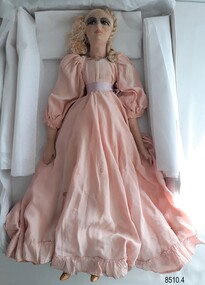
Leisure object - Boudoir Doll, c. early 1900s
... Boudoir Dolls dolls usually had no maker's marks and were primarily used as bedroom decorations for ladies rather than as children's toys. This doll appears to date at about the early part of the 20th century, but the petticoats are much older - possibly from a child's christening gown. ...Boudoir Dolls dolls usually had no maker's marks and were primarily used as bedroom decorations for ladies rather than as children's toys. This doll appears to date at about the early part of the 20th century, but the petticoats are much older - possibly from a child's christening gown. ...The donor was given this doll about 50 years ago by her grandfather (in the late 1960s). He used to be a handyman at a high rise building in St Kilda, Melbourne. He had been doing some work for one of the old ladies and she gave him the doll to give to his granddaughter, who collected dolls. The doll has spent a few years at the Nagambie museum until it closed down and returned to the donor The origins or age of the doll are unknown. Originally it was thought to be a Fashion Doll dating from around the 1880s but the painted face together with the bisque legs and gold painted shoes are similar to those found on Boudoir Dolls (also known as Bed Dolls, Sofa Dolls, Flapper Dolls and French Dolls) of the early 20th century. Fashion dolls were sent from fashion houses to advertise the latest styles, fabrics, trims, hairstyles and accessories. Dressmakers would show these dolls to their customers. Ladies would then place their order and the dressmakers would make the dress to their size. The dressmakers would learn the construction techniques from examining the dolls. Boudoir Dolls dolls usually had no maker's marks and were primarily used as bedroom decorations for ladies rather than as children's toys. This doll appears to date at about the early part of the 20th century, but the petticoats are much older - possibly from a child's christening gown. At the time that the donor received the doll, it had a coloured lace over-gown that was badly torn so her mother removed it to replace with more lace but this never eventuated. The pink silk dress also appears to have been remodelled into a 19th century style with gathered sleeves and a gathered skirt. This fashion or boudoir doll is significant for being a rare example of a doll made in the late 19th or early 20th centuries. The doll is wearing clothing representing the fashion for young girls in that era. The doll is also significant as an item possibly used by fashion houses and dressmakers to advertise the latest fashions in clothing, trims, accessories and hairstyles. A doll such as this may have been found in a Victorian dressmaker's premises for use as a pattern and technique template and for a display to customers. It may also have been used as a decorative item in a lady's bedroom. Female boudoir doll with silk face and body, and porcelain lower arms and legs. She has plaited blonde silk hair. Her painted face has brown eyes and her shoes are painted gold. The doll is dressed in a long pink puffed-sleeve dress with a gathered waist and a ruffle at the hem. A pink ribbon around her waist is tied at the back. There are small silver balls hand-stitched around the neckline. She has a white, hand-embroidered lace petticoat and bloomers. warrnambool, flagstaff hill maritime museum, shipwreck coast, flagstaff hill maritime village, great ocean road, doll, boudoir doll, female doll, dressmaker's doll, display doll, late 1800s doll, fashion doll, antique doll, 19th century doll, children's fashion, girl's fashion, late 1800s children's fashion, early 20th century doll, composite doll, french doll -
 Flagstaff Hill Maritime Museum and Village
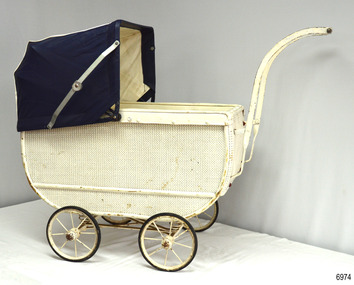
Leisure object - Doll's pram, late-1930s to early-1940s
... Flagstaff Hill Warrnambool Maritime Village Maritime Museum Shipwreck coast Great Ocean Road Dr W R Angus Dr Roy Angus Dr Ryan Warrnambool Oculist Port Medical Officer Nhill Base Hospital Mira Hospital Nhill doll's pram' toy pram child's pram toy W.R. Angus Collection Pram has a folding blue vinyl hood and a rectangular, white wicker base with curved corners at the bottom. ...This doll's pram was owned by the daughter of Dr William Roy Angus and his wife Gladys when the family came to Warrnambool in the late 1930s. It is part of the W.R. Angus collection, donated by the family of Dr W R Angus, surgeon and oculist. The W R Angus Collection spans the years 1885 to the mid-1900s and includes historical medical and surgical equipment and instruments from the doctors Edward and Thomas Ryan of Nhill, Victoria. Dr Angus married Gladys in 1927 at Ballarat, the nearest big city to Nhill where he began as a Medical Assistant. He was also Acting House surgeon at the Nhill hospital where their two daughters were born. Dr Angus and his family moved to Warrnambool in 1939, where Dr Angus operated his own medical practice. He later added the responsibility of part-time Port Medical Officer and was the last person appointed to that position. Both Dr Angus and his wife were very involved in the local community, including the planning stages of the new Flagstaff Hill and the layout of the gardens there. Dr Angus passed away in March 1970. This doll's pram is connected to the history of Warrnambool, as it was owned by the daughter of Dr W. R. Angus and his wife Gladys, and is part of the W.R. Angus Collection, which is important for still being located at the site connected to Doctor Angus, Warrnambool’s last Port Medical Officer. Dr Angus and his wife brought their young family to Warrnambool in 1939 and he remained a resident until his death in 1970. Early in his profession in the town of Nhill, Dr Angus assisted Dr Tom Ryan in his pioneering use of X-rays and in ocular surgery, and Dr Angus later inherited these items. The W.R. Angus Collection includes these medical instruments and other related equipment and is culturally and historically significant as an example of the medical practice of the late 19th to the mid-20th century. Other items in the collection relate to Dr Angus’ service in the Flying Doctor Service and the Army. Pram has a folding blue vinyl hood and a rectangular, white wicker base with curved corners at the bottom. The base and hood are lined with white vinyl. The wheels have eight spokes and black rubber tyres. The curved handle has a metal bard the width of the pram, which is covered in a white rubber tube. The handle sides are joined to two curved flat bars that extend in an outwards curve away from the pram. The Hood is hinged to flip from the back to the front of the pram and is designed to can fold. The undercarriage has suspension springs. The pram is part of the W.R. Angus Collection. flagstaff hill, warrnambool, maritime village, maritime museum, shipwreck coast, great ocean road, dr w r angus, dr roy angus, dr ryan, warrnambool oculist, port medical officer, nhill base hospital, mira hospital nhill, doll's pram', toy pram, child's pram, toy, w.r. angus collection -
 Flagstaff Hill Maritime Museum and Village
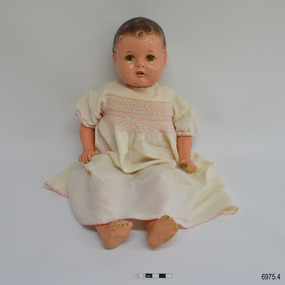
Leisure object - Doll, Reliable Toy Company Ltd, 1930s to 1940s
... doll is also significant as an example of toys imported into Australia in the 1930s and 1940s and used by children in the Warrnambool community. Flagstaff Hill Warrnambool Maritime Village Maritime Museum Shipwreck coast Great Ocean Road Dr W R Angus Dr Roy Angus Dr Ryan Warrnambool Oculist Port Medical Officer Mira Hospital Nhill toy Nhill hospital doll baby doll composition doll Reliable Toy Company Canada Solomon Samuels child's toy W.R. ...This dressed doll was owned by the daughter of Dr William Roy Angus and his wife Gladys when the family came to Warrnambool in the late 1930s. It is part of the W.R. Angus collection, donated by the family of Dr W R Angus, surgeon and oculist. The doll was donated with another dress and a blanket. The doll has features similar to, but an earlier model than, Reliable's 1940s model Cuddlekins doll, which has an entirely composite body. ReliableToy Company was founded in Toronto, Canada, by Solomon Samuels in 1920. Samuels was later joined by his two brothers. The company had a reputation for products of good quality. In 1922 the company began making their own dolls from composition, where previously the parts were made elsewhere and assembled by Reliable. The company stopped making Reliable dolls in 1995. The W R Angus Collection spans from 1885 to the mid-1900s and includes historical medical and surgical equipment and instruments from the doctors Edward and Thomas Ryan of Nhill, Victoria. Dr Angus married Gladys in 1927 at Ballarat, the nearest big city to Nhill where he began as a Medical Assistant. He was also Acting House surgeon at the Nhill hospital where their two daughters were born. Dr Angus and his family moved to Warrnambool in 1939, where Dr Angus operated his own medical practice. He later added the part-time Port Medical Officer responsibility and was the last person appointed to that position. Dr Angus and his wife were very involved in the local community, including the planning stages of the new Flagstaff Hill and the layout of the gardens there. Dr Angus passed away in March 1970. This doll is connected to the history of Warrnambool, as it was owned by the daughter of Dr W. R. Angus and his wife Gladys, and is part of the W.R. Angus Collection, which is important for still being located at the site connected to Doctor Angus, Warrnambool’s last Port Medical Officer. Dr Angus and his wife brought their young family to Warrnambool in 1939 and he remained a resident until his death in 1970. Early in his profession in the town of Nhill, Dr Angus assisted Dr Tom Ryan in his pioneering use of X-rays and in ocular surgery, and Dr Angus later inherited these items. The W.R. Angus Collection includes these medical instruments and other related equipment and is culturally and historically significant as an example of the medical practice of the late 19th to the mid-20th century. Other items in the collection relate to Dr Angus’ service in the Flying Doctor Service and the Army. The doll is also significant as an example of toys imported into Australia in the 1930s and 1940s and used by children in the Warrnambool community. Doll with moulded composition head, neck, arms and legs, all attached to a fabric body. The doll’s head has brown moulded curls. The facial features include an open mouth showing two top teeth, green eyes, and sleeping, closing eyelids with eyelashes. The doll has a crier inside that makes a sound when the doll is turned over. It is clothed in a knitted pink singlet, modern pink underwear, and a cream flannel short-sleeved dress with pink smocking and embroidery, and ties at the rear. There is a moulded inscription on the back of the doll’s head. The doll was made by Reliable Toy Company Ltd, Canada. The doll is part of the W.R. Angus Collection. On the back of the head “RELIABLE / CANADA” flagstaff hill, warrnambool, maritime village, maritime museum, shipwreck coast, great ocean road, dr w r angus, dr roy angus, dr ryan, warrnambool oculist, port medical officer, mira hospital nhill, toy, nhill hospital, doll, baby doll, composition doll, reliable toy company, canada, solomon samuels, child's toy, w.r. angus collection -
 City of Moorabbin Historical Society (Operating the Box Cottage Museum)
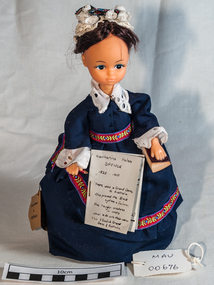
Dolls, antique copy 'Catherine Spence', c1980
... This doll is used as an educational toy to help visitors imagine life c1900 dolls spence catherine suffragettes politics authors orphanages child care An antique copy china doll representing Catherine Spence. ...Catherine Helen Spence (31 October 1825 – 3 April 1910) was a Scottish-born Australian author, teacher, journalist, politician and leading suffragette. Her family moved to South Australia in 1839. In 1897 she became Australia's first female political candidate after standing (unsuccessfully) for the Federal Convention held in Adelaide. Given the epitaph "Grand Old Woman of Australasia", Spence was commemorated on the Australian 5 dollar note issued for the Centenary of Federation of Australia. She was one of the prime movers, with C. Emily Clark (sister of John Howard Clark), of the "Boarding-out Society". This organization had as its aim the placing of destitute children, who would otherwise be sent to "Industrial School", into approved families. She was an advocate of Thomas Hare's scheme for proportional representation, at one stage considering this issue more pressing than that of woman suffrage. This doll is used as an educational toy to help visitors imagine life c1900 An antique copy china doll representing Catherine Spence. The Doll has dark brown hair with a head scarf decorated with flowers and a navy blue dress with white cuffs and collar. dolls, spence catherine, suffragettes, politics, authors, orphanages, child care -
 City of Moorabbin Historical Society (Operating the Box Cottage Museum)
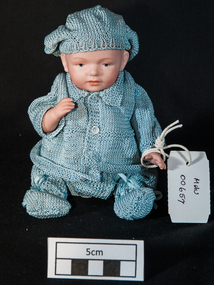
Leisure object - Doll, boy in blue knitted suit, 20thC
... The knitted outfit was made by an unrecorded home knitter probably as a present for a child. celluloid dolls knitting wool craftwork moorabbin bentleigh cheltenham toys A very small celluloid doll dressed as a boy in fine hand -knitted hat, vest, jacket and pants. ...When celluloid was invented and first came to prominence in the 1870s, dolls were nearly all breakable and fragile--bisque and china dolls were easily shattered and papier mache and wax easily ruined. So doll companies started experimenting with celluloid to mould dolls. By the early 1900s, celluloid dolls were plentiful, since celluloid was easily moulded and generally inexpensive. Celluloid is one of the first synthetic plastics. It is a plastic created from wood products that includes cellulose nitrate and camphor. However Celluloid is flammable and deteriorates easily if exposed to moisture, and can be prone to cracking and yellowing with certain formulations. Celluloid dolls were produced as late as the 1950s, but the vast majority were produced from 1900 through the 1940s. The knitted outfit was made by an unrecorded home knitter probably as a present for a child. A very small celluloid doll dressed as a boy in fine hand -knitted hat, vest, jacket and pants. celluloid, dolls, knitting, wool, craftwork, moorabbin, bentleigh, cheltenham, toys -
 Warrnambool and District Historical Society Inc.
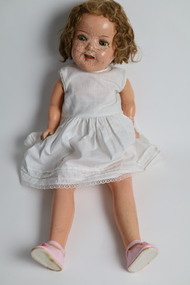
Leisure object - Child's Doll, Doll 1943 "Shirley", 25/03/2025
... This doll came to us with the name "Shirley" so possibly a Shirley Temple doll which were popular at the time. Dolls were a common child's toy and as such has strong social significance. composition doll shirley doll warrnambool 1940's doll This is a composition doll from the 1940's. ...Before plastic became commonplace in the 1950's dolls were typically made of this material which comprised a "combination" of sawdust and wood dust and glue which was then moulded in the required shape then painted and varnished. The head, arms and legs are made of this material. The body is stuffing covered in a cotton fabric.This doll has eyes that open and close and her teeth are visible and has a crying mechanism in the back. Her hair is possibly mohair and shoes are a synthetic material with metal buckles. The main enemy of composite material is water.It was a common practice for a girl to be given a doll and numerous outfits would be home made by mothers and grandmothers. This doll came to us with the name "Shirley" so possibly a Shirley Temple doll which were popular at the time. Dolls were a common child's toy and as such has strong social significance. This is a composition doll from the 1940's. It has composite arms and legs and face. Facial features are painted on and the teeth are moulded and white. Eyes are blue and open and close on moving the doll. The hair is light brown with curls and she wears pink Mary Jane style shoes. A crying mechanism is inserted in the body of the doll. The face has multiple crazed markings. composition doll, shirley doll, warrnambool, 1940's doll -
 Arapiles Historical Society
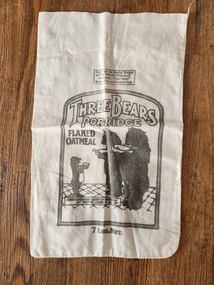
Container - Roy SCHMIDT Collection - Cotton Flour Bags (3)
... Popular in the early 1900s to mid-century, this product combined functional packaging with a child-friendly incentive — a cut-out cloth doll. The practice of printing toys, games, or clothing patterns on flour or oat sacks was a common marketing strategy, encouraging reuse and appealing to families during times when thrift and creativity were essential, especially during the Depression and wartime years. ...Popular in the early 1900s to mid-century, this product combined functional packaging with a child-friendly incentive — a cut-out cloth doll. The practice of printing toys, games, or clothing patterns on flour or oat sacks was a common marketing strategy, encouraging reuse and appealing to families during times when thrift and creativity were essential, especially during the Depression and wartime years. ...[1] Three Bears Porridge Flaked Oatmeal Bag: This textile bag originates from Canadian Cereal Mills Ltd., which marketed "Three Bears" flaked oatmeal. Popular in the early 1900s to mid-century, this product combined functional packaging with a child-friendly incentive — a cut-out cloth doll. The practice of printing toys, games, or clothing patterns on flour or oat sacks was a common marketing strategy, encouraging reuse and appealing to families during times when thrift and creativity were essential, especially during the Depression and wartime years. The Three Bears brand played off the enduring popularity of children’s nursery tales, while the doll encouraged children (and parents) to reuse packaging creatively. This object captures a unique intersection of food marketing, household resourcefulness, and early 20th-century domestic life. [2] Mammy Self-Raising Flour Bag: This item is a mid-20th-century Australian flour bag, branded “Mammy Oven Puff”, produced by A. Mammy Products Pty Ltd in West Footscray, Victoria. The use of the name "Mammy" and the caricatured illustration draws on a now widely recognised and offensive racial stereotype originating from American minstrel culture, commonly used in product branding in the early-to-mid 20th century. While the bag reflects a specific period in Australian domestic and commercial packaging history, it also exemplifies racially insensitive advertising that would be considered inappropriate and harmful by today’s standards. Such items are preserved today in museum collections to help document past social attitudes, consumer culture, and the evolution of racial representation in advertising. [3] Bandung Blue Triangle Brand Flour Bag: This bag represents a mid-20th-century Australian flour export product, particularly aimed at international markets such as Indonesia (as indicated by "Bandung"). The “Blue Triangle Brand” was likely a registered trademark used by a Melbourne-based flour mill engaged in both local and overseas trade. The use of durable cloth bags for bulk flour was common prior to the widespread adoption of paper and plastic packaging. These bags were often reused domestically for household textiles, clothing patterns, or storage. The export reference (Bandung) underscores Australia's historical agricultural trade ties with Southeast Asia, especially in wheat and flour exports. – Roy SCHMIDT resided with his siblings Mabel and Jack at ‘Parklands’ 85 Lake Avenue Natimuk home of Heinrich Friederick ‘Heiny’ & Minna Christina SUDHOLZ nee LANGE and their children Louis, Sophie, Alma, Lena (Roy's Mother), Florence 'Florrie' and Edward ‘Ted’. [1] Three Bears Porridge Flaked Oatmeal Bag: A vintage cloth oatmeal bag printed with black ink on both sides. One side is branded with "Three Bears Porridge – Flaked Oatmeal", showing an image of three bears behind a gate, referencing the well-known “Goldilocks and the Three Bears” fairytale. The opposite side features a printed cut-out doll design, showing a young girl with curly hair holding a bouquet of flowers, intended to be sewn into a stuffed toy. Instructions note that the reverse side (the doll’s back) could be obtained from a second bag. The design combines product branding with a promotional activity for children, typical of early- to mid-20th-century grocery packaging aimed at reuse. [2] Mammy Self-Raising Flour Bag: A small vintage cloth flour bag with printed branding in faded red, blue, and black inks. The front of the bag features a central image of a caricatured smiling African American woman wearing a headscarf. The text is unevenly faded but legible in parts. The bag has a rectangular shape with an open top edge and signs of previous use, including creasing and some fraying at the corners. [3] Bandung Blue Triangle Brand Flour Bag: A large, rectangular vintage cloth flour bag made of cream-coloured calico or cotton. The front of the bag is printed in bold blue ink with branding and export information. It prominently features a large triangular logo reading “Blue Triangle Brand” and numerous lines of text in block and stylised fonts. The bag is open at the top with frayed edges, suggesting it was once machine-stitched shut and later opened. [1] Three Bears Porridge Flaked Oatmeal Bag: Front side (branding side): "THREE BEARS Porridge – FLAKED OATMEAL" "7 Lbs. Net." “Packed and guaranteed by Canadian Cereal Mills Ltd., Toronto” Reverse side (doll pattern): "This is the Front for Three Bears Cut-out Doll" "In order to complete this Doll it will be necessary to obtain the Back Design from another Bag of Three Bears Rolled Oats or Oatmeal." [2] Mammy Self-Raising Flour Bag: Main product name: “MAMMY OVEN PUFF SELF-RAISING FLOUR” Additional text: “The Only Creamed Flour” “Prepared with phosphate aerator” “A. MAMMY PRODUCTS PTY. LTD., Sunshine Rd., West Footscray. Phone: FW 7321” “7 LBS. NET” (near top edge, very faded) [3] Bandung Blue Triangle Brand Flour Bag: The bag is printed with the following: “10270” “G.W.C | H.L” “BANDUNG” “BEST AUSTRALIAN” “BLUE TRIANGLE BRAND” (inside the triangle logo) “GROWER & GRINDERS” (curved around the logo) “Patent Roller” “MELBOURNE” “FLOUR” “50 LBS. GROSS WHEN PACKED” These inscriptions indicate that this flour bag was manufactured in Melbourne, Australia, and was likely exported to Bandung, Indonesia. farm equipment, flour, milling, oats, mammy, bandung blue, schmidt, sudholz, parklands -
 Warrnambool and District Historical Society Inc.
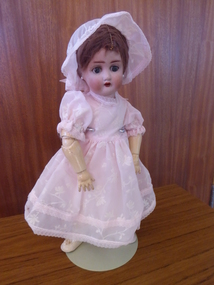
Child's Toy, Doll, c1906
... toys available in the early 20th century. It shows the manner in which dolls were jointed to allow movement of the limbs and head. blain children's toys dolls warrnambool catterfelder puppenfabrik Catterfelder Puppenfabrik 12 inch (30cm) doll with fully jointed composition body and bisque head with open mouth containing two tiny teeth, and sleep eyes. She has a hair wig stitched down the centre of the head and has tiny pearl earrings. The doll is dressed in a lace trimmed pink nylon dress with puffed sleeves and matching hat, and cream shoes. Doll Child's ...This doll belonged to member Allan Blain's sister. It was donated to WDHS and then recently returned after an extended loan. The doll has been re-dressed. Dollmaker Carl Trautmann founded his doll factory in Finsterbergen, Germany, in 1884. The firm made high quality ball jointed dolls and also pull-the-string mechanical and speaking dolls. In 1906 the factory moved to Catterfelder, Germany, and the company name was changed to Catterfelder Puppenfabrik. The firm JD Kestner supplied the bisque heads. This doll is significant as an example of the toys available in the early 20th century. It shows the manner in which dolls were jointed to allow movement of the limbs and head. 12 inch (30cm) doll with fully jointed composition body and bisque head with open mouth containing two tiny teeth, and sleep eyes. She has a hair wig stitched down the centre of the head and has tiny pearl earrings. The doll is dressed in a lace trimmed pink nylon dress with puffed sleeves and matching hat, and cream shoes. Catterfelder Puppenfabrik blain, children's toys, dolls, warrnambool, catterfelder puppenfabrik -
 Warrnambool and District Historical Society Inc.
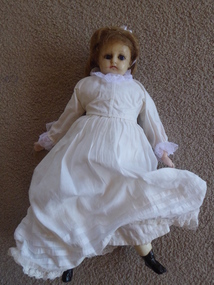
Child's Toy, Doll
... doll is an example of the toys available ....... dolls toys wax head dolls blain Doll with wax over composition head and straw stuffed body and hair wig. She has blue glass eyes and red painted mouth. Her hair has been elaborately plaited into four braids which join halfway down the back of the head with the remainder hanging free. Her black shoes are painted onto her legs. Doll Child's ...This doll belonged to member Allan Blain's sister. It was donated to WDHS and then recently returned after an extended loan. She has been re-dressed in cotton dress pantaloons with tucks and lace trim. This doll is an example of the toys available ....... Doll with wax over composition head and straw stuffed body and hair wig. She has blue glass eyes and red painted mouth. Her hair has been elaborately plaited into four braids which join halfway down the back of the head with the remainder hanging free. Her black shoes are painted onto her legs. dolls, toys, wax head dolls, blain -
 Warrnambool and District Historical Society Inc.
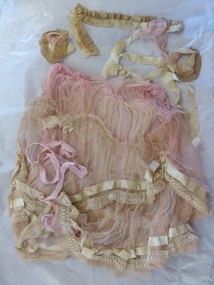
Child's Toy, Doll's clothes
... doll's clothing toys blain Remnants of the [VC02599] wax head doll's dress. The dress is made of pink gauze with coffee coloured lace trim and coffee and pink ribbons. The skirt is relatively intact; the bodice has fragments of the neckline and sleeves. Doll's clothes Child's ...This doll, from which this dress was removed, belonged to member Allan Blain's sister. It was donated to WDHS and then recently returned after an extended loan. This doll's dress is significant as it shows the style of dress of the c1860s as worn by both dolls and young girls and the fabrics available at that time. It would be a party dress. Remnants of the [VC02599] wax head doll's dress. The dress is made of pink gauze with coffee coloured lace trim and coffee and pink ribbons. The skirt is relatively intact; the bodice has fragments of the neckline and sleeves. dolls, doll's clothing, toys, blain -
 Stawell Historical Society Inc
Realia, Clothes Peg Doll
... Home made toy for Child Home made Toy Doll Insect wear on cape Clothes Peg Doll with knickers and Dress in whitehardager Tule. ...Home made toy for Child Clothes Peg Doll with knickers and Dress in whitehardager Tule. String arms holding small Basket. Red cape attached with Gold safety Pin. Painted face. Represented to be Red Riding Hood - Material stuffed over wooden Head of Clothes Peg Insect wear on cape home made, toy, doll -
 Tatura Irrigation & Wartime Camps Museum
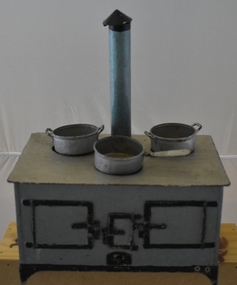
Toy - stove, 1940's
... Made by internee and used by Helga Weid (niece of Karl Kaltenbach) tatura toys dolls furniture toy stove Weid kaltenbach 3 holes on top of stove representing hot plates Blue painted steel model of a cooking oven used as a childs toy. ...Made by internee and used by Helga Weid (niece of Karl Kaltenbach) Blue painted steel model of a cooking oven used as a childs toy. Has two doors to two ovens either side of a smaller door on the fire box. 3 holes on top of stove representing hot plates tatura, toys, dolls, furniture, toy stove, weid, kaltenbach -
Tatura Irrigation & Wartime Camps Museum
Saucepan- Doll, 1940's
... Made in Camp 3 as a child's toy saucepan saucepan doll anderson h camp 3 tatura ww2 camp 3 toy furniture Small round metal meat paste tin with a handle soldered onto one side to form a saucepan Saucepan- Doll ...Made in Camp 3 as a child's toy saucepan Small round metal meat paste tin with a handle soldered onto one side to form a saucepan saucepan, doll, anderson h, camp 3, tatura, ww2 camp 3, toy, furniture -
 Brighton Historical Society
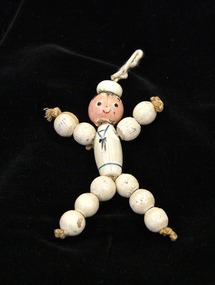
Doll, Bead doll, c.1937
... doll...child's toy...She re-invented some of Toula’s trousseau nightdresses and skilfully altered other clothing, making dresses which she wore around Brighton for many years. doll child's toy childhood sailor olga black Handmade painted wooden bead doll representing a sailor. ...Made by the cousin of Brighton local Olga Black. The cousin gave her the doll in 1937, when Olga was around seven years old. Olga Maria Black was born in Melbourne in 1930, the daughter of Ithacan migrants Constantine and Toula Mavrokefalos. Constantine first emigrated to Australia in 1902, returning to Greece circa 1912-13 to serve his home country in the Balkan Wars. Toula's family had left Ithaca for Romania when she was only six months old, but she happened to be visiting the island at the very time that Constantine arrived, fresh from the war. Within three weeks they were married, and when Constantine returned to Melbourne in 1914 his new bride came with him. Constantine had trained as an accountant, but his qualifications were not recognised in Australia. Changing his surname to the Anglicised "Black", he started off working in his older brother Dionysios's cafés before going into business on his own. In 1917 he opened the Paris Residential Café at 54-56 Swanston Street, which offered both dining and accommodation. The business saw some years of success, but did not survive the Great Depression. Constantine died in 1944. Olga's mother Toula learned to sew as a child, while growing up in the Romanian village of Brila. She developed her skills making lace and embroidering items for her trousseau. Some of the linen she embroidered had been woven from flax on Ithaca by her own grandmother, Efstathia. During the Depression, when money was scarce, Toula embroidered at home, doing work for a factory in Flinders Lane. Using a cotton reel, a threepence and a sixpence she created and embroidered designs on hundreds of blouses. Olga spent her preschool days sitting at the table where her mother worked. Toula would involve Olga by allowing her to help choose the colour combinations. Toula lived with Olga in Brighton until her death in 1976. Olga inherited her mother's sewing skills. She re-invented some of Toula’s trousseau nightdresses and skilfully altered other clothing, making dresses which she wore around Brighton for many years. Handmade painted wooden bead doll representing a sailor. Cream coloured body and limbs and pink head. The body is made from one long oval bead and the limbs from small round beads. doll, child's toy, childhood, sailor, olga black -
Vision Australia
Film - Video recording, 20th Century movies from RVIB, 1940s
... dolls, a playhouse and a rocker swing. 12. "Only for your support their lives might have been pitiful tragedies!" Children cuddle or play with soft toys, rocker swing and playhouse whilst a younger child sits in a chair. 13. ...dolls, a playhouse and a rocker swing. 12. "Only for your support their lives might have been pitiful tragedies!" Children cuddle or play with soft toys, rocker swing and playhouse whilst a younger child sits in a chair. 13. ...Various movies made by the RVIB and transferred on to digital media. These were created for raising awareness of the RVIB and to appeal for donations from the general public. Most are assumed to be from the 1940s. 1. Brief image of children at RVIB. Various girls knitting in the grounds of St Kilda road, with a quick cutaway to two babies in prams. In the middle of the girls is a globe with a rainbow style surround that reads "The sun will never set on our Empire / Because we have the will to win!" The Australia flag and Union Jack flutter above the words and in the middle is the AIF rising sun badge. There is a brief shot of uniformed girls holding up a rug. 2. Two men stand beside a Clarke and Smith talking book player. One man guides the other to the cartridge and to open the cartridge mailing container. 3. "The work and play of the babies and children give our supporters never ending interest and enthusiasm!" A boy weaving cane on to a timber frame, a girl reads her piano music as she plays, whilst another writes in Braille. 4. "This girl is studying for her leaving Certificate to enter the University for the Degree of Bachelor of Arts!" Phyllis Lawson at a typewriter, a classroom of students and a girl reading a book. 5. "Arithmetic and algebra sums are worked out by steel pins placed in octagonal holes." Students using a Taylor's Slate. 6. "Born into a world of darkness. They depend upon for the LIGHT! Through education, training, recreation." A teacher helps a girl read a raised map, a boy finds the South American landmass on the globe, and a boy feels his way around a toy galleon. 7. "You can quite understand why the School Inspector said the manual training and work of our pupils would do credit to a normal School!" A boy adjusts the rear wheels of a wooden model biplane and spins the propeller when done. 8. "Little fingers which are frequently stiff and clumsy through lack of training are guided into confidence and self help." Various children are shown weaving canework baskets or stringing beads, and a younger child creates plasticine models. 9. "Out of the Shadows of ignorance into the Sunshine" of Happy, useful Citizenship. With your help!" Two children make a bed in a dormitory, a girl brushes her teeth and washes and dries her hands in a dormitory bathroom, children eat with napkins tucked under their chins at tables covered in cloth and with flower centrepieces in a dining room, and girls in various costumes dance in the garden. 10. "They afford an object lesson on how to tackle and vanquish misfortune!" Four children row an adult on Albert Park Lake, children play on a swing carousel next to a building on which is painted 'Blind Babies Nursery', a boy winds up a train and places in on the track, and two children play with blocks. 11. "And now we come to our blind toddlers! Our Nursery School is the only one in the Southern Hemisphere!" Children play with dolls, a playhouse and a rocker swing. 12. "Only for your support their lives might have been pitiful tragedies!" Children cuddle or play with soft toys, rocker swing and playhouse whilst a younger child sits in a chair. 13. "All that sight means stimulates our minds to express the sympathy of our heart to them." Three girls sing their dolls to sleep as they cradle and rock them. 14. Outside of St Kilda Road building from various views. 15. "Our hostels for young blind." Raleigh Street hostel. 16. "The Lighthouse is the symbol of the Institute's activities. It spreads light through education and training into the lives of all eligible blind babies, children and adults of Victoria! A peep into our factories!" View of factory building, workers making millet brooms, weaving mats and basket weaving. 17. "Although our income totals 40,000 pounds annually the hand made articles of our sightless workers have to be sold at a heavy loss to compete with machine made goods! This loss, and the 10,000 pounds given annually in compassionate allowances to the adult blind to help them to support their wives and families can only be maintained by donations from Citizens!" Various workers making a range of brooms in the factory. 18. "All our blind adults live in their own homes. They receive 36,000 pounds annually, including nearly 10,000 pounds in compassionate allowances! We can NEVER THEREFORE BE SELF SUPPORTING." The range of goods produced by RVIB (baskets, mats, brooms and brushes) is shown hanging from the swing carousel in the children's playground. "Our blind workers can support their wives and families by constant employment only if Citizens ask Storekeepers for "BLIND INSTITUTE" goods. 19. A man adjusts the dampeners on a piano. "Please engage our expert blind piano tuners and repairers. They attend to more than 1000 pianos and pianolas every year!" A man puts in a row of dampeners and then tunes the piano. 20. "Our gymnasium, social, dancing, cricket and other forms of recreation give the sightless endless pleasure!" Male on a stationary bike, using a skipping rope, weightlifting and Greco-Roman wrestling in the gym, men playing cricket, people playing cards, a tile game, dominoes, checkers and a pinball game. 21. A girl using a wireless set. "For many years now we have given and maintained FREE wireless sets to all needy applicants throughout Victoria!" Girl puts on headphones and adjusts the dials. 22. " "TALKING BOOKS" have now been invented for the education and entertainment of the sightless. Literature of all kinds is thereby read to them by means of special records." A boy puts on headphones to listening to a recording. 23. Couples dance as the RVIB Orchestra plays on stage. Plates of cakes are passed around a table amongst tired dancers. The camera pans across the four piece orchestra (piano, saxophone, drummer and double bass). 24. "To lighten their darkness is a work of mercy! Please help us to give them The courage of usefulness, The privilege of work, The happiness of comradeship". 25. Various people at a meeting, one with a dog guide at his feet and some with dark glasses. Three men stand near a Clarke & Smith cartridge player talking. Two of them appeared earlier. 26. Women working in a room. A man gives dictation to a women, who is using possibly a Stainsby-Wayne embossed shorthand typewriter, a telephone operator connects calls, a man takes notes on a Stainsby-Wayne crab writer, a room full of people working, a metal device moves between two springs and two men work with timber. 27. RVIB sign, outside front of RVIB building and a group of adults sit on benches under the giant central trees, children have running races, children cheer and one receives a ribbon for her sash that is over her school uniform, a woman writes down the results, a man uses a device, various shots of children, games such as ball tossing, winding up string race, younger children have a running race holding hands with nursing staff. 28. "Melbourne, Blind Childrens' Annual Sports". Outside of RVIB building and sign, children compete in a variety of games as adults watch on. 29. "Melbourne, Swimming Under Handicap". Children walking along a street, past a Holden, to enter the City Baths. Inside they swim, learn to swim, jump and dive into the pool under the watchful gaze of a group of women. This portion of the film then is repeated in segments. 1 colour video recordings with no sound royal victorian institute for the blind, phyllis gration, rvib nursery, rvib school, rvib orchestra, braille equipment, braille music, recreation, fundraising, education, employment, buildings, raleigh street hostel, audio books -
 Kew Historical Society Inc
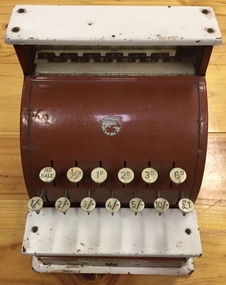
Leisure object - Toy Machine, TAGMA, Metal & Enamel Adding Machine, 1950s
... The examples of toys in the collection include examples of alphabet toys, arcade toys, baby toys, construction toys, dolls, doll accessories, educational toys, soft toys, tin toys, toy animals, toy blocks, toy machines, toy typewriters, etc. toys toy machine child's adding machine toy tagma australia A small, damaged label on the front states that it was made by Toys & *** Games Australia / TAGMA Small toy adding machine. ...The Kew Historical Society’s collection includes a wide range of leisure objects. Many of the items are European-made, generally of British origin, however there are a number that were made for the Australian market by Australian manufacturers. There were clearly a huge range of toys produced for the Australian and International children’s market in the Nineteenth and Twentieth centuries. The examples of toys in the collection include examples of alphabet toys, arcade toys, baby toys, construction toys, dolls, doll accessories, educational toys, soft toys, tin toys, toy animals, toy blocks, toy machines, toy typewriters, etc. Small toy adding machine. Tin with brown and white enamel painted. A small, damaged label on the front states that it was made by Toys & *** Games Australia / TAGMA toys, toy machine, child's adding machine toy, tagma australia -
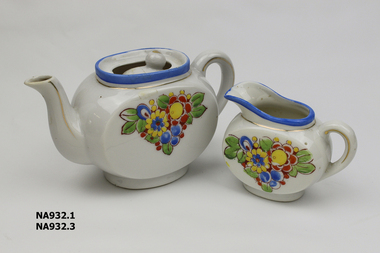 Whitehorse Historical Society Inc.
Leisure object - Child's Tea Set
... domestic items crockery toys dolls' accessories Child's china tea set - white with blue edge and flowered pattern. ...Child's china tea set - white with blue edge and flowered pattern. Comprising: tea pot with lid, milk jug with one handle, 1 cup, 1 bowl, 1 oval plate, 1 oval plate, 3 saucers, 5 plates. 13 parts make up the set domestic items, crockery, toys, dolls' accessories -
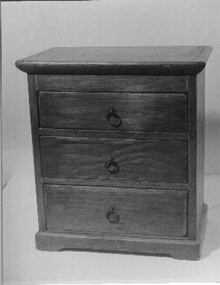 Whitehorse Historical Society Inc.
Leisure object - Toy Chest of Drawers
... Was one of Doris's toys as a child. toys doll's furniture Miniature wooden chest of drawers with three drawers with metal handles Leisure object Toy Chest of Drawers ...Was one of Doris's toys as a child. Miniature wooden chest of drawers with three drawers with metal handles toys, doll's furniture -
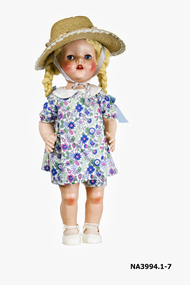 Whitehorse Historical Society Inc.
Leisure object - Doll, 1949
... The doll was a gift at 5 years old. toys dolls Pedigree E#England A walking doll A child's doll resembling a small child dressed in summer clothes and a straw hat, She has blonde hair plaited and tied with blue ribbons. ...The donor Margaret was born in 1944 and grew up at 31 Drummond Street Blackburn. The doll was a gift at 5 years old. A walking doll A child's doll resembling a small child dressed in summer clothes and a straw hat, She has blonde hair plaited and tied with blue ribbons. The dress is floral cotton with white collar and two press studs in centre back. Floral pants match the dress. Cream net socks and cream plastic shoes.|The hat is straw with blue frill around the brim and five blue bows around the crown tied with blue ribbon. Eight items including the doll. Pedigree E#England toys, dolls -
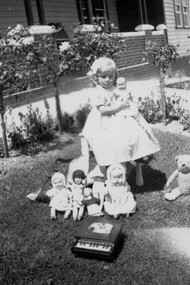 Linton and District Historical Society Inc
Photograph, Irene Bennett with Toys
... child of Gordon Bennett and his wife Ada (née Keil). Irene Bennett Small black and white photograph of a young girl holding a doll sitting on a seat. A teddy bear, five dolls and a small piano at her feet. Irene Bennett with Toys ...Irene Bennett, born 1935, was the only child of Gordon Bennett and his wife Ada (née Keil). Small black and white photograph of a young girl holding a doll sitting on a seat. A teddy bear, five dolls and a small piano at her feet. irene bennett
