
Showing 166 items matching "children on a fence"
-
 Flagstaff Hill Maritime Museum and Village
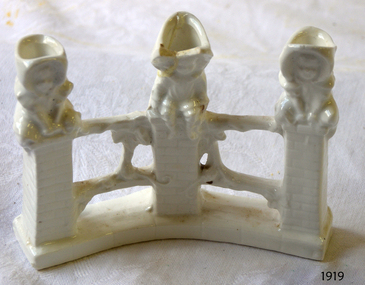
Decorative object - Ornament, ca. 19th century
... ...children on a fence...Fine glazed white porcelain ornament, carved to represent three children sitting on three brick fence pillars. There are gold highlights on the surface. ...Flagstaff Hill Flagstaff Hill Maritime Museum and Village Warrnambool Maritime Museum Maritime Village Great Ocean Road Shipwreck Coast Bisque China ornament white china ornament German Germany porcelain unglazed porcelain 19th century 18th century European ornament pottery unglazed pottery domestic ornament decoration table decoration children on a fence vase candle holder "6946" Fine glazed white porcelain ornament, carved to represent three children sitting on three brick fence pillars. ...This fine white glazed porcelain figurine is one of six donated together. The bisque material was easy to carve and allowed fine detail. Figurine ornaments were popular for table decorations between the mid-18th to early 19th centuries. This ornament was likely made in Germany, and German manufacturers began to use bisque material to make realistic faces for dolls in the 1850s.The set of six bisque figurines is representative of popular table decorations during the 19th and early 20th centuries.Fine glazed white porcelain ornament, carved to represent three children sitting on three brick fence pillars. There are gold highlights on the surface. The hats on the children are vases. An inscription is on the base of the centre pillar."6946"flagstaff hill, flagstaff hill maritime museum and village, warrnambool, maritime museum, maritime village, great ocean road, shipwreck coast, bisque, china ornament, white china ornament, german, germany, porcelain, unglazed porcelain, 19th century, 18th century, european ornament, pottery, unglazed pottery, domestic ornament, decoration, table decoration, children on a fence, vase, candle holder -
 Surrey Hills Historical Society Collection
Work on paper - Black and White Photograph, Ian, Elizabeth & Peter Hammet in back garden of 11 Durham Road, Surrey Hills, c 1956
... Black & white photo of three children with a fence and a bare deciduous trees in the background....Black & white photo of three children with a fence and a bare deciduous trees in the background. ...Garth and Dulcie Hammet were the owners of 11 Durham Road from 1949-1974. They were married on 16 January 1943 at the Gardiner Presbyterian Church. Garth was born 24 October 1919; died 5 December 2009. His parents were Ivy Read and Norman Hammet. He had an older sibling Holmayne Hammet. He served in WW2. He was an insurance clerk with T & G Mutual Life Assurance Society. Dulcie (nee Burnet) was born 1 May 1919; died 5 May 1997. Her parents were Charlotte Curtis and Harold Burnet and she had a younger sister Marjorie. She was a WRAN during WW2. At the time of her marriage she was living at 38 Mangarra Road, Canterbury (later 40 Mangarra Road). Her father was manager of the Melbourne Steamship Company. Prior to her marriage, Dulcie was a typist / secretary at T & G Mutual Life Assurance Society. The couple had 3 children: Ian (B 1945), Peter (B 1946) and Elizabeth (B 1950). After the Hammets sold 11 Durham Road, they moved to 29 Hill Street, Hawthorn.Black & white photo of three children with a fence and a bare deciduous trees in the background."Ian, Elizabeth & Peter Hammet / in back garden of 11 Durham Rd1"- written in grey lead on the rear by the donor.durham road, garth hammet, dulcie burnet, dulcie hammet, peter hammet, ian hammet, elizabeth hammet, elizabeth love -
 Port Melbourne Historical & Preservation Society
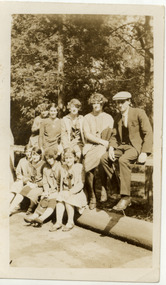
Photograph - Group sitting on a fence, 1920s
... Sepia photos of young adults and social activity in 1920s 03 - Adults and children sitting on fence...Social Activities Picnics Sepia photos of young adults and social activity in 1920s 03 - Adults and children sitting on fence Photograph Group sitting on a fence ...Sepia photos of young adults and social activity in 1920s 03 - Adults and children sitting on fencesocial activities, picnics -
 Bendigo Historical Society Inc.
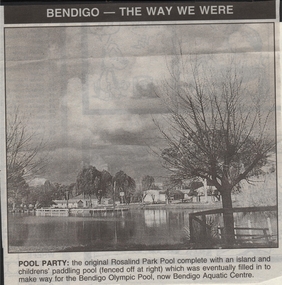
Newspaper - JENNY FOLEY COLLECTION: POOL PARTY
... Pool party: the original Rosalind Park Pool complete with an island and children's paddling pool (fenced off at right) which was eventually filled in to make way for the Bendigo Olympic Pool, now Bendigo Aquatic Centre....Pool party: the original Rosalind Park Pool complete with an island and children's paddling pool (fenced off at right) which was eventually filled in to make way for the Bendigo Olympic Pool, now Bendigo Aquatic Centre. ...Bendigo Advertiser ''The way we were'' from 1999. Pool party: the original Rosalind Park Pool complete with an island and children's paddling pool (fenced off at right) which was eventually filled in to make way for the Bendigo Olympic Pool, now Bendigo Aquatic Centre.newspaper, bendigo advertiser, the way we were -
 Tatura Irrigation & Wartime Camps Museum
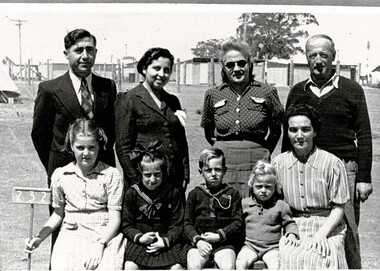
Photograph, Fortuna and Cassati Family 1942
... Black and white photograph of 4 adults standing, 4 children and a lady sitting. Fence and huts behind them....Black and white photograph of 4 adults standing, 4 children and a lady sitting. Fence and huts behind them. Fortuna and Cassati Family 1942 Photograph Photograph ...Fortuna and Cassati families were internees in Camp 3A during WW2. Back row (l to r): Domenico Fortuna, Elpi Fortuna, Mrs Cassati and Judge Cassati. Front row: Miss Cassati, Mafalda, John and Con Fortuna and governess. Photograph taken in 1942. Black and white photograph of 4 adults standing, 4 children and a lady sitting. Fence and huts behind them.232 to the left and being held by first girl.john fortuna, con fortuna, camp 3a rushworth, mafalda fortuna, mrs cassati, judge cassati, miss cassati, domenico fortuna, elpi fortuna -
 Bendigo Historical Society Inc.
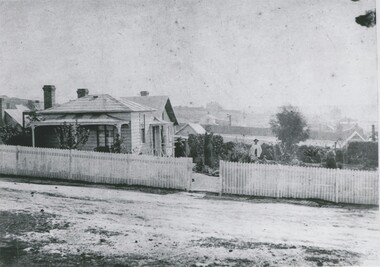
Photograph - MINER'S WEATHERBOARD COTTAGE, 1861
... ), adult female and two children. Picket fence fronting street. On back ' not known' in pencil....), adult female and two children. Picket fence fronting street. On back ' not known' in pencil. ...blacka nd white photo of wooden house with unusual side porch entrance; large building at rear. Extensive garden with adult male ( artist ? ), adult female and two children. Picket fence fronting street. On back ' not known' in pencil.Batchelderbuildings, residential, miner's cottage -
 Linton and District Historical Society Inc
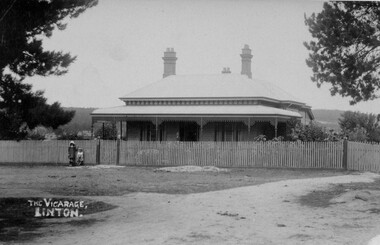
Photograph, Church of England Vicarage, Linton
... Postcard/photograph of a high roofed house with three chimneys, set in a garden surrounded by a wooden picket fence. Two young children are standing outside the fence....Postcard/photograph of a high roofed house with three chimneys, set in a garden surrounded by a wooden picket fence. Two young children are standing outside the fence. ...Postcard/photograph of a high roofed house with three chimneys, set in a garden surrounded by a wooden picket fence. Two young children are standing outside the fence."The Vicarage Linton".vicarage, buildings, houses -
 Sunbury Family History and Heritage Society Inc.
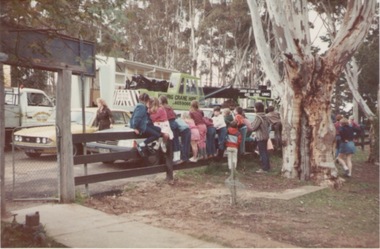
Photograph, Bulla Primary School, 1984
... A non-digital coloured photograph with school children sitting and standing on a fence watching a portable classroom being transported to their school. ...The use of portable classrooms was widespread across Victoria especially from 1945 to the end of last century. bulla primary school bulla schools Portable Classrooms A non-digital coloured photograph with school children sitting and standing on a fence watching a portable classroom being transported to their school. ...Portable classrooms being brought into a school was how many schools accommodated children when there was an increase in student enrolments and there were insufficient classrooms available at a school. This portable room was transported from Macedon Primary School in September 1984 and it became known as Room 1 at Bulla. The use of portable classrooms was widespread across Victoria especially from 1945 to the end of last century.A non-digital coloured photograph with school children sitting and standing on a fence watching a portable classroom being transported to their school. bulla primary school, bulla, schools, portable classrooms -
 Whitehorse Historical Society Inc.
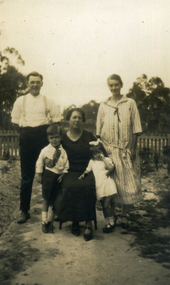
Photograph, Till family
... Black and white group photograph of three adults and two children in front of a wooden fence and trees. Names inscribed on reverse of photograph...till sydney mrs evelyn alwyn alison bertha Black and white group photograph of three adults and two children in front of a wooden fence and trees. Names inscribed on reverse of photograph Till family Photograph Photograph ...Black and white group photograph of three adults and two children in front of a wooden fence and trees. Names inscribed on reverse of photographtill, sydney, mrs, evelyn, alwyn, alison bertha -
Phillip Island and District Historical Society Inc.
Photograph, San Remo School, 1904
... fence. Porch at front, brick chimneys on each side of corrugated roof. Two single windows either side of porch. 17 children in front of picket fence with teacher. ...fence. Porch at front, brick chimneys on each side of corrugated roof. Two single windows either side of porch. 17 children in front of picket fence with teacher. ...Single-fronted wooden school building behind picket fence. Porch at front, brick chimneys on each side of corrugated roof. Two single windows either side of porch. 17 children in front of picket fence with teacher. Mostly hatted or capped - teacher behind children.Group of seventeen children with teacher outside front of school. John Dickie II in middle of front row.local history, photography, photographs, slides, film, school group 1904, san remo, black & white photograph, miss elms, schools, dickie family -
 Kiewa Valley Historical Society
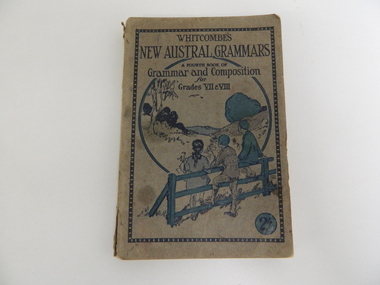
Book, Whitcombe's New Austral Grammars - a Fourth Book of Grammar and Composition for Grades V11 & V111
... A greeny/grey book with cardboard cover and with bluish picture of 3 children sitting on a fence looking at a view of the countryside. ...A greeny/grey book with cardboard cover and with bluish picture of 3 children sitting on a fence looking at a view of the countryside. ...Educational book for Grammar and Composition. Published for the Victorian Education Department.Historical: Comparative with other text books used in schools in different eras.A greeny/grey book with cardboard cover and with bluish picture of 3 children sitting on a fence looking at a view of the countryside. The countryside is in a solid circle of blue. Border is black with ladder-like line about 2 mm wide. Bottom right corner in circle coloured blue is (in black) 2/- Title: in black Whitcombe's / New austral Grammars / A Fourth Book of / Grammar and Composition / for / Grades VII & VIII. See physical description.education. school. victorian education department. english. grammar. composition. grades 7 and 8. -
 Port of Echuca
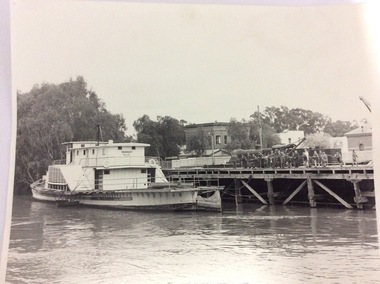
Black and white photograph, 1980? A note has been added by C.J (Claire Jackson) saying that the photo was taken about 1973-74
... There is a group of school children leaning over the wire fence at the edge of the wharf. ...There is a group of school children leaning over the wire fence at the edge of the wharf. ...The photograph shows the state of the Echuca wharf in 1973 or 1974. The P.S Pevensey looks like it has just received a fresh coat of paint. There is also a train parked on the wharf behind the school students. The river also appears to be quite high. This photograph shows the state of the wharf in the early 1970's. It shows the fence between the wharf and Murray Esplande was relatively new. The tourism industry was very new to Echuca in the 1970's but the P.S Pevensey looks ready to take Tourists cruising on the Murray River. It also shows schools were using the port as a valuable resource for teaching History.A black and white photograph of the P.S Pevensey tied up to the Echuca Wharf. There is a group of school children leaning over the wire fence at the edge of the wharf. There is also one teacher supervising the children. The Steam Packet Inn and the Customs House can be seen in the background.Pevensey; Melbourne can be seen clearly written on the paddle steamer. On the back of the photograph is written "This photograph is with the compliments of the Ministry of Tourism, Government of Victoria. Please acknowledge photo; Michael Cheshire. There is also a purple Port of Echuca stamp on the back of the photograph.echuca wharf, p. s pevensey, ministry of tourism, cheshire, michael -
 Wodonga & District Historical Society Inc
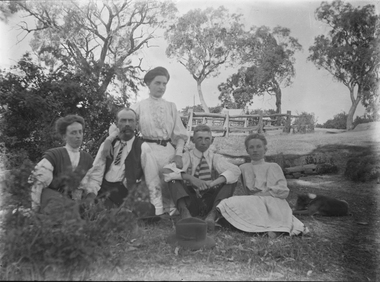
Negative - Haeusler Glass Negatives Collection - Family group seated outside
... A family group of husband, wife and three children seated outside. A house and fenced yard is in the background. ...A family group of husband, wife and three children seated outside. A house and fenced yard is in the background. ...The Wodonga Historical Society Haeusler Collection provides invaluable insight into life in late nineteenth and early twentieth century north east Victoria. The collection comprises manuscripts, personal artefacts used by the Haeusler family on their farm in Wodonga, and a set of glass negatives which offer a unique visual snapshot of the domestic and social lives of the Haeusler family and local Wodonga community. The Haeusler family migrated from Prussia (Germany) to South Australia in the 1840s and 1850s, before purchasing 100 acres of Crown Land made available under the Victorian Lands Act 1862 (also known as ‘Duffy’s Land Act’) in 1866 in what is now Wodonga West. The Haeusler family were one of several German families to migrate from South Australia to Wodonga in the 1860s. This digital image was produced from one of the glass negatives that form part of the collection, probably taken by Louis Haeusler (b.1887) with the photographic equipment in the Wodonga Historical Society Haeusler Collection.This item is unique and has well documented provenance and a known owner. It forms part of a significant and representative historical collection which reflects the local history of Wodonga. It contributes to our understanding of domestic and family life in early twentieth century Wodonga, as well as providing interpretative capacity for themes including local history and social history.Digital image created from the Haeusler Glass negative collection. A family group of husband, wife and three children seated outside. A house and fenced yard is in the background. C. 1910wodonga pioneers, haeusler family, glass negatives, dry plate photography -
 Glenelg Shire Council Cultural Collection
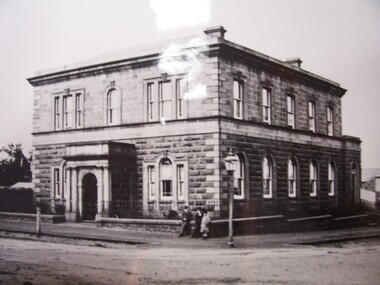
Photograph - Photograph - ANZ Bank, Portland, n.d
... Lamp on street corner and three figures (children ?) leaning against iron rail fence set in bluestone base....Lamp on street corner and three figures (children ?) leaning against iron rail fence set in bluestone base. ...State Library of South Australia.Black and white photographic reproduction of earlier photograph. Depicting 2-storey bluestone building on a corner with door in left side, framed by double columns. Lamp on street corner and three figures (children ?) leaning against iron rail fence set in bluestone base.Front: A.N.Z. (Formerly Union) Bank. Cnr Percy & Julia Streets (typed label, top centre). Back: B21766/98 (pencil, upper left). State Library of South Australia Photographic Section. Order No. A16493 (stamp, centre).anz bank, commerce, banking, portland, bluestone building -
 Halls Gap & Grampians Historical Society
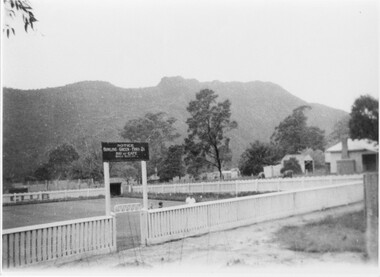
Photograph - B/W
... fence. There is a sign (" Notice, Bowling Green, Fee 2/-, Pay at Cafe, Bowls Supplied") over a wrought iron & mesh gate. A man and two children...fence. There is a sign (" Notice, Bowling Green, Fee 2/-, Pay at Cafe, Bowls Supplied") over a wrought iron & mesh gate. A man and two children ...The bowling green at Halls Gap.This photo is of a bowling green with a mountain range in the background. The green has a low wooden slat fence. There is a sign (" Notice, Bowling Green, Fee 2/-, Pay at Cafe, Bowls Supplied") over a wrought iron & mesh gate. A man and two children stand inside the fence to the right of the gate. A shelter can be seen at the rear of the green. The edge of a house and outbuildings can be seen on the right. A cleared area and footpath can be seen in the foreground.recreation, sport -
 Sunbury Family History and Heritage Society Inc.
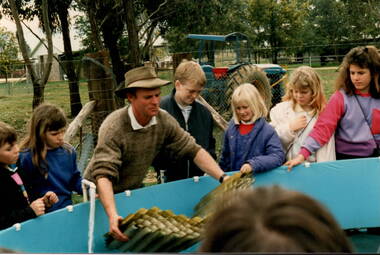
Photograph, Fish hatchery, 1988
... A non-digital coloured photograph of a man beside a pool and holding some matting and explaining its use while six children are looking on. Beyond the fenced off area is a building and picnic settings....School Camps Beechworth Fish Hatchery A non-digital coloured photograph of a man beside a pool and holding some matting and explaining its use while six children are looking on. Beyond the fenced off area is a building and picnic settings. ...The children from Bulla and Mickleham Primary Schools were attending a school camp at Beechworth and while there they were taken to a fish hatchery to see how it functions.A non-digital coloured photograph of a man beside a pool and holding some matting and explaining its use while six children are looking on. Beyond the fenced off area is a building and picnic settings.school camps, beechworth, fish hatchery -
 Bendigo Historical Society Inc.
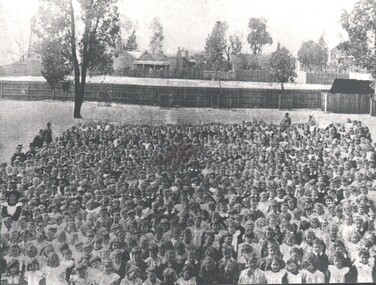
Photograph - HARRY BIGGS COLLECTION: EAGLEHAWK STATE SCHOOL
... Photograph of a LARGE group of children, behind the children there is a wooden fence also several small trees in wooden tree guards. ...PERSON Group school Eaglehawk State School Photograph of a LARGE group of children, behind the children there is a wooden fence also several small trees in wooden tree guards. ...Photograph of a LARGE group of children, behind the children there is a wooden fence also several small trees in wooden tree guards. To the right there is a fenced in container (rubbish container?). In the background behind the fence can be seen private dwellings. A note with the photo Eaglehawk State School Pupils, SS210, Church St. Eaglehawkperson, group, school, eaglehawk state school -
 Orbost & District Historical Society
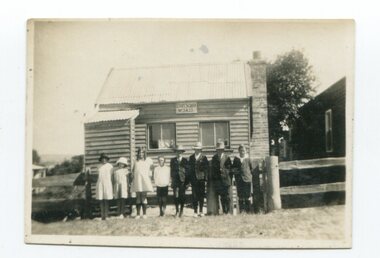
Photograph - black and white photograph, Marlo Primary School No. 3433
... A b/w photo of 8 children standing in front of a fence and timber building with a brick chimney on the right hand side. ...This small school was opened in 1902 to provide education to local children. education Marlo On back of photo are the words; Marlo School A b/w photo of 8 children standing in front of a fence and timber building with a brick chimney on the right hand side. ...This is a photograph of the Marlo Primary School in its original location in Argyle Street, approximately opposite the Marlo Hotel. This small school was opened in 1902 to provide education to local children. A b/w photo of 8 children standing in front of a fence and timber building with a brick chimney on the right hand side. A sign in black lettering on to a white background can be seen on the building. This reads STATE SCHOOL No. 3433.On back of photo are the words; Marlo Schooleducation, marlo -
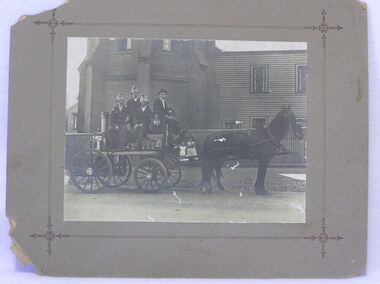 Ballarat Fire Brigade
Photograph, around 1881
... Pumper has 3 firemen and a driver on board. 3 children are standing against the fence in the rear of the picture. ...Picture shows side view of original station and corrugated iron fence B&W photograph of Shand Mason steam pumper taken beside Ballarat Fire Station in Barkly street. Pumper is being drawn by 2 dark coloured horses. Pumper has 3 firemen and a driver on board. 3 children ...Shand Mason steam pumper was purchased by the brigade in 1881 and was the first of its kind in Victoria. Picture shows side view of original station and corrugated iron fenceB&W photograph of Shand Mason steam pumper taken beside Ballarat Fire Station in Barkly street. Pumper is being drawn by 2 dark coloured horses. Pumper has 3 firemen and a driver on board. 3 children are standing against the fence in the rear of the picture. Photo is mounted on an brown coloured card with dcorative scrolls. -
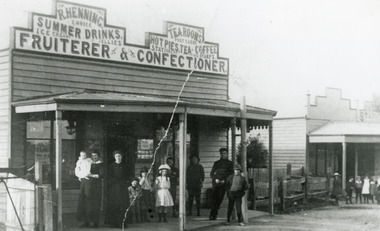 Lakes Entrance Historical Society
Photograph - Hennings Tea Room Lakes Entrance Victoria c1915
... Ten other children in photo. Post and rail fence beside footpath. ...Ten other children in photo. Post and rail fence beside footpath. Photograph Hennings Tea Room Lakes Entrance Victoria c1915 ...Copied from a negative produced by George Legg. Later El Ray Cafe - Crea's burned down 12th August 1964. Lakes Inn Cafe - J & L Mitchelson 1972.Black and white photograph of Hennings Store, on Esplanade. Notice above veranda, of weatherboard building, advertises drinks, fruit, confectionery, pies, tea, coffee, postcards, stationary and stamps. On veranda in front of shop two women in long dresses, one holding a baby, small girl in short frock and hat, man leaning on veranda post. Ten other children in photo. Post and rail fence beside footpath. township, retail trade, clothing, people -
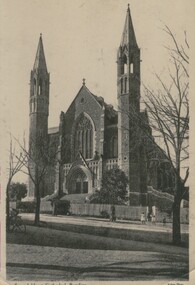 Bendigo Historical Society Inc.
Photograph - SACRED HEART CATHEDRAL
... Bicycle in foreground, found children in middle ground by picket fence. Looking across Wattle Street. ...Bicycle in foreground, found children in middle ground by picket fence. Looking across Wattle Street. ...Sepia print showing view of Bendigo's Sacred Heart Cathedral from West. Bicycle in foreground, found children in middle ground by picket fence. Looking across Wattle Street. Showing cathedral before main steeple build. Postcard. Inscriptions: in ink on face top RH 'MP 221'. Same site, in red ink - '32', Sacred Heart Cathedral, 'Kalima Press'. On back: in stamped circle 'Royal Historical Society of Victoria, Bendigo Branch'. Red ink '32', Printed 'V.S.M. Series. Printed in Germany' (ink stain above). Stamped: 'Royal Historical Society of Victoria, Bendigo Branch'. Lines for correspondence. History of object: previous acc. No. 'MP 122'buildings, church, sacred heart cathedral -
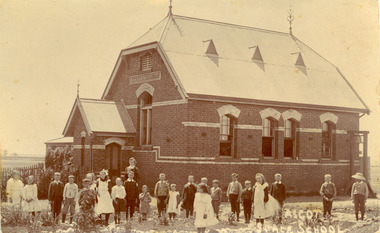 Federation University Historical Collection
Postcard - Photographic Postcard, Ascot Primary School (No. 2507)
... children stand in from on a brick building with corrugated iron roof. They are students of Ascot Primary School. .2) Twelve males students of Ascot Primary School stand in front of a timber post and rail fence. ...children stand in from on a brick building with corrugated iron roof. They are students of Ascot Primary School. .2) Twelve males students of Ascot Primary School stand in front of a timber post and rail fence. ...Ascot Denominational School in Ascot opened in 1859 for the Presbyterian Free Church with 26 students, which quickly grew to 96. In 1866 the local Board of Managers offered the school to the Board of Education if it would pay the 200 pound building debt, but the offer was rejected. In 1873 Ascot Primary School (No. 16) opened. A new site was purchased in 1981 forcing the closure of School 16. Ascot State School (No. 2507) opened in February 1883..1) Twenty three children stand in from on a brick building with corrugated iron roof. They are students of Ascot Primary School. .2) Twelve males students of Ascot Primary School stand in front of a timber post and rail fence. They are the same boys as depicted in the .1) Ascot Primary School photo. Members of the Chatham family were educated at Ascot Primary School and are thought to be in these photographs. In the late 1950s and 60s the children of Phillip and Elizabeth Chatham nee Holmes also attended Ascot State School along with the children of Bill and Margaret Holmes.Verso in blue ballpoint pen "Chatham Ascot"chatham family collection, ascot, ascot primary school, ascot state school, post and rail, elizabeth holmes, bill holmes -
 Federation University Historical Collection
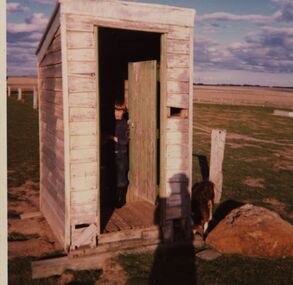
Photograph - Colour, Chatham-Holmes Collection: Andrew Chatham in the Out House, Kur-a-ruc South, Rokewood, Vic. {circa 1976)
... children, was born in 1968. In this photo, he looks about 8 - 10 years old. The photo was taken at Rokewood, Victoria on his parent's Western District property, "Kur-a-ruc South" a former part of the Kur-a ruc Station, Rokewood, Victoria purchased by Philip and Elizabeth Chatham in 1964. The family lived at Ascot, 15 miles north of Ballarat, and had regular weekend day trips and Easter holidays picnicking, droving sheep, feeding stock, checking water troughs and dams, hand-weeding Patterson curse, repairing fences, collecting paddock rocks and sugar-gum wood at "Kur-a-ruc South'. ...children, was born in 1968. In this photo, he looks about 8 - 10 years old. The photo was taken at Rokewood, Victoria on his parent's Western District property, "Kur-a-ruc South" a former part of the Kur-a ruc Station, Rokewood, Victoria purchased by Philip and Elizabeth Chatham in 1964. The family lived at Ascot, 15 miles north of Ballarat, and had regular weekend day trips and Easter holidays picnicking, droving sheep, feeding stock, checking water troughs and dams, hand-weeding Patterson curse, repairing fences, collecting paddock rocks and sugar-gum wood at "Kur-a-ruc South'. ...Andrew Chatham, the youngest of Philip and Elizabeth Chatham's 5 children, was born in 1968. In this photo, he looks about 8 - 10 years old. The photo was taken at Rokewood, Victoria on his parent's Western District property, "Kur-a-ruc South" a former part of the Kur-a ruc Station, Rokewood, Victoria purchased by Philip and Elizabeth Chatham in 1964. The family lived at Ascot, 15 miles north of Ballarat, and had regular weekend day trips and Easter holidays picnicking, droving sheep, feeding stock, checking water troughs and dams, hand-weeding Patterson curse, repairing fences, collecting paddock rocks and sugar-gum wood at "Kur-a-ruc South'. Home base for these excursions was either a car, the shearing shed, sometimes a 6-berth caravan and by the mid-1980s a shearer's quarters with an inside toilet. [Jane Dyer (nee Chatham).15 June 2024] chatham-holmes collection, andrew chatham, outdoor shed, toilet facility, rokewood, kur-a-ruc south, rokewood -
Glenelg Shire Council Cultural Collection
Postcard - Postcard - children in fancy dress, Portland, n.d
... Group of children in fancy dress, outdoors, grass surface, in front of corrugated iron fence...Group of children in fancy dress, outdoors, grass surface, in front of corrugated iron fence Postcard Postcard - children in fancy dress, Portland ...Black and white photo postcard. Group of children in fancy dress, outdoors, grass surface, in front of corrugated iron fenceBack: 'GROUP OF CHILDREN IN FANCY-DRESS, "DIGGERS" SPORTS-CARNIVAL TOYE PHOTO" -white print, bottom edge of postcarddiggers sports competition, portland events, sport, recreation -
Glenelg Shire Council Cultural Collection
Photograph - Photograph - Henty Beach, Portland, 1950s
... Children standing on wooden stage in front of ramp. Bunting on ramp fence and hanging from stage. ...Children standing on wooden stage in front of ramp. Bunting on ramp fence and hanging from stage. ...Black and white photo of small children in bathers on Henty Beach, Portland. Children standing on wooden stage in front of ramp. Bunting on ramp fence and hanging from stage. Brass band in foreground. Possibly Goldraiders bathing competition, summer 1950s.Back: 350-32 - pencilportland photography, bathing competition, henty beach -
 The Beechworth Burke Museum
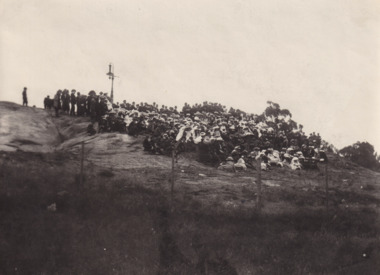
Photograph, c. 1905
... Taken in c. 1905, depicted is a large group of children and adults dressed in formal attire sitting and standing upon a granite rock that is located in the centre of Queen Victoria Park. In front of the group is a wooden picket wire fence...Taken in c. 1905, depicted is a large group of children and adults dressed in formal attire sitting and standing upon a granite rock that is located in the centre of Queen Victoria Park. In front of the group is a wooden picket wire fence ...Taken in c. 1905, depicted is a large group of children and adults dressed in formal attire sitting and standing upon a granite rock that is located in the centre of Queen Victoria Park. In front of the group is a wooden picket wire fence that sides the granite rock. On top of the rock is a gas lamp post.Originally known as the Beechworth Botanical Gardens, the Queen Victoria Park features a extensive collection of historic trees and plants, which have been listed on the Indigo Shire’s Significant Tree Register.Black and white rectangular reproduced photograph printed on matte photographic paperReverse: 6956 (in pencil)/ ©/ DONALD HAYES/ BEECHWORTH (stamped in orange ink)/entertainment album, burke museum, beechworth, queen victoria park, park -
 Orbost & District Historical Society
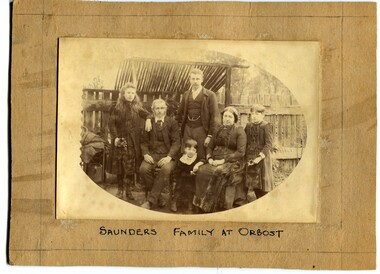
black and white photograph, C1888 -1889
... A black / white photograph of a family group with the parents seated and their children standing around them. In the background is a wooden fence. It is on a beige coloured buff card....The shop was burnt down in the early 1930‘s. ( info. from Saunders Family Newsletter by John Phillips) This is a pictorial record of a prominent early Orbost family and is a useful research item. saunders-orbost on front - "Saunders family at Orbost" on back - " Saunders family at orbost, 1888 - 1889" A black / white photograph of a family group with the parents seated and their children standing around them. In the background is a wooden fence. It is on a beige coloured buff card. black and white photograph ...This is a photograph of the Saunders Family at Orbost 1888-89. It is Arthur and Agnes Saunders with their children, Beatrice, Cyril, Hilda and Vera. Arthur Scott Saunders was born 1864 in Orbost and died 3.12.1913 in Orbost where he is buried. He was the son of Son of Thomas Frederick Saunders and Lucy Beard Scott. He was a storekeeper at Orbost, a member of the early Show Committees, a Rechabite in 1893, and was a member of the Board of Guardians of the Church of England from 1894 to 1913 where he served as secretary and treasurer of the Board. His wife was Agnes Louisa Stuart Morriss who was born in 1862 and died 26-11-1938 at East Malvern and is buried in . Orbost cemetery. She sold the business in 1919 to Mr J. H, V. Dale. She left Orbost with her two daughters for East Malvern in April 1927. Saunders General Store was opened in 1900, overlapping part of the present Mensland and Coultons. The ―Melbourne Store‖ refers to it being a branch of their Melbourne store. The shop was burnt down in the early 1930‘s. ( info. from Saunders Family Newsletter by John Phillips)This is a pictorial record of a prominent early Orbost family and is a useful research item.A black / white photograph of a family group with the parents seated and their children standing around them. In the background is a wooden fence. It is on a beige coloured buff card.on front - "Saunders family at Orbost" on back - " Saunders family at orbost, 1888 - 1889"saunders-orbost -
 Orbost & District Historical Society
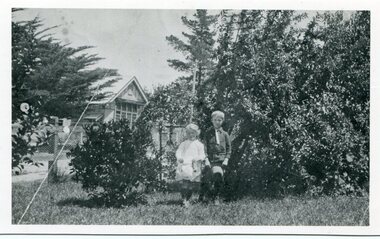
black and white photograph, 1919
... A black / white photograph of two children, holding their hats , standing in front of a tree outside a school fence. ...This is a pictorial record of a significant event in the life of the McDonald family of early Orbost. mcdonald-ian mcdonald-jean orbost-education rowe-john on back - "Ian & Jean McDonald opposite the school" A black / white photograph of two children, holding their hats , standing in front of a tree outside a school fence. black and white photograph ...Ian and Jean McDonald are the children of Mr and Mrs Norman McDonald of 42 Gladstone Street, Orbost. This photograph was taken in late January 1919 on the occasion of Jean's first day of school at the house of John Rowe, a former headmaster, who then lived opposite the school. Norman Alexander McDonald was a book-keeper at Macarthur‟s and was very musical. He was proprietor of the Capitol Cafe, Nicholson Street, Orbost, selling the business to Mr Coad on 4th December 1947.This is a pictorial record of a significant event in the life of the McDonald family of early Orbost.A black / white photograph of two children, holding their hats , standing in front of a tree outside a school fence. on back - "Ian & Jean McDonald opposite the school"mcdonald-ian mcdonald-jean orbost-education rowe-john -
 Orbost & District Historical Society
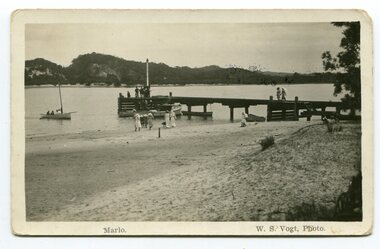
Postcard - Five b/w photos/postcards of Marlo, Rose series, 1900-1930
... Water and sand dunes in the background 2708.2 View showing grass and trees in the foreground; then water with sand dunes in the background. 2708.3 A sign across the top of a road with 'Welcome to Marlo'; a car on the road; trees on edges of road. 2708.4 A number of buildings behind a white fence; large tree on l.h.side. 2708.5 Sand in the foreground leading down to a water. Women on the foreshore, also a dog and children. ...Water and sand dunes in the background 2708.2 View showing grass and trees in the foreground; then water with sand dunes in the background. 2708.3 A sign across the top of a road with 'Welcome to Marlo'; a car on the road; trees on edges of road. 2708.4 A number of buildings behind a white fence; large tree on l.h.side. 2708.5 Sand in the foreground leading down to a water. Women on the foreshore, also a dog and children. ...Marlo is a settlement near the mouth of the Snowy River near Orbost. Before the railway was completed to Orbost in 1916, and roads were later improved, Marlo was the main entry-point for ships travelling the coastal route from Melbourne to Orbost. Marlo developed as a small port with a jetty. It also developed as a holiday destination with the Hotel and at least one guest-house. These five postcards are significant because they show important aspects of Marlo c.1890s - 1930s. Five b/w photos/postcards 2708.1 View showing grassy hillside in foreground with telegraph poles. Water and sand dunes in the background 2708.2 View showing grass and trees in the foreground; then water with sand dunes in the background. 2708.3 A sign across the top of a road with 'Welcome to Marlo'; a car on the road; trees on edges of road. 2708.4 A number of buildings behind a white fence; large tree on l.h.side. 2708.5 Sand in the foreground leading down to a water. Women on the foreshore, also a dog and children. A small sailing boat in the water. A jetty leading out into the water. People on the jetty. In the background are vegetated sand-dunes.2708.1 View from Hotel, Marlo, Vic. Rose Series P3253 2708.2 Sand Hummocks, Snowy River, Marlo, Vic. Rose Series P324 2708.3 Marlo Road, Marlo, Vic. Rose Series P3836 2708.4 Marlo Hotel, Marlo, Victoria. Rose Series P2421 2708.5 Marlo. W S Vogt photomarlo, marlo hotel, marlo jetty, snowy river -
 Orbost & District Historical Society
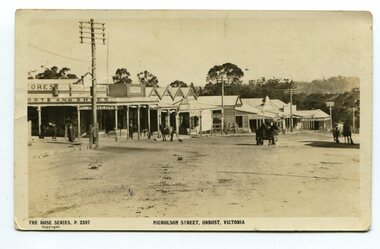
Photograph - Photos of Orbost, W S Vogt, 1900-1920
... fence. The building has several gables. A man with an apron is visible in the doorway of the top storey. There are several horses and carts in the building's yard. 2712.4 An oval shaped photograph showing a large group of school children on the right and a number of adults on the left who appear to be speaking to the children. ...fence. The building has several gables. A man with an apron is visible in the doorway of the top storey. There are several horses and carts in the building's yard. 2712.4 An oval shaped photograph showing a large group of school children on the right and a number of adults on the left who appear to be speaking to the children. ...These five b/w photos of Orbost were taken in the early 20th Century. 2712.1 is of Ruskin Street looking east from Nicholson Street with the Post Office on the corner. The Orbost Shire Council chambers is also shown. 2712.2 is an excellent photograph of the Post Office on the corner of Nicholson and Ruskin Streets. 2712.3 is a photograph of the first butter factory, built 1893 in Lochiel Street. 2712.4 shows a visit by the Governor of Victoria c.1920s. 2712.5 is a photo looking looking down Nicholson Street from the Ruskin Street corner. It shows a line of shops which were amongst the earliest in Orbost. These photographs are significant because they are a record of early Orbost. Five b/w photos/postcards of Orbost. 2712.1 People standing in a street; a building on the right, also buildings on the left. Telegraph pole on left hand side. 2712.2 Two horses and carts, a man riding a horse, dog in foreground. They are all in front of an elaborate wooden building (the Orbost) Post Office, and on the right hand side background is another building with the words L Herbert Snowy River Stores. 2712.3 A large wooden two-storey building behind a wooden post and rail fence. The building has several gables. A man with an apron is visible in the doorway of the top storey. There are several horses and carts in the building's yard. 2712.4 An oval shaped photograph showing a large group of school children on the right and a number of adults on the left who appear to be speaking to the children. A pine tree in the centre behind, and buildings also behind a fence. 2712.5 A streetscape with a telegraph pole in the left foreground and a group of shop buildings leading down a slope in the centre of the photograph. Several people standing around, and horses and carts. 2712.1 On front: Orbost, East Gippsland. Stanley Vogt, Bairnsdale 2712.2 On front: Orbost, Post Office. W S Vogt, Bairnsdale 2712.3 On front: Butter Factory, Orbost 2712.4 On front: added in ink is THE GOVERNOR'S VISIT TO ORBOST 2712.5 On front: Nicholson Street, Orbost, Victoria Rose Series P2397orbost, butter factory, post office, governor's visit
