
Showing 146 items matching "chinese businesses"
-
 Federation University Historical Collection
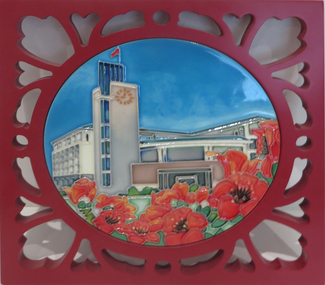
Object - commemorative tile, Commemorative Tile of South China Business College
... Commemorative Tile of South China Business College......south china business school...Glazed commemorative tile of South China Business College, Guangdong University of Foreign Studies. ...Guangdong University of Foreign Studies, South China Business School printed in gold on the back. ...guangdong university of foreign studies south china business school commemorative tile souvenir Guangdong University of Foreign Studies, South China Business School printed in gold on the back. ...Glazed commemorative tile of South China Business College, Guangdong University of Foreign Studies. Surrounded by red wood with shaped cutouts.Guangdong University of Foreign Studies, South China Business School printed in gold on the back. guangdong university of foreign studies, south china business school, commemorative tile, souvenir -
 Bendigo Historical Society Inc.
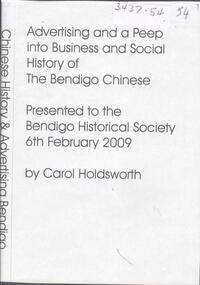
Document - SOCIAL HISTORY OF THE BENDIGO CHINESE, 6 February 2009
... ...Chinese Businesses...Advertising and a peep into Business and Social History of The Bendigo Chinese. Presented to the Bendigo Historical Society 6th February 2009, by Carol Holdsworth....Bendigo Chinese History Chinese Businesses DVD. Advertising and a peep into Business and Social History of The Bendigo Chinese. ...DVD. Advertising and a peep into Business and Social History of The Bendigo Chinese. Presented to the Bendigo Historical Society 6th February 2009, by Carol Holdsworth.bendigo chinese history, chinese businesses -
 Federation University Historical Collection
Book, Carolyn Blackman, China Business: The Rules of the Game, 2000
... China Business: The Rules of the Game...China...business...Red 230 page book on doing business in China....China Business: The Rules of the Game Book Carolyn Blackman Allen & Unwin ...Red 230 page book on doing business in China.non-fictionchina, business, staff publications, federation university staff author -
St Vincent's Hospital Melbourne Archives
Book - Ballarat and district 1920-1940, an oral history: women in the community, 1983
... Daughter of Chinese business and gold trader. The stories of the subjects were transcribed in the way each spoke of their lives. ...Daughter of Chinese business and gold trader. The stories of the subjects were transcribed in the way each spoke of their lives. ...Peter Mansfield, Librarian, oversaw a project interviewing women in Ballarat in 1983. The chapter on Agnes McLean talks about her lifetime dedication to nursing. There were other chapters about Housewife/Mother, Lucas girl, Teacher/Mercy Nun, Refugee/Migrant, Schoolteacher, Charity Worker, Woollen Mill Worker/Spinner. Daughter of Chinese business and gold trader. The stories of the subjects were transcribed in the way each spoke of their lives. Ballarat and District 1920-1940. An oral history. Women in the community. Authors Peter Mansfield, Carole Stoddart, John Murphy, Lloyd Jenkins. There is a photograph of nine professional women seated and standing around a Victorian round table on the front cover. One woman is referencing an open foolscap size book.agnes mclean, trained visiting nurse, ballarat, peter mansfield, carole stoddart, john murphy, lloyd jenkins -
 Eltham District Historical Society Inc
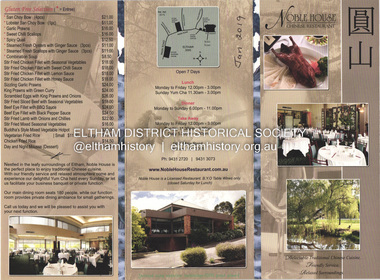
Document - Property Binder, 1453 Main Road, Eltham
... Menu: collected January 2019, Noble House Chinese Restaurant. Business card: Noble House Chinese Restaurant....Menu: collected January 2019, Noble House Chinese Restaurant. Business card: Noble House Chinese Restaurant. ...Newspaper advertisement: Diamond Valley Leader, 17 August 2005, Noble House. Menu: collected January 2019, Noble House Chinese Restaurant. Business card: Noble House Chinese Restaurant.main road, eltham, businesses, noble house chinese restaurant -
 Wodonga & District Historical Society Inc
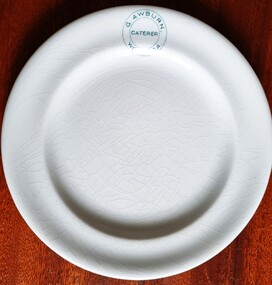
Functional object - G. Awburn Caterer Wodonga Plate
... Their business grew rapidly, as they were one of the world's largest pottery factories by the turn of the 20th century. By 1970, Johnson Bros. obtained the Royal Charter to become the official provider of china for Her Majesty Queen Elizabeth II. ...A round china plate imprinted with business name of G. Awburn Wodonga and Johnson Brothers on the back of the plate....businesses On front: G. Awburn Caterer Wodonga On back: Hotelware / Johnson Bros/ England A round china plate imprinted with business name of G. ...Mr George Awburn Jr. arrived in Wodonga West with his parents by bullock dray when he was aged six years old. As a young man he went to Melbourne where he worked with the Melbourne Tramway and Omnibus Company. He drove the first through tram from Abbotsford to Balaclava. On he return to Wodonga, Mr. Awburn opened a bakery and grocery business in Sydney St., Wodonga which he conducted up till the time of his death in 1946. He was active in community affairs in roles including being a foundation member of the Library Committee, a committeeman of the Town Band and football club, a member of the Hibernian Lodge and an ardent worker for the Roman Catholic Church. Johnson Bros. was founded by two brothers named Alfred and Frederick who purchased a pottery factory in Hanley, England, in 1883. They were grandsons of a renowned English potter, Alfred Meakin. They were later joined in the business by their brothers Henry and Robert. Their business grew rapidly, as they were one of the world's largest pottery factories by the turn of the 20th century. By 1970, Johnson Bros. obtained the Royal Charter to become the official provider of china for Her Majesty Queen Elizabeth II. More than 1,300 patterns have been created throughout Johnson Brothers' history. Due to their growing success, manufacturing plants were established overseas including the establishment of a tableware factory, Johnson Brothers Australia in 1957 in Croydon, Victoria operated through a company known as Sovereign Pottery Ltd. Due to rising competition, Johnson Brothers became part of the Wedgewood Group in 1968. In 2015, following the acquisition of Wedgewood by Finnish company Fiskars, the Johnson Brothers branding was discontinued. The trademark on this bowl was used by Johnson Brothers between 1913 and 1942.This item originates from a well-known and respected Wodonga business.A round china plate imprinted with business name of G. Awburn Wodonga and Johnson Brothers on the back of the plate.On front: G. Awburn Caterer Wodonga On back: Hotelware / Johnson Bros/ Englandawburn family, wodonga businesses -
 City of Moorabbin Historical Society (Operating the Box Cottage Museum)
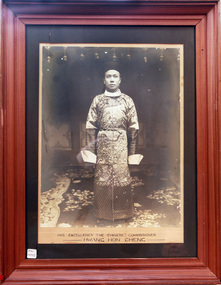
Photograph - Chinese Commissioner, Hwang Hong Cheng,1906, 1902
... His Excellency, Hwang Hon Cheng, from Peking, China, visited Australia from 1906 -1907 as Chinese Commissioner in response to an urgent petition from well respected Chinese business leaders, The 1906 Petition was sent to the Chinese Ambassador in Britain requesting the appointment of a Chinese Consular Representative in Australia to ease the escalating Discrimination and address the Immigration Restrictions in Australia. ...His Excellency, Hwang Hon Cheng, from Peking, China, visited Australia from 1906 -1907 as Chinese Commissioner in response to an urgent petition from well respected Chinese business leaders, The 1906 Petition was sent to the Chinese Ambassador in Britain requesting the appointment of a Chinese Consular Representative in Australia to ease the escalating Discrimination and address the Immigration Restrictions in Australia. ...His Excellency, Hwang Hon Cheng, from Peking, China, visited Australia from 1906 -1907 as Chinese Commissioner in response to an urgent petition from well respected Chinese business leaders, The 1906 Petition was sent to the Chinese Ambassador in Britain requesting the appointment of a Chinese Consular Representative in Australia to ease the escalating Discrimination and address the Immigration Restrictions in Australia. Hwang Hon Cheng visited Brisbane, Sydney, Melbourne , Adelaide and Hobart and after reviewing his recommendations Britain agreed to the appointment of the first Chinese Consul-General to Australia. In 1908 Mr Leong Lan Fun, Taotal of Swatow was appointed Consul-General for the Commonwealth with his headquarters in Melbourne. Animosity, suspicion and misunderstanding had existed between Chinese and European settlers since the Gold Rush of 1850’s. Language, customs, frugality and mostly their ability to obtain profit from crops seen as uneconomical by Europeans eg parsley, garlic and salad vegetables. Many of the Chinese workers did not purchase land instead their main aim was to obtain enough money for their family and return to China. There were a few still managing market gardens around East Bentleigh until the 1950’s, by which time they were highly regarded by the general community. A large photograph of His Excellency the Chinese Commissioner , Hwang Hong Cheng, in a wooden frame c1906His Excellency the Chinese Commissioner / Hwang Hong Cheng, moorabbin, bentleigh, ormond, brighton, gold rush, chinese immigration, chinese market gardeners, markets, cheltenham, cabinet makers, early settlers, pioneers, market gardeners, , hwang hon cheng, leong lan fun, peking china, melbourne -
 Federation University Historical Collection
Article - Article - Women, University of Ballarat: Women of Note; Carolyn Blackman, Lecturer in Chinese Language, c1992 - 1999
... ...australia china business council...In 1976 Carolyn Blackman set up Chinese language and studies at Melbourne Grammar School. Carolyn was appointed Director of the Centre for International Business at UB, and served on the Victorian Executive of the Australia China Business Council. ...In 1976 Carolyn Blackman set up Chinese language and studies at Melbourne Grammar School. Carolyn was appointed Director of the Centre for International Business at UB, and served on the Victorian Executive of the Australia China Business Council. ...Carolyn Blackman took up an appointment to teach Chinese at the University of Ballarat (UB) c1992. During her time at UB she developed, coordinated and taught Chinese language and associated Asian studies. She was the Director of Asian Studies Unit, University of Ballarat. Prior to this Carolyn was a broadcaster in Chinese at Radio Australia. She moved to Singapore in 1968 and worked in broadcasts of Radio Singapura. She was also a foreign correspondent in Taiwan. In 1976 Carolyn Blackman set up Chinese language and studies at Melbourne Grammar School. Carolyn was appointed Director of the Centre for International Business at UB, and served on the Victorian Executive of the Australia China Business Council. Ballarat and Queen's Anglican Grammar School have The Carolyn Blackman Award for International Understanding which is presented each year.women of note, carolyn blackman, university of ballarat, c1992 - 1999, chinese language, teacher, asian studies, director of asian studies unit, broadcaster chinese, radio australia, singapore, foreign correspondent, taiwan, chinese studies at melbourne grammar, international business at ub, australia china business council, ballarat and queen's grammar school, carolyn blackman award, international understanding -
 Warrnambool and District Historical Society Inc.
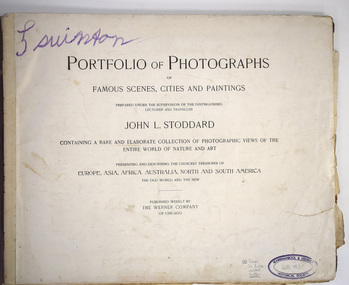
Book - Book of photographs, John Stoddard, Portfolio of Photographs of Famous Scenes, Cities and Paintings, c.1900
... William and Ann Swinton migrated to Australia in 1854 and in 1865 opened a store in Timor Street, Warrnambool selling groceries, hardware, glassware and china. The business over the years diversified and expanded into several nearby locations. ...William and Ann Swinton migrated to Australia in 1854 and in 1865 opened a store in Timor Street, Warrnambool selling groceries, hardware, glassware and china. The business over the years diversified and expanded into several nearby locations. ...A book with a collection of world wide photographs owned by a member of the Swinton familyThis is a book containing printed text and black and white photographs. There are several loose pages at the back. The book has lost its cover and has been inserted into a folder not relevant to the contents.non-fictionA book with a collection of world wide photographs owned by a member of the Swinton family world travel, swinton family of warrnambool -
Warrnambool and District Historical Society Inc.
Plate, City of Warrnambool, Late 20th century
... It was made by Westminster China which was a business established by Stanley Rogers and Sons Limited in Cheltenham, Melbourne in 1954. ...It was made by Westminster China which was a business established by Stanley Rogers and Sons Limited in Cheltenham, Melbourne in 1954. ...This plate would have been part of a crockery set used by the Warrnambool City Council at civic functions and receptions. It probably dates from the late 20th century. It was made by Westminster China which was a business established by Stanley Rogers and Sons Limited in Cheltenham, Melbourne in 1954. In 1977 the business was moved to Sandringham, Melbourne and by the 1990s it was mainly producing items for the hospitality sector. Warrnambool became a Municipality in 1865, a Borough in 1863, a Town in 1883 and a City in 1918. The seal and motto, ‘By These We Flourish’ were designed and drafted by John Macdonald, an original member of the Municipal Council in 1856 and the first Head Master of Warrnambool’s National School in 1850. This plate is of interest as one of a set used by the Warrnambool City Council in the late 20th century. This is a white china plate, slightly bowl-shaped, with a gold strip around the rim. The gold is partly fading. The plate has the City of Warrnambool crest in blue and yellow on one outer edge of the plate. ‘City of Warrnambool Victoria’ ‘By These We Flourish’ warrnambool city council, history of warrnambool -
 Warrnambool and District Historical Society Inc.
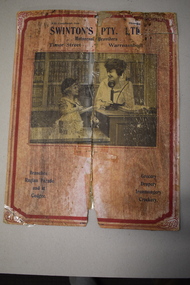
Advertising, Swintons Pty Ltd, Late 1920s
... business of Swintons Pty Ltd. William and Ann Swinton migrated to Australia in 1854 and for a decade William Swinton worked as a builder and carpenter in the Warrnambool area. In 1865 he opened a store in Timor Street, Warrnambool, selling groceries, hardware, glassware and china. ...business of Swintons Pty Ltd. William and Ann Swinton migrated to Australia in 1854 and for a decade William Swinton worked as a builder and carpenter in the Warrnambool area. In 1865 he opened a store in Timor Street, Warrnambool, selling groceries, hardware, glassware and china. ...This advertising card comes from the Warrnambool business of Swintons Pty Ltd. William and Ann Swinton migrated to Australia in 1854 and for a decade William Swinton worked as a builder and carpenter in the Warrnambool area. In 1865 he opened a store in Timor Street, Warrnambool, selling groceries, hardware, glassware and china. By 1888 the business was known as William Swinton and Sons. Branch stores were opened in Cudgee, Nullawarre, Wangoom, West Warrnambool and South Warrnambool. After William Swinton died in 1901 his son Robert became the first managing director of Swintons Pty Ltd. In 1934 the business split with George Swinton and Sons selling furnishings, clothing and glassware and Swintons Pty Ltd selling seeds, produce and hardware. Today the Swinton family still operates a furniture and bedding store in Timor Street. This card is of interest as it is a memento of the Warrnambool business of Swinton Pty Ltd. The current Swinton business in Timor Street is the oldest family business in Warrnambool and with the name Swinton associated with Timor Street businesses for over 150 years, it is amongst the oldest family businesses in Australia. This is a piece of cardboard torn in half but joined together with adhesive tape. The cardboard originally had a pink or white background but it is now very stained. The card has a red border with ornamental corners and a black and white photograph of a woman using a telephone and a young girl. The card also has dark blue printing. The card has had printing on the back but this is now covered over with a paper backing. ‘Phone 36 With Compliments from Swinton’s Pty Ltd Universal Providers Timor Street Warrnambool’ ‘Branches: Raglan Parade and at Cudgee’ ‘Grocery Drapery Ironmongery Crockery’ swintons pty ltd, warrnambool, history of warrnambool -
 Warrnambool and District Historical Society Inc.
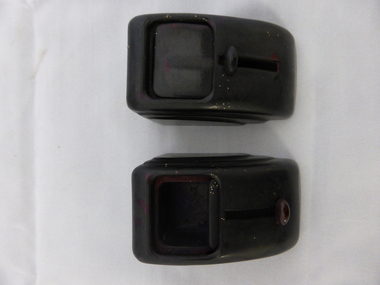
Container, Ink Wells
... business of Swintons Pty Ltd in the mid 20th century. William and Ann Swinton migrated to Australia in 1854 and for a decade William Swinton worked as a builder and carpenter in the Warrnambool area, erecting many buildings, including the Wangoom Presbyterian Church. In 1865 he opened a store in Timor Street, Warrnambool, selling groceries, hardware, glassware and china...business of Swintons Pty Ltd in the mid 20th century. William and Ann Swinton migrated to Australia in 1854 and for a decade William Swinton worked as a builder and carpenter in the Warrnambool area, erecting many buildings, including the Wangoom Presbyterian Church. In 1865 he opened a store in Timor Street, Warrnambool, selling groceries, hardware, glassware and china ...These ink wells have been used in the Warrnambool business of Swintons Pty Ltd in the mid 20th century. William and Ann Swinton migrated to Australia in 1854 and for a decade William Swinton worked as a builder and carpenter in the Warrnambool area, erecting many buildings, including the Wangoom Presbyterian Church. In 1865 he opened a store in Timor Street, Warrnambool, selling groceries, hardware, glassware and china. By 1888 the business was known as William Swinton and Sons. Branch stores were opened in Cudgee, Nullawarre, Wangoom, West Warrnambool and South Warrnambool. After William Swinton died his son became the first managing director of Swintons Pty Ltd. In 1934 the business split, with George Swinton and Sons selling clothing, furnishings and glassware and Swintons Pty Ltd selling produce, seeds and hardware. Today the Swinton family still operates a store in Timor Street, selling furniture and bedding. These ink wells are of interest as examples of the office equipment used by the firm of Swintons Pty Ltd in the mid 20th century. The current Swinton store in Timor Street is the oldest family business in Warrnambool and, with the name Swinton associated with businesses in Timor Street, it is amongst the oldest family businesses in Australia. These are two black Bakelite ink wells. They have a rectangular-shaped base with a curved top with a rectangular-shaped container at the top for holding ink. The ink container has a sliding top which is worked by means of a small mechanism or button sliding up and down in a slot. swinton family, warrnambool, history of warrnambool -
 Warrnambool and District Historical Society Inc.
Book, Swintons Stock book 1869, 1860s
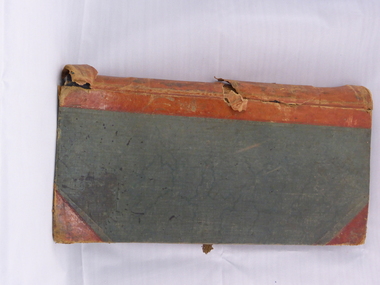
... In 1865 he opened a store in Timor Street, Warrnambool selling groceries, glassware and china. In 1888 the business was known as William Swinton and Sons. ...In 1865 he opened a store in Timor Street, Warrnambool selling groceries, glassware and china. In 1888 the business was known as William Swinton and Sons. ...This ledger is a Warrnambool Swintons Store stock book and contains the sales of stock from September 1869 to an unknown date (perhaps to the end of 1870) and entries for 1871, 1872 and 1873, 1889, the 1890s and some dates early in the 20th century. William and Ann Swinton migrated to Australia in 1854 and for a decade William Swinton worked as a builder and carpenter in the Warrnambool area, erecting many buildings, including the Wangoom Presbyterian Church. In 1865 he opened a store in Timor Street, Warrnambool selling groceries, glassware and china. In 1888 the business was known as William Swinton and Sons. Branch shops were opened in Cudgee, Nullawarre, Wangoom, South Warrnambool and West Warrnambool. When William died his son Robert became the first managing director of Swintons Pty Ltd. In 1934 the business split in two with George Swinton and Sons selling furnishings, clothing and glassware and Swintons Pty Ltd selling seeds, hardware and produce. Today the Swinton family still operates a furniture and bedding store in Timor Street. This ledger is very important as an early memento of the Swinton Stores in Warrnambool. It gives details of sales in the 19th century and has material relating to the assets of the founder of the business, William Swinton at the time of his death. It is of great interest to researchers. The current family business in Timor Street Warrnambool is the oldest family business in Warrnambool and, with the Swinton name associated with businesses in Timor Street for 152 years, is among the oldest family businesses in Australia. This is a dark green hard cover ledger with light brown leather bindings on the spine and cover edges. There is gold lettering on the spine. The cover is stained and the leather is torn and partly detached in places. The insides of the cover have a blue and white mottled patterning. The pages are blue with printed red lines. The entries are handwritten in black ink. There are four loose pages and two pieces of a plant dried and preserved between two pages. ‘Day Book’ ‘Stock Book Warrnambool September 2nd 1869’ swinton family, warrnambool -
 Warrnambool and District Historical Society Inc.
Leaflet, Kaye & Son, Printers, Swintons, Mid 20th century
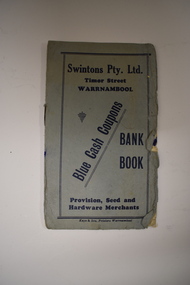
... business, Swintons Pty Ltd. It was used to insert stamps given by the firm when goods were purchased. When the pages were filled with 200 stamps the owner was given two shillings and sixpence in cash. It was a reward to the regular customer. William and Ann Swinton migrated to Australia in 1854 and for a decade William Swinton worked as a builder and carpenter in the Warrnambool area. In 1865 he opened a store in Timor Street, Warrnambool selling groceries, hardware, glassware and china...business, Swintons Pty Ltd. It was used to insert stamps given by the firm when goods were purchased. When the pages were filled with 200 stamps the owner was given two shillings and sixpence in cash. It was a reward to the regular customer. William and Ann Swinton migrated to Australia in 1854 and for a decade William Swinton worked as a builder and carpenter in the Warrnambool area. In 1865 he opened a store in Timor Street, Warrnambool selling groceries, hardware, glassware and china ...This leaflet was a promotion tool of the Warrnambool business, Swintons Pty Ltd. It was used to insert stamps given by the firm when goods were purchased. When the pages were filled with 200 stamps the owner was given two shillings and sixpence in cash. It was a reward to the regular customer. William and Ann Swinton migrated to Australia in 1854 and for a decade William Swinton worked as a builder and carpenter in the Warrnambool area. In 1865 he opened a store in Timor Street, Warrnambool selling groceries, hardware, glassware and china. By 1888 the business was known as William Swinton and Sons. Branch stores were opened in Cudgee, Nullawarre, Wangoom, West Warrnambool and South Warrnambool. After William Swinton’s death, his son, Robert, became the first managing director of Swintons Pty Ltd. In 1934 the business split, with George Swinton and Sons selling furnishings, clothing and glassware and Swintons Pty Ltd selling groceries, seeds, produce and hardware. Today the Swinton family still operates a furniture and bedding store in Timor Street. This leaflet is of interest as an example of the advertising practices carried out by the firm of Swintons Pty Ltd, an important business in Warrnambool for many years. The current Swinton business in Timor Street, Warrnambool is the oldest family business in Warrnambool and, with the name Swinton associated with Timor Street businesses for 152years, it is amongst the oldest family businesses in Australia.This is a leaflet with a grey cover and four pages inside. The cover has dark blue printing and the pages have black printing and are ruled into 15 spaces. There are over 100 blue stamps stuck onto the ruled spaces. The cover is tattered at the edges and one stamp is loose.‘Swintons Pty Ltd Timor Street Warrnambool Provision, Seed and Hardware Merchants Blue Cash Coupons Bank Book’ swinton family businesses, warrnambool, history of warrnambool -
 Warrnambool and District Historical Society Inc.
Functional object - Canisters, Cash Carriers from Swintons Store, Early 20th century
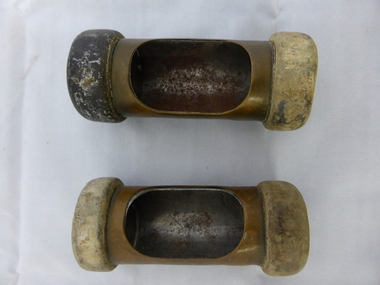
... business of Swintons Pty Ltd. They were manufactured by Lamson of U.S.A. William Lamson of Massachusetts, U.S.A. first patented cash carriers in 1882 and originally the cash balls were carried from counter to cashier via a wire and pulley system. These Swinton cash carriers were carried via pneumatic tubes. William and Ann Swinton migrated to Australia in 1854 and for a decade William Swinton worked as a builder and carpenter in the Warrnambool area, erecting many buildings, including the Wangoom Presbyterian Church. In 1865 he opened a store in Timor Street, Warrnambool, selling groceries, hardware, glassware and china...business of Swintons Pty Ltd. They were manufactured by Lamson of U.S.A. William Lamson of Massachusetts, U.S.A. first patented cash carriers in 1882 and originally the cash balls were carried from counter to cashier via a wire and pulley system. These Swinton cash carriers were carried via pneumatic tubes. William and Ann Swinton migrated to Australia in 1854 and for a decade William Swinton worked as a builder and carpenter in the Warrnambool area, erecting many buildings, including the Wangoom Presbyterian Church. In 1865 he opened a store in Timor Street, Warrnambool, selling groceries, hardware, glassware and china ...These cash carriers were used in the Warrnambool business of Swintons Pty Ltd. They were manufactured by Lamson of U.S.A. William Lamson of Massachusetts, U.S.A. first patented cash carriers in 1882 and originally the cash balls were carried from counter to cashier via a wire and pulley system. These Swinton cash carriers were carried via pneumatic tubes. William and Ann Swinton migrated to Australia in 1854 and for a decade William Swinton worked as a builder and carpenter in the Warrnambool area, erecting many buildings, including the Wangoom Presbyterian Church. In 1865 he opened a store in Timor Street, Warrnambool, selling groceries, hardware, glassware and china. By 1888 the business was known as William Swinton and Sons. Branch stores were opened in Cudgee, Nullawarre, Wangoom, West Warrnambool and South Warrnambool. After William Swinton’s death his son Robert became the first managing director of Swintons Pty Ltd. In 1934 the business split, with George Swinton and Sons selling furnishings, clothing and glassware and Swintons Pty Ltd selling seeds, produce and hardware. Today the Swinton family still operates a furniture and bedding store in Timor Street. These cash carriers are of great interest firstly as a memento of business practices in the past and secondly because they were used in the Warrnambool business of Swintons Pty Ltd. The current Swinton business in Timor Street Warrnambool is the oldest family business in Warrnambool and, with the name Swinton associated with Timor Street businesses for 152 years, it is amongst the oldest family businesses in Australia. These are two cash carriers. They are brass cylinders made with a large opening at the top with an inner lining which can close over the opening. The cylinder has two wooden holders at each end attached to the brass with three metal screws at each end. The brass is somewhat rusted and the wooden ends are worn. These cash carriers were sent from the cash counter in a shop or business to the cashier via pneumatic tubes. ‘Lamson Patent’ ‘RCM/Lamson’ swinton family, warrnambool, history of warrnambool -
 Warrnambool and District Historical Society Inc.
Ledger, Ledger and Correspondence (Swinton), 1930s
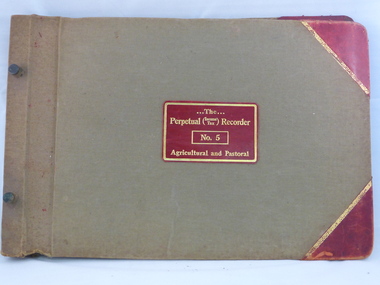
... business firm of Swintons Pty Ltd. These were contained within the ledger referred to above. William and Ann Swinton migrated to Australia in 1854 and William Swinton worked as a builder and carpenter for a decade, erecting many buildings in the Warrnambool area, including the Wangoom Presbyterian Church. In 1865 he opened a shop in Timor Street, Warrnambool selling groceries, glassware and china...business firm of Swintons Pty Ltd. These were contained within the ledger referred to above. William and Ann Swinton migrated to Australia in 1854 and William Swinton worked as a builder and carpenter for a decade, erecting many buildings in the Warrnambool area, including the Wangoom Presbyterian Church. In 1865 he opened a shop in Timor Street, Warrnambool selling groceries, glassware and china ....1 This is a ledger which was originally printed for the recording of agricultural and pastoral sales but has been used by the Warrnambool firm of Swintons Pty Ltd. to record sales of farm products and machinery from 1934 to 1945. .2 These are 13 items of correspondence, receipts, insurance documents, agreements etc. associated with the Warrnambool business firm of Swintons Pty Ltd. These were contained within the ledger referred to above. William and Ann Swinton migrated to Australia in 1854 and William Swinton worked as a builder and carpenter for a decade, erecting many buildings in the Warrnambool area, including the Wangoom Presbyterian Church. In 1865 he opened a shop in Timor Street, Warrnambool selling groceries, glassware and china. In 1888 the business was known as William Swinton and Sons. Branch stores were opened in Wangoom, Cudgee, Nullawarre, West Warrnambool and South Warrnambool. When William died his son Robert became the first managing director of Swintons Pty Ltd. In 1934 the business split in two with George Swinton and Sons selling furnishings, clothing and glassware and Swintons Pty Ltd selling produce, hardware and seeds. Today the Swinton family still operates a furniture and bedding store in Timor Street. This ledger and the accompanying paper material are of considerable importance as they are associated with the Swinton businesses in Warrnambool. The ledger contains lists of customers of the Swinton business in the 1930s and 40s and provides names, addresses and the cost of the product sold. This is very useful to researchers. The current Swinton business in Timor Street is the oldest family business in Warrnambool and, with the Swinton name associated with businesses in Timor Street for 152 years, is among the oldest family businesses in Australia..1 This is a hard cover ledger. It is beige-coloured with red leather edging on the corners and a red and gold label on the front cover. The pages are held in the folder with metal studs. The pages are white with red and blue printed lines and red leather tabs numbering 1 to 9. The entries are handwritten in blue and black ink. The ledger cover is slightly scuffed. .2 These are 13 items of correspondence from the 1930s and 40s. There is both handwritten and printed material. ‘The Perpetual Income Tax Recorder. No 5. Agricultural and Pastoral’. swinton family warrnambool, history of warrnambool -
 Wodonga & District Historical Society Inc
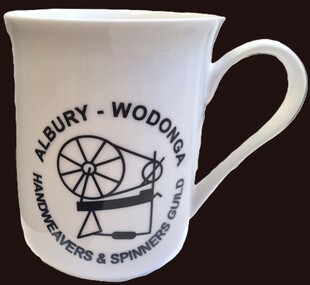
Souvenir - Mug Albury Wodonga Handweavers & Spinners Guild
... From this time Australian Fine China has operated its business from its headquarters in Welshpool, Perth in Western Australia, with all the products now being made overseas....From this time Australian Fine China has operated its business from its headquarters in Welshpool, Perth in Western Australia, with all the products now being made overseas. ...The Albury/Wodonga Handweavers and Spinners Guild was formed on 15th July 1970 at a meeting calling for interested people to attend a meeting, Mrs Reis had migrated from England bringing her spinning wheel and floor loom with her. The Guild was formed with 23 inaugural members. Guild members conducted workshops and demonstrated their work at the Albury Show and other venues. In 1973 a Woolcraft Festival Committee was formed and in 1974 the Guild was affiliated with the National Woolcraft Festival, which was held for many years at the Wool Store (in Albury and later at the Albury Showgrounds. In 1980 the Guild published “The Woolgatherers Handspun Pattern Book” which was very popular and had several reprints. The Albury Wodonga Handweavers and Spinners Guild is still an active organisation in the community more than 50 years after its formation. The Company name Australian Fine China was adopted in 1997. Its products were first produced in 1921 from its factory in Subiaco, Western Australia which opened under the name of Calyx Porcelain and Paint Company. In 1938 it was re-named H. L. Brisbane and Wunderlich Ltd. One of its key brands was Bristile with earthenware items known as Wembley Ware. Bristile was re-introduced in the 1960s with the manufacture of vitrified white crockery. In 1997 the name of Australian Fine China was adopted, and the company made china under this name until the closure of the Subiaco factory in 2006. From this time Australian Fine China has operated its business from its headquarters in Welshpool, Perth in Western Australia, with all the products now being made overseas.This item is significant because it represents a long-standing organisation in the Albury Wodonga Community.A white china mug bearing the outline of a spinning wheel, surrounded by black lettering,Around the spinning wheel ALBURY - Wodonga Handweavers & Spinners Guild Under the base - ARIA Porcelain made in Australia by Australian Fine China DIshwasher & Microwave Safethe albury wodonga handweavers and spinners guild, community groups -
 Flagstaff Hill Maritime Museum and Village
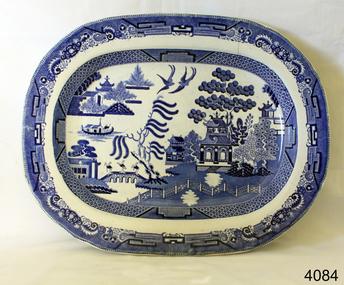
Ceramic - Serving Plate, Edward Challinor, Circa1862-1891
... The partners in Sandyford and Tunstall works are recorded as Edward Challinor Jnr and Charles Challinor Jnr and is presumably they are the sons of the partners of the Fenton pottery business. They produced china of white granite, printed sponged common earthenware for the American, Australian, and other foreign and colonial markets. ...The partners in Sandyford and Tunstall works are recorded as Edward Challinor Jnr and Charles Challinor Jnr and is presumably they are the sons of the partners of the Fenton pottery business. They produced china of white granite, printed sponged common earthenware for the American, Australian, and other foreign and colonial markets. ...The pottery was at Fenton, Stoke on Trent, Staffordshire UK and was established in 1825, by C J & GM Mason, they were succeeded by Mr. Samuel Boyle from whom the works passed into the hands of E & C Challinor, formally E Challinor & Co. Of Sandyford and Tunstall. The partners in Sandyford and Tunstall works are recorded as Edward Challinor Jnr and Charles Challinor Jnr and is presumably they are the sons of the partners of the Fenton pottery business. They produced china of white granite, printed sponged common earthenware for the American, Australian, and other foreign and colonial markets. The main goods produced were tea, coffee, breakfast, dinner, and toilet ceramic sets as well as other earthenware goods. Their pottery marks were the Staffordshire rope knot with or without E & C Challinor or just E C. An early piece of earthenware pottery made in England for the Australian colonial market around the mid to late 19th century.Serving plate white body, smooth rim, and blue oriental designRope knot motif printed on back in blue with letters EC warrnambool, shipwrecked-coast, flagstaff-hill, flagstaff-hill-maritime-museum, shipwreck-coast, flagstaff-hill-maritime-village, earthenware, ceramic, willow pattern, serving plate, e & c challinor, potteries -
 Flagstaff Hill Maritime Museum and Village
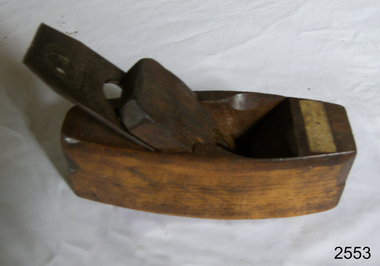
Tool - Wood Working Plane, Mathieson and Son, 1880-1900
... business was commenced in 1835, by James Haworth who was joined by his sons in 1863. Haworth manufacture light and heavy edge tools of all kinds, including a variety of joiners’ tools, hammers, skates, augers. The firm soon was extended and began exporting their products to the USA, Canada, Australia, China...business was commenced in 1835, by James Haworth who was joined by his sons in 1863. Haworth manufacture light and heavy edge tools of all kinds, including a variety of joiners’ tools, hammers, skates, augers. The firm soon was extended and began exporting their products to the USA, Canada, Australia, China ...A Mathieson & Son History: In 1792 John Manners had set up a workshop making woodworking planes at 14 Saracens Lane Glasgow. He also had employed an apprentice Alexander Mathieson (1773-1851). But in the following year at Saracen's Lane, the 1841 census describes Alexander Mathieson as a master plane-maker now at 38 Saracen Lane with his son Thomas Adam working with him as a journeyman plane-maker. Presumably, Alexander must have taken over the premises and business of John Manners. Now that the business had Thomas Adam Mathieson working with his father it gradually grew and became more diversified, and it is recorded at the time by the Post-Office Glasgow Annual Directory that by 1847-1848 Alexander Mathieson was a “plane, brace, bit, auger & edge tool maker.” In 1849 the firm of James & William Stewart at 65 Nicolson Street, Edinburgh was taken over and Thomas was put in charge of the business, trading under the name Thomas A. Mathieson & Co. as plane and edge-tool makers. Thomas's company went on to acquire the Edinburgh edge-tool makers “Charles & Hugh McPherson” and took over their premises in Gilmore Street. In the Edinburgh directory of 1856/7, the business is recorded as being Alexander Mathieson & Son, plane and edge-tool makers at 48 Nicolson Street and Paul's Work, Gilmore Street Edinburgh. The 1851 census Alexander is recorded as working as a tool and plane-maker employing eight men. Later that year Alexander died and his son Thomas took over the business. Under the heading of an edge-tool maker in the 1852/3 Post-Office Glasgow Annual Directory the firm is now listed as Alexander Mathieson & Son, with further entries as "turning-lathe and vice manufacturers". By the early 1850s, the business had moved to 24 Saracen Lane. The directory for 1857/8 records that the firm had moved again only a few years later to East Campbell Street, off the Gallowgate area, and that through further diversification was also manufacturing coopers' and tinmen's tools. The ten-yearly censuses report the firm's growth in 1861 stating that Thomas was a tool manufacturer employing 95 men and 30 boys; in 1871 he had 200 men working for him and in 1881 300 men. By 1899 the firm had been incorporated as Alexander Mathieson & Sons Ltd, even though only Alexander's son Thomas appears ever to have joined the firm so the company was still in his fathers' name. In September 1868 Thomas Mathieson put a notice in the newspapers of the Sheffield & Rotherham Independent and the Sheffield Daily Telegraph stating that his firm had used the trade-mark of a crescent and star "for some time" and that "using or imitating the Mark would be proceeded against for infringement". The firm had acquired its interest in the crescent-and-star mark from the heirs of Charles Pickslay, the Sheffield cutler who had registered it with the Cutlers' Company in 1833 and had died in 1852. The year 1868 seems also to be the one in which the name Saracen Tool Works was first adopted; not only does it figure at the foot of the notice in the Sheffield press, it also makes its first appearance in the firm's entry in the Post-Office Glasgow Annual Directory in the 1868/9 edition. As Thomas Mathieson's business grew, so too did his involvement in local public life and philanthropy. One of the representatives of the third ward on the town council of Glasgow, he became a river bailie in 1868, a magistrate in 1870 and a preceptor of Hutcheson's Hospital in 1878. He had a passion for books and was an "ardent Ruskinian". He served on the committee handling the bequest for the setting up of the Mitchell Library in Glasgow. When he died at Coulter Maynes near Biggar in 1899, he left an estate worth £142,764. Company's later years: Both Thomas's sons, James Harper and Thomas Ogilvie were involved in the continuing life of the firm. James followed in his father's footsteps in becoming a local public figure. He was appointed Deputy Lieutenant of the County of the City of Glasgow and was made a deacon of the Incorporation of the Hammermen of Glasgow in 1919. His brother Thomas Ogilvie was recorded as tool manufacturer and employer in the 1911 census. Thomas Ogilvie's son Thomas Alastair Sutherland Ogilvie Mathieson was born in 1908 took a rather different approach to engineering, however, by becoming a racing driver. In 1947 he wed the French film actress Mila Parély. The firm had won many awards at world fairs for their goods. At the Great Exhibition, London, 1851. Prize medal for joiners' tools in the class of Cutlery & Edge Tools, Great London Exposition, 1862. Prize medal honoris causa. International Exhibition, Melbourne, 1880. Gold medal International Exhibition of Industry, Science and Art, Edinburgh, 1886. Prize medal James Haworth & Sons History: James Haworth and Sons, of Broomspring Works, Bath-street Sheffield were among leading manufacturers of edge tools and joiners tools. The business was commenced in 1835, by James Haworth who was joined by his sons in 1863. Haworth manufacture light and heavy edge tools of all kinds, including a variety of joiners’ tools, hammers, skates, augers. The firm soon was extended and began exporting their products to the USA, Canada, Australia, China, and many other overseas destinations as well as to the home market. They were exhibitors at the London Exhibitions of 1851 and 1862, and Paris in 1855, receiving awards. Haworth was primarily operating from Sheffield. J Haworth & Sons produce goods of a very high class and were also engaged in the manufacture of steel, file, saw, and similar trades. Upon the death of James Haworth, the firm was managed by his four sons James, Samuel, Edwin, and John Haworth. The firm was discontinued in 1913, and its trademark was acquired by Robert Sorby and Sons in 1922.A significant tool made in the late 19th century by a known makers and sought after by collectors of vintage wood working tools.Smoothing Plane Coffin type. 2" stamped on one end and Tertius Keen & Co (plane maker.) Blade has James Haworth Warranted Cast Steel Sheffield (maker of blade only.)flagstaff hill, warrnambool, shipwrecked-coast, flagstaff-hill, flagstaff-hill-maritime-museum, maritime-museum, shipwreck-coast, flagstaff-hill-maritime-village -
 Federation University Historical Collection
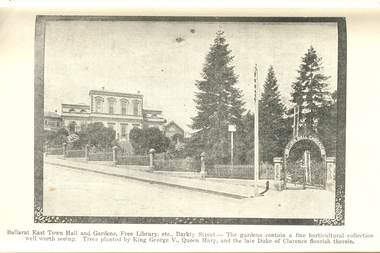
Book, Guide to Ballarat the Beautiful, 1923, 1923
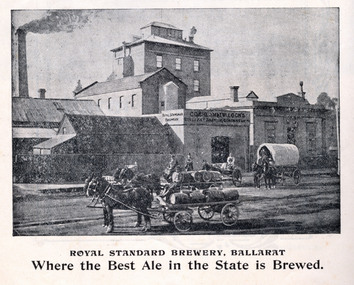
... In 2010 it was used as Cuthberts law firm. ballarat cuthberts ballarat trustees sturt street tram trams ballarat town hall crag's hotel sun foundry eureka aerated waters and brewing co d. lem chinese practioner chinese herbalist hugh v. mckay sunshine harvester gordon brothers central business college george hotel edwards pyrites furnace long's biscuits ballarat eisteddfod george farmer ballarat botanical gardens eureka stockade lake wendouree ballarat school of mines moorabool falls kirks reservoir ballarat post office hepburn lagoon star of the east mine emu river ballarat observatory statues angus' rialto cafe carlyon's hotel clarendon ladies' college j.e, sang ballarat coffee palace stansfield and smith ballaray brewing company phoenix brewery rotal standard brewery john macleod co robert sim and co cobb and co\eagle foundry j.j. goller and co. mt buninyong lookout ballarat town hall ballarat east gardens hot house glass house statuary pavilion new imperial gold mining co., art gallery of ballarat st patrick's college ballarat agricultural high school lake wendouree steamer grass trees at mt clear mount clear lake burrumbeet newlyn reservoir trout lal lal falls grosvenor square netherby ramelli's motor garage buninyong gold obelisk memorial imperial gold mine botanical gardens lily pond and fernery Grey/green soft covered book. ...The image of Ballarat Trustees relates to a building on the corner of Mair and Lydiard Streets. In 2010 it was used as Cuthberts law firm.Grey/green soft covered book. Includes photographs and map. Themes include: Ballarat History pre gold, mining, Eureka Stockade, Lake Wendouree, South Street, Grand National Eisteddfod of Australasia, schools, Black Hill, Lake Burrumbeet, Creswick, Buninyong. Illustrations and advertisement include: Sturt Street,James Smith, Ballarat Town Hall, Ballarat East Town Hall, Rowlands, Ballarat brewing Co., Royal Standard Brewery, steam train, Lake Wendouree, J.S. Vickery & Son, trout, Berry, Anderson & co., Ballarat Botanical Gardens and hot houses, Claxton Memorial Fountain, statues, New Imperial Gold Mine, Art Gallery of Ballarat, St Patrick's College, Ballarat Grammar School, Ballarat School of Mines, Ballarat College, Sunnyside Woollen Mills, Ballarat Agricultural High School, Passenger Steamer on Lake Wendouree, Moorabool Falls, Lal Lal Falls, Grosvenor Square, Netherby, Buninyong, Ballarat Motor Garage.ballarat, cuthberts, ballarat trustees, sturt street, tram, trams, ballarat town hall, crag's hotel, sun foundry, eureka aerated waters and brewing co, d. lem, chinese practioner, chinese herbalist, hugh v. mckay, sunshine harvester, gordon brothers, central business college, george hotel, edwards pyrites furnace, long's biscuits, ballarat eisteddfod, george farmer, ballarat botanical gardens, eureka stockade, lake wendouree, ballarat school of mines, moorabool falls, kirks reservoir, ballarat post office, hepburn lagoon, star of the east mine, emu river, ballarat observatory, statues, angus' rialto cafe, carlyon's hotel, clarendon ladies' college, j.e, sang, ballarat coffee palace, stansfield and smith, ballaray brewing company, phoenix brewery, rotal standard brewery, john macleod co, robert sim and co, cobb and co\eagle foundry, j.j. goller and co., mt buninyong lookout, ballarat town hall ballarat east gardens, hot house, glass house, statuary pavilion new imperial gold mining co.,, art gallery of ballarat, st patrick's college, ballarat agricultural high school, lake wendouree steamer, grass trees at mt clear, mount clear, lake burrumbeet, newlyn reservoir trout, lal lal falls, grosvenor square, netherby, ramelli's motor garage, buninyong gold obelisk, memorial, imperial gold mine, botanical gardens lily pond and fernery -
 Federation University Historical Collection
Book, Powell & Co, Guide to Ballarat the Beautiful, 1906, 1906
... Chinese Doctor and Herbalist, Reid's Ballarat Coffee Palace, Robert Sim & Co Timber Merchants, Cobb & C0 livery and stables Ballarat, Eagle Foundry, Fred A. Reed Tobacconist, Heinz bros butchers, J.J. Goller & Co. Illustrations include: Craig's Royal Hotel, McBride's Boots, John Lavis Cordial Manufacturer, R. Graham & Sons tanners, Lester's hotel, Sun Foundry, Central business...Chinese Doctor and Herbalist, Reid's Ballarat Coffee Palace, Robert Sim & Co Timber Merchants, Cobb & C0 livery and stables Ballarat, Eagle Foundry, Fred A. Reed Tobacconist, Heinz bros butchers, J.J. Goller & Co. Illustrations include: Craig's Royal Hotel, McBride's Boots, John Lavis Cordial Manufacturer, R. Graham & Sons tanners, Lester's hotel, Sun Foundry, Central business ...A book highlighting Ballarat and surrounds for visiting tourists. Green, black and red soft covered book of 50 pages. The book includes many illustrations and advertisements. Themes of the book include: Ballarat and district, Lake Wendouree, Ballarat Botanical Gardens, Statues, gold and mining, Ballarat gold nuggets, Eureka Stockade, Ballarat School of Mines, Hepburn Lagoon, Emu River, race courses, Art gallery of Ballarat Advertisements include: Dr Lem Chinese Practictioner, Eureka Aerated Waters & Brewing Co., Sunshine Harvester, Gordon Bros., Long's biscuits, South Street, Grand National Eisteddfod of Australia, Lake View Hotel, Carlyon's Hotel, Clarendon Ladies' College, J.E. Sang Chinese Doctor and Herbalist, Reid's Ballarat Coffee Palace, Robert Sim & Co Timber Merchants, Cobb & C0 livery and stables Ballarat, Eagle Foundry, Fred A. Reed Tobacconist, Heinz bros butchers, J.J. Goller & Co. Illustrations include: Craig's Royal Hotel, McBride's Boots, John Lavis Cordial Manufacturer, R. Graham & Sons tanners, Lester's hotel, Sun Foundry, Central business College, Edwards Pyrites & Ore Reduction Co., George Farmer, Sturt Street (colour), Lake Wendouree, Ballarat East Town Hall, Lake Burrumbeet, Queen Victoria Statue, Fairy Land, Ballarat Botanical Gardens, Lal Lal Falls, Moorabool Falls, Kirks Dam, Lake Wendouree and paddle boat, Lydiard Street, Bopeep Creek, Star of the East Mine, Peter Lalor Statue, great Equatorial Telescopu at Oddie Observatory (Ballarat Observatory), Boer War monument, Entrance to Art Gallery of Ballarat, interior of Art Gallery of Ballarat, Old Curiosity Shop, Angus Rialto cafe, Ballarat Brewing Co, Royal Standard brwery, Phoenix Brewery Warrenheip, John MacLeod and Companyballarat, ballarat school of mines, buninyong, burrumbeet, cobb and co, eureka brewery, ballarat brewing co, sturt street, m1604, chinese, chinese medicine, d. lem, j.e. sang, brewery, tanners -
Federation University Historical Collection
Book, University of Ballarat Research + Innovation Digest
... Contents include: * Case studies in keeping food safe, Benu Adhikari * technologies that combat climate change - Alberto Boretti *Learning t lead- leading to learn, Neil Trivett * Depression, diabities and motivation, Mirella Di Benedetto * Valuing Lake Wendouree, Julian Lowe * What's in a name, Laura Kostanski * Optimizing Regional & International Research, John Yearwood * Sport, physical activity and health research, Warren Payne * Climate secrets in the sediments, Peter Gell * Injury prevention and saftey promotion research theme, UB Sports injury centre, Caroline Finch, Men's Sheds & other learning places, Barry Golding * New economy, new work, new qualifications, Erica Smith * Cross-cultural communication in a shrinking world, Georgina Tsolidis * Child Protection & family services reform, Angela Murphy * making a difference for older Victorians, Sally Wellard * Making good (and goodly) profits, jackie tuck * Not too much 'ordinary' about Teh Ordinry, Lorraine Sim * Gaming Machines & regional gamblers * Toe nail clippings revel their secrets, Kim Dowling * Magnificently preserved megafaunal trackways in the Victorian volcanic plans, Stephen Carey * A stuttering start for a stunning outcome, Grant Meridith * Supporting patients & their careres, Anthony Love * Out of Africa and beyond, James O'Meara * Taking a hard look to avoid hard knocks, Caroline Finch and Dara Twomey * Skilling people for business success, Andy Smith * Promoting risk awareness in industry, David Borys * researching China's Rise & Rise, Mike Willis *Sex hormones link to heart disease, Fadi Charchar * Human factors in computer security, Paul watters * Are our rivers up the creek, Peter Gell * Women as managers7 entrepreneurs, Glenice Wood * Revisoning values and norms, Jane Mummery * 'Wimmera" - an epic Poem, Homer Rieth * Recycling, consumerism, climate change and art peactice, marie Purtill * Investing in ecologically sustainable development, Jerry Coursisanos * Indigenous peoples of the goldfields, Fred Cahir * Artists install images of sustainability, Jill Orr * addresing disadvantage& inequality with passion, John Smyth * Breaking up insulin haxamers, Mark Myers...Contents include: * Case studies in keeping food safe, Benu Adhikari * technologies that combat climate change - Alberto Boretti *Learning t lead- leading to learn, Neil Trivett * Depression, diabities and motivation, Mirella Di Benedetto * Valuing Lake Wendouree, Julian Lowe * What's in a name, Laura Kostanski * Optimizing Regional & International Research, John Yearwood * Sport, physical activity and health research, Warren Payne * Climate secrets in the sediments, Peter Gell * Injury prevention and saftey promotion research theme, UB Sports injury centre, Caroline Finch, Men's Sheds & other learning places, Barry Golding * New economy, new work, new qualifications, Erica Smith * Cross-cultural communication in a shrinking world, Georgina Tsolidis * Child Protection & family services reform, Angela Murphy * making a difference for older Victorians, Sally Wellard * Making good (and goodly) profits, jackie tuck * Not too much 'ordinary' about Teh Ordinry, Lorraine Sim * Gaming Machines & regional gamblers * Toe nail clippings revel their secrets, Kim Dowling * Magnificently preserved megafaunal trackways in the Victorian volcanic plans, Stephen Carey * A stuttering start for a stunning outcome, Grant Meridith * Supporting patients & their careres, Anthony Love * Out of Africa and beyond, James O'Meara * Taking a hard look to avoid hard knocks, Caroline Finch and Dara Twomey * Skilling people for business success, Andy Smith * Promoting risk awareness in industry, David Borys * researching China's Rise & Rise, Mike Willis *Sex hormones link to heart disease, Fadi Charchar * Human factors in computer security, Paul watters * Are our rivers up the creek, Peter Gell * Women as managers7 entrepreneurs, Glenice Wood * Revisoning values and norms, Jane Mummery * 'Wimmera" - an epic Poem, Homer Rieth * Recycling, consumerism, climate change and art peactice, marie Purtill * Investing in ecologically sustainable development, Jerry Coursisanos * Indigenous peoples of the goldfields, Fred Cahir * Artists install images of sustainability, Jill Orr * addresing disadvantage& inequality with passion, John Smyth * Breaking up insulin haxamers, Mark Myers University of Ballarat Research + Innovation Digest Book Book ...Black, soft covered book of 48 pages outlining research at the University of Ballarat. Contents include: * Case studies in keeping food safe, Benu Adhikari * technologies that combat climate change - Alberto Boretti *Learning t lead- leading to learn, Neil Trivett * Depression, diabities and motivation, Mirella Di Benedetto * Valuing Lake Wendouree, Julian Lowe * What's in a name, Laura Kostanski * Optimizing Regional & International Research, John Yearwood * Sport, physical activity and health research, Warren Payne * Climate secrets in the sediments, Peter Gell * Injury prevention and saftey promotion research theme, UB Sports injury centre, Caroline Finch, Men's Sheds & other learning places, Barry Golding * New economy, new work, new qualifications, Erica Smith * Cross-cultural communication in a shrinking world, Georgina Tsolidis * Child Protection & family services reform, Angela Murphy * making a difference for older Victorians, Sally Wellard * Making good (and goodly) profits, jackie tuck * Not too much 'ordinary' about Teh Ordinry, Lorraine Sim * Gaming Machines & regional gamblers * Toe nail clippings revel their secrets, Kim Dowling * Magnificently preserved megafaunal trackways in the Victorian volcanic plans, Stephen Carey * A stuttering start for a stunning outcome, Grant Meridith * Supporting patients & their careres, Anthony Love * Out of Africa and beyond, James O'Meara * Taking a hard look to avoid hard knocks, Caroline Finch and Dara Twomey * Skilling people for business success, Andy Smith * Promoting risk awareness in industry, David Borys * researching China's Rise & Rise, Mike Willis *Sex hormones link to heart disease, Fadi Charchar * Human factors in computer security, Paul watters * Are our rivers up the creek, Peter Gell * Women as managers7 entrepreneurs, Glenice Wood * Revisoning values and norms, Jane Mummery * 'Wimmera" - an epic Poem, Homer Rieth * Recycling, consumerism, climate change and art peactice, marie Purtill * Investing in ecologically sustainable development, Jerry Coursisanos * Indigenous peoples of the goldfields, Fred Cahir * Artists install images of sustainability, Jill Orr * addresing disadvantage& inequality with passion, John Smyth * Breaking up insulin haxamers, Mark Myersaborigines, mens shed, wimmera, gambling, megafauna, gell, golding, carey, cahir, purtill -
 Federation University Historical Collection
Book - Programme, South Street Eisteddfod Official Guide, 1907, 1907
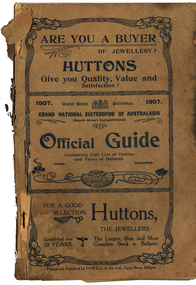
... Lem Chinese Medical Practitioner, Bosisto's Eucalyptus Oil, Ronaldson Bros & Tippett, Unicorn HOtel, Mrs F. Allen Caterer, Coles & Pullum, J.C. Dillon & Co., Surrey Tannery, Coulthard's Ballarat Business...Lem Chinese Medical Practitioner, Bosisto's Eucalyptus Oil, Ronaldson Bros & Tippett, Unicorn HOtel, Mrs F. Allen Caterer, Coles & Pullum, J.C. Dillon & Co., Surrey Tannery, Coulthard's Ballarat Business ...South Street competitions have been held in Ballarat since 1991.Official guide to the 1907 South Street competitions. Images include: Prince of Wales, Lord Northcote, W.D. Thomas, South Street Competition Executive Committee (W.H. Pearson, W.H. Chandler, A. Prichard, W.H. Richards, W.D. Hill, Col. Williams, W.D. Thomas, F. Besemeres, F.J. Martell, J.T. Morris. F.J. Williams, R. Maddern, R.J. Gribble), Sir John Madden, Lord Tennyson, W.D. Hill, Frederick Bevan, Ballarat (Sturt Street), Lake Wendouree (Yachts), J.W. Beswick, Lawrence Campbell, City of Ballarat Mayor and Councillor (Mayor Brawn, E. Williams, E. Morey. Cr Brokenshire, J. Whykes, J.M. Barker, G. Crocker, W.D. Hill, R. Pearse, T. Hollway), Ballarat East Mayor and Councillors (J. Gent, Cr Glendenning, J.N. Dunn, I. Pearce, C. Bunting, A. Levy, J. Ritchie, J. McNeil, A. McKenzie, Cr Penhalluriak), Sturt Street Looking West, Old Curiosity House, Entrance to the Ballarat Fine Art Gallery, Interior of the Ballarat Fine Art Gallery, Ballarat East Town Hall and Gardens, Lake Wendouree Ferry, W.E. Swenson, S.B. Swenson, J.G.M. Swenson, Rev. T. Flynn, Edwards' Pyrites, Lestor's Hotel, Sunshine Sheild, W to W Shield, Frank Herman, W.F. Coultman, Marks' Trophy, Lighthouse Port Fairy, R. Correll Music Seller, James Smith, Isaac Pitman, Arthur Brumfield, Hugh Leschen, John Robson, St Augustine's Band Geelong, Moorabool Falls, Kirks Dam, Ballarat Choral Society, Alfred Deakin, James Long, Hugh McKay Advertisements include: Huttons the Jewellers, Sam Jamieson, Sun Foundry, City Saw Mills, Blomeley Bros Iron and Brass Founders, G. Bongiorno- Railway Fruit Palace, Henry Brind & Co., Andrew Cant, Harrison's Foundry, Umbrella and Sunshade Emporium, Ballarat City Baths, Ballarat Coffee Palace, Irwin's Provincial Hotel, Victa Studio; D. Lem Chinese Medical Practitioner, Bosisto's Eucalyptus Oil, Ronaldson Bros & Tippett, Unicorn HOtel, Mrs F. Allen Caterer, Coles & Pullum, J.C. Dillon & Co., Surrey Tannery, Coulthard's Ballarat Business College, George Farmer, MrBride's Boots, L.J. Austin, Dyason's, Ballarat Brewing Company, Phoenix Brewery, Royal Standard Brewery, Edwards' Pyrites, Lestor's Hotel, Robson's College of Music, James A. Gear, Williams Shoemen, Tekardo Brothers, Powell & Co.south street competitions, eisteddfod, chinese herbalist, south street, r.b. lemmon, g. bongiorno, w.d. thomas, john madden, lord tennyson, w.d. hill, frederick bevan, j.w. beswick, lawrence campbell, boer war memorial, queen victoria statue, curiosity shop, m.b. john foundry, ballarat east town hall and gardens, sunshine shield, hugh victor mckay, w to w shield, w.j. coltman, frank herman, j. hutton-jones, t. downer, j. marks, hutton and co trophy, marks trophy, hugh leschen, john robson, st augustine's band, geelong, downer trophy, trekardo brothers, moorabool falls, kirks dam, ballarat choral society, alfred deakin, challenge cup, james long, grand national eisteddfod of australasia, ballarat east gardens, ballarat east town hall -
 Flagstaff Hill Maritime Museum and Village
Ceramic - Dish, Johnson Bros, Circa 1883 (very early Mark)
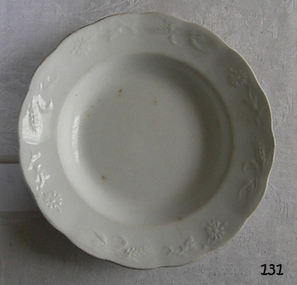
... china, but the durability of ironstone ware. This kind of tableware soon became very popular in the United States due to its durability and low cost. In 1889, the Hanley pottery was opened, later the Alexander pottery, and in 1891 the Imperial Works Pottery. In 1896, the Trent Sanitary Works was opened for the production of non-tableware products, and Alfred Johnson left the business...china, but the durability of ironstone ware. This kind of tableware soon became very popular in the United States due to its durability and low cost. In 1889, the Hanley pottery was opened, later the Alexander pottery, and in 1891 the Imperial Works Pottery. In 1896, the Trent Sanitary Works was opened for the production of non-tableware products, and Alfred Johnson left the business ...Johnson Brothers were a British tableware manufacturer and exporter that was noted for its early introduction of "semi-porcelain" tableware. It was among the most successful of the Staffordshire potteries which produced tableware, much of it exported from the 1890s through the 1960s. They were also important manufacturers of large bathroom ceramics. The company was founded in 1883, but from 1968 to 2015 it operated as a part of the Wedgwood Group. However, after the Wedgwood Group was acquired by Fiskars in 2015, the production of Johnson Brothers was discontinued. The company's name derives from the names of the company's founders. The four original "Johnson Brothers" were Alfred, Frederick, Henry, and Robert. Their father married the daughter of a master potter, Alfred Meakin. In 1883, Alfred and Frederick Johnson began production at defunct pottery, known as the Charles Street Works, that they had purchased at a bankruptcy sale in Hanley, Stoke-on-Trent. At first, they specialised in the manufacture of durable earthenware, which they called "White Granite". The success of this venture led to rapid expansion. In 1888, the Rev. Henry Johnson joined them, followed ten years later by a fourth brother, Robert Johnson. Having established a solid reputation producing basic "whiteware", the company developed a product known as "semi-porcelain", a range of pottery that had the characteristics of fine china, but the durability of ironstone ware. This kind of tableware soon became very popular in the United States due to its durability and low cost. In 1889, the Hanley pottery was opened, later the Alexander pottery, and in 1891 the Imperial Works Pottery. In 1896, the Trent Sanitary Works was opened for the production of non-tableware products, and Alfred Johnson left the business to establish his pottery. By 1898, Robert Johnson had relocated to New York City to manage Johnson Brothers' rapid expansion into the North American market. An item that gives a snapshot into the emerging market for tableware that was reasonably priced and serviceable. The company produced "whiteware" but the innervation of the pottery line called semi-porcelain changed the industry. This allowed potteries to produce fashionable pottery items that were affordable to all social classes of the time. Bowl white ceramic decorative with floral decoration around lip. On base, "Royal Ironside China, Johnson Bros England" & crest of lion and unicorn flagstaff hill, warrnambool, shipwrecked coast, flagstaff hill maritime museum, flagstaff hill maritime village, great ocean road, bowl, china bowl, lion and unicorn crest, table ware, kitchen ware, white ware, johnson brothers -
 Flagstaff Hill Maritime Museum and Village
Tool - Angular Bit Stock extension, 1897-1922
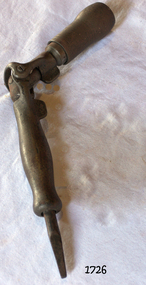
... business to the newly created Millers Falls Tool Co. The company was head quartered in Alpha, New Jersey. Since 2002 the company trademark has belonged to Hangzhou Great Star Industrial Co., Ltd, of Hangzhou, China....business to the newly created Millers Falls Tool Co. The company was head quartered in Alpha, New Jersey. Since 2002 the company trademark has belonged to Hangzhou Great Star Industrial Co., Ltd, of Hangzhou, China. ...Millers Falls Co. is a tool manufacturing company originally based in Millers Falls, Massachusetts. It was established in Greenfield, Massachusetts in 1868 as Gunn & Amidon by Levi J. Gunn and Charles H. Amidon. Gunn and Amidon, along with a third partner, Henry L. Pratt built a factory in the north of Greenfield. After the Greenfield factory burned down, the company was reorganized as the Millers Falls Manufacturing Co. It merged with Backus Vise Co. in 1872 to form the Millers Falls Co. In 1931 Millers Falls tools purchased the majority of the shares of Goodell-Pratt tools and merged with that manufacturer in 1932.In 1962 the company was acquired by Ingersoll Rand. In 1982, Ingersoll Rand sold the Millers Falls business to the newly created Millers Falls Tool Co. The company was head quartered in Alpha, New Jersey. Since 2002 the company trademark has belonged to Hangzhou Great Star Industrial Co., Ltd, of Hangzhou, China.An interesting an unusual tool made by the Millers Falls Tool company that continued to be featured in it’s catalogue up and till 1922. The tool was manufactured from 1897 until this date and is sought out by collectors of vintage tools.Universal Angular hand operated bit stock with spring type alligator jaws, main casting is Japanned bright parts are nickel plated item used with a bit & brace as an extension or angular borer. Millers Falls Co. USA Model 109flagstaff hill, warrnambool, flagstaff-hill, flagstaff-hill-maritime-museum, maritime-museum, shipwreck-coast, flagstaff-hill-maritime-village, tools, screw driver, angular hand operated driver, tool accessory -
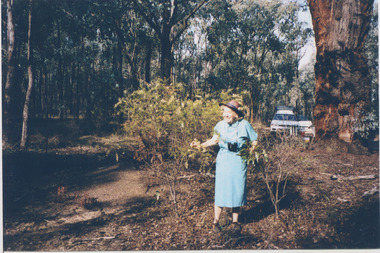 The Beechworth Burke Museum
Audio - Oral History, Mrs Frances Gladstone, 31st March 2000
... business, and was well known for writing letters for the miners to send to their families. Alfred also travelled to Beechworth with his sister, who was a trained nurse and helped establish a hospital for the goldfields. Frances remembers her father saying the Chinese...business, and was well known for writing letters for the miners to send to their families. Alfred also travelled to Beechworth with his sister, who was a trained nurse and helped establish a hospital for the goldfields. Frances remembers her father saying the Chinese ...Frances Gertrude Gladstone was born on the 18th of September 1919 to Arthur George Ladson and Gertrude Hunrick Irving. France's grandfather, Alfred Ladson, came Beechworth from Norfolk, England, during the gold rush. Alfred had a grocery business, and was well known for writing letters for the miners to send to their families. Alfred also travelled to Beechworth with his sister, who was a trained nurse and helped establish a hospital for the goldfields. Frances remembers her father saying the Chinese miners were not allowed to bring their families to the goldfields, hence there were no Chinese children in schools around Beechworth. Frances was an avid botanist, and wrote a book called 'The Little Huntsman', which she wrote while watching her husband gold mining. This oral history recording was part of a project conducted by Jennifer Williams in the year 2000 to capture the everyday life and struggles in Beechworth during the twentieth century. This project involved recording seventy oral histories on cassette tapes of local Beechworth residents which were then published in a book titled: Listen to what they say: voices of twentieth century Beechworth. These cassette tapes were digitised in July 2021 with funds made available by the Friends of the Burke.Frances Gladstone's story is significant, as she remembered important information about Chinese miners in the gold rush, explained the role of women in the 20th century in Beechworth, and the history of the hospitals in the region. This is a digital copy of a recording that was originally captured on a cassette tape. The cassette tape is black with a horizontal white strip and is currently stored in a clear flat plastic rectangular container. It holds up 40 minutes of recordings on each side.listen to what they say, beechworth, oral history, burke museum, botanist, chinese miners, goldmining, gladstone -
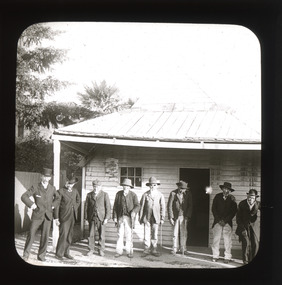 The Beechworth Burke Museum
Photograph - Lantern Slide, c1900
... This image shows six older Chinese men standing in a row with two younger non-Chinese men outside a small wooden business or official building in the Beechworth region, circa 1900. ...This image shows six older Chinese men standing in a row with two younger non-Chinese men outside a small wooden business or official building in the Beechworth region, circa 1900. ...This image shows six older Chinese men standing in a row with two younger non-Chinese men outside a small wooden business or official building in the Beechworth region, circa 1900. The two non-Chinese men are wearing clothes of the period that indicate relative prosperity (such as three piece suits, top hats, and a pocket handkerchief), whereas most of the Chinese men are wearing Western-style working clothes of the era. One Chinese man at the far right of the image is wearing similar garments to the non-Chinese men, including a bowler hat and longer, more tailored suit jacket. Chinese miners were a significant cultural group in Beechworth's gold rush period. Carole Woods' history of Beechworth, 'A Titan's Field', details that there were approximately 60 Chinese people in the area in 1855, more than 1000 in 1856 and 4700 (a quarter of the population) in 1857, despite the introduction in 1855 of official policies such as additional taxes formulated by the Victorian Government to limit access by Chinese immigrants. Most Chinese miners in the region came from southern China and had formerly worked as merchants, mechanics, farmers and shop-keepers. Chinese people were subjected to a 'protectorate' system, ostensibly to minimise the potential for conflict with other groups; this system required Chinese people to live in designated 'hygienic' camps with paid Chinese headmen who supervised the village and enforced the protectorate's rules. Chinese people were required to purchase an annual protection ticket to fund this system. The protectorate system was abolished in 1861, before this image was taken in approximately 1900, but it may still provide insight into social stratification or relationships between and within cultural groups in Beechworth resulting from such practices. Lantern slides, sometimes called 'magic lantern' slides, are glass plates on which an image has been secured for the purpose of projection. Glass slides were etched or hand-painted for this purpose from the Eighteenth Century but the process became more popular and accessible to the public with the development of photographic-emulsion slides used with a 'Magic Lantern' device in the mid-Nineteenth Century. Photographic lantern slides comprise a double-negative emulsion layer (forming a positive image) between thin glass plates that are bound together. A number of processes existed to form and bind the emulsion layer to the base plate, including the albumen, wet plate collodion, gelatine dry plate and Woodburytype techniques. Lantern slides and magic lantern technologies are seen as foundational precursors to the development of modern photography and film-making techniques.This glass slide is significant because it provides insight into Beechworth's cultural and social relationships in the early Twentieth Century, in particular the experiences of Chinese miners. It is also an example of an early photographic and film-making technology in use in regional Victoria in the time period.Thin translucent sheet of glass with a circular image printed on the front and framed in a black backing. It is held together by metals strips to secure the edges of the slide.burke museum, beechworth, lantern slide, slide, glass slide, plate, burke museum collection, photograph, monochrome, magic lantern, indigo shire, north-east victoria, nineteenth century, 1900s, twentieth century, emulsion slides, chinese, chinese miners, protectorate system, protection licence, immigration, racism, classism, social groups, cultural groups, taxes, hygiene camps -
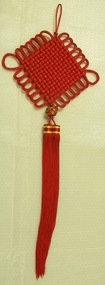 Mission to Seafarers Victoria
Decorative object - Knot, Chinese, 2012
... The red Chinese knot is a particular kind of knot unique to China, usually a gift as a symbol of good fortune for a home, a business or an organisation and the one strand ties people together. ...The red Chinese knot is a particular kind of knot unique to China, usually a gift as a symbol of good fortune for a home, a business or an organisation and the one strand ties people together. ...Often given at Chinese New Year, it was gifted to the Mission in 2012 by Ren Ban of the ship ‘Theresa’ from Micronesia. The red Chinese knot is a particular kind of knot unique to China, usually a gift as a symbol of good fortune for a home, a business or an organisation and the one strand ties people together. The object was presented to acknowledge the work done by the Mission for the seafarers of the world. Red and gold Chinese good fortune symbol made of synthetic, silk-like material with woven diamond hanging section and a long double hanging tassel with gold trim .symbol, ms theresa, seafarer gifts, chinese knot, chinese tassel, pan chang knot, red, handicraft -
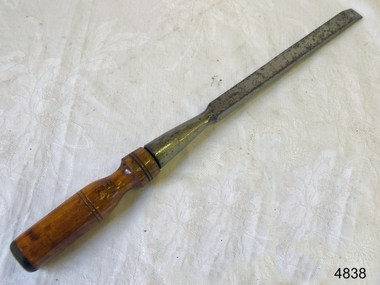 Flagstaff Hill Maritime Museum and Village
Tool - Chisel, 1940-1962
... businesses in Sheffield. The Robert Marples firm disappeared early in the 20th century. After several changes in the company's ownership tools are now made under the Ridgway name but in China....businesses in Sheffield. The Robert Marples firm disappeared early in the 20th century. After several changes in the company's ownership tools are now made under the Ridgway name but in China. ...William Marples junior joined his father's joinery making business in 1821. In 1860 William's sons joined him and the firm became William Marples and sons. Over the years they acquired John Moseley & Sons a London plane maker and Thomas Ibbotson & Co a Sheffield edge tool maker. Growing to become the most prolific and best known Sheffield tool maker. Their large factory was known as the Hibernia Works. Their trademark was a shamrock that appeared on some of their tools, in 1961 they had about 400 employees. In 1962 the record Tool Company and William Ridgway acquired a fifty percent interest in the company and in 1972 the companies merged with several others to form Ridgway Tools Ltd. After 116 years at its Hibernia Works, the company was moved to Dronfield. A 1982 takeover by A G Bahco of Sweden was short-lived and in 1985 Record Ridgway returned to British ownership first as Record Marples Woodworking Tools Ltd. In 1988 then as Record Holdings PLC in 1993. In 1998 the company accepted a bid from American Tool Corporation, subsequently trading as Record Irwin. The Irwin company itself was acquired by Newell Rubbermaid in 2002 and renamed Irwin Industrial Tool Co. Both the Marples and Record names were re-branded "Irwin" However the name has since been resurrected as Irwin/Marples and applied to wood chisels and table saw blades now made at their new facility in Udine, Italy. As a footnote, William Marples was the uncle of Robert Marples and Joseph Marples, both of whom established competing tool making businesses in Sheffield. The Robert Marples firm disappeared early in the 20th century. After several changes in the company's ownership tools are now made under the Ridgway name but in China.A tool made by a company with a long family history of tool making in Sheffield England, with a member of the Marples family, Joseph Marples establishing a competing tool company which continues today to manufacture quality products for the joinery and shipwrights trades.Socket chisel with 1/2" blade."Marples & Son" stamped on bladeflagstaff hill, warrnambool, flagstaff-hill, flagstaff-hill-maritime-museum, maritime-museum, shipwreck-coast, flagstaff-hill-maritime-village, hand tool, ward chisel, woodwork chisel, marples and sons, cabinet makers tools, william marples and sons -
 Federation University Historical Collection
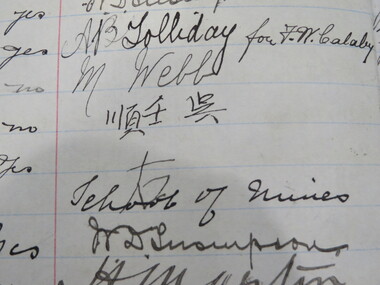
Book - Register, Berry Anderson & Co, Ballarat School of Mines Gold Entry Book. 1908-1976, 01/06/1908-01/12/1976
... The Register of Gold Entry Book had to be kept by the Licensed Gold Buyer or Assayer under the Gold Buyers Act. ballarat school of mines model mine battery assay smelting gold robinson frederick martell r. callister a. garrard peter tong lee sue ah lung chinese f.w. calaby ah kit charlie ah lung ah sung ah chee dep choon charlie ah hing frederick greaves peter fong george ah ki ah hing william mong thomas bell and party, brown hill dentist amalgam albert sydney sergeant plumber plumbing george spence, plumber commonwealth bank j. hutton-jones golden duke mining syndicate, blackwood d.e.j. grant, eganstown linton gold mining company mining D. Bernard G. peron john page David Bernard harry webb ah fou W.D. Thompson A.B. Tolliday M. Webb Brown half leather bound register registering receipt of gold. Columns include date, nature of transaction (eg assaying/purchase), age, where employed, business ...The Ballarat School of Mines had a model mine used by students, and to conduct assays for a fee. The Register of Gold Entry Book had to be kept by the Licensed Gold Buyer or Assayer under the Gold Buyers Act.Brown half leather bound register registering receipt of gold. Columns include date, nature of transaction (eg assaying/purchase), age, where employed, business (eg mining, fossicking, assayer, etc), Abode, Signature, Witness, Claim, Mining Division, District, Where Obtained, Character of Gold (eg alluvial, smelted, quartz, etc), Weight, Value, How Gold Treated, To whom delivered after assay or smelting, Date of Assayer's Certificate. ballarat school of mines, model mine, battery, assay, smelting, gold, robinson, frederick martell, r. callister, a. garrard, peter tong, lee sue, ah lung, chinese, f.w. calaby, ah kit, charlie ah lung, ah sung, ah chee, dep choon, charlie ah hing, frederick greaves, peter fong, george ah ki, ah hing, william mong, thomas bell and party, brown hill, dentist, amalgam, albert sydney sergeant, plumber, plumbing, george spence, plumber, commonwealth bank, j. hutton-jones, golden duke mining syndicate, blackwood, d.e.j. grant, eganstown, linton gold mining company, mining, d. bernard, g. peron, john page, david bernard, harry webb, ah fou, w.d. thompson, a.b. tolliday, m. webb
