
Showing 60 items matching "chinese motifs"
-
 Bendigo Historical Society Inc.
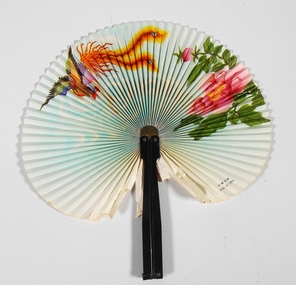
Ephemera - Paper fans
... ...Chinese motifs...Three fans: 10848.13a - paper fan made of many sections; with Chinese dragon and flower motif, made to form a round fan 1084801b - Black plastic fan with nine Australian motifs centered on Queensland, connected with red ribbon 100848013c - White plastic fan with an Asian tree motif...Paper fans Chinese motifs Three fans: 10848.13a - paper fan made of many sections; with Chinese dragon and flower motif, made to form a round fan 1084801b - Black plastic fan with nine Australian motifs centered on Queensland, connected with red ribbon 100848013c - White plastic fan with an Asian tree motif Ephemera Paper fans ...Three fans: 10848.13a - paper fan made of many sections; with Chinese dragon and flower motif, made to form a round fan 1084801b - Black plastic fan with nine Australian motifs centered on Queensland, connected with red ribbon 100848013c - White plastic fan with an Asian tree motifpaper fans, chinese motifs -
 Whitehorse Historical Society Inc.
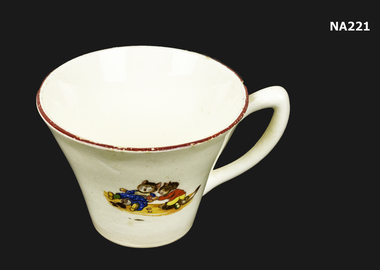
Domestic object - Child's cup
... Child's china cup with cat motif...domestic items infants Child's china cup with cat motif Domestic object Child's cup ...Child's china cup with cat motifdomestic items, infants -
 Embroiderers Guild, Victoria
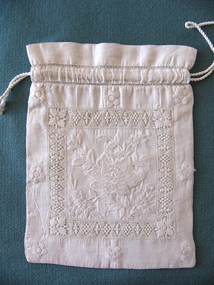
Accessory - Chinese Drawn Thread Reticule, Early 20th century
... Reticule made in white "Grass" fabric, with a square of drawn thread work with a large chinese floral motif on back and front. There are 8 flower heads around the design. ...Embroidery Bags Reticules 1900-20 China floral Reticule made in white "Grass" fabric, with a square of drawn thread work with a large chinese floral motif on back and front. There are 8 flower heads around the design. ...A classical Chinese bag of the period in the drawstring style fashionable for use with summer dresses. Made for European markets.Reticule made in white "Grass" fabric, with a square of drawn thread work with a large chinese floral motif on back and front. There are 8 flower heads around the design. Drawstring top in encased between 2 rows of drawn hemstitching. embroidery, bags, reticules, 1900-20, china, floral -
 Embroiderers Guild, Victoria
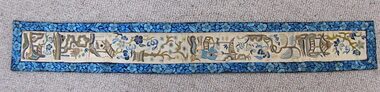
Accessory - Pair of Chinese Embroidered Sleeve Bands, 1880
... Chinese sleeve embroidery bands, or wanxiu became popular in the late 19th century during the Qing Dynasty, evolving from the traditional Han cuff embroidery and Manchu styles. These detachable, decorated bands were added to women's informal jackets and robes, often featuring symbolic motifs like landscapes, flowers, and auspicious symbols. ...A fine example of Pekin knot stitch outlined with gold thread showing traditional Chinese motifs and figures. From bottom to top there is an outdoor scene with water and a building. ...A fine example of Pekin knot stitch outlined with gold thread showing traditional Chinese motifs and figures. From bottom to top there is an outdoor scene with water and a building. ...Label attached to record card states "Chinese Embroidery from the Royal Palace, Pekin J.M.S." Chinese sleeve embroidery bands, or wanxiu became popular in the late 19th century during the Qing Dynasty, evolving from the traditional Han cuff embroidery and Manchu styles. These detachable, decorated bands were added to women's informal jackets and robes, often featuring symbolic motifs like landscapes, flowers, and auspicious symbols. They served both a decorative function, displaying artistic skill and personal wishes, and a practical one by covering the sleeves when hands were folded at the waist. History and evolution: Origins: The practice of embroidering cuffs on robes existed during the previous Ming Dynasty for Han women, and this was adopted by the Manchu rulers who founded the Qing Dynasty. Qing Dynasty (1644-1911): The practice was popularized and elaborated upon during this era, with detachable bands becoming a fashionable element for informal wear. Symbolism: The embroidery included a complex visual vocabulary of wishes for a long life, many offspring, and a happy marriage, derived from nature, mythology, and classical literature. Functionality: Women would fold their arms, often with their hands inside the sleeves, so the embroidered bands, which were sewn to hang down the back of the jacket, would be displayed prominently down the front. 19th century peak: The late 19th century was the peak of their popularity, with intricate designs becoming fashionable and even influenced by court tastes, such as those favoured by the Empress Dowager Cixi. Later developments: The late 19th century saw the introduction of chemical 'aniline' dyes from Europe, leading to brighter, bolder colours in embroidery. Motifs and their Meanings: Auspicious symbols: Designs often included symbols for good fortune, wealth, and longevity. Natural imagery: Birds, flowers, and landscapes were common motifs that could represent natural beauty or convey specific symbolic meanings. Figurative scenes: Bands could also feature narrative scenes from classical stories or legends. The choice of motifs allowed women to express personal desires, cultural values, and aesthetic preferences, reflecting a more personal and informal style than official court attire. Pagoda: an omen of good. Two birds (possibly swallows): an omen approaching spring and also of approaching success. Rooster: a symbol of high rank (it's comb/crown (jinguan) is a pun for 'official' guan). Peony: a symbol of wealth. Deer (lu): means wealth and prosperity. Willow: a symbol of spring (chun). Willows with apricot blossoms (xinghuo), willlows (liu) and swallows (yan) symbolizes 'may you attend the spring banquet in the apricot grove (xinglin chunyan), or may you become a successful candidate. Pine: longevity. Mouth organ (sheng): is a pun for giving birth or 'to rise' as in rising in rank.Meaning : this pair of sleeve bands may have been wishing the owner of them good luck, success in an upcoming exam and that he may rapidly rise in rank, live a long life and continue to receive an official salary. Information from 'Hidden Meaning in Chinese Art' Terese Tse BartholomewFine white satin edged in shades oft blue silk flower embroidery. A fine example of Pekin knot stitch outlined with gold thread showing traditional Chinese motifs and figures. From bottom to top there is an outdoor scene with water and a building. Above this are flowers, hills, a rock formation, a pine and an animal (? pig or deer). Another building, blossoms and pine trees and a pot containing a cypress tree. Above the tree there is a male figure holding a bamboo pipe in one hand and a bird in the other. Further buildings follow, with a willow tree and two swallows flying.embroidery, garments, silk embroidery, late 19th century, china, trees, animals, pagoda -
 Bendigo Historical Society Inc.
Document - JAMES LERK COLLECTION: BENDIGO CENTRAL BOTTLE CLUB NEWSLETTER
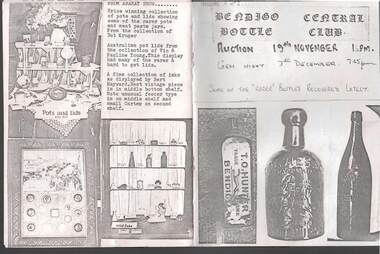
... C J Bryant 1856-1898.The Newsletter also contains an article and examples of China's Mystical Motifs - which were used on pottery etc.; together with a photo of a list of Essences, Drugs, etc....C J Bryant 1856-1898.The Newsletter also contains an article and examples of China's Mystical Motifs - which were used on pottery etc.; together with a photo of a list of Essences, Drugs, etc. ...Bendigo Central Bottle Club Newsletter - James Lerk Collection Vol 3, No. 2 1977. Article on the Maldon Brewery & Mr. C J Bryant 1856-1898.The Newsletter also contains an article and examples of China's Mystical Motifs - which were used on pottery etc.; together with a photo of a list of Essences, Drugs, etc.bendigo central bottle club, newsletter, james lerk -
 Embroiderers Guild, Victoria
Clothing - Chinese Embroidered Skirt, 19th century
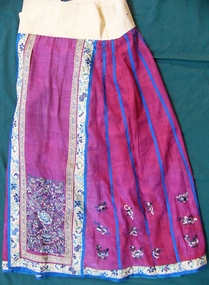
... Symbolism - from C.A.S.Williams ' Chinese Symbolism and Art Motifs' 2006 and 'Hidden Meanings in Chinese Art'2006 Terese Tse Bartholomew....Symbolism - from C.A.S.Williams ' Chinese Symbolism and Art Motifs' 2006 and 'Hidden Meanings in Chinese Art'2006 Terese Tse Bartholomew. ...Symbolism: Fish - abundance. Scrolls- happiness and prosperity. Fan - longevity. Chrysanthemum - longevity. Because these skirts were worn under knee length jackets , the embroidery only came up to where it would meet the bottom of the jacket. 'Chinese Dress from the Qing Dynasty to the Present' 2008 Valery Garrett. Symbolism - from C.A.S.Williams ' Chinese Symbolism and Art Motifs' 2006 and 'Hidden Meanings in Chinese Art'2006 Terese Tse Bartholomew.Cyclamen coloured, self patterned silk damask skirt with godets bordered in mid blue and lined with aqua silk. It has a wide cotton waist band with a loop at each end. The band was made in cotton (or hemp) to stop the skirt from slipping down. It was fastened by means of a tie or button. The skirt has a wide front panel embroidered with slowers in shades of blue and white, the central flower, a peony, is in a vase or urn. There are varius symbols inthe embroidery surrounding the central flower. Machine embroidered braid forms a border around this central area and beyond this is another hand embroidered border on white with blue and flesh coloured pink flowers. The godets have small embroidered motifs of fish, scrolls, fans and chrysanthemums. Embroidered in Pekin knot stitch outlined in metal thread. Pound sign 5-15-0 written in pencil on waistband.embroidery, garment, silk embroidery, china, 19th century -
 Embroiderers Guild, Victoria
Container - Chinese Lacquer Work and writing box with ivory contents and fittings, Chinese Lacquer Work Box
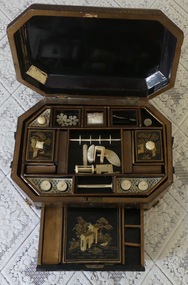
... Black all-over lacquered surfaces decorated with Chinese pavilion scenes and motifs with butterflies. Two inner compartments, upper one fitted with bone/ivory lids to compartments for needlework. ...Black all-over lacquered surfaces decorated with Chinese pavilion scenes and motifs with butterflies. Two inner compartments, upper one fitted with bone/ivory lids to compartments for needlework. ...Typical of work boxes made in China for sale to visiting Europeans 1840'sBlack lacquerware work box, hexagonal, with bone or ivory fittints. Black all-over lacquered surfaces decorated with Chinese pavilion scenes and motifs with butterflies. Two inner compartments, upper one fitted with bone/ivory lids to compartments for needlework. Lower compartment is a drawer with missing contents. Two metal carrying handles, two metal key holes (no keys). Front feet gilded wood, back feet wooden blocks. Interior has one removable fitted tray with eleven compartments. Two compartment lids match gold and green lacquerware of exterior. Two have removvable inserts. Third compartment has removable pincushion insert. Four narrow compartments fitted with wooden blocks to contain tools. Lower drawer has folding writing slope decorated and five compartments for writing toolsExterior: Black lacquer with gold and pale green inlaychinese lacquerware, workbox, ivory needlework accessories -
 Flagstaff Hill Maritime Museum and Village
Wash stand
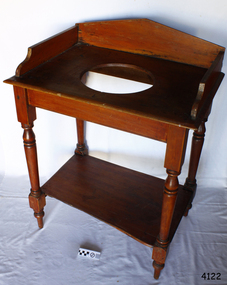
... china wash basin. Washstands were generally supported on pedestal, scrolled or cabriole legs, in keeping with the dressing table with which they were often made en suite. Edwardian washstands like most furniture of the period were much more rectangular in outline, with squared corners and (Lassetter) fairly plainly turned legs. They sometimes had a cupboard below the marble top. The back was usually tiled, often featuring the Art Nouveau motifs...china wash basin. Washstands were generally supported on pedestal, scrolled or cabriole legs, in keeping with the dressing table with which they were often made en suite. Edwardian washstands like most furniture of the period were much more rectangular in outline, with squared corners and (Lassetter) fairly plainly turned legs. They sometimes had a cupboard below the marble top. The back was usually tiled, often featuring the Art Nouveau motifs ...The subject item is essentially a 19th century development of the 18th century basin stand, the washstand had assumed a regular table form by about the 1830s, usually with a marble top and pot board beneath. The earlier timber top washstands had a timber splash back, while the marble top washstands usually had a matching marble splash back often with a small semicircular shelf for the soap dish, or a tiled splash back. Many washstands had a hole cut into the top to contain the china wash basin. Washstands were generally supported on pedestal, scrolled or cabriole legs, in keeping with the dressing table with which they were often made en suite. Edwardian washstands like most furniture of the period were much more rectangular in outline, with squared corners and (Lassetter) fairly plainly turned legs. They sometimes had a cupboard below the marble top. The back was usually tiled, often featuring the Art Nouveau motifs washstands were used until the 1920s. Wash stand wooden opening in top for basin, 3 raised sides, 4 turned legs, Lower shelf broken at front, has remnant black stain. flagstaff hill, warrnambool, shipwrecked-coast, flagstaff-hill, flagstaff-hill-maritime-museum, maritime-museum, shipwreck-coast, flagstaff-hill-maritime-village, wash stand -
 Flagstaff Hill Maritime Museum and Village
Domestic object - Ewer and Bowl, J & G Meakin, 1912 - 1925
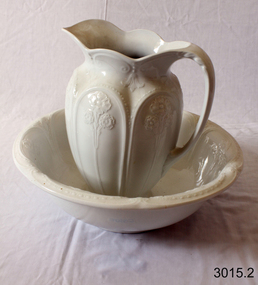
... China Reqd SOL 39/4/3 STG Meakin England" Trademark of J & G Meakin with sun emblem . Ironstone wash jug and bowl set, white, often referred to as a ewer and bowl. Both jug and bowl have matching raised embossing of panels with floral motifs ...J & G Meakin was an English pottery manufacturing company founded in 1851 and based in Hanley, Stoke-on-Trent, Staffordshire. In the 19th century, J & G Meakin was known for the vast quantities of cheap ironstone china it produced for the domestic English market and export to Australia, Canada, New Zealand, and the United States. From around 1970, designs included Liberty, Sterling, Trend, Classic, and Heirloom. Some of these were influenced by earlier designs. The newer wares can be distinguished by back stamp markings such as 'permanent colours', 'everlasting colour', or 'dishwasher proof'. J & G Meakin had close family and corporate affiliations to the potteries Johnson Brothers, and Alfred Meakin Ltd, which explains why many patterns are similar, if not almost the same. There was a takeover by J. & G. Meakin in 1968 of Midwinter Pottery. The firm was then taken over by the Wedgwood Group in 1970. In 2000 production under the Meakin name ceased and their long-established works, Eagle Pottery, was then used for the production of Johnson Bros pottery. Eagle Pottery closed in 2004 when production was transferred abroad; the works were demolished in 2005.Item is significant as it is believed to be an early example of the SOL trademark made between 1913-1925.Ironstone wash jug and bowl set, white, often referred to as a ewer and bowl. Both jug and bowl have matching raised embossing of panels with floral motifs within them.Both items have marks "Ironstone China Reqd SOL 39/4/3 STG Meakin England" Trademark of J & G Meakin with sun emblem .flagstaff hill, warrnambool, shipwrecked-coast, flagstaff-hill, flagstaff-hill-maritime-museum, maritime-museum, shipwreck-coast, flagstaff-hill-maritime-village, jug china white and basin, jug, jug and basin, jug & bowl, ewer, bowl, ewer & bowl, j and g meakin, ironstone ware, bathing, washing, personal hygiene -
 The Beechworth Burke Museum
Textile - Banner, c1872
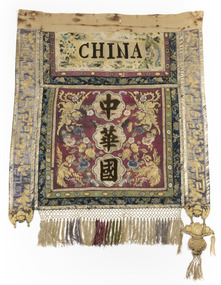
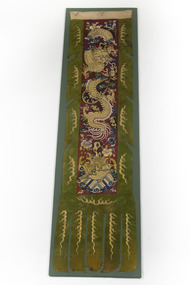
... Silk macrame fringe and tassels to central panel and padded lotus and bowl motif hanging tassel from side panels. Velvet lettering applied to front "CHINA" ...Silk macrame fringe and tassels to central panel and padded lotus and bowl motif hanging tassel from side panels. Velvet lettering applied to front "CHINA" Textile Banner Beechworth Chinese Community ...This banner was one of five banners gifted to the Beechworth Chinese community in recognition of their support of the Hospital and Benevolent Asylum in 1875, from the Carnival Committee. These banners had been purchased in China by a social envoy from Beechworth then presented to the Chinese community during the Beechworth Fine Arts Exhibition in May of that same year, by Donald Fiddes, President of the Ovens District Hospital. The Burke Museum's Chinese Collection presents the history of Chinese settlement in Beechworth from 1856 and its involvement in local community affairs in the second half of the 19th century. In settling in the area they formed their own community with distinctive Chinese cultural traditions, forming their own 'camps' with laid out streets, housing a Temple, Chinese Theatre and restaurants, hotels, stores, gambling houses and dwellings. Members of the Chinese community took an active interest in town affairs and were generous donors to the appeal to build the Ovens District Hospital in 1856/7. The vibrant colours and dynamic graphics of the silk embroidered Chinese banners were a highlight of Beechworth Charitable processions that took place in the main street. Two of the Chinese banners were conserved for the Burke Museum in 2006 by Carol Campbell of Phoenix Conservation Services with funding from Victoria’s Heritage Grants. In 2015, with the enormous support of the Copland Foundation and fundraising activities by the Friends of the Bur Museum Committee, conservation of the third banner was undertaken by Artlab Australia in Adelaide. The banners display traditional Chinese textile techniques and are visually beautiful and very rare and are considered of local and national significance, with the potential to be deemed internationally significant.Multi panelled banner with embroidery and applied design motifs on front. Back panel is painted design of two men. The front panels have been constructed using strips of various weaves and colours of silk that have been embroidered or had a design applied prior to the overall construction of the piece. The embroidery is predominantly gold work with both plyed and floss silk threads. Silk macrame fringe and tassels to central panel and padded lotus and bowl motif hanging tassel from side panels. Velvet lettering applied to front "CHINA" CHINA /beechworth, burke museum, chinese, benevolent asylum, ovens district hospital, beechworth carnival processions, carnival, processions, beechworth chinese community, beechworth fine arts exhibition, donald fiddes -
 The Beechworth Burke Museum
Textile - Banner, c1872
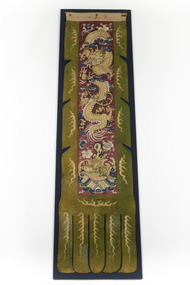
... Beechworth Burke Museum Chinese Benevolent Asylum Ovens District Hospital Beechworth Carnival processions Carnival processions Beechworth Chinese community Beechworth Fine Arts Exhibition Donald Fiddes Multi panelled banner with embroidery and applied design motifs on front. ...This banner was one of five banners gifted to the Beechworth Chinese community in recognition of their support of the Hospital and Benevolent Asylum in 1875, from the Carnival Committee. These banners had been purchased in China by a social envoy from Beechworth then presented to the Chinese community during the Beechworth Fine Arts Exhibition in May of that same year, by Donald Fiddes, President of the Ovens District Hospital. The Burke Museum's Chinese Collection presents the history of Chinese settlement in Beechworth from 1856 and its involvement in local community affairs in the second half of the 19th century. In settling in the area they formed their own community with distinctive Chinese cultural traditions, forming their own 'camps' with laid out streets, housing a Temple, Chinese Theatre and restaurants, hotels, stores, gambling houses and dwellings. Members of the Chinese community took an active interest in town affairs and were generous donors to the appeal to build the Ovens District Hospital in 1856/7. The vibrant colours and dynamic graphics of the silk embroidered Chinese banners were a highlight of Beechworth Charitable processions that took place in the main street. Two of the Chinese banners were conserved for the Burke Museum in 2006 by Carol Campbell of Phoenix Conservation Services with funding from Victoria’s Heritage Grants. In 2015, with the enormous support of the Copland Foundation and fundraising activities by the Friends of the Bur Museum Committee, conservation of the third banner was undertaken by Artlab Australia in Adelaide.The banners display traditional Chinese textile techniques and are visually beautiful and very rare and are considered of local and national significance, with the potential to be deemed internationally significant.Multi panelled banner with embroidery and applied design motifs on front. The front panels have been constructed using strips of various weaves and colours of silk that have been embroidered or had a design applied prior to the overall construction of the piece. The embroidery is predominantly gold work with both plyed and floss silk threads.beechworth, burke museum, chinese, benevolent asylum, ovens district hospital, beechworth carnival processions, carnival, processions, beechworth chinese community, beechworth fine arts exhibition, donald fiddes -
 The Beechworth Burke Museum
Textile - Banner, c1872
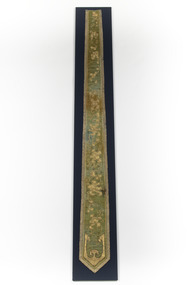
... Beechworth Burke Museum Chinese Benevolent Asylum Ovens District Hospital Beechworth Carnival processions Carnival processions Beechworth Chinese community Beechworth Fine Arts Exhibition Donald Fiddes Multi panelled banner with embroidery and applied design motifs on front. ...This banner was one of five banners gifted to the Beechworth Chinese community in recognition of their support of the Hospital and Benevolent Asylum in 1875, from the Carnival Committee. These banners had been purchased in China by a social envoy from Beechworth then presented to the Chinese community during the Beechworth Fine Arts Exhibition in May of that same year, by Donald Fiddes, President of the Ovens District Hospital. The Burke Museum's Chinese Collection presents the history of Chinese settlement in Beechworth from 1856 and its involvement in local community affairs in the second half of the 19th century. In settling in the area they formed their own community with distinctive Chinese cultural traditions, forming their own 'camps' with laid out streets, housing a Temple, Chinese Theatre and restaurants, hotels, stores, gambling houses and dwellings. Members of the Chinese community took an active interest in town affairs and were generous donors to the appeal to build the Ovens District Hospital in 1856/7. The vibrant colours and dynamic graphics of the silk embroidered Chinese banners were a highlight of Beechworth Charitable processions that took place in the main street. Two of the Chinese banners were conserved for the Burke Museum in 2006 by Carol Campbell of Phoenix Conservation Services with funding from Victoria’s Heritage Grants. In 2015, with the enormous support of the Copland Foundation and fundraising activities by the Friends of the Bur Museum Committee, conservation of the third banner was undertaken by Artlab Australia in Adelaide. The banners display traditional Chinese textile techniques and are visually beautiful and very rare and are considered of local and national significance, with the potential to be deemed internationally significant.Multi panelled banner with embroidery and applied design motifs on front. The front panels have been constructed using strips of various weaves and colours of silk that have been embroidered or had a design applied prior to the overall construction of the piece. The embroidery is predominantly gold work with both plyed and floss silk threads.beechworth, burke museum, chinese, benevolent asylum, ovens district hospital, beechworth carnival processions, carnival, processions, beechworth chinese community, beechworth fine arts exhibition, donald fiddes -
 The Beechworth Burke Museum
Textile - Banner, c1872
... Beechworth Burke Museum Chinese Benevolent Asylum Ovens District Hospital Beechworth Carnival processions Carnival processions Beechworth Chinese community Beechworth Fine Arts Exhibition Donald Fiddes Multi panelled banner with embroidery and applied design motifs on front. ...This banner was one of five banners gifted to the Beechworth Chinese community in recognition of their support of the Hospital and Benevolent Asylum in 1875, from the Carnival Committee. These banners had been purchased in China by a social envoy from Beechworth then presented to the Chinese community during the Beechworth Fine Arts Exhibition in May of that same year, by Donald Fiddes, President of the Ovens District Hospital. The Burke Museum's Chinese Collection presents the history of Chinese settlement in Beechworth from 1856 and its involvement in local community affairs in the second half of the 19th century. In settling in the area they formed their own community with distinctive Chinese cultural traditions, forming their own 'camps' with laid out streets, housing a Temple, Chinese Theatre and restaurants, hotels, stores, gambling houses and dwellings. Members of the Chinese community took an active interest in town affairs and were generous donors to the appeal to build the Ovens District Hospital in 1856/7. The vibrant colours and dynamic graphics of the silk embroidered Chinese banners were a highlight of Beechworth Charitable processions that took place in the main street. Two of the Chinese banners were conserved for the Burke Museum in 2006 by Carol Campbell of Phoenix Conservation Services with funding from Victoria’s Heritage Grants. In 2015, with the enormous support of the Copland Foundation and fundraising activities by the Friends of the Bur Museum Committee, conservation of the third banner was undertaken by Artlab Australia in Adelaide. The banners display traditional Chinese textile techniques and are visually beautiful and very rare and are considered of local and national significance, with the potential to be deemed internationally significant.Multi panelled banner with embroidery and applied design motifs on front. The front panels have been constructed using strips of various weaves and colours of silk that have been embroidered or had a design applied prior to the overall construction of the piece. The embroidery is predominantly gold work with both plyed and floss silk threads. beechworth, burke museum, chinese, benevolent asylum, ovens district hospital, beechworth carnival processions, carnival, processions, beechworth chinese community, beechworth fine arts exhibition, donald fiddes -
 Federation University Historical Collection
Object - Plate, Plate from Nanchang University
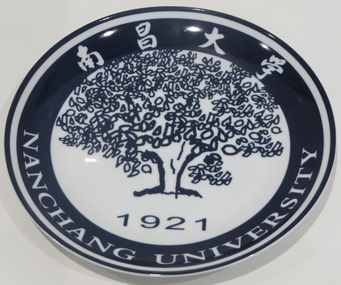
... Navy blue and white china plate from Nanchang University, with tree motif. ...Navy blue and white china plate from Nanchang University, with tree motif. Plate from Nanchang University Object - Plate Jingdezhen China ...Navy blue and white china plate from Nanchang University, with tree motif. Nanchang University 1921 on the front. Jingdezhen China and symbol on the back.nanchang university, ceramic plate, navy and white, tree plate -
 Glenelg Shire Council Cultural Collection
Domestic object - Coffee Pot - Macs Hotel Portland, Victoria, 1950-1960
... White china/ceramic lidded coffee pot, with Macs Hotel Portland logo (with belt motif), in black...Back: Underneath - Makers stamp in green 'Solian Ware Soho Pottery Ltd, Cobridge, England' White china/ceramic lidded coffee pot, with Macs Hotel Portland logo (with belt motif), in black Domestic object Coffee Pot - Macs Hotel Portland, Victoria ...White china/ceramic lidded coffee pot, with Macs Hotel Portland logo (with belt motif), in blackBack: Underneath - Makers stamp in green 'Solian Ware Soho Pottery Ltd, Cobridge, England' -
Glenelg Shire Council Cultural Collection
Souvenir - China Dish, n.d
... Hand painted china dish, rectangular with rounded corners of aboriginal motif. Souvenir of Portland....Anna - inscribed into surface gold sticker STUDIO ANNA Australia' AUSTRALIA' Hand painted china dish, rectangular with rounded corners of aboriginal motif. Souvenir of Portland. ...Hand painted china dish, rectangular with rounded corners of aboriginal motif. Souvenir of Portland.Front: 'PORTLAND' - in white Back: Makers 'HAND PAINTED 'S. Anna - inscribed into surface gold sticker STUDIO ANNA Australia' AUSTRALIA'souvenir of portland, domestic item -
 Orbost & District Historical Society
china, 1930-45
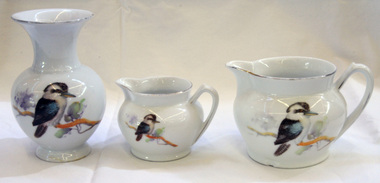
... Lancelot and Martha Herbert had purchased temple's Store and added to it. pocelian china tableware teaset household-items snowy-river-stores powell-henry Zeh Scherser with a crown above Bavaria On base of .1 is 15 ; on base of .2 is 45 0846 0846 .I is a white vase decorated with a motif of a kookaburra sitting on a branch. the rim is gilded. .2 is a milk jug with a spout and handle and decorated in the same way. .3 Is a smaller cream jug with the same motif. china Zeh, Scherzer & Co. ...This set was given to Mr and Mrs Henry Powell by Herbert's Store when their account was finalised. Herbert's Snowy River Store was at the lower end of Nicholson Street in Orbost. Lancelot and Martha Herbert had purchased temple's Store and added to it. .I is a white vase decorated with a motif of a kookaburra sitting on a branch. the rim is gilded. .2 is a milk jug with a spout and handle and decorated in the same way. .3 Is a smaller cream jug with the same motif.Zeh Scherser with a crown above Bavaria On base of .1 is 15 ; on base of .2 is 45 0846 0846 pocelian china tableware teaset household-items snowy-river-stores powell-henry -
 Flagstaff Hill Maritime Museum and Village
Domestic object - China piece, ca 1855
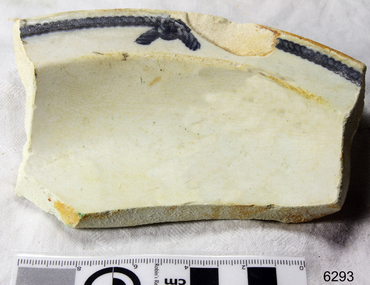
... china bowl...bowl fragment...blue knotted rope motif...It is historically significant for representing aspects of Victoria’s shipping history and for its association with the shipwreck and the ship, which was designed to be fastest and most luxurious of its day Warrnambool Shipwrecked-coast Flagstaff-Hill Flagstaff-Hill-Maritime-Museum Maritime-Museum Shipwreck-coast Flagstaff-Hill-Maritime-Village Schomberg Shipwrecked-artefact Clipper ship Black Ball line 1855 shipwreck Aberdeen clipper ship Captain Forbes Peterborough shipwreck SS Queen china bowl bowl fragment blue knotted rope motif Painted [blue knotted rope motif] Piece of China bowl, white with knotted blue rope design around outer rim. . ...When the ship Schomberg was launched in 1855, she was considered the most perfect clipper ship ever to be built. James Blaine’s Black Ball Line had commissioned her to be built for their fleet of passenger liners. At a cost of £43,103, the Aberdeen builders designed her to sail faster than the quick clippers designed by North American Donald McKay. She was a three masted wooden clipper ship, built with diagonal planking of British oat with layers of Scottish larch. This luxury vessel was designed to transport emigrants to Melbourne in superior comfort. She had ventilation ducts to provide air to the lower decks and a dining saloon, smoking room, library and bathrooms for the first class passengers. At the launch of Schomberg’s maiden voyage, her master Captain ‘Bully’ Forbes, drunkenly predicted that he would make the journey between Liverpool and Melbourne in 60 days. Schomberg departed Liverpool on 6 October 1855 with 430 passengers and 3000 tons cargo including iron rails and equipment intended the build the Geelong Railway and a bridge over the Yarra from Melbourne to Hawthorn. The winds were poor as Schomberg sailed across the equator, slowing her journey considerably. She was 78 days out of Liverpool when she ran aground on a sand-spit near Peterborough, Victoria, on 27 December; the sand spit and the currents were not marked on Forbes’s map. Overnight, the crew launched a lifeboat to find a safe place to land the ship’s passengers. The scouting party returned to Schomberg and advised Forbes that it was best to wait until morning because the rough seas could easily overturn the small lifeboats. The ship’s Chief Officer spotted SS Queen at dawn and signalled the steamer. The master of the SS Queen approached the stranded vessel and all of Schomberg’s passengers were able to disembark safely. The Black Ball Line’s Melbourne agent sent a steamer to retrieve the passengers’ baggage from the Schomberg. Other steamers helped unload her cargo until the weather changed and prevented the salvage teams from accessing the ship. Local merchants Manifold & Bostock bought the wreck and cargo, but did not attempt to salvage the cargo still on board the ship. They eventually sold it on to a Melbourne businessman and two seafarers. After two of the men drowned when they tried to reach Schomberg, salvage efforts were abandoned.32 In 1975, divers from Flagstaff Hill, including Peter Ronald, found an ornate communion set at the wreck. The set comprised a jug, two chalices, a plate and a lid. The lid did not fit any of the other objects and in 1978 a piece of the lid broke off, revealing a glint of gold. As museum staff carefully examined the lid and removed marine growth, they found a diamond ring, which is currently on display in the Great Circle Gallery.33 Flagstaff Hill also holds ship fittings and equipment, personal effects, a lithograph, tickets and photograph from the Schomberg. Most of the artefacts were salvaged from the wreck by Peter Ronald, former director of Flagstaff Hill. The Schomberg, which is on the Victorian Heritage Register (VHR S612), has great historical significance as a rare example of a large, fast clipper ship on the England to Australia run, carrying emigrants at the time of the Victorian gold rush. She represents the technical advances made to break sailing records between Europe and Australia. Flagstaff Hill’s collection of artefacts from the Schomberg is significant for its association with the shipwreck. The collection is primarily significant because of the relationship between the objects, as together they have a high potential to interpret the story of the Schomberg. It is archaeologically significant as the remains of an international passenger Ship. It is historically significant for representing aspects of Victoria’s shipping history and for its association with the shipwreck and the ship, which was designed to be fastest and most luxurious of its day Piece of China bowl, white with knotted blue rope design around outer rim. . Recovered from the wreck of the Schomberg. Painted [blue knotted rope motif]warrnambool, shipwrecked-coast, flagstaff-hill, flagstaff-hill-maritime-museum, maritime-museum, shipwreck-coast, flagstaff-hill-maritime-village, schomberg, shipwrecked-artefact, clipper ship, black ball line, 1855 shipwreck, aberdeen clipper ship, captain forbes, peterborough shipwreck, ss queen, china bowl, bowl fragment, blue knotted rope motif -
 Flagstaff Hill Maritime Museum and Village
Ceramic - China piece, ca. 1855
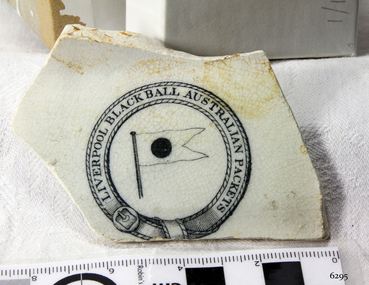
... China fragment...Black Ball line motif...It is historically significant for representing aspects of Victoria’s shipping history and for its association with the shipwreck and the ship, which was designed to be fastest and most luxurious of its day Warrnambool Shipwrecked-coast Flagstaff-Hill Flagstaff-Hill-Maritime-Museum Maritime-Museum Shipwreck-coast Flagstaff-Hill-Maritime-Village Schomberg Shipwrecked-artefact Clipper ship Black Ball line 1855 shipwreck Aberdeen clipper ship Captain Forbes Peterborough shipwreck SS Queen China China fragment Black Ball line motif Inscribed on front "LIVERPOOL BLACK BALL AUSTRALIAN PACKETS" and on back "DAVENPORT" Logo of a flag, Guidon shape, with a black ball on it. ...When the ship Schomberg was launched in 1855, she was considered the most perfect clipper ship ever to be built. James Blaine’s Black Ball Line had commissioned her to be built for their fleet of passenger liners. At a cost of £43,103, the Aberdeen builders designed her to sail faster than the quick clippers designed by North American Donald McKay. She was a three masted wooden clipper ship, built with diagonal planking of British oat with layers of Scottish larch. This luxury vessel was designed to transport emigrants to Melbourne in superior comfort. She had ventilation ducts to provide air to the lower decks and a dining saloon, smoking room, library and bathrooms for the first class passengers. At the launch of Schomberg’s maiden voyage, her master Captain ‘Bully’ Forbes, drunkenly predicted that he would make the journey between Liverpool and Melbourne in 60 days. Schomberg departed Liverpool on 6 October 1855 with 430 passengers and 3000 tons cargo including iron rails and equipment intended the build the Geelong Railway and a bridge over the Yarra from Melbourne to Hawthorn. The winds were poor as Schomberg sailed across the equator, slowing her journey considerably. She was 78 days out of Liverpool when she ran aground on a sand-spit near Peterborough, Victoria, on 27 December; the sand spit and the currents were not marked on Forbes’s map. Overnight, the crew launched a lifeboat to find a safe place to land the ship’s passengers. The scouting party returned to Schomberg and advised Forbes that it was best to wait until morning because the rough seas could easily overturn the small lifeboats. The ship’s Chief Officer spotted SS Queen at dawn and signalled the steamer. The master of the SS Queen approached the stranded vessel and all of Schomberg’s passengers were able to disembark safely. The Black Ball Line’s Melbourne agent sent a steamer to retrieve the passengers’ baggage from the Schomberg. Other steamers helped unload her cargo until the weather changed and prevented the salvage teams from accessing the ship. Local merchants Manifold & Bostock bought the wreck and cargo, but did not attempt to salvage the cargo still on board the ship. They eventually sold it on to a Melbourne businessman and two seafarers. After two of the men drowned when they tried to reach Schomberg, salvage efforts were abandoned.32 In 1975, divers from Flagstaff Hill, including Peter Ronald, found an ornate communion set at the wreck. The set comprised a jug, two chalices, a plate and a lid. The lid did not fit any of the other objects and in 1978 a piece of the lid broke off, revealing a glint of gold. As museum staff carefully examined the lid and removed marine growth, they found a diamond ring, which is currently on display in the Great Circle Gallery.33 Flagstaff Hill also holds ship fittings and equipment, personal effects, a lithograph, tickets and photograph from the Schomberg. Most of the artefacts were salvaged from the wreck by Peter Ronald, former director of Flagstaff Hill. The Schomberg, which is on the Victorian Heritage Register (VHR S612), has great historical significance as a rare example of a large, fast clipper ship on the England to Australia run, carrying emigrants at the time of the Victorian gold rush. She represents the technical advances made to break sailing records between Europe and Australia. Flagstaff Hill’s collection of artefacts from the Schomberg is significant for its association with the shipwreck. The collection is primarily significant because of the relationship between the objects, as together they have a high potential to interpret the story of the Schomberg. It is archaeologically significant as the remains of an international passenger Ship. It is historically significant for representing aspects of Victoria’s shipping history and for its association with the shipwreck and the ship, which was designed to be fastest and most luxurious of its day Piece of a china plate, white with the Black Ball Line insignia in black. Glazing is crazed. Recovered from the wreck of the Schomberg. Inscribed on front "LIVERPOOL BLACK BALL AUSTRALIAN PACKETS" and on back "DAVENPORT" Logo of a flag, Guidon shape, with a black ball on it.warrnambool, shipwrecked-coast, flagstaff-hill, flagstaff-hill-maritime-museum, maritime-museum, shipwreck-coast, flagstaff-hill-maritime-village, schomberg, shipwrecked-artefact, clipper ship, black ball line, 1855 shipwreck, aberdeen clipper ship, captain forbes, peterborough shipwreck, ss queen, china, china fragment, black ball line motif -
 Bendigo Historical Society Inc.
Accessory - CHINA SHAVING MUG
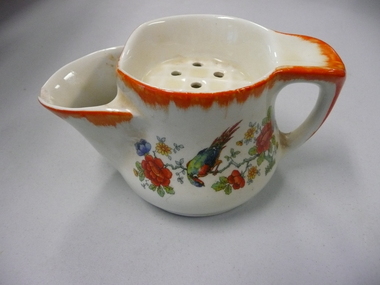
... China shaving mug ('Empire'; 'Ivory Ware England' marked on base)). Flower and bird motif on mug sides. ...PERSONAL EFFECTS Shaving mug China shaving mug ('Empire'; 'Ivory Ware England' marked on base)). Flower and bird motif on mug sides. ...China shaving mug ('Empire'; 'Ivory Ware England' marked on base)). Flower and bird motif on mug sides. Inscribed with catalog number U2-232.1.personal effects, shaving, mug -
 Bendigo Historical Society Inc.
Domestic Object - CHINA TOILET BOAT
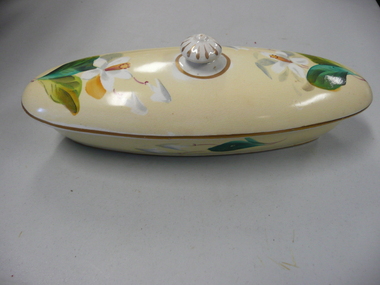
... China toilet boat (English?) of elongated 'oval' shape. Bottom piece has two ridges to make three (low) 'sections' in base. Flower motif...China toilet boat (English?) of elongated 'oval' shape. Bottom piece has two ridges to make three (low) 'sections' in base. Flower motif ...China toilet boat (English?) of elongated 'oval' shape. Bottom piece has two ridges to make three (low) 'sections' in base. Flower motif on top and sides. Inscribed catalog number U4.702.2domestic equipment, containers, toiletries -
 Bendigo Historical Society Inc.
Domestic Object - CHINA PLATES
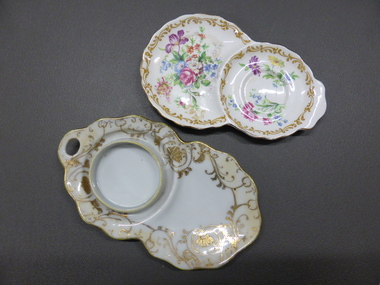
... Two china plates/saucers from Tennis sets. 1. White with floral motifs in various colours with gold decoration and gilding on edges. ...Nosegay Royal Albert Bone China England PEG No 39142 2. White with gilded motifs. Hand painted made in Japan Domestic Object CHINA PLATES ...Two china plates/saucers from Tennis sets. 1. White with floral motifs in various colours with gold decoration and gilding on edges. Nosegay Royal Albert Bone China England PEG No 39142 2. White with gilded motifs. Hand painted made in JapanNosegay Crown Royal Albert Bone China England Peg No 839142 & Hand painted made in Japandomestic equipment, table setting, plate -
 Embroiderers Guild, Victoria
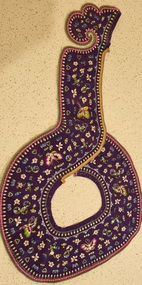
Textile - Chinese Adult Embroidered Collar, 19 th C
... 19 th C Chinese embroidery Adult collar and neckpiece in purple silk heavily embroidered with floral motifs and butterflies in multi-coloured silk threads. ...19 th C Chinese embroideryAdult collar and neckpiece in purple silk heavily embroidered with floral motifs and butterflies in multi-coloured silk threads. Long outside edged with pink woven silk tape. Inner edged with yellow woven silk tape. -
 Embroiderers Guild, Victoria
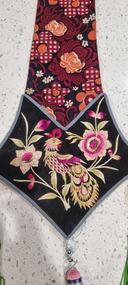
Textile - Pair of Chinese Decorative Hanging Panels
... motifs like peonies and birds (phoenix or rooster) represent cultural symbols of prosperity and beauty. Silk satin stitch on black cotton in pale greens, peach and shades of pink and red. Floral pattern with central symbolic bird. Three tassels hanging from lower edge - two green and one pink. Floral printed cotton hanging bands and backing. Textile Pair of Chinese ...Traditional motifs like peonies and birds (phoenix or rooster) represent cultural symbols of prosperity and beauty.Silk satin stitch on black cotton in pale greens, peach and shades of pink and red. Floral pattern with central symbolic bird. Three tassels hanging from lower edge - two green and one pink. Floral printed cotton hanging bands and backing. -
 Embroiderers Guild, Victoria
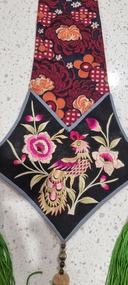
Textile - Pair of Chinese Decorative Hanging Panels
... motifs like peonies and birds (phoenix or rooster) represent cultural symbols of prosperity and beauty. Silk satin stitch on black cotton in pale greens, peach and shades of pink and red. Floral pattern with central symbolic bird. Three tassels hanging from lower edge - two green and one beige. Floral printed cotton hanging bands and backing. Textile Pair of Chinese ...Traditional motifs like peonies and birds (phoenix or rooster) represent cultural symbols of prosperity and beauty.Silk satin stitch on black cotton in pale greens, peach and shades of pink and red. Floral pattern with central symbolic bird. Three tassels hanging from lower edge - two green and one beige. Floral printed cotton hanging bands and backing. -
 Embroiderers Guild, Victoria
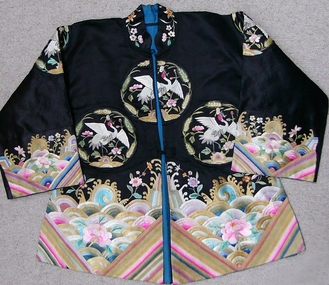
Clothing - Jacket, Ladies
... In Chinese embroidery, the crane (He, 鹤) is a powerful symbol of longevity, wisdom, immortality, and good fortune, often depicted with other auspicious motifs like peaches, pine, or bamboo to enhance these meanings, and historically used on civil officials' rank badges (buzi) to denote high rank and virtue, reflecting aspirations for a long, prosperous, and wise life, linked to Daoist immortals and heavenly ascent. ...In Chinese embroidery, the crane (He, 鹤) is a powerful symbol of longevity, wisdom, immortality, and good fortune, often depicted with other auspicious motifs like peaches, pine, or bamboo to enhance these meanings, and historically used on civil officials' rank badges (buzi) to denote high rank and virtue, reflecting aspirations for a long, prosperous, and wise life, linked to Daoist immortals and heavenly ascent. ...In Chinese embroidery, the crane (He, 鹤) is a powerful symbol of longevity, wisdom, immortality, and good fortune, often depicted with other auspicious motifs like peaches, pine, or bamboo to enhance these meanings, and historically used on civil officials' rank badges (buzi) to denote high rank and virtue, reflecting aspirations for a long, prosperous, and wise life, linked to Daoist immortals and heavenly ascent. Black satin with rich silk embroidery around the hem, which means it may have been made for a lady of high rank. Circular motifs of cranes and storks. Probably made for a pregnancy. Bright blue lining.embroidery, silk embroidery, garments, china, oriental -
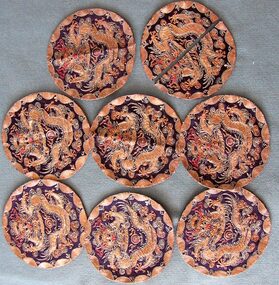 Embroiderers Guild, Victoria
Textile - Medallion
... Embroidery China Silk Embroidery Oriental Garments 7 circular pieces and 2 half circles. Black silk fabric with couched embroidery in gold and coloured threads. Each motif ...7 circular pieces and 2 half circles. Black silk fabric with couched embroidery in gold and coloured threads. Each motif has a dragon in the centre. Lined with blue silk.embroidery, china, silk embroidery, oriental, garments -
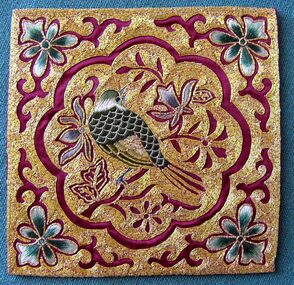 Embroiderers Guild, Victoria
Textile - Rank Badge (replica)
... Embroidery China Silk Embroidery Oriental badge Rank badge depicting birds and flowers. The central bird motif is embroidered in silk thread. ...Purchased in Macau for the Guild by Lady Amies on a trip to South East Asia in June 1972. From the Peoples' Republic of China.Rank badge depicting birds and flowers. The central bird motif is embroidered in silk thread. Remainder of design is worked in gold thread couched with red silk thread. embroidery, china, silk embroidery, oriental, badge -
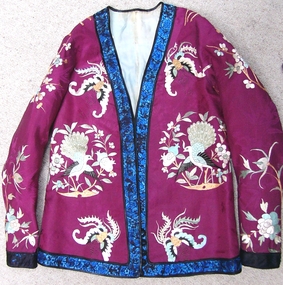 Embroiderers Guild, Victoria
Clothing - Ladies jacket, Early 20th century
... In Chinese embroidery, the combination of bats, peacocks, and peony roses creates a rich tapestry of highly auspicious symbols, primarily associated with wishes for happiness, wealth, beauty, and high rank. When these motifs...In Chinese embroidery, the combination of bats, peacocks, and peony roses creates a rich tapestry of highly auspicious symbols, primarily associated with wishes for happiness, wealth, beauty, and high rank. When these motifs ...In Chinese embroidery, the combination of bats, peacocks, and peony roses creates a rich tapestry of highly auspicious symbols, primarily associated with wishes for happiness, wealth, beauty, and high rank. When these motifs appear together, as they often do in intricate antique textiles or Mandarin squares, they collectively represent a desire for a life filled with wealth, prestige, and abundant happiness. Magenta brocade with embroidered motifs of bats, peacocks and peony roses in coloured silks using satin stitch. Jacket is edged with a band of black silk embroidered with blue peony roses.embroidery, silk embroidery, oriental, garments, 1900-20, china -
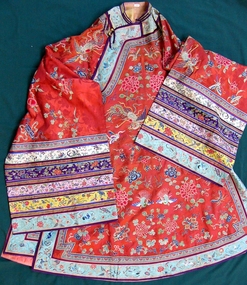 Embroiderers Guild, Victoria
Clothing - Chinese Mandarin Robe, Circa 17th century
... motifs. The birds and butterflies are worked in satin and long and short stitch. Clothing Chinese Mandarin Robe ...Purchased by the donor from a Chinese family on a rubber estate in Malacca for 3 pound in 1922. The country was suffering a deep depression owing to a slump in rubber and many wealthy Chinese were in serious financial difficulties and were realising on anything they could. When the coat was on show at an exhibition the donor was told by someone who had lived in China for many years that it was a very fine example and was possibly 200-300 years old (identified by the cut and fastening of the front panel). The golden pheasants embroidered on the back indicated it came from a Southern state and from a family of high degree. Some years later it was dated as 17th century. Classical style of garment, very long-sleeved in red silk with coloured embroidery. The symbols belong to a high ranking official, symbols of two white doves embroidered on the back, and also the long sleeves with their decorative embroidered bands of turquoise, blue, pink and yellow. The front of the garment overlaps the right side with five small decorative buttons fastened with loops. The buttons were gold and because of their value they were replaced with identical brass buttons. Motifs include phoenix, butterflies, birds, pomegranate, flowers and auspicious symbols. Predominate stitch used is Pekinese Knot Stitch with couched gold outlines of the motifs. The birds and butterflies are worked in satin and long and short stitch. embroidery, garments, china, silk embroidery, oriental, 17th century
