
Showing 6 items matching "chinese rank badges"
-
 Kew Historical Society Inc
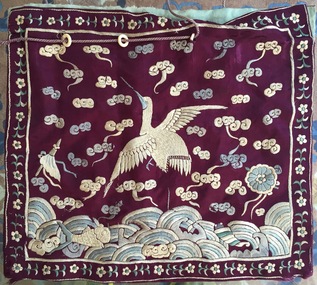
Accessory, Embroidered Silk Evening Bag, c.1950
... ...chinese rank badges...Evening bag constructed from two silk embroidered Chinese rank badges. Authentic badges would have been used on Imperial court costumes in the Ming and Qing Dynasties. ...As other cultures opened to Australian travellers in the 20th century, members began collecting and donating textiles produced in a number of other countries. bags evening bags mandarin squares chinese rank badges Evening bag constructed from two silk embroidered Chinese rank badges. ...The Fashion & Textiles collections of Kew Historical Society include a number of art or household textiles manufactured or created in the United Kingdom as well as in Australia. As other cultures opened to Australian travellers in the 20th century, members began collecting and donating textiles produced in a number of other countries. Evening bag constructed from two silk embroidered Chinese rank badges. Authentic badges would have been used on Imperial court costumes in the Ming and Qing Dynasties. The badges that comprise the bag are identical and were probably sold as souvenirs in Hong Kong during the 20th century. bags, evening bags, mandarin squares, chinese rank badges -
 Embroiderers Guild, Victoria
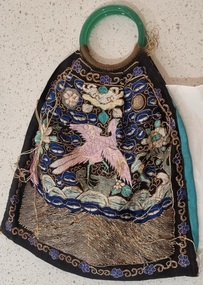
Functional object - Qing Dynasty Chinese Rank Badge Bag, 19 th C
... China not only framed the beautiful badges and hung them on walls, thus preserving them for future generations, but made evening purses of them. They put them under glass-covered serving trays, made decorative boxes adorned by them, and other imaginative items. They were most innovative with the regal badges that had been displayed with great pride by mandarin on the black silk surcoats worn over the colorful dragon robes on all official occasions in the court of the last emperors and empresses of China. Two groups of men achieved badges, civil and military. Each category had nine ranks. The civil rank...Originally a Chinese Civil Rank Badge, repurposed into a bag. Satin stitch and metallic thread couching. ...rank badge, the Paradise Flycatcher. This would be equivalent to receiving our Bachelor of Arts degree. Silk embroidery on silk fabric. Originally a Chinese ...During the late 19th and early 20th century, the badges were prized collector items for wives of western diplomats stationed in Peking or Shanghai, and missionaries throughout China. The western collectors in old China not only framed the beautiful badges and hung them on walls, thus preserving them for future generations, but made evening purses of them. They put them under glass-covered serving trays, made decorative boxes adorned by them, and other imaginative items. They were most innovative with the regal badges that had been displayed with great pride by mandarin on the black silk surcoats worn over the colorful dragon robes on all official occasions in the court of the last emperors and empresses of China. Two groups of men achieved badges, civil and military. Each category had nine ranks. The civil rank badges feature birds for identification, and the military utilize animals, both real and mythological. The first civil examination was generally taken at approximately age 18. Those who passed were awarded the Flower of Talent or Hsiu-ts’ai title and were entitled to wear the ninth rank badge, the Paradise Flycatcher. This would be equivalent to receiving our Bachelor of Arts degree.Silk embroidery on silk fabric. Originally a Chinese Civil Rank Badge, repurposed into a bag. Satin stitch and metallic thread couching. Embroidery in pale mauve, aqua, blue and cream. Central panel has a bird with wings outstretched. Metal thread is used to attach to green Peking glass handles. Internal lining is degraded teal silk. -
 Bendigo Military Museum
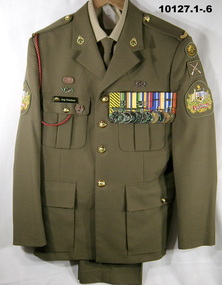
Uniform - SERVICE DRESS, ARMY, Australian Defence Industries, 2016
... CHINA/ MAY 2016/ 60% WOOL/ 40% POLYESTER/ DRY CLEAN ONLY Uniform Jacket, trousers, shirt, necktie, lanyard, medals, beret. 1. 2. & 4. Fabric outer - khaki colour wool and polyester. Lining - dark khaki polyester. 1. Jacket - Service dress style, shoulder epaulettes, four front patch pockets with button down flap. Gold colour plastic buttons with raised emblem - Rising Sun Badge. Army shoulder epaulettes - gold colour 'AUSTRALIA' badge. Cloth shoulder patches - eft sleeve top - gold, black and red. Rising Sun with Queen's Crown and lettering "THE AUSTRALIAN ARMY". Middle - silver and brown crossed rifles = Marksmanship Proficiency. Lower and right sleeves Rank ...Left side - Campaign and service medals = Left to Right. 1. Conspicuous Service Medal. 2. Australian Active Service Medal - 2 clasps - 1 RAQ 2003 - ICAT Afghanistan 2001. 3. Afghanistan Campaign Medal. 4. Iraq Campaign Medal. 5. Australian Service Medal - 2 clasps - Balkans 1997 - 2004, - Sinai - Egypt. 6. Defence Force Service Medal - 3 clasps (25 Years). 7. Australian Defence Medal. 8. North Atlantic Treaty Organisation medal (NATO) 9. British IRAQ Medal. 10. North Atlantic Treaty Organisation and clasp ISAF> 11. Multi National Force and Observers Medal - Sinai - Egypt (These are replica medals). Award badge - Crossed swords with Laurel wreath dark bronze colour = ARMY COMBAT BADGE. Right side - Top to Bottom. Award Badge = COMMANDER 2nd DIVISION COMMENDATION BRONZE 1998-99 Badge = STEYR INDIVIDUAL READINESS Badge Name Badge = Rising Sun Emblem with "GREG WESTHEAD"' Badge = RECENT INSTRUCTOR BADGE. Uniform Jacket, trousers, shirt, necktie, lanyard, medals, beret. 1. 2. & 4. Fabric outer - khaki colour wool and polyester. Lining - dark khaki polyester. 1. Jacket - Service dress style, shoulder epaulettes, four front patch pockets with button down flap. Gold colour plastic buttons with raised emblem - Rising Sun Badge. Army shoulder epaulettes - gold colour 'AUSTRALIA' badge. Cloth shoulder patches - eft sleeve top - gold, black and red. Rising Sun with Queen's Crown and lettering "THE AUSTRALIAN ARMY". Middle - silver and brown crossed rifles = Marksmanship Proficiency. Lower and right sleeves Rank Insignia Patch in colour. Australian Coat of Arms = Regimental Sergeant Major. Lapel Badges - gold colour plastic - Queens Crown above laurel wreath with centre crossed swords = Royal Australian Corps of Military Police. Front left side - Campaign and Service medals Mounted and Award badge. Right side - one award badge and three badges.(Fabric, metal and plastic). 2. Trousers - waistband, belt loops, fob pocket, two side pockets and one back pocket with button down flap. Bottom green plastic metal and nylon zipper fly. Fabric and lining as above. 3. Shirt - light khaki colour polyester/cotton fabric. Short sleeves, collar, shoulder epaulettes, two front patch pockets with button down flap. Buttons - beige plastic. Left and right shoulder and rank cloth patches as per jacket. 4. Necktie - fabric and lining as above. 'V' shape on ends. Two makers labels. 5. Lanyard - braided red and black colour cotton cord with knots. 6. Medals - mounted medals with ribbons. Metal pin on back. 7. Beret - red colour wool felt fabric with black colour polyester and plastic lining. Oval shape. Black colour vinyl trim with ribbon for size adjustment. Front - badge = Royal Australian Corps of Military Police - Queens Crown, Laurel wreath and crossed swords - gold colour plastic and metal.1. & 2. Manufacturers information on lining in black print on white colour fabric. "ADA/MADE IN CHINA/ AUG 2016/CC30BK or CC3087/ ^/ NSN 8405 66 162 6301 or 607?/ SIZE: 110R OR 85R/ NAME:/ PM KEYS NO:/ OUTER: 60% WOOL/40% POLYESTER/LINING: 100% POLYESTER/DRY CLEAN ONLY/ DO NOT WASH/ IRON UNDER DAMP CLOTH/ WARM IRON". 2. Handwritten black ink 'WESTHEAD/ 317595". 4. Tie - top label "ADAY" Lower label "ADAY"/ MADE IN CHINA/ MAY 2016/ 60% WOOL/ 40% POLYESTER/ DRY CLEAN ONLYuniform, army, military police, westhead -
 Embroiderers Guild, Victoria
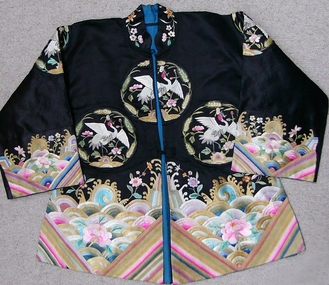
Clothing - Jacket, Ladies
... In Chinese embroidery, the crane (He, 鹤) is a powerful symbol of longevity, wisdom, immortality, and good fortune, often depicted with other auspicious motifs like peaches, pine, or bamboo to enhance these meanings, and historically used on civil officials' rank badges (buzi) to denote high rank and virtue, reflecting aspirations for a long, prosperous, and wise life, linked to Daoist immortals and heavenly ascent. ...In Chinese embroidery, the crane (He, 鹤) is a powerful symbol of longevity, wisdom, immortality, and good fortune, often depicted with other auspicious motifs like peaches, pine, or bamboo to enhance these meanings, and historically used on civil officials' rank badges (buzi) to denote high rank and virtue, reflecting aspirations for a long, prosperous, and wise life, linked to Daoist immortals and heavenly ascent. ...In Chinese embroidery, the crane (He, 鹤) is a powerful symbol of longevity, wisdom, immortality, and good fortune, often depicted with other auspicious motifs like peaches, pine, or bamboo to enhance these meanings, and historically used on civil officials' rank badges (buzi) to denote high rank and virtue, reflecting aspirations for a long, prosperous, and wise life, linked to Daoist immortals and heavenly ascent. Black satin with rich silk embroidery around the hem, which means it may have been made for a lady of high rank. Circular motifs of cranes and storks. Probably made for a pregnancy. Bright blue lining.embroidery, silk embroidery, garments, china, oriental -
 Embroiderers Guild, Victoria
Textile - Rank Badge (replica)
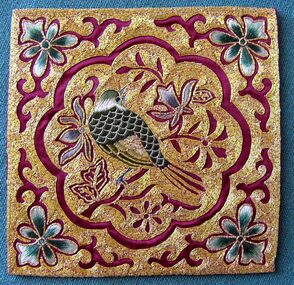
... Embroidery China Silk Embroidery Oriental badge Rank badge depicting birds and flowers. ...Purchased in Macau for the Guild by Lady Amies on a trip to South East Asia in June 1972. From the Peoples' Republic of China.Rank badge depicting birds and flowers. The central bird motif is embroidered in silk thread. Remainder of design is worked in gold thread couched with red silk thread. embroidery, china, silk embroidery, oriental, badge -
 Department of Energy, Environment and Climate Action
Chinese clothing once owned by Bill Ah Chow
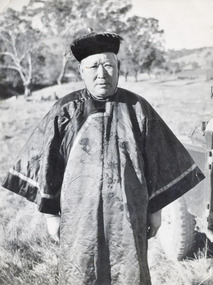
... Chinese Museum in Melbourne gave this advice. Mr. Ah Chow is dressed in a way that imitates a Mandarin or official of the Qing Dynasty. His hat looks like a mandarin style hat, a Qing dynasty official’s headwear, although it’s quite unlikely that he was actually a Mandarin. The button atop the hat usually indicated the wearer’s rank. His robe fastens up to the neck with buttons, which is typical of Manchurian style men’s clothing of the Qing dynasty also. He is not wearing a rank badge...Chinese Museum in Melbourne gave this advice. Mr. Ah Chow is dressed in a way that imitates a Mandarin or official of the Qing Dynasty. His hat looks like a mandarin style hat, a Qing dynasty official’s headwear, although it’s quite unlikely that he was actually a Mandarin. The button atop the hat usually indicated the wearer’s rank. His robe fastens up to the neck with buttons, which is typical of Manchurian style men’s clothing of the Qing dynasty also. He is not wearing a rank badge ...These are the Chinese robes that belonged to Forests Commission fireguard and builder of Moscow Villa - Bill ah Chow. Every organisation has a handful of colourful characters, and the Commission had its share, but Bill remains one of its enduring legends. After Bill's death in 1967, the robes were safely kept by Bill's daughter, Rose, until she died in 1993. The robes then passed to Bill's granddaughter, Janice, and were also highly prized. Janice wrote a book about Bill and Moscow Villa in 2019. After much deliberation, the family felt the retired foresters were better positioned to keep Bill's story alive. Bill loved to tell embellished campfire stories and often claimed to be a descendant of Chinese Royalty, but his family believes the robes were more likely picked up from a second-hand shop in Little Bourke Street in the 1940s. In 2018 the Chinese Museum in Melbourne gave this advice. Mr. Ah Chow is dressed in a way that imitates a Mandarin or official of the Qing Dynasty. His hat looks like a mandarin style hat, a Qing dynasty official’s headwear, although it’s quite unlikely that he was actually a Mandarin. The button atop the hat usually indicated the wearer’s rank. His robe fastens up to the neck with buttons, which is typical of Manchurian style men’s clothing of the Qing dynasty also. He is not wearing a rank badge, which denoted official status. This kind of garment was also normally worn with a separate collar, which Mr. Ah Chow is not wearing in any of these pictures.Chinese clothing including robes, bear skin hat, silk trousers and slippers
