
Showing 165 items matching "circular head"
-
 Narre Warren and District Family History Group
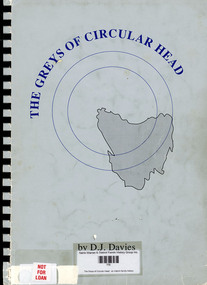
Book, DJ Davies, The Greys of Circular Head : an interim family history, 1991
... The Greys of Circular Head : an interim family history......Circular Head (Tas.)...Stephen Gray Mary Burns Tasmania Circular Head (Tas.) The story of Stephen and Mary Gray who settled at Circular Head in North West Tasmania. ...The story of Stephen and Mary Gray who settled at Circular Head in North West Tasmania.non-fictionThe story of Stephen and Mary Gray who settled at Circular Head in North West Tasmania.stephen gray, mary burns, tasmania, circular head (tas.) -
 Working Heritage Crown Land Collection
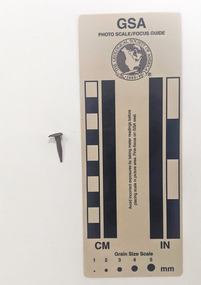
Functional object - Nail, Nail - tack with circular head
... Nail - tack with circular head...Collection of corroded tacks with a circular head....Archaeology Historic Building former Royal Mint Collection of corroded tacks with a circular head. Nail - tack with circular head Functional object Nail Andrew Long and Associates ...Collection of corroded tacks with a circular head.archaeology, historic building, former royal mint -
 Working Heritage Crown Land Collection
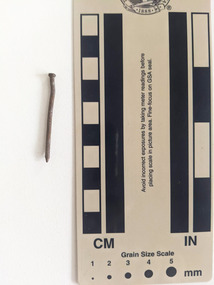
Functional object - Nail, Nail - medium with flattened circular head
... Nail - medium with flattened circular head...Nail - medium with flattened circular head Functional object Nail Andrew Long and Associates ...Corroded nail rounded and consistent in diameter to a pointed tip.archaeology, historic building, former royal mint -
 Working Heritage Crown Land Collection
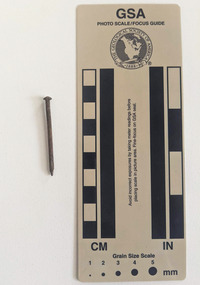
Functional object - Nail, Nail - medium with flattened circular head pointed head (rose head)
... Nail - medium with flattened circular head pointed head (rose head)...Nail - medium with flattened circular head pointed head (rose head) Functional object Nail Andrew Long and Associates ...Corroded nail rounded and consistent in diameter to a pointed tip.archaeology, historic building, former royal mint -
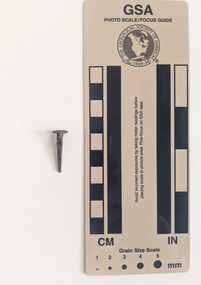 Working Heritage Crown Land Collection
Functional object - Nail, Nail - tack with circular head
... Nail - tack with circular head...Nail - tack with circular head Functional object Nail Andrew Long and Associates ...Collection of 20 corroded tacks with rectangular shaft that narrows to a pointed tip.archaeology, historic building, former royal mint -
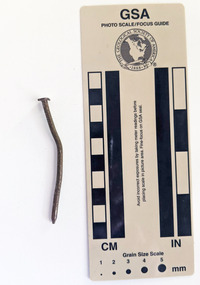 Working Heritage Crown Land Collection
Functional object - Nail, Nail - large with circular head
... Nail - large with circular head...Nail - large with circular head Functional object Nail Andrew Long and Associates ...Corroded nail with rounded shaft and consistent in diameter to a pointed tip.archaeology, historic building, former royal mint -
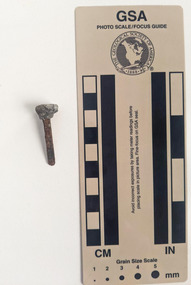 Working Heritage Crown Land Collection
Functional object - Nail, Nail - tack with lead covered circular head
... Nail - tack with lead covered circular head ...Nail - tack with lead covered circular head Functional object Nail Andrew Long and Associates ...Corroded tack with rectangular shaft narrowing to a blunt tip. The head is covered with lead.archaeology, historic building, former royal mint -
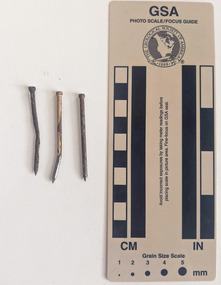 Working Heritage Crown Land Collection
Functional object - Nail, Nail - medium with circular flattened head
... Nail - medium with circular flattened head...White pain on the head of one nail. Nail - medium with circular flattened head Functional object Nail Andrew Long and Associates ...Collection of three corroded nails with a rounded and consistent in diameter to a pointed tip. White pain on the head of one nail. archaeology, historic building, former royal mint -
 Working Heritage Crown Land Collection
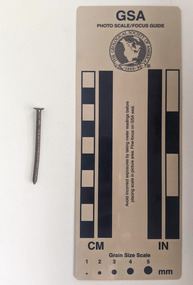
Functional object - Nail, Nail - medium with circular flattened head
... Nail - medium with circular flattened head...Nail - medium with circular flattened head Functional object Nail Andrew Long and Associates ...Corroded nail with a rounded shaft consistent in diameter to a pointed tip.archaeology, historic building, former royal mint -
 Working Heritage Crown Land Collection
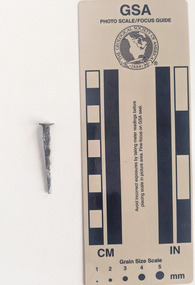
Functional object - Nail, Nail - large tack with circular flattened head
... Nail - large tack with circular flattened head...Nail - large tack with circular flattened head Functional object Nail Andrew Long and Associates ...Corroded tack with square shaft narrowing to a blunt tip. archaeology, historic building, former royal mint -
 Working Heritage Crown Land Collection
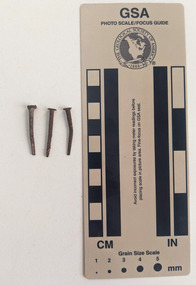
Functional object - Nail, Nail - small with circular flattened head and square shaft
... Nail - small with circular flattened head and square shaft...Archaeology Historic Building former Royal Mint Three corroded nails with a square shaped shaft narrowing to a blunt tip Nail - small with circular flattened head and square shaft Functional object Nail Andrew Long and Associates ...Three corroded nails with a square shaped shaft narrowing to a blunt tiparchaeology, historic building, former royal mint -
 Working Heritage Crown Land Collection
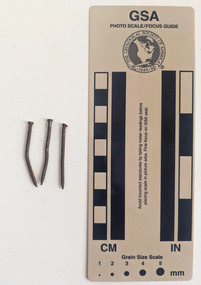
Functional object - Nail, Nail - medium with circular flattened head
... Nail - medium with circular flattened head...Nail - medium with circular flattened head Functional object Nail Andrew Long and Associates ...Collection of three corroded nails with a rounded shaft consistent in diameter to pointed tip.archaeology, historic building, former royal mint -
 Working Heritage Crown Land Collection
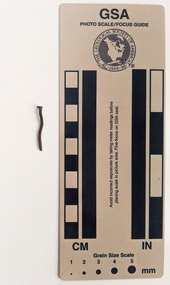
Functional object - Nail, Nail - small with circular flattened head
... Nail - small with circular flattened head...Nail - small with circular flattened head Functional object Nail Andrew Long and Associates ...Small nail with a rounded shaft consistent in diameter to pointed tip.archaeology, historic building, former royal mint -
 Working Heritage Crown Land Collection
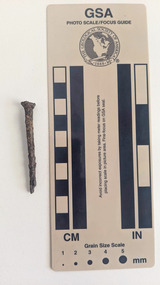
Functional object - Nail, Nail - medium with circular flattened head
... Nail - medium with circular flattened head...Nail - medium with circular flattened head Functional object Nail Andrew Long and Associates ...Corroded nail with rectangular shaft that narrows to a blunt tip.archaeology, historic building, former royal mint -
 Working Heritage Crown Land Collection
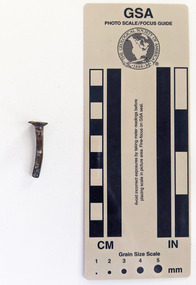
Functional object - Nail, Nail - small with circular flattened head
... Nail - small with circular flattened head...Nail - small with circular flattened head Functional object Nail Andrew Long and Associates ...Corroded nail with rectangular shaft that narrows to a blunt tip.archaeology, historic building, former royal mint -
 Working Heritage Crown Land Collection
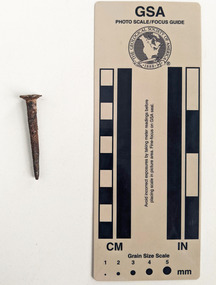
Functional object - Nail, Nail - medium with circular flattened head
... Nail - medium with circular flattened head...The shaft is pinched below the head and there is a white deposit, possibly paint on the nail head. Nail - medium with circular flattened head Functional object Nail Andrew Long and Associates ...Corroded nail with rectangular shaft narrowing to a blunt tip. The shaft is pinched below the head and there is a white deposit, possibly paint on the nail head.archaeology, historic building, former royal mint -
 Flagstaff Hill Maritime Museum and Village
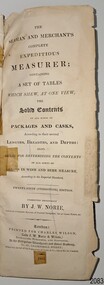
Book - Reference, navigation, J. W. Norie (author and editor), The Seaman and Merchants Complete Expeditious Measurer, 1853
... ...Circular Head...In the 1940s, Rose Anna traded between Hobart, Melbourne, Adelaide, Sydney, Circular Head, Port Fairy, and Port Albert. In the 1950s and 1960s, it traded between Geelong Heads and Hobsons Bay, Melbourne, in lime, wool, general cargo and ballast. ...In the 1940s, Rose Anna traded between Hobart, Melbourne, Adelaide, Sydney, Circular Head, Port Fairy, and Port Albert. In the 1950s and 1960s, it traded between Geelong Heads and Hobsons Bay, Melbourne, in lime, wool, general cargo and ballast. ...The book was published at the same address as London’s Navigation Waterhouse and Naval Academy. It is likely to be one of the textbooks used in educating seafarers, both naval and merchant. It is the twenty-fifth edition, showing that it was in great demand in the early to mid-19th century. Sea merchants could have used this as a reference for working out freight costs for their cargo. Customs Officers could have referred to it as well to calculate fees and taxes. The book’s owner had inscribed in pen and ink "Rose Anna, Schooner, Melbourne, March 25th 1857". At that time, the registered owners were Thomas Lamb & E. Keays, who were freighting cargo between Melbourne and Geelong. Schooner, ROSE ANNA: - The schooner Rose Anna was built in 1844 at Fremantle, W.A., by H. Edwards for Capt. William Heard. The 2-masted wooden vessel was carvel-built. Captain Heard registered Rose Anna at Fremantle in 1845 and in the same year, registered it at Port Adelaide. in 1852, Rose Anna was crushed and sunk at Port Adelaide by the Selma and raised. In 1852, the schooner was lengthened by William Hardy. In 1853, William Burton and W. Roberts registered Rose Anna at Melbourne. In 1855, W. Roberts registered, followed by John Balston & Thomas Ross. In 1856, it was registered by Thomas Lamb & E. Keays, in 1857 by William Howes & Charles Holland, in 1865 by Charles Holland & John Balfour, and in 1866 registered in Melbourne by mariners John Balfour & David Griffiths. In the 1940s, Rose Anna traded between Hobart, Melbourne, Adelaide, Sydney, Circular Head, Port Fairy, and Port Albert. In the 1950s and 1960s, it traded between Geelong Heads and Hobsons Bay, Melbourne, in lime, wool, general cargo and ballast. In 1857, when Rose Anna’s registered owners were Thomas Lamb & E. Keays, an advertisement was placed in The Age on March 9th, announcing that the Rose Anna was taking freight from Melbourne to Geelong. Later in the year, in October, the registered owners were William Howes & Charles Holland. They were still trading with Geelong, as on October 7th, The Age announced that Rose Anna arrived in Geelong from Melbourne on October 5th. On October 6th, 1866, Rose Anna went ashore while loading wheat at Sandridge, Port Phillip Bay, in severe gales and heavy seas and became a total wreck. The book is significant for its association with reference information to instruct sea merchant traders and naval officers. The publication is in its twenty-fifth edition, indicating the importance of such an instructional book. The book of tables and calculations shows the evolution of such reference texts, going from handwritten notes, to printed tables like these, and forward to slide rules, calculators, and to modern time computers. it demonstrates the importance of accuracy in calculating weights and measures at sea and for the purposes of fess, charges and taxes. The book is important to the history of the schooner Rose Anna, which is listed as a significant vessel on the Victorian Heritage Register, S582, as it has an inscription with the ship's name, date, and destination. Book, tall and narrow, with index tabs on the side edges of the pages. FULL Title: The Seaman and Merchants Complete Expeditious Measurer: The Seaman and Merchants Complete Expeditious Measure; containing a set of tables which show, at one view, the solid contents of all kinds of packags and casks, according to their several lengths, breadths and depths: also, rules for determining the contents of all sorts of casks in wine and beer measure, according to the Imperial Standard. Twenty-Fifth (Stereotype) Edition. Author: Mr J W Norie (John William Norie) Date: 1853 Publisher: Charles Wilson (late J.W. Norrie & Wilson), Bookseller, Publisher and Stationer, At the Navigation Waterhouse and Naval Academy, No. 157, Leadenhall Street, where may be had all the publications of Steel & Co. Late at No. 70, Cornhill. Printer: Bateman and Dennis, 95 Leadenhall Street, London, England, 1853 The book has handwritten, pen and ink inscriptions. It refers to the Schooner, Rose Anna, Melbourne, March 25th 1857.Handwritten in script with pen and ink: "Rose Anna / Schooner / Melbourne, / March 25th 1857"flagstaff hill, warrnambool, shipwrecked-coast, flagstaff-hill, flagstaff-hill-maritime-museum, maritime-museum, shipwreck-coast, flagstaff-hill-maritime-village, the seaman and merchants complete expeditious measurer, book, sea merchants, cargo, calculations, measurements, sea trade, maritime book, sea transportation, cargo rate calculations, naval academy, navy education, navigation, navigation instruction, navigation waterhouse and naval academy, twenty-fifth edition, 19th century, 1853, 1857, customs, freight, ullage, rose anna, schooner, 2-masted, march 25th 1857, melbourne, 25 march 1857, thomas lamb & e. keays, geelong, 1844, h. edwards, fremantle, carvel-built, port adelaide, selma, william hardy, william burton and w. roberts, john balston & thomas ross., charles holland & john balfour, john balfour & david griffiths, hobart, sydney, circular head, port fairy, port albert, hobsons bay, sandridge, port phillip bay -
 Tennis Australia
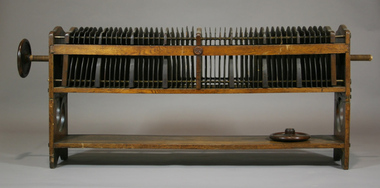
Racquet Press, Circa 1900
... A rare, if not, one of a kind, 48-racquet press, with two large wooden screws with circular heads. Materials: Wood, Metal, Glue...Tennis A rare, if not, one of a kind, 48-racquet press, with two large wooden screws with circular heads. Materials: Wood, Metal, Glue Racquet Press ...A rare, if not, one of a kind, 48-racquet press, with two large wooden screws with circular heads. Materials: Wood, Metal, Gluetennis -
 Federation University Historical Collection
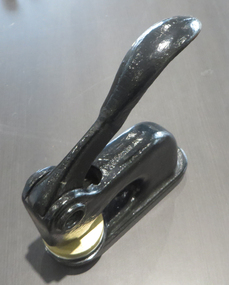
Seal Press, "E.M.U" Press
... (standing for Education Media Unit) presses onto paper Brass circular head on steel disc base....(standing for Education Media Unit) presses onto paper Brass circular head on steel disc base. "E.M.U" Press Seal Press Roeszler ...The press was in a show case in the Library of the Ballarat Institute of Advanced Education and the the University of Ballarat. It came from the Education Media Unit.Black enamelled iron. E.M.U. (standing for Education Media Unit) presses onto paper Brass circular head on steel disc base.Maker's name e m u press, library, ballarat institute of advanced education, education media unit, seal -
 Kiewa Valley Historical Society
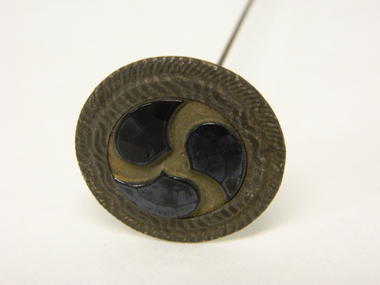
Pin Hat
... This hat pin is adorned with a flat metal circular head. There are two circles of narrow patterns around the outer edge. ...It is also an example of society's mores of tidiness and quasi religious beliefs of covering the hair and head when outdoors costume female head ware accessories hat pin This hat pin is adorned with a flat metal circular head. There are two circles of narrow patterns around the outer edge. ...Historically this item represents women's fashion in the 1920s to 1950s. As the material used in the construction is not of a high monetary value it can be assumed it was a day to day working woman apparel to keep the hat firmly fastened into the hair. It does indicate that fashion of the time was important within the regionThis item is a reflection of both the fashion mode of the 1920s to 1950s when long hair needed to be controlled by hair pins rather than later manufactured hair sprays. It is also an example of society's mores of tidiness and quasi religious beliefs of covering the hair and head when outdoorsThis hat pin is adorned with a flat metal circular head. There are two circles of narrow patterns around the outer edge. The centre is decorated with three shiny black faceted shapes producing a spoke like appearancecostume female head ware accessories, hat pin -
 Bendigo Historical Society Inc.
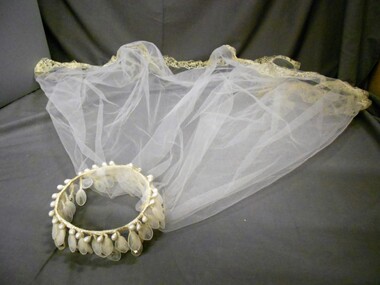
Clothing - BARBARA GALLAGHER COLLECTION: SHOULDER LENGTH WEDDING VEIL, 20/08/1960
... Off white shoulder length wedding veil edged with cream coloured nylon lace with scalloped edge. Circular head piece (Tiara) with double row of small net covered wire oval rings ( 2cm). ...BHS Collection COSTUME Female shoulder length wedding veil Off white shoulder length wedding veil edged with cream coloured nylon lace with scalloped edge. Circular head piece (Tiara) with double row of small net covered wire oval rings ( 2cm). ...BHS CollectionOff white shoulder length wedding veil edged with cream coloured nylon lace with scalloped edge. Circular head piece (Tiara) with double row of small net covered wire oval rings ( 2cm). Second row of oval rings each have a rhinestone stitched in centre. Worn with wedding dress 11400.327.costume, female, shoulder length wedding veil -
 Phillip Island and District Historical Society Inc.
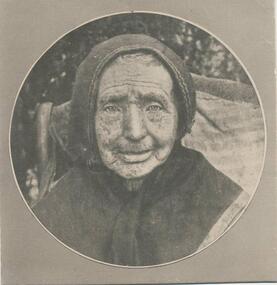
Photograph
... Circular Photograph of head and shoulders of Miss Coghlan aged 113. ...One of a collection of over 400 photographs in an album commenced in 1960 and presented to the Phillip Island & Westernport Historical Society by the Shire of Phillip Island local history photography photographs miss coghlan black & white photograph old eliza John Jenner Bryant West Circular Photograph of head and shoulders of Miss Coghlan aged 113. ...One of a collection of over 400 photographs in an album commenced in 1960 and presented to the Phillip Island & Westernport Historical Society by the Shire of Phillip IslandCircular Photograph of head and shoulders of Miss Coghlan aged 113. Called "Old Eliza". local history, photography, photographs, miss coghlan, black & white photograph, old eliza, john jenner, bryant west -
 Emerald Museum & Nobelius Heritage Park
Document - Documents, Clematis Miscellaneous Items, 1950s
... There is also a circular headed "Conversion of the Ferntree Gully to Gembrook Railway" complied and issued by the Dandenong Ranges Combined Progress Association. ...There is also a circular headed "Conversion of the Ferntree Gully to Gembrook Railway" complied and issued by the Dandenong Ranges Combined Progress Association. ...Accession contained several newspaper clippings covering a range of topics. There are two letters from the Gembrook Railway League directed to the Clematis Progress Association, copies of petitions and 33 copies of various parts of a proposed roundabout at Belgrave-Gembrook Road and Wellington Rd opposite Paradise Hotel. There are lso 5 laminated copies of "What,When,Where,Who" by Gus Ryberg, there are also 3 un-laminated copies of the same. There is also a circular headed "Conversion of the Ferntree Gully to Gembrook Railway" complied and issued by the Dandenong Ranges Combined Progress Association. Date Range of items 1936-1984. Currently only two letters from the Gembrook Railway League directed to the Clematis Progress Association can be located, the location rest of the bulk accession is currently unknown.Various items that all have some relevance to Clematis and Surrounding areas Date Range of items 1936-1984. Currently only two letters from the Gembrook Railway League directed to the Clematis Progress Association can be located, the location rest of the bulk accession is currently unknown.1956 letter contains inscription: 'Read too late for April meeting'emerald, victoria, australia, documents, gembrook railway league, clematis, clematis progress association -
Glenelg Shire Council Cultural Collection
Tool - Marlin spike, n.d
... Metal spike with timber knob/handle. Circular groove around head of knob, which has a nail inserted in it...Shaped in the form of a polished metal cone tapered to a rounded or flattened point, it is used in such tasks as unlaying rope for splicing, untying knots, drawing marline tight using a marlinspike hitch, and as a toggle joining ropes under tension in a belaying pin splice. marine technology maritime industry rope making rope work Metal spike with timber knob/handle. Circular groove around head of knob, which has a nail inserted in it Tool Marlin spike ...Used by Peter Carrison, donor's father-in-law, who was a boat builder. Originally used by Henty brothers for wire cable splicing. A marlinspike (/ˈmɑːrlɪnspaɪk/, sometimes spelled marlin spike, marlinespike, or [archaic] marlingspike) is a tool used in marine ropework. Shaped in the form of a polished metal cone tapered to a rounded or flattened point, it is used in such tasks as unlaying rope for splicing, untying knots, drawing marline tight using a marlinspike hitch, and as a toggle joining ropes under tension in a belaying pin splice.Metal spike with timber knob/handle. Circular groove around head of knob, which has a nail inserted in itmarine technology, maritime industry, rope making, rope work -
 St Kilda Historical Society
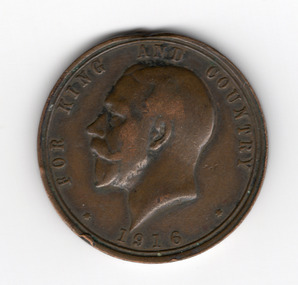
Souvenir - Medallion, ANZAC day medallion, 1916
... Circular medallion with head of King George V facing left on obverse, and a wreath surrounding the word 'ANZAC' on the reverse...OF EDUCATION VICTORIA LEST WE FORGET 25 APR 15 (around circumference) Circular medallion with head of King George V facing left on obverse, and a wreath surrounding the word 'ANZAC' on the reverse ANZAC day medallion Souvenir Medallion ...The ANZAC Day medallion was struck by the Education Department of Victoria for school children in 1916, to commemorate the first anniversary of the ANZAC Forces landing at Gallipoli on 25 April 1915. It was issued for sale to children and the general public.Circular medallion with head of King George V facing left on obverse, and a wreath surrounding the word 'ANZAC' on the reverseObverse: FOR KING AND COUNTRY 1916 Reverse; ANZAC (surrounded by wreath) DEPT. OF EDUCATION VICTORIA LEST WE FORGET 25 APR 15 (around circumference) wwi, world war i, anzac day -
 Alfred Hospital Nurses League - Nursing History Collection
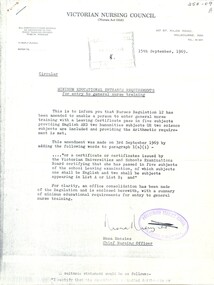
Document - Minimum educational entrance requirements, Victorian Nursing Council, Minimum educational entrance requirements for entry into general nurse training, 15th September 1969 (copy), 19690913
... Four pages, printed letter head and circular typed in black ink....Circular has been signed by Mona Menzies. There is a rectangular date stamp at top of page 'ALFRED HOSPITAL/19 SEP 1969 /initalled in black ink'. At the bottom of the page is an oval stamp 'PRELIMINARY TRAINING SCHOOL/ALFRED HOSPITAL' around margin. In the centre of this stamp something has been crossed out. Previous catalogue number handwitten at top right of all pages along with the letter 'A','B','C' or 'D' Four pages, printed letter head ...Letter sent to hospitals in 1969, from the Victorian Nursing Council updating the minimum educational entrance requirements for entry into general nurse training as at 19690903, Cover letter clarifies changesOf significance to he AHNL as it documents the changing educational requirements for prospective nursesFour pages, printed letter head and circular typed in black ink.Circular has been signed by Mona Menzies. There is a rectangular date stamp at top of page 'ALFRED HOSPITAL/19 SEP 1969 /initalled in black ink'. At the bottom of the page is an oval stamp 'PRELIMINARY TRAINING SCHOOL/ALFRED HOSPITAL' around margin. In the centre of this stamp something has been crossed out. Previous catalogue number handwitten at top right of all pages along with the letter 'A','B','C' or 'D'nursing education-victoria=history, victorian nursing council -
 Flagstaff Hill Maritime Museum and Village
Functional object - Rod, Approx. 1871
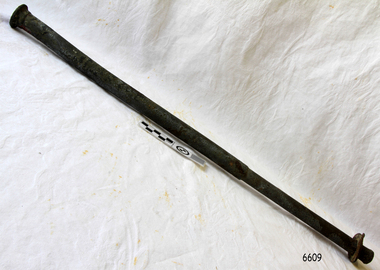
... The narrow end flares out slightly in the last few centimetres with a burred foot and has a circular head on the wider end. The washer on the narrower end cannot move past the centre or the narrow end of the rod. ...The narrow end flares out slightly in the last few centimetres with a burred foot and has a circular head on the wider end. The washer on the narrower end cannot move past the centre or the narrow end of the rod. ...This rod was salvaged from the American three-masted wooden clipper ship, Eric the Red, named after the Viking discoverer, Eric the Red. The ship first traded in coal between America and Britain and later traded in guano nitrates from South America. In 1879 its hull was re-metalled and the vessel was in first class condition. On 10th June 1880 Eric the Red departed New York under the command of Captain Z Allen, with 24 crew plus two passengers. It was heading for Melbourne and then Sydney. The ship was commissioned by American trade representatives to carry a special cargo of 500 American exhibits for the U.S.A. pavilion at Melbourne’s first International Exhibition. The items included furniture, ironmongery, wines, chemicals, dental and surgical instruments, paper, cages, bronze lamp trimmings, axles, stamped ware, astronomical and time globes, and samples of corn and the choicest of leaf tobacco. Also on board was general merchandise such as cases of kerosene and turpentine, brooms, Bristol's Sarsaparilla, Wheeler and Wilson sewing machines, Wheeler’s thresher machine, axe handles and tools, cases of silver plate, toys, pianos and organs, carriages and Yankee notions. The ship had been at sea for 85 days when, on 4th September 1880, it hit the Otway Reef on the southwest coast of Victoria and was quickly wrecked. Captain and crew ended up on floating parts, or in the long boat or the sea. He was amongst the 23 battered and injured men who were rescued by the steamer Dawn and later taken to Warrnambool, where they received great hospitality and care. Four men lost their lives; three crew and one passenger. Captain Allen took the train back to Melbourne and then returned to America. The captain and crew of the Dawn were recognised by the United States Government in July 1881 for their humane efforts, being thanked and presented with substantial monetary rewards, medals and gifts. The salvaging ship Pharos collected Wheeler and Wilson sewing machines, nests of boxes, bottles of Bristol’s sarsaparilla, pieces of common American chairs, axe handles, a Wheelers’ Patent thresher and a sailor’s trunk with the words “A. James” on the front. A ship’s flag board bearing the words “Eric the Red” was found on the deckhouse; finally, those on board the Pharos had found the name of the wrecked vessel. The government steamer Victoria and a steamer S.S. Otway picked up flotsam and wreckage. A whole side of the hull and three large pieces of the other side of the hull, with some of the copper sheathing stripped off, had floated onto Point Franklin. Some of the vessel's yards and portions of its masts were on shore with pieces of canvas attached, confirming that the vessel had been under sail. On shore were many cases of Diamond Oil kerosene labelled R. W. Cameron and Company, New York. large planks of red pine, portions of a small white boat and a large, well-used oar. There were sewing machines, some consigned to ‘Long and Co.”, and notions, axe and scythe handles, hay forks, wooden pegs, rolls of wire, some branded “T.S” and Co, Melbourne”, and kegs of nails branded “A.T. and Co.” from the factory of A. Field and Son, Taunton, Massachusetts. Other cargo remains included croquet balls and mallets, buggy fittings, rat traps, perfumery, cutlery and Douay Bibles, clocks, bicycles, chairs, a flywheel, a cooking stove, timber, boxes, pianos, organs, wooden clothes pegs and a ladder. There were three cases of goods meant for the Exhibition Other items salvaged from amongst the debris floating in the sea were chairs, doors, musical instruments, washing boards, nests of trunks and flycatchers. Most of the goods were saturated and smelt of kerosene. A section of the hull lies buried in the sand at Parker River Beach. An anchor with a chain is embedded in the rocks east of Point Franklin and a second anchor, thought to be from Eric the Red, is on display at the Cape Otway light station. A life belt was once on the veranda of Rivernook Guest House in Princetown with the words “ERIC THE RED / BOSTON”. Parts of the ship are on display at Bimbi Park Caravan Park and Apollo Bay Museum. Flagstaff Hill Maritime Village also has several artefacts from the wreck. There seemed to be no personal luggage or clothing. “The Eric the Red is historically significant as one of Victoria's major 19th century shipwrecks. (Heritage Victoria Eric the Red; HV ID 239) The wreck led to the provision of an additional warning light placed below the Cape Otway lighthouse to alert mariners to the location of Otway Reef. The site is archaeologically significant for its remains of a large and varied cargo and ship's fittings being scattered over a wide area. The site is recreationally and aesthetically significant as it is one of the few sites along this coast where tourists can visit identifiable remains of a large wooden shipwreck, and for its location set against the background of Cape Otway, Bass Strait, and the Cape Otway lighthouse.“ (Victorian Heritage Database Registration Number S239, Official Number 8745 USA)Iron rod with flat lugged washer. The rod is made of a heavy metal with encrustations and signs of rusting on the surface. It is stepped down in diameter mid-shaft and is slightly bowed on the narrower end. The narrow end flares out slightly in the last few centimetres with a burred foot and has a circular head on the wider end. The washer on the narrower end cannot move past the centre or the narrow end of the rod. The washer is a different metal from the rod and has a small lug jutting out along the circumference in one position. The rod was recovered from the wreck of the ship the Eric the Red.flagstaff hill, warrnambool, shipwrecked-coast, flagstaff-hill, flagstaff-hill-maritime-museum, maritime-museum, shipwreck-coast, flagstaff-hill-maritime-village, rod, iron-rod, eric the red, steamer dawn, cape otway reef, 1880, captain allen, usa pavillion, melbourne exhibition, melbourne international exhibition, captain jones, medal, united states government, pharos, a. james, flag board, steamer victoria, steamer otway, diamond oil, r w cameron and company, long and co., t s and co melbourne, a. field and son, taunton, massachusetts, ketch apollo, ship nail -
 City of Moorabbin Historical Society (Operating the Box Cottage Museum)
Tool - Hammer, wood metal taper head, c1900
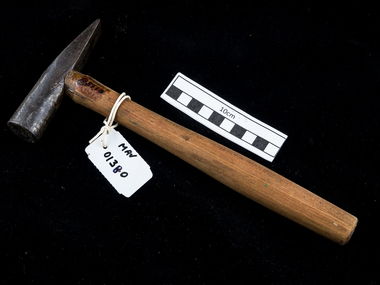
... c1900 Hammer with a wooden handle and metal head. The metal head a circular striking edge and a tapered wedge shaped edge...This hammer is typical of the type used by early settlers in Moorabbin Shire c1900 hammers, early settlers, market gardeners, blacksmiths, tools, building equipment, moorabbin shire, bentleigh, mckinnon, highett, cheltenham,mcewan james pty ltd, melbourne, bunnings pty ltd, c1900 Hammer with a wooden handle and metal head. The metal head a circular striking edge and a tapered wedge shaped edge Tool Hammer, wood metal taper head ...Among the early settlers in Moorabbin Shire were blacksmiths who made tools for the other settlers who were establishing the homes, market gardens, farms, orchards and various businesses. Early settlers were self reliant and repaired their own equipment for kitchen,dairy, farm, horses, carts using various tools . This hammer is typical of the type used by early settlers in Moorabbin Shire c1900c1900 Hammer with a wooden handle and metal head. The metal head a circular striking edge and a tapered wedge shaped edgehammers, early settlers, market gardeners, blacksmiths, tools, building equipment, moorabbin shire, bentleigh, mckinnon, highett, cheltenham,mcewan james pty ltd, melbourne, bunnings pty ltd, -
 Kiewa Valley Historical Society
Butter Stamp Block, Circa 1950
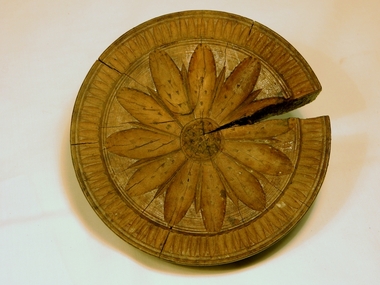
... The pattern on the face of the stamp is of an eleven petalled flower pattern around a small circular flower head. Both the head and petals have indentations which are will produce raised points in the pressed butter. ...The pattern on the face of the stamp is of an eleven petalled flower pattern around a small circular flower head. Both the head and petals have indentations which are will produce raised points in the pressed butter. ...At the time when this shortbread / butter stamp block was used, rural dairies and larger properties who manufactured their own butter used butter stamps blocks for identifying the source of the butter or for decoration.. The patterns stamped into the warmed butter provided for a range of decorative visual enhancement to the "plain" and "boring" straight leveled normal butter surface. Although the wooden surfaces could be hard to keep clean commercial usage would have been limited and eventually replaced by a non porous and hygienically cleaner material. Greater hygiene controls where introduced. from the late 1940s on. These controls were the result of high infectious illnesses due to contaminated milk and dairy handling methods.This shortbread / butter stamp was used by a Kiewa Valley dairy and it presents what the domestic butter beautification processes were available during the mid to latter 1900s was. Their was a pride by rural properties in their produce and its by-products.This shortbread / butter stamp is made from wood, round and fashioned from a flat bed to a dome top. The top has a round moulded hole with screw indentations for fastening a pressure pole. The pattern on the face of the stamp is of an eleven petalled flower pattern around a small circular flower head. Both the head and petals have indentations which are will produce raised points in the pressed butter. Enclosing the flower pattern is a pattern which when pressed against the butter would produce small ridges radiating outward.On the dome stamped in black ink "T. & W. Davies"butter stamp, domestic butter blocks, domestic food preparations., shortbread, stamp, dairy, butter -
 Old Colonists' Association of Ballarat Inc.
Photograph - Photograph - Colour, The entrance foyer of the Old Colonists' Club, 2015
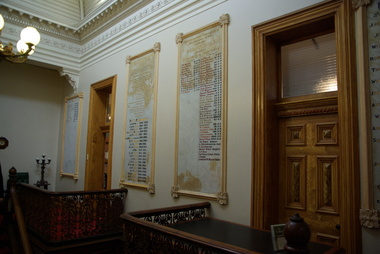
... The entrance is through a spacious circular headed doorway, the keystone of the arch of which bears a sculptured head, in marble, representing that of the president of the Old Colonists' Association here, Mr. ...The entrance is through a spacious circular headed doorway, the keystone of the arch of which bears a sculptured head, in marble, representing that of the president of the Old Colonists' Association here, Mr. ...From the Argus Newspaper of 10 May 1888: "OLD COLONISTS' ASSOCIATION OF BALLARAT. (FROM OUR CORRESPONDENT.) BALLARAT, WEDNESDAY. This association, which was founded in August, 1883, and at first known as the Old Identities' Association, now has a roll of 450 members. The objects of the association are "to aid and assist indigent or suffering old colonists; to raise a fund, by the voluntary subscriptions of the members and the aid of outside donations, for the purpose of relieving members in sickness and old age ; for assisting those in extreme distress, to provide the shelter o a home for old and indigent pioneers of the gold fields, their widows, or anyone connected with the association, and in the event of the death of any member to have his remains decently buried, the association defraying the expenses of the funeral (providing that no funds or property are left by the deceased), and to attend the funeral if so desired by the relatives " The qualifications for member- ship are good character and repute, and residence in the colonies for a quarter of a century. For some time the association had no property except the regular subscriptions, but about a year ago they obtained from the Minister of Lands the grant of a very valuable block of land in Lydiard-street, the Crown grant of which they received last week. This block has a frontage of 66ft to Lydiard street, worth at least £100 a foot. The ground was given to the association as a site for them to build a hall upon, and with so valuable an asset they had no difficulty in borrowing at 7 per cent, enough money to construct a hall. For revenue purposes the ground floor of the building has been made into four shops, and the rental from these, judging from the rentals of shops in the vicinity, will not only pay all the interest on the borrowed money, but over £200 a year towards clearing off the principal. The officers of the association are Messrs J P Murray, president; J W Graham and T. Stoddart, vice presidents; D Fern, treasurer , and J Fraser, secretary. The Old Colonists' Hall is an elegant looking building in Lydiard-street, lying between the newly-opened mining exchange and the Commercial Club house, and a few doors north of the Post office. The style of the facade is classic. The lower portion of the front is constructed of Waurn Ponds stone, forming piers, and the upper portion of brick and cement, the background being tuckpointed. The centre bay is carried by two three quarter columns with Ionic cups, which support a pediment on which is set a cast of the Ballarat coat of arms. The four other bays are supported by pilasters with Corinthian caps mid partly fluted. The entrance is through a spacious circular headed doorway, the keystone of the arch of which bears a sculptured head, in marble, representing that of the president of the Old Colonists' Association here, Mr. John P Murray. An ample vestibule leads to a wide stone staircase which ends at a spacious landing. The landing has a dome over the centre, with cornice and enrichments, and is lighted from above. The walls round the landing are panelled with marble slabs, which are to be appropriately inscribed in the future. On the first door are the rooms appropriated to the association. The principal of these is a hall 44ft x 33ft and 17ft high. This room is well ventilated and lighted from the back of the building with large windows, and the walls are finished with Keene's cement. The other rooms are committee room, 14ft x 16ft; scretary's, 14ft x 17ft 6in; kitchen, bedrooms, bathroom, &c. The front portion of the first floor is arranged so that it may be let for offices, or utilised for club purposes. Suitable provision has been made throughout tor lighting, ventilation, and means of egress. The architect for the edifice is Mr A. G Legge, of this city, and the contractors are Messrs. Whitelaw and Atkinson, Irving and Glover, Reynolds, and J Donaldson. The total cost of the building when completed, which will be in a few weeks, will be about £4,000."Colour photograph of a room with marble plaques on the wall. They relate to the Old Colonists' Association of Ballarat, old colonists' association ballarat, old colonists' club, marbles
