
Showing 19 items matching "civilian internees"
-
 Tatura Irrigation & Wartime Camps Museum
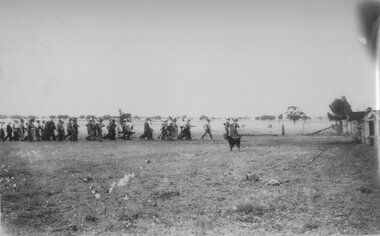
Photograph, marching across paddocks, 1940
... german civilian internees...Photographs show German civilian internees being transferred from Dhurringile internment camp (Mansion) via "Kiota" farm to Camp 1. ...Photographs show German civilian internees being transferred from Dhurringile internment camp (Mansion) via "Kiota" farm to Camp 1. ...Photographs show German civilian internees being transferred from Dhurringile internment camp (Mansion) via "Kiota" farm to Camp 1. Bill Pargeter owned "Kiota" farm at that time (January 1940).2 sepia coloured photograph depicting internees marching across paddocks, under guard, with soldiers carrying guns.german civilian internees, dhurringile camp, kiota farm, camp 1 -
 Tatura Irrigation & Wartime Camps Museum
Book, Kay Dreyfus, Silences and Secrets: The Australian Experience of the Weintraubs Syncopators, 2013
... ...civilian internees...The Tatura group of camps were built after the beginning of World War 2, and held prisoners of war (enemy military) and civilian internees (enemy nationals, regardless of political affiliation, either living in Australia or in Allied territories overseas). ...The Tatura group of camps were built after the beginning of World War 2, and held prisoners of war (enemy military) and civilian internees (enemy nationals, regardless of political affiliation, either living in Australia or in Allied territories overseas). ...(From back cover): "The Weintraubs Syncopators, international musical celebrities of the 1930s, embarked on a four-year journey across Europe, Russia and the Far East in exile from the antisemitic ideologies of the German Third Reich. This band of mainly Jewish musicians arrived in Sydney, Australia, in 1937. The decision of some of them to stay brought them into conflict with the aggressively protectionist Musicians’ Union of Australia. They gained employment at a high-end Sydney nightclub but when war came, were forced to come to terms with a change in their status – from celebrities to enemy aliens. Denounced for alleged espionage activities in Russia, three were interned and the band broke up. In this major recounting of the experience of the Weintraubs Syncopators, Kay Dreyfus pieces together the complex personal, social and political forces at work in this story of migration at a time of insecurity, fear and dramatic conflict." The Tatura group of camps were built after the beginning of World War 2, and held prisoners of war (enemy military) and civilian internees (enemy nationals, regardless of political affiliation, either living in Australia or in Allied territories overseas). The Weintraubs Syncopators' members were just some of the civilians caught up in the conflict. Paperback book. Glossy black front cover, black & white photo of group of musicians. Blue & white text. Back cover glossy white, black & white photo group of men standing over bass drum labelled "Weintraubs Syncopators". 305 pages. Dewey no. 781.65092weintraub, camp 1, tatura, internment camps, civilian internees, jazz, jewish community, world war ii, musicians, stefan weintraub, horst graff -
 Bendigo Military Museum
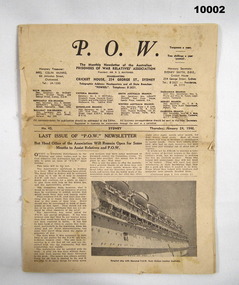
Newsletter - POW NEWSLETTER WW2, Deaton & Spencer P/L, 24 Jan 1946
... Yellowing paper with black writing containing pictures, articles and letters relating to P.O.W.'s and civilian internees....Yellowing paper with black writing containing pictures, articles and letters relating to P.O.W.'s and civilian internees. Newsletter POW NEWSLETTER WW2 Deaton & Spencer P/L ...Last issue of newsletter published by Australian Prisoners of War Association to families and friends of individual internees.Small 16 page newsletter. Yellowing paper with black writing containing pictures, articles and letters relating to P.O.W.'s and civilian internees.No inscriptions.prisoner of war, newsletter -
 Tatura Irrigation & Wartime Camps Museum
Plastic Envelope, Australian Military Forces, service and casualty forms, revised May 1941
... ...japanese civilian internees...Photographer interned at Hay, Tatura and died 26 June 1944 Tatura. yasukichi murakami japanese photographers japanese internees japanese pow's japanese civilian internees Minor heading - Yasukichi Murakami captured 8 December 1941 at Darwin. ...Yasukichi Murakami captured 8 December 1941 at Darwin. Born 19 December 1880 at Wakayama-Ken Japan. Photographer interned at Hay, Tatura and died 26 June 1944 Tatura. a clear plastic envelope containing the seven service and casualty forms as described in catalogue no C2084Minor heading - Yasukichi Murakami captured 8 December 1941 at Darwin. Born 19 December 1880 at Wakayama-Ken Japan. Photographer interned at Hay, Tatura and died 26 June 1944 Tatura.yasukichi murakami, japanese photographers, japanese internees, japanese pow's, japanese civilian internees -
 Tatura Irrigation & Wartime Camps Museum
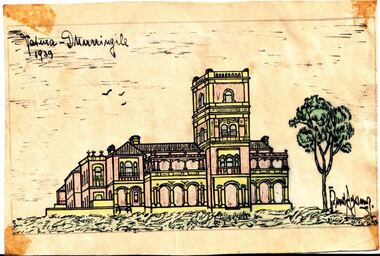
Sketch, Dhurringile, 1939
... ...civilian internees...Also donated some photos - cat. no. 1203.7 tatura dhurringile garrison civilian internees Tatura - Dhurringile 1939.|Signature of artist bottom right of sketch, not very legible. ...Given to a guard at Dhurringile, Arthur Severino. Passed on to his son, William, upon his death. Also donated some photos - cat. no. 1203.7Pencil & ink? drawing of Dhurringile Mansion by an internee there. Given to garrison member Arthur Severino, who was there November 1939 - June 1940.Tatura - Dhurringile 1939.|Signature of artist bottom right of sketch, not very legible. R---? A? J---?tatura, dhurringile, garrison, civilian internees -
 Tatura Irrigation & Wartime Camps Museum
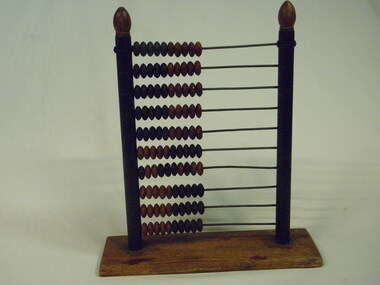
Abacus, Between 1939-1945
... ...civilian internees...Camp 3 was a civilian 'family' camp. The abacus was made by a German internee, for his son in the camp. ...It was made from scrap materials found in and around the camp & the beads & other wooden parts of the abacus were turned on a lathe also constructed by the internees. camp 3 tatura internment camps civilian internees Wood & metal abacus with wooden base, sides & beads (100), & metal rails. ...Camp 3 was one of the Tatura Group of civilian & prisoner of war internment camps during World War 2. Camp 3 was a civilian 'family' camp. The abacus was made by a German internee, for his son in the camp. It was made from scrap materials found in and around the camp & the beads & other wooden parts of the abacus were turned on a lathe also constructed by the internees. Wood & metal abacus with wooden base, sides & beads (100), & metal rails. Wood painted red & black. camp 3, tatura, internment camps, civilian internees -
Tatura Irrigation & Wartime Camps Museum
Document - Memoir, Hermine Wedel, Memories of Tatura, July 2014
... ...internee camps...civilian...The author also briefly recounts her marriage & married life in Brazil & Germany. world war ii internee camps civilian internees german internees camp 3 tatura new guinea strauss stuerzenhofecker 13 page document, A4 paper. 7 pages of English translation, 6 pages German original. ...An account of the author's family background & early life, more particularly those events leading to their internment in Tatura, Victoria, Australia during World War 2. The author's parents (author Hermine Wedel, nee Strauss) were of German nationality & practicing as missionaries in New Guinea. Upon the outbreak of WW2, those German nationals were ordered to the coast by the Australian authorities and the men were transported to internment camps in Australia. The women remained behind, reporting regularly to the authorities, until they too were brought to camps in Australia at the end of 1941. They were eventually reunited in a family camp for internees, Camp 3 at Tatura, in 1943. They were released from the camp to work in Australia in 1947 and the family returned to New Guinea in 1949, and eventually went back to Germany. The author also briefly recounts her marriage & married life in Brazil & Germany. 13 page document, A4 paper. 7 pages of English translation, 6 pages German original. world war ii, internee camps, civilian internees, german internees, camp 3, tatura, new guinea, strauss, stuerzenhofecker -
 Tatura Irrigation & Wartime Camps Museum
Photograph, 1947
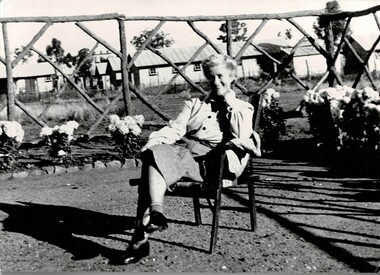
... Camp 3 Wardens and their involvement with the civilian internees....Camp 3 Wardens and their involvement with the civilian internees. internee children camp 3 camp 3 wardens F. ...Camp 3 Wardens and their involvement with the civilian internees.Black and white photograph of F. A. (Jack) Jackson 1947 Warden seated in a chair. Legs crossed. Background of huts, trellis work of poles.internee children, camp 3, camp 3 wardens, f. a. (jack) jackson -
 Tatura Irrigation & Wartime Camps Museum
Certificate, Deutches Reichs Sportabzeichen, 1945
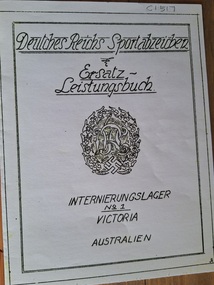
... Sporting events were organized and carried out by the German civilian internees within the compounds of the camp. ...Sporting events were organized and carried out by the German civilian internees within the compounds of the camp. ...Sporting events were organized and carried out by the German civilian internees within the compounds of the camp. This certificate sets out standards and achievement of internee.The item indicates the organizational capabilities of the internees and the sporting facilities made available by the Australian authorities. Photocopy of eight pages, five blank, hand printed and typed certificate, personally signed containing sports performances conducted in Camp 1. All in German. Photocopy.german internees, camp sport programmes, internment camp sports, wiessling -
 Tatura Irrigation & Wartime Camps Museum
Portrait
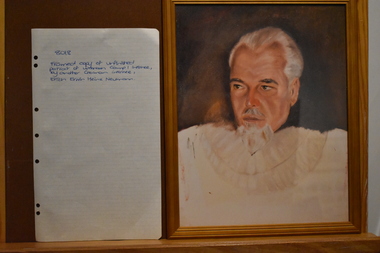
... Erich Erwin Heinz Neumann was a German civilian internee in Camp 1, Tatura, during WWII. ...Erich Erwin Heinz Neumann was a German civilian internee in Camp 1, Tatura, during WWII. ...Erich Erwin Heinz Neumann was a German civilian internee in Camp 1, Tatura, during WWII. He was an artist & this portrait, although unfinished, was of another internee, a Count, (name currently unknown), in the same camp. This is a framed, photographic copy of the original portrait, donated by the daughter of the artist, photograph taken by the grandson, (Tim Allan of TA Media, Adelaide, South Australia).Framed photograph copy of unfinished portrait of unknown Camp 1 internee, Count ....., by another German internee, Erich Erwin Heinz Neumann. Tan frame. Subject on dark background, white beard & hair, white clothing. tatura, camp 1, internee camps, illustrations, erich erwin heinz neumann, camp artwork, internment artwork -
Tatura Irrigation & Wartime Camps Museum
Folder, Australian Military Forces, Australian Archives Brighton May 1991, revised May 1941
... The interesting records of Japanese civilian internees in Camp 4. The Rev Len Kentish, pilot Hajime Toyashima and take to Cowra where he became one of the ringleaders of the infamous breakout and died during the attempt and made available with the efforts of the Knee family with the cooperation of the Australian Archives, also Shepparton News cutting, Keith Esson, Alan Fitzgerald. ...The interesting records of Japanese civilian internees in Camp 4. The Rev Len Kentish, pilot Hajime Toyashima and take to Cowra where he became one of the ringleaders of the infamous breakout and died during the attempt and made available with the efforts of the Knee family with the cooperation of the Australian Archives, also Shepparton News cutting, Keith Esson, Alan Fitzgerald. ...The interesting records of Japanese civilian internees in Camp 4. The Rev Len Kentish, pilot Hajime Toyashima and take to Cowra where he became one of the ringleaders of the infamous breakout and died during the attempt and made available with the efforts of the Knee family with the cooperation of the Australian Archives, also Shepparton News cutting, Keith Esson, Alan Fitzgerald. Italian farming soldiers.Seven Australian military forces internee/POW service and casualty forms, overprinted Japanese in individual plastic envelopes, clear plastic cover with a green border and back cover. Also the last page has details of the first Australian POW taken by Japanese on Australia soil and the first Japanese POW on Melville Island and captured by the aboriginals, one of who spoke fluent Japanese.On the green border - Australian Archives Brighton May 1991 Camp 4 Yasukichi and Terese Mupvakami and family internment camp records.rev len kentish, hajime toyashima, cowra, camp 4, keith esson, alan fitzgerald, italian farming soldiers, cowra breakout, shepparton news, japanese internees -
 Tatura Irrigation & Wartime Camps Museum
Artwork, other - Puppet, The Prince
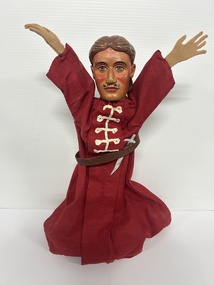
... Civilian internee Irmhild Beinssen wrote three puppet plays for the children of Camp 3A, Tatura. ...Civilian internee Irmhild Beinssen wrote three puppet plays for the children of Camp 3A, Tatura. ...Civilian internee Irmhild Beinssen wrote three puppet plays for the children of Camp 3A, Tatura. Her sister, Gisela von Koch, wrote the music and helped with costumes. Beinssen, her husband Ekkehard and her sister voiced and operated the puppets. Alfons Konig carved the puppets' heads from box wood and Italian artist Cesare Vagarini pained the backdrops. the play were dark, in the style of traditional Germain fairy-tails and heartily enjoyed by Beinssen's own children, Silke, Uwe and Peter.Carved wooden puppet head of man with tanned skin, brown eyes and black moustache. Long brown hair parted in centre tucked behind his ears. Felt light brown hand raised in the air. He is wearing a full length sewn burgandy gown with a leather belt around the waist. Decorative white ribbon sewn on the front. A small hand cut aluminium sword is tucked into the belt. The puppet is mounted on a wooden stand.irmhild beinssen, ekkehard beinssen, puppets, vagarini, puppet -
 Tatura Irrigation & Wartime Camps Museum
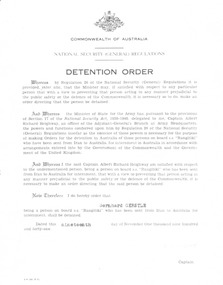
Document and CD - Biography, Mary Henderson Gerstle et al, Bernhard Hermann Gerstle, 2013
... Bernhard chose & was granted permission to remain in Australia post-war, as did many civilian internees, after their examination by a Committee of Inquiry which investigated their political leanings & other criteria for their supposed suitability as Australian residents. ...Bernhard chose & was granted permission to remain in Australia post-war, as did many civilian internees, after their examination by a Committee of Inquiry which investigated their political leanings & other criteria for their supposed suitability as Australian residents. ...Bernhard Gerstle & his family (parents & siblings) were German nationals working in Tehran, Iran upon the outbreak of World War II. In 1941, after the installation of a pro-British ruler to the Persian throne, all German nationals were targeted as threats to national security. The women and children evacuated to Stuttgart, Germany via Turkey, while the men were handed over to British forces. Bernhard was taken by ship (the SS Rona) to Bombay & then to Australia (on the SS Rangitiki). He was then marched in to Loveday internment camp 10, South Australia. In January 1945 the German & Italian internees at Loveday were transferred to Tatura Camp 1. Bernhard remained there until after the war & his eventual release, on 29th August 1946. Bernhard chose & was granted permission to remain in Australia post-war, as did many civilian internees, after their examination by a Committee of Inquiry which investigated their political leanings & other criteria for their supposed suitability as Australian residents. The biography also recounts his employment post-war, marriage in 1952 & his later naturalisation as an Australian citizen. Other material includes Gerstle family history from the perspective of Bernhard's sister & family, who remained in Stuttgart; background on the Gerstle family's Russian origins; and a biography of Oskar Speck, famous kayaker, amongst other things, who was interned along with Bernhard & who became good friends with the family; a brief historical background of the Allied forces/Persia invasion; and extracts of Tatura Camp 3 internee Helga Griffin's book, "Sing Me That Lovely Song Again". Black plastic A4 display folder. CD soft case with CD. Folder contains printed biographical information regarding Bernhard Hermann Gerstle. CD contains copies of same documents and also copies of photographs of Bernhard & the Gerstle family. Folder: Bernhard Hermann Gerstle/ Gerstle Family/ Loveday and Tatura Internment Camps 1941-1946/ Sydney 1946-1978/ Compiled by Mary Henderson 2013 CD: BH Gerstle; 1941 - Interned by British/ 1941-1946 - Internee at Loveday SA, Tatura VIC/ Sydney 1946-1978. camp 1, tatura, loveday, world-war-two, internment-camps -
 Monbulk RSL Sub Branch
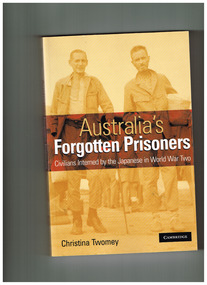
Book, Cambridge, Australia's forgotten prisoners: Civilians interred by the Japanese in World War Two, 2007
... They spent the war interned in harsh, prison-like camps throughout the Asia-Pacific region. Civilian internees - though not members of the armed forces - endured hardship, privation and even death at the hands of the enemy." ...The Japanese captured 1500 Australian civilians during World War II. They spent the war interned in harsh, prison-like camps throughout the Asia-Pacific region. Civilian internees - though not members of the armed forces - endured hardship, privation and even death at the hands of the enemy." "This book tells the stories of Australian civilians interned by the Japanese in World War II. By re-creating the daily lives and dramas within internment camps, it explores how captivity posed different dilemmas for the men, women and children held there.Ill, bib, index, notes, p.207.non-fictionThe Japanese captured 1500 Australian civilians during World War II. They spent the war interned in harsh, prison-like camps throughout the Asia-Pacific region. Civilian internees - though not members of the armed forces - endured hardship, privation and even death at the hands of the enemy." "This book tells the stories of Australian civilians interned by the Japanese in World War II. By re-creating the daily lives and dramas within internment camps, it explores how captivity posed different dilemmas for the men, women and children held there.japan - prisons and prisoners of war, world war 1939-1945 - prisoners of war - japan -
Tatura Irrigation & Wartime Camps Museum
Folder, Japanese Civilians Interned, 1991
... Lists of 498 Japanese civilians interned. The bond of friendship of the internees and officers, NCO's and particularly Lieutenant Jim Sullivan who loaded an Army truck with young internees for a trip to Rushworth and Peters ice cream. ...internees and Garrison. Olive green cardboard folder with white self adhesive sticker with inscription as below. Contains information in regard to Japanese civilians interned. ...Compiled and collected by Major Jim Sullivan. Lists of 498 Japanese civilians interned. The bond of friendship of the internees and officers, NCO's and particularly Lieutenant Jim Sullivan who loaded an Army truck with young internees for a trip to Rushworth and Peters ice cream. Old Lady Punshon was also fondly remembered.Olive green cardboard folder with white self adhesive sticker with inscription as below. Contains information in regard to Japanese civilians interned. Drawings, poems, letters, etc.Documents, Camp 4 Rushworth Japanese internees and Garrison. major jim sullivan, japanese internees, old lady punshon, camp 4, camp 4 japanese internees -
 Tatura Irrigation & Wartime Camps Museum
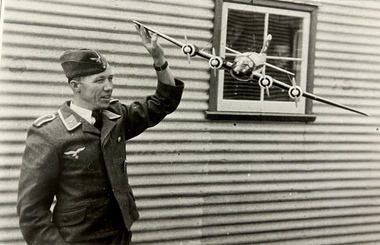
Photograph, Peter Mueller
... Model of Junkers peter mueller german internee camp 13 camp internees luftwaffa pilots german planes model planes Black and white photograph of Peter Mueller in Luftwaffe uniform and forage cap in front of a hut and suspended from the window is a 4 engine model plane. Looks like a civilian ...Peter Muller was a German pilot in North Africa and captured and sent to Camp 13. Model of JunkersBlack and white photograph of Peter Mueller in Luftwaffe uniform and forage cap in front of a hut and suspended from the window is a 4 engine model plane. Looks like a civilian plane the left hand of Herr Mueller is lightly holding up the wing tip of the model plane.peter mueller, german internee, camp 13, camp internees, luftwaffa pilots, german planes, model planes -
 Tatura Irrigation & Wartime Camps Museum
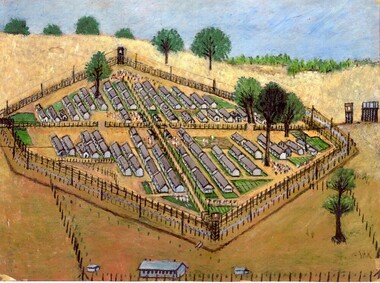
Sketch, Camp 3
... The remaining 4 camps held Internees who were civilians living in Australia or other Allied territories and countries at the outbreak of war and were deemed to be a security risk because of their nationality. ...The remaining 4 camps held Internees who were civilians living in Australia or other Allied territories and countries at the outbreak of war and were deemed to be a security risk because of their nationality. ...There were 7 camps in the area during World War II which held about 4,000-8,000 people at any one time. 3 camps housed Prisoners Of War who were enemy servicemen captured in various theatres of war around the world and transported to Australia for the duration of the war. The remaining 4 camps held Internees who were civilians living in Australia or other Allied territories and countries at the outbreak of war and were deemed to be a security risk because of their nationality. The camps were situated in the Goulburn Valley as food was plentiful here and there was a good supply of water from the Waranga Basin.A coloured sketch showing all the compounds at Tatura War and Internment Camp.internment, ww2, world war two, tatura, goulburn valley, war camps, prisoner of war, prisoner of war camps -
 Tatura Irrigation & Wartime Camps Museum
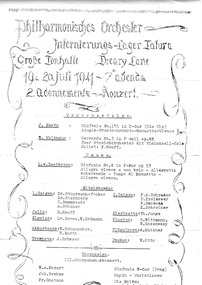
Programme - Internment Camp Christmas Program, Phillharmonisches Orchester Internierungs-Lager Tatura, 1941
... civilians interned as "Enemy Aliens" during World War 2. Those interned in 1941 were former Australian residents and New Guinea missionaries. The program indicates the caring attitude of the Australian authorities in permitting the acquisition of musical instruments, and the encouragement offered to the internees in order to produce the concert. german camp orchestra New Guinea Missionaries ww2 enemy aliens Camp 1 orchestra Original single page paper program with printed list of orchestral items to be performed by the camp orchestra,19th.and 20th. ...The orchestra consisted of German male civilians interned as "Enemy Aliens" during World War 2. Those interned in 1941 were former Australian residents and New Guinea missionaries.The program indicates the caring attitude of the Australian authorities in permitting the acquisition of musical instruments, and the encouragement offered to the internees in order to produce the concert. Original single page paper program with printed list of orchestral items to be performed by the camp orchestra,19th.and 20th. July 1941, in Internment Camp 1, Tatura. Also lists the names of the members of the orchestra and their instruments.german camp orchestra, new guinea missionaries, ww2 enemy aliens, camp 1 orchestra -
 Tatura Irrigation & Wartime Camps Museum
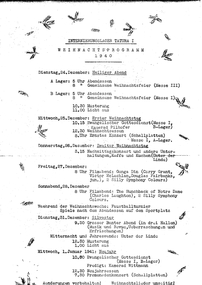
Programme - Theatre Program, Internierungslager Tatura 1, 24/12.1940
... Indicate life and interest of German male civilians who were held in internment during /world War 2. The names of several internees involved in the production are included. ...Indicate life and interest of German male civilians who were held in internment during /world War 2. The names of several internees involved in the production are included. ...Indicate life and interest of German male civilians who were held in internment during /world War 2. The names of several internees involved in the production are included. A unique document saved by the family for many years, and which illustrates the methods undertaken by the internees in order to improve their life while imprisoned. Also illustrates the help offered to the internee by the Australian Authorities, viz the use of office equipment to print the program, and the making available of movie films and musical instruments. Original paper program x 2 copiesnilgerman internees, german pow's, internment sports, j haydn, r volkmann, stuerzenhofecker, sternberg, c rammstedt, a schauer, e hauff, brose, w erdmann, w schumacher, h kurth, j grlisser, f a schrader, p preisser, f swoboda, k schreiner, th junge, g wittmann, w koszowsky, a metzner, w otto
