
Showing 10 items matching "cloisonné"
-
 Geoffrey Kaye Museum of Anaesthetic History
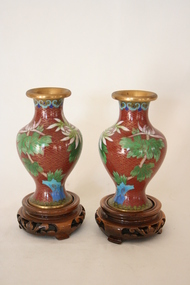
Decorative object - Cloisonné vases
... cloisonné...Twin cloisonné vases decorated ornately in red with floral designs in green, blue, and white on carved wooden bases. ...Decorative object Cloisonné vases ...Twin cloisonné vases decorated ornately in red with floral designs in green, blue, and white on carved wooden bases. The vases have a bulbous shape, and the lip of each is painted gold.cloisonné, vase, enamel -
 Kew Historical Society Inc
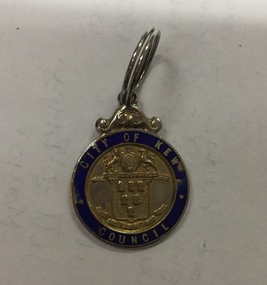
Badge - Identification Badge, Stoke, Cr HG Ferguson, City of Kew, 1955, 1955
... The City of Kew cost is surrounded by a blue enamel band with City of Kew Council picked out in gold cloisonné....The City of Kew cost is surrounded by a blue enamel band with City of Kew Council picked out in gold cloisonné. Cr HG Ferguson, City of Kew, 1955 Badge Identification Badge Stoke Stokes ...Hugh George Ferguson was born in June 1900 in Williamstown. After his family moved to Kew, they lived in Fernhurst Grove while his future wife’s family lived in Fellows Street. He married in 1940 and subsequently joined the Second AIF. In 1945, he was reported to be the ACF (Australian Comforts Fund) Commissioner in Borneo [Kalimantan]. After the Second World War, he worked as a Billeting Affairs Organiser for the Dutch Government, resettling migrants in Australia. He also worked in advertising as an account manager, and as campaign director for Arthur Rylah in Victorian politics. He directed the first major trade fairs at the Royal Exhibition Buildings after the Second World War, including ‘Australia Makes It Exhibition’ in 1947, the ‘Australian Industrial Fair’ in 1949 and 1950, the ‘Modern Home Exhibition’ in 1949, and ‘Made in Australia’ in 1952. The funds raised during the latter were earmarked for a ‘bankrupt’ Queen Victoria Hospital. He built a home in Brougham Street and represented North Ward on Kew Council from 1952 to 1968. He was elected Mayor in 1959. Hugh Ferguson died in 1975, aged 75. He was buried on 2 September in Grave 201, Special (Non- Denominational) Compartment A, Boroondara General Cemetery.City of Kew identification badge issued to sitting councillors. The City of Kew cost is surrounded by a blue enamel band with City of Kew Council picked out in gold cloisonné.Front: City of Kew to top, Crest in middle with Council below Rear: Cr H. G. Ferguson 27-8-1955mayors of kew - cr hg ferguson, kew council, city of kew -
 Mont De Lancey
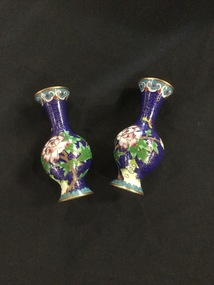
Cloisonne - Vase
... N. Lord in 1970. Cloisonné, a French word meaning "enclosed", is a metal-working technique. ...Pair of miniature royal blue Chinese Cloisonne vases with pink floral design....I vases Pair of miniature royal blue Chinese Cloisonne vases with pink floral design. Cloisonne - Vase ...Purchased by Mr. & Mrs. H. N. Lord in 1970. Cloisonné, a French word meaning "enclosed", is a metal-working technique. It is an ancient technique for decorating metalwork objects. The resulting objects can also be called cloisonné. The decoration is formed by first adding compartments or cells to the metal object. This is done by soldering or sticking silver or gold wires or thin strips placed on edge. These are visible in the finished piece, separating the different compartments. Coloured enamel is the usual filling for the cells. Cloisonné enamel objects are worked on with enamel powder made into a paste, which then is fired in a kiln. In older times inlays of cut gemstones were often used. They were decorated with geometric or schematic designs, with thick cloison walls. IPair of miniature royal blue Chinese Cloisonne vases with pink floral design.vases -
 Bendigo Historical Society Inc.
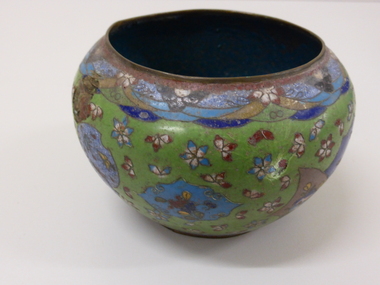
Decorative object - CLOISONNE BOWL
... ...Cloisonne...Squat Cloisonne bowl/vase decorated with flowers & butterflies in shades of blue,green,yellow with inside and base turquoise....ORNAMENTS Cloisonne vase Squat Cloisonne bowl/vase decorated with flowers & butterflies in shades of blue,green,yellow with inside and base turquoise. ...Squat Cloisonne bowl/vase decorated with flowers & butterflies in shades of blue,green,yellow with inside and base turquoise.ornaments, cloisonne, vase -
 Mont De Lancey
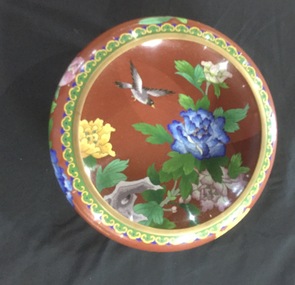
Cloisonne - bowl
... N. Lord in 1970. Cloisonné, a French word meaning "enclosed", is a metal-working technique. ...Cloisonne Chinese bowl. Large brown with blue and yellow floral design on a carved wooden base....Cloisonne - bowl ...Purchased by Mr. & Mrs. H. N. Lord in 1970.Purchased by Mr. & Mrs. H. N. Lord in 1970. Cloisonné, a French word meaning "enclosed", is a metal-working technique. It is an ancient technique for decorating metalwork objects. The resulting objects can also be called cloisonné. The decoration is formed by first adding compartments or cells to the metal object. This is done by soldering or sticking silver or gold wires or thin strips placed on edge. These are visible in the finished piece, separating the different compartments. Coloured enamel is the usual filling for the cells. Cloisonné enamel objects are worked on with enamel powder made into a paste, which then is fired in a kiln. In older times inlays of cut gemstones were often used. They were decorated with geometric or schematic designs, with thick cloison walls. ICloisonne Chinese bowl. Large brown with blue and yellow floral design on a carved wooden base.bowls -
 Mont De Lancey
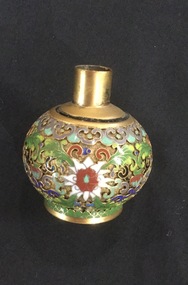
Cloisonne - Vase
... N. Lord in 1970. Cloisonné, a French word meaning "enclosed", is a metal-working technique. ...Ornamental miniature Chinese cloisonne vase. Has floral patterned design....Cloisonne - Vase ...Purchased by Mr. & Mrs. H.N. Lord in 1970. Purchased by Mr. & Mrs. H. N. Lord in 1970. Cloisonné, a French word meaning "enclosed", is a metal-working technique. It is an ancient technique for decorating metalwork objects. The resulting objects can also be called cloisonné. The decoration is formed by first adding compartments or cells to the metal object. This is done by soldering or sticking silver or gold wires or thin strips placed on edge. These are visible in the finished piece, separating the different compartments. Coloured enamel is the usual filling for the cells. Cloisonné enamel objects are worked on with enamel powder made into a paste, which then is fired in a kiln. In older times inlays of cut gemstones were often used. They were decorated with geometric or schematic designs, with thick cloison walls. IOrnamental miniature Chinese cloisonne vase. Has floral patterned design.vases -
 Mont De Lancey
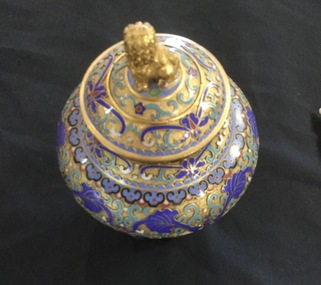
Cloisonne - bowl
... N. Lord in 1970. Cloisonné, a French word meaning "enclosed", is a metal-working technique. ...Blue and gold patterned Chinese Cloisonne bowl with lid, with gold lion on top....Cloisonne - bowl ...Purchased by Mr. & Mrs. H. N. Lord in 1970. Purchased by Mr. & Mrs. H. N. Lord in 1970. Cloisonné, a French word meaning "enclosed", is a metal-working technique. It is an ancient technique for decorating metalwork objects. The resulting objects can also be called cloisonné. The decoration is formed by first adding compartments or cells to the metal object. This is done by soldering or sticking silver or gold wires or thin strips placed on edge. These are visible in the finished piece, separating the different compartments. Coloured enamel is the usual filling for the cells. Cloisonné enamel objects are worked on with enamel powder made into a paste, which then is fired in a kiln. In older times inlays of cut gemstones were often used. They were decorated with geometric or schematic designs, with thick cloison walls. IBlue and gold patterned Chinese Cloisonne bowl with lid, with gold lion on top.bowls -
 Mont De Lancey
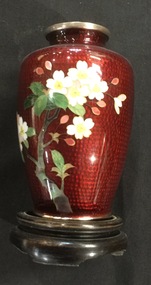
Cloisonne - Vase
... The Japanese word for Cloisonne ware is SHIPPPO or seven treasured ware. ...Small Japanese Cloisonne iridescent red vase, with pale pink flowers on black wooded stand....Cloisonne - Vase ...Purchased by Mr. & Mrs. H. N. Lord in Japan in 1960. The Japanese word for Cloisonne ware is SHIPPPO or seven treasured ware. It is an ancient technique for decorating metalwork objects. The resulting objects can also be called cloisonné. The decoration is formed by first adding compartments or cells to the metal object. This is done by soldering or sticking silver or gold wires or thin strips placed on edge. These are visible in the finished piece, separating the different compartments. Coloured enamel is the usual filling for the cells. Cloisonné enamel objects are worked on with enamel powder made into a paste, which then is fired in a kiln. In older times inlays of cut gemstones were often used. They were decorated with geometric or schematic designs, with thick cloison walls. Small Japanese Cloisonne iridescent red vase, with pale pink flowers on black wooded stand.vases -
 Mont De Lancey
Cloisonne - Vase
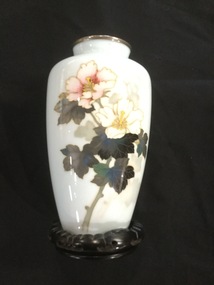
... The Japanese word for cloisonne ware is SHIPPO or seven treasured ware. ...Pale blue Japanese Cloisonne vase with peony flower design in pink and white with green leaves on black wooden stand. ...Cloisonne - Vase ...Purchased by Mr. & Mrs. H. N. Lord in Japan in 1960. The Japanese word for cloisonne ware is SHIPPO or seven treasured ware. It is an ancient technique for decorating metalwork objects. The resulting objects can also be called cloisonné. The decoration is formed by first adding compartments or cells to the metal object. This is done by soldering or sticking silver or gold wires or thin strips placed on edge. These are visible in the finished piece, separating the different compartments. Coloured enamel is the usual filling for the cells. Cloisonné enamel objects are worked on with enamel powder made into a paste, which then is fired in a kiln. In older times inlays of cut gemstones were often used. They were decorated with geometric or schematic designs, with thick cloison walls. Pale blue Japanese Cloisonne vase with peony flower design in pink and white with green leaves on black wooden stand. vases -
 Bendigo Historical Society Inc.
Document - Coolock or Denderah House - A brief History and Auction, 1959 and 1991
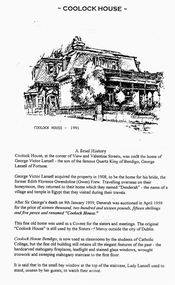
... Artworks (oil paintings, watercolors, prints, miniatures) Decorative items (marble sculptures, ormolu, cloisonné, porcelain, silverware)Household goods (rugs, curtains, carpets, kitchenware, linen, glassware) Collectibles (books, musical instruments, clocks, sporting goods, firearms) Garden and outdoor items (garden seats, pot plants, tools)Staff quarters and utility items (beds, wardrobes, kitchen equipment) Several pieces by renowned makers (Waring and Gillow, London) Unique items such as an exhibition French ornamental bedroom suite made for the Paris Exposition of 1880, and items from the "Fortuna" collection A wide range of silver and crystal tableware, antique carpets, and rare collectiblesStructure and Organization The catalog is organized by room and area (Drawing Room, Dining Room, Study, Bedrooms, Hall, Yard, Kitchen, Staff Quarters, etc.), with each lot described in detail....Artworks (oil paintings, watercolors, prints, miniatures) Decorative items (marble sculptures, ormolu, cloisonné, porcelain, silverware)Household goods (rugs, curtains, carpets, kitchenware, linen, glassware) Collectibles (books, musical instruments, clocks, sporting goods, firearms) Garden and outdoor items (garden seats, pot plants, tools)Staff quarters and utility items (beds, wardrobes, kitchen equipment) Several pieces by renowned makers (Waring and Gillow, London) Unique items such as an exhibition French ornamental bedroom suite made for the Paris Exposition of 1880, and items from the "Fortuna" collection A wide range of silver and crystal tableware, antique carpets, and rare collectiblesStructure and Organization The catalog is organized by room and area (Drawing Room, Dining Room, Study, Bedrooms, Hall, Yard, Kitchen, Staff Quarters, etc.), with each lot described in detail. bendigo fortuna george lansell coolck house denderah denderah auction george victor lansell edith lansell edith frew catholic college sisters of mercy Coolock House - A brief History and Auction This item contains the following document: 11217.59a A black and white brochure of Coolock House in 1991 with a brief history and a sketch of the house 11217.59b The auction catalog (24 pages) and sale notice for the estate of the late Sir George Lansell, held at his residence "Denderah" in Bendigo on April 7th and 8th, 1959. ...Coolock House, on the corner of View and Valentine Streets in Bendigo has a rich history marked by notable ownership and varied uses. Acquired in 1908 by George Victor Lansell, son of Bendigo's famous "Quartz King" George Lansell, as a home for himself and his bride, Edith Florence Gwendoline (Gwen) Frew. The couple named the house "Denderah" after a village and temple in Egypt they visited on their honeymoon. After Sir George's death in January 1959, the property was auctioned and renamed "Coolock House." It Served as a convent for the Sisters of Mercy and as a venue for meetings. The original "Coolock House" name is also associated with a Sisters of Mercy house outside Dublin. Currently, Coolock House is used as classrooms for Catholic College students in Bendigo. The building retains elegant historical features such as hand-carved mahogany fireplaces, leadlight and stained glass windows, wrought ironwork, and a sweeping mahogany staircase. A notable anecdote is that Lady Lansell would watch guests arrive from a small bay window at the top of the staircase. Coolock House remains a significant heritage building, blending its storied past with ongoing educational use. 1959 AUCTION The auction catalog (24 pages) and sale notice for the estate of the late Sir George Lansell, held at his residence "Denderah" in Bendigo on April 7th and 8th, 1959. The auction was conducted by Sandhurst and Northern District Trustees Limited and Agency Company Executors, as executors of George Victor Lansell's will. The property and its contents were offered for sale over two days, with viewing available the day before. The freehold property was specifically offered at 3 p.m. on April 7th. Highest bidder for each lot is the purchaser; disputes resolved by the auctioneer.25% deposit required immediately after winning a lot; full payment and removal by April 10th. The catalog lists hundreds of lots, including: Fine furniture (antique satinwood, mahogany, walnut, oak, Chippendale, French Buhl, etc.) Artworks (oil paintings, watercolors, prints, miniatures) Decorative items (marble sculptures, ormolu, cloisonné, porcelain, silverware)Household goods (rugs, curtains, carpets, kitchenware, linen, glassware) Collectibles (books, musical instruments, clocks, sporting goods, firearms) Garden and outdoor items (garden seats, pot plants, tools)Staff quarters and utility items (beds, wardrobes, kitchen equipment) Several pieces by renowned makers (Waring and Gillow, London) Unique items such as an exhibition French ornamental bedroom suite made for the Paris Exposition of 1880, and items from the "Fortuna" collection A wide range of silver and crystal tableware, antique carpets, and rare collectiblesStructure and Organization The catalog is organized by room and area (Drawing Room, Dining Room, Study, Bedrooms, Hall, Yard, Kitchen, Staff Quarters, etc.), with each lot described in detail.Coolock House - A brief History and Auction This item contains the following document: 11217.59a A black and white brochure of Coolock House in 1991 with a brief history and a sketch of the house 11217.59b The auction catalog (24 pages) and sale notice for the estate of the late Sir George Lansell, held at his residence "Denderah" in Bendigo on April 7th and 8th, 1959. The auction was conducted by Sandhurst and Northern District Trustees Limited and Agency Company Executors, as executors of George Victor Lansell's willnon-fictionbendigo, fortuna, george lansell, coolck house, denderah, denderah auction, george victor lansell, edith lansell, edith frew, catholic college, sisters of mercy
