
Showing 9 items matching "coal tar"
-
 Flagstaff Hill Maritime Museum and Village
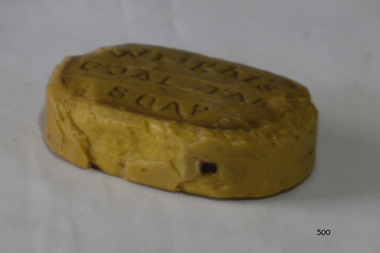
Domestic object - Soap, Wright, Layman & Umney Ltd, ca 20th century
... ...coal tar soap...Wright’s Coal Tar Soap was a popular brand of household soap, manufactured by William Valentine Wright from 1867. ...Soap; yellow oval tablet of soap engraved with the brand Wright's Coal Tar oval...."WRIGHT'S / COAL TAR / SOAP"...Wright’s Coal Tar Soap was a popular brand of household soap, manufactured by William Valentine Wright from 1867. ...Wright’s Coal Tar Soap was a popular brand of household soap, manufactured by William Valentine Wright from 1867. The oval yellow soap tablet was antiseptic, designed to cleanse the skin thoroughly. It was originally named Sapo Carbonis Detergens, which remains a registered trademark. The product was developed from ‘liquor carbonis detergens’, the liquid by-product of the distillation of coal to make coke. The liquid was made into an antiseptic soap for treating skin diseases. William Valentine Wright was born in 1826 at Aldeburgh, Suffolk. He was a wholesale druggist and chemist who had a small business, W.V. Wright & Co., at 11 Old Fish Street Hill, City of London, where he first sold the soap. In 1863 Wright moved his firm to small premises at 50 Southwark Street, Southwark, London, and not long afterwards M. Sellers and Mr Charles Noel Layman joined the partnership. The company's name changed to Wright, Layman & Umney, when Charles Umney (1843–1909) was taken into the partnership on June 17, 1876, after the death of M. Sellers. William Valentine Wight 1877. Rob Umney, great-great-grandson of Charles Umney, provided further details about the firm, adding that in the late 1960s, the Wright’s Coal Tar Soap business was taken over by LRC Products Ltd who sold it to Smith & Nephew in 1994. The current owners of the brand, Simple Health and Beauty Ltd are based in Solihull and the soap is called Wright's Traditional Soap ‘With coal tar fragrance’. The coal tar has been replaced with tea tree oil. There were concerns that ingredients in coal tar could cause cancer when a person is exposed to very high concentrations, such as in roofing and road paving. In January 2025 the current manufacturers still produce the Wright's Coal Tar Soap.Wright's Coal Tar Soap was sold throughout the United Kingdom and Colonies, which includes Australia. The soap represents many consumer goods sold at pharmacies and chemist shops across the world, such as Sambell and Son, who operated a pharmacy in Fairy Street, Warrnambool in the 19th century. The product has endured for over 150 years.Soap; yellow oval tablet of soap engraved with the brand Wright's Coal Tar oval."WRIGHT'S / COAL TAR / SOAP"flagstaff hill, maritime museum, wright's, coal tar soap, soap, bathing, antiseptic, washing, personal hygiene, london, southwark, chemist, pharmacist, colonies, wright's coal tar soap, sapo carboni detergens, england, soap tablet, babies soap, nursery soap, wright, layman & umney ltd., w.t. wrifght & co., soap cake, soap bar, medical, cleansing, baby care -
 National Wool Museum
Book, Dyeing with Coal Tar Dyestuffs
... Dyeing with Coal Tar Dyestuffs..."Dyeing with Coal Tar Dyestuffs - The Principles Involved and the Methods Employed" 4th ed. - C.M. ...Dyeing Dyeing with Coal Tar Dyestuffs Book ..."Dyeing with Coal Tar Dyestuffs - The Principles Involved and the Methods Employed" 4th ed. - C.M. Whittaker and C.C. Wilcock, 1946.dyeing -
 Flagstaff Hill Maritime Museum and Village
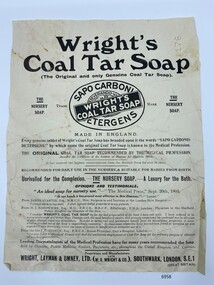
Flyer - Advertisement, Soap, Wright, Layman & Umney Ltd, Late 1940s
... ...coal tar soap...Wright’s Coal Tar Soap was a popular brand of household soap, manufactured by William Valentine Wright from 1867. ...It promotes Wright's Coal Tar Soap, made by Wright, Layman & Umney Ltd. ...Wright’s Coal Tar Soap was a popular brand of household soap, manufactured by William Valentine Wright from 1867. ...Wright’s Coal Tar Soap was a popular brand of household soap, manufactured by William Valentine Wright from 1867. The yellow soap was antiseptic, designed to cleanse the skin thoroughly. It was originally named Sapo Carbonis Detergens, which remains a registered trademark. The product was developed from ‘liquor carbonis detergens’, the liquid by-product of the distillation of coal to make coke. The liquid was made into an antiseptic soap for treating skin diseases. William Valentine Wright was born in 1826 at Aldeburgh, Suffolk. He was a wholesale druggist and chemist who had a small business, W.V. Wright & Co., at 11 Old Fish Street Hill, City of London, where he first sold the soap. In 1863 Wright moved his firm to small premises at 50 Southwark Street, Southwark, London, and not long afterwards M. Sellers and Mr Charles Noel Layman joined the partnership. The company's name changed to Wright, Layman & Umney, when Charles Umney (1843–1909) was taken into the partnership on June 17, 1876, after the death of M. Sellers. William Valentine Wight 1877. Rob Umney, great-great-grandson of Charles Umney, provided further details about the firm, adding that in the late 1960s, the Wright’s Coal Tar Soap business was taken over by LRC Products Ltd who sold it to Smith & Nephew in 1994. The current owners of the brand, Simple Health and Beauty Ltd are based in Solihull and the soap is called Wright's Traditional Soap ‘With coal tar fragrance’. The coal tar has been replaced with tea tree oil. There were concerns that ingredients in coal tar could cause cancer when a person is exposed to very high concentrations, such as in roofing and road paving. In January 2025 the current manufacturers still produce the Wright's Coal Tar Soap.The flier states that Wright's Coal Tar Soap was sold throughout the United Kingdom and Colonies, which includes Australia. The soap is representative of the many consumer goods sold at pharmacies and chemist shops across the world, such as Sambell and Son, who operated a pharmacy in Fairy Street, Warrnambool in the 19th century. The paper flier is rectangular and has printed text and a logo. The top right corner has stamped punch marks. It promotes Wright's Coal Tar Soap, made by Wright, Layman & Umney Ltd. England.Punch mark; "1176"flagstaff hill, maritime museum, wright's, coal tar soap, soap, bathing, antiseptic, washing, personal hygiene, london, southwark, chemist, pharmacist, colonies, wright's coal tar soap, sapo carboni detergens, punch marks, england, soap tablet, babies soap, nursery soap, advertising, poster, flyer, wright, layman & umney ltd., w.t. wrifght & co., soap bar, soap cake -
 Melbourne Tram Museum
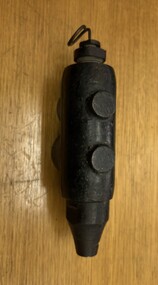
Functional object - Cable tram engine house boiler - tar burner, Melbourne Tramway and Omnibus Co (MTOCo), c1890
... ...coal tar...Item made by the MTOCo for burning coal tar in its boilers for engine houses. ...Item made by the MTOCo for burning coal tar in its boilers for engine houses. Used by the Company at the time coal tar from the gas works was provided a low cost. ...Item made by the MTOCo for burning coal tar in its boilers for engine houses. Used by the Company at the time coal tar from the gas works was provided a low cost. See item 9691 page 3 for a note on the use in a report by W R Pollock. Used with steam to feed the coal tar into the boilers through a venturi effect process.Demonstrates an item produced by the MTOCo to burn coal tar in its cable tram engine houses.Cast steel, with openings and with removable parts and rod. Drawing at 9692i5 refers.cable trams, engine houses, power house, boilers, coal tar, mtoco -
 Bendigo Historical Society Inc.
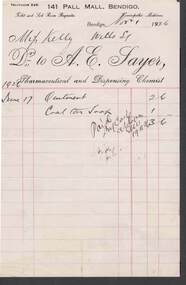
Document - KELLY AND ALLSOP COLLECTION: A. E. SAYER, CHEMIST ACCOUNT, 01/11/1926
... Chemist account for ointment and Coal Tar Soap, dated 1/11/1926 in the name of Mr Kelly. ...BUSINESS Stockbroker kelly & allsop Kelly & Allsop Collection - A E Sayer Chemist Account Mr Kelly Chemist account for ointment and Coal Tar Soap, dated 1/11/1926 in the name of Mr Kelly. ...Chemist account for ointment and Coal Tar Soap, dated 1/11/1926 in the name of Mr Kelly. Account has paid and dated 19/11/26 written on it.business, stockbroker, kelly & allsop, kelly & allsop collection - a e sayer chemist account, mr kelly -
 Wannon Water
Brush
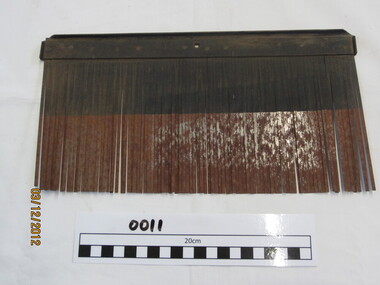
... The coating was propably coal tar ...The coating was propably coal tar Possibly used in the Otway Water Supply System Pipes. ...The brush/comb was used for identifying coating defects in steel mains. It was attached to a low voltage electrical supply and then used to brush along the steel pipe to test for faults in the coatings. If there is a fault in the coating, a spark would occur. The coating was propably coal tar Possibly used in the Otway Water Supply SystemRusted metal comb/brush, one side top half painted black to avoid conductivity of electrical currentpipes. maintenance -
 City of Moorabbin Historical Society (Operating the Box Cottage Museum)
Manufactured Glass, brown bottle 'Saccharin', 20thC
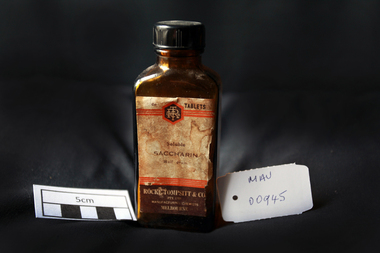
... Saccharin was produced first in 1878 by Constantin Fahlberg, a chemist working on coal tar derivatives in Ira Remsen's laboratory at the Johns Hopkins University, Baltimore, Maryland USA. ...Saccharin was produced first in 1878 by Constantin Fahlberg, a chemist working on coal tar derivatives in Ira Remsen's laboratory at the Johns Hopkins University, Baltimore, Maryland USA. ...Saccharin is an artificial sweetener. The basic substance, benzoic sulfilimine, has effectively no food energy and is much sweeter than sucrose, but has a bitter or metallic aftertaste, especially at high concentrations. It is used to sweeten products such as drinks, candies, , medicines, and toothpaste. Saccharin derives its name from the word "saccharine", meaning of, relating to, or resembling sugar. The form used as an artificial sweetener is usually its sodium salt. Saccharin was produced first in 1878 by Constantin Fahlberg, a chemist working on coal tar derivatives in Ira Remsen's laboratory at the Johns Hopkins University, Baltimore, Maryland USA. Although saccharin was commercialized not long after its discovery, it was not until sugar shortages during World War I that its use became widespread. A brown glass bottle with a plastic screw top containing 'Saccharin' tabletsFront label ; .... TABLETS / trademark ' R T & C ( entwined)' / Soluble / SACCHARIN / Half Grain / ROCKE TOMSETT & CO. / PTY LTD / MANUFACTURING CHEMISTS / MELBOURNEfahlberg constantin, remsen ira, john hopkins university, maryland, baltimore, america, nasau, south america, central america, sugar cane, pharmacy, medicines, saccharin, glassware, bottles, moorabbin, bentleigh, cheltenham, elbe, germany -
 Mont De Lancey
Book, Wells Gardner, Darton & Co. Limited, Chatterbox, 1918
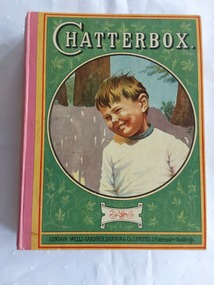
... At the back are advertisements for 'Pears the pure soap', Wright's coal tar soap, Chatterbox publications and Macintosh's Toffee de Luxe and Carnival Assortment. ...At the back are advertisements for 'Pears the pure soap', Wright's coal tar soap, Chatterbox publications and Macintosh's Toffee de Luxe and Carnival Assortment. ...A vintage 1929 Chatterbox collection of puzzles, poetry and stories for children with black lined illustrations and coloured plates throughout.A vintage 1929 hardcover children's book with the title Chatterbox printed in white lettering at the top of the front cover which has a green coloured background with an illustration in a large circle showing a boy wearing a white jumper in front of trees. The publisher details are printed at the bottom. Red tape binds the covers on the spine. The faded yellow coloured back cover has an advertisement for 'Allenbury's' The Progressive System of Infant Feeding, which was a similar composition to mother's milk. The manufacturer details are added at the bottom. Inside the front cover are black and white printed advertisements for 'Ovaltine' Tonic Food Beverage and "Blackbird" Fountpens. The coloured frontispiece illustration inside depicts an Indigenous American First Nations Indian riding a horse with his family and rest of the tribe in the background. The title of the picture is 'The Wilderness Road'. The title page has the title plus Funded by J. Erskine Clarke, M.A and publisher details with a black lined illustration of children, a woman with children at her knee reading and flowers. There are further coloured plates in the collection. The book contains plenty of puzzles, poetry, and stories for children. Pp. 316. At the back are advertisements for 'Pears the pure soap', Wright's coal tar soap, Chatterbox publications and Macintosh's Toffee de Luxe and Carnival Assortment. fictionA vintage 1929 Chatterbox collection of puzzles, poetry and stories for children with black lined illustrations and coloured plates throughout. children's books, books, children's stories, adventure stories -
 Flagstaff Hill Maritime Museum and Village
Container - Bottle, c. 1905
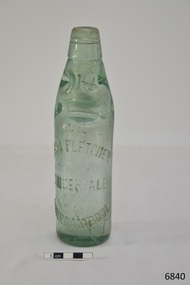
... Rowley & Co, cordial manufacturers in 1903, were prosecuted in September that year when the Board of Health found an analysed sample of Raspberry Vinegar to contain coal tar colouring, which could be injurious to health, particularly to the kidneys. ...Rowley & Co, cordial manufacturers in 1903, were prosecuted in September that year when the Board of Health found an analysed sample of Raspberry Vinegar to contain coal tar colouring, which could be injurious to health, particularly to the kidneys. ...This bottle once contained John Fletcher’s ginger cordial. It was found in August 2014 in the sand dunes at Levy's Point, near McKinnon's quarry, Warrnambool. ABOUT JOHN FLETCHER of WARRNAMBOOL John Fletcher Cordial (or Beverage) Co.. Warrnambool supplied cordial and aerated drinks to the Western District of Victoria. John Fletcher was named as a cordial manufacturer in the Warrnambool Standard of June 13th 1895, when he attended a Publican’s Association meeting. Mr John Fletcher, aerated water and cordial manufacturer of Koroit Street, Warrnambool, had a summary of his factory printed in a short article in the Advocate, Melbourne, in February 1901. The article said, “one of the most complete plants outside the metropolis … spacious … well appointed …old-established business … noted for the excellence of the quality … a trial [of the beverage] is solicited.” John Fletcher and Harold Caffin, trading as J.S. Rowley & Co, cordial manufacturers in 1903, were prosecuted in September that year when the Board of Health found an analysed sample of Raspberry Vinegar to contain coal tar colouring, which could be injurious to health, particularly to the kidneys. The factory was still in operation in December 1924, when sadly, Mr S. Fletcher, who was carrying bottles of aerated water at Mr John Fletcher’s cordial factory, sustained an eye injury when one of the bottles burst. Later, the eye had to be removed at the Warrnambool Base Hospital. ABOUT CODD BOTTLES Many inventions during the mid-to-late 1800s kept the fizz in carbonated drinks, such as ginger ale, soda water, and fruit drinks. Hiram Codd, an English engineer, invented a successful process that he patented as “Codd’s patented globe stopper bottle” in 1872. The Codd-neck bottle (commonly called Codd or marble bottle) is manufactured in two parts. The body of the bottle is cast in two sections. At the time of joining the sections, a glass marble and rubber seal are inserted into the neck section. The lip is then applied to the top of the bottle. The Codd bottle is filled upside down as the pressure of the gas from the carbonated liquid holds the marble up and out of the way. When the bottle stands upright, the gas pushes the marble up against the washer, creating a firm seal to keep the fizz inside. The bottle is opened by pushing the marble down firmly to allow some of the gas to escape. The marble drops down and is caught in a depression formed in the neck. When the bottle is tilted to pour or drink the liquid, the marble rests in a dimple. Some have said that the bottle is a character, the shape having a face with its mouth keeping the marble out of the drink and eyes that catch the marble so that it doesn’t roll into the mouth of the drinker. The Codd bottle was expensive to produce, and children loved to destroy the marbles to play with the marbles inside. Many shops and factories added a deposit to the cost of buying the drink to encourage children to return the bottles rather than break it for the marble. Codd bottles are still being produced in India and Japan for soft drinks. A Codd bottle with the same markings as this one is valued on today’s Australian auction sites from AUD 35 - $75. Bottle, aqua/green glass, with glass marble inside. John Fletcher's Ginger Ale, Warrnambool. Container is often called a "Codd neck bottle", “marble bottle” or “Codd’s patent bottle”. Bottle made by Dobson. Inscription on bottle and base. c. 1905Marks moulded into glass; "JOHN FLETCHER / GINGER ALE / WARRNAMBOOL" and “DOBSON” and on base “G”. flagstaff hill, warrnambool, shipwrecked coast, flagstaff hill maritime museum, maritime museum, shipwreck coast, flagstaff hill maritime village, great ocean road, codd bottle, codd neck bottle, marble bottle, ginger beer bottle, john fletcher soft drinks, warrnambool soft drinks and cordials, john fletcher cordial (or beverage) co ., codd neck bottle, glass stopper bottle, hiram codd, antique bottle, harold caffin, john fletcher
