
Showing 54 items matching "coastal views"
-
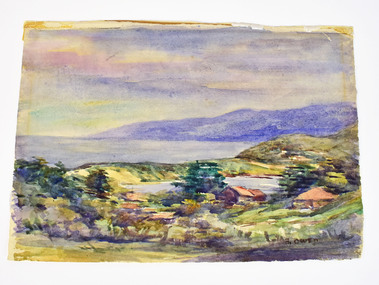 City of Greater Geelong
Watercolour, Mrs F Owen, Aireys Inlet Vista
... Hilly coastal view with ocean and hills in the background...Hilly coastal view with ocean and hills in the background Aireys Inlet Vista Watercolour Mrs F Owen ...Hilly coastal view with ocean and hills in the background -
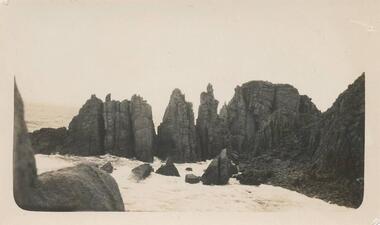 Phillip Island and District Historical Society Inc.
Photograph, The Pinnacles, Cape Woolamai
... Coastal view of The Pinnacles, Cape Woolamai - rocks at coast edge....Part of the Jessie Smith Collection. local history photographs the pinnacles cape woolamai phillip island coastal geography jessie smith collection stan mcfee Coastal view of The Pinnacles, Cape Woolamai - rocks at coast edge. ...Pinnacles south side of Philip Island, Cape Woolamai. Part of the Jessie Smith Collection.Coastal view of The Pinnacles, Cape Woolamai - rocks at coast edge.local history, photographs, the pinnacles, cape woolamai, phillip island, coastal geography, jessie smith collection, stan mcfee -
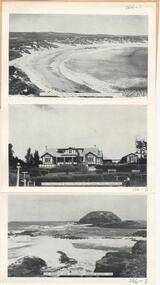 Phillip Island and District Historical Society Inc.
Souvenir Photographs, 1940's
... ...coastal views...Bottcher, Private Bag, Kerang, Vic. wildlife - koala wildlife - seals summerland beach isle of wight hotel cowes phillip island war memorial cowes phillip island the cenotaph cowes phillip island the nobbies phillip island seal rocks phillip island wildlife - penguins the killara ferry cowes pier phillip island bass memorial cairn rhyll suspension bridge san remo/phillip island coastal views san remo jetty breakers at the nobbies pyramid rock wildlife - birds wildlife - mutton birds erehwon point, cowes mussell rocks cowes phillip island berry's beach phillip island lovers walk cowes the pinnacles cape woolamai the blowhole phillip island the cascades the nobbies wendy fletcher Two Souvenir Photograph folders with a total of 30 photographs. ...The two folders found in an old home in Cohuna in 2010. Sent to Mrs J. H. Bottcher, Private Bag, Kerang, Vic.Two Souvenir Photograph folders with a total of 30 photographs. One folder named "Nature's Paradise, Phillip Island. Cowes" Second folder named "Cowes Phillip Island - 18 Selected Glimpses"wildlife - koala, wildlife - seals, summerland beach, isle of wight hotel cowes phillip island, war memorial cowes phillip island, the cenotaph cowes phillip island, the nobbies phillip island, seal rocks phillip island, wildlife - penguins, the killara ferry, cowes pier phillip island, bass memorial cairn rhyll, suspension bridge san remo/phillip island, coastal views, san remo jetty, breakers at the nobbies, pyramid rock, wildlife - birds, wildlife - mutton birds, erehwon point, cowes, mussell rocks cowes phillip island, berry's beach phillip island, lovers walk cowes, the pinnacles cape woolamai, the blowhole phillip island, the cascades the nobbies, wendy fletcher -
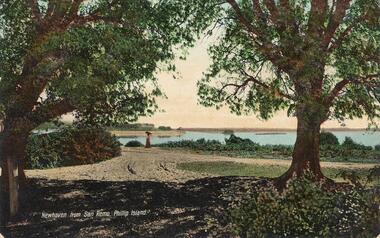 Phillip Island and District Historical Society Inc.
Photograph - Post Card, Valentine Postcard
... ...coastal views...Postcard donated by Mrs D Motton given to Kevin Findlay, Lang Lang. views newhaven newhaven phillip island coastal views mrs d motton kevin findlay Newhaven from San Remo, Phillip Island. ...Postcard donated by Mrs D Motton given to Kevin Findlay, Lang Lang.Coloured postcard taken from San Remo looking across to Newhaven, Phillip Island. Photograph showing two trees either side with lady in long dress and umbrella near the shoreline.Newhaven from San Remo, Phillip Island.views newhaven, newhaven phillip island, coastal views, mrs d motton, kevin findlay -
 Phillip Island and District Historical Society Inc.
Photograph, 1920's
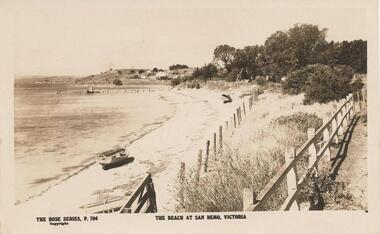
... ...coastal views...Part of a collection donated by Edith Elms via Chrisy Northcote. local history photography photographs san remo coastline sepia photograph coastal views The Rose Series, P764. The beach at San Remo - Victoria Sepia print of San Remo coastline at low tide with dinghy at left foreground. ...Sent as Happy Birthday wishes from "mother" Feb 18 1923. Part of a collection donated by Edith Elms via Chrisy Northcote.Sepia print of San Remo coastline at low tide with dinghy at left foreground. Two fences traversing from bottom to 3/4 where trees merge, sailboat beached at centre. Pier at 3/4 left top.The Rose Series, P764. The beach at San Remo - Victorialocal history, photography, photographs, san remo, coastline, sepia photograph, coastal views -
 Phillip Island and District Historical Society Inc.
Photograph, The Nobbies and Seal Rocks
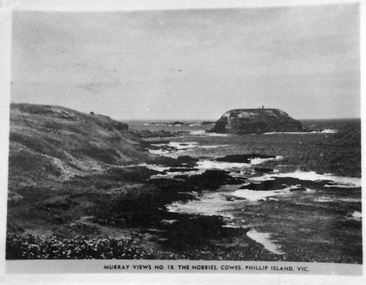
... ...coastal views...Part of a series of tourist postcards. photographs the nobbies coastal views seal rocks Murray Views No.18 The Nobbies, Cowes, Phillip Island, Vic Small black & white photo of coastal scenery of The Nobbies and Seal Rocks. ...Part of a series of tourist postcards.Small black & white photo of coastal scenery of The Nobbies and Seal Rocks.Murray Views No.18 The Nobbies, Cowes, Phillip Island, Vicphotographs, the nobbies, coastal views, seal rocks -
 Phillip Island and District Historical Society Inc.
Photograph, The Nobbies
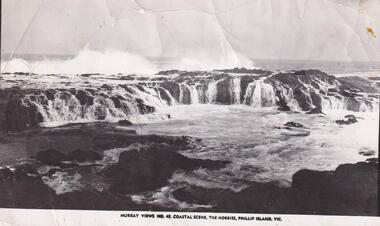
... Coastal view of The Nobbies area depicting platform rocks, surf, pounding behind them. ...Murray Views No. 45. Coastal Scene The Nobbies, Phillip Island, Vic....Coastal view of The Nobbies area depicting platform rocks, surf, pounding behind them. ...Coastal view of The Nobbies area depicting platform rocks, surf, pounding behind them. Rock and calmer water in the foreground.Coastal scene at The Nobbies, Phillip IslandMurray Views No. 45. Coastal Scene The Nobbies, Phillip Island, Vic.local history, photographs, the nobbies, coastline, phillip island, black & white photograph, mona condrick -
 Melbourne Legacy
Postcard, Le Crotoy - La Plage, 1918
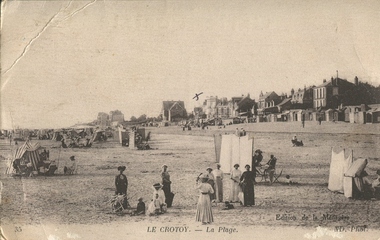
... Post card with a coastal panoramic view and beach houses. At the back of the post card is the written wishes. ...Post card with a coastal panoramic view and beach houses. At the back of the post card is the written wishes. ...A post card sent from France to Australia in 1918, presumably from a soldier son to his mother while on leave from the fighting in France.A record of correspondence from France to Australia in 1918. Postcards were a very common form of communication in the first World War. This postcard also records places for those who didn't have cameras. This type of souvenir would have been familiar to the first Legatees as they had served in World War 1.Post card with a coastal panoramic view and beach houses. At the back of the post card is the written wishes. Front side: Printed, 35 / LE CROTOY. - La Plage. / Edition de la Menagere / ND. Phot. Back Side: handwriten mark, x / printed, Carte Postale / IMP. PHOT. NEURDEIN ET CIE. - PARIS. / Correspondance / Adresse, Stamped Postal Sticker from the Republique Francaise valuated in 10c Postes. / Handwritten text: 13/1/18 Dear Mater This is a snap of where I am now. We are in the house marked x, and are very comfy. Love to all Lee / Mrs W. Elsum 42 Parker St. Williamstown Victoria Australia. war correspondence, souvenir -
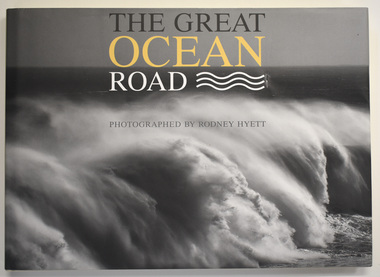 Warrnambool and District Historical Society Inc.
Book, Rodney Hyett, The Great Ocean Road, 2013
... This book contains photographs of the Great Ocean Road taken by Rodney Hyett, a photographer who produces books and calendars featuring coastal views of the Great Ocean Road. The book contains his best images from 15 years of calendar making and includes mostly black and white photographs together with historical engravings, maps and diaries dating back to the early history of the region. ...This book contains photographs of the Great Ocean Road taken by Rodney Hyett, a photographer who produces books and calendars featuring coastal views of the Great Ocean Road. The book contains his best images from 15 years of calendar making and includes mostly black and white photographs together with historical engravings, maps and diaries dating back to the early history of the region. ...A book containing Great Ocean Road PhotographsThis is a book of 144 pages. The cover is buff-coloured with an embossed title. The dust cover has a black and white photograph and a map with white, yellow and black printing. The pages contain printed text and black and white and colour photographs amd mapsnon-fiction A book containing Great Ocean Road Photographsgreat ocean road, rodney hyett photographer -
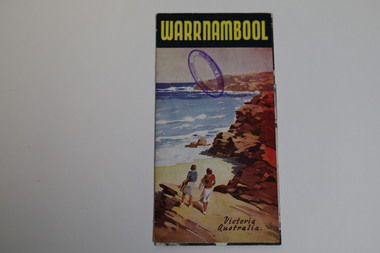 Warrnambool and District Historical Society Inc.
Pamphlet - Tourist Map and Guide, Victorian Railway Commissioners, Warrnambool Victoria Australia, c. 1950
... Since the late 19th century Warrnambool has been promoted as a tourist destination because of its beaches, coastal views, sporting events and proximity to nearby tourist attractions. ...Since the late 19th century Warrnambool has been promoted as a tourist destination because of its beaches, coastal views, sporting events and proximity to nearby tourist attractions. ...Warrnambool Tourist Map and Guide.1 This is a single sheet of paper folded twice to make a pamphlet. It has a multi-coloured map (predominantly yellow), an illustration, several black and white photographs, printed text and coloured headings. .2 This is a single sheet of paper inserted into item 1. It is folded twice and contains black and white photographs.non-fictionWarrnambool Tourist Map and Guidetourism in warrnambool, warrnambool rail, warrnambool tourist guides -
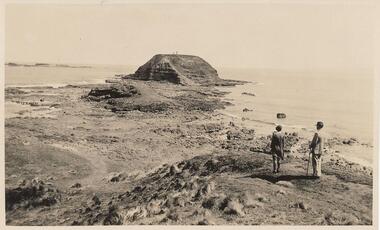 Phillip Island and District Historical Society Inc.
Photograph, 20th Century
... Photo 6. Coloured coastal view looking towards the Nobbies in the distance....Photo 6. Coloured coastal view looking towards the Nobbies in the distance. ...Selection of 6 photographs and postcards of The Nobbies, A Seal and the SS Killara, donated by D Reid.A selection of postcards and photograph Black & White and Coloured of The Nobbies, a Seal and the SS Killara. Photo 1. View of the Nobbies with two people in the foreground. Photo 2. View of the Nobbies with a Horse and jinker in the foreground. Photo 3. A Seal resting on the rocks at Seal Rocks Phillip Island Photo 4. The Ferry steamer S. S. Killara arriving at Cowes Photo 5. Coloured view of the Nobbies looking across breakers on the rocks. Photo 6. Coloured coastal view looking towards the Nobbies in the distance.Inscriptions on the front of postcards Photo 2. The Rose Series. P 666. Looking to The Nobbies, Phillip Island, Victoria Photo 3. The Rose Series. P 747. A Seal on the rocks, Phillip Island, Victoria Photo 4. The Ferry Steamer S. S. "Killara" arrives at Cowes. Photo 5. The Nobbies, Cowes Photo 6. Coastal Scene Cowes. Nobbies in Distance.the nobbies phillip island, wildlife - seals, seal at seal rocks, ss killara, ferries -
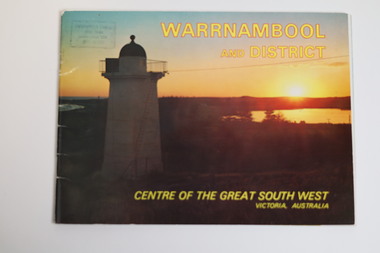 Warrnambool and District Historical Society Inc.
Booklet - Tourist Booklet, Warrnambool Chamber of Commerce and Industry, Warrnambool and District - Centre of the Great South West, Victoria, Australia, c. 1970
... Today tourism remains an important aspect of the area's economy with Warrnambool promoted for its beaches, coastal views, key sporting events, the winter whales and its proximity to many other tourist locations. ...Today tourism remains an important aspect of the area's economy with Warrnambool promoted for its beaches, coastal views, key sporting events, the winter whales and its proximity to many other tourist locations. ...Warrnambool Tourist BookletThis is a booklet of 22 pages. The cover has two colour photographs and the pages contain a sketch map, printed text and colour photographs. The pages have ben stapled but the staples have been removed.non-fictionWarrnambool Tourist Bookletwarrnambool tourism, south west victoria tourist locations, warrnambool chamber of commerce -
 Warrnambool and District Historical Society Inc.
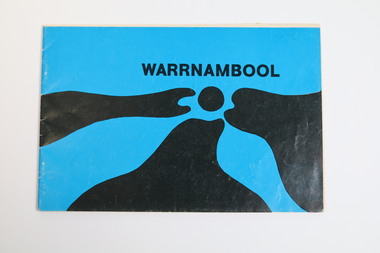
Booklet - Tourist booklet, Warrnambool Chamber of Commerce and Industry, Warrnambool, c. 1970
... Today tourism is a vital part of the city's economy because of the beaches, the coastal views, the sporting events, the winter whales and the proximity to many other tourist destinations. ...Today tourism is a vital part of the city's economy because of the beaches, the coastal views, the sporting events, the winter whales and the proximity to many other tourist destinations. ...Warrnambool Tourist BookletThis is a booklet of 30 pages with a blue and black cover featuring an art work, a map, advertisements, black and white photographs and printed text. The booklet was stapled but the staples have been removed.non-fictionWarrnambool Tourist Bookletwarrnambool tourism, warrnambool tourist guides, warrnambool chamber of commerc -
 Warrnambool and District Historical Society Inc.
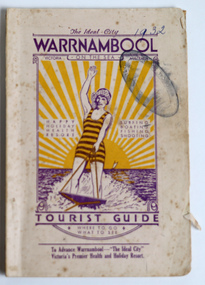
Booklet - Warrnambool Tourist Booklet, Warrnambool Progress Association, Warrnambool On the Sea, Victoria, Australia, Tourist Guide, 1932
... Today tourism in Warrnambool remains a key component of the city's economy because of its beaches, coastal views, sporting events, winter whales and its proximity to other tourist attractions. ...Today tourism in Warrnambool remains a key component of the city's economy because of its beaches, coastal views, sporting events, winter whales and its proximity to other tourist attractions. ...Warrnambool Tourist GuideThis is a booklet with a cream cover featuring a sketch of a woman waterskiing and blue printing. The pages contain black and white photographs, advertisements, two maps and printed text. There is one fold-out page. The booklet is stapled and bound with glue.non-fictionWarrnambool Tourist Guidewarrnambool tourism, warrnambool progress association -
 Warrnambool and District Historical Society Inc.
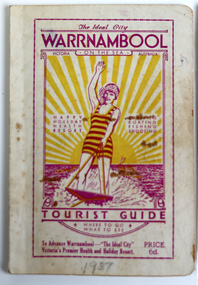
Booklet - Warrnambool Tourist Guide, Warrnambool Progress Association, Warrnambool On The Sea Tourist Guide, The Ideal City, Where to Go and What to See, 1936
... Today tourism is a key component of Warrnambool's economy because of its beaches, coastal views, winter whales, sporting events and its proximity to other tourist attractions. ...Today tourism is a key component of Warrnambool's economy because of its beaches, coastal views, winter whales, sporting events and its proximity to other tourist attractions. ...Warrnambool Tourist Guide 1936This is a booklet with a buff-coloured cover featuring an illustration of a woman water skiing. The back cover has blue printing. The pages contain a fold-out map, advertisements, printed text and black and white photographs. The pages have been stapled and then glued.non-fictionWarrnambool Tourist Guide 1936tourism in warrnambool, warrnambool progress association -
 Mission to Seafarers Victoria
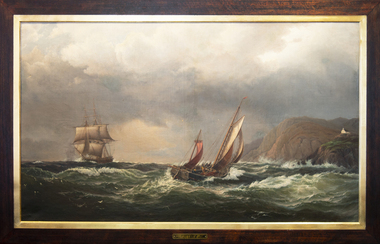
Painting - Oil painting, Madeline M.Ravenna Lewellin, Start Point Light, Devonshire, 1875
... It depicts a famous Devonshire coastal region famous now for its lighthouse and the pick up point for the pilot when entering waters approaching Dartmouth. The sailing vessels pre-date the construction of the famous lighthouse. Over the centuries the view...It depicts a famous Devonshire coastal region famous now for its lighthouse and the pick up point for the pilot when entering waters approaching Dartmouth. The sailing vessels pre-date the construction of the famous lighthouse. Over the centuries the view ...This painting was made after an artwork by Wilhelm Melby held at the National Gallery of Victoria. Melby is a Danish artist (1824-1882). It depicts a famous Devonshire coastal region famous now for its lighthouse and the pick up point for the pilot when entering waters approaching Dartmouth. The sailing vessels pre-date the construction of the famous lighthouse. Over the centuries the view would have been familiar to many sailors as they left or approached the English mainland and south coast ports in the English Channel. Madeline Mary Ravenna Lewellin (1854 – 24 November 1944) was born in Victoria to Dr John Henry Hill Lewellin, a physician, and Grace Elizabeth (née Danneby). She was one of five daughters, and the family lived in Prahran. Lewellin's brother, Captain Herbert Gordon Hill Lewellin, was a commander in the P. and O. fleet (apprentice on the Romanoff, Lieutenant RNR on the HMS Arethusa in 1899, RMS Mongolia in 1913 sunk in 1917, Naldera in 1920). She studied painting at the National Gallery School in 1879 under Eugene von Guerard. She's also known for collecting and painting specimens, and became a member of the Field Naturalists Club of Victoria in 1885. In 1884 she won a silver medal for her studies of fungi. She collected plants for Australian botanist Ferdinand von Mueller, and the variety of Dicrastylis lewellinii (Purple sand-sage) is named after her. Miss Lewellin, who had a love of the sea and ships as subject matter is listed in 1910 as a donor as a 10/6 member donating to the motor launch fund and in 1918 as a working member of the Ladies Harbour Lights Guild which involved regular volunteer shifts at the Mission to Seamen on canteen and other duties. The painting was donated by Miss Lewellin in 1918 and hanged above the stage in the main hall; it appears on several postcards of the time.Marine art, Maritime artThis oil painting has a dark polished wood and gold leaf slip. The painting depicts two masted boats. The choppy sea takes up the lower-third of the painting, and the other two-thirds of the image of made up of stormy grey clouds. A rocky cliff face can be seen on the right-hand side of the painting. A small church can be seen on the hillside. The ship on the left third of the painting sits on the horizon line of the sea. The centre ship with two masts appears to be leaning to the right and its deck is exposed to the viewer showing four men attempting to handle the masts and rigging. The left-hand ship with three masts is surrounded by two grey distant silhouetted mast ships. There are three seagulls at the upper left-centre of the image. There are another three gulls down on the lower-left of the image. Front: ENGRAVED PLAQUE: Start Point Light. Devonshire. SIGNATURE: After W. Melby / M.M.R Lewellin. 1875. Reverse: IN BLACK MARKER PEN: * Hang from two points * WHITE STICKER WITH CONSERVATOR DETAILS: Art Conservation Frames / 118 Bridport Street, Albert Park, VIC, 3206 / 9696 9066 / artconservationframers.com.aupainting, ships, mast, church, sea, storm, oil painting, seagulls, madeline r. lewellin, artwork-paintings, ngv, wilhelm melby, eugene von guerard, botanist, rms mongolia, captain herbert gordon hill lewellin (1862-1935), paddy lewellin, reproduction, seascape, danger -
 Flagstaff Hill Maritime Museum and Village
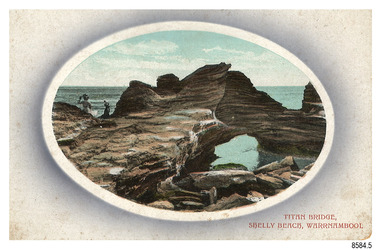
Postcard - Scenic, Warrnambool, Titan Bridge, Shelly Beach, Warrnambool, 1902-1929
... coastal traders brought passengers and cargo to the Port of Warrnambool from ports along Victoria's southwest coast. Joseph Jordan is a significant figure in Warrnambool history as he helped to establish early units of the Mounted Rifles (G Company) in local towns during the late 1880's and later, photographed local scenes, groups and citizens of early Warrnambool. Flagstaff Hill Maritime Museum Flagstaff Hill Maritime Village Flagstaff Hill Maritime Museum and Village Maritime Museum Warrnambool Great Ocean Road Warrnambool and District Warrnambool Scenes local scenes Views ...The nine postcards in this set were donated together and date to the early 1900s. All but one postcard in this set shows images of Warrnambool, in the Western District of Victoria; the other has a London image. The postcards were all printed in Great Britain according to that country’s postal regulations. The fronts of all cards have titles printed in red. Most of the images on the cards are attributed to photographer Joseph Jordan and belong to the Jordan Series. The back of these cards has an outline for a postage stamp, a vertical dividing line and a heading on each side of the line to separate the Correspondence from the Address. Postcards or ‘correspondence cards’ appeared in Britain in 1894. They were plain cards with a space for the message on one side and an address on the other; regulations didn’t allow anything but the address to be written on the ‘address’ side. In 1902 the British regulations then allowed a picture to be printed on the front and the address on the back, so messages had to be written on the picture side. Soon, the regulations changed and the back was divided for a message and the address. Titan Bridge, Warrnambool – The name Titan Bridge is likely to be a reference to the huge Titan crane that was used in the construction of the Breakwater in the late 19th century. Shelly Beach is a popular swimming area with the added attraction of rock pools to investigate and rock formations to climb. Joseph Jordan - Joseph Jordan was born in 1841 in Leicester England. When he was 16 he joined the 7th Queen's Own Hussars and was sent to India at the outbreak of the mutiny. He took part in the relief of Lucknow and remained in India for eleven years. It was during this time that he became interested in photography. He was posted to New Zealand and later came to Victoria, becoming a sergeant major of the Mounted Rifles. In the mid-1880s he came to the Western district where he was responsible for establishing units of the Mounted Rifles in various country towns such as Dunkeld, Mortlake, Panmure, Bushfield, Koroit etc. He resigned from the army in 1889 and set up a professional photography studio in Liebig Street, Warrnambool. He became very well known in the Western District for family photographs, official photographs of local councillors and groups as well as views of local scenery. In 1891 he photographed the wrecked barque ‘Fiji’ at ‘Wrecks Beach’ near Princetown. His business was taken over by his son Arthur around 1917. Joseph was a keen rifle shot and in 1924 he donated the "Jordan Shield" as a prize to the Victorian Rifle Association. He was made a "Life Honorary Member" of the Warrnambool Returned Soldiers League and in 1933 he was recognised as being the oldest living soldier in Victoria. Joseph died in 1935 aged 95.The image of the Titan Bridge rock formation with figures on it suggests that the location was a popular place to visit. It captures a time when the rock formation was publically accessible. The choice of subject for this postcard indicates the popularity of Warrnambool's natural environment as a tourist attraction at a time when ships called coastal traders brought passengers and cargo to the Port of Warrnambool from ports along Victoria's southwest coast. Joseph Jordan is a significant figure in Warrnambool history as he helped to establish early units of the Mounted Rifles (G Company) in local towns during the late 1880's and later, photographed local scenes, groups and citizens of early Warrnambool.Postcard, one of nine, landscape orientation, coloured print within an oval border and mauve-toned shading. The cameo image shows two figures, one seated and one standing, beside the sea on a rough rock beside a rock formation resembling a bridge. There is no correspondence written on the card. The back has inscriptions and outlines for a postage stamp. Jordan Series, printed in Great Britain.Front, in red: “TITAN BRIDGE / SHELLY BEACH, NEAR WARRNAMBOOL” Back in black: “Jordan Series” “POST CARD” “PRINTED IN GREAT BRITAIN” “For correspondence” “The Address only to be written here”flagstaff hill maritime museum, flagstaff hill maritime village, flagstaff hill maritime museum and village, maritime museum, warrnambool, great ocean road, warrnambool and district, warrnambool scenes, local scenes, views of warrnambool, joseph jordan, jordan series, jordan photography, postcard, souvenir, correspondence, cameo postcard, landscape, shelly beach, titan bridge, titan, rock formation -
 Flagstaff Hill Maritime Museum and Village
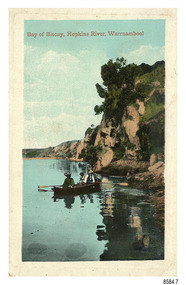
Postcard - Scenic - Warrnambool, Bay of Biscay, Hopkins River, Warrnambool, 1902-1910
... coastal traders brought passengers and cargo to the Port of Warrnambool from ports along Victoria's southwest coast. Joseph Jordan is a significant figure in Warrnambool history as he helped to establish early units of the Mounted Rifles (G Company) in local towns during the late 1880's and later, photographed local scenes, groups and citizens of early Warrnambool. Flagstaff Hill Maritime Museum Flagstaff Hill Maritime Village Flagstaff Hill Maritime Museum and Village Maritime Museum Warrnambool Great Ocean Road Warrnambool and District Warrnambool Scenes local scenes Views ...The nine postcards in this set were donated together and date to the early 1900s. All but one postcard in this set shows images of Warrnambool, in the Western District of Victoria; the other has a London image. The postcards were all printed in Great Britain according to that country’s postal regulations. The fronts of all cards have titles printed in red. Most of the images on the cards are attributed to photographer Joseph Jordan and belong to the Jordan Series. The back of these cards has an outline for a postage stamp, a vertical dividing line and a heading on each side of the line to separate the Correspondence from the Address. Postcards or ‘correspondence cards’ appeared in Britain in 1894. They were plain cards with a space for the message on one side and an address on the other; regulations didn’t allow anything but the address to be written on the ‘address’ side. In 1902 the British regulations then allowed a picture to be printed on the front and the address on the back, so messages had to be written on the picture side. Soon, the regulations changed and the back was divided for a message and the address. Bay of Biscay, Hopkins River, Warrnambool – This same image was published in Table Talk on January 6th, 1910 and in The Age, on December 18, 1929, referred to a revival of fishing at the Bay of Biscay on the Hopkins River. These and similar articles showcased the Bay of Biscay as a popular boating and fishing location and well worth promoting to places outside of Warrnambool. Joseph Jordan - Joseph Jordan was born in 1841 in Leicester England. When he was 16 he joined the 7th Queen's Own Hussars and was sent to India at the outbreak of the mutiny. He took part in the relief of Lucknow and remained in India for eleven years. It was during this time that he became interested in photography. He was posted to New Zealand and later came to Victoria, becoming a sergeant major of the Mounted Rifles. In the mid-1880s he came to the Western district where he was responsible for establishing units of the Mounted Rifles in various country towns such as Dunkeld, Mortlake, Panmure, Bushfield, Koroit etc. He resigned from the army in 1889 and set up a professional photography studio in Liebig Street, Warrnambool. He became very well known in the Western District for family photographs, official photographs of local councillors and groups as well as views of local scenery. In 1891 he photographed the wrecked barque ‘Fiji’ at ‘Wrecks Beach’ near Princetown. His business was taken over by his son Arthur around 1917. Joseph was a keen rifle shot and in 1924 he donated the "Jordan Shield" as a prize to the Victorian Rifle Association. He was made a "Life Honorary Member" of the Warrnambool Returned Soldiers League and in 1933 he was recognised as being the oldest living soldier in Victoria. Joseph died in 1935 aged 95.The image of the figures in a row boat on the river suggests that the location was a popular place to visit. The choice of subject for this postcard indicates the popularity of Warrnambool's natural environment as a tourist attraction at a time when ships called coastal traders brought passengers and cargo to the Port of Warrnambool from ports along Victoria's southwest coast. Joseph Jordan is a significant figure in Warrnambool history as he helped to establish early units of the Mounted Rifles (G Company) in local towns during the late 1880's and later, photographed local scenes, groups and citizens of early Warrnambool.Postcard, one of nine, portrait orientation, coloured print within a rectangle border with an impressed line around the image and a title in red. The picture shows three figures wearing hats in a rowboat on the bank of a river beside cliffs. There is no correspondence written on the card. The back has inscriptions and outlines for a postage stamp. Jordan Series, printed in Great Britain.Front, in red: “Bay of Biscay, Hopkins River, Warrnambool” Back in green: “Jordan Series” “POST CARD” “PRINTED IN GREAT BRITAIN” “For correspondence” “The Address only to be written here”flagstaff hill maritime museum, flagstaff hill maritime village, flagstaff hill maritime museum and village, maritime museum, warrnambool, great ocean road, warrnambool and district, warrnambool scenes, local scenes, views of warrnambool, joseph jordan, jordan series, jordan photography, postcard, souvenir, correspondence, cameo postcard, bay of biscay, fishing, boating -
 Flagstaff Hill Maritime Museum and Village
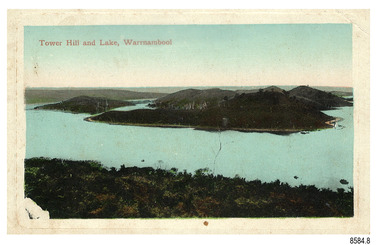
Postcard - Scenic, Warrnambool, Tower Hill and Lake, Warrnambool, 1902-1929
... coastal trading ships brought passengers and cargo to the Port of Warrnambool, it continues to be a popular place to visit. Joseph Jordan is a significant figure in Warrnambool history as he helped to establish early units of the Mounted Rifles (G Company) in local towns during the late 1880's and later, photographed local scenes, groups and citizens of early Warrnambool. Flagstaff Hill Maritime Museum Flagstaff Hill Maritime Village Flagstaff Hill Maritime Museum and Village Maritime Museum Warrnambool Great Ocean Road Warrnambool and District Warrnambool Scenes local scenes Views ...The nine postcards in this set were donated together and date to the early 1900s. All but one postcard in this set shows images of Warrnambool, in the Western District of Victoria; the other has a London image. The postcards were all printed in Great Britain according to that country’s postal regulations. The fronts of all cards have titles printed in red. Most of the images on the cards are attributed to photographer Joseph Jordan and belong to the Jordan Series. The back of these cards has an outline for a postage stamp, a vertical dividing line and a heading on each side of the line to separate the Correspondence from the Address. Postcards or ‘correspondence cards’ appeared in Britain in 1894. They were plain cards with a space for the message on one side and an address on the other; regulations didn’t allow anything but the address to be written on the ‘address’ side. In 1902 the British regulations then allowed a picture to be printed on the front and the address on the back, so messages had to be written on the picture side. Soon, the regulations changed and the back was divided for a message and the address. Tower Hill and Lake, Warrnambool – Tower Hill Wildlife Reserve is in the crater of a dormant volcano. In 1892 the area was declared a National Park, the first in Victoria, preserving native animals and Indigenous plants. The rich volcanic soil in the area attracted early settlers including the families of Henry Giles, born at Tower Hill in 1858 and his wife Mary Jane (born Freckleton) born nearby at Cooramook in 1860. Henry and Mary worked in the local area where they also raised their six children. For a time, Henry was employed as a labourer on the Warrnambool Breakwater. Joseph Jordan - Joseph Jordan was born in 1841 in Leicester England. When he was 16 he joined the 7th Queen's Own Hussars and was sent to India at the outbreak of the mutiny. He took part in the relief of Lucknow and remained in India for eleven years. It was during this time that he became interested in photography. He was posted to New Zealand and later came to Victoria, becoming a sergeant major of the Mounted Rifles. In the mid-1880s he came to the Western district where he was responsible for establishing units of the Mounted Rifles in various country towns such as Dunkeld, Mortlake, Panmure, Bushfield, Koroit etc. He resigned from the army in 1889 and set up a professional photography studio in Liebig Street, Warrnambool. He became very well known in the Western District for family photographs, official photographs of local councillors and groups as well as views of local scenery. In 1891 he photographed the wrecked barque ‘Fiji’ at ‘Wrecks Beach’ near Princetown. His business was taken over by his son Arthur around 1917. Joseph was a keen rifle shot and in 1924 he donated the "Jordan Shield" as a prize to the Victorian Rifle Association. He was made a "Life Honorary Member" of the Warrnambool Returned Soldiers League and in 1933 he was recognised as being the oldest living soldier in Victoria. Joseph died in 1935 aged 95.The postcard of Tower Hill and Lake is connected to the location near Warrnambool where many of our early settlers lived and worked. One of these settlers was the Giles family, whose son Henry was born at Tower Hill. His family has donated many Victorian-era items which are now on display at Flagstaff Hill. Tower Hill National Park is the first place in Victoria to be named a National Park. As in the times when coastal trading ships brought passengers and cargo to the Port of Warrnambool, it continues to be a popular place to visit. Joseph Jordan is a significant figure in Warrnambool history as he helped to establish early units of the Mounted Rifles (G Company) in local towns during the late 1880's and later, photographed local scenes, groups and citizens of early Warrnambool.Postcard, one of nine, landscape orientation, coloured print within a rectangle and an impressed line around the image on the front. The picture shows several islands close together with hills around them and bushland in the foreground. There are dead trees amongst the vegetation and a sandy shore at the foot of some of the hills. The lower left corner shows what appears to be two white rails, possibly a lookout fence. There is no correspondence written on the card. The title is printed in red on the front and the back has inscriptions and outlines for a postage stamp. Jordan Series, printed in Great Britain. Front, in red: “Tower Hill Lake, Warrnambool” Back in green: “Jordan Series” “POST CARD” “PRINTED IN GREAT BRITAIN” “For correspondence” “The Address only to be written here”flagstaff hill maritime museum, flagstaff hill maritime village, flagstaff hill maritime museum and village, maritime museum, warrnambool, great ocean road, warrnambool and district, warrnambool scenes, local scenes, views of warrnambool, joseph jordan, jordan series, jordan photography, postcard, souvenir, correspondence, cameo postcard, tower hill, tower hill national park, victoria's first national park, henry giles, mary jane freckleton, breakwater, early settlers -
 Flagstaff Hill Maritime Museum and Village
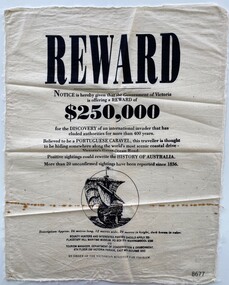
Article - Reward Poster - Portuguese Caravel, 1992
... coastal drive- Victoria's Great Ocean Road. Positive sightings could rewrite the HISTORY OF AUSTRALIA. More than 20 unconfirmed sightings have been reported since 1836. Description: Approx. 26 metres long, 12 metres wide, 20 metres in height, dark brown in colour. BOUNTY HUNTERS AND INTERESTED PARTIES SHOULD APPLY TO: FLAGSTAFF HILL MARITIME MUSEUM, PO BOX 574 WARRNAMBOOL 3280 OR TOURISM MANAGER, DEPARTMENT OF CONSERVATION & ENVIRONMENT, 8TH FLOOR 250 VICTORIA PARADE, EAST MELBOURNE 3002 BY ORDER OF THE VICTORIAN MINISTER FOR TOURISM. Printed image: back view...coastal drive- Victoria's Great Ocean Road. Positive sightings could rewrite the HISTORY OF AUSTRALIA. More than 20 unconfirmed sightings have been reported since 1836. Description: Approx. 26 metres long, 12 metres wide, 20 metres in height, dark brown in colour. BOUNTY HUNTERS AND INTERESTED PARTIES SHOULD APPLY TO: FLAGSTAFF HILL MARITIME MUSEUM, PO BOX 574 WARRNAMBOOL 3280 OR TOURISM MANAGER, DEPARTMENT OF CONSERVATION & ENVIRONMENT, 8TH FLOOR 250 VICTORIA PARADE, EAST MELBOURNE 3002 BY ORDER OF THE VICTORIAN MINISTER FOR TOURISM. Printed image: back view ...The mystery of the Portuguese Caravel, commonly known as the ‘Mahogany Ship’ is today regarded as legend and refers to an ancient wreck that is said to lie beneath the sand between Warrnambool and Port Fairy. Its location is currently unknown, but many people have searched for it through the years since the first reported sighting of an unidentified wreck in 1836. For over a century this mystery has fascinated Australians because the existence of such a vessel could throw light on the earliest phase of exploration of Eastern Australia by Europeans. The interest in the mystery was high enough for the Victorian Government to offer a reward in 1992 which was subsequently withdrawn a year later with no monies being paid.This item is historically significant because of its relationship to an ongoing mystery (the Mahogany Ship) that may throw light on the early exploration of Australia. The offering of a reward, 150+years after the first recorded sighting, by the Victorian Government points to the ongoing fascination with this subject to the Victorian people.A reward poster printed on calico. Even though the poster was created in 1992 it follows the regular structure of a reward poster from earlier times; the word REWARD in large print at the top, the amount $250,000 in bold type and an imagined drawing of the missing Portuguese Caravel.Printed text: REWARD Notice is hereby given that the Government of Victoria is offering a REWARD of $250,000 for the DISCOVERY of an international invader that has eluded authorities for more than 400 years. Believed to be a PORTUGUESE CARAVEL, this traveller is thought to be hiding somewhere along the world's most scenic coastal drive- Victoria's Great Ocean Road. Positive sightings could rewrite the HISTORY OF AUSTRALIA. More than 20 unconfirmed sightings have been reported since 1836. Description: Approx. 26 metres long, 12 metres wide, 20 metres in height, dark brown in colour. BOUNTY HUNTERS AND INTERESTED PARTIES SHOULD APPLY TO: FLAGSTAFF HILL MARITIME MUSEUM, PO BOX 574 WARRNAMBOOL 3280 OR TOURISM MANAGER, DEPARTMENT OF CONSERVATION & ENVIRONMENT, 8TH FLOOR 250 VICTORIA PARADE, EAST MELBOURNE 3002 BY ORDER OF THE VICTORIAN MINISTER FOR TOURISM. Printed image: back view of a Caravel in full sail flagstaff hill maritime museum and village, great ocean road, shipwreck coast, warrnambool, port fairy, portuguese caravel, mahogany ship, reward poster, victorian government -
 Flagstaff Hill Maritime Museum and Village
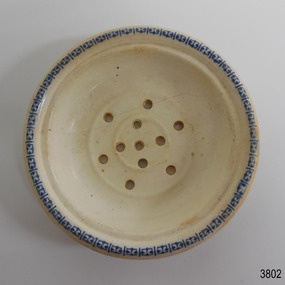
Ceramic - Soap dish, circa 1883
... Divers can still access parts of the scattered wreck and other artefacts recovered in the 1970s and 1980s can be viewed in both public and private collections. flagstaff hill warrnambool flagstaff hill maritime museum maritime museum shipwreck coast flagstaff hill maritime village great ocean road john chance west coast trader george roper captain john ward russell stourbridge bricks port phillip heads lonsdale reef dive wreck vhr s286 coastal trader ceramic vintage personal hygiene bathroom accessory soap dish Soap dish; glazed white porcelain. ...This ceramic soap dish was recovered from the wreck of the 1882-1883 George Roper between the late 1960’s to early 1970’s. It is one of the shipwreck artefacts in the John Chance Collection. Soap dishes were often part of a wash set that also included a water jug and wash bowl. The holes in the dish allowed water to drain out of the dish, keeping the soap dry for next use. The GEORGE ROPER 1882 - 1883 - The George Roper was a 4-masted iron sailing ship built in Liverpool, England, in 1882 for fast international trade with Australia. The large vessel was launched in February 1883. The ship was on its first trip, departing Liverpool for Melbourne, captained by John Ward and a crew of 31. She had almost reached her destination on July 4 1883, approaching Port Phillip Bay and being towed by the steam tug William. The weather changed to rough with fog and both the George Roper and the William hit the dangerous Lonsdale Reef at Port Phillip Heads. The Captain and crew were eventually rescued and taken to Queenscliff. Salvage syndicates were able to recover a lot of the cargo before the George Roper broke up and sank. Amongst the cargo was soft goods, draperies, household items, spirits of malt and distilled liquors, chemicals, dynamite, and 1,400 tons of steel rails for the Victorian Government. Also in the hold were Russell Stourbridge bricks, as paying ballast. This 1880s soap dish is an example of personal hygiene accessories and may have been part of a set comprising jug, bowl and dish.. The soap dish is also significant as it was recovered by John Chance, a diver from the wreck of the George Roper in the 1960s-70s. Items that come from several wrecks along Victoria's coast have since been donated to the Flagstaff Hill Maritime Village’s museum collection by his family, illustrating this item’s level of historical value. The soap dish is significant for its association with the barque George Roper, which is considered historically and archaeologically significant and as such, is listed on the Victorian Heritage Database, VHR S286. The George Roper is an example of a vessel built specifically for fast travel to and from Australia with a large shipment of cargo. Its cargo of steel rails adds to the historical significance of international trade to the growing colony of Australia and Victoria in particular, with rail transportation soon to become a faster and safer form of transportation between colonial towns. Divers can still access parts of the scattered wreck and other artefacts recovered in the 1970s and 1980s can be viewed in both public and private collections. Soap dish; glazed white porcelain. Round shallow bowl with blue patterned border, resembling butterflies. Two raised, concentric rings are moulded into the base. Six pierced holes are evenly spaced between the rings, five holes are in the centre of the dish.flagstaff hill, warrnambool, flagstaff hill maritime museum, maritime museum, shipwreck coast, flagstaff hill maritime village, great ocean road, john chance, west coast trader, george roper, captain john ward, russell stourbridge bricks, port phillip heads, lonsdale reef, dive wreck, vhr s286, coastal trader, ceramic, vintage, personal hygiene, bathroom accessory, soap dish -
 Flagstaff Hill Maritime Museum and Village
Ceramic - Cover, circa 1883
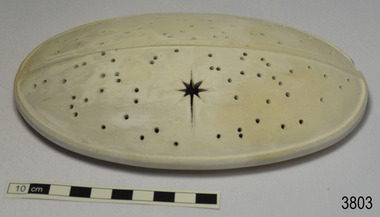
... Divers can still access parts of the scattered wreck and other artefacts recovered in the 1970s and 1980s can be viewed in both public and private collections. flagstaff hill warrnambool flagstaff hill maritime museum maritime museum shipwreck coast flagstaff hill maritime village great ocean road john chance west coast trader george roper w. h. potter & sons w.t. dickson and son captain john ward russell stourbridge bricks port phillip heads lonsdale reef dive wreck vhr s286 coastal trader ceramic vintage ventilated cover domestic item Cover; unglazed white ceramic, oval shape. ...This ceramic cover was recovered from the wreck of the 1882-1883 George Roper between the late 1960’s to early 1970’s. It is one of the shipwreck artefacts in the John Chance Collection. The purpose of the cover is unclear. The holes could be for ventilation. The cover may have been used to protect food or keep it at an even temperature. It may also have been used for covering fragrant petals, allowing some scent to escape through the holes. The residue around the underside of the holes and their random placement indicate that the cover could be partially handmade. The discolouration could have come from its time in the sea. The GEORGE ROPER 1882 - 1883 - The George Roper was a 4-masted iron sailing ship built in Liverpool, England, in 1882 for fast international trade with Australia. The large vessel was launched in February 1883. The ship was on its first trip, departing Liverpool for Melbourne, captained by John Ward and a crew of 31. She had almost reached her destination on July 4 1883, approaching Port Phillip Bay and being towed by the steam tug William. The weather changed to rough with fog and both the George Roper and the William hit the dangerous Lonsdale Reef at Port Phillip Heads. The Captain and crew were eventually rescued and taken to Queenscliff. Salvage syndicates were able to recover a lot of the cargo before the George Roper broke up and sank. Amongst the cargo was soft goods, draperies, household items, spirits of malt and distilled liquors, chemicals, dynamite, and 1,400 tons of steel rails for the Victorian Government. Also in the hold were Russell Stourbridge bricks, as paying ballast. The ventilated cover is as an example of domestic ceramic ware of the 1880s. The cover also holds significance as it was recovered by John Chance, a diver from the wreck of the George Groper in the 1960s-70s. Items that come from several wrecks along Victoria's coast have since been donated to the Flagstaff Hill Maritime Village’s museum collection by his family, illustrating this item’s level of historical value. The George Roper is considered historically and archaeologically significant and as such, is listed on the Victorian Heritage Database, VHR S286. It is an example of a vessel built specifically for fast travel to and from Australia with a large shipment of cargo. The George Roper’s cargo of steel rails adds to the historical significance of international trade to the growing colony of Australia and Victoria in particular, with rail transportation soon to become a faster and safer form of transportation between colonial towns. Divers can still access parts of the scattered wreck and other artefacts recovered in the 1970s and 1980s can be viewed in both public and private collections. Cover; unglazed white ceramic, oval shape. The cover has holes randomly poked through its surface, one large hole is a six pointed star shape. Underneath there is a narrow rim placed slightly inside the edge. There is residue on the underneath around the holes. There is orange-brown discolouration and areas where the surface is lighter coloured. flagstaff hill, warrnambool, flagstaff hill maritime museum, maritime museum, shipwreck coast, flagstaff hill maritime village, great ocean road, john chance, west coast trader, george roper, w. h. potter & sons, w.t. dickson and son, captain john ward, russell stourbridge bricks, port phillip heads, lonsdale reef, dive wreck, vhr s286, coastal trader, ceramic, vintage, ventilated cover, domestic item -
 Flagstaff Hill Maritime Museum and Village
Photograph - Coastal Scene, Joseph Jordan Photographic Studio, Lady Bay and Breakwater, Warrnambool, circa 1907
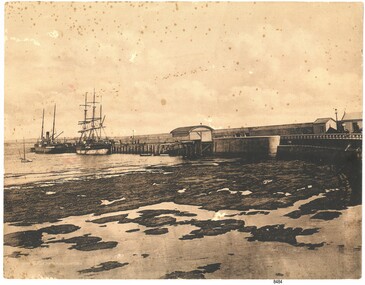
... Flagstaff Hill Flagstaff Hill Maritime Museum Warrnambool Warrnambool Harbour Port of Warrnambool Tramway jetty Breakwater Lifeboat and Rocket Shed Steamship barque Photograph of Lady Bay Rocket House shipping Joseph Jordan Lady Bay Views of Warrnambool Jordan photography Front of photo - BREAKWATER, WARRNAMBOOL, VICTORIA Back of photo - "From: P Gregory / 365 Beach Road / BLACK ROCK 3193" Sepia photograph showing the beach and the Breakwater in Lady Bay Warrnambool, two ships (a steamship and a barque), a small sailboat, and the Lifeboat and Rocket House plus two smaller sheds. Lady Bay and Breakwater, Warrnambool Photograph Coastal ...The Port of Warrnambool - In the early years the Port of Warrnambool was a busy port. Steamships and sailing ships were frequent visitors to the port. Steam navigation companies were plentiful, carrying passengers and freighting cargo such as coal, timber, food, livestock, furniture, hardware and haberdashery between Melbourne and the ports along the southwest coast of Victoria, including Warrnambool. The carts would take their loads into the township for distribution. The Breakwater was built (using 32 ton blocks of concrete) between 1874 and 1890 to provide ships with greater protection from the Southern Ocean. The Lifeboat and Rocket House - The coastline of South West Victoria has had over 600 shipwrecks and many lost lives; even in Warrnambool’s Lady Bay there were around 16 known shipwrecks between 1850 and 1905, with eight lives lost. In 1859 the first Government-built lifeboat arrived at Warrnambool Harbour and a shed was soon built to house it, followed in 1864 by a rocket house to safely store the Rocket Rescue equipment. In 1878 the buildings were moved to the Breakwater area, and in 1910 the new Lifeboat Warrnambool arrived with its ‘self-righting’ design. For almost one hundred years the lifeboat and rocket crews, mostly local volunteers, trained regularly to maintain and improve their skills, summoned when needed by alarms, gunshots, ringing bells and foghorns. Some became local heroes but all served an important role. By the end of the 1950s the lifeboat and rescue equipment had become obsolete. Joseph Jordan - Joseph Jordan was born in 1841 in Leicester England. When he was 16 he joined the 7th Queen's Own Hussars and was sent to India at the outbreak of the mutiny. He took part in the relief of Lucknow and remained in India for eleven years. It was during this time, he became interested in photography. He was posted to New Zealand and later came to Victoria, becoming a sergeant major of the Mounted Rifles. In the mid 1880s he came to the Western district where he was responsible for establishing units of the Mounted Rifles in various country towns such as Dunkeld, Mortlake, Panmure, Bushfield, Koroit etc. He resigned from the army in 1889 and set up a professional photography studio in Liebig Street, Warrnambool. He became very well known in the Western District for family photographs, official photographs of local councillors and groups as well as views of local scenery. In 1891 he photographed the wrecked barque "Fiji" at "Wrecks Beach" near Princetown. His business was taken over by his son Arthur around 1917. Joseph was a keen rifle shot and in 1924 he donated the "Jordan Shield" as a prize to the Victorian Rifle Association. He was made a "Life Honorary Member" of the Warrnambool Returned Soldiers League and in 1933 he was recognised as being the oldest living soldier in Victoria. Joseph died in 1935 aged 95.This photograph is significant for its association with the Port of Warrnambool and the Warrnambool Breakwater as it shows a point in time when shipping activities were an important part of Warrnambool's commerce and social development. It is also a record of the Warrnambool Lifeboat and Rocket house which was important in aiding ordinary citizens, harbour employees and the volunteer boat and rescue crew in saving the lives of sailors and passengers due to the high number of shipwrecks that occurred along the coastline. Joseph Jordan is a significant figure in Warrnambool history as he helped to establish early units of the Mounted Rifles (G Company) in local towns during the late 1880's and later, photographed local scenes, groups and citizens of early Warrnambool. Sepia photograph showing the beach and the Breakwater in Lady Bay Warrnambool, two ships (a steamship and a barque), a small sailboat, and the Lifeboat and Rocket House plus two smaller sheds.Front of photo - BREAKWATER, WARRNAMBOOL, VICTORIA Back of photo - "From: P Gregory / 365 Beach Road / BLACK ROCK 3193"flagstaff hill, flagstaff hill maritime museum, warrnambool, warrnambool harbour, port of warrnambool, tramway jetty, breakwater, lifeboat and rocket shed, steamship, barque, photograph of lady bay, rocket house, shipping, joseph jordan, lady bay, views of warrnambool, jordan photography -
 Glenelg Shire Council Cultural Collection
Painting, Nancy Malseed, Seal Cave, c. 1964
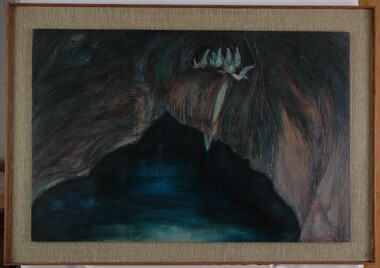
... Nancy Malseed sea seals coastal seascape Front: Malseed (lower right, red paint) Back: Nancy Malseed "Seal Cave" Portland Art Gallery Trust, c/c C. Woolcock (upper and mid left, black felt tip pen). View ...Acquired by Portland Council for the Encouragement of Music and the Arts (CEMA) as a winner of its annual Art Price in 1964; later presented by CEMA to Portland Town Council.View of the interior of a cave. In foreground is a triangular pool of dark blue water with lighter highlights. The walls of the cave curve up both sides of the water, meeting at the back of the cave. At back of cave is a ledge with 7 seals on it. One seal is diving into the water. The walls are painted in brown and dark blue, the seals in pale blue with highlights in white.Front: Malseed (lower right, red paint) Back: Nancy Malseed "Seal Cave" Portland Art Gallery Trust, c/c C. Woolcock (upper and mid left, black felt tip pen).sea, seals, coastal, seascape -
 Glenelg Shire Council Cultural Collection
Photograph - Photograph - view of Portland Bay, n.d
... Esther Winifred Hall 1934 centenary Portland photography Back: "View of Portland Bay to E.W. Hall from Marg..." Black and white photograph showing a coastal scene with from left, foreshore with buildings, cars, people, pier and ocean. ...Photographs taken by Esther Winifred Hall (nee Smallpage) - great grand-daughter of Stephen George Henty. Taken in 1934 Centenary celebrations in Portland.Black and white photograph showing a coastal scene with from left, foreshore with buildings, cars, people, pier and ocean.Back: "View of Portland Bay to E.W. Hall from Marg..."esther winifred hall, 1934, centenary, portland, photography -
 Glenelg Shire Council Cultural Collection
Photograph - Photograph - aerial view of Portland foreshore, 1970s
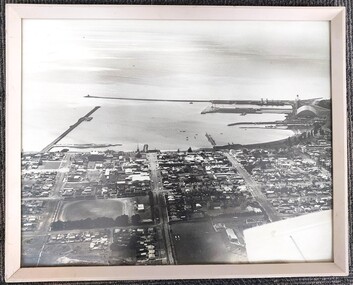
... Portland Foreshore harbour coastal photography Aerial Photo Portland Front: (no inscriptions) Back: Twites Picture Framers, Carlton label. Aerial view ...Aerial view of Portland and foreshore. Black and white photograph. Breakwater is on left, but part has only one domed building evident on far right.Front: (no inscriptions) Back: Twites Picture Framers, Carlton label.portland foreshore, harbour, coastal photography, aerial photo, portland -
 Orbost & District Historical Society
Postcard - Five b/w photos/postcards of Marlo, Rose series, 1900-1930
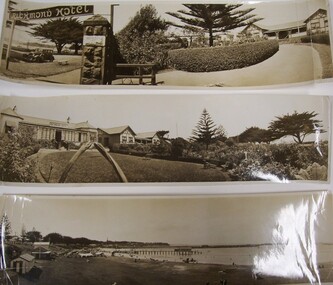
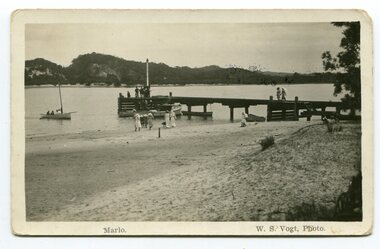
... coastal route from Melbourne to Orbost. Marlo developed as a small port with a jetty. It also developed as a holiday destination with the Hotel and at least one guest-house. These five postcards are significant because they show important aspects of Marlo c.1890s - 1930s. Marlo Marlo Hotel Marlo Jetty Snowy River 2708.1 View ...Marlo is a settlement near the mouth of the Snowy River near Orbost. Before the railway was completed to Orbost in 1916, and roads were later improved, Marlo was the main entry-point for ships travelling the coastal route from Melbourne to Orbost. Marlo developed as a small port with a jetty. It also developed as a holiday destination with the Hotel and at least one guest-house. These five postcards are significant because they show important aspects of Marlo c.1890s - 1930s. Five b/w photos/postcards 2708.1 View showing grassy hillside in foreground with telegraph poles. Water and sand dunes in the background 2708.2 View showing grass and trees in the foreground; then water with sand dunes in the background. 2708.3 A sign across the top of a road with 'Welcome to Marlo'; a car on the road; trees on edges of road. 2708.4 A number of buildings behind a white fence; large tree on l.h.side. 2708.5 Sand in the foreground leading down to a water. Women on the foreshore, also a dog and children. A small sailing boat in the water. A jetty leading out into the water. People on the jetty. In the background are vegetated sand-dunes.2708.1 View from Hotel, Marlo, Vic. Rose Series P3253 2708.2 Sand Hummocks, Snowy River, Marlo, Vic. Rose Series P324 2708.3 Marlo Road, Marlo, Vic. Rose Series P3836 2708.4 Marlo Hotel, Marlo, Victoria. Rose Series P2421 2708.5 Marlo. W S Vogt photomarlo, marlo hotel, marlo jetty, snowy river -
 Phillip Island and District Historical Society Inc.
Photograph - Post Cards, Early 20th Century
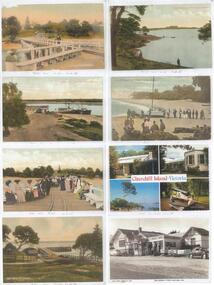
... Cowes Pier; Churchill Island; People waiting on the Cowes Pier for the Steamer; The Cowes Pier; View of Churchill Island; Coastal scene at Cowes; Postcard with 4 scenes at Churchill Island - Amess Cottage, Moonah Trees, Historic Cannon; Kilcunda General Store....Cowes Pier; Churchill Island; People waiting on the Cowes Pier for the Steamer; The Cowes Pier; View of Churchill Island; Coastal scene at Cowes; Postcard with 4 scenes at Churchill Island - Amess Cottage, Moonah Trees, Historic Cannon; Kilcunda General Store. ...One of a collection of 15 sheets with copies of Postcards printed onto A3 sheets from the Shirley Jones Collection.Copies of postcards. Cowes Pier; Churchill Island; People waiting on the Cowes Pier for the Steamer; The Cowes Pier; View of Churchill Island; Coastal scene at Cowes; Postcard with 4 scenes at Churchill Island - Amess Cottage, Moonah Trees, Historic Cannon; Kilcunda General Store."Cowes from the Pier" - "Waiting for the steamer on the Pier at Cowes P.I." - "The Pier at Cowes" - "Churchill Island from Phillip Island" - "Churchill Island, Amess Cottage, Moonah Trees, Historic Cannon" - "The General Store Kilcunda Vic"cowes pier phillip island, churchill island, amess house churchill island, moonah trees, kilcunda general store, shirley jones collection, thelma astbury -
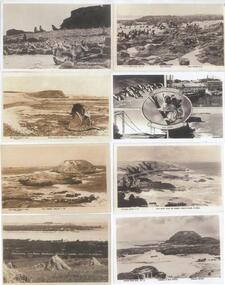 Phillip Island and District Historical Society Inc.
Photograph - Post Cards, Rose Series et al, Early 20th Century
... Shirley Jones Collection. seal rocks phillip island wildlife - seals kitty miller bay phillip island the nobbies coastal scene phillip island wildlife - koala wildlife - penguins phillip island suspension bridge shirley jones collection thelma astbury "Seals new Cowes Phillip Island" - Kitty Miller Bay Cowes Phillip Island Vic" - "The Nobbies" - "Overlooking San Remo Newhaven Churchill Island Rhyll in the distance" - "Photo Shop Series No. 15 Seal Colony Seal Rocks P15" - "Greetings from San Remo, Koalas, Penguins, The Whart, Suspension Bridge, Picturesque Coast" - "The Rose Series P667 Back Beach near The Nobbies Phillip Island Vic" - "Photo Shop Series No 12, Nobbies & Seal Rocks Phillip Island". Postcard copies: Seal Rocks; Kitty Miller Bay; The Nobbies; View ...One of a collection of 15 A3 sheets with copies of postcards printed on them. Shirley Jones Collection.Postcard copies: Seal Rocks; Kitty Miller Bay; The Nobbies; View of San Remo, Newhaven, Churchill Island & Rhyll in the distrance; Seal Colony; Greeting Card with 5 photos of Koalas, Penguins, The Whart, Suspension Bridge and coastline; The Back Beach near The Nobbies; The Nobbies & Seal Rock."Seals new Cowes Phillip Island" - Kitty Miller Bay Cowes Phillip Island Vic" - "The Nobbies" - "Overlooking San Remo Newhaven Churchill Island Rhyll in the distance" - "Photo Shop Series No. 15 Seal Colony Seal Rocks P15" - "Greetings from San Remo, Koalas, Penguins, The Whart, Suspension Bridge, Picturesque Coast" - "The Rose Series P667 Back Beach near The Nobbies Phillip Island Vic" - "Photo Shop Series No 12, Nobbies & Seal Rocks Phillip Island".seal rocks phillip island, wildlife - seals, kitty miller bay phillip island, the nobbies, coastal scene phillip island, wildlife - koala, wildlife - penguins, phillip island suspension bridge, shirley jones collection, thelma astbury -
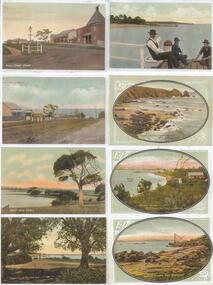 Phillip Island and District Historical Society Inc.
Photograph - Post Cards, F & J Postcards, Early 20th Century
... View of Newhaven from San Remo. Right side from top to bottom: 1. Three men sitting on the Cowes Pier - Baths in the background. 2. Coastal...View of Newhaven from San Remo. Right side from top to bottom: 1. Three men sitting on the Cowes Pier - Baths in the background. 2. Coastal ...One of 15 A3 sheets of copies of postcards on each page. Shirley Jones Collection.Copies of Postcards: Left side from top to bottom: 1 & 2. Main Street, Cowes. 3. Rural scene nears Cowes. 4. View of Newhaven from San Remo. Right side from top to bottom: 1. Three men sitting on the Cowes Pier - Baths in the background. 2. Coastal scene at Cape Woolamai. 3. Newhaven Pier. 4. Granite Quarry at Cape Woolamai. Left side from top to bottom: 1. "Main St Cowes". 2. "Main St Cowes". 3. "Scene Near Cowes". 4. "Newhaven from San Remo Phillip Island". Right side from top to bottom: 1. "Phillip Island from Cowes Pier". 2. "Phillip Island - Cape Woollami - Home of Mutton Bird". 3. "Phillip Island - Newhaven San Remo in distance". 4. Phillip Island - Granite Quarry Cape Woolamai".main street cowes phillip island, rural scene phillip island, views newhaven, cowes pier phillip island, coastline cape woolamai, granite quarry cape woolamai, shirley jones collection, thelma astbury
