
Showing 12 items matching "cockatoo residents"
-
 Cockatoo History & Heritage Group
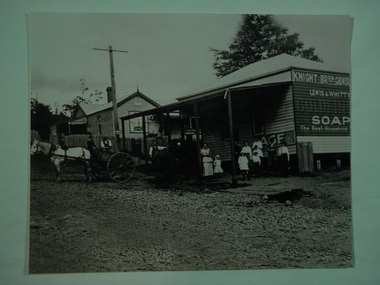
Photograph, Knight's General Store McBride St Cockatoo
... ...Cockatoo Residents...Cockatoo. The Knight's who had a general store in Gembrook, later bought it and put his sister and brother-in-law, Tom and Mary Fairbridge, in as managers. This store ran as a sub branch of the Gembrook store until Tom and Mary brought it. It then became known as 'Fairbridges". Local residents...Cockatoo Victoria McBride Fairbridge Gembrook horse cart McBride St shops Knight bros Cockatoo Residents Photograph taken circa 1910 of Knight's General Store McBride St Cockatoo. ...James and Caroline McBride built the store when their small "tack on" room at the side of "Fernholme Guest house" became too small. The Knight's, who had a general store in Gembrook, later bought it and put his sister and brother in law, Tom and Mary Fairbridge, in as managers and was run as a sub branch of the Gembrook store. This store was later known as Fairbridges when Tom and Mary bought it from the Knight's. Photograph taken circa 1910 of Knight's General Store McBride St Cockatoo. The Knight's who had a general store in Gembrook, later bought it and put his sister and brother-in-law, Tom and Mary Fairbridge, in as managers. This store ran as a sub branch of the Gembrook store until Tom and Mary brought it. It then became known as 'Fairbridges". Local residents and a horse and cart are in the foreground of the photograph. cockatoo victoria, mcbride, fairbridge, gembrook, horse, cart, mcbride st shops, knight bros, cockatoo residents, -
 Cockatoo History & Heritage Group
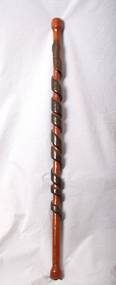
Walking Stick, Hand carved snake walking stick
... Carved by an elderly Cockatoo resident and given to the history and heritage group...Carved by an elderly Cockatoo resident and given to the history and heritage group walking stick cockatoo carving snake Carved wooden walking stick, snake entwined down the full length Wooden hand carved walking stick Hand carved snake walking stick Walking Stick ...Carved by an elderly Cockatoo resident and given to the history and heritage group Wooden hand carved walking stick Carved wooden walking stick, snake entwined down the full length walking stick, cockatoo, carving, snake -
 Emerald Museum & Nobelius Heritage Park
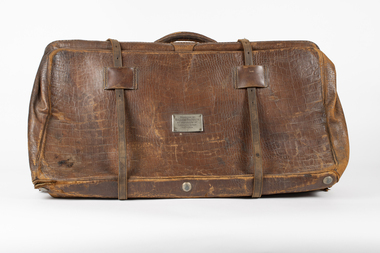
Container - Military kit bag, T. C. Jackson & Co, 1910-1920
... Presented to William Durance by Cockatoo Creek residents....Inscribed on metal plaque on front of bag: 'Presented to / William Durance / by Residents of / Cockatoo Creek / Victoria T C Jackson Maker 583 Bourke St Melbourne|T C Jackson 583 Bourke St W Melbourne' Inscribed on inside label:'T. ...According to the label, this is a bag presented to William Durance (presumably a local resident) by Cockatoo Creek residents after returning from World War 1. ...The bag has had a renovation at some stage with new internal straps and a new internal label. There is a luggage label inside with 'T J Madigan Emerald' inscribed which suggests that Jim Madigan may have used it and that he was a subsequent owner of the bag. According to the label, this is a bag presented to William Durance (presumably a local resident) by Cockatoo Creek residents after returning from World War 1. There is nothing further known about William Durance. Officer's kit bag, suitcase type with straps small dedicatory metal plaque attached to side. Leather. Presented to William Durance by Cockatoo Creek residents. Inscribed on metal plaque on front of bag: 'Presented to / William Durance / by Residents of / Cockatoo Creek / Victoria T C Jackson Maker 583 Bourke St Melbourne|T C Jackson 583 Bourke St W Melbourne' Inscribed on inside label:'T. C. Jackson & Co. Makers / ... Collins Street / 268 Flinders Street / 583 Bourke St / Melbourne On (new) internal label: ''T. C. Jackson / Maker / 583 Bourke Street / Melbourne william durance, jim madigan, cockatoo creek, world war 1, leather bag -
 Emerald Museum & Nobelius Heritage Park
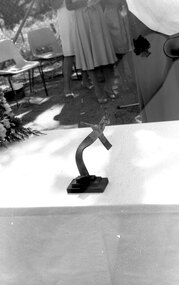
Photograph - Cross - Uniting Church, Upper Beaconsfield, Unknown photographer, 1980s
... The cross, which buckled in the heat generated by the fires, is believed to be on display at the Ash Wednesday Bushfire Education Centre in Cockatoo, which was itself constructed as a memorial on the site of a kindergarten in which 300 Cockatoo residents sheltered from the fire. The specific occasion on which this photograph was taken is not known....The cross, which buckled in the heat generated by the fires, is believed to be on display at the Ash Wednesday Bushfire Education Centre in Cockatoo, which was itself constructed as a memorial on the site of a kindergarten in which 300 Cockatoo residents sheltered from the fire. The specific occasion on which this photograph was taken is not known. ...The cross depicted in the photograph is stated to be from the Uniting Church in Upper Beaconsfield in the Museum's registration records but may instead be from St John's Anglican Church which burned down in the Ash Wednesday bushfires as no Uniting Church site is recorded in Upper Beaconsfield. Forty-seven people were killed in the Ash Wednesday fires in Victoria, including twenty-seven from the Cardinia Shire area. Twenty-one of the people killed were located in Upper Beaconsfield; twelve of the people killed in the area were fire-fighters, along with nine residents. 186 homes and countless livestock were also lost in the fires which ranged through Victoria and into South Australia due to a combination of dry, hot and windy weather. The date of the fires corresponds with the the date of the Christian religious festival of the same name that year. St John's Anglican Church was rebuilt on the same site within the next three years. The design, by local architect Paul Reid, combined elements of the previous building with the style of village churches Reid had observed in Austria and Bavaria after his graduation from Melbourne University. The cross, which buckled in the heat generated by the fires, is believed to be on display at the Ash Wednesday Bushfire Education Centre in Cockatoo, which was itself constructed as a memorial on the site of a kindergarten in which 300 Cockatoo residents sheltered from the fire. The specific occasion on which this photograph was taken is not known. This item is significant because of its association with the Ash Wednesday bushfires, one of the worst natural disasters in Victoria's history. The Ash Wednesday fires occurred on 16th February 1983. Twenty-seven people from the Cardinia Shire area were killed in the fires, including twenty-one who died within a kilometre of the church in which the cross depicted resided. Black and white rectangular photograph printed on photographic paper. The photograph depicts a plain dark-coloured metal cross on a stand. The cross has buckled forwards. The item is resting on a table covered with a pale-coloured table-cloth. A bouquet of flowers is visible to the left-hand side of the image. Chairs and three women in special occasion-style clothing are visible at the rear of the image. The cross featured in the photograph is from a church in Upper Beaconsfield which was damaged in the Ash Wednesday bushfires in February 1983. The specific occasion on which this photograph was taken is not known. ash wednesday 1983, bushfires, churches, st john's anglican church, uniting church, upper beaconsfield victoria australia, cockatoo victoria australia, cross, deceased persons, natural disasters, ash wednesday bushfire education centre, paul reid, cardinia shire council -
 Cockatoo History & Heritage Group
Plaque, Cockatoo Kindergarten - Official Opening Plaque
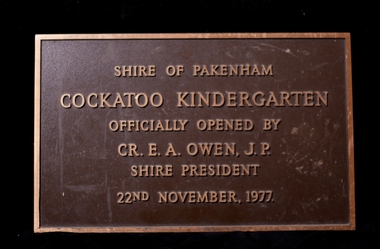
... In 1977 residents of Cockatoo built a kindergarten in McBride Street Cockatoo to service the growing population in the area. ...In 1977 residents of Cockatoo built a kindergarten in McBride Street Cockatoo to service the growing population in the area. ...In 1977 residents of Cockatoo built a kindergarten in McBride Street Cockatoo to service the growing population in the area. The building was officially opened on the 22nd of November of that year. Residents formed a Co-op, raised all the money to build the kinder along with lawn bowls and tennis sporting facilities for the town. No small feat, let alone for a town with a population of around 3000. The land was provided by the council for the kinder to use and that was their sole contribution to the building of the kinder. The unique building, was designed by Richard Allen and depicted a children's carousel. The design was to provide a feeling of enjoyment and friendship to the children who used the building. The large glass windows that were installed on the north-eastern side of the building made up 1/3 of the exterior wall. This overlooked the playground of the kinder making it easy to see the children at play from inside. The site of the building is in a dominant position and is highly visible to all who travel through Cockatoo. It was used as a child care facility right up until 2005. The kindergarten has recently been granted heritage listing after Cardinia Council started demolishing the building. The local community were successful in putting a halt to the demolition and saved the building. It will become an integral part of the Cockatoo Ash Wednesday memorial. Details on the fight to save the kinder building can be found at https://sites.google.com/site/cockatoosheritageashwednesday/ Brass Plaque, depicting the opening of the Cockatoo Kindergarten by the Shire of Pakenham Shire President - Cr Owen Shire of Pakenham Cockatoo Kindergarten Officially Opened by Cr E A Owen J.P Shire President 22nd November 1977 cockatoo, kindergarten opening, -
 Narre Warren and District Family History Group
Book, Cockatoo History and Heritage Group, Cockatoo Voices From the Past, 2019
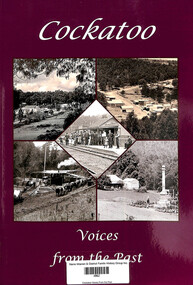
... Robert Loney Maye Reminiscences by Cockatoo residents of happenings in Cockatoo Cockatoo Voices From the Past Book Cockatoo History and Heritage Group ...Reminiscences by Cockatoo residents of happenings in Cockatoonon-fiction Reminiscences by Cockatoo residents of happenings in Cockatoo cockatoo (vic.), robert loney maye -
 Narre Warren and District Family History Group
Book, Icia Molloy, Baked apples on the tree : Ash Wednesday reflections, 2012
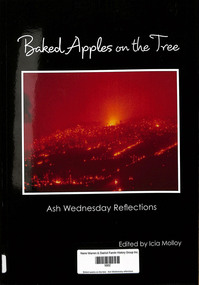
... Ash Wednesday bushfires 1983 cockatoo (vic.) Ash Wednesday reflections by residents of Cockatoo 151 p.; 30 cm Baked apples on the tree : Ash Wednesday reflections Book Icia Molloy Cockatoo Neighbourhood House ...Ash Wednesday reflections by residents of Cockatoo151 p.; 30 cm non-fiction Ash Wednesday reflections by residents of Cockatoo ash wednesday bushfires 1983, cockatoo (vic.) -
 Cockatoo History & Heritage Group
Recording, Dave Oliver recording on the history of Cockatoo 1995
... Dot Griffin recorded many of Cockatoo's earlier residents so their stories weren't lost like so much of Cockatoo's written history. recording Cockatoo Cockatoo Creek audio file Audio File, originally recorded on cassette Dave Oliver recording on the history of Cockatoo 1995 Recording ...After the devastating fires that hit Cockatoo on February 16th 1983. Dot Griffin recorded many of Cockatoo's earlier residents so their stories weren't lost like so much of Cockatoo's written history. Audio File, originally recorded on cassette recording, cockatoo, cockatoo creek, audio file -
 Kew Historical Society Inc
Album - Photograph Album No.1, Henry Beater Christian, 1924-26
... resident of Pakington Street), of places in Kew and throughout regional Victoria during the 1920s. The mainly sepia photographs, while small, are of a high quality. Photographs are typically lightly glued onto pages. Locations are frequently identified by white or black ink, which in a number of cases is illegible due to wear. Readable named locations include: Kew, the Grampians, Marysville, Baw Baw, Daylesford, Hepburn Springs, Bruthen, Swan Reach, Yea, Flowerdale, Port Fairy, Cockatoo....) — construction warburton (vic.) cockatoo (vic.) bruthen (vic.) swan reach road (vic.) glen hills (vic.) lightning creek (vic.) omeo (vic.) glen wills (vic.) mt wills (vic.) sunnyside (vic) granite flat (vic.) toolangi (vic.) yea (vic ). flowerdale (vic.) mt white law (vic.) baw baw (vic.) christian-washfold collection Digital copy of a 47-page photograph album containing 255 gelatinous silver images, loaned by Diane Washfold with permission given to digitise and hold a copy in our collection. The album contains a groups of photographic positives taken by Henry B Christian (a resident ...Henry Christian (c.1809-91), the grandfather of the photographer, was one of the first settlers in Kew. He arrived in Victoria with his wife Agnes and son Orlando in 1855 on the Gypsy Queen. He established a rope-making business in Bulleen Road by 1858 but was declared insolvent two years later. In his final years, he was celebrated as one of the oldest living settlers of the district. His son, Orlando Henry Beater Christian (c.1853-1930) became a member of the Hawthorn Band and a foundation member of the Willsmere Swimming Club. Orlando and his wife Elizabeth had four children of which Henry Beater Christian (1886-1962) was the oldest. An album of photographs, compiled by Henry Beater Christian (1886-1962) of Pakington Street, Kew, depicting individuals, natural and settled environments and the interactions between these worlds. Henry Christian, was a keen explorer, not just of his immediate environment but also of the Victorian wilderness. His major opus is contained in two albums in which he records, sometimes in majestic detail and on other occasions the intimate features of the natural world. His photographic travels during the 1920s, often in solitary ramblings but on other occasions with companions, recall the heroic landscape photography of an earlier era, pioneered by Nicholas Caire. In addition to their aesthetic value, the albums are historically significant records within the State of Victoria, of what is now a distant point in time, and of places that have become radically altered through human intervention. Digital copy of a 47-page photograph album containing 255 gelatinous silver images, loaned by Diane Washfold with permission given to digitise and hold a copy in our collection. The album contains a groups of photographic positives taken by Henry B Christian (a resident of Pakington Street), of places in Kew and throughout regional Victoria during the 1920s. The mainly sepia photographs, while small, are of a high quality. Photographs are typically lightly glued onto pages. Locations are frequently identified by white or black ink, which in a number of cases is illegible due to wear. Readable named locations include: Kew, the Grampians, Marysville, Baw Baw, Daylesford, Hepburn Springs, Bruthen, Swan Reach, Yea, Flowerdale, Port Fairy, Cockatoo, etc. henry beater christian (1886-1962), landscape photography, photograph albums, kew (vic.) — yarra river, kew (vic.) — zig-zag bridge, kew (vic.) — macauley’s boathouse, studley park (vic.) — yarra river, wonderland — grampians (vic.), black spur (vic.), marysville (vic.), maroondah dam (vic.) — construction, warburton (vic.), cockatoo (vic.), bruthen (vic.), swan reach road (vic.), glen hills (vic.), lightning creek (vic.), omeo (vic.), glen wills (vic.), mt wills (vic.), sunnyside (vic), granite flat (vic.), toolangi (vic.), yea (vic, )., flowerdale (vic.), mt white law (vic.), baw baw (vic.), christian-washfold collection -
 City of Melbourne Libraries
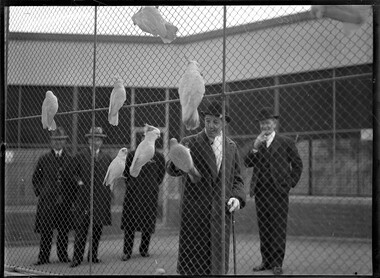
Photograph, Bull, Hugh Jones, 1897-1993, Vice-regal visit to zoo: Governor (Lord Huntingfield) meets the cockatoos
... It was explained to them that most of the cockatoos had been presented by residents of flats, whose neighbours objected to the noise of the birds, while others were protected birds which had been surrendered. ...It was explained to them that most of the cockatoos had been presented by residents of flats, whose neighbours objected to the noise of the birds, while others were protected birds which had been surrendered. ...A group of five men dressed in hats and overcoats look at caged cockatoos. Research by project volunteer, Fiona Collyer: On 25 June 1934, new Victorian Governor, His Excellency Lord Huntingfield and his wife Lady Huntingfield made an official visit to the Melbourne Zoological Gardens in order to grant his patronage to the Royal Zoological and Acclimatisation Society. The zoo director, Mr. Andrew Wilkie, introduced them to the cockatoos in the flight aviary. The Argus newspaper reported the visit in the following morning’s issue: "Birds' Greeting To Governor. Visit to Zoological Gardens. "A Very Important Society." "Cheery shouts of "Hullo!" and requests for drinks greeted His Excellency the Governor (Lord Huntingfield) on one of his official visits yesterday morning. Lady Huntingfield, who accompanied him, was asked loudly for a kiss. They were inspecting the huge cockatoo aviary at the Zoological Gardens after Lord Huntingfield had granted his patronage to the Royal Zoological and Acclimatisation Society. Both obviously enjoyed the democratic experience. It was explained to them that most of the cockatoos had been presented by residents of flats, whose neighbours objected to the noise of the birds, while others were protected birds which had been surrendered. Lord Huntingfield recalled that he had taken two Australian cockatoos to England when he left Australia in his youth. One, a galah, had lived in England for many years." In 1929, the Zoo built a commodious new flight aviary at the cost of several thousand pounds and Zoo director, Mr Andrew Wilkie, sent out an appeal published in newspapers Australia-wide for donations of parrots from all states. Many of the parrot species he wanted were protected and a special permit needed for their capture, however Mr Wilkie guaranteed he would obtain authority from the Fisheries and Game Department and that the cost of transit would be borne by the Zoo. The wanted birds were "Parrots - Black-tailed, Rock Pebbler, King, Superb, Grass (all kinds), Swamp or Ground, Mallee or Ringneck" and "Cockatoo[s] - Black, Pink or Major Mitchell, Gang-Gang". The Zoo asked that the birds be sent in boxes large enough to prevent overcrowding, contain food and water and the Zoo notified on the type and number of birds in transit. All boxes were to be addressed to 'The Zoo, Melbourne'. A letter from a reader appeared in the Weekly Times newspaper's popular "Camp-fire Circle" page for "Young Australians", 11 May 1929: "Dear Pal, I am much interested in your page, especially the nature notes. I have a pet parrot, but I don’t like to see it shut up in a cage, so I am giving it to the Melbourne Zoo. It can whistle 'Pretty Joey' and 'What's the Matter with Father' and is just learning to whistle for the dog... Wishing you and the Camp-fire Circle success." - Murray Holmes (Gorae, Vic.) The fate of this talented parrot is unknown, however in 1932, this young naturist, T Murray Holmes, 1912-1947, collected for the first time a type specimen, blue star sun orchid from Gorae (near Portland, Victoria), and it was named in his honour, Thelymitra holmesii. Murray was described by orchid collector W H Nicholls as "a youthful and energetic orchidologist, who added much to our knowledge of the orchids of south-western Victoria." Murray Holmes enlisted in the army in 1941 and fought in the Middle East before being sent to Java. In 1942 he was captured by the Japanese and became a prisoner of war for three years, working on the notorious Thai-Burma railway. Murray's health was undermined though ill treatment and starvation and he returned to Australia after the war, broken and sick. He died aged 35 in 1947. He was intensely interested in the flora and fauna of the Gorae area to the end. Murray's parents received over 200 tributes of respect for their son - too many to answer personally so they put a notice in the Portland Guardian thanking "all kind friends and relatives for letters, cards, floral tributes and personal expressions of sympathy received in their recent sad bereavement - the lamented death of their loved son, Murray." Andrew Arthur Wellesley Wilkie, 1853-1948, was Director of the Melbourne Zoo from 1923 to 1936 and was associated with the zoo for 70 years. He first worked as a horticultural assistant to Government botanist Baron Ferdinand von Mueller at the Botanical Gardens at the age of 13, along with his older brother David. One of Andrew’s jobs was to capture moths for the National Herbarium. In 1857, a group of prominent Melburnians assembled at St. Patrick’s Hall to form the Zoological Society of Victoria, with the aim of introducing animals and plants from overseas. It was conceived, “For the purposes of science and for that of affording the public the advantages of studying the habits of the animal creation in properly arranged zoological gardens.” The Victorian Government granted 32 acres (13 hectares) of land to the Zoological Society at the southern end of Richmond Paddock on the opposite bank to the Botanical Gardens. (This is where AAMI Stadium and Collingwood Football Club now stand.) In 1861, the Zoological Society of Victoria was renamed The Acclimatisation Society of Victoria. Unfortunately the Yarra River frontage was damp, swampy and subject to flooding, so the animals were briefly housed at the Botanical Gardens until in 1862, the City of Melbourne donated 55 acres (22 hectares) of land at Royal Park for the fledgling zoo. Baron von Mueller secured employment at Royal Park for Andrew and David and they helped to lay out the gardens, plant trees and take care of a collection of deer, pheasants, hares and partridges. Initially the zoo was used for the acclimatisation of animals recovering from the long voyage to Australia and for breeding them for sport. In 1872, the zoo bought two lions, a leopard and a cheetah that had been seized from circus showmen Keith and Phillips when they were unable to pay the bill of butcher Mr T K Bennet of Bourke Street. The first zoo director, Mr. Albert Le Souef, negotiated with captains of ships to buy animals at overseas ports they visited and soon a multitude of exotic species arrived, including a ten-year-old Indian elephant in 1878. In 1923, after being head keeper for some years, Andrew was appointed director of the zoo. By 1933, the zoo had 110 different species of animals, 200 species of birds and 72 species of reptiles under Andrew’s care. He had personally planted all but six trees and laid out the garden beds. As director he lobbied authorities for funds to build more humane enclosures for the animals. In June 1928, Table Talk magazine wrote of Andrew Wilkie: “Up at the Zoo there is a humble gentleman who is a lion among the lions, who knows the proper specific to employ when the boa constrictor has chilblains, and who is a friend and confidant of Queenie the elephant. His fount of zoological lore has never been plumbed. It is bottomless, like his good fellowship and geniality. Every day he may be seen somewhere in the grounds of that growing sanctuary for the strange and arresting fauna and creeping things of the world, and I assure you as one who is privy to his passion that that area and its inhabitants are rarely out of his thoughts.” Andrew retired from the zoo in 1936 at the age of 83 and in 1948 died at his home in Brunswick aged 94. He and his wife Josephine had six children. The Victorian Acclimatisation Society was founded in 1861 by Edward Wilson, 1813-1878, then owner and editor of The Argus newspaper. He said that Australian indigenous animals were practically useless, providing only “a little sport and an occasional meal”. The Society believed that Australia’s plants and animals were vastly inferior to those in Europe. They wanted to introduce and acclimatise to Victoria “all innoxious animals, birds, fishes, insects and vegetables, whether useful or ornamental” for sport and for the table, and to spread indigenous animals and plants from the colony around the world. Their motto was “if it lives, we want it”. The Society was primarily responsible for introducing sparrows, starlings, sambar and hog deer, ostriches, brown trout, blackberries, and carp to the Murray River. They released the European songbirds, thrush and blackbird to quell the homesickness of British settlers. The Society also sent Australian animals like platypus, echidnas, kangaroos and koalas to Europe for scientific and novelty purposes. Thomas Austin, a wealthy sheep farmer of Barwon Park, Winchelsea (property now owned by the National Trust) was a member and in 1859 he introduced hares, blackbirds, thrushes and partridges onto his property. He is probably best known for introducing 24 breeding rabbits onto his estate as game for shooting parties. Thomas quipped, “The introduction of a few rabbits could do little harm and might provide a touch of home, in addition to a spot of hunting." In 2022, genomic data confirmed that Australia’s feral rabbit population is entirely descended from these rabbits. Biological control has brought the rabbit population down from an estimated high of 10 billion rabbits in the 1920s to approximately 200 million today, inhabiting 70% of Australian landmass (5.3 million square kilometres). In 1872, the Acclimatisation Society was renamed The Zoological and Acclimatisation Society of Victoria and they focused on importing exotic animals for display purposes to the zoo. In 1937, the Royal Acclimatisation Society of Victoria was recreated as the Zoological Board of Victoria with a focus on research of native animals threatened with extinction. In an editorial for The Argus newspaper, 16 March 1856, Edward Wilson lamented: "...this country has been shamelessly stolen from the blacks. Had they been like the New Zealanders or the North American Indians, we should have bought their land, and supplied them with the means of living when we took it... In less than twenty years we have nearly swept them off the face of the earth. We have shot them down like dogs. In the guise of friendship we have issued corrosion sublimate in their damper, and consigned whole tribes to the agonies of an excruciating death. We have made them drunkards, and infected them with disease which has rotted the bones of their adults, and made such few children as are born amongst them a sorrow and a torture from the very instant of their birth. We have made them outcasts on their own land, and are rapidly consigning them to entire annihilation. There are but a few of them left, comparatively. This is what we would do for that few. We would feed and clothe every one of them.” [Note: this last sentence is italicized in the original newspaper article text]. Lord Huntingfield, (William Charles Arcedeckne Vanneck) 1883-1969, Governor of Victoria 1934-1939, was a British Conservative Party politician and the first ever Australian-born Governor of an Australian state (although he was always considered British). He was patron of the Royal Zoological and Acclimatisation Society of Victoria and was acting Governor-General for six months during the absence of Lord Gowie in 1938. Lady Huntingfield (née Margaret Eleanor Crosby) 1884-1943, his American-born wife showed great interest in social welfare and the advancement of women and children. She was president of the City Newsboys Society and Patroness of the Girls Friendly Society. In 1937, rose breeder Alister Clark named a yellow hybrid tea rose for her. In 1940, the City of Melbourne opened the Lady Huntingfield Free Kindergarten in North Melbourne, now the Lady Huntingfield Early Learning and Family Services Centre. Lady Huntingfield died in London in 1943 after her house was bombed during a German airstrike. The Lady Huntingfield Memorial Scholarship was established after the City of Melbourne raised £1000 in a public appeal conducted in her memory for students undertaking a Social Work degree at the University of Melbourne. It is awarded annually to this day. The Queen Victoria Hospital named a bed in her honour. References: Prominent Personalities ANDREW WILKIE (1928, June 7). Table Talk (Melbourne, Vic. : 1885 - 1939), p. 15. Retrieved August 29, 2024, from http://nla.gov.au/nla.news-article146562949 BIRDS' GREETING TO GOVERNOR (1934, June 26). The Argus (Melbourne, Vic. : 1848 - 1957), p. 6. Retrieved August 19, 2024, from http://nla.gov.au/nla.news-article10950051 Zoo Appealing For Parrots And Cockatoos To Fill Aviary For Children’s Instruction (1929, April 11). The Sun News-Pictorial (Melbourne, Vic. : 1922 - 1954; 1956), p. 31. Retrieved August 23, 2024, from http://nla.gov.au/nla.news-article275757361 LETTERS FROM READERS (1929, May 11). Weekly Times (Melbourne, Vic. : 1869 - 1954), p. 50. Retrieved October 6, 2024, from http://nla.gov.au/nla.news-article223183144 Correspondence. (1929, April 18). Corryong Courier (Vic. : 1894 - 1945), p. 6. Retrieved August 30, 2024, from http://nla.gov.au/nla.news-article269039262 'Edward Wilson (journalist)', Wikipedia, https://en.wikipedia.org/wiki/Edward_Wilson_(journalist) 'Thomas Austin (pastoralist)', Wikipedia, https://en.wikipedia.org/wiki/Thomas_Austin_(pastoralist) 'The Acclimatisation Society was driven by misguided ideals about 'fixing nature' in Australia', ABC News, https://www.abc.net.au/news/2022-11-04/acclimatisation-society-introduced-species-history-listen/101588262? utm_source=abc_news_app&utm_medium=content_shared&utm_campaign=abc_news_app&utm_content=safari Touching Canine Devotion. (1942, September 21). Portland Guardian (Vic. : 1876 - 1953), p. 1 (EVENING). Retrieved October 6, 2024, from http://nla.gov.au/nla.news-article64381989 OBITUARY (1947, August 11). Portland Guardian (Vic. : 1876 - 1953), p. 2 (EVENING). Retrieved August 26, 2024, from http://nla.gov.au/nla.news-article64412155 Family Notices (1947, September 11). Portland Guardian (Vic. : 1876 - 1953), p. 2 (EVENING). Retrieved October 10, 2024, from http://nla.gov.au/nla.news-article64412476 'Thelymitra holmesii', Wikipedia, https://en.wikipedia.org/wiki/Thelymitra_holmesii THE ABORIGINES. (1856, March 16). The Argus (Melbourne, Vic. : 1848 - 1957), p. 4. Retrieved September 28, 2024, from http://nla.gov.au/nla.news-article4833244 Photographer notations on slide: "Vice Regal visit to zoo B42". zoos, governors, 1930-1939, cockatoos -
 Emerald Museum & Nobelius Heritage Park
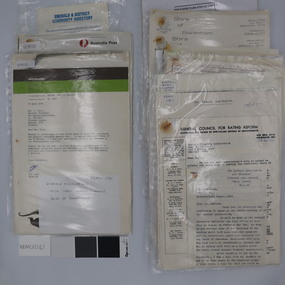
Administrative record - Emerald Association correspondence, 1978-1981
... resident action group which appears to have operated from 1978 to 1981, and was a successor to the Emerald Progress Association. Includes election campaigns for local government, results of a parent survey regarding youth activities and needs, correspondence with various community groups. Includes much information on various Emerald organisations, including Gembrook Cockatoo...resident action group which appears to have operated from 1978 to 1981, and was a successor to the Emerald Progress Association. Includes election campaigns for local government, results of a parent survey regarding youth activities and needs, correspondence with various community groups. Includes much information on various Emerald organisations, including Gembrook Cockatoo ...Records and correspondence of the Emerald Association, a resident action group which appears to have operated from 1978 to 1981, and was a successor to the Emerald Progress Association. Includes election campaigns for local government, results of a parent survey regarding youth activities and needs, correspondence with various community groups. Includes much information on various Emerald organisations, including Gembrook Cockatoo and Emerald Waterworks Trust, Emerald Tennis Club, Emerald Fire Brigade, Emerald Arts Society, Emerald Community House, and others. Collection of correspondence, notices and other papers from the Emerald Association 17 plastic pockets with documents Parent responses to Emerald Association questionnaires emerald, victoria, australia, shire of sherbrooke victoria australia, resident action, clubs, associations, societies, elections, emerald association -
 Emerald Museum & Nobelius Heritage Park
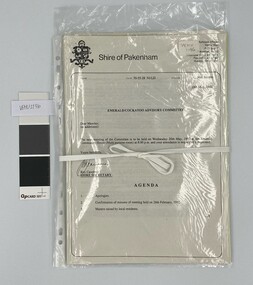
Document - Documents, correspondence and minutes Shire of Pakenham 1991-1992, 1992
... Cockatoo Victoria Australia...Shire of Sherbrooke Victoria Australia...Shire of Pakenham Victoria Australia...resident...Shire of Pakenham Residents' Action Group letter 1st November 1991 Emerald/ Cockatoo advisory committee meeting minutes, 7 pages 5th September 1991 letter from Michael Elg to Mr Tyrell Charter Emerald/ Cockatoo advisory committee 30th August 1991 letter from Michael Elg to Mr Horley 5th September 1991 letter from Michael Elg to Mr Horley Charter Emerald/ Cockatoo advisory committee Pacjenham Shire note card attached to 26th Feb 1992 Minutes of the Emerald/ Cockatoo advisory committee meeting, 3 pages 26th February 1992 letter from Graham Pankhurst to Mr Horley, 2 pages...Shire of Pakenham Residents' Action Group letter 1st November 1991 Emerald/ Cockatoo advisory committee meeting minutes, 7 pages 5th September 1991 letter from Michael Elg to Mr Tyrell Charter Emerald/ Cockatoo advisory committee 30th August 1991 letter from Michael Elg to Mr Horley 5th September 1991 letter from Michael Elg to Mr Horley Charter Emerald/ Cockatoo advisory committee Pacjenham Shire note card attached to 26th Feb 1992 Minutes of the Emerald/ Cockatoo advisory committee meeting, 3 pages 26th February 1992 letter from Graham Pankhurst to Mr Horley, 2 pages cont. 14th October 1991 Emerald/ Cockatoo advisory committee meeting agenda, 4 pages and 5 additional pages of appendices Pocket 2 20th May 1992 Minutes of the Emerald/ Cockatoo advisory committee meeting, 4 pages cont. below Emerald Victoria Australia Cockatoo Victoria Australia Shire of Sherbrooke Victoria Australia Shire of Pakenham Victoria Australia resident action Emerald-Cockatoo Advisory Committee 13th May 1992 Emerald/ Cockatoo advisory committee meeting agenda with three appendix pages including January/ February 1992 The Australian Municiple Journal 'Local Government's role in weed control' 11 March 1992 letter from Melbourne water to Mr Ray Canobie re. drainage 14th April 1992 letter from Gas and Fuel Corporation of Victoria and 26th March 1992 letter from Department of Conservation and Environment 26th Feb 1992 Minutes of the Emerald Cockatoo Advisory Committee Meeting, three pages with charter cont. below Document Documents, correspondence and minutes Shire of Pakenham 1991-1992. ...Shire of Pakenham Residents' Action Group letter 1st November 1991 Emerald/ Cockatoo advisory committee meeting minutes, 7 pages 5th September 1991 letter from Michael Elg to Mr Tyrell Charter Emerald/ Cockatoo advisory committee 30th August 1991 letter from Michael Elg to Mr Horley 5th September 1991 letter from Michael Elg to Mr Horley Charter Emerald/ Cockatoo advisory committee Pacjenham Shire note card attached to 26th Feb 1992 Minutes of the Emerald/ Cockatoo advisory committee meeting, 3 pages 26th February 1992 letter from Graham Pankhurst to Mr Horley, 2 pages cont. 14th October 1991 Emerald/ Cockatoo advisory committee meeting agenda, 4 pages and 5 additional pages of appendices Pocket 2 20th May 1992 Minutes of the Emerald/ Cockatoo advisory committee meeting, 4 pages cont. below 13th May 1992 Emerald/ Cockatoo advisory committee meeting agenda with three appendix pages including January/ February 1992 The Australian Municiple Journal 'Local Government's role in weed control' 11 March 1992 letter from Melbourne water to Mr Ray Canobie re. drainage 14th April 1992 letter from Gas and Fuel Corporation of Victoria and 26th March 1992 letter from Department of Conservation and Environment 26th Feb 1992 Minutes of the Emerald Cockatoo Advisory Committee Meeting, three pages with charter cont. below emerald, victoria, australia, cockatoo victoria australia, shire of sherbrooke victoria australia, shire of pakenham victoria australia, resident action, emerald-cockatoo advisory committee
