
Showing 25 items matching "cockpit design"
-
 Moorabbin Air Museum
Manual - Sikorsky S76 helicopters, Sikorsky S-767C++ Program Fran Bonomo , S-76 Chief Engineer
... ...Cockpit design...Sikorsky S76 helicopters Aircraft performance Power yields Cabin design HUMS system Flight data management Cockpit design Electrical system Rotor blades Rotor ice protection Engineering-continuous improvement Design features Falling & blowing snow Safety upgrades Customer service Overview of Sikorsky S76C program for promotional purposes, circa 2007Ma Plastic covered, spiral bound book type manual Sikorsky S-767C++ Program Fran Bonomo , S-76 Chief Engineer Manual Sikorsky S76 helicopters ...Overview of Sikorsky S76C program for promotional purposes, circa 2007MaPlastic covered, spiral bound book type manualnon-fictionOverview of Sikorsky S76C program for promotional purposes, circa 2007Maaircraft performance, power yields, cabin design, hums system, flight data management, cockpit design, electrical system, rotor blades, rotor ice protection, engineering-continuous improvement, design features, falling & blowing snow, safety upgrades, customer service -
 Australian Gliding Museum
Machine - Glider – Sailplane, 1963
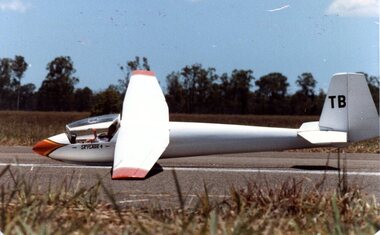
... The design heralded a trend towards the use of plastics in the construction of gliders. Slingsby incorporated GRP (glass reinforced plastic) panels to achieve a streamlined fuselage nose and cockpit area while retaining the more traditional wood techniques for the rest of the aircraft. ...However, the cockpit and forward part of the fuselage consists of glass reinforced plastic which was innovative at the time that the type was designed. ... and forward part of the fuselage consists of glass reinforced plastic which was innovative at the time that the type was designed. The cockpit provides for a semi reclining position for the pilot protected with a full Perspex canopy. ...The Skylark 4, the final in the Slingsby Skylark series, dates from 1961. The design heralded a trend towards the use of plastics in the construction of gliders. Slingsby incorporated GRP (glass reinforced plastic) panels to achieve a streamlined fuselage nose and cockpit area while retaining the more traditional wood techniques for the rest of the aircraft. Another notable feature was the smooth wing surface that was obtained using a Gaboon ply skin across the ribs. Best glide performance of 1:33 was found to be comparable with the early full GRP glider designs. The Museum’s example (VH-GTB – C/N 1382) was built in 1963 and originally owned by Chuck Bentson of the UK. It was brought to Australia in 1967 by Jeremy Picket-Heaps and flown at various places including Benalla, Cooma and Gundaroo. In 1970 the glider was transferred to the New England Soaring Club. Many flights were made from Armidale and Bellata in Northern New South Wales. On one occasion, the glider was kept aloft for 8 hours 45 minutes and on another the pilot took it around a 500 kilometre triangle in nearly 8 hours. In 1980 it was sold to Ralph (“Feathers”) Crompton and was flown extensively in South Australia until 1988. The final owner before the glider was given to the Museum in 2004 was Ross Dutton of Melbourne. The last recorded flight occurred in 1992. The glider at that point had logged over 2000 hours flying time from about 2000 launches. The airframe is currently being restored to flying condition. Technically this aircraft represents the state of the art at the stage that sailplane design was changing from traditional wood construction to composites (GRP) The Slingsby Skylark 4 is high wing single seat sailplane of mainly wooden construction with plywood and fabric covering. However, the cockpit and forward part of the fuselage consists of glass reinforced plastic which was innovative at the time that the type was designed. The cockpit provides for a semi reclining position for the pilot protected with a full Perspex canopy. The wings are made up of a centre section with constant chord and tapered wing tips. The aircraft has a conventional arrangement for the tail stabiliser / control surfaces. The sailplane bears construction number 1382 and is registered in Australia as VH-GTBaustralian gliding, glider, sailplane, skylark, slingsby, bentson, picket-heaps, crompton, new england soaring club, dutton -
 Flagstaff Hill Maritime Museum and Village
Vehicle - Vessel, Couta boat, Viator, 1890-1920
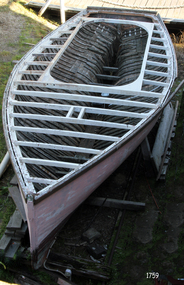
... design. The features of Viator - carvel planked, open cockpit, vertical stem and straight keel, single mast and a pivoting centreboard - are all characteristics of an early Bass Strait ‘couta boat. ...design. The features of Viator - carvel planked, open cockpit, vertical stem and straight keel, single mast and a pivoting centreboard - are all characteristics of an early Bass Strait ‘couta boat. ...The historic Victorian ‘couta boat “Viator” was built by renowned boat builder J.R. Jones of Williamstown in Melbourne, between 1890 and 1920. He was one of the early builders of this design. The features of Viator - carvel planked, open cockpit, vertical stem and straight keel, single mast and a pivoting centreboard - are all characteristics of an early Bass Strait ‘couta boat. This has been confirmed by experienced Victorian ‘couta boat restorer Tim Phillips. Viator served as a ‘couta fishing boat in the Warrnambool area until the mid-1930s, then some say she served as a mail ferry across to Portland. Later it was used as a fishing and recreation boat for local families. For years Viator sat in a paddock in East Warrnambool until purchased in 1975 and donated to Flagstaff Hill. ‘COUTA BOATS - The ‘couta design for vessels is believed to have originated at Port Phillip, Victoria, for the purpose of the Barracouta (‘couta) fishing industry, being both fast and seaworthy. , The 'couta fish was an important food fish in Australian waters, supplying Melbourne with plenty of inexpensive fish. VIATORY’S OWNERS - Some of Viator’s history is known: - 1940, registered Port Fairy and owned by G.J. Richards. - 1941-1945, registered in Port Fairy and owned by Jens “Peter” Petersen. - 1950’s “Brusher” Richards of Warrnambool and Port Fairy used it for fishing. - Peter Watson and his son also went fishing in Viator. - Frank Ferrier, boat builder, was an owner (son of ‘La Bella’ hero, William Ferrier) - Arthur Rogers owned Viator too, then sold it to Terry Pridmore and Wayne Moorefield - The Viator was stored in a paddock, unused, in Fairmont Avenue, Warrnambool, where it was gradually deteriorating. - 1975 Viator was purchase at a very reasonable price from Pridmore, then donated to Flagstaff Hill Maritime Village. RESTORATION - Shipwright Erik Mikkelsen soon started restoration on the Viator after it arrived at Flagstaff Hill in 1975. In 2006 the Maritime Museums of Australia awarded a grant to Flagstaff Hill Maritime Village to assist with the restoration and renovation of the Viator. Its restoration continues today in the care of Flagstaff Hill’s boat builder. J R. JONES - boat builder The photograph of the EVA MYRL shows the builder J R Jones with his team of workers. The other photograph shows a vessel built by J R Jones' son, J B Jones of Footscray, and his team of boat boulders. The photograph of the EVA MYRL was taken by E. A. Dond---. The other photograph is of the Sturrock Coot, taken a Albert Park Lake in St Kilda.The Viator is the most significant boat in the Flagstaff Hill's fleet, being the last remaining local 'couta boat and one of few existing examples of this craft. Viator received Heritage status with the Australian Maritime Museums Council and is listed on the Australian Register of Historical Vessels in 2006 (ARHV Number: HV000561). Viator was built in Victoria in the early days by renowned boat builder J.R. Jones, and sailed by fishermen for many years, both local and on the coastal waters of Victoria, and was possibly used for the mail service. It is significant for being used for the fishing trade, for government service, perhaps as a mail boat, and for recreation by local families.Vessel, the ‘Viator’, an historic Victorian ‘couta boat, handmade by renowned boat builder This J.R. Jones 'couta boat, the Viator, was built in Williamstown, c.1890-1920. The single mast vessel has a Caravel hull built from New Zealand Kauri, blackwood, with a red gum keel and a jarrah stem and stern. It has a pivoting centreboard. Two photographs are included; one of the builder with his team, the other is of his son J B Jones, with his team. Marked "Viator" Photograph 1759.2: "E. A. Dond---" (indecipherable". Handwritten on back "Grandfather / J R Jones / Built" Photograph 1759.3; sign within photograph "J B JONES / BUILDER / FOOTSCRAY", stamped in the card, bottom right " ----- / MELBOURNE" and handwritten on the back "I think this is Mr Abel Sturrock Coot Albert Park Lake"flagstaff hill, warrnambool, shipwrecked coast, flagstaff hill maritime museum, maritime museum, shipwreck coast, flagstaff hill maritime village, great ocean road, arhv hv000561, arthur rogers, bass strait ‘couta boat, “brusher” richards of warrnambool and port fairy, clinker hull boat, ‘couta crafted boat c 1890-1905, ‘couta fishing boat, erik mikkelsen shipwright, g.j. richards of port fairy, jens “peter” petersen, john lindsay, old mail boat, pivoting centerboard boat, peter watson, single-masted ketch, terry prodmore and wayne moorefield, vessel viator, viator a historical vessel, victorian ‘couta boat, victorian barracoota boat, warrnambool ‘couta boat, western victoria fishing boat, western victoria mail boat, hv000561, australian register of historical vessels, erik mikkelsen, j b jones, j b jones boat builder, footscray, sturrock coot, sturrock, j r jones, j r jones boat builder, williamstown, eva myrl -
 Monbulk RSL Sub Branch
Book, HarperPress, Apache : the man, the machine, the mission, 2008
... Afghan war 2001-2021 - Military operations - Britain Afghan war 2001-2021 - personal narratives - Britain Apache' is the first book to come from the cockpit of the most sophisticated fighting helicopter the world has ever known. Designed in the mid 1980s to take on the Soviets, these machines have proven themselves as the perfect tool for combat in Afghanistan. ...Apache' is the first book to come from the cockpit of the most sophisticated fighting helicopter the world has ever known. Designed in the mid 1980s to take on the Soviets, these machines have proven themselves as the perfect tool for combat in Afghanistan. Ed Macy's account of the incredibly hard Apache selection process, tougher than that of the SAS, combined with his description of the sheer difficulty of flying one of these helicopters provides a fascinating insight into the relationship between man and machine fighting in the toughest conditions imaginable.Index, ill, maps, p.374.non-fictionApache' is the first book to come from the cockpit of the most sophisticated fighting helicopter the world has ever known. Designed in the mid 1980s to take on the Soviets, these machines have proven themselves as the perfect tool for combat in Afghanistan. Ed Macy's account of the incredibly hard Apache selection process, tougher than that of the SAS, combined with his description of the sheer difficulty of flying one of these helicopters provides a fascinating insight into the relationship between man and machine fighting in the toughest conditions imaginable.afghan war 2001-2021 - military operations - britain, afghan war 2001-2021 - personal narratives - britain -
Moorabbin Air Museum
Manual (item) - Duplicates - see Description
... Cockpit Navigation Guide by Don Downie. Modern Aircraft Series. Manual No date Pan American Navigation Service. Flight Engineers Manual 4th edition. Manual No date RAAF Mosquito MK XL - duplicate. Booklet No date CAC Gas Turbine Division GT08 Folder x 2 No date CAC Logistic Support Group Technical Manuals Folder May-05 Rolls-Royce Overhaul Acceptance Standards for Derwent Engines. Booklet Nov-43 CAC - Company History Melboure Australia. Booklet No date Model Aeronautical Association of Australia (Incorporated) - Manual of Procedures Issue 3 Booklet No date CAC Gas Turbine Division GT02 Folder No date CAC Design...Cockpit Navigation Guide by Don Downie. Modern Aircraft Series. Manual No date Pan American Navigation Service. Flight Engineers Manual 4th edition. Manual No date RAAF Mosquito MK XL - duplicate. Booklet No date CAC Gas Turbine Division GT08 Folder x 2 No date CAC Logistic Support Group Technical Manuals Folder May-05 Rolls-Royce Overhaul Acceptance Standards for Derwent Engines. Booklet Nov-43 CAC - Company History Melboure Australia. Booklet No date Model Aeronautical Association of Australia (Incorporated) - Manual of Procedures Issue 3 Booklet No date CAC Gas Turbine Division GT02 Folder No date CAC Design ... -
 Australian Gliding Museum
Machine - Glider - Sailplane, 2012
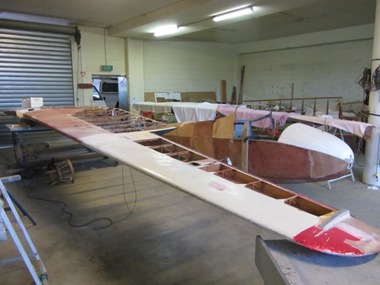
... A notable feature of the ES52 design was the staggered side-by-side seating arrangement of the cockpit. This made for good in flight communication between instructor and trainee. ...A notable feature of the ES52 design was the staggered side-by-side seating arrangement of the cockpit. This made for good in flight communication between instructor and trainee. ...The ES52 Kookaburra is a two seat high wing glider – sailplane of wooden construction designed by Harry Schneider and built Edmund Schneider Pty Ltd. It was first flown on 26 June 1954 and became the glider of choice for training new pilots of many gliding clubs around Australia in the 1950s, 1960s and 1970s. Several found there way to New Zealand. Further two kits were sent to Brazil and at least one of these was finished and flow successfully. The ES52 performed well with a glide ratio of about 22:1 and had soaring and cross-country capabilities. A notable feature of the ES52 design was the staggered side-by-side seating arrangement of the cockpit. This made for good in flight communication between instructor and trainee. Overall, thirty six were built by Edmund Schneider Pty Ltd. A longer wing version (the ES52B) was also introduced that had a better glide ratio (around 25:1). Five examples of this version were built. In Germany a modified ES52 was built incorporating a metal tube fuselage frame and with the addition of a engine driven propeller mounted on top of the wing which enabled the glider to be self launching. This museum collection item consists of the fuselage, tailplane, elevators, fin, rudder from the Mark I, ES 52 Kookaburra, formerly registered as VH-GFF and last owned by the Barcaldine and District Airsports Club of Queensland. The glider was in a damaged condition when it was acquired by the Museum. A decision was made by the Museum to repair the glider for display rather than endeavouring to restore it to an airworthy condition. The reconstruction of the wings is being undertaken by using parts of damaged ES 52 Kookaburra wings (as it happened from later ES 52 Marks). The Log Book for VH-GFF reveals operational life with a succession of gliding clubs around Australia. This exhibit will be of interest to gliding enthusiasts wishing to inspect the popular two seat club trainer of a by-gone era.This is a wood and fabric covered aircraft that is being rebuilt from the components of several aircraft as a non-flying exhibit.Fuselage marked with Edmund Schneider Pty Ltd Serial Number 9 and comes from the glider previously registered as VH-GFF.australian gliding, glider, sailplane, edmund schneider, es 52, kookaburra, barcaldine and district airsports club, victorian motorless flight group, alice springs gliding club, raaf richmond, raaf williamtown, gayndah gliding club, blackwater gliding club, southern downs aero and soaring club, charleville gliding club -
 Australian Gliding Museum
Machine - Glider – Sailplane, 1953
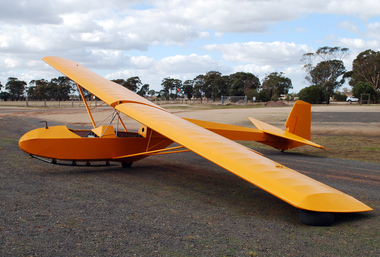
... However, it was a later Schneider design, the ES 52 Kookaburra, which was accepted by many Australian gliding clubs for filling their need for a basic two seat training glider in the 1950s and 1960s. australian gliding glider sailplane schneider es50 renmark gliding club millicent gliding club corangamite soaring club sydney technical college gliding club Given serial number 3 by manufacturer and registered as VH-GHP This is a two seat high wing aircraft of mainly wood and fabric construction. The cockpit ...The Schneider ES50 Club was built in 1953 and is the only one of its type. It was designed by Schneider to comply with specifications laid down by the Gliding Federation of Australia for a basic two seat training glider*. It was first flown on 10 May 1953 and delivered to the Renmark Gliding Club. The log book shows that it later passed to other gliding clubs, namely Millicent Gliding Club, Corangamite Soaring Club, Sydney Technical College Gliding Club. Overall, as at September 1967, the glider had logged over 5000 flights and a total airtime of 388 hours. The Museum volunteers have partly refurbished the ES50 to static display standard. [*Plans were also prepared for a single seat version which never eventuated] This glider is one of Edmund Schneider Pty Ltd earliest Australian designs. However, it was a later Schneider design, the ES 52 Kookaburra, which was accepted by many Australian gliding clubs for filling their need for a basic two seat training glider in the 1950s and 1960s. This is a two seat high wing aircraft of mainly wood and fabric construction. The cockpit area of the fuselage is fabric over tubular steel framing. Given serial number 3 by manufacturer and registered as VH-GHPaustralian gliding, glider, sailplane, schneider, es50, renmark gliding club, millicent gliding club, corangamite soaring club, sydney technical college gliding club -
 Australian Gliding Museum
Machine - Glider – Sailplane, Construction completed 1952
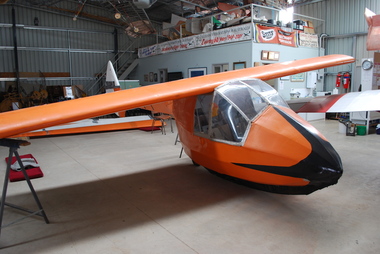
... A unique home grown sailplane design associated with Australian gliding pioneers australian gliding glider sailplane kite pelican waikerie gliding club jock barratt harold bradley martin warner allan campbell Registration VH-GFY On each side of rudder – “Pelican II” in black lettering on a rectangle of silver On each side of fuselage pod the letters ‘FY’ On each side of the fuselage, below the edge of the cockpit opening – “WAIKERIE” in black paint. ...This unique aircraft was conceived in 1943 as a two seat trainer. A very large part of the design work can be attributed to Jock Barratt and Harold Bradley. The general layout adopted is similar to the Kite I and Kite II single seat sailplanes of Martin Warner and Allan Campbell. Having regard to this heritage, the glider was originally named Kite III but renamed Pelican 2, perhaps because it was the second two seat training glider built by the Waikerie Gliding Club – the first being the Pelican, a reconfigured Pratt Utility glider. Pelican 2 was first flown in 1952 and regularly since then, at least until about 1992. The Pelican 2’s performance was found to be very good for sailplanes of its era and was often used for more advanced flying in addition to training new pilots. Very few changes have been made to the Pelican 2 over the years. The undercarriage was modified after its initial testing to improve the placement of the wheels. The trailing edge of the rudder (originally straight) was rounded adding to the surface area. The twin shoulder tow line bridles were replaced with a belly hook when aviation design rules declared shoulder bridles dangerous and a nose hook has since been added to allow for aero-towing. A unique home grown sailplane design associated with Australian gliding pioneers Wooden 2 seat glider sailplane with fabric covering. Distinctive features include the pod and boom fuselage with side by side seating for pilot and a second person. The canopy of perspex supported by aluminum framing opens with port and starboard segments separately folding upwards and forward. The instrument panel includes altimeter, airspeed indicator, slip indicator and variometers. In addition to the usual controls, there is a trim operated by a small wheel mounted centrally, at head height, on the bulkhead at the rear of the cockpit. Incorporated in the skid under the fuselage pod are two wheels (one approximately midships and the other at the rear end). It has a three piece cantilever wing of approximately nearly 17 metres. The ailerons run almost full length of the outer wing segments. A Gottingen 426 section has been used changing to M6 at the tips. Outer wing segments are joined to the centre section to give about 300 mm of dihedral at the tips. The glider is equipped with airbrakes. The colour scheme consists of orange fuselage with black nose and skid. The tailplane / elevator and rudder are painted white. The wing is predominantly white with an orange leading edge. Registration VH-GFY On each side of rudder – “Pelican II” in black lettering on a rectangle of silver On each side of fuselage pod the letters ‘FY’ On each side of the fuselage, below the edge of the cockpit opening – “WAIKERIE” in black paint. australian gliding, glider, sailplane, kite, pelican, waikerie gliding club, jock barratt, harold bradley, martin warner, allan campbell -
 Australian Gliding Museum
Machine - Glider – Sailplane, 1963
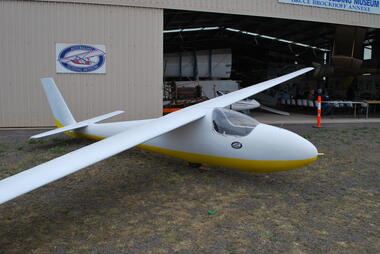
... This type is of note because it was the first Australian designed and built sailplane to be used in a world gliding competition (Jack Iggulden in Argentina in 1963). australian gliding glider sailplane schneider es59 arrow darling downs soaring club wollongong gliding club ron geake Plate in cockpit with details of manufacturer states; manufactured by E. ...This aircraft is one of 9 single seat ES 59 advanced club sailplanes manufactured by Edmund Schneider Pty Ltd in the 1960s. It was first flown in August 1963 and delivered to the Darling Downs Soaring Club at Toowoomba Queensland. At that Club it had 2603 flights and recorded a total airtime of 1475 hours. In addition to many local circuits and soaring and cross country flying, it was used at gliding competitions, including Nationals at Benalla in December 1964, State Championships at Oakey in April 1965, at Warwick in April 1966, and at (Inverell?) in March 1967. On at least 15 occasions flight times in excess of 5 hours duration were achieved. On 5 October 1970, the glider had a new life when it was relocated to Wollongong in New South Wales. It recorded 1927 flights with a total airtime of 1179 hours at the club between October 1970 and June 1988. Competition appearances included the State Championships held at Forbes in January 1972. Places away from Wollongong where the glider was launched include Cootamundra, Wagga, Temora, Marulon, Narromine, Leeton, Nowra, Goulburn, Horsham, Greenthorpe. On 15 June 1988 it was transferred to Ron Geake who transported it to Warrego in Northern Territory (flown once at Alice Springs), and then to Gympie in Queensland where it was flown about 20 times by the end of 1995. It was also flown on a small number of occasions at Forbes in New South Wales in 1996 and 1997. During 1998 and 1999 the glider was sparsely used (9 flights) at locations that have not been recorded. From May 1999 until transfer to the Australian Gliding Museum in May 2011 it apparently was not flown. Aggregate airtime hours for the glider stand at 2702 hours 53 minutes. It has been launched 4569 times. A good example of a Schneider ES59 sailplane from the 1960s. This type is of note because it was the first Australian designed and built sailplane to be used in a world gliding competition (Jack Iggulden in Argentina in 1963). This Schneider ES59 Arrow is a single seat wooden sailplane with one piece wing. The instruments are not present except for altimeter. Fin and rudder are of swept back design. Colour scheme is white with lemon yellow fuselage underbelly. The aircraft came to the museum on an open trailer that had been designed to carry the one piece wing. Plate in cockpit with details of manufacturer states; manufactured by E. Schneider Ltd, Adelaide SA; Type ES 59; Serial Number 62; Date August 1963.australian gliding, glider, sailplane, schneider, es59, arrow, darling downs soaring club, wollongong gliding club, ron geake -
 Australian Gliding Museum
Machine - Glider – Sailplane, 1952-1953
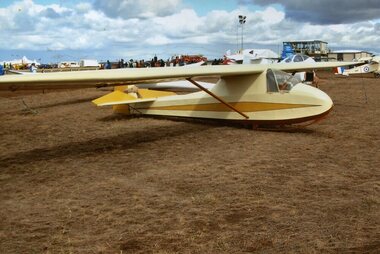
... It is essentially a Grunau Baby 2B with a Perspex enclosed cockpit, wing airbrakes and a landing wheel. However, the wing design came from an existing Grunau 3 type that was being built in Germany. ...It is essentially a Grunau Baby 2B with a Perspex enclosed cockpit, wing airbrakes and a landing wheel. However, the wing design came from an existing Grunau 3 type that was being built in Germany. ...This aircraft, the first glider built by Schneiders after they immigrated to Australia, was test flown on 3 January 1953 by Dave Darbyshire and Owen Lewis. It is the only machine of its type. It is essentially a Grunau Baby 2B with a Perspex enclosed cockpit, wing airbrakes and a landing wheel. However, the wing design came from an existing Grunau 3 type that was being built in Germany. The glider has given extensive service for a number of owners – including the Gliding Club of Victoria, Sunraysia Gliding Club, Millicent Gliding Club, Max Bugler of Morwell and Garth Hudson of Brighton in Victoria. Prior to being donated to the Australian Gliding Museum in January 2001 the glider had logged over 2200 hours flying time from over 9000 flights. The glider is an improved Grunau Baby design that Edmund Schneider built after coming to Australia.Single seat glider of wood and fabric construction, with steel wing struts. Currently painted crème with yellow details. Underside of fuselage is painted orange.australian gliding, grunau, grunau baby, schneider, gliding club of victoria, sunraysia gliding club, millicent gliding club, darbyshire, lewis, bugler, hudson -
 Australian Gliding Museum
Machine - Glider – Sailplane, 1949
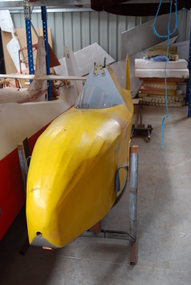
... design that became a popular choice for home building in the post war years in Australia when gliding as a sport was in recovery. Some examples are still flying. australian gliding glider sailplane hutter sweetwings fleetwings reichelt riley wynne milligan Small single seat glider. Fuselage and wing struts are painted yellow. Wings, rudder and tailplane / elevator are primed with pink dope. It has an open cockpit ...The Hutter H17 is a small single seat glider with a wing span of 9.69 metres, designed in 1934 by Wolfgang Hutter, for flying in the Austrian Alps. Construction of the museum’s example, “Sweetwings” (now registered as VH-GQM), commenced in Perth in 1949. It is one of two Hutter H17 gliders built in Western Australia by N.J. Wynne and A.G. Milligan at the time – the other “Fleetwings” (formerly VH-HDQ and since re-registered as VH-GXV) is located at Millicent, South Australia. Ownership transferred to G.R. Reichelt of Tocumwal New South Wales and later to D.B. Hunt of Thornbury in Melbourne and later Mt Isa, Queensland. It was acquired by Bill Riley of Tocumwal who donated it to the Museum. The glider was last flown on 25 October 1979 at Tocumwal. This exhibit is an example of a 1930s small wood and fabric glider that was designed in Austria for hill soaring. It is a simple design that became a popular choice for home building in the post war years in Australia when gliding as a sport was in recovery. Some examples are still flying.Small single seat glider. Fuselage and wing struts are painted yellow. Wings, rudder and tailplane / elevator are primed with pink dope. It has an open cockpit with small clear Perspex wind screen. Instruments include airspeed indicator and altimeter tucked neatly under front edge of the cockpit rim.australian gliding, glider, sailplane, hutter, sweetwings, fleetwings, reichelt, riley, wynne, milligan -
 Australian Gliding Museum
Machine - Glider – Sailplane, 1969
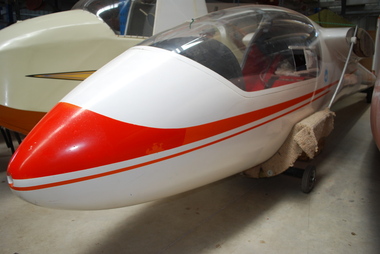
... Early fibreglass design that was manufactured in numbers. australian gliding glider sailplane bolkow phoebus cohn nagele linder eppler Serial number 866 on plate affixed inside cockpit – registration VH-GSW which has been painted on the sides of the fuselage rear of the wings. ...The Phoebus is a fibreglass composite sailplane that was designed by H. Nagele, R. Linder and R. Eppler in the early 1960s for competition flying. It is a derivative from the Akaflieg Stuttart Phonix which was the first sailplane to be built of fibreglass. The first Phoebus, a Standard Class design with a 15 metre wingspan, flew in 1964. The Phoebus C is the open class version of the type that was introduced in 1967. It has a 17 metre wing span, retractable wheel and tail brake parachute. Several hundred Phoebus sailplanes (all versions) were made by the manufacturer Bolkow at Ottobrun in Germany before production ended in 1970. The Museum’s Phoebus C, serial number 866, was built in 1969. It was donated to the Museum by Ian Cohn in 2008. Early fibreglass design that was manufactured in numbers. The Phoebus is a modern looking single seat glass fibre sailplane with a ‘T’ tailplane. It is finished in white with light red detailing including thin red stripe on wings and some red striping on fuselage sides from nose to underneath wings.Serial number 866 on plate affixed inside cockpit – registration VH-GSW which has been painted on the sides of the fuselage rear of the wings. A Freistaat Bayern crest has been applied to each side of the vertical stabilizer. australian gliding, glider, sailplane, bolkow, phoebus, cohn, nagele, linder, eppler -
 Australian Gliding Museum
Machine - Glider - Sailplane, 1943
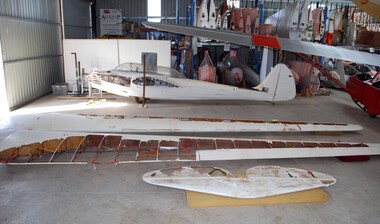
... design in United States and the United Kingdom in the immediate post war period. It is interesting to note that at that time a number of clubs in Australia who acquired a two seat glider for training chose the United Kingdom open cockpit high strutted wing offerings from Slingsby (e.g. ...The Laister-Kauffman 10A (LK10A) is a 2 seat a military training glider developed from a successful Jack Laister single seat glider called Yankee Doodle that first flew in 1938 and was exhibited at the Paris Air Show of 1939. The two seater variation was ordered in 1941 by the US Army for training glider pilots of troop carrying gliders. The military designation was XTG-4. The LK 10A glider was a simpler, more robust design than Yankee Doodle. A longer canopy enclosed both seating positions. The top of the fuselage formed a straight ridge from the top of the canopy to the point where the fin – rudder connected. Also, the design was simplified by adopting straight spar wings of 15.2 metres in place of gull wings of 14.170 metres. During the war years 156 LK10As were produced before the contracts to supply the US Army were terminated. Many of these were later sold as surplus. The Museum’s exhibit (serial number 122) was built in 1943. It was imported into Australia in the 1950s by Ric New, a member of the Gliding Club of Western Australia. Ric New modified the glider by “flat topping” the fuselage and making other aerodynamic changes. This kind of modification of the LK10A was a well tried strategy in United States for extracting better performance from the glider. It is understood that the reduction in weight and cleaner aerodynamics from the changes could increase the glide ratio from 1:24 to something like 1:30. The LK10A was located at the Gliding Club of Western Australia for many years. Records reveal that it was kept airworthy until about 1975. The LK10A is an important acquisition in that it allows one to compare the state of two seat glider design in United States and the United Kingdom in the immediate post war period. It is interesting to note that at that time a number of clubs in Australia who acquired a two seat glider for training chose the United Kingdom open cockpit high strutted wing offerings from Slingsby (e.g. T31) instead of more innovative military surplus gliders from America. Modified LK10A glider consisting of tubular steel fuselage with a combination of fabric and metal covering, fabric covered wooden wings and other flying surfaces.australian gliding, glider, sailplane, laister, kauffman, ric new, gliding club of western australia, lk10a, yankee doodle, xtg-4 -
 Australian Gliding Museum
Machine - Glider – Sailplane, 1964
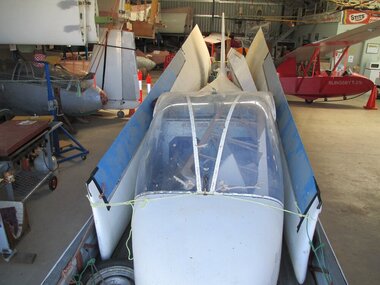
... The T49 “Capstan” is a two seat trainer, developed by Slingsby in 1960-1961 from an earlier design, the T42 “Eagle”. A major difference was that the T49 cockpit was arranged with side by side seating instead of the tandem seats of the earlier design. ...The T49 “Capstan” is a two seat trainer, developed by Slingsby in 1960-1961 from an earlier design, the T42 “Eagle”. A major difference was that the T49 cockpit was arranged with side by side seating instead of the tandem seats of the earlier design. ...The T49 “Capstan” is a two seat trainer, developed by Slingsby in 1960-1961 from an earlier design, the T42 “Eagle”. A major difference was that the T49 cockpit was arranged with side by side seating instead of the tandem seats of the earlier design. The prototype T49 flew in 1961. The production version (T49-B) was slightly different to the prototype in that it was given a taller fin. Thirty two were built by Slingsby. The Australian Gliding Museum example of this type (Serial Number FMD86), designated T49-B, is one of a pair built in 1964 from kits by Fred M. Dunn (Sailplane Services Ltd (NZ)) at Christchurch, New Zealand. It was registered as ZK-GDU in July 1964 and was flown at Wigram Gliding Club and Canterbury Gliding Club. It had logged over 4000 hours as at December 1987. The glider was brought to Australia in 1988 and registered as VH-CQH by Allen Rundle of Maclean, near Grafton, New South Wales. The glider’s last New Zealand maintenance release expired in January 1988. It has not flown in Australia. The exhibit is one of a relatively small number (probably about a dozen) of this Slingsby type that remain. It is the only T49B in Australia, as the other built by Fred Dunn in 1964 (and brought to Australia by Allen Rundle) was found to be beyond repair and has been broken up. Sailplane of wood, plywood and fabric construction with some fibreglass elements.Marked with NZ registration “DU”australian gliding, glider, sailplane, slingsby, capstan, t49, wigram gliding club, canterbury gliding club, fred dunn, allen rundle, sailplane services ltd -
 Australian Gliding Museum
Machine - Glider –Sailplane, 1960
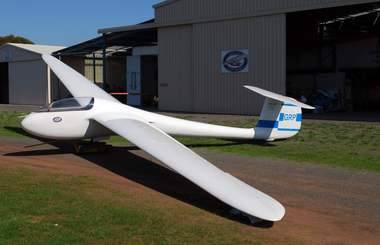
... design. It is the only one in Australia. australian gliding sailplane glider fs-24 phonix nagele eppler lindner stuttgart technical university bolkov aircraft company segelfluggruppe solothurn ashford geelong gliding club. Australian registration GRP on rudder; Serial Number 403 and Vintage glider club of Netherlands plaque in cockpit ...The FS-24 Phonix is the first sailplane design to be built using a moulded fiberglass sandwich technique. It was designed by Hermann Nagele and Richard Eppler leading a group setup for the purpose at Stuttgart Technical University in the early 1950s. Initial construction was undertaken at workshops of Wolf Hirth and the first prototype was completed at the Bolkow Aircraft Company where Nagele and another member of the group, Rudi Lindner, had gained employment. It flew on 27 November 1957. Two further prototypes were built incorporating a T-tail and other refinements. Eight in all were built before production was stopped in 1961. A number of gliding records were broken in Phonix sailplanes in Germany in 1962-1963. It was found to have a best glide ratio of 40:1. The Museum’s example, No. 403 was originally a prototype built on 25 May 1960 [Registration D-8354]. It was converted at Bolkow to a Phonix T in 1963 and sold to a private owner in Switzerland [Registration HB-746] and later then to gliding club Segelfluggruppe Solothurn in 1965. The glider returned to Germany in 1971 (Meersburg) and re-registered as D-0738. It moved to a new owner in Allershausen in 1976, and again to Lindhoft in 1982. In 1983 the glider was sold to owners at Hasselt, Belgium and given registration OO-ZQD. In 1989 a further change of ownership occurred and the glider went to Leusden in the Netherlands where it was registered as PH-949. In 2006 the Phonix No.403 was imported into Australia by John Ashford of the Geelong Gliding Club. On 30 January 2007, it was registered as VH-GRP. However, as at January 2016 it has not been flown in Australia. In the course of its flying history the glider was damaged several times and repaired. At one stage a larger rudder was fitted and later on this modification was reversed. With the original conversion to a Phonix T and subsequent repairs and changes to equipment the weight of the airframe increased from 182 kg to approximately 220 kg. Nevertheless, the wing loading is a modest 20kg/square metre. As at January 2016, minor repairs and airworthiness certification are required to return the glider to flying condition. This exhibit is highly significant as it is one of only eight of this pioneering sailplane design. It is the only one in Australia. Glassfibre single seat sailplane, finished white with blue stripes on fin and rudder.Australian registration GRP on rudder; Serial Number 403 and Vintage glider club of Netherlands plaque in cockpitaustralian gliding, sailplane, glider, fs-24, phonix, nagele, eppler, lindner, stuttgart technical university, bolkov aircraft company, segelfluggruppe solothurn, ashford, geelong gliding club. -
 Australian Gliding Museum
Machine - Glider – Sailplane
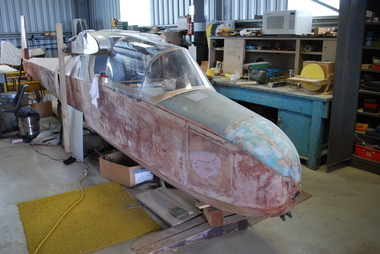
... cockpit canopy. The glider was at Warkworth, New South Wales in 1992 and became to be owned by Eric Oates who preserved it until he donated it to the Australian Gliding Museum. According to the logbook for VH-GLL held by the Museum, the glider was last flown in November 1990 and at that time had logged 2758 hours and 57 minutes from 15775 launches. The fuselage is currently under restoration at the Museum’s Dave Darbyshire workshop. The ES49 – VH-GLL – is an example of the state of wood and fabric dual place sailplane design ...The ES49 glider / sailplane was designed by Edmund Schneider in Germany before he migrated to Australia in the early 1950s. In Germany the ES49 was put into limited production by the Schleicher factory from 1951 to 1953 (8 produced). In Australia the ES49 is commonly referred to as the “Wallaby”; two were built by the Adelaide Soaring Club with assistance from Edmund Schneider Ltd and one independently from plans by Eric Hader and members of the Cooma Gliding Club. The Museum’s ES49 – serial number GFA-HB-36 - was built at Gawler from 1955 to 1958 and registered as VH-GLL on 15 January 1959. It was the second of the ES49s built by the Adelaide Soaring Club. Originally it had a rather distinctive appearance due to the use of a sleek P51 Mustang canopy to enclose the forward seating position of the cockpit. The glider, together with its sister VH-GDK, was used at the Gliding Federation of Australia National Gliding Schools at Gawler. In 1964 the glider was transferred to the Newcastle Gliding Club, Newcastle, in New South Wales and then in 1966 it went to the Albury and District Gliding Club, Albury, New South Wales. The Snowy Mountains Gliding Club, Khancoban, New South Wales acquired the glider in 1968 where it remained until 1974. In 1974 the glider transferred into private hands at Wodonga, Victoria, for two years and then to interests at Albury until 1985. At that stage the glider was acquired by a private owner at Bathurst, New South Wales, who undertook a restoration that included, amongst other work, the fitting of a more conventional cockpit canopy. The glider was at Warkworth, New South Wales in 1992 and became to be owned by Eric Oates who preserved it until he donated it to the Australian Gliding Museum. According to the logbook for VH-GLL held by the Museum, the glider was last flown in November 1990 and at that time had logged 2758 hours and 57 minutes from 15775 launches. The fuselage is currently under restoration at the Museum’s Dave Darbyshire workshop. The ES49 – VH-GLL – is an example of the state of wood and fabric dual place sailplane design in the late 1940s. The glider served the Adelaide Soaring Club and subsequent owners well as a training and general purpose sailplane over many years. It is a rare example of the type (one of 4 existing in the world). Tandem two seat high wing strut braced glider-sailplane finished in silver grey colour scheme.australian fliding, glider, sailplane, schneider, es 49, wallaby, oats, adelaide soaring club, hader, cooma gliding club, newcastle gliding club, albury & district gliding club, snowy mountains gliding club -
 Australian Gliding Museum
Machine - Glider – Sailplane, 1959
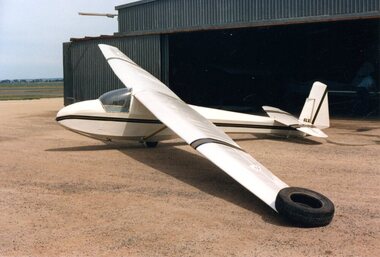
... However, it was a new design with fully enclosed cockpit. The main point of difference to earlier Schneider Grunau designs was the tapered wings with the Gottingen 549 aerofoil. ...However, it was a new design with fully enclosed cockpit. The main point of difference to earlier Schneider Grunau designs was the tapered wings with the Gottingen 549 aerofoil. ...This aircraft was designed by Edmund Schneider as a single seat medium performance sailplane. Originally designated as the Grunau 3b but later named the Grunau 4. However, it was a new design with fully enclosed cockpit. The main point of difference to earlier Schneider Grunau designs was the tapered wings with the Gottingen 549 aerofoil. This design feature gave the Grunau 4 a better speed range compared to the Grunau Baby 2b or the Grunau 3. The prototype flew on 6 December 1953 and it went to the Waikerie Gliding Club. A second was delivered to the Dubbo Gliding Club in October of the next year and a third (the Australian Gliding Museum’s exhibit) built for the Adelaide Soaring Club in 1959 (registered as VH-GLX on 21 October 1959). Another was built by Josef Brabec from a Schneider supplied kit from 1954 to 1956. The log book indicates that the glider recorded 2362 flying hours over approximately 40 years of active service. There are many long flights recorded. The registration was cancelled on 30 July 2014 as a result of a decision by the Museum to withdraw the glider from service. The exhibit represents the final development of the "Grunau" single seat type by Edmund Schneider Ltd in Australia. Viewed together with the Grunau Baby gliders in the ATO Collection (Two Grunau Baby 2, and a Grunau Baby 3A), the changes to this glider type over a 30 year period can be recognized. Single seat wooden sailplane with fabric covering. Fully enclosed cockpit. The aircraft is white with Linden Green on the wing tips, tailplane and underside of the fuselage and also on the central wing cover. Identification Plate in cockpit showing that glider is serial number 37 built by Edmund Schneider Ltd in 1959 australian gliding, glider, sailplane, grunau, grunau 3a, grunau 3b, grunau 4, schneider, waikerie gliding club, dubbo gliding club, adelaide soaring club, josef brabec -
 Australian Gliding Museum
Machine - Glider - Sailplane, 1974
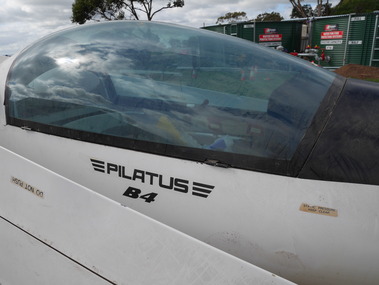
... The aircraft is representative of a popular imported 1970s intermediate single seat sailplane design of aluminium alloy construction. australian gliding glider sailplane pilatus b4 sutton narrogin albury corowa green townsville millward geelong White colour scheme with yellow fuselage underside highlighted by blue stripe – “Pilatus B4” in black lettering on starboard side of cockpit – black anti-glare paint on the fuselage nose – Registration “GID” on the underside of port wing. ...The Pilatus B4 is an all metal intermediate sailplane meeting Standard Class rules that was designed in 1966 by Ingo Herbst, Manfred Küppers and Rudolf Reinke. It did not immediately go into production. In 1972 Pilatus Aircraft of Switzerland acquired a licence to build the aircraft and began production. The PCII and PCIIA versions were semi-aerobatic. The PC11AF released in 1975 was rated as fully aerobatic. By 1980, when Pilatus sold the rights to manufacture of the aircraft to Nippi Aircraft of Japan, 322 of the Pilatus B4 had been produced. Nippi Aircraft built a further 13 and also one two seat version. The Pilatus B4 proved popular in Australia with 26 appearing on the Australian register. The Museum’s example is a basic semi-aerobatic type (Serial Number 092) that was built in 1974. It is registered as VH-GID on 8 July 1974 by H.G. Sutton of Mandura, Western Australia and flown out of the Narrogin Gliding Club in Western Australia until September 1986 when it was sold to the Albury – Corowa Gliding Club, New South Wales. In 1999 it was acquired by Michael Green and moved to Townsville, Queensland. The aircraft changed ownership again in 2004 and fell out of use for nearly 4 years. By then it had recorded 4377 hours in the air from 4304 flights. It returned to service briefly in January 2008 (5 flights totalling about 5 hours). It was donated to the Museum by David Millward of the Geelong Gliding Club, Victoria, on 10 April 2017. The aircraft is representative of a popular imported 1970s intermediate single seat sailplane design of aluminium alloy construction.Single seat sailplane of metal alloy constructionWhite colour scheme with yellow fuselage underside highlighted by blue stripe – “Pilatus B4” in black lettering on starboard side of cockpit – black anti-glare paint on the fuselage nose – Registration “GID” on the underside of port wing.australian gliding, glider, sailplane, pilatus b4, sutton, narrogin, albury, corowa, green, townsville, millward, geelong -
Moorabbin Air Museum
Machine - BA Swallow II VH-UUM, 1935
... cockpit. Description: The BA Swallow was developed in England by the British Aircraft Manufacturing Company Limited and was based upon the German designed Klemm L25 light aircraft that first flew in 1927. ...cockpit. Description: The BA Swallow was developed in England by the British Aircraft Manufacturing Company Limited and was based upon the German designed Klemm L25 light aircraft that first flew in 1927. ...Historical Details: The AARG BA Swallow is one of two examples surviving in Australia, along with a Klemm L.25 Swallow, although it is the only one in a public collection, while 4 airworthy survivors exist in the UK. It is a rare example of the pre-war civil open cockpit. Description: The BA Swallow was developed in England by the British Aircraft Manufacturing Company Limited and was based upon the German designed Klemm L25 light aircraft that first flew in 1927. A total of 133 were built and nine examples found their way to Austra. Level of Importance: National -
Moorabbin Air Museum
Machine - De Havilland DH104 Dove (Cockpit) VH-ALD (G-BAHB, CS-TAC )
... One recommendation was for the design of what what is now call. Level of Importance: Regional De Havilland DH104 Dove (Cockpit) VH-ALD (G-BAHB, CS-TAC ) Machine De Havilland DH104 Dove (Cockpit) VH-ALD (G-BAHB, CS-TAC ) ...Historical Details: . Description: The de Havilland Dove was one of the aircraft types resulting from the recommendations of the wartime Brabazon Committee which studied the post war requirements of British commercial aviation. One recommendation was for the design of what what is now call. Level of Importance: Regional -
Moorabbin Air Museum
Machine - Edgely EA-7 OptiCA (Cockpit)
... design was. Level of Importance: Regional Edgely EA-7 OptiCA (Cockpit) Machine Edgely EA-7 OptiCA (Cockpit) ...Historical Details: . Description: The Edgely Optica is a UK design developed by John Edgely in the late 1970s using a flat 6 engine in pusher configuration in the form of a ducted fan, and featuring a fully glazed cabin said to be 'reminiscent of an Alouette helicopter'. The design was. Level of Importance: Regional -
Moorabbin Air Museum
Manual (Item) - Cockpit layout of the F2 trainer Design Philosophy wind tunnel tests subcontracting design progress, Government Aircraft Factories Project Note F2/5
... Cockpit layout of the F2 trainer Design Philosophy wind tunnel tests subcontracting design progress...Government Aircraft Factories Project Note F2/5 Manual Cockpit layout of the F2 trainer Design Philosophy wind tunnel tests subcontracting design progress ... -
Moorabbin Air Museum
Booklet - RAAF F/A18 Hornet, The Australian Hornet F/A-18A
... Design...Engines...Cockpit...RAAF F/A18 Hornet The Australian requirement Structure Design Engines Cockpit Radar/avionics Multimission capability Survivability Reliability & maintainability Related high technology Technical & promotional overview of RAAF FA18 Hornet fighter, circa 1981 The Australian Hornet F/A-18A Booklet RAAF F/A18 Hornet ...Technical & promotional overview of RAAF FA18 Hornet fighter, circa 1981non-fictionTechnical & promotional overview of RAAF FA18 Hornet fighter, circa 1981the australian requirement, structure, design, engines, cockpit, radar/avionics, multimission capability, survivability, reliability & maintainability, related high technology -
 Surrey Hills Historical Society Collection
Work on paper - War Savings Stamp, 6d WW2 war savings stamp, 1941-1944
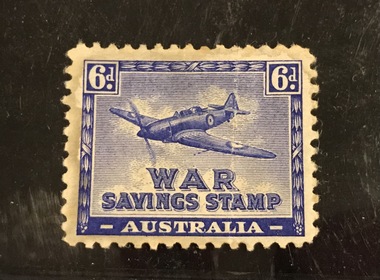
... Designed and produced by the Government Stamp Printer. Although the stamp has been called the "Spitfire" for over 70 years, the image of the plane depicted is either a Boulton-Paul Defiant (with a turret mounted behind the cockpit) or a Hurricane rather than a Spitfire. ...Designed and produced by the Government Stamp Printer. Although the stamp has been called the "Spitfire" for over 70 years, the image of the plane depicted is either a Boulton-Paul Defiant (with a turret mounted behind the cockpit) or a Hurricane rather than a Spitfire. stamps war savings stamps planes second world war fundraising A 6d stamp Australian War Savings stamp in Imperial Blue and white. ...These stamps were issued during WW2 and designed to be stuck into a war savings stamp booklet. When these were filled, you could redeem them for a £1 or £5 War Bond. This specimen is not watermarked indicating it was a re-issue of the earlier version with a watermark. Issued between August 1941 and March 1944. Designed and produced by the Government Stamp Printer. Although the stamp has been called the "Spitfire" for over 70 years, the image of the plane depicted is either a Boulton-Paul Defiant (with a turret mounted behind the cockpit) or a Hurricane rather than a Spitfire. A 6d stamp Australian War Savings stamp in Imperial Blue and white. Loosely held in a philatelic mount. stamps, war savings stamps, planes, second world war, fundraising -
 Mont De Lancey
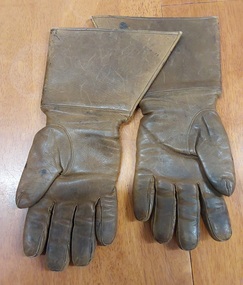
Uniform - Flying Gauntlets, 1940's
... World War II 1939-1945 Luftwaffe leather flying gauntlets were protective hand wear designed for military aviators to guard against high-altitude freezing temperatures and severe flash burns. They shielded aircrews from instrument burns and cockpit fires. ...World War II 1939-1945 Luftwaffe leather flying gauntlets were protective hand wear designed for military aviators to guard against high-altitude freezing temperatures and severe flash burns. They shielded aircrews from instrument burns and cockpit fires. ...World War II 1939-1945 Luftwaffe leather flying gauntlets were protective hand wear designed for military aviators to guard against high-altitude freezing temperatures and severe flash burns. They shielded aircrews from instrument burns and cockpit fires. Long gauntlet cuffs protected the wrists and forearms from drafts and cold air. They were favored by bomber and maritime patrol crews in unheated aircraft, German aircrew gauntlets used thin brown kid leather with raised ridges and expanding wrist gussets. Fighter pilots usually rejected them in favor of shorter gloves for better mobility.A pair of WW11 Luftwaffe flying gauntlets. They are light brown leather, fur lined, tapered at the wrist, and fitted with a narrow expandable wristband which closes with a dark brown press stud. There are three detailed stitching lines on the back of each gauntlet.gloves, gauntlet gloves, ww2 flying gloves, uniforms
