
Showing 17 items matching "collector of customs"
-
 Flagstaff Hill Maritime Museum and Village
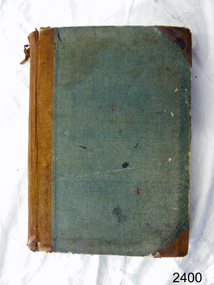
Book - Record Book, Collector of Customs, 1917-1921
... ...collector of customs...Collector of Customs, letter copybook. Handwritten records dated between 1917 - 1921: hardcover, light blue with medium brown spine and reinforced corners. ...Collector of Customs...Book Record Book Collector of Customs ...Collector of Customs, letter copybook. Handwritten records dated between 1917 - 1921: hardcover, light blue with medium brown spine and reinforced corners. Pages have printed alphabetical index on the right-hand edge. The fly page of the book has handwritten pencil numbers and calculations.flagstaff hill, warrnambool, shipwrecked-coast, flagstaff-hill, flagstaff-hill-maritime-museum, maritime-museum, shipwreck-coast, flagstaff-hill-maritime-village, book, collector of customs, maritime record book, excise and taxes, government records -
 Flagstaff Hill Maritime Museum and Village
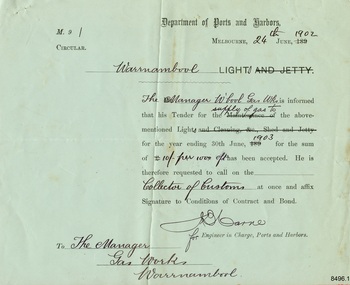
Document - Ports and Harbours, Ports and Harbours, Tender for Warrnambool Light, 24-06-1902
... ...Collector of Customs...The Manager of the Warrnambool Gas Works expected to follow this acceptance with a visit to the Collector of Customs to sign the Conditions of Contract and Bond. ..."24th [June] 1902" Warrnambool [Light]" "Manager W'bool Gas Wks" "supply of gas to" "1903" "10/- per 100.0 c/f" "Collector of Customs" " The Manager / Gas Works / Warrnambool" [Signature] "for" [Engineer in Charge, Ports and Harbours]...The Manager of the Warrnambool Gas Works expected to follow this acceptance with a visit to the Collector of Customs to sign the Conditions of Contract and Bond. ...The document confirms that the Tender for the supply of gas to the Warrnambool Light, also known as the Lighthouse, by the Warrnambool Gas Works was successful. The Tender was issued by the Engineer in Charge, Ports and Harbours, Melbourne, for a the period ending 30th June 1903, at the offered rate of 10/- (ten shillings) per 100.0 c/f (cubic feet). The Manager of the Warrnambool Gas Works expected to follow this acceptance with a visit to the Collector of Customs to sign the Conditions of Contract and Bond. The light of Warrnambool's Lady Bay Lighthouse was originally powered by oil. Later it was converted to gas, followed by electricity, then solar power, and finally to battery power. The Warrnambool Gas Company operated the gas works from the 1870's to the late 1920's.This document connects Warrnambool's Lady Bay Lighthouse to the Warrnambool Gas Works during the first decade of the 20th century. It documents to process of a Government department requesting Tenders for the supply of goods to operate a service, the the formal documentation required at that time.Pale green rectangular paper with template text printed in black and completed in black ink script. Letterhead of the Department of Ports and Harbours, Melbourne, and addressed to the Gas Works, Warrnambool, dated 24th June 1902, for the supply of gas to the Warrnambool Light until 30th June 1903 at the cost of Ten Shillings per 100 cubic feet."24th [June] 1902" Warrnambool [Light]" "Manager W'bool Gas Wks" "supply of gas to" "1903" "10/- per 100.0 c/f" "Collector of Customs" " The Manager / Gas Works / Warrnambool" [Signature] "for" [Engineer in Charge, Ports and Harbours]flagstaff hill, flagstaff hill maritime museum and village, warrnambool, maritime museum, maritime village, great ocean road, shipwreck coast, department of ports and harbours, ports and harbours, ports and harbours melbourne, warrnambool light, warrnambool lighthouse, warrnambool gas works, w'bool gas works, gas works, gas supply, early 1900s, early 20th century, shillings, cubic feet, collector of customs, customs, warrnambool customs, engineer in charge, lady bay lighthouse, warrnambool gas company -
 Flagstaff Hill Maritime Museum and Village
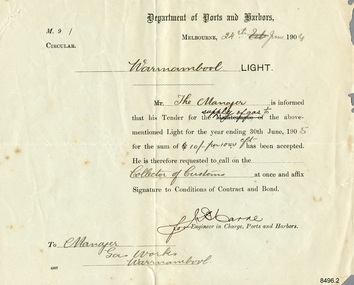
Document - Ports and Harbours, Ports and Harbours, Tender for Warrnambool Light, 24-06-1904
... ...Collector of Customs...The Manager of the Warrnambool Gas Works expected to follow this acceptance with a visit to the Collector of Customs to sign the Conditions of Contract and Bond. ..."24th [June] 1904" Warrnambool [Light]" "Manager W'bool Gas Wks" "supply of gas to" "1905" "10/- per 100.0 c/f" "Collector of Customs" " The Manager / Gas Works / Warrnambool" [Signature] "for" [Engineer in Charge, Ports and Harbours]...The Manager of the Warrnambool Gas Works expected to follow this acceptance with a visit to the Collector of Customs to sign the Conditions of Contract and Bond. ...The document confirms that the Tender for the supply of gas to the Warrnambool Light, also known as the Lighthouse, by the Warrnambool Gas Works was successful. The Tender was issued by the Engineer in Charge, Ports and Harbours, Melbourne, for a the period ending 30th June 1905, at the offered rate of 10/- (ten shillings) per 100.0 c/f (cubic feet). The Manager of the Warrnambool Gas Works expected to follow this acceptance with a visit to the Collector of Customs to sign the Conditions of Contract and Bond. The light of Warrnambool's Lady Bay Lighthouse was originally powered by oil. Later it was converted to gas, followed by electricity, then solar power, and finally to battery power. The Warrnambool Gas Company operated the gas works from the 1870's to the late 1920's.This document connects Warrnambool's Lady Bay Lighthouse to the Warrnambool Gas Works during the first decade of the 20th century. It documents to process of a Government department requesting Tenders for the supply of goods to operate a service, the the formal documentation required at that time.Pale cream rectangular paper with template text printed in black and completed in black ink script. Letterhead of the Department of Ports and Harbours, Melbourne, and addressed to the Gas Works, Warrnambool, dated 24th June 1904, for the supply of gas to the Warrnambool Light until 30th June 1905 at the cost of Ten Shillings per 100 cubic feet."24th [June] 1904" Warrnambool [Light]" "Manager W'bool Gas Wks" "supply of gas to" "1905" "10/- per 100.0 c/f" "Collector of Customs" " The Manager / Gas Works / Warrnambool" [Signature] "for" [Engineer in Charge, Ports and Harbours]flagstaff hill, flagstaff hill maritime museum and village, warrnambool, maritime museum, maritime village, great ocean road, shipwreck coast, department of ports and harbours, ports and harbours, ports and harbours melbourne, warrnambool light, warrnambool lighthouse, warrnambool gas works, w'bool gas works, gas works, gas supply, early 1900s, early 20th century, shillings, cubic feet, collector of customs, customs, warrnambool customs, engineer in charge, lady bay lighthouse, warrnambool gas company -
 Flagstaff Hill Maritime Museum and Village
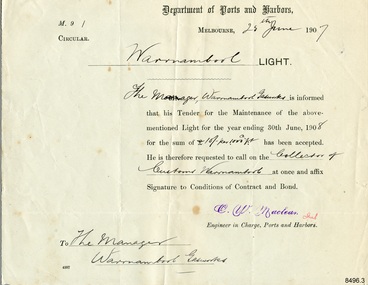
Document - Ports and Harbours, Ports and Harbours, Tender for Warrnambool Light, 24-06-1907
... ...Collector of Customs...The Manager of the Warrnambool Gasworks expected to follow this acceptance with a visit to the Collector of Customs to sign the Conditions of Contract and Bond. ..."25th [June] 1907" Warrnambool [Light]" "Manager W'bool Gasworks" "supply of gas to" "1908" "10/- per 100.0 c/f" "Collector of Customs" " The Manager / Warrnambool Gasworks" [Signature] "for" [Engineer in Charge, Ports and Harbours] Stamped " C. -. ...The Manager of the Warrnambool Gasworks expected to follow this acceptance with a visit to the Collector of Customs to sign the Conditions of Contract and Bond. ...The document confirms that the Tender for the supply of maintenance to the Warrnambool Light, also known as the Lighthouse, by the Warrnambool Gasworks was successful. The Tender was issued by the Engineer in Charge, C. Maclean, Ports and Harbours, Melbourne, for a the period ending 30th June 1908, at the offered rate of 10/- (ten shillings) per 100.0 c/f (cubic feet). The Manager of the Warrnambool Gasworks expected to follow this acceptance with a visit to the Collector of Customs to sign the Conditions of Contract and Bond. The light of Warrnambool's Lady Bay Lighthouse was originally powered by oil. Later it was converted to gas, followed by electricity, then solar power, and finally to battery power. The Warrnambool Gas Company operated the gas works from the 1870's to the late 1920's.This document connects Warrnambool's Lady Bay Lighthouse to the Warrnambool Gas Works during the first decade of the 20th century. It documents to process of a Government department requesting Tenders for the supply of goods to operate a service, the the formal documentation required at that time.Pale cream rectangular paper with template text printed in black and completed in black ink script. Letterhead of the Department of Ports and Harbours, Melbourne, and addressed to the Gas Works, Warrnambool, dated 25th June 1907, for the supply of maintenance to the Warrnambool Light until 30th June 1908 at the cost of Ten Shillings per 100 cubic feet. A purple stamped signature is also added and initialled in red pen."25th [June] 1907" Warrnambool [Light]" "Manager W'bool Gasworks" "supply of gas to" "1908" "10/- per 100.0 c/f" "Collector of Customs" " The Manager / Warrnambool Gasworks" [Signature] "for" [Engineer in Charge, Ports and Harbours] Stamped " C. -. Maclean"flagstaff hill, flagstaff hill maritime museum and village, warrnambool, maritime museum, maritime village, great ocean road, shipwreck coast, department of ports and harbours, ports and harbours, ports and harbours melbourne, warrnambool light, warrnambool lighthouse, warrnambool gas works, w'bool gas works, gas works, gas supply, early 1900s, early 20th century, shillings, cubic feet, collector of customs, customs, warrnambool customs, engineer in charge, lady bay lighthouse, warrnambool gas company, gasworks, warrnambool gasworks, maintenance, c. - maclean -
 Orbost & District Historical Society
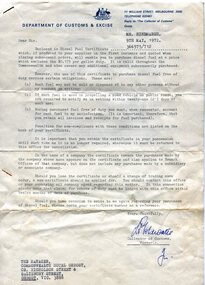
Certificate - Fuel certificate, Diesel fuel certificate from Dept. of Customs & Excise 1972
... Goldwater, Collector of Customs, Victoria; ...Goldwater, Collector of Customs, Victoria; 3 b/w printed pages held together by a staple. ...This is a diesel fuel certificate for an exemption from payment of excise tax, issued to a local business in Orbost. It shows the name of the recipient as ... Hindmarsh, Commonwealth Hotel, Orbost. An original certificate relating to an Orbost business. 3 b/w printed pages held together by a staple. A letter to Mr Hindmarsh dated 19 May 1972, signed by ... Goldwater, Collector of Customs, Victoria; diesel fuel certificate, commonwealth hotel, orbost -
 Flagstaff Hill Maritime Museum and Village
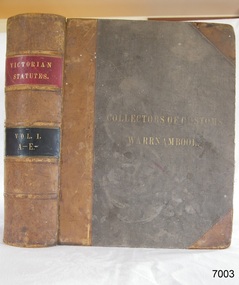
Book - Reference Colonial Legal Statutes, John Ferres, Government Printer, The Victorian Statutes Vol 1 Collectors of Customs A-E, 1866
... Hard cover book,The Victorian Statutes Vol 1. Collectors of Customs A-E Author: Corporate Author “The Colony of Victoria” Publisher: John Ferres Government Printer Melbourne. ...The Victorian Statutes Vol 1 Collectors of Customs A-E Book Reference Colonial Legal Statutes John Ferres, Government Printer Corporate Author “The Colony of Victoria” ...This volume is part of the first comprehensive consolidation of laws for the Colony of Victoria after it separated from New South Wales and established its own parliament. Specifically, Volume 1 (published in 1866) contains Local Colonial Acts. These were laws debated, passed, and enacted right here in Melbourne by the newly formed Parliament of the Colony of Victoria. They dealt with purely domestic, local matters, such as Victorian land selection, goldfields regulations, local municipal boundaries, and colonial courts. Volume 1 was the handbook for everyday domestic Victorian life, governing how a local town council operated, how gold claims were filed, or how local debts were settled in a Victorian county court or how customs should operate.Hard cover book,The Victorian Statutes Vol 1. Collectors of Customs A-E Author: Corporate Author “The Colony of Victoria” Publisher: John Ferres Government Printer Melbourne. Date: 1866 The Victorian Statutes Vol 1, front cover has title Collectors of Customs Warrnambool. Brown leather binding and corners, black canvas cover, red and black bands on spine. non-fictionThis volume is part of the first comprehensive consolidation of laws for the Colony of Victoria after it separated from New South Wales and established its own parliament. Specifically, Volume 1 (published in 1866) contains Local Colonial Acts. These were laws debated, passed, and enacted right here in Melbourne by the newly formed Parliament of the Colony of Victoria. They dealt with purely domestic, local matters, such as Victorian land selection, goldfields regulations, local municipal boundaries, and colonial courts. Volume 1 was the handbook for everyday domestic Victorian life, governing how a local town council operated, how gold claims were filed, or how local debts were settled in a Victorian county court or how customs should operate.warrnambool, shipwrecked-coast, flagstaff-hill, flagstaff-hill-maritime-museum, maritime-museum, shipwreck-coast, flagstaff-hill-maritime-village, shipwrecked-artefact, book, government statutes for victoria 1866, warrnambool's copy of government statutes 1866 -
 Flagstaff Hill Maritime Museum and Village
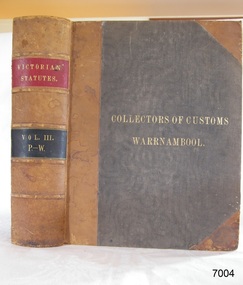
Book - Reference Colonial Legal Statutes, John Ferres, Government Printer, The Victorian Statutes Vol 3 Collectors of Customs P-W, 1866
... Hard cover book,The Victorian Statutes Vol 3. Collectors of Customs P-W Author: Corporate Author “The Colony of Victoria” Publisher: John Ferres Government Printer Melbourne. ...The Victorian Statutes Vol 3 Collectors of Customs P-W Book Reference Colonial Legal Statutes John Ferres, Government Printer Corporate Author “The Colony of Victoria” ...This volume is part of the first comprehensive consolidation of laws for the Colony of Victoria after it separated from New South Wales and established its own parliament. Specifically, Volume 3 (published in 1866) contains Local Colonial Acts. These were laws debated, passed, and enacted right here in Melbourne by the newly formed Parliament of the Colony of Victoria. They dealt with purely domestic, local matters, such as Victorian land selection, goldfields regulations, local municipal boundaries, and colonial courts. Volume 3 was the handbook for everyday domestic Victorian life, governing how a local town council operated, how gold claims were filed, or how local debts were settled in a Victorian county court or how customs should operate.Hard cover book,The Victorian Statutes Vol 3. Collectors of Customs P-W Author: Corporate Author “The Colony of Victoria” Publisher: John Ferres Government Printer Melbourne. Date: 1866 The Victorian Statutes Vol 3, front cover has title Collectors of Customs Warrnambool. Brown leather binding and corners, black canvas cover, red and black bands on spine. non-fictionThis volume is part of the first comprehensive consolidation of laws for the Colony of Victoria after it separated from New South Wales and established its own parliament. Specifically, Volume 3 (published in 1866) contains Local Colonial Acts. These were laws debated, passed, and enacted right here in Melbourne by the newly formed Parliament of the Colony of Victoria. They dealt with purely domestic, local matters, such as Victorian land selection, goldfields regulations, local municipal boundaries, and colonial courts. Volume 3 was the handbook for everyday domestic Victorian life, governing how a local town council operated, how gold claims were filed, or how local debts were settled in a Victorian county court or how customs should operate.warrnambool, shipwrecked-coast, flagstaff-hill, flagstaff-hill-maritime-museum, maritime-museum, shipwreck-coast, flagstaff-hill-maritime-village, shipwrecked-artefact, book, government statutes for victoria 1866, warrnambool's copy of government statutes 1866 -
 Bendigo Historical Society Inc.
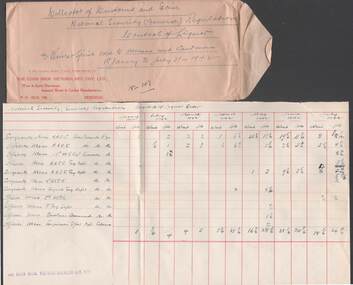
Document - COHN BROTHERS COLLECTION: PRINTED ENVELOPE
... [a] Cohns printed envelope captioned 'Collector of Customs and Excise, National Security [General] Regulations re Control of Liquor re Wines & Spirits sold to Messes and Canteens 1st January to July 31st 1942. ...BENDIGO Industry cohn bros brewery [a] Cohns printed envelope captioned 'Collector of Customs and Excise, National Security [General] Regulations re Control of Liquor re Wines & Spirits sold to Messes and Canteens 1st January to July 31st 1942. ...[a] Cohns printed envelope captioned 'Collector of Customs and Excise, National Security [General] Regulations re Control of Liquor re Wines & Spirits sold to Messes and Canteens 1st January to July 31st 1942. [b] Documents pertaining to above enclosed.bendigo, industry, cohn bros brewery -
 Flagstaff Hill Maritime Museum and Village
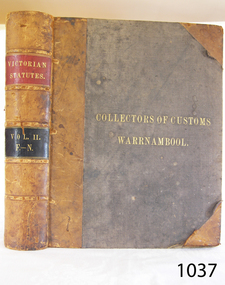
Book - Reference/Legal Acts, John Ferres, Government Printer, The Victorian Statutes Vol 2 Collectors of Customs, 1866
... Date: 1866 Three quarter leather, Olive Front Cover, Brown Spine with Gold embossed Title on spine & front cover "Collector of Customs Warrnambool"...Date: 1866 Three quarter leather, Olive Front Cover, Brown Spine with Gold embossed Title on spine & front cover "Collector of Customs Warrnambool" The Victorian Statutes Vol 2 Collectors of Customs. ...Because the subject item is a book of law, it would not traditionally have a singular author, but rather a corporate author, specifically the Colony of Victoria and, more precisely, the Parliament of Victoria. The Victorian Statutes of 1866 is an official compilation of the statute law of the Colony of Victoria, Australia, 'Published by Authority', and printed by John Ferres, who was the Victorian Government Printer at the time. Ferres was the printer/publisher, not an author or editor in the usual sense, as this is a government publication rather than an individually authored work.Hard cover book, The Victorian Statutes Vol 2 Author: Corporate Author “The Colony of Victoria” Publisher: John Ferres Government Printer Melbourne. Date: 1866 Three quarter leather, Olive Front Cover, Brown Spine with Gold embossed Title on spine & front cover "Collector of Customs Warrnambool"non-fictionBecause the subject item is a book of law, it would not traditionally have a singular author, but rather a corporate author, specifically the Colony of Victoria and, more precisely, the Parliament of Victoria. The Victorian Statutes of 1866 is an official compilation of the statute law of the Colony of Victoria, Australia, 'Published by Authority', and printed by John Ferres, who was the Victorian Government Printer at the time. Ferres was the printer/publisher, not an author or editor in the usual sense, as this is a government publication rather than an individually authored work.flagstaff hill, warrnambool, shipwrecked-coast, flagstaff-hill, flagstaff-hill-maritime-museum, maritime-museum, shipwreck-coast, flagstaff-hill-maritime-village, the victorian statutes vol 2 collectors of customs, book -
 Bendigo Historical Society Inc.
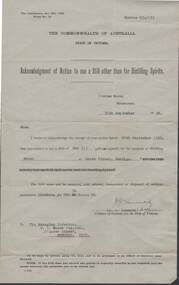
Document - W.D.MASON COLLECTION: DISTILLATION ACT, 20-30 Sep.1938
... Signed J.J.Kennedy; Collector of Customs for the State of Victoria....Signed J.J.Kennedy; Collector of Customs for the State of Victoria. Document W.D.MASON COLLECTION: DISTILLATION ACT ...Grey / green Document, Form 19 re the Distillation Act 1901-1925 dated 30.9.1938 W.D.Mason Collection, an Acknowledgement of Notice to use a Still other than for Distilling Spirits. The Commonwealth of Australia, State of Victoria. The Still was intended for distilling Water at Queen Street Bendigo. The Still must not be removed, sold, altered, dismantled, or disposed of without permission (Distillation Act 1901-34, Section 10). Signed J.J.Kennedy; Collector of Customs for the State of Victoria.Customs House, Melbourne.business, retail, w d mason -
 Wodonga & District Historical Society Inc
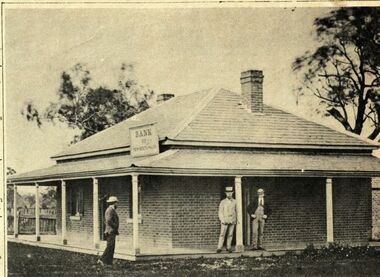
Photograph - Bank of New South Wales, Wodonga
... Other early accounts included Cronin & Callaghan, storekeepers; John Bassett Jnr, shoemaker; John Jennings, contractor; Ah Soon, tobacco grower, Kergunyah; John de Corney Ireland, collector of customs; Andrew Kyle, fellmonger; Rowan Lockhead, accountant; Alexander McKay, publican; George Pollard, farmer; Thomas Street, farmer; and Edmund Uren, gentleman, Buninyong. ...Other early accounts included Cronin & Callaghan, storekeepers; John Bassett Jnr, shoemaker; John Jennings, contractor; Ah Soon, tobacco grower, Kergunyah; John de Corney Ireland, collector of customs; Andrew Kyle, fellmonger; Rowan Lockhead, accountant; Alexander McKay, publican; George Pollard, farmer; Thomas Street, farmer; and Edmund Uren, gentleman, Buninyong. ...The first Bank of New South Wales building in Wodonga was located in a small cottage. The branch opened on 7 May 1872. At first it was conducted as an agency of the Beechworth branch. In October 1872 premises in Sydney road were purchased from Mr P. L. M. S. Chauncy for £650. When the bank commenced in the cottage the first account was opened in the name of Hillerman & Co, storekeepers, Wodonga. Another early account was in the name of William Huon, squatter of de Kerilleau, Wodonga. On 9 July 1873, the agency was converted into full branch under the management of Mr. Joseph Belcher. Other early accounts included Cronin & Callaghan, storekeepers; John Bassett Jnr, shoemaker; John Jennings, contractor; Ah Soon, tobacco grower, Kergunyah; John de Corney Ireland, collector of customs; Andrew Kyle, fellmonger; Rowan Lockhead, accountant; Alexander McKay, publican; George Pollard, farmer; Thomas Street, farmer; and Edmund Uren, gentleman, Buninyong. Organisations banking at the branch included Wodonga Building Society, 1873; Wodonga Mechanics Institute 1875; Wodonga Band Fund 1882; Talgarno Athenaeum, 1888; Talgarno Butter & Cheese Factory 1892; Wodonga Federation League 1893; Wodonga Brass Band 1895; Wodonga Benevolent Society 1895; Wodonga Fire Brigade 1897; Wodonga Rifle Club and Wodonga Racing Club in 1899 and Kiewa Polo Club in 1900. There were also numerous lodge and church accounts. The cottage was later renovated with a porch added in 1889 and an extension to the residence in 1898. The original house was eventually demolished to make way for a new bank and manager’s residence in Sydney Road in 1906. That building was again remodelled in 1969. It became a branch of the WESTPAC bank when the Bank of NSW and CBA Bank joined to become the Westpac Banking Corporation in 1982. After the building ceased operation as a bank, it has been the home to several businesses including a video store, a travel agency and a clothing store.These images have local significance as they record changes to a building which filled an important role in the commercial life of Wodonga.A series of photos both black and white and coloured which document changes in the former Bank of New South Wales building in Wodonga over time.Photo 1: On sign above verandah "BANK of NEW SOUTH WALES" Photo 2: On sides of building and above door: "BANK OF NEW SOUTH WALES" Photo 3: Above door: "HIRE/ VIDEO MADNESS/ SALES" Photo 4: Above door: "WODONGA TRAVEL"wodonga businesses, banking wodonga, bank nsw wodonga, businesses high street wodonga -
 Wodonga & District Historical Society Inc
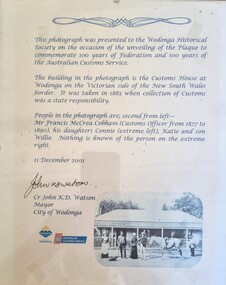
Certificate - 100 Years of Federation and the Australian Customs Service, 2001
... The Government set aside 500 Pounds in 1859 to build Belvoir's own Customs House J P Hanify was appointed as sub-collector at Belvoir. ...The Government set aside 500 Pounds in 1859 to build Belvoir's own Customs House J P Hanify was appointed as sub-collector at Belvoir. ...On 11th December 2001 an event was held in Wodonga to celebrate 100 years of the Australian Customs Service. It was held at the former Customs House building in Wodonga. The ceremony was attended by several dignitaries including the sitting Members of Parliament Mr Tony Plowman and Mr Bill Baxter. Speeches were made by Cr John Watson and Mr Bob Morgan, Supervisor of Australian Customs. A commemorative plaque was also unveiled. The Australian Customs Service played an important role in the history of Wodonga and a major part in the federation of the colonies of Australia. In 1852 the colonies were given the right to collect import duties on items such as coffee, tea, tobacco, chocolate and spirits. NSW was first to impose collection of duties in 1853. At that time Wodonga was not an official port of entry and was not allowed to collect duties. This regulation made it illegal for people to transport dutiable goods across the Murray River from NSW which provided an incentive for smuggling, while at the same time strangling the legitimate trade. Merchants and settlers along the Murray River complained and petitioners approached Melbourne to establish a Customs House on the Murray River so that trade could resume. Belvoir (later to become Wodonga) was a made a port of entry with its own Customs House gazetted on 22nd December 1854. The Government set aside 500 Pounds in 1859 to build Belvoir's own Customs House J P Hanify was appointed as sub-collector at Belvoir. The Customs House was built near the end of Union Bridge over the Murray River in 1859. Tariffs or customs duties greatly angered residents and it was little wonder the customs officer of the day was always an unpopular man. Tariffs had to be paid on articles such as tobacco, many food items and new clothing that were carried across the Border. The range of items was extended over time, leading to some farmers even swimming their livestock across the river to avoid duties at the Customs House. The levying of duties ended with Federation in 1901. Francis Cobham depicted in this photograph, took up the position of Customs Officer in 1867 and remained there until his retirement in 1890. The building was originally a 2-roomed Customs House in 1856 but was extended to provide living quarters for the Cobham family while a nearby cottage became the Customs House. The building was moved to a position south of the lagoon in the mid-1980s and is now a restaurant.This item is significant because it documents the commemoration ceremony for the Australian Custom Service held in Wodonga on 11th December 2001.An A4 size certificate created to acknowledge the centenary of the Australian Customs Service officially established at the time of Federation in 1901. The certificate accompanied the donation of a photo of the Wodonga Customs House including the Customs Officer and his family. It has been mounted in a clear frame.This photograph was presented to the Wodonga Historical Society on the occasion of the unveiling of the Plaque to commemorate 100 years of Federation and 100 years of the Australian Customs Service. The building in the photograph is the Customs House at Wodonga on the Victorian side of the New South Wales border. It was taken in 1883 when collection of Customs wàs a state responsibility. People in the photograph are; second from left- Mr Francis McCrea Cobham (Customs Officer from 1877 to 1890), his daughters Connie (extreme, left), Katie and son Willie. Nothing is known of the person on the extreme right. 11 December 2001 Cr John K.D. Watson Mayor City of Wodonga Insignias of the City of Wodonga and Australian Customs Serviceaustralian customs service, customs house wodonga -
 Flagstaff Hill Maritime Museum and Village
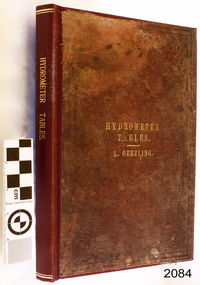
Book - Technical Reference, L Oertling (Ludwig Oertling), Tables for Ascertaining The Strength of Spirits with a Sike's Hydrometer, c. 1922
... It was of great importance to the Board of Revenue for the collectors of taxes and duties Customs Offices, and used in the calculation of alcohol levels in wine and spirits. ...The book was compiled for the proprietor, L Oertling (Ludwig Oertling), who established his firm of precision scientific instruments in 1849 and went on to become well-known in Britain for its manufacture of precision instruments, particularly its balance scales. In 1865 Ludwig Oertling and business partner Edward Wilds Laad at 27 Moorgate Street London were granted Patent 75 for the invention of improvements in hydrometers. The firm was situated at Turnmill Street, London, in 1922, when it advertised its products including hydrometers, petroleumeters, saccharometers, balances and weights, and automatic coin weighing machines in the British Industries Fair catalogue. In 1925 the firm became part of the Avery group of companies, which acquired Stanton Instruments in 1968 and about two years later Stantons merged into L. Oertling Ltd. Joseph Long has been mentioned by some sources as the author of this book, written for the proprietor of L. Oertling Ltd.The book has been recognised as being culturally important as a basis for our current civilization. It was of great importance to the Board of Revenue for the collectors of taxes and duties Customs Offices, and used in the calculation of alcohol levels in wine and spirits.Reference book, hardcover, burgundy with gold text and lines. Cloth cover with embossed design. Title: Tables for Ascertaining The Strength of Spirits for ascertaining the strengths of spirits with Sike's Hydrometer; Compiled for L. Oetlihg, by appointment, sole manufacturer of Hydrometers & Saccharometers to the Board of Inland Revenue. [some sources say the author is Joseph Long] Published in Turnmill Street, London, near Farringdon Street Station Printer: Printed in London, England by George Berridge and Co, Eastcheap Works, ECflagstaff hill, flagstaff hill maritime museum and village, warrnambool, maritime museum, maritime village, great ocean road, shipwreck coast, l. oertling, ludwig oertling., precision balances, edward wilds ladd, patent 75, improvements in hydrometers, hydrometer, automatic balance for weighing sovereigns, hydrometers, petroleometers, saccharometers, balances and weights, automatic coin-weighing machines, avery group, stanton instruments, l. oertling ltd, testing machine, tables for hydrometers, strength of spirits, alcohol content, alcohol measurement, board of revenue, joseph long -
 Flagstaff Hill Maritime Museum and Village
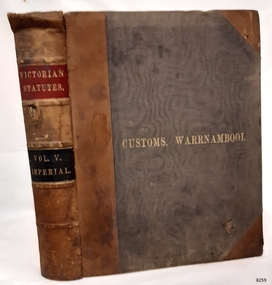
Book - Reference/Legal Statutes, John Ferres, Government Printer, The Victorian Imperial Statutes Vol 5 Customs Warrnambool, 1868
... Because it was an official port of entry, it had its own Customs House and local Sub-Collector of Customs. A copy of Volume 5 kept in Warrnambool would have been the literal rulebook used by local customs officers to enforce imperial maritime laws, collect duties on incoming British and international merchant ships, and regulate the harbour. ...This volume is part of the first comprehensive consolidation of laws for the Colony of Victoria after it separated from New South Wales and established its own parliament. Specifically, Volume 5 (published in 1868) is dedicated to "A selection of the imperial statutes apparently in force in Victoria". Because Victoria was still a British colony, laws passed by the British (Imperial) Parliament in Westminster still applied locally if they hadn't been superseded by local Victorian colonial acts. Volume 5 was the legal handbook used by lawyers, judges, and government officials to determine exactly which British laws still governed colonial matters, ranging from shipping and trade to criminal law and merchant customs.The Victorian Statutes Vol 5 Customs Warrnambool Publisher: John Ferres Government Printer Melbourne Date: 1868 Further Information: Three quarter leather. Junction between front board and spine slightly exposed. Top section of leather on spine damaged. non-fictionThis volume is part of the first comprehensive consolidation of laws for the Colony of Victoria after it separated from New South Wales and established its own parliament. Specifically, Volume 5 (published in 1868) is dedicated to "A selection of the imperial statutes apparently in force in Victoria". Because Victoria was still a British colony, laws passed by the British (Imperial) Parliament in Westminster still applied locally if they hadn't been superseded by local Victorian colonial acts. Volume 5 was the legal handbook used by lawyers, judges, and government officials to determine exactly which British laws still governed colonial matters, ranging from shipping and trade to criminal law and merchant customs.flagstaff hill, warrnambool, shipwrecked coast, flagstaff hill maritime museum, maritime museum, shipwreck coast, flagstaff hill maritime village, great ocean road, book, pattison collection, warrnambool library, warrnambool mechanics’ institute, ralph eric pattison, corangamite regional library service, warrnambool city librarian, mechanics’ institute library, victorian library board, warrnambool books and records, warrnambool children’s library -
 Port Melbourne Historical & Preservation Society
Print, W.F.E LIARDET, The Landing-Place and Market Reserve in 1839 (Melb.), 1875
... In ink below print - Figure at right is Richard Webb, 1st customs collector "used his hat for a desk to sign ships' papers". ...Wilbraham Frederick Evelyn LIARDET Charles TROEDEL Richard WEBB Built Environment Natural Environment - Beaches and Foreshore WFE LIARDET In ink below print - Figure at right is Richard Webb, 1st customs collector "used his hat for a desk to sign ships' papers". ...See also Cat. No. 870.In ink below print - Figure at right is Richard Webb, 1st customs collector "used his hat for a desk to sign ships' papers". (NB Charles Troedel published 'Melbourne Album' in 1863- check Sandridge) (Annotated by Pat GRAINGER) In pencil Flying Trapeze 7.30wilbraham frederick evelyn liardet, charles troedel, richard webb, built environment, natural environment - beaches and foreshore, wfe liardet -
 Wodonga & District Historical Society Inc
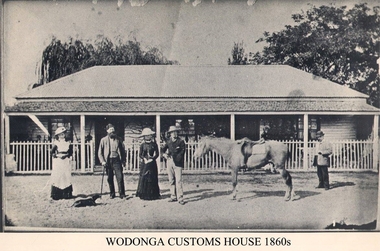
Photograph - Old Customs House, Wodonga, 1860s
... Customs duties were a means of raising revenue between the 1850s and Federation. They were first introduced by NSW in November 1854 after it was separated from the colony of Victoria three years earlier. J P Hanify was appointed as sub-collector...Customs duties were a means of raising revenue between the 1850s and Federation. They were first introduced by NSW in November 1854 after it was separated from the colony of Victoria three years earlier. J P Hanify was appointed as sub-collector ...Customs duties were a means of raising revenue between the 1850s and Federation. They were first introduced by NSW in November 1854 after it was separated from the colony of Victoria three years earlier. J P Hanify was appointed as sub-collector at Belvoir, the official name present day Wodonga at that time. Wodonga Customs House was built near the end of Union Bridge over the Murray River in 1859 Tariffs or customs duties greatly angered residents and it was little wonder the customs officer of the day was always an unpopular man. Tariffs had to be paid on articles such as tobacco, many food items and new clothing that were carried across the Border. The range of items was extended over time, leading to some farmers even swimming their livestock across the river to avoid duties at the Customs house. The levying of duties ended with Federation in 1901. Francis Cobham depicted in this photograph, took up the position of Customs officer in 1867 and remained there until his retirement in 1890. The building was originally a 2 roomed custom house in 1856 but was extended to provide living quarters for the Cobham family while a nearby cottage became the Customs house. The building was moved to a position south of the lagoon in the mid 1980s and is now a restaurant.This image represents an important stage in the development of colonial relationships and rivalries in Australia.Black and white photograph of Customs officer Francis Cobham in Wodonga c 1860customs house wodonga, albury wodonga border, colonial rivalry victoria /nsw, tariffs -
 Mrs Aeneas Gunn Memorial Library
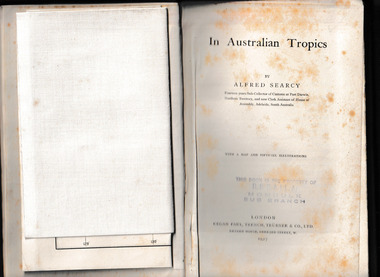
Book, Kegan Paul Trench Trubner and Co, In Australian tropics, 1907
... Northern Australia - Description and travel Ethnography Early history of N.T. and explorations; Detailed account of intercepting Macassan proas around coast of Arnhem Land whilst author was Sub-Collector of Customs for 14 years; Names of proas and masters, Malay camps & smoke houses along coast & nearby islands; Natives employed by Malays in trepang fishing and collecting tortoiseshell, relationships between Malays and Aborigines; influences (physical & cultural); Habit of exchanging children between tribes (Roper R. & Normanton) for the purpose of learning each others language & customs; Description of native camps at Fort Dundas (1895) shelters, finding of bark water bags, types of canoes used; Platform burial at Daly R.; Sacred burial site on Maria Island; Geographical features, vegetation, climate etc., general ecology, depredations & murders by natives; Cannibalism practiced by Fitzmaurice River tribes. ...Early history of N.T. and explorations; Detailed account of intercepting Macassan proas around coast of Arnhem Land whilst author was Sub-Collector of Customs for 14 years; Names of proas and masters, Malay camps & smoke houses along coast & nearby islands; Natives employed by Malays in trepang fishing and collecting tortoiseshell, relationships between Malays and Aborigines; influences (physical & cultural); Habit of exchanging children between tribes (Roper R. & Normanton) for the purpose of learning each others language & customs; Description of native camps at Fort Dundas (1895) shelters, finding of bark water bags, types of canoes used; Platform burial at Daly R.; Sacred burial site on Maria Island; Geographical features, vegetation, climate etc., general ecology, depredations & murders by natives; Cannibalism practiced by Fitzmaurice River tribes.Ill, maps, p.373.non-fictionEarly history of N.T. and explorations; Detailed account of intercepting Macassan proas around coast of Arnhem Land whilst author was Sub-Collector of Customs for 14 years; Names of proas and masters, Malay camps & smoke houses along coast & nearby islands; Natives employed by Malays in trepang fishing and collecting tortoiseshell, relationships between Malays and Aborigines; influences (physical & cultural); Habit of exchanging children between tribes (Roper R. & Normanton) for the purpose of learning each others language & customs; Description of native camps at Fort Dundas (1895) shelters, finding of bark water bags, types of canoes used; Platform burial at Daly R.; Sacred burial site on Maria Island; Geographical features, vegetation, climate etc., general ecology, depredations & murders by natives; Cannibalism practiced by Fitzmaurice River tribes. northern australia - description and travel, ethnography
