
Showing 13 items matching "commemorative plaques and other memorials"
-
 Returned Nurses RSL Sub-branch
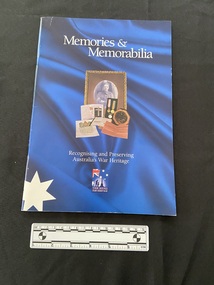
Book - Illustrated paperback book, Department of Veterans' Affairs, Canberra, Memories & memorabilia: recognising and preserving Australia's war heritage, 2014
... ...commemorative plaques and other memorials...Honour rolls commemorative plaques and other memorials memorabilia A guide to Australia's war heritage. ...A guide to Australia's war heritage. Extract from introduction: [To provide opportunities for future generations to understand, investigate and value these experiences, we must ensure that the significant material relating to Australia's war heritage is preserved...]Staple bound, illustrated magazine type book.non-fictionA guide to Australia's war heritage. Extract from introduction: [To provide opportunities for future generations to understand, investigate and value these experiences, we must ensure that the significant material relating to Australia's war heritage is preserved...] australian army. australian and new zealand army corps., wwi, ww1, world war i participation - australia, military campaigns anniversaries, war memorials, preserving australia's war heritage., honour rolls, commemorative plaques and other memorials, memorabilia -
 Flagstaff Hill Maritime Museum and Village
Artwork, other - Window, circa 1928
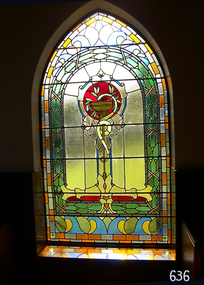
... commemorative window dr connell Stained glass leadlight window in Gothic arched metal frame with six horizontal reinforcing rods. Image depicts a golden flat-bowled baptismal font on a slender stand with foliage proceeding from it. The image is internally framed by a Roman arch of coloured glass and surrounding rectangular and breaking-wave shapes. (The window was previously known locally as the Dr. Connell Memorial Window and a plaque ...This religiously themed window is situated in the western (weather) wall of the St. Nicholas Mission to Seamen’s Church building in the Flagstaff Hill Maritime Village. It was crafted circa 1928. ABOUT THE WINDOW This window, once known as the Dr Connell Memorial Window, was a feature of an external wall adjacent to the Women’s Children’s Wards of Warrnambool Hospital. Honorary Doctors had played a significant role in the operation of the hospital between the years 1900 to 1939. One of these doctors was Dr. Connell, who passed away in 1928. The green glass plaque is also a registered object in Flagstaff Hill's Collection. Its inscription dedicates the window to Dr. Connell. The inscription reads: “A tribute to Egbert John Connell M.B.B.S. who for 30 years rendered devoted and valuable service to this institution. Obiit April 4th 1928 A.D." A paragraph in the book ‘A History of the Warrnambool Base Hospital’ by Forth and Yule describes the role of the Honorary Doctors - “At the start of the period the senior-part time medical officer was replaced by the junior resident medical officer and control of beds and the right to operate were given to the honorary medical officers...and these men dominated the Warrnambool medical world in the years before the Second World War.” Dr. Connell leased ‘Ambleside’, 192 Koroit Street, in the early 20th century, following Dr Teed who had previously run his medical practice there. In 1914 Dr Connell purchased the property and continued his private practice there until his death in 1928. He also took a prominent part in hospital work, both as physician and surgeon, and often acted as spokesmen for the Honorary Doctors. According to colleague Dr. Horace Holmes’ subsequent notes, it was after the close of the First World War, and the following years of the world-wide pneumonic influenza epidemic, that Dr. Connell himself contracted pneumonia and died. His family and friends then recognised his work by gifting the memorial window in his honour to the Hospital. By the mid-1970s the old wards at the hospital had been replaced and there was no obvious place for the window. Discussions between the previous and past Hospital managers, the Anglican Diocese, and Flagstaff Hill Planning Board, led to its installation in its present position in St Nicholas Seamen’s Church and the memorial plaque was later installed beside the window. St NICHOLAS SEAMEN’S CHURCH, Anglican Church Flagstaff Hill’s Mission to Seamen was opened in 1981. Its conception was partly motivated by the offer of Stained Glass Memorial Windows from the local Warrnambool and District Base Hospital, which was undergoing multi-storey development in the late 1960’s and early 1970’s. The Manager/Secretary at the time was keen to see the historical windows installed in an appropriate location. The chapel was designed by a local architectural draftsman in conjunction with members of the Planning Board of Flagstaff Hill, and built by Mr Leon Habel. The vision of the designers included the hope that the church be used for formal worship such as weddings and funeral, and for multi-denominational special services such as War commemorations. The design is based on the ‘Mission to Seamen’ buildings in both Portland and Port Melbourne. These types of buildings were often erected to house social and worshipful activities for seamen. The materials used in the building include sandstone recycled from nineteenth-century buildings demolished in Warrnambool and American slate tiles retrieved from the 1908 wreck of the FALLS OF HALLADALE. Most of the chapel furnishings came from the Williamstown Missions to Seamen, which was consecrated in 1946 but later decommissioned. These artefacts range from the altar cloth to the hymn board and include a visually stunning round stained glass widow called ‘Christ Guiding the Helmsman’. However the provenance of this particular artefact, large western window, is local. This stained glass memorial window is of local, historical and social significance, linking local history and heritage with one of Warrnambool's doctors, Dr. Egbert John Connell (d. 1928), who gave 30 years of dedicated, medical service to the local citizens.Stained glass leadlight window in Gothic arched metal frame with six horizontal reinforcing rods. Image depicts a golden flat-bowled baptismal font on a slender stand with foliage proceeding from it. The image is internally framed by a Roman arch of coloured glass and surrounding rectangular and breaking-wave shapes. (The window was previously known locally as the Dr. Connell Memorial Window and a plaque dedicated to Dr. Connell is catalogued separately. See Context notes for details.)flagstaff hill, warrnambool, shipwrecked coast, flagstaff hill maritime museum, maritime museum, shipwreck coast, flagstaff hill maritime village, great ocean road, chapel window, stained glass window, warrnambool and district base hospital, st nicholas mission to seamen’s church, williamstown mission to seamen, dr egbert connell, ambleside warrnambool, leon habel builder, falls of halladale slate, memorial window, commemorative window, dr connell -
 Federation University Historical Collection
Medal - Numismatics, 'Dead Man's Penny' for Edwin Joseph 'Ted' Cannon, c1919
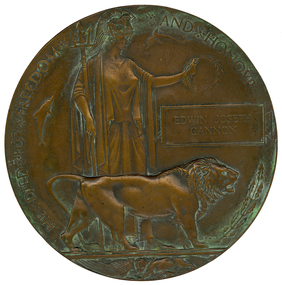
... commemorative medallion which was presented to the next-of-kin of the men and women from England and the Empire who died during World War One. The Dead Man’s Penny was accompanied by a letter from King George V, stating ‘I join with my grateful people in sending you this memorial of a brave life given for others in the Great War’.[http://nma.gov.au/blogs/education/2010/11/14/dead-mans-penny/] Popularly known as the "Dead Man’s Penny", because of the similarity in appearance to the somewhat smaller penny coin. 1,355,000 plaques...commemorative medallion which was presented to the next-of-kin of the men and women from England and the Empire who died during World War One. The Dead Man’s Penny was accompanied by a letter from King George V, stating ‘I join with my grateful people in sending you this memorial of a brave life given for others in the Great War’.[http://nma.gov.au/blogs/education/2010/11/14/dead-mans-penny/] Popularly known as the "Dead Man’s Penny", because of the similarity in appearance to the somewhat smaller penny coin. 1,355,000 plaques ...The Dead Man’s Penny is a commemorative medallion which was presented to the next-of-kin of the men and women from England and the Empire who died during World War One. The Dead Man’s Penny was accompanied by a letter from King George V, stating ‘I join with my grateful people in sending you this memorial of a brave life given for others in the Great War’.[http://nma.gov.au/blogs/education/2010/11/14/dead-mans-penny/] Popularly known as the "Dead Man’s Penny", because of the similarity in appearance to the somewhat smaller penny coin. 1,355,000 plaques were issued, which used a total of 450 tonnes of bronze, and continued to be issued into the 1930s to commemorate people who died as a consequence of the war. [http://en.wikipedia.org/wiki/Memorial_Plaque_(medallion)] It was decided that the design of the plaque was to be picked from submissions made in a public competition. Over 800 designs were submitted and the competition was won by the sculptor and medallist Edward Carter Preston with his design called Pyramus, receiving a first place prize of £250.[http://en.wikipedia.org/wiki/Memorial_Plaque_(medallion)] They were initially made at the Memorial Plaque Factory, 54/56 Church Road, Acton, W3, London from 1919. Early plaques did not have a number stamped on them but later ones have a number stamped behind the lion's back leg. [http://en.wikipedia.org/wiki/Memorial_Plaque_(medallion)] Ted Cannon's plaquette does not have a stamped number. Ted Cannon was a gifted artist and cartoonist who studied at the Ballarat School of Mines Technical Art School. During the Battle of Pozieres on the Western Front Ted Cannon worked with the Scout Platoon sketching the enemy's gun emplacements. Ted proved invaluable to the Brigade and brought he came under the attention of the Australian High Command. On 13 September 1916 Ted was given a special assignment for General C.B.B. White. Ted was sent out forward of the Old Mill at Verbrandenmolen (in the Ypres Salient) to draw a panorama of the German lines in the area from Hill 60 to The Bluff. It was a hazardous task and Ted was warned to be careful. Tragically he was sniped by an enemy machine-gunner and sustained severe abdominal wounds. Stretcher-bearers rushed him to the 17th Casualty Clearing Station where he was operated on by the doctors at 8.30 that night. With little chance of success, but ever resilient, Ted remained conscious almost to the end. He died early in the morning of the 14 September 1916. His body was buried in the large Military Cemetery at Lijssenthoek. The effects of the late Ted Cannon were returned to his parents. These were an autograph book, three brushes, prayer book, housewife, whistle, book, hymn book, curios. Another listing gives his effects as "identity disc, letters, photos, wallet, 2 books, Mexican Dollar, 1 cent (Ceylon), 3 German Straps, Fountain Pen, Cigarette-holder, Franc Note, 50 centimes Note, devotional book, mirror, rosary, scapula, metal ring, two combs, book of views, nail clippers, badges, tie clip, Egyptian stamp.[http://recordsearch.naa.gov.au/scripts/Imagine.asp?B=3202589] Ted Cannon was an only child. It is not known how the 'Dead Man's Penny' came into the ownership of the donor, but it is thought that it may have been left in a house owned by the donor's mother. Further information on Ted Cannon can be found at http://bih.ballarat.edu.au/index.php/Edwin_J._Cannon and http://www.ballarat.edu.au/about-ub/history/art-and-historical-collection/ub-honour-roll/c/edwin-joseph-ted-cannon-1895-1916Large bronze medallion or plaquette featuring an image of Lady Britannia surrounded by two dolphins (representing Britain’s sea power) and a lion (representing Britain) standing over a defeated eagle (symbolising Germany). Around the outer edge of the medallion are the words ‘He died for freedom and honour’. Next to Lady Britannia is the deceased solider’s name, with no rank provided to show equality in their sacrifice. (http://nma.gov.au/blogs/education/2010/11/14/dead-mans-penny) The plaque was distributed throughout the British Empire, and the first plaques were distributed in Australia in 1922 "Returned home" by W. & O. Mayne, 2013. ted cannon, edwin joseph cannon, cannon, world war 1, world war -
 Frankston RSL Sub Branch
Plaque, Memorial, 1914-1918 Memorial Plaque, 1920 (estimated); Issued from 1920
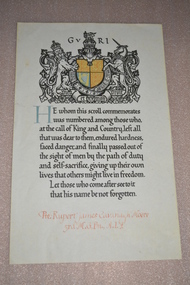
... others might live in freedom. Let those that come after see that his name is not forgotten". Underneath the message the serviceman or woman’s name, rank, honours and unit were written by hand in red ink. Because of the late arrival in Australia of the plaques many scrolls were sent out separately. A message from the King, "I join with my grateful people in sending you this memorial ...This round, bronze memorial plaque was presented to the family of Private Richard Evans Harkness, service number 3426, of the 37th Battalion, (8th Reinforcements) who was killed in action at Villers-Bretonneux on 12th August, 1918. Colloquially known as 'Dead Man's Penny' or 'King's Penny', this plaque was given to the next of kin of service personnel who died on active service in WW1. 1914-1918 Memorial Plaque In early 1920 it was announced that the next-of-kin of all Australian servicemen and women whose deaths were attributable to the First World War would receive a memorial plaque and scroll "as a solace for bereavement and as a memento". The memorial plaques were not uniquely Australian. In fact they were designed and produced in Britain and issued to commemorate all those who died as a result of war service from within the British Commonwealth. The idea for the plaques was originally conceived mid-way through the war. In 1917 a competition was announced to obtain a suitable design and 800 entries were eventually received. The winner, Mr. E. Carter Preston of Liverpool, England, was chosen in 1918. He was awarded a prize of 250 pounds. Mr Manning Pike directed the manufacture of the memorial plaques at the Memorial Plaque Factory set up at Acton, London. Some later plaques were also made at the Woolwich Arsenal. The cost of manufacturing so many plaques must have been considerable. Each plaque had the name of the soldier commemorated individually embossed (some were engraved) as part of the design. The full name was given without any indication of rank or honours to show the equality of sacrifice of all those who had lost their lives. The scroll designed to accompany the plaques was of thick paper, headed by the royal coat-of-arms, and bore the following message: "He whom this scroll commemorates was numbered among those who, at the call of King and Country, left all that was dear to them, endured hardness, faced danger, and finally passed out of the sight of men by the path of duty and self-sacrifice, giving up their own lives that others might live in freedom. Let those that come after see that his name is not forgotten". Underneath the message the serviceman or woman’s name, rank, honours and unit were written by hand in red ink. Because of the late arrival in Australia of the plaques many scrolls were sent out separately. A message from the King, "I join with my grateful people in sending you this memorial of a brave life given for others in the Great War", was included with the scroll. The first plaques were distributed in Australia in 1922. Each plaque was sent out from Base Records Office at Victoria Barracks in Melbourne by second-class mail. Approximately 60,000 plaques were issued in Australia. Families of deceased members of the Royal Australian Navy and the Australian Army Nursing Service also received plaques and scrolls This plaque is significant because it commemorates the death of an Australian soldier on active service in World War 1. It is representative of some 60,000 issued to next of kin of soldiers killed in World War 1. Although Richard Harness was living at 52 Victoria Street, Abbotsford when enlisted, together with a scroll from the King, it was donated by a Frankston Family.This round, bronze memorial plaque was presented to the family of Australian Army private Richard Evans Harkness, service number 03426, of the 37th battalion, 8th re-inforcement. Harkness was killed in action on 12th August, 1918, near the French village of Proyart, during the 3rd Division's advance along the Somme Valley. further details can be found here: https://www.awm.gov.au/collection/U51477 Colloquially known as 'Dead Man's Penny' or 'King's Penny', these plaques were awarded to the next of kin of service personnel who died on active service during WW1. refer to link for further information : http://www.awm.gov.au/encyclopedia/memorial_scroll/plaque.aspAround the edge are the words 'HE DIED FOR FREEDOM AND HONOUR' On the righthand side of the plaque is the name of the soldier, in this case Richard Evans Harkness.commemorative, memorial, plaque, dead, man s, penny, king s, richard, evans, harkness -
Frankston RSL Sub Branch
Letter
... ww1 world war 1 dead mans penny great war 1914 1918 memorial plaque commemorative plaque kings penny george v Letterhead inscription consist of a coat of arms and the words BUCKINGHAM PALACE Text is "I join with my grateful people in sending you this memorial of a brave life given for others in the Great War." ...Letter that accompanied the 1914 - 1918 Memorial Plaque and scroll presented to the families of allied service personnel who died during or as a result of the First World War. This letter is sent from Buckingham Palace, London and is signed by King George IV.Letterhead inscription consist of a coat of arms and the words BUCKINGHAM PALACE Text is "I join with my grateful people in sending you this memorial of a brave life given for others in the Great War." Signed by GEORGE Vww1, world war 1, dead mans penny, great war, 1914 1918 memorial plaque, commemorative plaque, kings penny, george v -
 Flagstaff Hill Maritime Museum and Village
Plaque - Commemorative Plaque, circa August 1947
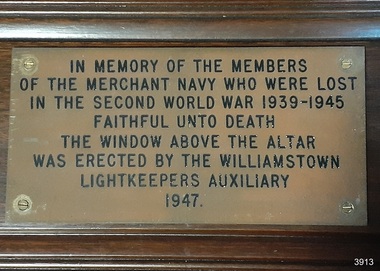
... This commemorative plaque was made for the round, stained glass memorial window titled “Christ showing the helmsman the way”, originally installed at the St Nicholas Seamen’s Church in Williamstown. ...Plaque: rectangular brass commemorative plaque. Each corner has a round hole. ...This commemorative plaque was made for the round, stained glass memorial window titled “Christ showing the helmsman the way”, originally installed at the St Nicholas Seamen’s Church in Williamstown. The window was donated as a memorial to the members of the Merchant Navy whose lives were lost in the Second World War, 1939-1945. The donor was the Williamstown Lightkeepers Auxiliary, an independent ladies' association that worked with the Williamstown Missions to Seamen (renamed the Mission to Seafarers in 2000). The window was officially dedicated on December 14, 1947, by Geelong's Anglican Bishop, Rt. Rev. J.D. McKie. In the early months of 1948, this bronze plaque was also placed in the chapel above the altar. The Williamstown St Nicholas Seamen’s Church ceased operation in 1966. In 1979, the Victoria Missions to Seamen donated this round, stained glass window and the memorial plaque to Flagstaff Hill Maritime Village, along with many other items and furnishings. These items have been used to simulate the Williamstown Mission and Chapel as much as possible. THE MISSIONS TO SEAMEN: - The Missions to Seamen was an Anglican charity that served seafarers since 1856 in Great Britain. Its symbol is a Flying Angel, inspired by a Bible verse. Today, there are centres in over 200 ports worldwide where seamen of all backgrounds are offered a warm welcome and provided with a wide range of facilities. In Victoria, the orgainsation began in Williamstown in 1857 as a Sailors’ Church, also known as ‘Bethel’ or the ‘Floating Church’ in an old hulk floating in Hobson’s Bay, Port of Melbourne. It soon became part of the Missions to Seamen, Victoria. In the year 2000, the organisation, now named Mission to Seafarers, still operated locally in Melbourne, Portland, Geelong and Hastings. The Ladies’ Harbour Lights Guild was formed in 1906 to support the Missions to Seamen in Melbourne and other centres such as Williamstown. Two of the most significant ladies of the Guild were founder Ethel Augusta Godfrey and foundation member Alice Sibthorpe Tracy (who established a branch of the Guild in Warrnambool in 1920). The Guild continued its work until the 1960s. In 1943, a former Williamstown bank was purchased for the Missions to Seamen Club. The chapel was named St Nicholas’ Seamen’s Church and was supported by the Ladies’ Harbour Lights Guild, the Williamstown Lightkeepers’ Auxiliary and the League of Soldiers’ and Sailors’ Friends. It ceased operation in 1966. A Missions to Seamen Chapel and Recreation Room was a significant feature of ports during the late 1800s and into the 1900s. It seemed appropriate for Flagstaff Hill to include such a representation within the new Maritime Village, so the Melbourne Board of Management of Missions to Seamen Victoria gave its permission on 21st May 1979 for the entire furnishings of the Williamstown chapel to be transferred to Flagstaff Hill. The St Nicholas Seamen’s Church was officially opened on October 11, 1981 and closely resembles the Williamstown chapel. This plaque is significant for its connection with the round Sanctuary window above the altar in the chapel at Flagstaff Hill. The window was originally installed at the chapel of the St Nicholas Seamen’s Church in Williamstown in 1947, and is listed on the Victorian War Heritage Inventory No. 196973 as an object of significance. The plaque is also significant for its recognition of the members of the Merchant Navy who lost their lives in service to our country during World War II. The plaque is important for its connection with the Williamstown Lightkeepers’ Auxiliary and Missions to Seamen, which were dedicated to supporting seafarers from all over the world. The funds the group raised helped to furnish the St Nicholas Seamen’s Church in Williamstown, including the Sanctuary window, pews, carpets and hangings. These items are now part of the St Nicholas Seamen's Church Williamstown Collection at Flagstaff Hill Maritime Village, Warrnambool. Plaque: rectangular brass commemorative plaque. Each corner has a round hole. Inscription impressed into the metal and filled in with black paint. Plaque refers to the memorial, a stained glass window titled "Christ Showing the Helmsman the Way," donated by the Williamstown Lightkeepers' Auxiliary to the Willimastown Missions to Seamen. This plaque is part of the St. Nicholas Seamen's Church Collection. “IN MEMORY OF THE MEMBERS / OF THE MERCHANT NAVY WHO WERE LOST / IN THE SECOND WORLD WAR 1939-1945 / FAITHFUL UNTO DEATH / THE WINDOW ABOVE THE ALTAR / WAS ERECTED BY THE WILLIAMSTOWN / LIGHTKEEPERS AUXILIARY / 1947.”flagstaff hill, warrnambool, flagstaff hill maritime museum, maritime museum, shipwreck coast, flagstaff hill maritime village, mission to seamen williamstown, st nicholas seaman’s church williamstown, missions to seamen victoria, mission to seafarers, lightkeepers auxiliary, ladies harbour light guild, 139 nelson place williamstown, religion, religious service, sailors rest, bethel sailors’ church, bethel floating church, e. s. & a. bank williamstown, christ directing a sailor, christ showing the helmsman the way, quartermaster’s hand on the wheel, stained glass window, church window, religious window, sanctuary window, memorial window, war memorial window, victorian war heritage inventory, victorian heritage database, merchant navy ww2, 1939-1945, anglican church, bishop mckie, flying angel club, williamstown lightkeepers' auxiliary, ladies' harbour lights guild, commemorative window, memorial plaque, merchant navy, ww ii, st. nicholas seamen's church -
 Flagstaff Hill Maritime Museum and Village
Letter - Loch Ard Centenary Letter, Koroit Council, March 1978
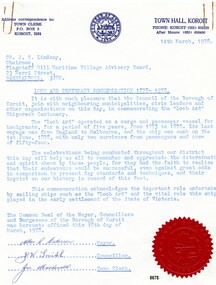
... The anchor of the Loch Ard was raised from the wreck and displayed at Port Campbell, a memorial plaque (erected by The National Park) was unveiled at Loch Ard Gorge, a special "Loch Ard Shipwreck Centennial Port Campbell" postmark was issued by the Post Office and a model ship competition was held. Flagstaff Hill Maritime Museum and Village, together with other...The anchor of the Loch Ard was raised from the wreck and displayed at Port Campbell, a memorial plaque (erected by The National Park) was unveiled at Loch Ard Gorge, a special "Loch Ard Shipwreck Centennial Port Campbell" postmark was issued by the Post Office and a model ship competition was held. Flagstaff Hill Maritime Museum and Village, together with other ...The Loch Ard was an iron hulled clipper, built in Scotland in 1873 and wrecked on the southwest coast of Victoria in 1878 at what is now known as Loch Ard Gorge, near Port Campbell. Fifty two crew and passengers died and only Tom Pierce and Eva Carmichael survived. The Loch Ard was the last sailing ship to lose emigrants' lives when negotiating the entrance to Bass Strait. One of the most unlikely pieces of cargo to have survived the shipwreck was a Minton porcelain peacock - one of only nine in the world. The peacock was destined for the Melbourne International Exhibition in 1880. It had been well packed, which gave it adequate protection during the violent storm. Today, the Minton peacock can be seen at the Flagstaff Hill Maritime Museum in Warrnambool. From Australia's most dramatic shipwreck it has now become Australia's most valuable shipwreck artefact and is one of very few 'objects' on the Victorian State Heritage Register. The Victorian History Advisory Council decided 1978 was an appropriate year to mark, not only the centenary of the sinking of the Loch Ard in 1878, but also commemorate the large part played by sailing ships in immigration, and through this, the development of Australia. The Victorian Government authorised the commemoration and a "Loch Ard Centenary Committee" was formed. It was established to create public interest and awareness for the 100th anniversary of the tragic Loch Ard shipwreck. Activities and events included student essays, exhibitions, videos, publications, competitions and historical information. A booklet called "Settlers Under Sail" by Don Charlwood was commissioned to be made available to all school children. The anchor of the Loch Ard was raised from the wreck and displayed at Port Campbell, a memorial plaque (erected by The National Park) was unveiled at Loch Ard Gorge, a special "Loch Ard Shipwreck Centennial Port Campbell" postmark was issued by the Post Office and a model ship competition was held. Flagstaff Hill Maritime Museum and Village, together with other local towns and shires along the south-west coast participated in many of these commemorative activities. This letter is a significant reminder (and recognition) of the importance the Loch Ard (and other immigrant ships) played in the settling of Victoria and the dangers faced by the settlers who came to Australia in these ships. Flagstaff Hill’s collection of artefacts from LOCH ARD is significant for being one of the largest collections of artefacts from this shipwreck in Victoria. It is significant for its association with the shipwreck, which is on the Victorian Heritage Register (VHR S417). The collection is significant because of the relationship between the objects, as together they have a high potential to interpret the story of the LOCH ARD. The LOCH ARD collection is archaeologically significant as the remains of a large international passenger and cargo ship. The LOCH ARD collection is historically significant for representing aspects of Victoria’s shipping history and its potential to interpret sub-theme 1.5 of Victoria’s Framework of Historical Themes (living with natural processes). The collection is also historically significant for its association with the LOCH ARD, which was one of the worst and best-known shipwrecks in Victoria’s history.Single page letter typed in blue ink, on behalf of Koroit Council, written on 14th March 1978 and addressed to the Chairman, Flagstaff Hill Maritime Village Advisory Board, in recognition of the "Loch Ard Centenary Commemoration 1878 - 1978". It has the "Borough of Koroit" stamp at the top of the page and a red "Borough of Koroit" seal on the bottom right-hand corner of the page. It is signed by the Mayor (Allan R. Waterson), a councillor (J. W. Smith) and the Town Clerk (Jim Macdonald). The letter is in a plain buff manilla folder labelled in blue type.Top left corner - "Address correspondence to:/TOWN CLERK / P.O. BOX 5/KOROIT, 3282" Top Centre - blue circular ink stamp of "BOROUGH OF KOROIT 1870" with coat of arms in the center Top right - "TOWN HALL,KOROIT/ PHONE KOROIT (055) 658230/After Hours (055) 658490" The letter is addressed to - "CR. J. S. Lindsay, /Chairman,/ Flagstaff Hill Maritime Village Advisory Board,/ WARRNAMBOOL. 3280" "LOCH ARD CENTENARY COMMEMORATION 1878 - 1978" (underlined) The letter begins - "It is with much pleasure that the Council of the Borough of Koroit, join with neighbouring municipalities, civic leaders and other organisations on this day, in commemorating the "Loch Ard" Shipwreck centenary. The "Loch Ard" operated as a cargo and passenger vessel for immigrants, for a period of five years, from 1873 to 1878. Its last voyage was from England to Melbourne, and the ship was sunk on the 1st June 1878, with only two survivors from passengers and crew of fifty-four. The celebrations being conducted throughout our district this day will help us all to remember and appreciate the determination and spirit shown by these people, for they had the faith to realise that their endeavours would be successful, even against great odds in comparison to present day standards and techniques, and their imprint on our history is record of this fact. This commemoration acknowledges the important role undertaken by sailing ships such as the "Loch Ard" and the vital role this ship played in the early settlement of the State of Victoria." The letter ends with -" the Common Seal of the Mayor, Councillors and Burgesses of the Borough of Koroit was hereunto affixed this 18th day of March, 1978." The letter is signed "Allan J. Waterson Mayor/J. W. Smith Councillor/ Jim Macdonald Town Clerk and a large red seal of the Borough of Koroit (with their coat of arms) is in the bottom right-hand corner. Front of manilla folder - "BOROUGH OF KOROIT / LOCH ARD CENTENARY COMMEMORATION/ 1878 - 1978" "4050" written in black ink top right-hand corner next to a scribbled out numberflagstaff hill maritime museum and village, warrnambool, great ocean road, shipwreck coast, loch ard, port cambell, shipwreck, commemorative committee, loch ard centenary, koroit council, commemorative letter, loch ard commemorative committee -
 Alfred Hospital Nurses League - Nursing History Collection
Artwork, other - metal sundial, Memorial Sundial, [ca.1953]
... The dial and commemorative plaque were salvaged by the Archive. ...Donated by family and friends in memory of Alfred nurse Eileen Rutherford in 1953. Eileen, a graduate of 1935, died on the Hospital Ship Centaur, bombed by the Japanese in May 1943. The sundial was demolished, along with the Main Nurses' Home in 1996. The dial and commemorative plaque were salvaged by the Archive.Of significance to the AHNL as the sundial, originally placed in the garden in front of the Main Nurses' Home was to remind the nurses of the future of the sacrifices of nurses during war. Metal sundial originally placed on a brick pedestal with accompanying plaque, located near the Punt Rd entrance to the main Alfred Hospital Nurses home 'Be as true to each other as the dial is to the sun'. Roman numerals, showing hours, minutes and the months of the year.sundial, hospital ship centaur, eileen rutherford -
 Wangaratta RSL Sub Branch
Document - Commemorative Scroll, R.J.C. Moore
... The Memorial Scroll bears the Royal Coat of Arms and a message paying tribute to the soldiers who gave up "their own lives that others might live in freedom". pte rupert james cavanagh moore kia wangaratta ww1 Pte. ...Commemorative scroll sent to the next of kin of Private Rupert James Cavanagh MOORE 6852 attached to the 3rd Machine Gun Battalion and who made the ultimate sacrifice.- killed in action on 13/7/1918 in France. MOORE was born in Wangaratta, Victoria and a Printer when enlisted on 6/2/1917.In 1922 a Memorial Scroll was presented to the next of kin of those soldiers, sailors, and nurses who died while serving in the Australian Imperial Force or Royal Australian Navy during the First World War. Later they were presented with a Next of Kin Memorial Plaque. The Memorial Scroll bears the Royal Coat of Arms and a message paying tribute to the soldiers who gave up "their own lives that others might live in freedom". Cream paper scroll with Coat of Arms above ten lines of black writing and two lines in red ink.Pte. Rupert James Cavanagh Moore 3rd M.G.Bn., A.I.F.pte rupert james cavanagh moore, kia, wangaratta, ww1 -
 Kew Historical Society Inc
Plaque, A Special Meeting of the Kew City Council Was Held in This Hall on 13th December 1960 to Commemorate the Centenary of Kew : Cr. W.H.S. Dickinson M.B.E., J.P. Mayor, 1960
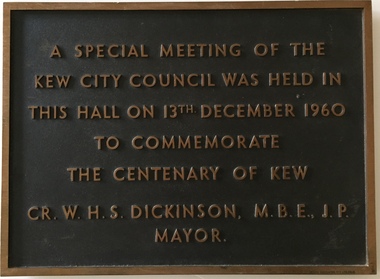
... Source: Survey of Built Heritage in Victoria: Stage Two (Built Heritage Pty Ltd., 2010) Historically significant commemorative plaque kew city hall foundation stones - kew (vic) cr. w.h.s. dickinson local government -- kew (Vic.) ...The Municipality of Kew was proclaimed on 19 December 1860, then upgraded to a Borough (1863), a Town (1910) and finally a City (1921). From 1865, its offices were based in the former Athenaeum Hall in Walpole Street, which, although extended in 1883, inevitably became inadequate. Plans for a new purpose-built Town Hall were first mooted in the late 1880s, but fell prey to six subsequent decades of debate. During that time, many sites were considered and rejected, and several schemes prepared. Finally, in 1945, it was resolved to build a new civic centre as a war memorial. The council acquired Southesk, a mansion on the south-west corner of Cotham Road and Charles Street – first mooted as a possible Town Hall site two decades earlier – and plans for a civic precinct were drawn up by John Scarborough. The project stalled until 1957, when a Town Hall Committee was formed and a new architect appointed: Harold Bartlett of Leith & Bartlett. He also proposed an entire civic precinct, of which a large public hall would constitute Stage One. Designed to accommodate almost any public or official function, the space had had a small stage at one end for intimate theatrical productions, a larger stage at the other (with operable sunken orchestra pit) for musical performances, plus the most up-to-date equipment for live TV transmission. The building, befitting its original intent as a war memorial, was also to include a sculpted monument, for which a separate design competition was held. First prize went to George H Allen (1900-1972), long-time head of the Sculpture Department at RMIT and a former war artist himself (the only one, in fact, to have worked in the medium of sculpture). At the time of the Kew project, Allen was best known for his Cenotaph at the Shrine of Remembrance (1955) and a controversial abstract sculpture at Hume House in William Street (1957). Tenders for the new hall were called and the contract (worth £104,986) was awarded to H F Yuncken. The foundation stone was laid by the Mayor, Cr F C O'Brien, on 1 June 1959. Completion (initially scheduled for October) was delayed by the unavailability of certain materials; it was barely finished in time for the official opening (by Premier Henry Bolte) on 23 April 1960. The war memorial was unveiled two days later (Anzac Day) by Bolte's deputy, the Hon A G Rylah. Fittingly, that year also marked Kew's municipal centenary, and many celebratory events were held in and around the new civic centre in December, including a special council meeting (attended by the Prime Minister), a tree planting ceremony and a youth ball. Source: Survey of Built Heritage in Victoria: Stage Two (Built Heritage Pty Ltd., 2010)Historically significant commemorative plaqueMetal plaque relating to special Council meeting to mark centenary of Kew, 13th December 1960. This plaque was given to the Kew Historical Society in 1991 by the former City of Kew.A Special Meeting Of The / Kew City Council Was Held In / This Hall On 13th December 1960 / To Commemorate / The Centenary of Kew / Cr. W.H.S. Dickinson, M.B.E., J.P., / Mayorkew city hall, foundation stones - kew (vic), cr. w.h.s. dickinson, local government -- kew (vic.) -
 South Gippsland Shire Council
Window, Stained Glass, Australia Rembembers 1945-1995, 1995
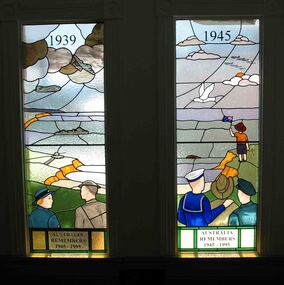
... On the left window: (across the top) 1939 and (across the bottom) AUSTRALIA REMEMBERS 1945-1995 On the right window: (across the top) 1945 and (across the bottom) AUSTRALIA REMEMBERS 1945-1995 Accompanying the windows is a brass plaque: TO COMMEMORATE THE 50th ANNIVERSARY OF VJ DAY, THESE WINDOWS WERE DONATED BY THE LEONGATHA SUB-BRANCH, RETURNED & SRVICES LEAGUE AND THE SOUTH GIPPSLAND SHIRE COUNCIL. THEY WERE DEDICATED BY MR. B. G. WARR, CHIEF COMMISSIONER OF THE SHIRE, AND MR. J. A. DOWLING, R.S.L. PRESIDENT, ON 15TH AUGUST, 1995. Pair of commemorative ...Pair of commemorative leadlight and stained-glass windows fitted in the stairwell of Leongatha Memorial Hall. The scene, which extends across both windows, features five people representing each of the armed forces standing on a cliff in the foreground overlooking the sea. In the first window (1939), a tank on land, a ship in the sea and two planes in the sky represent the beginning of the war. The clouds in this window are large, dark and ominous. In the second window (1945), a small boy wearing a hat and shirts stands separate from the group of servicepeople, he holds a teddy in one hand and waves an Australian flag in the other. The clouds are smaller and paler and a white dove with an olive branch in its beak flies in the sky to represent peace, hope and new beginnings.On the left window: (across the top) 1939 and (across the bottom) AUSTRALIA REMEMBERS 1945-1995 On the right window: (across the top) 1945 and (across the bottom) AUSTRALIA REMEMBERS 1945-1995 Accompanying the windows is a brass plaque: TO COMMEMORATE THE 50th ANNIVERSARY OF VJ DAY, THESE WINDOWS WERE DONATED BY THE LEONGATHA SUB-BRANCH, RETURNED & SRVICES LEAGUE AND THE SOUTH GIPPSLAND SHIRE COUNCIL. THEY WERE DEDICATED BY MR. B. G. WARR, CHIEF COMMISSIONER OF THE SHIRE, AND MR. J. A. DOWLING, R.S.L. PRESIDENT, ON 15TH AUGUST, 1995. -
 Flagstaff Hill Maritime Museum and Village
Newspaper - Newspaper Article, March 1978
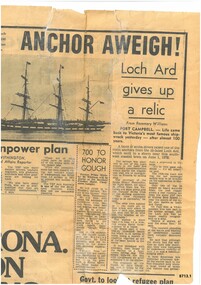
... A booklet called "Settlers Under Sail" by Don Charlwood was commissioned to be made available to all school children, a memorial plaque (erected by The National Park) was unveiled at Loch Ard Gorge, a special "Loch Ard Shipwreck Centennial Port Campbell" postmark was issued by the Post Office and a model ship competition was held. Flagstaff Hill Maritime Museum and Village, together with other...A booklet called "Settlers Under Sail" by Don Charlwood was commissioned to be made available to all school children, a memorial plaque (erected by The National Park) was unveiled at Loch Ard Gorge, a special "Loch Ard Shipwreck Centennial Port Campbell" postmark was issued by the Post Office and a model ship competition was held. Flagstaff Hill Maritime Museum and Village, together with other ...The Loch Ard was the last sailing ship to lose emigrants' lives when negotiating the entrance to Bass Strait. The ship Loch Ard was built on the River Clyde in Scotland in 1873 for the prestigious Loch Line of colonial clipper ships, designed for the Australian run. It sailed from England on 1 March 1878 carrying 37 crew, 17 passengers and a diverse general cargo ranging from luxury items to bulk railway iron. On 1 June 1878, emerging from fog and hearing too late the sound of breakers against the tall limestone cliffs, the vessel struck the southern foot of Mutton Bird Island and sank in 23 metres of water. Of the fifty-four people on board only two survived, one young male crewman, Tom Pearce, and one young female passenger, Eva Carmichael. This newspaper advertisement was donated by the family of George Shields - a member of the Shields family who had had a long association with the wreck of the Loch Ard and Eva Carmichael. In 1878, following the wreck of the Loch Ard and the subsequent rescue of Eva Carmichael, Eva was taken to Glenample station (near Princetown) to recuperate. It was during this period that Eva became great friends with Jane Shields (an Aunt of George Shields) - a friendship that continued throughout their lives. At that time, Jane was a young woman living in Princetown with her parents and siblings. Many of the Shields family continued to have a great interest in the Loch Ard and several generations of the family are buried in the Loch Ard cemetery. One of the most unlikely pieces of cargo to have survived the shipwreck was a Minton porcelain peacock - one of only nine in the world. The peacock was destined for the Melbourne International Exhibition in 1880. It had been well packed, which gave it adequate protection during the violent storm. Today, the Minton peacock can be seen at the Flagstaff Hill Maritime Museum in Warrnambool. From Australia's most dramatic shipwreck it has now become Australia's most valuable shipwreck artefact and is one of very few 'objects' on the Victorian State Heritage Register. The Victorian History Advisory Council decided 1978 was an appropriate year to mark, not only the centenary of the sinking of the Loch Ard in 1878, but also commemorate the large part played by sailing ships in immigration, and through this, the development of Australia. The Victorian Government authorised the commemoration and a "Loch Ard Centenary Committee" was formed. It was established to create public interest and awareness for the 100th anniversary of the tragic Loch Ard shipwreck. Activities and events included student essays, exhibitions, videos, publications, competitions and historical information. A booklet called "Settlers Under Sail" by Don Charlwood was commissioned to be made available to all school children, a memorial plaque (erected by The National Park) was unveiled at Loch Ard Gorge, a special "Loch Ard Shipwreck Centennial Port Campbell" postmark was issued by the Post Office and a model ship competition was held. Flagstaff Hill Maritime Museum and Village, together with other local towns and shires along the south-west coast participated in many of these commemorative activities. The Chair of the Loch Ard Century Committee (Sir John Holland) approached the "Scuba Divers Federation of Victoria" to "seek and recover a significant relic from the Loch Ard" with the idea of having it available for public display at Port Campbell. The SDFV enlisted the help of the VSAG (Victorian Sub Aqua Group) with a contingent of nineteen divers participating in the salvage which took place over the weekend of 11th and 12th March 1978. The anchor was placed in the custody of the expert conservators at Flagstaff Hill Maritime Museum and Village to be cleaned, and eighteen months later was returned to Port Campbell. This newspaper article was one of many reports and descriptions of events that took place during the Centennial Commemoration of the sinking of the Loch Ard. This newspaper article is a significant reminder (and recognition) of the importance the Loch Ard (and other immigrant ships) played in the settling of Victoria and the dangers faced by the settlers who came to Australia in these ships. Flagstaff Hill’s collection of artefacts from LOCH ARD is significant for being one of the largest collections of artefacts from this shipwreck in Victoria. It is significant for its association with the shipwreck, which is on the Victorian Heritage Register (VHR S417). The collection is significant because of the relationship between the objects, as together they have a high potential to interpret the story of the LOCH ARD. The LOCH ARD collection is archaeologically significant as the remains of a large international passenger and cargo ship. The LOCH ARD collection is historically significant for representing aspects of Victoria’s shipping history and its potential to interpret sub-theme 1.5 of Victoria’s Framework of Historical Themes (living with natural processes). The collection is also historically significant for its association with the LOCH ARD, which was one of the worst and best-known shipwrecks in Victoria’s history.A newspaper cutting taken from a Victorian newspaper (possibly the Herald) printed in March 1978, describing the salvaging of the anchor from the wreck of the Loch Ard near Port Campbell. The cutting has two tears (that have sticky tape on them) and the paper is yellowed with age. The article (written by Rosemary Williams) has an old black and white photograph of the Loch Ard, two large print headings and two colomns of text. The article has been cut out of a larger page and also contains parts of other articles and an advertisement."ANCHOR AWEIGH!" "Loch Ard /gives up/ a relic" Plus two colomns of text describing the raising of the anchor by a team of divers.flagstaff hill maritime museum and village, warrnambool, great ocean road, shipwreck coast, loch ard, loch ard centennial, loch ard anchor, port campbell, loch ard salvage, scuba divers, scuba divers federation of victoria, victorian sub aqua group -
 Bendigo Military Museum
Memorabilia - MEMORIAL PLAQUES WW1, Bickford Family, Plaques post WW1
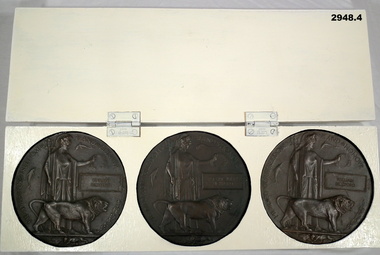
... Refer 2949P, 2950P, 2991P for their photos. military history Memorial plaques Written on rear of box is: “A.T.B. 94” Bickford Family Set of WWI Commemorative Plaques: .1) Bronze Death Plaque, British pattern showing a helmeted female (Brittanica) in classic style dress holding a trident in right hand, wreath in the other & a lion at her side. ...Edward Bickford No 1519 enlisted in the AIF in the 1st reinforcements 21st Batt on 8.4.1915 age 25 years. Embarked for for Egypt 28.6.1915, embark for Gallipoli 29.8.1915, embark for France 19.3.1916, reported MIA 26.8.1916, a Court of inquiry dated 20.7.1917 found that he was KIA 26.8.1916 at Moquet Farm. Robert John Bickford No 1518 enlisted in the AIF in the 1st reinforcements 21st Batt on 8.4.1915 age 30 years 11 months. Embark for Egypt 8.4.1915, embark for Gallipoli 29.8.1915, hospital with Mumpa 20.1.1916, rejoin unit 7.3.1916, embark for France 19.3.1916, awarded the Military Medal (MM) as a Lewis Gunner and Gallantry under fire since March 1916, promoted CPL 1.9.1916, hospital with Odema of the feet 8.11.1916, rejoin unit 22.11.1916, WIA 12.1.1917 SW’s to Groin and Abdomen, DOW;s Flers 12.1.1917. William Bickford No 815 enlisted in G Coy 14th Batt on 12.9.1914 age 21 years 11 months. Embark for Egypt 22.12.1914, embarked for Gallipoli, WIA 4.6.1915 shrapnel wound left arm, returned to Australia for discharge stating Stiffness of the Arm15.8.1915, return to Egypt in the 14th reinforcements and rejoin the 14th Batt 2.4.1916, embark for France 1.6.1916, promoted L/Cpl 1.9.1916, promoted Cpl 24.3.1917, reported MIA 11.4.1917, Court of Inquiry found he was KIA 11.4.1917 at Bullecourt. Refer 2949P, 2950P, 2991P for their photos.Bickford Family Set of WWI Commemorative Plaques: .1) Bronze Death Plaque, British pattern showing a helmeted female (Brittanica) in classic style dress holding a trident in right hand, wreath in the other & a lion at her side. In the rectangular box, embossed is the name Edward Bickford. .2) As above description though in the rectangular box is the name Robert John Bickford. .3) Descriptions as above though in the rectangular box is the name William Bickford. .4) Heavy wooden display case painted cream colour, 2 hinges on the side, no lock or catch. Inside are 3 recessed circular holes to hold the plaques.Written on rear of box is: “A.T.B. 94”military history, memorial, plaques
