
Showing 64 items matching "commercial stores"
-
 Sunbury Family History and Heritage Society Inc.
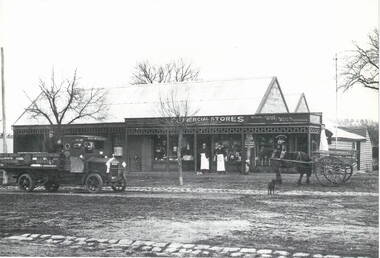
Photograph, Commercial Stores
... Commercial Stores.......Commercial Stores...Commercial Stores was owned and run by Peter Eadie from Perthshire in Scotland, whose brothers were John and Robert. ...Commercial Stores was owned and run by Peter Eadie from Perthshire in Scotland, whose brothers were John and Robert. ...Commercial Stores was owned and run by Peter Eadie from Perthshire in Scotland, whose brothers were John and Robert. Peter and Robert arrived in Sunbury in 1864 to help their brother John with his milling enterprise. In 1866, Peter purchased the blue stone general store in Macedon Street near the bridge. He later built the Commercial Hotel also in Macedon Street and near the Ballcourt Hotel.Before the railway arrived in Sunbury, Macedon Street was Sunbury's main commercial centre. After the establishment of the railway, the commercial centre shifted close to the railway station. The Eadie family's stately home, 'Dunblane', was on the corner of Brook and Jackson Street.A Lutheran Church now occupies the lower section of the land fronting Brook Street, but the home has a local heritage listing. Peter Eadie became a Shire of Bulla councillor and President in 1880. Dunblane is from the Scots Gaelic -'dun' is a fortified hill and 'Blane' a missionary.The Eadie Family established one of Sunbury's general stores in the town and were involved in many other commercial activities.A print of a non-digital black and white photograph of a country general store. A medium sized vintage open tray truck is parked in front of the shop on the LHSand a horse-drawn open cart is on the RHS of the image.eadie family, peter eadie, commercial stores, macedon street, businesses -
 Ballarat Heritage Services
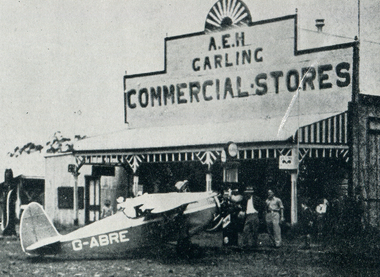
Image - Black and White, Butler refueling his Swift Aeroplane at A.E.H. Carling's Commercial Stores, Tooraweenah
... Butler refueling his Swift Aeroplane at A.E.H. Carling's Commercial Stores, Tooraweenah......commercial stores, tooraweenah...Carling's Commercial Stores, Tooraweenah Image - Black and White ...flight, aeroplane, pilot, butler, comper swift, commercial stores, tooraweenah, a.e.h. carling -
 Bendigo Historical Society Inc.
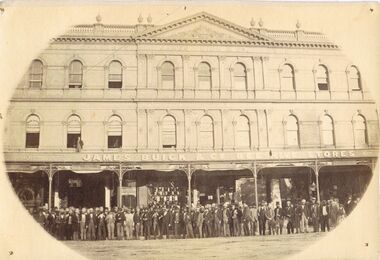
Photograph - OLIVE PELL COLLECTION: GROUP PHOTO OF MEN
... Commercial...beehive stores...BUILDINGS Commercial beehive stores James Buick & Co Bee-Hive Stores Bee-Hive Billard Saloon. ...Photograph, on cream photo paper with picture within an oval shape of the name James Buick & Co Bee Hive Stores Building sign written across the verandah. The building has an ornate roof with six decorative finials in the shape of urn's along a balustrade. In the center is a triangle with a coat of arms. Lace work runs along the rood line. There are eighteen curved windows three have advertising for the Bee Hive Billiard Saloon, left to right one for H. Birch Legal Manager and General acent? and Globe Insurance Company. The fifth one is C. W. Belt Legal Manager General Accountant. the last on the right reads Denson?. One Man is standing on the verandah next to the Saloon window. There are 60+ men in the photo all wearing hats, one girl and two dogs some standing on the road and others standing on the foot path. Three pin hole on the top of the photo.buildings, commercial, beehive stores, james buick & co bee-hive stores, bee-hive billard saloon. -
 Bendigo Historical Society Inc.
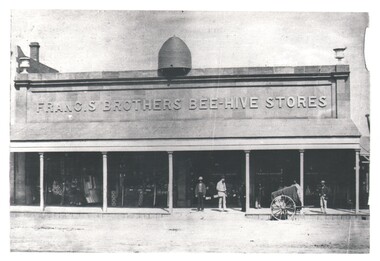
Photograph - WES HARRY COLLECTION: BEE - HIVE STORES, 1861
... Commercial...beehive stores...BUILDINGS Commercial beehive stores Francis Brothers Beehive Stores Pall Mall Batchelder Photograph of a single storied stone shop front with a wide verandah over the wooden footpath. ...Photograph of a single storied stone shop front with a wide verandah over the wooden footpath. Above the verandah in raised lettering is ' Franc.s ( Francis) Brothers Beehive Stores, There are two decorative urns on each side of the parapet and in the middle is a stylized representation of a Beehive.Batchelderbuildings, commercial, beehive stores, francis brothers, beehive stores, pall mall -
 Bendigo Historical Society Inc.
Photograph - HARRY BIGGS COLLECTION: ANCHOR STORES MOORHEAD BROS
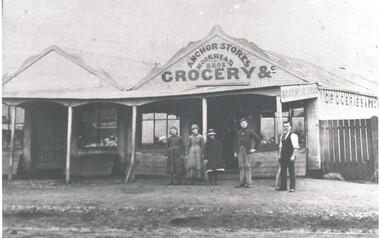
... Commercial...anchor stores...BUILDINGS Commercial anchor stores Anchor Stores Moorhead Bros Sailors Gully Photograph of a double fronted wooden shop front with a verandah across the whole width. ...Photograph of a double fronted wooden shop front with a verandah across the whole width. There is decorative fretwork on the gables of the buildings. Above the verandah on the right hand side is a painted sign Anchor Stores, Moorhead Bros. Grocery &c. In front of the verandah there are three women and two men. The name 'Moorhead Bros.' is also on a sign at the side of the verandah. This store is in Sailors Gullybuildings, commercial, anchor stores, anchor stores, moorhead bros, sailors gully -
 Wangaratta RSL Sub Branch
Souvenir - Japanese Water Canteen, Takada Aluminum Mill (TKD), c1920
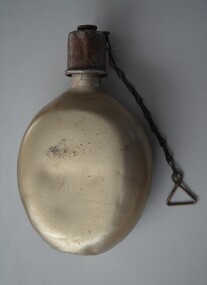
... Many Japanese soldiers, particularly officers and infantrymen, frequently purchased their own tactical gear from commercial department stores or military supply shops before being deployed. ...Many Japanese soldiers, particularly officers and infantrymen, frequently purchased their own tactical gear from commercial department stores or military supply shops before being deployed. ...Original pre-WWII commercial export field bottle manufactured in Japan during the 1920s or 1930s. During this era, Japanese aluminum manufacturers stamped their civilian-market exports with localized nature motifs such as a soaring crane or eagle over Mount Fuji or stylized mountain peaks framed inside a circular border such as the one on the base of this canteen. Many Japanese soldiers, particularly officers and infantrymen, frequently purchased their own tactical gear from commercial department stores or military supply shops before being deployed. Allied troops fighting in the Pacific routinely collected Japanese field gear as combat trophies. Item belonged to and probably souvenired by John Williams JAMES born 4/5/1922 at Benalla. V22561 served with the 8th Light Horse prior to enlisting in WW2 - VX90269 served with the 2/5 Commandos and 2/16 Battalion in New Guinea and Morotai/Borneo, prior to discharge in 1946.An original pre-war Japanese aluminum export canteen with a fully intact base stamp, brown screw cap, and its retaining chainUnpainted aluminium oval shaped water canteen with brownish screw top lip with chain attached.Maker's logo stamped on basejapanese canteen, ww2, new guinea, borneo -
 Lara RSL Sub Branch
Postcards
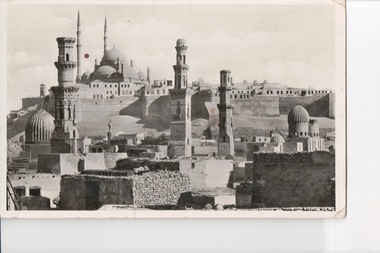
... stores in Cairo. It is rather nice but the Gyppoes sleeping on the foot path, and other stupid pranks. Harvey." Publ. the Oriental Commercial...stores in Cairo. It is rather nice but the Gyppoes sleeping on the foot path, and other stupid pranks. Harvey." Publ. the Oriental Commercial ...This postcard was sent by an Australian soldier from Cairo to Australia during the First World War. It has the capacity to illustrate issues of British Imperialism, Australian approaches to race and religion, and the experience of Australian Soldiers experiencing world travel during the war.Postcard with a black and white image of citadel and tombs of the Mameluks, Cairo. Has writing on the reverse in black ink, and some scribble from a blue pen."The polish of the main pyramids is decorated in the interior of the tombs. I use to pass this often when going for stores in Cairo. It is rather nice but the Gyppoes sleeping on the foot path, and other stupid pranks. Harvey." Publ. the Oriental Commercial Bueau. Port Said.cairo, egypt, wwi, world war one, first world war, australia, army, british empire -
 Federation University Historical Collection
Book, St Patrick's College Annual Magazine, 1914, 1914
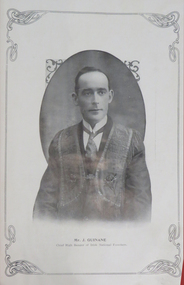
... Commercial Class, Intercollegiate Athletics, Orchestra, Rev. Dr Higgins, Br Keniry, J. Guinane of the Irish National Forresters, Gerald O'Day, P. Ryan, Frank Keys, L. Bartels, G. Hickey, T. Keys, O. Daly, J. Wolf, A. McKean, T.H. Jenkins, Football Team, Dr Devine, J. Sowersby, Chemistry Laboratory, Gerard Little, Rev. J. McHugh, Andrew Mulquiney, Bernard Heinz Advertisements: Ballarat Trustees, Heinz Brothers Butchers, Middleton and Morris, National Trustees, F. Cannon Hairdresser, G. Werner & Co, Clegg, Miller and Morrow, Rowlands, Gordon Brothers, Loreto Convent, St Alysius Junior Boys' School Portland, Coghlan Boase and Co, Briant's Red Shop Tea Rooms, Ballarat Supply Stores...Commercial Class, Intercollegiate Athletics, Orchestra, Rev. Dr Higgins, Br Keniry, J. Guinane of the Irish National Forresters, Gerald O'Day, P. Ryan, Frank Keys, L. Bartels, G. Hickey, T. Keys, O. Daly, J. Wolf, A. McKean, T.H. Jenkins, Football Team, Dr Devine, J. Sowersby, Chemistry Laboratory, Gerard Little, Rev. J. McHugh, Andrew Mulquiney, Bernard Heinz Advertisements: Ballarat Trustees, Heinz Brothers Butchers, Middleton and Morris, National Trustees, F. Cannon Hairdresser, G. Werner & Co, Clegg, Miller and Morrow, Rowlands, Gordon Brothers, Loreto Convent, St Alysius Junior Boys' School Portland, Coghlan Boase and Co, Briant's Red Shop Tea Rooms, Ballarat Supply Stores ...St Patrick's College is a Catholic bous secondary school in Ballarat in the Christian Brothers tradition,School Magazine of St Patrick's College, Ballarat. Includes a boarders' Roll Call. Articles include: Ireland's Freedom, The Catholic Federation, Dr Daniel Mannix Images: Physics Laboratory, Sloyd and Manual Art Room. Senior Public Class, Commercial Class, Intercollegiate Athletics, Orchestra, Rev. Dr Higgins, Br Keniry, J. Guinane of the Irish National Forresters, Gerald O'Day, P. Ryan, Frank Keys, L. Bartels, G. Hickey, T. Keys, O. Daly, J. Wolf, A. McKean, T.H. Jenkins, Football Team, Dr Devine, J. Sowersby, Chemistry Laboratory, Gerard Little, Rev. J. McHugh, Andrew Mulquiney, Bernard Heinz Advertisements: Ballarat Trustees, Heinz Brothers Butchers, Middleton and Morris, National Trustees, F. Cannon Hairdresser, G. Werner & Co, Clegg, Miller and Morrow, Rowlands, Gordon Brothers, Loreto Convent, St Alysius Junior Boys' School Portland, Coghlan Boase and Co, Briant's Red Shop Tea Rooms, Ballarat Supply Stores, Stephen Wellington furnishing undertaker, W. Cornell, Eden Photographs, W.E. Longhurst Bread, Sacred Heart Boarding School, St Anes' Ladies' College Geelong, Ballarat Brewing Company, J.S. Young Suit Builders, George Smithm, Kearns Brothers Fish and Oyster Saloon, T.G. Skewes Pharmacy, J.A. Reynolds Wal paper Wahehouse, Walter Gude Music Teacher, Snows, Auldana Wines, J. Ewins Book Store, Cowdell, Tonner and Ellis, Richards and Co, Kruse's Fluid Magnesia, Jago's Ballarat Boot Palace, R.J. Miller Undertaker, W.C. Thomas and Sons Flour Millers, Broadbent Bros, W.E. Thomas American Dentist, Harry Davies and Co., Permewan Wright, William P. Linehan, Tyler's Clothing Arcadem C. Marks and Co, Coad and Hewitson Chaff Cutters.st patrick's college ballarat, daniel mannix, rev. dr higgins, br keniry, j. guinane, irish national forresters, gerald o'day, p. ryan, frank keys, l. bartels, g. hickey, t. keys, o. daly, j. wolf, a. mckean, t.h. jenkins, dr devine, j. sowersby, gerard little, rev. j. mchugh, andrew mulquiney, bernard heinz, ballarat trustees, heinz brothers butchers, middleton and morris, national trustees, f. cannon hairdresser, g. werner & co, clegg, miller and morrow, gordon brothers, loreto convent, st alysius junior boys' school portland, coghlan boase and co, briant's red shop tea rooms, ballarat supply stores, stephen wellington furnishing undertaker, w. cornell, eden photographs, w.e. longhurst bread, sacred heart boarding school, st anes' ladies' college geelong, ballarat brewing company, j.s. young suit builders, george smith, kearns brothers fish and oyster saloon, t.g. skewes pharmacy, j.a. reynolds wal paper warehouse, walter gude music teacher, snows, auldana wines, j. ewins book store, cowdell, tonner and ellis, richards and co, kruse's fluid magnesia, jago's ballarat boot palace, r.j. miller undertaker, w.c. thomas and sons flour millers, broadbent bros, w.e. thomas american dentist, harry davies and co., permewan wright, william p. linehan, tyler's clothing arcade, c. marks and co, coad and hewitson chaff cutters, loret oconvent portland -
 City of Moorabbin Historical Society (Operating the Box Cottage Museum)
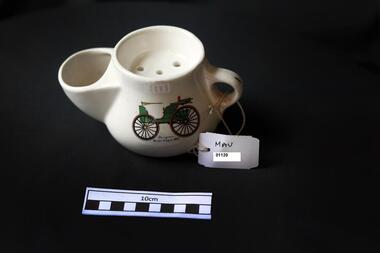
Personal Effects, china shaving mug / scuttle, c1950
... stores, had more variety in style but usually went without a name. Barber shops sold mugs with the owners’ names on them partly because they thought that shaving rash came from sharing the same soap. In reality, the rash was not a result of soap but of unsterilized razors. Transfer ; The Duryea Motor Wagon was among the first standardized automobiles and among the first powered by gasoline. Fifteen examples were built by the Duryea Motor Wagon Company of Chicopee, Massachusetts, between 1893 and 1896. Their enterprise followed the first commercially...stores, had more variety in style but usually went without a name. Barber shops sold mugs with the owners’ names on them partly because they thought that shaving rash came from sharing the same soap. In reality, the rash was not a result of soap but of unsterilized razors. Transfer ; The Duryea Motor Wagon was among the first standardized automobiles and among the first powered by gasoline. Fifteen examples were built by the Duryea Motor Wagon Company of Chicopee, Massachusetts, between 1893 and 1896. Their enterprise followed the first commercially ...Shaving soap scuttles are distinguished from shaving mugs by having a separate area for hot water. The hot water is for dipping a shaving brush into to make a lather with the soap which is then applied to the skin before using the razor. Vintage scuttles are often elaborately decorated. Between 1880 and 1920 is the original time period for the occupational shaving mug. Most men owned a shaving mug, either at home or at a barber shop. Mugs purchased for home use typically were purchased through local stores, had more variety in style but usually went without a name. Barber shops sold mugs with the owners’ names on them partly because they thought that shaving rash came from sharing the same soap. In reality, the rash was not a result of soap but of unsterilized razors. Transfer ; The Duryea Motor Wagon was among the first standardized automobiles and among the first powered by gasoline. Fifteen examples were built by the Duryea Motor Wagon Company of Chicopee, Massachusetts, between 1893 and 1896. Their enterprise followed the first commercially available automobile which was patented by Karl Benz on January 29, 1886, and put into production in 1888. The Duryea Motor Wagon remained in production until 1917. The Duryea brothers entered their horseless carriage in many shows and races. A china shaving mug / scuttle with a car transfer. The mug has a wide spout to hold / insert the shaving brush , a perforated tray opening at the top to hold the soap and a bulbous base for the hot water. car transfershaving equipment, safety razors, cheltenham, early settlers, moorabbin, shaving soap sticks, shaving brushes, shaving scuttles, shaving rash, infectious diseases, barber shops, -
 Ringwood and District Historical Society
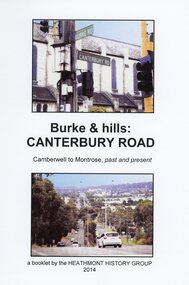
Book, Burke & Hills: Canterbury Road Camberwell to Montrose, by Heathmont History Group - 2014
... Grand homes and churches at one end, major and minor shopping centres along the 25km, factories now where farms were, big box stores, fast food outlets, train stations, resrvoir, traffic, residential stretches, modern apartment blocks, parklands, child-minding centres, sporting ovals, a sewage farm, hotels, quarries, commercial developments, plant nurseries, a golf course, bridges, memorials, Asian food shops, telecommunication towers, bushland, creeks, crossroads, traffic lights, mansions, orchards, swamps ... ...Grand homes and churches at one end, major and minor shopping centres along the 25km, factories now where farms were, big box stores, fast food outlets, train stations, resrvoir, traffic, residential stretches, modern apartment blocks, parklands, child-minding centres, sporting ovals, a sewage farm, hotels, quarries, commercial developments, plant nurseries, a golf course, bridges, memorials, Asian food shops, telecommunication towers, bushland, creeks, crossroads, traffic lights, mansions, orchards, swamps ... ...Soft cover book of 40 pages with spiral wire spine. Compilation of images and descriptive timeline of the geology, geography and European settlement history of Canterbury Road.Soon after beginning at Burke Road Camberwell, Canterbury Road moves into the gentle hills of Canterbury, then on to Surrey Hills, Box Hill and Forest Hill. Further along past these three "hills" come three "monts" - Vermont, Heathmont and at its other end, Montrose, by then in the foothills of the Dandenongs. Grand homes and churches at one end, major and minor shopping centres along the 25km, factories now where farms were, big box stores, fast food outlets, train stations, resrvoir, traffic, residential stretches, modern apartment blocks, parklands, child-minding centres, sporting ovals, a sewage farm, hotels, quarries, commercial developments, plant nurseries, a golf course, bridges, memorials, Asian food shops, telecommunication towers, bushland, creeks, crossroads, traffic lights, mansions, orchards, swamps ... Delaneys Road, renamed Canterbury Road after a 19th century Victorian Governor, is a fascinating study in land use and history as suburban Melbourne has continually diversified and pushed outwards. Compiled by Heathmont History Group, Rita James, Les Prato, Betty Colbert, Jeff Leipold, Gerry Robinson (convenor). -
 Ringwood and District Historical Society
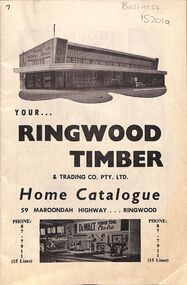
Pamphlet, Two catalogues from Ringwood Timber & Trading circa 1960s
... Today, acclaimed as one of the most modern mills and hardware stores in the Southern Hemisphere, combining up to date machinery and handling equipment together with unique drive-in facilities and a self-selection centre. Ringwood Timber & Trading Co. are proud to offer a service unparallelled to home builders. In conformity with modern commercial...Today, acclaimed as one of the most modern mills and hardware stores in the Southern Hemisphere, combining up to date machinery and handling equipment together with unique drive-in facilities and a self-selection centre. Ringwood Timber & Trading Co. are proud to offer a service unparallelled to home builders. In conformity with modern commercial ...Two catalogues of goods to sell, from Ringwood Timber & TradingEditorial of 15201b includes a short history of the company. In 1937, Mr S Coopersmith and son, Frank (the present Managing Director) started a fruit case manufacturing business in North Melbourne under the name of The Cooper Case Co. The business flourished, and in 1940, recognising the possibilities in and around Ringwood, an old bush sawmill and an area of land on the Maroondah Highway, were secured. Subsequent purchases have since increased this area to approximately 15 acres. It was decided to widen the activities and scope of the business and two new firms were formed. Cooper Sawmilling Co., which operated a modern sawmill, and Ringwood Timber & Trading Co., which handled the output of the sawmill and introduced builders' and general hardware lines to meet the demands of this rapidly expanding area. As Ringwood grew, so too did the organisation which was created to serve it. The principals studied timber and hardware merchandising trends overseas, and after considerable investigation the new building on Maroondah Highway was completed in 1956. Today, acclaimed as one of the most modern mills and hardware stores in the Southern Hemisphere, combining up to date machinery and handling equipment together with unique drive-in facilities and a self-selection centre. Ringwood Timber & Trading Co. are proud to offer a service unparallelled to home builders. In conformity with modern commercial practice the various firms have since been incorporated under the Victorian Companies Act and the latest accounting methods and office equipment have been installed to provide an efficient and virile administration to control the entire manufacturing and trading activities. We have a staff of over 220 personnel, each trained in their particular field to provide you, our valued client, with expert advice, quality merchandise and second-to-none service to enable you to fulfil every need in and around your home. -
 Glenelg Shire Council Cultural Collection
Functional object - Foot Warmer, Hecla Electrics Pty Ltd, c. 1920
... commercial appliances to cafés, hospitals and offices. In 1927, the company shifted from small premises in the city to a bigger, electric-powered factory in South Yarra. Hecla had no retail stores...commercial appliances to cafés, hospitals and offices. In 1927, the company shifted from small premises in the city to a bigger, electric-powered factory in South Yarra. Hecla had no retail stores ...From Museum Victoria: Made in about 1927 by Hecla Electrics Pty Ltd and sold under the model name 'Foot Warma'. The foot warmer was made from the late 1920s until the 1950s and did not change substantially in design during this time. The Hecla brand name and logo was registered in 1918 by Clarence Marriott. It was inspired by the recent eruption of Iceland's volcano Mt Heckla. Clarence and his father James were metal workers who had made Australia's first carbon filament electric radiators in 1899, and also built an early steam car. As electricity use exploded in the 1920s and 1930s, 'Hecla' became a household name in Melbourne. They made a wide range of appliances for the home, and supplied commercial appliances to cafés, hospitals and offices. In 1927, the company shifted from small premises in the city to a bigger, electric-powered factory in South Yarra. Hecla had no retail stores of its own - instead it sold products through wholesalers and retailers, including the State Electricity Commission (SEC). The company promoted its goods through advertisements in home magazines and displays in shop windows, home shows and the 1935 All-Electricity Exhibition. A popular advertising slogan in the 1930s was 'Hecla household helps make happy healthy housewives!'. Hecla ceased manufacturing in Melbourne in the 1980s.Documentation of how people lived and is an example of early domestic electrical appliances. From Museum Victoria: Hecla Electrics Pty Ltd were a significant Melbourne manufacturing company, who became a household name in the 1920s making small electric appliances such as heaters and kettles. They also made a variety of other electrical appliances for domestic, commercial and military use. The company manufactured electric appliances in Melbourne from about 1922 until the 1980s, although Clarence Marriott, who formed the company, had begun making radiators with his father James in 1899. The company had a reputation for quality products. The company also played an important role within the Australian domestic and commercial appliance industry, both as a leading innovator and through its role in training skilled staff, many of whom went on to work for competitors such as Kambrook, Electrolux and Sunbeam. This electric coffee percolator represents the typical small domestic appliance that the Hecla company was famous for. Along with other items in the Hecla Collection, it highlights the diversity of electric appliances that the company made. This object also highlights the legacy of high quality design and metal construction work that Clarence and James established for the company, stemming from their early work as talented art metal workers. It also represents the first major period of the take-up of electricity use in the home. This take-up began in the 1920s and 1930s with the use of small appliances, and by the 1950s electricity had become commonplace in the home, and large appliances such as refrigerators and stoves became standard.Square metal object. The top surface is heavy cast iron and patterned with floral motifs. In the centre is a circle with the words ' Hecla Foot Warma' inside. Under the top is a black metal base with two feet at either end which extend the length of the base. The back foot is higher than the front foot. There is a circular disk from which extends the electrical cord. The cord is brown and white checks. At the end of the cord is a plug on which is printed 250V AMP S.2 EARTH 5. The plug is brown and made from Bakelite. On the base is a rectangular label which has words printed - HECLA Australia.Top: HECLA/-FOOT-/WARMA Base: Volts / 230/250 / WATTS / 80 / HECLA / Australia / CAT. NO. F26domestic, city of portland, glenelg shire council, electrical, foot warmer, heating, hecla, manufacture -
 Mission to Seafarers Victoria
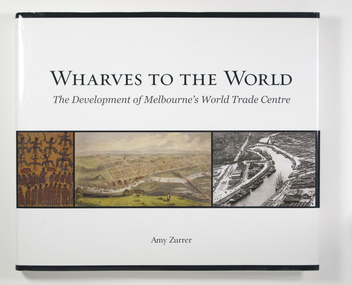
Book - Reference book, Melbourne Books, Wharves To The World: The Development Of Melbourne's World Trade Centre, 2011
... Stores were demolished to make way to the new buildings. This book provides a well illustrated history of Melbourne's waterfront: photographs from PROV, RHSV, SLV from the Aboriginal past, John Batman, John Pascoe Fawkner, Sir John Coode and the cutting of the Yarra river. WTC was acquired by Riverlee in 2005 and has undergone major refurbishment of the commercial ...Wharves to the World: The Development of Melbourne's World Trade Centre is a photographic chronicle of the history of the World Trade Centre and its surrounds. The book traces the journey of land and the buildings that occupied it - from its beginnings with the Wurundjeri people to its role as a trading hub in early Melbourne, then as the site of the modern-day World Trade Centre, and now as part of a flourishing residential and commercial Precinct. As with any major project The World Trade Centre has face its share of fêlures, but despite thèse it has become an integral part of the City. So it goes that was once home to swampland and the City morgue has been transformer into a Diamond of the Yarra River.A 128-page book of printed matter, photographs, engravings and drawings. The hard cover is white with the title in gold lettering on the front. The dust-cover is also white with black lettering. Along the lower half of the cover, front and back, is a strip of six photos, three coloured and three black and white. 128 p. : ill. (some col.), ports. non-fictionWharves to the World: The Development of Melbourne's World Trade Centre is a photographic chronicle of the history of the World Trade Centre and its surrounds. The book traces the journey of land and the buildings that occupied it - from its beginnings with the Wurundjeri people to its role as a trading hub in early Melbourne, then as the site of the modern-day World Trade Centre, and now as part of a flourishing residential and commercial Precinct. As with any major project The World Trade Centre has face its share of fêlures, but despite thèse it has become an integral part of the City. So it goes that was once home to swampland and the City morgue has been transformer into a Diamond of the Yarra River.yarra yarra tribe, early melbourne, world trade centre, melbourne, southbank, northbank, australian wharf, siddeley street, waterfront, amy zurrer, wurundjeri, spencer street bridge, north wharf, riverlee, wtc, wharf, harbor trust, sir john coode, harbour trust, little dock, polly woodside, wharfies, divers -
 Warrnambool and District Historical Society Inc.
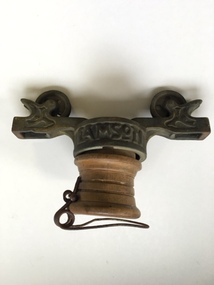
Equipment - Artefact, Lamson's Rapid Wire Cash Carrier, Youngers, C Early 20th century
... stores around Australia. This particular Lamson's cash carrier was installed in Youngers department store which was situated in Liebig Street. The success of Youngers store was partly responsible for the shift to Liebig St as the main commercial district. ...stores around Australia. This particular Lamson's cash carrier was installed in Youngers department store which was situated in Liebig Street. The success of Youngers store was partly responsible for the shift to Liebig St as the main commercial district. ...Lamson was established in Australia in 1898 with the idea for a store security money handling system being patented in the latter part of the 19th century.The practise of taking money from the counter and customer to the cashier was time consuming and cumbersome.Some bright ideas were employed including tying the money and dockets in a hankerchief and throwing it to the cashier. The first attempt to improve this was the ball system where a ball containing the cash was rolled to the cashier on an elevated track. The rapid wire system superseded this in the early 1900's and for the next 50 years it became a popular part of money handling in stores around Australia. This particular Lamson's cash carrier was installed in Youngers department store which was situated in Liebig Street. The success of Youngers store was partly responsible for the shift to Liebig St as the main commercial district. The Warrnambool Standard reported in 1901 that Younger and Co would operate on a wholly cash basis replacing incidental trades of goods such as potatoes and other farm produce.This item has strong social and historical significance. Apart from having strong links to one of Warrnambool's largest and longest running businesses, the object itself is of considerable interest with thousands of the original ball systems and Rapid Wire cash carriers being in use around the world. Cylindrical brass top with central circular part with section either side which have two small pulleys. A wooden cylindrical section slots in below with a wire clip attached at the bottom.Lamson is cast into the brass on either side of therim of the top circular section. . AUS is on the side of this same section. warrnambool,, youngers, youngers warrnambool, lamson, lamson rapid wire cash carrier, wire cash carrier -
 Eltham District Historical Society Inc
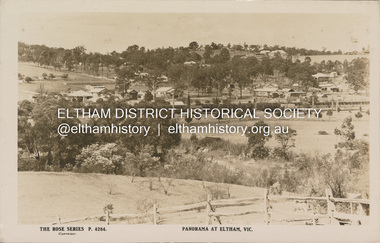
Postcard - Photograph postcard, Panorama at Eltham, Vic, c.1923
... commercial development on Main Road, it is estimated this image is circa 1925. Luther Haley was the first to build an open a baker and General Store in this location next to the railway station in 1902. However, it took nearly twenty years until the early to mid-1920s when a period of significant growth in the Eltham shopping centre happened with many businesses relocating their operations from the original town centre of Maria Street in Little Eltham as well as new businesses opening. Other stores...commercial development on Main Road, it is estimated this image is circa 1925. Luther Haley was the first to build an open a baker and General Store in this location next to the railway station in 1902. However, it took nearly twenty years until the early to mid-1920s when a period of significant growth in the Eltham shopping centre happened with many businesses relocating their operations from the original town centre of Maria Street in Little Eltham as well as new businesses opening. Other stores ...The Rose Series P. 4284 post card Taken from near what would be present day CLC car park looking southwest across Diamond Street, present-day Andrew Park to the railway station and developing Eltham shopping precinct. Arthur Street visible, Pryor and Luck Street not evident. Sunnybrook, the Taylor home is visible at the top of the hill in Bible Street. Only three residences visible in Arthur Street on the southern side, two of these are the David Harbison Rest Home at 10 and 12 Arthur Street (built and opened in November 1919), present day site of Eltham Mall. There are none on the north side of the street. Based on 1945 aerial view there are 8 buildings on the northern side between Main Road and Bible Street which and given the extent of commercial development on Main Road, it is estimated this image is circa 1925. Luther Haley was the first to build an open a baker and General Store in this location next to the railway station in 1902. However, it took nearly twenty years until the early to mid-1920s when a period of significant growth in the Eltham shopping centre happened with many businesses relocating their operations from the original town centre of Maria Street in Little Eltham as well as new businesses opening. Other stores/buildings noted (L-R) are: Stationmaster's House built circa 1910 Eltham Hardware Store opposite the railway station first opened on Main Road opposite the Railway Station around late 1922. An advertisement placed in the Hurstbridge Advertiser advised that the Hardware Store had just opened with a varied stock of Saws, Hammers, Nails, Shovels, Screw Drivers, and every article required in a house or on a farm. People were also encouraged to try their Jams, Pickles, Sauces, Cups and Saucers, etc. Newsagency with 'Leader' advertising on awning - E. J. Andrew opened his newsagency shop opposite the station in March 1923, advertising for sale stationery, school requisites and periodicals. Bird Brothers Cash Grocer & Fruiterer opposite the railway station offering summer drinks and confectionery a specialty with a full Stock of groceries of the best quality always on hand at city prices opened December 1921 William Capewell's Butcher shop at the corner of Dudley Street. Capewell previously had a small shop in front of the station opposite Luck Street. He enlisted in the AIF during WW1 and returned home in 1919. He re-applied for a slaughtering license in February 1920 and was advertising by October 1922 supplying all districts. Not visible (or not yet identified) but in business by October 1922 were: J.H. Fraser, Carpenter and Builder at Luck Street opposite the station George A. Danslow, Hairdresser and Tobacconist opposite the railway station Miss Barber's 'Blue Gum' Soda Fountain opened October 1922 opposite the railway station (hidden behind Stationmaster's House). It was so named due to its proximity to a tall Blue Gum tree G.H. McDonald Boot Repairer opposite the railway station In December 1923 the first portion of the main street to be formed from Dudley to Arthur streets was almost completed. This is the section in front of Capewell's Butcher shop though it is difficult to fully make out from the photoDigital file only Postcards scanned from the collection of Michael Aitken on loan to EDHS, 2 Sep. 2022michael aitken collection, eltham, postcards, arthur street, david harbison rest home, electrine candles, eltham railway station, eltham shopping centre, lloyd's general store, red rattler, rose series postcard, rose stereograph company, tait train, velvet soap, andrew park, bible street, bird brothers cash grocer & fruiterer, bird brothers cash grocer and fruiterer, butcher, diamond street, dudley street, eltham hardware and timber, eltham hardware store, eltham mall, main road, station masters house, stationmaster's house, sunnybrook, w.j. capewell, w.j. capewell butcher shop -
 Kiewa Valley Historical Society
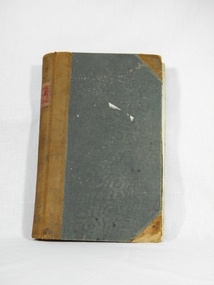
Book - Ledger Commercial, Cash Book for General Store, 5/3/1906; Commenced on 5th March 1906 to December 1906
... It also displays the importance of general stores to the community book general store customers shop store cash book ledger 1906 groceries accounts kiewa valley pioneers "Commenced March 5th 06" on front page Leather spined cash book for general store, for period from 5th March 1906 to circa December 1906. Green cover with brown spine. Hand writtern entries record date, purchaser, account number and items purchased. 382 pages. Cash Book for General Store Book - Ledger Commercial ...Records names of local people and purchases bought from a local general store. When names in the register are indexed it may be possible to determine where the store was located. Historically significant. This shows who the families of the Kiewa Valley were and what type of things they purchased. This would be the only register for this store in 1906.It gives a good historical record of what families purchased during this period and how much they could spend. It also displays the importance of general stores to the community Leather spined cash book for general store, for period from 5th March 1906 to circa December 1906. Green cover with brown spine. Hand writtern entries record date, purchaser, account number and items purchased. 382 pages. "Commenced March 5th 06" on front page book, general store, customers, shop, store, cash book, ledger, 1906, groceries, accounts, kiewa valley, pioneers -
 Kiewa Valley Historical Society
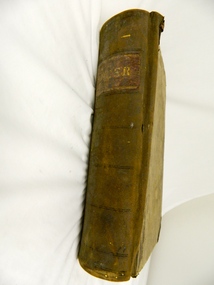
Book - Ledger Commercial, "Ledger No. 4", Circa 1895
... commercial trade. Emphasis on neatness was ingrained in students at a young age. This era was well before general typewriters and computers. Generally all students of commerce required an accuracy in writing and arithmetic. Neatness and order were a selection requirement. This ledger belonged to a general store, which was a forerunner to supermarkets and specialty stores...commercial trade. Emphasis on neatness was ingrained in students at a young age. This era was well before general typewriters and computers. Generally all students of commerce required an accuracy in writing and arithmetic. Neatness and order were a selection requirement. This ledger belonged to a general store, which was a forerunner to supermarkets and specialty stores ...Historically this ledger not only details the legible hand writing of this era but also the day to day commercial activity in this region(first entry in 1895).The neatness and the diligence of those who were required to pen the information was a requirement by all who were in commercial trade. Emphasis on neatness was ingrained in students at a young age. This era was well before general typewriters and computers. Generally all students of commerce required an accuracy in writing and arithmetic. Neatness and order were a selection requirement. This ledger belonged to a general store, which was a forerunner to supermarkets and specialty stores. The shop provided everything from food, postage stamps, nails, tobacco, boots and Epsom salts. The general store provided nearly every product required to exist in a remote rural area of Australia in the 1800's.This item clearly identifies the Kiewa Valley as having a substantial financial hub to accommodate the various commercial enterprises within a rural environment Circa 1880's. Although Kiewa Valley had mining, agriculture, cattle and sheep it was also composed of a mixed society, encompassing all levels of society at that period. It identifies some the commercial activities(newsagency/general store) undertaken by specific families farming in the Kiewa Valley and relates their history in the pioneer period of the late 1800's. Some of those pioneers still have descendants living on the same home sites provided by the 1847 Land Act.This ledger has a very thick cover of strong compressed cardboard. Originally it had a cloth covering both front and back(Glued on) but due to wear and tear it is only attached to the back cover) and is a faded blue colour. The corners of the opening side of the cover are reinforced by suede cloth,in a triangular shape, and enclose both the front and inside portions of the the ledger. The spine is reinforced by a suede section to provide increased strength and protection. The inside cover (both front and back) has an orange bubbles with red and blue sinuous lines forming shapes in a haphazardous pattern. The grammage of the lined sheets (blue) is approximately 120g/m. Originally the first seven of twelve pages were indented and alphabetically marked with black letters (one letter per page) however this ledger had been modified to cover only the initials of customers and the pages of unused letters were glued to the previous page. The remaining pages are numbered in black print at the top outside edge of each page. There are 890 page numbers. Each page has thirty seven blue horizontal lines and one double red line ( top). Each page has thirteen vertical lines starting from the top horizontal double red lines and ending at the bottom of the page. These lines segregate the page into blocks for the date, the transaction and financial input. There are three double vertical red lines which designate the amount of money of each transaction (in pounds, shillings,and pence).On the suede spine in gold lettering and on a red (port coloured) background "LEDGER"grocery shop, haberdashery, general store -
 Kiewa Valley Historical Society
Tin Coffee Cylindrical, circa mid to late 1900's
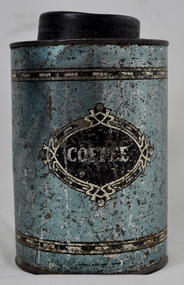
... stores in Tawonga and Mount Beauty in the supply of previously "hard to get" groceries. This transition was precipitated by the SEC Vic Hydro Scheme of the 1940's to 1960's which increased the valley's population level three fold. kitchen containers domestic food storage bulk stocks of dried condiments "COFFEE" within an elongated spherical "art deco" four pointed banner of silver and black colouring This cylindrical tin has a pull/push lid(for easy access to the contents). The container is labelled for "coffee" however it has no commercial ...This "coffee" tin has by the "art deco" appearance its origins in the late 1950's to 1960's. This time period was one of accelerated growth both in the physical (housing) sense and the mental (new ideas and inventions) changes in "attitudes". These occurred more rapidly in cities but had its effects on the rural environment. The drinking of coffee was spurred on by easier distribution of imported food and drinks. Advertising by stronger radio links and then by television brought the variety of foods and drinks to semi isolated rural regions. The accessibility through greater information channels becoming available brought with it unbelievable ranges of goods and foodstuffs. Rural regions still relied on bulk supplies and relatively larger storage containers than those in cities. This "bulk" buying and storage "syndrome" was a lingering result of many years of "drought" periods when road transports met delays from flooded roadways in supplying population centres in the Kiewa Valley. The construction phases in building the SEC Vic Hydro electricity Scheme in the eastern sections of the Victorian Alps brought many changes to the quiet rural regions in the Kiewa Valley. Changes in population and social mores. The influx of a varied , mostly temporary, and "European flavoured cuisine" changes the "cuppa tea only" flavour to the have a "coffee break". The subliminal influence of the "American" films changed those children growing up in the post 1950s from the "English tea" to the "American coffee". This "Americanisation process has influenced not only rural Australia but also other areas throughout the world.This "insignificant" coffee tin is very significant as it demonstrates that the Kiewa Valley was becoming more accessible to reliable coffee supplies and general food items.The container was part of a "set" of containers that included tea, sugar,biscuits,flour, rice and other family condiments. This type of kitchen storage containers was brought about through changing patterns in tea and coffee useage and overall consumption. Household demands for faster "self help" cooking especially beveridges and the greater choice of kitchen "utensils" was brought on by easier access to products due to a lessening of the area's "isolation" by having a reliable (all weather) road system and an ever increasing population growth. The need for travelling goods/merchant supply caravans to service the area became a diminishing factor, as a result of the establishment of grocery stores in Tawonga and Mount Beauty in the supply of previously "hard to get" groceries. This transition was precipitated by the SEC Vic Hydro Scheme of the 1940's to 1960's which increased the valley's population level three fold.This cylindrical tin has a pull/push lid(for easy access to the contents). The container is labelled for "coffee" however it has no commercial manufacturer's label to establish that it was bought with coffee ingredients in it. The majority of the container's external surface has a "metallic" light blue colour with two sets of silver rings confining black (horizontal spotted) rectangles. "COFFEE" within an elongated spherical "art deco" four pointed banner of silver and black colouringkitchen containers, domestic food storage, bulk stocks of dried condiments -
Bendigo Historical Society Inc.
Administrative record - Commercial Egg Producers' Association of Victoria (CEPA) Central Council Correspondence, 1981
... Incorporated entities are treated as separate legal bodies.Insurance is emphasized as essential for managing risks, including public liability, personal accident, and property insurance. 8504.37b Commercial Egg Producers Co-op's submission regarding agricultural policy and support for family farmers in Victoria 8504.37c The document is a letter from the association secretary to the Victorian Egg Marketing Board, expressing concerns and suggestions after a recent meeting. 8504.37d To the Victorian Egg Board. Complaint About Reduced Purchases. The producer is concerned that Safeway Stores...Incorporated entities are treated as separate legal bodies.Insurance is emphasized as essential for managing risks, including public liability, personal accident, and property insurance. 8504.37b Commercial Egg Producers Co-op's submission regarding agricultural policy and support for family farmers in Victoria 8504.37c The document is a letter from the association secretary to the Victorian Egg Marketing Board, expressing concerns and suggestions after a recent meeting. 8504.37d To the Victorian Egg Board. Complaint About Reduced Purchases. The producer is concerned that Safeway Stores ...The Commercial Egg Producers' Association of Victoria was active by the 1930s, engaging in industry management and lobbying.The Commercial Egg Producer's Association (CEPA) had branches in Bendigo, South Bendigo, Eaglehawk, Wedderburn, Murrabit and Euroa.CEPA Commercial Egg Producer's Association (Bendigo Region) correspondence, for the year 1981. This item includes the following documents: 8504.37a Legal Liabilities for Sporting Clubs and Community Groups. The document explains that clubs and groups can be held legally responsible for damages or injuries occurring during their activities.Liability may arise from negligence, breach of duty, or failure to provide a safe environment. Incorporation is recommended to limit personal liability of members and office bearers. Incorporated entities are treated as separate legal bodies.Insurance is emphasized as essential for managing risks, including public liability, personal accident, and property insurance. 8504.37b Commercial Egg Producers Co-op's submission regarding agricultural policy and support for family farmers in Victoria 8504.37c The document is a letter from the association secretary to the Victorian Egg Marketing Board, expressing concerns and suggestions after a recent meeting. 8504.37d To the Victorian Egg Board. Complaint About Reduced Purchases. The producer is concerned that Safeway Stores have significantly reduced their purchases of eggs from the Bendigo Crystal Egg Co., dropping from 80,000 dozen per week to about 40,000 dozen per week. 8504.37e Letter by the Secretary of the Commercial Egg Producers Association of Victoria to Mr Milton Whiting, M.P. The Association opposes the extension of daylight saving time in Victoria and supports abandoning it altogether. The letter states that the Association's 800 members are unanimous in their opposition to extending daylight saving, and most favour ending it. 8504.37f Confirmation of Attendance: The Secretary, K. Fitzgibbon, confirms that 12 members from their organization will attend the Victorian Egg Marketing Board meeting scheduled for 19th November, 1981. 8504.37g The document is a letter from K. Fitzgibbon to Mr. J.R.A. McMillan, Secretary of the Federal Council of Poultry Farmers Associations of Australia, dated August 20, 1981. Payment of Subscription Fee: A cheque for $250.00 is enclosed as payment for the 1979-80 subscription fee. 8504.37h The document is a formal letter from the secretary addressed to Minister Tom Austin. The group thanks Minister Austin for meeting with four of its members at the St. Arnaud Knitting Mills. 8504.37i This document is a formal letter from the Commercial Egg Producers' Association of Victoria requesting a meeting with Mr J. W. Bourchier, M.P., to discuss two main industry concerns. The Association is concerned about a rumour that export controls on oatmeal may be lifted on September 16. 8504.37j To the Minister of Agriculture:Acknowledgement of Minister's ResponseThe Association thanks the Minister for his letter and the meeting held on March 17, 1981. The Association is concerned that the price increase is only effective until the end of the year.They disagree with the stated figure of £500,000, suggesting that if this is accurate, egg pulp is being sold at too low a price. 8504.37k To the Minister of Agriculture recommends Mr. Donald Kirkwood Bain for a position on the Egg Marketing Board 8504.37l To the Committee of Enquiry into the NSW Egg Industry. The document is a letter from the Commercial Egg Producers' Association of Victoria expressing support for various items. 8504.37m This document is a nomination letter submitted to the Minister of Agriculture, proposing candidates for the vacant Producer Member position on the Victorian Egg & Marketing Board. 8504.37n Formal apology letter sent by the Secretary of the Poultry Farmers Association of Australia:Apology for Delayed Response:The Secretary apologizes for not replying promptly to a notification regarding a recent Federal Council meeting. 8504.37o This document is a formal communication addressed to the Secretary (as addressed), transmitting several important items. 8504.37p This document is a formal letter from the Secretary of CEPA addressed to the Minister of Agriculture. A large meeting was held in Bendigo with delegates from several country districts (Harcourt, Murrabit, Wedderburn, Euroa, Bendigo).The group is concerned about proposed changes to the Victorian Egg Marketing Board, believing these changes are economically disadvantageous to country producers and decentralisation. 8504.37q This summary highlights the main points from the Commercial Egg Producers' Association of Victoria Central Council half-yearly conference report from November 1981: 8504.37r Minutes from the 1981 Annual Meeting of the Commercial Egg Producers AssociationMeeting Details and AttendanceHeld at City Hall, Bendigo on June 22, 1981, with 21 members present from various districts. 8504.37s The document outlines the proceedings and resolutions from the Central Council's annual meeting regarding the egg industry. 8504.37t This document summarizes a special meeting of the Commercial Egg Producers Association of Victoria (C.E.P.A.) held on July 13, 1981, focused on industry recommendations and regulatory issues. 8504.37u Key Points from the Special Meeting of the Commercial Egg Producers Association of Victoria Central Council Meeting March 1981. 8505.37v This document is a formal response from the Victorian Egg Marketing Board addressing concerns from egg producers about packing material maintenance, reuse, and associated costs. It is to CEPA, Attention Mr M Jackman of Symons St Golden Square and addresses his two page hand written letter in Feb 1981 8505.37w Government of Victoria Department of Agriculture "Agnote" - Registration of agricultural chemicals and household insecticides March 1981 8505.37x The document from the Egg Marketing Board outlines additional charges and procedures for egg consignments handled by the Crystal Grading Floor 8505.37y The document outlines the agenda and minutes for the Commercial Egg Producers' Association of Victoria's central council and branch meetings held on November 19, 1981 8505.37z From the Crystal Egg Company informational letter regarding the new egg grading and pooling system: 8505.37aa Letter sent from the Victorian Egg Marketing Board circular. Effective April 20, 1981, the price of first quality Class B eggs is increased by 10¢ per dozen.This follows a previous reduction of 20¢ per dozen for Class B eggs after a Class A premium increase in February.Class A Premium Adjustment:The Class A premium is reduced from 30¢ to 20¢ per dozen, effective April 20, 1981.Prices for first quality Class A eggs remain unchanged.New Advance Prices (¢ per dozen). 8505.37ab From the Department of Agriculture Victoria's letter. The Department thanks C.E.P.A. members for reviewing and commenting on poultry training modules for the 1982 Farm Apprenticeship program at Bendigo Technical College.egg producer's information, correspondence, cepa, commercial egg producers' association -
Bendigo Historical Society Inc.
Document - 1925 CHRISTIAN'S COMMERCIAL CALENDAR, 1925
... Commercial Calendar.with Compliments from A.Frigerio, Ironmonger and Wireworker,181 Mitchell Street, Bendigo. Guns, Ammunition and Fishing Tackle. In the centre is a 12 month calendar and surrounding it are 26 ''Alphabet'' Advertisements for different traders in Bendigo, A-Z. Designed by Ace Ad Service, Sydney and Melbourne. Copyright Reg. The Arcade Stores...Commercial Calendar.with Compliments from A.Frigerio, Ironmonger and Wireworker,181 Mitchell Street, Bendigo. Guns, Ammunition and Fishing Tackle. In the centre is a 12 month calendar and surrounding it are 26 ''Alphabet'' Advertisements for different traders in Bendigo, A-Z. Designed by Ace Ad Service, Sydney and Melbourne. Copyright Reg. The Arcade Stores ...The Three C's, 1925 Christian's Commercial Calendar.with Compliments from A.Frigerio, Ironmonger and Wireworker,181 Mitchell Street, Bendigo. Guns, Ammunition and Fishing Tackle. In the centre is a 12 month calendar and surrounding it are 26 ''Alphabet'' Advertisements for different traders in Bendigo, A-Z. Designed by Ace Ad Service, Sydney and Melbourne. Copyright Reg. The Arcade Stores, H. Gittens, T Chamberlin, V. Broadway, William Dowel, Geo. Jalland, T.D.Cairns & Co., G.l.Bray, A. Frigerio, L.R.Hepworth, J.D.Kerr, Geo. Greaves, William Dowel, Paton's, B.T,Toy, H.Gittens, H.Greig, Warren's, Northern Seed Supply, W.Koska, P.Travenor, Frank Every, Warren's, Randall's, C.A.Waters, The Ace Ad Service. All of these traders had a small poem structured into their ad.Designed by Ace Ad Service, Sydney and Melbourne. -
 Bendigo Historical Society Inc.
Photograph - BEEHIVE BUILDING
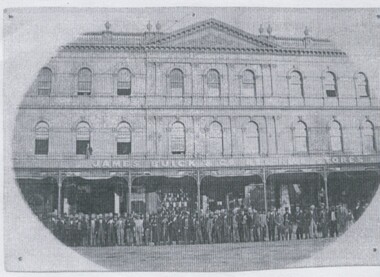
... Commercial beehive building Black and white photocopy of photograph on board. Oval shaped image. Beehive Building. Large group of men standing at front. Inscriptions: In image - on verandah 'James Buick & Co. Beehive Stores ...Black and white photocopy of photograph on board. Oval shaped image. Beehive Building. Large group of men standing at front. Inscriptions: In image - on verandah 'James Buick & Co. Beehive Stores'. On building below parapet 'Beehive Chambers, James Buick & Co, Beehive Chambers'. On windows 'Bee Hive, Billiard Saloon'. 'H? Birch, Legal Manager'. 'CW Bell, Legal Manager'. History of object: James Lerk 2000 'James Buick's Beehive Store & Mining Exchange, Pall Mall Bendigo. Legal Managers staff and speculators are standing on the roadway' Photographed for Bendigo Advertiser 11.1.2001.buildings, commercial, beehive building -
 Bendigo Historical Society Inc.
Photograph - BENDIGO ARCADE, 1955
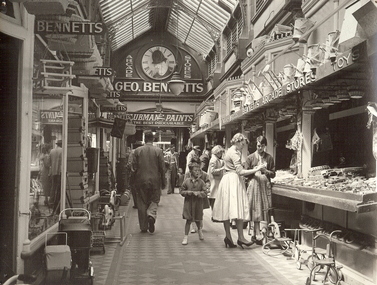
... black and white satin finish commercial arcade. ( Bendigo arcade ) Geo Bennetts Arcade stores and clock in gable. ...Doney black and white satin finish commercial arcade. ( Bendigo arcade ) Geo Bennetts Arcade stores and clock in gable. ...black and white satin finish commercial arcade. ( Bendigo arcade ) Geo Bennetts Arcade stores and clock in gable. Open fronted stalls on right , tiled footway, closed shop front on left. Merchandise ( prams, tricycles ) in foreground, shoppers in foreground to lerft. Male child in foreground.A. Doneyplace, arcade, bendigo -
 Bendigo Historical Society Inc.
Photograph - HARRY BIGGS COLLECTION: BENNETTS ARCADE, c1940,s
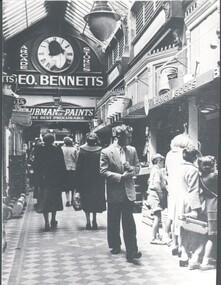
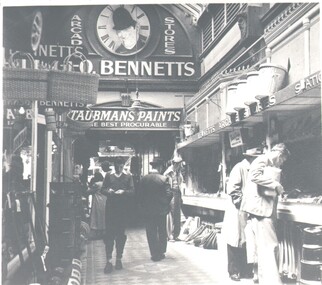
... Commercial signs are Taubmans Paints, the best procurable, Bennetts Arcade, Stores. ...Commercial signs are Taubmans Paints, the best procurable, Bennetts Arcade, Stores. ...Photograph. Harry Biggs Collection. People walking through &andshopping in Bennetts Arcade. Commercial signs are Taubmans Paints, the best procurable, Bennetts Arcade, Stores. Along the side are words including Stationary, Fancy goods. Items are in front of the shops for purchase. A woman & 3 children are shopping. A group of adults are walking through. The roofing is clear to allow for light. The building is very ornate. There is a clock built into the wall of the Bennetts sign.place, building, commercial, harry biggs collection, bennetts arcade, taubmans paints -
 Bendigo Historical Society Inc.
Photograph - HARRY BIGGS COLLECTION: BENNETTS ARCADE
... commercial Harry Biggs Collection Bennetts Arcade Photograph. Harry Biggs Collection. A black & white photo of the clock and of Bennetts Arcade. Numerous items are displayed out the front of the stores ...Photograph. Harry Biggs Collection. A black & white photo of the clock and of Bennetts Arcade. Numerous items are displayed out the front of the stores including hoses, lawn mowers, bins, baskets. People are shopping & walking through the Arcade. Taubmans paints sign - the best procurable can be seen as is Bennetts Arcade Stores.place, building, commercial, harry biggs collection, bennetts arcade -
 Bendigo Historical Society Inc.
Photograph - MINING EXCHANGE, PALL MALL - SANDHURST, C. 1870
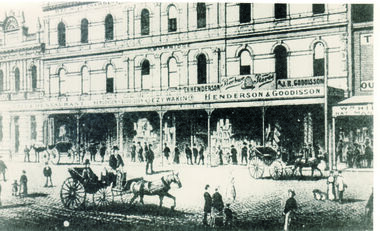
... Commercial...beehive building...Beehive Stores...BUILDINGS Commercial beehive building Beehive Stores Beehive Beehive Chambers Pall Mall Mining Exchange Henderson & Goodisson T.H. ...Black and White Photo, The 'Beehive Chambers', Signs and advertising read - 'Café + Restaurant', 'Henderson & Goodisson', 'Ezy Wakin', 'Beehive Stores', Markings on back of photo read Mining Exchange, Pall Mall, Sandhurst. Three horse carriages with driver and passenger. T. H. Henderson. J. H. Goodison.buildings, commercial, beehive building, beehive stores, beehive, beehive chambers, pall mall, mining exchange, henderson & goodisson, t.h. henderson, j.r. goodisson -
 Port Melbourne Historical & Preservation Society
Photograph - William Dalglish shop, corner Station and Ingles Streets, Port Melbourne, 1874
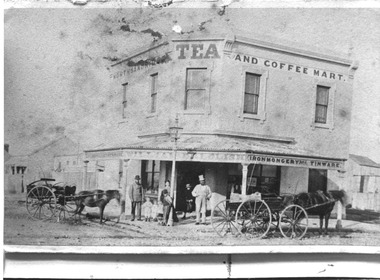
... Commercial...Business and Traders - General Stores...William DALGLISH Built Environment - Commercial Business and Traders - General Stores Faded black and white photo of the William DALGLISH shop at the corner of Station and Ingles Streets. ...Donated by the granddaughter of William DALGLISH.Faded black and white photo of the William DALGLISH shop at the corner of Station and Ingles Streets. Signage shows "North Sandridge Tea and Coffee Mart" and also Kitchenware, Ironmongery and Tinware. The photo taken in 1874 shows several people at the doorway of the shop and two horsedrawn wagons.william dalglish, built environment - commercial, business and traders - general stores -
Glen Eira Historical Society
Letter - Hawthorn Road, 566, Caulfield
... Stores Plus... City of Caulfield... Petrol Stations... Shops... Employment... Commercial...Hawthorn Road Caulfield Food Stores Plus City of Caulfield Petrol Stations Shops Employment Commercial Establishments Letter Hawthorn Road, 566, Caulfield ...Three paged letter dated 18/08/1980 from Food Plus Stores to City of Caulfield giving support factors re proposed redevelopment for a Food Plus Store corner of Hawthorn Road and North Road, South Caulfield. Current address is 566 Hawthorn Road, Caulfield.hawthorn road, caulfield, food stores plus, city of caulfield, petrol stations, shops, employment, commercial establishments -
 Warrnambool and District Historical Society Inc.
Labelsx8, Swinton, Early 20th century
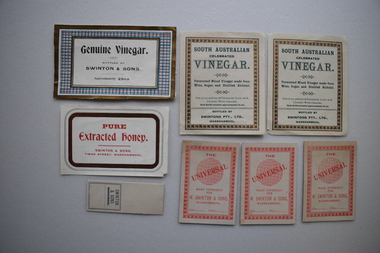
... These labels are of interest because Swintons stores have been of utmost importance in Warrnambool's history.Today it is one of the oldest family businesses in Australia .1 Genuine Vinegar BOTTLED BY SWINTON & SONS Approximately 25oz. .2 SOUTH AUSTRALIAN CELEBRATED VINEGAR . Fermented Mixed Vinegar made from Wine, Sugar, and Distilled Alcohol. Free of any addition of Commercial ...William and Ann Swinton came to Warrnambool in 1854. William was a carpenter and established a general store in Warrnambool in 1865. By 1888 the firm was known as William Swinton & Sons. After William died in 1901 the business was known as Swintons Pty. Ltd. After 1934 there were two branches of the business, George Swinton & Son and Swintons Pty. Ltd. These labels are of interest because Swintons stores have been of utmost importance in Warrnambool's history.Today it is one of the oldest family businesses in Australia.1 Rectangular paper label with white inner rectangle with black text surrounded by dark green, checked red and dark green gold coloured borders.It is adhered to a piece of white paper. It is damaged. .2,.3 Rectangular paper cream labels with dark green text and gold coloured decorative borders. .4 Rectangular paper white label with red text surrounded by a brown and two thin black borders. It is damaged. .5,.6,.7 Rectangular cream coloured card with red text and a sphere surrounded by a decorative border. .8 White paper rectangular label with dark blue text. It has remnants of an adhesive on the back. .1 Genuine Vinegar BOTTLED BY SWINTON & SONS Approximately 25oz. .2 SOUTH AUSTRALIAN CELEBRATED VINEGAR . Fermented Mixed Vinegar made from Wine, Sugar, and Distilled Alcohol. Free of any addition of Commercial Acetic Acid, COLOURED WITH CARAMEL. Each Bottle contains approximately 22oz. BOTTLED BY SWINTONS PTY.LTD.WARRNAMBOOL .4 PURE Extracted Honey SWINTON & SONS TIMOR STREET WARRNAMBOOL .5,.6,.7 THE UNIVERSAL MADE EXPRESSLY FOR W SWINTON & SONS, WARRNAMBOOL Size.....Price..... .8 SWINTON & SONS WARRNAMBOOL -
 Ballarat Tramway Museum
Print, Geoff Grant, 19/06/1955 12:00:00 AM
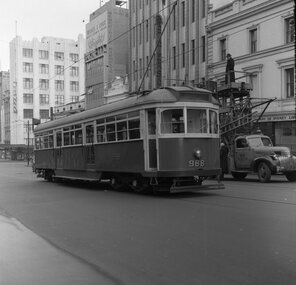
... Outside the Commercial Banking Company of Sydney Ltd. offices. Patersons ((furnishers) and Norman's corner stores - drapers building in view. ...Outside the Commercial Banking Company of Sydney Ltd. offices. Patersons ((furnishers) and Norman's corner stores - drapers building in view. ...Negative No. N325 and black and white print made by a laser printer (stored in folder ) of W6 988 in Bourke St. Melbourne alongside tower truck No. 2. Tram travelling west bound in Bourke St. just before Russell St. Outside the Commercial Banking Company of Sydney Ltd. offices. Patersons ((furnishers) and Norman's corner stores - drapers building in view. See page 6 of Sands & McDougall's Directory of Melbourne 1968 for details. Negative scanned hi res and imaged updated 21/5/2020. Page 6 of 1968 Sands and McDougall's directory of Melbourne.trams, tramways, melbourne, bourke st., testing overhead, commissioning, tram w6 988 -
 Ballarat Tramway Museum
Administrative record - Memorandum, State Electricity Commission of Victoria (SECV), "Protective Clothing - Eye Protection", Jul. 1959
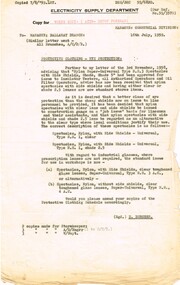
... Memorandum on Electricity Supply Department letterhead, foolscap, from the Manager of the Commercial Division to the Branch Manager with a copy to the Tram Depot Foreman, dated 16-7-1959, about the provision of eye protection spectacles to staff and the type of spectacles to be issued as a stores item. ...Trams tramways Personnel Safety Stories Memorandum on Electricity Supply Department letterhead, foolscap, from the Manager of the Commercial Division to the Branch Manager with a copy to the Tram Depot Foreman, dated 16-7-1959, about the provision of eye protection spectacles to staff and the type of spectacles to be issued as a stores item. ...Yields information about the provision of safety spectaculars to SEC staff., Yields information about the provision of safety spectaculars to SEC staff.Memorandum on Electricity Supply Department letterhead, foolscap, from the Manager of the Commercial Division to the Branch Manager with a copy to the Tram Depot Foreman, dated 16-7-1959, about the provision of eye protection spectacles to staff and the type of spectacles to be issued as a stores item. Signed E. Burgesstrams, tramways, personnel, safety, stories
