
Showing 16 items matching "company 98"
-
 Federation University Historical Collection
Booklet - Company '98, Henksan Printers, University of Ballarat Performing Arts through the Ballarat Academy of Performing Arts Company '98, 1998
... Company '98...University of Ballarat Performing Arts through the Ballarat Academy of Performing Arts Company '98...Company 98...Black and White folder with orange and white writing that contains photographs and details of Company '98. also included are notes belonging to Peter Tulloch ...Malthouse The Beckett Theatre Black and White folder with orange and white writing that contains photographs and details of Company '98. also included are notes belonging to Peter Tulloch University of Ballarat Performing Arts through the Ballarat Academy of Performing Arts Company '98 Booklet Company '98 Henksan Printers ...University of Ballarat is a predecessor of Federation University Black and White folder with orange and white writing that contains photographs and details of Company '98. also included are notes belonging to Peter Tulloch company 98, university of ballarat performing arts, ballarat academy of performing arts, bapa, peter tulloch, richard di gregorio, denis moran, kevin dee, heather kent, luke doxey, derren jackson, adelle gregory, collette bruggeman, jamie robertson, tim haymes, nadia andary, cassie arnold, sophie o'connor, sally buttle, wendy taylor, cancerto, chris dickins, c.u.b. malthouse, the beckett theatre -
Federation University Historical Collection
Book, Bedford McNeill, Mining and General Telegraphic Code, 1899, 1899
... This code is employed almost without exception by mining-companies and engineers, to whose use it was specially dedicated, and other business men have found it extremely practical for cable communications. [Nature 98...This code is employed almost without exception by mining-companies and engineers, to whose use it was specially dedicated, and other business men have found it extremely practical for cable communications. [Nature 98 ...McNeill's Code was arranged to meet the requirements of mining, metallurgical and civil engineers, Directors of Mining, Smelting companies; bankers; stock and share brokers, solicitors, accountants, financiers and general merchants. Bedford McNeil )Assoc. M. Inst. C.E.) was an Associate of the Royal School of Mines; Member of the Institution of Mining and metallurgy and of the north of England Institute of Mining and Mechanical Engineers; and a Fellow of the Geological Society. "OBITUARY - Mr. Bedford McNeill IT is with regret that we announce the death on September 18, due to cerebral hemorrhage, of Mr. Bedford McNeill, the well-known mining engineer, at fifty-five years of age. Apart from his high reputation as a mining engineer, Mr. McNeill’s name was almost a household word in connection with the telegraphic code compiled by him, which was issued originally in 1893, and in an enlarged and revised form in 1908. This code is employed almost without exception by mining-companies and engineers, to whose use it was specially dedicated, and other business men have found it extremely practical for cable communications. [Nature 98, 94-94 (05 October 1916)] Black hard covered book of 807 pages by Bedford McNeil. Contents include: General suggestions for using code; Morse signals, alphabet and figures; Timetable west of Greenwich; Timetable east of Greenwich; map; Alphabetical Code; Survey of Mineral Properties; Numbers; English Money; American money; Lineal measurement; Weights; Letters; Cables; banks; Finance Companies; Substitutions; Extra Code. The book includes the following advertisements: Nobel's Explosives Company; Otto Aerial Ropeways; Tabloid Medicine cases & Chests; Charleton's Report Book for Mining Engineers; Bornhardt's Electrical Firing Machine; On a page towards the front "R. Brook"morse code, mcneill, bedford mcneill, mining, noble's explosives company, otto, charleton, tabloid, bornhadt, brook, r. brook, telegraphy, morse -
 Greensborough Historical Society
Advertising Leaflet, Buckingham and Company Estate Agents, 1/198 St Helena Road Greensborough; and, 1 & 2/60 St Helena Road Greensborough, 2018_08
... Advertising for 1/98 St Helena Road Greensborough, 4 bedroom house, on market March 2019 for $850,000; and, 1 & 2/60 St Helena Road Greensborough, new development, 3 or 4 bedroom homes; previous sales of 60 St Helena Road, sold June 2015 for $520,000, and December 2014 $400,000. st helena road greensborough Colour page from real estate magazine, printed both sides. 1/198 St Helena Road Greensborough; and, 1 & 2/60 St Helena Road Greensborough Advertising Leaflet Buckingham and Company Estate Agents ...Advertising for 1/98 St Helena Road Greensborough, 4 bedroom house, on market March 2019 for $850,000; and, 1 & 2/60 St Helena Road Greensborough, new development, 3 or 4 bedroom homes; previous sales of 60 St Helena Road, sold June 2015 for $520,000, and December 2014 $400,000. Colour page from real estate magazine, printed both sides.st helena road greensborough -
 Bendigo Historical Society Inc.
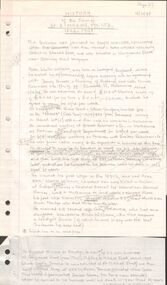
Document - IAN DYETT COLLECTION: HISTORY OF THE FIRM OF W. D. MASON PTY LTD 1894 - 1998
... BUSINESS Auctioneers j h curnow & son pty ltd Ian Dyett Collection - History of the Firm of W D Mason Pty Ltd 1894 - 1998 Owen Walter Williams Evening Mail Newspaper Henry Brooks & Co Shaw Savill & Albion Company Arawa (5026 Tons) Brooks Robinson & Co Walter Williams Gallipoli Samuel Thomas Williams Susan Rebecca Lawson Owen Mostyn Williams Ann (Annie) McKenzie Wavertree Ellen Williams Walter Davids Mason Alan Walter Mason Melva Joan Mason Wavertree Ellen Mason (nee Williams) J B Young Taylor Family Reed Smart & Tappin Bendigo Cathedral (Sacred Heart) A W & M H Mason New Zealand Ins Building Thelma Annie Taylor (nee Mason) Garnet James Taylor Walter David Mason Australian Window Glass Company Four pages of the History of the Firm of W. D. Mason Pty. Ltd. 1894 - 1998. Also four blank pages. Dated 16/12/98 ...Four pages of the History of the Firm of W. D. Mason Pty. Ltd. 1894 - 1998. Also four blank pages. Dated 16/12/98. A lot the same as Part a, but more information about the business, including the different locations of the business in Bendigo. Contained in a light yellow Viper File.business, auctioneers, j h curnow & son pty ltd, ian dyett collection - history of the firm of w d mason pty ltd 1894 - 1998, owen walter williams, evening mail newspaper, henry brooks & co, shaw savill & albion company, arawa (5026 tons), brooks robinson & co, walter williams, gallipoli, samuel thomas williams, susan rebecca lawson, owen mostyn williams, ann (annie) mckenzie, wavertree ellen williams, walter davids mason, alan walter mason, melva joan mason, wavertree ellen mason (nee williams), j b young, taylor family, reed smart & tappin, bendigo cathedral (sacred heart), a w & m h mason, new zealand ins building, thelma annie taylor (nee mason), garnet james taylor, walter david mason, australian window glass company -
 Bendigo Historical Society Inc.
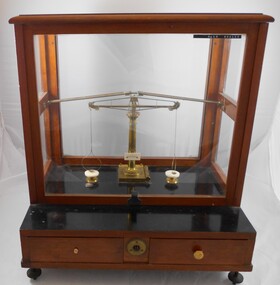
Tool - OERTLING SCALES IN GLASS CASE, 1898
... 98'. Written in pencil inside the drawer cavity is 'E.C' in fancy script. This refers to 'Charlie Craig, employed as an instrument maker by the Oertling Company. ...98'. Written in pencil inside the drawer cavity is 'E.C' in fancy script. This refers to 'Charlie Craig, employed as an instrument maker by the Oertling Company. ...The Oertling beam balance scale was used in the Bendigo School of Mines assay laboratory. The manufacturer, Ludwig Oertling (1818-1893), was born near Hamburg and gained his apprenticeship in instrument-making with his brother Johann. He immigrated to London in 1840, where he joined instrument-maker and assayer George Makins (1815-1893). Oertling collaborated with Makins and built his first balance, which was "a twin-column assay type with a light lattice beam". By 1851, the year of the Great International Exhibition of the Works of All Nations, Oertling had established his own instrument-making business, employed five instrument-makers and by 1861, ten staff were engaged in designing and making instruments, principally analytical balances. Oertling's first twin-column beam balance was the prototype for all Oertling assay balances that were produced during the next century and exported to the British colonies: Australia, New Zealand, Canada, South Africa and India, to Europe and America." Reference: Powerhouse Collection - https://collection.powerhouse.com.au/object/550913 Brass beam balance made by Oertling, London in 1898. The scale is mounted on a wooden base board with a mahogany case, glass on four sides with two drawers underneath. On bottom of the left hand drawer, written in pencil, is the works number '21736'. A cursive 'L' on the same drawer bottom indicates 'left'. Also on bottom corner 'J.W. 28.2.98'. 'J.W' was John Wright, foreman and cabinet maker. He was Oertling’s longest working cabinet maker from1886-1928. In pencil underneath the right corner of the left drawer is '3/98'. Written in pencil inside the drawer cavity is 'E.C' in fancy script. This refers to 'Charlie Craig, employed as an instrument maker by the Oertling Company. The maker's name, "Oertling' is embossed on the base of the scale. There is a brass knob that fits in the front to make adjustments to the scales and also on either side of the exterior case to set the top of the scales. 21736, J.W. 28.2.98, E.C., 3/98mining, equipment, scales, ludwig oertling, beam balance, assay, bendigo school of mines and industry -
 National Wool Museum
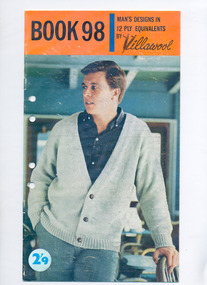
Book, Knitting, Villawool Knitting Book no. 98
... Knitting Handicrafts - history Villawood Textile Company Knitting Handicrafts - history BOOK 98 / MAN'S DESIGNS IN / 12 PLY EQUIVALENTS / BY / Villawool / 2'9 Villawool Knitting Book no. 98 Book, Knitting ...This knitting pattern book was published by the Villawood Textile Company, Sydney and contains knitting patterns for mens knitted garments. The photographs were taken on board the liner Orsova.BOOK 98 / MAN'S DESIGNS IN / 12 PLY EQUIVALENTS / BY / Villawool / 2'9knitting handicrafts - history, villawood textile company, knitting, handicrafts - history -
 Sunshine and District Historical Society Incorporated
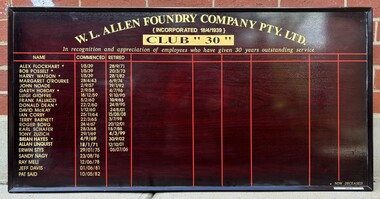
Honour Board - W. L. Allen Foundary Company Pty Ltd Club "30" Honour Board
... Allen Foundry Company Pty Ltd (Incorporated 18/4/1939) Club "30"|In recongnition and appreciation of employees who have given 30 years of outstanding service|Alex Flockhart 1/5/39 - 28/9/71|Bob Posselt 1/5/39 - 20/3/73|Harry Watson 1/5/39 - 28/1/82|Margaret O'Rouke 28/4/43 - 6/9/74|John Hoade 2/9/57 - 19/1/92|Garth Hobday 2/9/58 - 4/7/96|Luigi Gioffre 18/12/59 - 9/10/90|Frank Falukozi 5/2/60 - 10/9/03|Donald Dean 22/2/60 - 24/8/95|David McKay 1/12/60 - 24/8/01|Ian Corby 25/11/64 - 15/08/08|Terry Barnett 22/3/65 - 3/7/98|Roger Borg 24/4/67 - 20/12/01|Karl Schafer 28/3/68 - 15/7/05|Tony Zuzich 29/1/69 - 4/3/99|Brian Hayes 4/9/69 - 30/9/02|Allan Linquist 18/1/71 - 12/10/01|Erwin Stys 29/01/75 - 06/07/06|Sandy Nagy 23/08/76 -|Ray Meli 12/06/78 -|Jeff Davis 01/06/81 -|Pat Said 10/05/82 - Dark brown wooden item board with company name and employee names. ...Item came from the W. L. Allen Foundry located at 3 Hulett Street Albion.Dark brown wooden item board with company name and employee names.W. L. Allen Foundry Company Pty Ltd (Incorporated 18/4/1939) Club "30"|In recongnition and appreciation of employees who have given 30 years of outstanding service|Alex Flockhart 1/5/39 - 28/9/71|Bob Posselt 1/5/39 - 20/3/73|Harry Watson 1/5/39 - 28/1/82|Margaret O'Rouke 28/4/43 - 6/9/74|John Hoade 2/9/57 - 19/1/92|Garth Hobday 2/9/58 - 4/7/96|Luigi Gioffre 18/12/59 - 9/10/90|Frank Falukozi 5/2/60 - 10/9/03|Donald Dean 22/2/60 - 24/8/95|David McKay 1/12/60 - 24/8/01|Ian Corby 25/11/64 - 15/08/08|Terry Barnett 22/3/65 - 3/7/98|Roger Borg 24/4/67 - 20/12/01|Karl Schafer 28/3/68 - 15/7/05|Tony Zuzich 29/1/69 - 4/3/99|Brian Hayes 4/9/69 - 30/9/02|Allan Linquist 18/1/71 - 12/10/01|Erwin Stys 29/01/75 - 06/07/06|Sandy Nagy 23/08/76 -|Ray Meli 12/06/78 -|Jeff Davis 01/06/81 -|Pat Said 10/05/82 -w. l. allen, honour board, hulett street, albion -
Moorabbin Air Museum
Manual (Item) - De Havilland Mosquito MK. 41 Electrics, D.H.98 - Mk41 Electrics
... De Havilland Aircraft Company Ltd D.H.98 - Mk41 Electrics Manual De Havilland Mosquito MK. 41 Electrics ...De Havilland Aircraft Company Ltd -
 Whitehorse Historical Society Inc.
Artwork, other - Ink Line Drawing, Margaret Picken, 7 Valma Crt., Forest Hill, 1998
... companies over sole contractors. This artwork is of Historical Significance as a record of local domestic architecture. Whitehorse Historical Society Schwerkolt Cottage Housing Architecture Margaret Picken House Garden Forest Hill Real Estate 7 Valma Crt., Forest Hill Margaret Picken -98 Woodards B/Burn A black ink line drawing on drafters film by Margaret Picken, of 7 Valma Crt., Forest Hill depicting a single story weatherboard house set back from a front lawn. ...A property illustration by Margaret Picken Commissioned by a real estate agency for the purpose of advertising 7 Valma Crt., Forest Hill This property is listed as having sold for $160,500 in 1998. Made by using Rotring ‘Rapidigraph’ drafting pens with Rotring ink on Rapidigraph polyester drafting film, double matte. Trained as a cartographic draftsman within the mining industry, Margaret Picken is an artist who worked producing property illustrations for real estate agencies in eastern suburbs of Victoria from 1983-2005. Retiring from the industry as technological changes favored coloured photography over illustrations, and commissioning companies over sole contractors.This artwork is of Historical Significance as a record of local domestic architecture.A black ink line drawing on drafters film by Margaret Picken, of 7 Valma Crt., Forest Hill depicting a single story weatherboard house set back from a front lawn. On the left is a driveway leading to a separate garage There are two hole punch holes near the centre of the upper edge.7 Valma Crt., Forest Hill Margaret Picken -98 Woodards B/Burnwhitehorse historical society, schwerkolt cottage, housing, architecture, margaret picken, house, garden, forest hill, real estate -
 8th/13th Victorian Mounted Rifles Regimental Collection
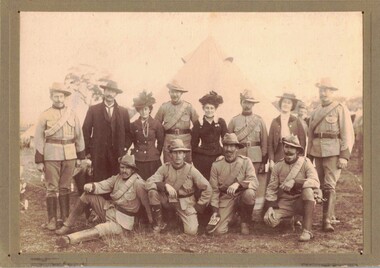
Photograph - VMR c.1900
... Companies of the Victorian Mounted Rifles were raised in rural districts throughout Victoria. The soldiers were paid a small annual allowance and were required to provide their own horse. Many members served in contingent to the Boer War. After Federation the VMR was gathered up into the Australian Light Horse. VMR Boer War Colonial training uniform Ink stamp on reverse: "Hewitt / Photographer / 98 ...The Victorian Mounted Rifles was raised as the mounted arm of the Victorian Colonial defence force in 1885. It was under the command of Colonel Thomas Caradoc Rose (Tom) Price (1842-1911). Price was born in Tasmania, educated in Hobart Town and at Scotch College, Melbourne, before entering the East India Military College, Addiscombe, England. He was commissioned on 7 July 1861 in the Madras Infantry and began twenty years’ service in India with several regiments, retiring in April 1883. On his return to Victoria he was tasked with raising of a force of one thousand, to be known as the Victorian Mounted Rifles, and appointed a lieutenant-colonel in the Permanent Military Forces. Companies of the Victorian Mounted Rifles were raised in rural districts throughout Victoria. The soldiers were paid a small annual allowance and were required to provide their own horse. Many members served in contingent to the Boer War. After Federation the VMR was gathered up into the Australian Light Horse. Black and white photograph of group of Victorian Mounted Rifles soldiers posed with a gentleman and three ladies. Occasion is probably open day at a camp of training. Photograph is professionally mounted o backing card.Ink stamp on reverse: "Hewitt / Photographer / 98 Simpson Street east Melbourne / Weddings and picnics attended / Extra copies may be obtained"vmr, boer war, colonial, training, uniform -
 Whitehorse Historical Society Inc.
Artwork, other - Ink Line Drawing, Margaret Picken, 23 Laburnum St., B/Burn, 1998
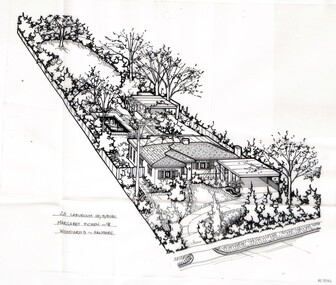
... companies over sole contractors. This artwork is of Historical Significance as a record of local domestic architecture. Whitehorse Historical Society Schwerkolt Cottage Housing Architecture Margaret Picken House Garden Real Estate Pool Blackburn 23 Laburnum St., B/Burn Margaret Picken - 98 Woodards - Hawthorn A black ink line drawing on drafters film by Margaret Picken, of a single story brick house from a left angled street birds eye view. ...A property illustration by Margaret Picken Commissioned by a real estate agency for the purpose of advertising 23 Laburnum St., Blackburn This property is listed as having sold for $553,000 in 1998 Made by using Rotring ‘Rapidigraph’ drafting pens with Rotring ink on Rapidigraph polyester drafting film, double matte. Trained as a cartographic draftsman within the mining industry, Margaret Picken is an artist who worked producing property illustrations for real estate agencies in eastern suburbs of Victoria from 1983-2005. Retiring from the industry as technological changes favored coloured photography over illustrations, and commissioning companies over sole contractors.This artwork is of Historical Significance as a record of local domestic architecture.A black ink line drawing on drafters film by Margaret Picken, of a single story brick house from a left angled street birds eye view. On the left is a driveway curving to a separate carport on the right in front of the house, leading to a second larger carport in the backyard. Pointed hedges fence in the front garden, which features ornamental trees and a small pond. The fenced backyard has a pool on the left and beyond that is a large space of open lawn and trees. There are two holepunch holes on just under the upper edge.23 Laburnum St., B/Burn Margaret Picken - 98 Woodards - Hawthornwhitehorse historical society, schwerkolt cottage, housing, architecture, margaret picken, house, garden, real estate, pool, blackburn -
 Whitehorse Historical Society Inc.
Artwork, other - Ink Line Drawing, Margaret Picken, 7 Laurel Gve., B/Burn, 1995
... companies over sole contractors. This artwork is of Historical Significance as a record of local domestic architecture. Whitehorse Historical Society Schwerkolt Cottage Housing Architecture Margaret Picken House Garden Real Estate Blackburn 7 Laurel Gve., B/Burn Margaret Picken - 98 Woodards - C'Well A black ink line drawing on drafters film by Margaret Picken, of a black and white line drawing of a single story brick house, with three dormer windows, and portico over the front door. ...A property illustration by Margaret Picken Commissioned by a real estate agency for the purpose of advertising 7 Laurel Gve, Blackburn This property is listed as having sold in for $840,000 in 1995 Made by using Rotring ‘Rapidigraph’ drafting pens with Rotring ink on Rapidigraph polyester drafting film, double matte. Trained as a cartographic draftsman within the mining industry, Margaret Picken is an artist who worked producing property illustrations for real estate agencies in eastern suburbs of Victoria from 1983-2005. Retiring from the industry as technological changes favored coloured photography over illustrations, and commissioning companies over sole contractors.This artwork is of Historical Significance as a record of local domestic architecture.A black ink line drawing on drafters film by Margaret Picken, of a black and white line drawing of a single story brick house, with three dormer windows, and portico over the front door. In the center is a driveway leading to a separate double garage with dormer windows. To the right is a wooden fence and gate connecting to the house. In the foreground is a wrought iron and brick post fence enclosing the front yard which features a path to the front door, a greenery and a tree to the right. There are two holepunch holes on just under the upper edge.7 Laurel Gve., B/Burn Margaret Picken - 98 Woodards - C'Wellwhitehorse historical society, schwerkolt cottage, housing, architecture, margaret picken, house, garden, real estate, blackburn -
 Heidelberg Theatre Company Inc..
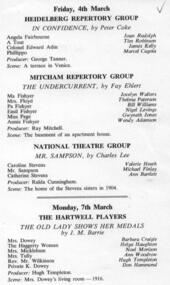
Special Events, In confidence by Peter Coke directed by George Tanner
... 98...City of Heidelberg Repertory Group...heidelberg theatre company...1966 98 City of Heidelberg Repertory Group heidelberg theatre company inc director George Tanner In confidence by Peter Coke directed by George Tanner Special Events ...1966, 98, city of heidelberg repertory group, heidelberg theatre company inc, director george tanner -
 The 5th/6th Battalion Royal Victoria Regiment Historical Collection
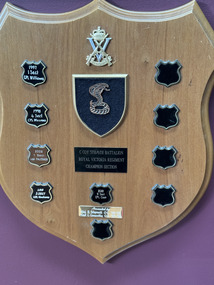
Honour Board - Champion Section, 5/6 Battalion Champion Section Honour Board
... 98. The honour board contains the unit badge and the company symbol...98. The honour board contains the unit badge and the company symbol 5/6 Battalion Champion Section Honour Board Honour Board Champion Section ...The Honour Board of C Coy 5/6 RVR Champion Section, it has recorded the champion section between 1997-1998, 2009-2010, and 2022, there are no other records, it also contains the name of the OC during 95-98. The honour board contains the unit badge and the company symbol -
 Department of Energy, Environment and Climate Action
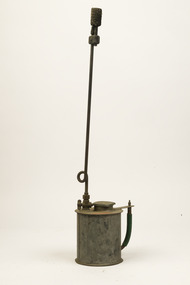
Driptorch - hand held - unknown date, design or manufacturer
... company in the 1940s. The Pacific Forester is slightly different in design from the more robust and common “Panama” driptorch first manufactured in 1933 and used extensively by Queensland cane farmers. The Panama is closely related to the current “Firebug” used in Victoria which is manufactured by Rodney Industries in Brisbane. The fuel is a mixture of petrol and diesel and every FCV District had their own closely-guarded secret formula ... 2:1, 3:1, 1:1, 4:1 or 3:2 ratio. There was also the choice of 91, 95 or 98...company in the 1940s. The Pacific Forester is slightly different in design from the more robust and common “Panama” driptorch first manufactured in 1933 and used extensively by Queensland cane farmers. The Panama is closely related to the current “Firebug” used in Victoria which is manufactured by Rodney Industries in Brisbane. The fuel is a mixture of petrol and diesel and every FCV District had their own closely-guarded secret formula ... 2:1, 3:1, 1:1, 4:1 or 3:2 ratio. There was also the choice of 91, 95 or 98 ...The origins of the humble handheld driptorch have been lost in time. They are widely used for ignition in controlled burning operations in forest and grasslands. The date, origins and manufacturer of this particular model are unknown. The “Pacific Forester“ with its short central wand and somewhat leaky ball-valve was made by the American Wajax company in the 1940s. The Pacific Forester is slightly different in design from the more robust and common “Panama” driptorch first manufactured in 1933 and used extensively by Queensland cane farmers. The Panama is closely related to the current “Firebug” used in Victoria which is manufactured by Rodney Industries in Brisbane. The fuel is a mixture of petrol and diesel and every FCV District had their own closely-guarded secret formula ... 2:1, 3:1, 1:1, 4:1 or 3:2 ratio. There was also the choice of 91, 95 or 98 octane petrol mixed with summer or winter diesel. Occasionally some of the old Avgas or Jet-A1 lying around the depot was added with a splash of engine oil to make the mixture stick to the fuel to be ignited. The fuel mixed also varied between autumn or spring, heathland, mixed forest, or high-intensity slash burnsEarly driptorch designDrip torch with handle Wand has loop and valve. The loop is designed to assist with even flow of fuel which flows out onto the burning head of the wand. Soldered tin fuel container which holds burner mix. Gravitational feed of the driptorch allows the unit to drip fire, making it simple and quick to operate. bushfire, forests commission victoria (fcv) -
 City of Melbourne Libraries
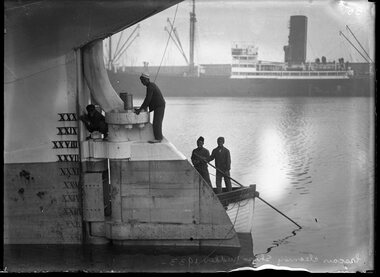
Photograph, Bull, Hugh Jones, 1897-1993, Lascars cleaning ship's rudder
... company by Australian-owned Burns Philp, with Australian Government assistance, and it was instrumental in ensuring the shipment of rice from Vietnam to Papua New Guinea. Rice is still a household staple in PNG. Despite it being introduced into PNG more than 100 years ago, the crop has not been sufficiently integrated into the country’s traditional agricultural production system, and today PNG imports still account for nearly 98% of rice. ...company by Australian-owned Burns Philp, with Australian Government assistance, and it was instrumental in ensuring the shipment of rice from Vietnam to Papua New Guinea. Rice is still a household staple in PNG. Despite it being introduced into PNG more than 100 years ago, the crop has not been sufficiently integrated into the country’s traditional agricultural production system, and today PNG imports still account for nearly 98% of rice. ...Published: unknown, however, on 26 June 1935 a similar, but not the exact photo in the McKenzie Collection, was published in The Age: Published title: Shipping Victorian Flour to the East Published Caption: Flour and wheat figure prominently in all cargoes carried by ships trading to Chinese, Japanese and Eastern ports. Victorian millers are eager to extend lids outlet for their produce, and every opportunity is grasped. The pictures show Australian labourers unloading from railway trucks some of the 2300 tons of flour which will go into the hold of the Burns, Philp motor ship Neptuna for shipment to Hong Kong, while Chinese seamen are busy cleaning and painting the rudder post of the ship. Hard by the Neptuna, other ships are taking on flour for the East. Research by Project Volunteer, Louise McKenzie: The image was described by Hugh Bull on the rear of the glass plate as – “Lascars cleaning ships rudder 1933”. Basically, a “lascar” is a seaman. Image No. 032 in the McKenzie Collection shows two lascars perched on the rudder of a ship, with two others standing in a rowboat along side. They are dressed in baggy trousers and jackets and wearing caps. Across a very calm dock area is a single funnel ship with on-deck derricks. The rudder of the ship being cleaned is white, with large black roman numbering denoting the depth at which the ship is sitting, depending on whether it is loaded or empty. Whilst the exact photo in the McKenzie Collection has yet to be located in The Age in 1933, the date when it was taken, there is a photo published in The Age on 25 June 1935 which appears to be one of a series of photos taken on the same day, featuring lascars cleaning a ship’s rudder. It bears a striking resemblance to MCK 032, but it is taken from a slightly different angle. The 1935 published photo is a close up of a ship’s rudder being cleaned, with same style of roman numerals in black on the white of the rudder. One lascar is standing on the rudder, one is standing in a small clinker style rowboat, with its characteristic wooden overlapping hull planks, holding a broom; two more lascars are sitting in the bow and stern of the rowboat. The ship being cleaned is in a dock, as a wharf and warehouses can be seen in the background, the water is very calm, and there are two other ships moored nearby – one across the other side of the dock with a black and white hull and derricks on its deck, and one adjacent, with its mooring lines clearly visible. The lascars are wearing caps, baggy trousers and jackets. Compelling similarities therefore exist between the two images. Whilst it is difficult to positively identify the cultural background of these particular lascars in either photo, the newspaper article dated June 1935 advises they are “Chinese”. This is possibly because the ship they are associated with, the Neptuna, is reported to have sailed from Melbourne on this date, bound for Hong Kong. However, the men are probably from South East Asia. Wikipedia describes the term “Southeast Asia” as covering ” … the people of Southeast Asia from prehistory to the present in two distinct sub-regions: Mainland Southeast Asia (or Indochina) and Maritime Southeast Asia (or Insular Southeast Asia). Mainland Southeast Asia comprises Cambodia, Laos, Myanmar (or Burma), Peninsular Malaysia, Thailand and Vietnam whereas Maritime Southeast Asia comprises Brunei, Cocos (Keeling) Islands, Christmas Island, East Malaysia, East Timor, Indonesia, Philippines and Singapore. Additionally, Wikipedia “Lascars” states that “Lascars were sailors from the Indian subcontinent, South East Asia, the Arab world, British Somaliland and lands east of the Cape of Good Hope, who were employed to work on colonial merchant ships. The practice ran from the 16th century to the mid 20th century”. Indian seamen were used as early as the 16th century by Portuguese explorer Vasgo da Gama in his successful voyage to India, and subsequently by Portuguese ships in the 16th and 17th centuries. “Through the Portuguese and Spanish maritime world empires, some Indian lascars found their way onto English merchant ships, and were among the sailors on the first English East India Company (EIC) ships to sail to India.” In the 17th Century “When the English adopted the term "lascar", they initially used it for all Asian sailors on English-flagged ships, but after 1661 and the Portuguese ceded Bombay to England, the term was used mainly to describe Indian sailors specifically. The term "topaze" was used to describe Indo-Portuguese personnel, especially those from Bombay, Thana, Diu, Dammam and Cochin. The term "sepoy" was used to describe Indian soldiers in European service. The number of lascars employed on EIC East Indiamen was so great that the Parliament of England restricted their employment via the Navigation Acts (in force from 1660 onwards) which required that 75% of the crew onboard English-flagged ships importing goods from Asia be English subjects. The restriction arose due to the high rates of illnesses and death among European sailors on East Indiamen, and their frequent desertions in Asia, which left such ships short of crew for the return voyage. Another reason was the frequent impressment of European sailors from EIC East Indiamen by the Royal Navy in times of war“. The term “impressment” colloquially refers to “the “press gang” …”a type of conscription of people into a military force, especially a naval force, via intimidation and physical coercion, conducted by an organized group (hence “gang”). .. The large size of the British Royal Navy in the Age of Sail meant impressment was most commonly associated with Great Britain.”. (Wikipedia – Impressment). By the 20th century these sailors served on British ships under "lascar agreements", which allowed shipowners more control than was the case in ordinary articles of agreement. The sailors could be transferred from one ship to another and retained in service for up to three years at one time. “Lascars served all over the world in the period leading up to the First World War. Lascars were barred from landing at some ports, such as in British Columbia. At the beginning of World War I, there were 51,616 lascars working on British merchant ships in and around the British Empire. In World War II thousands of lascars served in the war and died on vessels throughout the world, especially those of the British India Steam Navigation Company, P&O and other British shipping companies. The lack of Canadian naval manpower led to the employment of a total of 121 Catholic Goans and 530 Muslim British Indians on the Empress vessels of the Canadian Pacific Railway, such as the Empress of Asia and Empress of Japan. These ships served in the Indian Ocean both as ANZAC convoy ships and in actions at Aden. The ships were placed under the British Admiralty as part of Canada's contribution to the war effort and all of the Indian men were awarded medals by the Admiralty, though none of them were delivered. In the 1950s the use of the term "lascar" declined with the ending of the British Empire. The Indian “Lascar Act” of 1832 was finally repealed in 1963. However, "traditional" Indian deck and Pakistani engine crews continued to be used in Australia until 1986 when the last crew was discharged from the P&O and replaced by a general-purpose crew of Pakistanis. The term lascar has been widely used to engender an element of exoticism in literature eg “Sir Arthur Conan Doyle created a Lascar foil to Sherlock Holmes in "The Man with the Twisted Lip" in 1891. Lascars aboard the ship Patna figure prominently in the early chapters of Joseph Conrad's novel Lord Jim. Frances Hodgson Burnett's novel A Little Princess features a lascar named Ram Dass. Also, Caleb Carr portrays two lascars as bodyguards for a Spanish diplomat near the end of The Angel of Darkness. In Wuthering Heights, it is speculated that Heathcliff, the main character, may be of lascar origin." (Wikipedia – Lascar) And what has become of these “forgotten heroes of the World Wars”? The South Asian Heritage Trust, which seeks to commemorate, mark and celebrate South Asian cultures, stories, and communities, published an article in July 2025 entitled – The Lascars: Seafaring Roots of Modern Britain. It particularly honours the role of the 80,000 lascars who served Britain in WWI, and the over 100,000 who served in the British Merchant Navy in WWII, and concludes: “The hardships faced by Lascars were profound. They were often assigned the most dangerous tasks, lived in substandard conditions aboard ships and, even after their immense contributions to the war efforts, many veterans found it difficult to secure the recognition, pensions and rights afforded to other veterans. Many were employed under ‘Asiatic Articles’, which offered less protection and lower pay than their European counterparts. Yet, their legacy endures. The multicultural fabric of areas like East London owes much to these early seafarers and settlers. The East London Mosque, established in 1910, became an important spiritual and community hub. Today, efforts to bring their stories out of the shadows are growing. The Museum of London Docklands features exhibits on their history. Memorials, such as the P&O headstone in Dover for the 22 Lascar crew members of the SS Maloja sunk in 1916 and the careful restoration of the Lascar War Memorial in Kolkata, serve as important reminders of the sacrifices. The journey of the Lascars – from their homelands, along dangerous wartime shipping routes, to the docklands of Britain – is a story of personal courage and of a rich contribution to Britain’s history and identity.” The ship MV Neptuna, mentioned in the 1935 article, had that year been purchased from a German company by Australian-owned Burns Philp, with Australian Government assistance, and it was instrumental in ensuring the shipment of rice from Vietnam to Papua New Guinea. Rice is still a household staple in PNG. Despite it being introduced into PNG more than 100 years ago, the crop has not been sufficiently integrated into the country’s traditional agricultural production system, and today PNG imports still account for nearly 98% of rice. (Spotlight Magazine Sept. 2016) The 1935 newspaper article states that the Neptuna is involved in moving flour for the East. Australian wheat exports began in 1845, but were not regular until the 1870s. New land clearing methods in Australia allowed large tracts of land to be cleared more efficiently – this included the invention of the iconic ‘stump jump’ plough. With the success of the wheat harvests, flour mills began to spring up around the country. By the 1870s, many large country towns had their own mills, with around 500 mills producing flour across the country. Flour exports were an important part of the wheat industry until around the 1930s. After the Second World War, many of Australia’s export partners (which were mainly in the developing nations of Asia) began setting up their own flour industries and the Australian product was no longer in demand. In 1942 MV Neptuna was being utilised for the war effort, and carrying depth charges and other armaments for Australia, when on 19 February it was sunk in a bombing raid on Darwin, and where part of her hull still lies. References: SHIPPING VICTORIAN FLOUR TO THE EAST. (1935, June 25). The Age (Melbourne, Vic. : 1854 - 1954), p. 11. Retrieved July 23, 2025, from http://nla.gov.au/nla.news-article204357218 Age (Melbourne, Vic. : 1854 - 1954), Tuesday 25 June 1935, page 11 Wikipedia, Clinker (boat building), https://en.wikipedia.org/wiki/Clinker_(boat_building) Wikipedia, Lascar, https://en.wikipedia.org/wiki/Lascar Wikipedia, History of Southeast Asia, https://en.wikipedia.org/wiki/History_of_Southeast_Asia Wikipedia, Impressment, https://en.wikipedia.org/wiki/Impressment NEPTUNA LEAVES FOR CHINA WITH TOURISTS (1935, June 25). The Herald (Melbourne, Vic. : 1861 - 1954), p. 5. Retrieved July 23, 2025, from http://nla.gov.au/nla.news-article244841163 National Research Institute SPOTLIGHT paper Vol 9, Issue 7, https://pngnri.org/images/Publications/Spotlight_No_9_Vol_7_-_201609_-_Sofe__Odhuno_-_Rice_Import_Quota1.pdf South Asian Heritage Trust, The Lascars: Seafaring Roots of Modern Britain, July 11,2025 : Royal British Legion. https://southasianheritage.org.uk/royal-british-legion/the-lascars-seafaring-roots-of-modern-britain/ Photographer notations on slide: "Lascars cleaning ships rudder 1933".lascars, ships, 1930-1939, employment, ethnic communities
