
Showing 22 items matching "concrete footbridge"
-
 Flagstaff Hill Maritime Museum and Village
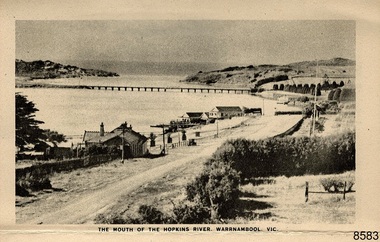
Postcard - Postcard Folder - scenes, George Rose, Rose Stereographic Company, Rose Series Picturesque Views of Warrnambool Australia [Warrnambool], 1880-1942
... ...concrete footbridge...Flagstaff Hill Maritime Museum and Village Great Ocean Road Shipwreck Coast Warrnambool Flagstaff Hill Flagstaff Hill Maritime Museum Flagstaff Hill Maritime Village Warramble postcard postcard folder Warrnambool Scenes Picturesque views of Warrnambool Picturesque views of Warramble Lady Bay Port of Warrnambool Breakwater Warrnambool Breakwater Viaduct Merri River footbridge Merri River suspension bridge suspension footbridge Merri River mouth Hopkins River mouth Proudfoot's Fanny Nelson Nelson's boatsheds Nelson's Boathouse boathouse Hopkins River boathouses Flett's boathouse Flett George Rose image of a rose Rose Series Rose Stereograph Co Rose Stereographic Company Lighograph Armadale Victoria Lady Bay beach beach scene Lower Light concrete footbridge 1922 footbridge Viaduct Road Rose postcard new concrete bridge 1945 1890 1922 small footbridge 1872 footbridge 1872 Merri River Estuary Stingray Bay postcards Image: [Rose with rosebud and leaves] Printed: "Rose Series / Picturesque Views of / WARRAMBOOL / AUSTRALIA" [correct spelling is WARRNAMBOOL] "PUBLISHED BY / ROSE STEREOGRAPH CO / ARMADALE. ...This postcard folder contains lithographs of photographs taken locally by Georg Rose between 1880 and 1942. He reproduced them at his company's premises, the Rose Stereographic Company at Armadale, Victoria. The postcard folder was purchased as a Warrnambool souvenir by the donor's parents around 1945 to 1950. Interestingly, the city on the cover is printed as "Warrambool", which is a location in New South Wales, but the postcards within all have the locations and text of Warrnambool. The photographs include the 'new' concrete bridge, built in 1922 to replace the original bridge, built in 1872. The boathouses belonging to Proudfoots and to Flett/Fanny Nelson are also pictured on the Hopkins River mouth. The twelve photographs included locations connected to other items in our Collection. The photographs are titled: - b. The Avenue and War Memorial. Warrnambool. Vic. c. The Blow-hole. Thunder Point. Warrnambool. Vic. d. Botanical Gardens. Warrnambool. Vic. e. Eagle Rock. Warrnambool. Vic. f. The New Concrete Bridge and Breakwater. Warrnambool. Vic. g. Liebig Street. Warrnambool. Vic. h. Looking to Thunder Point. Warrnambool. Vic. i. The Beach. Warrnambool. Vic. j. Hopkins Falls. Warrnambool. Vic. k. Shelly Beach. Warrnambool. Vic. l. The Mouth of the Hopkins River. Warrnambool. Vic. m. Panorama of Warrnambool. Vic. [Kepler Street towards Presbyterian Church on Spence St] George Rose, 1861-1942: - famous for his Late 19th and early 20th century photography. He was born in Clunes, Victoria, and was in his 20th year when he founded Rose Stereograph Company in 1880. He took the opportunity of a popular trend of the times to produce stereographs, pairs of almost duplicate photographs which appeared to be in 3D when viewed in a handheld stereo viewer. By the 1920s these lost their popularity, so he used his photographic skills to produce cards and postcards of scenes and people. The photographs in this postcard folder were taken between 1880 and 1942 by the renowned Victorian photographer George Rose. The locations match photographs and postcards in our collection that were taken at different times. A comparison between them shows the changes over time in the land and bay, the buildings and other structures, transportation and even the fashions of the times, building the story of our local history.This copy of a postcard folder has a blue-grey textured rectangular card cover with a sketch of a rose on the front along with the name of the postcard series. the location of the series' focus, the producer's details and lines for adding an address. The folded cover contains a long, concertinaed page with six titled photographs on each side, totalling twelve in all. Interestingly, the cover has the location name of "Warrambool", a place in NSW, instead of Warrnambool, the location of all of the photographs inside. The folder contains scenes from Warrnambool and nearby popular areas including Lady Bay, Port of Warrnambool, Warrnambool Breakwater, Viaduct, Merri River Footbridge, the Hopkins River Mouth, with Proudfoot’s and the Fanny Nelson/Flett boathouses. The cover has a sketch of a rose and inscriptions. The photographs for the lithographs were taken prior between 1880 and 1942 by well-known Victorian photographer, George Rose, Rose Stereograph Company of Armadale, Victoria.Image: [Rose with rosebud and leaves] Printed: "Rose Series / Picturesque Views of / WARRAMBOOL / AUSTRALIA" [correct spelling is WARRNAMBOOL] "PUBLISHED BY / ROSE STEREOGRAPH CO / ARMADALE. VIC." Printed lines (3) for an address. Printed rectangle [ ] for attaching a stamp.flagstaff hill maritime museum and village, great ocean road, shipwreck coast, warrnambool, flagstaff hill, flagstaff hill maritime museum, flagstaff hill maritime village, warramble, postcard, postcard folder, warrnambool scenes, picturesque views of warrnambool, picturesque views of warramble, lady bay, port of warrnambool, breakwater, warrnambool breakwater, viaduct, merri river footbridge, merri river suspension bridge, suspension footbridge, merri river mouth, hopkins river mouth, proudfoot's, fanny nelson, nelson's boatsheds, nelson's boathouse, boathouse, hopkins river boathouses, flett's boathouse, flett, george rose, image of a rose, rose series, rose stereograph co, rose stereographic company, lighograph, armadale victoria, lady bay beach, beach scene, lower light, concrete footbridge, 1922 footbridge, viaduct road, rose postcard, new concrete bridge, 1945, 1890, 1922, small footbridge, 1872 footbridge, 1872, merri river estuary, stingray bay, postcards -
 Flagstaff Hill Maritime Museum and Village
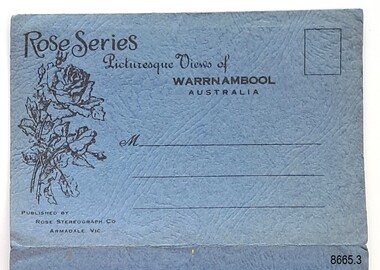
Postcard - Postcard Folder, scenes, George Rose, Rose Stereographic Company, Rose Series Picturesque Views of Warrnambool Australia, 1880-1942
... ...concrete footbridge...Flagstaff Hill Maritime Museum and Village Great Ocean Road Shipwreck Coast Warrnambool Flagstaff Hill Flagstaff Hill Maritime Museum Flagstaff Hill Maritime Village Warramble postcard postcard folder Warrnambool Scenes Picturesque views of Warrnambool Picturesque views of Warramble Lady Bay Port of Warrnambool Breakwater Warrnambool Breakwater Viaduct Merri River footbridge Merri River suspension bridge suspension footbridge Merri River mouth Hopkins River mouth Proudfoot's Fanny Nelson Nelson's boatsheds Nelson's Boathouse boathouse Hopkins River boathouses Flett's boathouse Flett George Rose image of a rose Rose Series Rose Stereograph Co Rose Stereographic Company Lighograph Armadale Victoria Lady Bay beach beach scene Lower Light concrete footbridge 1922 footbridge Viaduct Road Rose postcard new concrete bridge 1945 1890 1922 small footbridge 1872 footbridge 1872 Merri River Estuary Stingray Bay postcards Image: [Rose with rosebud and leaves] Printed: "Rose Series / Picturesque Views of / WARRNAMBOOL / AUSTRALIA" "PUBLISHED BY / ROSE STEREOGRAPH CO / ARMADALE. ...GEORGE ROSE 1861-1942: - George Rose was a well-known Victorian photographer, famous for his late 19th and early 20th century photography. He was born in Clunes, Victoria, and was in his 20th year when he founded Rose Stereograph Company in 1880. He took the opportunity of a popular trend of the times to produce stereographs, pairs of almost duplicate photographs that appeared in 3D when viewed in a handheld stereo viewer. By the 1920s, these lost their popularity, so he used his photographic skills to produce cards and postcards of scenes and people. The twelve photographs in the Rose postcard folders include locations connected to other items in our Collection, including the Valentine postcard folder in this set. The photographs are titled: - . The Avenue and War Memorial. Warrnambool. Vic. . The Blow-hole. Thunder Point. Warrnambool. Vic. . Botanical Gardens. Warrnambool. Vic. . Eagle Rock. Warrnambool. Vic. . The New Concrete Bridge and Breakwater. Warrnambool. Vic. . Liebig Street. Warrnambool. Vic. . Looking to Thunder Point. Warrnambool. Vic. . The Beach. Warrnambool. Vic. . Hopkins Falls. Warrnambool. Vic. . Shelly Beach. Warrnambool. Vic. . The Mouth of the Hopkins River. Warrnambool. Vic. . Panorama of Warrnambool, Vic. [Kepler Street towards Presbyterian Church on Spence St] The photographs in this postcard folder were taken between 1880 and 1942 by the renowned Victorian photographer George Rose. The locations match photographs and postcards in our collection that were taken at different times. A comparison between them shows the changes over time in the land and bay, the buildings and other structures, transportation and even the fashions of the times, building the story of our local history.Postcard folder, Rose Series, blue cover. One of a set of three containing images of Warrnambool and district before 1942. Green folder, textured cardboard folder containing a Z-folded strip of white matte photographic paper with six black and white photographs on each side. Titles are printed below the images. The folder is secured by placing two tabs into two slots on the back cover to hold the cover in place and create an envelope shape. Three horizontal lines are printed on the front for the receiver’s address. There is a logo of a long-stemmed rose on the left side and inscriptions on the front cover. The lithograph photographs were taken between 1880 and 1942 by well-known Victorian photographer George Rose and published by Rose Stereograph Company of Armadale, Victoria. The folder contains scenes of popular areas at Warrnambool and nearby locations including Lady Bay, the Port of Warrnambool, the Warrnambool Breakwater, the Viaduct, the Merri River Footbridge, the Hopkins River Mouth, and Proudfoot’s and the Fanny Nelson/Flett boathouses. Image: [Rose with rosebud and leaves] Printed: "Rose Series / Picturesque Views of / WARRNAMBOOL / AUSTRALIA" "PUBLISHED BY / ROSE STEREOGRAPH CO / ARMADALE. VIC." flagstaff hill maritime museum and village, great ocean road, shipwreck coast, warrnambool, flagstaff hill, flagstaff hill maritime museum, flagstaff hill maritime village, warramble, postcard, postcard folder, warrnambool scenes, picturesque views of warrnambool, picturesque views of warramble, lady bay, port of warrnambool, breakwater, warrnambool breakwater, viaduct, merri river footbridge, merri river suspension bridge, suspension footbridge, merri river mouth, hopkins river mouth, proudfoot's, fanny nelson, nelson's boatsheds, nelson's boathouse, boathouse, hopkins river boathouses, flett's boathouse, flett, george rose, image of a rose, rose series, rose stereograph co, rose stereographic company, lighograph, armadale victoria, lady bay beach, beach scene, lower light, concrete footbridge, 1922 footbridge, viaduct road, rose postcard, new concrete bridge, 1945, 1890, 1922, small footbridge, 1872 footbridge, 1872, merri river estuary, stingray bay, postcards -
 Flagstaff Hill Maritime Museum and Village
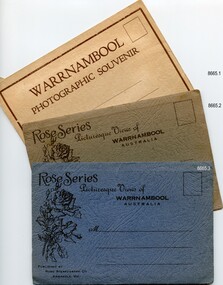
Postcard - Postcard Folder set, George Rose, Rose Stereographic Company, 1880-1942
... ...concrete footbridge...Flagstaff Hill Maritime Museum and Village Great Ocean Road Shipwreck Coast Warrnambool Flagstaff Hill Flagstaff Hill Maritime Museum Flagstaff Hill Maritime Village Warramble postcard postcard folder Warrnambool Scenes Picturesque views of Warrnambool Picturesque views of Warramble Lady Bay Port of Warrnambool Breakwater Warrnambool Breakwater Viaduct Merri River footbridge Merri River suspension bridge suspension footbridge Merri River mouth Hopkins River mouth Proudfoot's Fanny Nelson Nelson's boatsheds Nelson's Boathouse boathouse Hopkins River boathouses Flett's boathouse Flett George Rose image of a rose Rose Series Rose Stereograph Co Rose Stereographic Company Lighograph Armadale Victoria Lady Bay beach beach scene Lower Light concrete footbridge 1922 footbridge Viaduct Road Rose postcard new concrete bridge 1945 1890 1922 small footbridge 1872 footbridge 1872 Merri River Estuary Stingray Bay postcards Shipwrecked coast Maritime Museum Souvenir Warrnambool local scenes Hopkins River Botanic Gardens Soldiers’ Memorial Pier Post Office Municipal Buildings Merri River Proudfoot’s The Cliffs at Shelly Beach The Road to Sandy Beach tourism photographs visitors travel scenes local history mid-20th century 1940s 1950s Rose Stereograph Co Armadale. ...Each postcard folder in this set has no address, message or postage stamp. Postcard folders such as these were popular as holiday souvenirs in the early to mid-20th century and were kept in good condition by collectors. The size is convenient for posting to friends and relatives and packing as holiday luggage. Postcards in the early-to-mid-19th century were an inexpensive way to remember and share holiday scenes, as few people could afford a camera and the price of developing the photographs. The images on these postcards were produced from black and white lithographs of photographs taken at Warrnambool and the surrounding district during the early to mid-20th century. Publishing firms such as Melbourne-based Valentine and Rose purchased photographs from local photographers and reproduced them for sale. This set of postcard folders shows that more than one publishing company had access to the same or almost the same images. The photographs include street scapes, the Warrnambool Breakwater and Pier, Botanical Gardens, beach scenes, cliff formations, the Hopkins River, municipal buildings, the Post Office and the Soldiers’ Memorial. The postcard folders in this set of three are significant as a record of local history from the late 19th century to the mid-20th century. The locations of the images match photographs and postcards in our collection that were taken at different times and provide a historical record of the Warrnambool and southwest Victorian locations, growth and changes.. The images record changes in the coastline, land, bay, buildings and other structures, roads, transportation and even the fashions of the times. Set of three postcard folders containing black and white images of photographed scenes showcasing Warrnambool and district between 1880 and 1942. The images were produced from lithographs of the original photographs and are printed on both sides of long strips of white photographic paper that are Z-folded into covers of textured card. Some of the images are repeated in all three folders. Folder 8665.1 - the cream-coloured folder was produced by The Valentine Publishing Co. Pty. Ltd. Melbourne and contains 15 photographs, some of which are also in the blue and the green folders. Folders 8665.2, the green folder, and 8665.3, the blue folder, were published by Rose Stereograph Co, Armadale, Vic. Each contains the same twelve images, but they are presented in a different order. flagstaff hill maritime museum and village, great ocean road, shipwreck coast, warrnambool, flagstaff hill, flagstaff hill maritime museum, flagstaff hill maritime village, warramble, postcard, postcard folder, warrnambool scenes, picturesque views of warrnambool, picturesque views of warramble, lady bay, port of warrnambool, breakwater, warrnambool breakwater, viaduct, merri river footbridge, merri river suspension bridge, suspension footbridge, merri river mouth, hopkins river mouth, proudfoot's, fanny nelson, nelson's boatsheds, nelson's boathouse, boathouse, hopkins river boathouses, flett's boathouse, flett, george rose, image of a rose, rose series, rose stereograph co, rose stereographic company, lighograph, armadale victoria, lady bay beach, beach scene, lower light, concrete footbridge, 1922 footbridge, viaduct road, rose postcard, new concrete bridge, 1945, 1890, 1922, small footbridge, 1872 footbridge, 1872, merri river estuary, stingray bay, postcards, shipwrecked coast, maritime museum, souvenir, warrnambool local scenes, hopkins river, botanic gardens, soldiers’ memorial, pier, post office, municipal buildings, merri river, proudfoot’s, the cliffs at shelly beach, the road to sandy beach, tourism, photographs, visitors, travel, scenes, local history, mid-20th century, 1940s, 1950s, rose stereograph co armadale. vic, valentine publishing co. pty. ltd melbourne, valentine publishing co. pty. ltd sydney -
 Flagstaff Hill Maritime Museum and Village
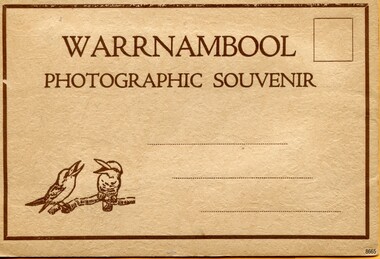
Postcard - Postcard Folder, scenes, Valentine & Sons Co. Publishing Ltd, Warrnambool Photographic Souvenir, Early-to-mod 20th century
... ...concrete footbridge...Flagstaff Hill Maritime Museum and Village Great Ocean Road Shipwreck Coast Warrnambool Flagstaff Hill Flagstaff Hill Maritime Museum Flagstaff Hill Maritime Village Warramble postcard postcard folder Warrnambool Scenes Picturesque views of Warrnambool Picturesque views of Warramble Lady Bay Port of Warrnambool Breakwater Warrnambool Breakwater Viaduct Merri River footbridge Merri River suspension bridge suspension footbridge Merri River mouth Hopkins River mouth Proudfoot's Fanny Nelson Nelson's boatsheds Nelson's Boathouse boathouse Hopkins River boathouses Flett's boathouse Flett George Rose image of a rose Rose Series Rose Stereograph Co Rose Stereographic Company Lighograph Armadale Victoria Lady Bay beach beach scene Lower Light concrete footbridge 1922 footbridge Viaduct Road Rose postcard new concrete bridge 1945 1890 1922 small footbridge 1872 footbridge 1872 Merri River Estuary Stingray Bay postcards concertina fold Z fold Shipwrecked coast Maritime Museum Souvenir Warrnambool local scenes photography local history tourism photographs visitors travel scenes mid-20th century 1940s 1950s Z-fold 1880s collection correspondence Valentine Publishing Co. ...This postcard folder is one of three in a set of postcards that were published in Victoria, Australia, and collected together. The Valentine Publishing Co. Pty. Ltd. produced this folder. Valentine and Sons was a printing and photography business based in Dundee, Scotland, and in Canada. In the early 1900s, at the height of the postcard craze, the firm published large numbers of postcards in the U.K., Canada, U.S., Australia and South Africa. From around 1900 or earlier, the firm bought many lithographic images for its postcards from local and national photographers who sold publishing rights to Valentines, and the business was famous for publishing photographs of popular sites worldwide. Postcard titles in this folder include many of those in the Rose postcard folders plus the following titles that are not duplicated. . Municipal Buildings and Post Office . Soldiers’ Memorial . Hopkins River . The Cliffs at Shelly Beach . The Road to Sandy Beach . The Breakwater and Pier This Valentine postcard folder was produced in Australia. It includes pictures from the early-to-mid 20th century. It is one of three in a set, with images of the same locations as other images in our collection but at different periods in time. Each postcard records a moment in history and is significant as a way to compare and show the changes in the local environment and community, building a story of the local history. The images record changes in the coastline, land, bay, buildings and other structures, roads, transportation and even the fashions of the times.Postcard folder, Valentine Publishing, cream cover. One of a set of three displaying images of Warrnambool and district around the mid-20th century. Print on the front and back covers is in brown ink. The front has an image of two laughing kookaburras on a branch, three address lines and an outline for a postage stamp. The back cover has the publisher’s details and a line for a return address. The cover opens like a book, and then the double-sided, Z-folded page of photographs drops downward. Titles are printed below each of the fifteen black and white photographs inside. The folder is secured on the back cover by placing a tab into a slot. The folder was produced by The Valentine Publishing Co. Pty. Ltd. Melbourne“WARRNAMBOOL / PHOTOGRAPHIC SOUVENIR” Symbol: [Two facing kookaburras standing on a branch with beaks open] “Published by The Valentine Publishing Co. Pty. Ltd. Melbourne” flagstaff hill maritime museum and village, great ocean road, shipwreck coast, warrnambool, flagstaff hill, flagstaff hill maritime museum, flagstaff hill maritime village, warramble, postcard, postcard folder, warrnambool scenes, picturesque views of warrnambool, picturesque views of warramble, lady bay, port of warrnambool, breakwater, warrnambool breakwater, viaduct, merri river footbridge, merri river suspension bridge, suspension footbridge, merri river mouth, hopkins river mouth, proudfoot's, fanny nelson, nelson's boatsheds, nelson's boathouse, boathouse, hopkins river boathouses, flett's boathouse, flett, george rose, image of a rose, rose series, rose stereograph co, rose stereographic company, lighograph, armadale victoria, lady bay beach, beach scene, lower light, concrete footbridge, 1922 footbridge, viaduct road, rose postcard, new concrete bridge, 1945, 1890, 1922, small footbridge, 1872 footbridge, 1872, merri river estuary, stingray bay, postcards, concertina fold, z fold, shipwrecked coast, maritime museum, souvenir, warrnambool local scenes, photography, local history, tourism, photographs, visitors, travel, scenes, mid-20th century, 1940s, 1950s, z-fold, 1880s, collection, correspondence, valentine publishing co. pty. ltd melbourne, valentine publishing co. pty. ltd sydney, municipal buildings and post office, soldiers’ memorial, hopkins river, the cliffs at shelly beach, the road to sandy beach, the breakwater and pier -
 Flagstaff Hill Maritime Museum and Village
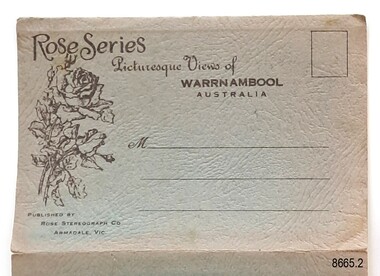
Postcard - Postcard Folder, scenes, George Rose, Rose Stereographic Company, Rose Series, Picturesque Views of Warrnambool Australia, 1880-1942
... ...concrete footbridge...Flagstaff Hill Maritime Museum and Village Great Ocean Road Shipwreck Coast Warrnambool Flagstaff Hill Flagstaff Hill Maritime Museum Flagstaff Hill Maritime Village Warramble postcard postcard folder Warrnambool Scenes Picturesque views of Warrnambool Lady Bay Port of Warrnambool Breakwater Warrnambool Breakwater Viaduct Merri River footbridge Merri River suspension bridge suspension footbridge Merri River mouth Hopkins River mouth Proudfoot's Fanny Nelson Nelson's boatsheds Nelson's Boathouse boathouse Hopkins River boathouses Flett's boathouse Flett George Rose image of a rose Rose Series Rose Stereograph Co Rose Stereographic Company Lighograph Armadale Victoria Lady Bay beach beach scene Lower Light concrete footbridge 1922 footbridge Viaduct Road Rose postcard new concrete bridge 1945 1890 1922 small footbridge 1872 footbridge 1872 Merri River Estuary Stingray Bay postcards green-grey postcard folder Shipwrecked coast Maritime Museum Souvenir Warrnambool local scenes photography local history tourism photographs visitors travel scenes mid-20th century 1940s 1950s concertina fold Z-fold 1880s collection correspondence Rose Stereograph Co Armadale Victorian photographer Soldiers’ Memorial Hopkins River The Cliffs at Shelly Beach The Road to Sandy Beach Pier Botanic Gardens Post Office Municipal Buildings Merri River Proudfoot’s Image: [Rose with rosebud and leaves] Printed: "Rose Series / Picturesque Views of / WARRNAMBOOL / AUSTRALIA" "PUBLISHED BY / ROSE STEREOGRAPH CO / ARMADALE. ...GEORGE ROSE 1861-1942: - George Rose was a well-known Victorian photographer, famous for his late 19th and early 20th century photography. He was born in Clunes, Victoria, and was in his 20th year when he founded Rose Stereograph Company in 1880. He took the opportunity of a popular trend of the times to produce stereographs, pairs of almost duplicate photographs that appeared in 3D when viewed in a handheld stereo viewer. By the 1920s, these lost their popularity, so he used his photographic skills to produce cards and postcards of scenes and people. The twelve photographs in the Rose postcard folders include locations connected to other items in our Collection, including the Valentine postcard folder in this set. The photographs are titled: - . The Avenue and War Memorial. Warrnambool. Vic. . The Blow-hole. Thunder Point. Warrnambool. Vic. . Botanical Gardens. Warrnambool. Vic. . Eagle Rock. Warrnambool. Vic. . The New Concrete Bridge and Breakwater. Warrnambool. Vic. . Liebig Street. Warrnambool. Vic. . Looking to Thunder Point. Warrnambool. Vic. . The Beach. Warrnambool. Vic. . Hopkins Falls. Warrnambool. Vic. . Shelly Beach. Warrnambool. Vic. . The Mouth of the Hopkins River. Warrnambool. Vic. . Panorama of Warrnambool, Vic. [Kepler Street towards Presbyterian Church on Spence St] This postcard folder shows scenes and places of interest in and around Warrnambool. The George Rose postcard folders in this set were produced in Victoria and include pictures taken by the renowned photographer between 1880 and 1942. Other postcards in our collection have photographs of the same or similar locations at different periods in time. Each postcard records a moment in history and is significant as a way to compare and show the changes in the local environment and community, building a story of the local history. The images record changes in the coastline, land, bay, buildings and other structures, roads, transportation and even the fashions of the times. This copy folder is one of a set of three. This folder has a green-grey textured rectangular card cover with a sketch of a rose on the front. The cover also contains the name of the postcard series, the location of the series' focus, the producer's details, and lines for adding an address. The folded cover contains a long, concertinaed page with six titled photographs on each side, totalling twelve. The folder contains scenes from Warrnambool and nearby popular areas, including Lady Bay, the Port of Warrnambool, the Warrnambool Breakwater, the Viaduct, the Merri River Footbridge, the Hopkins River Mouth, and Proudfoot’s and the Fanny Nelson/Flett boathouses. The cover has a sketch of a rose and inscriptions. The lithograph photographs were taken between 1880 and 1942 by well-known Victorian photographer George Rose, Rose Stereograph Company of Armadale, Victoria.Image: [Rose with rosebud and leaves] Printed: "Rose Series / Picturesque Views of / WARRNAMBOOL / AUSTRALIA" "PUBLISHED BY / ROSE STEREOGRAPH CO / ARMADALE. VIC."flagstaff hill maritime museum and village, great ocean road, shipwreck coast, warrnambool, flagstaff hill, flagstaff hill maritime museum, flagstaff hill maritime village, warramble, postcard, postcard folder, warrnambool scenes, picturesque views of warrnambool, lady bay, port of warrnambool, breakwater, warrnambool breakwater, viaduct, merri river footbridge, merri river suspension bridge, suspension footbridge, merri river mouth, hopkins river mouth, proudfoot's, fanny nelson, nelson's boatsheds, nelson's boathouse, boathouse, hopkins river boathouses, flett's boathouse, flett, george rose, image of a rose, rose series, rose stereograph co, rose stereographic company, lighograph, armadale victoria, lady bay beach, beach scene, lower light, concrete footbridge, 1922 footbridge, viaduct road, rose postcard, new concrete bridge, 1945, 1890, 1922, small footbridge, 1872 footbridge, 1872, merri river estuary, stingray bay, postcards, green-grey postcard folder, shipwrecked coast, maritime museum, souvenir, warrnambool local scenes, photography, local history, tourism, photographs, visitors, travel, scenes, mid-20th century, 1940s, 1950s, concertina fold, z-fold, 1880s, collection, correspondence, rose stereograph co armadale, victorian photographer, soldiers’ memorial, hopkins river, the cliffs at shelly beach, the road to sandy beach, pier, botanic gardens, post office, municipal buildings, merri river, proudfoot’s -
 Eltham District Historical Society Inc
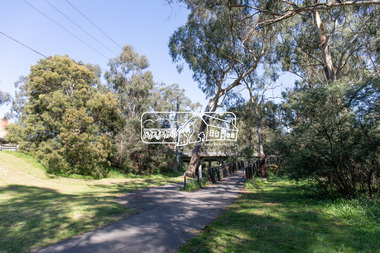
Photograph, Peter Pidgeon, Manna Gum, Main Road Bridge, Eltham South, 8 Sep. 2021
... footbridge over the Diamond Creek at Eltham dates back to the early 1900s. The original timber bridge over the Diamond Creek was built around 1840. It was destroyed by floodwaters in October 1923. A temporary bridge was rigged up but further damaged in April 1924. A new concrete...footbridge over the Diamond Creek at Eltham dates back to the early 1900s. The original timber bridge over the Diamond Creek was built around 1840. It was destroyed by floodwaters in October 1923. A temporary bridge was rigged up but further damaged in April 1924. A new concrete ...This significant tree located near the Main Road Bridge and Diamond Creek Trail footbridge over the Diamond Creek at Eltham dates back to the early 1900s. The original timber bridge over the Diamond Creek was built around 1840. It was destroyed by floodwaters in October 1923. A temporary bridge was rigged up but further damaged in April 1924. A new concrete bridge was built and opened in October 1926. The bridge decking was widened along with Main Road to Dalton Street by the Road Construction Authority in 1984., The uygraded bridge was opened in October 1984, 78 years after its original opening.These trees are not only significant for the natural environment but also present a navigational beacon back in time as the environmental landscape is developed around them.Born Digitaleltham south, main road bridge, manna gum, significant tree, diamond creek trail -
 Eltham District Historical Society Inc
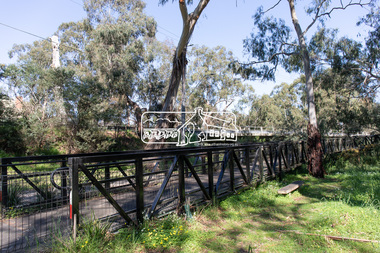
Photograph, Peter Pidgeon, Manna Gum, Main Road Bridge, Eltham South, 8 Sep. 2021
... footbridge over the Diamond Creek at Eltham dates back to the early 1900s. The original timber bridge over the Diamond Creek was built around 1840. It was destroyed by floodwaters in October 1923. A temporary bridge was rigged up but further damaged in April 1924. A new concrete...footbridge over the Diamond Creek at Eltham dates back to the early 1900s. The original timber bridge over the Diamond Creek was built around 1840. It was destroyed by floodwaters in October 1923. A temporary bridge was rigged up but further damaged in April 1924. A new concrete ...This significant tree located near the Main Road Bridge and Diamond Creek Trail footbridge over the Diamond Creek at Eltham dates back to the early 1900s. The original timber bridge over the Diamond Creek was built around 1840. It was destroyed by floodwaters in October 1923. A temporary bridge was rigged up but further damaged in April 1924. A new concrete bridge was built and opened in October 1926. The bridge decking was widened along with Main Road to Dalton Street by the Road Construction Authority in 1984., The uygraded bridge was opened in October 1984, 78 years after its original opening.These trees are not only significant for the natural environment but also present a navigational beacon back in time as the environmental landscape is developed around them.Born Digitaleltham south, main road bridge, manna gum, significant tree, diamond creek trail -
 Eltham District Historical Society Inc
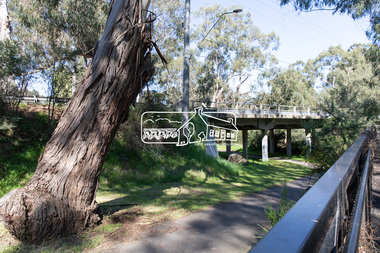
Photograph, Peter Pidgeon, Manna Gum, Main Road Bridge, Eltham South, 8 Sep. 2021
... footbridge over the Diamond Creek at Eltham dates back to the early 1900s. The original timber bridge over the Diamond Creek was built around 1840. It was destroyed by floodwaters in October 1923. A temporary bridge was rigged up but further damaged in April 1924. A new concrete...footbridge over the Diamond Creek at Eltham dates back to the early 1900s. The original timber bridge over the Diamond Creek was built around 1840. It was destroyed by floodwaters in October 1923. A temporary bridge was rigged up but further damaged in April 1924. A new concrete ...This significant tree located near the Main Road Bridge and Diamond Creek Trail footbridge over the Diamond Creek at Eltham dates back to the early 1900s. The original timber bridge over the Diamond Creek was built around 1840. It was destroyed by floodwaters in October 1923. A temporary bridge was rigged up but further damaged in April 1924. A new concrete bridge was built and opened in October 1926. The bridge decking was widened along with Main Road to Dalton Street by the Road Construction Authority in 1984., The uygraded bridge was opened in October 1984, 78 years after its original opening.These trees are not only significant for the natural environment but also present a navigational beacon back in time as the environmental landscape is developed around them.Born Digitaleltham south, main road bridge, manna gum, significant tree, diamond creek trail -
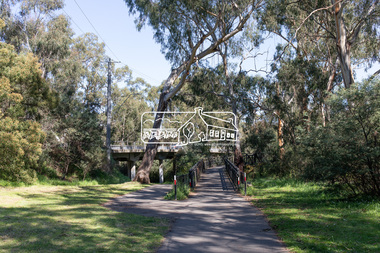 Eltham District Historical Society Inc
Photograph, Peter Pidgeon, Manna Gum, Main Road Bridge, Eltham South, 8 Sep. 2021
... footbridge over the Diamond Creek at Eltham dates back to the early 1900s. The original timber bridge over the Diamond Creek was built around 1840. It was destroyed by floodwaters in October 1923. A temporary bridge was rigged up but further damaged in April 1924. A new concrete...footbridge over the Diamond Creek at Eltham dates back to the early 1900s. The original timber bridge over the Diamond Creek was built around 1840. It was destroyed by floodwaters in October 1923. A temporary bridge was rigged up but further damaged in April 1924. A new concrete ...This significant tree located near the Main Road Bridge and Diamond Creek Trail footbridge over the Diamond Creek at Eltham dates back to the early 1900s. The original timber bridge over the Diamond Creek was built around 1840. It was destroyed by floodwaters in October 1923. A temporary bridge was rigged up but further damaged in April 1924. A new concrete bridge was built and opened in October 1926. The bridge decking was widened along with Main Road to Dalton Street by the Road Construction Authority in 1984., The uygraded bridge was opened in October 1984, 78 years after its original opening.These trees are not only significant for the natural environment but also present a navigational beacon back in time as the environmental landscape is developed around them.Born Digitaleltham south, main road bridge, manna gum, significant tree, diamond creek trail -
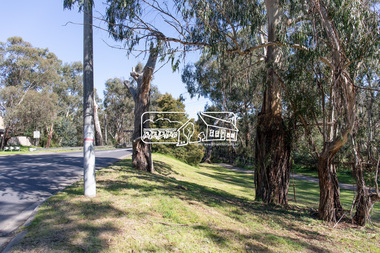 Eltham District Historical Society Inc
Photograph, Peter Pidgeon, Manna Gum, Main Road Bridge, Eltham South, 8 Sep. 2021
... footbridge over the Diamond Creek at Eltham dates back to the early 1900s. The original timber bridge over the Diamond Creek was built around 1840. It was destroyed by floodwaters in October 1923. A temporary bridge was rigged up but further damaged in April 1924. A new concrete...footbridge over the Diamond Creek at Eltham dates back to the early 1900s. The original timber bridge over the Diamond Creek was built around 1840. It was destroyed by floodwaters in October 1923. A temporary bridge was rigged up but further damaged in April 1924. A new concrete ...This significant tree located near the Main Road Bridge and Diamond Creek Trail footbridge over the Diamond Creek at Eltham dates back to the early 1900s. The original timber bridge over the Diamond Creek was built around 1840. It was destroyed by floodwaters in October 1923. A temporary bridge was rigged up but further damaged in April 1924. A new concrete bridge was built and opened in October 1926. The bridge decking was widened along with Main Road to Dalton Street by the Road Construction Authority in 1984., The uygraded bridge was opened in October 1984, 78 years after its original opening.These trees are not only significant for the natural environment but also present a navigational beacon back in time as the environmental landscape is developed around them.Born Digitaleltham south, main road bridge, manna gum, significant tree, diamond creek trail -
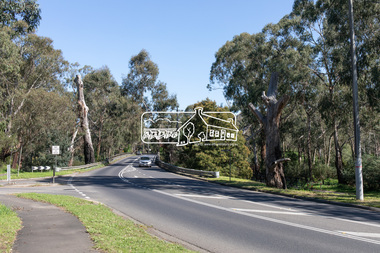 Eltham District Historical Society Inc
Photograph, Peter Pidgeon, Manna Gum, Main Road Bridge, Eltham South, 8 Sep. 2021
... footbridge over the Diamond Creek at Eltham dates back to around 1870-1880. The original timber bridge over the Diamond Creek was built around 1840. It was destroyed by floodwaters in October 1923. A temporary bridge was rigged up but further damaged in April 1924. A new concrete...footbridge over the Diamond Creek at Eltham dates back to around 1870-1880. The original timber bridge over the Diamond Creek was built around 1840. It was destroyed by floodwaters in October 1923. A temporary bridge was rigged up but further damaged in April 1924. A new concrete ...This significant tree located near the Main Road Bridge and Diamond Creek Trail footbridge over the Diamond Creek at Eltham dates back to around 1870-1880. The original timber bridge over the Diamond Creek was built around 1840. It was destroyed by floodwaters in October 1923. A temporary bridge was rigged up but further damaged in April 1924. A new concrete bridge was built and opened in October 1926. The bridge decking was widened along with Main Road to Dalton Street by the Road Construction Authority in 1984., The uygraded bridge was opened in October 1984, 78 years after its original opening.These trees are not only significant for the natural environment but also present a navigational beacon back in time as the environmental landscape is developed around them.Born Digitaleltham south, main road bridge, manna gum, significant tree, diamond creek trail -
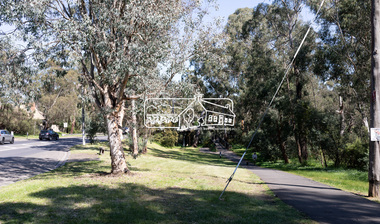 Eltham District Historical Society Inc
Photograph, Peter Pidgeon, Manna Gum, Main Road Bridge, Eltham South, 8 Sep. 2021
... footbridge over the Diamond Creek at Eltham dates back to around 1870-1880. The original timber bridge over the Diamond Creek was built around 1840. It was destroyed by floodwaters in October 1923. A temporary bridge was rigged up but further damaged in April 1924. A new concrete...footbridge over the Diamond Creek at Eltham dates back to around 1870-1880. The original timber bridge over the Diamond Creek was built around 1840. It was destroyed by floodwaters in October 1923. A temporary bridge was rigged up but further damaged in April 1924. A new concrete ...This significant tree located near the Main Road Bridge and Diamond Creek Trail footbridge over the Diamond Creek at Eltham dates back to around 1870-1880. The original timber bridge over the Diamond Creek was built around 1840. It was destroyed by floodwaters in October 1923. A temporary bridge was rigged up but further damaged in April 1924. A new concrete bridge was built and opened in October 1926. The bridge decking was widened along with Main Road to Dalton Street by the Road Construction Authority in 1984., The upgraded bridge was opened in October 1984, 78 years after its original opening.These trees are not only significant for the natural environment but also present a navigational beacon back in time as the environmental landscape is developed around them.Born Digitaleltham south, main road bridge, manna gum, significant tree, diamond creek trail -
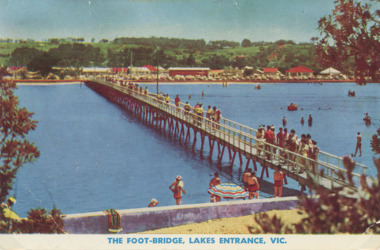 Lakes Entrance Historical Society
Photograph - Cunninghame Arm footbridge Lakes Entrance Victoria. c1955, Rose Series, 1955 c
... Cunninghame Arm footbridge showing crowd on bridge, cars parked on Esplanade, new concrete wall between dunes and lake at south end of bridge Lakes Entrance Victoria. ...Colour postcard taken from south end of the Cunninghame Arm footbridge showing crowd on bridge, cars parked on Esplanade, new concrete wall between dunes and lake at south end of bridge Lakes Entrance Victoria. c1955. ...Cunninghame Arm footbridge showing crowd on bridge, cars parked on Esplanade, new concrete wall between dunes and lake at south end of bridge Lakes Entrance Victoria. c1955. ...Cunninghame Arm footbridge showing crowd on bridge, cars parked on Esplanade, new concrete wall between dunes and lake at south end of bridge Lakes Entrance Victoria. c1955. Also another colour postcard similar view of footbridge made by Murray Views donor Susan Samuel 2 January 2015 number 04272.1, 9 x 14 cmColour postcard taken from south end of the Cunninghame Arm footbridge showing crowd on bridge, cars parked on Esplanade, new concrete wall between dunes and lake at south end of bridge Lakes Entrance Victoria. c1955. Also another colour postcard similar view of footbridge The Foot-Bridge, Lakes Entrance. Vicrecreation, waterfront, land reclamation, gippsland lakes -
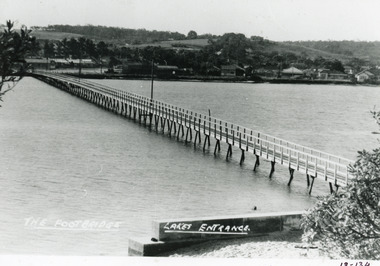 Lakes Entrance Historical Society
Photograph - Footbridge Lakes Entrance Victoria c1940, Bulmer HD
... 1 black and white copy 13x18 has glue on back|1 copy tinted 9x14 Bridges Waterways Township The Footbridge Lakes Entrance Black and white photograph of the foot bridge over the Cunninghame Arm. It shows a concrete wall at the edge of lake in foreground, two light poles on the bridge buildings on Esplanade and Myer Street. ...1 black and white copy 13x18 has glue on back|1 copy tinted 9x14Black and white photograph of the foot bridge over the Cunninghame Arm. It shows a concrete wall at the edge of lake in foreground, two light poles on the bridge buildings on Esplanade and Myer Street. The Footbridge Lakes Entrancebridges, waterways, township -
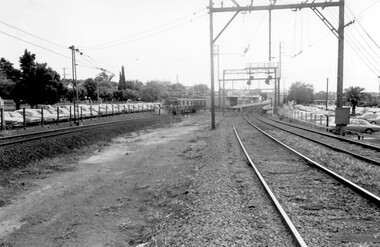 Surrey Hills Historical Society Collection
Photograph, Surrey Hills Station and car park
... At this time the original station buildings were demolished and replaced by buildings constructed from concrete bricks and a second subway replaced the overhead footbridge. According to Roderick Smith, a local railway enthusiast, originally there had been 3 railway houses at the Mont Albert end of the northern car park. ...At this time the original station buildings were demolished and replaced by buildings constructed from concrete bricks and a second subway replaced the overhead footbridge. According to Roderick Smith, a local railway enthusiast, originally there had been 3 railway houses at the Mont Albert end of the northern car park. ...There are 3 tracks; the third track was built in 1971, which gives an approximate date for the photo. At this time the original station buildings were demolished and replaced by buildings constructed from concrete bricks and a second subway replaced the overhead footbridge. According to Roderick Smith, a local railway enthusiast, originally there had been 3 railway houses at the Mont Albert end of the northern car park. These were demolished to extend the car park. Certainly 8 Bedford Avenue, built as the station master's house was demolished at this time. The palm tree had been planted in the station master's front garden and was retained in a small garden bed within the car park. A black and white photograph of a station with cars parked on both sides of the 3 tracks. A Harris train is departing the station heading towards Mont Albert. A palm tree is prominent in the station car park to the north.1971, surrey hills station, railway stations, car parks, public transport, trains, railway lines, palm tree -
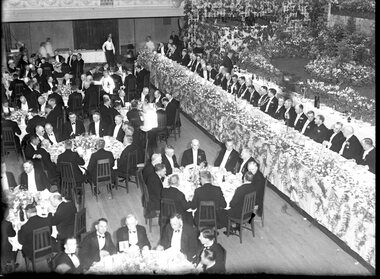 City of Melbourne Libraries
Photograph, Bull, Hugh Jones, 1897-1993, Lord Mayor's Dinner, Melbourne Town Hall
... concrete pillars with Art Deco-styled steamlined decoration. Each pillar supports a Victorian-style lamp. The infill railings are geometric-patterned painted metal. Construction began in late 1937, and it was opened by Premier Albert Dunstan on 22 December 1938. It replaced an earlier footbridge...concrete pillars with Art Deco-styled steamlined decoration. Each pillar supports a Victorian-style lamp. The infill railings are geometric-patterned painted metal. Construction began in late 1937, and it was opened by Premier Albert Dunstan on 22 December 1938. It replaced an earlier footbridge ...Photographer notations on slide: "General View Of Lord Mayor's Dinner At Town Hall Nov 1936 B112" Published: The Age, Tuesday 10 November 1936, page 13 Published title: LORD MAYOR'S BANQUET Published caption: The brilliant scene inside the Melbourne Town Hall last night during the Lord Mayor’s banquet. Trove article identifier: http://nla.gov.au/nla.news-article205939431 Description: 700 guests (all men) are seated around numerous tables in the Melbourne Town Hall for the Lord Mayor's dinner in November 1936. Before the stage is a top table of 35 men, all dressed smartly in black dinner suits, with either a black or white bow tie. Many are wearing their medals. The Lord Mayor has on his Mayoral chains, and to his right is the Governor of Victoria, Lord Huntingfield. The stage is heavily decorated with fresh flowers. Research by project volunteer, Louise McKenzie: This image takes up one quarter of the photographic space on page 13 of The Age on 10 November 1936, reflecting the importance of the event and also the sheer dramatics of the image: 700 guests (all men), a top table of 35, and all dressed smartly in black dinner suits, with either a black or white bow tie. Many are wearing their medals. The Lord Mayor has on his Mayoral chains, and to his right is the Governor of Victoria, Lord Huntingfield. Further to his right is a man with an impressive sash across his chest. It is a very animated, and rather informal, moment. Banks of fresh flowers smother the stage, which is decorated in the manner of a terrace at an English stately home. Tables are laden with food, drink and decorations, and the wait staff (men and women) are also formally dressed, in the manner of Downton Abbey. It is spectacular, dramatic, and luxurious, and perpetuates the proud descriptor of “Marvellous Melbourne” as conferred by London Journalist George Augustus Sala when he visited the city in 1885. During its 1880s boom, Melbourne was the second-largest city in the British Empire, after London, and reputedly the richest city in the world. At times the expression was used with some irony, but "...in Victoria’s centenary year, 1934, with the city mired in another depression, a publisher bravely entitled a book of souvenir photographs Marvellous Melbourne, claiming that the subject ‘still finds apt expression in the happy one-time sobriquet’.” This photo seems to reflect an ongoing pride in Melbourne and a desire for it to live up to its descriptor and celebrate its post-centenary era in style. So it is no surprise to find that on page 11 of The Age on the same day, a second photo is to be found – a cropped view of one table – along with a very detailed description of the night, its purpose, and a surprise announcement. But, who was the Lord Mayor in whose honour the dinner was held? In 1934, the Lord Mayor of Melbourne was Cr. Alexander George Wales, (born Richmond, 11 October 1885, died Elsterwick, 31 May 1962). His father was a contractor and quarry-owner, but was blinded in an industrial accident in 1899. Consequently Alexander, then aged 14, left Brunswick State School to become a railway labourer working at a quarry, and in 1903 joined the Commonwealth public service as a clerk and began studying at night school, determined to improve himself. In 1907 he was appointed secretary of the Albion Quarrying Co. (in which the family had an interest), then its managing director and chairman. As the Australian Dictionary of Biography notes, he was instrumental in expanding the company’s interests, "...becoming director of the Hardware Co. of Australia Pty Ltd, the Twentieth Century Building and Investment Society, the Albion Sand Co. and the Geelong Brick Co.”. His public career began in 1914 when he was elected to the Brunswick council. He was mayor 1917-18, and in 1925 progressed to the Melbourne City Council where he remained for 29 years, being a member of most council committees. He served three successive terms as lord mayor (1934-37), was Chairman of the council’s decorations committee for Melbourne’s centenary, president of the Metropolitan Fire Brigades Board (1936), and Chairman of the Public Works Committee (1937-39). In 1936 he was elected to the Legislative Council with United Australia Party support, but later resigned over possible State government contract tender irregularities. Wales received "the customary reward” of a knighthood and was invested at Buckingham Palace by King George VI whose coronation he attended in 1937. He was an early director of what is now Ampol, and helped the development of the petroleum industry in Australia after visiting the USA in 1943 and 1946. He was impressed by that country’s wartime shipbuilding efforts and supported closer ties with the USA. “While president (1947-48) of the Melbourne Chamber of Commerce, Wales was a vocal critic of the Federal Labor Government, ...a staunch anti-socialist ... and a focus for conservative opposition to the Curtin and Chifley governments...” He is described as “a natural leader in business and civic politics,... a powerful force in the Melbourne City Council... opposing democratic reforms such as the creation of a Greater Melbourne Council and the abolition of plural voting, but advocat[ing] the redevelopment of city-owned property like the Eastern and Western markets...” So, this Lord Mayor’s dinner marks the third successive term in office for Governor Cr. A G Wales. The room is filled with powerful and influential men, and provided a platform for the Premier of Victoria, Albert Dunstan (1882-1950, United Country party) to announce that if the City Council would bear half the cost the State Government would build a bridge at Punt Road “at once”. He announced that the Government proposed to have the bridge built by the Country Roads Board, and allow the City Council to pay its share on convenient terms, and further, it would investigate the shared provision of more Yarra bridges. The proposal for the Punt Road Bridge was met with applause as the Yarra River constituted a serious traffic barrier. On 12 November 1936, two days after the Lord Mayor’s dinner, The Age published an article, “Building without a Plan”. It questions the appropriateness of the next Yarra bridge being the one at Punt Road, and encourages a “proper procedure” to look at the provision of additional Yarra bridges as a whole. But in fact this topic had been canvassed back in August when Melbourne City Council’s public works committee had recommended the replacement of the footbridge at Punt Road with a bridge, and if the Country Roads Board would declare this portion of Punt Road, including the river crossing, a State Highway, this could give the Board authority to construct the bridge and allocate the cost. Hence the reference at the dinner to a shared expense. Still an integral part of traffic management today, the Hoddle Bridge carries Punt Road over the Yarra River between Richmond and South Yarra in Melbourne. It is a five-lane road bridge with narrow footpaths on either side. It is of continuous reinforced concrete T-beam construction with five segmental arched spans, supported on transverse piers, and linked by concrete cross-beams. “The piers terminate in a series of tapered concrete pillars with Art Deco-styled steamlined decoration. Each pillar supports a Victorian-style lamp. The infill railings are geometric-patterned painted metal. Construction began in late 1937, and it was opened by Premier Albert Dunstan on 22 December 1938. It replaced an earlier footbridge, which in turn had replaced a punt service. The bridge (originally referred to as Punt Road Bridge) was named after Robert Hoddle, who planned central Melbourne’s Hoddle Grid, the grid of streets which form Melbourne’s central business district. Hoddle arrived in Australia from the UK in 1823 and went on to carry out surveys in NSW and Queensland before arriving in Melbourne in 1837. He designed layouts for both Melbourne and Williamstown, and later Geelong and other Victorian country areas. He was keen that major streets be at least 30 metres wide. ”With remarkable foresight he provided for wide boulevards from the city to the suburbs, but the subdivisions of early speculators in inner suburbs created the bottle-necks of today. After the separation of the colony in 1851, he became Victoria’s first surveyor-general... and advocated the provision of three-chain (60 m) roads and the widening of all existing main roads from one (20 m) to three chains." However, he was met with constant opposition and in 1853, was eased out of office. As a small and interesting aside: Hoddle was appointed auctioneer for the first sale of crown land in Melbourne on 1 June 1837. His commission was 57 pounds 12s 7d. and he bought two allotments for himself at a cost of 54 pounds. After he died his second wife married Richard Buckhurst Buxton, a member of the family which in 1860s Melbourne established the Australian property dynasty of Buxton Real Estate, Becton, MAB Corporation etc. Returning to the dinner and The Age article of 10 November 1836: Another topic of the after-dinner speeches was a reference to the upcoming Armistice Day. “The Minister of Customs (Mr White) said the proximity of Armistice day reminded us that eighteen years ago we had high hopes of prolonged peace.” The term “Armistice Day” was coined after WWI: “At 11 am on 11 November 1918, the guns on the Western Front fell silent after more than four years of continuous warfare. The Germans called for an armistice (suspension of fighting) in order to secure a peace settlement. They accepted the allied terms on unconditional surrender. Therefore on the 11th hour of the 11th day of the 11th month, a minute’s silence is observed and dedicated to those soldiers who died fighting to protect the nation. Originally known as Armistice Day, it was renamed Remembrance Day after World War Two to commemorate those who were killed in both World Wars. Today it refers to the loss of Australian lives from all wars and conflicts, accompanied by the words, "We will remember them, Lest we forget"." There was comment at the dinner about the need to remain firm in supporting the “democratic government in the British Empire to avoid a “plunge into savagery”. There was a grave responsibility on the British people to keep democracy alive, and that could not be done without adequate defence forces... Many weak governments in non-British countries had been swept aside by strong-fisted dictators, who now were the real threat to peace”. With the benefit of hindsight these were very pertinent comments and tragically prophetic. The Melbourne Shrine of Remembrance had only been dedicated two years earlier, at a ceremony attended by the Duke of Gloucester, son of King George V. Over 300,000 citizens attended: one third of the population of Melbourne. It became the location for the Anzac Day Dawn Service. Originally the march travelled from the Shrine into the city, however, in 1936, this was reversed, and the Shrine became the termination point for Anzac Day Marches. Also significant in 1936, was the installation of a statue in the west forecourt of the Shrine: “The Man with the Donkey” (aka 'Private John Simpson and his Little Donkey'). The work is said to represent the “valour and compassion of the Australian soldier”. Its full citation, according to the City of Melbourne City Collection is: West Side of Base: "The / Man with his Donkey / Gallipoli, April 25 to May 19 / in Commemoration / of the valour and compassion / of the Australian Soldier" AFTER LANDING AT GALLIPOLI, SIMPSON, WITH HIS LITTLE DONKEY, WORKED ALONE, DAY AND NIGHT TAKING WATER TO THE FRONT LINE AND CARRYING THE WOUNDED BACK TO THE DRESSING STATIONS. HE AND HIS DONKEY WERE KILLED BY A SHRAPNEL SHELL ON THE 19TH MAY, 1915. SIMPSON WAS MENTIONED IN DISPATCHES BY SIR IAN HAMILTON, COMMANDER-IN-CHIEF OF THE MEDITERRANEAN EXPEDITIONARY FORCE. / Erected by Public Subscription under auspices of the / Red Cross Society. East Side of Base: Private John Simpson." Their summary in background states: "A bronze figure of Simpson and his donkey with a wounded man on the donkey's back on a granite pedestal. Private John Simpson Kirkpatrick’s intrepid and short-lived exploits during the Gallipoli campaign have made him a popular figure of World War One. He has been mythologised to represent the lauded values of the digger, and he symbolises all those who went into battle unarmed. Born in England in 1892, he came to Australia in 1910. He enlisted to make his way back to England, but as a member of the 3rd Field Ambulance AIA was sent to Gallipoli. After just three weeks of bearing wounded soldiers across Shrapnel Gully on the back of his donkey, Simpson was killed by shrapnel fire. Simpson’s story became a powerful propaganda tool for enlistment in Australia, but following the war he was quickly forgotten. With the Shrine of Remembrance nearing completion in 1933, the memory of Simpson was rekindled to commemorate all who gave their lives to help others during the war. One plaque reads: ‘The / Man with his donkey / Gallipoli … / In commemoration / of the valour and compassion / of the Australian soldier’. In 1935, Wallace Anderson’s design for the memorial was selected though a competition organised by the Australian Red Cross. Anderson had served during the war and worked at the Australian War Memorial after his return. His Man with the Donkey was cast in Italy, and after some debate was sited near the shrine. Unveiled 20th June, 1936." The sculptor, Victorian-born William Wallace Anderson (1888-1975), served in France during WWI and afterwards produced a number of bronze war memorials and memorial portraits, predominantly in Victoria. “His most famous work is that of Simpson and his Donkey (1935), which he completed after winning a competition conducted by the Victorian Division of the Australian Red Cross. Anderson’s fee was 350 pounds; the cast, made by the Chiurazzi Foundry, Naples, Italy, cost 40 pounds. The work... has become well known as a symbol of the Anzac tradition.” A debate as to the siting of the statue arose from a strong view expressed by General Sir John Monash that no representation of individual members of the Australian Defence Force be located on the Shrine itself. Hence its location off to the northwest of the forecourt, in a garden of rosemary. And finally we return to the photo of the grand Lord Mayor’s dinner! An article in The Argus of 4 November 1936 refers to “Brilliant Scene at Lord Mayor’s Ball – Hall Becomes a Garden”. So now it becomes clear why the Town Hall, location of the Lord Mayor’s Dinner on 10 November 1934, only 6 days later, is so lavishly decorated. The floral decorations from the Ball are still in place - an early example of “recycling”, which is gratifying to note at a time of Depression. The reporter has captured the scene with enthusiasm: “Hundreds of tiny rose lights, hidden among pink roses, transformed the Melbourne Town Hall into a magical garden last night, when the Lord Mayor and Lady Mayoress (Councillor A. C. Wales, M.L.C., and Mrs. Wales) entertained about 3,500 guests at a ball. His Excellency the Governor (Lord Huntingfield) and Lady Huntingfield were present, while Rear-Admiral and Mrs. Lane Poole and officers from the visiting squadron were among the special guests. The balconies all round the hall were hidden by a white trellis, covered with pink blossoms and greenery. Rosy flowers were issued up every pillar, and great golden lamps, hanging from the door, were seated in greenery and trails of sweet peas. The organ gallery was converted into a terrace garden with stone steps leading to banks of pink azaleas, pink pelargoniums, masses of calceolarias, and the lovely deep mauve and blue of cinerarias. Slender Japanese maples and poplar trees grew from the higher slopes amid thickets of hostas, while a fascinating illusion was created by the lofty conservatory windows, which formed the background, and which were tinted cerulean blue to simulate the sky seen through glass. Large fern baskets hung from the conservatory roof, and the whole scene was enclosed in trellises of blossom. In the entrance palm green shrubs stood like sentinels round the passed floor, and flowers bloomed in misty golds. The long corridor upstairs leading to the council chamber was lined with an avenue of poplar trees in tubs. In the Lower Town Hall great banks of calceolarias and azaleas decked the upper dais, and each supper table was adorned with a different coloured flower with sprays of roses and Japanese maple laid on the snowy cloths. The adjoining supper-rooms were fragrant with the scent of huge bowls of stock in mauve, purple, and pink, while the white walls were covered with palm leaves and flowers. The roof garden below the clock tower was enclosed as a buffet with rose wreathed walls, and flowers were arranged attractively in the Lady Mayoress's rooms." References: LORD MAYOR'S BANQUET. CENTURY MAKERS AT THE M.C.G. BEFORE THE CHANGE. (1936, November 10). The Age (Melbourne, Vic. : 1854 - 1954), p. 13. Retrieved September 4, 2024, from http://nla.gov.au/nla.news-article205939431 'Portrait of Sir George Wales (Lord Mayor 1934-1937)', City Collection, City of Melbourne, https://citycollection.melbourne.vic.gov.au/portrait-of-sir-george-wales-lord-mayor-1934-37/ Graeme Davison, 'Marvellous Melbourne', eMelbourne, https://www.emelbourne.net.au/biogs/EM00906b.htm THE LORD MAYOR'S BANQUET. (1936, November 10). The Age (Melbourne, Vic. : 1854 - 1954), p. 11. Retrieved September 26, 2024, from http://nla.gov.au/nla.news-article205939643 BRILLIANT SCENE AT LORD MAYOR'S BALL Hall Becomes a Garden (1936, November 4). The Argus (Melbourne, Vic. : 1848 - 1957), p. 14. Retrieved September 26, 2024, from http://nla.gov.au/nla.news-article11932746 'Hoddle Bridge', Wikipedia, https://en.wikipedia.org/wiki/Hoddle_Bridge 'Hoddle Bridge', Victorian Heritage Database Report, Victorian Heritage Council, https://vhd.heritagecouncil.vic.gov.au/places/195689/download-report David Dunstan, 'Wales, Sir Alexander George (1885–1962)', Australian Dictionary of Biography, National Centre of Biography, Australian National University, https://adb.anu.edu.au/biography/wales-sir-alexander-george-8951/text15737, published first in hardcopy 1990, accessed online 26 September 2024. Marjorie J. Tipping, 'Hoddle, Robert (1794–1881)', Australian Dictionary of Biography, National Centre of Biography, Australian National University, https://adb.anu.edu.au/biography/hoddle-robert-2190/text2823, published first in hardcopy 1966, accessed online 26 September 2024. BUILDING WITHOUT A PLAN. (1936, November 12). The Age (Melbourne, Vic. : 1854 - 1954), p. 8. Retrieved September 26, 2024, from http://nla.gov.au/nla.news-article205949762 NEW BRIDGE AT PUNT ROAD (1936, August 12). The Argus (Melbourne, Vic. : 1848 - 1957), p. 10. Retrieved September 26, 2024, from http://nla.gov.au/nla.news-article11902131 'The Shrine of Remembrance', Beaconsfield’s Soldiers: https://beaconsfield.org.au/digitalmemorial/shrine-introduction/ 'Shrine of Remembrance', Wikipedia, https://en.wikipedia.org/wiki/Shrine_of_Remembrance Ken Scarlett, 'Anderson, William Wallace (1888–1975)', Australian Dictionary of Biography, National Centre of Biography, Australian National University, https://adb.anu.edu.au/biography/anderson-william-wallace-9362/text16441, published first in hardcopy 1993, accessed online 26 September 2024. 'Man with the Donkey', City Collection, City of Melbourne, https://citycollection.melbourne.vic.gov.au/man-with-the-donkey-aka-private-john-simpson-and-his-little-donkey/ 'Remembrance Day', Australian Army, https://www.army.gov.au/about-us/history-and-research/traditions/remembrance-day Photographer notations on slide: "General View Of Lord Mayor's Dinner At Town Hall Nov 1936 B112".melbourne town hall, mayors, lord mayors, centenaries, bridges, dinners, clothing and dress, festive decorations, dances and balls, eating and drinking, shrine of remembrance, governors, monuments and memorials, 1930-1939, plants -
 Lakes Entrance Historical Society
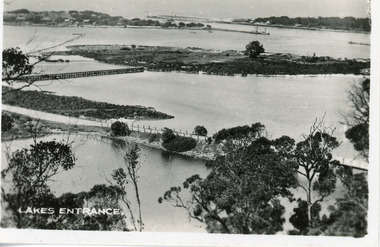
Postcard - Bullock Island Lakes Entrance c1920, c1920
... It shows the approaches to the concrete bridge over the North Arm, the footbridge to Bullock Island, the entrance to the Gippsland Lakes from Bass Strait and part of the township on the sand hummocks across the lake. ...It shows the approaches to the concrete bridge over the North Arm, the footbridge to Bullock Island, the entrance to the Gippsland Lakes from Bass Strait and part of the township on the sand hummocks across the lake. ...1 x Faded miniature postcard 6.5 x 8.5 |1 x Black and white 9.5 x 12 copied from album in private hands |1 x Sepia toned 10 x 15 |1 x Black and white 12 x 17.5Black and white small format postcard of Bullock Island. It shows the approaches to the concrete bridge over the North Arm, the footbridge to Bullock Island, the entrance to the Gippsland Lakes from Bass Strait and part of the township on the sand hummocks across the lake. Lakes Entrance VictoriaLakes Entrancewaterways, topography, islands, bridges -
 Sunshine and District Historical Society Incorporated
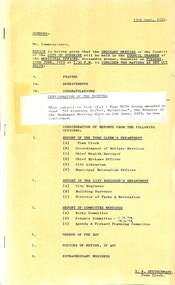
Administrative record - City of Sunshine - Commissioner Mr Alexander Alex George Gillon Collection 1976 - 1982 - Notice of ordinary meeting of the council 19th June 1979, City of Sunshine, 13th June 1979
... Albans Strata Subdivision 125 Anderson Road Albion Strata Subdivision 53 Graham Street Sunshine Contract Fencing Tip Site Variations Annual Supply Contract Supply of Bituminous Concrete Contract Construction of Part of Warrs Road Consolidation of 112 Ballarat Road Maidstone Finalisation of Health Act Drain Rear of Cooper Street and Gertrude Street Sunshine Declaration of Sewerage Area No 3781 Sewerage Facilities St. Albans Allocation of Funds 1979/80 Main Roads Unclassified Highpoint West Welfare Complex Air Conditioning Footbridge...Albans Strata Subdivision 125 Anderson Road Albion Strata Subdivision 53 Graham Street Sunshine Contract Fencing Tip Site Variations Annual Supply Contract Supply of Bituminous Concrete Contract Construction of Part of Warrs Road Consolidation of 112 Ballarat Road Maidstone Finalisation of Health Act Drain Rear of Cooper Street and Gertrude Street Sunshine Declaration of Sewerage Area No 3781 Sewerage Facilities St. Albans Allocation of Funds 1979/80 Main Roads Unclassified Highpoint West Welfare Complex Air Conditioning Footbridge ...Notice of Ordinary Meeting of the Council 19th June 1979 Report of the Town Clerk's Department Report of the Town Clerk Interest Charges New Minister for Local Government The Hon. Digby Crozier Land Transfer Sandford Avenue Corner of Camperdown Avenue Sunshine North Maribyrnong Hall R.S.L. Club Rooms Proposed Alterations Western Region Refuse Disposal Group Meeting Seminar Bains' Board of Review Report Proposed Acquisition of Land Maribyrnong Formerly Owned by Humes Ltd Van Ness Avenue Central Records Disposal Schedule Consultants' Fees Report of the Co-Ordinator of Welfare Services Senior Citizens' and Activities Centre Maribyrnong First Australian Greek Welfare Workers' Conference The Report of the Domiciliary Care Services Working Party Secretary Lions House of Sunshine Senior Citizens Club Caretaker Lions House of Sunshine Senior Citizens Club Community Youth support Scheme Sessional Instructions Youth Emergency Accommodation Services Family Day Care Conference Information and Co-Ordination Grant Seminar Local Government Welfare Services to Migrants Report of the Chief Health Surveyor Prosecutions Proceedings Sunshine Magistrates Court Application for Transfer of Proprietorship of Premises under the Health Act Inspection of Skinner Reserve Churchill Avenue Braybrook Food and Liquor Facilities Health Act Section 95 (Smorgon Consolidated Industries Ltd) Somerville Road Footscray West Diamond Avenue Infant Welfare Centre Municipal Sunshine Tip E.P.A. Licence Renewal. Council advised E.P.A. the licence is no longer required as the tip has stopped disposal of refuse or garbage and only work is the addition of more cover Report of the Chief By-Laws Officer Alterations to Existing Restrictions Suns Crescent Sunshine Prohibited Parking 288A Ballarat Road Braybrook Proposed School Crossing Main Road West near Kate Street St. Albans Report of the City Librarian Melton Library Reserve Account Melton Library Official Opening Report of the Municipal Recreation Officer Our Lady's Youth Centre Use of Facility by the Community Ardeer High School Development of Facilities Environmental Day Brimbank Park Report of the City Engineer & Planner Rezoning Land Laurel Street St. Albans Amendment No 122 to the Melbourne Metropolitan Planning Scheme Rezoning Land North East Corner of Lots 45, 46 & 47 Appleby Avenue and Devonshire Road Sunshine Planning Permit School Extensions to St. Bernadette's Primary School, Church, Place of Assembly, Convent, Presbytery and Church on land Bounded by Suffolk Road, Westmoreland Road, Rufford Street and Willey Street Sunshine North Planning Permit Application Consulting Room Lot 2 Ashley Street Maidstone Planning Permit Application First Aid and Drovers' Amenities Building, Additions to Industrial Complex Somerville Road Opposite Alick Street Tottenham Planning Permit Application Illuminated Pole Sign Lot 1 Ballarat Road South West Corner of Stonemark Street Sunshine Planning Permit Application Plant Nursery Extensions Lot 41 Duke Street Sunshine Planning Permit Application Car Sales Yard Preparation Shed Ballarat Road South West Corner of Hampshire Road Sunshine Planning Permit Application Ballarat Road and Anderson Road Subdivision Plan of Subdivision Emu Road The Olympic Tyre & Rubber Co Pty Ltd Plan of Subdivision Mitchell Street, Richards Street and Emu Road The Olympic Tyre & Rubber Co Pty Ltd Plan of Subdivision Oakwood Road, Neale Road, Concord Circuit and Newark Court Albanvale Stage 2A Strata Subdivision 11 Yarmouth Avenue St. Albans Strata Subdivision 125 Anderson Road Albion Strata Subdivision 53 Graham Street Sunshine Contract Fencing Tip Site Variations Annual Supply Contract Supply of Bituminous Concrete Contract Construction of Part of Warrs Road Consolidation of 112 Ballarat Road Maidstone Finalisation of Health Act Drain Rear of Cooper Street and Gertrude Street Sunshine Declaration of Sewerage Area No 3781 Sewerage Facilities St. Albans Allocation of Funds 1979/80 Main Roads Unclassified Highpoint West Welfare Complex Air Conditioning Footbridge Programme Esmond Street Bridge and Lawrence Street Bridge M.M.B.W. Directive Use of Clay Pipes in Property Service Drains Report of the Building Surveyor Building Over Easement 41 Tasman Avenue Deer Park Installation of Underground Tank Lot 1 Sunshine Road Tottenham Siting of Building 8 Jacana Court Sunshine North Orders of the Day Accounts Submitted for Payment as at 31st May 1979hume pipe company, warrs road, maribyrnong, maribyrnong rsl, maribyrnong hall, raleigh road, van ness avenue, maribyrnong senior citizens' club, lions house of sunshine, coiro street, watt street, sunshine, lions house of sunshine senior citizens club, skinner reserve, churchill avenue, braybrook, smorgon consolidated industries, somerville road, footscray west, diamond avenue infant welfare centre, diamond avenue, albanvale, sunshine tip, ballarat road, main road west, kate street, st. albans, our lady's youth centre, ardeer high school, glengala road, sunshine west, brimbank park, keilor park drive, keilor east, laurel street, appleby avenue, devonshire road, st. bernadette's primary school, suffolk road, westmoreland road, rufford street, willey street, sunshine north, ashley street, maidstone, alick street, stonemark street, duke street, hampshire road, anderson road, emu road, the olympic tyre & rubber co, mitchell street, richards street, oakwood road, neale road, concord circuit, newark court, yarmouth avenue, graham street, gertrude street, cooper street, highpoint west welfare complex, rosamond road, esmond street bridge, esmond street, lawrence street bridge, lawrence street, ardeer, tasman avenue, deer park, sunshine road, tottenham, jacana court, randall street -
 Lakes Entrance Historical Society
Photograph - Foot bridge Cunninghame Arm Lakes Entrance Victoria 2008
... Colour photograph of building of the new footbridge over Cunninghame Arm showing method of construction and application of concrete surface. ...Date made December 2008 plus 7 other photos Bridges Waterways Construction Colour photograph of building of the new footbridge over Cunninghame Arm showing method of construction and application of concrete surface. ...Date made December 2008 plus 7 other photosColour photograph of building of the new footbridge over Cunninghame Arm showing method of construction and application of concrete surface. Lakes Entrance Victoriabridges, waterways, construction -
Lakes Entrance Historical Society
Postcard - Lakes Entrance from Jemmys Point c1950, Bulmer H D
... Caravan parked beside concrete brick constructed toilet block opposite road to Bullock Island. Footbridge across Cunninghame Arm in distance, also lookout tower on Esplanade, and Life Saving tower over hummocks. ...Caravan parked beside concrete brick constructed toilet block opposite road to Bullock Island. Footbridge across Cunninghame Arm in distance, also lookout tower on Esplanade, and Life Saving tower over hummocks. ...Township of Lakes Entrance from Jemmys PointColour tinted postcard of township showing bridge across North Arm; town buildings including Club Hotel, Methodist Church, Maranui Guest House; tower of Central Hotel; jetties in Cunninghame Arm, and sand dunes. Caravan parked beside concrete brick constructed toilet block opposite road to Bullock Island. Footbridge across Cunninghame Arm in distance, also lookout tower on Esplanade, and Life Saving tower over hummocks. Lakes Entrance VictoriaNorth Arm Bridge and Town, Lakes Entrancetownship, jetties, guesthouses, islands, hotels -
 Sunshine and District Historical Society Incorporated
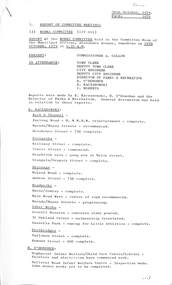
Administrative record - City of Sunshine - Commissioner Mr Alexander Alex George Gillon Collection 1976 - 1982 - Report of Committee Meetings 30th October 1979, City of Sunshine, 30th October 1979
... Albans Centre of Road Recommenced Roadwork Mernda Street & Mayne Street Sunshine West Progressing Other Work Scovell Reserve Concrete Slab Poured Other Work 31 Oakland Street Naturestrip Reinstated Other Work Sassella Park Run up for Deer Park Little Athletics Centre Completed Footbridge Yallourn Street Completed Footbridge Esmond Street 90% Complete Highpoint West Infant Welfare Child Care Centre Painting and Electrical Work Commenced Highpoint West Library Painting and Electrical Work Commenced Ballarat Road Infant Welfare Centre Inspection Completed Some Minor Works Outstanding Depot Amenities Block Work Nearing Completion Public Toilets Deer Park Letter of Approval Received from Health Department Tree Maintenance Talmage Street Albion Progressing Report of the Finance Committee Meeting Report of the Town Clerk Outstanding Rates Estimates 1979/80 Sunshine View Estate Stage 2 Drainage Report of the City Engineer & Planner Staff Reclassifications Rates, Sanitary & Interest Statement as at 30th September 1979 Rates, Sanitary & Interest Statement as at 30th September 1979 Analysis of Accounts Outstanding Rates, Sanitary & Interest Statement as at 30th September 1979 Progressive Analysis Accounts Outstanding...Albans Centre of Road Recommenced Roadwork Mernda Street & Mayne Street Sunshine West Progressing Other Work Scovell Reserve Concrete Slab Poured Other Work 31 Oakland Street Naturestrip Reinstated Other Work Sassella Park Run up for Deer Park Little Athletics Centre Completed Footbridge Yallourn Street Completed Footbridge Esmond Street 90% Complete Highpoint West Infant Welfare Child Care Centre Painting and Electrical Work Commenced Highpoint West Library Painting and Electrical Work Commenced Ballarat Road Infant Welfare Centre Inspection Completed Some Minor Works Outstanding Depot Amenities Block Work Nearing Completion Public Toilets Deer Park Letter of Approval Received from Health Department Tree Maintenance Talmage Street Albion Progressing Report of the Finance Committee Meeting Report of the Town Clerk Outstanding Rates Estimates 1979/80 Sunshine View Estate Stage 2 Drainage Report of the City Engineer & Planner Staff Reclassifications Rates, Sanitary & Interest Statement as at 30th September 1979 Rates, Sanitary & Interest Statement as at 30th September 1979 Analysis of Accounts Outstanding Rates, Sanitary & Interest Statement as at 30th September 1979 Progressive Analysis Accounts Outstanding Foolscap sized document. ...Report of Committee Meetings 30th October 1979 Report of the Works Committee Meeting Kerb & Channel Furlong Road Sunshine North Reinstatement Completed Kerb & Channel Mernda Street & Mayne Street Sunshine West Recommenced Kerb & Channel Holehouse Street Sunshine North 75% Complete Footpath Kellaway Street Maidstone Completed Footpath Yewers Street Sunshine Commence Footpath Braybrook Area Gang now in Melon Street Footpath Glengala Road / Gregory Street Completed Drainage McLeod Road St. Albans Completed Drainage Andrew Street Sunshine Completed Roadwork Burns Street / Sonley Street Completed Roadwork Main Road West St. Albans Centre of Road Recommenced Roadwork Mernda Street & Mayne Street Sunshine West Progressing Other Work Scovell Reserve Concrete Slab Poured Other Work 31 Oakland Street Naturestrip Reinstated Other Work Sassella Park Run up for Deer Park Little Athletics Centre Completed Footbridge Yallourn Street Completed Footbridge Esmond Street 90% Complete Highpoint West Infant Welfare Child Care Centre Painting and Electrical Work Commenced Highpoint West Library Painting and Electrical Work Commenced Ballarat Road Infant Welfare Centre Inspection Completed Some Minor Works Outstanding Depot Amenities Block Work Nearing Completion Public Toilets Deer Park Letter of Approval Received from Health Department Tree Maintenance Talmage Street Albion Progressing Report of the Finance Committee Meeting Report of the Town Clerk Outstanding Rates Estimates 1979/80 Sunshine View Estate Stage 2 Drainage Report of the City Engineer & Planner Staff Reclassifications Rates, Sanitary & Interest Statement as at 30th September 1979 Rates, Sanitary & Interest Statement as at 30th September 1979 Analysis of Accounts Outstanding Rates, Sanitary & Interest Statement as at 30th September 1979 Progressive Analysis Accounts Outstandingfurlong road, sunshine north, mernda street, mayne street, sunshine west, holehouse street, kellaway street, yewers street, melon street, braybrook, glengala road, gregory street, mcleod road, st. albans, andrew street, burns street, sonley street, maidstone, main road west, scovell reserve, scovell crescent, oakland street, maribyrnong, deer park little athletics centre, sassella park, deer park, station road, yallourn street, esmond street, ardeer, highpoint west infant welfare child care centre, highpoint west library, rosamond road, ballarat road infant welfare centre -
 Sunshine and District Historical Society Incorporated
Administrative record - City of Sunshine - Commissioner Mr Alexander Alex George Gillon Collection 1976 - 1982 - Minutes of the ordinary meeting of council held on 19th June 1979, City of Sunshine, 19th June 1979
... Albans Strata Subdivision 125 Anderson Road Albion Strata Subdivision 53 Graham Street Sunshine Contract Fencing Tip Site Variations Annual Supply Contract Supply of Bituminous Concrete Contract Construction of Part of Warrs Road Consolidation of 112 Ballarat Road Maidstone Finalisation of Health Act Drain Rear of Cooper Street and Gertrude Street Sunshine Declaration of Sewerage Area No 3781 Sewerage Facilities St. Albans Allocation of Funds 1979/80 Main Roads Unclassified Highpoint West Welfare Complex Air Conditioning Footbridge...Albans Strata Subdivision 125 Anderson Road Albion Strata Subdivision 53 Graham Street Sunshine Contract Fencing Tip Site Variations Annual Supply Contract Supply of Bituminous Concrete Contract Construction of Part of Warrs Road Consolidation of 112 Ballarat Road Maidstone Finalisation of Health Act Drain Rear of Cooper Street and Gertrude Street Sunshine Declaration of Sewerage Area No 3781 Sewerage Facilities St. Albans Allocation of Funds 1979/80 Main Roads Unclassified Highpoint West Welfare Complex Air Conditioning Footbridge ...Minutes of the Ordinary Meeting of Council held on 19th June 1979 Report of the Town Clerk's Department Report of the Town Clerk Interest Charges New Minister for Local Government The Hon. Digby Crozier Land Transfer Sandford Avenue Corner of Camperdown Avenue Sunshine North Maribyrnong Hall R.S.L. Club Rooms Proposed Alterations Western Region Refuse Disposal Group Meeting Seminar Bains' Board of Review Report Proposed Acquisition of Land Maribyrnong Formerly Owned by Humes Ltd Van Ness Avenue Central Records Disposal Schedule Consultants' Fees Report of the Co-Ordinator of Welfare Services Senior Citizens' and Activities Centre Maribyrnong First Australian Greek Welfare Workers' Conference The Report of the Domiciliary Care Services Working Party Secretary Lions House of Sunshine Senior Citizens Club Caretaker Lions House of Sunshine Senior Citizens Club Community Youth support Scheme Sessional Instructions Youth Emergency Accommodation Services Family Day Care Conference Information and Co-Ordination Grant Seminar Local Government Welfare Services to Migrants Report of the Chief Health Surveyor Prosecutions Proceedings Sunshine Magistrates Court Application for Transfer of Proprietorship of Premises under the Health Act Inspection of Skinner Reserve Churchill Avenue Braybrook Food and Liquor Facilities Health Act Section 95 (Smorgon Consolidated Industries Ltd) Somerville Road Footscray West Diamond Avenue Infant Welfare Centre Municipal Sunshine Tip E.P.A. Licence Renewal. Council advised E.P.A. the licence is no longer required as the tip has stopped disposal of refuse or garbage and only work is the addition of more cover Report of the Chief By-Laws Officer Alterations to Existing Restrictions Suns Crescent Sunshine Prohibited Parking 288A Ballarat Road Braybrook Proposed School Crossing Main Road West near Kate Street St. Albans Report of the City Librarian Melton Library Reserve Account Melton Library Official Opening Report of the Municipal Recreation Officer Our Lady's Youth Centre Use of Facility by the Community Ardeer High School Development of Facilities Environmental Day Brimbank Park Report of the City Engineer & Planner Rezoning Land Laurel Street St. Albans Amendment No 122 to the Melbourne Metropolitan Planning Scheme Rezoning Land North East Corner of Lots 45, 46 & 47 Appleby Avenue and Devonshire Road Sunshine Planning Permit School Extensions to St. Bernadette's Primary School, Church, Place of Assembly, Convent, Presbytery and Church on land Bounded by Suffolk Road, Westmoreland Road, Rufford Street and Willey Street Sunshine North Planning Permit Application Consulting Room Lot 2 Ashley Street Maidstone Planning Permit Application First Aid and Drovers' Amenities Building, Additions to Industrial Complex Somerville Road Opposite Alick Street Tottenham Planning Permit Application Illuminated Pole Sign Lot 1 Ballarat Road South West Corner of Stonemark Street Sunshine Planning Permit Application Plant Nursery Extensions Lot 41 Duke Street Sunshine Planning Permit Application Car Sales Yard Preparation Shed Ballarat Road South West Corner of Hampshire Road Sunshine Planning Permit Application Ballarat Road and Anderson Road Subdivision Plan of Subdivision Emu Road The Olympic Tyre & Rubber Co Pty Ltd Plan of Subdivision Mitchell Street, Richards Street and Emu Road The Olympic Tyre & Rubber Co Pty Ltd Plan of Subdivision Oakwood Road, Neale Road, Concord Circuit and Newark Court Albanvale Stage 2A Strata Subdivision 11 Yarmouth Avenue St. Albans Strata Subdivision 125 Anderson Road Albion Strata Subdivision 53 Graham Street Sunshine Contract Fencing Tip Site Variations Annual Supply Contract Supply of Bituminous Concrete Contract Construction of Part of Warrs Road Consolidation of 112 Ballarat Road Maidstone Finalisation of Health Act Drain Rear of Cooper Street and Gertrude Street Sunshine Declaration of Sewerage Area No 3781 Sewerage Facilities St. Albans Allocation of Funds 1979/80 Main Roads Unclassified Highpoint West Welfare Complex Air Conditioning Footbridge Programme Esmond Street Bridge and Lawrence Street Bridge M.M.B.W. Directive Use of Clay Pipes in Property Service Drains Report of the Building Surveyor Building Over Easement 41 Tasman Avenue Deer Park Installation of Underground Tank Lot 1 Sunshine Road Tottenham Siting of Building 8 Jacana Court Sunshine North Orders of the Day Accounts Submitted for Payment as at 31st May 1979maribyrnong senior citizens club, randall street, maribyrnong, maribyrnong hall, maribyrnong rsl, raleigh road, sandford avenue, sunshine north, hume pipe company, van ness avenue, lions house of sunshine senior citizens club, lions house of sunshine, corio street, watt street, sunshine, skinner reserve, churchill avenue, braybrook, smorgon consolidated industries, somerville road, footscray west, diamond avenue infant welfare centre, diamond avenue, albanvale, sunshine tip, suns crescent, ballarat road, main road west, kate street, st. albans, our lady's youth centre, ardeer high school, glengala road, ardeer, sunshine west, laurel street, appleby avenue, devonshire road, st. bernadette's primary school, suffolk road, westmoreland road, rufford street, willey street, ashley street, maidstone, alick stree, stonemark street, duke street, hampshire road, anderson road, the olympic tyre & rubber co, mitchell street, richards street, emu road, oakwood road, neale road, concord circuit, armouth avenue, graham street, warrs road, cooper street, gertrude street, highpoint west welfare complex, rosamond road, esmond street bridge, esmond street, lawrence street bridge, lawrence street, tasman avenue, deer park, sunshine road, tottenham, jacana court
