
Showing 11 items matching "configuration development"
-
 Moorabbin Air Museum
Book - Aircraft design, Synthesis of Subsonic Airplane Design
... General aspects of aircraft configuration development...Aircraft design General aspects of aircraft configuration development General arrangement Fuselage design Subsonic engine technology Design for performance Choice of engine/propeller & powerplant installation Wing design Airplane weight & balance Tailplane design Undercarriage Aerodynamic & operational characteristics Presentation of a preliminary design Introduction to preliminary design of subsonic general aviation & transport aircraft, circa 1976 Synthesis of Subsonic Airplane Design Book Aircraft design ...Introduction to preliminary design of subsonic general aviation & transport aircraft, circa 1976non-fictionIntroduction to preliminary design of subsonic general aviation & transport aircraft, circa 1976general aspects of aircraft configuration development, general arrangement, fuselage design, subsonic engine technology, design for performance, choice of engine/propeller & powerplant installation, wing design, airplane weight & balance, tailplane design, undercarriage, aerodynamic & operational characteristics, presentation of a preliminary design -
Moorabbin Air Museum
Book - AGARD reports, Special Course on Engineering Methods in Aerodynamic Analysis and Design of Aircraft
... ...Configuration development...AGARD reports Computational procedures for preliminary design Configuration development Survey of experimental techniques for performance prediction Panel methods for aerodynamic analysis & design High angle of attack - aerodynamics Aircraft drag analysis methods Overview of computational procedures for conceptual & preliminary aircraft design, circa 1992 Special Course on Engineering Methods in Aerodynamic Analysis and Design of Aircraft Book AGARD reports ...Overview of computational procedures for conceptual & preliminary aircraft design, circa 1992non-fictionOverview of computational procedures for conceptual & preliminary aircraft design, circa 1992computational procedures for preliminary design, configuration development, survey of experimental techniques for performance prediction, panel methods for aerodynamic analysis & design, high angle of attack - aerodynamics, aircraft drag analysis methods -
 Federation University Historical Collection
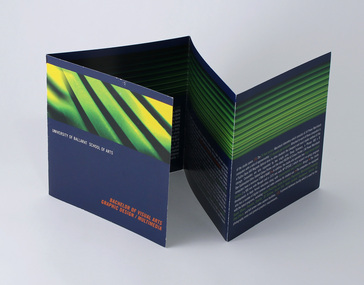
Pamphlet - Promotional brochure, Bachelor of Visual Arts, Graphic Design/Multimedia, c1999
... These workstations are configurations of six, consisting of two students from each year level. This reinforces the area's ongoing development with an open ethos and cross-level delivery and learning. ...These workstations are configurations of six, consisting of two students from each year level. This reinforces the area's ongoing development with an open ethos and cross-level delivery and learning. ...Promoting the Graphic Design/Multimedia program being offered by the University of Ballarat at the Mt Helen Campus. Promoted course as "one of the smallest and arguably the best three year programs of its kind in Australia and the South Pacific region." The brochure lists student awards received including Platinum and Gold in the AGFA International Young Designer Contest, 1999; two meritorious awards in The Art Directors Club Student Awards, New York, USA 1999; Graphis New Talent 1999; two Gold in Souther Cross Packaging Awards, 1998. At time of publication, the School of Arts, Visual Arts reportedly had 210 students with majors in Graphic Design/Multimedia, Ceramics/3D, Painting, Drawing, and Multidiscipline. Minors studies included Printmaking, Photography, 3D, 2D, and Graphic Communication. ___ Course aimed to train "independent, flexible thinkers". The course promised to "Promote creativity, originality and imaginative thinking; Develop self-directed learners, displaying initiative in the formation of ideas and the confidence to construct personal responses; Develop appropriate conceptual, technical and professional skills; Develop the student's critical process: ability to undertake research, and to make informed decisions; Clarify thinking, concepts and understanding and deep knowledge, attitudes and skills enabling the designer to respond to community needs." Studio and working environment described as "one open space with working facilities for approximately 75 students across 3 year levels. The area is divided up into work stations where 1st, 2nd and 3rd year students intermix, allowing a natural interaction. These workstations are configurations of six, consisting of two students from each year level. This reinforces the area's ongoing development with an open ethos and cross-level delivery and learning. This maximises the use of information in order for it to be applied throughout all levels of the learning process, whilst allowing a natural mentor arrangment to be developed for all first year students, " "The open ethos approach also encourages students and staff to freely express their opinions in relation to design via cross-level critiques, whilst allowing for a liberal arts approach and structure to the development of the creative process." "Emphasis is placed on experimentation, innovation, expression and the development of the individual's design philosophies, concepts and style." Also notes the 24 hour access Macintosh laboratory, with 34 Power Macintosh computers, ratio of one for every 2.5 students. Each with a Fujitsu Dyna Magneto Optical drive for file storage and transport. Two Sharp scanners, Phaser Dye-Sublimation Extra Tabloid colour printer and Ricoh A3 colour printer. Two large format printers. Digital and video cameras. Software: Adobe Photoshop, Illustrator, Acrobat; QuarkXpress; Macromedia Freehand; Pagemaker; Premier; Director; 3D Extreme; Sound Eidt, Shockwave, Infinite 3D and After Effects. Approx 4.5 staff, "all of whom are practicing designers. They have a full understanding of industry requirements and trends which assists in the development of industrial contacts when specialists are required." Prospective students interviewed in late Nov/ early Dec, face to face. Present a "comprehensive folio of work", academic records, references. "Selection is determined by the perceived potential of the student, their motivation and reason for study within the field as well as their previous experience in the Visual Arts. Folio work should be representative of the individual's ideas and abilities. Qualities of importance are: originality, innovation, imagination, experimentation and a competent display of the basic skills associated with visual arts [evidence of drawing skills should be included]." Demonstration of GD/MM computer skills an advantage. Students also asked to bring sketch books. Promotional brochure for prospective students. 8pp Double fold brochureuniversity of ballarat, federation university, graphic design, multimedia, bachelor, degree -
 Ringwood and District Historical Society
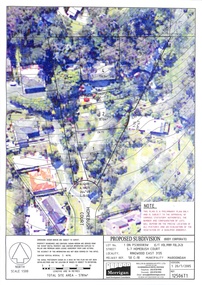
Document, Proposed Subdivision 5-7 Homebush Court Ringwood East 3135 - 20/7/2005
... The number and configuration of lots will depend on the precise location of all features and an evaluation of the vegetation by a qualified arborist." Millar & Merrigan Pty Ltd, Land Development...The number and configuration of lots will depend on the precise location of all features and an evaluation of the vegetation by a qualified arborist." Millar & Merrigan Pty Ltd, Land Development ...Three coloured overhead view maps showing contours and proposed property boundaries with varied common property access references (Ref 12506T1, T2 and T3)Notations on each plan: "This plan is a preliminary plan only and is subject to the approval of various statutory authorities. The number and configuration of lots will depend on the precise location of all features and an evaluation of the vegetation by a qualified arborist." Millar & Merrigan Pty Ltd, Land Development Consultants, 126 Merrindale Drive, Croydon. Telephone (03) 8720 9500, Facsimile (03) 8720 9501. Email [email protected], PO Box 247 Croydon Vic 3136. -
 Kiewa Valley Historical Society
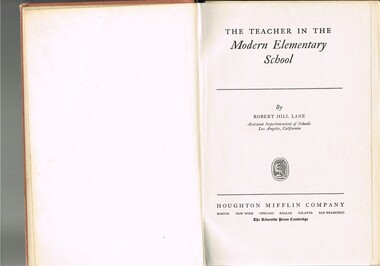
Book - Reference Teaching Infants, The Teacher in the Modern Elementary School, 1941
... configurations point to larger classes and slightly different teaching methods than that which existed in Australia. This teacher's aid book presents the Australian rural teachers with an advanced American approach to teaching methods. These methods were based on the then modern "group" psychological teachings and were a good guide in the development ...This teacher's aid publication was used by the teachers in the The Bogong Primary School from 1941 and also the Mount Beauty Primary School from its establishment in 1947. Both had most of their pupils recruited from SEC(Victoria) Hydro Electricity Scheme employees working for a limited time scale. Rural based children benefited greatly by the decision by the SEC to provide these facilities for their worker's families. This bypass of the "typical rural provisions" offered to other schools, by the Victorian Department of Education was a bonus to the Kiewa Valley educational community. These schools had a higher level of facilities available to them than other "typical" rural schools. Treasured facilities such as a comprehensive library, movie projector, tape recorder and public address system placed these two schools at the level of the Greater Public School of city or the larger towns rather than the small rural schools in Victoria.This item was used in Mount Beauty Primary School as part of a teacher's curriculum. The fact that it is in a rural area, in an enclosed SEC construction worker's village in the Kiewa Valley did present a slightly different learning atmosphere than in the larger towns and cities. The majority of parents within the Kiewa Valley, had a slight resentment of the "high and mighty" attitude of city dwellers with a "plum in their mouths" and the effectiveness that city bred teachers had to achieve was to overcome these ingrained mores. The majority of students at this primary school had parents who were working for (the closed "village" of the SEC Hydro Electricity Scheme. In the 1940s this school would have children from multi-cultural backgrounds as many of the parents were recruited as labourers or with European technical backgrounds. In the book,the black and white photographs detailing the classroom sizes and configurations point to larger classes and slightly different teaching methods than that which existed in Australia. This teacher's aid book presents the Australian rural teachers with an advanced American approach to teaching methods. These methods were based on the then modern "group" psychological teachings and were a good guide in the development of a more effective and progressive teaching platform. The one thing that it did not address was the easy going Australian psyche of "she'll be right mate" of the Australia rural community. The socio-economic identity of the Kiewa Valley rural community was not that of the typical city community (American) and this was a challenge for city based and trained teachers. The principles that the book presents is not constrained by the date of publication or its time of use (1954).This hard cardboard covered book is sleeveless but bound by a red cloth glued onto a thick cardboard base. It has the title printed in gold script on the spine with horizontal and fifteen black horizontal lines at the top and bottom. The front cover has the title printed in gold coloured letters (the first and last words are in freehand script style)On the spine and front cover is printed "The TEACHER IN THE MODERN ELEMENTARY School" school organisation, developmental stages of children, subliminal classroom mental and physical stimulation, usa 1940s teacher aids. -
Port Melbourne Historical & Preservation Society
Plan - Proposed Bayside development, Sep 1987
... The EES hearing, scheduled for three days in September, ran for 57 sessions into February 1988. town planning - proposals shelved - bayside sandridge city development co pty ltd scdc In blue: EES Variation September 1987:In red: markings to indicate alterations to land configuration Large plan of original proposed Bayside development as submitted to council in 1987; as 502.01 but with alterations superimposed in red, It was this altered plan that was submitted at the enquiry into the Environmental Effects Statement in September. ...SCDC plans for the Bayside development were revised as investigations into water circulation in artifical canals/harbour were completed. This is the altered plan, with alterations drawn in red on the original proposal, for the EES hearing in September 1987. The EES hearing, scheduled for three days in September, ran for 57 sessions into February 1988.Large plan of original proposed Bayside development as submitted to council in 1987; as 502.01 but with alterations superimposed in red, It was this altered plan that was submitted at the enquiry into the Environmental Effects Statement in September.In blue: EES Variation September 1987:In red: markings to indicate alterations to land configurationtown planning - proposals shelved - bayside, sandridge city development co pty ltd, scdc -
Moorabbin Air Museum
Manual (Item) - NATO Advisory Group for Aerospace Researc;h & Development Reports - Aeroelasticity, AGARD Report No.765 AGARD Standard Aeroelastic Configurations for Dynamic Response I - Wing 445.6
... NATO AGARD Report No.765 AGARD Standard Aeroelastic Configurations for Dynamic Response I - Wing 445.6 Manual NATO Advisory Group for Aerospace Researc;h & Development Reports - Aeroelasticity ...NATO -
 Australian Gliding Museum
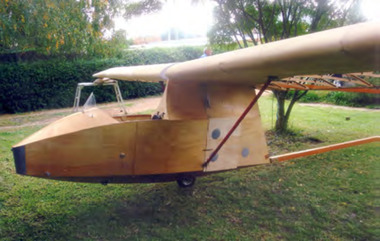
Machine - Glider – Sailplane, 2015
... development of gliding in Australia in the early years. However, it is an important exhibit in that it shows in tangible form a nacelle fuselage training glider in configuration and construction detail. ...The Salamandra is a Polish glider designed by Waclaw Czerwinski at the Military Glider Workshops in Krakow in 1936. This glider, designated “W.W.S.1”, was produced in substantial numbers prior to the second world war and used in Poland and some other eastern European countries for training pilots. Only one example survived the war, hidden away in the village of Goleszow in Silesia. In addition, no technical drawings could be found, so when the glider was discovered, the Gliding Institute being keen to re-establish gliding in Poland, used the glider to draw up new plans for construction. Five were built for the Institute in 1947 before production was resumed of the “Salamandra 48” at the SZD Jezow Workshops. Improvement were made by adding airbrakes and structural changes for the “Salamandra 49” and a windscreen and larger tailplane were changes adopted for the “Salamandra 53”. An export version designated “53A” was sold to and built under licence in China. Production of the Salamandra ceased in the early 1960s. Total production may have been in excess of 500. The glider was well regarded as a light weight trainer capable of soaring performance. The Museum’s replica was built by Ray Ash and may be may be classified as a “Salamandra 53”. However, he has added something of his own to the design by replacing the cable runs in the wings with control rods. The glider is substantially complete. The wings and tail / rudder surfaces have been covered with poly-fibre fabric. The fuselage woodwork is sealed with varnish. In addition to the finishing work (including painting) and rigging of the main components, the linkages for Ray’s control rod modification may need further engineering to make them operational. The Ray Ash Salamandra is the first of the type to appear in Australia. The Salamandra did not play any role in the development of gliding in Australia in the early years. However, it is an important exhibit in that it shows in tangible form a nacelle fuselage training glider in configuration and construction detail. As such it revisits the pioneering era of the 1930s and 1940s in Australia when wood, wire and fabric were the rule and the nacelle primary glider was generally the first step up for pilots who had mastered the basics in an open primary.Nacelled solo training glider of traditional wood and fabric construction. Construction incomplete.Noneaustralian gliding, sailplane, glider, salamandra, czerwinshi, poland, ash -
Moorabbin Air Museum
Machine - CAC CA-31 Jet Trainer Factory Mockup, 1964
... Historical Details: The CA-31 Factory Mockup was constructed by CAC to provide a full size – 3 dimensional demonstration of the aircraft’s overall size, layout and cockpit configuration. It was constructed in CAC’s development Hangar, (the CAC Butler Hangar now relocated to. ...Historical Details: The CA-31 Factory Mockup was constructed by CAC to provide a full size – 3 dimensional demonstration of the aircraft’s overall size, layout and cockpit configuration. It was constructed in CAC’s development Hangar, (the CAC Butler Hangar now relocated to. ...Historical Details: The CA-31 Factory Mockup was constructed by CAC to provide a full size – 3 dimensional demonstration of the aircraft’s overall size, layout and cockpit configuration. It was constructed in CAC’s development Hangar, (the CAC Butler Hangar now relocated to. Description: The CAC CA-31 concept was developed in 1964 as a two seat delta wing trainer to support the intended use of the GAF Mirage fighter in RAAF service. It followed on from an earlier swept wing jet trainer proposal first commenced in 1953, which went through. Level of Importance: National -
Moorabbin Air Museum
Book - Aircraft design, Aircraft Design: A Conceptual Approach
... Aircraft design Overview of design process Sizing Airfoils Thrust to weight Configuration layout Payload Crew station/passengers Landing gear Performance Cost analysis Industry perspective on new aircraft concept development process, circa 1992 Aircraft Design: A Conceptual Approach Book Aircraft design ...Industry perspective on new aircraft concept development process, circa 1992non-fictionIndustry perspective on new aircraft concept development process, circa 1992overview of design process, sizing, airfoils, thrust to weight, configuration layout, payload, crew station/passengers, landing gear, performance, cost analysis -
Emerald Museum & Nobelius Heritage Park
Photograph - Emerald Primary School, 1979, Unknown photographer, 1979
... The school had several configurations of buildings during the century from 1879-1979, reflecting the fluctuating but generally growing enrolment of students, developments and trends in children's education (such as the move to age-specific classrooms and separate facilities for activities such as arts and crafts) and developments in technology (such as the introduction of electricity and sewage systems). ...The school had several configurations of buildings during the century from 1879-1979, reflecting the fluctuating but generally growing enrolment of students, developments and trends in children's education (such as the move to age-specific classrooms and separate facilities for activities such as arts and crafts) and developments in technology (such as the introduction of electricity and sewage systems). ...Local farmers and business-owners who settled in Emerald after the initial gold rush period first petitioned for a school in the local area in 1876, with at least two petitions to the Education department lodged by 1877. Emerald School no. 2110 opened as a temporary 'half time' school (meaning that the single teacher split their time between two schools) in temporary facilities in January 1879 while a permanent location was selected. Lobbying by townspeople in 1899 identified the present location of Emerald School no. 3381, within the original township boundary near the football field. The original building constructed to house the school was described variously as 'the tin shed' and 'a hut with a chimney.' It opened in February 1901. The school had several configurations of buildings during the century from 1879-1979, reflecting the fluctuating but generally growing enrolment of students, developments and trends in children's education (such as the move to age-specific classrooms and separate facilities for activities such as arts and crafts) and developments in technology (such as the introduction of electricity and sewage systems). The Centenary in 1979 took place one year after original 1915 classrooms were changed into administration facilities, portable classrooms were halved in size and moved and a new brick wing was constructed by building firm A.V. Jennings. At the time of writing (2023) Emerald Primary School is the largest primary school in the area, with nearly 500 students.The image is significant as it depicts a key commemorative event in Emerald's history, the centenary of Emerald Primary School (Township School no. 3381.) It also depicts aspects of the built environment in Emerald at the time the photograph was taken (1979) such as road and telephone infrastructure and commercial buildings adjacent to the school.Black and white rectangular photograph printed on print media paper. The image depicts approximately twenty-six people (primarily women and young children) attending or arriving at an event held to commemorate the Centenary of Emerald Primary School in 1979. The photograph is taken within the school grounds looking outwards, with trees, cars and businesses visible in the background. Telephone poles hung with lights and bunting can be seen in the middle section of the photograph along with a sign stating '1879-1979 Emerald School Centenary Nov. 16-17-18'.Obverse: 1879-1979 / EMERALD SCHOOL / CENTENARY / NOV.16-17-18 /emerald, victoria, australia, 1979, 1970s, emerald primary school, township school no. 3381, families, school children, centenary, a.v. jennings
