
Showing 11 items matching "constitution 1954"
-
 Canterbury History Group
Booklet - Canterbury Chamber of Commerce Constitution 1954, Canterbury Chamber of Commerce, 1954
... Canterbury Chamber of Commerce Constitution 1954......Constitution 1954...Bragg's Pharmacy Stamp in red on front Canterbury Chamber of Commerce Constitution 1954 1 Booklet of 4 pages Booklet Canterbury Chamber of Commerce Constitution 1954 Canterbury Chamber of Commerce ...Bragg's Pharmacy Stamp in red on front1 Booklet of 4 pagescanterbury chamber of commerce, constitution 1954 -
 Uniting Church Archives - Synod of Victoria
Booklet - Methodist Order of Knights, Constituion
... MOK238.3 Methodist Order of Knights Constitution, 1954, 35 pages. MOK238.4 Methodist Order of Knights Constitution, 1960, 36 pages. ...MOK238.3 Methodist Order of Knights Constitution, 1954, 35 pages. MOK238.4 Methodist Order of Knights Constitution, 1960, 36 pages. ...MOK238.1 Methodist Order of Knights Constitution, 1946, 31 pages. MOK238.2 Methodist Order of Knights Constitution, 1951, 31 pages. MOK238.3 Methodist Order of Knights Constitution, 1954, 35 pages. MOK238.4 Methodist Order of Knights Constitution, 1960, 36 pages. MOK238.5 Methodist Order of Knights Constitution, 1969, 43 pages. MOK238.6 Methodist Order of Knights Constitution, 1937, 23 pages. MOK238.7 Methodist Order of Knights Constitution, 1933, 23 pages.methodist orders of knights -
 Ballarat Clarendon College
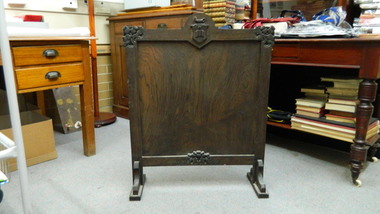
Furniture, Fire screen
... In 1954 the assembly hall at the Mair Street property was officially named Watson Hall in his honour. In 1957 the constitution of the Council was amended to enable Mr Watson to be elected its first life member. ...In 1954 the assembly hall at the Mair Street property was officially named Watson Hall in his honour. In 1957 the constitution of the Council was amended to enable Mr Watson to be elected its first life member. ...The fire screen was gifted to Mr J J Watson at his retirement in 1952. The assembly hall at the Mair Street property was named in his honour. Mr J J watson was a member of the school council from its inception in 1919 when he was elected as a representative of Scots' Church. He succeeded Rev J T Riddle as secretary to council in 1920. In 1954 the assembly hall at the Mair Street property was officially named Watson Hall in his honour. In 1957 the constitution of the Council was amended to enable Mr Watson to be elected its first life member. The fire screen was returned to the school by the family after his death. In a tribute in 1952 at the time of Mr watson's retirement from secretarial position on council, Principal Kerr said, 'Mr watson's family was friendly with the Kennedy(founder) family in Ireland, so that his interest in Clarendon was almost hereditary. His breadth of vision, generosity, devotion to the advancement of the school in every way, and meticulous care of the property and ikts interests, have given him a unique place in the hostory of the school. Wood fire screen with school crest at top of front. Carved details at top corners and base of front feature scottish thistle and leaves. Solid wood frame and stand; veneer insert. Small bronze plaque fixed to top of back. Plaque: Presented to / Mr J J WATSON / in appreciation of his devoted service / as secretary of the council of / CLARENDON PRESBYTERIAN LADIES / COLLEGE / FROM 1920 - 1952.j-j-watson, clarendon-presbyterian-ladies-college, mair-street-campus, school-council, watson-hall, life-member, fire-screen, furniture, -
 Ringwood and District Historical Society
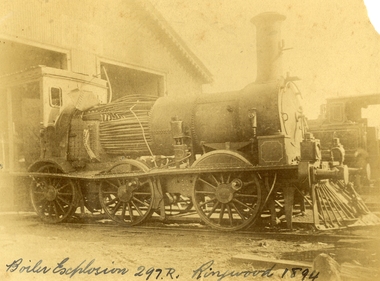
Photograph, Boiler explosion at Ringwood station 20th June 1894 for engine 297R. "Heard in Box Hill"
... 1954), Saturday 27 January 1894, page 21 Official enquiry. The Board of Enquiry appointed by the Railway Commissioners to enquire into the causes of the boiler explosion which shattered the locomotive at Ringwood on Saturday night, assembled at the Railway department on Wednesday to commence its deliberations, The board consisted of Mr R. Fulton, engineer, C. W. McLean; engineer to the Marine Board, and Mr Mephan Ferguson, iron-founder. There is some difficulty at the outset about the constitution...1954), Saturday 27 January 1894, page 21 Official enquiry. The Board of Enquiry appointed by the Railway Commissioners to enquire into the causes of the boiler explosion which shattered the locomotive at Ringwood on Saturday night, assembled at the Railway department on Wednesday to commence its deliberations, The board consisted of Mr R. Fulton, engineer, C. W. McLean; engineer to the Marine Board, and Mr Mephan Ferguson, iron-founder. There is some difficulty at the outset about the constitution ...Black and white photographs - 2 copiesTyped below photograph, "Boiler explosion at Ringwood station 20/6/1894. Heard in Box Hill". Article from newspapers:- Weekly Times (Melbourne, Vic. : 1869 - 1954), Saturday 27 January 1894, page 21 Official enquiry. The Board of Enquiry appointed by the Railway Commissioners to enquire into the causes of the boiler explosion which shattered the locomotive at Ringwood on Saturday night, assembled at the Railway department on Wednesday to commence its deliberations, The board consisted of Mr R. Fulton, engineer, C. W. McLean; engineer to the Marine Board, and Mr Mephan Ferguson, iron-founder. There is some difficulty at the outset about the constitution of the board; It was suggested that the Apt of Parliament contemplated that boards of experts, after the manner of the present one, needed, to have their appointments confirmed by the Governor-in-Council. The point, however, was not considered sufficiently important to prevent the board from proceeding with evidence. Robert Greyford, stationmaster at Ringwood, was the first witness. He said he saw the explosion on Saturday night at about twenty minutes to 8. There was a rush to the engine to see what had happened, and the driver and fireman were both found on the platform of the engine. The driver seemed badly hurt, but the fireman, to all appearances, was not so badly injured. They were both attended to and sent up to Melbourne by the last suburban train. Witness had a look at the engine and found the dome and all the plates round the boiler blown clean, away. The springs were also blown clean away. The Chairman (Mr Fulton) : Did you measure the distance ? Witness: Yes; one of the plates was 209 yards away. A piece from the top of the boiler 15 pounds in weight he found driven into the hard beaten track 410 yards away. Several pieces of boiler plate were found scattered at various distances. The buildings roundabout were injured. The Chairman; Did you notice anything peculiar about either of the driver or the fireman ? — No ; nothing wrong, with either of them. If the engine was blowing off at all, it must have been very light. In your opinion, were they perfectly sober ? — Perfectly. In approaching the station, is there a down or an up grade? — A very slight down grade. How is the road from Healesville ? — Up and down all the way. It is down, grade for about 200 yards coming into Ringwood station. They shut off ; steam about a quarter of a mile away, and come in at a good pace. They generally put on 15 pounds of steam while they are in the station. Mr Ferguson : Had the driver the usual load on ? — Yes ; about the usual load. Witness added that he had known the driver personally for about 10 years, and he had always been a careful, steady, sober man. He did not know the fireman so well. John Palmer, porter at Ringwood station, also saw the explosion. He was attending to the train on its arrival. He was knocked down by the force of the explosion. When he got up he saw the engine driver being carried into the office covered in blood. He noticed nothing peculiar about the driver and fireman, nor about the engine. Mr McLean : How far were you from the engine when you were knocked down ? — From ten to fifteen yards. William Paul, the guard of the train to which the injured locomotive Was attached, said he was looking at the engine at the very moment the explosion occurred. It seemed to come from exactly under the dome. The force of it took him off his feet. He was about 15 yards from the tender. When he rose he tried to reach the engine, but could not do so on account of the steam and coal dust. He called out to know whether any of the passengers were injured, and got no response, so that he concluded they were all right. All the lamps but about half dozen were extinguished by the force of the explosion, although the glass was not broken. He could testify most distinctly that the driver and fireman were both sober. The driver was a man who never drank. The steam started to blow off about a minute and a half before the explosion took place. The last place at which the engine took water was Healesville. The Chairman : Do yon know anything of the quality of the water there ? Is it creek water ? — Yes ; it comes from the Graceburn River. You never heard of its quality ?— No. How long have you known this engine on the road— About 13 months. Hew long have you known the driver on this line ? — About six weeks. I have known the fireman several years. The driver was a strict teetotaller, and I never saw the fireman take anything to drink in his life. Mr T. H, Woodroffe, chief mechanical engineer of the Victorian Railways, produced a report he had written to the secretary, about this explosion. The document gave facts concerning the engine and the explosion. It stated that the rapture seemed to have occurred at the rim of the plates adjoining the fire box. The engine was built at the Phoenix Foundry, Ballarat, in 1883. It was repaired at various times, the last time being in July of last year when it was sent to the Port Melbourne shops, and was then tested to a cold water pressure of 195 and found all right. It was the custom to overhaul all locomotives about every five years. The Chairman : There were no very heavy repairs in July, 1893; were there? — Not to the boilers. The shop manager's report says that the plug and safety tap holes were repaired, five new copper studs put in firebox, ash-pan door repaired, tender cleaned and overhauled, and studs re-rivetted, and boiler tested to pressure of 195, cold water. Mr Woodroffe read the report of the repairs effected to the boiler in December, 1888. That would be the time the plate was put in the boiler. On that occasion three new plates were put in the bottom and the boiler tested up to 195. The Chairman: Do you keep a record of the water used ?— Yes, the water in this case, I think, came from the Maroondah scheme. Mr Woodroffe said boilers were examined front time to time in the running sheds. In his opinion every possible care had been taken to keep the engine in proper care. There might, however, be lessons learnt from this. The Chairman: No doubt. From his examination of the plates [the] witness did not think the state of them could have been detected from the outside. There were no signs of leakage or sweating or anything of that sort. The next witness- was Walter Stinton, workshop manager at Newport and he said that the injured engine had been repeatedly repaired under his charge. He gave a technical account of the repairs effected on various occasions. The testing of locomotives was under his special notice. They had a high pressure pipe running; round the works, and a pump set at 2001b. When the boiler was pumped full of water the pressure when applied up to 1951b. The board appointed by the department to inquire into the Ringwood locomotive boiler explosion sat again at Spencer street on 25th inst. Mr R. Fulton presided and the other members of the board were. Mr Mephan Ferguson and Mr C. W. McLean. Charles Grubb, foreman of the boiler-makers at the Newport workshops, said he had inspected the pieces of plate that had been blown out of the engine, and after examining them, pointed out to the Chief Mechanical Engineer the portion where the plate had started to burst. It was under the lap, on the right hand side of the boiler. The grooving might be accounted for by bad water. During the past twenty years he had examined all the boilers that came into the Williamstown workshops, and while some were hardly marked at all, others were very badly eaten away. The practice was to cut out the defective portions. In this case the boiler was repaired in a similar manner. The Chairman : Can you suggest any other way of repairing so as to prevent accident ? — No, unless by taking out a plate on one side from the joint, and carrying it further up so as to avoid the joints meeting, or by taking out the plate altogether. What would.be the cost .of putting in a new " plate I—Perhaps about double the price; but I wouldn't recommend that course. It would be putting a new plate against plates that have been in use ten years or so and that would not be advisable. I think the present system better. I consider the present system of repairing the best. This is the first we have had so bad like that, to my knowledge. You attributed this to bad water. Is there no other probable cause ? — Well; unless the iron be bad. This was Lowmoor iron. I think this accident was caused by the eating away of plates. This one was the worst I have seen, for the short time it had been running. We use three classes of iron — Lowmoor, Monkbridge and Bowling. By Mr Woodroffe (Chief Mechanical Engineer) ; There are engines still running that were repaired at the same time as this one, in 1888, and. in the same way. These are engines 339 and 333. They have been recently examined and are in splendid order. What in your experience, is the age of a boiler on the Victorian railways? — From 17 to 20 years our earlier boilers stood. The later boilers don't stand so well. How is that? — There is difference in construction, and the material is lighter. The old boilers had thicker plates. Have you been asked in any way to curtail boiler affairs? — No, sir; nor in any way. You have never hesitated to carry out any necessary repairs? — Never. Our orders have been to exercise every care in examining, repairing and renewing boilers. Witness said that his practice was when an engine came into the workshop to find out how long she had been running. If over five years, he informed the workshop manager, and they thought it necessary the tubes were taken nut. If everything was in good order witness reported to the manager. The cost of taking out the tubes and putting them in again was about L20. Mr Woodroffe : Have you ever hesitated to repair a boiler on the score of expense ? — No, never. Mr McLean : Hew do yon ascertain whether a boiler requires repairs?— I keep a record of every boiler examined. From every boiler that comes in I have the dome covers taken off, and when it is practical I get inside. l can almost tell from the top of a boiler what the bottom is like. If there is any doubt about it I have the tubes taken out. If I have suspicion of defective plate I cause to have bored a triangle in the plate at the point where there is the most wear. There is a travelling inspector who visits all the running sheds of the colony except Port Melbourne and tests the boilers. He reports to us and we note what he points out. Alfred Thompson, locomotive inspector of the eastern section, said he knew this engine, 297R. He read a list of her repairs. He heard of the accident on Saturday night and went up to Ringwood. The Chairman : Did you ever notice anything peculiar about the engine? — No, I considered her A1 and would not have hesitated to have put on 140lb pressure owing to the repairs she had undergone. Witness considered that the explosion was caused by the expansion and contraction of the plates ; and, no doubt, the plate had been eaten away through bad water. The other side of the boiler showed: signs of corrosion: By Mr Woodroffe ; Is every care taken with the boilers ? — Yes, every possible care is taken for the safety of boilers, Weekly Times (Melbourne, Vic. : 1869 - 1954), Saturday 27 January 1894, page 7 EXPLOSION OF A LOCOMOTIVE BOILER, NARROW ESACPE FROM FATALITIES. THE DAMAGED ENGINE. [See drawing of loco – saved in “Railways” folder] The explosion of a locomotive boiler at Ringwood on Saturday evening, formed the subject of much discussion in railway circles on Monday. The Minister arrived at the office at an unusually early hour and immediately entered into a consultation with the acting chairman, Mr Kibble, and Mr Commissioner Murray. As the result of the interview it was resolved to ask three gentlemen of acknowledged engineering experience to sib as a board with the . object of inquiring into the cause of the accident and furnishing a report. Mr Richardson and the Commissioners are tally seized of the importance of having a searching investigation into the accident, and, with Mr Murray, the former went to Ringwood to inspect the scene of the disaster. They will he accompanied by Mr Woodroffe. During the morning no official report had come to hand from the driver or fireman of the engine in reference to the accident, but that is thought to be due to the circumstance that they have not sufficiently recovered to be able to give a circumstantial account of what occurred. The engine was one of the old R's, and, Mr Kibble pronounced them to be about the best class of engines used. So far nothing can be said as to the probable cause of the accident, as the broken plating of the engine has not been submitted to the inspection of experts. Weekly Times (Melbourne, Vic. : 1869 - 1954), Saturday 27 January 1894, page 7 STATEMENT BY THE FIREMAN. This morning Thomas Miles, fireman on the engine the boiler of which exploded on Saturday night, is suffering from an injury to the spine, as well as a very severe shaking to the system. He states that he was fireman on the engine attached to the train which left Healesville on Saturday evening, at ten minutes to 8. Everything went all right until Ringwood was reached, when, .just as the train was about to continue its journey, a load explosion took place and Miles remembers nothing more until he was picked np on the platform ; and found himself suffering from a pain in the back, and an injury to his arm. He cannot think of any reason which could have caused the explosion, as there was plenty of water in the boiler, and everything seemed working all right. Mr R. Fulton, consulting engineer, of Queen street; Mr McLean, a member of the Marine Board ; and Mr Mephan Ferguson, engineer, have consented to act as a board to inquire into the cause of the engine boiler explosion at Ringwood on Saturday evening. The board has been appointed under section 117 of Act 1135, which provides that the Governor-in-Council may direct the taking of a such a step. Mr1 Fulton will act as chairman of the board, which met for the first time at the railway offices, Spencer street, this forenoon. Before separating the members of the Board paid a visit to the Prince's Bridge locomotive sheds in company with Mr Woodroffe, the chief mechanical engineer, for the purpose of inspecting the shattered boiler. It has been stated that the explosion is known to have been caused by a flaw in a plate which was put on the boiler about four years ago, but enquiries have tailed to elicit anything in support of that view. The engineers connected with the department are not inclined to say anything on the subject. Weekly Times (Melbourne, Vic. : 1869 - 1954), Saturday 14 April 1894, page 20 The Ringwood Boiler Explosion, The Minister of Railways has received the supplementary report of the board appointed by him to investigate the circumstances connected with the explosion of a locomotive boiler at Ringwood. In their first report the board did not attach blame to anyone. Mr Richardson felt satisfied that the responsibility of having the engines properly inspected and overhauled periodically could be fixed if the inquiry were extended. He therefore referred the matter again to the Board, who took further evidence. In the report now furnished, the Board hold Loco. Inspector Thompson blameable, but point out as a mitigating circumstance that he had not received "written instructions" respecting inspections and overhauls. Weekly Times (Melbourne, Vic. : 1869 - 1954), Saturday 7 July 1894, page 32 The Ringwood Boiler Explosion. The Minister of Railways takes exception to the tone of a paragraph appearing in a morning contemporary respecting the Ringwood boiler explosion. It makes it appear that Mr Richardson has referred the report of the board which considered the facts connected with the explosion to the Crown solicitor simply because he differed from the finding of the board. The Minister explains that when he received the report he found that the responsibility for having boilers properly inspected and overhauled had not been clearly fixed. He personally obtained farther evidence on that point, and arrived at a conclusion, from which the commissioners differed. As he did not like to take upon himself the responsibility of deciding upon the effect of the evidence, he submitted the matter to the Crown Solicitor, but that officer did not furnish him with the information sought. He has, therefore, referred the question to the Attorney-General, together with the draft of a regulation respecting boiler inspections and overhauls in the future. Mr Richardson says that his whole aim is to have the responsibility positively fixed. Weekly Times (Melbourne, Vic. : 1869 - 1954), Saturday 28 April 1894, page 23 The Minister of Railways has completed his consideration of the supplementary report received by him from the Ringwood Boiler Explosion Board. The report, it will be remembered, held Loco-Inspector Thompson blameable for the non-inspection of the boiler, but considered there was extenuating circumstances. There was a certain amount of doubt as to the absolute instructions given for overhauling engines periodically. Mr. Richardson is sending the report on to the Commissioners with instructions that the responsibility respecting inspection of boilers shall be made clear for the future. -
 Bendigo Historical Society Inc.
Book - VICTORIAN COUNTRY FOOTBALL LEAGUE CONSTITUTION AND RULES BOOKLET, 1962
... 1954, the Victorian Country Football League initially organised the Interleague Victorian Football Championships. It became AFL Victoria Country after merging with AFL Victoria in November 2012. CLUBS Football victorian country football league Victorian Country Football League Constitution ...Formed in 1954, the Victorian Country Football League initially organised the Interleague Victorian Football Championships. It became AFL Victoria Country after merging with AFL Victoria in November 2012.Victorian Country Football League Constitution and Rules Booklet: Cream card and paper with black print. *Victorian Country Football League founded 1927 * Constitution and Rules Issued 1962. To be read in conjunction with Rules of affiliated Bodies * Indexed Pages, 63-65. E.O. McCutchan, Secretary* within rectangular black ink border. The book contains Victorian Country Football League Office Bearers (Season1962) The Delegate for Bendigo was E.A. Hains plus Rules, Regulations and Fixture Programme. Box 625clubs, football, victorian country football league -
 Ithacan Historical Society
Photograph, Cup Eve, November 1954
... 1954 Cup Eve dance at which an 'Ithacan Cup' event was held. The young women, wearing sashes representing the different Ithacan villages, raced up and down the hall to find the winner. Pictured L-R back row: Nina Kallinikos, Angelica Raftopoulos, June Megalos, Kalliope Kallinikos, Kiki Zaverdinos, Leah Sikiotis; middle row: Mary Metaxas, Eula Flocas, Nina Paxinos, Marina Deftereos; front row Olga Black , Nina Black At that time the IPS Constitution prevented women from becoming members of the Ithacan Philanthropic Society, however, there was a Ladies Auxiliary which organised social events such as the Cup Eve events. ...Melbourne Cup Eve dances were a regular event in the 1950s and 1960s The young women are photographed at the 1954 Cup Eve dance at which an 'Ithacan Cup' event was held. The young women, wearing sashes representing the different Ithacan villages, raced up and down the hall to find the winner. Pictured L-R back row: Nina Kallinikos, Angelica Raftopoulos, June Megalos, Kalliope Kallinikos, Kiki Zaverdinos, Leah Sikiotis; middle row: Mary Metaxas, Eula Flocas, Nina Paxinos, Marina Deftereos; front row Olga Black , Nina Black At that time the IPS Constitution prevented women from becoming members of the Ithacan Philanthropic Society, however, there was a Ladies Auxiliary which organised social events such as the Cup Eve events. A sepia photograph of twelve young women wearing sashes and standing in three rows on a platform in front of a banner on which the words 1954 ITHACA CUP are written. Two of the women are kneeling in front of the group. -
 National Wool Museum
Booklet, Federal Woollen Mills Benefit Society: Constitution and By-Laws
... 1954[?] Federal Woollen Mills Benefit Society: Constitution and By-Laws Booklet ...Acquired when "Classweave Industries" closed down.B Turnbull/ 26/11/1954[?]post-war reconstruction textile mills - staff woollen mills - history, federal woollen mills ltd classweave industries pty ltd commonwealth woollen mills federal woollen mills benefit society, post-war reconstruction, textile mills - staff, woollen mills - history -
 Melbourne Legacy
Document, (H5) Earliest Constitution, 1967
... 1954). The notation H5 in red pen shows that it was part of the archive project that was trying to capture the history of Legacy (late 1960s/early 1970s by Frank Doolan and Brian Armstrong- see item at 00456). A lot of other documents relating to the History file of the original archive are stored from 01475 onwards. Earliest extant Constitution ...A valuable insight into the genesis of Melbourne Legacy, as well as the life and work of the founder of Melbourne Legacy, Lieut Gen Sir Stanley George Savige KBE, CB, DSO, MC, ED (1890 - 1954). The notation H5 in red pen shows that it was part of the archive project that was trying to capture the history of Legacy (late 1960s/early 1970s by Frank Doolan and Brian Armstrong- see item at 00456). A lot of other documents relating to the History file of the original archive are stored from 01475 onwards.Earliest extant Constitution of Melbourne Legacy, identified by J.H.B. Armstrong (Brian) who organised to obtain it from the Savige archives kept by his daughter, Mrs Gwen Walters.Letter dated 22 March 1968 blue letterhead, blue handwritten ink Faded white foolscap copy paper, purple carbon imprint, black ink or pencil handwritten annotations. Unsigned, undated. 00473.1 Signed Legatee Brian Armstrong 00473.2 Annotations by Sir Stanley Savige in ink.stan savige, constitution, founding legatee -
 Melbourne Tram Museum
Document - Rule Book, MTT Employees Old Comrades Association, 905.1 - "Constitution - Tramways Old Comrades Association" 905.2 - "MTT Employees Old Comrades Association - Officers 1954- 1955", mid 1950's
... 905.1 - "Constitution - Tramways Old Comrades Association" 905.2 - "MTT Employees Old Comrades Association - Officers 1954- 1955"...Set of two documents concerning the "MTT (Adelaide), "Tramways Old Comrades Association" .1 - Constitution, 8 pages contained within a stippled light brown card cover, centre stapled, providing the rules or "Constitution - Tramways Old Comrades Association" - undated. .2 - folder printed on light brown card, "MTT Employees Old Comrades Association - Officers 1954- 1955", providing a list of officers, dates of meetings and other information....Trams tramways Adelaide Association MTT Rules Set of two documents concerning the "MTT (Adelaide), "Tramways Old Comrades Association" .1 - Constitution, 8 pages contained within a stippled light brown card cover, centre stapled, providing the rules or "Constitution - Tramways Old Comrades Association" - undated. .2 - folder printed on light brown card, "MTT Employees Old Comrades Association - Officers 1954- 1955", providing a list of officers, dates of meetings and other information. 905.1 - "Constitution - Tramways Old Comrades Association" 905.2 - "MTT Employees Old Comrades Association - Officers 1954- 1955" Document Rule Book MTT Employees Old Comrades Association ...Set of two documents concerning the "MTT (Adelaide), "Tramways Old Comrades Association" .1 - Constitution, 8 pages contained within a stippled light brown card cover, centre stapled, providing the rules or "Constitution - Tramways Old Comrades Association" - undated. .2 - folder printed on light brown card, "MTT Employees Old Comrades Association - Officers 1954- 1955", providing a list of officers, dates of meetings and other information.trams, tramways, adelaide, association, mtt, rules -
 Melbourne Tram Museum
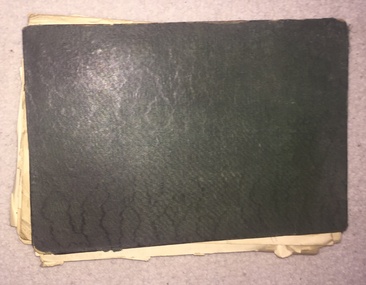
Document - Personal Papers, Melbourne & Metropolitan Tramways Board (MMTB), Act No. 3243 - 1922 - Construction of West Brunswick tramway, 1920's to late 1950's
... Gazette - 22/10/1958, extension in Park St Kilda 3 - 3515 - 1927 - Spencer St Bridge 4 - 6516 - 1957 - King St Bridge 5 - 3824 - 1929 - changes to the MMTB Consolidation Act of 1928 6 - 3902 - 1930 - ditto 7 - 3941 - 1930 - ditto 8 - 3943 - 1930 - Revision of Statute Law - minor change to the MMTB Act 9 - 3994 - 1931 - changes to the MMTB Consolidation Act of 1928 10 - 4179 - 1933 - ditto 11 - 4255 - 1934 - ditto 12 - 4288 - 1935 - appointment of a public works committee and its powers. 13 - 4445 - 1936 - conveyance of land at Port Melbourne 14 - 4546 - 1938 - construction of Doncaster Road, Camberwell 15 - 4598 - 1938 - changes to the MMTB Consolidation Act of 1928 16 - 4710 - 1939 - ditto 17 - 4806 - 1941 - ditto 18 - 4898 - 1942 - ditto 19 - 4978 - 1943 - Hanna St to Market St tramway, South Melbourne 20 - 5106 - 1945 - changes to the MMTB Consolidation Act of 1928 21 - 5140 - 1946 - Nicholson St East Brunswick tramway 22 - 5141 - 1946 - tramway for Burke Road from Whitehorse Road to Doncaster Rd. 23 - 5160 - 1946 - changes to the MMTB Consolidation Act of 1928 24 - 5206 - 1947 - ditto 25 - 5233 - 1947 - ditto 26 - 5322 - 1948 - Latrobe St to Victoria St tramway 27 - 5342 - 1948 - changes to the MMTB Consolidation Act of 1928 28 - 5367 - 1949 - changes to the MMTB Consolidation Act of 1928 29 - 5615 - 1951 - relating to the salaries of Judges and certain Public Officers 30 - 5645 - 1952 - relating to payments to Metropolitan Fire Brigades Board 31 - 5695 - 1953 - joining of the Footscray and Maribyrnong Tramways 32 - 5756 - 1953 - changes to the MMTB Consolidation Act of 1928 33 - 5757 - 1953 - Revision of Statute Law - minor change to the MMTB Act 34 - 5784 - 1954 - changes to the constitution and powers of the MMTB 35 - 5814 - 1954 - relating to the Infectious Diseases Hospitals 36 - 5914 - 1955 - changes to the Law relating to Limitation of Time for commencing Actions and Arbitrations 37 - 5970 - 1956 - relating to the salaries of certain Public Officers Unknown who made the book - made for an MMTB officer. ...Gazette - 22/10/1958, extension in Park St Kilda 3 - 3515 - 1927 - Spencer St Bridge 4 - 6516 - 1957 - King St Bridge 5 - 3824 - 1929 - changes to the MMTB Consolidation Act of 1928 6 - 3902 - 1930 - ditto 7 - 3941 - 1930 - ditto 8 - 3943 - 1930 - Revision of Statute Law - minor change to the MMTB Act 9 - 3994 - 1931 - changes to the MMTB Consolidation Act of 1928 10 - 4179 - 1933 - ditto 11 - 4255 - 1934 - ditto 12 - 4288 - 1935 - appointment of a public works committee and its powers. 13 - 4445 - 1936 - conveyance of land at Port Melbourne 14 - 4546 - 1938 - construction of Doncaster Road, Camberwell 15 - 4598 - 1938 - changes to the MMTB Consolidation Act of 1928 16 - 4710 - 1939 - ditto 17 - 4806 - 1941 - ditto 18 - 4898 - 1942 - ditto 19 - 4978 - 1943 - Hanna St to Market St tramway, South Melbourne 20 - 5106 - 1945 - changes to the MMTB Consolidation Act of 1928 21 - 5140 - 1946 - Nicholson St East Brunswick tramway 22 - 5141 - 1946 - tramway for Burke Road from Whitehorse Road to Doncaster Rd. 23 - 5160 - 1946 - changes to the MMTB Consolidation Act of 1928 24 - 5206 - 1947 - ditto 25 - 5233 - 1947 - ditto 26 - 5322 - 1948 - Latrobe St to Victoria St tramway 27 - 5342 - 1948 - changes to the MMTB Consolidation Act of 1928 28 - 5367 - 1949 - changes to the MMTB Consolidation Act of 1928 29 - 5615 - 1951 - relating to the salaries of Judges and certain Public Officers 30 - 5645 - 1952 - relating to payments to Metropolitan Fire Brigades Board 31 - 5695 - 1953 - joining of the Footscray and Maribyrnong Tramways 32 - 5756 - 1953 - changes to the MMTB Consolidation Act of 1928 33 - 5757 - 1953 - Revision of Statute Law - minor change to the MMTB Act 34 - 5784 - 1954 - changes to the constitution and powers of the MMTB 35 - 5814 - 1954 - relating to the Infectious Diseases Hospitals 36 - 5914 - 1955 - changes to the Law relating to Limitation of Time for commencing Actions and Arbitrations 37 - 5970 - 1956 - relating to the salaries of certain Public Officers Unknown who made the book - made for an MMTB officer. ...Book - dark green card stippled cover, originally bound it would appear for Act 3732. See Reg Item 2120 for the reprint. Remains of the Act in the book, with an index, with well used pages, red pen marks noting changes and the following loose 39 Acts or documents. Also has some hand written notes. 1. - Act No. 3243 - 1922 - Construction of West Brunswick tramway 2 - Extract of Govt. Gazette - 22/10/1958, extension in Park St Kilda 3 - 3515 - 1927 - Spencer St Bridge 4 - 6516 - 1957 - King St Bridge 5 - 3824 - 1929 - changes to the MMTB Consolidation Act of 1928 6 - 3902 - 1930 - ditto 7 - 3941 - 1930 - ditto 8 - 3943 - 1930 - Revision of Statute Law - minor change to the MMTB Act 9 - 3994 - 1931 - changes to the MMTB Consolidation Act of 1928 10 - 4179 - 1933 - ditto 11 - 4255 - 1934 - ditto 12 - 4288 - 1935 - appointment of a public works committee and its powers. 13 - 4445 - 1936 - conveyance of land at Port Melbourne 14 - 4546 - 1938 - construction of Doncaster Road, Camberwell 15 - 4598 - 1938 - changes to the MMTB Consolidation Act of 1928 16 - 4710 - 1939 - ditto 17 - 4806 - 1941 - ditto 18 - 4898 - 1942 - ditto 19 - 4978 - 1943 - Hanna St to Market St tramway, South Melbourne 20 - 5106 - 1945 - changes to the MMTB Consolidation Act of 1928 21 - 5140 - 1946 - Nicholson St East Brunswick tramway 22 - 5141 - 1946 - tramway for Burke Road from Whitehorse Road to Doncaster Rd. 23 - 5160 - 1946 - changes to the MMTB Consolidation Act of 1928 24 - 5206 - 1947 - ditto 25 - 5233 - 1947 - ditto 26 - 5322 - 1948 - Latrobe St to Victoria St tramway 27 - 5342 - 1948 - changes to the MMTB Consolidation Act of 1928 28 - 5367 - 1949 - changes to the MMTB Consolidation Act of 1928 29 - 5615 - 1951 - relating to the salaries of Judges and certain Public Officers 30 - 5645 - 1952 - relating to payments to Metropolitan Fire Brigades Board 31 - 5695 - 1953 - joining of the Footscray and Maribyrnong Tramways 32 - 5756 - 1953 - changes to the MMTB Consolidation Act of 1928 33 - 5757 - 1953 - Revision of Statute Law - minor change to the MMTB Act 34 - 5784 - 1954 - changes to the constitution and powers of the MMTB 35 - 5814 - 1954 - relating to the Infectious Diseases Hospitals 36 - 5914 - 1955 - changes to the Law relating to Limitation of Time for commencing Actions and Arbitrations 37 - 5970 - 1956 - relating to the salaries of certain Public Officers Unknown who made the book - made for an MMTB officer. Binds the original Act's printed by the various Government Printers at the time. Some multiple copies of the various Acts included.Inside front cover on first page in ink "Mr. J. Cass" and in other locations as well.trams, tramways, tramways, acts of parliament, mmtb, park st, spencer st, bridges, king st, port melbourne, doncaster rd, burke rd, nicholson st, latrobe st, hanna st, mfbb, hospital, finances, east brunswick, footscray, maribyrnong -
 Williamstown Historical Society Inc
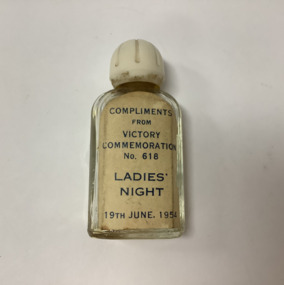
Domestic object - Masonic perfume bottle
... Lodge number 618 under the Victorian constitution was historically the Victory Commemoration Lodge (founded in 1947), which eventually returned its warrant in 1995. Lodges around this time often were named to ackonwledge the war. Masons Label: "COMPLIMENTS/FROM/FROM/VICTORY/COMMEMORATION/No. 618/LADIES' NIGHT/19th June, 1954 ...This perfume bottle is from Masonic Lodge 618, based in Willliamstown. Freemasonry in Williamstown dates back to 1854 with the formation of the town's first lodge.The historic Masonic hall on Electra Street had its memorial stone laid in August 1890 and was opened in 1891. Lodge number 618 under the Victorian constitution was historically the Victory Commemoration Lodge (founded in 1947), which eventually returned its warrant in 1995. Lodges around this time often were named to ackonwledge the war. Small rectangular fluted glass perfume bottle with cream fluted plastic lid. Perfume residue. Label: "COMPLIMENTS/FROM/FROM/VICTORY/COMMEMORATION/No. 618/LADIES' NIGHT/19th June, 1954"masons
