
Showing 166 items matching "control of a flight"
-
 Moorabbin Air Museum
Book - AIR TRAFFIC CONTROL, Take Off To Touchdown The Story of Air Traffic Control
... ...Control of a flight...Air traffic control The coming of radio War years Post war boom Navigation & control aids Area control Control tower Operational control Control of a flight Search & rescue Men of ATC Phonetic alphabet Air traffic control terms Technical & general overview of air traffic control in Australia, circa 1967 Take Off To Touchdown The Story of Air Traffic Control Book AIR TRAFFIC CONTROL ...Technical & general overview of air traffic control in Australia, circa 1967non-fictionTechnical & general overview of air traffic control in Australia, circa 1967the coming of radio, war years, post war boom, navigation & control aids, area control, control tower, operational control, control of a flight, search & rescue, men of atc, phonetic alphabet, air traffic control terms -
 Moorabbin Air Museum
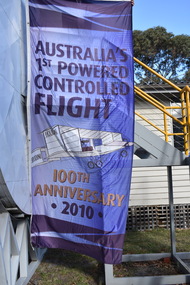
Banner (item) - Harry Houdini 100th Flight Anniversary Banner
... The 100th anniversary of Australia's first powered, controlled, and sustained flight was celebrated in 2010, with events held in Diggers Rest Victoria. ...The 100th anniversary of Australia's first powered, controlled, and sustained flight was celebrated in 2010, with events held in Diggers Rest Victoria. ...The 100th anniversary of Australia's first powered, controlled, and sustained flight was celebrated in 2010, with events held in Diggers Rest Victoria. Ehrich Weiss ( better known as Harry Houdini), made Australia's first recognised flight in a Voisin biplane at Diggers Rest on 18th March 1910. Houdini made three flights that day, the last covering 3km. -
Moorabbin Air Museum
Document (Item) - A Modern Control System For Jindivik
... Controls. Ground Handling and Preparation for Flight. Airfram. Power Plant Installation. ...Controls. Ground Handling and Preparation for Flight. Airfram. Power Plant Installation. ...Description: JINDIVIK MK31 General and Technical Information. Controls. Ground Handling and Preparation for Flight. Airfram. Power Plant Installation. Electrical System. AAP: 721:92/3A VOL1 Book1 Date: 09/66 AL6 Author: Department of Air Amended to AL Publishe Level of Importance: . -
 Wodonga & District Historical Society Inc
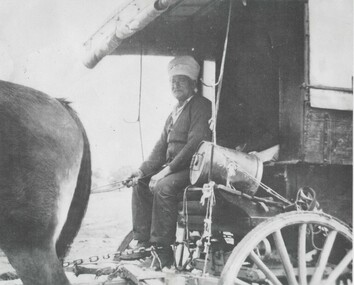
Photograph - Sikh Hawkers in Wodonga
... On the morning of 23 June 1923 his horses were restive and hard to control. They took flight and ran Pola down on the road near Cudgewa. ...On the morning of 23 June 1923 his horses were restive and hard to control. They took flight and ran Pola down on the road near Cudgewa. ...Sikh hawkers were a regular sight throughout the Wodonga and Upper Murray district in the early 20th century. The regular visitors to the area included Pola Singh and Gambil (Gamble) Singh. Gamble Singh often camped on McKoy’s Moorefield property in West Wodonga and several other places around the district. Gamble was also a horse breeder and had several draught horses to pull his wagon. Like many of the hawkers he worked hard to send money back to support family in India. He apparently returned to India about 1950, but left some money in the Bank of NSW in Wodonga in case he returned. He allegedly died soon after and the money was eventually able to be claimed by his nephews in India. A small overlooked park in Wodonga is named the “Gamble Singh Park” in his memory. J. Flanagan who operated the Halfway Hotel commented on having as many as seven or eight bullock teams “yoked” overnight to the fence outside the hotel as well as 100 or more Indian hawkers – led by the fondly known Pola (Pollah) Singh. The hawkers returned to Wodonga annually to renew their hawkers’ license and camped on the flats, or also came to Wodonga to collect orders at the railway station to stock up their supplies. Pola Singh was often based at the Colac Colac reserve near Corryong and had on board his compatriot Isar Singh. He often acted as an intermediary between the individual hawkers and the authorities. Unfortunately, it was Pola’s habit to walk in front of his wagon at the start of each day. On the morning of 23 June 1923 his horses were restive and hard to control. They took flight and ran Pola down on the road near Cudgewa. He was rushed to the Corryong Hospital but died there a few days later, aged 65. Pola was cremated, with some of his ashes scattered in the Murray River and some returned to his homeland to be scattered in the Ganges River. His cremation was listed in the Obituary page of the Weekly Times, Melbourne on Saturday 14 July 1923. A small memorial to Pola Singh is located in the Corryong Cemetery.These images are significant because they help to document the history of the Sikh Hawkers who plied their services to Wodonga and throughout rural Australia in the late 19th and early 20th centuries.A collection of black and white images featuring Sikh Hawkers Gamble Singh and Pola Singh take in the Wodonga area.indian hawkers, sikh hawkers, gamble singh, pola singh -
Moorabbin Air Museum
Bill Prowse Collection Box WP13 See Description for Details
... Jindivik Mk 203B General and Technical Information Book 1 GAF Jindivik Mk 203B General and Technical Information Book 2 GAF Jindivik Mk 3A General and Technical Information Vol 1 Book 2 AAP 721:92/3A Jindivik Mk 3A General and Technical Information Vol 1 Book 1 AAP 721:92/3A A modern Control System for Jindivik Jindivik Mk3A Flight Manual Target Aircraft Jindivik Photographs ...Jindivik Mk 203B General and Technical Information Book 1 GAF Jindivik Mk 203B General and Technical Information Book 2 GAF Jindivik Mk 3A General and Technical Information Vol 1 Book 2 AAP 721:92/3A Jindivik Mk 3A General and Technical Information Vol 1 Book 1 AAP 721:92/3A A modern Control System for Jindivik Jindivik Mk3A Flight Manual Target Aircraft Jindivik Photographs Bill Prowse Collection Box WP13 See Description for Details ... -
 Eltham District Historical Society Inc
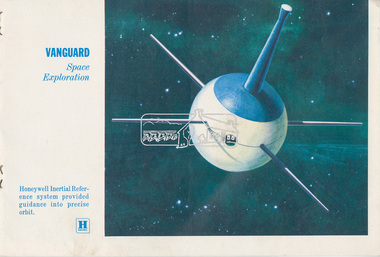
Document - Folder, Aerospace Industry, 1958-1961
... Satellite Situation Report, February 14, 1961; Space operations Control Center, Goddard Space Flight Center, National Aeronautics and Space Administration, Greenbelt, Maryland; 4 pages 9. ...Satellite Situation Report, February 14, 1961; Space operations Control Center, Goddard Space Flight Center, National Aeronautics and Space Administration, Greenbelt, Maryland; 4 pages 9. ...honeywell, scout rocket, echo satellite, mercury rocket, centaur rocket, advent rocket, mariner satellite, dyna soar, x-15, midas rocket, tiros satellite, discoverer rocket, vanguard satellite, aerospace industry, alan gardiner collection, space industry -
Moorabbin Air Museum
Document (series) - Nomad Development Material - Collection of Vilem Gottlieb
... 1987 74 A seating plan - probably of section at Avalon 75 Copy of the Department of Defence OFFICIAL SECRECY - Crimes Act 1914 1977 76 Technical Officer (Engineering) Duty Statement 1978 77 Memo: Request to train Fight Test Observers as pilots 1980 78 GAF Letter: GAF Test Pilots 1986 79 Letter to the editor of Aircraft 1984 80 GAF/ASTA Letter to the editor of the Geelong Advertiser 1994 81 Geelong Advertiser Article that relates to #80 1994 82 GAF Memorandum of Insurance 1978 83 GAF Duty Statement - Senior Technical Officer (Engineering) Grade 3 84 GAF Duty Statement - Senior Technical Officer (Engineering) Grade 2 85 Suspension folder Nomad Handwritten Certification report N24A-20 - Ground and flight tests - Water methanol injection system 86 Nomad Flight manual supplement - Trial installation - Option G428 - Water-methanol power augmentation system 1980 87 Nomad More handwritten notes about the water/methanol injection system - N24A 88 Nomad Draft Water.methanol power augmentation system flight test schedule - N22S, N22B 89 Nomad Handwritten notes on the water/methanol system 90 Nomad GAF Nomad Model N - Flight test schedule - Water/methanol power augmentation system 91 Nomad GAF Nomad Model N - Flight test schedule - Water/methanol power augmentation system 92 Article - Light-twin engine-out flying by Dennis Newton- Business and Commercial Aviation - November 1987 1987 93 Nomad Handwritten and photocopies attached re conditions for turbine aircraft and federal aviation regulations part 23 94 Mississippi State University Article: Determining Performance Parameters of General Aviation Aircraft - Mississippi State University 95 Technological University, The Netherlands Article: Determination of performance, stability and control characteristics from measurements in non-steady manoeuvres 96 Department of Mechanical and Aerospace Engineering, North Carolina State University Article: Recent results obtained with a new method for measuring aircraft power and drag in flight 1979 97 Mississippi State University Article: Flight test evaluation of a method to determine the level flight performance of a propellor-driven aircraft 1977 98 NASA Report: Practical aspects of using a maximum likelihood estimation method to extract stability and control derivatives from flight data 1976 99 Two photographs of engines unknown 100 Folder Nomad ASTA Aircraft Flight Manual - Nomad Model N22C 2006 101 Plastic Wrapped paper Nomad ASTA Pilot’s Operating Handbook - Model N22S Searchmaster 1990 102 Stapled book Aeronautical Engineering Report: AF-36 - Flight Test Report 103 Manila Folder Nomad ASTA Documentation relating to Florida Court Case 1989 104 Suspension folder Paperwork on recording the weight of aircraft - including aircraft weighing summaries 105 Manila Folder Nomad Brochure: What Nomad is that? ...1987 74 A seating plan - probably of section at Avalon 75 Copy of the Department of Defence OFFICIAL SECRECY - Crimes Act 1914 1977 76 Technical Officer (Engineering) Duty Statement 1978 77 Memo: Request to train Fight Test Observers as pilots 1980 78 GAF Letter: GAF Test Pilots 1986 79 Letter to the editor of Aircraft 1984 80 GAF/ASTA Letter to the editor of the Geelong Advertiser 1994 81 Geelong Advertiser Article that relates to #80 1994 82 GAF Memorandum of Insurance 1978 83 GAF Duty Statement - Senior Technical Officer (Engineering) Grade 3 84 GAF Duty Statement - Senior Technical Officer (Engineering) Grade 2 85 Suspension folder Nomad Handwritten Certification report N24A-20 - Ground and flight tests - Water methanol injection system 86 Nomad Flight manual supplement - Trial installation - Option G428 - Water-methanol power augmentation system 1980 87 Nomad More handwritten notes about the water/methanol injection system - N24A 88 Nomad Draft Water.methanol power augmentation system flight test schedule - N22S, N22B 89 Nomad Handwritten notes on the water/methanol system 90 Nomad GAF Nomad Model N - Flight test schedule - Water/methanol power augmentation system 91 Nomad GAF Nomad Model N - Flight test schedule - Water/methanol power augmentation system 92 Article - Light-twin engine-out flying by Dennis Newton- Business and Commercial Aviation - November 1987 1987 93 Nomad Handwritten and photocopies attached re conditions for turbine aircraft and federal aviation regulations part 23 94 Mississippi State University Article: Determining Performance Parameters of General Aviation Aircraft - Mississippi State University 95 Technological University, The Netherlands Article: Determination of performance, stability and control characteristics from measurements in non-steady manoeuvres 96 Department of Mechanical and Aerospace Engineering, North Carolina State University Article: Recent results obtained with a new method for measuring aircraft power and drag in flight 1979 97 Mississippi State University Article: Flight test evaluation of a method to determine the level flight performance of a propellor-driven aircraft 1977 98 NASA Report: Practical aspects of using a maximum likelihood estimation method to extract stability and control derivatives from flight data 1976 99 Two photographs of engines unknown 100 Folder Nomad ASTA Aircraft Flight Manual - Nomad Model N22C 2006 101 Plastic Wrapped paper Nomad ASTA Pilot’s Operating Handbook - Model N22S Searchmaster 1990 102 Stapled book Aeronautical Engineering Report: AF-36 - Flight Test Report 103 Manila Folder Nomad ASTA Documentation relating to Florida Court Case 1989 104 Suspension folder Paperwork on recording the weight of aircraft - including aircraft weighing summaries 105 Manila Folder Nomad Brochure: What Nomad is that? ...Donation from Anna Gottlieb -
 The Beechworth Burke Museum
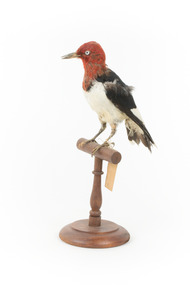
Animal specimen - Red Headed Woodpecker, Trustees of the Australian Museum, 1860-1880
... flight. The Red Headed Woodpecker is threatened in Canada and some areas of the United States due to deforestation, lack of deadwood for nesting, competition with other birds, and a lack of food. They are an important part of the ecosystem, controlling...flight. The Red Headed Woodpecker is threatened in Canada and some areas of the United States due to deforestation, lack of deadwood for nesting, competition with other birds, and a lack of food. They are an important part of the ecosystem, controlling ...Red Headed Woodpeckers can be found in Southern Canada and a large portion of the United States of America, generally migrating to the south if they originated in the northern regions. Their habitat is open forests or savannahs. They are classed as omnivores, finding food from pecking at wood or in flight. The Red Headed Woodpecker is threatened in Canada and some areas of the United States due to deforestation, lack of deadwood for nesting, competition with other birds, and a lack of food. They are an important part of the ecosystem, controlling insect populations and pollinating flora. Red Headed Woodpeckers typically have a beautiful, vibrant red neck and head, a stark white chest, black back, and black wings with white secondary remiges. They have a large chisel-like beak, suitable for foraging for their food. Their heads are rounded and they have short tails. This specimen is part of a collection of almost 200 animal specimens that were originally acquired as skins from various institutions across Australia, including the Australian Museum in Sydney and the National Museum of Victoria (known as Museums Victoria since 1983), as well as individuals such as amateur anthropologist Reynell Eveleigh Johns between 1860-1880. These skins were then mounted by members of the Burke Museum Committee and put-on display in the formal space of the Museum’s original exhibition hall where they continue to be on display. This display of taxidermy mounts initially served to instruct visitors to the Burke Museum of the natural world around them, today it serves as an insight into the collecting habits of the 19th century.This specimen is part of a significant and rare taxidermy mount collection in the Burke Museum. This collection is scientifically and culturally important for reminding us of how science continues to shape our understanding of the modern world. They demonstrate a capacity to hold evidence of how Australia’s fauna history existed in the past and are potentially important for future environmental research. This collection continues to be on display in the Museum and has become a key part to interpreting the collecting habits of the 19th century.This Red Headed Woodpecker is a small to medium-sized bird found in North America. This specimen is tricoloured: it has a red head and neck, a white chest, a black back, and black wings with white secondary remiges. It has a large chisel-like beak. This specimen has pest or humidity damage on the neck and head area. This specimen is standing on a wooden mount with a swing tag attached to it's leg.Swing-tag: 151a. Unnamed / Catalogue page, 60 /taxidermy mount, taxidermy, animalia, burke museum, beechworth, australian museum, skin, reynell eveleigh johns, bird, red headed woodpecker -
 Federation University Historical Collection
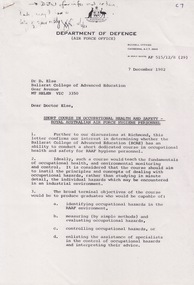
Document - Document - Correspondence, VIOSH: Department of Defence - Air Force Office, Canberra, December 1982
... control. Better use of the practical time allocated is needed. Noise induced hearing loss is the most widespread occupational health risk in the RAAF. Industrial chemicals used and hazardous industrial procedures in the repair and maintenance of aircraft are an issue needing resolution. Existing terminal objectives for basic hygiene inspectors course in occupational health and safety are provided for comment. Information provided by K R Stone, Flight...control. Better use of the practical time allocated is needed. Noise induced hearing loss is the most widespread occupational health risk in the RAAF. Industrial chemicals used and hazardous industrial procedures in the repair and maintenance of aircraft are an issue needing resolution. Existing terminal objectives for basic hygiene inspectors course in occupational health and safety are provided for comment. Information provided by K R Stone, Flight ...Victorian Institute of Occupational Safety and Health (VIOSH) Australia is the Asia-Pacific centre for teaching and research in occupational health and safety (OHS) and is known as one of Australia's leaders on the field. VIOSH has a global reputation for its innovative approach within the field of OHS management. VIOSH had its first intake of students in 1979. At that time the Institution was known as the Ballarat College of Advanced Education. In 1990 it became known as Ballarat University College, then in 1994 as University of Ballarat. It was 2014 that it became Federation University. VIOSH Australia students are safety managers, senior advisors and experienced OHS professionals. They come from all over Australia and industry. Students are taught active research and enquiry; rather than textbook learning and a one-size fits all approach. VIOSH accepts people into the Graduate Diploma of Occupational Hazard Management who have no undergraduate degree - on the basis of extensive work experience and knowledge Letter from the Department of Defence to Dennis Else looking at the possibility of Ballarat College of Advanced Education conducting a short course in occupational health and safety for RAAF hygiene personnel. It would teach the fundamentals of occupational health and environmental monitoring and control. Better use of the practical time allocated is needed. Noise induced hearing loss is the most widespread occupational health risk in the RAAF. Industrial chemicals used and hazardous industrial procedures in the repair and maintenance of aircraft are an issue needing resolution. Existing terminal objectives for basic hygiene inspectors course in occupational health and safety are provided for comment. Information provided by K R Stone, Flight Lieutenant for Director General of Air Force Health Services. Eight A4 pages,typed. Handwritten note top left cornerLetterhead of Department of Defence - Air Force Office.Signature of K R Stoneviosh, victorian institute of occupational safety and health, department of defence, air force office, raaf, ballarat college of advanced education, dennis else, k r stone, flight lieutenant, director general of air force health services, short course in occupational health and safety, raaf hygiene personnel, hearing loss, industrial chemicals, hazardous industrial procedures -
 Lara RSL Sub Branch
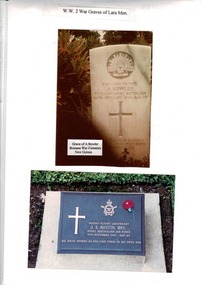
World War 2 War Graves of Lara Men, Photograph of Head Stone of grave site Pte. A. Bowler at Bomana War Cementary, New Guinea and Grave Site of Flight Lieutenant J.S. Austin DFC grave site Adelaide River, N. T
... Flight Lieutenant "Bunny" Austin (A16-207) led five Hudsons to bomb Koepang town. The next night he led back seven aircraft against the airfield at Penfoei, attacking before dawn on the 8th prior to United States Liberators bombing the runways and barracks. 75 Austin's aircraft was caught by Penfoei's master defensive searchlight, and Austin used violent evasion and switching on and off of his IFF equipment, a tactic used in Europe. The radar-controlled...Flight Lieutenant "Bunny" Austin (A16-207) led five Hudsons to bomb Koepang town. The next night he led back seven aircraft against the airfield at Penfoei, attacking before dawn on the 8th prior to United States Liberators bombing the runways and barracks. 75 Austin's aircraft was caught by Penfoei's master defensive searchlight, and Austin used violent evasion and switching on and off of his IFF equipment, a tactic used in Europe. The radar-controlled ...Flt Lt J S Austin DFC, 400363. No 608 Sqn RAF, Nos 32, 13 & 2 Sqns. Stock agent of Lara, Vic; b Melbourne 15 May 1918. Died of illness 9 Nov 1943. Timor was the target for the night of 6 July, when Flight Lieutenant "Bunny" Austin (A16-207) led five Hudsons to bomb Koepang town. The next night he led back seven aircraft against the airfield at Penfoei, attacking before dawn on the 8th prior to United States Liberators bombing the runways and barracks. 75 Austin's aircraft was caught by Penfoei's master defensive searchlight, and Austin used violent evasion and switching on and off of his IFF equipment, a tactic used in Europe. The radar-controlled searchlights went out. Flying Officer Mick Helsham (A16-160) attacked first to act as a pathfinder and mark the target for the other Hudsons and Liberators:Full service records of J. S. Austin held by Lara R.S.L.Plain Sheet A4 paper with 2 photographs 1. A. Bowler W. 9.8 cm H. 13.8 cm photograph 2. J.S. Austin W. 1`5.9 cm H. 10.0 cmA4 sheet heading as: W.W. 2 War Graves of Lara Men. Note on photograph 1. Grave of A. Bowler, Bomana War Cemetery.r.a.f., graves, lara -
Federation University Historical Collection
Document - Documents, Federation University Notifications Referring to Covid-19, 2020, 06/04/2020
... However, the new case in Queensland was linked to the Rydges on Swanston cluster in Melbourne when a man who travelled from Melbourne to Brisbane on Virgin flight VA313 on 1 June tested positive. covid-19 corona virus pandemic social distancing lock down federation university australia covidsafe plan Notifications to staff and students relating to the worldwide Covid-19 Pandemic. * Federation University COVIDSafe Plan prepared by the Transition to Campus Control ...On 12 January, the World Health Organization (WHO) confirmed that a novel coronavirus was the cause of a respiratory illness in a cluster of people in Wuhan City, Hubei Province, China, who had initially come to the attention of the WHO on 31 December 2019. On 3 March, the Reserve Bank of Australia became the first central bank to cut interest rates in response to the outbreak. Official interest rates were cut by 0.25% (25 base points) to a record low of 0.5%. On 12 March, the Federal Government announced a A$17.6 billion stimulus package, the first since the 2008 GFC. he package consists of multiple parts, a one-off A$750 payment to around 6.5 million welfare recipients as early as 31 March 2020, small business assistance with 700,000 grants up to $25,000 and a 50% wage subsidy for 120,000 apprenticies or trainees for up to 9 months, 1 billion to support economically impacted sectors, regions and communities, and $700 million to increase tax write off and $3.2 billion to support short-term small and medium-sized business investment. On 16 March, Premier Dan Andrews and Minister for Health Jenny Mikakos declared a state of emergency for Victoria for at least four weeks. On 19 March, the Reserve Bank again cut interest rates by a further 0.25% to 0.25%, the lowest in Australian history. On 22 March, the government announced a second stimulus package of A$66bn, increasing the amount of total financial package offered to A$89bn. This included several new measures like doubling income support for individuals on Jobseeker's allowance, granting A$100,000 to small and medium-sized businesses and A$715 million to Australian airports and airlines. It also allowed individuals affected by the outbreak to access up to A$10,000 of their superannuation during 2019–2020 and also being able to take an additional same amount for the next year. on the same day Victorian Premier Daniel Andrews announced on 22 March that the state will bring the school holiday forwards to 24 March from 27 March. On 30 March, the Australian Federal Government announced a $130 billion "JobKeeper" wage subsidy program offering to pay employers up to $1500 a fortnight per full-time, part-time or casual employee that has worked for that business for over a year. For a business to be eligible, they must have lost 30% of turnover after 1 March of annual revenue up to and including $1 billion. For businesses with a revenue of over $1 billion, turnover must have decreased by 50%. Businesses are then required by law to pay the subsidy to their staff, in lieu of their usual wages. This response came after the enormous job losses seen just a week prior when an estimated 1 million Australians lost their jobs. This massive loss in jobs caused the myGov website to crash and lines out of Centrelink offices to run hundreds of metres long.The program was backdated to 1 March, to aim at reemploying the many people who had just lost their jobs in the weeks before. Businesses would receive the JobKeeper subsidy for six months. On 2 April, the number of cases in Victoria exceeded 1,000, including over 100 healthcare workers. On 5 April, New South Wales Police launched a criminal investigation into whether the operator of Ruby Princess, Carnival Australia, broke the Biosecurity Act 2015 (Cwth) and New South Wales state laws, by deliberately concealing COVID-19 cases. On 6 April, the Department of Health revealed that 2,432 people recovered from the infection as the federal government started reporting recovery statistics. This is more than a third from the official number reported so far, Deputy Chief Medical Officer Professor Paul Kelly stating, "I think it is important. Firstly it really reinforces that message, which is a true one, that most people who get this disease do recover”. The day before, at 3pm, it was announced that 2,315 of the 5,687 confirmed coronavirus cases had recovered. May 2020 - An outbreak in Victoria at a meatworks that was later revealed to be Cedar Meats was announced on 02 May with eight cases. By 8 May, the cluster of cases linked to Cedar Meats in Victoria was 71, consisting of at least 57 workers and 13 close contacts, including a nurse, aged care worker and high school student. The number had increased to 75 by 9 May, 88 by 13 May, and 90 by 14 May. On 9 May, two Victorian cases were announced to be related to McDonald's Fawkner. By 18 May, this had increased to 12 cases, and on that day it was revealed that a delivery driver had tested positive, prompting the closing for cleaning of 12 more McDonald's locations: Melton East, Laverton North, Yallambie, Taylors Lakes, Campbellfield, Sunbury, Hoppers Crossing, Riverdale Village, Sandown, Calder Highway Northbound/Outbound, Calder Highway Southbound/Inbound, and BP Rockbank Service Centre Outbound. On 15 May, South Australia became the second jurisdiction, after the ACT, to be free of any active cases, however on 26 May, a woman returning from overseas who was granted exemption into South Australia from her hotel quarantine in Victoria tested positive for COVID-19. This was the first new case in 19 days for the state.[101] On 4 June, it was announced that the woman had recovered and the state was free of any active cases once again.[102] On 17 May, Victoria announced two further business sites had been shut down due to a suspected case at each. Domino's Pizza in Fairfield has been shut for two weeks, and mattress manufacturer The Comfort Group in Deer Park was closed from Friday 15 May to at least Wednesday 20 May. On 6 June, both New South Wales and Victoria reported no new cases for the previous 24 hours, with only Queensland and Western Australia reporting one new case each, the lowest national total since February. Western Australia also announced two old cases. However, the new case in Queensland was linked to the Rydges on Swanston cluster in Melbourne when a man who travelled from Melbourne to Brisbane on Virgin flight VA313 on 1 June tested positive.Notifications to staff and students relating to the worldwide Covid-19 Pandemic. * Federation University COVIDSafe Plan prepared by the Transition to Campus Control Group, Version 1.4, 21 July 2020 * Federation University Notifications Referring to Covid-19, 18 August 2020covid-19, corona virus, pandemic, social distancing, lock down, federation university australia, covidsafe plan -
![Newspaper Clipping, Drone law proposals gain flight [Banyule Council], 06/04/2016](/media/collectors/4f729f5697f83e03086015b8/items/5868a6fad0ce1a04fc94ab90/item-media/5868a724d0ce1a04fc94be24/item-fit-380x285.jpg?cb=6) Greensborough Historical Society
Greensborough Historical SocietyNewspaper Clipping, Drone law proposals gain flight [Banyule Council], 06/04/2016
... Banyule Mayor Craig Langdon agreed to lobby for controls on the use of drones, particularly regarding privacy issues. banyule city council drones craig langdon News clipping, black text. Drone law proposals gain flight ...Banyule Mayor Craig Langdon agreed to lobby for controls on the use of drones, particularly regarding privacy issues.News clipping, black text.banyule city council, drones, craig langdon -
 Ringwood and District Historical Society
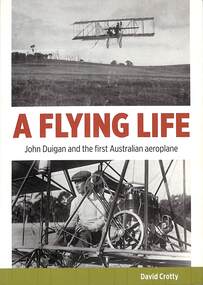
Book, A Flying Life - John Duigan and the first Australian aeroplane, 2010
... Front cover: Top - Duigan's aeroplane in flight, Spring Plains Station, Mia Mia, Victoria, in 1911. Below - John Duigan at the controls of his aircraft at Spring Plains Station, Mia Mia, Victoria, in 1911....Front cover: Top - Duigan's aeroplane in flight, Spring Plains Station, Mia Mia, Victoria, in 1911. Below - John Duigan at the controls of his aircraft at Spring Plains Station, Mia Mia, Victoria, in 1911. ...About the author: Born in Melbourne, David Crotty has worked in museums since 1984. He has a long-standing interest in aviation history and has worked as a curator with the Australian War Memorial and the RAAF Museum. He is currently (2010) a curator in the History and Technology Department of Museum Victoria. Story of John Robertson Duigan and his flying creer, from his early years as a Melbourne school boy to his heroic activities as a pilot on the Western Front in World War One. He was the first Australian to fly a powered Australian-made aeroplane in Australia.Front cover: Top - Duigan's aeroplane in flight, Spring Plains Station, Mia Mia, Victoria, in 1911. Below - John Duigan at the controls of his aircraft at Spring Plains Station, Mia Mia, Victoria, in 1911. -
 Bendigo Military Museum
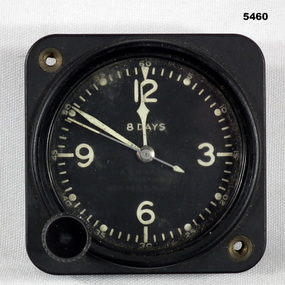
Equipment - EIGHT DAY CLOCK, 1942
... Flight Lieutenant Ian A. Lyons Stamped on a plate on the back of the clock: 'ORDER No. AC26186, MFR'S. PART No. 1776, SPEC. No. 94-27970, SER No. AC42-17865, ELGIN NAT'L WATCH CO.' Analogue eight-day aircraft clock with square mounting and round face. Numbers 3, 6, 9 and 12 and hands are white in colour with a black background. A winding knob is located on the bottom left-hand corner. There are two threaded holes on opposite corners for attachment to the control ...Eight-day clock from a Kittyhawk aircraft flown by Flight Lieutenant Ian A. Lyons. Part of the Flight Lieutenant Ian A. (Joe) Lyons MBE Collection. See catalogue No 5374P for his service record.Analogue eight-day aircraft clock with square mounting and round face. Numbers 3, 6, 9 and 12 and hands are white in colour with a black background. A winding knob is located on the bottom left-hand corner. There are two threaded holes on opposite corners for attachment to the control panel of an aircraft. The casing is made from bakelite.Stamped on a plate on the back of the clock: 'ORDER No. AC26186, MFR'S. PART No. 1776, SPEC. No. 94-27970, SER No. AC42-17865, ELGIN NAT'L WATCH CO.'eight-day clock, aircraft clock, kittyhawk aircraft, flight lieutenant ian a. lyons -
 Running Rabbits Military Museum operated by the Upwey Belgrave RSL Sub Branch
Ikara Missile, Maribyrnong Ordinance Factory in Victoria. et al, 1965
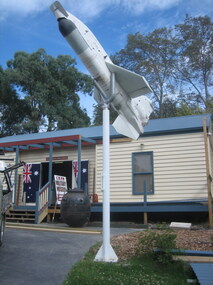
... Flight maneuverability was provided by elevons fitted into the trailing edge of each wing, these were operated by an actuator system that received flight correction data transmitted to the autopilot from the fire control system. ...Flight maneuverability was provided by elevons fitted into the trailing edge of each wing, these were operated by an actuator system that received flight correction data transmitted to the autopilot from the fire control system. ...During the 1950’s, the growing threat from Submarines, led the Royal Australian Navy to consider a quick reaction, long range ASW torpedo delivery system as an alternative to the USN’s ASROC and the RN’s Match. Full scale research and development began in 1960 using the Turana target drone as the basis for the delivery platform. Shipboard tests began in 1963 and the Government Aircraft Factory (GAF) began production of three variants M3, M4 and M5 in 1965. The M4 variant had a guidance system designed to interface to a full tactical data handling system while the M3 and M5 variants used a simpler system with a dedicated fire control system. The IKARA is an unmanned miniature aircraft with clip on upper and lower stabilizers and wings. The upper stabilizer (SVU) housed and electronic package that transmitted flight data back to the launch platform and received updated target acquisition data during flight. Flight maneuverability was provided by elevons fitted into the trailing edge of each wing, these were operated by an actuator system that received flight correction data transmitted to the autopilot from the fire control system. The payload, either the Mk44 or Mk46 lightweight torpedo was suspended to the underside of the airframe and faired into the body to provide and aerodynamic shape. The forward section of the body housed the autopilot and the thermal battery unit. Propulsion was provided by the MURAWA steel cased, solid propellant rocket motor with a combined boost and sustainer stage. IKARA was capable of engaging a target to the maximum range of the ships sonar, regardless of weather conditions. Target information is fed into the fire control system, which calculated to drop zone for the torpedo taking into account speed and direction of launch platform and target, win speed etc, then tracking the missile to the drop zone where command signals initiate torpedo release. The IKARA is an unmanned miniature aircraft with clip on upper and lower stabilizers and wings. navy, torpedo, rocket, submarine, missile -
 Bendigo Military Museum
Photograph - Army Survey Regiment’s Officers, Warrant Officers and Sergeants and Squadrons, at Fortuna, Bendigo, 1982
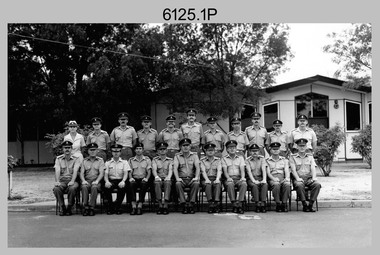
... flight planning the acquisition of aerial photography, pugging, mensuration and block adjustments, photogrammetric extraction of topographic features from aerial photography, digital feature editing, map compilation, operating the scanner/plotter, operating the AUTOMAP 1 system and computer programming by civilians. Cartographic Squadron was responsible for the production of the following military products: Joint Operation Graphics, small-scale RAAF Air Charts, large-scale topographic line maps and orthophotomaps. Cartographic technician tasks were scribing, compiling, retouching, masking, type setting, type stickup, terrain embossing, correcting and proving quality control...flight planning the acquisition of aerial photography, pugging, mensuration and block adjustments, photogrammetric extraction of topographic features from aerial photography, digital feature editing, map compilation, operating the scanner/plotter, operating the AUTOMAP 1 system and computer programming by civilians. Cartographic Squadron was responsible for the production of the following military products: Joint Operation Graphics, small-scale RAAF Air Charts, large-scale topographic line maps and orthophotomaps. Cartographic technician tasks were scribing, compiling, retouching, masking, type setting, type stickup, terrain embossing, correcting and proving quality control ...This is a set of six staff photographs of the Army Survey Regiment’s Officers, Warrant Officers and Sergeants, and each of its four Squadrons at Fortuna, Bendigo in December 1982. Note - Air Survey Squadron’s photo was probably taken in July 1982 as they appear in winter dress. Air Survey Squadron was responsible for aerotriangulation, photogrammetric feature extraction and the AUTOMAP 1 system. Typical tasks were flight planning the acquisition of aerial photography, pugging, mensuration and block adjustments, photogrammetric extraction of topographic features from aerial photography, digital feature editing, map compilation, operating the scanner/plotter, operating the AUTOMAP 1 system and computer programming by civilians. Cartographic Squadron was responsible for the production of the following military products: Joint Operation Graphics, small-scale RAAF Air Charts, large-scale topographic line maps and orthophotomaps. Cartographic technician tasks were scribing, compiling, retouching, masking, type setting, type stickup, terrain embossing, correcting and proving quality control. Headquarters Squadron was responsible for the planning and coordination of map production and contracts. It also performed administrative and support functions such as personnel administration, pay, finance, transportation, records, map Library, kitchens, messes and facility maintenance. It was staffed by Army personnel from RASvy, RACT, AACC, RAAOC and RAEME corps. Other supporting staff at this time included the RAAF Liaison Officer, RAN Liaison Officer and several civilians employed in administration, the Q-Store and grounds maintenance. A component of the Army Svy Regt’s cartographic map production was carried out by the Detachment, a sub-unit located at Bonegilla next to the School of Military Survey. Lithographic Squadron was responsible for the reproduction of map materials and printing of military map products. The main tasks undertaken by photographic technicians were photographic enlargements, reductions and duplication of map reproduction material and processing of aerial photography. Printing technician tasks included platemaking, offset printing, map stock despatching and proofing.This is a set of six staff photographs of the Army Survey Regiment’s Officers, Warrant Officers and Sergeants, and its four Squadrons, at Fortuna, Bendigo, 1982. The black and white photographs were printed on photographic paper and are part of the Army Survey Regiment’s Collection. The photograph was scanned at 300 dpi. No personnel are identified. No personnel are identified. .1P – Annotated on front “OFFICERS MESS DEC ’82” .2P – Annotated on back “SGTS MESS DEC ’82” .4P– Annotated on front “CARTO SQN DEC ’82” .5P– Annotated on front “HQ SQN DEC ’82”royal australian survey corps, rasvy, army survey regiment, army svy regt, fortuna, asr, air survey, carto, litho -
Moorabbin Air Museum
Manual - Department of Civil Aviation Training Courses, Airworthiness Training Course Notes Basic Systems Course Flight Voice Recorder
... ...Flight Control Systems...Flight...Department of Civil Aviation Training Courses VAR & VOR Flight Control Systems Flight director Integrated & Automatic Flight Control Systems G.P.W.S. ...Technical overview of fligh voice recorder for training purposes3 ring foldernon-fictionTechnical overview of fligh voice recorder for training purposesvar & vor, flight control systems, flight director, integrated & automatic flight control systems, g.p.w.s. -
Moorabbin Air Museum
Drawing - Filter Assy. - Hyd. Flight Control - 6 Tube Size, Commonwealth Aircraft Corporation Drawing No. 27-58656
... Filter Assy. - Hyd. Flight Control - 6 Tube Size....Commonwealth Aircraft Corporation Drawing No. 27-58656 Drawing Filter Assy. - Hyd. Flight Control - 6 Tube Size. ... -
Moorabbin Air Museum
Drawing - Valve Assy. - Hyd. Ail. Flight Control Relief R.H. (Complete), Commonwealth Aircraft Corporation Drawing No. 27-58657
... Valve Assy. - Hyd. Ail. Flight Control Relief R.H. (Complete)...Commonwealth Aircraft Corporation Drawing No. 27-58657 Drawing Valve Assy. - Hyd. Ail. Flight Control Relief R.H. (Complete) ... -
Moorabbin Air Museum
Drawing - Valve Assy-Hyd Ail. Flight Control Relief L.H. (Complete), Commonwealth Aircraft Corporation Drawing No. 27-58658
... Valve Assy-Hyd Ail. Flight Control Relief L.H. (Complete)...Commonwealth Aircraft Corporation Drawing No. 27-58658 Drawing Valve Assy-Hyd Ail. Flight Control Relief L.H. (Complete) ... -
Moorabbin Air Museum
Drawing - Valve Assem - Hyd. Ail. Flight Control Relief L.H. (Complete), Commonwealth Aircraft Corporation Drawing No. 27-58675
... Valve Assem - Hyd. Ail. Flight Control Relief L.H. (Complete)...Commonwealth Aircraft Corporation Drawing No. 27-58675 Drawing Valve Assem - Hyd. Ail. Flight Control Relief L.H. (Complete) ... -
Moorabbin Air Museum
Drawing - Bungee Assy. - Hyd. Flight Control Valve Centering, Commonwealth Aircraft Corporation Drawing No. 27-587110
... Bungee Assy. - Hyd. Flight Control Valve Centering...Commonwealth Aircraft Corporation Drawing No. 27-587110 Drawing Bungee Assy. - Hyd. Flight Control Valve Centering ... -
 Bendigo Historical Society Inc.
Newspaper - LONG GULLY HISTORY GROUP COLLECTION: BENDIGO'S CENTURY VOLUME SEVEN: 1960 - 1969
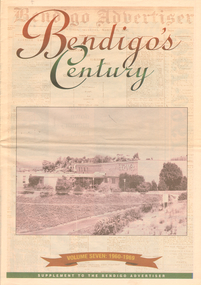
... Control Board... General Television Pty Ltd... Bendigo Central Victoria Telecasters Pty Ltd... Mr Davidson... Bennett's Arcade... Woolworth's... White Hills Swimming Pool... Herb Elliott... Sailor's Guide... Toni Riley Pharmacies... Rising Sun Hotel... Ron Alderton... Dr Albert L Beischer... Channel 8... Melbourne Herald... 3BO... Bendigo Advertiser OfficesLyceum Theatre... Junior Technical School White Hills... Mount Alvernia Hospital... Most Reverend DR B D Stewart... Sisters of the Franciscan Missionaries of the Divine Motherhood... Lazarus Family... Bendigo's Tramways... State Electricity Commission... George Pethard... Lance Pethard... Bendigo Advertiser Fire 29/7/1962... Riverine Herald... The Herald and Weekly Times... Bendigo Art Gallery... Oscar Flight...BENDIGO History long gully history group The Long Gully History Group - Bendigo's Century Volume Seven: 1960 - 1969 Bendigo Advertiser BCV 8 Eppalock Dam Premier Henry Bolte The Criterion Hotel McCarthy Family Teachers Training College Bendigo Original Teachers College Long Gully State School Stramit Bendigo University Site Committee Mrs Christine Wiseman Bendigo City Council The Broadcasting Control Board General Television Pty Ltd Bendigo Central Victoria Telecasters Pty Ltd Mr Davidson Bennett's Arcade Woolworth's White Hills Swimming Pool Herb Elliott Sailor's Guide Toni Riley Pharmacies Rising Sun Hotel Ron Alderton Dr Albert L Beischer Channel 8 Melbourne Herald 3BO Bendigo Advertiser OfficesLyceum Theatre Junior Technical School White Hills Mount Alvernia Hospital Most Reverend DR B D Stewart Sisters of the Franciscan Missionaries of the Divine Motherhood Lazarus Family Bendigo's Tramways State Electricity Commission George Pethard Lance Pethard Bendigo Advertiser Fire 29/7/1962 Riverine Herald The Herald and Weekly Times Bendigo Art Gallery Oscar Flight Hollands Foundry Eaglehawk U.F.S. ...Supplement to the Bendigo Advertiser, December 15, 1999 Volume Seven: 1960-1969 titled Bendigo's Century. The front has a photo of the BCV 8 Studio. Contains photos and local news, council matters, planning, Who's Who, Weather, Sport and Business and some Advertisements. Photos include Early stages in the construction of the Eppalock tower and bridge pillars, Christine Wiseman, TV8's first news reader Ron Alderton, Dr Albert L Beischer, Advertiser buiding, fire at the Advertiser building, Oscar Flight, Bendigo Town Hall, William Basil Ashman, Lake Eppalock, Premier Henry Bolte, Que O'Hoy, Sandhurst Guest House, The Lyric Theatre, E C Thompson, The elm tree in Market Square, Leslie Galvin, The original Myer Store, The Joss House, Sidney Myer, Bendigo Police Barracks, Bunratty Castle, Albert Vivian Gray, The Victoria Hill site, Architects drawing of the new council administrative offices and Noel Beaton MHR.bendigo, history, long gully history group, the long gully history group - bendigo's century volume seven: 1960 - 1969, bendigo advertiser, bcv 8, eppalock dam, premier henry bolte, the criterion hotel, mccarthy family, teachers training college, bendigo original teachers college, long gully state school, stramit, bendigo university site committee, mrs christine wiseman, bendigo city council, the broadcasting control board, general television pty ltd, bendigo central victoria telecasters pty ltd, mr davidson, bennett's arcade, woolworth's, white hills swimming pool, herb elliott, sailor's guide, toni riley pharmacies, rising sun hotel, ron alderton, dr albert l beischer, channel 8, melbourne herald, 3bo, bendigo advertiser officeslyceum theatre, junior technical school white hills, mount alvernia hospital, most reverend dr b d stewart, sisters of the franciscan missionaries of the divine motherhood, lazarus family, bendigo's tramways, state electricity commission, george pethard, lance pethard, bendigo advertiser fire 29/7/1962, riverine herald, the herald and weekly times, bendigo art gallery, oscar flight, hollands foundry, eaglehawk u.f.s. dispensary, gillies famous pies, william basil ashman, golden gate hotel, grieves family, bendigo town hall, mr r r anderson, mr e h brown, cr neville oliver, cr tom flood, traffic commission, lansell family, abev-1, bendigo ordnance factory, actu, bendigo trades hall council, the ramsay report, bendigo benevolent home, bendigo home and hospital for the aged, princess theatre, amoco, lake eppalock, bendigo training prison, bendigo police station lock-up, shamrock hotel, rifle brigade hotel, hopetoun hotel, anz bank, marong shire offices, sir rohan delacombe, st paul's church, que o'hoy, waldron family, windermere hotel, aids & appliance shop, anne caudle centre, e c thompson, mayfair hams, sandhurst guest house, lyric theatre, chinese joss house, ordnance factory, sir john jenson, bridge street chinese quarter, bendigo city hall, cr r f turner, cr tom flood, victorian inland meat authority, new zealand insurance co, mrtropolitan security service, bendigo easter fair society, golden square high school, eaglehawk high school, bendigo technical college, mr ralph w birrell, bendigo fountain plaza, the bethlehem home for the aged, dick hazeldene, victorian egg board, bendigo united cricket club, south bendigo united cricket club, western mining corporation, les priest, alexandra fountain, bendigo advertiser, cr w cambridge, bendigo council, eaglehawk council, strathfieldsaye shire, huntly shire, marong shire, david thomas, senator john gorton, bendigo's college of advanced education, bank of new south wales, harp and shamrock hotel, the honorable leslie william galvin, kurmala, cain government, hanro knitting mills, myer store, sidney myer, davey brothers grocery store, national trust, myer emporium, myer's ltd, cox bros (australia) ltd, dame merlyn myer, baillieu myer, frank greenaway, institute of technology, gas & fuel corporation, bendigo railway station, anz bank, city family hotel, tab branch, senior constable alfred herbert wright, senior constable allan raymond brown, victorian football league, bendigo police barracks, camp hill state school, state electricity commission, the country party, the labor party, transport regulation board, stuart anderson, grose family, jean theodore de ravin, kyneton shire, sir william mcdonald, mines department, the loddon hospitals region group laundry and central linen service, kevin wynne, albert vivian gray, bradford cotton mills ltd, bradmill industries ltd, victoria hill, bendigo and district tourist association, professor brian lewis, melbourne university, victorian chinese community, loong, sun loong, stafford ellinson, coles' store, north deborah mining company nl, noel beaton mhr, durham ox hotel, taylor family -
National Vietnam Veterans Museum (NVVM)
Document - Travel Order Document
... Control Group/Sydney - Manila Int. Airport/Saigon A foolscap page of typed instructions for fourteen soldiers to fly via QANTAS flight QF 755. ...Standard instructions for the movement of troops to HQAFV South Vietnam via QANTAS. The instructions explain how to travel, the cost to them/bearer and the destination. Collected by Pte Stanley Walter Middleton, No: 3789360 who served in Royal Australian Army Ordnance Corps, 2nd Composite Ordnance Depot 1967-8.A foolscap page of typed instructions for fourteen soldiers to fly via QANTAS flight QF 755. The travel order is dated 1967 (23/8). Australian Military Forces/Hq 10 Movement Control Group/Sydney - Manila Int. Airport/Saigonsoldier, vietnam, qantas, transport, travel, middleton, s w middleton, ordnance -
 National Vietnam Veterans Museum (NVVM)
Photograph, Another Recce Mission
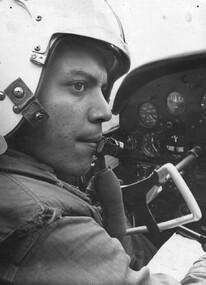
... A black and white photograph of 2Lt Tom 'Rockets' Guivarra, a fixed wing pilot with 161 (Indep) Recce Flight at the controls of his Cessna fixed wing aircraft, as he carries out yet another mission over the jungle of Phuoc Tuy Province searching for signs of NVA/VietCong operations....Photograph 2lt Tom "Rockets" Guivarra 161 Recon Flt Cessna Phuoc Tuy Province NVA/VC Gibbons Collection Catalogue 161 (Indep) Recce Flt Fixed Wing Pilot Jungle NVA/VietCong Denis Gibbons A black and white photograph of 2Lt Tom 'Rockets' Guivarra, a fixed wing pilot with 161 (Indep) Recce Flight at the controls of his Cessna fixed wing aircraft, as he carries out yet another mission over the jungle of Phuoc Tuy Province searching for signs of NVA/VietCong operations. ...Denis Gibbons (1937 – 2011) Trained with the Australian Army, before travelling to Vietnam in January 1966, Denis stayed with the 1st Australian Task Force in Nui Dat working as a photographer. For almost five years Gibbons toured with nine Australian infantry battalions, posting compelling war images from within many combat zones before being flown out in late November 1970 after sustaining injuries. The images held within the National Vietnam Veterans Museum make up the Gibbons Collection.A black and white photograph of 2Lt Tom 'Rockets' Guivarra, a fixed wing pilot with 161 (Indep) Recce Flight at the controls of his Cessna fixed wing aircraft, as he carries out yet another mission over the jungle of Phuoc Tuy Province searching for signs of NVA/VietCong operations.photograph, 2lt tom "rockets" guivarra, 161 recon flt, cessna, phuoc tuy province, nva/vc, gibbons collection catalogue, 161 (indep) recce flt, fixed wing pilot, jungle, nva/vietcong, denis gibbons -
 National Vietnam Veterans Museum (NVVM)
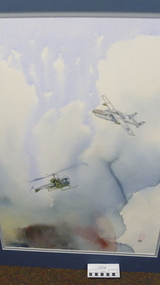
Painting, Jade & Possum Phuoc Tuy 1969, 2001
... flight, the camaraderie of the Services and ugliness of war. Cessna 0-2A Painting Phuoc Tuy David Robson Signed by Artist David Robson 2001. Original watercolour of USAF Cessna 0-2A supporting A/An Army Bell Helicopter in 1969 in Phuoc Tuy Province. Call sings Jade and Possum respectively. The scene portrayed in the watercolour is of a USAF Cessna 0-2A aircraft supporting an Australian Army Bell 47 helicopter in 1969. the team operated in Phuoc Tuy Province in support of the 1st australian Task Force. the 0-2A was a Forward Air Control aircraft flown by both USAF and RAAF pilips in this role. ...David Robson has had a lifelong association with aircraft. He started flying at the age of 16 and served for 21 years in the RAAF as a fighter pilot, test pilot and forward air controller (including a tour in Vietnam in the 0-2A). His hobby is painting, and he naturally turns to his own experiences and visual images to convey the wonders and beauty of flight, the camaraderie of the Services and ugliness of war.Original watercolour of USAF Cessna 0-2A supporting A/An Army Bell Helicopter in 1969 in Phuoc Tuy Province. Call sings Jade and Possum respectively. The scene portrayed in the watercolour is of a USAF Cessna 0-2A aircraft supporting an Australian Army Bell 47 helicopter in 1969. the team operated in Phuoc Tuy Province in support of the 1st australian Task Force. the 0-2A was a Forward Air Control aircraft flown by both USAF and RAAF pilips in this role. Jade 07 was the callsign reserved for a RAAF fighter pilot. As well as directing airstrikes in the Jad FAC gave top cover and navigational assistance to the Possum helicopter and , in return, the Possum provided very accurate BDA (Bomb Damage Assesment) following the airstrike.Signed by Artist David Robson 2001. cessna 0-2a, painting, phuoc tuy, david robson -
 National Vietnam Veterans Museum (NVVM)
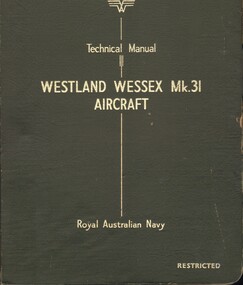
Manual, Royal Australian Navy, Technical Manual: Westland Wessex Mk.31 Aircraft: Repair and Overhaul Information Flight Control System MK.3. Wessex MK.31A and MK.31B Aircraft
... Technical Manual: Westland Wessex Mk.31 Aircraft: Repair and Overhaul Information Flight Control System MK.3. Wessex MK.31A and MK.31B Aircraft...Royal Australian Navy - technical manuals Westland Wessex MK.3 Aircraft A dark green covered mannual with gold writing on the front cover, The word RESTRICTED is in the bottom right hand corner Technical Manual: Westland Wessex Mk.31 Aircraft: Repair and Overhaul Information Flight Control System MK.3. Wessex MK.31A and MK.31B Aircraft Manual Manual Royal Australian Navy ...A dark green covered mannual with gold writing on the front cover, The word RESTRICTED is in the bottom right hand cornerroyal australian navy - technical manuals, westland wessex mk.3 aircraft -
 National Vietnam Veterans Museum (NVVM)
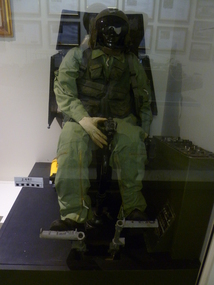
Uniform - Uniform, RAN, Huey Pilot
... Royal Australian Navy Royal Australian Navy helicopters Royal Australian Navy Helicopter Fight Vietnam (RANHFV) Model Huey Helicopter Huey Pilot RAN Helicopter Flight Vietnam Lieutenant James C 'Jim' Buchanan, DFC A model of a huey pilot who is in green uniform and sitting in a cabin that reproduce the controlling area of a helicopter Huey Pilot Uniform Uniform, RAN ...A model of a huey pilot who is in green uniform and sitting in a cabin that reproduce the controlling area of a helicopterHuey Pilot RAN Helicopter Flight Vietnam Lieutenant James C 'Jim' Buchanan, DFCroyal australian navy, royal australian navy helicopters, royal australian navy helicopter fight vietnam (ranhfv), model, huey helicopter -
Moorabbin Air Museum
Document (item) - CA-15 Emergency procedures during flight Survey of commercial pilots metal fatigue Die penetrants HPR3 Handley Page performance and design details Boeing A300 B767 Turkish airline DC10 crash 3 march 1974 Avro Anson Nomad N24A high speed flight WW1 Australian pilots Australian aircraft registration Aermacchi MB-326H Jim Bede CAC Wallaby ESAMS remote piloted helicopter types of British aircraft up to 1918 SR71 U2 Ken Wallis Little Nelly Jean Batten Bob Miles Gypsy Moth Molyneux helicopter CA 25 FLUT-R-Bug Chipmunk Chris Neale Perfectus Ellis Walker New Comet Beagle Landing areas in Australia Fishermans Bend airport Southern Cross Southern Cross Junior Akro Laser Short Scion Pierpont Langley Jeep plane Homebuilt plane criteria R33 R101 R100 Graf Zeppelin Corrosion DEF Aust 143 Weight control of aircraft DCA No.17 Airtruck F14 B-1 F-4 F-15 A-6 F-16 F/A-18 CH-53E AH-64 A-10 F-5 Space Shuttle Winjeel DC-3 Her Majesty the Queen ME 410 Nestler Scout Bellmodel 214 Loire 11 Schweizer model 300 Antonov An-8 camp Nanchang cj-6 Nieuport de Lage ni-D.122 Junker K 39 ICA Brasov IAR-823 Les Mureaux 120 F&W C-3603 Spitfire Lockheed C-36 Pilatus PC-6 Heinkel He 115 Canadair CL-215 Curtiss JN-4 Jenny Antonov An-2 colt Boeing KC-135 Stuka Liberator B-52 Morane Saulnier Bf-109 Dewoitine Yak-3 F-5 KFIR F-100 B-1B B-25 B-17 Fokker D VII Mustang F-16 Aeritalia Aermacchi Fishbed Mikoyan Hawker Hunter PZL P.11 Yakovlev Yak-11 Dassault Alpha jet Westland Lynx Magni PM-3-4 Letov S 50 Partenavia P.64 Piaggio P.149D Breda Ba 64 Aerotec A-122 Farman F.40 McCulloch H-30 Junkers K 53 Cessna U-3 Bf 161, CAC Keith Meggs collection
... CA-15 Emergency procedures during flight Survey of commercial pilots metal fatigue Die penetrants HPR3 Handley Page performance and design details Boeing A300 B767 Turkish airline DC10 crash 3 march 1974 Avro Anson Nomad N24A high speed flight WW1 Australian pilots Australian aircraft registration Aermacchi MB-326H Jim Bede CAC Wallaby ESAMS remote piloted helicopter types of British aircraft up to 1918 SR71 U2 Ken Wallis Little Nelly Jean Batten Bob Miles Gypsy Moth Molyneux helicopter CA 25 FLUT-R-Bug Chipmunk Chris Neale Perfectus Ellis Walker New Comet Beagle Landing areas in Australia Fishermans Bend airport Southern Cross Southern Cross Junior Akro Laser Short Scion Pierpont Langley Jeep plane Homebuilt plane criteria R33 R101 R100 Graf Zeppelin Corrosion DEF Aust 143 Weight control of aircraft DCA No.17 Airtruck F14 B-1 F-4 F-15 A-6 F-16 F/A-18 CH-53E AH-64 A-10 F-5 Space Shuttle Winjeel DC-3 Her Majesty the Queen ME 410 Nestler Scout Bellmodel 214 Loire 11 Schweizer model 300 Antonov An-8 camp Nanchang cj-6 Nieuport de Lage ni-D.122 Junker K 39 ICA Brasov IAR-823 Les Mureaux 120 F&W C-3603 Spitfire Lockheed C-36 Pilatus PC-6 Heinkel He 115 Canadair CL-215 Curtiss JN-4 Jenny Antonov An-2 colt Boeing KC-135 Stuka Liberator B-52 Morane Saulnier Bf-109 Dewoitine Yak-3 F-5 KFIR F-100 B-1B B-25 B-17 Fokker D VII Mustang F-16 Aeritalia Aermacchi Fishbed Mikoyan Hawker Hunter PZL P.11 Yakovlev Yak-11 Dassault Alpha jet Westland Lynx Magni PM-3-4 Letov S 50 Partenavia P.64 Piaggio P.149D Breda Ba 64 Aerotec A-122 Farman F.40 McCulloch H-30 Junkers K 53 Cessna U-3 Bf 161...CAC Keith Meggs collection Document CA-15 Emergency procedures during flight Survey of commercial pilots metal fatigue Die penetrants HPR3 Handley Page performance and design details Boeing A300 B767 Turkish airline DC10 crash 3 march 1974 Avro Anson Nomad N24A high speed flight WW1 Australian pilots Australian aircraft registration Aermacchi MB-326H Jim Bede CAC Wallaby ESAMS remote piloted helicopter types of British aircraft up to 1918 SR71 U2 Ken Wallis Little Nelly Jean Batten Bob Miles Gypsy Moth Molyneux helicopter CA 25 FLUT-R-Bug Chipmunk Chris Neale Perfectus Ellis Walker New Comet Beagle Landing areas in Australia Fishermans Bend airport Southern Cross Southern Cross Junior Akro Laser Short Scion Pierpont Langley Jeep plane Homebuilt plane criteria R33 R101 R100 Graf Zeppelin Corrosion DEF Aust 143 Weight control of aircraft DCA No.17 Airtruck F14 B-1 F-4 F-15 A-6 F-16 F/A-18 CH-53E AH-64 A-10 F-5 Space Shuttle Winjeel DC-3 Her Majesty the Queen ME 410 Nestler Scout Bellmodel 214 Loire 11 Schweizer model 300 Antonov An-8 camp Nanchang cj-6 Nieuport de Lage ni-D.122 Junker K 39 ICA Brasov IAR-823 Les Mureaux 120 F&W C-3603 Spitfire Lockheed C-36 Pilatus PC-6 Heinkel He 115 Canadair CL-215 Curtiss JN-4 Jenny Antonov An-2 colt Boeing KC-135 Stuka Liberator B-52 Morane Saulnier Bf-109 Dewoitine Yak-3 F-5 KFIR F-100 B-1B B-25 B-17 Fokker D VII Mustang F-16 Aeritalia Aermacchi Fishbed Mikoyan Hawker Hunter PZL P.11 Yakovlev Yak-11 Dassault Alpha jet Westland Lynx Magni PM-3-4 Letov S 50 Partenavia P.64 Piaggio P.149D Breda Ba 64 Aerotec A-122 Farman F.40 McCulloch H-30 Junkers K 53 Cessna U-3 Bf 161 ... -
Moorabbin Air Museum
Document (item) - GAF - Jindivik Flight Control Console Systems
... GAF - Jindivik Flight Control Console Systems...GAF - Jindivik Flight Control Console Systems...GAF - Jindivik Flight Control Console Systems Document GAF - Jindivik Flight Control Console Systems ...
