
Showing 56 items matching "convict ships"
-
 Mission to Seafarers Victoria
Book, Charles Bateson, The Convict Ships, 1959
... The Convict Ships...keith oliver donation The Convict Ships Book Charles Bateson ...non-fictionkeith oliver, donation -
 Mission to Seafarers Victoria
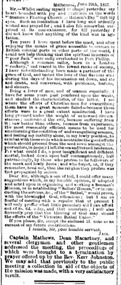
Article - Newspaper clipping, Argus newspaper, Seamen's floating church in Hobson's Bay, 2 July 1857
... ship emily...floating church...reverend kerr johnston, 1812-1887...hobson's bay...sandridge...captain ferguson...Captain Charles Ferguson (1813-1868)...convict...The ship Emily may have been a convict ship sailing from England to the Van Diemen's land in 1842 and 1844. ...The ship Emily may have been a convict ship sailing from England to the Van Diemen's land in 1842 and 1844. ...After an attempt of building a Seamen's Hospital in Williamstown, the ship Emily was transformed in a floating chapel to welcome seamen for service. Captain Charles Ferguson (1813-1868) was one of the members of the committee who founded the floating church. The ship Emily may have been a convict ship sailing from England to the Van Diemen's land in 1842 and 1844. Before 1856, it was used as a "water police hulk" then transformed in an accommodation for Reverend Kerr Johnson and his large family and fitted to receive 200 attendees in the chapel.The article is significant as it describes the ship and its location: "The hulk is moored midway between Sandridge and Williamstown, and is distinguished by a blue flag flying at the mainmast with "Bethel" inscribed on it; and in one corner of the flag is the star of Bethlehem, in another a dove with an olive branch."1 column article in the Argusship emily, floating church, reverend kerr johnston, 1812-1887, hobson's bay, sandridge, captain ferguson, captain charles ferguson (1813-1868), convict ships -
 Flagstaff Hill Maritime Museum and Village
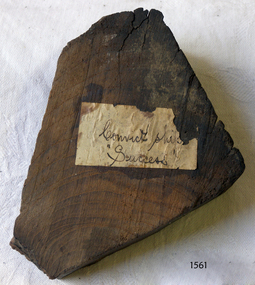
Wood Sample, 1840
... This shipwreck artefact is a section of wood from the vessel “Success, a former immigrant ship, and later a convict hulk at Melbourne. The sailing ship “Success” was a teakwood vessel built in Natmoo (Natmaw), Tenasserim, Burma (now Myanmar) in 1840 for Cockerell & Co., Calcutta. ...label marked in script handwriting “Convict ship / “Success””...Calcutta label marked in script handwriting “Convict ship / “Success”” Section of wood from ship “Success”. ...This shipwreck artefact is a section of wood from the vessel “Success, a former immigrant ship, and later a convict hulk at Melbourne. The sailing ship “Success” was a teakwood vessel built in Natmoo (Natmaw), Tenasserim, Burma (now Myanmar) in 1840 for Cockerell & Co., Calcutta. Over its lifetime of 106 years, it was used to trade in the Indian subcontinent, to transport free emigrants to Australia, as a prison hulk in the Port of Melbourne for both hardened criminals, and later for women and boys, as a storage vessel for ammunition, a reformatory, and as a floating museum sent around the world to tell the tale of the convict era. During the time “Success” was used as a museum, pamphlets were distributed to paying customers advertising erroneously, that the “Success” was the oldest ship in the world. The “Success” sank and was re-floated twice: the first in Sydney in 1885, the second in the USA in 1918, before it was finally burned and sank July 4, 1946 in Lake Erie, near Sandusky, Ohio in 1946. Although the “Success” was home to prisoners while berthed in the Port of Melbourne, it was not used as convict transport. There has been speculation that Ned Kelly’s infamous armour was displayed on the “Success”, but this cannot be verified. Another link to Ned Kelly is Henry Johnson, an Irish prisoner on the Success, who was implicated in the murder of the ship’s warder, and later Johnson was supposedly a bushranger with Ned Kelly. It is also rumoured that Ned Kelly’s father John was a passenger on the Success, but this is also unverified. There are over 16 other ships named “Success”, although one in particular causes some confusion when researching “Success” in Australia. This other ship – the “HMS Success” was a 28 gun frigate built in1823, which was broken up in 1849. It also sailed to Australia. Statement of Significance: This piece of wood from the “Success” is connected to the ship Success, built in Burma in 1840. The “Success” is connected to the history of Australia because she was used as a merchant ship to transport immigrants to Australia, as a prison ship in Melbourne, a storage vessel, and as a floating “convict” museum, which travelled the world. Section of wood from ship “Success”. Wood appears to have been partially burnt, saw marks faintly visible on wood, remnant of a label with handwriting in black inklabel marked in script handwriting “Convict ship / “Success””flagstaff hill, warrnambool, shipwrecked-coast, flagstaff-hill, flagstaff-hill-maritime-museum, maritime-museum, shipwreck-coast, flagstaff-hill-maritime-village, sailing vessel success, wood sample of sailing ship success, cockerell & co. calcutta -
 Greensborough Historical Society
Book, Fourth Fleet families of Australia by C J Smee, 1992_
... ...convict ships...Lists of the families of those convicts arriving in Australia in 1792. australian convicts australia history convict ships pitt kitty royal admiral Yarra Plenty Regional Library Hard cover book, black cover with gold writing. ...Lists of the families of those convicts arriving in Australia in 1792.Hard cover book, black cover with gold writing. Pages not numbered. Yarra Plenty Regional Libraryaustralian convicts, australia history, convict ships, pitt, kitty, royal admiral -
 Mission to Seafarers Victoria
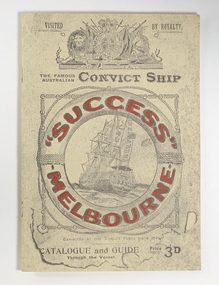
Book - Catalogue and Guide, Facsimile, Pryor Publications, The Famous Australian Convict Ship: "Success" Melbourne
... The Famous Australian Convict Ship: "Success" Melbourne...convict ships...The Emily, the Water Police hulk which was transformed in floating chapel in 1857, may have been a convict ship and looked similar. convict ships success The Famous Australian Convict Ship: "Success" Melbourne Book Catalogue and Guide, Facsimile Pryor Publications ...non-fictionconvict ships, success -
 Queenscliffe Maritime Museum
Leisure object - Boat Model, Barque David Clarke, John Evans, 2002
... ...Convict ships...Migrant ships Convict ships Port Phillip boat models Scale model of the barque David Clarke Leisure object Boat Model, Barque David Clarke John Evans ...The barque David Clarke was launched in 1816 and may have been broken up at Batavia in 1854. She sailed one of the last voyages under charter to the British East India Company (EIC). In 1842 she transported more than 300 convicts to Hobart. She was last listed in Lloyd's Register in 1854.In 1839 she carried mainly Scots assisted migrants to Australia, and was the first immigrant ship to sail from the Great Britain directly to Port Phillip.Scale model of the barque David Clarkemigrant ships, convict ships, port phillip, boat models -
 Narre Warren and District Family History Group
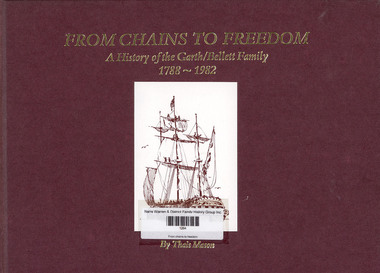
Book, Thais Mason, From chains to freedom. A History of the Garth/Bellett Family 1788-1982, 1982
... ...Convict ships Lady Penrhyn and Friendship...Jacob Bellett Susannah Garth Convict ships Lady Penrhyn and Friendship The History of the Garth/Bellett Family 1788 - 1982 From chains to freedom. ...The History of the Garth/Bellett Family 1788 - 1982non-fictionThe History of the Garth/Bellett Family 1788 - 1982jacob bellett, susannah garth, convict ships lady penrhyn and friendship -
Port Melbourne Historical & Preservation Society
Accessory - Walking Stick
... Carved Walking Stick roughly carved but polished smooth, verbally claimed by donor to have been carved on a local convict ship....It was attempted unsuccessfully to contact him for better information. crimes and misdemeanours les o'shannessy john murray Wendy Morris advised by Ted McCarthy; had noted on the back of the note that came with it, "putting you on the John Murray" was used as a threat to kids when he was a boy Carved Walking Stick roughly carved but polished smooth, verbally claimed by donor to have been carved on a local convict ship. Accessory Walking Stick ...Donated to the Society by Mr O'Shannessy, (wharfie). His description is in supplementary file but gives only the above information. It was attempted unsuccessfully to contact him for better information.Carved Walking Stick roughly carved but polished smooth, verbally claimed by donor to have been carved on a local convict ship.Wendy Morris advised by Ted McCarthy; had noted on the back of the note that came with it, "putting you on the John Murray" was used as a threat to kids when he was a boycrimes and misdemeanours, les o'shannessy, john murray -
Glenelg Shire Council Cultural Collection
Souvenir - Tea Towel, Bicentennial Portland Tea Towel, c. 1988
... It marked 200 years since the arrival of the First Fleet of British convict ships at Sydney in 1788....It marked 200 years since the arrival of the First Fleet of British convict ships at Sydney in 1788. bicentennial tall ships 1988 Tea towel, white linen/cotton. ...The bicentenary of Australia was celebrated in 1988. It marked 200 years since the arrival of the First Fleet of British convict ships at Sydney in 1788.Tea towel, white linen/cotton. Souvenir of Australian. Visit by Tall Ships. Brown 'rope' circle surrounding black and white tall ship. 'Australia' in yellow above circle, 'visit by the tall ships' beneath. 'PORTLAND VICTORIA' in blue, beneath this and 'Feb-March '88" beneath that. Top left corner ships wheel, top right, bell, bottom left, compass, right anchor - all surrounded by thin brown 'rope'.bicentennial, tall ships, 1988 -
 Lara RSL Sub Branch
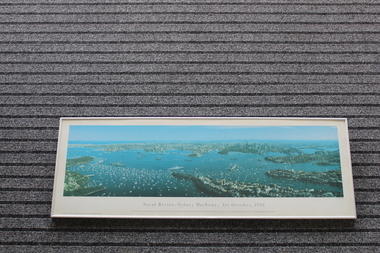
Framed Print of Naval Review,Sydney Harbour, 1st October,1988, Naval Review,Sydney Harbour, 1st October,1988, 12/01/1990
... It marked 200 years since the arrival of the First Fleet of British convict ships at Sydney in 1788. This aerial photo shows naval and pleasure craft in Sydney Harbour for the bicentennial celebrations....It marked 200 years since the arrival of the First Fleet of British convict ships at Sydney in 1788. This aerial photo shows naval and pleasure craft in Sydney Harbour for the bicentennial celebrations. ...The bicentenary of Australia was celebrated in 1988. It marked 200 years since the arrival of the First Fleet of British convict ships at Sydney in 1788. This aerial photo shows naval and pleasure craft in Sydney Harbour for the bicentennial celebrations.The bicentennial year marked Captain Arthur Phillip's arrival with the 11 ships of the First Fleet in Sydney Harbour in 1788, and the founding of the city of Sydney and the colony of New South Wales. 1988 is considered the official bicentenary year of the founding of Australia. Rectangular shaped glass covered picture frame showing photo of Naval Review, Sydney Harbour, 1st October,1988Naval Review, Sydney Harbour, 1st October,1988 This 140 degree panoramic photograph was taken from a helicopter by Phil Gray. It shows the visiting warships in the harbour including the USS New Jersey, FNS Colbert and HMS Ark Royal in the foreground.This print is the fourth in the Sydney Harbour Panorama series by Phil Gray who uses Kodak film.Printed in Australia.prints, naval photos, hms ships, sydney harbour, lara r.s.l. -
 Orbost & District Historical Society
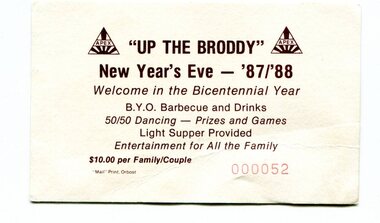
ticket, 1987
... It marked 200 years since the arrival of the First Fleet of British convict ships at Sydney in 1788. Many events were organised to celebrate the occasion....It marked 200 years since the arrival of the First Fleet of British convict ships at Sydney in 1788. Many events were organised to celebrate the occasion. ...This ticket was for an entertainment at Brodribb for the celebration of the incoming bi-centennial year, 1988. The bicentenary of Australia was celebrated in 1988. It marked 200 years since the arrival of the First Fleet of British convict ships at Sydney in 1788. Many events were organised to celebrate the occasion.The Apex Club of Orbost was a volunteer service club which contributed to the Orbost community. A declining population has led to the demise of many social groups in the area. The Apex Club, like other groups in Orbost have organised social events for the local community for many years.A rectangular shaped cardboard ticket coloured white/cream. On the front in brown print is " APEX 'Up the Broddy' new Year's Eve - '87/88 WElcome in the Bi-Centennial Year BYO barbecue and drinks. 50/50 dancing - prizes and games. Light supper provided. Entertainment for all the family. $10 per family/couple". In red is 000052.celebration bicentennial-celebration-orbost -
 Orbost & District Historical Society
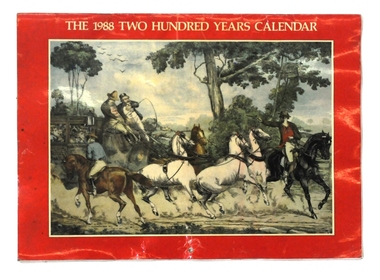
calendar, 1988 200 YEAR CALENDAR, 1988
... It marked 200 years since the arrival of the First Fleet of British convict ships at Sydney in 1788. The event triggered debate on Australian national identity, Aboriginal rights, historical interpretation and multiculturalism. ...It marked 200 years since the arrival of the First Fleet of British convict ships at Sydney in 1788. The event triggered debate on Australian national identity, Aboriginal rights, historical interpretation and multiculturalism. ...The bicentenary of Australia was celebrated in 1988. It marked 200 years since the arrival of the First Fleet of British convict ships at Sydney in 1788. The event triggered debate on Australian national identity, Aboriginal rights, historical interpretation and multiculturalism. The calendar was one of many types of souvenirs created to celebrate the occasion.The bicentenary of Australia was celebrated in 1988. It marked 200 years since the arrival of the First Fleet of British convict ships at Sydney in 1788. The calendar was one of many types of souvenirs created to celebrate the occasion.1988 200 YEAR CALENDAR. It has a cream and red cover with a large photo of an old painting of a coach and bushranger. Inside are photos of events and paintings.1988 200 YEAR CALENDARcalendar bicentenary 1988 -
 Flagstaff Hill Maritime Museum and Village
Nail, circa 1810
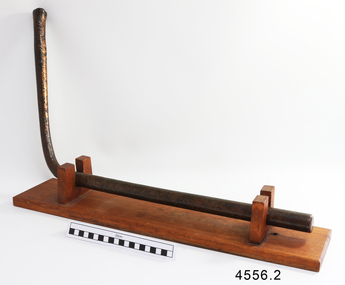
... ship nail...1835 shipwreck...19th century shipwreck...william moxey...d'entrecasteaux channel...convict...The three masted sailing ship “George III” was a convict transport ship built in Deptford, England, in 1810. ...Copper nail (also called a Dumpy bolt or spike) from the convict ship George III, wrecked in 1835. Nail is long, bent in an ‘L’ shape about 3/5ths along, tapering from both ends to the bend. ...The three masted sailing ship “George III” was a convict transport ship built in Deptford, England, in 1810. ...This copper nail, sometimes known as a ‘Dumpy Bolt’ or spike, was salvaged from the hull of the wreck of the “George III”. It dates back to at least 1810. It was found by an abalone diver on the south east coast of Tasmania. The nail would have been used to hold the layers of the ship’s keel frame and the planking together. The nail has been passed from the abalone diver to an interested business man on a trip to the south of Hobart, on again to the business man’s close friend who then donated it to Flagstaff Hill Maritime Village. The metal of nails such as this one, after being in the sea for a long time, become affected by the natural reaction of the sea water, causing it to degenerate and thin, and the stress from the force of the sea over the years alters its shape. Iron nails had been used on ships previously, but they quickly corroded in the salt; ships needed regular, costly and time-consuming maintenance to replace the iron nails. Towards the end of the 18th century the British Navy trialled the use of copper nails, finding them to be very successful. Merchant ships began to adopt this process in the early 19th century, although it made ship building very expensive and was more often used for ships such as the “George III” that sailed on long voyages. The three masted sailing ship “George III” was a convict transport ship built in Deptford, England, in 1810. On 14th December 1834 she left Woolwich, England, bound for Hobart Town, Van Diemen’s Land (Tasmania), under Captain William Hall Moxey. She was carrying 220 male convicts plus crew, guards and their families, totalling 294 persons (another 2 were during the voyage). Amongst the cargo were military stores including several copper drums of gun powder. On 27th January 1835 the “George III” was near the Equator, about half way into her journey. A fire broke out and the gun powder was in danger of explosion, threatening the whole ship. Two convicts braved the heat and smoke, entered the store and seized the gun powder drums, suffering burns for their efforts but saving a probable disaster. The fire destroyed some of the provisions and food was scarce. Many became ill with scurvy and some died during the journey. Nearing the end of their journey on 10th April 1835 the “George III” was headed through the D'Entrecasteaux Channel, south east Tasmania, between the mainland and Bruny Island. She was sailing in the moonlit night to hasten her arrival in port due to the great number of sick on board. She struck uncharted rocks, known only to the local whalers, between Actaeon Reef and Southport Lagoon and within hours began to break up. The ship’s boats were used to first rescue the women and children. Firearms were used to help quell the panic of the convicts below decks and some were killed by the shots. Many convicts, including the sick, were drowned. In all, 133 lives were lost including 5 of the crew, guards and their families. It was the third worst shipping disaster in Tasmanian waters. A monument in honour of the prisoners who perished in the “George III” has been erected, noting the date of the wreck as “Friday 10th April 1835.” (NOTE: there are a few differences between sources regarding dates of the shipwreck, some saying March and others April 1835. There are also differences in the figures of those on board and the number of lives lost.) The copper nail is significant as an example of sailing ship construction; fasteners used in the early 19th century on ships carrying convicts to Australia. The nail is also significant for its association with the ship “George III”. The “George III” is registered on the Australian National Shipwreck Database, ID 7195 as an Historic Shipwreck. She is the third worst shipwreck in Tasmanian waters. She is also associated with Early Australian History and the transportation of convicts to Australia. The incident of the fire on board and the bravery of the convicts in making the gun powder safe is an example of the social character of the people in early Tasmanian colonisation. Copper nail (also called a Dumpy bolt or spike) from the convict ship George III, wrecked in 1835. Nail is long, bent in an ‘L’ shape about 3/5ths along, tapering from both ends to the bend. Both ends are flat and do not taper to a point, nor have a thread. The shorter end has been polished, showing bright copper. There is pitting along the nail and virdigris is evident on the longer, unpolished end. The nail is displayed with the longer section resting on a wooden board between two ‘U’ shaped uprights, the shorter section upright. flagstaff hill, warrnambool, shipwrecked coast, flagstaff hill maritime museum, maritime museum, shipwreck coast, flagstaff hill maritime village, great ocean road, george iii, ship construction, ship nail, 1835 shipwreck, 19th century shipwreck, william moxey, d'entrecasteaux channel, convict transportation, copper nail, dumpy bolt, spike, keel nail -
 City of Moorabbin Historical Society (Operating the Box Cottage Museum)
Badge - Bicentennial Lapel Pin c.1988
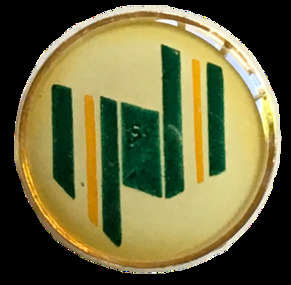
... It marked 200 years since the arrival of the First Fleet of British convict ships at Sydney in 1788. The bicentennial year marked Captain Arthur Phillip’s arrival with the 11 ships of the First Fleet in Sydney Harbour in 1788, and the founding of the city of Sydney and the colony of New South Wales. 1988 is considered the official bicentenary year of the founding of Australia....It marked 200 years since the arrival of the First Fleet of British convict ships at Sydney in 1788. The bicentennial year marked Captain Arthur Phillip’s arrival with the 11 ships of the First Fleet in Sydney Harbour in 1788, and the founding of the city of Sydney and the colony of New South Wales. 1988 is considered the official bicentenary year of the founding of Australia. ...The bicentenary of Australia was celebrated in 1988. It marked 200 years since the arrival of the First Fleet of British convict ships at Sydney in 1788. The bicentennial year marked Captain Arthur Phillip’s arrival with the 11 ships of the First Fleet in Sydney Harbour in 1788, and the founding of the city of Sydney and the colony of New South Wales. 1988 is considered the official bicentenary year of the founding of Australia.A Souvenir of the Australian Bicentennial Celebration in 1988enamel metal pinaustralia bicentenary, captain arthur phillip, city of moorabbin historical society, moorabbin, cheltenham, bentleigh, early settlers, henry dendy special survey 1840. -
 Sunshine and District Historical Society Incorporated
Journal - Ray Barnes Diary - Australia A Detailed Year Book From 1st Fleet Thru 20th Century, Barnes, Raymond Frank
... |Information mainly purchased from "The Moedern Encyclopedia of Aust & N.Z.", "A Pictorial History of Australia", A Pictorial History of Bushrangers", "Parade Magazine" & The Convict Ships".|With more recent activities (namely 1960 onwards) gathered from Newpapers, Television & Magazine reports....|Information mainly purchased from "The Moedern Encyclopedia of Aust & N.Z.", "A Pictorial History of Australia", A Pictorial History of Bushrangers", "Parade Magazine" & The Convict Ships".|With more recent activities (namely 1960 onwards) gathered from Newpapers, Television & Magazine reports. ...These events were compiled by Mr Raymond "Ray" Frank Barnes (b1936) from local magazines, newspapers and his own personal diariesAustralia a detailed year book from 1st Fleet thru 20th century compiled By R. F. Barnes (1936-)|An account of the general history of Australia, with arrivals, departures, births, deaths, bushranging, appointments, achievements, sporting results, both in Austrlia and abroad plus other items of interest.|Information mainly purchased from "The Moedern Encyclopedia of Aust & N.Z.", "A Pictorial History of Australia", A Pictorial History of Bushrangers", "Parade Magazine" & The Convict Ships".|With more recent activities (namely 1960 onwards) gathered from Newpapers, Television & Magazine reports.ray barnes, history -
 Melbourne Legacy
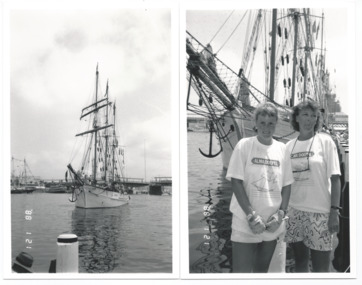
Photograph - Junior legatee outing, Alma Doepel, 1988
... The paper label mentions the tall ships race in 1988 - this was part of the Australian Bicentenary celebrations marking 200 years since the arrival of the First Fleet of British convict ships. The articles from the Answer show timetables and criteria for nomination of junior legatees to be selected on the trips. ...The paper label mentions the tall ships race in 1988 - this was part of the Australian Bicentenary celebrations marking 200 years since the arrival of the First Fleet of British convict ships. The articles from the Answer show timetables and criteria for nomination of junior legatees to be selected on the trips. ...There was a program to send young legatees on trips on the Alma Doepel sailing ship through the 1980s and 90s. The photos are date stamped with '88 1 21' meaning 21 January 1988. The paper label mentions the tall ships race in 1988 - this was part of the Australian Bicentenary celebrations marking 200 years since the arrival of the First Fleet of British convict ships. The articles from the Answer show timetables and criteria for nomination of junior legatees to be selected on the trips. One of these articles mentions the war service of the Alma Doepel - the only ship with served in World War II that was still active in 1995. See other items regarding Alma Doepel. These photos were in a scrapbook of photos spanning 1987 to 1991.A record of a Legacy providing amazing experiences for the junior legatees that they might never have done because of the deaths of their fathers.Black and white photo x 4 of Junior Legatees on the Alma Doepel in 1988.White paper label handwritten in blue pen 'Tall Ships Race. January 1988. Katie Sticpewich, Melbourne and Susan Clarke, Hobart'.junior legatee outing, alma doepel -
Lakes Entrance Historical Society
Book, Baxter Carol J, General Musters of New South Wales Norfolk Island and Van Diemens Land, 1987
... A list of convicts and residents of New South Wales, Norfolk Island, and Van Diemens Land taken from General Musters showing name, whether convict or ree ship of arrival, and other information of value to researchers and family historians....Convicts Settlers Statistics A list of convicts and residents of New South Wales, Norfolk Island, and Van Diemens Land taken from General Musters showing name, whether convict or ree ship of arrival, and other information of value to researchers and family historians. ...A list of convicts and residents of New South Wales, Norfolk Island, and Van Diemens Land taken from General Musters showing name, whether convict or ree ship of arrival, and other information of value to researchers and family historians.convicts, settlers, statistics -
Seaworks Maritime Museum
Model Ship, Friendship
... Friendship was a convict transport ship of 276 tons, which was built in Scarborough England, in 1784, for her owners Hoppers of Scarborough. ...Friendship was a convict transport ship of 276 tons, which was built in Scarborough England, in 1784, for her owners Hoppers of Scarborough. ...Friendship was a convict transport ship of 276 tons, which was built in Scarborough England, in 1784, for her owners Hoppers of Scarborough. Aboard on the voyage to Botany Bay, were the Master, Captain Francis Walton, Assistant Surgeon Thomas Arnell and Marines, Captain James Meredith, Lieutenant Ralph Clark, and Lieutenant William. As the smallest of the transports Friendship probably carried a crew of around 20. Her 76 male and 21 female convicts were loaded at Plymouth. Model of "The Friendship" -
The Beechworth Burke Museum
Audio - Oral History, Jennifer Williams, Fred and Bette Wyatt, 27 April 2000
... Both of their families immigrated from England on convict ships in the 1800s. Fred and Bette both had large families of 9 and 5 siblings respectively, with 2 of Fred's siblings suffering from muscular dystrophy both dying at 20 years old which affected the family. ...Both of their families immigrated from England on convict ships in the 1800s. Fred and Bette both had large families of 9 and 5 siblings respectively, with 2 of Fred's siblings suffering from muscular dystrophy both dying at 20 years old which affected the family. ...Fred was born on the 1st of March 1928 and Bette in 1934, in Beechworth. Both of their families immigrated from England on convict ships in the 1800s. Fred and Bette both had large families of 9 and 5 siblings respectively, with 2 of Fred's siblings suffering from muscular dystrophy both dying at 20 years old which affected the family. Bette originally worked in multiple cafes and kitchens in Beechworth before working in "Ennals Store" which was a grocery store, for over 30 years. Fred worked as a milkman during the war before becoming an engineer at the tannery and the brewery in Beechworth. He rebuilt the factory at the brewery during the 1970s and worked there until he retired. This oral history recording was part of a project conducted by Jennifer Williams in the year 2000 to capture the everyday life and struggles in Beechworth during the twentieth century. This project involved recording seventy oral histories on cassette tapes of local Beechworth residents which were then published in a book titled: Listen to what they say: voices of twentieth century Beechworth. These cassette tapes were digitised in July 2021 with funds made available by the Friends of the Burke.Fred and Bette Wyatt's account of their lives in Beechworth and the local area during the 20th century is historically and socially significant to the cultural heritage of the region. They both mention important historical events and hardships in the region's history that had a lasting local, regional and national impact, including Australia during wartime, economic struggles, and the development of Beechworth town. This oral history account is socially and historically significant as it is a part of a broader collection of interviews conducted by Jennifer Williams which were published in the book 'Listen to what they say: voices of twentieth-century Beechworth.' While the township of Beechworth is known for its history as a gold rush town, these accounts provide a unique insight into the day-to-day life of the town's residents during the 20th century, many of which will have now been lost if they had not been preserved.This is a digital copy of a recording that was originally captured on a cassette tape. The cassette tape is black with a horizontal white strip and is currently stored in a clear flat plastic rectangular container. It holds up 40 minutes of recordings on each side.Fred and Bette Wyattbeechworth, beechworth tannery, beechworth brewery, fred and bette wyatt, wyatt, wyatt beechworth, ennals store, ennals beechworth, listen to what they say, burke museum -
 Lara RSL Sub Branch
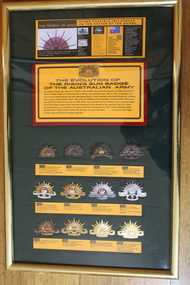
The Evolution of the Rising Sun Badge of the Australian Army, Captain D'arcy.2004, 2004
... The representation below was reputedly painted for Thomas Silk, the son of the captain of the Prince of Orange, a convict ship that visited Sydney in 1821. The symbol struck a chord with the pre-federation population and many examples still exist on colonial architecture.[4] ...The representation below was reputedly painted for Thomas Silk, the son of the captain of the Prince of Orange, a convict ship that visited Sydney in 1821. The symbol struck a chord with the pre-federation population and many examples still exist on colonial architecture.[4] Proudly worn by soldiers of the 1st and 2nd Australian Imperial Force in both World Wars, the 'Rising Sun' badge has become an integral part of the digger tradition. ...The origins of the rising sun badge are disputed. Rising sun designs had appeared on early Australian colonial coins and military insignia decades before the federation of the Australian colonies in 1901, and may have represented the image of Australia as 'a young nation' and a 'new Britannia'.[2] As early as the 1820s, the symbol of a 'rising sun' was used by various progressive organisations, loosely characterised under the banner "Advance Australia". The rising sun crest used in the New South Wales colonial and State crests was taken from the crest used on the first Advance Australia Arms, circa 1821, and consistently since then.[3] The oldest known example is the 'Advance Australia' coat of arms. The 'Advance Australia Arms' (named because of the motto inscription) became widely used in New South Wales and the neighbouring colonies by private corporations and individuals. Although they never had any official status, they formed the basis for several official coats of arms, including the New South Wales coat of arms. The representation below was reputedly painted for Thomas Silk, the son of the captain of the Prince of Orange, a convict ship that visited Sydney in 1821. The symbol struck a chord with the pre-federation population and many examples still exist on colonial architecture.[4] Proudly worn by soldiers of the 1st and 2nd Australian Imperial Force in both World Wars, the 'Rising Sun' badge has become an integral part of the digger tradition. The distinctive shape of the badge, worn on the upturned side of a slouch hat, is commonly identified with the spirit of Anzac.Glass covered Rectangular Picture Frame showing the Evolution of the Rising Sun Badge of the Australian Army.Gives a brief rundown on the Evolution of Rising Sun Badge with 12 examples and explanatory notes -
 Wodonga & District Historical Society Inc
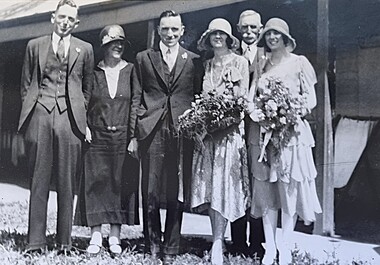
Clothing - Wedding Dress of Catherine Waite, 1929
... He arrived in Sydney on 7th May 1804 from Sevenoaks, Kent, England on the convict ship "Coromandel" having been convicted of stealing two sheep. ...He arrived in Sydney on 7th May 1804 from Sevenoaks, Kent, England on the convict ship "Coromandel" having been convicted of stealing two sheep. ...Catherine Waite married Hugh Hyndman in Albury in 1929 at the age of 23 years. She was a great granddaughter of John Waite and Mary Ann Robinson who settled in “Bungil” and became pioneers of the Upper Murray region of Victoria. John Waite was born in 1771 at Gravesend, Kent, England. He arrived in Sydney on 7th May 1804 from Sevenoaks, Kent, England on the convict ship "Coromandel" having been convicted of stealing two sheep. He was assigned to Dr Charles Throsby, surgeon, land holder and inland explorer. John Waite was granted an absolute pardon in 1818. John married Mary Robinson on 14th April 1812 at Windsor, NSW. Mary was the daughter of a member of the NSW Corps and an emancipated convict. John and Mary went on to have 14 children. The family of John Waite formed strong connections with the Hore family which also became prominent in the Upper Murray, Albury and Wodonga. John Hore (Hoare) Snr. of Wexford County, Ireland, was a volunteer in the English Navy for four years before being sentenced to death for mutiny. On appeal this was commuted to seven years’ transportation to Australia. In Australia several marriages occurred between the two families. After the journey of Hume and Hovell to Victoria, John Waite and the Hore family sought pastoral land further south. John Hore Jnr and his brothers Andrew, William, Thomas and Charles all settled in the Upper Murray. John and Elizabeth's son John Hore Jnr married Elizabeth Waite, a daughter of John and Mary Waite. This forged a family connection that would have an influence on the Upper Murray for generations to come. John Waite formed the Bungil run for his son-in-law John Hore, acquiring land through the Robertson Land Act of 1861 which enabled land owners to use relatives as "dummies" to help acquire land. When the “dummy” defaulted on the rent John Hore and other landowners were able to buy the land at reduced prices at auction. In this way the Hore family and their relatives established a large pastoral empire in the Upper Murray, including Bungil, Wagra and Cumberoona. Catherine Waite was born in Albury, NSW in 1905, great granddaughter of John Waite Snr and Mary Robinson. In 1929 she married Hugh Hyndman who before migrating to Australia from Northern Ireland had worked on the construction of the Titanic at the dockyards in Belfast. This dress is significant because it was worn by a descendant of two important pioneer families of the Upper Murray Region of Victoria.A wedding dress from the late 1920s made from peach coloured silk and lace. The bodice and sleeves feature a lace overlay which is repeated from hip length. It is matched with cloche style hat made from matching lace and decorated with ribbon, flowers and a bow.1920s wedding dress, waite family, hore family -
 Flagstaff Hill Maritime Museum and Village
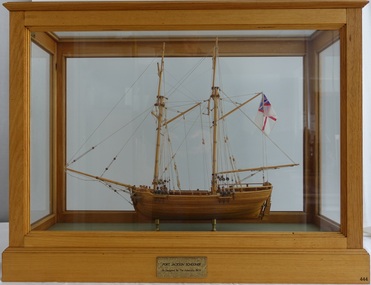
Craft - Ship Model, Port Jackson Schooner
... ships before 1803. In 1797 His Majesty’s Dockyard was opened at Port Jackson for building larger vessels. The Royal Navy’s 1803 design of a ‘Schooner for Port Jackson’ has been recognised on the obverse of Australia’s twenty dollar banknote since 1994. A sketch of the schooner is beside the portrait of Mrs Mary Reibey, who arrived as a convict...ships before 1803. In 1797 His Majesty’s Dockyard was opened at Port Jackson for building larger vessels. The Royal Navy’s 1803 design of a ‘Schooner for Port Jackson’ has been recognised on the obverse of Australia’s twenty dollar banknote since 1994. A sketch of the schooner is beside the portrait of Mrs Mary Reibey, who arrived as a convict ...This ship model is of a Colonial Port Jackson schooner, originally designed by the British Admiralty in 1803 as a response to the request of New South Wales' Governor Arthur Phillip. The drafts for the original plans are in Greenwich, UK, in the National Maritime Museum. The model is a Ledition edition, number 2 of 5, modelled by Bill Leonard. The model is rigged and decked in the manner of David McGregor. The flag on model of Port Jackson schooner is that of the British White Ensign which was used as the flag design of the Royal Australian Navy from 1911 - 1967. In 1785 the First Fleet arrived in the new British colony of Port Jackson (now Sydney Harbour) in New South Wales and Arthur Phillip was appointed as the first Governor. The following year Governor Phillip asked the English Royal Navy to provide drafts and materials for two ships for use in the Port Jackson colony for exploring and surveying rivers. The vessels needed a shallow draught and to be made from local cedar timber. He asked for the frames of the schooners to be provided along with shipwrights to assemble them. Many years later, in 1803, Governor Phillip’s request was fulfilled but he had already resigned from his post. The drafts titled ‘Schooner for Port Jackson’ were despatched by the Royal Navy from England to Australia. The original draft is still in the National Maritime Museum in Greenwich, UK. Meanwhile, the NSW Government had already built various other ships before 1803. In 1797 His Majesty’s Dockyard was opened at Port Jackson for building larger vessels. The Royal Navy’s 1803 design of a ‘Schooner for Port Jackson’ has been recognised on the obverse of Australia’s twenty dollar banknote since 1994. A sketch of the schooner is beside the portrait of Mrs Mary Reibey, who arrived as a convict and rose to become a respected and successful owner of a cargo shipping business. Her fleet included the Mercury, a schooner similar to the 1803 design for the Port Jackson schooner. Although the 1803 plans for a ‘Schooner for Port Jackson’ are commonly believed to be used for the first ship built in Australia, no records have been found of any ships being built according to these plans. However, it can be claimed that the plans were the ‘first Royal Navy plans made for a ship for use at Port Jackson, and to be built at Port Jackson, in Australia’. William (Bill) Leonard passed away on March 1st 1995.This ship model is significant for its representation of an early Australian colonial schooner. The 1803 Royal Navy’s plans for the colonial ‘Schooner for Port Jackson, were for the first ship specifically designed by the Royal Navy to be built and used in Port Jackson, for use in exploration and surveying of Australian ports and rivers. The plans are associated with Australia’s colonial settlement in the late 1700s. This ship model is significant for its association with the emblems of Australia’s history on the twenty dollar banknote. The colonial Port Jackson schooner is considered significant to Australian history, and represented on the 1994 twenty dollar banknote and its new version being rolled out in October 2019.Ship model of a colonial Port Jackson Schooner. Two-masted sailing ship displaying the flag named The British White Ensign. Mode of light coloured stained timberl is mounted on brass legs inside a glass case with timber frame and base. Metal engraved plaque states that the model is as designed by The Admiralty in 1803. Model is a number 2 of 5 in a limited edition, made by Bill Leonard.Engraved on metal plaque "PORT JACKSON SCHOONER / As Designed By The Admiralty. 1803"flagstaff hill, warrnambool, shipwrecked-coast, flagstaff-hill, flagstaff-hill-maritime-museum, maritime-museum, shipwreck-coast, flagstaff-hill-maritime-village, ship model port jackson schooner, sailing ship, limited edition model, model maker bill leonard, david mcgregor design, maritime trade, maritime vessel, colonial port jackson schooner, pacific island trade in early 1800s, sydney cove, governor arthur phillip, governor philip gidley king, a schooner for port jackson, national maritime museum greenwich, australian $20 banknote -
 Learmonth and District Historical Society Inc.
Book, Jean Tillet, Baker Family History, 18/6/2010 (exact)
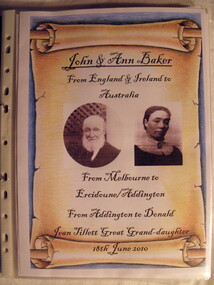
... Comprehensive Baker Family History / John,Ann of 48 pages.John Weaver Baker arrived in Williamstown aboard the "Marion" on 25th January 1848.He was transported from Parkhurst Prison on the Isle of Wight as an "Exile",having been convicted of having in his possesion a silk handkerchief and sentenced to 10 years.On arrival he "left ship at own request",finding his own way to Melbourne and a new life.Proof of birth has at this time not been located,it is possible he may have been an orphan.He met Ann Neligan,an Irish orphan,who along with her sister,Eliza,made the journey from the poor house in Mallow on board ship.They were Married in Melbourne 9th July 1850. ...Comprehensive Baker Family History / John,Ann of 48 pages.John Weaver Baker arrived in Williamstown aboard the "Marion" on 25th January 1848.He was transported from Parkhurst Prison on the Isle of Wight as an "Exile",having been convicted of having in his possesion a silk handkerchief and sentenced to 10 years.On arrival he "left ship at own request",finding his own way to Melbourne and a new life.Proof of birth has at this time not been located,it is possible he may have been an orphan.He met Ann Neligan,an Irish orphan,who along with her sister,Eliza,made the journey from the poor house in Mallow on board ship.They were Married in Melbourne 9th July 1850. ...Comprehensive Baker Family History / John,Ann of 48 pages.John Weaver Baker arrived in Williamstown aboard the "Marion" on 25th January 1848.He was transported from Parkhurst Prison on the Isle of Wight as an "Exile",having been convicted of having in his possesion a silk handkerchief and sentenced to 10 years.On arrival he "left ship at own request",finding his own way to Melbourne and a new life.Proof of birth has at this time not been located,it is possible he may have been an orphan.He met Ann Neligan,an Irish orphan,who along with her sister,Eliza,made the journey from the poor house in Mallow on board ship.They were Married in Melbourne 9th July 1850. They had three daughters Caroline Ann 2nd May 1851,Elizabeth Conchetta 1st April 1853,died 20th August 1853,and Elizabeth born 1854.History of Journey of the Baker family from England and Ireland to Australia, then Melbourne/Ercildoune/Addington and finally to Donald.Family History Book, England / Ireland to Australia. Melbourne to Ercildoune / Addington and Addington to Donald. Author Jean Tillet/ Great Grandaughter.18/06/2010.Baker, John and Ann, Family History.ercildoune, addington, baker family -
 Learmonth and District Historical Society Inc.
Medal - Australia 150th, Medal - Australia's 150th Anniversary, 1938
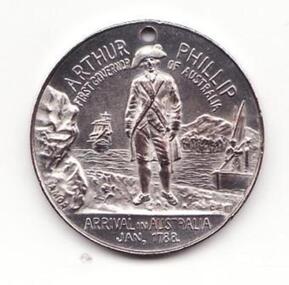
... convicts. Celebrates the 150th of Australia and the first govenor of Australia, Arthur Phillip. 1788 - 1938 australia 150th govenor arthur phillip Obverse - Australia standing with front arms raised, sun behind her head, men representing industry and agriculture kneel at her feet, biplane in sky on right, tall building on left; inscribed with "Australia's 150th Anniversary 1938 and the initials C.E on the lower left. Reverse - Figure of Govenor Arthur Phillip standing on the shore, left rocks with the makers name, Amor, in the background is a ship ...This medal commemorates the 150 years of Australia and the first govenor of Australia, Arthur Phillip, he arrived with the First Fleet along with 729 convicts.Celebrates the 150th of Australia and the first govenor of Australia, Arthur Phillip. 1788 - 1938This medal was struck in 1938 to commemorate the 150th anniversary of British settlement of Australia. It depicts Australia standing with the sun behind her head. At her feet kneel two men, one representing industry (with tools, city buildings and shipping) and the other representing agriculture (with sheep, fruit, silos and an aircraft). It is a round medal which is silver plated.Obverse - Australia standing with front arms raised, sun behind her head, men representing industry and agriculture kneel at her feet, biplane in sky on right, tall building on left; inscribed with "Australia's 150th Anniversary 1938 and the initials C.E on the lower left. Reverse - Figure of Govenor Arthur Phillip standing on the shore, left rocks with the makers name, Amor, in the background is a ship on the left, right hill with trees and a long boat with a sailor, under this the letters C.E.australia 150th, govenor arthur phillip -
City of Moorabbin Historical Society (Operating the Box Cottage Museum)
Newsletter, City of Moorabbin Historical Society Feb 2012, February 2012
... ...convict ship asia...The Newsletter is an important record of the activities of the CMHS. city of moorabbin historical society stanley helen melbourne moorabbin brighton cheltenham ormond bentleigh market gardeners pioneers early settlers the moorabbin roads board 1862 city of glen eira city of kingston moorabbin shire parish of moorabbin brighton east south brighton bent tommy green william convicts convict ship asia eyre edward john mair william CITY of MOORABBIN HISTORICAL SOCIETY / FEBRUARY 2012 NEWSLETTER 6 x A4 paper printed on 1 side Issue 25 of the bi-monthly, City of Moorabbin Historical Society Newsletter produced by Society member and Secretary, Mrs Helen Stanley in February 2012. ...The City of Moorabbin Historical Society was formed c 1960 by a group of Moorabbin area residents who were concerned that the history of the area should be preserved. A good response to a call for items related to the historical area of Moorabbin Shire brought donations of a wide variety of artefacts which are now preserved by the current members of CMHS at Box Cottage Museum . Helen Stanley, Secretary of CMHS, began producing a Newsletter for members in April 2007 to provide current information and well researched items of historical interestHelen Stanley has produced a bi-monthly Newsletter, 2007 - 2013, for the members of the City of Moorabbin Historical Society that contains well researched interesting historical items, notification of upcoming events, current advice from Royal Australian Historical Society , Museums Australia Victoria and activities of Local Historical Societies. The Newsletter is an important record of the activities of the CMHS. 6 x A4 paper printed on 1 side Issue 25 of the bi-monthly, City of Moorabbin Historical Society Newsletter produced by Society member and Secretary, Mrs Helen Stanley in February 2012. Notice of meeting February 26th, subscriptions are due, reminder to all members to encourage visitors to ‘sign in’, offer all children the ‘Treasure Hunt Quiz’ cards, and to complete the Volunteer Hours Record Book. Members are asked to help on the monthly Roster for Open Days. Unfortunately Jim Dale, President, found a disposable lighter and water bottle and at the working bee members found a ‘bong’, so Glen Eira Property Manager, Amanda Mills was notified. Thankfully there was no damage to our property. As May 2012 will be the 150th Anniversary of ‘The Moorabbin Roads Board’, Ms Elizabeth Triarico, Glen Eira CC History & Heritage , has requested a CD of photos, which has been sent, and Ms Suzanne Snooks, Arts & Culture Manager Kingston CC, invited CMHS to assist with a Celebration of this event. Helen has given a précis of The William Green Family History which has been given to CMHS Library by Ms Denise McAvoy , a descendant CITY of MOORABBIN HISTORICAL SOCIETY / FEBRUARY 2012 NEWSLETTER city of moorabbin historical society, stanley helen, melbourne, moorabbin, brighton, cheltenham, ormond, bentleigh, market gardeners, pioneers, early settlers, the moorabbin roads board 1862, city of glen eira, city of kingston, moorabbin shire, parish of moorabbin, brighton east, south brighton, bent tommy, green william, convicts, convict ship asia, eyre edward john, mair william -
 Flagstaff Hill Maritime Museum and Village
Functional object - Copper Sheet, circa 1878
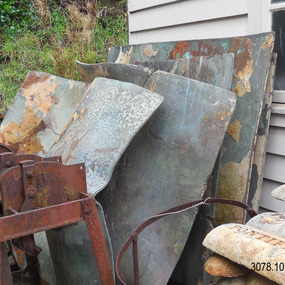
... convicted. The “repossessed loot of the Tassie Boys” was placed into secure storage (Jack Loney, 1978, Wrecks & Reputations). The LOCH ARD manifest of cargo lists “Pig lead 50 tons, 994 pig & 37 rolls” and “Copper 33 plates, 53 bolts”. While the lead ingots have been subsequently described as “ballast”, the copper sheets are unlikely to have been associated with the ship’s...convicted. The “repossessed loot of the Tassie Boys” was placed into secure storage (Jack Loney, 1978, Wrecks & Reputations). The LOCH ARD manifest of cargo lists “Pig lead 50 tons, 994 pig & 37 rolls” and “Copper 33 plates, 53 bolts”. While the lead ingots have been subsequently described as “ballast”, the copper sheets are unlikely to have been associated with the ship’s ...In 1984 the Commonwealth Government made available to Flagstaff Hill a collection of lead ingots and copper sheets recovered from the wreck-site of the LOCH ARD. They were presented to the Warrnambool City Council by the Hon. Tom Uren MHR, Minister for Territories and Local Government: “The Commonwealth recognises that shipwrecks like the LOCH ARD are our national heritage with important educational, recreational and tourist applications” (The Standard, Tuesday 8 May 1984). The LOCH ARD was wrecked in 1878. Unsuccessful salvage operations were then undertaken with the 90 ton paddle steamer NAPIER. In sudden bad weather this vessel too was sunk. The precise position of the LOCH ARD in the exposed and dangerous waters off Mutton Bird Island became lost to memory. The underwater location of the LOCH ARD was rediscovered in 1967 by a Warrnambool skindiver, Stan McPhee. In the two years following his find, the vessel was systematically pillaged by unauthorised salvagers. This led to the State and Federal Governments’ intervention in 1969. A roundup and seizure of recovered lead ingots and copper sheets was conducted by Commonwealth and Victorian Police. Offenders were charged and convicted. The “repossessed loot of the Tassie Boys” was placed into secure storage (Jack Loney, 1978, Wrecks & Reputations). The LOCH ARD manifest of cargo lists “Pig lead 50 tons, 994 pig & 37 rolls” and “Copper 33 plates, 53 bolts”. While the lead ingots have been subsequently described as “ballast”, the copper sheets are unlikely to have been associated with the ship’s normal complement in that way. Similar product lines in the cargo manifest are “Bar and rod iron 102 tons”, “Plate iron 3 tons” and “Zinc 12 tons”. These raw materials were used by colonial artisans such as blacksmiths and metal smelters to fashion, and repair, agricultural implements and industrial machinery. Copper was valued for its non-corrosive properties and its malleability, or ease of working. Both these qualities were useful, for example, in laying underground gas pipes that supplied lighting to residences, businesses and streetscapes in the mid-nineteenth century. As the nineteenth century progressed, the metal was also increasingly valued for its conductivity, with copper wiring linking colonial communities to each other, and the wider world, via the Telegraph system. The average weight of the copper sheets is 216 kilograms, calculated by "volume 0.1936m³ X Cu density 8930kgs/m³".The shipwreck of the Loch Ard is of significance for Victoria and is registered on the Victorian Heritage Register ( S 417). Flagstaff Hill has a varied collection of artefacts from Loch Ard and its collection is significant for being one of the largest accumulation of artefacts from this notable Victorian shipwreck. The collections object is to also give us a snapshot into history so we can interpret the story of this tragic event. The collection is also archaeologically significant as it represents aspects of Victoria's shipping history that allows us to interpret Victoria's social and historical themes of the time. The collections historically significance is that it is associated unfortunately with the worst and best-known shipwreck in Victoria's history. Large heavy sheets or panels of copper metal raised from the wreck of the LOCH ARD. The 10 sheets are of roughly similar dimensions and rectangular shape. They bear signs of prolonged submersion in seawater, with various degrees of limestone accretion, adhered marine growth, and green oxidisation. Three of the sheets are severely buckled, demonstrating the force of underwater explosives used in their salvage. One sheet appears cut or severed in a diagonal line downwards from its top left hand corner. One sheet has a 10cm X 10cm square cut out of its top right hand corner. All sheets are in sturdy, stable condition. No maker’s marks are visible. Kindly on loan from the Commonwealth of Australia.flagstaff hill, warrnambool, shipwrecked coast, flagstaff hill maritime museum, flagstaff hill maritime village, great ocean road, loch line, loch ard, captain gibbs, eva carmichael, tom pearce, glenample station, mutton bird island, loch ard gorge, sailing ship, copper sheet, manutacturing materials, metal imports, muntz -
 Seaworks Maritime Museum
Model Ship, Alexander
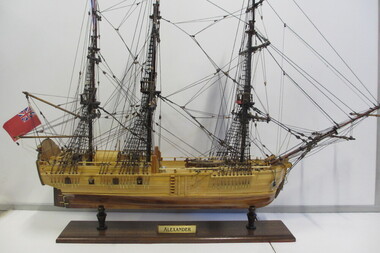
... She carried 195 male convicts and was the largest ship in the fleet. Being built in Hull, England in 1783, little is known of her after her return journey and then disappeared from records in 1808. ...She carried 195 male convicts and was the largest ship in the fleet. Being built in Hull, England in 1783, little is known of her after her return journey and then disappeared from records in 1808. ...Weighing in at 452 tons, 114 ft long and 31ft at the beam, the Alexander was skippered by Master Duncan Sinclair. She carried 195 male convicts and was the largest ship in the fleet. Being built in Hull, England in 1783, little is known of her after her return journey and then disappeared from records in 1808. Large model of the ship "Alexander" -
 Seaworks Maritime Museum
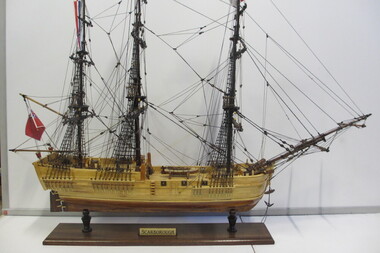
Model ship, Scarborough
... convicts. She was built at Scarborough in 1782. The Scarborough sailed back to England and returned to Port Jackson in the Second fleet. Apart from the 'Sirius' and 'Supply' she was the only other ship from the first fleet to return. ...convicts. She was built at Scarborough in 1782. The Scarborough sailed back to England and returned to Port Jackson in the Second fleet. Apart from the 'Sirius' and 'Supply' she was the only other ship from the first fleet to return. ...Being a large 430 tons, the Scarborough carried 208 male convicts. She was built at Scarborough in 1782. The Scarborough sailed back to England and returned to Port Jackson in the Second fleet. Apart from the 'Sirius' and 'Supply' she was the only other ship from the first fleet to return. She was skippered by Master Kohn Marshall. Large model of the ship "Scarborough"first fleet -
 Seaworks Maritime Museum
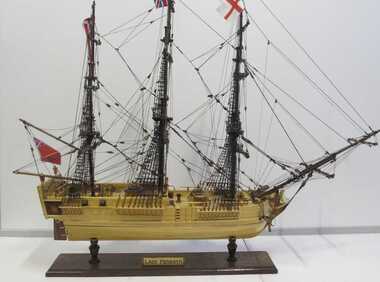
Model ship, The Lady Penrhyn
... convicts. After returning to England, she was put on the London - Jamaica run and was captured in 1811 in the West Indies. first fleet Large model of "The Lady Penrhyn" The Lady Penrhyn Model ship ...This convict transport of 333 tons was skippered by Master William Sever. Built at the Thames in 1786, she carried 101 female convicts. After returning to England, she was put on the London - Jamaica run and was captured in 1811 in the West Indies. Large model of "The Lady Penrhyn" first fleet -
 Seaworks Maritime Museum
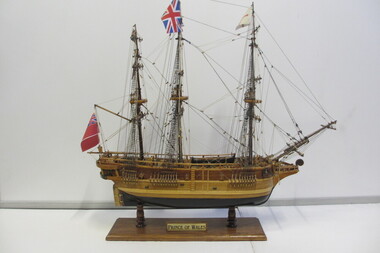
Model Ship, The Prince of Wales
... This ship carried only one male convict and 49 female convicts. ...This ship carried only one male convict and 49 female convicts. ...This ship carried only one male convict and 49 female convicts. She was of 350 tons and skippered by Master John Mason. Built at the Thames in 1786, She operated in England until 1797 when her registration transferred to Fort Royal. Martinique, after which little is known. Model of "The Prince of Wales"
