
Showing 4 items matching "cordial manufacturing in warrnambool district"
-
 Warrnambool and District Historical Society Inc.
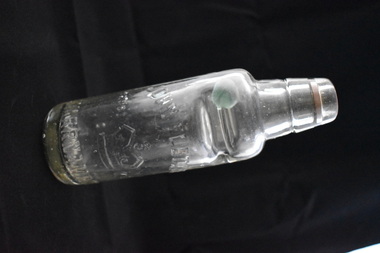
Bottle, Webb Bros Port Fairy, Early 20th century
... cordial manufacturing in warrnambool district...Cordial manufacturing was an important industry in Warrnambool and district for over 100 years cordial manufacturing in warrnambool district ‘Webb Bros. ...This is a marble stopper bottle from the Port Fairy aerated waters factory of the Webb brothers. A marble stopper bottle was filled upside down so that as soon as the filling stopped the stopper was forced down to seal the bottle against the rubber ring. Pressure inside the bottle would keep the marble pressed against the top of the bottle. To open the bottle the marble was pressed down where it would fall into the neck chamber below. The marble would stay inside the chamber when the bottle was tilted up for drinking. The Webb brothers operated the Port Fairy Aerated Water and Cordial Factory in William Street (no 29) in the late 19th and early 20th centuries. This bottle is of interest as an example of a marble stopper bottle from the aerated waters factory of the Webb brothers in Port Fairy. Cordial manufacturing was an important industry in Warrnambool and district for over 100 yearsThis is a marble stopper glass bottle. It has a rounded base with a rounded body tapering to a deeply-indented section which forms a narrow neck chamber. The top is rounded moulded glass with an opening. The green marble is loose inside the neck chamber and the rubber ring has been displaced and is at the bottom of the bottle. There is some discolouration inside the bottle from the original contents.‘Webb Bros. Aerated Waters Port Fairy’ cordial manufacturing in warrnambool district -
 Warrnambool and District Historical Society Inc.
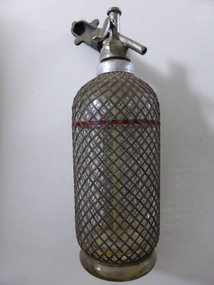
Bottle, Soda Siphon, c. 1920
... manufacturing also in U.S.A. and Europe. This syphon has no known provenance but it could have been used in a hotel or a cordial factory in Warrnambool or district. ...manufacturing also in U.S.A. and Europe. This syphon has no known provenance but it could have been used in a hotel or a cordial factory in Warrnambool or district. ...This soda syphon is a device for dispensing carbonated or soda water. It was also called a Seltzer bottle. The design of soda syphons used in the 20th century was first created in the late 1830s and these bottles were especially popular in the 1920s and 30s. This Sparklets Company syphon was probably made in England but the company was manufacturing also in U.S.A. and Europe. This syphon has no known provenance but it could have been used in a hotel or a cordial factory in Warrnambool or district. This soda syphon is of interest as an example of how soft drinks were dispensed 90 to 100 years ago. It will be useful for display.This is a heavy glass bottle with a heavy base. It has a metal mesh over the bottle with a metal (or material) red band around the bottle three-quarters of the way up from the bottom. The mechanisms for filling and siphoning at the top are made of metal (these include a funnel and two handles). Attached to the top and inside the bottle is a tube for syphoning. Directions for use are printed on the lid. ‘Sparklets’ ‘Admit gas slowly and shake vigorously’ Important. Do not fill the bottle above the red line’. sparklets company, soda syphon bottle, warrnambool -
 Warrnambool and District Historical Society Inc.
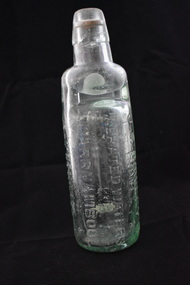
Bottle, Bottle Rowley, Late 19th century
... District town of Hamilton. By the 1880s the Warrnambool factory was occupying half an acre of land, was employing 13 people and manufacturing 20 varieties of drinks. Rowley was active in community affairs, serving four years on the Warrnambool Council and he was on the committees of the Warrnambool Hospital and the Mechanics’ Institute. This bottle is of great interest as it comes from the factory of the prominent 19th century Warrnambool aerated waters manufacturer, John Rowley. This is one of the few bottles we have from the Rowley factory. Cordial ...This marble stopper bottle came from the Warrnambool aerated waters manufacturer, John Rowley. A marble stopper bottle was filled upside down so that as soon as the filling stopped the stopper was forced down to seal the bottle against the rubber ring. Pressure inside the bottle would keep the marble pressed against the top of the bottle. To open the bottle the marble was pressed down where it would fall into the neck chamber below. The marble would stay inside the chamber when the bottle was tilted up for drinking. John Rowley (1837-1893) was born in England and came to Australia in 1856. In 1865 he opened a branch of the Geelong Corio Brewery at the corner of Timor and Banyan Streets, Warrnambool, bottling the beer, not brewing it. In 1870 this business was closed and Rowley developed his soft drinks business which he had established in 1868. In 1872 the business was called the Warrnambool Steam Aerated Works when a steam engine was purchased from Melbourne. By this time the factory was turning out 600 dozen bottles a day. For some time Rowley also had a factory in the Western District town of Hamilton. By the 1880s the Warrnambool factory was occupying half an acre of land, was employing 13 people and manufacturing 20 varieties of drinks. Rowley was active in community affairs, serving four years on the Warrnambool Council and he was on the committees of the Warrnambool Hospital and the Mechanics’ Institute.This bottle is of great interest as it comes from the factory of the prominent 19th century Warrnambool aerated waters manufacturer, John Rowley. This is one of the few bottles we have from the Rowley factory. Cordial manufacturing was an important industry in Warrnambool for over 100 years and John Rowley was a key figure in this industry. This is a marble stopper green-coloured glass bottle. The body is rounded with a round base and it has deep indentations at the top of the body that narrows to form a small chamber. The neck tapers to the top of the bottle which has a moulded glass top and a rubber ring inside the top. A green marble is loose in the neck chamber. Details of the soft drinks manufacturer are impressed into the glass on the side of the bottle. ‘J.S.Rowley’s Aerated Waters Warrnambool & Hamilton’ ‘D. K.’ john searle rowley, warrnambool, cordial manufacturers in warrnambool, history of warrnambool -
 Warrnambool and District Historical Society Inc.
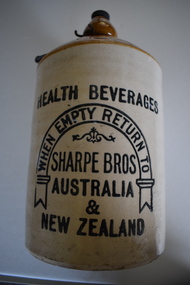
Demijohn (Sharpe Bros), Sharpe Bros, Early 20th century
... Warrnambool and District Historical Society Sharpe Bros jars is that of John H. Sharpe who for many years was the manager of the Sydney Sharpe Bros factories. He put the signature on the jars when he was visiting History House in Warrnambool in the mid 1980s. This demijohn is of considerable importance as it comes from the Sharpe Bros aerated waters factory, a business that was prominent in Warrnambool for over 30 years. Cordial manufacturing ...This item is a Sharpe Bros stone jar, presumably from the Warrnambool factory. The Sharpe Bros soft drinks factories in Australia and New Zealand existed from 1903 to 1972 and at one stage they had 35 factories. They were best known for their home deliveries of ginger beer and other brewed beverages in one gallon stone jars. The Warrnambool Sharpe Bros factory was established in 1919 and existed until 1951. It was situated at the old Rowley cordial factory at the corner of Banyan and Timor Streets. It was established by the founder of the Sharpe Bros business, John Sharpe. The signature on the base of the Warrnambool and District Historical Society Sharpe Bros jars is that of John H. Sharpe who for many years was the manager of the Sydney Sharpe Bros factories. He put the signature on the jars when he was visiting History House in Warrnambool in the mid 1980s. This demijohn is of considerable importance as it comes from the Sharpe Bros aerated waters factory, a business that was prominent in Warrnambool for over 30 years. Cordial manufacturing was an important industry in Warrnambool for over 100 years.This is a cylindrical stone jar with a buff-coloured base, a light brown top and a composite material screw topper. The top above the neck is bulbous-shaped and above this it is dome-shaped. A metal handle is attached to the neck. The maker’s information is on the sides in black printing. Part of this information includes a horseshoe-shaped scroll and a decorative pattern. There is a signature and other writing on the base of the jar in blue ballpoint pen. Health Beverages When empty return to Sharpe Bros Australia & New Zealand Persons damaging, retaining or trading with this jar are liable to be prosecuted John H. Sharpe Jar made prior to 1914 sharpe bros soft drinks factory warrnambool, john h. sharpe, history of warrnambool
